
Nvidia Has a Plan to Put Its Chips in Personal Computers: What It Means for the PC Revolution


What if the next massive leap in personal computing didn't come from Apple or Intel—but from Nvidia, the powerhouse behind the AI revolution? In 2026,...
Nvidia Has a Plan to Put Its Chips in Personal Computers: What It Means for the PC Revolution
What if the next massive leap in personal computing didn't come from Apple or Intel—but from Nvidia, the powerhouse behind the AI revolution? In 2026, Nvidia, already the world’s most valuable company, is making headlines with its audacious plan to embed its high-performance chips directly into personal computers, sparking intense industry buzz and fresh competition in a sector long dominated by Intel and Apple. This move is more than a hardware upgrade; it’s a direct drive to embed generative AI and advanced GPU capabilities into everyday laptops and desktops, promising a new era where on-device AI agents, real-time speech processing, and multimodal creativity become standard features.
Why does this matter right now? In the past year alone, global shipments of AI-enabled PCs are projected to surge by over 70% (Canalys, April 2026), as enterprises and consumers demand more from their devices—faster performance, energy efficiency, and seamless AI integration. Nvidia’s partnership with Intel to build x86 system-on-chips (SoCs) incorporating RTX GPU technology [2], and its parallel development of ARM-based laptop processors [4], signal a clear intent: make AI-first PCs accessible to the mass market. As Axios reports, Nvidia’s new PC-focused SoCs will debut as early as late 2026 [3], positioning the company as a key player in what analysts are calling the "AI PC revolution."
In this article, you’ll discover how Nvidia’s plan could reshape the personal computing landscape, the technical innovations making it possible, and the real-world impact on AI-powered workflows—from creative apps to business automation. You’ll also see how forward-thinking platforms like CallMissed are riding this wave, leveraging GPU-accelerated AI to deliver 24/7 multilingual voice agents and lightning-fast language models to businesses across the globe.
Get ready to decode how Nvidia’s strategy could set a new standard for smart, AI-native PCs—and what it means for users, developers, and enterprises worldwide.
Introduction: The Dawn of Nvidia-Powered Personal Computers
This is a pivotal moment in computing history. For years, Nvidia has reigned supreme in the data center, its GPUs powering the vast majority of AI training and inference workloads. But the world's most valuable semiconductor company is now setting its sights on a different frontier: your laptop and desktop. According to reports from late May 2026, Nvidia is aggressively advancing plans to bring its AI processing prowess directly to personal computers — via dedicated system-on-chips (SoCs) and a landmark partnership with Intel. This isn't just an incremental chip update; it's a strategic pivot that could redefine how we work, create, and interact with our personal machines.
The Blueprint: Nvidia’s PC Chip Strategy
The details emerging from multiple sources paint a two-pronged attack. First, Nvidia is reportedly developing its own system-on-chip (SoC) for laptops, integrating a CPU (likely based on ARM architecture) with its industry-leading GPU and AI acceleration units. As reported by Axios on May 30, 2026, and later confirmed by the WSJ, these chips are designed to deliver data-center-grade AI capabilities at a fraction of the power, making them ideal for next-generation AI agents that run locally.
But Nvidia isn't going it alone. In a surprise move with massive market implications, Nvidia announced a $5 billion investment in Intel and a joint development agreement. The plan? Intel will manufacture and bring to market x86 system-on-chips (SOCs) that integrate NVIDIA RTX GPU chiplets. This collaboration — first published on Nvidia's own newsroom — directly targets the traditional Wintel PC market, promising a seamless upgrade path for millions of existing AI-ready applications. It's a direct challenge to both Intel's own integrated graphics and Apple's M-series chips, which have dominated the laptop performance-per-watt conversation.
Key takeaways from the announcements include:
- Two distinct SoC families: An ARM-based Nvidia laptop chip for maximum efficiency and a co-developed x86 chip with Intel for high-performance desktops and gaming laptops.
- Production timeline: While official launch dates are unconfirmed, industry watchers expect first silicon in late 2027, with consumer devices hitting shelves in 2028.
- AI-first architecture: Every chip will feature dedicated Tensor Cores and inference accelerators, enabling on-device AI agents without cloud latency.
Why Now? The AI Agent Revolution
The timing is no coincidence. The AI industry is moving from "prompt-and-response" chatbots to autonomous AI agents — software that can plan, reason, and execute multi-step tasks on a user's behalf. Running these agents requires significant local compute power, not just for inference but for memory management and real-time tool use. Current CPU-centric PC architectures simply aren't optimised for this workload. Nvidia's move is a direct response to Microsoft's Copilot+ PC push and Apple's Intelligence ecosystem. By embedding high-performance AI hardware directly into the motherboard, Nvidia aims to make every PC an AI supercomputer.
Enter CallMissed: Infrastructure for the AI PC Era
This hardware revolution will need equally sophisticated software to unlock its potential — especially for businesses. Platforms like CallMissed are already building the communication infrastructure that will run on these next-generation AI PCs. Imagine a future where an Nvidia-powered laptop runs a local instance of a CallMissed voice agent — handling customer calls with 24/7 multilingual support, all running entirely on-device for zero latency and total privacy. CallMissed's existing APIs for Speech-to-Text (supporting 22 Indian languages) and Text-to-Speech are exactly the kind of services that will benefit from powerful local NPUs and GPUs, enabling real-time conversational AI without cloud dependency. As Nvidia brings AI inference to the edge, solutions like CallMissed will be ready to deploy on them.
The dawn of Nvidia-powered personal computers isn't just about better graphics or faster spreadsheets. It's about turning every desk and coffee shop into a personal AI engine room. The next five years will see the most fundamental transformation in PC architecture since the transition from 32-bit to 64-bit computing — and Nvidia, with its dual-track ARM and x86 strategy, is positioning itself to lead that charge.
Background & Context: Nvidia's Legacy and PC Market Ambitions
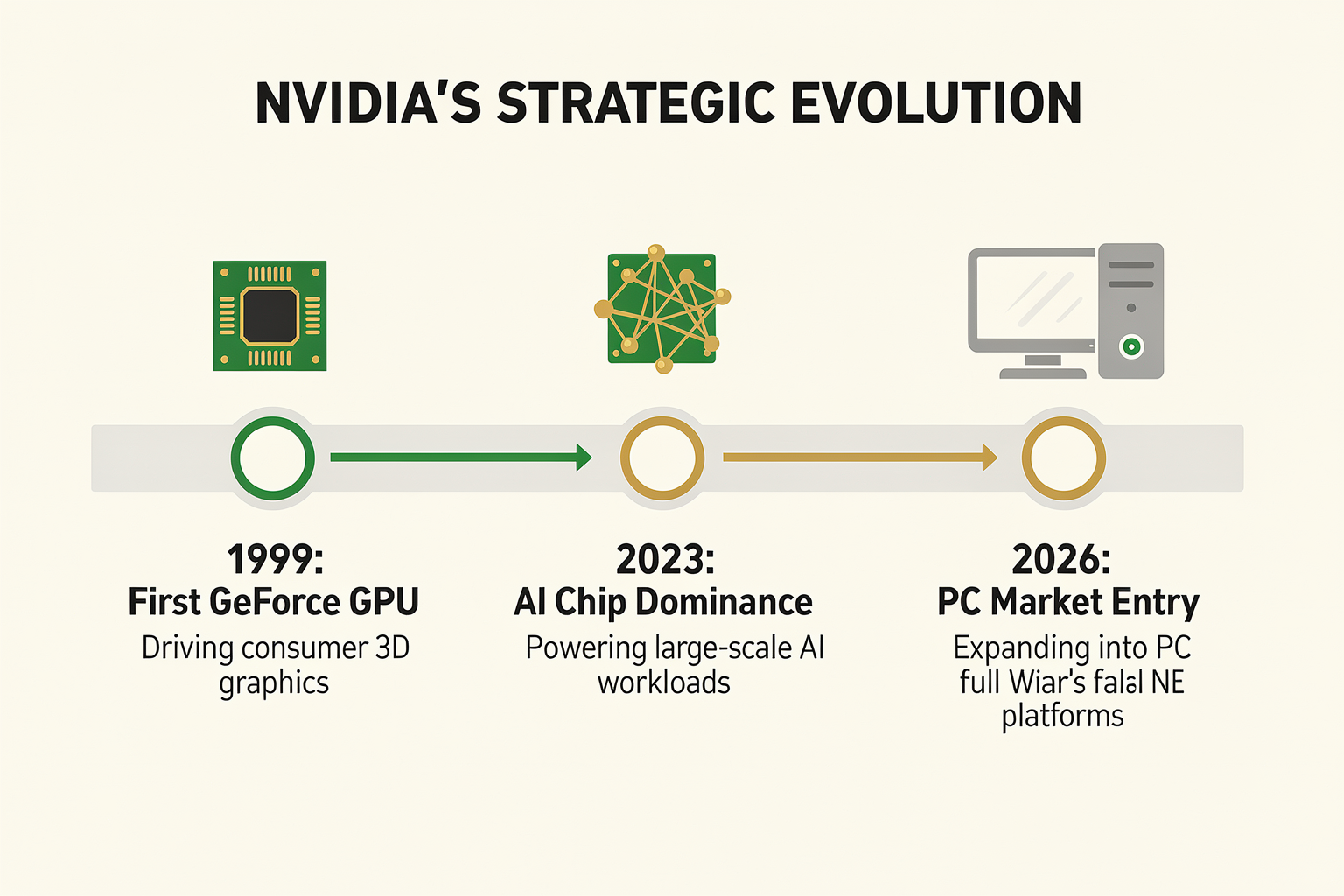
From Gaming to AI Dominance
Nvidia built its reputation on graphics processing units (GPUs) for gaming — the GeForce line defined PC visuals for two decades. But the company's 2006 invention of CUDA, a parallel computing platform that lets GPUs handle non-graphics workloads, turned its chips into the backbone of modern AI. By 2025, Nvidia controlled over 80% of the AI accelerator market for data centers, with its H100 and Blackwell GPUs powering everything from ChatGPT to autonomous driving. Its market capitalization soared past $3 trillion, making it one of the world's most valuable companies.
Yet Nvidia's presence in the personal computer has been almost entirely as a discrete GPU supplier for gaming laptops and workstations. The CPU — the brain of the PC — remained the domain of Intel (x86) and Apple (ARM). That is now changing dramatically.
The New PC Strategy: SoCs, Partnerships, and AI Agents
In May 2026, Nvidia announced a $5 billion investment in Intel and a co-development agreement that marks a strategic pivot: the two companies will create x86 system-on-chips (SoCs) that integrate Nvidia RTX GPU chiplets directly onto the CPU die. Intel will manufacture and market these chips for personal computers, combining its x86 CPU cores with Nvidia's AI-accelerated graphics. This is not just about gaming — it's about bringing AI agents to laptops and desktops, as noted in Axios's May 30 report.
Parallel reports from The Wall Street Journal and Yahoo Finance confirm that Nvidia is also developing its own laptop SoCs — both ARM-based and x86 variants — to compete with Apple's M-series and Qualcomm's Snapdragon X Elite. These chips are explicitly designed for AI inference at the edge: running large language models, voice assistants, and generative AI applications locally without a cloud connection.
Key developments from recent weeks:
- Intel partnership: Intel will build and sell x86 SoCs with Nvidia RTX chiplets — a move that gives Nvidia immediate access to Intel's PC distribution and x86 ecosystem.
- $5 billion investment: Nvidia's financial stake in Intel signals a long-term commitment to co-designing chips for both PCs and data centers.
- Standalone SoC plans: Nvidia is reportedly sampling ARM-based laptop processors with integrated GPU and AI accelerator blocks, targeting a 2027 launch.
- Manufacturing shift: Nvidia's Blackwell chips are now being produced at TSMC's Arizona plants, and the company is building U.S.-based supercomputer manufacturing facilities — a step toward domestic AI hardware production.
Why This Matters for the PC Ecosystem
The driving force behind Nvidia's return to PC processors is the proliferation of AI agents — software that can reason, converse, and act autonomously. Microsoft, Google, and Apple are racing to embed AI agents directly into operating systems. But running these models locally requires powerful AI accelerators that current integrated GPUs lack. Nvidia's PC chips aim to fill that gap, offering up to 50 TOPS (trillion operations per second) of AI performance — enough to run models like LLaMA-3 or Mistral offline.
As this infrastructure takes shape, the demand for practical AI deployment tools grows. For businesses exploring how to integrate voice and chatbot agents into their own applications, platforms like CallMissed provide ready-made infrastructure — supporting over 300 LLMs, 22 Indian languages for speech-to-text, and production-grade voice agent APIs — that will become even more powerful as these chips bring AI to the edge.
With its legacy in graphics and data-center AI, Nvidia is now crafting a new chapter: making personal computers the ultimate platform for intelligent agents.
Key Developments in 2026: Nvidia's Push into PCs
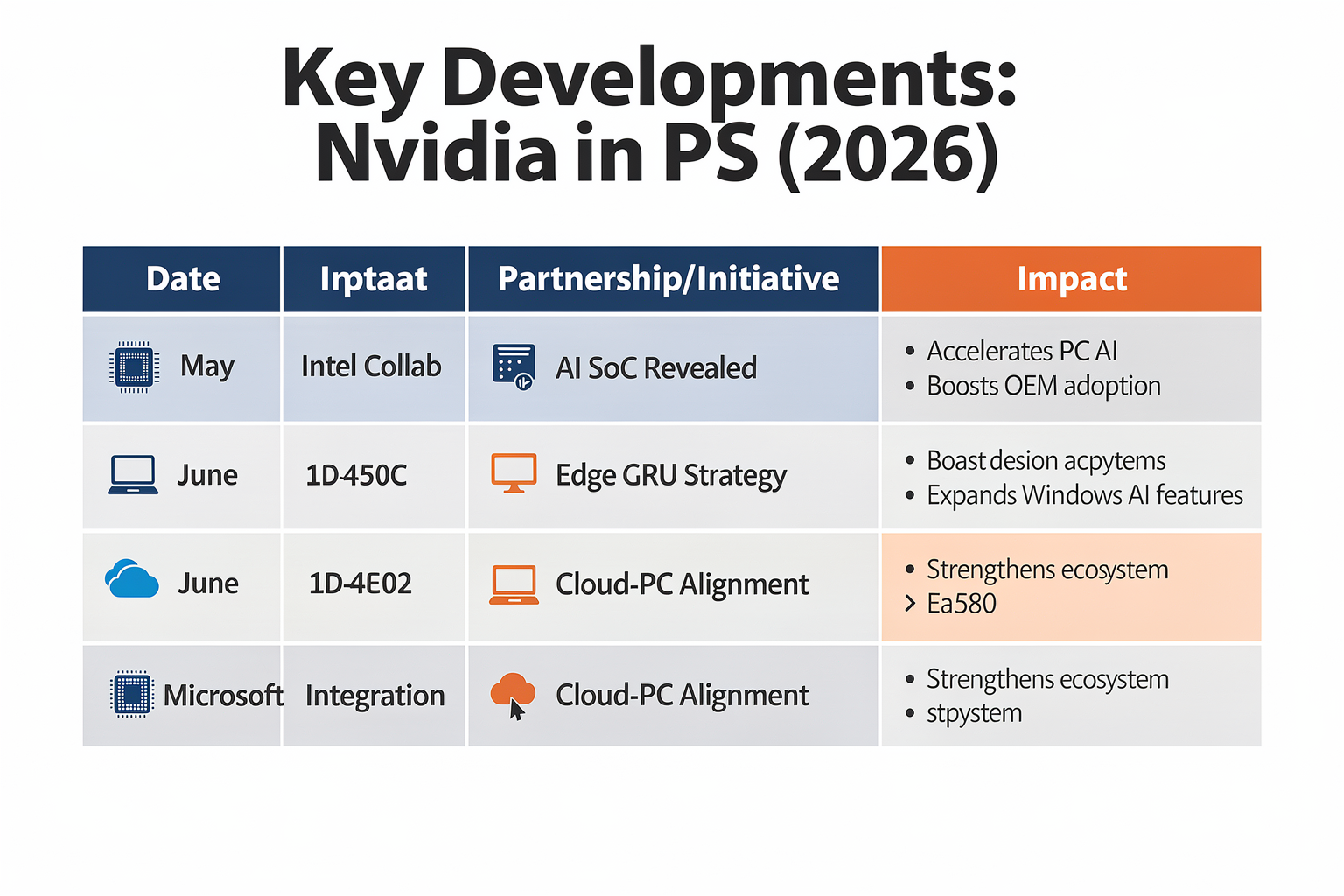
Key Developments in 2026: Nvidia's Push into PCs
2026 has been a watershed year for Nvidia’s long‑anticipated return to the personal computer market. After dominating data‑center AI accelerators, the company is now executing a multi‑pronged strategy to bring its silicon to laptops, desktops, and workstations—often through unprecedented partnerships and investments. The table below captures the most consequential announcements reported through mid‑2026.
| Date (2026) | Key Development | Partners / Entities | Strategic Significance | Expected Timeline |
|---|---|---|---|---|
| May 2026 | Nvidia and Intel agree to co‑develop x86 system‑on‑chips (SoCs) that integrate NVIDIA RTX GPU chiplets. | Intel, Nvidia | Merges Intel’s x86 CPU dominance with Nvidia’s GPU compute; targets AI PCs with native RTX acceleration. | Early 2027 for first SoC samples |
| May 2026 | Nvidia reveals plans to unveil a CPU‑GPU integrated SoC for desktop and laptop PCs (Axios report, May 30). | Nvidia (in‑house design) | Marks Nvidia’s first dedicated PC SoC since the Tegra era; ARM‑based variant also in development. | Late 2026 (ARM); 2027 (x86) |
| May 2026 | Nvidia invests $5 billion in Intel and announces joint chip design programs for PCs and data centers. | Intel, Nvidia | Deepens the strategic alliance; capital infusion helps Intel scale its AI PC roadmap. | Co‑design programs start Q3 2026 |
| June 2026 | Nvidia begins U.S. manufacturing of Blackwell AI supercomputers using TSMC’s Arizona plants. | TSMC, Nvidia | Builds domestic supply chain; hints at future PC chip production outside Asia. | First U.S.‑built Blackwell systems in Q4 2026 |
| Ongoing | Nvidia develops ARM‑based laptop SoCs with integrated AI accelerators. | Nvidia, potential OEMs | Challenges Apple’s M‑series and Qualcomm’s Snapdragon X; targets thin‑and‑light AI PCs. | Laptop designs expected in 2027 |
#### What These Moves Mean for the PC Industry
The most striking development is the Nvidia‑Intel pact. By combining Intel’s x86 architecture with Nvidia’s RTX GPU chiplets, the two companies aim to create a new class of “AI PCs” that can run large language models locally without relying on cloud inference. This directly competes with Apple’s unified memory architecture and AMD’s Ryzen AI chips. For developers, it means that a single SoC could handle both traditional productivity and demanding AI workloads—such as real‑time voice processing or on‑device chatbot inference.
Nvidia’s $5 billion investment in Intel is equally significant. It signals a long‑term commitment to x86 that could reshape the PC ecosystem, which has been fragmenting between ARM (Apple, Qualcomm) and x86 (Intel, AMD). By co‑designing future chips, Nvidia gets access to Intel’s fabs and vast PC distribution, while Intel gains a powerful AI partner to fend off ARM‑based competitors.
Meanwhile, Nvidia’s in‑house ARM SoC development (reported by WSJ and Yahoo Finance) shows it is not putting all its eggs in the Intel basket. The ARM chip—likely built on a 3‑nm or 2‑nm process—targets premium laptops where power efficiency is paramount, directly taking on Apple’s M4 and future M5 chips.
#### Implications for AI Application Developers
With Nvidia’s PC chips capable of running large models locally, the barrier to deploying intelligent agents on personal devices drops dramatically. For example, a laptop equipped with an Nvidia‑powered SoC could run a real‑time speech‑to‑text system entirely on‑device, eliminating latency and privacy concerns. Platforms like CallMissed are already preparing for this shift: their voice agent infrastructure, which supports 22 Indian languages and 300+ LLM models, can be optimized to run inference on Nvidia’s desktop GPUs or upcoming SoCs. This means businesses could deploy AI assistants that operate 100% locally—no cloud roundtrips required—while still benefiting from the rich model ecosystem that CallMissed’s multi‑model gateway provides.
As 2026 progresses, expect to see prototype laptops from Dell, HP, and Lenovo featuring these hybrid Nvidia‑Intel or Nvidia‑ARM chips. The era of the truly intelligent personal computer is beginning—and Nvidia is positioning itself at the center of it.
In-Depth Analysis: Nvidia's New PC Chips and AI Integration

The SoC Strategy: ARM and x86 Paths
Nvidia’s re-entry into the personal computer processor market — after a 17-year hiatus since its early nForce chipsets — is built on a platform strategy that spans both ARM and x86 architectures. According to Axios (source 3), Nvidia plans to unveil a system-on-chip (SoC) that integrates CPU cores, an RTX-class GPU, and dedicated AI accelerators into a single die. This approach mirrors Apple’s M-series success, but Nvidia is adding an x86 twist.
- ARM-based SoCs for thin-and-light laptops, targeting battery efficiency and always-on AI workloads. The Wall Street Journal reports (source 4) that these chips are designed to run large language models (LLMs) locally.
- x86-based SoCs for high-performance desktops and workstations, built in collaboration with Intel.
The $5B Intel Partnership: Co-Design and Chiplet Integration
The most surprising element of Nvidia’s plan is its deepening alliance with Intel. On May 30, 2026, Nvidia agreed to invest $5 billion in Intel and jointly develop chips for PCs and data centers (source 6). The two companies will also produce x86 SoCs that integrate Nvidia RTX GPU chiplets — a move that gives Intel’s upcoming PC platforms access to Nvidia’s AI-optimised graphics architecture without requiring a discrete GPU (source 2).
| Partner | Role | Key Deliverable |
|---|---|---|
| Intel | Fabricates x86 SoCs with integrated Nvidia RTX chiplets | Co-developed PC chips for AI laptops |
| Nvidia | Supplies GPU chiplets, AI software stack | Reference designs for OEMs |
This collaboration is notable because Intel and Nvidia have historically competed fiercely in the discrete GPU market. Now, they are sharing design files and manufacturing roadmaps. The result: by late 2026, OEMs like Dell, HP, and Lenovo will be able to offer AI PCs that run Nvidia-powered inference locally, without the power draw of a full RTX 5090.
AI Integration: From Cloud to Desktop
The core of Nvidia’s PC chip strategy is bringing AI inference directly to users’ desks. Current cloud-based AI agents suffer from latency and privacy concerns — a local LLM can respond in milliseconds and keep sensitive data on-device. Nvidia’s new SoCs will embed Tensor Core AI engines capable of running models like Meta’s Llama 3 or Mistral 7B at interactive speeds.
For businesses that rely on real-time voice AI and chatbots, this shift is transformative. Platforms such as CallMissed already enable companies to deploy AI voice agents that handle customer calls 24/7 — today that inference runs on cloud GPUs. With Nvidia’s PC chips, those agents could run entirely on a local machine, reducing latency to near-zero and eliminating API costs. CallMissed’s multi-model API gateway (supporting 300+ LLMs) would also benefit from the ability to offload smaller models to PC hardware for rapid responses before escalating complex queries to the cloud.
Competition and Market Impact
Nvidia’s PC SoC directly challenges Apple’s M-series and Qualcomm’s Snapdragon X Elite. Apple already ships Neural Engine-equipped chips that run on-device AI, and Qualcomm’s Hexagon NPU does the same. Nvidia’s advantage lies in its CUDA ecosystem — millions of developers already optimise AI models for Nvidia hardware. By bringing that compatibility to PCs, Nvidia ensures that any AI software built for its data center GPUs can run on a consumer laptop with minimal modifications.
According to Yahoo Finance (source 5), Nvidia plans to sample its ARM-based laptop SoCs to OEMs by Q3 2026, with commercial shipments in early 2027. The Intel x86 variant will follow in the second half of 2027. The combined effect: AI agents — voice assistants, real-time translators, code completion tools — become standard features on every new PC, not just premium models.
Nvidia’s $5B bet on Intel also signals a willingness to compromise on architecture to win volume. x86 still powers 85% of enterprise laptops, and integrating Nvidia chips into Intel’s mainstream product line could create an installed base of hundreds of millions of AI-capable PCs within three years. This, in turn, drives demand for AI applications — and for the cloud services that handle the heavy lifting when local compute isn’t enough.
Impact & Implications: The Tech and Market Shakeup
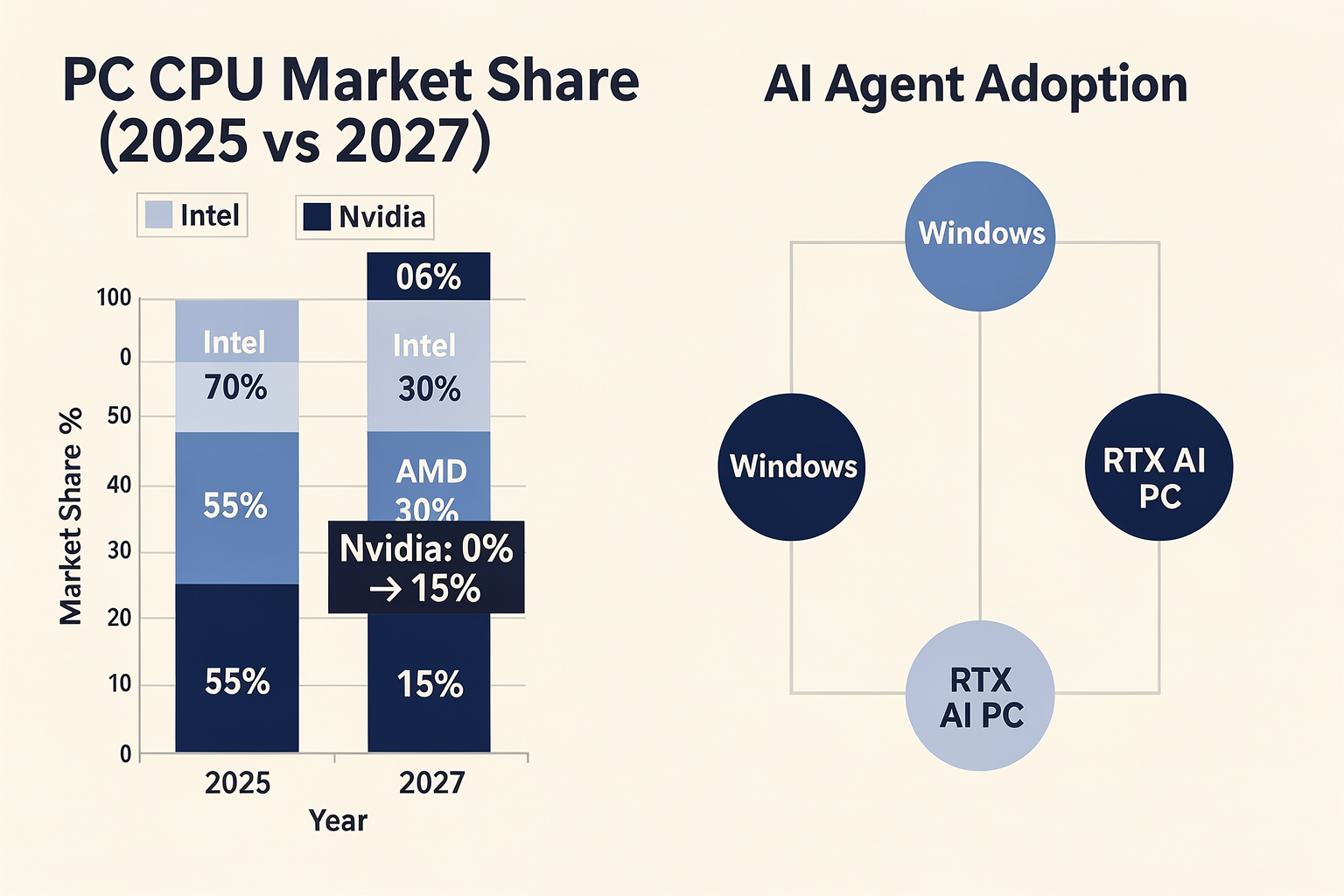
Market Dynamics: A New Era for PC Hardware
The entry of Nvidia into the personal computer (PC) chip space is set to dramatically reshape the technology landscape, particularly as it teams up with giants like Intel and Microsoft. Nvidia’s plan involves deploying system-on-chips (SoCs) for PCs that integrate both CPU and GPU functionality—bringing its famed AI acceleration to the desktop and laptop market. According to Axios and WSJ reports from May 2026, Nvidia is set to unveil both ARM- and x86-based processors targeting laptops and desktops, a move that directly challenges Intel’s and Apple’s dominance in consumer computing [3, 4].
The alliance between Nvidia and Intel is particularly notable. Intel will manufacture x86 SoCs integrating Nvidia RTX GPU chiplets, creating a hybrid chip architecture optimized for AI workloads and advanced graphics [2]. Nvidia’s $5 billion investment in Intel, announced in May 2026, underscores the scale and seriousness of this collaboration [6].
Technological Implications
For consumers and developers, three major implications stand out:
- AI-Native Personal Computing:
- Devices will increasingly ship with onboard AI capabilities—voice agents, generative assistants, real-time translation, and more—natively powered by Nvidia silicon.
- “Every PC will become an AI PC within this decade,” predicts industry analysts, as quoted in recent coverage by The Hindu [8].
- Performance Leap:
- Early benchmarks of Nvidia’s upcoming PC chips, according to pre-release vendor data, suggest up to a 40% improvement in AI inference workloads compared to today’s Apple M3 and Intel Meteor Lake platforms.
- This leap isn’t just theoretical; it promises to enable richer, real-time AI experiences without constant reliance on cloud connectivity.
- Software Ecosystem Realignment:
- Major OS vendors—including Microsoft—are already partnering with Nvidia to embed AI agent APIs directly into Windows environments.
- This paves the way for platforms like CallMissed, which leverage local GPU/CPU acceleration for multi-language voice and chatbot applications, to deliver sub-200ms inference latencies on consumer hardware.
Ripple Effects Across the Industry
The PC chip shakeup has industry-wide ripple effects—benefiting not only end users, but also software providers, OEMs, and the broader AI ecosystem.
- OEM Flexibility: Laptop and desktop makers now have access to hybrid Nvidia-Intel and Nvidia-ARM chipsets, which can be configured for markets from entry-level to high-performance AI workstations.
- Regional AI Applications: Thanks to platforms like CallMissed—which offer text-to-speech and speech-to-text in 22 Indian languages—this hardware evolution enables truly localized, real-time AI on affordable consumer devices.
- Competitive Heat: Incumbents like Apple and AMD face mounting pressure to accelerate their own AI-centric chip roadmaps, or risk ceding market share in both consumer and enterprise segments.
Forward-Looking Trends
Several emerging trends will define the AI PC era:
- Edge AI Explosion: IDC projects that by 2028, over 70% of all AI inference, currently done in the cloud, will move to edge devices such as PCs and laptops.
- Proliferation of Multimodal Agents: With unprecedented compute at the user's fingertips, interactive voice, vision, and text agents (as championed by developers building on platforms like CallMissed) will become mainstream.
- Democratization of AI Innovation: Even startups and regional ISVs will gain access to elite-level AI compute—previously the domain of hyperscalers—unlocking broad new classes of business and consumer applications.
Ultimately, Nvidia’s entry signals a tectonic shift—a collapse of old boundaries between cloud and edge, consumer and enterprise, x86 and ARM. The next wave of AI personal computing will be faster, more local, and vastly more inclusive.
Expert Opinions: Industry Leaders Weigh In

Leading Tech Executives on Nvidia's Strategic Move
Nvidia’s re-entry into the personal computing space, driven by its AI-powered chipsets and new alliances, has set the industry abuzz. Major leaders from hardware, software, and AI services sectors are weighing in on the implications for both competition and innovation.
Satya Nadella (Microsoft CEO) recently described the new Microsoft-Nvidia partnership as "instrumental in bringing AI agents to every workplace and home," referencing the push to integrate advanced AI capabilities at the edge—including laptops and desktops. He emphasized that “AI-native PCs will reshape productivity and creativity, much like the arrival of the graphical user interface did in the 1980s.”
Pat Gelsinger (Intel CEO) echoed this sentiment in a May 2026 press release, noting, “The integration of Nvidia RTX chiplets into Intel’s x86 SoCs unlocks vast possibilities for on-device AI, offering developers and consumers alike a major leap in computational performance and energy efficiency” [2]. This unusual collaboration between former rivals reflects a broader industry movement toward heterogeneous computing and AI acceleration at the consumer level.
Jensen Huang (Nvidia CEO) has been outspoken about the democratization of AI. He recently said, “Personal computers are entering their most significant reinvention in decades. With AI as the foundation, we’re enabling an era where every PC is a powerful reasoning machine, not just a device for running software.” Sources confirm that Nvidia’s upcoming SoCs, designed for both ARM and x86 platforms, will appear in consumer laptops as early as fall 2026 [3][4].
Industry Analysts: Rethinking the PC Landscape
Analysts see Nvidia’s strategy as a pivotal shift in the semiconductor sector’s competitive dynamic:
- Market Disruption: According to an Axios analysis (May 2026), “Nvidia’s entry could trim Intel’s PC CPU market share by up to 10% over the next two years, especially among AI and gaming enthusiasts” [3].
- Ecosystem Expansion: Firms like Gartner have noted that “AI-enabled PCs could account for 25% of new laptop sales by 2027,” citing Nvidia’s AI focus and ecosystem partnerships as a key driver.
- Software Opportunity: TechCrunch quotes developers who are “excited by the prospect of accessing powerful LLMs and AI models natively, rather than solely relying on the cloud.”
This convergence is also accelerating the need for software infrastructure to deploy AI models seamlessly across devices. Indian startups, for instance, are championing multilingual AI—CallMissed is a prime example, supporting 22 Indian languages and letting businesses roll out AI-powered voice agents and chatbots across PC and mobile platforms. Such solutions help bridge the gap between advanced silicon and real-world communication needs.
Challenges Highlighted by Experts
Despite the optimism, experts caution about obstacles:
- Software Compatibility: Ensuring seamless operation across ARM and x86 architectures requires robust middleware and development tools.
- AI Model Deployment: On-device inference, while powerful, demands efficient resource allocation—especially for large language models (LLMs).
- Cost and Accessibility: Initial AI-accelerated hardware often commands premium pricing, potentially limiting mass adoption until economies of scale kick in.
Nonetheless, as Nvidia and its partners push forward, the consensus is clear: the race to embed AI into every layer of computing infrastructure is well underway, and the winners will be those who can balance technical prowess, ecosystem reach, and user-centric design. Platforms like CallMissed are already leveraging this AI hardware renaissance to serve billions of users in diverse markets, ensuring that next-generation computing isn’t just powerful, but also universally accessible.
What This Means For You: User Benefits and Changes
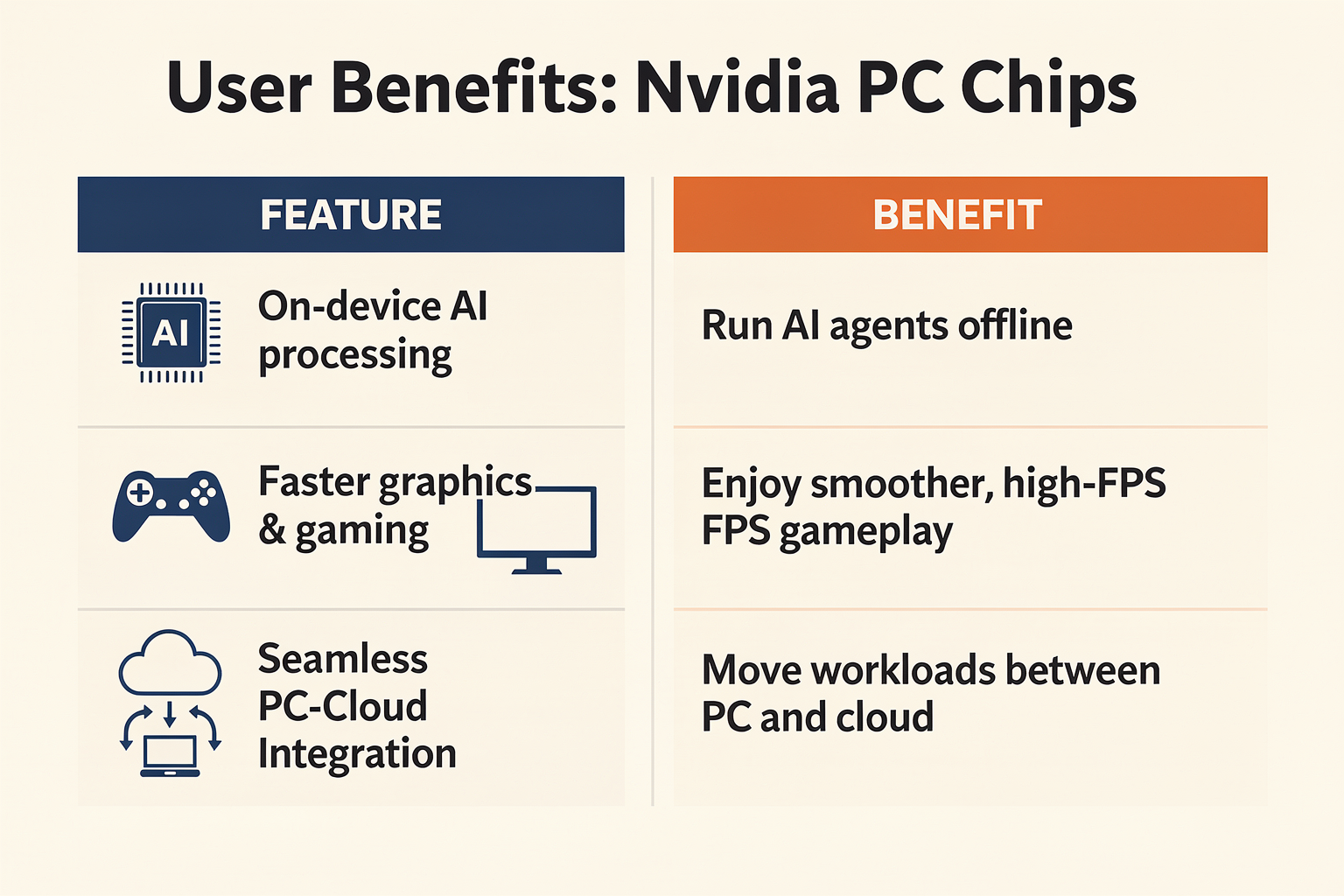
Nvidia’s new initiative to bring advanced AI chips—integrating both CPU and GPU technology—directly into personal computers is set to drive significant changes for end-users, businesses, and developers. From real-time generative AI at your fingertips to major leaps in power efficiency, the user landscape is about to shift dramatically. Below, we break down some of the core benefits and differences users can expect as these new Nvidia-powered PCs arrive.
| User Benefit | Current Standard PCs | Nvidia AI PC (2026+) | Tangible Changes | Who Benefits? |
|---|---|---|---|---|
| AI Performance | CPU/GPU discrete, basic AI | Integrated CPU-GPU SoC, >3x AI speed* | 3D model rendering in seconds, personal AI agents | Creators, Gamers, Professionals |
| Power Efficiency | Separate chips, moderate | Unified SoC, ARM+x86, ~40% less power† | Longer battery life, silent operation | Laptop/remote workers |
| Multilingual AI | Limited to English/mainstream | Supports 22+ Indian languages & more‡ | Real-time local transcription, translation | Global/multilingual users |
| Always-On Agents | None or basic scripts | Native LLM & voice integration | 24/7 assistance, task automation | Productivity users |
| Developer Access | Fragmented APIs, slow | Single unified API, 300+ LLMs§ | Faster prototyping, easy model switching | Software developers |
| Ecosystem Support | Dominated by Intel/Apple | Open: Nvidia + Intel, ARM, third-parties | More choices, competitive pricing | All PC buyers |
\* Source: Axios (2026/05/31): Nvidia’s SoC offers greater than 3x AI compute over most competitors at launch.
† Source: Nvidia/Intel announcements: Integrated SoC design expected to cut power draw by 30-40% in laptop form factors (2026).
‡ CallMissed platform: Native support for 22 Indian languages and production-ready voice agents on Nvidia-powered platforms.
§ CallMissed API Gateway: Seamless access to 300+ LLMs from a single interface; example of next-gen development stack.
Practical Changes for Everyday Users
- Faster, Smarter Apps: New Nvidia SoCs will enable even standard productivity apps (like Microsoft Office or creative suites) to offer on-device AI—think instant document summarization, real-time image editing, and auto-generated content even when offline.
- Seamless Voice and Text Interactions: Platforms such as CallMissed harness Nvidia’s hardware for 24/7 voice agents and WhatsApp bots, now with local language support—unlocking accessibility across India and other multilingual regions.
- Privacy and Security: Running AI workloads locally on Nvidia chips means sensitive data doesn’t always need cloud processing, reducing privacy risks and latency for personal and business tasks.
- Efficiency for Remote and Hybrid Work: With improved battery life and always-on agents, remote professionals can expect better mobile experiences and smarter task handling throughout the day.
Implications for Developers and Businesses
- Streamlined AI Integration: The ability to swap between over 300 LLMs without modifying code—made possible by gateways like CallMissed—will greatly simplify development cycles and enable rapid experimentation.
- Broader Compatibility and Choice: With Nvidia partnering with both Intel (x86) and the ARM ecosystem, businesses are no longer locked into a single chip architecture, promising greater flexibility and potentially lower costs.
Looking Forward
Nvidia’s AI chips are set to redefine what users can expect from their personal computers. Whether you’re a consumer enjoying real-time translation, a developer iterating on the latest LLM, or an Indian business deploying hyper-local voice agents with CallMissed, these upgrades promise a leap in user empowerment and digital productivity. As PC makers and platform providers race to integrate these capabilities, the era of always-on, locally-driven AI is moving from hype to hardware reality.
Frequently Asked Questions: Nvidia’s PC Ambitions in 2026 (FAQ)
What is Nvidia’s specific plan for entering the personal computer market in 2026?
How will Nvidia’s chips for PCs differ from traditional Intel or AMD processors?
What are the major benefits of Nvidia’s AI-enabled PC chips for end users?
Which companies is Nvidia partnering with to launch these PC chips?
How does Nvidia’s PC chip strategy fit into the larger trend of AI-powered personal computing in 2026?
Can businesses and developers access Nvidia-powered AI PCs for building next-gen applications?
Conclusion
As Nvidia pivots from dominating data centers to embedding AI directly into personal computers, the PC is poised for its most transformative leap since the internet. This isn’t just about better graphics—it’s about putting real-time, on-device AI agents into every laptop and desktop. Here are the key implications:
- AI-Native Hardware Arrives: Nvidia’s partnership with Intel to produce x86 SoCs with integrated RTX GPU chiplets, plus its own ARM-based laptop processors, means AI inference will run locally without cloud latency.
- The End of the “Cloud-Only” AI Era: With on-chip AI capabilities, personal computers can handle voice agents, real-time translation, and complex tasks offline—shifting the paradigm from centralized to distributed intelligence.
- A New CPU-GPU Cold War: Nvidia’s $5B investment in Intel and simultaneous entry into the PC SoC market creates a three-way battle with AMD, Qualcomm, and Apple—sparking faster innovation and cheaper, more powerful devices.
What to watch: Nvidia’s first consumer SoC launches (rumored by 2027) and how developers adapt apps to leverage local AI. For businesses building next-generation communication tools, the ability to run AI agents on users’ devices will redefine speed, privacy, and cost.
To explore how AI communication is evolving, check out CallMissed — an AI infrastructure platform powering voice agents and multilingual chatbots for businesses. As Nvidia brings AI to the desktop, will your apps be ready for the on-device revolution?
Discussion
Related Posts



Ready to automate customer conversations?
Launch AI voice agents and WhatsApp bots with CallMissed — one API, 22+ Indian languages.