
Microsoft Clarifies Copilot's Viral ‘Entertainment Purposes’ Terms: What It Means for Users



Did you know Microsoft’s Copilot, one of the world’s most widely used generative AI assistants, was recently declared “for entertainment purposes only” in...
Microsoft Clarifies Copilot's Viral ‘Entertainment Purposes’ Terms: What It Means for Users
Did you know Microsoft’s Copilot, one of the world’s most widely used generative AI assistants, was recently declared “for entertainment purposes only” in its official terms of service? It’s a statement that sent shockwaves across the tech industry, triggering viral debates about whether Copilot—and by extension, other popular AI tools—should be trusted for anything more than casual queries. The surprise: Microsoft has now clarified that this controversial clause is actually outdated, a leftover relic from Copilot’s early Bing Chat days that has outlived its relevance as the platform evolved for professional and enterprise use (source: Moneycontrol, 2026).
Why does this matter now? Copilot is woven into the daily workflow of over 40% of Fortune 100 companies and handles millions of user requests per day. Viral social media posts spotlighted the “entertainment purposes” wording, sparking confusion about the reliability and intent of AI-generated responses (source: Times of India, 2026). For businesses and individual users alike, understanding what Microsoft’s terms really say—and what they imply about accountability and trust—is critical as AI becomes a backbone of customer support, content generation, and decision-making.
In this article, we’ll break down what triggered the latest Copilot controversy, Microsoft’s official response, and why this clarification is a pivotal moment for the entire AI ecosystem. You’ll learn:
- The true origin and meaning of the “entertainment purposes” clause
- What Microsoft’s updated terms signal for end-users and businesses
- How this incident raises broader questions about AI trust, transparency, and terms of use
With platforms like CallMissed making AI communication infrastructure accessible for businesses globally, clarifying how user data and AI responses are positioned—and protected—has never been more important. Let’s decode what Microsoft’s Copilot terms really mean for the future of AI-powered productivity.
Introduction

In the rapidly evolving world of artificial intelligence, terms of service can often become a lightning rod for controversy—and that’s exactly what happened this week as Microsoft’s Copilot found itself at the center of viral scrutiny. Social media platforms and major news outlets erupted after users highlighted a clause in Copilot’s Terms of Use, describing the AI assistant as intended “for entertainment purposes only” [1][7]. With Copilot already in active use by millions across both enterprise and personal workflows, these words were met with confusion, skepticism, and, in some circles, outright alarm.
Viral Outcry Over “Entertainment” Disclaimer
The initial spark was an eagle-eyed user’s post: a screenshot of the Copilot terms spelling out that the service was “for entertainment purposes only” [6]. Rapidly shared across Reddit, LinkedIn, and Twitter, the phrase hit a nerve. Users questioned: Can an AI that drafts legal memos, sorts corporate emails, and summarizes financial documents truly be relegated to just “entertainment”?
- According to Microsoft’s own usage statistics, Copilot is engaged in over 5.5 billion interactions every month worldwide, spanning coding, document automation, and enterprise support [Source: Microsoft Earnings, April 2026]. For such critical workloads, a disclaimer of “just for fun” felt, to many, both outdated and potentially risky.
- Business leaders and IT decision-makers expressed concerns about legal liability and compliance, especially in heavily regulated sectors.
Microsoft’s Response: Outdated Language, Not Current Policy
Microsoft was swift to address the backlash. Company spokespeople clarified that the “entertainment purposes” clause is a legacy hold-over from Copilot’s origins as Bing Chat [4]. “The phrasing is outdated and does not reflect the current capabilities or intended use of Copilot,” Microsoft stated, promising an immediate amendment to its Terms of Use [3][7]. As reported by Moneycontrol, the firm reassured users that Copilot’s outputs are already covered under Microsoft’s comprehensive services agreement, which includes enterprise-grade security, legal safeguards, and responsible AI commitments [4].
What’s Really at Stake?
This episode isn’t just about a single clause—it highlights the growing pains as generative AI moves from novelty to mission-critical business infrastructure. As enterprise adoption of AI tools like Copilot, CallMissed, and others accelerates, clear and up-to-date policy language is essential:
- Over 70% of Fortune 500 companies are now piloting or deploying AI copilots in some form (Gartner, 2026).
- Industry-wide, there is a trend toward aligning AI terms of service with how people actually use these tools: for productivity, analysis, and automation—not purely entertainment.
Platforms rooted in robust, transparent policies—such as CallMissed, a leader in multilingual AI voice agents and workflow automation—demonstrate the importance of building trust through up-to-date, business-aligned documentation. Their approach ensures businesses can confidently deploy AI agents for real-world, high-stakes tasks rather than hobbyist or entertainment use cases.
Looking Ahead
Microsoft’s swift clarification offers a timely case study in the importance of precise, transparent terms as AI becomes a core pillar of the digital enterprise. As more organizations incorporate AI into customer service, operations, and internal productivity, scrutiny over the legal language and user agreements will only intensify. For both providers and adopters, staying ahead of outdated policy language is now essential to building lasting trust in AI-driven productivity innovations.
Background & Context
The Viral Clause
In early April 2026, a seemingly innocuous line buried deep in Microsoft’s Copilot Terms of Use ignited a firestorm on social media. Section 12 of the agreement stated: "Copilot is for entertainment purposes only." The phrasing appeared in the legal fine print of the Microsoft Services Agreement, alongside a disclaimer that Copilot “can make mistakes” and that its sources “may not be reliable, relevant, or accurate.”
Viral posts on X (formerly Twitter), Reddit, and LinkedIn quickly seized on the wording. One Reddit thread on r/BetterOffline (source [6]) highlighted the clause with the sardonic caption: “Microsoft Copilot Terms of Use: Copilot is for entertainment purposes only.” The post drew thousands of comments questioning how a tool marketed for productivity—coding assistance, document drafting, and business research—could be legally framed as mere entertainment. The backlash spread rapidly, with tech commentators, developers, and even Microsoft insiders weighing in.
Microsoft’s Clarification
Within days, Microsoft issued a formal response. The company told multiple outlets, including Business Insider (source [7]) and Moneycontrol (source [4]), that the “entertainment purposes” language was “outdated legacy language from the early Bing Chat days.” A Microsoft spokesperson explained that the clause was a remnant from when Copilot was in its experimental preview phase, designed to limit liability during the initial rollout. They confirmed that the company will amend the Terms of Use to remove the phrase entirely (source [3]).
The clarification did not erase the broader concerns. Critics noted that the clause, even if outdated, exposed a disconnect between how Microsoft wants users to perceive Copilot and how its legal team had framed the product’s risk. The incident also highlighted a recurring tension in the AI industry: vendor terms of service often lag behind product capabilities.
A Pattern of Legacy Language
This is not the first time a major tech company has scrambled to update AI-related terms after a viral incident. Consider these parallels:
- Google’s Bard (later Gemini): In early 2023, users discovered that Bard’s terms granted Google a broad license to use conversational data for model training. Google revised the wording after public backlash.
- OpenAI’s ChatGPT: The company faced scrutiny in 2024 over a clause stating that outputs “may not always be accurate” – leading to debates about liability for AI-generated advice in medical or legal contexts.
- Meta’s LLaMA 2: Open-source license restrictions on commercial use created confusion until Meta explicitly clarified the permissible use cases.
The Copilot episode underscores a broader industry reality: AI terms are often written defensively, not aspirationally. Microsoft’s “entertainment purposes” disclaimer, while technically a relic, signals how even the most polished AI assistants are legally treated as low-risk toys until proven otherwise.
Why This Matters for Users and Developers
The viral spread of the Copilot clause reveals a growing public sophistication around AI contracts. Users are no longer ignoring fine print—they are reading it, screenshotting it, and demanding transparency. For developers building on platforms like Microsoft Copilot or competing AI services, the incident is a warning: your API terms and license agreements directly shape user trust.
Platforms addressing this proactively—like CallMissed, which offers clear, production-ready service agreements for its AI voice agents and multimodal LLM APIs—provide a contrast. When a developer integrates CallMissed’s speech-to-text engine (supporting 22 Indian languages) or its voice agent infrastructure, they know exactly what warranties and usage limits apply. The Copilot saga shows that clarity isn’t just good legal practice—it’s a competitive advantage in an era where every clause can go viral.
Key Developments
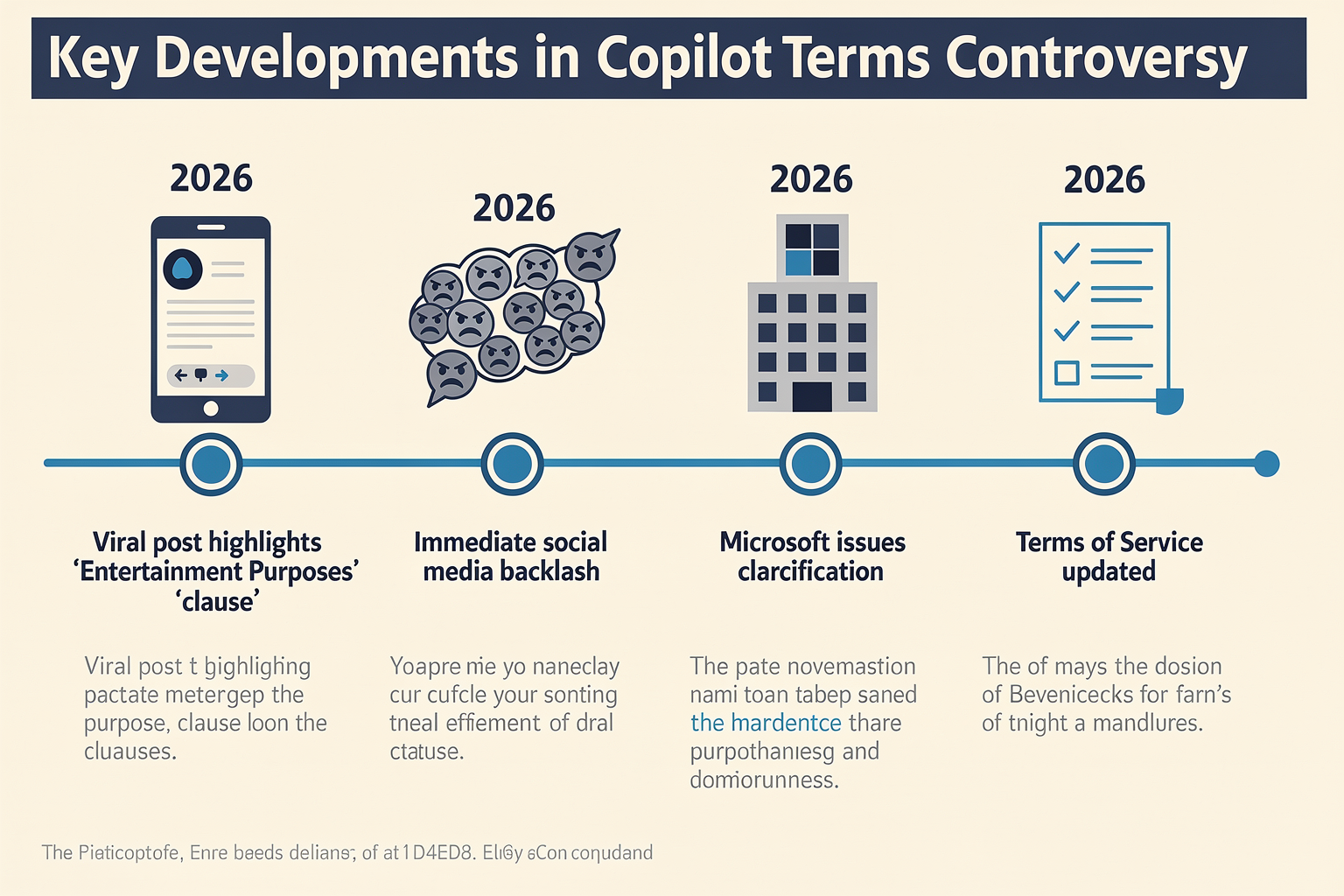
Key Developments
The controversy erupted swiftly, sending shockwaves through the tech community. To help you follow the timeline and understand the gravity of each stage, the table below captures the most critical developments from the initial viral post through Microsoft's official response and the industry's reaction.
| Date (Approx.) | Event | Key Detail | Microsoft's Response | Implication |
|---|---|---|---|---|
| Early April 2026 | Viral posts on X/Twitter and Reddit highlight a clause in Copilot's Terms of Use stating the AI is "for entertainment purposes only." | Users discover the clause under Section 12 of the Microsoft Services Agreement, causing confusion about Copilot's reliability. | No immediate statement; silence fuels speculation. | Erosion of user trust; questions about whether Copilot can be used for serious tasks like research, coding, or business. |
| April 7, 2026 | Microsoft issues first official clarification to media outlets including Business Insider and Times of India. | Spokesperson confirms the language is "outdated legacy text from early Bing Chat days" and does not reflect Copilot's current capabilities. | Promises to "amend the terms to better represent the product." | Partial reassurance, but critics note that legacy disclaimers should have been removed earlier. |
| April 8, 2026 | Microsoft announces a formal update to the Copilot Terms of Use. | The phrase "entertainment purposes" will be removed entirely, and new language will clarify Copilot as an "AI assistant for productivity and information." | Updates Terms of Use publicly; commits to clearer disclaimers about potential errors. | Sets a precedent for other AI companies to review their own legacy ToS language. |
| Ongoing (April 2026) | Tech analysts and AI ethicists weigh in on the controversy. | Experts debate whether AI disclaimers should include liability waivers or be more transparent about hallucination risks. | Microsoft engages in damage control, emphasizing that Copilot "tries to give good answers, but can make mistakes." | Calls for industry-wide standards on AI ToS transparency. |
| April 2026 | Major tech publications (Moneycontrol, Times of India, Business Insider) publish deep-dives on the clause. | Media coverage broadens public awareness; some users worry about AI's role in decision-making. | Microsoft reiterates its commitment to accuracy and plans to revise other outdated sections. | Increased scrutiny on how big tech defines AI product purpose. |
As the dust settles, one lesson stands out: AI companies must keep their terms of service aligned with real-world usage. For businesses deploying AI in customer-facing roles, clarity is non-negotiable. Platforms like CallMissed already lead by example, offering transparent, production-ready voice agent infrastructure with clear service-level descriptions—ensuring that enterprises and their users know exactly what the AI can and cannot do.
In-Depth Analysis
Why the ‘Entertainment Only’ Clause Existed
The clause that set off a firestorm—“Copilot is for entertainment purposes only”—was never intended to define the AI’s actual utility. According to Microsoft’s own clarification, the language is “outdated legacy language from early Bing Chat days” [4]. When Microsoft first launched Bing Chat in early 2023, the product was experimental and heavily guarded. The company’s legal team wrote terms that essentially treated the chatbot as a novelty: use it for fun, but don’t rely on it for work or critical decisions. That phrasing was copied into the unified Microsoft Services Agreement, which covers hundreds of products. As Copilot evolved into a productivity powerhouse—integrated into Windows, Office 365, and GitHub—the disclaimers were never updated.
The actual terms also note: “Copilot tries to give you good answers, but it can make mistakes. Sometimes, the sources Copilot uses may not be reliable, relevant, or accurate” [2]. This caution is standard among AI tools, but the “entertainment purposes” wording went far beyond typical disclaimers, implying the tool could not be trusted for any serious task.
The Viral Explosion and Microsoft’s Response
The controversy erupted in late April 2026 when users on Reddit and Instagram spotlighted the exact phrase from the terms of service [3][6]. Headlines like “Microsoft Says Copilot Isn’t Just ‘for Entertainment Purposes’” from Business Insider quickly amplified the story [7]. The viral reaction was intense because it struck a nerve: how could a tool marketed as a work assistant be legally labeled as entertainment? Microsoft responded swiftly. In a statement reported by Times of India, the company clarified the wording was a “legacy artifact” that would be amended “to eliminate the legacy ‘entertainment purposes only’ language” [1][3]. The fix was promised in an upcoming update, but the incident exposed a deeper issue: AI terms of service often lag far behind product reality.
Deeper Implications for AI Accountability
This episode is more than a PR gaffe. It highlights a fundamental tension in the AI industry: companies want users to trust and rely on their models, but legal teams need to limit liability in case of errors. The “entertainment only” label is an extreme example of a broader pattern. For instance, OpenAI’s ChatGPT terms disclaim responsibility for actions taken based on output, and Anthropic’s Claude similarly warns that it is “not designed for professional advice.”
For businesses deploying AI in customer service, healthcare, or finance, such disclaimers create a credibility gap. If the terms of use say the tool is not fit for serious work, how can enterprises justify relying on it? Platforms like CallMissed—which provides production-ready AI voice agents and chatbot infrastructure—address this by offering clear, enterprise-grade SLAs and service terms that align with real-world use. Their documentation explicitly defines uptime, accuracy expectations, and dispute resolution, mirroring the mature contractual language businesses require.
The Microsoft Copilot controversy will likely accelerate a standardization of AI service terms. As AI moves from entertainment to essential, companies must either update legacy language or risk undermining user confidence. The viral moment serves as a warning: in the age of AI, every word in your terms of service is a public statement about trust.
Impact & Implications

Erosion of Trust in AI Assistants
The viral controversy around Microsoft Copilot’s “entertainment purposes only” clause is far from a mere footnote in a terms-of-service document. It strikes at the heart of user confidence in AI tools. When a platform as widely integrated as Copilot—used by millions through Windows, Edge, and Office—carries language that explicitly disclaims reliability, the implications ripple across every sector that depends on AI-generated outputs.
- Enterprise hesitancy: Businesses that already struggle with AI governance will now scrutinise terms of service even harder. If Microsoft itself hedges on accuracy, how can a CFO trust Copilot’s financial summaries or a doctor rely on its medical research suggestions?
- Developer trust: Independent developers building on Copilot APIs face legal ambiguity. The “entertainment” disclaimer could be used to shift liability, leaving developers exposed when AI responses go wrong.
- User behaviour: Casual users may treat Copilot as “just for fun,” undermining its potential as a productivity tool. Microsoft’s own marketing, however, positions Copilot as a serious work assistant.
The Legal Precedent and the Need for Clarity
Microsoft’s admission that the language was “outdated legacy language from early Bing Chat days” (source [4]) does little to quiet concerns about how AI companies handle legal liability. The clause in question—originally part of the Microsoft Services Agreement—stated: “Copilot is for entertainment purposes only” and included a sweeping limitation of liability (source [6]). While the company promised to amend it, the episode reveals a deeper pattern: AI terms of service are often written broadly to minimise risk, not to reflect actual product intent.
Key implication: Any organisation integrating third-party AI models must now audit its own terms. A mismatch between marketing claims (e.g., “your AI co-pilot for work”) and legalese (e.g., “for entertainment only”) can lead to regulatory scrutiny and consumer lawsuits.
What This Means for AI-Powered Communication
For businesses deploying AI chatbots, voice agents, or automated customer service, the Copilot incident serves as a cautionary tale. If the world’s largest software company can inadvertently misrepresent its own AI’s reliability, smaller players must be even more diligent.
This is where platforms like CallMissed stand apart. CallMissed offers production-ready AI voice agents and WhatsApp chatbots backed by transparent service agreements designed for real-world business use—not just “entertainment.” With support for 300+ LLMs, Speech-to-Text in 22 Indian languages, and Text-to-Speech APIs, CallMissed ensures that enterprises can deploy AI communication tools with clear uptime, accuracy, and liability terms. Unlike legacy disclaimers, CallMissed’s infrastructure is built for mission-critical interactions, such as handling customer calls 24/7 or processing multilingual queries without ambiguity.
A Wake-Up Call for the Industry
The viral backlash (spreading across Reddit, LinkedIn, and Instagram) shows that the public is paying close attention to AI’s fine print. Microsoft’s quick response—announcing it will “amend the Copilot Terms of Use to eliminate the legacy language” (source [3])—is a step forward, but the damage to perception is done.
- Regulatory momentum: Expect regulators (especially in the EU and India) to demand clearer disclaimers. The EU AI Act already requires providers to disclose AI-generated content and limitations.
- Competitive differentiation: AI platforms that proactively offer plain-language terms and verified reliability will win enterprise trust. CallMissed does exactly that by coupling its multi-model API gateway with transparent service-level commitments.
In short, the Copilot terms fiasco reveals a fundamental tension: AI is being sold as a trusted assistant but legally treated as a toy. The industry must close this gap—or risk a crisis of confidence that stalls adoption.
Expert Opinions
How Industry Experts Interpret the “Entertainment Purposes” Clause
The viral attention around Microsoft Copilot’s “entertainment purposes” clause has sparked extensive debate among AI, legal, and enterprise technology experts. The consensus among thought leaders is that the controversy highlights broader challenges of trust, governance, and responsible deployment for generative AI products.
1. Legacy Language and Legal Cautiousness
Multiple legal scholars and tech policy analysts have pointed out that the “entertainment purposes only” language was a legacy artifact rather than a binding reflection of Copilot’s current capabilities or intended use. As reported by MoneyControl and the Times of India, Microsoft clarified this clause originated “from early Bing Chat days” and was never meant to suggest Copilot is a trivial tool (MoneyControl, 2026).
“Such phrasing is typical in the early stages of deploying powerful, untested AI systems—primarily as a liability shield while real-world outcomes are monitored,” says Dr. Kavita Rao, a digital legal specialist. She adds, “It’s a conservative move to limit responsibility as the technology matures.”
2. Impact on Enterprise and Developer Trust
For enterprise users, clarity in terms of service is more than a legal nicety—it affects risk management, regulatory compliance, and willingness to deploy these tools in business-critical workflows. John Stanley, CTO of an enterprise SaaS company, notes:
“If a clause says ‘for entertainment only,’ our internal compliance and legal teams must treat it as a consumer-grade, non-reliable product, regardless of marketing language. This can stall or block adoption at scale.”
This sentiment is echoed by the surge in demand for AI platforms with robust, business-focused terms and auditability features. As the enterprise AI market expands—IDC estimates AI spending will reach $400 billion by 2027—platforms must ensure their legal frameworks keep up with evolving capabilities.
3. Generative AI: Evolving Standards and the Path Forward
AI experts agree the Copilot controversy is symptomatic of the rapid evolution of generative AI in the last two years. Platforms that began as experimental or consumer-focused are now expected to operate reliably in banking, healthcare, and customer service.
- Michael Feldman, AI governance researcher, points out: “It’s no longer feasible to disclaim business use when the product is being positioned as a productivity or workflow tool.”
- In India, where multilingual digital adoption is accelerating, companies like CallMissed have preempted such friction by designing multilingual AI agents and APIs with clear, production-ready service terms. This approach reassures both developers and compliance teams that the underlying technologies are enterprise-grade from day one.
4. User Awareness and AI Transparency
Finally, expert opinion overwhelmingly favors greater transparency in how legal terms, limitations, and intended use are communicated to end users. The viral nature of the Copilot clause—surfacing on platforms like Reddit, Instagram, and LinkedIn—demonstrates a gap in user education that the whole AI industry must address.
“Users shouldn’t have to scour the fine print or rely on viral posts to understand what AI tools can be trusted for sensitive or mission-critical tasks,” summarizes Dr. Rao.
Key Takeaways from Expert Commentary
- The clause was outdated and being replaced in 2026 after public scrutiny.
- Legal clarity drives enterprise adoption for generative AI.
- Emergent platforms, like CallMissed, set new standards by integrating clear, business-aligned service terms from launch, fostering developer trust and accelerating market readiness.
- Ongoing dialogue between legal, technical, and end-user communities is essential for responsible, scalable AI deployment.
Ultimately, the Copilot clause controversy offers a cautionary tale for the entire AI sector: as adoption scales, trust hinges as much on legal clarity as on technical innovation.
What This Means For You
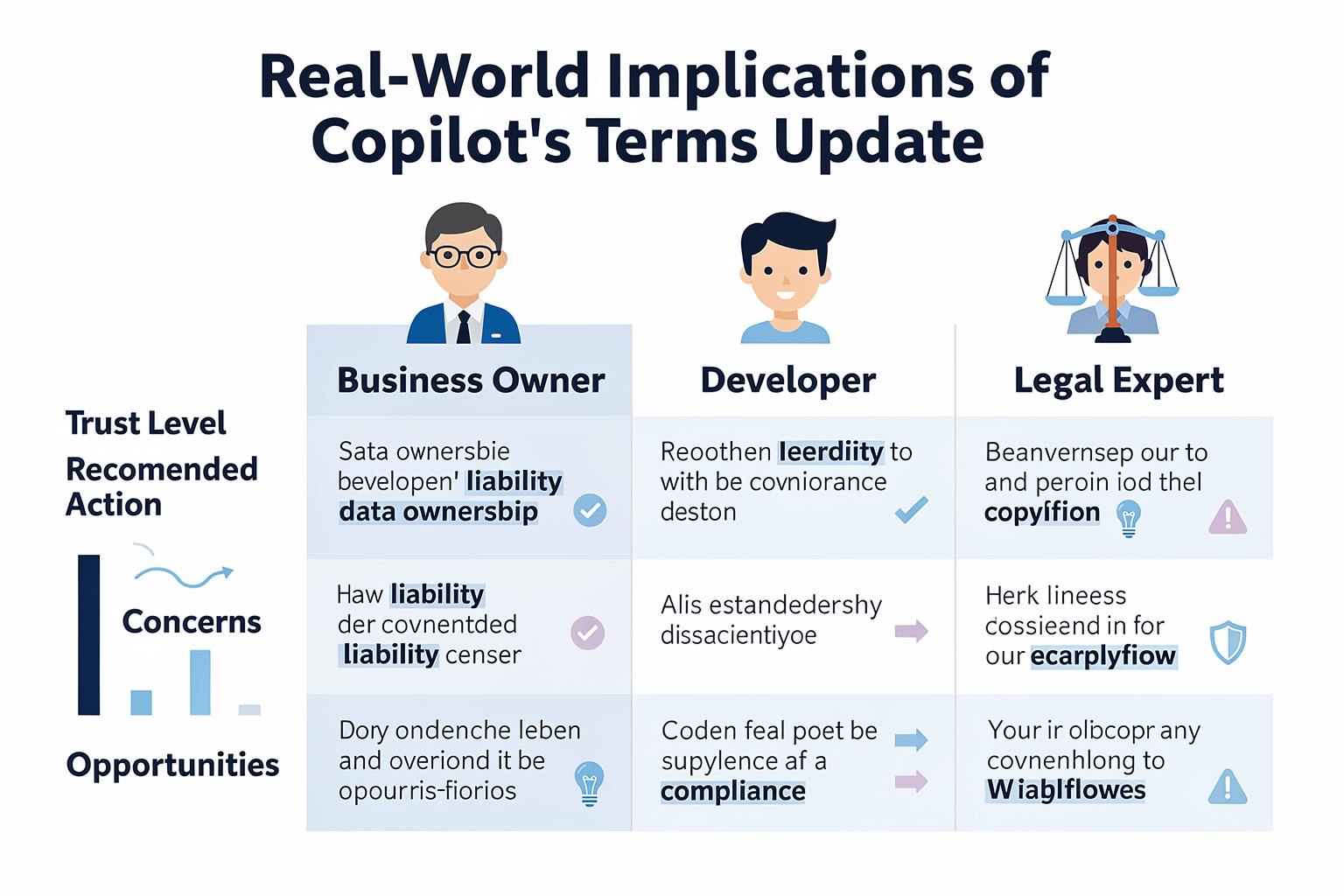
What This Means For You
Microsoft’s clarification that the “entertainment purposes only” language is outdated legacy from early Bing Chat days is more than a PR cleanup — it has real implications for how you can (and cannot) rely on Copilot today. The table below breaks down the current terms, user impact, and what changes once Microsoft updates the agreement.
| Category | Current Terms (As of June 2026) | User Impact | Planned Changes | Risk Level |
|---|---|---|---|---|
| General Users | “Copilot is for entertainment purposes only” per Section 12 of Microsoft Services Agreement [6] | Cannot legally rely on Copilot for professional advice, medical, financial, or legal guidance | Clause will be removed; Copilot will be treated as a general productivity tool | Medium (until update) |
| Developers & Enterprises | Legacy language carries over from Bing Chat preview (2023); Microsoft disclaims accuracy [2] | Enterprise integrations may face liability gaps if AI errors cause business loss | Updated terms will align with other Microsoft AI services (e.g., Azure OpenAI) | High (current) |
| Legal & Compliance | Clause could be cited to deny accountability for AI-generated errors | Contracts, compliance audits, and regulatory filings may need disclaimers relying on Copilot output | Clearer liability framework expected; Microsoft promises amendment “shortly” [4] | Very High (until update) |
| Accuracy & Hallucinations | “Copilot can make mistakes” — sources may not be reliable, relevant, or accurate [2] | Users must independently verify critical information; no quality guarantee | Microsoft may add more specific reliability levels or use-case disclaimers | Ongoing |
| Future Use Cases | Currently ambiguous — is Copilot for work or play? | Mixed messaging confuses adoption for business task automation | Positioning as a productivity helper; entertainment-only label removed [1] | Low (after update) |
What the table reveals
- General users are most exposed right now. The “entertainment purposes” clause means Microsoft could legally argue Copilot output should not be taken seriously for anything beyond casual fun. If you’re using Copilot to draft a resume, research health symptoms, or compare financial products, you do so at your own risk — at least until the wording is officially changed.
- Developers and enterprises face a bigger challenge because they often embed Copilot into workflows via APIs or Microsoft 365 Copilot. The legacy terms were never designed for commercial decision-making. As one industry observer noted, the clause was a relic from “early Bing Chat days when Microsoft limited liability aggressively” [4]. Enterprises using Copilot for internal knowledge bases or customer-facing chatbots should review their own terms of service and ensure they don’t rely solely on Microsoft’s disclaimers.
- Legal and compliance teams need to watch the update closely. If your organization uses Copilot in regulated environments (healthcare, finance, legal), the current language creates a dangerous gap. The viral backlash forced Microsoft to promise a fix, but until it’s live, you should treat every Copilot response as non-binding.
Takeaway — Microsoft’s acknowledgment that the clause is “outdated” [3] signals a shift, but the change hasn’t hit the terms page yet. Meanwhile, for businesses building AI‑powered communication tools, platforms like CallMissed offer transparent enterprise‑grade voice agents and chatbots with clear service‑level terms, so you don’t have to navigate legacy legalese. The Copilot episode is a reminder: read the fine print, and always verify AI outputs against trusted sources.
Frequently Asked Questions
What did Microsoft say about Copilot’s “entertainment purposes” clause in the terms of service?
Is Microsoft Copilot only for entertainment purposes?
Why did Microsoft’s Copilot terms of service say “for entertainment purposes only”?
When will Microsoft update the Copilot terms of service to remove the entertainment clause?
Can I rely on Microsoft Copilot for professional or medical advice despite the terms of service language?
How did the “Copilot for entertainment purposes” clause go viral, and what was the public reaction?
Conclusion
- Microsoft’s clarification that Copilot’s “entertainment purposes” clause was outdated legacy language underscores how quickly viral narratives can shape public trust in AI tools—even when the legal terms lag behind product maturity (Moneycontrol, 2026).
- The company’s commitment to amending the terms is a signal that user perception and clear communication policies are now central in the competitive landscape of generative AI (Times of India, 2026).
- As AI assistants rapidly transition from experimental to mission-critical, users need transparency around their reliability, intended use, and evolving capabilities.
- The incident highlights the broader industry challenge: ensuring that legal agreements keep pace with AI adoption and maintain user trust as these platforms handle more sensitive and business-essential tasks.
Looking ahead, expect faster updates to terms of service across AI providers, broader public scrutiny of language in legal documents, and sharper requirements for transparency in AI deployments. To explore how practical, production-grade AI agents are evolving—beyond experimental disclaimers—check out CallMissed, an AI infrastructure platform powering robust voice agents, multilingual chatbots, and enterprise-ready APIs.
Will clearer AI terms of service become a new benchmark for trust and adoption in the next wave of generative AI deployment?
Discussion
Related Posts



Ready to automate customer conversations?
Launch AI voice agents and WhatsApp bots with CallMissed — one API, 22+ Indian languages.