
Meta Loses 20 Million Users Across WhatsApp, Instagram, and Facebook: What It Means for Q1 2026 and Beyond


For years, Meta’s relentless user growth seemed like an unstoppable force of the modern digital landscape, but a sudden shift in Q1 2026 has sent...
Meta Loses 20 Million Users Across WhatsApp, Instagram, and Facebook: What It Means for Q1 2026 and Beyond
For years, Meta’s relentless user growth seemed like an unstoppable force of the modern digital landscape, but a sudden shift in Q1 2026 has sent shockwaves through the tech industry. In its latest earnings report, the tech giant revealed that it has lost a staggering 20 million daily active users across its "Family of Apps"—including WhatsApp, Instagram, Facebook, and Messenger. This marks the company's first major decline in collective daily active user activity, abruptly halting a multi-quarter growth streak and forcing businesses to reassess their reliance on social media giants.
This topic matters immensely right now because it exposes the growing vulnerability of centralized global platforms to geopolitical volatility and shifting user sentiment. While Meta's profits continue to surge and Chief Executive Officer Mark Zuckerberg channels billions into aggressive AI development, the sudden disappearance of 20 million daily active users highlights a stark reality. Meta has primarily blamed external geopolitical factors for the drop, specifically pointing to widespread internet outages in Iran and ongoing platform blocks in Russia. At the same time, analysts point out that growing user fatigue and rising concerns over social media feed quality are quietly driving users away.
As organizations realize the risks of placing all their customer communication eggs in a single social media basket, diversifying digital touchpoints has become a business-critical priority. This shift is prompting forward-thinking enterprises to transition toward robust, sovereign infrastructure like CallMissed’s AI communication platform, allowing them to engage audiences directly through reliable, multi-channel voice and messaging APIs rather than relying solely on third-party social networks.
In this article, we will break down the core reasons behind why Meta loses 20 million users across WhatsApp, Facebook, Instagram, and Messenger, evaluate the geopolitical and systemic issues driving this decline, and outline the strategic steps businesses must take to secure their communication channels in Q1 2026 and beyond.
Introduction

For over a decade, Meta’s relentless trajectory of user growth seemed like an immutable law of the digital economy. However, the first quarter of 2026 has delivered a surprising shift. According to the company's Q1 2026 earnings report, Meta recorded a decline of 20 million daily active users across its "Family of Apps"—which includes WhatsApp, Facebook, Instagram, and Messenger.
This drop in "Family Daily Active People" (DAP) marks the company's first major decline in daily user activity, breaking a multi-quarter growth streak and sending ripples through the tech and advertising industries.
The Paradox: Surging Profits and Shrinking Users
The announcement has sparked intense debate among industry analysts, primarily because it highlights a fascinating paradox. While Meta's profits are currently surging and the company is aggressively pouring billions of dollars into generative AI infrastructure, its core user engine has hit a temporary roadblock.
During the earnings call, CEO Mark Zuckerberg and Meta leadership attributed this rare decline primarily to external geopolitical factors rather than a systemic loss of interest. Specifically, the company pointed to two main disruptions:
- Widespread internet outages and restrictions in Iran, which heavily blocked access to WhatsApp and Instagram.
- Ongoing regulatory blocks and censorship in Russia, which continue to suppress access to Meta's ecosystem.
Despite these explanations, some industry watchdogs argue that geopolitical friction is only part of the story. Emerging reports also point to growing user fatigue, changing algorithmic dynamics, and localized feed quality concerns that may be driving some daily active users to seek alternative platforms.
Navigating a Volatile Digital Ecosystem
For businesses that rely heavily on Meta's ecosystem—particularly WhatsApp and Messenger—to handle customer support, sales, and operations, this sudden dip is a wake-up call. It highlights the inherent risk of over-relying on a single, centralized communication channel. When regional internet outages or platform-specific shifts occur, businesses cannot afford to lose connection with their customers.
To mitigate these risks, forward-thinking enterprises are shifting toward diversified, multi-channel communication strategies. Platforms like CallMissed are helping organizations build this resilience. By providing advanced AI communication infrastructure—including multilingual voice agents, SMS, and robust WhatsApp chatbots powered by a multi-model gateway of over 300 LLMs—CallMissed ensures that businesses remain reachable and responsive, regardless of shifting social media platform metrics or regional outages.
As we dissect Meta's Q1 2026 performance, we will explore the deeper implications of this 20-million-user drop, analyze the geopolitical and technical challenges Meta faces, and look at how the tech giant’s massive pivot toward artificial intelligence aims to win back—and retain—its global audience.
Background & Context
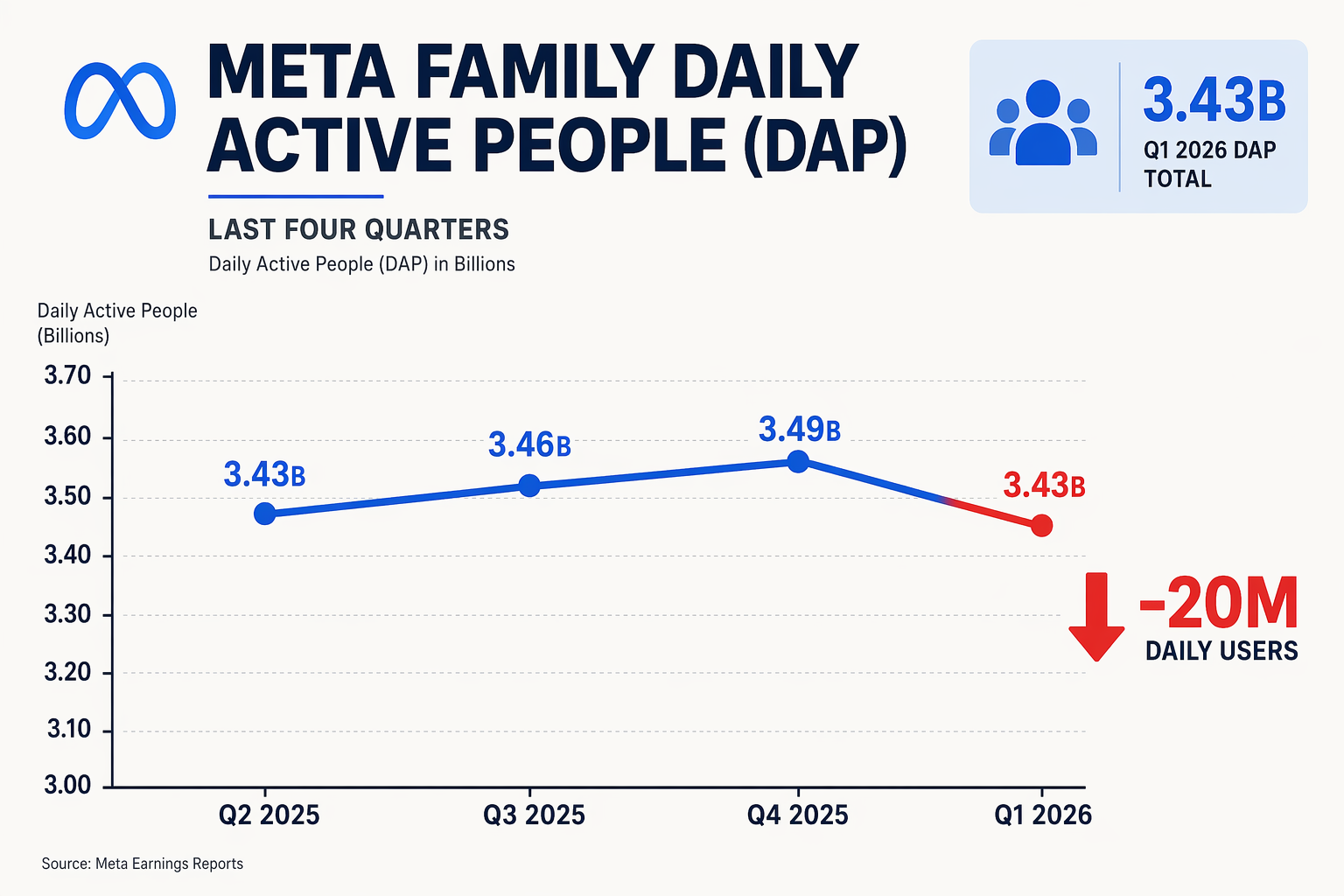
To fully grasp the significance of Meta’s recent user loss, it is essential to look at the metrics that define the company's global dominance. In its Q1 2026 earnings report, Meta revealed a rare and historic contraction: a loss of 20 million daily active users across its suite of applications, which includes Facebook, Instagram, WhatsApp, and Messenger.
This drop broke a massive, multi-quarter growth streak and marked the first major decline in overall user activity in the tech giant's history. While 20 million users represent a small percentage of Meta’s billions-strong global audience, the sudden reversal has forced a reevaluation of the platform’s absolute market stability.
Understanding the "Family Daily Active People" (DAP) Metric
To measure its reach, Meta relies heavily on a metric called Family Daily Active People (DAP). DAP tracks the number of unique individuals who log into at least one of Meta’s core apps—Facebook, Instagram, WhatsApp, or Messenger—on any given day.
- The Decline: In the first three months of 2026, this collective user pool shrank by 20 million compared to the previous quarter.
- The Financial Contrast: Paradoxically, this decline occurred alongside surging corporate profits. Meta continues to generate massive revenue, even as it pours billions of dollars into high-end AI research and compute infrastructure.
- The User Sentiment: While Meta frames the drop as an environmental anomaly, external analysts point out that growing user dissatisfaction with algorithmic feed quality and heavy ad loads on Instagram and Facebook may also be driving passive user churn.
The Official Catalysts: Geopolitics and Outages
According to Meta's executive team, including Chief Executive Officer Mark Zuckerberg, the sudden loss of 20 million daily users was not primarily driven by a sudden shift in consumer taste. Instead, the company attributed the decline to sharp, localized geopolitical developments and infrastructure blocks:
- Internet Outages in Iran: Widespread, state-sanctioned internet shutdowns and digital disruptions heavily restricted access to WhatsApp and Instagram, locking millions of active users out of the ecosystem.
- Blocks in Russia: Continued governmental bans and strict enforcement against Meta’s platforms effectively severed a massive regional user base from daily access.
Because WhatsApp is highly utilized as a primary communication tool in these regions, these regional shutdowns immediately registered as a sharp drop in worldwide daily active numbers.
The Shift Toward Omnichannel Resilience
This sudden drop highlights a critical vulnerability for modern enterprises. Businesses that rely exclusively on a single social media ecosystem for customer acquisition and support are highly exposed to sudden geopolitical shifts, regional bans, or algorithmic changes.
To mitigate these risks, forward-thinking organizations are diversifying their digital footprints. Rather than keeping all customer interactions locked inside a single proprietary messaging app, companies are turning to flexible, multi-channel communication infrastructure. Implementing platforms like CallMissed allows businesses to deploy resilient AI voice agents, WhatsApp chatbots, and multi-lingual Speech-to-Text APIs across diverse networks. By maintaining a robust, decentralized communication infrastructure, enterprises ensure they can reach their customers through automated voice and chat channels even if a specific global social media network experiences regional outages.
Key Developments
The Q1 2026 Shift: Geopolitics vs. Product Experience
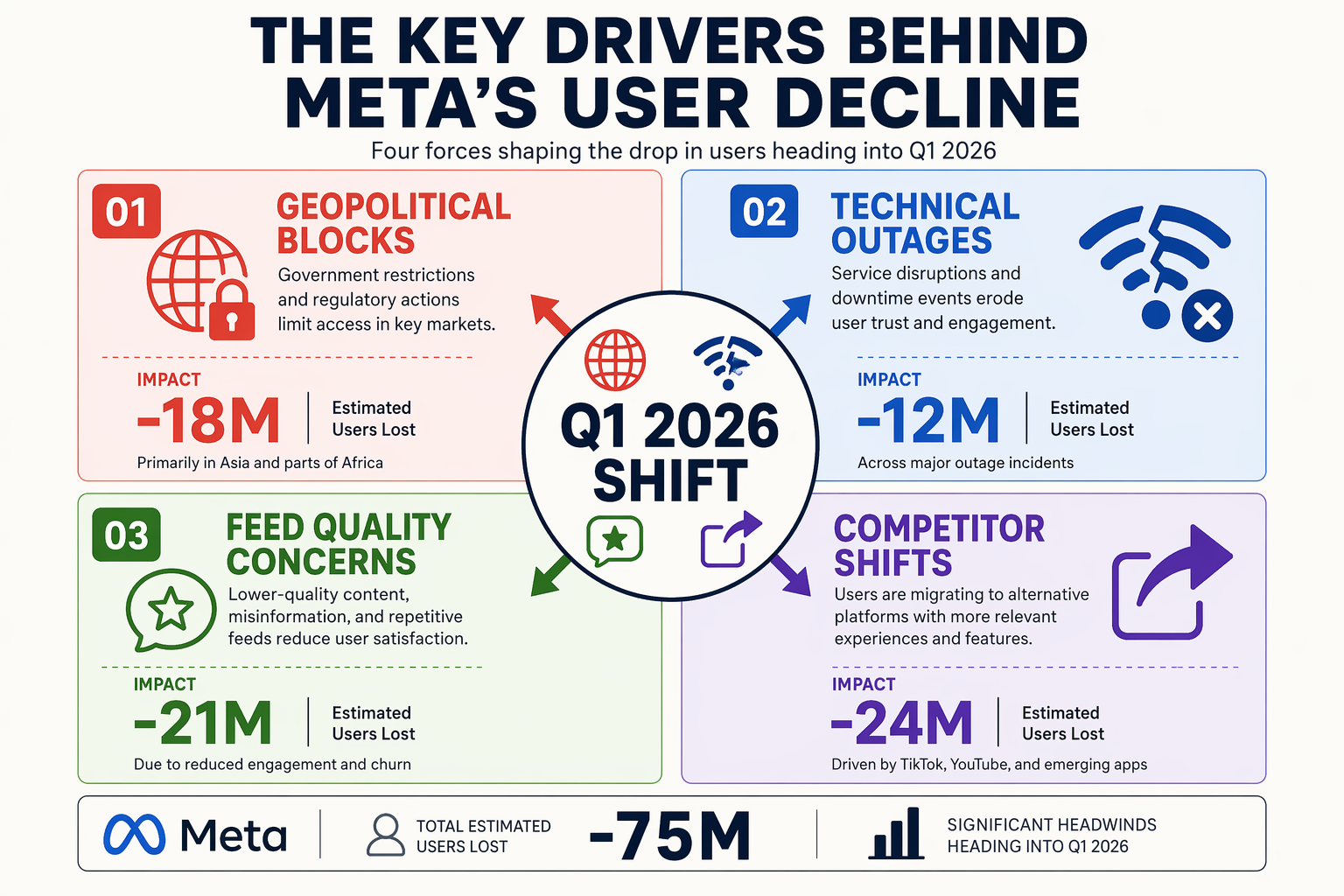
The drop of 20 million daily active users (DAP) across Meta’s family of apps—including Facebook, Instagram, Messenger, and WhatsApp—marks a significant pivot point in the company's growth trajectory. While Meta's financial health remains robust with surging profits, this rare contraction in user volume highlights the platform's vulnerability to macroeconomic and geopolitical forces.
According to Meta's executive team, led by CEO Mark Zuckerberg, the decline is largely attributed to external geopolitical factors. Specifically, ongoing internet outages in Iran and government-imposed blocks in Russia have cut off millions of users from their daily social feeds. However, industry analysts also point to internal headwinds. A growing chorus of users has raised concerns over declining feed quality, driven by aggressive algorithmic shifts toward recommended AI content and increased ad density.
Key Metrics and Developments
To understand the scope of this transition, the following table breaks down the key developments from Meta's Q1 2026 performance report:
| Key Area | Metric / Detail | Primary Cause | Long-term Impact |
|---|---|---|---|
| User Base Decline | 20 Million Daily Active Users (DAP) | Geopolitical blocks & feed quality issues | First major multi-quarter growth interruption |
| Geopolitical Hurdles | Iranian outages & Russian blocks | External government restrictions | Shrinking addressable markets in contested regions |
| Financial Standing | Surging profit margins | High monetization of existing user base | Reassures Wall Street despite shrinking user volume |
| Capital Expenditures | Billions invested in AI | Infrastructure scaling (Llama models) | Pivoting Meta from social media first to an AI-first company |
| Product Sentiment | Rising feed quality complaints | Heavy algorithmic pushing of ads and Reels | Potential long-term threat to user retention |
Diversifying Communication in an Unstable Ecosystem
This sudden contraction in Meta's user base underscores a critical lesson for modern enterprises: relying on a single third-party ecosystem for customer engagement is a high-risk strategy. If a geopolitical event or an algorithmic shift can suddenly disconnect millions of users, businesses must build resilience into their digital outreach.
This is where robust, omnichannel communication infrastructure becomes essential. Advanced platforms like CallMissed allow enterprises to mitigate these platform-specific risks. By decoupling communication from any single proprietary social channel, CallMissed enables businesses to deploy conversational AI voice agents, SMS systems, and WhatsApp chatbots backed by a multi-model API gateway featuring over 300 LLMs. Whether a customer prefers interacting via traditional telephony, WhatsApp, or localized web widgets, enterprises can maintain constant, high-quality engagement without worrying about the algorithmic or geopolitical instability of a single tech giant.
In-Depth Analysis: Why Users Are Disappearing
Geopolitical Headwinds and Access Restrictions
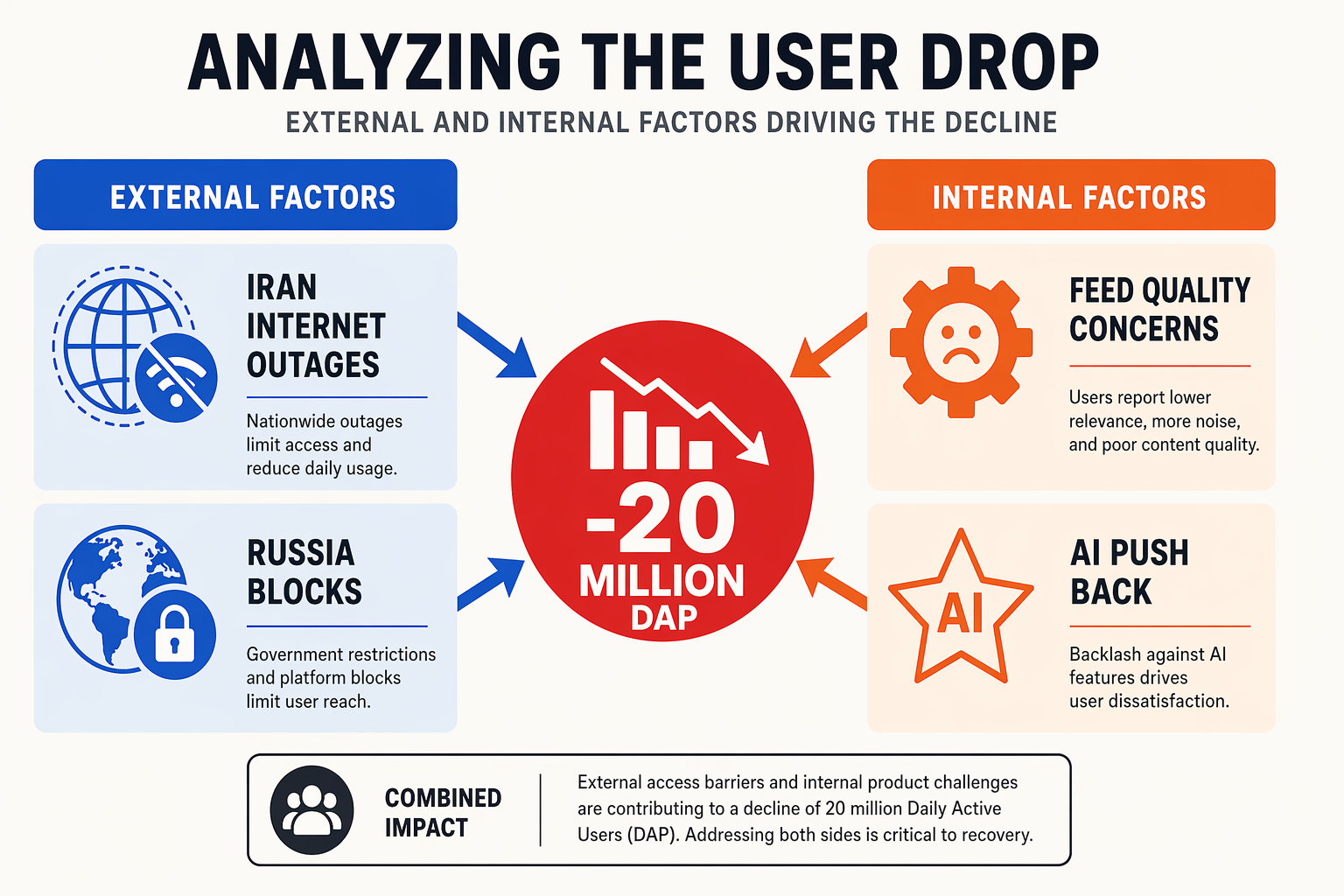
One of the most significant drivers behind Meta’s 20 million user loss during Q1 2026 comes from geopolitical turbulence and direct government action. According to statements released by Meta and widely reported by sources such as the Times of India and Inc., the company attributes much of the decline to:
- Internet outages in Iran: Nationwide blackouts and government-imposed restrictions effectively severed millions of users from WhatsApp and Instagram temporarily in early 2026.
- Network blocks in Russia: In the wake of increasing regulation and political tensions, Russian authorities expanded bans on Meta platforms, locking out millions of active users overnight.
Meta’s “Family Daily Active People” metric—which counts unique users across its core apps—reflects these steep drops. As of Q1 2026, the company saw its first ever net negative growth, with a direct loss of 20 million daily actives (Inc., TOI).
Feed Quality and Content Fatigue
Beyond external factors, Meta is simultaneously grappling with growing user dissatisfaction around feed quality. Platforms like Facebook and Instagram have faced criticism for algorithm-driven repetition, viral clickbait, and an avalanche of sponsored content. According to a 2025 Pew Research Center study, 56% of social media users globally reported increased frustration with irrelevant or low-quality feeds.
Key concerns include:
- Perceived decrease in authentic posts from friends/family
- More aggressive ad placement and AI-generated content
- Stagnant innovation compared to emerging competitors
This aligns with reports in outlets like MSN regarding the correlation between feed fatigue and active use churn (MSN). As novelty wears thin, platforms with more curated, private, or meaningful social experiences are drawing disengaged Meta users.
Intensified Competition and Platform Shifts
The social media landscape is evolving rapidly, with nimble competitors and regional platforms capturing user attention. In India and other emerging markets, for instance, AI-powered messaging and communication platforms have begun to outpace traditional social networks.
- Rise of alternative messengers: Apps like Telegram and Signal have doubled down on privacy, security, and user control, driving millions to test, and sometimes switch, from WhatsApp.
- AI-first experiences: Platforms such as CallMissed, an Indian startup, are pushing the envelope with multi-lingual AI voice agents, WhatsApp chatbots, and seamless LLM integration—addressing communication gaps that legacy social platforms overlook.
- Demographic shift: Gen Z and younger users spend more time on platforms offering short-form video (TikTok, Reels), micro-communities (Discord), or ephemeral content (Snapchat), further eroding Meta’s traditional strongholds.
Regulatory Scrutiny and Privacy Pushback
Another undercurrent is the ongoing global push for data sovereignty and digital privacy. European and Asian regulators have rolled out, or threatened, tighter controls over how platforms process personal data and moderate speech. A 2026 IDC report noted that 34% of lapsed users cite privacy or surveillance concerns as a core reason for reducing time on Meta apps.
Meta’s loss of 20 million users in just one quarter is not a random blip—it’s a multifaceted consequence of geopolitical shocks, competitive disruption, shifting tastes, and a rising expectation for privacy and relevance. In response, we’re seeing industry players double down on adaptability and innovation. Platforms like CallMissed, for example, are enabling rapid deployments of secure, multi-language conversational AI, providing alternatives as the boundaries of social communication rapidly evolve.
Impact & Implications: Financials vs. Engagement
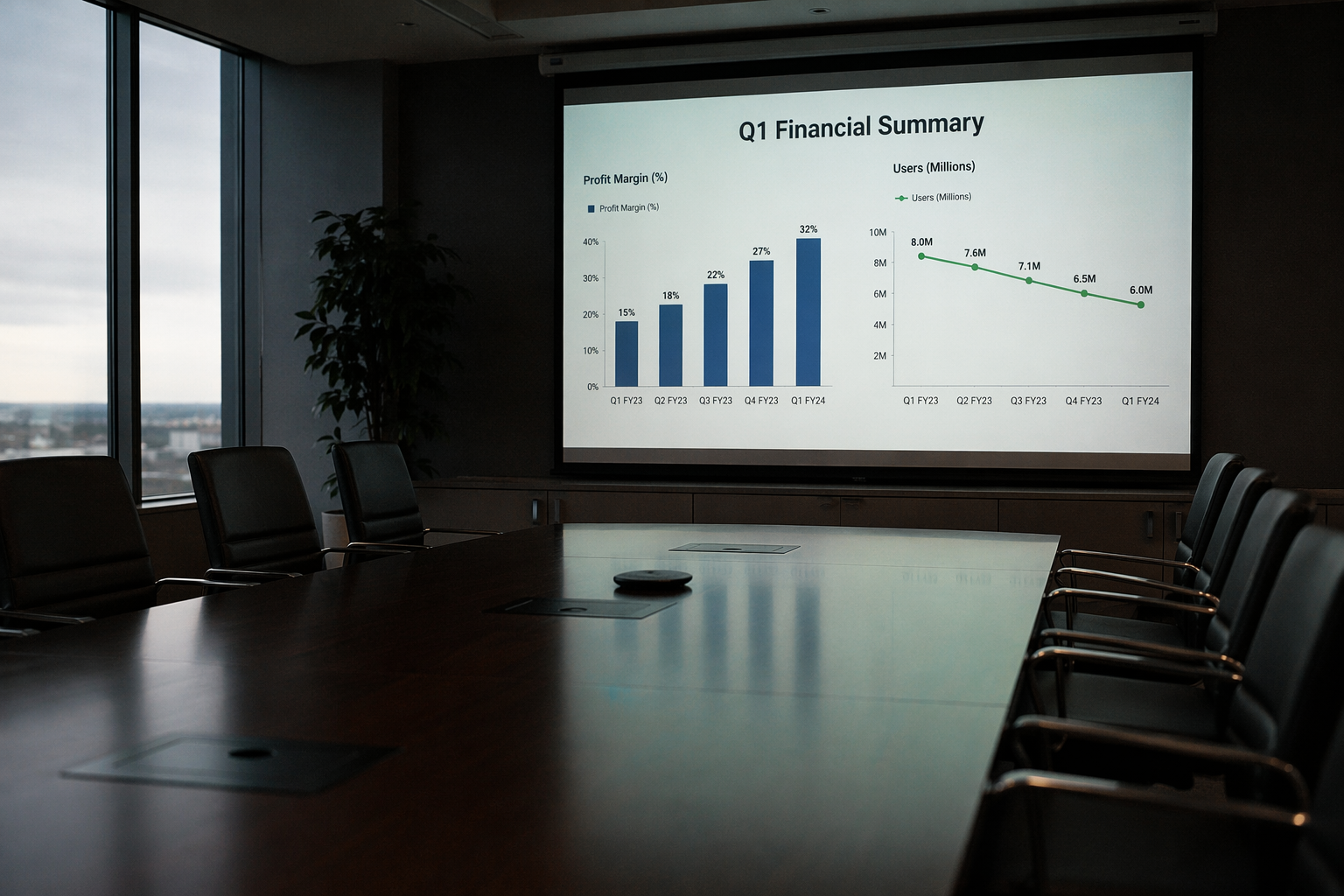
The contrast between Meta’s Q1 2026 performance metrics highlights a fascinating paradox in the tech landscape: while the company's "Family Daily Active People" (DAP) fell by 20 million users, its overall profits continue to surge. This disconnect raises a critical question for businesses and investors alike: does a drop in sheer user volume actually threaten Meta's bottom line, or is the nature of digital engagement simply shifting?
The Financial Paradox: Why Profits Keep Surging
Historically, a drop in daily active users would trigger panic on Wall Street. However, Meta's Q1 2026 financial health remains remarkably robust, driven by a heavy pivot toward monetization efficiency and massive investments in artificial intelligence.
- AI-Optimized Ad Delivery: Even with a smaller pool of users, Meta’s AI algorithms have dramatically increased ad relevance and conversion rates, allowing the company to command higher prices per ad impression.
- Geographic High-Value Retention: The loss of 20 million users was primarily driven by external geopolitical events—specifically internet outages in Iran and ongoing blocks in Russia. Because these regions generate significantly lower average revenue per user (ARPU) compared to North America and Europe, the financial impact of the decline was heavily mitigated.
- The B2B and Utility Pivot: Meta is increasingly leveraging its communication infrastructure, particularly WhatsApp Business, to drive transactional revenue. Businesses are paying to interact directly with customers, shifting the focus from passive feed scrolling to active, high-value conversations.
The Engagement Shift: From Feeds to Conversations
While CEO Mark Zuckerberg has blamed external blocks and outages for the drop, industry analysts note that growing user fatigue and "feed quality concerns" on platforms like Facebook and Instagram are also playing a role. Consumers are increasingly moving away from public social feeds in favor of private, direct messaging channels like WhatsApp.
For enterprises, this shift highlights the risk of relying solely on organic social media reach or traditional ad placement. To maintain consistent engagement, forward-thinking brands are turning to direct, automated conversational channels. This is where modern communication infrastructure becomes essential. Platforms like CallMissed allow businesses to capitalize on this shift by deploying automated WhatsApp chatbots and multilingual AI voice agents. By integrating advanced Speech-to-Text and LLM capabilities, businesses can engage their audiences directly on the messaging platforms they use daily, bypassing the volatility of algorithmic social feeds.
Long-Term Implications for Marketers
Ultimately, Meta's Q1 2026 results show that the era of chasing infinite user growth is giving way to an era of maximizing interaction depth.
- Efficiency Over Volume: Advertisers must prioritize high-intent conversational marketing over passive display ads.
- Diversification of Channels: Relying entirely on a single social network is a risky strategy; multi-channel outreach (combining voice, WhatsApp, and SMS) is now mandatory.
- AI-Driven Personalization: As Meta doubles down on billions in AI spending to keep users engaged, businesses must match that sophistication by adopting AI-driven customer communication tools to remain competitive.
Expert Opinions: Is This a Temporary Dip?
The sudden drop of 20 million daily active users (DAUs) across Meta’s suite of apps in Q1 2026 has ignited a fierce debate among tech analysts, economists, and digital marketers. Is this historic decline a minor, explainable speed bump, or does it signal the beginning of a structural decline for the world’s largest social media empire?
Industry experts are currently divided into two primary camps:
1. The Geopolitical and Infrastructure Defense
Meta’s official stance, supported by CEO Mark Zuckerberg, is that the drop in "Family Daily Active People" is primarily a temporary setback driven by external, macroeconomic forces. The company has pointed to two major catalysts:
- Widespread Internet Outages in Iran: Government-imposed shutdowns and severe connectivity issues cut off millions of active users from WhatsApp and Instagram.
- Blocks and Restrictions in Russia: Ongoing geopolitical tensions and state-level blocks continue to erode user numbers in Eastern Europe.
Supporters of this view argue that Meta's core ecosystem remains fundamentally healthy. They point out that despite the user dip, Meta's profits are surging, largely driven by highly efficient ad targeting and a massive ramp-up in backend AI investments. From this perspective, once geopolitical disruptions stabilize, user acquisition numbers will normalize.
2. The Feed Quality and Saturation Theory
On the other side of the aisle, independent tech analysts suggest that blaming geopolitics is a convenient way to mask a more concerning trend: user fatigue and declining content quality.
Critics point to growing dissatisfaction with algorithmic changes on Facebook and Instagram. Over the past year, both platforms have aggressively pushed AI-recommended content from accounts users do not follow, alongside an increased density of sponsored ads. This shift has led to what many call "feed quality decay," driving users—particularly younger demographics—to seek more direct, less cluttered communication spaces.
The Business Takeaway: Diversifying Communication Channels
For enterprises that rely on Meta's ecosystem for customer acquisition and support, this user dip is a wake-up call. Relying solely on third-party social algorithms exposes businesses to sudden drop-offs in customer reach.
To build resilience against these platform fluctuations, forward-thinking enterprises are diversifying their digital footprints. Instead of relying purely on social media feeds, companies are shifting toward direct, owned communication channels. Platforms like CallMissed are helping businesses bridge this gap by enabling them to deploy automated WhatsApp chatbots and intelligent AI voice agents. By utilizing CallMissed’s robust communication infrastructure, companies can maintain consistent, 24/7 contact with their global audience, ensuring their customer engagement remains unaffected by external social media algorithm changes or regional outages.
Ultimately, while Meta’s Q1 2026 decline may indeed be a temporary dip heavily influenced by geopolitical events, it highlights a critical reality: the digital landscape is shifting, and organizations must adapt by building multi-channel, direct-to-consumer communication strategies.
What This Means For You
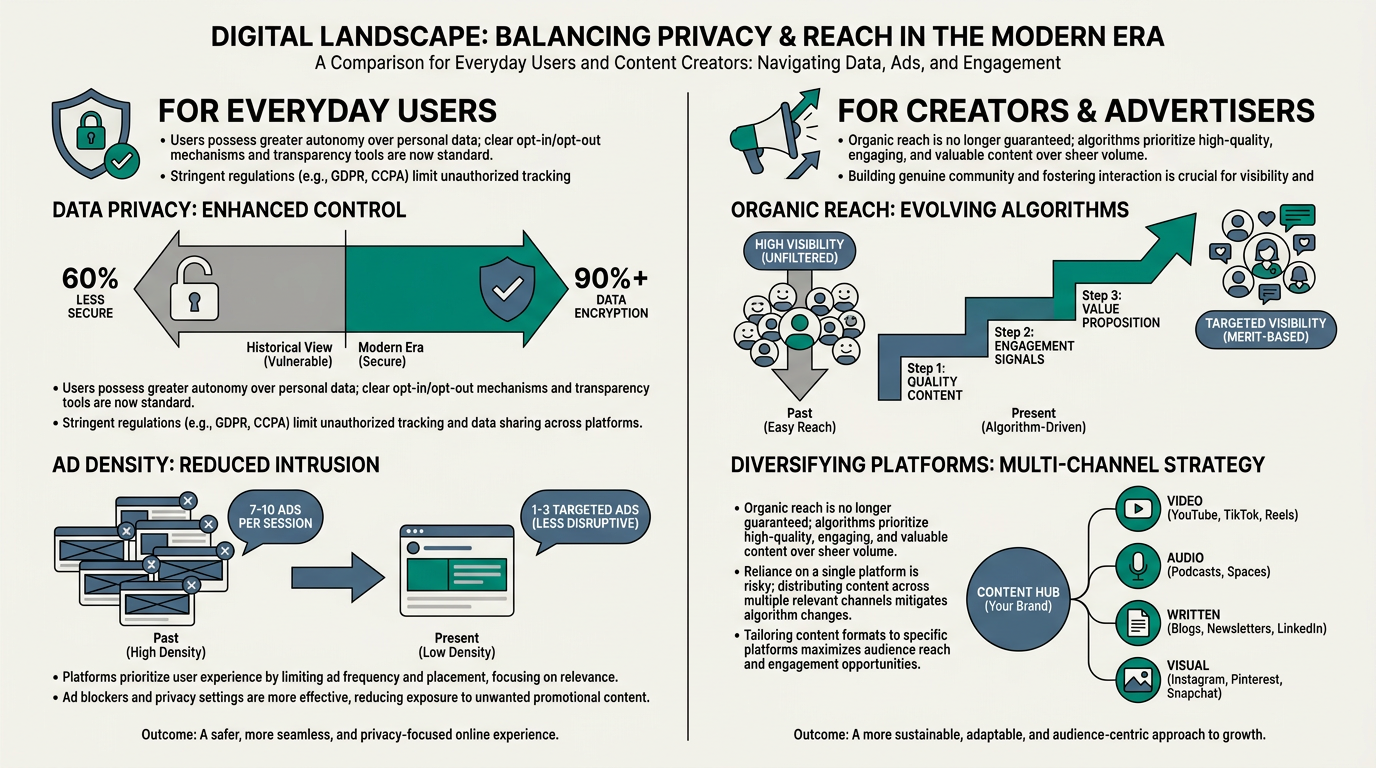
The news of Meta losing 20 million users across WhatsApp, Facebook, Instagram, and Messenger in Q1 2026 is not just an industry headline—it has immediate ramifications for users, brands, and developers worldwide. As platforms once considered ubiquitous see significant shrinkage, the implications ripple across digital communications, marketing strategies, and user choices. Below, we break down exactly what this means for different stakeholders and how alternative solutions are rising to meet evolving needs.
Key Impacts of Meta’s User Decline
| Who’s Affected | Impact Area | Example/Stat | Short-Term Effect | Long-Term Opportunity |
|---|---|---|---|---|
| Everyday Users | Messaging & Social Presence | 20 million fewer daily active users in Q1 2026 [[2]](https://www.facebook.com/techjuicepk/posts/meta-has-lost-20-million-daily-active-users-in-q1-2026-marking-the-companys-firs/1409838321172572/) | Users in blocked/internet-restricted regions lose access | Shift to localized/multilingual platforms |
| Marketers & Brands | Audience Reach & Engagement | End of Meta’s multi-quarter growth streak [[7]](https://www.msn.com/en-in/news/insight/meta-loses-20-million-users-as-feed-quality-concerns-grow/gm-GM9767D1CD?gemSnapshotKey=GM9767D1CD-snapshot-1) | Ad effectiveness and targeting suffer in affected regions | Diversify outreach: new channels & AI voice agents |
| Developers | Platform Dependence | Geopolitical blocks (Russia, Iran) cited as key factors [[5]](https://www.inc.com/moses-jeanfrancois/meta-says-profits-are-surging-but-20-million-users-just-disappeared/91338409) | API dependencies become riskier | Build for multi-platform & multi-language support |
| Emerging Markets | Access to Global Platforms | WhatsApp, Facebook still primary in many countries [[4]](https://www.reddit.com/r/technology/comments/1sztnuv/meta_lost_20_million_users_last_quarter/) | Unreliable connectivity & sudden outages possible | Local startups provide tailored services |
| AI Communication Platforms | New Growth Opportunities | Meta’s AI investment > $10B/year, but with shrinking user base [[6]](https://www.youtube.com/watch?v=sG1znSb2bKg) | Appetite for AI-powered alternatives rises | Adoption of voice agents, LLM APIs, e.g., CallMissed |
How Can You Respond?
- Users: If you’re in a region impacted by outages or restrictions, consider adopting new platforms that prioritize privacy, localization, and accessibility in your primary language.
- Brands: Rethink your communication mix. Marketers who relied solely on Meta’s reach should pilot campaigns using voice, WhatsApp chat, and even direct AI-powered outreach through alternatives.
- Developers: This is a wake-up call for platform resilience. APIs that natively support multiple languages, modalities (voice, chat), and regulatory scenarios—such as CallMissed’s API suite—offer a much safer path to scale.
- Business Leaders: Don’t wait for user migration to erode your audience. Explore communication infrastructure vendors innovating in regional language support and omnichannel automation.
- Tech Innovators: While Meta invests billions in AI, platforms like CallMissed are rapidly democratizing access to LLMs, voice bots, and speech APIs—with production-ready support for 22 Indian languages, designed for environments with unstable internet.
Concrete Next Steps
- Audit your digital communication stack: Identify Meta dependencies and test alternatives for high-risk markets.
- Experiment with next-gen platforms: Try AI-driven chat and voice agents for 24/7 engagement, especially in multilingual regions.
- Monitor platform health: Track DAU/MAU trends across providers to ensure your audience remains reachable.
- Educate and empower your users: Help employees and customers navigate disruptions confidently—offer resources and guidance on switching platforms.
As Meta’s user base shifts, the need for robust, flexible, and future-proof communication strategies grows. For businesses, this moment underscores the urgency of diversifying channels and integrating tools—like those offered by CallMissed—that aren’t tied to a single provider or nation’s geopolitics. The digital landscape is changing: the winners will be those that adapt quickest to user migration, localization needs, and the ongoing rise of AI-driven infrastructure.
Frequently Asked Questions
To help you understand the broader implications of Meta's historic user decline, we have compiled the most frequently asked questions surrounding this shift. From geopolitical factors to technological alternatives, here is everything you need to know.
Why did Meta lose 20 million users across WhatsApp, Facebook, Instagram, and Messenger?
Is the news that Meta loses 20 million users a sign of permanent decline for WhatsApp?
How does the Q1 2026 user drop impact Meta's overall financial performance and AI investments?
Are feed quality concerns related to why Meta lost 20 million users last quarter?
What is the difference between Daily Active People (DAP) and Monthly Active Users (MAU) in Meta's reports?
How can global businesses maintain stable customer support despite social media outages?
Conclusion
While Meta’s historic Q1 2026 user decline marks a critical shift in the digital landscape, it also highlights a broader transition in how we connect online. Here are the key takeaways from this unprecedented drop:
- Geopolitical Vulnerabilities: External factors, including internet outages in Iran and ongoing blocks in Russia, demonstrate how vulnerable centralized platforms remain to regional disruptions.
- Feed Fatigue: Rising concerns over feed quality suggest that users are increasingly fatigued by traditional, algorithm-heavy social networks.
- The Pivot to AI: Meta's massive investments in artificial intelligence reveal that the future of digital engagement lies in intelligent, utility-driven agents rather than passive social scrolling.
Moving forward, watch closely as enterprises and creators pivot away from volatile social feeds, focusing instead on direct, interactive engagement channels. To explore how AI communication is evolving, check out CallMissed — an AI infrastructure platform powering voice agents and multilingual chatbots for businesses. Is your brand ready to adapt as the global social media landscape fractures?
Discussion
Related Posts

Ready to automate customer conversations?
Launch AI voice agents and WhatsApp bots with CallMissed — one API, 22+ Indian languages.