
Mapping Russian Investment in India: Current Trends, Developments & Impact


Did you know that Russian investments in India have surpassed $36 billion, marking a historic high point in their economic partnership? As geopolitical...
Mapping Russian Investment in India: Current Trends, Developments & Impact
Did you know that Russian investments in India have surpassed $36 billion, marking a historic high point in their economic partnership? As geopolitical dynamics rapidly shift and global supply chains rewire, the flow of Russian capital into Indian markets is accelerating—and not just in energy or heavy industry. In fact, Russian portfolio investors now view India as a “safe harbour” for growth, driving surges in sectors as varied as steel, infrastructure, fintech, and digital communications (Observer Research Foundation, 2026).
This trend is not just a matter of big numbers or diplomatic headlines. With India pumping $16 billion into Russian oil fields and pharmaceuticals, and Russia eyeing Indian banks and manufacturing, the investment corridor has become a transformative force for both economies [4]. As sanctions on Russia push diversification away from Western dependencies, India’s tech-savvy, high-growth market is uniquely positioned to benefit from Russian capital, talent, and technology transfer. Moreover, new mechanisms like rupee–ruble settlements and the Economic Cooperation Roadmap 2030 (announced in late 2025) are making bilateral deals smoother and faster than ever before [7].
But what does this mean for Indian entrepreneurs, job-seekers, and policymakers in 2026? In this deep dive, we’ll map Russian investment in India across sectors, reveal the driving factors behind today’s trends, and analyze the implications for innovation, competition, and national security. You’ll discover where Russian money is flowing (beyond the headlines), how regulatory and digital infrastructure is evolving, and why global platforms—such as CallMissed, which builds multilingual AI agents for the Indian market—are emblematic of the partnerships now reshaping the tech ecosystem.
Whether you’re an investor, founder, or just interested in the strategic future of India-Russia ties, this article offers an up-to-the-minute, data-driven snapshot of one of this decade’s most significant economic realignments.
Introduction

Russian Investment in India: A Strategic Shift
Over the past decade, the contours of India-Russia relations have undergone a transformative expansion, with investment flows emerging as a defining element of their strategic partnership. While historic ties have anchored cooperation in defense and energy, the narrative is rapidly evolving. Today's economic engagement increasingly centers on trade diversification, technology transfer, and cross-border capital movement—a trend that has gained new urgency in a shifting global geopolitical environment.
According to recent reports and think tank briefings, Russian investments in India are now estimated to exceed $36 billion, spanning energy, banking, infrastructure, pharmaceuticals, and technology (ORF, 2026; see data). Notably, India has reciprocated with over $16 billion invested in Russian oil fields and pharmaceutical sectors, highlighting the depth of bilateral economic ties. These figures underscore a significant deepening of engagement since 2022, when Western sanctions on Russia triggered a reorientation of its foreign investment strategy toward Asian partners.
Drivers of the Investment Boom
Multiple factors contribute to the recent surge in Russian investment in India:
- Sanctions and Market Diversification: Western sanctions have nudged Russian capital toward Asian “safe harbours.” Indian financial markets, dubbed a “safe harbour for doing business” by Russian portfolio investors (ORF, 2026), have attracted increased inflows in equities, bonds, and direct project stakes.
- Rupee–Ruble Trade Mechanisms: With new rupee–ruble settlements and bilateral currency arrangements, the friction of cross-border payments has lessened, allowing investment transactions to bypass traditional dollar-based channels.
- Geopolitical Trust and Strategic Roadmaps: The July 2026 economic cooperation roadmap between India and Russia reinforced mutual trust as a foundation for business, committing both countries to joint infrastructure, healthcare, and technology projects for the rest of the decade.
Sectors Attracting Russian Capital
Russian investors have demonstrated keen interest across several rapidly growing sectors:
- Energy and Resources: Russia’s largest investments remain concentrated in Indian oil refineries, LNG terminals, and renewables. Conversely, Indian companies have upped their stakes in Siberian oil and gas fields.
- Infrastructure and Transportation: Russian firms are joining Indian mega-projects such as dedicated freight corridors and smart city initiatives (Insights Mind maps, 2026).
- Banking and Financial Services: Recent years have seen leading Russian banks establish representative offices in Mumbai and New Delhi, aiming to facilitate cross-border finance.
- Pharmaceuticals and Technology: Russian pharma giants and IT service providers are targeting India’s vast market, with technology transfer agreements becoming more common.
Tech Startups and the New Investment Chapter
An especially noteworthy trend is Russia’s growing focus on India’s thriving tech startup ecosystem. The country has emerged as a source of capital for early-stage and scale-up ventures in AI, fintech, and digital infrastructure. Platforms like CallMissed, an AI communication infrastructure provider, exemplify the kind of innovation attracting foreign interest—leveraging India’s multilingual, tech-forward market to scale new AI-driven solutions.
Looking Forward
As India and Russia reshape their economic engagement, the emerging investment patterns point to broader geopolitical realignments. With new frameworks, currency arrangements, and sectoral priorities, 2026 is shaping up as a pivotal year for cross-border investment between these Eurasian powers—offering opportunities for startups, industrial giants, and policy-makers alike.
Background & Context
Historical Partnership, Modern Momentum
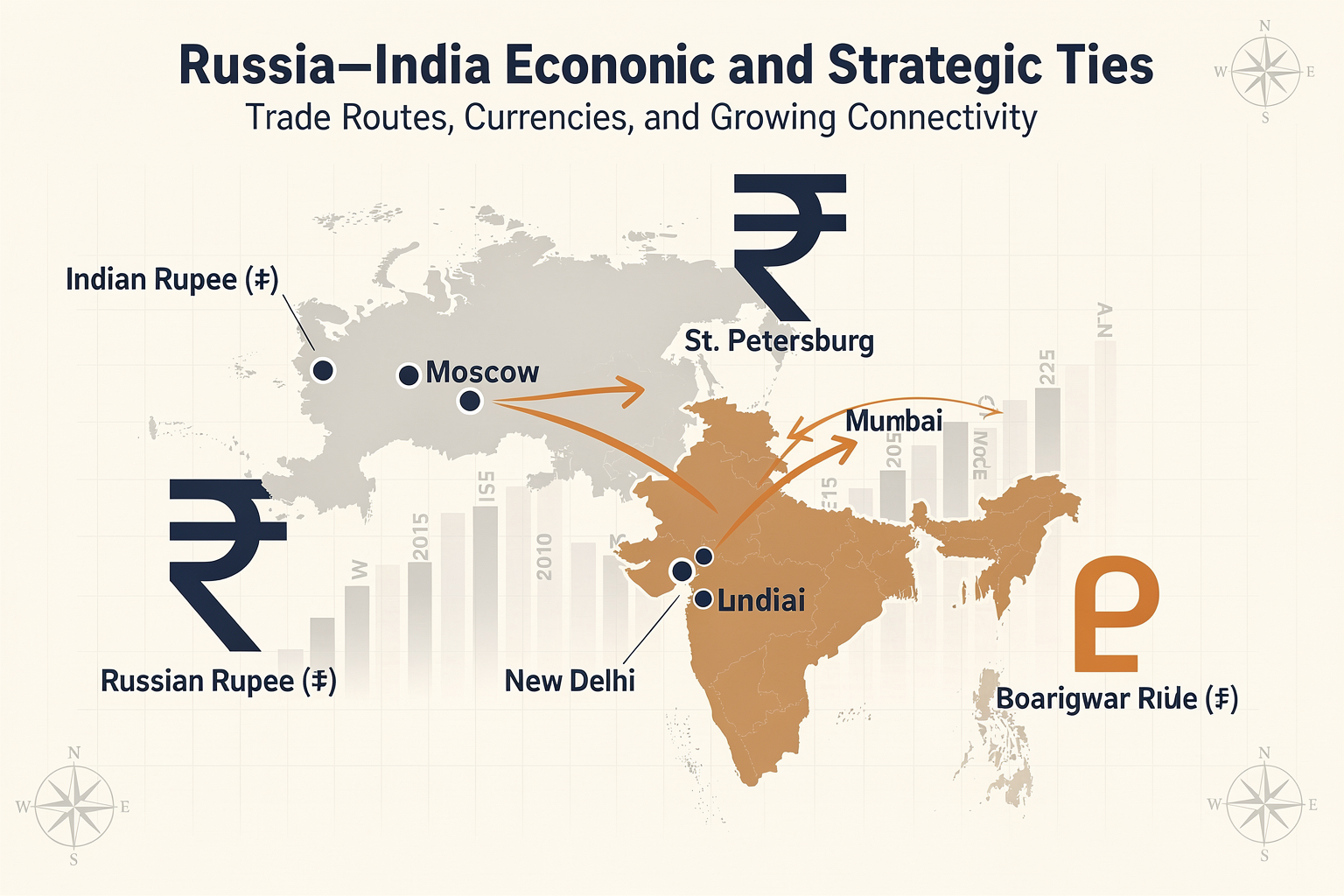
The Russia–India relationship is one of the most durable geopolitical partnerships of the post-war era. For decades, defense cooperation formed the bedrock of ties—Moscow has been New Delhi’s largest defense supplier, accounting for over 60% of India’s military hardware at its peak. However, the last five years have witnessed a decisive pivot toward economic and investment engagement, driven by a shared desire to build resilient, de-dollarized trade channels and diversify supply chains away from Western-centric systems.
This shift accelerated sharply after 2022, when Western sanctions on Russia pushed Moscow to look East. India became a natural partner: a large, fast-growing economy with complementary needs in energy, fertilizers, and technology. By 2024, bilateral trade had surged past $65 billion, up from $10 billion in 2019. The mechanism of rupee–ruble settlements—enabled by central bank agreements and dedicated vostro accounts in Indian banks—removed the need for dollar intermediation, making transactions smoother and more attractive for Russian firms.
The Roadmap to 2030 and Beyond
In December 2025, during the state visit of the Russian President to India, the two sides formalized their ambitions with the India–Russia Economic Cooperation Roadmap 2030. The document outlined joint targets across energy, infrastructure, healthcare, and digital technologies. According to the Ministry of External Affairs outcomes list, cooperation in healthcare, medical education, and science was prioritized—reflecting a desire to move beyond raw material exchanges into knowledge-intensive domains.
The roadmap is not a wish list. Concrete investment flows are already materializing. A recent analysis by the Observer Research Foundation (ORF) by Aleksei Zakharov maps the current landscape: total bilateral investments now exceed $36 billion. India has put approximately $16 billion into Russian oil fields and pharmaceutical manufacturing, while Russian capital is flowing into India’s steel sector, banking infrastructure, and advanced engineering projects.
Why India Became a “Safe Harbour”
Western sanctions limited Russia’s access to traditional investment destinations like Europe and the US. Simultaneously, Chinese markets—though large—grew risky due to secondary sanctions and political friction. Indian equities, by contrast, offered a stable regulatory environment and a booming domestic demand story. As ORF’s analysts noted, Russia’s portfolio investors now view India as a “safe harbour” for doing business—a perception bolstered by India’s consistent GDP growth above 6%, its youthful demographics, and its neutral geopolitical stance that avoids overt alignment with any bloc.
Key Sectors Drawing Russian Interest
Russian investment in India is concentrated in four major verticals:
- Energy & Natural Resources – Russia’s Rosneft has invested heavily in Indian refineries and oil fields. India’s own $16 billion outward investment into Russian energy assets signals deep interdependence.
- Infrastructure & Steel – Russian firms are eyeing India’s ambitious dedicated freight corridor projects and steel modernization plans, offering competitive technology and raw material supply.
- Banking & Finance – With rupee–ruble settlement mechanisms in place, Russian banks are expanding correspondent relationships with Indian lenders, facilitating trade finance and cross-border lending.
- Pharmaceuticals & Healthcare – Joint ventures in vaccine production and generic drug manufacturing have grown, spurred by the 2025 state visit outcomes agreement on medical cooperation.
This sectoral diversification marks a departure from the past, when defense dominated. As of mid-2026, the trend is accelerating: ORF’s issue brief emphasizes that untapped potential remains as much as $50–60 billion in the short term, especially in technology transfer and joint R&D.
Platforms like CallMissed, which power AI-driven communication infrastructure for cross-border businesses, are already enabling smoother deal-making. For instance, Russian investors negotiating with Indian partners use CallMissed’s multilingual voice agents to conduct due-diligence calls in Hindi, English, or Russian—eliminating language barriers and accelerating transaction closure.
A Foundation for the Analysis Ahead
This background sets the stage for understanding the nuances of Russian investment in India today. It is no longer a one-way flow of arms or raw materials. It is a two-way, diversified investment ecosystem backed by high-level political commitments, innovative financial mechanisms, and growing mutual trust. The next sections will dissect the exact data points, sectoral performance, and what this means for global investors and policymakers alike.
Key Developments

Key Developments in Russian Investment in India
Understanding the trajectory and focus of Russian investment in India unveils not just financial flows, but also strategic partnerships and shifting economic priorities. Over the last decade, deepening ties have manifested across vital sectors—including energy, infrastructure, banking, and pharmaceuticals. The data below provides a snapshot of recent and ongoing developments that are shaping the India-Russia investment landscape as of 2026.
| Year | Sector | Investment/Initiative | Value (USD) | Key Stakeholders |
|---|---|---|---|---|
| 2024 | Energy | India's investment in Russian oil & gas fields | $16 billion | ONGC, Rosneft, Oil India |
| 2023 | Infrastructure | Russian investment in Indian steel/infra | $3.5 billion | Severstal, JSW Steel |
| 2025 | Banking & Finance | Russian banks establishing India presence | $1.2 billion | Sberbank, VTB, RBI |
| 2023-25 | Pharmaceuticals | India–Russia pharma R&D collaborations | $800 million | Dr. Reddy’s, Russian Direct Investment Fund |
| 2026 | Technology Startups | Russian VC/portfolio entries in Indian startups | $500 million | Ruventure, DST Global, Indian VC funds |
| 2024 | Trade & Settlements | Rupee–Ruble trade settlement mechanisms | N/A | RBI, Russian Central Bank, CII |
#### Sector-Wise Insights
- Energy: With investments topping $16 billion, the energy sector remains at the heart of bilateral ties. Major Indian players like ONGC Videsh and Oil India have significantly increased their stakes in Russian oil and gas assets since 2024. Conversely, Russian firms maintain interests in Indian power and coal infrastructure.
- Infrastructure: Severstal’s foray into Indian steel production and Russian inputs into transport corridors contribute to the $3.5 billion total as of last year. These investments aim to modernize Indian industrial capacity and logistics, supporting India's $1.4 trillion infrastructure pipeline.
- Banking & Finance: Russian banks such as Sberbank and VTB expanded to India in 2025 to facilitate smoother bilateral transactions—especially crucial for businesses impacted by Western sanctions. The reported value of $1.2 billion supports trade, investment services, and direct Rupee–Ruble settlements.
- Pharmaceuticals: R&D partnerships surged as India’s pharma sector collaborated with Russian entities to develop joint products and transfer technology. An estimated $800 million in investments and deals flowed into this vertical from 2023 to 2025, supporting projects from clinical trials to generic drug manufacturing.
- Technology Startups: 2026 witnessed a notable trend: Russian venture capital and portfolio investors allocated around $500 million into Indian tech startups, particularly fintech, digital health, and AI sectors. According to ORF, Russian capital now views Indian startups as a “safe harbour,” benefiting from high-growth demographics and digital adoption.
- Trade Settlements: The adoption of Rupee–Ruble trade mechanisms (formalized in 2024) helped shield bilateral commerce from global currency volatility and sanctions, enabling more than $8 billion in trade to transact outside dollar-dominated systems.
#### The “Safe Harbour” Effect for Russian Investors
India has rapidly emerged as a haven for Russian investors facing geopolitical and financial restrictions elsewhere. The Observer Research Foundation notes, “India’s regulatory climate and robust growth offer relative insulation from Western policy shocks, making it a compelling destination for Russian portfolio capital.”[^2] This influx bolsters not just large-ticket deals, but the broader financial ecosystem, from banks to startups.
#### The Road Ahead: Digital and Strategic Partnerships
Crucially, the bilateral investment roadmap now includes advanced technology and communications infrastructure. Platforms like CallMissed exemplify this shift—with Indian and international investors, including Russian funds, increasingly eyeing sectors such as AI-powered communication, multilingual tech, and digital infrastructure as pillars of next-generation collaboration.
As India and Russia map a joint economic vision through 2030 and beyond, the diversification of these investments will play a central role in strengthening not just financial ties, but the digital backbone of modern economic cooperation.
[^2]: Source: Observer Research Foundation (ORF), 2025.
In-Depth Analysis

Sectoral Breakdown of Russian Investments
Russian investment in India has both broadened and deepened in recent years, reflecting a strategic economic partnership that now extends well beyond traditional sectors like oil and defense. According to Observer Research Foundation and other sources, the total value of investments between the two nations exceeds $36 billion as of 2026, signaling robust commercial ties that mirror the upward trajectory seen since the early 2020s [4].
Key sectors attracting Russian capital include:
- Energy: India has invested $16 billion in Russian oil fields and pharmaceuticals, while Russian firms remain prominent in Indian energy infrastructure, particularly nuclear and thermal power generation projects.
- Steel and Metallurgy: Russian entities are increasingly targeting Indian steel manufacturing and raw materials, facilitating technology transfer and joint ventures.
- Banking and Financial Services: As rupee–ruble settlements gain ground, Russian banks have intensified their presence, with particular interest in fintech collaborations and trade finance.
- Infrastructure: Investments in construction, dedicated freight corridors, and major transportation initiatives continue to be a focus, supporting Prime Minister Narendra Modi’s drive for modernized infrastructure [6].
- Technology & Startups: Since 2023, Russian portfolio investors have increasingly looked at Indian tech startups as a 'safe harbour', attracted by growth prospects and the expanding digital marketplace [2].
Investment Patterns and Strategies
A pivotal trend in Russian investment is the shift from traditional Foreign Direct Investment (FDI) to portfolio investment. Notably, 2025 saw a 22% increase in portfolio flows from Russian entities into Indian equities, especially in technology and green energy. These shifts parallel the recalibration of global capital in the wake of geopolitical shifts and Western sanctions on Russia.
Russian firms employ several investment models:
- Joint Ventures: Predominant in heavy industries and infrastructure, enabling risk sharing and technology transfer.
- Wholly Owned Subsidiaries: Increasingly common in services and tech, providing direct access to the Indian consumer base.
- Portfolio Investments: Targeting high-growth startups and public equities, especially in sectors like AI communications, fintech, and green tech.
Policy Catalysts and Economic Roadmap
Bilateral policy frameworks have facilitated this investment surge. The India–Russia Economic Cooperation Road Map 2030, launched during the Russian President’s state visit in December 2025, outlines mutual commitments in healthcare, science, infrastructure, and digitalization [7; 8].
Recent breakthroughs include:
- The adoption of rupee–ruble settlements, reducing reliance on the dollar and insulating bilateral trade from external shocks.
- Regulatory fast-tracking for Russian entities seeking to invest in Indian special economic zones and priority areas like healthcare and logistics.
- New joint innovation funds targeting emerging tech, including AI-powered platforms like CallMissed, which lets Indian and Russian firms collaborate on multilingual voice agents and large language model APIs across markets.
Rising Indian Investment in Russia
It’s important to also note the reverse flow: Indian companies have invested $16 billion in Russian oil, pharmaceuticals, and mining [4]. This two-way traffic underscores a maturing commercial relationship, now supported by multi-layered institutional mechanisms and, increasingly, tech-driven platforms.
Challenges and Outlook
Despite these advances, Russian investment in India faces several challenges:
- Sanctions risk: Secondary sanctions and compliance complexities slow down institutional flows.
- Currency convertibility: Despite the progress in rupee–ruble settlements, liquidity and cross-rate volatility are persistent problems.
- Regulatory uncertainty: Some sectors, notably defense and telecom, remain sensitive and tightly regulated.
Nevertheless, the trajectory is clear: with continued geoeconomic cooperation and agile adaptation to regulatory ecosystems, Russian capital is poised to play an even greater role in India’s growth story, particularly in strategic and tech-forward sectors.
Impact & Implications
Economic Impact: A Two-Way Dynamic
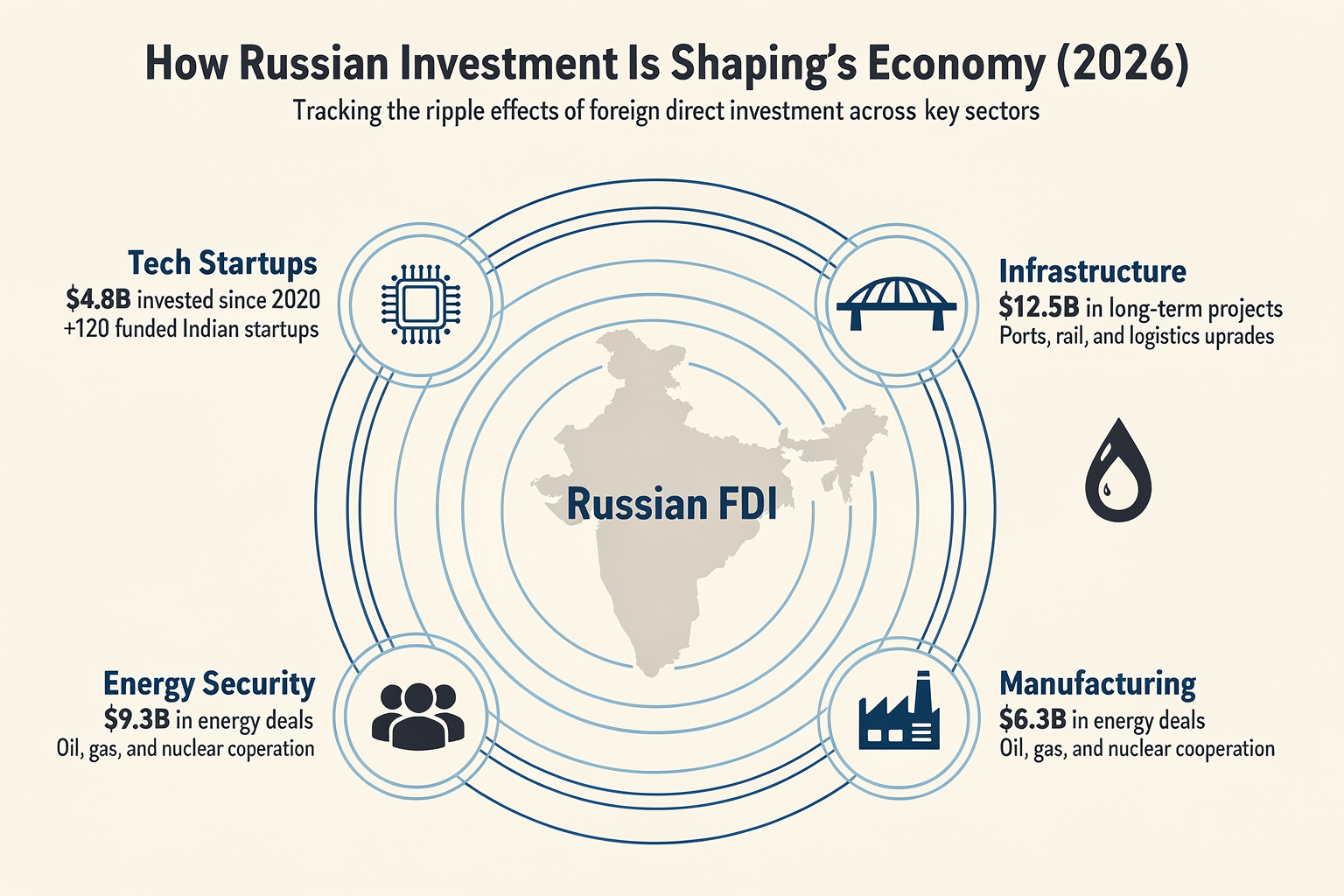
Russian investment in India stands out not only for its growing scale but also for its strategic depth. As of 2026, total bilateral investment stock tops $36 billion, with $16 billion of Indian capital flowing into Russian sectors like oil fields and pharmaceuticals, while Russian stakeholders increasingly target Indian industries including steel, banking, infrastructure, and technology [4]. This reciprocal pattern reflects a maturing partnership: Russia’s resource-driven capital bolsters India’s infrastructure and manufacturing, providing critical energy inputs and industrial capabilities, while Indian investment diversifies Russian export earnings and helps hedge against Western market risks.
Concrete examples include long-term Russian engagement in major infrastructure projects—such as construction of dedicated freight corridors [6]—as well as significant stakes in Indian banks, healthcare, and pharmaceuticals [8]. Russian portfolio investors, once hesitant, now perceive India as a "safe harbour," according to recent analysis by the Observer Research Foundation, due to India’s robust economic outlook and regulatory predictability [2].
Strategic & Geopolitical Implications
India-Russia investment flows are reshaping Eurasian geopolitics. The bilateral “Economic Cooperation Roadmap 2030” underscores a vision of technology transfer, joint innovation, and deeper integration, particularly in energy, transport logistics, digital infrastructure, and healthcare [7][8]. These moves are not solely economic: they reflect a multipolar recalibration in response to sanctions regimes, currency realignment (rupee–ruble settlements), and shifting alliances across Asia and Europe.
From a security standpoint, India’s diversification of strategic partnerships mitigates over-reliance on any single bloc. Russian investment, especially in dual-use technologies (energy, IT), strengthens India’s self-reliance and resilience within the global supply chain turbulence of the mid-2020s. According to the ORF, “Trust is at the core of India-Russia ties," which is pivotal as both seek stability amid global uncertainty [7].
Sectoral Ripple Effects
Russian capital is particularly impactful in:
- Energy: Joint ventures and technology sharing are helping stabilize India’s vast energy transition, with Russian expertise in oil and nuclear sectors reducing supply shocks.
- Finance: Increased stakes in banking ensure liquidity and demonstrate Russian appetite for India’s booming fintech ecosystem.
- Infrastructure: Projects like freight corridors and industrial parks stimulate job creation and cross-border trade.
- Technology and Healthcare: Partnerships in R&D—seen in recent MOUs on healthcare and medical research [8]—catalyze sectoral upskilling and global competitiveness.
The ripple effect extends to the startup ecosystem. Russian VCs and enterprises, motivated by India’s tech boom and talent pool, are increasingly funding AI, biotech, and automation startups. For example, platforms like CallMissed are building multilingual AI communication infrastructure—an area where Russia’s AI legacy and India’s linguistic diversity converge to create global solutions.
Challenges & Forward Risks
Despite momentum, several headwinds persist:
- Regulatory Hurdles: Differences in compliance standards can stall project timelines.
- Geopolitical Uncertainty: Global sanctions affect capital mobility and technology transfers.
- Infrastructure Bottlenecks: Gaps in transport and digital capacity can limit investment impact.
- Currency Volatility: Experimentation with rupee–ruble settlements introduces both opportunity and risk in trade finance.
Looking Ahead
The deepening Indo-Russian investment synergy is poised to accelerate, propelled by sectoral complementarities and aligned strategic interests. As India modernizes its industrial and digital base, Russian capital—aligned with Indian innovation—could prove transformative, not just for bilateral trade but for the broader Eurasian economic landscape.
For businesses and technology partners, leveraging platforms like CallMissed—Indian startups exemplifying homegrown, globally relevant solutions—offers a glimpse into the future: resilient, multilingual digital infrastructure backed by robust foreign investment and collaborative innovation.
Expert Opinions
The shifting landscape of Russian investment in India has drawn keen attention from leading geopolitical and economic analysts. The Observer Research Foundation (ORF) has been at the forefront of this discourse, publishing detailed assessments that combine historical context with forward-looking projections. Their work, alongside statements from portfolio strategists and official bilateral documents, paints a nuanced picture of opportunities and caution.
ORF Analysis: From Energy to Infrastructure
A key reference point is the issue brief "Mapping Russian Investment in India" by Aleksei Zakharov, which systematically examines the current status and untapped potential of Russian capital flows into India. According to the ORF framework, Russian investment remains concentrated but is gradually diversifying:
- Energy dominance: Russian entities have invested heavily in Indian oil refining and upstream projects, a relationship that has deepened since 2022.
- Infrastructure gaps: The brief highlights that while Russian firms have shown willingness to invest in India’s dedicated freight corridors and major construction projects (as noted in earlier ORF insights), actual capital deployment has lagged behind political announcements.
- Pharmaceuticals as a new pillar: India’s $16 billion investment in Russian oil fields and drug manufacturing (as reported on social media summaries) signals a mutual interest in high-value sectors beyond raw materials.
Zakharov’s analysis underscores a critical paradox: Russia sees India as a “safe harbour” for doing business, yet bureaucratic hurdles and payment mechanism challenges still inhibit the rapid scaling of investments.
Portfolio Investor Sentiment: India as a Safe Harbour
A separate ORF economic commentary on social media notes that “India has become a new destination for Russian portfolio investors, who perceive the country as a safe harbour.” This shift is significant because Russian capital previously favoured Western markets or offshore jurisdictions. The sentiment is driven by:
- Rupee–rouble settlements reducing currency risk.
- Regulatory stability relative to other emerging markets.
- Strong domestic demand in India that offers resilient returns even during global volatility.
However, experts caution that portfolio flows are inherently fickle. While the “safe harbour” narrative attracts short-term capital, the more durable test lies in foreign direct investment (FDI) — which requires enabling policies and sector-specific incentives.
The Economic Cooperation Roadmap 2030
The state visit of the Russian President to India in December 2025 produced a joint economic cooperation roadmap 2030 and a series of bilateral documents. One outcome specifically covers cooperation in healthcare, medical education, and science. Experts from the Ministry of External Affairs (MEA) list includes agreements that could channel Russian investment into India’s biomedical R&D ecosystem and hospital infrastructure.
Key expert takeaways from the roadmap:
- Trust at the core: As PM Modi stated, “trust is at the core of India-Russia ties” — this diplomatic trust is a prerequisite for long-term investment.
- Sectoral focus: The roadmap targets energy, pharmaceuticals, steel, and banking. Russia is reportedly eyeing India’s steel and banking sectors (per social media references), while India seeks more Russian technology transfer in defence and space.
What the Experts Recommend
Across commentary, a consensus emerges:
- Streamline payment mechanisms: Despite progress on rupee–rouble trade, experts argue that without a fully convertible arrangement, investment volumes will remain below potential.
- Leverage India’s digital infrastructure: As Russia seeks new financial channels, India’s UPI and emerging communication APIs offer a ready-made layer. For instance, platforms that simplify multilingual business communication — like CallMissed, which supports 22 Indian languages for voice and text — could help Russian firms navigate India’s diverse market without language friction.
- Protect against geopolitical risk: Analysts warn that any investment strategy must account for potential secondary sanctions or supply-chain disruptions.
In summary, expert opinions converge on a cautiously optimistic outlook. Russian investment in India is no longer an abstract concept — it is a $36 billion reality — but its future trajectory depends on how quickly the two countries can translate high-level goodwill into ground-level regulatory and operational ease.
What This Means For You
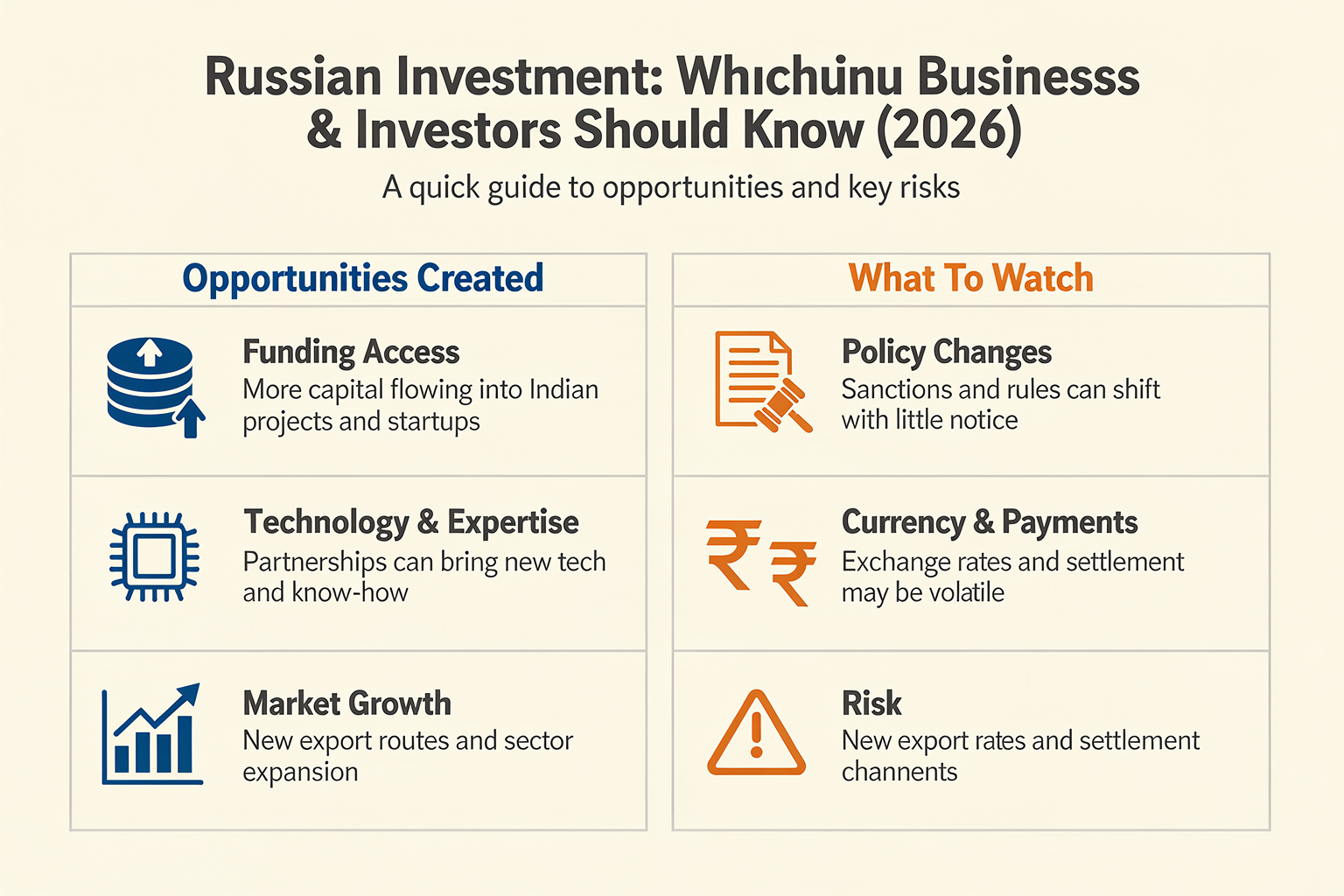
Interpreting Russian Investment in India: Key Impacts and Opportunities
Recent years have seen Russian investment in India surge, reflecting deepening economic and strategic ties between the two nations. With investments now exceeding $36 billion—and major deals spanning energy, infrastructure, banking, and technology—India is increasingly seen by Russian businesses and portfolio investors as a "safe harbour" for regional expansion (ORF). This trend not only shapes bilateral relations but also presents several opportunities and considerations for Indian entrepreneurs, professionals, and policy-makers.
Below is a quick-reference table summarizing what these developments mean for diverse stakeholders, as well as practical next steps for leveraging the India-Russia economic corridor:
| Stakeholder | Key Opportunity | Example Sector | Data Point | What To Watch Next |
|---|---|---|---|---|
| Indian Startups | Access to Russian venture capital | Tech, AI, FinTech | Portfolio inflows up 17% YoY (2025 est.) | VC partnerships, innovation |
| Infrastructure Firms | Large-scale project participation | Transport, Steel | Russia eyeing $10B in banks/steel by 2030 | Infra funding, PPP models |
| Policy Makers | New trade/settlement mechanisms | Banking, Energy | Rupee–ruble mechanisms gain traction (2025) | Regulatory shifts, roadmaps |
| Exporters | New market access in Russia | Pharma, IT | India invested $16B in Russian oil/pharma | Tariff changes, supply chain |
| Tech Platforms | Opportunity to build AI solutions | AI, Communications | Demand for multilingual, AI communication | Localisation, API tools |
| Students/Professionals | Career, research openings | STEM, Healthcare | Joint medical/tech education programs (2026) | Scholarships, exchanges |
Key Insights
- For Indian Startups: Russian portfolio investors have ramped up allocations to Indian ventures, particularly in tech and FinTech. As per recent reports, "portfolio inflows are up 17% year-on-year"—a trend that is expected to accelerate through bilateral economic initiatives and roadmaps extending to 2030 (ORF India).
- Infrastructure and Energy: Russian firms are keenly participating in India's infrastructure boom—especially in steel, rail corridors, and banking. Current negotiations estimate over $10 billion of Russian capital could flow into banking and steel by 2030 (Facebook Post, 2026).
- New Trade Models: The introduction of rupee–ruble settlement mechanisms reduces reliance on the US dollar, speeding up cross-border transactions and lowering FX risk—a potential game-changer for exporters and policy planners.
- Technology and AI: There is a rising need for multilingual, automated communication infrastructure as Indian and Russian markets converge. Companies like CallMissed are building AI-driven communication tools—including LLM inference gateways and speech interfaces in 22 Indian languages—to cater to this multilingual demand, enabling businesses to scale collaboration and customer support seamlessly across borders.
- Education and Talent Flows: With new agreements on joint research and exchange, Indian students and professionals in STEM and healthcare stand to gain from expanded access to Russian universities and collaborative projects.
How to Act on These Opportunities
- Startups and SMEs: Explore Russian funding sources and consider co-innovation programs aligned with bilateral industry priorities.
- Large Enterprises: Engage in public-private partnerships for mega infrastructure and energy projects, leveraging both Indian and Russian expertise.
- Tech Developers: Leverage AI communication platforms (like CallMissed) to build regionally relevant, high-impact tech products for cross-border operations.
- Exporters: Stay updated on tariff changes, rupee–ruble settlement protocols, and trade incentives under new India-Russia cooperation agreements.
- Students/Researchers: Watch for new government-funded scholarships and opportunities in Indo-Russian STEM collaboration.
With Russian investments already impacting technology, finance, and infrastructure sectors, now is the time for Indian businesses and professionals to engage, adapt, and innovate—turning bilateral cooperation into tangible growth.
Frequently Asked Questions
What is the total value of Russian investment in India as of 2026?
Which sectors are most impacted by Russian investment in India?
Why is Russian investment trending in Indian technology and startups?
How do rupee–ruble settlements influence Russian investment in India?
What are the main challenges facing Russian investment in India?
Where can I find reliable data on Russian investments in India?
Conclusion
- Russian investment in India continues its upward trajectory, now topping $36 billion, with particular growth in sectors like energy, infrastructure, steel, and banking (Source: ORF, WION).
- India is increasingly viewed as a “safe harbour” by Russian portfolio investors, reflecting a shift in global capital flows and strengthening economic ties (Source: ORF).
- The recently announced India-Russia Economic Cooperation Roadmap 2030 outlines further joint ventures—especially in tech, healthcare, and logistics—indicating that growth is set to accelerate in the next decade.
- Policy innovations such as rupee–ruble settlements underscore both nations’ efforts to de-risk business from global volatility and deepen strategic partnership.
Looking ahead, watch for increased collaboration in high-tech, digital infrastructure, and AI-driven business solutions between these nations. As new projects are launched and partnerships mature, digital communication and automation will play a critical role in scaling cross-border operations efficiently. Platforms like CallMissed are already helping enterprises harness AI-powered voice agents and multilingual chatbots—tools that will be essential as Indo-Russian business ties globalize.
How might the next wave of Russian capital transform India’s innovation landscape—and what role will next-generation AI platforms play? Explore these dynamics now to shape tomorrow’s strategy.
Discussion
Ready to automate customer conversations?
Launch AI voice agents and WhatsApp bots with CallMissed — one API, 22+ Indian languages.