
Making AI Agents Work Inside Your Organisation: The Onboarding Blueprint


What if the biggest barrier to the AI revolution isn’t the underlying technology, but how we welcome it into our teams? As organizations rapidly shift...
Making AI Agents Work Inside Your Organisation: The Onboarding Blueprint
What if the biggest barrier to the AI revolution isn’t the underlying technology, but how we welcome it into our teams? As organizations rapidly shift from simple prompt-based tools to fully autonomous digital workforces, a surprising reality has emerged: the vast majority of AI agent deployments fail not because of software bugs, but due to non-technical organizational friction. Executives often treat agentic AI as a plug-and-play software installation, overlooking the critical need to redesign human workflows around these new capabilities.
To unlock the true business value of these autonomous systems, we must stop viewing them as mere IT tools and start treating them like new team members. Recent insights from Harvard Business Review emphasize that the secret to successful deployment lies in building a structured onboarding plan for AI agents. Rather than focusing on replacing human headcount, forward-thinking enterprises are restructuring workflows around collaborative, "human-in-the-loop" systems where AI and employees complement each other. To facilitate this transition, communication infrastructure platforms like CallMissed are already enabling enterprises to deploy production-ready voice agents and multilingual chatbots that plug directly into existing operational pipelines from day one.
When organizations fail to onboard AI agents properly, they suffer from low adoption rates, misaligned expectations, and wasted capital. To prevent this, companies must define precise "jobs to be done," establish real-time performance tracking, and align human incentives with digital capabilities.
In this comprehensive guide, we will break down the essential blueprint for making AI agents work inside your organisation. You will learn how to shift from isolated pilot projects to scalable production, design predictable workflows that mitigate agent errors, and establish the operational governance needed to manage your hybrid human-AI workforce.
Introduction: The Real Secret to Deploying AI Agents
The promise of AI agents is no longer just a futuristic concept. Organizations worldwide are shifting from passive LLM chat windows to autonomous digital workforces. According to research by the Boston Consulting Group (BCG), modern AI agents do far more than answer queries; they proactively automate multi-step operations, analyze complex datasets, and actively collaborate with human teams. Yet, as companies rush to implement these systems, an uncomfortable truth has emerged: most AI agent projects fail due to non-technical reasons.
The Human-Agent Onboarding Gap
The core issue isn't that the underlying large language models lack capability. Instead, the failure lies in how organizations introduce these agents into their existing structures. A study published by Harvard Business Review highlights that executives mistakenly view agentic AI deployment purely as a technology adaptation challenge. In reality, the real secret to successful deployment is treating an AI agent like a new hire rather than a software update.
To unlock genuine business value, companies must shift their focus from replacing headcount to redesigning workflows around collaborative human-AI dynamics. This requires moving away from "plug-and-play" expectations and instead establishing:
- Clear operational boundaries: Defining exactly what tools the agent can access, what actions it can take autonomously, and when it must hand off to a human supervisor.
- Structured communication paths: Rewriting standard operating procedures (SOPs) so human employees know how to review, guide, and collaborate with their digital counterparts.
- Explicit "job descriptions": Mapping natural language instructions to specific, measurable business outcomes rather than generic conversational prompts.
Building the Infrastructure for Digital Coworkers
For an AI agent to succeed, it needs a robust, reliable communication layer that connects its reasoning engine to the real world. Businesses cannot expect an agent to drive value if it is isolated from the channels where customers and team members actually interact.
This is where modern communication infrastructure becomes vital. Platforms like CallMissed are already enabling organizations to bridge this gap. By offering production-ready AI voice agents, WhatsApp chatbots, and a multi-model gateway with native access to over 300 LLMs, CallMissed provides the operational pipeline needed to deploy these digital workforces smoothly. Instead of spending months building custom Speech-to-Text pipelines or telephony integrations from scratch, companies can leverage CallMissed’s developer-friendly infrastructure to focus entirely on what actually matters: refining their workflows and training their agents to execute tasks perfectly.
As we explore the blueprint for making AI agents work inside your organization, we must move past the technical hype. The companies winning the AI transition today are those that view agent deployment not as an IT upgrade, but as an exercise in thoughtful organizational design.
Background & Context: From Basic Automation to Agentic Workforces

For years, enterprise automation was synonymous with Robotic Process Automation (RPA) and rigid, rule-based workflows. These systems excelled at repetitive tasks—like copying data between spreadsheets—but broke down the moment they encountered unstructured data or unexpected variables. The rise of advanced Large Language Models (LLMs) has fundamentally shifted this paradigm, moving us from static automation to agentic workforces: dynamic, autonomous AI systems capable of reasoning, planning, and executing complex workflows.
The Anatomy of an AI Agent
According to analysis by the Boston Consulting Group (BCG), modern AI agents go far beyond simple chat interfaces. They are designed to automate multi-step tasks, analyze highly complex data, and actively collaborate with human workers. Unlike legacy bots, a true AI agent possesses four key architectural pillars:
- Planning and Reasoning: The ability to break down a high-level goal into sequential sub-tasks and self-correct when an obstacle is encountered.
- Memory: Utilizing short-term context during a live interaction, while pulling long-term knowledge from vector databases or enterprise systems.
- Tool Usage: The capacity to interact with external software, call APIs, run code, and query databases to retrieve or update information.
- Autonomy: Making execution decisions independently without requiring constant human prompts at every single junction.
The Shift from Headcount Reduction to Workflow Redesign
As organizations adopt these autonomous systems, a critical realization has emerged: to unlock the true value of AI agents, companies must focus less on replacing human employees and more on redesigning workflows around real business goals.
A March 2026 report by the Harvard Business Review emphasizes that the hurdle in adopting agentic AI is not just the technology itself, but creating an effective "onboarding plan" for these digital workers. Just like hiring human employees, integrating AI agents requires defining clear boundaries, responsibilities, and performance-tracking metrics. Indeed, deployment data from Spiral Scout notes that most AI agent projects fail due to non-technical reasons—such as poor integration into existing human workflows and a lack of predictable structures.
To bridge the gap between raw LLM capabilities and production-ready deployments, enterprises are increasingly turning to specialized communication and AI infrastructure. This is where platforms like CallMissed play a pivotal role. By offering a unified infrastructure that combines LLM inference (supporting 300+ models) with multilingual Speech-to-Text (covering 22 regional Indian languages) and customizable voice agent APIs, CallMissed allows companies to transition from basic automated responders to fully cognitive digital agents. These agents can handle complex, real-time customer interactions natively and seamlessly within existing business processes.
Transitioning to an agentic workforce is no longer about writing deterministic code; it is about managing a digital team. By shifting focus toward collaborative workflows and leveraging robust integration infrastructure, enterprises can successfully scale AI agents from experimental pilots to core operational assets.
Key Developments: The Evolution of Agentic AI
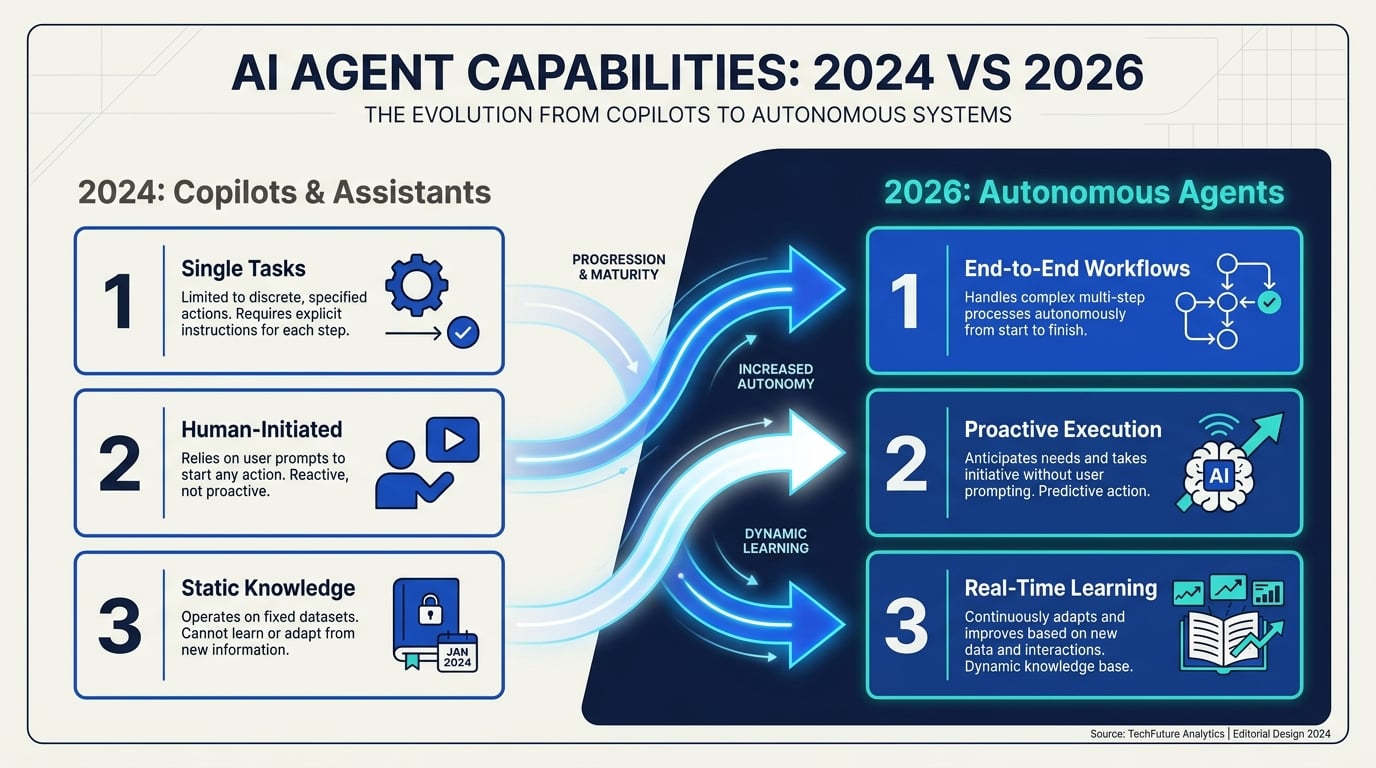
For years, enterprises treated artificial intelligence as a reactive tool—a glorified search bar or a basic conversational interface. Today, we are witnessing a profound paradigm shift. According to recent research by Boston Consulting Group (BCG), AI agents have evolved from passive, automated task-handlers into highly collaborative, goal-driven digital partners. Rather than merely answering queries, modern agentic systems autonomously analyze complex datasets, make real-time decisions, and orchestrate workflows across disparate enterprise software.
Understanding this trajectory is essential for any organization aiming to deploy agents that deliver tangible ROI. The table below maps this technological shift, outlining how agentic capabilities have progressed from simple, rigid rules to autonomous, multi-agent collaboration.
The Stages of Agentic Evolution
| Evolution Phase | Core Technology | Autonomy Level | Key Characteristics | Typical Enterprise Use |
|---|---|---|---|---|
| Gen 1: Chatbots | Rule-based scripts, basic NLP | Low (Script-dependent) | Linear dialog, no memory, strict triggers | Simple FAQs, basic routing |
| Gen 2: Copilots | Early LLMs, prompt engineering | Medium (Human-in-the-loop) | Summarization, draft generation, context-aware | Content creation, code assistance |
| Gen 3: Single Agents | LLMs with tool access, RAG, APIs | High (Semi-autonomous) | Recursive reasoning, tool calling, memory | Customer support, automated data entry |
| Gen 4: Multi-Agent Systems | Multi-model orchestration, advanced planners | Very High (Goal-driven) | Self-correction, agent-to-agent collaboration | Department-scale workflow automation |
Transitioning to a Digital Workforce
As shown above, the transition to Gen 4 multi-agent systems redefines the nature of enterprise automation. Early iterations of AI required constant human intervention and rigid formatting. Today’s systems utilize advanced reasoning techniques and self-correction to manage multi-step processes autonomously.
However, as highlighted by the Harvard Business Review, the primary challenge of adopting agentic AI is not the technology itself, but figuring out how to onboard these digital assets into your existing business architecture. Just as you would not expect a human recruit to perform flawlessly on day one without training, Gen 4 agentic systems require structured onboarding. Organizations must define clear "jobs to be done" by outlining specific topics, writing natural language instructions, and setting strict guardrails for tool execution.
Building and scaling these advanced, multi-agent networks requires robust, production-grade infrastructure capable of handling complex pipelines. Platforms like CallMissed address this challenge directly, providing the communication infrastructure necessary to deploy voice and text agents globally. By offering unified access to over 300+ LLMs alongside multilingual Speech-to-Text APIs supporting 22 Indian languages natively, CallMissed enables enterprises to build highly adaptive, conversational agents that integrate smoothly with existing backend systems.
Ultimately, deploying AI agents that actually work requires moving past isolated pilots. Production data reveals that most agentic projects fail due to non-technical bottlenecks, such as a lack of clear workflow alignment and poor handoff protocols between human employees and digital agents. By focusing on workflow design and leveraging reliable infrastructure, companies can successfully integrate AI agents as true, productive extensions of their workforce.
In-Depth Analysis: Why Most Agent Projects Fail and How to Onboard Them
Despite the massive potential of autonomous systems, a staggering number of enterprise deployments stall in the pilot phase. According to industry analyses from Harvard Business Review (March 2026) and leading system integrators, the primary barriers to success are rarely technical. Instead, most AI agent projects fail because organizations treat agentic AI as static software rather than dynamic digital team members that require structured training, integration, and management.
The Failure Modes of Enterprise AI Agent Projects
Understanding why these projects stumble is the first step toward building a resilient deployment framework.
- The Direct Substitution Fallacy: Many organizations attempt to use AI agents to directly replace human staff rather than redesigning workflows to leverage human-agent collaboration. This approach creates friction, limits creative problem-solving, and ignores the critical need for human-in-the-loop oversight.
- Lack of an Onboarding Plan: Unlike traditional software, AI agents operate with a level of autonomy. If they are deployed without a formal "onboarding" period—where their actions, tools, and guardrails are systematically tested in low-stakes environments—they are highly prone to hallucination and operational drift.
- Ambiguous Job Descriptions: Businesses often build agents with overly broad scopes. Without a tightly defined "job to be done," natural language instructions become bloated, leading to unpredictable decision-making and poor alignment with business KPIs.
A 4-Step Framework for Successfully Onboarding AI Agents
To transition agents from experimental novelties into productive corporate assets, organizations must adopt a structured onboarding methodology that mirrors human talent integration.
- Define the "Job to be Done": Write a clear, natural-language job description for your agent. Explicitly outline its department, the specific topics it is authorized to handle, the internal databases it can access, and the exact boundaries of its decision-making authority.
- Redesign Workflows for Human-Agent Collaboration: Instead of forcing AI into rigid, legacy processes, restructure workflows around what agents do best (e.g., retrieving data, processing high-volume requests, and executing routine tasks) while reserving complex reasoning and emotional intelligence for human employees.
- Deploy Production-Ready Communication Infrastructure: An AI agent is only as good as its ability to interact with your ecosystem. For consumer-facing or telephony workflows, using robust middleware is crucial. Platforms like CallMissed enable businesses to easily deploy and onboard production-ready voice agents. By supporting multilingual voice interactions in 22 regional Indian languages and offering a gateway to 300+ LLMs, CallMissed provides the infrastructure needed to ensure your agent communicates reliably across diverse channels.
- Establish Continuous Performance Tracking: Performance tracking must be a core component of your ongoing AI management strategy. Establish key performance indicators (KPIs) for your digital workforce, monitor latency and accuracy, and create feedback loops where human supervisors can refine the agent’s natural language instructions over time.
Impact & Implications: Redesigning Workflows Around Human-Agent Collaboration

The true paradigm shift of agentic AI does not lie in how well the technology performs in a vacuum, but in how seamlessly it integrates into daily operations. As highlighted by Harvard Business Review (March 2026), the biggest hurdle in adopting agentic AI is not the underlying technology, but figuring out how to adapt organizational structures to support it. To unlock genuine business value, organizations must shift their focus away from replacing human staff and toward redesigning workflows around human-agent collaboration.
Treating Agents as "Digital Coworkers"
Most AI agent projects fail for non-technical reasons, often due to a lack of clear operational roles, poor training data, or a failure in change management. Rather than viewing an AI agent as just another software utility, forward-thinking organizations are treating them as digital team members. This requires a strategic shift in how they are integrated:
- Structured Onboarding: Just like a human employee, an AI agent needs a clear "job to be done." Organizations must define specific topics, natural language instructions, and operational boundaries for the agent to prevent drift and ensure reliable outputs.
- Iterative Performance Tracking: According to Cloudflare, tracking performance must be a core component of your AI agent management strategy. Organizations must establish clear KPIs, audit logs, and feedback loops to monitor agent accuracy, identify failure points, and refine their behavior over time.
The Human-in-the-Loop (HITL) Architecture
Redesigning workflows around collaboration requires a robust Human-in-the-Loop (HITL) architecture. AI agents excel at processing high-volume structured data, executing repetitive tasks, and running multi-step reasoning loops. However, humans remain irreplaceable for high-stakes decision-making, handling complex edge cases, and providing emotional intelligence.
For instance, in a modern customer support workflow, an AI voice agent can handle 24/7 triaging, answering routine questions, and updating records. When an emotional or highly complex customer query arises, the agent seamlessly hands off the interaction—complete with context and conversation history—to a human representative.
Platforms like CallMissed are already enabling this cooperative model. By offering production-ready voice agents and WhatsApp chatbots, CallMissed provides the underlying infrastructure that allows organizations to deploy agentic communication workflows. Human agents no longer get bogged down by repetitive inquiries, allowing them to focus on high-value, relationship-building tasks.
Overcoming Cultural Friction
A successful transition to a collaborative digital workforce requires addressing cultural resistance. Employees often fear displacement when AI agents are introduced. Leaders can mitigate this by clearly defining how the agent acts as a force multiplier that removes cognitive drudgery. By freeing up bandwidth, workers can transition into "agent managers" or focus on strategic initiatives, ensuring that the technology elevates human potential rather than sidelining it.
Expert Opinions: Industry Leaders on the Future of Digital Workers
The transition from static software tools to autonomous digital workers represents one of the most profound shifts in modern enterprise history. As organizations rush to deploy AI agents, industry leaders and researchers are warning that operational success requires a complete paradigm shift in management, design, and organizational culture.
Shift from Replacement to Workflow Redesign
Leading analysts, including those at the Boston Consulting Group (BCG), emphasize that AI agents are not merely isolated automation tools; they are collaborative partners capable of analyzing data, making decisions, and working alongside humans. To unlock true business value, organizations must focus less on replacing human personnel and more on redesigning workflows around actual business outcomes.
Industry data shows that the most successful implementations restructure the work itself. Rather than simply handing off repetitive tasks to an agent, companies are building hybrid environments where human employees act as strategic supervisors, guiding and collaborating with digital workers to scale productivity exponentially.
Treating Agents as Onboarded Colleagues
A key perspective published in the Harvard Business Review (March 2026) highlights a critical roadblock: executives often struggle with agentic AI because they treat it as a traditional IT deployment rather than a talent onboarding process.
To succeed, companies must create an explicit onboarding plan for AI agents. Just as a human recruit needs to understand company protocols, operational boundaries, and specific "jobs to be done," digital workers require structured training. Industry leaders recommend introducing agents through a phased approach:
- Define the Role: Establish clear boundaries and natural language instructions using agent-building frameworks.
- Provide Tools and Access: Securely integrate the agent with necessary internal databases and software APIs.
- Establish Guardrails: Define what the agent cannot do, setting strict limits on decision-making authority.
- Implement Feedback Loops: Constantly monitor performance and refine instructions based on real-world outcomes.
Building the Infrastructure for Digital Workers
Deploying reliable digital workers requires robust infrastructure that can bridge the gap between complex AI models and daily operations. Many organizations face technical debt when trying to connect their agents to legacy systems or diverse communication channels.
This is where advanced communication infrastructure becomes vital. Platforms like CallMissed are enabling businesses to deploy production-ready digital workers and AI voice agents that operate 24/7. By leveraging CallMissed’s ability to process Speech-to-Text across 22 Indian languages and connect to over 300+ LLMs via a single API gateway, enterprises can deploy multilingual agents that understand local context and execute complex workflows without undergoing massive system overhauls.
Overcoming the Non-Technical Hurdles
According to deployment experts at Spiral Scout, the vast majority of AI agent projects fail for non-technical reasons—such as poor goal definition, lack of team alignment, and inadequate performance tracking. To scale these systems, performance monitoring must become a core component of your AI management strategy.
Industry leaders agree that the future of work belongs to enterprises that build "reliable structures" for their digital workforce. By setting clear performance benchmarks, establishing structured handoff protocols between humans and AI, and treating agents as dynamic team members, organizations can finally transition from experimental AI pilots to high-performing, agent-driven enterprises.
What This Means For You: A Step-by-Step Blueprint
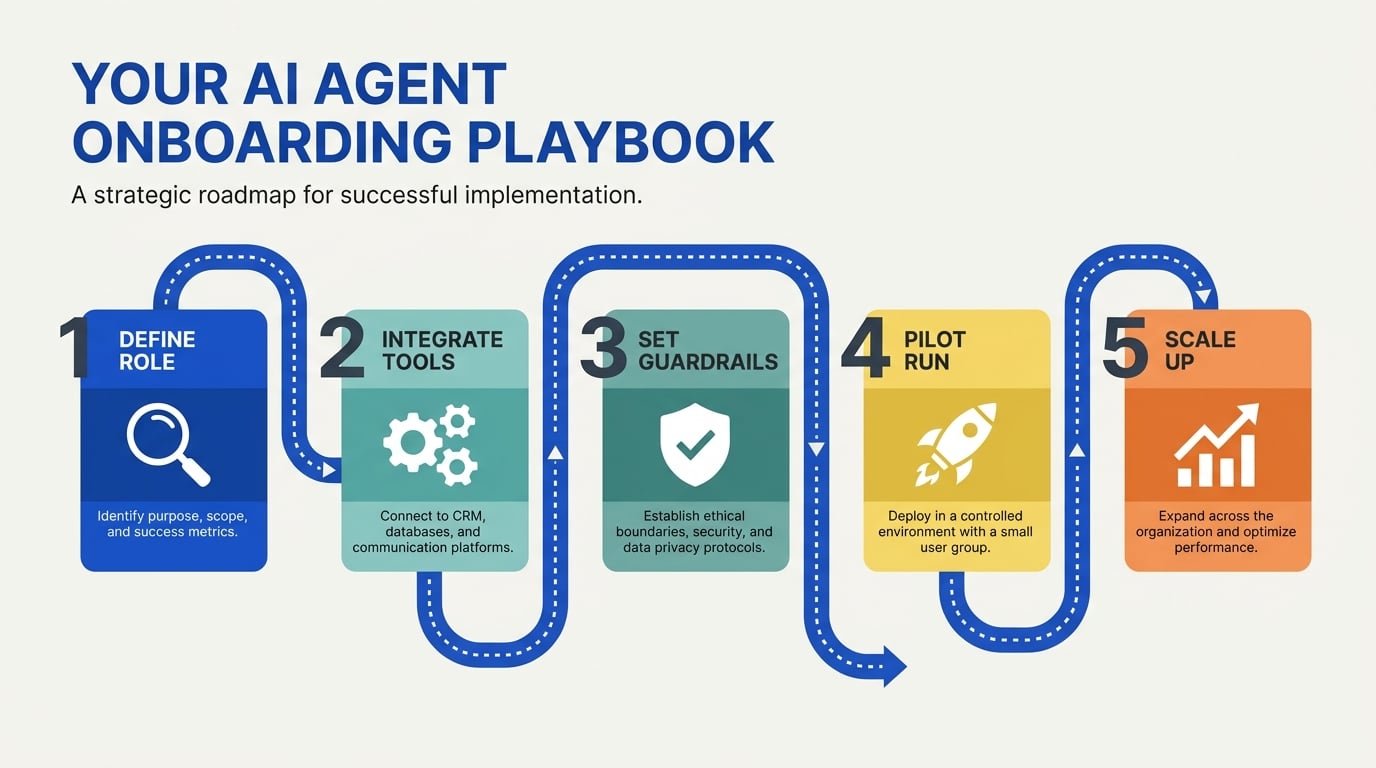
Successfully deploying AI agents within an organization requires moving away from the traditional "plug-and-play" software installation mentality. According to research from the Harvard Business Review, the primary challenge in adopting agentic AI is not the underlying technology itself, but rather the organizational hurdle of onboarding and integrating these systems into existing, human-led workflows.
To bridge this operational gap, enterprises must focus on workflow redesign and structured alignment. Rather than viewing an agent as a background script, companies must treat it as a digital colleague undergoing a structured, rigorous onboarding process.
The table below outlines a five-step blueprint designed to transition your AI agents from simple prototypes to fully integrated, productive digital workers:
| Phase | Focus Area | Key Actions | Human-in-the-Loop Role |
|---|---|---|---|
| 1. Scope & Define | Job-to-be-Done | Write natural language instructions; define topics, APIs, and operational boundaries. | Subject Matter Expert (SME) |
| 2. Redesign | Collaborative Workflow | Map data handoffs; design fallback loops where agents escalate edge cases to humans. | Operations Architect |
| 3. Infrastructure | Integration & Tech Stack | Connect LLMs, internal databases, and communication channels (voice, SMS, WhatsApp). | Systems Engineer / Developer |
| 4. Onboard | Pilot & Alignment | Run sandbox tests; treat the agent like a new hire with a structured 30-day trial period. | Team Supervisor |
| 5. Manage | Performance Tracking | Track task completion rates; audit LLM outputs to prevent drift and optimize prompts. | AI Operations Manager |
1. Shift from Task Automation to Workflow Redesign
To unlock real business value, organizations must design processes around the AI agent's strengths. Rather than forcing an agent into a legacy pipeline originally designed for manual human data entry, reconstruct the workflow. For example, an agent can autonomously analyze data, draft customer responses, and update the CRM simultaneously. Designing workflows around these capabilities ensures humans are positioned at high-value decision points rather than performing repetitive administrative tasks.
2. Establish a Robust Infrastructure Layer
An AI agent is only as powerful as its cognitive engine and its access to external tools. To succeed in production, your agent needs real-time access to communication channels and customer databases.
Using an enterprise-grade AI communication platform like CallMissed accelerates this phase. CallMissed provides the production-ready infrastructure needed to deploy voice and text-based AI agents, offering an LLM gateway with access to over 300+ models, alongside native Speech-to-Text and Text-to-Speech APIs that support 22 regional Indian languages. This allows developers to build highly localized, multilingual agents without having to construct complex telephony and translation pipelines from scratch.
3. Implement Strict Performance Tracking and Management
Once an agent is deployed, continuous management is critical. Cloudflare highlights that rigorous performance tracking must be a core component of any enterprise AI management strategy. Organizations must monitor task completion rates, track latency, and regularly audit agent interactions. Treating AI agents as dynamic employees means establishing feedback loops where prompt engineering, database updates, and safety guardrails are updated on a weekly basis to prevent system drift.
Frequently Asked Questions
What is the biggest barrier to making AI agents work inside your organisation?
How do you measure the performance and business impact of enterprise AI agents?
How do you choose the right LLM or infrastructure to make AI agents work effectively?
What are the core architectural components required to build a functioning AI agent?
Should companies build custom AI agents or purchase pre-built digital workforce solutions?
How can leadership prepare employees to work alongside autonomous AI systems?
Conclusion
Successfully onboarding AI agents is less about mastering new software and more about redesigning how your business actually functions. To ensure your digital workforce delivers measurable value, keep these foundational rules in mind:
- Redesign, Don't Replace: Focus on restructuring workflows around human-agent collaboration rather than simple headcount reduction.
- Define Clear Roles: Treat agents like human hires by establishing specific responsibilities, clear boundaries, and continuous performance tracking.
- Prioritize Reliable Infrastructure: Ensure your underlying systems support seamless integration, predictable data pipelines, and structured outputs.
Looking ahead, the next major shift will see organizations move from isolated tools to multi-agent autonomous ecosystems that collaborate dynamically across entire departments. To explore how AI communication is evolving and start building your own agentic setup, check out CallMissed — an AI infrastructure platform powering voice agents and multilingual chatbots for businesses.
As AI agents transition from novel technology to essential teammates, the ultimate question remains: is your organization's blueprint ready to onboard them?
Discussion
Related Posts


Ready to automate customer conversations?
Launch AI voice agents and WhatsApp bots with CallMissed — one API, 22+ Indian languages.