
Key Insights on President Trump’s New AI Executive Order and Policy & Regulatory Implications


What happens when the world’s most powerful technology sector is suddenly handed a mandate of aggressive deregulation? On January 23, 2025, President...
Key Insights on President Trump’s New AI Executive Order and Policy & Regulatory Implications
What happens when the world’s most powerful technology sector is suddenly handed a mandate of aggressive deregulation? On January 23, 2025, President Trump issued Executive Order 14179, titled "Removing Barriers to American Leadership in Artificial Intelligence," fundamentally rewriting the rules of engagement for AI development. This sweeping policy represents a dramatic 180-degree turn from the previous administration's risk-focused approach, framing AI not as a hazard to be tightly managed, but as a vital engine for economic dominance and national security.
This policy shift matters immensely right now because it aggressively dismantles the federal oversight that previously governed frontier models. By revoking the prior administration's restrictive compliance hurdles and actively targeting state-level regulatory bottlenecks, the federal government is clearing the runway for rapid infrastructure development and private-sector innovation. For businesses, developers, and global enterprise leaders, this transition introduces both massive opportunities and sudden regulatory uncertainty. As the U.S. shifts toward an "America First" AI posture, the focus is squarely on maintaining global leadership, leaving organizations to quickly realign their technological roadmaps with the new federal directive.
In this fast-evolving landscape, staying agile is critical; platforms like CallMissed are already helping enterprises navigate these shifting policy tides by offering flexible access to over 300+ LLMs through a unified, adaptable API gateway.
In this post, we will break down the Key Insights on President Trump’s New AI Executive Order and Policy & Regulatory Implications. You will learn how the administration plans to streamline federal AI governance, the steps being taken to eliminate state-law obstructions to national AI policy, and the concrete actions your business must take to capitalize on this newly deregulated, highly competitive tech landscape.
Introduction
On January 23, 2025, the landscape of global artificial intelligence regulation underwent a seismic shift. President Trump signed Executive Order 14179, titled "Removing Barriers to American Leadership in Artificial Intelligence," signaling a definitive pivot toward an aggressive "America First" technological doctrine. This landmark directive fundamentally challenged the prior administration's highly structured, risk-mitigation framework, replacing it with a policy designed to maximize deployment speed, encourage private capital investment, and secure absolute U.S. dominance in the global AI race.
By explicitly rejecting what the administration terms "over-regulation," the executive order positions AI not merely as a commercial utility, but as a critical pillar of national security and economic supremacy. The policy seeks to streamline AI governance across federal agencies, eliminate state-level regulatory bottlenecks, and clear the runway for massive private sector development. For businesses, developers, and global competitors, the message is clear: the United States is prioritizing rapid innovation and infrastructure scaling over precautionary constraints.
A Paradigm Shift: Deregulation as a Strategy
The core philosophy driving EO 14179 is that heavy-handed oversight stifles technological progress and threatens national security by allowing foreign adversaries to outpace domestic development. The administration's action plan targets regulatory friction at multiple levels:
- Minimizing Federal Oversight: Reducing bureaucratic red tape within agencies to expedite the commercial testing and deployment of advanced AI systems.
- Eliminating State-Level Obstructions: Actively limiting state and local jurisdictions from implementing a patchwork of restrictive AI laws that could fragment the domestic market.
- Accelerating Infrastructure: Encouraging the rapid development of the physical infrastructure—such as high-density data centers and energy resources—necessary to train and run frontier models.
- Talent and Research Focus: Emphasizing federal support for training the next generation of American AI researchers and prioritizing sovereign capability.
This dramatic pivot to a pro-growth, deregulatory environment presents an unprecedented window of opportunity for enterprises looking to scale their AI operations.
Agility in a Deregulated Landscape
While the federal government actively lowers administrative barriers to encourage domestic innovation, the operational challenge for businesses shifts from navigating strict compliance to maintaining technical agility. In a market where AI technologies are advancing at breakneck speed, organizations must build on flexible, production-ready systems.
This is where advanced communication infrastructures play a vital role. Platforms like CallMissed enable enterprises to capitalize on this deregulatory wave by offering the infrastructure needed to deploy highly adaptable AI solutions. Through a multi-model API gateway that allows seamless switching between 300+ LLMs, and Speech-to-Text APIs supporting 22 Indian languages, CallMissed provides businesses with the technical agility required to scale conversational AI, voice agents, and customer-facing automation globally without being locked into a single regulatory or technological framework.
As we analyze the deeper policy, legal, and operational implications of this executive action in the following sections, we will explore how this deregulated stance alters compliance, global competitiveness, and the future of enterprise AI deployment.
Background & Context

To understand the sweeping implications of the Trump administration's approach to artificial intelligence, one must examine the dramatic regulatory pivot that took place in early 2025. On January 23, 2025, President Trump signed Executive Order 14179, titled "Removing Barriers to American Leadership in Artificial Intelligence." This directive initiated a profound shift in US technology policy, moving away from a precautionary, compliance-heavy approach and toward a market-driven, deregulatory framework designed to secure global technology dominance.
Reversing the Precautionary Approach
Prior to this executive order, federal AI policy was largely guided by the Biden administration’s Executive Order 14110, which placed heavy emphasis on risk mitigation, mandatory safety testing, and civil rights guardrails. While proponents argued those measures were necessary to prevent algorithmic bias and security vulnerabilities, critics contended they created burdensome compliance bottlenecks, particularly for startups and mid-market developers.
Executive Order 14179 systematically dismantled these stringent oversight mechanisms. By rejecting what the administration framed as "over-regulation," the current policy framework prioritizes:
- Rapid commercialization: Speeding up the transition of AI research from conceptual laboratories to active commercial markets.
- Streamlined governance: Reducing federal oversight to minimize bureaucratic red tape and speed up technological deployment.
- Infrastructure support: Encouraging private-sector investment in the massive data centers, energy grids, and advanced hardware necessary to train next-generation models.
The "America First" AI Strategy
The executive order positions artificial intelligence not merely as a commercial tool, but as a critical arena for geopolitical and economic competition. Framed through an "America First" lens, the policy asserts that the United States must maintain absolute leadership in frontier AI models to secure both economic dominance and national security.
This regulatory flexibility is a significant boon for companies building and scaling AI-driven systems. For instance, enterprises leveraging platforms like CallMissed to deploy advanced voice agents and automated workflows can now do so with far greater speed and fewer compliance hurdles. Because CallMissed provides unified access to over 300 LLMs and robust Speech-to-Text capabilities in 22 regional languages, a frictionless regulatory environment allows businesses to quickly integrate these tools into global operations without navigating preemptive federal design restrictions.
Curbing State-Level Fragmentation
A major challenge for businesses has been the threat of a fragmented regulatory environment, where individual states attempt to pass conflicting AI safety and compliance laws. To combat this, the administration's policy explicitly targets "state-law obstruction" of national AI policy.
By asserting federal preemption, the administration seeks to establish a unified, national framework. This strategy prevents a patchwork of state-level rules from stifling innovation, ensuring that American enterprises can build, test, and deploy AI solutions nationwide under a single, predictable federal standard.
Key Developments
The signing of Executive Order 14179 on January 23, 2025, titled "Removing Barriers to American Leadership in Artificial Intelligence," marked a monumental paradigm shift in global technology governance. By dismantling the previous administration's stringent reporting requirements and safety mandates, this "America First" AI Action Plan establishes a highly flexible, deregulated environment. The administration’s strategic roadmap positions AI not merely as a technology to be managed for risk, but as a critical instrument for national security, economic dominance, and global technological leadership.
| Development Area | Key Policy Directive | Primary Objective | Strategic Implications |
|---|---|---|---|
| Executive Order 14179 | Revokes prior Biden-era AI mandates (including EO 14110) | Streamline federal AI governance and eliminate heavy reporting requirements | Drastically lowers compliance barriers for AI startups and enterprises |
| Federal Preemption | Eliminates state-law obstruction of national AI policy | Ensure a single, unified national framework for AI development | Limits states (like California) from enforcing fragmented, restrictive AI safety laws |
| Infrastructure Scaling | Accelerates approvals for AI datacenters and power grids | Support massive compute demands required for next-gen LLMs | Promotes rapid domestic infrastructure expansion despite environmental hurdles |
| Defense & Security | Rejects over-regulation; accelerates military AI adoption | Maintain clear technological dominance over systemic global adversaries | Integrates cutting-edge frontier models directly into national security workflows |
| Research & Workforce | Redirects federal grants to technical AI training | Educate the next generation of top-tier AI researchers and engineers | Focuses federal resources on building technical talent over regulatory oversight |
Decentralization and the Regulatory Sandbox
By stripping away bureaucratic friction, EO 14179 effectively transforms the United States into a massive regulatory sandbox for rapid AI deployment. The executive order prioritizes speed, commercial viability, and technological supremacy over precautionary compliance. Instead of forcing developers to submit extensive safety evaluations before deploying frontier models, the federal government is shifting the burden of proof, encouraging organizations to ship products quickly and innovate continuously.
For enterprises navigating this newly deregulated landscape, flexibility is paramount. Platforms like CallMissed are uniquely positioned to help developers leverage this agility. Through its advanced API gateway, CallMissed enables organizations to seamlessly switch between over 300 distinct Large Language Models (LLMs) without rewriting any integration code. This allows businesses to immediately capitalize on new, unrestricted frontier models as soon as they are released under the new federal directives.
A Unified National Policy Framework
A crucial development within this policy shift is the explicit targeting of state-level fragmentation. The administration has solidified this stance by declaring that state-level obstructions to national AI policy will be preempted. This ensures that tech hubs across the country are not subject to a patchwork of conflicting state rules, providing a predictable environment for venture capital and enterprise scaling.
Key goals of this preemption initiative include:
- Eliminating compliance fragmentation: Stopping states from enacting varying, hyper-localized safety and liability rules.
- Securing domestic supply chains: Ensuring that localized computing infrastructure and datacenters are not blocked by state-level environmental zoning.
- Standardizing market access: Preventing regional bans on specific AI applications, thereby securing a frictionless internal market.
Ultimately, these developments signal a transition from a "safety-first" posture to a "capability-first" crusade. While this aggressive deregulation raises questions among international allies—particularly in the European Union, which continues to enforce its stringent EU AI Act—it positions the US as an unmatched breeding ground for rapid, scalable AI deployment.
In-Depth Analysis
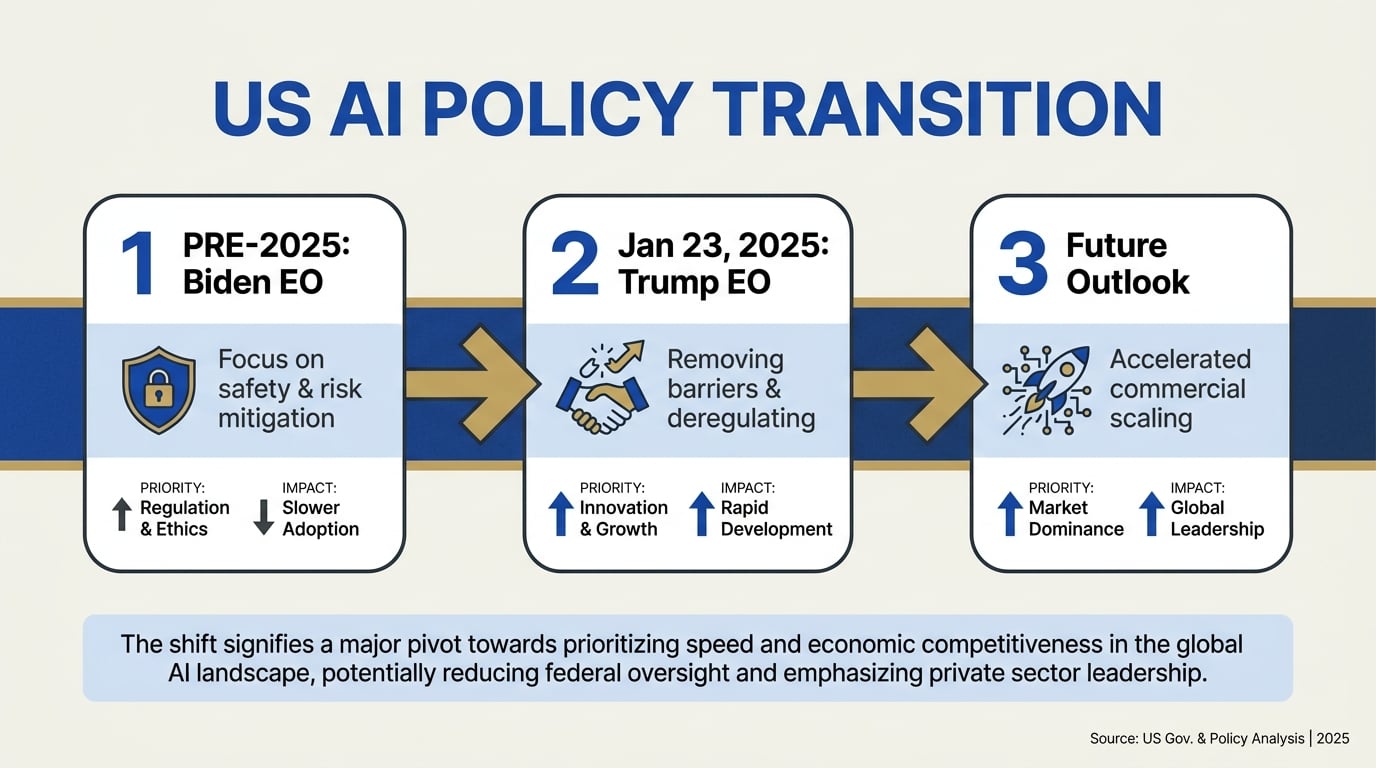
The issuance of Executive Order 14179 on January 23, 2025, titled “Removing Barriers to American Leadership in Artificial Intelligence,” marks a fundamental paradigm shift in how the United States approaches AI governance. By explicitly rejecting the precautionary, heavily regulated approach of the previous administration, President Trump’s policy establishes a framework focused on aggressive deregulation, national security, and global technology dominance.
Dismantling Federal Oversight and State Obstruction
A core objective of the executive order is the centralization of AI policy to prevent fragmented, state-level regulations from slowing down commercial innovation. The administration has taken a firm stance against what it labels as "state law obstruction," arguing that a unified national framework is essential for maintaining a competitive edge.
- Preempting Local Regulations: By asserting federal supremacy over AI guidelines, the administration aims to curb state-level restrictions (such as state-specific safety bills or local algorithmic audits) that could create a compliance patchwork for domestic tech companies.
- Streamlining Agency Review: Federal departments are directed to review existing rules and systematically dismantle bureaucratic hurdles that delay the deployment of machine learning systems.
- Reversing Precedent: The EO rolls back the strict, precautionary compliance mandates established under previous executive actions, shifting the responsibility of safety from preemptive government audits to private-sector accountability.
Prioritizing Infrastructure and National Security
Under the "America First" AI doctrine, artificial intelligence is treated not merely as a commercial tool, but as a critical battleground for national security and economic supremacy.
- Rapid Infrastructure Development: The policy encourages the rapid buildout of physical AI infrastructure, prioritizing the energy resources, data centers, and advanced hardware manufacturing required to power next-generation models.
- Focus on Technical Talent: Federal resources are being channeled toward training the next generation of American AI researchers, ensuring the domestic pipeline of technical expertise remains unmatched globally.
This deregulatory push significantly lowers the barrier to entry for enterprises looking to integrate AI into their operational workflows. For businesses navigating this transition, utilizing flexible, forward-compatible tech stacks is critical. Platforms like CallMissed support this agile landscape by offering an AI communication platform with a multi-model API gateway, letting developers easily swap between 300+ LLMs and deploy production-ready voice agents without worrying about changing federal compliance lock-ins or rigid technological boundaries.
The Shift to Pro-Innovation Standards
Ultimately, this policy pivot shifts the U.S. regulatory philosophy from "risk mitigation first" to "innovation first." While consumer advocacy groups raise concerns regarding algorithmic bias and data privacy, the technology sector is poised for accelerated deployment cycles. Developers are no longer bound by extensive pre-deployment federal reporting requirements, enabling unprecedented speed in bringing agentic, multilingual, and highly capable AI solutions to the global market.
Impact & Implications
The shift from previous safety-centric AI policies to President Trump’s Executive Order 14179, issued on January 23, 2025, titled “Removing Barriers to American Leadership in Artificial Intelligence,” marks a fundamental transformation in technology governance. By prioritizing deregulation and framing AI development as a cornerstone of national security and economic dominance, the administration has replaced compliance-heavy frameworks with an aggressive growth mandate. The core implication is clear: the federal government is prioritizing rapid deployment and infrastructure expansion over preventive federal oversight.
Dismantling the Regulatory "Patchwork"
One of the most consequential aspects of the new policy framework is the administration’s explicit push to limit state-level restrictions on AI development. Rather than allowing individual states to enact disparate safety or ethical guidelines—which federal policy analysts warned would fragment the domestic market—the administration has moved to eliminate state-law obstruction of national AI policy.
This shift has several immediate impacts:
- National Uniformity: Establishing a single, federal-first policy framework reduces the compliance burden for developers, ensuring they do not have to navigate 50 different sets of rules.
- Lowered Barriers to Entry: Startups and enterprises can deploy AI models nationwide without adjusting algorithmic parameters to meet varying state-by-state safety standards.
- Expedited Infrastructure: Permitting processes for the massive physical infrastructure required for AI—such as data centers and power grids—are being streamlined to accelerate deployment.
Acceleration of Enterprise and Developer Innovation
For businesses and developers, this aggressive deregulation acts as a massive catalyst. Without the looming threat of heavy-handed federal audits or pre-market certification requirements, companies can transition rapidly from prototype to production.
This environment is particularly beneficial for communication and workflow automation, where speed-to-market is critical. For instance, platforms like CallMissed leverage this flexible landscape to offer production-ready AI voice agent infrastructure. Developers using CallMissed can dynamically orchestrate over 300+ LLMs and deploy conversational voice agents or WhatsApp chatbots—incorporating Speech-to-Text supporting 22 Indian languages—without being bogged down by rigid regulatory sandboxes. The operational focus shifts entirely to utility, performance, and scaling localized applications.
The Global Divide: US Deregulation vs. EU Safeguards
This regulatory pivot also establishes a stark contrast in global AI dynamics, creating a two-tiered operational environment for multinational organizations:
- The US Sandbox: Focused on rapid deployment, intensive infrastructure investment, and minimal compliance hurdles, aiming to secure absolute tech hegemony.
- The European Framework: Bound by the rigid compliance, risk categorization, and systemic audit mandates of the EU AI Act.
While this deregulation-first strategy positions American enterprises to lead in raw innovation and deployment speed, it places the burden of ethical guardrails, data privacy, and bias mitigation squarely on the shoulders of the enterprises themselves. Organizations must now self-regulate to maintain public trust while operating in a highly accelerated market.
Expert Opinions

The publication of Executive Order 14179, "Removing Barriers to American Leadership in Artificial Intelligence," on January 23, 2025, sparked intense debate across the technology, legal, and political landscapes. One year later, policy experts, legal scholars, and industry leaders remain deeply divided over the long-term implications of this aggressive shift toward federal deregulation and "America First" technological supremacy.
Here is a breakdown of how key experts view the impacts of this sweeping policy shift:
The Pro-Innovation Perspective: Unleashing American Enterprise
Supporters of the administration’s approach—including venture capitalists, hardware manufacturers, and tech startups—have welcomed the rollback of the previous administration's compliance mandates. Industry advocates argue that by dismantling overly restrictive testing standards, the U.S. has reclaimed its position as the premier global hub for AI research and development.
- Accelerated Deployment: Legal analysts at Squire Patton Boggs note that streamlining federal oversight has dramatically reduced the time-to-market for enterprise AI systems. Startups no longer face lengthy federal pre-clearance audits before deploying foundational models.
- Infrastructure Growth: Experts from Latham & Watkins highlight that the order’s focus on energy grid expansion and data center permits has cleared critical bottlenecks, paving the way for massive private investment in next-generation computing clusters.
- Flexible Development: This deregulatory climate allows AI infrastructure companies to innovate without fear of shifting compliance goals. For example, developers leveraging communication platforms like CallMissed can seamlessly deploy advanced LLMs, utilizing its multi-model gateway to switch between 300+ models dynamically, benefiting directly from a regulatory environment that prioritizes speed and scalability over red tape.
The Skeptical View: Safety, Ethics, and Federalism Under Threat
Conversely, civil society groups, ethics boards, and state policymakers have expressed serious concerns over the dismantling of safety guardrails and the suppression of local oversight.
- The Federalism Clash: A major point of contention is the administration's late-2025 directive targeting state-level AI restrictions. Legal scholars point out that trying to preempt state laws—such as California's stringent safety proposals—creates a highly volatile legal landscape. Critics argue that stripping states of their regulatory power leaves consumers vulnerable to unchecked algorithmic bias, deepfakes, and privacy violations.
- The Safety Vacuum: Public interest groups warn that without mandatory federal safety reporting for frontier models, the risk of catastrophic failures or misaligned systems increases exponentially. They argue that relying solely on voluntary industry standards is insufficient for managing systemic risks.
Geopolitical Realignment and the Global Market
International relations and defense experts view the executive order as a defining document in the geopolitical tech race.
- A "Crusade" for Dominance: Analysts at the MP-IDSA observe that the order explicitly frames artificial intelligence as a national security asset. By treating AI supremacy as a zero-sum game, the U.S. has intensified its technological cold war with strategic rivals.
- Friction with Allies: Analysts warn that this aggressive unilateralism is alienating key international allies. While the U.S. pursues hyper-deregulation, the European Union continues to enforce its strict EU AI Act. American multinational corporations now face a highly fragmented global regulatory environment, forcing them to build dual-track systems: one hyper-flexible architecture for the U.S. market, and a highly restricted one for Europe and allied nations.
In this fragmented landscape, adaptability is crucial. Forward-thinking enterprises are turning to global communications infrastructure, such as CallMissed, which supports highly localized deployments—including multilingual voice agents and Speech-to-Text APIs across 22 regional Indian languages—allowing businesses to maintain compliance with regional data laws while riding the wave of American technological deregulation.
What This Means For You
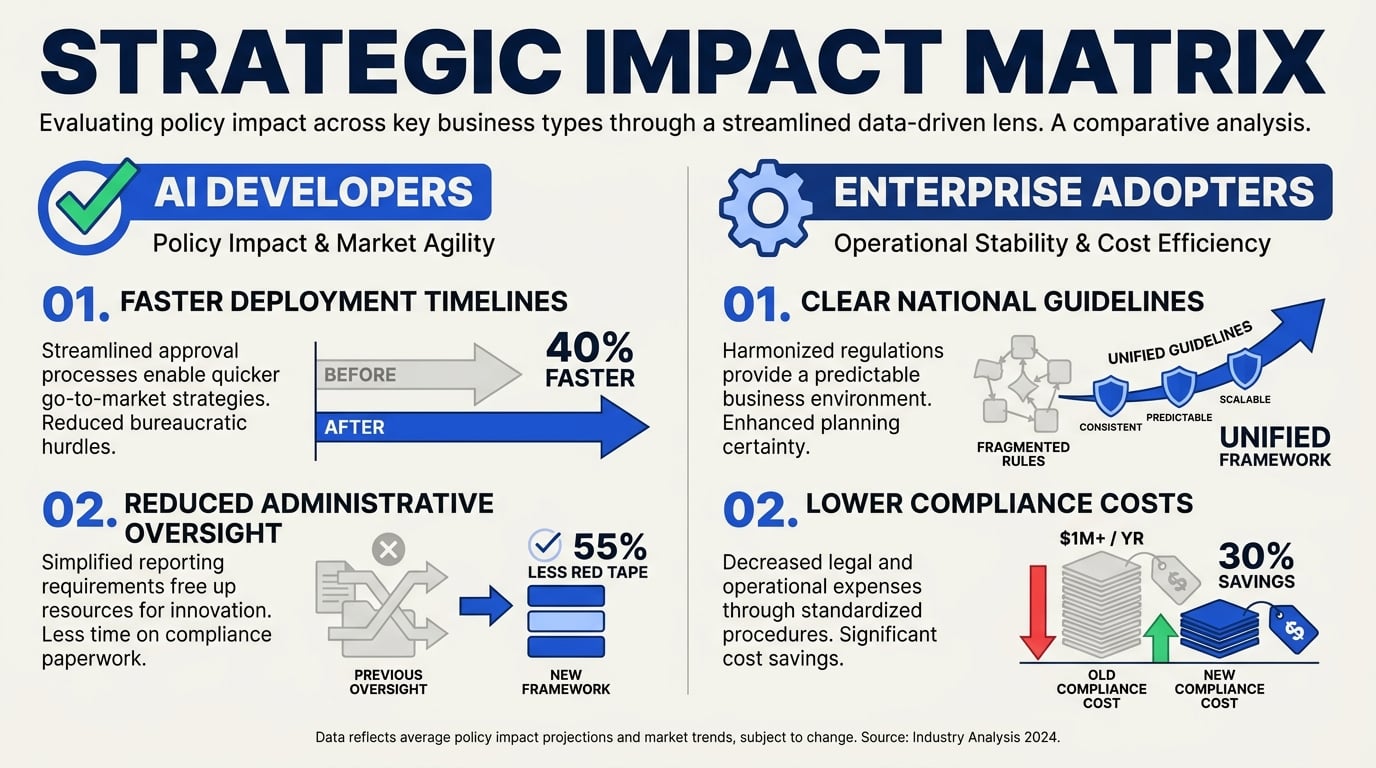
The signing of Executive Order 14179, "Removing Barriers to American Leadership in Artificial Intelligence," on January 23, 2025, represents a massive paradigm shift in tech policy. By actively reversing previous compliance-heavy, safety-first restrictions, the administration has cleared the runway for rapid innovation. For businesses, developers, and enterprise leaders, this aggressive deregulation alters everything from compliance roadmaps to product launch timelines.
The primary objective of the new executive order is to assert American technological dominance by dismantling unnecessary bureaucratic hurdles. By shifting federal oversight to a highly flexible, pro-innovation model, organizations can pivot from defensive legal compliance to offensive product development and market expansion.
To help you navigate this transition, the table below breaks down exactly what these policy changes mean for different stakeholders across the technology ecosystem:
| Stakeholder Group | Key Policy Shift under EO 14179 | Practical Business Impact | Strategic Recommendation |
|---|---|---|---|
| AI Startups & Developers | Elimination of restrictive federal reporting mandates on large-scale model training. | Faster development cycles and lower barriers to entry for training frontier models. | Focus on rapid prototyping and scaling core IP without regulatory delay. |
| Enterprise Tech Leaders | Streamlined integration of AI tools within federal agencies and regulated industries. | Expanded public sector procurement and simplified B2B AI software deployment. | Accelerate digital transformation plans and deploy automated customer systems. |
| Compliance & Legal Teams | Federal pushback against restrictive state-level AI regulations and obstructions. | Reduced immediate threat of fragmented, state-by-state compliance penalties. | Transition from strict safety compliance to performance-driven risk management. |
| Infrastructure Providers | Federal support for rapid AI data center construction and energy prioritization. | Decreased latency, improved compute availability, and lower hosting costs. | Scale processing capacity to handle high-throughput workloads like real-time voice. |
Unlocking Operational Agility
Under this deregulatory wave, the premium is no longer on bureaucratic documentation, but on market execution. Organizations that previously spent months auditing their algorithms for theoretical risks can now focus on deploying practical, high-value AI solutions.
For businesses aiming to capitalize on this accelerated timeline, leveraging flexible, multi-model infrastructure is crucial. Modern communication platforms like CallMissed allow enterprises to deploy production-ready AI voice agents and WhatsApp chatbots immediately. Because CallMissed's infrastructure provides access to over 300+ LLMs and localized Speech-to-Text APIs (supporting 22 Indian languages and global dialects), companies can easily switch between model architectures to optimize costs and performance under this highly competitive, deregulated ecosystem.
Managing the Transition
While federal oversight is declining, businesses must remain mindful of global and local dynamics. Despite the administration's clear policy goal of eliminating state-level obstructions to national AI policy, certain jurisdictions may still attempt localized enforcement.
Organizations should prioritize modular technical architectures. By decoupling the AI model layer from the application delivery layer, tech leaders can maintain maximum agility, ensuring they can adapt to both international market dynamics—such as the European Union's stricter AI Act—and the highly permissive regulatory climate now established in the United States.
Frequently Asked Questions
What is the primary focus of President Trump’s new AI Executive Order?
How does the policy shift under President Trump’s new AI Executive Order compare to previous federal regulations?
How does the new executive order impact state-level artificial intelligence regulations?
What does the executive order mean for businesses deploying artificial intelligence systems?
How does President Trump’s new AI Executive Order address global competitiveness and national security?
What steps does the administration outline to support domestic AI infrastructure?
Conclusion
President Trump’s Executive Order 14179, "Removing Barriers to American Leadership in Artificial Intelligence," signals a dramatic shift in the global tech landscape. Here are the critical takeaways to keep in mind:
- Aggressive Deregulation: The administration is actively rolling back federal oversight and preempting state-level restrictions to fast-track domestic AI development.
- Geopolitical Primacy: AI is now officially treated as a core pillar of U.S. national security, designed to ensure global economic and technological dominance.
- Rapid Infrastructure Scale: Policies prioritize massive computing infrastructure expansion and flexible regulatory frameworks over rigid pre-market guardrails.
Looking ahead, organizations must pivot from navigating complex compliance hurdles to accelerating deployment and infrastructure scaling. As federal barriers fall, the race is on to deploy resilient, production-ready systems. To explore how AI communication is evolving under this new paradigm, check out CallMissed—an AI infrastructure platform powering voice agents and multilingual chatbots that help businesses scale rapidly.
How will your organization adapt to this deregulated, high-velocity era of AI innovation?
Discussion
Related Posts



Ready to automate customer conversations?
Launch AI voice agents and WhatsApp bots with CallMissed — one API, 22+ Indian languages.