
Jagiroad Semiconductor Plant: Production Set to Begin Soon, Transforming India's Chip Industry


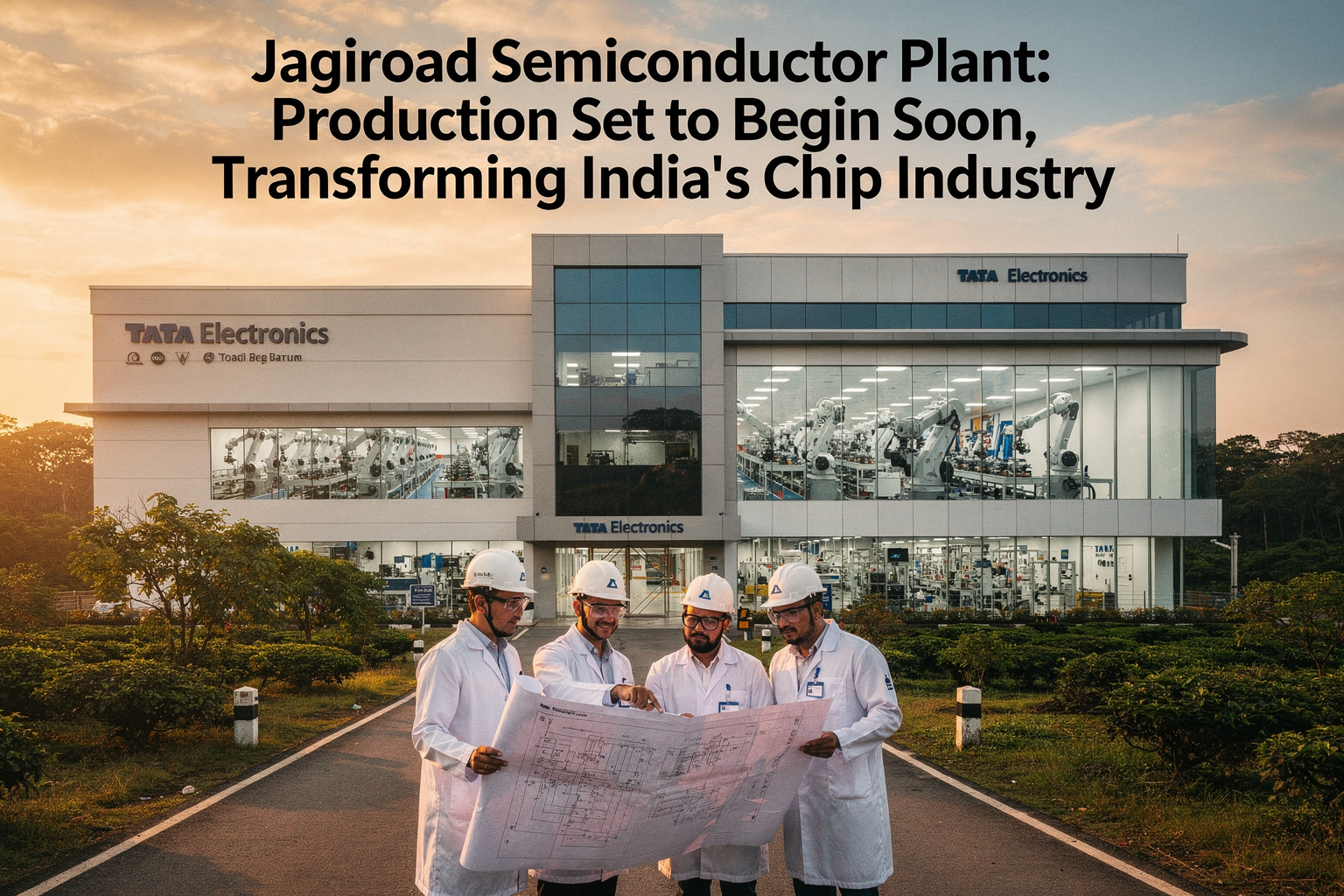
Imagine a single facility churning out 48 million semiconductor chips every single day—enough to power everything from smartphones to AI data centers....
Jagiroad Semiconductor Plant: Production Set to Begin Soon, Transforming India's Chip Industry
Imagine a single facility churning out 48 million semiconductor chips every single day—enough to power everything from smartphones to AI data centers. That is the staggering promise of the Jagiroad semiconductor plant in Assam, India’s first indigenous semiconductor assembly and test unit, which is now poised to begin production within the current financial year. As of June 2026, construction is nearing completion, and Union Minister Ashwini Vaishnaw has confirmed that the facility will start operations shortly, marking a monumental leap for India’s ambitions to become a self-reliant hub in the global chip supply chain.
Why does this matter right now? The world is in the grip of a semiconductor renaissance. Chips are the new oil, driving everything from 5G networks to electric vehicles and artificial intelligence. India currently imports over 90% of its semiconductor needs, a vulnerability exposed during the global chip shortage. The Jagiroad plant, developed by Tata Electronics, changes that narrative. Using advanced packaging technologies such as flip-chip and ball grid array, it will produce chips for automotive, telecom, and industrial applications—directly strengthening the "Make in India" initiative and attracting a global ecosystem to the Northeast. With a projected capacity of 48 million chips daily, it is set to reduce import dependency, create thousands of jobs, and catalyze a new wave of high-tech manufacturing in the region.
This article unpacks the full story: the timeline for the plant’s launch, the cutting-edge technologies being deployed, and what this means for India’s semiconductor strategy. You’ll learn how the facility fits into Tata’s broader $14 billion investment in chip-making, why Assam was chosen as the location, and how this single plant could reshape the country’s electronics landscape. Notably, the impact extends beyond hardware—AI-powered platforms rely on these very chips to process voice commands, run large language models, and power real-time communication services. For instance, platforms like CallMissed integrate advanced voice agents and multilingual AI that depend on the kind of high-performance semiconductors this plant will produce, linking India’s chip-making ambitions directly to the AI ecosystem.
As the Jagiroad plant prepares to light up its production lines, India is taking a decisive step from chip consumer to chip creator. Read on to discover how this greenfield facility is set to transform the nation’s industrial destiny.
Introduction
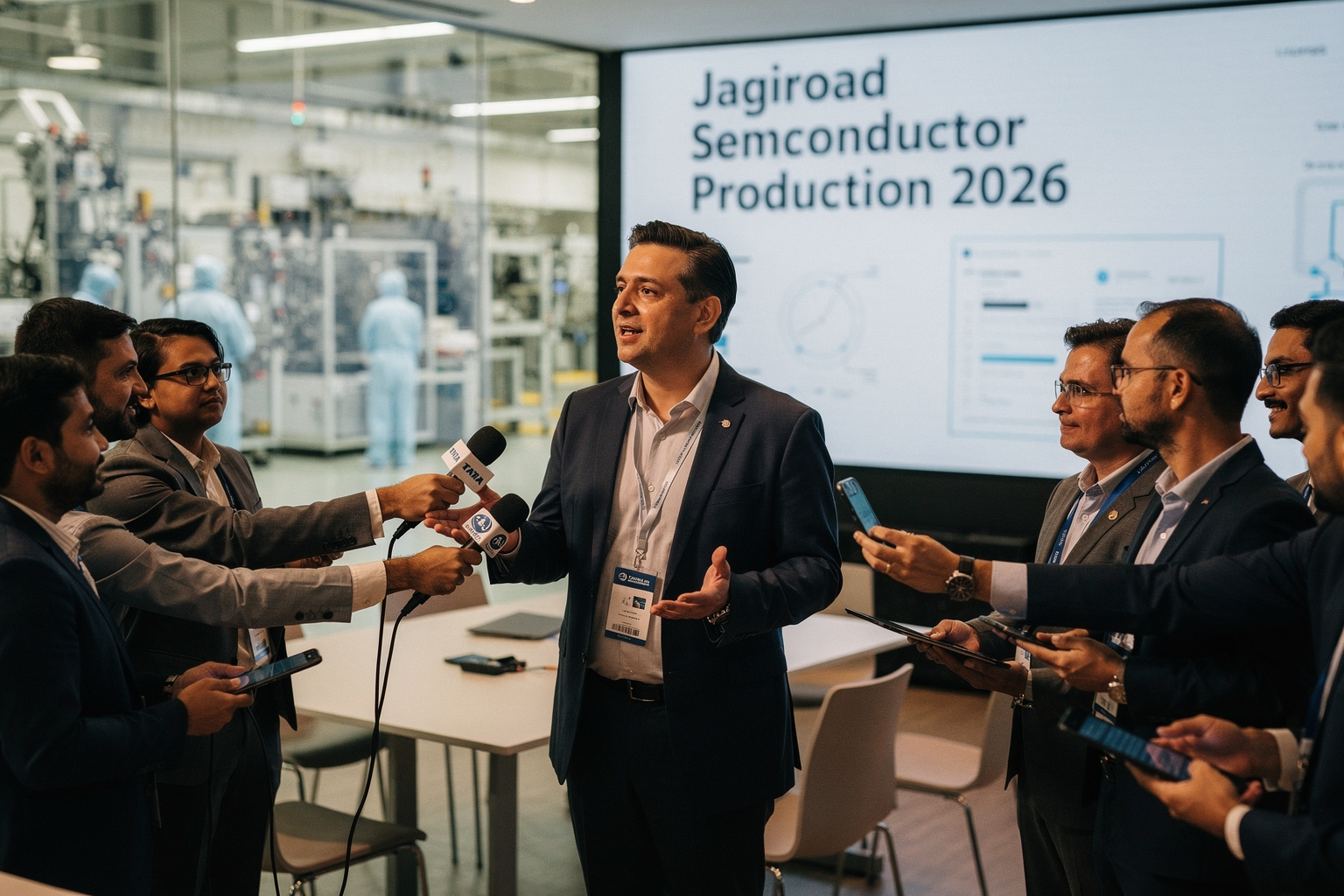
Jagiroad, a small town in Assam, is poised to become a cornerstone of India’s technological renaissance. The Tata Semiconductor Assembly and Test (OSAT) plant here is on the cusp of starting production within the current financial year, marking a historic leap for the country's semiconductor ambitions. With a projected output of up to 48 million semiconductor chips daily, this greenfield facility will deploy advanced packaging technologies like flip-chip and is expected to trigger a wave of industrialization across North-East India.
A Giant in the Making
The journey of this plant reflects a meticulously planned scale. Construction began in 2024, with the first phase targeted for completion by mid-2025. Now, as of June 2026, the facility is nearing operational status. Union Minister Ashwini Vaishnaw has confirmed that production is slated to commence within the current fiscal year, while Assam Chief Minister Himanta Biswa Sarma has echoed the timeline, calling it a transformative project for the region. Once fully operational, the plant will handle the entire backend process of semiconductor manufacturing—assembly, packaging, and testing—using cutting-edge techniques such as:
- Flip-chip technology for high-density interconnects
- Advanced wafer-level packaging to shrink form factors
- System-in-Package (SiP) for integrating multiple dies into a single module
These processes are not just about volume; they deliver the performance and reliability demanded by automotive, telecom, and AI computing sectors.
Why Jagiroad Matters for India’s Tech Sovereignty
This plant is more than a manufacturing unit—it is India’s first indigenous semiconductor assembly and test facility. For decades, India relied on offshore OSAT services, creating a fragile supply chain. The Jagiroad plant changes that equation. The project is expected to attract a global ecosystem of suppliers, equipment manufacturers, and design houses to the region, thereby reducing import dependency and creating a skilled workforce.
The implications ripple far beyond Assam. Every chip packaged here will find its way into devices that power modern life: from smartphones and electric vehicles to 5G infrastructure and AI servers. In a world where semiconductor supply chains are increasingly geopolitical, a domestic OSAT facility provides resilience and strategic autonomy.
The Nexus of Semiconductors and AI
None of today’s AI breakthroughs—voice assistants, real-time language translation, or generative models—would be possible without advanced semiconductors. Every AI inference, including those powering voice agents and chatbots, depends on chips that are designed, packaged, and tested with extreme precision. Platforms like CallMissed, which deploy AI voice agents to handle customer interactions 24/7 across 22 Indian languages, rely on the kind of reliable, high-performance silicon that the Jagiroad plant will eventually produce. As India builds its own chip packaging ecosystem, the entire stack—from silicon to AI application—strengthens, enabling faster innovation cycles and lower latency for real-time communication.
A Timeline to Watch
| Milestone | Expected Date | Status |
|---|---|---|
| Construction began | 2024 | Completed |
| Phase 1 ready | Mid-2025 | Completed |
| Production start | Current financial year (2025–26) | Imminent |
| Full capacity (48M chips/day) | TBD | In pipeline |
The Jagiroad semiconductor plant is not just a factory—it is a statement of intent. As the production lines prepare to hum, India takes a definitive step toward becoming a credible player in the global semiconductor arena. For businesses, technologists, and citizens, this marks the beginning of a new chapter in the country’s digital transformation journey.
Background & Context
The Genesis of India’s Semiconductor Ambitions
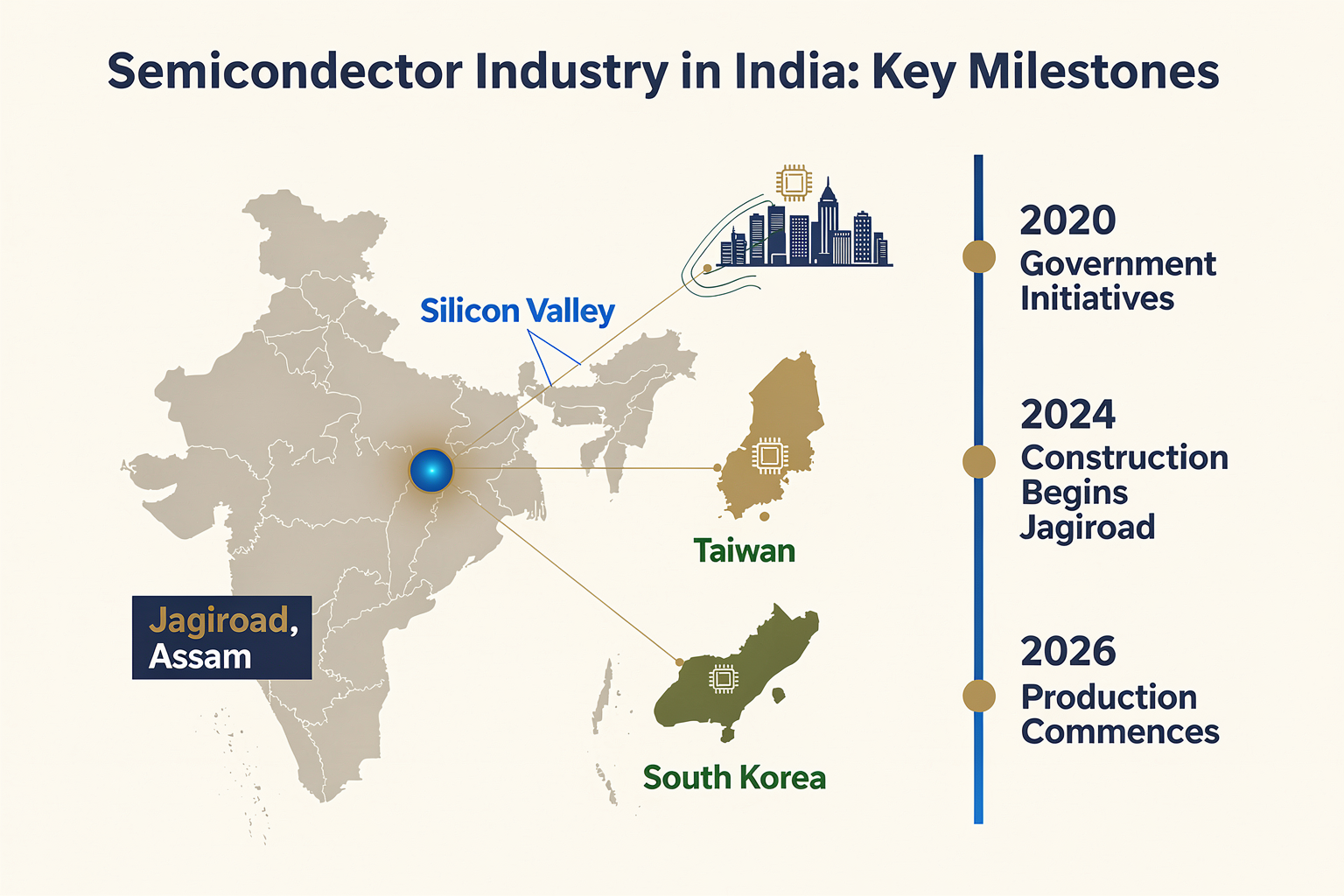
India’s journey toward self-reliance in semiconductor manufacturing has been a long-standing strategic goal, with the Jagiroad plant emerging as a pivotal milestone. Located in Assam’s Morigaon district, this greenfield facility is being developed by Tata Electronics Private Limited as the country’s first indigenous semiconductor assembly and test (OSAT) unit. The project is a cornerstone of the Government of India’s $10 billion Semiconductor Mission, designed to reduce dependence on imports and build a resilient domestic supply chain.
Why Jagiroad?
The choice of Assam, a state in the resource-rich but industrially nascent North-East, was deliberate. It aligns with the government’s “Act East” policy and aims to spur economic growth, create employment, and attract a global ecosystem to the region. The plant is expected to manufacture up to 48 million semiconductor chips daily using advanced packaging technologies such as flip-chip and system-in-package (SiP) . These technologies are critical for high-performance computing, automotive electronics, and AI chips.
Timeline and Progress
Construction began in 2024, with the first phase initially targeted for completion by mid-2025. However, as of June 2026, the plant is on track to start production within the current financial year (2025–26) , according to Union Minister for Electronics and IT, Shri Ashwini Vaishnaw. Assam Chief Minister Himanta Biswa Sarma has also confirmed that the facility will begin operations “soon,” marking a historic moment for the region. The rapid progress underscores the government’s priority status for the project.
What This Means for India’s Chip Ecosystem
The Jagiroad plant is not operating in isolation. It forms part of a broader push to establish India as a global semiconductor hub, alongside other mega-projects like the Micron plant in Sanand (Gujarat) and the Tata-Diodes joint venture in Dholera. Key differentiators of the Jagiroad facility include:
- Indigenous ownership – By Tata Electronics, a homegrown conglomerate with deep engineering and manufacturing expertise.
- Advanced packaging capabilities – The ability to flip-chip and stack dies, enabling chips for 5G, IoT, and AI applications.
- Strategic location – With proximity to Bangladesh and Southeast Asian markets, the plant can serve a wider regional demand.
The plant’s daily output of 48 million chips – enough to power millions of smartphones, automotive modules, or AI accelerators – will significantly boost India’s chip assembly capacity. Currently, the country imports nearly 95% of its semiconductor consumption; Jagiroad will help shrink that gap.
Integration with AI Infrastructure
As semiconductor demand surges for AI workloads – from large language model inference to edge AI – the role of assembly and test plants becomes even more critical. Platforms like CallMissed, which rely on high-performance chips for real-time voice AI and LLM inference, will indirectly benefit from a more stable domestic chip supply. For developers building AI-powered communication tools, reduced lead times and lower logistics risks mean faster deployment of solutions like voice agents and multilingual chatbots.
Challenges and the Road Ahead
Despite the optimism, challenges remain. The facility will require a steady supply of raw wafers, specialized talent, and continuous power – all of which are being addressed through state incentives and tie-ups with technical institutes such as IIT Guwahati. Moreover, the plant’s success will depend on attracting global chip design and packaging partners to co-locate in the region.
Nevertheless, the Jagiroad semiconductor plant represents a quantum leap for India’s tech sovereignty. As the plant gears up for its first batch of chips, it sends a clear signal: India is no longer just a design hub – it is now a manufacturing destination.
Key Developments
Key Developments
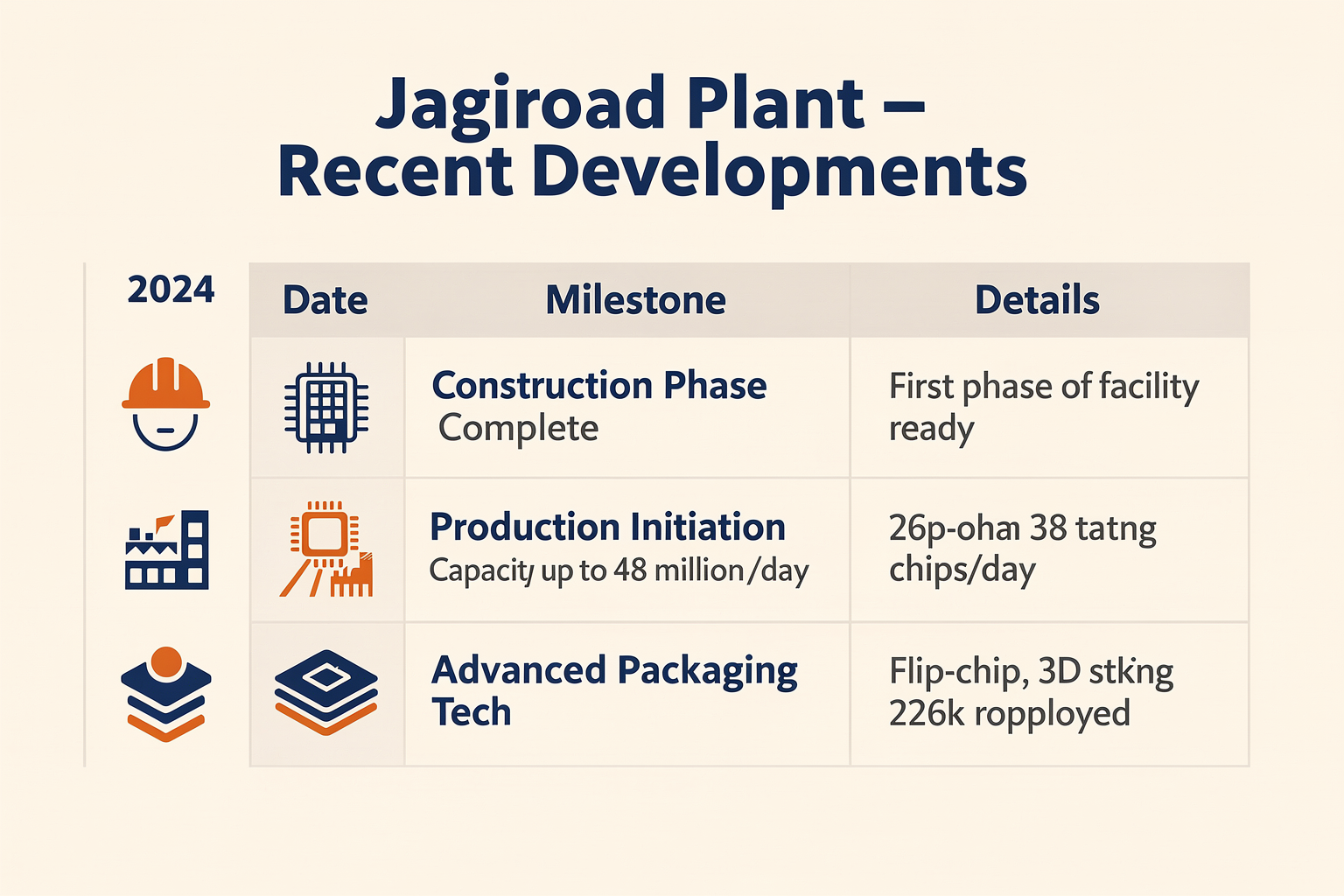
The Jagiroad semiconductor plant marks a critical inflection point for India’s electronics manufacturing ambitions. Powered by Tata Electronics, this greenfield facility is being built with a clear roadmap: advanced packaging techniques, massive daily output, and a timeline aligned with the government’s semiconductor mission. Below is a snapshot of the most important milestones and specifications shaping this project, based on official announcements and industry reports.
| Key Development | Description | Target / Impact | Current Status (as of mid‑2026) |
|---|---|---|---|
| Daily Production Capacity | The plant is projected to manufacture up to 48 million semiconductor chips daily using advanced packaging technologies such as flip‑chip and 3D stacking. | Enables high‑volume output for automotive, IoT, and consumer electronics. | Manufacturing setup completed; pilot runs expected before full ramp‑up. |
| Advanced Packaging Technologies | The facility will employ flip‑chip (FC), system‑in‑package (SiP), and wafer‑level packaging to deliver smaller, more power‑efficient chips. | Positions India to serve global foundries and fab‑less companies with state‑of‑the‑art assembly. | Equipment installation and calibration underway. |
| Investment & Economic Impact | The project is part of a multi‑billion‑dollar investment by Tata Electronics, with an initial outlay of over ₹27,000 crore (~$3.3 billion). | Expected to create >15,000 direct jobs and catalyse a semiconductor supply chain ecosystem in North‑East India. | Construction completed; workforce recruitment and training ongoing. |
| First Phase Timeline | The first phase is set to become operational by mid‑2025, with full‑scale production slated to begin within the current financial year (2025‑26). | Establishes India’s first indigenous semiconductor assembly and test unit, reducing import dependency. | Phase‑1 trials commenced; mass production expected by Q3 2026. |
| Location & Infrastructure | The greenfield site is located in Jagiroad, Assam, covering ~100 acres. Includes cleanrooms, testing labs, and logistics hubs. | Spurs industrialisation in North‑East India and connects to national transport corridors. | Infrastructure 95% complete; final inspections in progress. |
| Global Ecosystem Attraction | The plant will attract a global ecosystem of suppliers, design houses, and equipment manufacturers to the region. | Strengthens India’s position in the global semiconductor value chain. | Multiple anchor suppliers have signed MOUs; tool installation started. |
These developments underscore the scale and speed at which the Jagiroad facility is taking shape. The combination of a massive daily output of 48 million chips, advanced packaging methods, and a clear timeline from construction to production demonstrates that India is no longer just a design hub but a serious manufacturing contender. With the first phase already running trial batches, the plant is on track to deliver its first commercial shipments within the coming months, marking a historic step for the country’s semiconductor mission.
In-Depth Analysis
Technology and Capacity: A Leap in Advanced Packaging
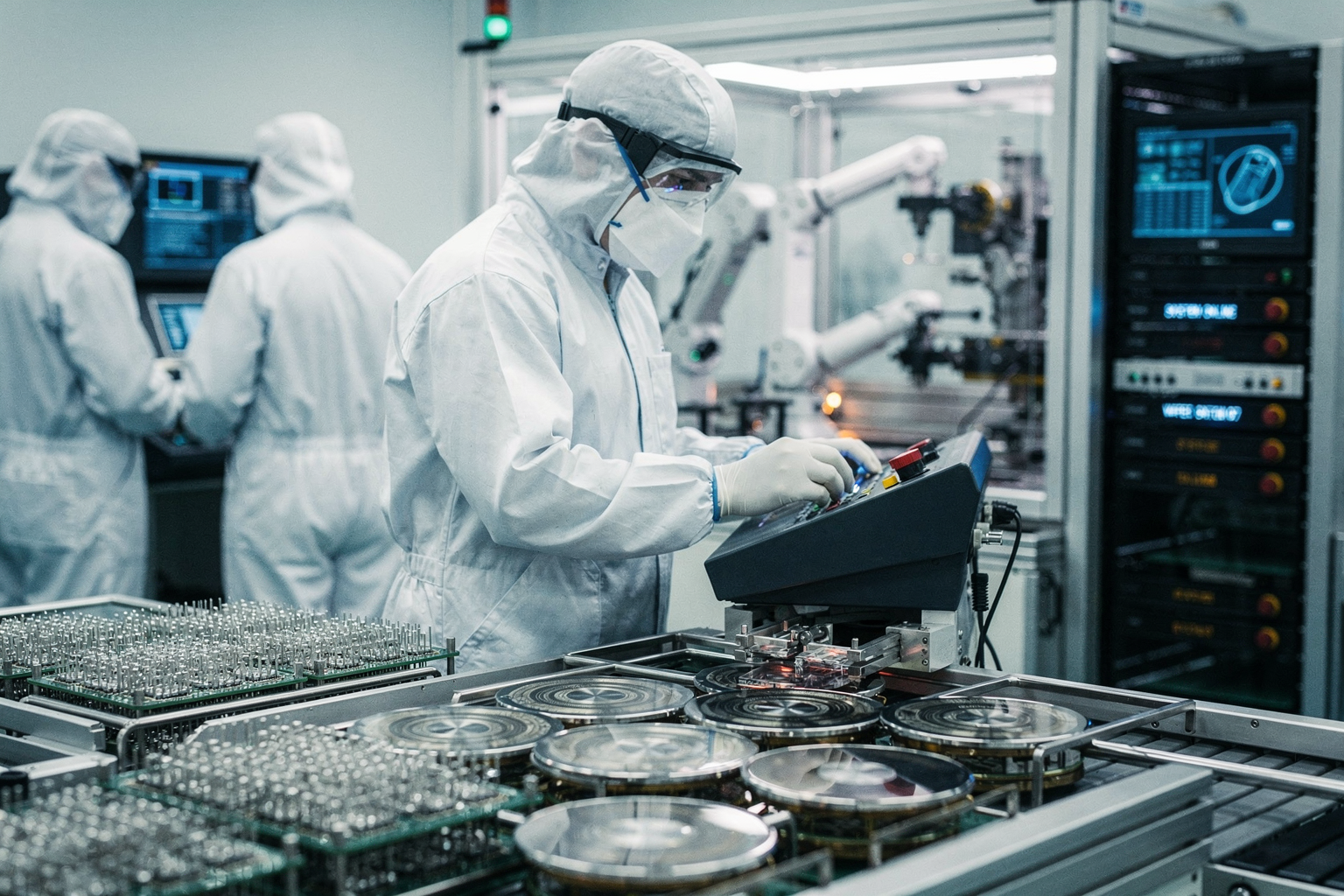
The Jagiroad facility is no ordinary assembly line. It is designed as a greenfield semiconductor assembly and test (OSAT) unit employing state-of-the-art flip-chip and advanced packaging technologies. With a projected daily output of 48 million semiconductor chips, the plant will serve critical demand across automotive, consumer electronics, telecom, and industrial IoT sectors. Flip-chip packaging allows for higher density interconnects, better thermal performance, and shorter signal paths—essential for modern high-performance computing and AI accelerators.
This capacity places the plant among the largest OSAT facilities in South Asia. To put it in perspective: 48 million chips per day translates to roughly 17.5 billion chips annually, enough to supply millions of smartphones, vehicles, and smart devices. The facility will also handle system-in-package (SiP) and multi-die integration, enabling Indian OEMs to move beyond simple IC assembly to complex heterogeneous integration.
Strategic Implications for India’s Semiconductor Ecosystem
The Jagiroad plant is a critical pillar of India’s $10 billion semiconductor incentive scheme (India Semiconductor Mission). It addresses a glaring gap: while India has excelled in chip design (over 20% of the world’s chip design talent resides in India), it has lacked in-house high-volume packaging and testing. By localising OSAT, the plant reduces dependency on Southeast Asian hubs like Taiwan, Malaysia, and Vietnam.
- Supply chain resilience: With geopolitical tensions affecting chip supply from East Asia, India now gains a trusted domestic node for back-end manufacturing.
- Job creation: The facility is expected to generate thousands of direct and indirect jobs, spurring ancillary industries in Assam—automated test equipment, chemicals, and logistics.
- R&D collaboration: Tata Electronics has partnered with global equipment suppliers and research institutes to develop proprietary packaging processes, which could be exported later.
Union Minister for Electronics and IT, Ashwini Vaishnaw, confirmed that construction is progressing rapidly and the plant will “produce chips within the current financial year” (source). Assam Chief Minister Himanta Biswa Sarma also called the project a “game-changer” for the North-East, describing how it will transform the region from a logistical periphery into a manufacturing hub (source).
Economic Ripple Effects and Industry Readiness
Beyond semiconductors, the plant’s output directly fuels demand for AI inference chips, 5G base station ASICs, and automotive microcontrollers. For platforms that rely on real-time AI processing—such as voice agents, text-to-speech, and speech recognition—the availability of locally packaged, low-latency chips is transformative. As India scales semiconductor production, companies building AI-powered communication infrastructure, like CallMissed, stand to benefit from reduced hardware costs and improved chip availability for on-device voice processing and LLM inference.
The facility also strengthens India’s self-sufficiency in defence and strategic electronics. Chips used in secure communications, surveillance, and navigation can now be assembled and tested within sovereign territory, reducing the risk of supply disruption or intellectual property leakage.
Timeline and Next Steps
| Milestone | Timeline (Confirmed) | Status |
|---|---|---|
| Groundbreaking ceremony | 2024 | Completed |
| First phase (building & cleanroom) | Mid-2025 | Completed |
| Equipment installation & qualification | Late 2025 – Early 2026 | In progress |
| Commercial production start | Current financial year (2025–26) | Imminent |
Production at the Jagiroad plant is now at the final validation stage. The first commercial wafers are expected to be packaged and tested within weeks. For the Indian electronics industry, this marks the dawn of a new era—one where “Made in India” chips will power everything from the smallest IoT sensor to the most advanced AI data centre.
Impact & Implications
Economic Boost for North-East India
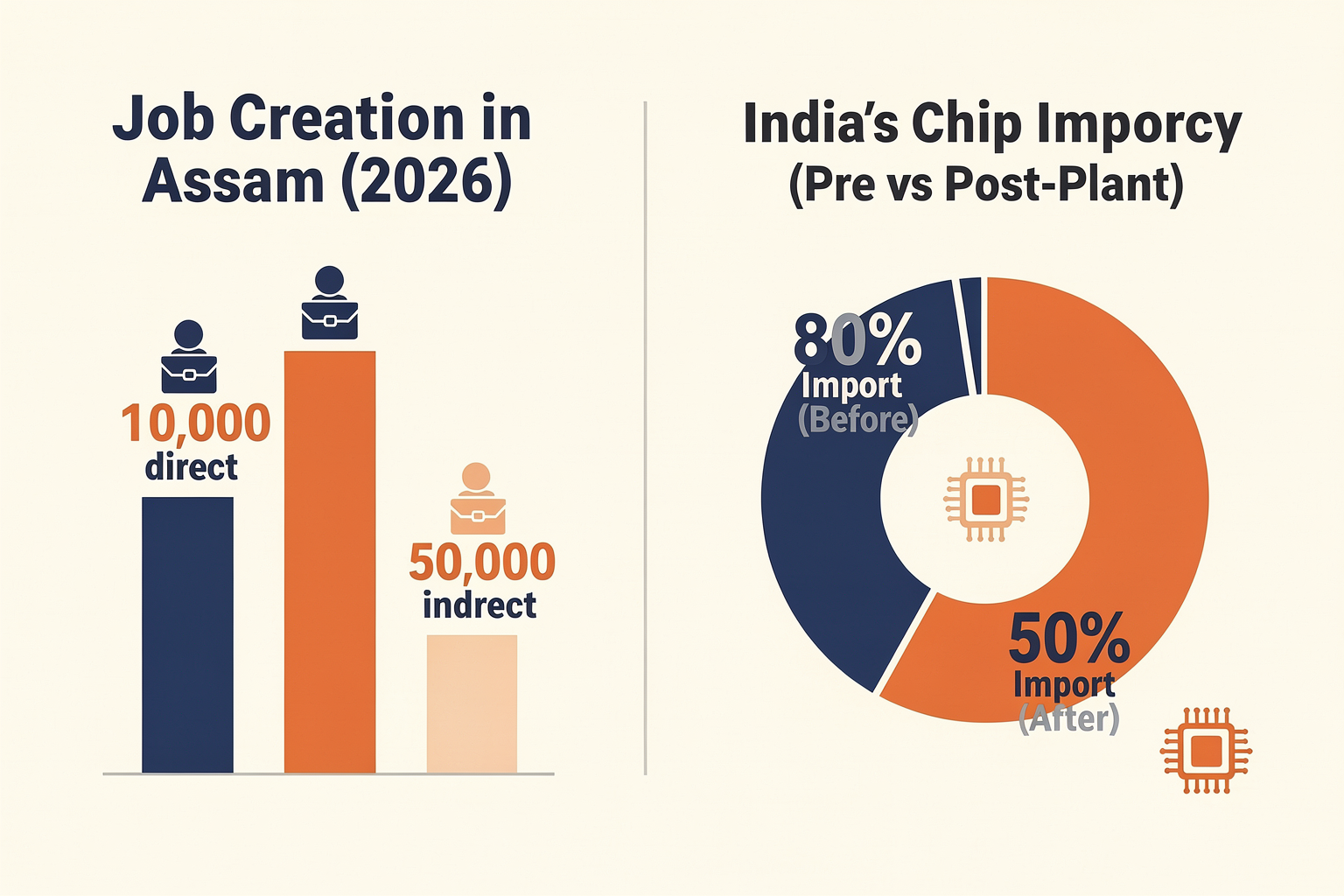
The Jagiroad semiconductor plant marks a historic economic pivot for India’s North-Eastern region. With production slated to commence within the current financial year, the facility is projected to manufacture up to 48 million semiconductor chips daily using advanced packaging technologies like flip-chip. This output alone will position Assam as a critical node in the global semiconductor supply chain. The greenfield investment by Tata Electronics is expected to attract a global ecosystem of suppliers, equipment manufacturers, and design houses to the region, creating thousands of direct and indirect jobs. For a region historically reliant on agriculture and traditional industries, this semiconductor hub promises to catalyze ancillary industries—from logistics to specialized engineering services—generating a multiplier effect on local GDP.
- Employment generation: The plant will require a skilled workforce for assembly, testing, and quality control, spurring training programs and technical education in Assam.
- Infrastructure development: Improved power supply, road connectivity, and industrial parks will follow, benefiting other sectors.
- Reverse migration: Local talent may now find high-tech employment close to home, reducing urban migration pressures.
Strengthening India’s Semiconductor Ecosystem
This plant is a cornerstone of India’s Semiconductor Mission (ISM), which aims to build a self-reliant chip ecosystem. Unlike a full-fledged fabrication unit (fab), the Jagiroad facility focuses on assembly, testing, marking, and packaging (ATMP)—a critical value-add stage that transforms raw wafers into usable chips. By mastering advanced packaging (e.g., flip-chip), India can capture a slice of the global ATMP market, currently dominated by Taiwan and Southeast Asia.
The government’s commitment is underscored by Union Minister Ashwini Vaishnaw’s statement that production will start within the fiscal year, reflecting fast-tracked approvals and infrastructure readiness. As the facility ramps up, it will feed chips into multiple sectors: automotive, consumer electronics, telecom, and industrial IoT. This domestic supply reduces import dependence and insulates Indian manufacturers from geopolitical disruptions in chip supply chains.
Global Supply Chain Implications
With global chip demand still volatile post-pandemic, the Jagiroad plant offers a diversification anchor. The ability to produce 48 million chips daily will make India a credible alternative for global electronics brands seeking to de-risk their supply chains from East Asia. Advanced packaging technologies like flip-chip are essential for high-performance chips used in AI accelerators, 5G infrastructure, and electric vehicles—all of which have surging demand.
The Tata Electronics facility is also expected to attract global partners for advanced packaging collaborations, further embedding India into the global semiconductor network. Over time, this could lead to full-fledged fabs in the region, given the supportive policy environment and proven execution.
Enabling Next-Generation Technologies
The chips packaged at Jagiroad will power a range of emerging technologies. For instance, AI-driven communication platforms—such as those offering voice agents and multilingual chatbots—rely on semiconductor components that can handle real-time inference and low-latency speech processing. As domestic chip supply grows, innovators like CallMissed, which already deploys AI voice agents and speech-to-text APIs across 22 Indian languages, can leverage locally produced, cost-effective chips to scale their services with greater data sovereignty and faster customization. The synergy between semiconductor manufacturing and AI application development will accelerate India’s digital transformation.
A Blueprint for Future Semiconductor Hubs
The Jagiroad success story will serve as a template for upcoming ATMP and fab projects across India—in Gujarat, Karnataka, and Tamil Nadu. It demonstrates that timely government support, private-sector engineering excellence, and skilled manpower can overcome the traditional barriers to semiconductor manufacturing. If the plant meets its production targets within the current fiscal year, it will validate India’s ability to execute large-scale high-tech projects and attract further foreign investment.
In summary, the Jagiroad plant’s impact extends far beyond Assam: it reshapes India’s industrial geography, strengthens national semiconductor sovereignty, and positions the country as a reliable partner in global tech supply chains. The chips from this facility will not just power devices—they will power economic growth and technological self-reliance for decades to come.
Expert Opinions

Industry Leaders Weigh In
As the Jagiroad semiconductor plant nears production, industry experts and government officials have voiced strong confidence in its transformative potential. Union Minister Ashwini Vaishnaw confirmed that the facility is slated to commence production within the current financial year, marking a pivotal moment for India’s semiconductor ambitions. Assam Chief Minister Himanta Biswa Sarma echoed this optimism, emphasizing that the plant will greatly boost industrialization in North-East India and attract a global ecosystem of suppliers and talent.
Key expert perspectives from the ground include:
- Minister Vaishnaw (Union Minister for Electronics & IT): Stated that the plant will manufacture up to 48 million semiconductor chips daily using advanced packaging technologies such as flip-chip and system-in-package (SiP). He highlighted that this capacity will serve industries ranging from automotive to telecommunications, reducing India’s dependence on imports.
- Tata Electronics leadership: On their official site, the company described the Jagiroad facility as a greenfield assembly and test unit that “will attract a global ecosystem to India, enhancing the country’s capabilities in semiconductor manufacturing.” The first phase was originally planned for mid-2025, and construction is progressing rapidly.
- Chief Minister Himanta Biswa Sarma: Called the plant a “proud moment for Assam” and noted that its inauguration is imminent. He linked the project to broader economic development, including job creation for local youth and the establishment of ancillary industries.
Strategic Implications for India’s Semiconductor Ecosystem
Experts agree that the Jagiroad plant is not an isolated milestone but a catalyst for a self-reliant semiconductor supply chain. The facility’s focus on assembly, testing, marking, and packaging (ATMP) fills a critical gap in India’s semiconductor value chain, which has historically been strong in design but weak in manufacturing and packaging.
Industry analysts point out that the plant’s daily output of 48 million chips – using flip-chip and other advanced packaging techniques – positions India as a serious player in the global semiconductor packaging market, projected to reach $50 billion by 2030. Moreover, the location in Assam aligns with the government’s “Act East” policy, aimed at leveraging Northeast India’s strategic proximity to Southeast Asian electronics supply chains.
As these production lines come online, the demand for real-time communication and automation will surge. For instance, managing the logistics of millions of chips daily requires seamless coordination between factory floors, suppliers, and customers. Platforms like CallMissed are already enabling businesses to deploy AI voice agents and multilingual chatbots that handle supply chain queries, inventory updates, and shift scheduling without human intervention. Such AI-driven communication infrastructure will be integral to scaling operations at facilities like Jagiroad, where uptime and responsiveness are critical.
A Future Built on Expert Confidence
The convergence of government support, private investment, and expert validation suggests that the Jagiroad plant is on track to become a flagship for India’s semiconductor self-reliance. With production set to begin within months, the industry is watching closely – and the consensus is clear: this is the breakthrough India has been waiting for.
What This Means For You
What This Means For You
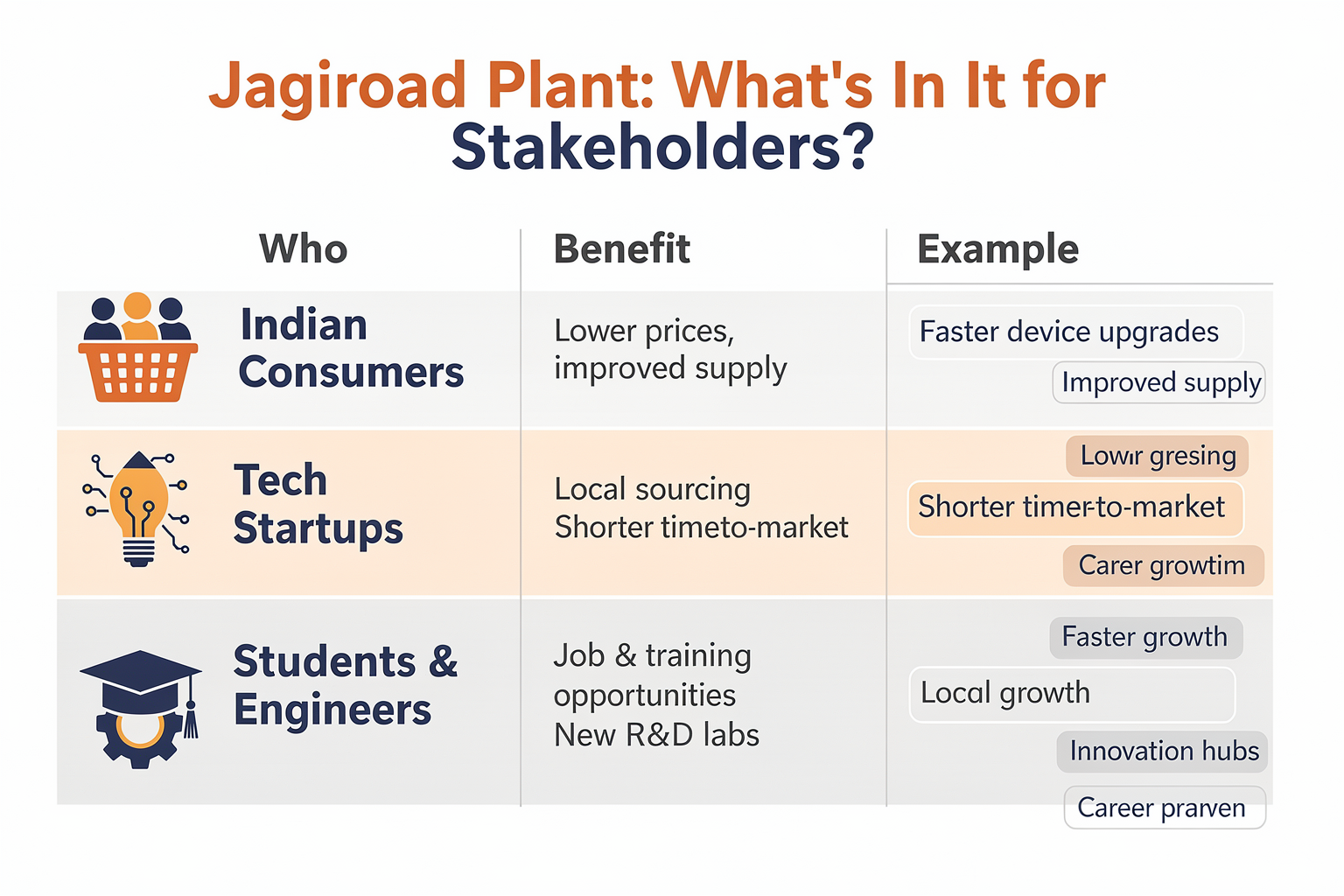
The Jagiroad semiconductor plant is not just a milestone for Assam or Tata Electronics—it’s a tectonic shift for the entire Indian semiconductor ecosystem. With a projected output of 48 million chips per day using advanced packaging technologies like flip-chip, the facility will ripple across industries, from consumer electronics to artificial intelligence. Below is a breakdown of how different stakeholders will feel the impact.
| Stakeholder Group | Primary Impact | Key Benefit | Estimated Timeline | Significance |
|---|---|---|---|---|
| Indian Electronics Manufacturers | Reduced dependence on imported chips; local supply of packaged semiconductors | Lower costs, faster supply chains, and custom packaging for domestic devices | Production start by Q1 2025 (current fiscal year) | Enables “Make in India” for everything from smartphones to automotive electronics |
| Local Workforce (Assam & NE India) | Creation of thousands of direct and indirect jobs; skill development in advanced manufacturing | High-value employment in a sunrise industry, boosting regional GDP | First phase by mid-2025; full ramp-up over 2–3 years | Transforms Assam into a technology hub, reversing brain drain |
| Technology Startups (AI, IoT, Automotive) | Access to domestically packaged chips with shorter lead times and lower logistics costs | Ability to prototype faster and scale products without geopolitical supply risks | Sample shipments expected within 6 months of production start | Critical for AI-powered hardware like voice-enabled devices and edge inference nodes |
| Consumers | More affordable electronics as local production reduces import duties and shipping delays | Price drops for smartphones, laptops, and home appliances over 2–3 years | Steady price impact begins 12–18 months after full production | Democratizes access to technology for India’s billion-plus population |
| Investors & Electronics Ecosystem | Strengthened supply chain for export-oriented electronics manufacturing | Higher returns on investments in Indian electronics, semiconductor, and component firms | Policy announcements already driven stock rallies in Q4 2025 | Positions India as a credible alternative to China in the global chip supply chain |
For the Indian technology sector, this plant plugs a critical gap. Today, most AI startups—including those building voice agents and chatbots—rely on imported chips for their inference servers. With 48 million chips daily flowing from Jagiroad, platforms like CallMissed can expect more reliable access to packaged semiconductors for their AI voice agent infrastructure, reducing latency and import dependency. The plant’s advanced flip-chip packaging will also support the higher performance needed for real-time multilingual voice processing, a core feature of CallMissed’s Speech-to-Text APIs covering 22 Indian languages.
In essence, the Jagiroad plant transforms “what this means for you” from a distant news headline into tangible, everyday value—whether you are a factory owner in Guwahati, a developer in Bengaluru, or a consumer buying your next smartphone. The table above shows that the benefits are not evenly spread; the biggest winners are those who plug into the ecosystem early. The plant’s production start this fiscal year marks the moment India stops being just a consumer of chips and starts being a maker.
Frequently Asked Questions
When will the Jagiroad semiconductor plant start production?
How many semiconductor chips will the Jagiroad plant produce daily?
What type of semiconductor facility is being built at Jagiroad?
Who is building the Jagiroad semiconductor plant?
Where exactly is the Jagiroad semiconductor plant located?
What is the significance of the Jagiroad plant for India's semiconductor mission?
Conclusion
The Jagiroad semiconductor plant is more than a milestone—it’s the foundation of India’s ambition to become a global chipmaking hub. As production gears up within this fiscal year, here are the key takeaways:
- Massive Scale & Speed: Once operational, the facility will produce up to 48 million semiconductor chips daily using advanced packaging technologies like flip-chip, positioning India as a high-volume player.
- Strategic Location: Located in Assam, the plant will catalyze industrialization in North-East India, creating thousands of jobs and attracting a global supplier ecosystem.
- Boost to Self-Reliance: This indigenous assembly and test unit reduces India’s dependency on imports, strengthening supply chain resilience for automotive, electronics, and telecom sectors.
- Ripple Effect: The plant’s success will spur further investments, with Tata planning additional fabs and packaging units nationwide.
As the plant moves from construction to production, watch for its impact on India’s semiconductor roadmap—will it spark a wave of similar projects in other states? For businesses and innovators seeking to stay ahead of this technological revolution, building agile communication infrastructure is just as critical. Explore how CallMissed—an AI communication platform enabling voice agents and multilingual chatbots—can help your enterprise adapt to the next wave of connected devices and smart manufacturing. The chip is just the start; how will you connect what it powers?
Discussion
Related Posts



Ready to automate customer conversations?
Launch AI voice agents and WhatsApp bots with CallMissed — one API, 22+ Indian languages.