
India’s AI Revolution Accelerates as Billion-Dollar Investments Reshape the Artificial Intelligence Market



Did you know that Microsoft recently committed a staggering $17.5 billion to India’s artificial intelligence sector—its single largest AI investment in...
India’s AI Revolution Accelerates as Billion-Dollar Investments Reshape the Artificial Intelligence Market
Did you know that Microsoft recently committed a staggering $17.5 billion to India’s artificial intelligence sector—its single largest AI investment in Asia to date? [4] This landmark decision signals more than just a bullish corporate move: it’s the clearest sign yet that India’s AI revolution is accelerating at an unprecedented pace, transforming everything from everyday business workflows to national infrastructure. In 2023 alone, India secured the 10th global position for AI investment, drawing $1.4 billion in private funding [1]. And the momentum is only building—industry forecasts predict the Indian AI market will surge to $28.8 billion by 2025, expanding at a meteoric 45% CAGR [2].
But why is this sudden influx of billion-dollar investments turning heads in global tech circles? The stakes are high: as India shapes its AI future, it’s not just about growing faster but also about building an inclusive, innovation-driven ecosystem. The government’s ambitious $1.2 billion IndiaAI Mission and the rapid upskilling of the workforce—a 14-fold talent increase since 2016 [2]—are helping to democratize cutting-edge technologies for real-world challenges, from vernacular language support to personalized healthcare. Already, platforms like CallMissed are leveraging this momentum by creating multilingual AI communication infrastructure, showing how homegrown solutions are rising to meet both domestic demand and global standards.
In this article, you’ll discover how billion-dollar bets and strategic pushes from both the public and private sectors are reshaping India’s AI landscape. We’ll break down where the money is flowing, which technologies and sectors are seeing the most disruption, and the role of startups and established players in building the AI infrastructure of tomorrow. Whether you’re an entrepreneur, a technologist, or a policymaker, understanding India’s unprecedented AI acceleration isn’t optional—it’s essential for anyone looking to ride the next big wave of global technology transformation.
Introduction
India is at the cusp of an unprecedented artificial intelligence (AI) transformation, marked by a flood of billion-dollar investments and government-led initiatives that are rapidly reshaping the country’s digital economy. Once seen as a technology trend to watch, AI has now become a vital growth multiplier for India’s enterprises, government agencies, and technology ecosystem. In 2023 alone, India secured the 10th position globally in AI investments, attracting $1.4 billion in private funding—a remarkable feat that signals the country's ascension onto the world stage as a serious AI contender (MyGovIndia, 2023).
A Massive Investment Surge
The landscape of India’s AI sector is undeniably bullish. According to government data, the industry is on track to reach USD 28.8 billion by 2025, fueled by a scorching compound annual growth rate (CAGR) of 45% (PIB, 2023). This trajectory is underpinned not just by local startups and enterprises but also by strategic commitments from global tech giants. For instance, Microsoft’s recently announced $17.5 billion investment—their largest ever in Asia—cements India’s status as an indispensable global AI compute hub (Analytics India Magazine, 2026).
Such large-scale capital flows are shaping a new era of innovation:
- Diverse AI Applications: From healthcare diagnostics to fintech automation and multilingual conversational AI, investments are accelerating the deployment of AI in real-world, high-impact scenarios tailored for India's complex markets.
- Rising Startup Ecosystem: Startups are zeroing in on India’s unique challenges, ranging from supporting 22 official languages to vast, underbanked rural populations. These real-world applications make India a pivotal testbed for scalable AI innovation (Instagram, 2026).
- Government Backing: The Indian government itself is catalyzing the AI revolution through the proposed $1.2 billion IndiaAI Mission, designed to fuel homegrown talent, R&D capability, and digital public infrastructure (Invest India, 2026).
Workforce & Economic Impact
One of the most striking trends is the rapid upskilling of India’s tech workforce. The number of professionals with AI skills has increased 14-fold since 2016, positioning India as a global talent pool for machine learning, natural language processing, and data analytics (PIB, 2023).
AI’s influence on the broader economy is profound. According to research from the Journal of Management Research & Analysis, AI adoption is already transforming management practices and boosting GDP contributions across industries.
Key drivers of this impact include:
- Automated Customer Engagement: AI voice agents, chatbots, and personalized customer support.
- Smart Manufacturing & Supply Chain Optimization: Predictive analytics and real-time monitoring.
- Financial Inclusion: AI-driven credit scoring and fraud detection for underserved markets.
Enabling Next-Gen AI Infrastructure
The sheer scale and diversity of India’s linguistic, cultural, and business landscape pose challenges that require robust, adaptable AI infrastructure. Platforms like CallMissed are already enabling Indian enterprises to deploy multilingual AI voice agents and chatbots, supporting 22 Indian languages natively and providing access to over 300 large language models for tailored solutions. This democratization of technology is critical as businesses seek to reach audiences and customers across every region and demographics.
A Unique Global Moment
India isn’t just riding the wave of global AI growth—it is actively shaping it. The convergence of billion-dollar investments, homegrown entrepreneurship, and an assertive policy push has created unstoppable momentum. As India’s AI industry accelerates into 2026 and beyond, the nation stands ready to chart a unique and inclusive trajectory—one that offers a globally relevant template for responsible, large-scale AI adoption.
Background & Context: India on the AI Growth Map
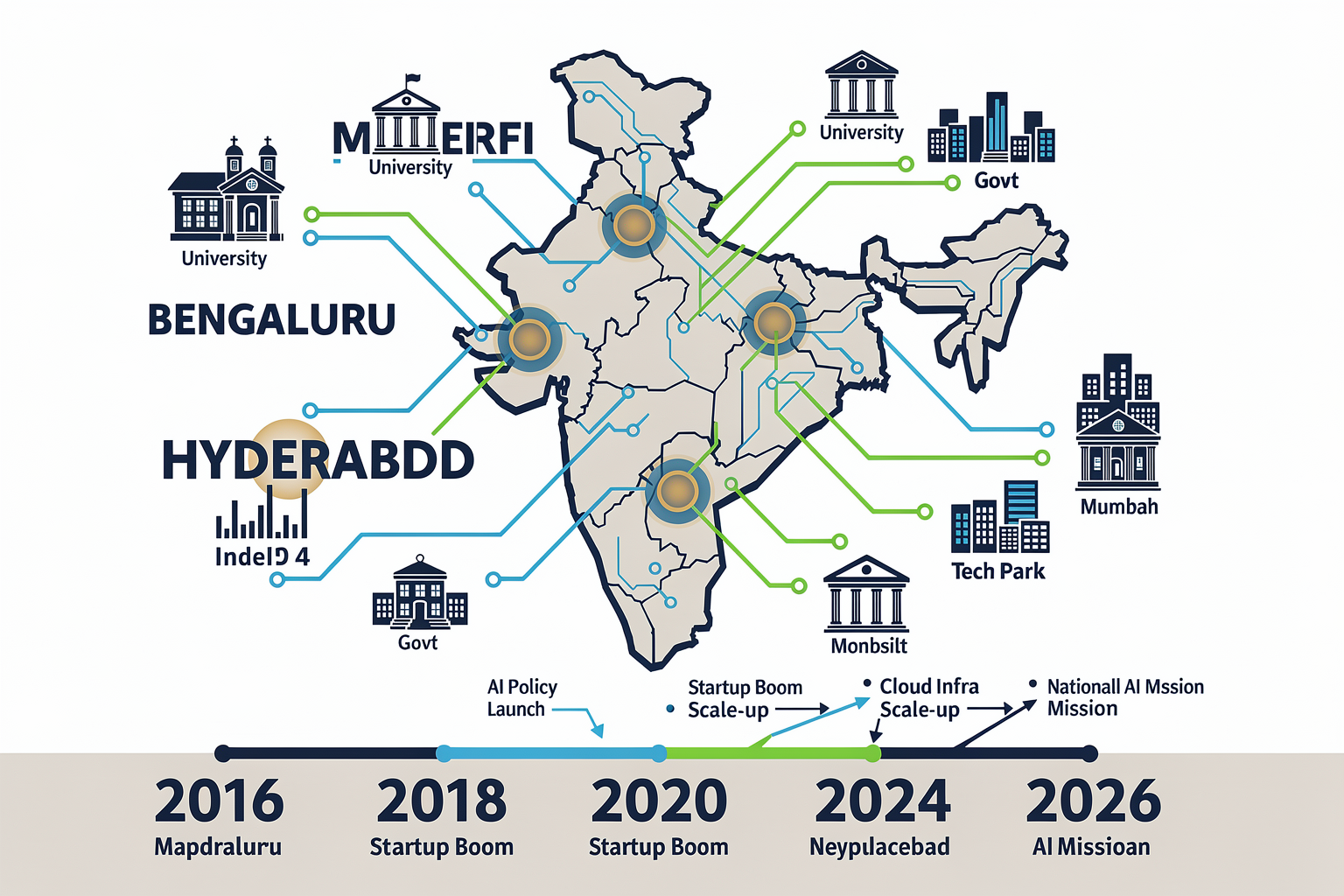
Investment Landscape: Billions Flowing In
India’s position on the global AI map has shifted dramatically over the past two years. In 2023, the country secured the 10th spot worldwide for AI private investment, attracting $1.4 billion in funding [1]. While this ranks behind the U.S. and China, the momentum is accelerating quickly. Microsoft’s announcement of a $17.5 billion investment — its largest in Asia — cements India as a rising global AI compute hub [4]. According to government estimates, overall AI investment in the country is growing at a compound annual growth rate (CAGR) of 30.8% [5]. This influx is not limited to hyperscalers; domestic venture capital is also pouring into AI-native startups, creating a dense ecosystem from foundational models to application-layer solutions.
Government Catalysts: The IndiaAI Mission
The central government has matched private momentum with bold policy. The proposed $1.2 billion IndiaAI Mission is designed to build sovereign AI infrastructure, fund research, and democratize compute access [6]. This public push aligns with projections from the Press Information Bureau that India’s AI industry will reach $28.8 billion by 2025 — a staggering 45% CAGR from current levels [2]. The mission also prioritizes “AI for All,” ensuring that rural and vernacular markets benefit from the wave. Such structural support sets India apart from other emerging economies, where AI development remains largely uncoordinated.
Talent and Startup Ecosystem
The human capital side is equally impressive. Between 2016 and 2024, India’s AI-skilled workforce grew 14-fold, creating one of the largest pools of AI talent outside the U.S. [2]. Unlike copycat models from the West, Indian startups are focusing on real-world solutions for the country’s diverse markets — from agriculture and healthcare to financial inclusion and logistics [3]. This localization is a key competitive advantage. Platforms like CallMissed, for instance, are already enabling businesses to deploy multilingual AI voice agents that handle customer calls 24/7 in 22 Indian languages, directly addressing Bharat’s communication challenges. Such innovations are possible only because the foundational investment (both capital and compute) now exists to support them.
A Unique Trajectory
Unlike markets that treat AI as a pure technology play, India is shaping an inclusive AI story — one where billion-dollar investments meet grassroots problem-solving. The combination of hyperscaler bets, government mission-mode spending, and a talent base focused on practical deployment gives India a trajectory that few countries can replicate. The next section will examine how these macro trends translate into real enterprise adoption.
Key Developments: India’s Billion-Dollar AI Investments
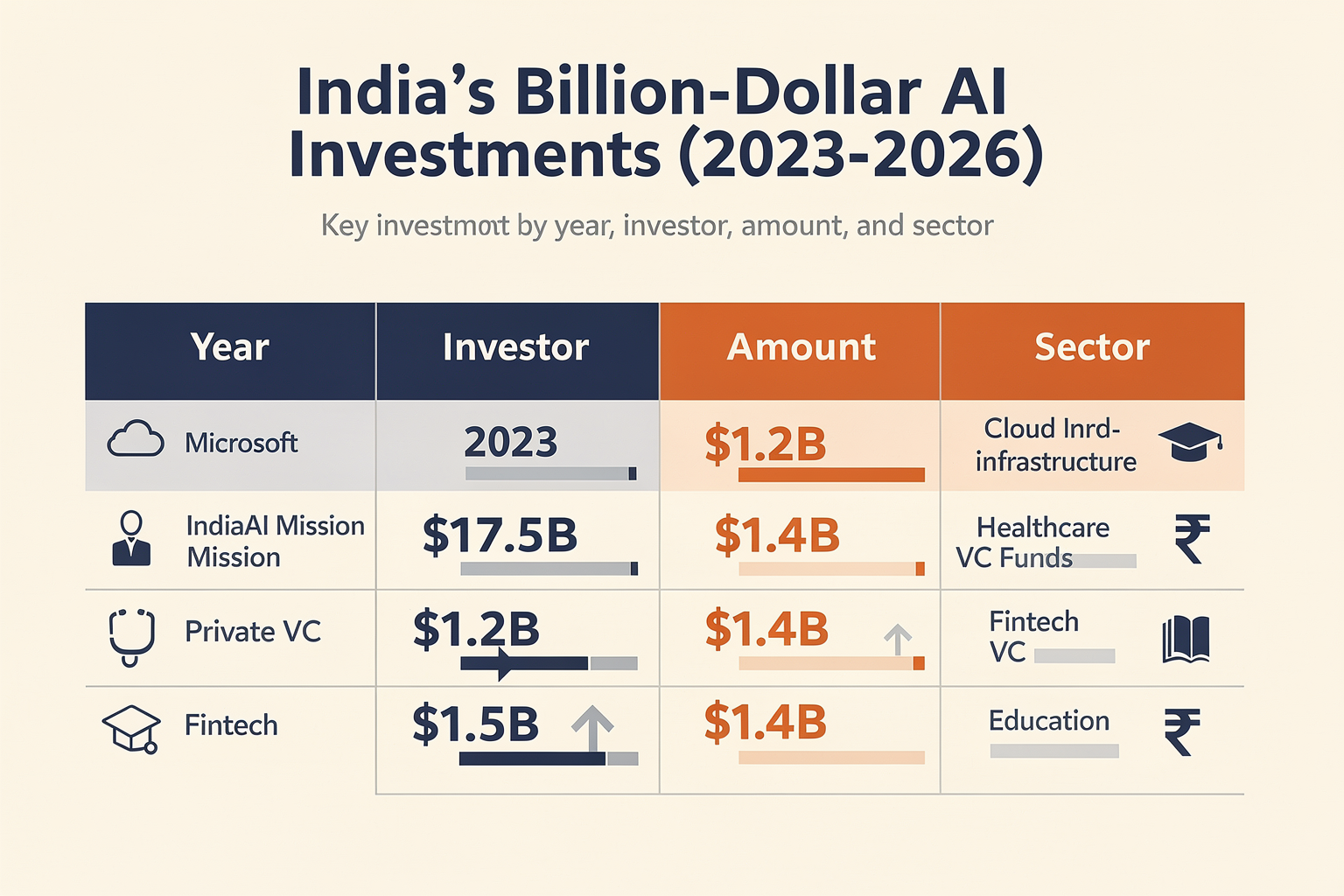
India’s artificial intelligence sector is witnessing a historic surge in billion-dollar investments, attracting both domestic and global capital at unprecedented levels. Here’s a data-driven snapshot of the most significant milestones defining this era.
Major Milestones in India’s AI Investment Landscape
| Year | Investment/Initiative | Value (USD) | Key Players | Impact/Details |
|---|---|---|---|---|
| 2023 | Private AI Funding | $1.4 Billion | Various VCs, Startups | Ranked 10th globally for private AI investment [1] |
| 2024 | Microsoft Azure AI Hub Announcement | $17.5 Billion | Microsoft | Largest single AI investment in Asia [4] |
| 2024 | IndiaAI Mission (Govt. Initiative) | $1.2 Billion | Govt. of India | National AI infrastructure, policy, R&D [6] |
| 2023 | Indian AI Market Valuation | $12.3 Billion | Ecosystem-wide | Set to reach $28.8B by 2025, 45% CAGR [2] |
| 2016-2024 | AI-Skilled Talent Growth | 14x Increase | Universities, Corporates | Massive upskilling/education initiatives [2] |
| 2025 (Projected) | Total AI Market Size | $28.8 Billion | Startups, Enterprises | High-growth trajectory for the sector [2] |
Investment Drivers and Patterns
India’s AI revolution is propelled by several unique dynamics:
- Private Equity and Venture Capital Surge: In 2023 alone, India attracted $1.4 billion in private AI funding, positioning it among the world’s top 10 AI investment destinations [1].
- Big Tech Bets: Microsoft’s landmark $17.5 billion investment in 2024 is not just its largest in Asia but also a defining moment that accelerates the creation of AI compute infrastructure and R&D hubs [4].
- Government-Led Push: The $1.2 billion IndiaAI Mission was launched to build foundational AI ecosystem components—from compute clusters to regulatory frameworks—reflecting the government’s deep-rooted commitment [6].
- Exponential Talent Pipeline: India’s AI-skilled workforce has expanded 14 times since 2016, underpinned by national skilling programs and global tech partnership [2].
- Market Expansion: The Indian AI market, valued at $12.3 billion in 2023, is set to more than double by 2025, with an annual compound growth rate of 45%—outpacing most regions worldwide [2].
Strategic Impacts
These investments are reshaping India’s role in the global AI ecosystem:
- India is not just consuming but actively shaping AI trends, with government, academia, and industry collaborating on home-grown innovation [7].
- Large-scale funding has enabled the development of AI infrastructure at scale—think hyperscale GPU data centers, multilingual language model support, and enterprise-grade AI services.
- Ecosystem players, including platforms like CallMissed, are emerging to operationalize these breakthroughs—delivering production-ready AI infrastructure for businesses, making advanced capabilities (such as LLM inference in 300+ models and voice AI in 22 Indian languages) accessible to a wider market.
Looking Ahead
India’s combination of billion-dollar investments, talent expansion, and government leadership is cementing its status as a global AI powerhouse. With projections of a $28.8 billion AI industry by 2025, the next two years will be critical in defining new benchmarks for adoption, innovation, and real-world AI impact.
In-Depth Analysis: Why India’s AI Revolution is Unique

India’s Distinctive AI Growth Story
India’s AI revolution stands out on the global stage not just for its sheer scale and rapid acceleration, but for the unique contexts shaping its trajectory. Unlike Western and East Asian counterparts, India’s AI expansion is defined by inclusive design, grassroots innovation, and solutions tailored specifically to its socio-economic diversity.
#### 1. Massive Scale, Rapid Growth, and Regional Focus
India’s AI industry is projected to reach $28.8 billion by 2025, growing at a blistering 45% CAGR (PIB, 2024)[2]. This is not only fueled by marquee investments—Microsoft’s $17.5 billion bet on India is its largest AI outlay in Asia (AIM, 2026)[4]—but also by targeted government efforts such as the proposed $1.2 billion IndiaAI Mission, focused on democratizing AI benefits (InvestIndia, 2026)[6].
The sector’s momentum is characterized by:
- Surge in AI workforce: A 14-fold increase in AI-skilled professionals since 2016 (PIB, 2024)[2].
- Vast linguistic market: Real-world solutions must cater to 22 official languages and hundreds of dialects, making language and accessibility central to AI strategies.
- Regional adaptation: Unlike in many markets, AI solutions in India are designed to reach Tier-2/3 cities and rural users, not just urban centers.
#### 2. Solving for India—Not Just India’s Elite
Multilingual and affordable AI is not a luxury, but a necessity. Indian startups have pioneered inclusive AI—from vernacular speech recognition to WhatsApp-based agri-advisors. As noted by industry voices, “Startups are focusing on developing real-world solutions for India's diverse markets, rather than chasing Silicon Valley-typical problems” (Instagram[3]).
For example:
- Healthcare: Low-cost AI chatbots in Hindi and regional languages are reaching first-time users in rural clinics.
- Financial services: Automated voice agents handle transactions for non-English speakers in microfinance and insurance.
- Agritech: Multilingual chatbots provide crop and weather updates via local messaging platforms.
Platforms like CallMissed are crucial in this landscape, offering production-ready AI voice agents and speech-to-text in 22 Indian languages, making AI accessible beyond major metros and English-speaking cohorts.
#### 3. Government as Catalyst, Not Just Regulator
India’s proactive government stance is another key differentiator. Initiatives such as:
- The IndiaAI Mission ($1.2B) aims to build compute infrastructure, talent, and ethical frameworks for responsible AI growth (InvestIndia[6]).
- Government and public sector AI pilots tackle problems like crop yield prediction and traffic congestion, emphasizing public good over commercial returns.
According to Nasscom, investment in India’s AI capabilities is growing at 30.8% CAGR, underpinned by cross-sectoral collaboration between state, academia, and industry (Nasscom[5]).
#### 4. Frugal Innovation and Global Implications
India’s “Jugaad” (frugal innovation) mindset permeates its AI revolution. Solutions must operate reliably on low-bandwidth networks and affordable devices—a constraint that is now an enabler for scalable, exportable AI products worldwide. As India’s AI market grows, these learnings will shape enterprises everywhere eyeing the next billion users.
India’s AI revolution is thus unique for its focus on scale, inclusivity, and “solving for India”—turning demographic complexity into a global testbed for AI relevance. With its unmatched pool of talent, massive investments, and deep commitment to democratized technology, India is not just riding the AI wave; it is actively shaping what the next generation of AI will mean for the world.
Impact & Implications: AI’s Economic and Social Ripple Effects
AI’s Economic Catalysts: Growth, Jobs, and Industry Transformation
The surge of AI adoption in India is already having tangible economic effects. According to the Press Information Bureau, India’s AI industry is on track to reach USD 28.8 billion by 2025, growing at an astonishing 45% CAGR [2]. This growth is fueled by rapid investment inflows, with private funding touching $1.4 billion in 2023, propelling India to the 10th position globally in AI investments [1].
Key economic ripple effects include:
- New Job Creation: There has been a 14-fold increase in the AI-skilled workforce since 2016 [2]. As AI becomes mainstream, demand for roles like ML engineers, AI trainers, prompt engineers, and data annotators is soaring.
- Productivity Gains: Sectors ranging from manufacturing to financial services are automating repetitive tasks, reducing costs, and improving efficiency. McKinsey estimates that AI could add $500 billion to India’s GDP by 2025, primarily through productivity improvements and new market creation.
- Startup Ecosystem: Indian startups, now flush with capital from both global giants and domestic VCs, are focused on developing AI solutions rooted in local challenges—spanning agriculture, healthcare, logistics, and multilingual communication [3].
Platforms such as CallMissed are emblematic of this trend, enabling businesses to leverage AI voice agents and multilingual chatbots to serve customers across India’s linguistic and geographic spectrum—delivering productivity at scale while creating new categories of tech jobs in the process.
Social Implications: Inclusion, Access, and the Urban-Rural Divide
While AI’s economic impact is undeniable, its social implications are equally profound. India’s demographic and regional diversity presents both opportunities and challenges:
- Inclusion via Language: AI-powered platforms supporting 22 Indian languages are democratizing access to digital services. For instance, CallMissed’s Speech-to-Text APIs enable voice-driven applications for millions of non-English speakers, bridging digital and literacy divides.
- AgriTech and Healthcare: AI-driven applications are delivering crop insights to farmers via WhatsApp and providing diagnostic support to doctors in rural areas. These solutions directly address core issues of food security and healthcare access.
- Skill Gaps and Workforce Transition: While AI will automate some roles, it’s also catalyzing investment in upskilling. Government and private programs are ramping up AI education—crucial as the transition could disproportionately affect low-skilled jobs if not managed proactively [6].
Emerging Risks and Future Directions
India’s AI leap isn’t without risks. Biases in data, algorithmic decision-making, and privacy breaches are significant concerns. The urban-rural digital divide could widen if infrastructure investments lag behind AI rollout in non-metro regions. Moreover, ensuring that AI-generated economic gains are equitably distributed remains a policy priority.
However, policy momentum is building. The Government’s proposed $1.2 billion IndiaAI Mission aims to anchor national AI priorities, focusing on inclusive innovation and talent development [6]. Corporations are also committing; for example, Microsoft’s $17.5 billion investment solidifies India’s role as a global AI compute hub [4].
The Path Forward
To maximize AI’s ripple effects, India must synchronize investment, policy, and upskilling at scale. Concrete measures include:
- Incentivizing local AI innovation for public good
- Expanding broadband and digital infrastructure in rural zones
- Enforcing clear AI governance standards and ethical norms
- Widening access to AI education and literacy programs
With platforms like CallMissed leading the way in accessible, multilingual AI infrastructure, and with momentum from both government and global tech leaders, India’s AI revolution is uniquely poised to deliver economic transformation alongside inclusive social progress—a model of AI-for-all that could set the global benchmark.
Expert Opinions: Insights from Industry Leaders
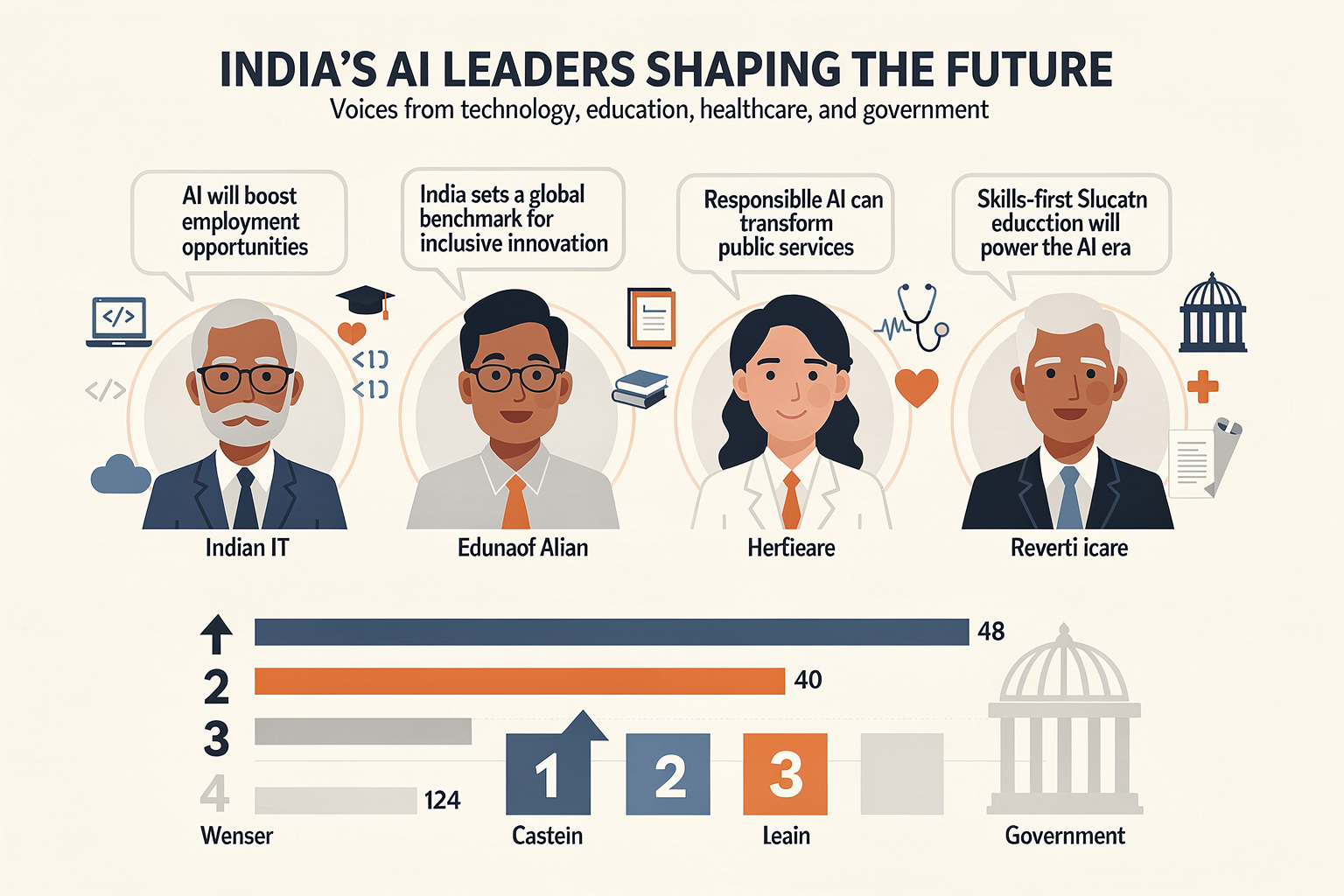
Global Tech Giants Bet on India
The scale of global confidence in India’s AI potential is perhaps best captured by Microsoft’s $17.5 billion investment — its largest single bet in Asia. According to industry analysts, this move “cements India as a rising global AI compute hub.” Satya Nadella, Microsoft’s CEO, has repeatedly highlighted India’s unique combination of a vast developer base, digital public infrastructure, and a rapidly growing startup ecosystem as the reasons behind the commitment. “India is a market that none of them can ignore,” noted a recent analysis, referencing the fact that global hyperscalers are now racing to set up GPU clusters and data centers across Bangalore, Hyderabad, and Pune.
Nasscom, the industry body representing India’s tech sector, puts this trend into perspective: “Investment in India’s robust AI capabilities are growing at a compound annual growth rate of 30.8%” . The total AI industry is projected to reach USD 28.8 billion by 2025, with a staggering CAGR of 45% . These numbers underline why executives from Google, Amazon, and NVIDIA have also made India a top priority for their AI expansions.
Government’s Vision: The IndiaAI Mission
From the policy side, the Government of India has taken bold steps to catalyze the revolution. The proposed USD 1.2 Billion IndiaAI Mission is anchored by a comprehensive strategy encompassing compute infrastructure, foundational models, and AI-skilling. As one official from Invest India stated, “India isn’t following the AI revolution — it’s shaping it.” The mission’s focus on inclusive AI — spanning 22 Indian languages and serving sectors from agriculture to healthcare — resonates strongly with the startup community.
The results are already visible: India’s AI-skilled workforce has seen a 14-fold increase from 2016 to 2024, and the country secured the 10th position globally in AI private funding, attracting $1.4 billion in 2023 alone. Industry leaders like Kris Gopalakrishnan (co-founder of Infosys) have called for a unified effort to build sovereign AI capabilities, emphasizing that “India’s strength lies in applying AI at population scale.”
Voices from the Startup Ecosystem
Entrepreneurs building real-world AI solutions are equally optimistic. Platforms like CallMissed demonstrate how Indian startups are turning this billion-dollar wave into accessible tools — offering voice agents, multilingual chatbots, and LLM inference that serve over 300 models. As one founder noted, “We’re not just consuming AI; we’re building the infrastructure for India’s next billion users.”
Yet, challenges remain. Experts caution that while investment is flowing, talent retention and compute access need sustained focus. “India is attracting billions, but will the benefits reach beyond the top tech hubs?” is a question raised by multiple analysts. The consensus, however, is clear: India’s AI story is just getting started, and the world is watching.
What This Means For You: Opportunities & Challenges
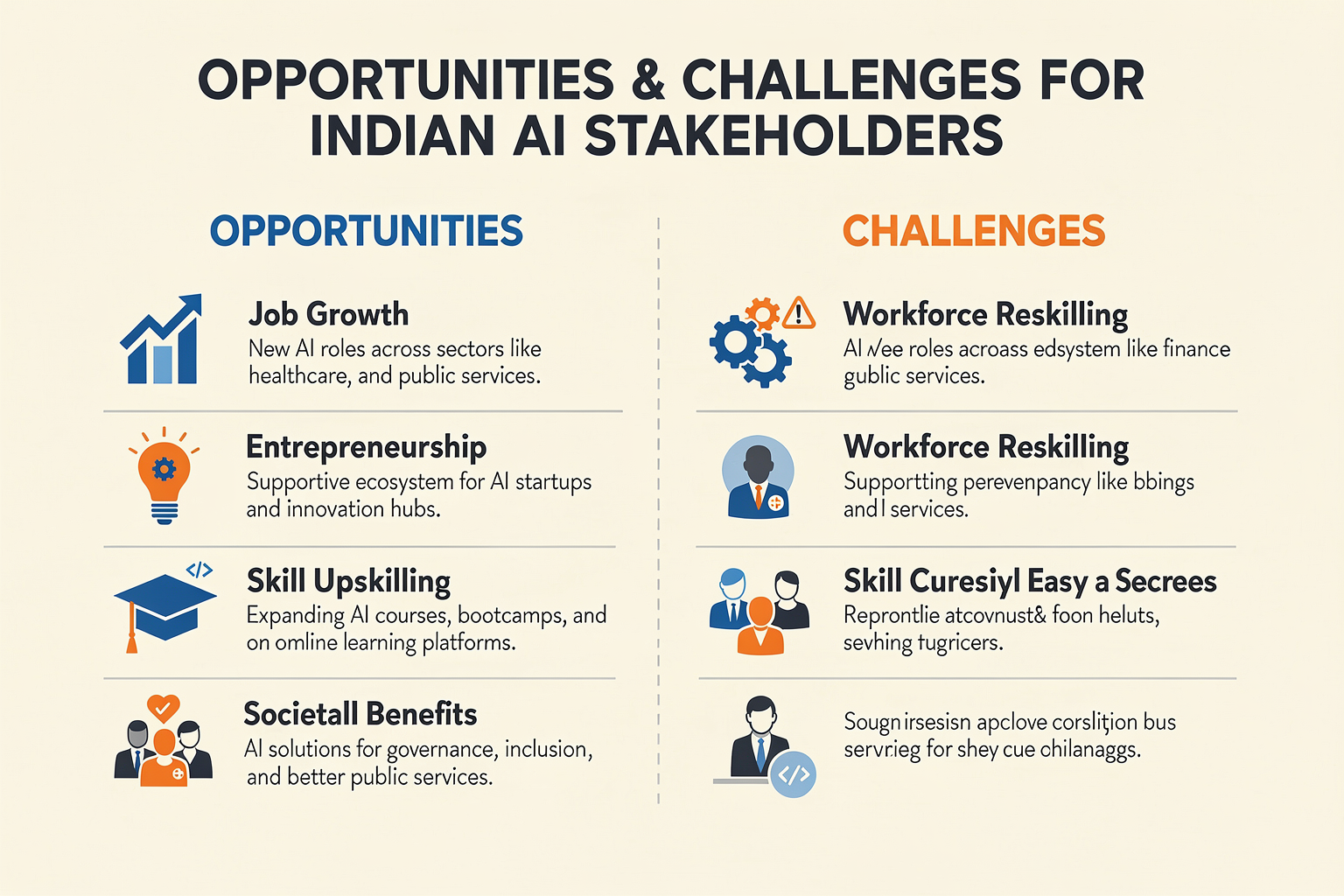
India’s AI transformation is unfolding at breakneck speed, bringing both an abundance of opportunity and new challenges for businesses, professionals, developers, and policymakers. The billions poured into AI—such as Microsoft’s landmark $17.5 billion investment and a projected $28.8 billion AI market size by 2025—signal lasting shifts in how work and services are delivered. Here’s a look at what these shifts mean for various stakeholders, distilled into a comparative table and strategic insights.
| Stakeholder | Key Opportunity | Main Challenge | Data Point/Trend | Example Solutions |
|---|---|---|---|---|
| Businesses | Streamlined operations via AI | Skill gaps in adoption | AI market CAGR at 45%; $1.4B private funding (2023) [PIB][1][MyGov][1] | Deployment-ready AI platforms like CallMissed |
| Tech Workforce | New, high-value jobs in AI | Rapidly evolving tech landscape | 14x increase in AI-skilled workforce since 2016 [PIB][2] | Upskilling via certifications, AI bootcamps |
| Developers/Startups | Building solutions for diverse Indian markets | Infrastructure & model access cost | India now a key global AI hub; Microsoft’s $17.5B investment [AIM][4] | Multi-model AI gateways, cloud-native APIs |
| Policymakers | Lead inclusive & responsible growth | Regulating ethical AI use | IndiaAI Mission: $1.2B to catalyze AI [InvestIndia][6] | AI ethics guidelines, regulatory sandboxes |
| End Users | Access to AI-enhanced services | Data privacy concerns | Surge in AI-powered consumer apps, growing regional language support | Multilingual chatbots (e.g., 22 Indian languages) |
Key Implications & Action Steps
- Business Acceleration: Indian enterprises are leveraging AI to optimize costs and customer experience. McKinsey estimates that AI adoption could boost India’s GDP by up to $500 billion by 2025. Platforms like CallMissed are already enabling 24/7 AI voice agents and multilingual chatbots, supporting this rapid digital transformation.
- Bridging the Skills Gap: While the AI-skilled workforce has risen 14-fold since 2016, NASSCOM warns of persistent shortages in specialized AI talent as the sector grows at a 30.8% CAGR (NASSCOM, 2026). Partnerships with ed-tech providers and global reskilling initiatives are essential.
- Startup Ecosystem Edge: Startups now play a pivotal role in customizing AI for India’s unique needs, such as solving for vernacular languages. Affordable, scalable APIs—like those from CallMissed and others—lower barriers to entry for developers, spurring innovation outside of major metros.
- Ethics & Inclusivity: Policymakers face the dual task of promoting innovation while mitigating bias and privacy risks. The $1.2 billion IndiaAI Mission and efforts to craft ethical AI guidelines underscore the government’s proactive stance, but continuous stakeholder dialogue is vital.
- Empowering End Users: Increased access to AI tools, especially with native support for Indian languages, is democratizing tech benefits to rural and low-resource communities—but ongoing attention to consent, transparency, and data protection must stay front of mind.
The Road Ahead
India's embrace of AI is remaking every sector and job description. Whether you’re a business leader prioritizing automation, a developer eyeing next-gen APIs, or a policymaker defining ethical guardrails, understanding both the risks and rewards will define your strategy. Platforms such as CallMissed, serving as industry enablers, exemplify the kind of agile, future-facing infrastructure driving India’s AI revolution.
Frequently Asked Questions
How much investment is flowing into India's artificial intelligence (AI) market in 2026?
What is the size and projected growth of the artificial intelligence market in India?
How are billion-dollar AI investments impacting jobs and the Indian workforce?
What role does India play in the global AI revolution?
Which Indian AI startups and platforms are leading innovation in real-world applications?
What are the main government initiatives supporting the artificial intelligence market in India?
Conclusion
As India surges toward an AI industry valued at $28.8 billion by 2025 and attracts record-breaking investments—from Microsoft's $17.5 billion bet to the government’s $1.2 billion IndiaAI Mission—the country is no longer just following the global AI revolution; it is actively shaping it. The path ahead is defined by three key realities:
- Scale meets inclusion: With a 45% CAGR and a 14-fold increase in AI-skilled workforce since 2016, India is building solutions that serve its vast, multilingual population rather than copying Western models.
- Infrastructure is the new frontier: Investments are shifting from pure research to production-ready compute hubs and application-layer platforms, enabling startups to deploy AI at unprecedented speed.
- Global relevance, local impact: India’s ability to innovate for diverse markets means its AI breakthroughs will have ripple effects across the developing world.
What to watch next? The race to make AI voice-native and language-agnostic. As 22 Indian languages become first-class citizens in AI interfaces, the next billion users will be brought online through speech and text in their mother tongue.
To explore how AI communication is evolving, check out CallMissed — an AI infrastructure platform powering voice agents and multilingual chatbots for businesses ready to ride this wave. The question is no longer if India will lead in AI, but how quickly you’ll adapt.
Discussion
Related Posts



Ready to automate customer conversations?
Launch AI voice agents and WhatsApp bots with CallMissed — one API, 22+ Indian languages.