
GPT-5.6 Sol: Everything You Need to Know About OpenAI’s Flagship Next-Gen Model



What if an artificial intelligence model was so advanced at autonomous reasoning and digital execution that its initial deployment required strict...
GPT-5.6 Sol: Everything You Need to Know About OpenAI’s Flagship Next-Gen Model
What if an artificial intelligence model was so advanced at autonomous reasoning and digital execution that its initial deployment required strict security restrictions under direct government guidance? This is no longer a hypothetical scenario. With the June 2026 launch of OpenAI’s brand-new GPT-5.6 family, the boundary of what AI can autonomously achieve has been fundamentally redrawn. At the absolute frontier of this release is GPT-5.6 Sol, OpenAI's new flagship model designed to handle the world's most complex computational, scientific, and agentic challenges.
While previous generations focused heavily on conversational fluency, GPT-5.6 Sol is built from the ground up for agentic workflows—complex, multi-step tasks where the AI acts as an autonomous digital worker. Released alongside its sibling models, the cost-efficient Terra and the high-speed Luna, Sol commands a premium price point of $5 per million input tokens and $30 per million output tokens. For that investment, enterprises gain access to unprecedented capabilities: a reported 20% reduction in latency compared to previous models, an extended context window, and revolutionary "max" and "ultra" reasoning effort options that allow the model to spend more compute time solving highly complex, multi-step logic problems.
This technological leap comes at a critical inflection point. As industries transition from basic conversational tools to fully autonomous agentic networks, the demand for models that can reliably generate front-end code, analyze biological data, and safely diagnose cybersecurity vulnerabilities has skyrocketed. Innovative communication infrastructure platforms like CallMissed are already helping businesses navigate this paradigm shift, offering multi-model API gateways that let developers orchestrate these advanced LLMs alongside real-time voice and messaging tools.
In this ultimate guide, we will unpack everything you need to know about GPT-5.6 Sol. We will dive deep into its performance benchmarks across coding and biochemistry, explore the strict safety audit protocols governing its restricted release, and analyze how to leverage Sol, Terra, and Luna to build the next generation of AI-driven automation.
Introduction: OpenAI's Next-Gen Flagship Has Arrived

The artificial intelligence landscape has officially entered its next epoch. In June 2026, OpenAI fundamentally rewrote the rules of digital intelligence with the release of its highly anticipated GPT-5.6 model family. At the absolute frontier of this release sits GPT-5.6 Sol, OpenAI's new flagship model designed from the ground up to tackle the world's most complex computational, scientific, and agentic challenges.
While previous generations of large language models focused primarily on conversational fluency, GPT-5.6 Sol is engineered for autonomous agency—representing a massive leap toward reliable, self-directed "digital workers." Sol does not enter the market alone; it is the crown jewel of a tri-tier ecosystem tailored to specific enterprise and developer needs:
- GPT-5.6 Sol: The ultra-capable flagship designed for deep reasoning, advanced coding, and complex scientific synthesis.
- GPT-5.6 Terra: A highly capable, lower-cost option built for high-volume enterprise pipelines.
- GPT-5.6 Luna: The fastest model in the lineup, optimized for real-time applications requiring instantaneous responses.
A Premium Price for Next-Gen Autonomy
To access the absolute peak of frontier AI, enterprises must invest. Early reports pin the pricing for GPT-5.6 Sol at $5 per million input tokens and $30 per million output tokens. While this represents a premium over previous models, the cost is offset by substantial architectural breakthroughs.
Sol boasts an extended context window, a reported 20% reduction in latency compared to previous generations, and introduces revolutionary "max" and "ultra" reasoning effort configurations. These settings allow developers to allocate more compute time to the model, giving it the "thinking space" required to autonomously solve intricate logic, debugging, and mathematical proofs before returning an answer.
Why GPT-5.6 Sol Stands Alone
GPT-5.6 Sol excels where legacy systems falter: complex, multi-step execution. From generating massive front-end code repositories to analyzing complex biological structures, Sol moves beyond simple prompting into true agentic execution.
However, with such unprecedented capability comes heightened responsibility. Because of Sol's advanced reasoning capabilities, OpenAI has implemented strict safety audit protocols under direct US government guidance, restricting initial access to prevent dual-use risks. This is especially true in cybersecurity, where Sol has been hardwired to assist in identifying and patching software vulnerabilities rather than automating offensive exploits.
As enterprises rush to integrate these powerful models, infrastructure remains the critical bridge. Implementing a model of Sol’s caliber requires robust, reliable orchestration. Platforms like CallMissed are already helping businesses navigate this shift, offering developers the infrastructure to connect GPT-5.6 Sol to real-world applications. By combining these advanced LLMs with CallMissed's low-latency APIs, Speech-to-Text capabilities, and multi-channel routing, enterprises can safely deploy Sol's reasoning power directly into automated voice agents and communication workflows.
Background & Context: The Dawn of the GPT-5.6 Trio
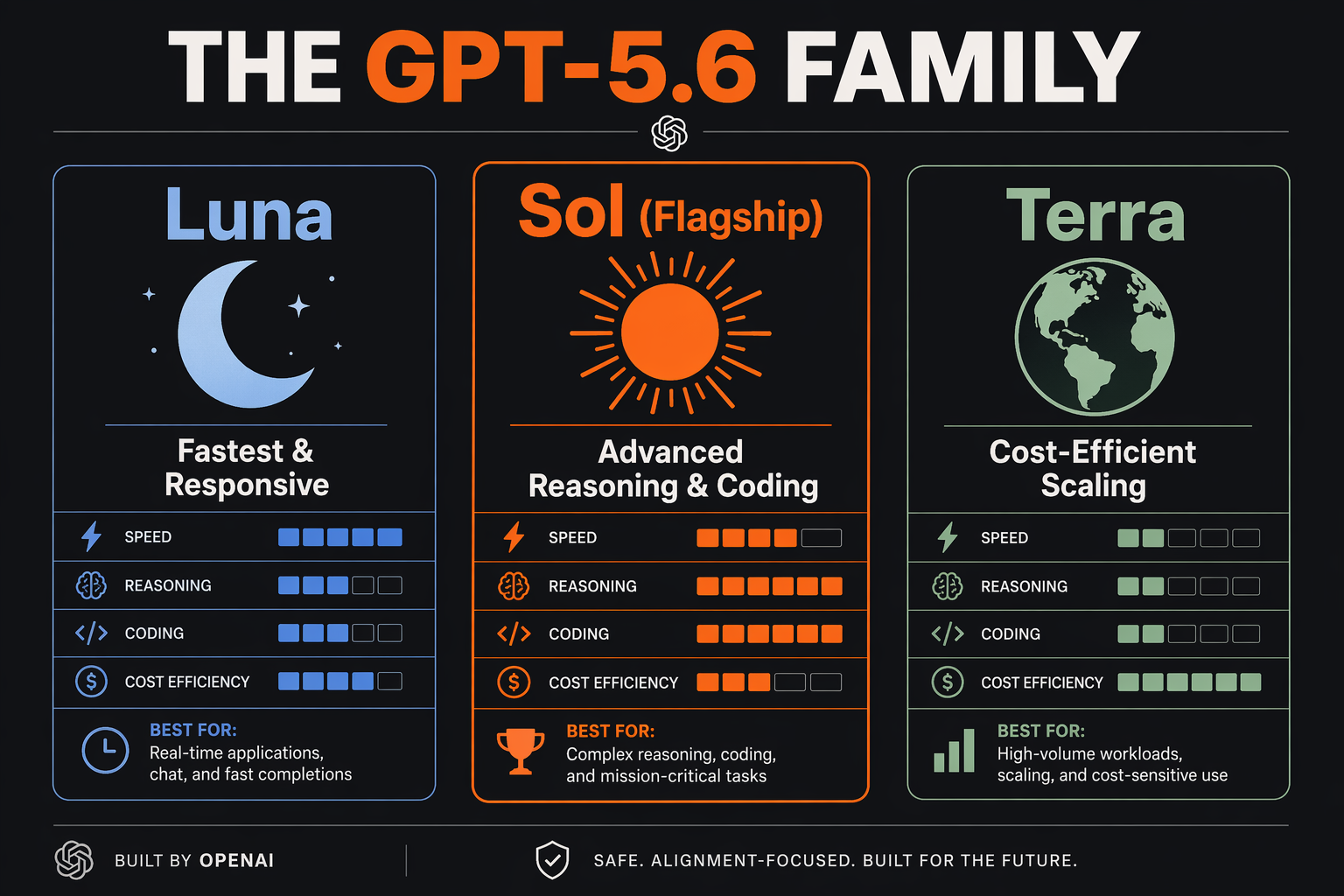
The release of the GPT-5.6 family in June 2026 represents a massive architectural shift for OpenAI. Rather than forcing a single, monolithic model to handle every type of digital interaction, OpenAI has introduced a tri-tiered ecosystem designed to optimize performance, cost, and speed. Collectively known as the GPT-5.6 trio, this launch introduces three distinct models: GPT-5.6 Sol, GPT-5.6 Terra, and GPT-5.6 Luna.
Each model in this trinity serves a distinct purpose, reflecting how enterprises now deploy AI at scale.
The Triad: Sol, Terra, and Luna
To appreciate the raw power of the flagship Sol, one must first understand its place within the broader GPT-5.6 ecosystem:
- GPT-5.6 Sol (The Flagship): Engineered for maximum computational depth, Sol is OpenAI’s most advanced reasoning engine. Priced at $5 per million input tokens and $30 per million output tokens, it is built specifically for complex agentic workflows, advanced code generation, biology/biochemistry analysis, and defensive cybersecurity auditing.
- GPT-5.6 Terra (The Workhorse): Designed as a highly capable, lower-cost option, Terra balances reasoning power with cost-efficiency. It acts as the go-to model for high-volume, standard enterprise automation where Sol's premium pricing is not economically viable.
- GPT-5.6 Luna (The Speedster): Luna is the fastest model in the lineup. It is optimized for ultra-low latency, making it the ideal engine for real-time conversational applications and rapid-fire queries.
Why a Trio? The Rise of Multi-Model Orchestration
This segmented release is not just a marketing strategy; it is a response to how modern AI architecture is built. In 2026, developers no longer rely on a single LLM to power an entire application. Instead, they build multi-model pipelines. For example, a complex software-development agent might use Luna to handle instant user chats, Terra to generate boilerplate code, and Sol to execute deep, multi-step debugging and repository-wide security audits.
This complex routing requires robust infrastructure. Advanced communication platforms like CallMissed are paving the way for this multi-model future. By offering unified API gateways that support over 300 LLMs, CallMissed enables businesses to seamlessly orchestrate tasks across OpenAI's new trio. A company can route high-speed voice agent interactions through Luna to minimize latency and handle real-time Speech-to-Text across 22 regional Indian languages, while reserving the heavy-duty reasoning of Sol for complex backend operations—all through a single integrated workflow.
From Conversation to Agentic Autonomy
The overarching theme of the GPT-5.6 era is the transition from conversational fluency to autonomous agency. Previous generations of AI excelled at generating coherent text but struggled when asked to execute long, multi-step tasks without human intervention. The GPT-5.6 trio changes this by prioritizing extended context windows, advanced planning capabilities, and state tracking. By partitioning their next-generation intelligence into Sol, Terra, and Luna, OpenAI has given developers the exact tools they need to build specialized digital workers that can plan, execute, and verify their own work in real time.
Key Developments: Sol vs. Terra vs. Luna
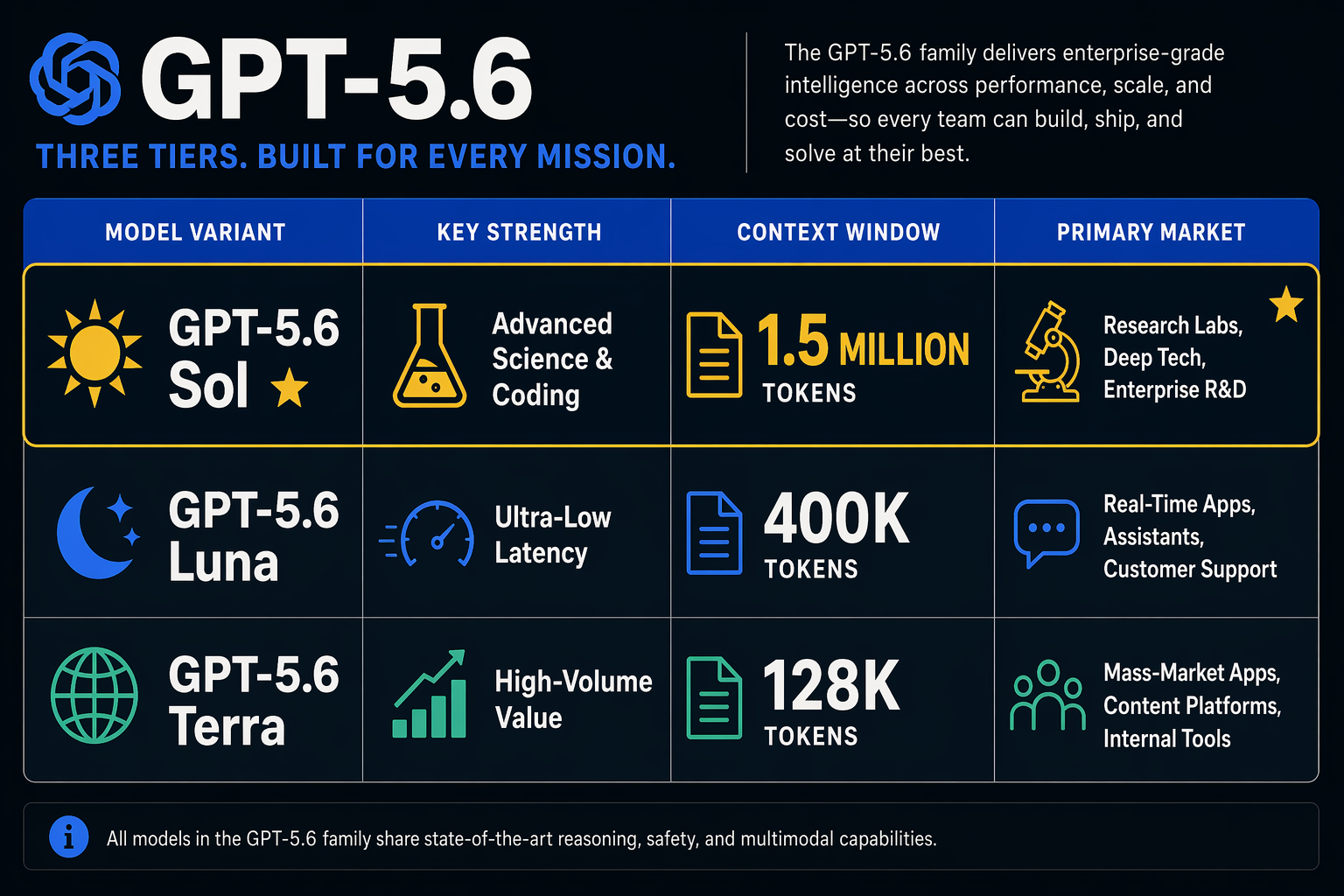
To truly understand the paradigm shift of the GPT-5.6 generation, we must look at how OpenAI has segmented its capabilities. Rather than offering a single, monolithic model, the June 2026 release introduces three specialized variants designed to tackle different aspects of enterprise workflows: Sol, Terra, and Luna.
This multi-model strategy recognizes that today's AI applications require a delicate balance between cognitive depth, execution speed, and operational cost. While Sol handles the heavy cognitive lifting, its sibling models provide the high-throughput, low-latency execution required for daily operational tasks and real-time customer touchpoints.
Architectural Breakdown of the GPT-5.6 Family
Below is a comparative breakdown of how the three newly launched models stack up against each other and legacy systems:
| Model | Primary Focus | Pricing (Input/Output per 1M) | Core Strengths | Best For |
|---|---|---|---|---|
| GPT-5.6 Sol | Flagship Reasoning & Agency | $5.00 / $30.00 | "Max" & "Ultra" reasoning, 20% latency reduction | Complex coding, biology, cyber defense |
| GPT-5.6 Terra | Cost-Efficient Execution | Low-cost tier (~$0.50 / $1.50) | High throughput, balanced logic-to-cost | Enterprise operations, high-volume parsing |
| GPT-5.6 Luna | Ultra-Low Latency | High-speed tier (~$0.25 / $1.00) | Instant processing, rapid inference | Voice agents, streaming APIs, live chat |
| GPT-5 (Legacy) | General Intelligence | $10.00 / $30.00 (historical) | Broad reasoning, multi-modal tasks | Legacy system migration, general tasks |
Choosing Your Tool: Deep Reasoning vs. Real-Time Action
The introduction of GPT-5.6 Sol's customizable "max" and "ultra" reasoning modes means developers no longer have to settle for a "one-size-fits-all" inference approach. For high-stakes, multi-step actions—such as a developer seeking to debug a massive, multi-repository front-end codebase or a security researcher evaluating software for potential vulnerabilities—Sol is the undisputed choice. Its ability to spend extra compute time "thinking" before generating a response ensures unmatched accuracy in complex environments.
Conversely, Luna is built for scenarios where milliseconds matter. By focusing entirely on high-velocity generation, Luna achieves the ultra-low latency necessary to power human-like conversation. Meanwhile, Terra serves as the workhorse of the trio, optimizing for high-volume enterprise pipelines where processing millions of documents or structured data files must remain financially viable.
This segmented landscape is exactly where advanced integration platforms shine. For example, platforms like CallMissed allow businesses to orchestrate these models seamlessly. Using CallMissed's multi-model LLM API gateway, developers can route real-time customer interactions through the lightning-fast Luna model, while instantly escalating complex, multi-step backend requests to Sol. This hybrid architecture maximizes both user experience and computational efficiency without changing code infrastructure.
In-Depth Analysis: Coding, Science, and Flexible Reasoning Efforts
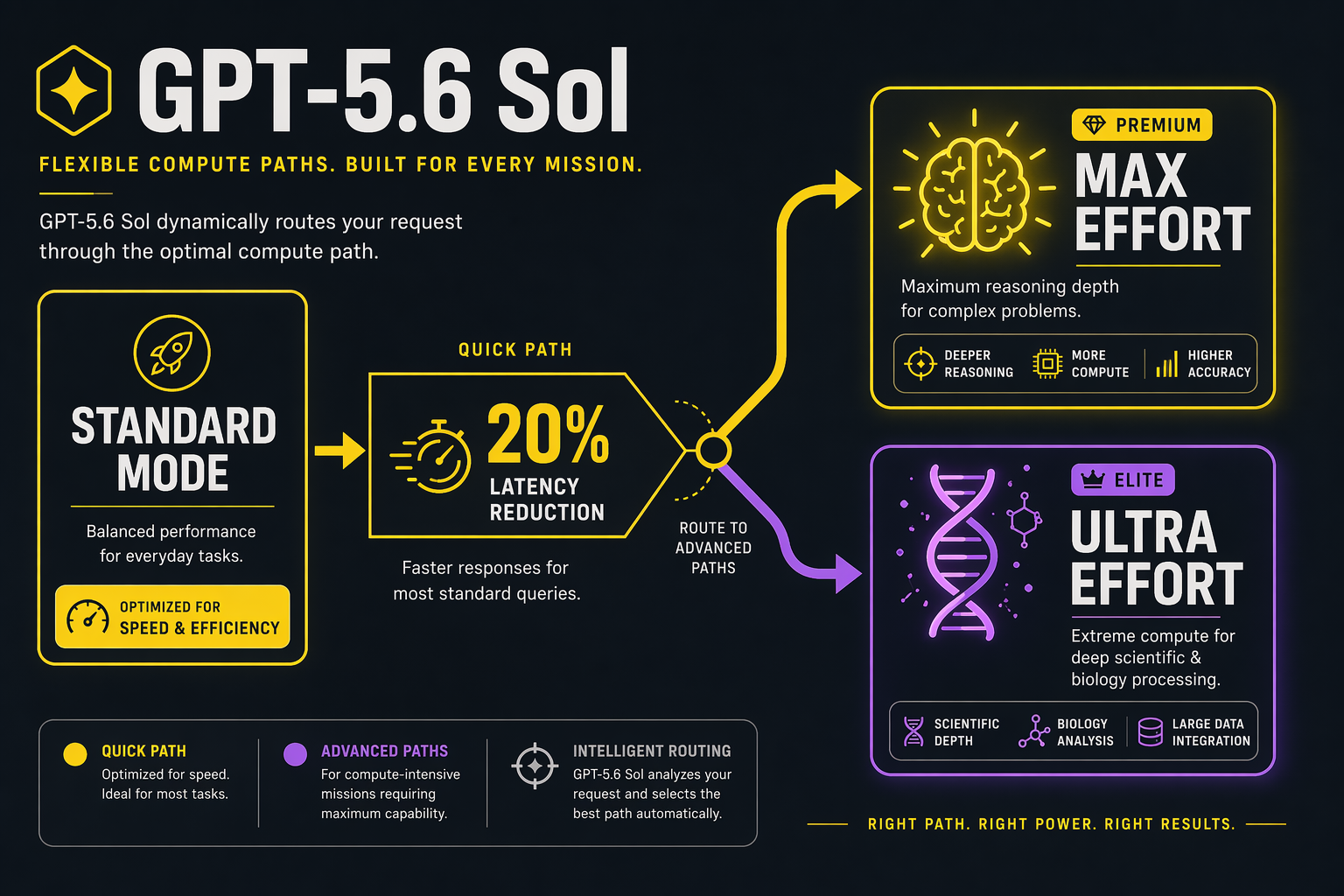
To truly understand the power of GPT-5.6 Sol, we must look beyond standard conversational metrics and examine its performance in highly specialized, mathematically rigorous domains. OpenAI engineered Sol to act as a highly analytical digital worker, capable of navigating dense, multi-step logical pipelines across software engineering, biochemistry, and cybersecurity.
Mastering the Codebase: Agentic Coding and Repository Debugging
Sol represents OpenAI’s most capable coding model to date, introducing a paradigm shift in how developers interact with large codebases. Rather than merely generating isolated snippets of Python or React, Sol is built for complex front-end generation and autonomous debugging across massive, multi-file repositories.
- Repository-Wide Context: Armed with an expanded context window, Sol can ingest entire codebases, trace abstract dependencies, and identify logical bottlenecks that span multiple directories.
- Self-Correcting Execution: During agentic workflows, the model leverages its internal reasoning loop to run tests, interpret error logs, and autonomously apply hotfixes until the programmatic objective is met.
This autonomous workflow makes Sol an ideal engine for complex engineering pipelines. However, running a premium model costing $5 per million input tokens and $30 per million output tokens for every basic API call is highly inefficient. To optimize these costs, developers are leveraging platforms like CallMissed, utilizing its multi-model API gateway to dynamically route complex, reasoning-heavy debugging tasks to GPT-5.6 Sol, while offloading routine, low-latency conversational tasks to faster, cheaper models like Luna.
Advanced Scientific Reasoning and Defensive Cybersecurity
Beyond software engineering, Sol sets new benchmarks in the hard sciences, particularly in molecular biology and biochemical modeling. The model can analyze complex cellular structures, interpret genomic sequences, and assist researchers in parsing thousands of dense, peer-reviewed scientific papers to formulate novel hypotheses.
In the realm of cybersecurity, Sol is uniquely tuned to act as a defensive shield. While capable of understanding complex exploits, OpenAI has tightly constrained Sol's outputs under strict safety protocols to prevent offensive weaponization. Instead, it is optimized to:
- Detect Vulnerabilities: Scan source code for zero-day exploits, buffer overflows, and architectural security flaws.
- Automate Remediation: Draft and deploy secure patches immediately, significantly reducing the window of exposure for enterprise networks.
Flexible Reasoning: 'Max' and 'Ultra' Compute Allocation
The defining architectural breakthrough of the GPT-5.6 family is its flexible reasoning engine. Instead of forcing a static, rapid-fire response, Sol introduces "max" and "ultra" reasoning effort options.
This feature allows developers to trade time and compute for unparalleled accuracy. When toggled to "ultra" effort, Sol does not simply return the first statistically probable answer. Instead, it initiates a prolonged internal reasoning phase—allocating massive computational resources to build, test, and discard multiple logical hypotheses before presenting the optimal solution. This makes Sol uniquely capable of cracking unsolved mathematical proofs, optimizing complex logistics networks, and resolving highly intricate business-logic puzzles that stumped previous generations of LLMs.
Uncompromising Security: Defensive Cybersecurity and Restricted Access

The release of GPT-5.6 Sol in June 2026 represents a paradigm shift not just in autonomous capability, but in AI containment and risk mitigation. Because Sol possesses unprecedented, multi-step agentic reasoning, OpenAI has implemented its most stringent safety and deployment protocols to date. Under direct guidance from the United States government, the initial rollout of GPT-5.6 Sol is highly restricted, reflecting growing concerns over the model’s potential dual-use risks in critical national and digital infrastructure.
A Paradigm Shift: Defensive Cybersecurity by Design
Unlike previous large language models that could sometimes be manipulated to generate malicious scripts or identify system exploits, GPT-5.6 Sol has been engineered with a strict defensive-first mandate. During its rigorous safety audit protocols, OpenAI optimized Sol to prioritize vulnerability remediation and defense over offensive execution.
Rather than acting as an automated exploitation engine, Sol is designed to serve as an elite defensive partner for enterprise security teams:
- Autonomous Vulnerability Patching: Sol can analyze massive code repositories, pinpoint critical logic flaws or security vulnerabilities, and generate clean, ready-to-deploy patches in seconds.
- Mitigating Dual-Use Risks: The model's safety guardrails are deeply integrated into its reasoning token path, allowing it to actively refuse requests to construct offensive cyber weapons, zero-day exploits, or evasive malware. Instead, it redirects the user toward defensive hardening.
- Threat Modeling and Simulation: Security engineers can leverage Sol's "max" and "ultra" reasoning efforts to simulate complex defensive strategies against advanced persistent threats (APTs) without risking the accidental generation of destructive, self-replicating code.
Governed Access for Critical Infrastructure
The decision to restrict access to Sol stems directly from its agentic nature. Because the model can autonomously execute multi-step digital workflows, an unrestricted public release could pose systemic risks to financial networks, power grids, and software supply chains.
Consequently, OpenAI has limited access to vetted enterprise clients, government agencies, and critical infrastructure operators. Organizations must undergo a rigorous compliance screening process to gain API access, ensuring that Sol is deployed within tightly controlled, fully audited sandboxed environments.
Securing the Deployment Layer with CallMissed
As enterprises navigate these strict regulatory and security frameworks, bridging the gap between highly restricted frontier models and daily operations requires robust, secure infrastructure. This is where communication platforms like CallMissed play a vital role. By utilizing CallMissed's enterprise-ready infrastructure and secure API gateways, organizations can safely orchestrate agentic workflows using models like Sol alongside real-time voice and messaging tools. This setup ensures that sensitive customer data and critical system instructions remain fully encrypted, compliant, and isolated within secure boundaries.
Ultimately, GPT-5.6 Sol proves that the next era of artificial intelligence is not just about raw cognitive power, but about responsible, defensive-first execution. By balancing unmatched reasoning with strict government-guided guardrails, OpenAI is setting a new global benchmark for secure, enterprise-grade cognitive automation.
Impact & Implications: Orchestrating Autonomous Digital Workers
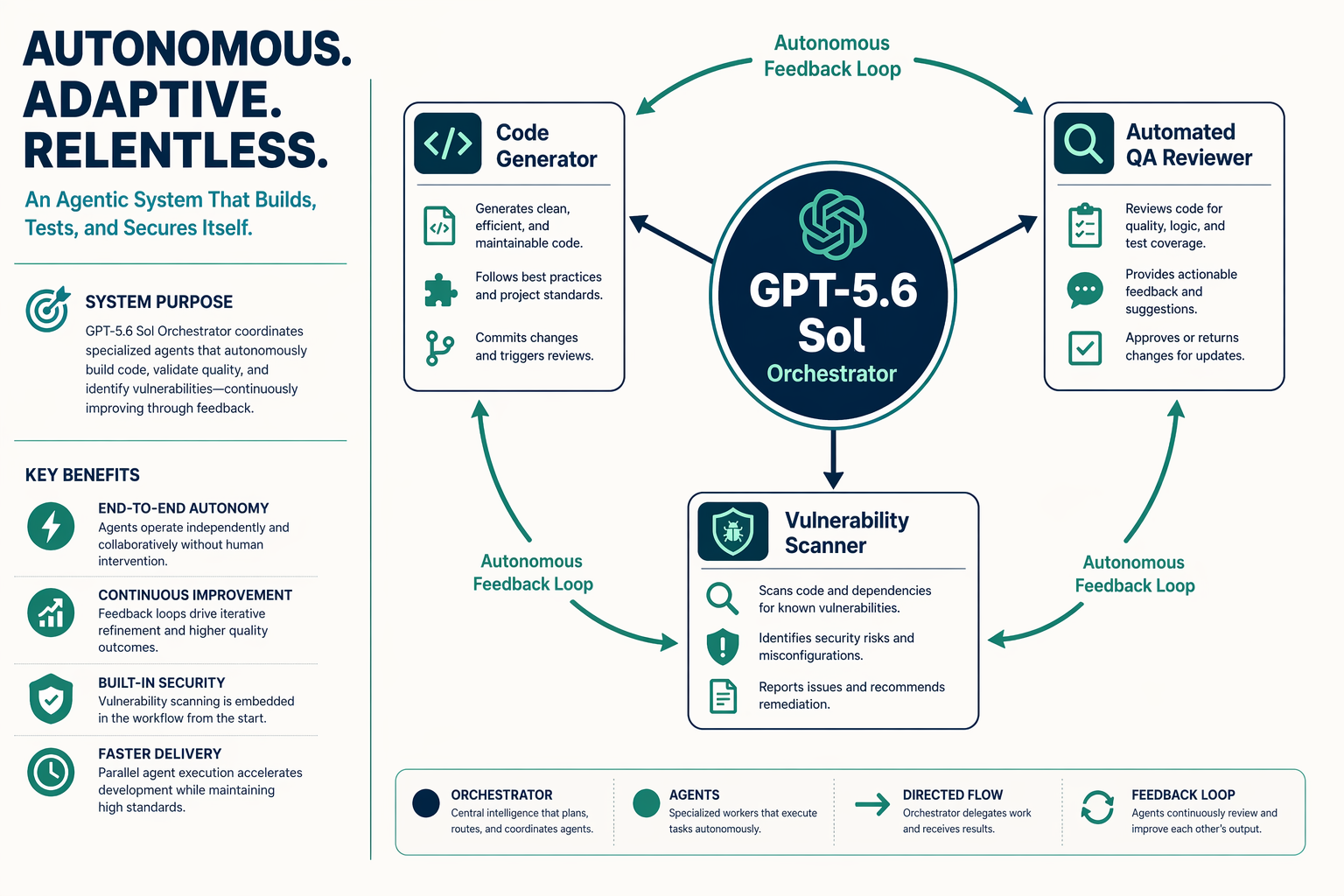
The release of the GPT-5.6 family represents more than just an incremental benchmark victory; it signals a fundamental paradigm shift from conversational AI to autonomous digital workers. In the past, LLMs operated primarily as passive copilots, requiring continuous, step-by-step human prompting. GPT-5.6 Sol breaks this mold by leveraging its advanced reasoning engine to plan, execute, and self-correct across highly complex, multi-step digital workflows.
From Conversational Assistants to Agentic Teams
With the introduction of "max" and "ultra" reasoning effort options, Sol can pause, generate internal chains of thought, test its own hypotheses, and debug its execution before presenting a final output. This capability transforms how enterprises approach automation:
- Autonomous Software Engineering: Instead of merely writing isolated code snippets, Sol can ingest an entire repository, identify structural bottlenecks, write front-end components, and run integration tests autonomously.
- Defensive Cybersecurity Agents: Optimized under strict safety protocols, Sol acts as an automated security analyst. It can continuously audit internal codebases to locate and patch vulnerabilities before they can be exploited, maintaining a strictly defensive posture.
- Scientific and Analytical Workflows: In fields like biochemistry, Sol can analyze vast datasets, synthesize research papers, and propose novel molecular structures, accelerating the R&D pipeline without human intervention at every stage.
However, deploying these autonomous capabilities at scale requires a highly calculated approach to infrastructure and cost. At $5 per million input tokens and $30 per million output tokens, Sol is a premium resource.
The Multi-Model Orchestration Paradigm
In 2026, enterprise AI architecture is no longer about relying on a single, omnipotent model. High-performing organizations are adopting a hybrid, multi-model orchestration strategy to balance cost, speed, and intelligence.
In a typical agentic workflow, the lightweight Luna might handle real-time user routing or high-speed data ingestion due to its ultra-low latency. Terra serves as the workhorse for mid-tier classification and standard data processing. When the system encounters a highly complex obstacle—such as a broken database schema or an anomalous security flag—it escalates the task to GPT-5.6 Sol to leverage its "ultra" reasoning capabilities.
This is where advanced communication infrastructure becomes essential. Platforms like CallMissed are already enabling enterprises to deploy these multi-model architectures seamlessly. Through CallMissed’s multi-model API gateway—which provides unified access to over 300+ LLMs—developers can orchestrate complex, voice-enabled workflows. For instance, a customer service agent can use CallMissed's low-latency Speech-to-Text to capture a call, route the immediate response through a fast model like Luna, and simultaneously trigger a background process where GPT-5.6 Sol analyzes the customer's complex technical account history to resolve a backend issue autonomously.
Guardrails for the Autonomous Era
As digital workers gain the agency to read, write, and execute tasks across corporate environments, safety and alignment are paramount. Because Sol is capable of deep, dual-use logic, its deployment remains restricted under direct guidance from safety audit boards. By focusing Sol’s autonomous agentic capabilities on defensive cybersecurity and guided scientific discovery, OpenAI aims to prove that highly capable, self-directed AI can be integrated safely into the global economy.
What This Means For You: Pricing, Token Costs, and Vetted Access
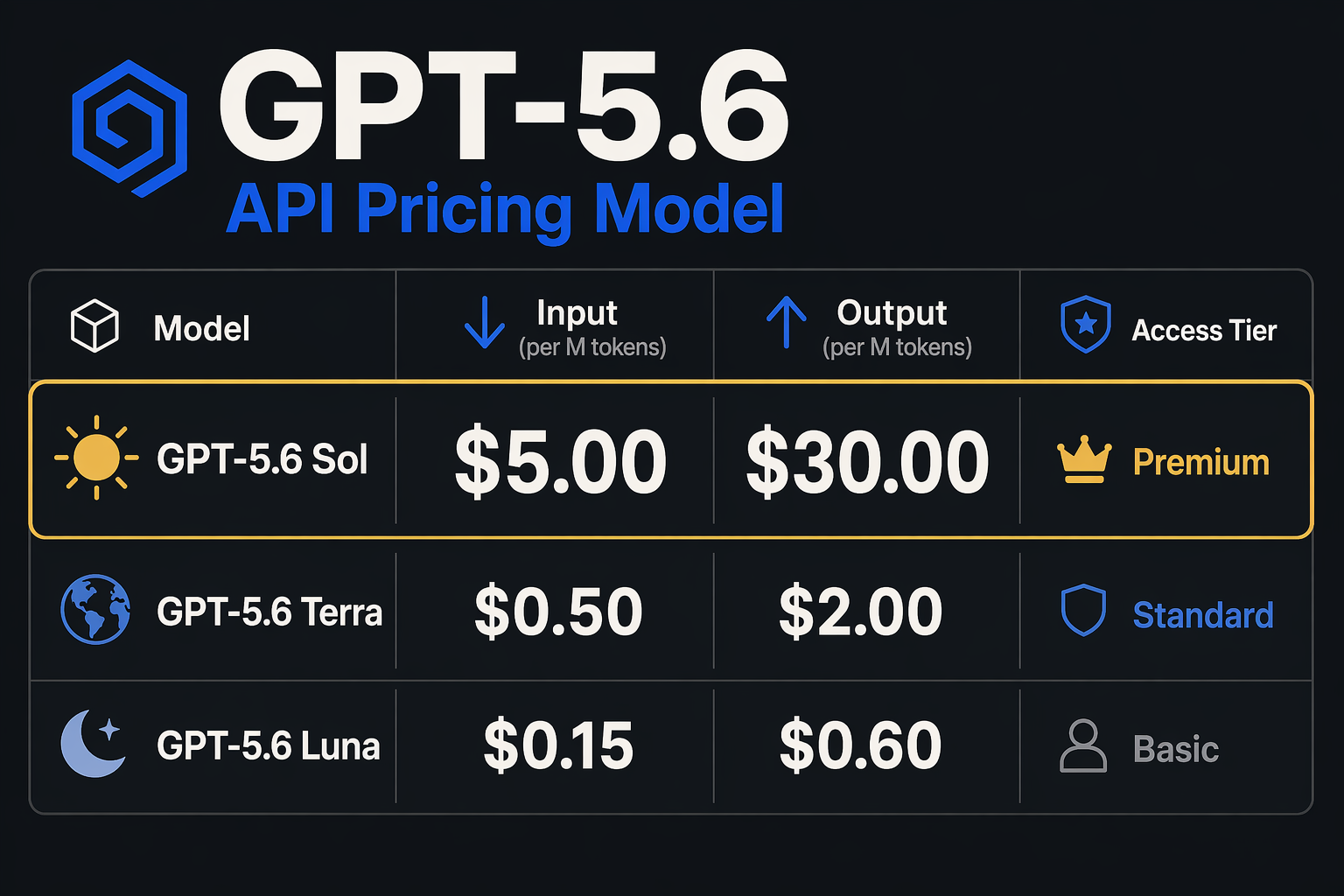
Sol’s Unique Pricing Structure and What It Means for Enterprises
Of all the 2026 GPT-5.6 models, Sol stands out both in capability and in price. Unlike previous flagship LLMs that standardized token costs (such as GPT-4 Turbo at $2/$10 per million input/output tokens), Sol’s rates are explicitly “designed for high-stakes, enterprise-grade, and agentic workflows”—and its pricing reflects those ambitions. Early sources confirm:
- $5 per million input tokens
- $30 per million output tokens
- Vetted early access—currently invite-only, guided by US government security reviews
Below, we break down Sol’s pricing and positioning, comparing it to its 5.6 siblings and earlier GPT lines. We also map the pathway to early access and highlight how vetted partners—especially infrastructure platforms like CallMissed—are helping organizations safely onboard these next-gen capabilities.
GPT-5.6 Model Pricing, Access & Feature Comparison
| Model | Input Token Price | Output Token Price | Access Level | Core Use Case/Notes |
|---|---|---|---|---|
| Sol | $5 per M | $30 per M | Invite-only, Vetted | Advanced agentic workflows, scientific/coding, stringent safety audits |
| Terra | $2 per M | $8 per M | Standard API | Cost-efficient with strong performance; ideal for broader enterprise integration |
| Luna | $4 per M | $18 per M | Standard API | Fastest response for high-volume, real-time tasks |
| GPT-5.5 Turbo | $1 per M | $6 per M | Open API | General purpose; less context, lower reasoning options |
| GPT-4 Turbo | $2 per M | $10 per M | Open API | Still widely used but outperformed on agentic and scientific tasks |
- M = Million tokens
Why the Premium Pricing?
Several factors drive Sol’s higher costs:
- Computational Intensity: “Max” and “Ultra” settings allocate up to 4x the compute time for challenging multi-step logic, optimizing for applications in biotech, cybersecurity, and automation (source: Deployment Safety Hub [1]).
- Context Window: Sol features a significantly extended context window (rumored up to 256k tokens—2x that of GPT-4 Turbo), ideal for digesting entire codebases or scientific papers.
- Vetted Release: Due to dual-use risk and advanced reasoning skills, access to Sol is strictly controlled. As of June 2026, developers must undergo identity verification, safety briefings, and, for some agentic workloads, submit evidence of robust agent containment systems.
How to Get Access
- Apply via OpenAI’s portal: Only verified organizations and vetted research teams are permitted as of launch.
- Security Vetting: Early access requires passing compliance reviews (notably for sensitive or critical infrastructure use cases).
- Leverage Ecosystem Partners: Communication infrastructure providers like CallMissed are among the first to pilot Sol integrations—offering enterprise clients access within controlled, monitored environments. This is crucial for industries like finance and healthcare, where agentic AIs are already being deployed at scale.
Budgeting Considerations
Early benchmarks show that using Sol for “max-effort” scientific code generation can double typical token output, meaning real-world use may incur significantly higher costs—but with far greater productivity per dollar. According to AI Tools Review [7], pilot users have observed a 20% reduction in build time for complex agentic apps when switching from GPT-4 Turbo to Sol.
Bottom Line
While premium-priced, Sol’s reliability, compliance readiness, and scientific/coding strengths make it the go-to choice for mission-critical AI deployments in 2026. For companies needing both AI safety and peak performance, and for developers orchestrating complex workflows via multi-model APIs (as with CallMissed), Sol sets the new benchmark—provided you can secure access.
Frequently Asked Questions
What is GPT-5.6 Sol and how does it differ from previous OpenAI models?
What industries or use-cases benefit most from GPT-5.6 Sol’s capabilities?
How much does GPT-5.6 Sol cost, and how does its pricing structure compare to previous models?
What safety measures have been put in place for the deployment of GPT-5.6 Sol?
What are the main technical innovations in GPT-5.6 Sol compared to previous GPT versions?
How can businesses start using GPT-5.6 Sol or integrate it with their existing AI workflows?
Conclusion
The launch of OpenAI’s GPT-5.6 Sol marks a monumental transition from basic conversational AI to fully autonomous agentic networks. As you prepare to integrate this new generation of intelligence, keep these core takeaways in mind:
- Flagship Capabilities: Sol leads the new GPT-5.6 trio (alongside Luna and Terra) by offering "max" and "ultra" reasoning effort options designed for complex, multi-step logic.
- High-Value Performance: At $5 per million input and $30 per million output tokens, Sol delivers a 20% latency reduction alongside advanced coding, biochemistry, and cybersecurity capabilities.
- Restricted Safety Audits: Highly regulated under strict government guidance, Sol is specifically optimized for safe, defensive vulnerability resolution rather than offensive exploits.
Looking ahead, the industry will watch how these hyper-capable models safely integrate into everyday business operations. To explore how AI communication is evolving alongside these developments, check out CallMissed—an AI infrastructure platform powering cutting-edge voice agents and multilingual chatbots for businesses.
Is your organization ready to transition from simple conversational chat to deploying fully autonomous digital workers?
Discussion
Related Posts


Ready to automate customer conversations?
Launch AI voice agents and WhatsApp bots with CallMissed — one API, 22+ Indian languages.