
GPT-5.4 Raises the Ceiling for Browser-Driven Customer Operations


GPT-5.4 Raises the Ceiling for Browser-Driven Customer Operations explains what this AI launch means for CallMissed-style voice, WhatsApp, Smart IVR, and customer workflow automation.
GPT-5.4 Raises the Ceiling for Browser-Driven Customer Operations
OpenAI published Introducing GPT-5.4 on March 5, 2026, and the announcement matters because it points to where the AI market is heading for communication-heavy products. This is not generic model news. It is a signal about how customer-facing workflows, agent runtimes, voice systems, and business messaging are being rebuilt.
For CallMissed, the relevance is direct. The product is positioned as AI communication infrastructure with WhatsApp chatbots, AI voice call agents, Smart IVR, multilingual speech APIs, and OpenAI-compatible endpoints. That means each of these launches should be evaluated through one practical lens: does it improve how businesses answer, route, follow up, and complete customer work across channels?
What the source actually says
- OpenAI described GPT-5.4 as its most capable and efficient frontier model for professional work.
- The launch page highlights improved spreadsheet, document, presentation, and computer-use performance.
- OpenAI reported leading benchmark results for browser and desktop tasks, positioning GPT-5.4 as stronger for agents completing real work across websites and software systems.
The primary source is here: Introducing GPT-5.4. In this article, the important move is not only the feature list. It is the direction of travel: more production readiness, more deployment maturity, more observability, better real-time performance, or stronger cost discipline depending on the topic.
Why this trend matters now
The important business signal is not the benchmark headline by itself. It is that the model is being positioned for work that touches spreadsheets, browser interfaces, and real-world operational tooling.
That matters for customer operations because many service and sales tasks still live in admin portals, CRMs, spreadsheets, and internal dashboards rather than clean APIs.
If models get better at navigating those surfaces reliably, AI communication products can close the loop between a conversation and the operational action it should trigger.
What this means for CallMissed
CallMissed can benefit from this shift because communication automation is often bottlenecked not by answering the customer, but by finishing the operational step that follows the conversation.
A stronger work-oriented model means a voice or WhatsApp workflow can potentially summarize a request, collect structured details, and then help drive the next task in the operations layer.
For teams using CallMissed as the front end of customer interaction, the long-term upside is a tighter connection between channel conversations and the browser-based systems where work still happens.
CallMissed documentation reinforces the same architectural story. The platform offers AI-powered communication APIs, WhatsApp business workflows, voice-call agents, Smart IVR, speech-to-text in 22 Indic languages plus English, text-to-speech options for telephony, and OpenAI-compatible endpoints. Those verified capabilities make the product a natural surface for turning this market momentum into real business workflows instead of one-off experiments.
Practical operating blueprint
- Keep browser action workflows narrow and deterministic, such as checking one status portal or updating one known record layout.
- Use AI to prepare and verify the action plan before execution, especially when customer state might have changed during the conversation.
- Log pre-action and post-action summaries so support staff can audit what the automation believed it was doing.
- Combine browser actions with channel continuity: after the action is done, send a WhatsApp confirmation or trigger a follow-up call only if the workflow truly requires it.
- Measure success on task completion and error recovery, not just on model output quality.
Where teams can use this immediately
- Support operations that still rely on browser portals for order lookup, payment reconciliation, or ticket updates.
- Sales operations where AI qualifies the lead first and then prepares the CRM handoff package.
- Appointment and service workflows where the conversation is natural language but the final step still happens in a browser UI.
- Back-office assist workflows where staff want AI to draft, validate, and partially complete repetitive operational tasks.
Commercial perspective
The reason GPT-5.4 customer operations matters is that communication systems sit near revenue and support cost at the same time. When a company answers faster, routes more accurately, preserves context across channels, and lowers repetitive agent work, the gains show up in booked appointments, recovered leads, faster ticket flow, lower backlog, or healthier margins. That is why these infrastructure and model announcements matter even when they seem technical on the surface.
The other important shift is buyer expectation. Enterprise teams increasingly expect AI communication platforms to look like serious software infrastructure: secure enough to deploy, measurable enough to improve, and flexible enough to fit the business’s chosen channels and workflows. Products that only sound impressive in demos will lose to products that make the day-to-day operating loop cleaner.
Risks and mistakes to avoid
- Letting the model operate without enough UI-specific guardrails. Browser agents need narrow permissions and strong verification steps.
- Assuming high benchmark scores equal universal reliability across custom internal tools.
- Skipping human-readable summaries. When things go wrong, operations teams need to understand what the system attempted.
- Treating browser use as a substitute for workflow design instead of as one capability within a larger customer journey.
Metrics to review after rollout
| Metric | Why it matters |
|---|---|
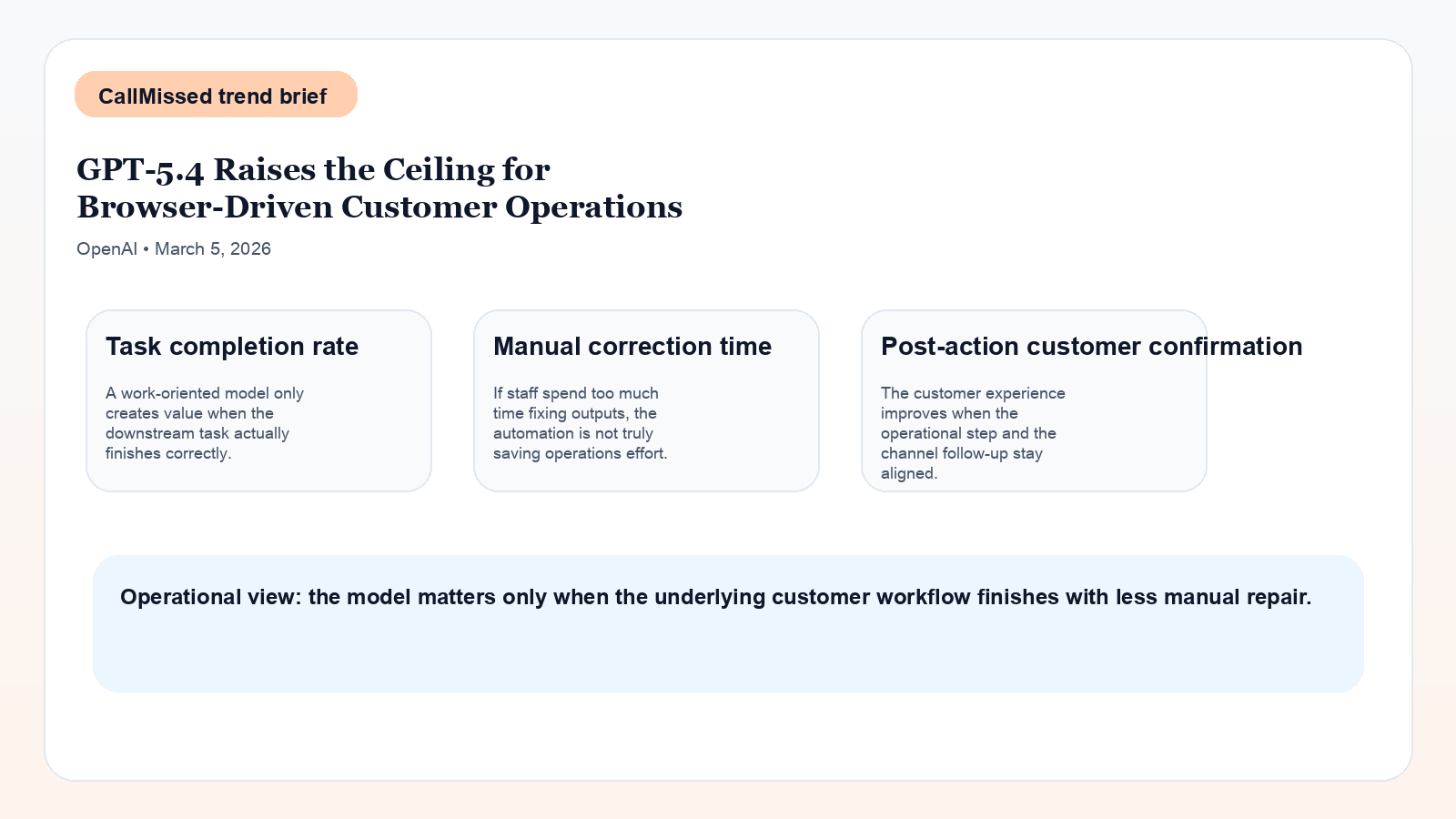
| Task completion rate | A work-oriented model only creates value when the downstream task actually finishes correctly. |
| Manual correction time | If staff spend too much time fixing outputs, the automation is not truly saving operations effort. |
| Post-action customer confirmation | The customer experience improves when the operational step and the channel follow-up stay aligned. |
The common trap in AI communication programs is optimizing for the wrong layer. Teams celebrate a model change, a voice upgrade, or a faster runtime while the actual workflow remains fragmented. The right question is always the same: did the customer interaction become easier to complete, and did the business spend less manual effort to complete it?
FAQ
Why does GPT-5.4 matter for customer operations?
How is that relevant to CallMissed?
Should teams automate browser actions immediately?
What is the best metric here?
Sources
- OpenAI (March 5, 2026): Introducing GPT-5.4
- CallMissed Introduction: https://docs.callmissed.com/docs/introduction
- CallMissed Quickstart: https://docs.callmissed.com/docs/quickstart
- CallMissed Speech to Text: https://docs.callmissed.com/docs/speech-to-text
- CallMissed Text to Speech: https://docs.callmissed.com/docs/text-to-speech
- CallMissed Chat Completions: https://docs.callmissed.com/docs/chat-completion
Conclusion
GPT-5.4 Raises the Ceiling for Browser-Driven Customer Operations is important because it shows how quickly the market is professionalizing around communication AI. The lesson for CallMissed is not to chase every logo or every launch headline. The lesson is to keep building the operational layer where these advances become useful: voice, WhatsApp, Smart IVR, multilingual understanding, measured routing, and clean handoffs. That is where real business value appears.
Discussion
Ready to automate customer conversations?
Launch AI voice agents and WhatsApp bots with CallMissed — one API, 22+ Indian languages.