
Generative AI Is Having Its Herbalife Moment: The Reality Behind Vibe Coding



Could "vibe coding"—the practice of spinning up software applications purely through natural language prompts without understanding a single line of...
Generative AI Is Having Its Herbalife Moment: The Reality Behind Vibe Coding
Could "vibe coding"—the practice of spinning up software applications purely through natural language prompts without understanding a single line of underlying code—actually be a multi-level marketing scam in disguise? This provocative question is currently dominating discussions across HackerNews, Reddit's r/BetterOffline, and tech communities, as industry critics warn that Generative AI Is Having Its Herbalife Moment. The comparison is as sharp as it is alarming: predatory platforms and viral influencers are selling the false hope of effortless wealth to young, non-technical creators, promising they can bypass years of software engineering to "vibe-code" their way to startup prosperity. Much like traditional multi-level marketing (MLM) schemes, this narrative dangles the carrot of financial independence while transferring the actual wealth back to a select few infrastructure giants.
This shift in the AI narrative matters immensely right now. As we navigate the mid-2026 technology landscape, the initial awe of generative text and image generation has evolved into intense pressure for real-world utility and financial return. Instead of truly democratizing software development, the "vibe coding" bubble frequently leaves aspiring creators stranded with convoluted, unmaintainable codebases they cannot debug, requiring them to buy more and more API credits to fix what the AI broke. It exposes a growing divide: while retail hype-merchants peddle get-rich-quick code wrappers, serious enterprises are focusing on stable, scalable architecture. For organizations looking past the speculative noise, sustainable success relies on production-grade infrastructure—such as CallMissed’s developer-first platform, which integrates robust multi-model LLM routing and voice agent APIs to build reliable, real-world communication tools rather than temporary prototypes.
In this article, we will peel back the marketing layer of the "vibe coding" phenomenon. We’ll analyze why the comparison between generative AI and MLMs like Herbalife is gaining traction, examine the structural and technical limitations of prompt-only software development, and outline how legitimate developers are using structured AI infrastructure to build lasting enterprise value without falling for the hype.
Introduction: The Dawn of the AI 'Vibe Coding' Promise
Over the past few years, artificial intelligence has transitioned from a specialized computational field into a massive cultural phenomenon. However, a more cynical narrative is taking hold across the industry. Critics, developers, and tech commentators are pointing out that generative AI is rapidly having its "Herbalife moment." Much like the infamous multi-level marketing (MLM) wellness empire, generative AI is increasingly being packaged not just as a technology, but as a financial escape hatch for the masses. At the heart of this phenomenon is the rise of "vibe coding"—the seductive promise that anyone, regardless of technical skill, can simply describe an app to a Large Language Model (LLM) and "vibe" their way to overnight prosperity.
The Seductive Promise of Democratic Wealth
The core hook of the vibe coding trend is the democratization of software creation. Proponents argue that traditional programming is obsolete, replaced entirely by natural language prompts. On social media platforms and message boards, predatory startups and self-proclaimed "AI gurus" sell young people the dream of becoming instant tech founders. The narrative is strikingly similar to classic MLMs:
- Low Barrier to Entry: No prior computer science education, coding experience, or technical background is required.
- The "Be Your Own Boss" Allure: The promise that you can escape the traditional 9-to-5 grind by spinning up and monetizing micro-SaaS applications in a single afternoon.
- The Illusion of Ownership: Believing that pasting prompts into a chat interface makes one a software architect, ignoring the massive platform dependency beneath.
However, as tech commentators and essays on platforms like What We Lost point out, this setup closely mirrors predatory MLMs. In these structures, the vast majority of participants exhaust their time and resources creating identical, low-value "wrapper" apps, while the platform providers, GPU manufacturers, and cloud giants reap all the profits.
Hype vs. Production-Grade Utility
The tragedy of the vibe coding trend is that it cheapens the very real breakthroughs occurring in AI engineering. Behind the MLM-style wrappers lies a sophisticated landscape of genuine automation. The difference between a "vibe-coded" toy application and actual business value lies in infrastructure, reliability, and real-world integration.
For enterprises and serious developers looking to solve actual business problems rather than chase speculative hype, the focus isn't on prompt-engineered get-rich-quick schemes. Instead, it is on deploying hardened, production-ready AI infrastructure. Platforms like CallMissed bypass the speculative noise entirely, offering reliable APIs for Speech-to-Text in 22 regional Indian languages, LLM gateways to switch dynamically between 300+ models, and production-grade voice agents. This is where AI delivers actual, tangible utility—by automating customer engagement and streamlining communication workflows, rather than selling false dreams of effortless software empires.
As we dissect this "Herbalife moment," it becomes crucial to separate predatory marketing from foundational technology, examining how we reached a point where generative AI began mimicking the structures of a multi-level marketing scheme.
Background & Context: Drawing the Parallel to Herbalife
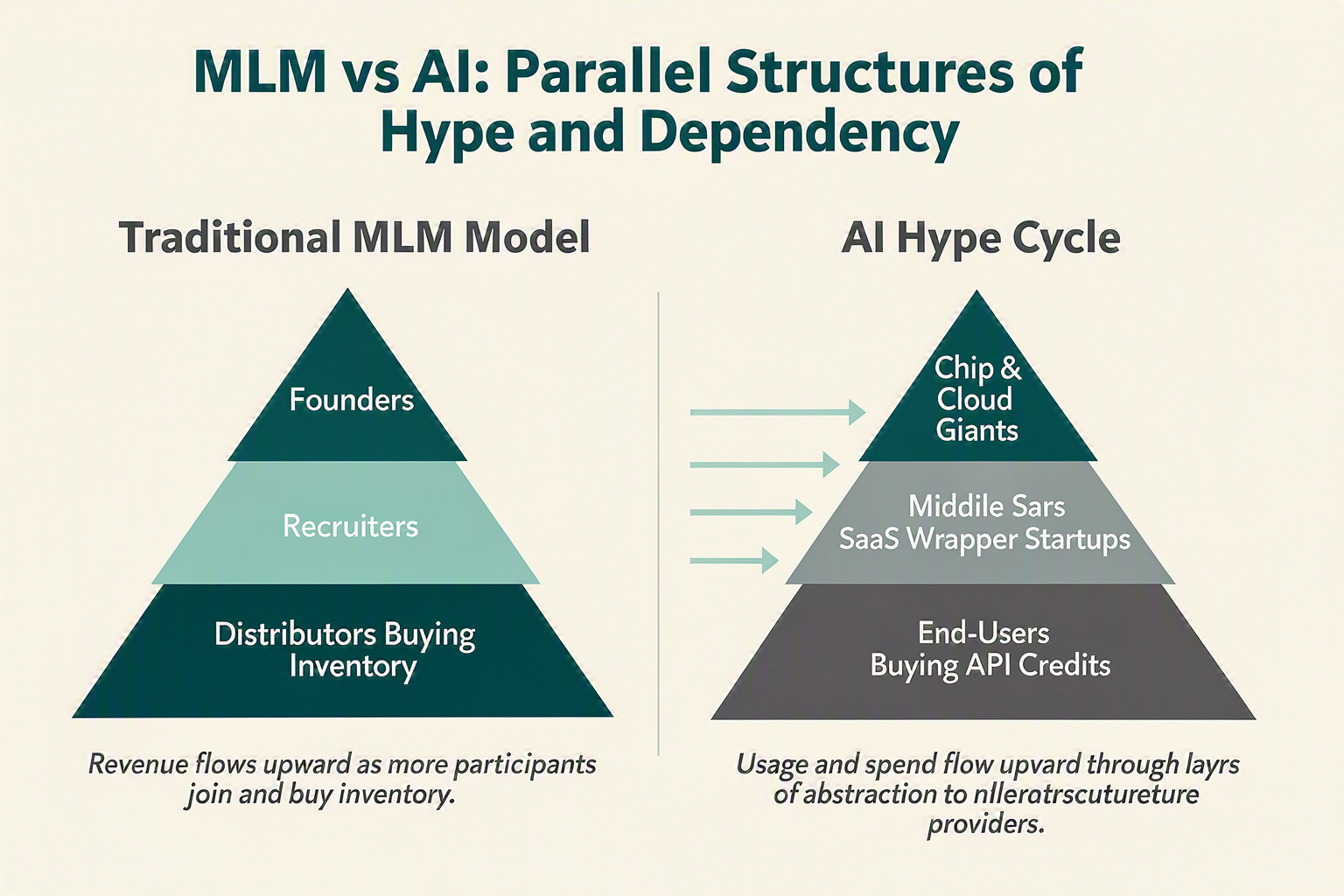
To understand why industry commentators are declaring that generative AI is having its Herbalife moment, one must look at the structural mechanics of multi-level marketing (MLM) schemes. Herbalife built a global empire not merely by selling nutritional supplements, but by selling an aspirational dream: the promise of effortless entrepreneurship, financial independence, and the opportunity for everyday people to bypass traditional career ladders. In reality, the vast majority of participants make little to no money, while the wealth concentrates heavily at the very top of the pyramid.
Today, a remarkably similar narrative is playing out across the generative AI landscape. The "get-rich-quick" promise has simply been rebranded. Instead of selling dietary shakes, a wave of predatory startups and self-proclaimed "AI gurus" are selling the dream of vibe coding to young people and non-technical creators.
The Illusion of "Vibe Coding"
The term "vibe coding"—the act of developing software entirely through natural language prompts without writing or understanding a single line of underlying code—has captured the public imagination. Viral social media posts and newsletters regularly promise non-techies that they can vibe-code their way to immense prosperity.
However, this phenomenon mirrors the classic MLM structure in several distinct ways:
- Selling False Hope: Young and aspirational creators are being targeted with messaging that promises frictionless software empires, convincing them that deep technical skills are no longer necessary to compete with established tech giants.
- Asymmetrical Value Extraction: The primary beneficiaries of the "vibe coding" boom are almost exclusively the trillion-dollar foundation model providers and cloud infrastructure giants. The individual creator takes on the market risk, while the platform owners collect rent on every API call.
- The Commodity Trap: If an application can be built in five minutes using a basic system prompt, it possesses zero competitive moat. The market quickly becomes oversaturated with identical, low-value software wrappers, leaving creators with high API bills and no actual customers.
Distinguishing Hype From Real Infrastructure
The Herbalife parallel does not mean generative AI is useless; rather, it highlights a profound mismatch between speculative marketing and economic reality. Generative AI is an incredibly powerful technological shift, but it is a tool of productivity and automation, not a magical business generator.
The companies succeeding in today's landscape are those that treat AI as practical infrastructure rather than a speculative shortcut. For instance, rather than chasing the "vibe coding" hype cycle, platforms like CallMissed focus on delivering concrete, enterprise-grade communication tools. By providing production-ready voice agents and high-accuracy Speech-to-Text APIs that natively support 22 Indian languages, CallMissed enables businesses to solve real-world customer service challenges.
Ultimately, drawing the parallel to Herbalife serves as a necessary reality check. The democratization of technology is highly valuable, but the promise that AI will allow millions to effortlessly build software empires without technical depth, distribution, or unique data is a predatory illusion that benefits the platform giants at the expense of hopeful creators.
Key Developments
The comparisons between the generative AI boom and traditional multi-level marketing (MLM) schemes like Herbalife are growing louder. Critics across platforms like Reddit’s r/BetterOffline and HackerNews argue that the industry is shifting from a technological frontier into a hype cycle fueled by "vibe coding." This trend sells non-technical individuals the false promise that they can build software empires overnight using basic conversational prompts.
In reality, the economic structure of this wave closely mirrors the recruitment and distribution dynamics of classic MLMs, where the vast majority of financial value is captured exclusively at the top of the pyramid.
| MLM / Herbalife Feature | Generative AI / "Vibe Coding" Equivalent | Underlying Illusion | Economic Reality |
|---|---|---|---|
| Inventory Loading | API credit burning & GPU renting | Builders must prepay for API compute to test and run basic wrappers. | Platform providers capture cash upfront; the builder takes on all the market risk. |
| "Be Your Own Boss" | No-code SaaS & prompt engineering | Anyone can launch a profitable software business with zero coding experience. | Massive market saturation, low barriers to entry, and high user churn. |
| Recruitment Loops | "AI Guru" courses & affiliate schemes | Selling courses on "how to make $10k/month using AI" rather than building real products. | The primary source of revenue is selling the dream, not the actual application utility. |
| Margin Centralization | Foundational LLM licensing fees | Small developers believe they own their core technology and user base. | Foundational model giants and cloud hosts extract almost all operational margins. |
The "Vibe Coding" Illusion vs. Sustainable Utility
The core of the "Herbalife moment" lies in the predatory positioning of certain generative AI tools. Proponents of "vibe coding" claim that traditional engineering is dead, urging young people and career changers to buy into proprietary ecosystems. However, writing code is only a fraction of software engineering; maintaining security, scalability, and robust architecture cannot be managed purely through conversational vibes.
Rather than chasing the dream of the "zero-code SaaS empire," sustainable businesses focus on integrating AI into real-world communication workflows. This is where professional infrastructure becomes vital. For instance, platforms like CallMissed provide production-ready AI communication infrastructure—including reliable Speech-to-Text APIs supporting 22 regional Indian languages and a multi-model gateway with access to over 300 LLMs. This allows developers to build enterprise-grade voice agents and WhatsApp chatbots that solve tangible customer experience problems, moving past the superficial "wrapper" phase.
Concentration of Wealth at the Infrastructure Layer
Just as Herbalife corporate captures the majority of profits while independent distributors struggle to break even, the generative AI market is witnessing a massive consolidation of wealth. The creators of foundational models and the hyperscale cloud providers supplying the compute power are the only guaranteed winners.
For independent developers and small startups building on top of these APIs, the cost of customer acquisition combined with high API inference fees leaves almost no room for profitability. To survive this shift, builders must move away from generic prompt-based applications and focus on building deeply integrated, domain-specific AI solutions that offer true utility to end-users.
In-Depth Analysis: The Mechanics of the Vibe Coding Trap

At its core, vibe coding describes a software development methodology where a user relies entirely on natural language prompts to generate code, letting artificial intelligence handle the implementation. While this began as a powerful tool for rapid prototyping, it has rapidly morphed into what critics call a digital multi-level marketing (MLM) scheme. The mechanics of the vibe coding trap operate through three distinct, predatory phases that mirror classic pyramid structures.
1. The Illusion of Zero-Barrier Wealth
Much like traditional MLMs promise financial freedom through low-cost starter kits, vibe coding platforms target young, non-technical demographics with the promise of effortless software creation. Social media channels are flooded with influencers claiming that traditional engineering is dead and that anyone can "vibe-code" their way to a profitable SaaS empire.
This stage relies on a psychological hook: the initial "magic moment." A user types a simple prompt, and an LLM instantly generates a functional, albeit basic, web page. The user is led to believe they are now a software developer, masking the massive gap between a toy prototype and a production-ready application.
2. The Tech Debt Wall and the Prompt Squeeze
The trap springs when the user attempts to scale, secure, or debug their application.
- The Breakage Point: LLMs generate code based on statistical probability, not logical understanding. As a vibe-coded system grows more complex, minor prompt adjustments cause cascading failures across the codebase.
- The Knowledge Deficit: Because the user cannot read or write the underlying code, they cannot debug it. They are forced to write more prompts to fix the generated errors, creating an endless loop of compounding technical debt.
- The API Meter: Every attempt to fix the broken code consumes more API tokens. The user spends money trying to debug a product that remains fundamentally broken, funneling capital directly to the underlying model providers.
3. Upward Wealth Extraction
In a classic MLM like Herbalife, the vast majority of distributors lose money, while wealth flows upward to the founders and top-tier recruiters. Vibe coding replicates this economic flow perfectly. The "vibe coders" build fragile applications that rarely find paying customers, yet they must pay consistent subscription fees for IDE integration tools, LLM APIs, and cloud hosting.
The only entities reliably profiting from the vibe-coding craze are the foundational AI model developers, GPU providers, and the predatory startups selling the "no-code dream" courses. The dream of software democratization becomes, in reality, a highly efficient pipeline for extracting capital from aspiring creators.
Transitioning to Production-Grade Reality
For businesses and developers looking to escape this cycle of fragile, prompt-dependent software, the solution lies in moving away from "vibes" and moving toward robust, enterprise-grade engineering. Building reliable AI systems requires stable infrastructure, deterministic guardrails, and professional APIs.
Platforms like CallMissed address this shift by offering production-ready AI communication infrastructure. Rather than relying on fragile prompt chains, CallMissed provides developers with stable, multi-model LLM gateways (supporting 300+ models), secure Text-to-Speech APIs, and native multi-lingual support in 22 regional Indian languages. This allows technical teams to build scalable, predictable AI voice agents and communication chatbots that survive real-world deployment—proving that sustainable AI development is built on infrastructure, not illusion.
Impact & Implications: Who Really Wins and Loses in the AI Gold Rush
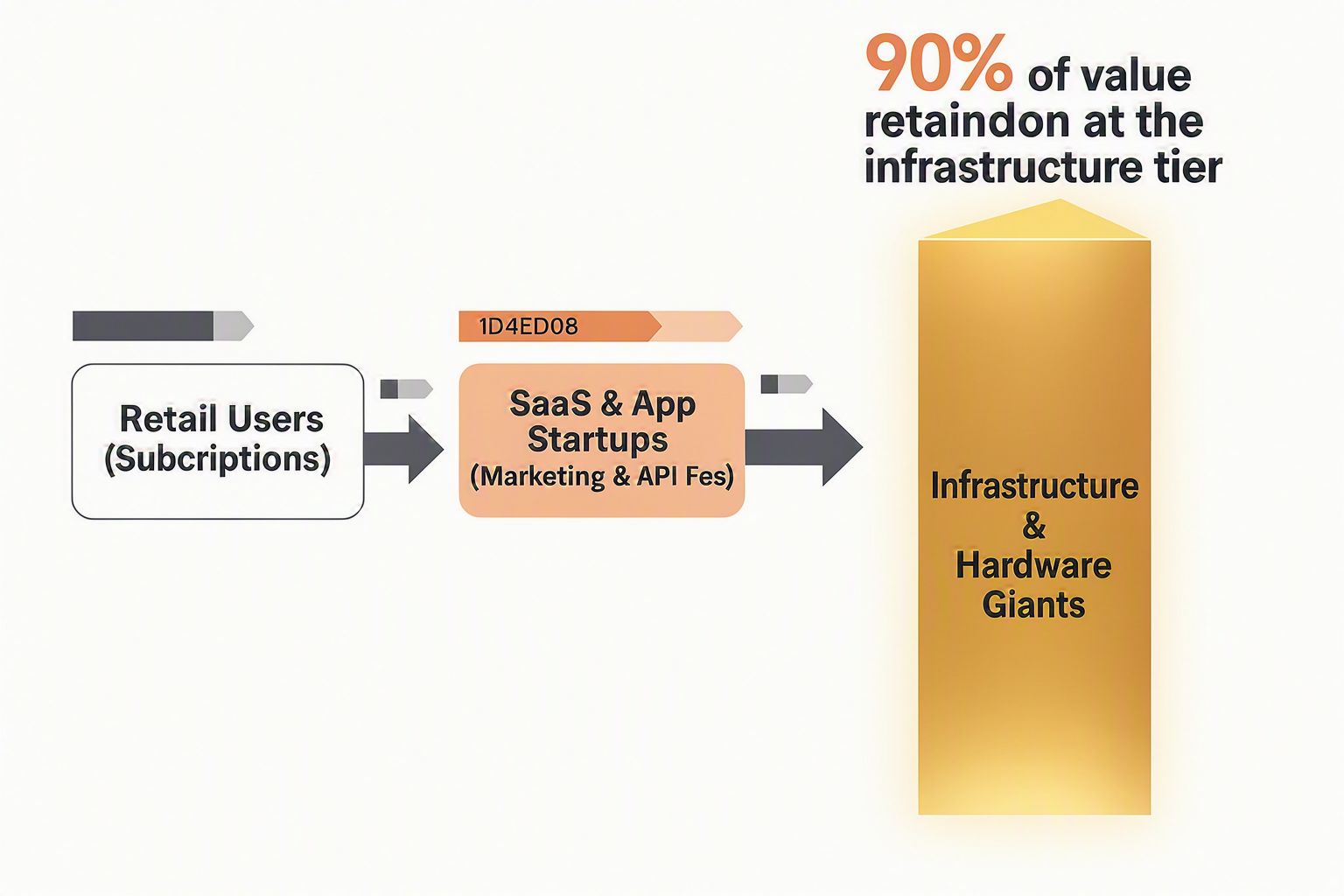
The comparison between the generative AI boom and multi-level marketing (MLM) giants like Herbalife highlights a stark division in who actually profits. On one side, we have the promise of democratized technology; on the other, a reality where economic benefits are increasingly concentrated at the top. In this digital gold rush, the lines between genuine technological utility and predatory speculation have blurred, creating a distinct class of winners and losers.
The Losers: "Vibe Coders" Chasing False Hope
At the bottom of this modern economic pyramid are the aspiring creators, non-technical founders, and young people targeted by predatory startups.
- The "Vibe Coding" Illusion: Social media channels are flooded with promises that anyone can build a software empire simply by "vibing" with a large language model. This narrative sells the false hope that domain expertise and deep technical knowledge are no longer required to build viable software businesses.
- The Cost of Entry: Enthusiastic builders spend significant capital on premium API access, prompt engineering courses, and proprietary no-code tools, only to realize they are building fragile wrappers on top of shifting foundations.
- Platform Disintermediation: When foundational model providers release native feature updates, entire "vibe-coded" micro-startups are wiped out overnight.
As critics point out, these systems promise non-techies they can vibe-code their way to prosperity, yet the primary beneficiaries of this behavior are the gatekeepers charging recurring fees for compute and API credits.
The Winners: Infrastructure Kings and Gatekeepers
While thousands of hopeful builders try to sell lightweight wrappers, the true victors in this landscape are the ones selling the raw materials of the trade.
- Hyperscalers and Hardware Giants: The massive computational demands of LLMs guarantee that cloud providers and chip manufacturers capture the lion's share of AI spending, regardless of whether the end-user's application succeeds or fails.
- Foundational Model Owners: By locking developers into proprietary ecosystems, major AI research labs secure recurring API subscription fees and gather valuable user interaction data to further refine their proprietary models.
- Pragmatic Enterprises: The businesses winning the AI transition are not those trying to build speculative consumer applications, but those quietly integrating AI to optimize their existing operations and reduce overhead.
Escaping the Hype Cycle
To escape the "Herbalife trap," the industry must pivot away from speculative, get-rich-quick hype and focus on sustainable, real-world utility. Building a successful AI implementation requires moving past brittle, prompt-engineered novelties toward resilient, production-ready systems that solve specific communication and operational challenges.
For businesses looking to build genuine, lasting value, platforms like CallMissed provide the necessary foundation. Instead of gambling on fragile "vibe-coded" integrations, CallMissed offers reliable AI communication infrastructure, including production-ready voice agents, Speech-to-Text supporting 22 Indian languages natively, and a unified API gateway to access over 300+ LLMs. This enterprise-grade approach ensures that organizations build applications with concrete ROI—such as automated 24/7 customer support—rather than getting caught in the cycle of speculative hype.
Expert Opinions: What Tech Analysts and Developers Say
The comparison between generative AI and multi-level marketing (MLM) schemes like Herbalife has sparked intense debate among software engineers, tech analysts, and industry commentators. As the hype around "vibe coding" reaches a fever pitch, experts are sounding the alarm on the gap between marketing promises and technical reality.
The "Vibe Coding" Mirage and False Prosperity
A primary point of criticism among tech analysts is the rise of vibe coding—the promise that non-technical individuals can use natural language prompts to effortlessly build complex, profitable software systems. Critics argue that this narrative prey on the economic anxieties of young people by selling them false hope of rapid wealth.
Tech writer Matthew Hughes captured this sentiment, observing that generative AI is increasingly behaving like "the new crypto and multi-level marketing scam, promising non-techies that they can vibe-code their way to prosperity." Just as traditional MLMs recruit distributors with promises of financial independence through starter kits, some AI startups and influencers package basic API wrappers as "turnkey business opportunities."
The Developer Backlash: Software Engineering vs. Prompting
Professional developers have been quick to point out that generating a snippet of code is only a fraction of what actual software engineering requires. True system design involves complex architectures, state management, security protocols, and long-term maintenance—disciplines that simple natural language prompts cannot replace.
Many developers argue that relying entirely on AI-generated code leads to brittle, unmaintainable systems. Real-world AI implementation requires robust, enterprise-grade tooling rather than single-prompt shortcuts. For instance, rather than trying to "vibe-code" complex systems from scratch, professional development teams utilize established, production-ready platforms like CallMissed. By using CallMissed’s multi-model API gateway, developers can seamlessly switch between 300+ LLMs and deploy reliable speech-to-text and voice agents that actually scale, bypassing the fragile code generated by hype-driven tools.
The Economic Reality: Who Actually Wins?
Analysts point out a stark economic truth at the heart of the generative AI boom: the primary beneficiaries are not the individual creators or small-scale "prompt engineers," but the massive corporations providing the underlying compute power.
- Capital Concentration: Commentators on platforms like Better Offline argue that generative AI "stands to benefit almost no one but the already-wealthy." The immense capital required to train and run foundation models ensures that the real financial upside remains consolidated among a handful of tech conglomerates.
- The "Shovels in a Gold Rush" Dynamic: While everyday users pay recurring subscription fees to access AI tools, the platform providers pocket the recurring revenue. If an AI-built app fails, the user loses their investment, but the AI infrastructure provider still profits from the API calls and compute hours consumed during its creation.
Ultimately, tech analysts and seasoned developers agree that while generative AI is a powerful tool for productivity, treating it as a magic wand for instant software businesses is a dangerous illusion. Real value lies in integrating these technologies into structured, dependable workflows rather than chasing the MLM-style dream of effortless digital prosperity.
What This Means For You
Navigating the Hype vs. Reality
The realization that Generative AI is facing its "Herbalife moment" is a crucial wake-up call for developers, entrepreneurs, and enterprises alike. Just as multi-level marketing (MLM) schemes sell the dream of effortless financial independence, the trend of "vibe coding" often peddles false hope—convincing non-technical creators they can prompt their way to sustainable riches without understanding the underlying technology.
To survive this transition from speculative hype to economic reality, builders must pivot away from thin API wrappers and fragile prompt configurations. The future belongs to those who build concrete, high-utility systems that integrate deeply with business operations, rather than chasing speculative "get-rich-quick" AI templates.
| Strategic Pillar | The MLM / "Vibe-Coding" Trap | The Sustainable AI Approach | Production Imperative |
|---|---|---|---|
| Application Depth | Relying on thin UI wrappers over a single commercial LLM. | Building multi-model orchestrations with custom business logic. | Prevents commoditization and platform risk. |
| Infrastructure | Using fragile, unmonitored prompt templates that fail randomly. | Deploying production-ready APIs with fallback models and SLAs. | Ensures 99.9% uptime and reliable customer experiences. |
| Language & Reach | Limiting customer interactions to basic English-only chat templates. | Utilizing multilingual engines (e.g., supporting 22+ regional languages). | Unlocks underserved global and regional demographics. |
| Voice & Channel | Relying solely on text-based web widgets that customers ignore. | Deploying low-latency, conversational AI voice agents. | Solves real-world operational bottlenecks like high support volume. |
Pivot to Production-Grade Utility
If you are building in the AI space today, avoiding the vibe-coding trap requires a fundamental shift in how you construct your tech stack. It means moving from superficial prototyping to building hardened, scalable infrastructure. This is where professional AI communication platforms change the game.
Instead of trying to orchestrate complex prompt chains on fragile, direct-to-consumer interfaces, professional developers leverage robust developer tools. For example, platforms like CallMissed help developers escape the trap of hype-driven AI by offering structured, production-ready infrastructure. With unified access to 300+ LLMs, enterprise-grade Speech-to-Text supporting 22 Indian languages, and low-latency voice agent APIs, CallMissed allows you to build systems that deliver genuine, measurable business value rather than fleeting internet novelty.
To successfully navigate this market correction, keep these core principles in mind:
- Focus on Unit Economics: A business model built entirely on high-cost API calls with zero proprietary data or workflows is financially unsustainable.
- Own the Integration: Don't just generate text; automate actual workflows. Integrate your AI models directly with customer CRMs, telephony networks, and databases.
- Solve Real Pain Points: Stop building "nice-to-have" novelty apps. Focus on critical, high-friction operational tasks, such as automated multilingual customer support or 24/7 missed call recovery.
Frequently Asked Questions
Understanding the Hype
What does it mean when critics say generative AI is having its Herbalife moment?
Why is "vibe coding" being compared to an MLM scam within the generative AI Herbalife moment?
Who is actually profiting from the current generative AI hype cycle?
Finding Real Value
How can businesses avoid falling for the predatory hype described in the generative AI Herbalife moment?
What are the main technical limitations of relying on generative AI for software development?
Will the generative AI market crash like previous tech bubbles?
Conclusion
To navigate the shift from speculative hype to tangible utility, we must separate the MLM-style promises of effortless "vibe coding" from sustainable technological progress. Here are the key takeaways:
- The Illusion of Easy Wealth: Much like classic multi-level marketing, the promise that non-techies can effortlessly vibe-code their way to prosperity mostly enriches platform gatekeepers, not everyday creators.
- Engineering Over "Vibes": High-quality software still requires rigorous systems design, security, and domain expertise; AI is a powerful accelerator, not a magic substitute.
- A Pivot to Infrastructure: Real economic value is migrating away from superficial wrappers and toward robust, dependable, and production-grade applications.
Moving forward, watch for a sharp market correction where fragile, hyped-up "vibe projects" give way to resilient, enterprise-ready integrations. To explore how reliable AI communication is actually evolving beyond the noise, check out CallMissed—an AI infrastructure platform powering dependable voice agents and multilingual chatbots for real-world businesses. Will your organization invest in solid, scalable engineering, or will it get swept up in the temporary vibes?
Discussion
Related Posts


Ready to automate customer conversations?
Launch AI voice agents and WhatsApp bots with CallMissed — one API, 22+ Indian languages.