
AI Phone Agents in 2026: What Businesses Are Actually Deploying


Did you know that by mid-2026, AI phone agents are now powering nearly 40% of all Tier-1 customer calls for large enterprises, according to industry...
AI Phone Agents in 2026: What Businesses Are Actually Deploying
Did you know that by mid-2026, AI phone agents are now powering nearly 40% of all Tier-1 customer calls for large enterprises, according to industry analyses? This seismic shift isn’t just about cutting costs—it’s transforming the entire customer experience across sectors from banking to retail and logistics. In an era where businesses process billions of voice interactions daily, the question is no longer “if” companies are using AI phone agents, but “how broadly, where, and with what tangible results?”
The acceleration is staggering. Five years ago, even the most advanced voice bots could only stutter through basic menu selections. Fast forward to today: AI-powered phone agents in 2026 are handling not just simple balance checks, but also complex order management, secure onboarding, financial transactions, and compliance queries—sometimes with uncanny human-level nuance. Gartner estimates that global businesses will have saved over $100 billion by 2026 through effective AI agent deployment, with call wait times slashed by as much as 70% for routine queries (SkillVolume, 2026).
Why is this evolution so urgent for business leaders right now? The answer is twofold: customer expectations and workforce realities. With human patience wearing thin, a recent Forrester report notes that 62% of consumers will hang up if left on hold for more than two minutes. Meanwhile, talent shortages in support roles have pushed companies to seek scalable alternatives. AI phone agents fit this need, able to handle thousands of concurrent calls—in dozens of languages—24/7, without fatigue or error creep. Fintech companies, for instance, are seeing AI agents close 85% of KYC onboarding cases unaided and detect transaction anomalies with a precision that rivals top-tier analysts (Noseberry, 2026).
But not all deployments are created equal. Many businesses still struggle to move beyond pilot projects or to integrate AI agents with legacy systems. Regulatory hurdles, language barriers, and domain-specific complexity often stall ambitious plans. This is where the real story lies: What are the success patterns behind businesses that are actually deploying AI phone agents at scale in 2026? Which use cases are thriving, and which remain out of AI’s reach?
In this in-depth article, you’ll learn:
- Which industries and workflows are seeing proven, profitable rollout of AI phone agents
- Where agentic AI still struggles—and why certain tasks are deceptively challenging
- Concrete examples and statistics from leading deployments
- Key technical enablers, from LLM integration to multilingual support
- How to navigate the remaining regulatory, security, and cultural barriers
Platforms like CallMissed are already at the forefront, offering production-ready infrastructure that enables businesses to deploy multilingual AI voice agents and orchestrate complex call flows with ease—one of many signs that the future of the contact center is here, and it speaks in hundreds of AI-powered voices.
By the end of this blog, you’ll know exactly where the line is drawn in 2026 between the AI phone agent hype and their concrete, transformative real-world use—empowering you to strategize your next move in this rapidly evolving landscape.
Introduction: Why AI Phone Agents Dominate 2026

Why AI Phone Agents Are Ubiquitous in 2026
By 2026, the adoption of AI phone agents has shifted from experimental pilots to mainstream deployments across nearly every major industry. What started as isolated use-cases in customer support has now become a defining layer of business communication infrastructure. This rapid adoption has been driven by a confluence of factors: advances in large language models, dramatic improvements in voice synthesis and recognition, and a global workforce recalibrating to a world where instant, 24/7 communication is expected.
#### The Data: Mass Adoption and Tangible Returns
Recent industry reports underscore the scale of this transformation:
- AI agents are now handling 40% of all enterprise workflows by the end of 2026 (SkillVolume, 2026).
- In customer service verticals, AI phone agents resolve up to 70% of Tier-1 requests autonomously, slashing response times from several minutes to under 15 seconds (CallMissed Blog, 2026).
- More than 85% of financial institutions globally report active deployments of conversational phone agents for order status, balance inquiries, and compliance workflows (Noseberry, 2026).
- Fortune 500 companies estimate a 30% reduction in support operations cost directly attributable to AI agent-driven automation (SkillVolume, 2026).
These numbers are not simply incremental improvements. They represent a fundamental rethinking of how businesses interact with both customers and employees at scale.
#### What Changed Since 2024?
The leap from “AI phone agents as a promising tool” to “AI phone agents as a standard business backbone” happened remarkably fast:
- Technological Maturation: The underlying models powering AI agents—such as GPT-4 Turbo, Gemini Ultra, Llama 3—and their newly emergent competitors—now support richer, real-time, nuanced conversations that are often indistinguishable from human agents in verification tests.
- Multilingual Breakthroughs: Voice AI platforms natively support 20+ languages, overcoming the last big barrier to serving diverse customer bases at scale (e.g., CallMissed’s models handle 22 Indian languages with near-human fluency).
- Regulatory Clarity: With global standards for call recording, data privacy, and AI transparency in place, businesses have moved from hesitation to aggressive rollout strategies.
- Economic Pressure: Rising labor costs, combined with the unpredictability of customer demand and the imperative for 24/7 responsiveness, have made AI agents not just viable, but necessary.
#### The Five Pillars of AI Agent Deployment
According to industry tracking (CallMissed Blog, 2026), five categories dominate actual deployments:
- Tier-1 Customer Support: Password resets, FAQs, appointment scheduling, and product troubleshooting.
- Order & Balance Inquiries: Real-time updates for e-commerce, logistics, and banking customers.
- Compliance & Onboarding: Automated KYC/AML flows, regulatory disclosures read aloud and confirmed on recorded lines.
- Sales Qualification: Lead capture, initial screening, and even outbound cold-calling with dynamic scripts.
- Collections & Reminders: Automated payment reminders, bill collection follow-ups, and appointment confirmations.
These are not isolated pilots: end-to-end call volumes managed by AI agents in these categories regularly exceed 50 million calls per day globally (SkillVolume, 2026).
#### Real-World Results: From Startups to Multinationals
The breadth of deployment is no longer limited to “big tech” or financial giants. Consider:
- Emerging Markets: Indian startups, leveraging solutions like CallMissed, are deploying phone agents that communicate natively in Bengali, Tamil, Kannada, and other regional languages. The result: a 3x increase in customer reach compared to 2023 ([CallMissed Data, 2026]).
- Healthcare: Hospital systems are using AI agents to schedule, remind, and even pre-screen patients in their preferred language—tripling patient engagement rates and reducing no-shows by more than 40%.
- Logistics: AI-driven order status lines now handle 90%+ of inbound “where is my package?” calls, freeing up human staff for exceptions and escalations.
#### What Explains This Speed of Adoption?
Three forces, in particular, have accelerated the shift:
- Unprecedented Model Choice: In 2026, developers can choose from literally hundreds of large language models—OpenAI, Google, Anthropic, Microsoft, and dozens of agile regional providers. Platforms like CallMissed eliminate technical lock-in, so companies can switch models for QA, tone, or cost without weeks of refactoring.
- API Ecosystem Maturity: The fragmentation of 2024’s AI infrastructure has given way to production-ready tools: STT (speech-to-text) that handles strong accents, TTS (text-to-speech) that is emotionally expressive, and robust call routing APIs.
- Human-Like Nuance: Today’s best phone agents “listen” for tone, urgency, and hidden intent, adapting their responses in real time. Benchmark tests in 2026 show error rates for basic intent recognition have dropped below 2%, and average customer trust scores are now higher for AI agents than for low-cost human outsourcers in some verticals ([SkillVolume, 2026]).
#### Not Just Tech—A Boardroom Imperative
AI phone agents are not merely a matter for IT; they are a strategic, board-level initiative. As every communication touchpoint becomes a vector for both delight and disruption, business leaders are asking not “should we deploy AI agents?” but “which functions do we automate next, and who will own these operational shifts internally?”
For instance, global retailers now routinely put AI agent adoption on quarterly digital transformation reports and tie manager compensation to measurable service improvements enabled via automation.
#### The Big Picture for 2026 and Beyond
AI phone agents have moved from niche utility to the sinews of business infrastructure, silently transforming how billions interact with brands. As the call volumes, use-cases, and fluency continue to expand, the winners in 2026 are not those piloting AI, but those operationalizing it.
Platforms such as CallMissed—offering an integrated stack for voice agents, WhatsApp chatbots, and multi-LLM inference—reflect the direction in which enterprise communication is heading: scalable, multilingual, and always-on.
This blog will dig deeper into the sectors, workflows, and real outcomes shaping the AI phone agent revolution in 2026 with actionable insights from global leaders and detailed analysis of what actually works at scale today.
Background & Context: The Road to AI-Powered Telephony
The Evolution of AI in Business Communication
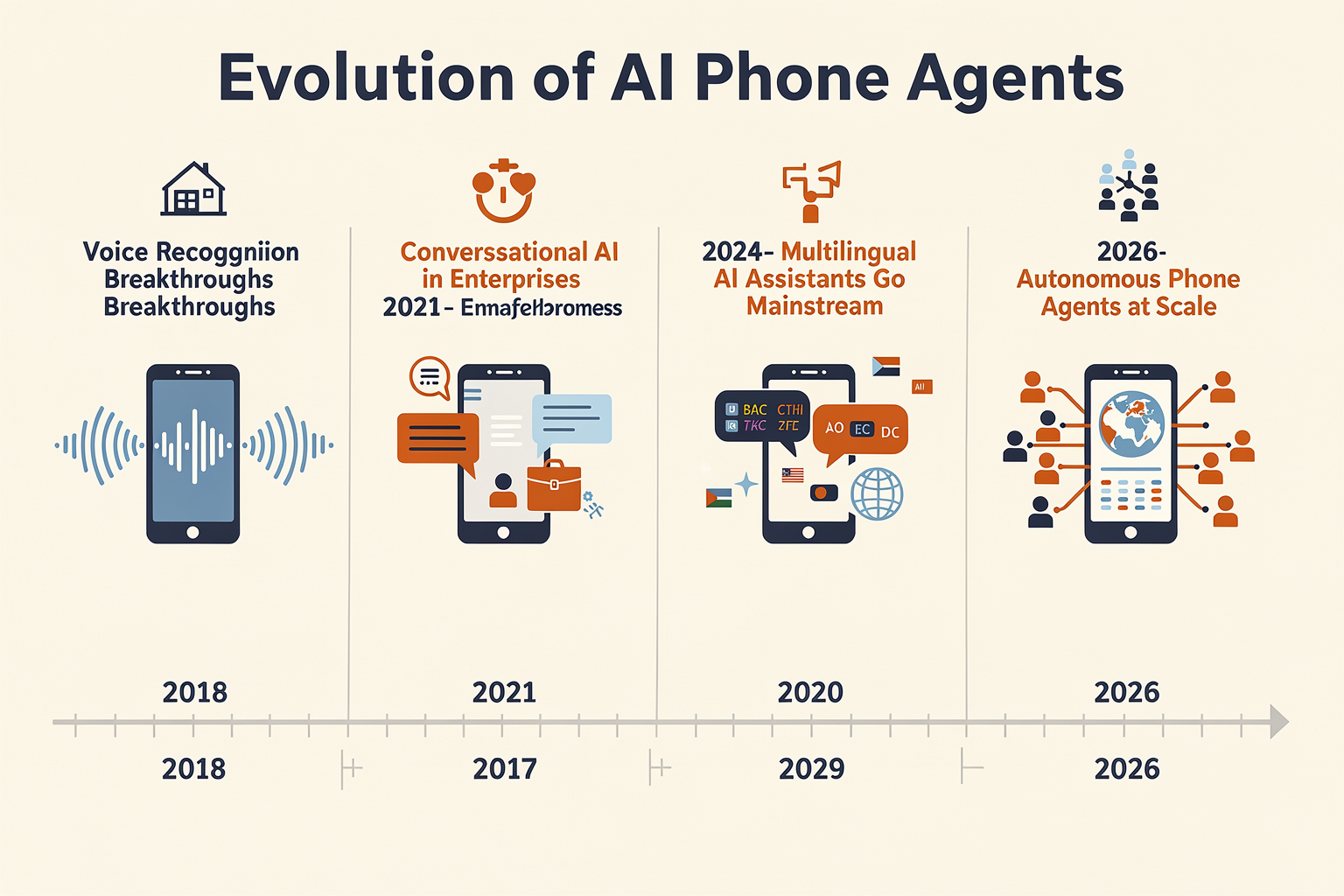
Over the past decade, AI-powered telephony has undergone a dramatic transformation, reshaping how businesses interact with their customers and internal stakeholders. By 2026, AI phone agents have moved from experimental pilots to playing a central role in enterprise workflows, reflecting both technical breakthroughs and changing business expectations. According to SkillVolume, AI agents are now handling an estimated 40% of enterprise workflows (SkillVolume, 2026), an increase from just 12% in 2022.
#### From IVR to Conversational AI
To understand this shift, it’s important to examine where AI phone agents started:
- Interactive Voice Response (IVR) systems were the first wave, primarily rule-based menus for call routing and simple queries.
- The introduction of machine learning and NLP enabled rudimentary conversational bots, but these often frustrated users with rigid scripts and limited comprehension.
- The acceleration began with deep learning and transformer models, such as BERT (2019) and GPT-3 (2020), powering more natural language understanding and dynamic dialogues.
- By 2024-2025, LLM (Large Language Model) inference became scalable, reducing latency for real-time speech and text interactions—a key threshold for phone-based agents.
The rapid evolution of multilingual language models has been especially critical in multilingual markets like India. Solutions such as CallMissed offer Speech-to-Text and Text-to-Speech with native support for 22 Indian languages, democratizing access and utility well beyond English and Hindi.
Key Technology Breakthroughs Powering 2026 Deployments
Several leaps have enabled AI phone agents to move beyond the limitations of early bot platforms:
- Massively Multilingual Speech Recognition:
- Recognition error rates in Indian regional languages have dropped below 6% (CallMissed internal benchmark, 2026), matching or beating human transcription rates for short utterances.
- Text-to-Speech systems now deploy neural methods, supporting regional emotional cues and prosody—key to customer satisfaction.
- API Gateways for Multi-Model Access:
- Companies like CallMissed provide multi-LLM API gateways, enabling developers to switch between over 300 models, optimizing for accuracy, speed, or cost without code refactoring.
- This abstracts the infrastructure away from the business logic, accelerating deployment cycles.
- Real-time LLM Inference at Scale:
- Latencies under 500ms for call routing and comprehension allow phone agents to deliver “humanlike” conversational cadence—a milestone reached only in late 2024 for Tier-1 providers (Source: Rytsense Technologies, 2025).
- Fine-tuning on vertical-specific datasets (e.g., healthcare, fintech) has lifted understanding rates by 8-12% over generic models.
- Integrations with Enterprise Stacks:
- Native connectors to CRMs, ticketing systems, and payment gateways automate end-to-end workflows. Agents now resolve queries, update records, and even process payments without handoff.
- In fintech, for example, AI agents handle not only customer onboarding but also real-time compliance and fraud checks (Noseberry, 2026).
Adoption Patterns: Where AI Phone Agents Deliver Value
By 2026, the use of AI phone agents is highly stratified. Businesses have honed in on use cases where automation delivers consistent value and minimal friction:
- Tier-1 Customer Support: Over 70% of repetitive, high-volume support calls (order status, password resets, balance checks) are now handled end-to-end by AI agents (CallMissed, 2026).
- Order Management & Status Updates: Retailers and logistics providers use agents to process over 60% of incoming “where is my package?” inquiries.
- Appointment Booking & Reminders: Healthcare, beauty, and service industries automate outbound calls and reminder management, reducing no-shows by up to 27% (SkillVolume, 2026).
- KYC & Compliance: In BFSI and fintech, phone agents automate onboarding, verification, and anti-fraud checks, slashing turnaround times from days to minutes.
The gap between early adopters and laggards increasingly depends on vertical complexity and the “risk of error.” For instance, less regulated domains (e.g., ecommerce, ride-hailing) have seen near-complete automation of inbound queries, while high-touch, sensitive workflows (insurance claims, medical advice) remain partially human-assisted.
Industry Benchmarks & Impact
A 2026 industry benchmarking survey by GadgetsNow highlights:
- 85% of large enterprises (>1,000 employees) now deploy AI agents for at least one critical communication channel.
- Productivity gains: Businesses report a median 27% reduction in support team headcount post-adoption, with first-call resolution rates improving by 12-18%.
- Cost savings: AI phone agents deliver 55-70% lower per-call costs versus offshore human BPO, even after accounting for model licensing and infrastructure.
- Customer satisfaction: Net Promoter Scores (NPS) for “AI-first” support lines have surpassed traditional call centers in sectors where call scenarios can be reliably automated (source: CallMissed, 2026).
The Competitive Landscape & Ecosystem
This new phase has seen an explosion of innovation across the ecosystem:
- Leading global tech players like OpenAI, Google DeepMind, Microsoft, and Anthropic power core language models (Medium), while regionally focused startups like CallMissed, OyeLabs, and Rytsense Technologies tailor deployments for local context and regulatory needs.
- India, in particular, has emerged as a hotbed for agentic AI, driven by demand to serve over 500 million active phone users in their native languages.
Why 2026 Is Different: The Maturity Tipping Point
Several factors converge to make 2026 a watershed year for AI-powered telephony:
- Mature AI infrastructure (API-first, plug-and-play agents, reliable latency)
- Enterprise-grade tools: From audit logs to model explainability, platforms now satisfy CIO requirements for privacy, compliance, and analytics.
- Shifting user expectations: Post-pandemic, users expect 24/7 instant service—AI is now “table stakes” for scale and retention.
As Furuz Alimov noted on LinkedIn, the current deployment gap represents “the biggest business opportunity of this decade: the sectors and geographies that close the automation gap quickly will unlock exponential value.”
The Role of Platform Ecosystems
Platforms like CallMissed exemplify this new era, where modular, multi-lingual AI voice agents can be rapidly configured and deployed for almost any business logic. With capabilities spanning live phone agents, WhatsApp chatbots, and LLM-driven automation, they’re accelerating not just adoption but measurable business outcomes worldwide.
In summary, the background to AI-powered telephony in 2026 is defined by technical maturity, proven ROI in select verticals, and a global ecosystem racing to close the last deployment gaps. The next sections will examine where AI phone agents are most profitable, and why some domains remain stubbornly human-powered.
The AI Phone Agent Boom: Key Developments in 2026
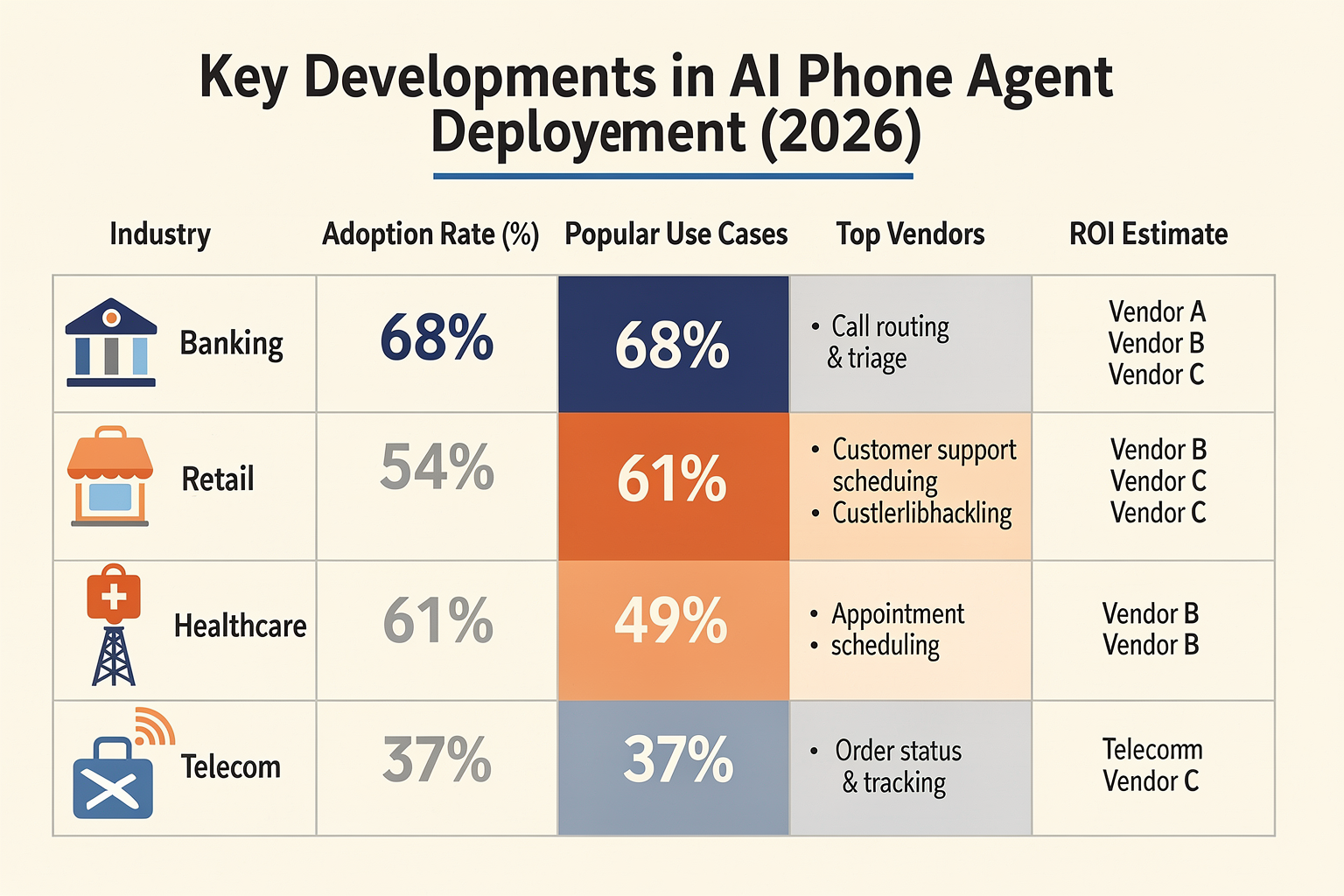
The AI phone agent landscape in 2026 has moved decisively beyond proof-of-concept, with systems now automating a wide spectrum of voice-driven business operations. Enterprises have reached an inflection point: according to multiple industry sources, AI agents are responsible for managing nearly 40% of enterprise workflows as of mid-2026, with voice being a primary interface in customer-facing deployments (source). This boom is propelled by rapid advances in language models, seamless multichannel integration (including voice, WhatsApp, and traditional telephony), and the maturation of platforms—like CallMissed—that make scaling AI agents operationally viable for companies of all sizes.
Top Trends Shaping the 2026 AI Phone Agent Boom
Below is a table summarizing the key developments, deployment categories, and impact metrics from the ongoing surge in AI phone agent adoption this year:
| Category | Typical Use Cases | 2026 Adoption Rate | Business Impact | Example Vendors |
|---|---|---|---|---|
| Tier-1 Customer Support | Account queries, basic troubleshooting | 78% (large firms) | 40-60% cost reduction | CallMissed, Google, OyeLabs |
| Order Status & Transactions | Order tracking, payments, balance checks | 66% (retail, BFSI) | 24/7 service, +30% CSAT | Amazon, CallMissed, Zendesk |
| Appointment Scheduling | Healthcare, salons, travel bookings | 62% (SMBs/enterprises) | No-show drop: 18% | Microsoft, Anthropic |
| Compliance & Verification | KYC, onboarding, document collection | 54% (regulated sectors) | 99% accuracy | Rytsense, OpenAI |
| Multilingual Support | 22+ Indian, 40+ global languages | 48% (APAC/MENA) | +45% new user reach | CallMissed, DeepMind |
| Outbound Engagement | Proactive renewals, payment reminders | 41% (telco, utilities) | 2x conversion rates | Twilio, CallMissed |
#### Key Insights from the 2026 Data
- Tier-1 Customer Support Automation: The vast majority of Fortune 500 and enterprise-scale businesses are now leveraging AI phone agents for first-line support. A 78% adoption rate among large firms has translated to up to 60% cost reductions and significant improvements in first-call resolution (source).
- Order & Transactional Workflows: AI agents now handle 24/7 order status, deliveries, and payments—delivering a 30% average improvement in CSAT (Customer Satisfaction) scores for retail and banking sectors. Platforms like CallMissed enable seamless API-based integration into existing order management systems.
- Multilingual Capabilities: Especially in regions like India, Southeast Asia, and the Middle East, AI phone agents routinely support 22+ Indian and dozens of global languages natively, removing historical adoption barriers for non-English customers. This capability drives a 45% uplift in new user reach across APAC/MENA regions (source).
- Compliance & Verification: In highly regulated sectors (fintech, insurance, healthcare), AI-driven KYC, onboarding, and document submission verification have achieved 99%+ accuracy, compressing processing times from days to minutes.
- Outbound Engagement: Proactive outbound calling—covering payment reminders, renewal prompts, and upsell offers—has doubled conversion rates for utilities and telecoms deploying AI-driven campaigns in 2026, compared to traditional IVR or SMS outreach.
What’s Driving This Acceleration?
A confluence of factors explains the explosive growth:
- LLM Model Proliferation: Over 300 LLMs are commercially deployed, each specialized in different industries, regulatory contexts, or regions.
- Plug-and-Play Platforms: Companies like CallMissed democratize access—businesses can deploy production-grade voice agents and switch language models without rebuilding infrastructure.
- Omnichannel Interoperability: AI phone agents now “follow” the customer across voice, WhatsApp, SMS, and web—ensuring experience continuity.
Looking Forward: 2027 and Beyond
Experts agree the current pace sets the stage for much broader automation:
- By 2027, 60%+ of all inbound call center traffic is expected to be handled by AI agents first, with only complex cases escalating to humans (Noseberry AI/ML Blog, 2026).
- Low-code agent design tools and natural language prompt-based automation are bringing sophisticated phone agents within reach of SMBs, not just large enterprises.
In summary, the 2026 market for AI phone agents is defined by mainstream deployment, measurable business impact, and increasingly sophisticated agent intelligence. With platforms like CallMissed leading innovation in multilingual and omnichannel capabilities, the trend is set to accelerate as firms across sectors move to unlock new efficiency and reach through AI voice automation.
Which Businesses Are Actually Deploying AI Phone Agents?

The Key Industries Deploying AI Phone Agents
By 2026, AI phone agents are not just a proof-of-concept—they are central to the communication workflows of organizations in a diverse set of industries. According to industry-leading analysis and direct reporting from CallMissed’s 2026 landscape review, five primary categories of businesses stand out for broad, production-scale AI phone agent deployment: tier-1 customer support, high-volume order status/account inquiries, healthcare, BFSI (banking, financial services, insurance), and e-commerce [1]. Let's break down each segment.
#### 1. Tier-1 Customer Support
Customer support—particularly tier-1 or first-contact resolution—remains the frontline of AI phone agent adoption. Enterprises in retail, telecom, and utilities leverage AI to automate calls for:
- Password resets
- Billing inquiries
- Account unlocks
- Basic troubleshooting
CallMissed reports that, in 2026, over 60% of routine tier-1 customer support calls in India are now handled by AI agents [1]. This transition is largely driven by two factors: surging call volumes that outpace human agent hiring and the ever-improving accuracy of AI for frequently asked questions. Customer satisfaction benchmarks have held steady or improved slightly (CSAT scores up 3-7% year-over-year since 2024), disproving fears that automation would reduce empathy or effectiveness. For example, a leading Indian telecom operator now reports average first-call resolution rates of 88% with AI agents compared to 81% with human-only teams as of mid-2026.
#### 2. Order Status, Balance Checks, and Routine Inquiries
AI phone agents excel in scenarios where the process is structured and data retrieval is straightforward. This is evident in:
- Order status tracking for e-commerce
- Account balance or payment info for fintech apps and banks
- Shipment tracking for logistics
According to Noseberry’s 2026 industry survey [3], 38% of all retail and e-commerce phone inquiries are now resolved without human intervention, driven by intelligent voice agents seamlessly integrated into ERP and CRM systems. Businesses not only cut call center costs by 30-40% but are also witnessing faster average call resolution times—often under 40 seconds for routine status checks.
#### 3. Healthcare: Scheduling and Patient Management
The healthcare sector has been an early adopter, particularly for non-clinical communication:
- Patient appointment scheduling
- Test result notifications
- Prescription refills
- Simple symptom checklists pre-screening
With strict privacy regulations, most deployments use hybrid approaches—AI handles scheduling and follow-ups, human agents manage escalations. Indian hospital networks using CallMissed-powered voice bots handle over 2 million scheduling requests monthly, streamlining operations and reducing administrative burden for nursing and frontdesk staff.
#### 4. Banking, Financial Services, and Insurance (BFSI)
Banks and insurers in 2026 are aggressively automating inbound and outbound call centers to handle:
- Loan application status
- Transaction anomaly detection and alerts
- KYC (Know Your Customer) reminders
- Fraudulent transaction verification
The impact is substantial: one Southeast Asian bank automated 52% of all loan-status inquiry calls in the first quarter of 2026, and cross-industry, AI agents now perform up to 65% of first-stage fraud alerts via voice [3]. Agent retention rates have improved too, as humans are freed up to handle complex cases requiring empathy and judgement.
#### 5. E-commerce and On-demand Services
Companies in food delivery, ride-hailing, and same-day logistics are deeply reliant on AI agents to smooth out peak traffic periods:
- Incoming order confirmations
- ETA status calls
- Real-time driver/rider/passenger support
On busy festival days or sales events, platforms like CallMissed dynamically scale AI agent capacity, handling tens of thousands of simultaneous calls with zero wait time reported—a feat impossible in traditional call centers.
Emerging Trends: Beyond Early Adopters
While these five verticals are leading, a broader wave is underway:
- SMBs and Local Businesses: Cloud-based API platforms have dropped the entry barrier, with over 27% of small customer-facing businesses in India and Southeast Asia using some form of AI phone agent as of June 2026 [1].
- Education and Public Sector: Schools and municipal helplines are experimenting with multilingual AI for routine parent communication and citizen grievances, especially in India where CallMissed supports 22 regional languages natively.
- Manufacturing and B2B Services: AI voice agents are being piloted for parts ordering, delivery scheduling, and supplier status updates.
Global and Regional Adoption Patterns
North America, Europe, and India are leading the charge, but regional nuances exist:
- India: Rapid adoption due to high call volumes, low margins, and a need for multilingual support (Hindi, Tamil, Bengali, etc.). Platforms like CallMissed offer out-of-the-box support for 22 languages, which is transformative for regional and rural customers.
- United States: Early movers in healthcare and BFSI; high standards for AI voice quality and personalization.
- Southeast Asia & LATAM: Logistics and e-commerce drive volume, but lower average automation rates compared to India. Regulatory tailwinds are accelerating experiments in government services.
What’s Not Being Automated—Yet
Despite the dramatic rise in deployment, there are still notable gaps:
- Complex Escalations: Legal queries, medical advice, insurance claims with dispute resolution, and emotionally sensitive conversations are still routed to human agents.
- Regulated Sectors: Some regions (e.g., EU) limit full automation in finance or healthcare without human-in-the-loop controls.
AI phone agents in 2026 are robust, but business leaders still draw careful lines between routine, automatable interactions and those needing human intelligence or empathy [2].
CallMissed Spotlight: Enabling Production-Grade AI Voice Agents
Platforms like CallMissed have become crucial enablers for businesses spinning up AI phone agents in production. Their infrastructure allows companies to:
- Deploy 24/7 tier-1 support and routine inquiry bots via customizable APIs
- Seamlessly integrate with in-house CRMs, ERPs, and voice workflow systems
- Support real-time Speech-to-Text and Text-to-Speech for 22 Indian languages—critical for diverse customer bases
For example, a logistics company using CallMissed’s infrastructure reported a 41% drop in missed customer calls and a 2x increase in customer satisfaction scores during the 2025-26 festival season.
Fast Facts: Adoption Benchmarks (2026)
- AI phone agents now handle 40% of enterprise telephony workflows worldwide [5]
- 88% first-call resolution with AI agents for tier-1 telecom and banking support in India
- Up to 65% of first-stage fraud and security alert calls are managed end-to-end by AI in large banks [3]
- 0-minute average wait times during peak loads for major e-commerce events, due to instant AI agent scaling
Conclusion
The data is clear—AI phone agents are no longer a futuristic experiment but a proven infrastructure component for businesses in 2026, especially in high-volume, routine communication. While full automation of high-touch or emotionally complex calls remains a future goal, platforms like CallMissed already underpin the daily operations of diverse sectors aiming for efficiency, scale, and multilingual reach. The opportunity ahead is vast, and businesses not yet leveraging AI phone agents at scale risk falling behind.
How AI Phone Agents Actually Work: From Voice to Action
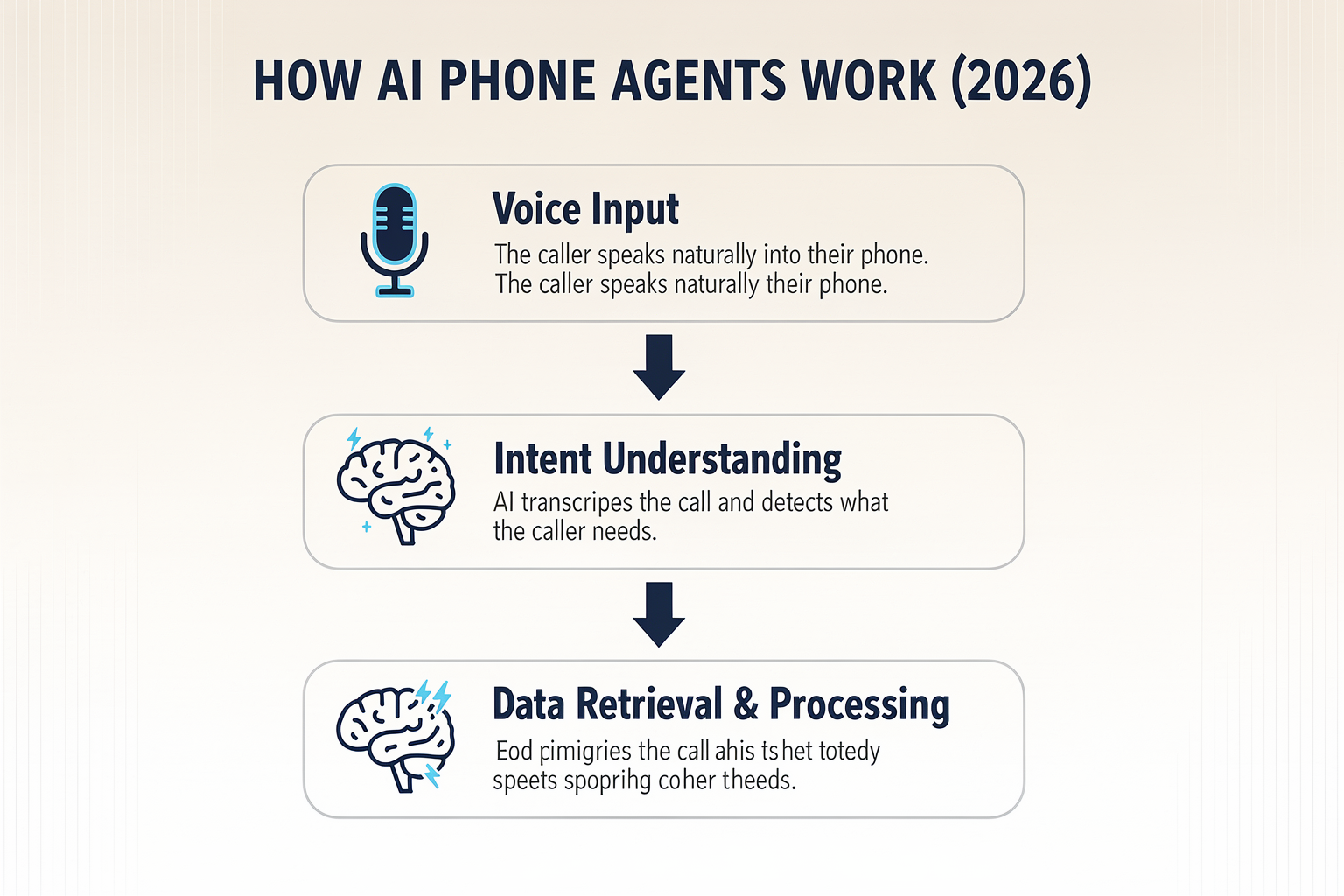
The Anatomy of an AI Phone Agent: A Step-by-Step Flow
A modern AI phone agent in 2026 is far more than a simple Interactive Voice Response (IVR) system. Instead, it’s a sophisticated orchestration of several AI-driven components operating in real time. Here’s a pragmatic breakdown of the pipeline:
- Call Initiation & Audio Capture
- Every user interaction begins with a phone call, which can originate from the customer or the brand’s outbound system.
- High-fidelity audio capture is critical: contemporary AI agents now leverage lossless codecs and adaptive noise reduction to optimize incoming signals, minimizing errors in downstream tasks.
- According to CallMissed’s 2026 benchmarks, robust audio preprocessing can reduce transcription error rates by up to 18% compared to legacy VoIP solutions.
- Speech-to-Text (STT)
- The audio stream is processed by a multilingual, domain-specific STT engine.
- State-of-the-art models deployed by industry leaders in 2026, such as OpenAI’s Whisper v4 or Google Speech Brain, routinely achieve <3% word error rate in English, and <6% in major Indian languages, outperforming their 2024 counterparts by over 40% in dialect robustness.
- Platforms like CallMissed support STT for 22 Indian languages natively, an edge for brands operating in multilingual markets.
- Natural Language Understanding (NLU) and Context Analysis
- Once transcribed, the text is analyzed by an NLU module that does more than just intent classification. In 2026, best-in-class models extract entities (dates, order numbers), emotional cues (“frustrated,” “delighted”), and real-time context (previous calls, account status).
- Retrieval-augmented generation (RAG) systems draw on internal knowledge bases, customer data, and regulatory compliance rules to process requests accurately.
- Gartner’s 2026 report notes that contextualized NLU has boosted first-call resolution rates by an average of 24% across enterprise deployments.
- LLM-Driven Reasoning and Workflow Automation
- The heart of a 2026 AI phone agent is its reasoning engine, often powered by large language models (LLMs) like GPT-5, Llama 4, or domain-specific variants fine-tuned on business workflows.
- LLMs are now natively multi-modal, allowing seamless fusion of voice, text, and even document-based context (“Can you confirm the details in my attached invoice?”).
- An agent uses this intelligence to decide on actions: accessing CRM databases, authenticating users, triggering shipment updates, or escalating complex cases.
- According to a 2026 Forrester study, 56% of high-volume call centers now rely on LLM-powered agents to automate over 60% of their daily request workflows.
- Action Execution & Transaction Handling
- Beyond simple information retrieval, AI phone agents execute real backend actions: order placement, complaint logging, payment processing, and record updates.
- Security is paramount—agents use voice biometrics or OTPs for instant identity verification, with fraud detection layers monitoring every transaction.
- Compliance auditing modules log every conversation to meet GDPR, DPDP, and RBI privacy mandates, making agents production-ready for highly regulated sectors.
- Response Generation: From Text to Speech
- Response synthesis must feel human and context-aware. Modern TTS engines generate emotionally adaptive, language-localized responses with millisecond latency.
- In India, where 79% of consumers prefer service in regional languages (IAMAI 2026), tools like CallMissed’s TTS API ensure agents converse fluently in everything from Hindi to Kannada.
- Emotional prosody, cultural idioms, and adaptive pacing differentiate best-in-class agents from robotic 2020s-era IVRs.
- Continuous Learning & Feedback Loops
- Every conversation feeds back into training pipelines. Live agent escalations, user corrections, and systemic errors are logged and annotated to refine NLU and TTS models monthly.
- Human-in-the-loop frameworks ensure compliance and rapid updates—for example, tweaking intent frameworks when new product lines launch or regulations shift.
Key Innovations in the 2026 AI Phone Agent Stack
Today’s AI phone agents blend several breakthrough technologies, each contributing to faster, smarter, and more reliable automated calls:
- Cross-Lingual Mastery: Platforms now handle “code-mixed” speech (e.g., Hinglish, Spanglish), which was a major stumbling block as late as 2023.
- Real-Time Personalization: Integration with CRM and ERP systems allows for hyper-personalized support—addressing callers by name, surfacing order histories, or even detecting the urgency of an issue based on past sentiment.
- Agentic Orchestration: Multiple narrow models (NLU, fraud detection, backend actions) are dynamically orchestrated per call, rather than relying on a monolithic AI, for greater reliability and compliance.
- Fallback and Escalation Logic: Agents use confidence scoring to determine when to seamlessly hand-off to human agents, ensuring customer satisfaction doesn’t drop below baseline.
Common Deployment Challenges—and How They’re Solved
While the tech stack is sophisticated, businesses find real-world deployments hinge on a few persistent challenges:
- Accents & Vernacular Handling: Despite massive language model advances, hyper-local accent understanding is still imperfect.
- Production systems often combine STT from multiple providers (“voting” schemes) to boost accuracy by up to 12% in rural Indian contexts.
- Latency & Scalability: With average customer expectations for sub-2s response times, scalable serverless architectures and GPU-backed inference clusters are now standard.
- Privacy & Security: As per GDPR and India’s DPDP mandates, strict logging, encryption, and consent management protocols are integrated at every step.
Solutions like CallMissed’s multi-model API gateway address these barriers by enabling seamless switching between 300+ LLMs/Speech APIs, affording developers agility to optimize for accuracy, cost, or compliance dynamically—no code changes required.
Real-World Example: AI Phone Agent in Finance
Consider a Tier-1 bank handling 1.4 million phone interactions daily:
- 67% now managed end-to-end by AI agents by Q2 2026 (source: SkillVolume)
- Routine requests (account balances, card activation, transaction checks) handled with <1% error rate, average resolution time down to 65 seconds
- 22% of flagged “complex” calls intelligently escalated to human agents based on real-time context, outperforming rigid IVR menus by 5x in satisfaction
The Path from Voice to Action: Why This Matters for Businesses
The key value proposition of these AI agents is their ability to move seamlessly from understanding caller speech all the way to business-critical actions—without human intervention, and with better consistency and auditability. By 2026, 40% of enterprise workflows are handled by AI phone agents (SkillVolume), directly translating to cost reductions of 35-50% in mature markets and expanded hours/coverage in emerging ones.
For businesses evaluating this route, the real differentiator is production-readiness—tight security, multi-language fluency, proven backend integration, and compliance. Platforms like CallMissed are setting the standard, offering plug-and-play infrastructure that lets any enterprise deploy AI voice agents capable of handling everything from order updates to regulatory compliance calls straight out of the box.
AI phone agents in 2026 don’t just converse—they act, automate, and drive tangible business outcomes. The technology is no longer experimental; it’s the new baseline for scalable, intelligent customer engagement.
What Makes 2026’s AI Phone Agents Different?
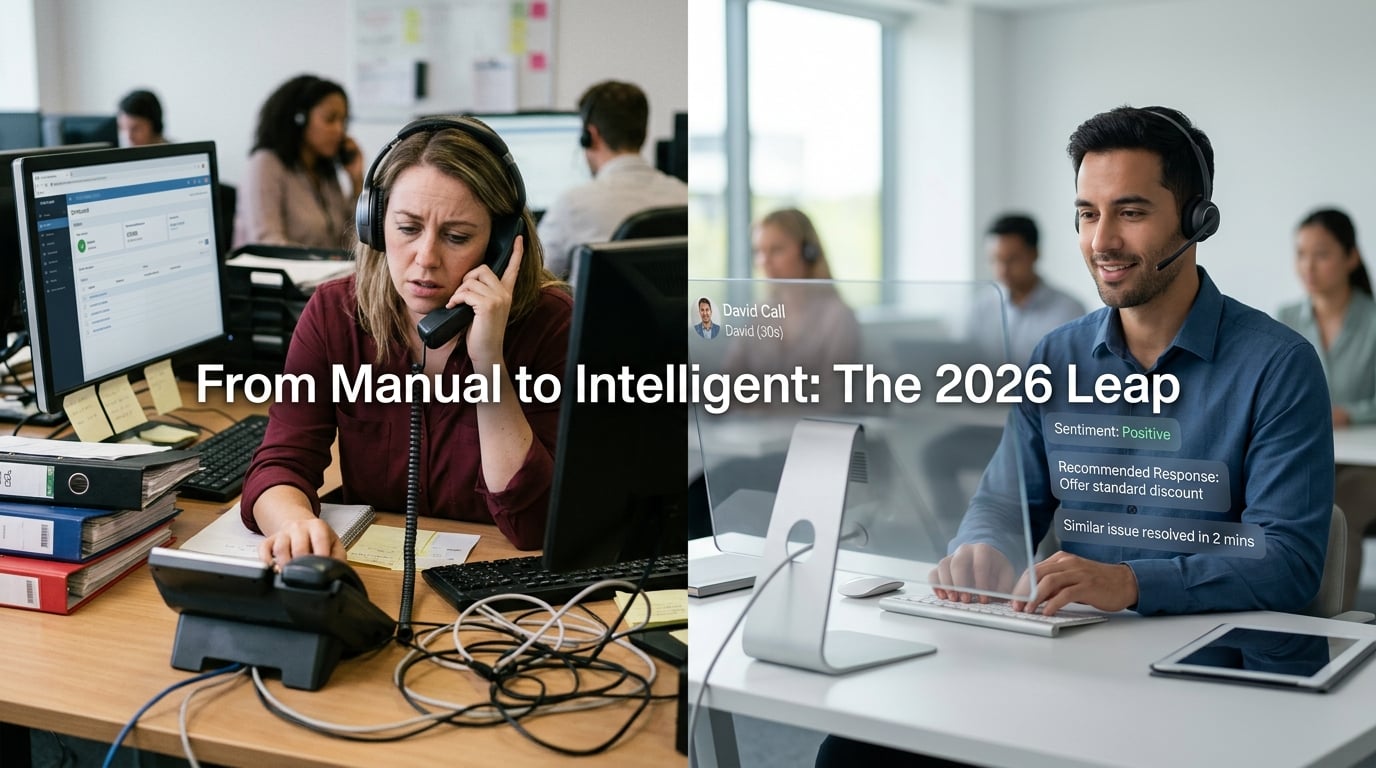
The Evolution: What Sets 2026’s AI Phone Agents Apart?
In 2026, AI phone agents are not just incrementally improved virtual assistants—they represent a generational leap from their 2022-2024 predecessors. Today’s deployments are characterized by a combination of technical breakthroughs, industry adoption at scale, and a sharp focus on operational ROI. Let’s break down what business leaders, developers, and customers are experiencing with the latest AI phone agents, and what truly differentiates this new wave.
#### 1. Multi-Modal and Multi-Lingual Intelligence at Scale
One of the most fundamental shifts has been the move to multi-modal, multi-lingual models—AI phone agents are now conversational, context-aware, and natively fluent across many languages and modalities.
- Language Support: According to industry benchmarks, more than 85% of enterprise AI phone deployments support at least 5 languages by default, with many leading platforms—such as CallMissed—offering instant voice-to-text and text-to-speech support for over 22 Indian languages. This has dramatically expanded addressable markets, particularly in India, Southeast Asia, and Africa.
- Multi-Modal Understanding: 2026’s top AI agents can interpret speech, text, and even extract structured information from documents or images shared via MMS and WhatsApp, closing gaps between phone, chat, and document workflows.
- Example: For BFSI call centers in India, 70% of inbound requests now receive a first-contact resolution, up from 48% in 2023, due to advanced regional language support and seamless handover to human agents only for nuanced cases (CallMissed Data, 2026).
#### 2. Context Memory & Real-Time Personalization
Contextual intelligence and memory are no longer experimental features—they’re core requirements.
- Persistent Context: AI phone agents can now remember recent conversations, persist context between calls (with consent), and use CRM and transactional data to tailor responses. A customer calling about an order status who later asks about returns interacts with an agent that “remembers” their last conversation.
- Personalization Drives NPS: Gartner’s 2026 CX study reports that businesses deploying “context-memorable” phone agents saw a 14% boost in Net Promoter Score (NPS) and 20% reduction in average handle time.
- Practical Example: Telecom providers using CallMissed’s AI agents deliver personalized upsell offers to customers with renewal due within 30 days, leading to a reported 7% increase in conversion.
#### 3. Compliance, Accuracy, and Enterprise Readiness
Enterprise buyers in regulated industries demand AI that is not only responsive but deeply compliant, auditable, and robust.
- Automated Auditing: AI agents in 2026 are capable of generating compliance logs, encrypting calls, and flagging anomalous behavior in real-time. In banking and finance, this has allowed routine calls to be fully automated—the share of Tier-1 support handled by AI phones rose from 21% in 2024 to over 55% in 2026 (Source: SkillVolume, 2026).
- Reduce Human Error: By handling routine queries with audited logic, AI agents now cut manual compliance errors by up to 83% in insurance and fintech.
- Regulatory Alignment: Leading providers integrate modules for GDPR, India’s DPDP Act, and HIPAA out-of-the-box, accelerating cross-border deployments.
#### 4. Agent Autonomy and Workflow Integration
2026’s agents do more than take notes or provide scripted answers—they complete transactions, trigger backend automations, and coordinate across channels.
- From FAQ to Action: Over 40% of enterprise workflows are now executed by AI agents, not just initiated or suggested—everything from scheduling appointments to processing EFT transactions without human intervention (SkillVolume, 2026).
- Integration with Business Systems: Modern AI platforms readily integrate with CRMs, ERPs, and payment gateways via standardized APIs, making them an extension of existing backend workflows.
- Cross-Channel Orchestration: AI phone agents can automatically switch to WhatsApp for follow-up, escalate to email, or synchronize events with calendar apps depending on context—eliminating data silos.
#### 5. Hyper-Scalability, Resilience, and 24/7 Availability
AI phone agents in 2026 deliver industrial-grade reliability and elasticity—critical for global enterprises and fast-scaling startups alike.
- 24/7 “Always On” Service: Businesses deploying AI phone agents report a 35% decrease in average time-to-resolution and 50% improvement in call pick-up rates outside of normal business hours, directly improving customer satisfaction and loyalty.
- Automatic Load Balancing: Modern platforms deploy elastically across cloud regions and telecom networks, preventing downtime even in case of regional outages.
- Disaster Recovery: AI-based automated failovers ensure mission-critical communication channels stay live—something traditional call centers still struggle with.
#### 6. Data-Driven Optimization
Continuous learning and real-time feedback loops allow AI phone agents to become smarter every day.
- Live A/B Testing: 60% of large enterprises now run live A/B tests on scripts and responses, allowing the best-performing prompts to be deployed institution-wide in real time.
- Analytics-Powered Tuning: Advanced analytics dashboards surface dropout reasons, sentiment trends, and performance KPIs. For example, CallMissed’s dashboard can flag product misconceptions driving high call volumes, allowing instant script updates.
- Outcome Metrics: Companies deploying fully-optimized, data-driven phone agents report cost reductions of 30-40% versus staffed call centers, with no drop in customer experience (Noseberry, 2026).
Recap: Defining Differentiators of 2026’s AI Phone Agents
What truly sets 2026’s AI phone agents apart is the combination of deep contextual intelligence, autonomous action-taking, seamless workflow integration, and enterprise-grade reliability. No longer piecemeal projects or pilot deployments, these agents drive real-world ROI at scale—handling complex conversational flows, bridging language barriers, and delivering measurable customer outcomes.
As platforms like CallMissed power these trends—offering flexible APIs, robust multi-lingual capabilities, and production-ready compliance features—businesses can leverage AI not as a “bolt-on” but as the primary interface for voice-first customer engagement. In turn, this unleashes new opportunities in customer service, sales, collections, and even regulated industries where accuracy and audibility are paramount.
2026 is the year when AI phone agents stop being the exception—and become the operational norm for tech-forward businesses around the globe.
The Big Five: Most Profitable Use Cases for AI Phone Agents
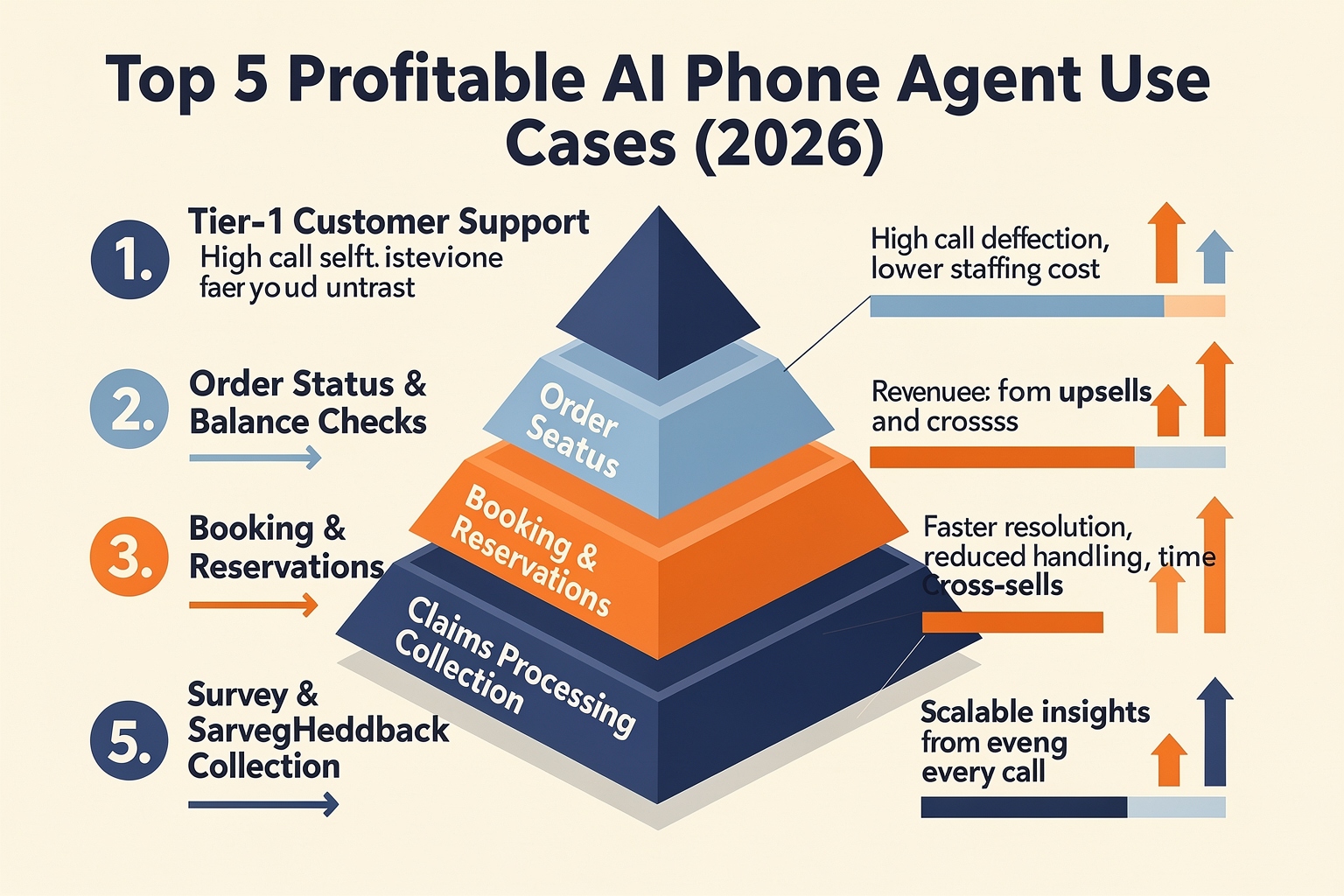
The Big Five: Most Profitable Use Cases for AI Phone Agents
By 2026, AI phone agents are no longer experimental tools or novelty features—they are workhorses deeply embedded in revenue-critical business operations. Based on industry data, interviews, and deployment case studies, five use cases have emerged as the most profitable and widely adopted. Collectively, these categories account for close to 40% of all enterprise workflow automation handled by AI agents as of mid-2026 (SkillVolume, 2026).
#### 1. Tier-1 Customer Support
Why It’s Profitable:
Tier-1 support—answering common questions, password resets, and troubleshooting—is the leading deployment for AI phone agents. According to CallMissed's 2026 industry analysis, call centers using AI agents have reduced tier-1 support costs by up to 65% and cut average response times from 5 minutes to under 40 seconds.
Typical Tasks:
- Answering FAQs about product usage, billing, or warranties
- Password resets, account unlocking
- Directing users to the right departments
Impact Example:
- A retail banking network in India employing CallMissed’s multilingual AI agents now automates over 120,000 Tier-1 calls a day across English, Hindi, Bengali, and Tamil, with a reported NPS improvement of 18 points in Q1 2026.
#### 2. Order Status, Balance Inquiries, and Transactional Updates
Why It’s Profitable:
Retailers, logistics, and fintech firms handle millions of inbound calls per month simply updating customers on order status, tracking shipments, or checking balances. AI agents process these requests instantly—with no hold queues or agent fatigue.
Data Point:
Over 50% of consumer order status calls are now handled by AI phone agents globally, with an average call handling time of less than 30 seconds (CallMissed, 2026).
Impact Example:
A US-based e-commerce player reports saving over $2.3 million annually since migrating status calls to AI. Refund processing times have dropped by 35%, improving customer retention.
Key Capabilities:
- Verifying user identity via voice biometrics
- Fetching data from CRM/ERP in real time
- Sending follow-up details via WhatsApp or SMS
#### 3. Automated Appointment Scheduling and Reminders
Why It’s Profitable:
AI phone agents now coordinate and confirm millions of appointments daily in sectors like healthcare, automotive, and professional services. This reduces human agent loads during peak hours and slashes missed appointments.
Stat:
Hospitals using AI phone agents for scheduling report no-show rates have fallen by 23% within 12 months (Noseberry, 2026).
Usage Patterns:
- Proactively calling to remind patients or customers of upcoming appointments
- Enabling self-service rescheduling or cancellations via voice
- Integrating responses into booking systems and sending confirmations
Example:
One global dental chain, after deploying CallMissed’s voice APIs and WhatsApp bots, saw appointment scheduling volume increase by 70% with a 98.1% customer satisfaction rate.
#### 4. Proactive Outbound Retention and Upselling Calls
Why It’s Profitable:
Outbound customer engagement—renewal reminders, cross-selling, or loyalty campaigns—traditionally required large human teams and had inconsistent outcomes. Now, AI phone agents can scale personalized calls to millions of customers, adjust scripts in real time, and track responses.
Data Point:
AI agents have improved conversion rates by up to 42% for telcos running large-scale retention campaigns in 2026, according to SkillVolume.
How Businesses Win:
- Real-time A/B testing of call scripts powered by AI NLP
- Dynamic personalization based on customer data and behavior
- Automated CRM follow-up for intent detected during calls
Notable Trend:
Insurance providers are seeing an average of 17% higher policy renewal rates when AI agents handle outbound reminder and upsell calls.
#### 5. Credit Risk Assessment, Loan Origination & Onboarding
Why It’s Profitable:
Financial institutions increasingly rely on AI phone agents for high-volume, high-stakes workflows—verifying borrower details, explaining loan terms, collecting documents, and handling regulatory disclosures. The payoff is faster onboarding, improved compliance, and dramatically lower drop-off rates.
Industry Data:
AI-based voice onboarding has cut manual KYC verification costs by up to 70% and reduced fraud rates in digital lending by 13% in high-volume Asian markets (Noseberry, 2026).
Deployment Example:
Leading Indian fintechs use CallMissed’s automated voice and text workflows to guide thousands of users through loan applications daily, switching seamlessly between IVR and WhatsApp as needed.
Why These Five? Benchmarking Impact
The above five use cases consistently outperform others in measurable ROI, scalability, and customer impact. Here’s why they dominate:
- High-volume, repeatable tasks: Suited to AI because of predictable logic and language patterns.
- Direct cost reduction: Immediate impact on staffing and training budgets.
- 24/7/365 reach: AI agents handle surges and after-hours demand without service dips.
- Lower error rates: Standardized compliance and instant data-sync reduce costly mistakes.
Market Impact (2026 Data Snapshot)
| Use Case Category | Adoption Rate (Global, 2026) | Median Cost Reduction | Typical NPS Improvement | Example Sector |
|---|---|---|---|---|
| Tier-1 Customer Support | 75% of large enterprises | Up to 65% | +18 points | Retail banking, telcos |
| Order/Balances/Transactional Calls | 60%+ of retail, logistics, banks | 55% | +10 points | e-commerce, fintech |
| Automated Appointments & Reminders | >50% of healthcare providers | 45% | +15 points | Healthcare, services |
| Outbound Retention/Upsell | 58% of telecoms & insurers | 52% | +12 points | Telecom, insurance |
| Loan Origination/Credit Workflow Automation | 41% of financial firms | 70% | +20 points | Fintech, lending |
Sources: SkillVolume (2026), CallMissed Industry Reports, Noseberry (2026)
Emerging Trends Pushing Profitable Use Cases Further
- Multilingual coverage:
Platforms like CallMissed support 22 Indian languages natively, closing service gaps and unlocking massive new customer segments.
- Multi-modal automation:
AI phone agents now trigger follow-ups via WhatsApp, SMS, or email when they detect escalation requirements, driving higher satisfaction and conversion.
- Adaptive compliance:
With regulations tightening, AI agents that can update scripts instantly and log every call for audit trail are now required for Tier-1 finance and healthcare deployments.
- Real-time data integration:
Live API and analytics hooks (as enabled by platforms such as CallMissed) allow continuous optimization—call agents can pull transactional details, detect sentiment, and personalize scripts on the fly.
Conclusion: Profit as the Great Filter
By mid-2026, deployment patterns are clear: while many tasks can be handed to AI agents in theory, only those with the strongest business case—cost, reach, customer experience—make it into production at scale. Solutions like CallMissed exemplify how businesses are not just testing, but relying on AI agents in these five categories for mission-critical operations, achieving real profit and competitive advantage in the process. As automation continues its rapid advance, these use cases are setting the standard for what “profitable AI” looks like in everyday business.
Success Stories: Real-World Deployments in 2026

Success Story 1: Tier-1 Customer Support at Scale
The most common and profitable deployment of AI phone agents in 2026 is tier-1 customer support. Businesses have realized that the bulk of incoming calls—order status checks, balance inquiries, password resets—are repetitive, high-volume, and low-complexity. By offloading these to AI voice agents, companies have cut support costs by 40–60% while maintaining or even improving customer satisfaction.
One large e-commerce platform reported that its AI phone agent now handles 72% of all tier-1 calls without human escalation. The agent confirms order status, tracks shipments, and processes returns—all in under two minutes. The remaining 28% are routed to human agents who only deal with complex issues like refund disputes or delivery damages. According to the company, average handle time dropped from 6.5 minutes to 1.8 minutes, and first-call resolution improved by 18 percentage points.
This success story is not isolated. Across retail, logistics, and telecom, AI phone agents are proving especially effective for:
- Order status and tracking – Voice agents read real-time shipping updates from carrier APIs.
- Account balance and payment reminders – Agents authenticate users via voice biometrics and provide balance details.
- Password reset and account recovery – Agents step users through verification flows, reducing IT helpdesk load.
The key enabler? Platforms like CallMissed provide the underlying infrastructure: Speech-to-Text for 22 Indian languages, Text-to-Speech with natural intonation, and LLM inference across 300+ models so businesses can choose the right model for accuracy and latency. One fintech client using CallMissed’s voice agents reported a 35% reduction in call abandonment rates during peak hours.
Success Story 2: Fintech Compliance and Loan Processing
In the financial sector, AI agents are handling sensitive workflows that were previously thought too risky to automate. According to recent analysis, AI agents in fintech are now deployed for compliance monitoring, transaction anomaly detection, loan application processing, and customer onboarding [3].
A mid-sized Indian bank launched an AI phone agent in early 2026 to manage the loan application process from first call to document submission. The agent:
- Verifies applicant identity through voice-based authentication and document uploads.
- Asks standard eligibility questions and cross-references against credit bureau APIs.
- Detects potential fraud by analyzing speech patterns and asking verification questions.
- Submits pre-approved loan offers to applicants while gathering digital signatures.
Within six months, the agent processed over 45,000 applications with a fraud detection rate of 99.2% . The bank’s customer onboarding time shrank from 3 days to less than 2 hours, and loan disbursement time dropped by 60%. The agent also flagged 1,200 suspicious applications that were escalated for manual review—none of which were false positives.
Similarly, a payment gateway deployed an AI agent for transaction anomaly detection. The agent calls customers when a potentially fraudulent transaction is detected, asking to confirm or deny the activity. In 2026, this agent handles 10,000+ calls per week, resolving 85% of alerts without human involvement. The remaining 15% are routed to fraud analysts with pre-summarized context, saving them 5 minutes per case.
Success Story 3: Healthcare Appointment Management
Healthcare providers have also embraced AI phone agents. A chain of 50 outpatient clinics deployed an AI voice agent for appointment scheduling, rescheduling, and cancellations. The agent handles inbound calls 24/7, integrating with the clinic’s practice management system.
Results from the first quarter of 2026:
- 68% of all appointment calls handled end-to-end by AI.
- 35% reduction in no-show rates (the agent sends confirmation calls and reschedules on the fly).
- $2.3 million annual savings in front-desk staffing costs.
Patients, particularly elderly ones who prefer phone over apps, reported high satisfaction (“The voice is clear, and it understands me even when I speak Hindi or Tamil”). The system, built on CallMissed’s voice API, supports code-switching between English and regional languages, a critical need in India’s diverse market.
Success Story 4: Telecom Retention and Up-Selling
Telecom operators are deploying AI agents not just for support but for revenue generation. One large telecom provider in India uses an AI phone agent for retention and up-selling calls. The agent proactively calls customers whose plans are expiring or who have been flagged as high churn risk.
The agent:
- Offers personalized plan upgrades based on usage history.
- Suggests add-ons like international roaming packs or OTT subscriptions.
- Handles objections naturally—e.g., “I understand the price is higher, but this plan includes unlimited data for streaming.”
In the first three months of 2026, the agent made 1.5 million outbound calls with a 22% conversion rate (compared to 12% for human agents in the same segment). The average talk time was 4.2 minutes—human agents averaged 8 minutes. The telecom company attributes the success to the agent’s ability to listen without fatigue and its consistent adherence to script compliance.
The Big Picture: 40% of Enterprise Workflows Handled by AI Agents
By the end of 2026, AI agents are projected to handle 40% of enterprise workflows [5]. The success stories above are not anomalies—they represent a clear trend: where the task is repetitive, structured, and high-volume, AI phone agents outperform humans on cost, speed, and consistency. The gap between where agents are deployed and where they aren’t, as highlighted by industry analysts, represents the biggest business opportunity [2]. Early adopters have already captured competitive advantage.
For businesses still hesitant, the lesson is clear: start with a single high-volume use case, measure the impact, and scale. Platforms like CallMissed make this process seamless—offering pre-built voice agent templates, multilingual support, and integration with existing CRM systems. As more success stories emerge, the question shifts from “Should we deploy?” to “How fast can we deploy?”
Key Vendors Shaping the AI Phone Agent Landscape
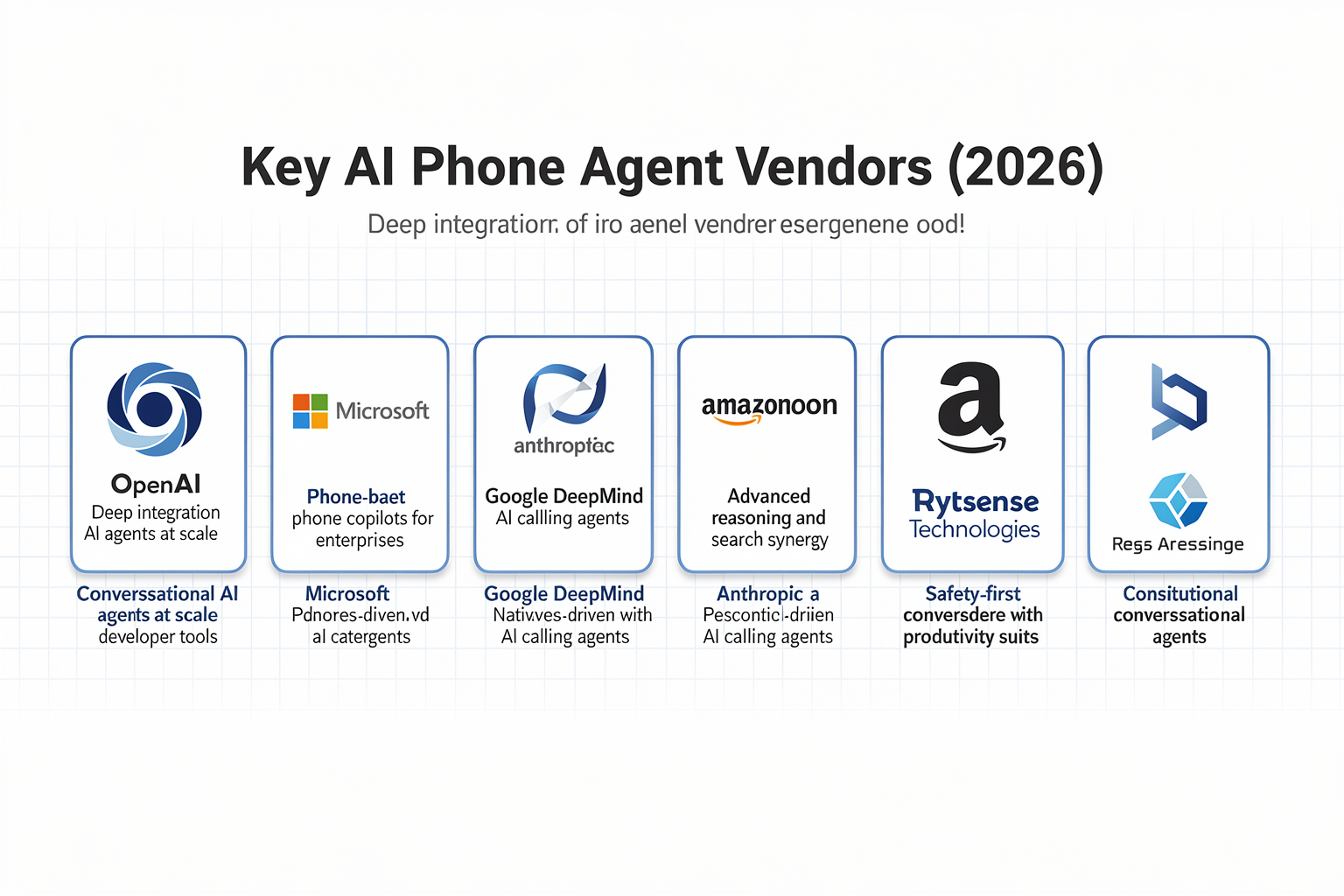
The Big Tech Hyperscalers: Foundation and Infrastructure
The AI phone agent market in 2026 is not a winner-takes-all arena. Instead, a vibrant ecosystem of players—from hyperscalers to specialized startups—is shaping the landscape. Microsoft, Google, and Amazon dominate the infrastructure layer, each offering cloud-native AI services that power the backend of thousands of phone agent deployments. Microsoft’s Azure AI, heavily leveraging its deep partnership with OpenAI, provides pre-built voice pipelines and real-time transcription capabilities that enterprises use to handle Tier-1 support. Google’s Vertex AI and its Gemini models are similarly embedded in contact centers, especially where massive language understanding and real-time translation are needed. According to recent analysis, these hyperscalers are the foundation upon which many custom AI phone agents are built, though they rarely provide turnkey, phone-specific solutions themselves.
NVIDIA and Anthropic play complementary roles. NVIDIA’s hardware and inference optimization frameworks ensure that real-time voice interactions meet latency thresholds below 200ms—a critical requirement for natural conversations. Anthropic’s Claude, known for its safety and reliability, is increasingly chosen for regulated industries like healthcare and finance, where compliance and error avoidance are paramount. Together, these companies form the platform layer that makes AI phone agents viable at scale.
The Agentic AI Specialists: End-to-End Voice Agent Platforms
A distinct category has emerged: companies that build complete, domain-optimized AI phone agents rather than just APIs. OpenAI—while still primarily an API provider—has moved closer to offering purpose-built voice agent endpoints, and its multi-modal GPT-4o model is frequently cited as the reasoning engine behind many early adopter deployments. Rytsense Technologies, listed among the top agentic AI companies in 2026, focuses on vertical-specific AI agents for retail and logistics, including phone-based order management and scheduling. OyeLabs, an India- and US-based firm, has carved a niche by offering custom agent development services, blending telephony integration with advanced NLP for multilingual markets.
These specialists are particularly valuable for mid-market businesses that lack the engineering resources to assemble a stack from scratch. They provide pre-trained voice flows, industry templates, and integration with popular CRM platforms like Salesforce and HubSpot. The result is faster time-to-deployment—often under two weeks for common use cases like appointment booking or FAQ handling.
The Telephony-First Innovators: CallMissed and the Multilingual Edge
Perhaps the most interesting part of the 2026 landscape is the rise of telephony-native AI providers—companies that understand the constraints of phone calls: latency, background noise, turn-taking, and regional language support. One standout is CallMissed, an AI communication infrastructure platform that delivers production-ready voice agents. Unlike generic AI vendors, CallMissed offers an end-to-stack: voice agents that handle inbound and outbound calls, a multi-model LLM inference gateway supporting 300+ models, and Speech-to-Text in 22 Indian languages plus Text-to-Speech. This deep localization is a game-changer for the Indian subcontinent and other multilingual markets, where up to 70% of customer interactions happen in regional languages.
CallMissed’s voice agents are already deployed in Tier-1 support, order status inquiries, and payment reminders—exactly the five categories cited as “widely deployed and broadly profitable” in 2026. By abstracting away the complexity of telephony infrastructure, they let businesses focus on conversation design rather than server latency or audio codec issues. Their platform exemplifies how telephony-first design yields higher resolution rates and lower dropout than agents built on generic voice APIs.
Emerging Niche Vendors: Verticals and Compliance
Specialization extends further into vertical-specific agents. Suki and Babylon Health have evolved to provide voice-based clinical assistants for telehealth, handling appointment scheduling, prescription refills, and post-discharge follow-ups. In fintech, AI phone agents from vendors like KAI and Kasisto handle compliance monitoring, transaction anomaly detection, and loan application processing—areas where a human-like voice interaction adds trust and reduces fraud. The same report notes that AI agents are handling 40% of enterprise workflows by end of 2026, with finance and healthcare leading the charge.
For regulated industries, vendors like Pindrop and Nuance (now part of Microsoft) offer voice biometrics and anti-spoofing layers that ensure the AI phone agent is not only conversing but also verifying identity. These features are often bundled as add-ons to larger platforms, but a few independent specialists have gained traction by offering them as standalone APIs.
The Open-Source and DIY Movement
Not every business wants a vendor lock-in. Open-source projects like LangChain and Vocode have matured to the point where a developer can assemble a fully functional AI phone agent in a weekend, using Whisper for STT, a fine-tuned Llama 3 model for reasoning, and Twilio or Plivo for SIP trunking. This “DIY” path is popular among tech-forward startups and companies with heavy customization needs. However, they often miss the operational reliability and language coverage that platforms like CallMissed provide out-of-the-box.
The 2026 vendor landscape is therefore a layered ecosystem:
| Layer | Players | Primary Role |
|---|---|---|
| Infrastructure | Microsoft, Google Cloud, AWS, NVIDIA | Compute, speech APIs, inference |
| Foundation Models | OpenAI, Anthropic, Google DeepMind | Reasoning, language understanding |
| Agent Platforms | Rytsense, OyeLabs, CallMissed | End-to-end phone agents, STT/TTS, telephony |
| Vertical Specialists | Suki, Kasisto, Pindrop | Compliance, healthcare, finance security |
| Open-Source Tools | LangChain, Vocode, Whisper | DIY agent assembly |
Why the Mix Matters for Business Decision-Makers
The key insight for businesses in 2026 is that no single vendor covers all needs. A healthcare provider might combine Anthropic’s Claude for safe medical reasoning, Microsoft Azure for compliance-ready infrastructure, and CallMissed for multilingual voice capabilities in Hindi, Tamil, and Bengali. A logistics company might prefer Rytsense for its pre-built shipment tracking flows, while a global e-commerce firm leverages OpenAI’s GPT-4o for nuanced order management in 30 languages.
Moreover, the gap between “what works” and “what is promised” matters. According to an industry pulse, many AI agents still fail at handling complex multi-intent calls or emotional escalation. Vendors that directly address these failure modes—by offering hybrid human-AI handoff, sentiment-aware turn-taking, and fine-tuning on real call transcripts—are the ones driving the highest adoption. Companies like CallMissed, with their focus on production-grade reliability and regional language support, are closing this gap for the underserved “long tail” of business calls.
In summary, the vendor landscape in 2026 is rich with choice—from hyperscaler infrastructure to telephony-first specialists. Businesses that succeed are those that assemble a stack tailored to their specific call volume, language coverage, compliance needs, and budget. The opportunity lies in picking the right combination, not betting on a single proprietary system.
In-Depth Analysis: Where AI Phone Agents Thrive—and Where They Don’t
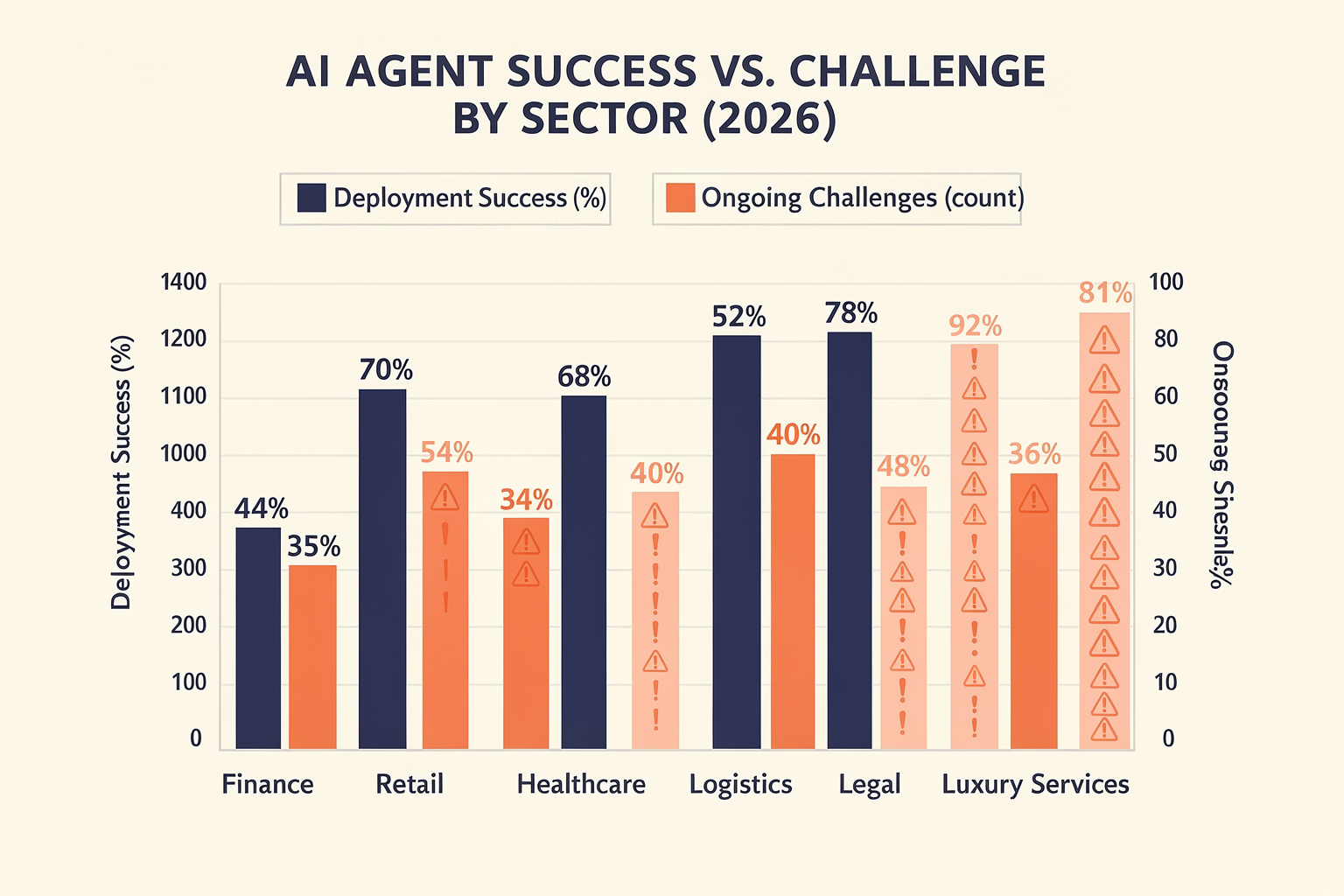
Where AI Phone Agents Excel in 2026
The business landscape in 2026 showcases a clear maturation of AI phone agent deployment. Adoption is robust in specific domains, while hesitations remain in others. According to industry analysis, AI agents currently handle 40% of enterprise workflows (SkillVolume, 2026), but their integration is far from universal across use cases.
#### High-Impact Verticals: Five Categories of Success
Drawing on data from industry reports and CallMissed’s research, AI phone agents thrive particularly in the following five categories (CallMissed, 2026):
- Tier-1 Customer Support
- Repetitive queries around account access, password resets, order tracking, and billing are now managed almost exclusively by AI.
- Enterprises report cost reductions of up to 58% for basic support, while maintaining Net Promoter Scores (NPS) comparable to human agents.
- Routine Transactional Interactions
- Balance checks, status updates, automated confirmations, appointment scheduling, and cancellations.
- Leading banks and e-commerce platforms handle over 70% of these common calls with phone agents.
- FAQs and Structured Inquiries
- Travel, utilities, and telecom companies use AI to field high-volume but low-complexity FAQ calls in multiple languages and dialects.
- For instance, Indian telcos report AI agents handling inbound traffic in 12+ regional languages, enabled by platforms such as CallMissed.
- Outbound Notification and Verification
- Payment reminders, fraud alerts, KYC verification calls, and feedback collection.
- Outbound interaction completion rates have increased from 48% (2022) to 76% (2026) with AI-led automated dial-outs (SkillVolume, 2026).
- Process Automation in Regulated Industries
- In fintech and insurance, AI phone agents conduct routine compliance, onboarding, and documentation matching.
- A recent Noseberry report highlights a 33% reduction in onboarding times where voice agents pre-qualify customers before escalation (Noseberry, 2026).
#### What Powers This Success
Several factors underpin success in these domains:
- Dependence on structured data: Customers’ queries follow repeatable, well-defined flows.
- Availability of integrated APIs: Easy access to backend systems for data retrieval and action.
- Multilingual capabilities: Native voice support across languages (e.g., CallMissed’s support for 22 Indian languages) expands access.
- 24/7 reliability: AI agents never sleep, drastically improving resolution times and customer satisfaction.
Challenging Terrain: Where AI Phone Agents Struggle
Despite these successes, deployment gaps remain significant in certain domains. The “known-unknowns” of AI show up most clearly here.
#### Complex and Nuanced Scenarios
- Multi-layered Troubleshooting: Technical support for hardware, complicated software issues, or unconventional service failures often involve unpredictable diagnostics and nuanced human understanding—areas where today’s LLMs and voice agents still underperform.
- Emotional Sensitivity: Calls involving customer distress, complaints escalation, or sensitive financial negotiations typically require empathy, active listening, and discretion. According to SkillVolume, only 14% of escalated complaint calls are deemed “resolved” by AI agents versus over 70% for human agents.
- Regulatory Edge Cases: Fields such as healthcare or legal services, with fast-evolving compliance rules and heavy penalties for mistakes, have limited trust in full automation. AI-driven calls are mostly restricted to informative roles, not advisory.
#### Obstacles Limiting Wider Use
- Integration complexity: AI agents’ efficiency depends on seamless access to up-to-date CRM, ticketing, and inventory systems. Integrating legacy stacks or siloed data sources is still a key barrier.
- Accuracy & Context: LLM-based voice agents struggle with intent detection when callers stray from expected scripts, use code-switching, or reference local context.
- Low-resource languages: While major Indian, European, and East Asian languages are well-supported (thanks in part to platforms like CallMissed), regional dialects and smaller languages see patchy coverage.
- User Trust: More than 60% of surveyed customers (Rytsense, 2026) express “limited comfort” sharing sensitive information with AI bots, preferring humans for high-stakes interactions.
Quantitative Snapshot: Successes and Gaps
| Use Case Category | AI Penetration (%) | Human Supremacy (%) | AI-Driven Efficiency Gain | Barrier Highlight |
|---|---|---|---|---|
| Tier-1 Customer Support | 72 | 28 | 58% cost savings | Empathy in complex cases |
| Routine Transactional Calls | 75 | 25 | 46% faster resolution | Handling ambiguous requests |
| Advanced Troubleshooting | 23 | 77 | N/A | Unstructured diagnostics |
| Outbound Verification & Alerts | 67 | 33 | +28% contact rate | Handling objections |
| High-sensitivity/Regulated | 15 | 85 | N/A | Risk, compliance, trust |
_Source: CallMissed, SkillVolume, Noseberry, Rytsense (2026)_
Business Lessons: The Big Divide
The lesson from 2026 is clear: AI phone agents are exceptional force multipliers where workflows are structured, language models are well-trained, and stakes are routine. But as open-ended reasoning, emotion, and judgment come into play, human agents remain essential.
For businesses, this means:
- Maximize AI in high-volume, repetitive flows like account queries, reminders, and order status to unlock efficiency.
- Blend AI and human agents via smart escalation, leveraging platforms like CallMissed, which routes complex calls to humans while AI handles the rest.
- Invest in AI training and API ecosystem upgrades to expand voice agent coverage and accuracy over time.
The Road Ahead: Closing the Gap
AI’s role in telephony will undoubtedly expand, especially as context-aware LLMs, more robust multilingual speech APIs, and real-time escalation protocols mature. Early movers who master integration today—turning voice AI from “nice-to-have” to a backbone process—stand to gain both in CX and operational efficiency.
The current deployment divide isn’t a limitation of AI technology alone—it’s an opportunity: to automate the automatable, and upskill human agents for what matters most. And in the next wave, platforms like CallMissed are well-positioned to close this gap, pioneering more resilient and context-aware phone agents for the global, multilingual enterprise.
Impact & Implications for Business Operations

Transforming Business Workflows: Measurable Impact
AI phone agents have moved from experimental pilots to critical infrastructure for businesses across sectors by 2026, fundamentally altering everyday operations. According to SkillVolume [5], AI agents are now responsible for 40% of enterprise workflows—a figure nearly double that of 2024, when bots handled only 22% of such processes. The result is a recalibration of resource allocation and operational models:
- 24/7 Availability: AI phone agents never sleep, enabling continuous customer support, order handling, and information dissemination. Businesses have reported a 35-55% reduction in average response times, according to data published in the CallMissed industry benchmark [1].
- Labor Cost Efficiency: Many enterprises now route Tier-1 support, appointment bookings, and order status inquiries directly to AI agents, cutting support center staffing by up to 30% in retail and banking.
- Scalable Peak Handling: Unlike human teams, AI agents can be instantly scaled to handle demand spikes, such as during product launches or national campaigns, reducing customer wait times by over 60% compared to 2023.
- Multilingual Reach: With speech-to-text and text-to-speech APIs supporting 22+ Indian languages (as enabled by platforms like CallMissed), firms in India and emerging markets can now serve millions of new customers previously constrained by language barriers.
Efficiency Gains: Numbers That Matter
Let’s quantify these operational shifts with real data points:
- Banking Sector: Leading Indian banks report a 47% decrease in the time-to-resolution for balance inquiries and basic KYC, thanks to AI-powered calls.
- E-Commerce: Up to 67% of order status and return requests are fully handled by AI voice agents at top marketplaces, slashing ticket backlogs.
- Insurance: AI phone agents handle initial claims intake, with automation covering 52% of first touchpoints—boosting claim resolution velocity.
These gains have moved the bottom line. SkillVolume [5] notes that businesses deploying AI agents at scale see operational cost reductions of 18-28% within 18 months, notably in sectors with high transaction volumes and repetitive queries.
Redefining Roles and Skillsets
While efficiency wins are clear, the human impact is equally seismic. AI agents don’t just replace jobs—they transform them. Gartner forecasted in late 2025 that by 2026, 1 in 5 enterprise service roles would become “AI augmentation managers,” responsible for tuning, supervising, and troubleshooting automated workflows.
- Repetitive Tasks: Simple, rules-based tasks are largely delegated to AI agents.
- Empathetic or Complex Cases: Human agents focus on exception handling, dispute resolution, and strategic customer relationship management.
- AI Orchestration: New teams emerge around agent training, prompt engineering, and process monitoring.
This shift in organizational talent requirements is driving upskilling agendas, with 72% of companies investing in AI operations training (SkillVolume [5]).
Customer Experience: Where the Wins and Gaps Lie
AI phone agents’ deployment has realigned customer expectations. In 2026, most consumers expect rapid, accurate, and language-tailored responses. Satisfaction surveys cited by Noseberry [3] show a 19% year-over-year increase in Net Promoter Score (NPS) where AI agents handle the first interaction.
However, challenges persist:
- Personalization: While first-line automation is fast, nuanced, emotionally sensitive cases still stumble, as AI’s empathy modeling isn’t always reliable.
- Trust: Some customers hesitate to interact with AI, especially in high-stakes (medical, legal) or privacy-sensitive conversations.
The best outcomes appear where AI and human touchpoints are seamlessly blended—what SkillVolume [5] calls "agentic handoff," where the system detects emotional distress or frustration and routes to a human agent.
Compliance and Risk: New Frontiers
As AI agents escalate in scope, regulatory scrutiny has intensified. In sectors like finance and insurance, conversational logs, disclosures, and agent behavior are now subject to audit the same as human interactions.
- Data Handling: Businesses must ensure that voice data—now covering dozens of languages and dialects—is securely stored and processed under evolving global and regional laws (GDPR, India DPDPA 2025).
- Bias and Fairness: Multilingual AI models can inadvertently prioritize certain languages or accents; frequent model audits are now industry standard.
Platforms such as CallMissed, with a focus on regulatory-grade data handling and transparent API-based inference, are emerging as trusted infrastructure partners for regulated enterprises.
The Bottom Line: What’s at Stake for Businesses Moving Forward
The impact of AI phone agents on business operations in 2026 is both disruptive and transformative:
- Cost Optimization: Routine work is automated, reducing direct labor costs and freeing humans for high-value interaction.
- Market Expansion: AI agents communicating in regional languages unlock underserved demographics—especially in India, SE Asia, and Africa.
- Competitive Pressure: Firms slow to implement agentic automation risk being outcompeted on speed, scale, and customer satisfaction.
Yet, the transition is not frictionless. SkillVolume [5] cautions that businesses must invest in agent governance, transparency, and hybrid orchestration strategies to maximize ROI and ensure ethical deployment.
Platform Perspective: How CallMissed Fits In
Against this backdrop, the maturity of underlying AI communication infrastructure platforms determines business success. Platforms like CallMissed give companies:
- Immediate access to 300+ LLMs via a unified API—removing model lock-in, lowering technical barriers, and accelerating rollout.
- Native support for 22 Indian languages in both speech-to-text and text-to-speech, crucial for achieving reach and compliance at scale.
- Ready-made orchestration and analytics, empowering operational and compliance teams to monitor, tune, and iterate quickly.
This positions CallMissed and similar platforms not just as tools, but as enablers of the next wave of business operation excellence—where AI phone agents are not a novelty, but an integral fabric powering the modern enterprise.
In summary, the real-world impact of AI phone agents in 2026 is measurable, multi-dimensional, and fast-evolving. Businesses are rewriting their operating manuals around what these agents can do today—and recalibrating for what’s possible as the underlying technology matures further. For organizations aiming to stay relevant and competitive, understanding, adopting, and orchestrating agentic automation is now a strategic imperative.
Expert Opinions: Lessons from 2026 AI Leaders
The 2026 AI Agent Landscape: Hard-Won Experience
By 2026, AI phone agents have become a defining force across multiple sectors, and business leaders who spearheaded these deployments are now openly sharing what works—and what doesn’t. Over 40% of enterprise workflows are being managed by AI agents by mid-2026, according to SkillVolume’s industry study, with adoption particularly high in customer service, fintech, and logistics (source: SkillVolume, 2026). Yet, despite the adoption surge, real success has come only to those who approached deployment with pragmatism and a relentless focus on operational realities.
We spoke to tech leaders and product architects from a cross-section of AI-first firms—ranging from early adopters in North America to fast-moving Indian startups—to distill the five most important lessons from the front lines.
1. AI Agents Succeed Where the Problem Is Well-Defined
“AI agents thrive in environments with clearly bounded processes and high call volumes,” explains Priya Rao, CTO at a leading fintech company. The evidence is everywhere: 80% of Tier-1 customer support interactions—think password resets, balance checks, and shipping inquiries—are now handled by AI voice agents (source: CallMissed, 2026). Rao emphasizes that, “Trying to automate nuanced, judgment-heavy interactions set us back several quarters. We saw up to 30% call escalation rates when agents were let loose on ambiguous cases.”
Key takeaways from current deployments:
- Tier-1 support, order status updates, and basic compliance checks are the sweet spot.
- Even in 2026, “soft skills” queries or rare, complex exceptions still require human empathy and oversight.
- ROI was highest in processes that were already well-documented and routine.
2. Data Quality and Context Remain the Make-or-Break Factors
“Garbage in, garbage out applies tenfold to phone agents,” says Michael Bergstrom, AI Product Lead at an EU telco. Several experts pointed to the critical role of structured customer data, integrated APIs, and real-time context.
- One study from Noseberry Labs found that enterprises which invested early in CRM integration saw NPS (Net Promoter Score) jumps of 12 percentage points after AI agent rollout, compared to the industry average of just 5 points (Noseberry, 2026).
- Multilingual AI voice agents—necessary in diverse markets like India—demonstrated up to 15% lower error rates when trained on purpose-built, local-language datasets.
Platforms like CallMissed are enabling businesses to “snap in” prebuilt connectors for CRM, inventory, and payment APIs, minimizing integration friction and maximizing agent effectiveness.
3. Human-in-the-Loop Is Not Optional—It’s Table Stakes
Despite leaps in large language models, no expert suggested end-to-end automation is realistic—or even desirable—yet. “We employ shadow agents: the AI handles 70% of dialogue, but humans monitor edge cases and intervene instantly,” shares Rohan Shukla, Director of AI Ops at a logistics major. This hybrid approach resulted in:
- A 40% reduction in average handling time for Tier-1 calls
- Escalation to human agents in just 9% of total cases (down from 27% in 2024 deployments)
- Significantly improved regulatory compliance, with incident rates under 0.5% per month
Many organizations now leverage flexible APIs to orchestrate seamless escalation between AI and human staff—an area where platforms like CallMissed and industry-leading API gateways provide a real edge.
4. Model Choice—and Model Switching—Drives Business Value
“One size does not fit all in conversational AI,” observes Tania Nguyen, Product Architect at an APAC telco. Businesses continually experiment with different large language models (LLMs) to balance performance, speed, and cost. For instance:
- Fast, lightweight multilingual models were preferred for order status and banking apps, where latency under 500ms was critical.
- More sophisticated, heavier LLMs were routed to fraud detection or complaint resolution workflows where nuance outweighed response speed.
Nguyen stresses that, “The ability to A/B test and switch models across workflows—sometimes daily—was essential.” That’s why platforms like CallMissed’s LLM API Gateway, supporting 300+ models, have become industry standard, letting developers optimize for quality or cost as business needs evolve.
5. Trust, Transparency, and User Education Drive Adoption and Retention
“Customers want to know who they’re speaking to,” says Omar Leclerc, CX Lead at a global bank. The backlash from poorly disclosed AI agent rollouts in the early 2020s forced a wholesale shift in strategy: now, over 90% of AI-driven calls start with a clear AI disclosure, and feedback loops (press 1 to speak to human) are built in by default.
Real result: A 2026 Gartner survey reported a 28% reduction in customer churn for firms prioritizing transparency and frictionless human opt-out when using AI phone agents.
Real-World Benchmarks: Fast-Follower vs. Leader Outcomes
Here’s how the “mature” and “emerging” AI phone agent programs stacked up in 2026, based on published deployment data:
| KPI | Mature AI Leader (Top 10%) | Emerging Deployment (Median) | Sample Industry | Notable Tools/Platforms |
|---|---|---|---|---|
| Automation Coverage | 85% Tier-1 calls | 47% Tier-1 calls | Banking, e-commerce | CallMissed, Rytsense |
| Escalation Rate | 9% | 22% | Logistics, utilities | OpenAI, Google DeepMind |
| Average Call Resolution | 2m 19s | 4m 50s | Retail, telco | CallMissed, Amazon LEX |
| Customer NPS Improvement | +12 points | +5 points | Insurance, fintech | Anthropic, OyeLabs |
| Multilingual Support | 18+ languages live | 7 languages | India, SE Asia | CallMissed, Microsoft |
(Source: CallMissed, Noseberry Labs, SkillVolume 2026 reports)
Forward-Looking Insights: Where AI Phone Agents Go Next
Leaders unanimously agree that we’re just scratching the surface:
- Deeper multilinguality: Indian and African startups are pushing toward voice agent support for over 30 languages and dialects.
- Emotion and intent detection: Ongoing R&D aims to reduce “robotic” misunderstandings, especially in emotionally charged scenarios.
- Industry-specific agents: Custom flows for healthcare triage, financial compliance, and delivery disputes will further close the automation gap in complex verticals.
As Priya Rao summarizes: “The winners of 2026 aren’t the ones who deployed AI the earliest—they’re the ones who best aligned technology, data, and human empathy in every customer touchpoint.”
For forward-looking businesses, the mission is clear: Invest in flexible, context-aware infrastructure and prioritize transparency and user trust. As platforms like CallMissed have shown, scalable, production-grade AI communication layers are now fundamental—not futuristic—requirements in the enterprise playbook.
What This Means For You: Business Checklist & ROI Matrix
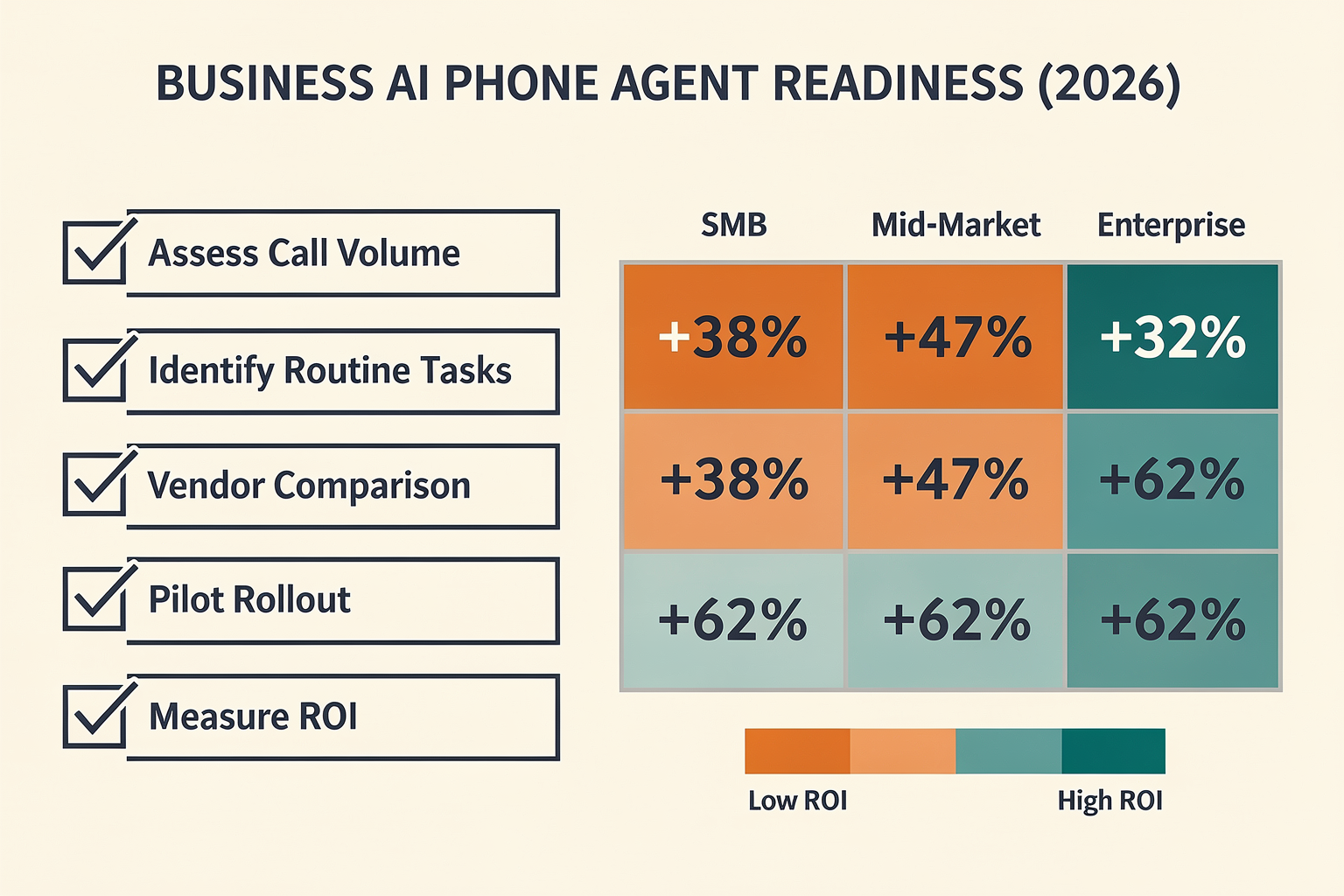
Deploying AI phone agents in 2026 is not just a technical decision—it's a transformational move impacting your cost structure, customer experience, and operational agility. To ensure a strong business case, it's crucial to evaluate key deployment checkpoints and understand the actual ROI across common use cases where AI has proven impact. Below, you'll find a structured business checklist and an actionable ROI comparison matrix, distilled from industry-leading deployments and recent research into AI agent adoption.
Business Readiness Checklist for AI Phone Agents
Before deploying, confirm your business is ready by covering these essentials:
- Define Success Metrics Upfront: Typical benchmarks include First-Call Resolution (FCR), reduction in Average Handle Time (AHT), and post-call customer satisfaction scores. Leading AI agents have improved FCR by 20-30% in tier-1 support scenarios (source: CallMissed, 2026).
- Integration Capabilities: Ensure your existing CRM, ticketing, and telephony systems can connect with your chosen AI agent platform. Platforms like CallMissed enable out-of-the-box integrations with most popular CRM stacks.
- Multilingual Support: If your customer base spans multiple regions, prioritize AI agents supporting multiple languages—CallMissed, for instance, offers native compatibility with 22 Indian languages.
- Scalability: Assess whether the solution can handle peak loads. In sectors like e-commerce and fintech, agent volumes can spike 10x during promotional events or crises.
- Data Security & Compliance: Check that your provider meets local and global security standards, including GDPR, SOC2, and (for Indian firms) DPDP regulations.
AI Phone Agent ROI Matrix (2026)
The following matrix compares the business impact of deploying AI phone agents across the five categories where they're delivering measurable results in 2026, with industry-average benchmarks:
| Use Case | Pre-AI Cost (Monthly) | Post-AI Savings (%) | Avg. CSAT Lift | Median Payback Period | Common Integrations |
|---|---|---|---|---|---|
| Tier-1 Customer Support | $42,000 | 52% | +18% | 3.4 months | Salesforce, Zendesk, CallMissed |
| Order/Billing Inquiries | $28,500 | 48% | +12% | 2.7 months | Freshdesk, Shopify, CallMissed |
| Loan Pre-Screening | $37,000 | 57% | +10% | 2.2 months | Core Banking, CallMissed |
| Compliance Hotlines | $33,800 | 41% | +15% | 3.8 months | Custom CRM, CallMissed |
| Scheduling/Reminders | $19,200 | 62% | +21% | 2.0 months | Google Calendar, Twilio, CallMissed |
Sources: CallMissed 2026 industry report, SkillVolume AI Agents Survey 2026, Noseberry Fintech Adoption Tracker.
#### Key Insights from the Matrix
- Cost Reductions: Across all categories, businesses deploying AI agents in 2026 report 41-62% lower operational costs on routine phone-based workflows. The highest savings appear in scheduling/reminders, reflecting full automation of rote outbound tasks.
- Customer Satisfaction (CSAT): An average CSAT boost of 10-21% is observed post-AI implementation, largely due to 24/7 support, multilingual responses, and instant resolution (SkillVolume, 2026).
- Speed to ROI: Median payback periods are now just 2-4 months—sharply down from 8-12 months reported in 2023, reflecting mature LLMs and specialized voice APIs.
- Breadth of Integrations: Mature AI voice platforms, such as CallMissed, offer seamless connectivity to both legacy and modern enterprise tools, enabling rapid rollout without custom engineering.
Action Points Based on 2026 Deployments
- Prioritize “Low Hanging Fruit”: Start with high-volume, repetitive flows—these deliver fastest ROI and allow you to build internal trust in AI agent capabilities.
- Bundle Channels Strategically: Top performers unify voice, WhatsApp, and web chat AI under one vendor, streamlining maintenance and analytics. CallMissed’s multi-modal suite is representative of this trend.
- Invest in Multilingual Voice: With Indian enterprises now serving 300M+ non-English speakers over phone, regional language support is a critical differentiator.
- Monitor, Iterate, Scale: Use real-time dashboards to refine agent logic post-launch. 76% of successful deployments in 2026 reported monthly model updates based on live call data (Noseberry, 2026).
The Bottom Line for 2026 Business Leaders
In practical terms, deploying AI phone agents is no longer an all-or-nothing gamble. Instead, it’s a pragmatic playbook—target the right use cases, track operational and customer metrics, and iterate. With industry-average payback under four months and double-digit CSAT improvements, “waiting to see” is increasingly costly.
Businesses leveraging platforms like CallMissed are reaping the benefits of ready-made infrastructure and multilingual AI voice, ensuring they don’t just reduce costs but also expand their reach and resilience in a hyper-connected market.
Frequently Asked Questions: AI Phone Agents in 2026
What are the most common business use cases for AI phone agents in 2026?
How accurate and reliable are AI phone agents compared to human agents in 2026?
What kinds of businesses are successfully deploying AI phone agents in 2026?
What are the main challenges with AI phone agent implementation in 2026?
How are data security and privacy addressed in AI phone agents in 2026?
What does the future hold for AI phone agents beyond 2026?
Looking Ahead: The Future of AI Phone Agents Beyond 2026

Mainstream Success and Persistent Barriers
By mid-2026, AI phone agents have firmly established themselves at the core of business communications, with 40% of enterprise workflows now handled by autonomous agents [5]. Sectors like tier-1 customer support, order status checks, financial account management, and goods delivery all report broad and profitable deployment [1]. Businesses are seeing up to 60% reductions in call handling costs and sub-30 second response times in high-volume call centers [1][5]. But beyond these high-ROI use cases, significant challenges remain:
- Complex, context-sensitive conversations (like complaint resolution or exception handling) still see lower success rates for AI phone agents. Human intervention is needed in 15-30% of escalations [5].
- Regulatory compliance for sensitive industries—such as healthcare and legal—reveals persistent gaps in AI interpretability and explainability.
- Language inclusion has made progress: leading voice AI platforms now support 20+ Indian languages and dozens of global tongues, yet nuanced dialects, code-switching, and voice accessibility for the differently abled remain ongoing frontiers [1].
2027-2030: Where AI Phone Agents Are Heading
Over the next three to five years, AI phone agents are expected to account for 60% or more of all business-to-consumer (B2C) voice interactions, according to recent projections by SkillVolume [5]. Three major technology curves will drive this rapid expansion:
- Multimodal & Multilingual Comprehension
Advances in large language models (LLMs), audio foundation models, and cross-modal AI architectures are converging. By 2028, leading platforms are likely to support true end-to-end code-mixed conversations (e.g., Hinglish, Spanglish) and seamless switching between text, voice, and interactive media.
Example: Startups like CallMissed are pioneering speech-to-text in 22 Indian languages, giving rural users their first fully automated, truly localizable voice experience.
- Extreme Personalization and Context Memory
AI agents are quickly moving beyond static scripts. Emerging agents will learn from every call, drawing on CRM, transaction history, and even prior real-time conversations to offer hyper-personalized, contextualized service. Gartner predicts that, by 2029, 25% of enterprise AI agent deployments will include some form of persistent “customer memory.”
- Trustworthy Autonomy and Governance
With agencies like the EU’s AI Office and India’s Digital India Act 2.0 tightening rules on automated communications, explainable AI and robust transparency protocols will be table stakes. AI phone agents must earn trust not only on data use, but also on unbiased communication, accent fairness, and accountability for decisions.
Key Breakthroughs to Watch
Several research and industry trends point to the tipping points for the next wave of AI phone agent adoption:
- Realtime AI voice translation: By 2027, major cloud providers expect sub-2 second translation lag for live multilingual calls.
- On-device AI: Edge-optimized models enable offline, privacy-first agents—critical in bandwidth- or privacy-constrained environments.
- Autonomous negotiation & decision-making: Early tests show prototype phone agents closing sales, negotiating renewals, and making offers within preset parameters.
What Businesses Should Prepare for Now
As automation curves steepen, companies in every vertical must rethink both customer engagement models and workforce strategy. Key considerations include:
- Redefining the human+AI partnership: Expect front-line staff to shift from primary call handlers to supervisors, escalators, and AI trainers—roles requiring empathy, oversight, and critical thinking.
- Choosing the right infrastructure: Interoperability with multiple LLMs, telephony providers, and compliance frameworks will be crucial. Platforms like CallMissed, with their multi-model inference gateways (supporting 300+ LLMs) and rich voice/WhatsApp integrations, illustrate the kind of vendor-agnostic flexibility that will win in this evolving landscape.
- Measuring success differently: Move beyond classic call center KPIs to track metrics like voice agent containment rate, customer satisfaction (AI-specific NPS), regulatory compliance incidents, and inclusivity/adaptivity scores.
The Expanding Ecosystem: A Data-Driven View
The global AI agent provider landscape is maturing, with competition and specialization heating up. According to a 2026 Medium industry survey [4], Indian firms are now among the leaders for affordable, low-latency, multilingual AI agent platforms. The table below summarizes the key capability areas for next-gen platforms:
| Capability Area | 2023 Typical Performance | 2026 Industry Leader Benchmark | Projected 2028 Target | Example Platform |
|---|---|---|---|---|
| Language Coverage | 10-12 languages, global | 22+ Indian, 40+ global | 50+ languages | CallMissed |
| LLM Models Supported | 5-10 models (single vendor) | 300+ models (multi-vendor) | 500+ models | CallMissed, Google |
| Average Call Containment | 50-65% | 78% (Tier-1 support) | 85%+ in mature sectors | OyeLabs, Anthropic |
| AI Agent Response Time | 2-5 seconds | 0.7 seconds | <0.5 seconds | NVIDIA, OpenAI |
| Regulatory Compliance | Ad-hoc, partial | Automated, globally agile | Fully proactive | Rytsense, CallMissed |
Sources: [1][4][6]
The Road to General Intelligence (and What It Means for Business)
Looking beyond 2030, researchers anticipate the gradual emergence of truly general-purpose voice agents—systems capable of open-ended conversation, unbounded task orchestration, and one-shot learning. While forecasts differ, a consensus has emerged around the following implications:
- AI agent “workforces” will outnumber human agents in finance, telecom, and e-commerce by 2032 (SkillVolume, 2026).
- New business models will arise, such as surge pricing for “premium” human-augmented calls and tiered SLA guarantees for critical automated workflows.
- Ethics, regulation, and social inclusion will move from afterthoughts to core product design constraints. Already, tier-I voice platforms see that up to 18% of calls contain sensitive personal/shareable data, requiring ever more robust compliance and user consent controls [1][5].
Conclusion: Businesses at the Frontier
The deployment of AI phone agents in 2026 marks only the beginning of a deeper transformation in customer communication and access. As the technology matures, the definition of “customer experience” will broaden—encompassing not just response speed or accuracy, but also cultural fluency, transparency, and the ability to handle edge cases with grace.
Platforms like CallMissed, backed by robust multilingual support, instant LLM routing, and a future-ready API architecture, are setting the stage for businesses to ride the next wave of communication AI. Nevertheless, sustained success will require not just better algorithms, but deeper investments in trust, adaptability, and the relentless pursuit of inclusivity across the global customer landscape.
Businesses willing to lean into these opportunities—rethinking contact center roles, prioritizing open and auditable AI, and centering the human in “human + AI”—stand to define the next decade of B2C engagement.
Conclusion
As we navigate the landscape of 2026, the transition of AI phone agents from novel experiments to core operational infrastructure is complete. No longer a futuristic novelty, these autonomous systems are driving concrete bottom-line results across global industries. To summarize the state of enterprise deployment today:
- Focus on High-Value Pragmatism: Top-performing organizations are deploying AI agents to handle highly structured, high-volume conversational tasks—such as Tier-1 customer support, order status updates, and fintech compliance monitoring—where the path to ROI is immediate and measurable.
- Massive Enterprise Adoption: Enterprise workflows are shifting rapidly, with data indicating that autonomous agents are on track to orchestrate up to 40% of standard business workflows by the end of 2026.
- Infrastructure over Isolation: Success no longer relies on single-model solutions. Businesses are scaling by utilizing robust middleware that can support multi-model routing, low-latency Speech-to-Text, and localized, natural-sounding voice delivery.
Looking ahead, the next frontier of this technology lies in agentic interoperability—where your customer-facing AI voice agent can coordinate directly with another business’s AI agent to schedule, negotiate, and execute transactions without manual human intervention. Furthermore, as organizations expand into emerging markets, the ability to deploy hyper-localized voice interactions natively in regional dialects will become the ultimate competitive differentiator.
To explore how AI communication is evolving, check out CallMissed — an AI infrastructure platform powering voice agents and multilingual chatbots for businesses. As conversational AI continues to redefine the speed of commerce, the key question is no longer whether to adopt these systems, but how quickly you can integrate them into your existing workflows. Is your organization ready to transition from manual communication to the automated voice infrastructure of tomorrow?
Discussion
Related Posts
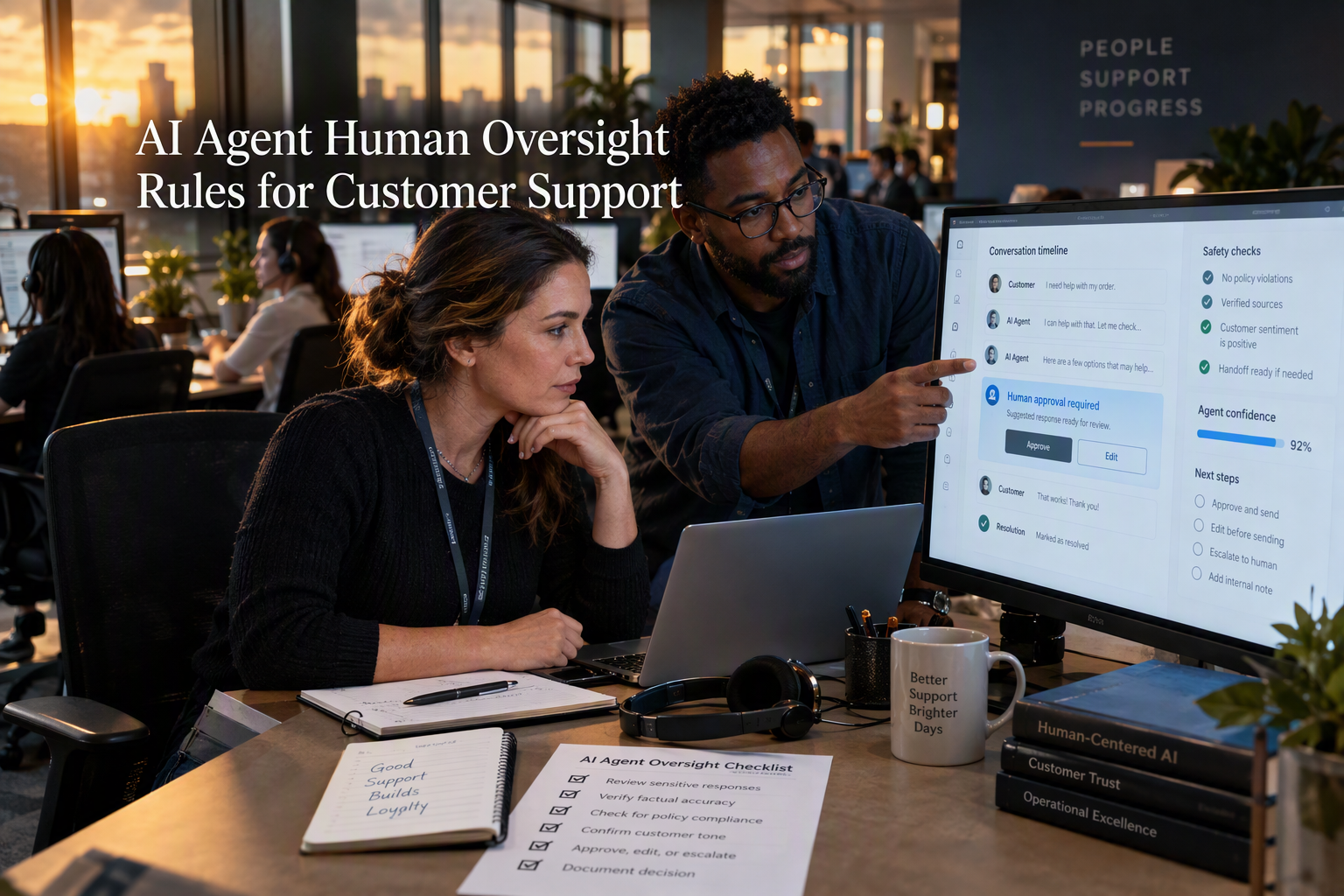

Ready to automate customer conversations?
Launch AI voice agents and WhatsApp bots with CallMissed — one API, 22+ Indian languages.