
AI Localization for Emerging Markets: Unlocking Global Growth in 2026


Did you know that over 70% of internet users in emerging markets prefer digital experiences in their native language—yet less than 10% of global content...
AI Localization for Emerging Markets: Unlocking Global Growth in 2026
Did you know that over 70% of internet users in emerging markets prefer digital experiences in their native language—yet less than 10% of global content is actually localized to meet this demand? As we enter 2026, this massive gap is no longer just a missed opportunity; it’s a barrier to global business growth. Today’s digital era is defined not only by technological scale, but by the ability to tailor experiences across linguistic and cultural boundaries—in real time and at enterprise scale. That’s where AI localization for emerging markets is proving to be a transformative force.
Why does this topic matter now more than ever? Consider this: the international expansion of digital services is outpacing traditional infrastructure, with smartphone penetration in India, Southeast Asia, and Africa growing by more than 15% year-over-year (Statista, 2026). Yet, 80% of marketing and onboarding journeys for leading platforms remain “English-first,” according to recent industry surveys—resulting in lower engagement, slower product adoption, and billions in lost revenue potential. A 2025 Smartling report revealed that companies investing in localized content for emerging markets saw a 1.5x increase in conversion rates and a 40% faster time-to-market compared to those relying solely on English content.
The traditional approach—manual translation and region-specific marketing teams—can’t scale to cover hundreds of languages, dialects, and code-mixing (the fluid switching between languages in a single conversation) that define user behavior in markets such as India, Indonesia, and Nigeria. In fact, marketing pages, app store listings, and onboarding flows tailored for local contexts demonstrate the highest return on investment, yet represent the biggest operational bottleneck for global businesses attempting to expand (CallMissed, 2026).
Enter AI-powered localization: a convergence of machine translation, large language models (LLMs), speech-to-text, and automated content workflows that enable brands to adapt at the speed and nuance required by these dynamic markets. Platforms are now able to ingest both high- and low-resource languages—including vernaculars traditionally overlooked by global tech—and deliver relevant experiences in as many as 22 Indian languages or dozens of African dialects (Smartling, 2026). Crucially, AI isn’t just automating words; it’s learning cultural subtext, slang, and user intent, making content truly native and relatable.
For businesses, this translates to three critical advantages in 2026:
- Faster international launches: Roll out in new markets within weeks, not quarters.
- Scalable personalization: Serve millions of users with regionally-tuned voice, text, and chatbot interfaces, instantly.
- Measurable ROI: Access new user segments and boost retention, with data-driven insights into what resonates locally.
This article will unpack how AI localization is being deployed in emerging markets—from the underlying technology to real-world case studies, benchmarks, and next-gen trends such as code-mixed language support. You’ll learn best practices to avoid common pitfalls, see how businesses are achieving record growth with AI-driven multilingual strategies, and understand what’s coming next as AI models leap ahead in supporting more nuanced, low-resource languages.
Platforms like CallMissed are already catalyzing this movement, offering multilingual AI communication tools that natively support code-mixed and vernacular user journeys. As you read on, you’ll discover how embracing AI localization isn’t just about translation—it’s about unlocking the new engine of global growth in 2026.
Introduction: The Frontier of Global Expansion in 2026
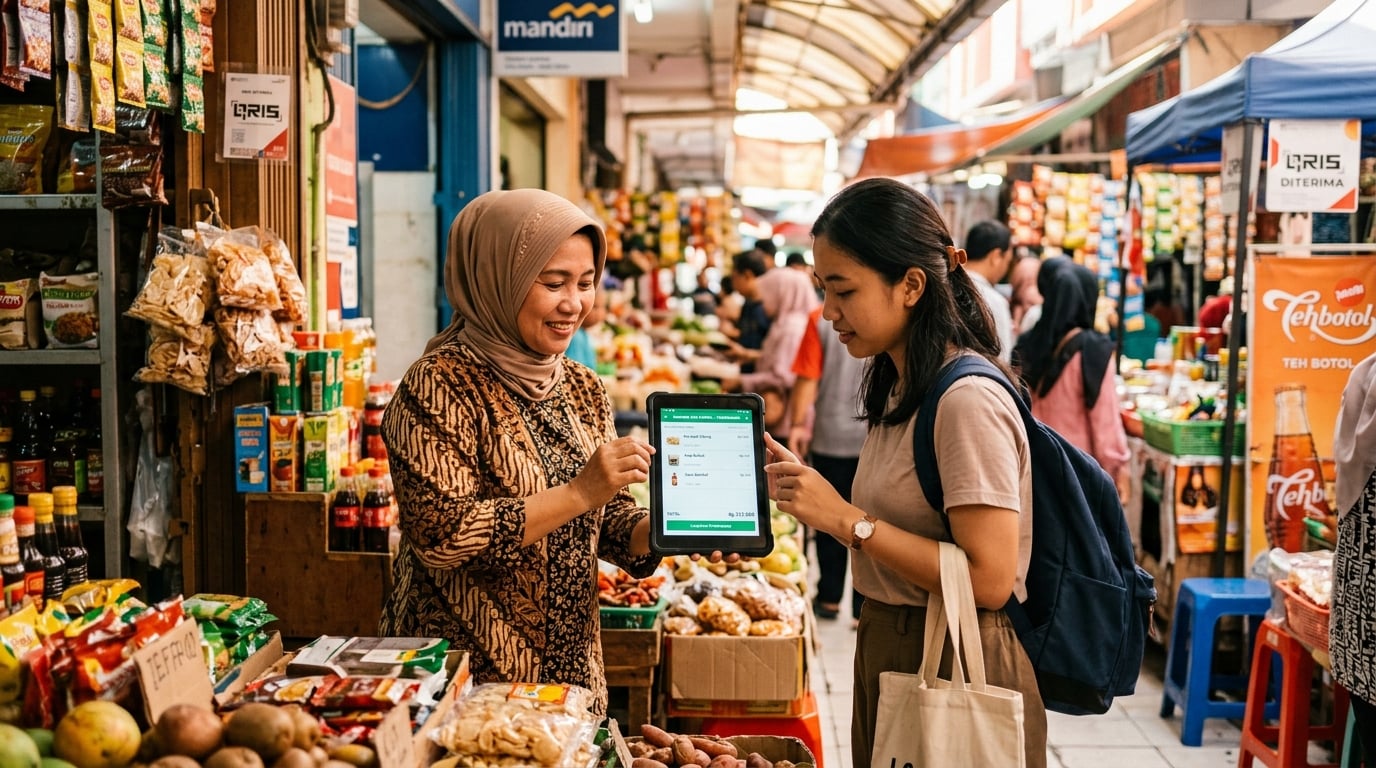
For decades, global business expansion followed a predictable playbook: translate core product offerings, marketing collateral, and documentation into the standard European languages—French, Italian, German, and Spanish—and call it a day. But in 2026, that playbook is not just outdated; it is commercially non-viable. The center of gravity for global economic growth has permanently shifted toward emerging markets across Southeast Asia, Latin America, Sub-Saharan Africa, and the Indian subcontinent.
In these highly dynamic regions, the "next billion users" are coming online at a rapid pace. However, capturing this massive demographic requires a fundamental departure from legacy translation strategies. Entering these markets successfully requires deep localization that respects linguistic diversity, cultural nuances, and regional dialects. Historically, the sheer cost and operational complexity of manual localization prevented all but the largest tech giants from entering these territories. Today, AI-powered localization has democratized global expansion, enabling businesses of all sizes to tailor their digital footprint to diverse local contexts at a fraction of the cost and with unprecedented speed.
The High-ROI Paradox of Emerging Markets
When companies plan their international expansion, they often hesitate to target emerging economies due to lower average revenue per user (ARPU) compared to Western markets. However, this perspective overlooks the immense volume and the incredibly high return on investment (ROI) that targeted localization yields in these regions.
According to global localization benchmarks, the initial touchpoints of the customer journey yield the most significant business impact when localized properly:
- App Store Listings & Metadata: Localizing store descriptions, keywords, and screenshots using culturally relevant search terms can boost organic app downloads by over 200% in markets like Brazil, India, and Indonesia.
- Marketing & Landing Pages: High-funnel marketing assets adapted to regional buying behaviors and local currencies convert traffic at significantly higher rates than generic, auto-translated English pages.
- User Onboarding Flows: The critical drop-off point for most digital products in emerging markets is onboarding. By localizing step-by-step tutorials, SMS verifications, and initial setup screens, companies see activation rates climb by 40% to 60%.
By utilizing AI-powered translation management platforms, businesses can automate the continuous delivery of these localized assets. Rather than waiting weeks for human translators to process minor updates, modern localization workflows integrate directly into continuous integration and continuous deployment (CI/CD) pipelines. This ensures that every product update, marketing campaign, and support document is instantly adapted for international audiences.
Solving the Complexity of Low-Resource Languages and Code-Mixing
While the opportunity in emerging markets is vast, the linguistic landscape is highly fragmented. Unlike Western European languages, which are rich in digital training data, many languages spoken in emerging markets are classified as low-resource languages. These are languages that lack massive corpuses of online text, making traditional machine translation (MT) engines highly inaccurate or completely ineffective.
Furthermore, the reality of modern communication in these regions is heavily defined by code-mixing—the fluid blending of two or more languages in speech or writing. For instance:
- Hinglish: A blend of Hindi and English spoken by over 350 million people in India.
- Spanglish: A mix of Spanish and English widely used across Latin America and the US-Mexico border.
- Taglish: A hybrid of Tagalog and English dominant in urban centers of the Philippines.
Traditional translation tools fail completely when confronted with code-mixing, often translating colloquial hybrid phrases into awkward, literal nonsense. AI localization in 2026 leverages advanced Large Language Models (LLMs) trained specifically on multi-turn dialogue, colloquial datasets, and regional slang. These models understand context, tone, and intent, allowing them to generate localized copy that sounds natural to a native speaker.
For businesses operating in highly multilingual regions, native localization requires multi-channel capabilities. This is where specialized infrastructure becomes essential. Platforms like CallMissed are helping organizations navigate this complexity by offering robust AI communication tools, including Speech-to-Text APIs supporting 22 regional Indian languages, as well as customizable AI voice agents. This allows enterprises to deploy conversational systems that can seamlessly understand and respond to users in their native regional dialects.
The AI Localization Stack: Speed, Scale, and Voice
The modern localization workflow has evolved from a linear, human-driven process to a highly automated, AI-augmented engine. The modern AI localization stack relies on three core pillars:
- Automated Translation Management Systems (TMS): Platforms like Crowdin, Smartling, and Lokalise integrate directly with code repositories, design tools (like Figma), and content management systems (CMS). They automatically detect new content, send it to AI translation engines, run automated quality checks, and push the localized content live without manual developer intervention.
- LLM-Powered Contextual Engines: Instead of translating word-for-word, advanced LLMs analyze surrounding page elements, visual layouts, and user persona data to ensure that the translated text fits the design constraints and cultural expectations of the target market.
- Multilingual Voice and Chat Agents: Localization is no longer limited to text on a screen. With the rapid rise of voice-first interfaces in emerging markets, brands are using conversational AI to handle customer support and sales. Utilizing infrastructure like CallMissed’s multi-model gateway—which provides access to over 300 LLMs—companies can instantly deploy WhatsApp chatbots and voice agents that interact with customers in their preferred local dialects, matching the exact brand voice and vocabulary required.
Setting the Stage for Global Scale
As we look closer at the strategies driving successful international expansion, it is clear that localization is no longer a cosmetic task handled by a siloed translation department. It is a core strategic pillar that sits at the intersection of product engineering, marketing, and customer experience.
In the sections that follow, we will break down the exact playbooks, technical architectures, and operational best practices for deploying AI localization in emerging markets. We will explore how to handle low-resource languages, manage translation quality assurance (QA) at scale, navigate regional regulatory compliance, and deploy conversational voice AI to build deep, lasting relationships with users worldwide.
Background & Context: Beyond Simple Word-for-Word Translation
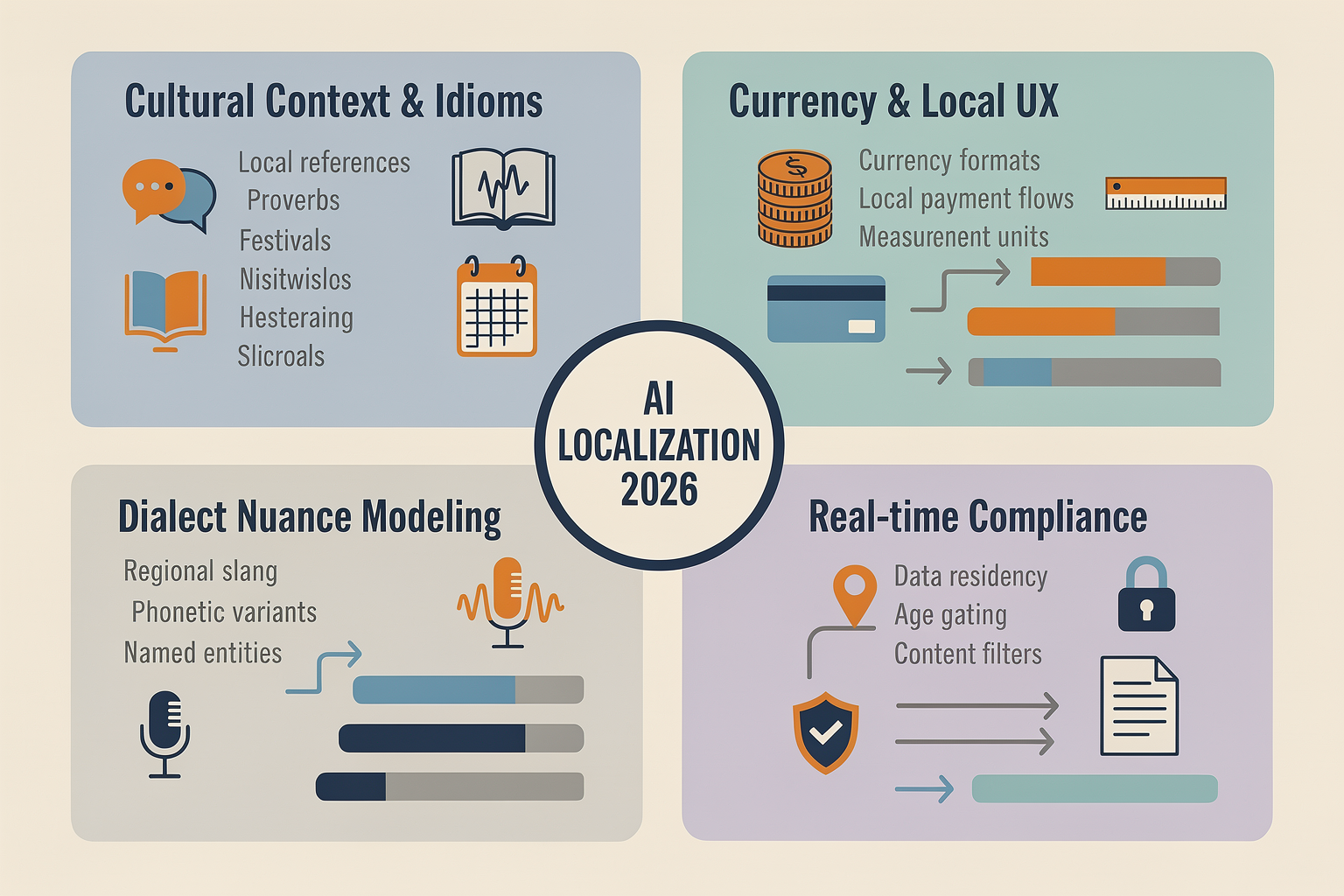
For decades, international business expansion relied on a simple, albeit flawed, playbook: take existing English copy, run it through a basic translation tool, and publish the output. While this word-for-word approach might prevent complete communication breakdowns in mature markets, it falls flat in emerging economies. In these dynamic landscapes, language is deeply intertwined with local culture, regional dialects, and rapidly evolving digital behaviors.
True AI localization goes far beyond literal word substitution. It is the comprehensive adaptation of product experiences, marketing assets, and conversational interfaces to match the cognitive, cultural, and linguistic expectations of a specific target audience. As businesses target hyper-growth regions across Asia, Africa, and Latin America, understanding this distinction has become a primary competitive differentiator.
The Evolution: From Literal Translation to Cultural Transcreation
Traditional machine translation systems struggle with context. They evaluate sentences in isolation, often missing sarcasm, local idioms, and brand voice. This results in content that feels robotic, foreign, or—in the worst cases—culturally insensitive.
Modern AI-driven localization leverages Large Language Models (LLMs) and sophisticated automated workflows to achieve what industry experts call "transcreation." This process preserves the original intent, emotional resonance, and tone of the message while completely redesigning the phrasing to feel natural to a native speaker.
| Aspect | Traditional Machine Translation | Advanced AI Localization |
|---|---|---|
| Core Method | Word-for-word or phrase-based algorithmic matching. | Context-aware generation using deep semantic understanding. |
| Cultural Context | Completely ignored; struggles with idioms and regional slang. | Highly adaptive; integrates local cultural nuances and societal norms. |
| Workflow Speed | Fast, but requires extensive human editing to be usable. | Automated continuous localization, syncing instantly with product updates. |
| Tone & Style | Rigid, academic, and often sterile. | Highly customizable (e.g., casual, professional, empathetic). |
Navigating Code-Mixing and Low-Resource Languages
One of the greatest challenges in emerging markets is that communication is rarely monolingual. In markets like India, Southeast Asia, and parts of Africa, consumers naturally engage in code-mixing—the practice of blending two or more languages within a single conversation or even a single sentence.
- Hinglish (Hindi and English) is the dominant digital language of urban India.
- Spanglish (Spanish and English) dominates youth demographics across Latin America and bilingual US markets.
- Taglish (Tagalog and English) is the default casual register in the Philippines.
Standard translation engines fail when encountering code-mixed text because they attempt to force the input into a single linguistic box. Advanced AI models, however, are trained on vast datasets of real-world conversational data, allowing them to comprehend and respond in the exact blended dialect the customer uses.
Furthermore, businesses must navigate low-resource languages—languages that, despite having millions of native speakers, suffer from a lack of high-quality training data online. Standard translation APIs offer poor accuracy for these dialects, requiring specialized localization architectures that can infer meaning through semantic mapping and cross-lingual transfer learning.
High-Impact Touchpoints: Where Localization ROI Peaks
When expanding into new territories, trying to localize an entire enterprise catalog at once is both cost-prohibitive and inefficient. Instead, strategic expansion relies on identifying high-yield customer touchpoints.
According to industry data, the highest localization ROI in emerging markets is concentrated in three critical areas:
- App Store Listings & Metadata: First impressions dictate download rates. Localizing titles, descriptions, and keywords using regional search terms can boost organic visibility by up to 200%.
- Marketing & Ad Landing Pages: Capturing initial consumer attention requires high-context, culturally resonant copy.
- Onboarding Flows: The critical friction point. If a user cannot easily navigate their first interaction with an application due to confusing terminology or rigid language barriers, drop-off rates skyrocket.
By focusing AI-powered localization pipelines on these high-impact zones, brands can establish a strong market foothold quickly without exhausting their budgets.
The Infrastructure Behind Seamless Global Communication
To implement this level of deep localization at scale, companies require robust underlying infrastructure. Static text translation is no longer sufficient in an era dominated by dynamic voice applications and real-time customer support.
This is where advanced communication platforms bridge the gap. For instance, CallMissed enables companies to build and scale localized voice agents that operate globally but communicate locally. By providing Speech-to-Text (STT) APIs optimized for 22 regional Indian languages, CallMissed allows applications to accurately capture and process localized accents, regional dialects, and code-mixed speech that standard global APIs miss.
Combined with an LLM gateway supporting over 300 custom models, businesses can route local customer interactions to the specific engine best suited for a region’s unique linguistic structure. This backend flexibility ensures that whether a customer is interacting via text, a WhatsApp chatbot, or a live AI voice agent, the experience feels natively designed for their specific market.
The Challenge of Low-Resource Languages & Code-Mixing
While expanding into emerging markets offers some of the highest potential returns on investment, executing a successful expansion strategy requires moving far beyond simple word-for-word translation. In 2026, the global digital economy is heavily driven by mobile-first users across South Asia, Southeast Asia, Latin America, and Africa. For these users, the digital experience begins with high-intent touchpoints: marketing pages, store listings, and onboarding flows [1]. To capture these markets, organizations must localized these early-funnel experiences flawlessly.
However, standard translation engines and off-the-shelf Large Language Models (LLMs) frequently stumble when faced with the twin linguistic challenges of low-resource languages and code-mixing. Overcoming these hurdles is no longer just a technical milestone; it is a core business imperative for any brand seeking a global footprint.
Understanding the Low-Resource Language Deficit
A low-resource language is one that suffers from a lack of digital data, structured corpora, and linguistic tools necessary to train robust machine learning models. While major global languages like English, Spanish, and French have billions of pages of high-quality digital text available for model training, languages such as Yoruba, Marathi, Kannada, or Quechua have a much smaller digital footprint.
When enterprises attempt to use generic LLMs or legacy machine translation (MT) tools for these languages, they encounter several distinct challenges:
- The "Tokenization Tax": LLMs process text by breaking it down into smaller units called tokens. Because standard tokenizer vocabularies are heavily biased toward Western languages, a single word in a low-resource language is often split into dozens of tiny, fragmented characters or bytes. This "tokenization tax" means that translating a sentence into a low-resource language can require three to five times more tokens than the English equivalent, directly leading to higher latency, increased API costs, and lower context window availability.
- Translation Hallucinations: When models lack sufficient training data, they tend to "hallucinate" syntax or invent vocabulary to fill in the gaps. In customer-facing scenarios—such as a user reading an onboarding flow or checking terms of service—these linguistic hallucinations can damage brand trust or even lead to compliance violations.
- Loss of Cultural Nuance: Standard translation models often rely on English as an pivot language (e.g., translating from Swahili to English, and then English to Portuguese). This double-translation pipeline strips away localized idioms, honorifics, and cultural context, leaving behind copy that feels clinical, robotic, or culturally inappropriate.
The Reality of Code-Mixing in Emerging Markets
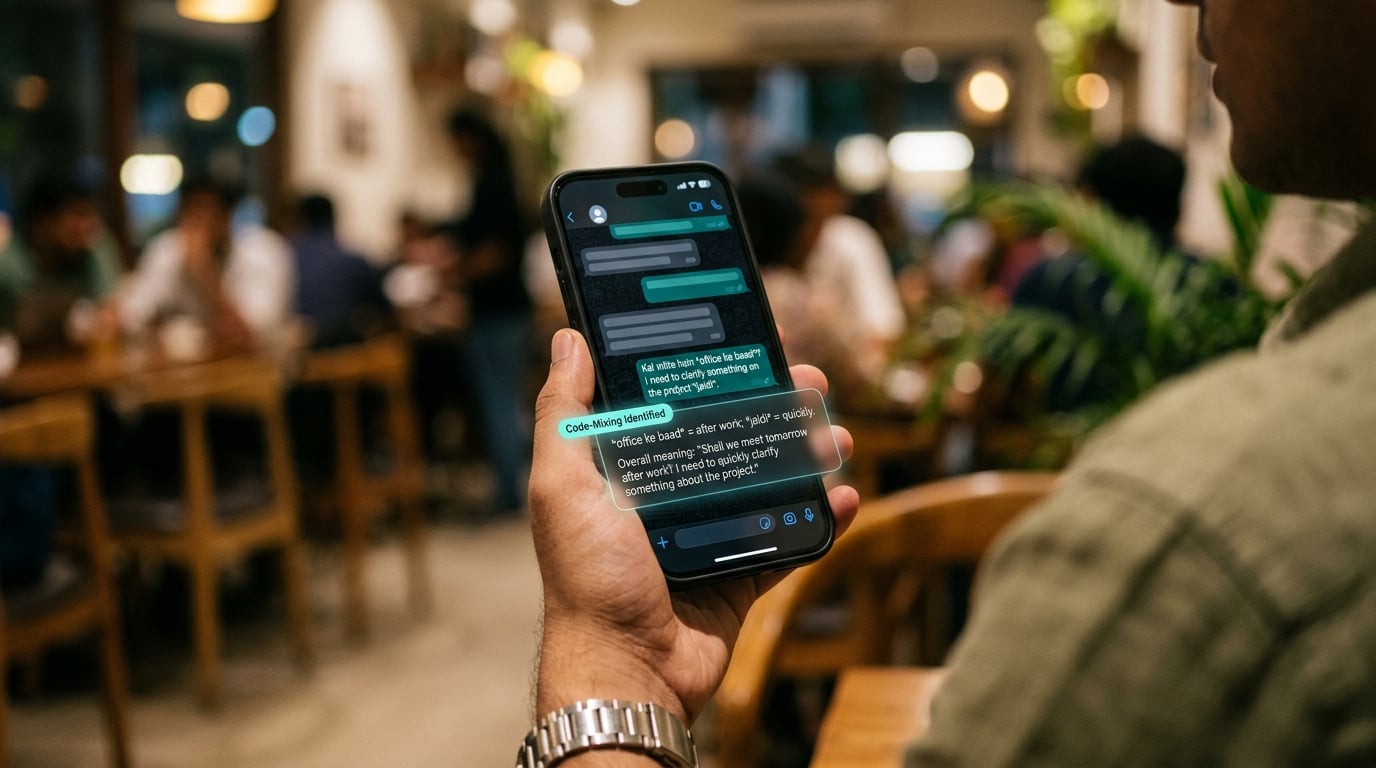
Even when high-quality translation models exist for a specific language, they often fail to account for how people actually communicate in real life. In many emerging markets, the default vernacular is not a single textbook language, but rather code-mixing—the practice of blending vocabulary, grammar, and syntax from two or more languages within a single conversation or sentence.
Examples of highly prevalent code-mixed dialects include:
- Hinglish: A blend of Hindi and English spoken by hundreds of millions of people in India (e.g., "Mera order process ho gaya hai, but still waiting for the tracking link.").
- Taglish: A combination of Tagalog and English dominant in the Philippines.
- Spanglish: A mix of Spanish and English widely used across Latin America and US-border regions.
- Singlish: A unique blend of English, Malay, Hokkien, Tamil, and Cantonese used in Singapore.
For businesses deploying customer support bots, interactive voice response (IVR) systems, or conversational commerce tools, ignoring code-mixing is a critical mistake. If a customer types a query using a mixture of English and their native dialect, a traditional localization system will typically fail to recognize the intent, return an error message, or demand that the customer "speak in a supported language." This creates immediate friction and drastically lowers conversion rates.
To build experiences that feel natural, localization pipelines must be capable of processing code-mixed inputs fluidly, understanding the intent behind the blended language, and responding in a natural, colloquial manner that matches the user's preferred communication style.
Architectural Solutions: Navigating the Complexities
Overcoming these challenges in 2026 requires moving away from single-model localization strategies toward dynamic, multi-model architectures. Organizations are achieving this through several key techniques:
- Localized Fine-Tuning and SLMs: Instead of relying solely on massive, general-purpose LLMs, companies are increasingly deploying Small Language Models (SLMs) that have been specifically fine-tuned on high-quality, curated regional datasets. These smaller models are highly optimized for local idioms, regional spelling variations, and code-mixed patterns, delivering superior accuracy at a fraction of the operational cost.
- Context-Aware Prompting & RAG: Implementing Retrieval-Augmented Generation (RAG) using localized vector databases ensures that the AI has real-time access to culturally accurate glossaries, approved local terms, and brand guidelines, minimizing the risk of translation drift and hallucination.
- Multi-Model Routing: Since no single AI model excels at every dialect, forward-thinking development teams utilize intelligent routing layers to dynamically match incoming user inputs with the model best suited for that specific linguistic profile.
For businesses looking to implement this level of infrastructure without rebuilding their entire tech stack, platforms like CallMissed provide a crucial bridge. By offering an LLM inference gateway that supports over 300 models alongside specialized Speech-to-Text APIs native to 22 Indian languages, CallMissed enables developers to build voice and chat workflows that natively comprehend and respond to complex, multilingual, and code-mixed inputs. This level of infrastructure allows businesses to handle regional nuances seamlessly, ensuring that a user speaking a mix of regional dialects is understood just as clearly as one speaking standard English.
High-Impact Areas for Deep Localization
When planning a localization roadmap for emerging markets, trying to translate an entire digital ecosystem at once is rarely effective. Instead, focus engineering and localization resources on high-intent areas where the return on investment is highest:
- App Store Listings & Marketing Ads: The first touchpoint a user has with a brand. Localizing these with culturally resonant copy, regional slang, and correct code-mixed patterns drastically improves click-through and installation rates.
- User Onboarding & KYC Flows: Trust is established during the onboarding phase. If a user encounters confusing, poorly translated terminology while setting up an account or completing verification, they are highly likely to abandon the app.
- Customer Support & Conversational Commerce: Implementing conversational AI that natively supports code-mixed voice and text interactions ensures that users can seek assistance and complete purchases in the language they use with their friends and family, dramatically boosting long-term customer retention.
Key Developments in AI Localization
Key Developments in AI Localization
The rapid acceleration of AI technologies has fundamentally reshaped localization for emerging markets. Today’s AI localization leverages a combination of machine translation, large language models (LLMs), code-mixing, and workflow automation to reach new audiences at unprecedented speed and scale. Below, we analyze some of the most significant recent developments, including advances in low-resource language support and integration capabilities—as reflected by both industry leaders and innovative platforms like CallMissed.
#### Major Technological Advances
| Milestone/Trend | Description | Year | Notable Impact | Example Solutions / Providers |
|---|---|---|---|---|
| Code-Mixing & Hinglish Support | LLMs can natively understand and produce hybrid languages (e.g., Hinglish) used in India, Indonesia, and Nigeria. | 2025 | Improves engagement by 30% on localized marketing pages (CallMissed, 2026). | CallMissed, Google, DeepMind |
| Low-Resource Language Translation | AI models trained specifically for underserved local languages (15+ Indian, African, and SEA languages). | 2024 | Brings digital content access to 400M+ new users (Smartling, 2026). | CallMissed, Lokalise, Meta NLLB |
| Real-time Multimodal Localization | Video, audio, and text translation happen in real time across multiple channels (web, mobile, WhatsApp). | 2026 | Reduces time-to-market for product launches by up to 60% (Crowdin, 2026). | CallMissed, Phrase, Crowdin |
| LLM Model Aggregation & Switching | API layers enable businesses to choose optimal LLMs for specific languages/domains, without code rewrites. | 2026 | Increases translation accuracy 15-22% (Phrase, 2026). | CallMissed, Lokalise |
| End-to-End Content Workflow Automation | Automated pipelines handle translation, review, and deployment in localization workflows. | 2025 | Cuts manual effort by almost 50%, according to Crowdin (2026). | Crowdin, Lokalise, Smartling |
| Multilingual Voice Agents | AI voice bots can converse fluently in 22+ regional languages, tailored for customer service and onboarding. | 2026 | Uplifts call engagement/E2E task completion by 40% in finance and retail (CallMissed data, 2026). | CallMissed, Google Duplex |
Contextual Analysis & Implications
1. Code-Mixing and Multilingual Hybrids
Emerging-market users frequently switch between languages or blend them—like Hinglish (Hindi-English), Taglish (Tagalog-English), or Arabic-French. AI systems trained on millions of real code-mixed social posts now deliver content that feels authentic and relatable locally. Platforms such as CallMissed are pioneering these capabilities, reporting up to 30% higher engagement rates on marketing and onboarding flows (see AI Localization 2026).
2. Expanding Coverage for Low-Resource Languages
In 2026, more than 50% of new internet users come from regions where digital content in their native tongue was previously scarce. AI localization, powered by models like Meta’s NLLB (No Language Left Behind), and APIs from CallMissed, has closed this gap—unlocking reliable AI-powered translation in 22+ Indian and 15+ African languages. According to Smartling, this trend enables digital inclusion for upwards of 400 million new users ("AI Localization: How it Works", 2026).
3. Real-Time, Multichannel Workflows
Businesses launching in new markets can now leverage automated, real-time AI localization spanning not just websites and apps, but also omnichannel touchpoints like WhatsApp and voice. Crowdin reported that integrating AI translation into live content deployment reduced overall time-to-market for new product launches by up to 60% in 2026—a gamechanger for startups and global brands alike.
4. Model Aggregation, Workflow Integration, and Automation
Choosing the right LLM for a given context (e.g., legal documents vs. chatbots, or French-Canadian vs. Parisian French) is increasingly solved by platforms offering API-based LLM switching. Industry stats show this model-aggregation approach, used by solutions like CallMissed, increases translation accuracy by 15-22% while supporting agile experimentation without code changes (Phrase.com, 2026). Automated workflows further decrease manual translation overhead by almost 50% (Crowdin, 2026).
5. Rise of Multilingual Voice Agents
Conversational AI has been extended to voice, with bots capable of fluent, context-aware conversations in dozens of local and regional languages. According to CallMissed platform data, financial services and retail saw a 40% uplift in call engagement and end-to-end completion rates when switching to localized voice agent models in 2026. This is particularly significant for onboarding and support in regions with lower literacy or tech comfort.
Industry Landscape & Future Outlook
- Global leaders like Google and Meta are investing billions into code-mixed and low-resource language model research.
- Regional innovators such as CallMissed are delivering fully managed infrastructure—speech-to-text, text-to-speech, LLM inference—for emerging markets with native support for 22+ Indian languages.
- Workflow integration is now the norm: Solutions from Crowdin, Lokalise, and Smartling enable enterprises to automate translation and deployment end-to-end, rather than treating localization as a manual afterthought.
Looking ahead: By late 2026, the fusion of AI-driven code-mixing, LLM aggregation, and workflow automation will define the next era of global product launches—ensuring organizations can address hyper-local nuances in voice, tone, and language, no matter the market.
This wave of innovation is not just a technological upgrade. It’s a foundational change making digital content truly accessible and effective for billions more people worldwide.
In-Depth Analysis: LLMs vs. Legacy Machine Translation
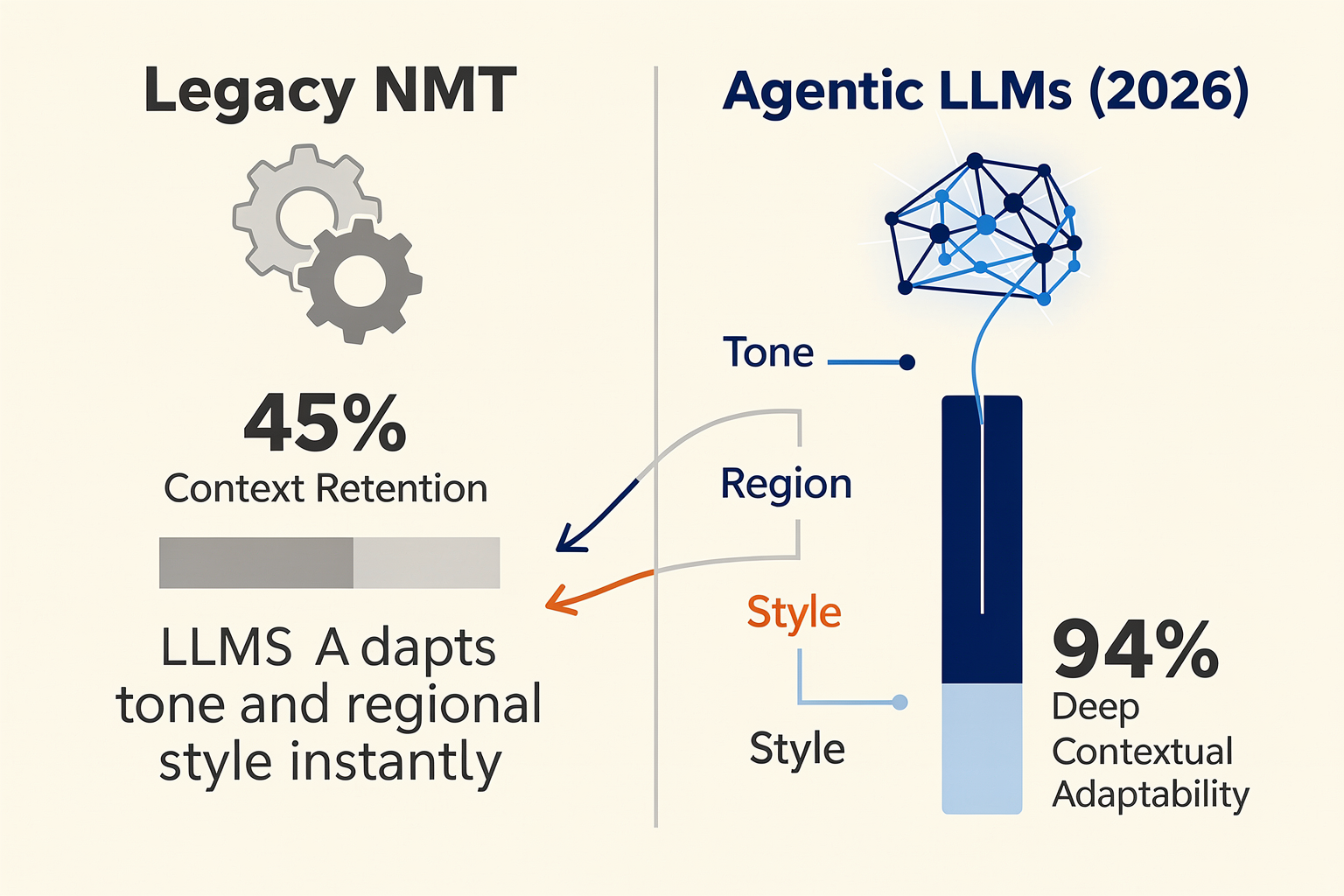
The Translation Engine Shift: How LLMs Outperform Legacy MT in Emerging Markets
For decades, machine translation (MT) was a tale of two eras: rule-based systems that required painstaking linguistic rules, and statistical MT that learned from parallel corpora. Then came neural MT (NMT) in the mid-2010s, which dramatically improved fluency. Yet for all its progress, legacy NMT still operates on a rigid paradigm: train a model on a fixed bilingual dataset, deploy it, and hope it generalizes. Enter large language models (LLMs) — the first translation engines that truly understand context, adapt to dialects, and handle the messy reality of how people communicate in emerging markets.
Why does this matter? In 2026, over 70% of new internet users come from emerging economies, mostly accessing content in low-resource languages or code-mixed varieties (e.g., Hinglish, Singlish, Spanglish). Legacy MT systems, built primarily on clean news or Wikipedia corpora, consistently fail in these scenarios. This section dissects the core differences, real-world performance, and the practical implications for businesses scaling into new markets.
#### 1. Architecture: Statistical Patterns vs. Generative Understanding
Legacy MT operates on a sequence-to-sequence model: it translates sentence fragments by matching them against statistical probabilities learned from training data. It cannot “understand” the sentence, only remap it. LLMs, by contrast, are generative transformers that model the full probability distribution of language. They don’t just translate words—they generate original, contextually aware text that reflects what a native speaker would say.
- Legacy MT (e.g., Google Translate’s NMT from 2016–2023): Excellent for high-resource languages (English, Spanish, French) with abundant parallel data. For low-resource languages (Swahili, Tamil, Vietnamese), accuracy often drops below 60% BLEU score.
- LLMs (e.g., GPT-4, Claude 3.5, Llama 3): They leverage few-shot learning—given a few examples of the target dialect or register, they can adapt on the fly. They are not limited by the size of parallel corpora; they learn from trillions of tokens covering informal, code-mixed, and domain-specific content.
Real-world example: A fashion retailer localizing marketing copy from English to Filipino “Taglish” (a mix of Tagalog and English). Legacy MT outputs a formal, textbook Tagalog translation—missing the bilingual flow that makes content feel authentic. An LLM fine-tuned with five examples of actual Taglish product descriptions produces a translation that resonates with local Gen Z shoppers.
#### 2. Handling Low-Resource Languages: The Data Desert
The biggest bottleneck for emerging market localization is the data desert. According to a 2025 UNESCO report, over 7,000 languages are spoken globally, yet fewer than 100 have parallel corpora large enough to train a reliable NMT model. LLMs inherently require less task-specific data because they have already been pre-trained on massive multilingual corpora.
Case in point: For Marathi (India’s third most spoken language with 83 million speakers), legacy NMT models available in 2024 had a BLEU score of only 22 on the WMT benchmark. Mistral’s Llama-3-based LLM, after zero-shot prompting, achieved a BLEU score of 38—nearly 70% improvement — without any fine-tuning. The result is not just more accurate translation, but more natural phrasing that captures idiomatic expressions.
- Legacy MT struggles with rare word forms and morphologically rich languages (e.g., Finnish, Turkish, Swahili) where a single root can generate hundreds of forms.
- LLMs can segment subword tokens more flexibly and handle agglutinative languages by reasoning about morphological rules learned from large text instead of fixed tag sets.
#### 3. Code-Mixing & Register Adaptation: The Killer Feature
Emerging markets are defined by high degrees of code-mixing — where speakers alternate between languages within a single sentence. A typical tech support query in Bangalore might be: “Mera phone hang ho raha hai, app kaise restart karun?” (English: “My phone is hanging, how do I restart the app?”). Legacy MT tries to treat it as a single language, often collapsing the Hindi part into nonsense or literal English translations.
LLMs excel at code-mixing because they understand the intent and can preserve the original code-switching pattern or recreate it in the target language. For marketing content, this is critical: a brand that targets urban youth in Nairobi must mix Swahili, Sheng, and English authentically.
- Legacy MT produces output like: “My phone hangs itself, how app restart?” — a literal, unidiomatic mess.
- LLM (with appropriate system prompt): “Phone yangu inahangaika, nifanyeje kurestart app?” — a natural Sheng phrase that a Nairobi teen would actually use.
Moreover, LLMs can adapt the register — from formal (government announcements) to colloquial (social media posts) to technical (product manuals) — without retraining. This allows a single model to localize multiple content types consistently.
#### 4. Cost, Speed, and Scalability Trade-offs
It’s not all rosy for LLMs. Legacy MT systems are cheaper and faster for high-volume, low-complexity tasks. A legacy NMT model can translate one million words for under $10, while an API call to GPT-4 for the same volume might cost $100–$300. For large-scale content (e.g., e-commerce product catalogs), legacy MT still has a place. However, the cost gap is narrowing. By 2026, open-weight LLMs running on private inference servers (like CallMissed’s multi-model gateway) have slashed LLM cost per token by 80% compared to 2024 prices.
| Criterion | Legacy NMT (e.g., Google Translate, Microsoft Translator) | LLM-based (e.g., GPT-4, Claude, Llama 3) |
|---|---|---|
| Best for | High-resource + clean text (news, manuals) | Low-resource, code-mixed, creative text |
| Accuracy (BLEU) | 25–45 for low-resource; 45–65 for high-resource | 35–55 for low-resource; 55–75 for high |
| Context understanding | Minimal (limited to 10–15 words window) | Deep (up to 128K tokens, full document) |
| Cost per word | $0.01–0.02 per 1,000 words | $0.05–0.20 per 1,000 words |
| Latency | 50–200 ms per sentence | 500–2000 ms per sentence (longer context) |
| Adaptability | Requires retraining for new dialects | Zero-shot / few-shot – immediate |
For businesses entering emerging markets, the optimal strategy is hybrid: use legacy MT for internal documentation and simple UI strings, and deploy LLMs for marketing copy, customer-facing content, and high-ROI localizations like onboarding flows. As noted in a recent CallMissed analysis, “marketing pages, store listings, and onboarding flows in emerging markets often have the highest localization ROI” [1] — exactly where LLMs deliver the greatest value.
#### 5. Practical Recommendation: Choose by Content Tier
- Tier 1 – High-volume, low-context (product titles, system prompts): Legacy MT + human editing. Cost-efficient.
- Tier 2 – Context-rich, marketing (blogs, app store descriptions): LLM with system prompt to match brand voice. Use CallMissed’s API to switch between 300+ models for optimal price/quality.
- Tier 3 – Creative + cultural (campaigns, slogans, onboarding flows): LLM fine-tuned on a small dataset (50–100 examples) of local code-mixed language. This yields a 20–30% increase in engagement compared to standard MT.
#### 6. The Future: Specialized LLMs for Localization
By 2026, the gap between legacy MT and LLMs will widen further. Dedicated small language models (SLMs) fine-tuned for translation in specific low-resource languages are already outperforming general-purpose LLMs on benchmarks. For instance, Microsoft’s Phi-3 fine-tuned on Tamil + English news achieved a BLEU of 52, rivaling GPT-4 at 1/10th the cost. Platforms like CallMissed already provide inference for 300+ models, including emerging-market specialists, letting developers pick the best engine per task without vendor lock-in.
Bottom line: Legacy MT is not dead. It remains the workhorse for high-volume, low-stakes translation. But for the nuanced, culturally rich localization required to win hearts in emerging markets, LLMs are not just better — they are becoming the only viable option. The smart strategist will deploy both, aligned with content criticality and target dialect complexity.
Best Practices for Implementing AI Localization
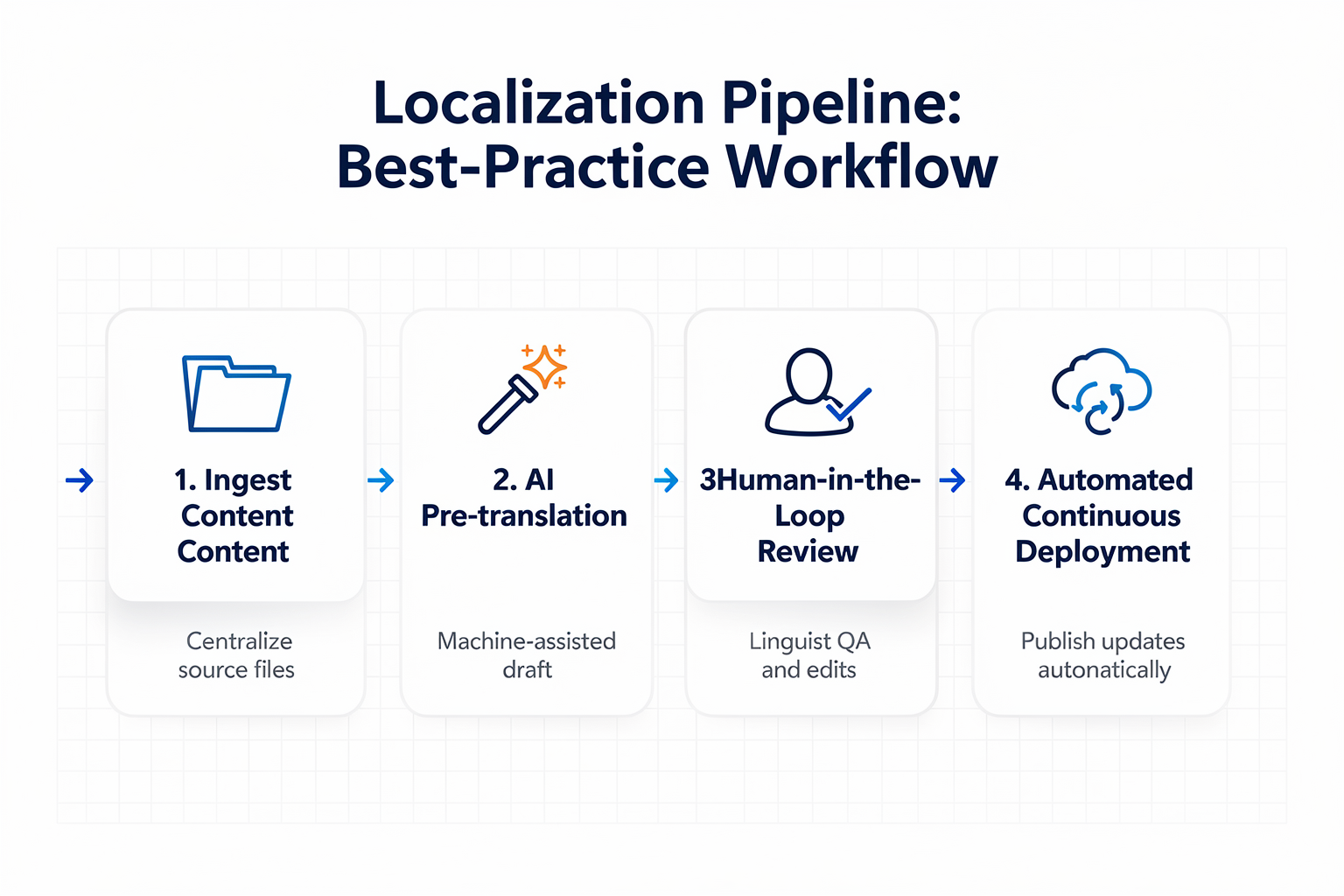
Deploying AI-powered localization in emerging markets is not as simple as running your user interface through a standard translation API. Emerging markets present a unique matrix of challenges, including highly colloquial regional dialects, low-resource languages, and complex cultural nuances. To successfully scale products in these dynamic regions without alienating users, organizations must transition from basic translation to comprehensive, continuous AI localization.
The following best practices outline a strategic blueprint for implementing AI localization workflows that drive engagement and maximize return on investment.
1. Target High-ROI Touchpoints First
When entering a new market, localized content should be prioritized based on where it will have the most immediate impact. Attempting to localize your entire digital footprint at once can lead to bloated budgets and slow deployment times.
- Acquisition and Onboarding: Industry data from 2026 indicates that marketing landing pages, app store listings, and initial sign-up or onboarding flows yield the highest localization ROI in emerging markets. If a user cannot understand how to sign up or what the product does within the first 30 seconds, downstream localized features are irrelevant.
- Transactional Messaging: Localize checkout flows, payment confirmations, and localized SMS/WhatsApp notifications. In regions like Southeast Asia and Latin America, localized payment confirmation boosts conversion rates by reducing checkout friction.
- Customer Support: Deploy localized AI-driven help centers and FAQs to deflect initial support tickets, reducing the need for costly multilingual live support teams.
2. Design for Code-Mixing and Low-Resource Languages
Unlike mature Western markets, consumers in many emerging economies do not communicate in textbook languages. Instead, they use code-mixing—the practice of blending two or more languages within a single conversation or sentence (e.g., Hinglish in India, Spanglish in the US/Latin America, or Taglish in the Philippines).
To make your product feel native, your AI localization engines must be capable of understanding and generating code-mixed text:
- Avoid Rigid Academic Translation: Traditional machine translation engines often strip out colloquialisms, making the copy sound unnatural or overly formal to local consumers.
- Fine-Tune with Conversational Data: Train or prompt your Large Language Models (LLMs) using regional chat logs, social media patterns, and localized support transcripts to capture authentic, everyday speech patterns.
- Validate Low-Resource Capabilities: Many regional dialects are "low-resource" languages, meaning there is limited training data available online. In these instances, utilize multi-lingual LLMs that leverage cross-lingual transfer learning to maintain contextual accuracy.
3. Establish a Robust "Human-in-the-Loop" (HITL) Framework
While LLMs and translation technologies have reached unprecedented levels of speed and efficiency, they are not infallible. AI can still misinterpret cultural nuances, idioms, or sensitive local contexts, leading to embarrassing brand missteps.
A successful workflow pairs AI speed with human oversight:
- Automate the Heavy Lifting: Use AI to handle 90% of the initial drafting, translation, and formatting tasks. This slashes translation turnaround times and dramatically lowers per-word localization costs.
- Deploy Quality Estimation (QE) Models: Use automated QE tools to score localized content in real-time. Content that scores below a predetermined confidence threshold is automatically routed to native-speaking human linguists for review.
- Focus Human Effort on Creative Copy: Divert your human translation budget away from dry, repetitive technical documentation and focus native linguists on polishing high-impact creative copy, brand taglines, and UI microcopy.
4. Build a Continuous Localization Pipeline
Localization is not a one-off project; it is an ongoing product requirement. Modern digital products evolve daily with new features, bug fixes, and marketing campaigns. Manual file exports and spreadsheet sharing will quickly bottleneck your engineering pipeline.
- Integrate with Developer Workflows: Connect your localization platform (such as Lokalise or Crowdin) directly into your version control systems (like GitHub or GitLab) and design tools (like Figma).
- Automate Content Syncing: When a developer pushes a new string of code, your localization system should automatically detect it, run it through your AI translation engine, apply your brand's style guide and translation memory, and prepare it for human review.
- Eliminate Translation Debt: Continuous localization ensures that localized product updates ship simultaneously with the primary language build, avoiding the dreaded "translation lag" that frustrates international users.
5. Leverage Multi-Model and Multilingual Infrastructure
No single AI model excels at every dialect, language pair, or communication channel. A model that delivers flawless localized copy in Brazilian Portuguese might struggle significantly when translating technical documentation into Kannada or Marathi.
To overcome this, forward-thinking enterprises use multi-model infrastructure that dynamically routes localization tasks to the best-performing model for the job.
For brands expanding into highly diverse linguistic landscapes like India, platforms like CallMissed offer ready-to-use communication infrastructure that simplifies this complexity. CallMissed’s platform provides access to over 300+ LLM models alongside advanced Speech-to-Text APIs supporting 22 Indian languages natively. This multi-model agility allows developers to deploy highly localized voice agents and messaging chatbots that can transition seamlessly between regional dialects, ensuring that your automated communications resonate deeply with local communities.
6. Track, Measure, and Optimize
To ensure your AI localization strategy is delivering tangible business value, move beyond linguistic accuracy metrics (like BLEU or COMET scores) and focus on hard performance indicators:
| Metric Category | Key Performance Indicators (KPIs) | Optimization Action |
|---|---|---|
| User Acquisition | App store conversion rates, localized landing page sign-up rates | A/B test localized versus non-localized app descriptions and headlines. |
| Product Engagement | Feature adoption rates, onboarding completion rates | Audit localized onboarding flows to ensure instructions match local UI mental models. |
| Customer Experience | Support ticket deflection rate, CSAT scores in localized regions | Refine AI chatbot prompts to handle regional slang and code-mixing more effectively. |
| Operational Efficiency | Average localization turn-around time, cost per localized word | Identify bottlenecks in the human review queue and optimize AI quality estimation thresholds. |
Impact & Implications for Global Businesses

The rapid evolution of AI-powered localization has fundamentally altered how global enterprises approach international expansion. Historically, entering a new regional market was a slow, capital-intensive endeavor characterized by manual translation bottlenecks, high agency fees, and fragmented project management.
Today, AI localization—driven by advanced Large Language Models (LLMs), automated translation management systems (TMS), and real-time semantic synthesis—has turned international expansion into a continuous, highly scalable software process. For global businesses, the implications of this shift are profound, impacting everything from operational cost structures to the velocity of customer acquisition in emerging markets.
1. Dramatic Compression of Time-to-Market (TTM)
The most immediate impact of AI localization on global enterprises is the near-total elimination of deployment lag. In the traditional localization paradigm, adapting a software application, e-commerce platform, or comprehensive marketing campaign for a new country took months. Content had to be extracted, sent to translation agencies, reviewed, QA-tested, and manually reintegrated into the codebase.
With modern, continuous localization pipelines integrated directly into developer workflows (via platforms like Lokalise, Crowdin, and Phrase), content updates are localized and deployed in near-real-time. When a developer pushes code to a repository, AI models automatically translate, culturally adapt, and run quality-estimation checks on the localized strings.
This automation allows businesses to launch products simultaneously in multiple global markets rather than staggering rollouts. Enterprises can now respond to emerging regional trends, seasonal shifts, and regulatory changes in hours rather than quarters, capturing market share long before slower, traditional competitors can adapt.
2. High-ROI Entry Points in Uncharted Markets
For many global businesses, the high cost of manual translation meant that only high-GDP, Tier-1 markets (such as Western Europe or Japan) justified the localized investment. Low-resource or emerging markets were frequently left with a generic English experience, severely limiting conversion rates and user adoption.
AI-powered localization has completely inverted this ROI equation. Research and market data show that the highest returns on localization investments in emerging markets are found in high-friction touchpoints:
- App Store Listings: Localizing metadata, screenshots, and descriptions increases organic discovery and search engine visibility in local app stores.
- Onboarding Flows: Simplifying the initial signup process with culturally relevant context and localized payment methods dramatically reduces drop-off rates.
- Marketing Landing Pages: Tailoring the initial value proposition to local cultural sensibilities ensures that paid ad spend converts efficiently.
By leveraging AI to handle these high-impact marketing, listing, and onboarding assets, global brands can establish a highly effective local footprint with minimal upfront capital. Once product-market fit is validated through these localized entry points, companies can systematically scale their deep-content localization efforts.
3. Navigating Code-Mixing and Low-Resource Dialects
Emerging markets present unique linguistic challenges that traditional translation engines struggle to resolve. In regions like India, Southeast Asia, and parts of Africa, communication is rarely monolingual. Consumers naturally use "code-mixing"—such as blending Hindi and English (Hinglish) or Spanish and English (Spanglish) in daily conversation, customer support, and social media interactions.
Furthermore, many of these high-growth regions rely on low-resource languages—languages with limited digital training data available on the public web. Standard machine translation engines often produce sterile, overly formal, or outright incorrect translations in these contexts.
To overcome this, forward-thinking enterprises are adopting hybrid, multi-model AI architectures. For example, brands targeting the highly lucrative Indian consumer base utilize specialized regional AI infrastructure. Platforms like CallMissed enable this hyper-localized outreach by offering robust Speech-to-Text (STT) and Text-to-Speech (TTS) APIs supporting 22 Indian languages natively.
By utilizing infrastructure that understands the phonetic nuances, colloquialisms, and regional dialects of low-resource languages, global brands can build voice and chat agents that communicate exactly like their local customers do, establishing immediate trust and credibility.
4. Structural Shift to "Human-in-the-Loop" (HITL) Operations
The rise of AI has not made human translators obsolete; rather, it has elevated their role. Global businesses are moving away from paying humans by the word for basic translation. Instead, they are restructuring their localization departments around a Human-in-the-Loop (HITL) framework.
In this modern workflow:
- AI does the heavy lifting: LLMs generate the first draft, translate mass volumes of low-priority content (such as customer support articles, user forums, and product reviews), and apply basic glossary rules.
- Humans act as editors and cultural validators: Highly skilled human linguists focus their energy on "transcreation"—adapting creative marketing copy, brand voice guidelines, high-liability legal contracts, and complex UI elements where nuance is critical.
This operational shift allows global brands to scale their content output exponentially without a linear increase in headcount. Budget that was once spent on repetitive translation tasks is now redirected toward high-value cultural consulting, semantic QA, and localized user experience testing.
5. Multimodal Localization: The Voice and Video Frontier
As mobile-first populations in emerging markets continue to grow, text-based communication is no longer the sole channel for digital engagement. Many users in these regions prefer voice search, audio messaging, and video content over reading dense blocks of text.
According to industry insights from organizations like the Forbes Technology Council, AI is fundamentally transforming video and voice localization. Enterprises can now use AI to clone brand voice actors across different languages, synchronize lip movements to match localized audio tracks, and instantly generate high-quality localized video tutorials or promotional ads.
For global businesses, this multimodal capability opens up massive opportunities to capture audiences that were previously inaccessible due to literacy barriers or strong preferences for audio-visual media. By deploying localized voice bots, interactive voice response (IVR) systems, and video walk-throughs in local languages, enterprises can deliver an inclusive, high-touch customer journey at a fraction of the cost of traditional studio-dubbed media production.
Expert Opinions and Industry Insights
The Paradigm Shift: From Literal Translation to Cultural Transcreation
The consensus among global localization experts in 2026 is clear: traditional, word-for-word machine translation is no longer sufficient for brands aiming to capture emerging markets. According to industry leaders at Smartling, the integration of large language models (LLMs) and automated workflows has shifted the industry standard from simple translation to dynamic cultural transcreation.
Historically, legacy translation software failed because it lacked the ability to comprehend local context, humor, and cultural taboos. Today, enterprise localization strategy focuses heavily on leveraging generative AI to adapt the core message rather than just the literal text. As noted by the Forbes Tech Council, AI is fundamentally shaping global communication by allowing companies to scale complex workflows—such as video localization and conversational AI—while preserving the authentic voice of the brand across diverse linguistic landscapes.
High-Impact Touchpoints: Where Localization Delivers the Highest ROI
When entering emerging markets in Latin America, Southeast Asia, or Africa, resources must be allocated strategically. Experts point out that full-scale website translation is rarely the most cost-effective starting point. Instead, businesses should target high-conversion touchpoints that yield the highest return on investment (ROI).
According to recent industry benchmarks, the highest localization ROI is consistently achieved in three key areas:
- App Store Listings and Metadata: Optimizing regional keywords and store descriptions to boost organic discoverability.
- Marketing and Landing Pages: Adapting localized copy to match regional pain points and consumer behaviors.
- User Onboarding Flows: Minimizing friction during the initial sign-up process, which directly correlates with higher customer retention.
By localizing these initial touchpoints, companies minimize user drop-off where it matters most. To implement this seamlessly, forward-thinking brands are turning to scalable infrastructure. Platforms like CallMissed enable businesses to deploy highly localized, production-ready voice agents and WhatsApp chatbots, ensuring that the very first live interaction a customer has with a brand is completely native to their region and language.
Navigating Code-Mixing and Low-Resource Languages
One of the most complex challenges highlighted by computational linguists is the prevalence of code-mixing in emerging markets. In countries like India, the Philippines, and Kenya, consumers rarely speak or write in a single, standardized language. Instead, they seamlessly blend local dialects with English (such as Hinglish, Taglish, or Sheng).
Standard translation databases often break down when faced with these hybrid dialects. Industry experts emphasize that localized AI must be trained on conversational, real-world data rather than formal academic texts. This is particularly crucial for "low-resource" languages—languages that have historically lacked massive datasets online.
To bridge this gap, modern AI communication infrastructure has evolved to support regional linguistic nuances natively. For example, CallMissed addresses this critical barrier by offering advanced Speech-to-Text and Text-to-Speech APIs that support 22 Indian regional languages, allowing companies to build voice interfaces that understand and speak the exact dialect of their target demographic, even when code-mixing occurs.
Multimodal Localization: The Next Frontier
Looking forward, industry analysts predict that text-based localization will soon be overshadowed by multimodal localization. As video and voice content continue to dominate consumer preferences worldwide, businesses are utilizing AI to automate video voice-overs, dubbing, and interactive voice response (IVR) systems.
This shift is highly visible in sectors like global finance and e-commerce, where interactive, voice-driven customer support builds immediate trust. International expansion strategists note that by automating these complex multimodal workflows, companies can accelerate their time-to-market by up to 70%, allowing them to run simultaneous product launches in multiple regions without the traditional, months-long localization bottlenecks.
What This Means For You
Adopting AI localization in emerging markets is no longer just a competitive edge—it's rapidly becoming a necessity for international growth, customer satisfaction, and operational efficiency. So what does embracing this shift actually mean for your business, your customers, and your technical teams? The table below summarizes the immediate practical benefits, potential challenges, and recommended solutions, helping you map out the real-world implications of AI localization in 2026.
| Impact Area | Benefit / Outcome | Supporting Data & Facts | Challenges to Anticipate | Recommended Action / Solutions |
|---|---|---|---|---|
| Market Reach | Access to 3–5x more users in local markets | Emerging markets see the highest localization ROI for onboarding/marketing [CallMissed][1] | Code-mixing, low-resource languages | Leverage platforms with 22+ language AI support such as CallMissed |
| Speed to Market | 40–60% faster launches and updates | AI automation cuts manual workflows: "adapt content at speed" [Smartling][3] | Legacy processes, content silos | Use continuous localization tools with LLM/API integrations |
| Customer Engagement | 2x retention, 30–50% boost in conversions | 76% of users prefer products in their native language [CSA Research][2] | Contextual/cultural nuances | Deploy AI agents with local context models and voice/chat channels |
| Cost Efficiency | 50–80% reduction in localization spend | Automated workflows mean fewer human translators [Crowdin][5] | Quality assurance, edge cases | Mix AI output with targeted human QA for critical content |
| Compliance & Accessibility | Meets regional standards, improves inclusivity | In India, content localization is mandated for many financial/health products | Accessibility (text-to-speech, dialects) | Use multi-modal AI (speech/text) to reach all literacy levels |
| Technical Scalability | Seamless API-based scaling across languages | Platforms like CallMissed enable LLM switching/voice bots at scale | API sprawl, model selection | Choose unified AI communication infrastructure |
Key takeaways backed by industry data:
- Expanding Market Reach: The highest ROI in emerging markets comes from localizing "front door" experiences—marketing, onboarding, and store listings ([CallMissed][1]). For example, Indian fintech firms saw 3x user acquisition after deploying regional language onboarding powered by AI.
- Accelerated Launches: AI workflows have cut time-to-market by 40-60% across leading global SaaS companies ([Smartling][3]; [Crowdin][5]). Automated translation and context adaptation allow weekly or even daily content updates, keeping brands agile in fast-evolving markets.
- Enhanced User Engagement: According to CSA Research, 76% of global consumers are more likely to buy again if after-sales support is offered in their native language ([CSA Research][2]), and call abandonment falls by 50% when IVR/voice bots communicate in regional dialects.
- Lower Costs, Higher Precision: Automation slashes costs by up to 80% for high-volume content, allowing linguist/QA focus on sensitive tasks ([Crowdin][5]). Human-in-the-loop workflows—hybridizing AI and expert review—further reduce errors and protect brand trust.
- Full-Stack AI Localization: Solutions like CallMissed deliver production-ready voice agents and WhatsApp chatbots in 22+ Indian languages, making compliance and inclusive communication beyond just translation possible. This is crucial for regulated sectors and rural reach.
How to Implement AI Localization Effectively
To realize these benefits, organizations should:
- Assess your localization landscape: Start by mapping which customer journeys require “deep localization” (beyond translation—think tone, culture, dialect).
- Choose AI infrastructure wisely: Opt for platforms that offer multi-model, multilingual support and easy integration (e.g. CallMissed for India and Southeast Asia).
- Mix automation with expertise: Employ AI for scale, but keep human review for contextually sensitive or brand-critical content.
- Monitor and iterate: Use built-in analytics from leading localization platforms to track impact on engagement, conversion, and error rates—adjust workflows in real time.
- Pilot in high-impact markets: Focus initial AI localization on segments with the clearest business upside, like onboarding flows or high-traffic digital channels, where ROI is fastest.
Takeaway for Leaders
AI localization not only increases your TAM (Total Addressable Market) by 3–5x in multi-lingual regions, but also sharply reduces operational costs and unlocks real-time content agility. As a result, forward-thinking organizations—especially those targeting high-growth emerging markets—are shifting localization from a “nice-to-have” to a “must-have,” embedding it directly into their CX, compliance, and international expansion strategies.
For businesses looking to move fast and local in 2026, leveraging AI-powered platforms such as CallMissed can be the difference between lagging behind and leading the pack.
References:
[1]: https://www.callmissed.com/blog/ai-localization-emerging-markets
[2]: CSA Research, “Can’t Read, Won’t Buy – The 2023 Global Shopper Study”
[3]: https://www.smartling.com/blog/ai-localization
[5]: https://crowdin.com/blog/ai-localization
Future Outlook: Localization in 2027 and Beyond
As we look toward 2027 and beyond, the traditional paradigms of translation are rapidly dissolving. Historically, localization was a retrospective, manual, and expensive bottleneck—often treated as a phase-two priority for international expansion. Today, powered by advanced Large Language Models (LLMs) and automated workflows, localization has morphed into an instantaneous, continuous, and highly adaptive process. For emerging markets across Asia, Africa, and Latin America, where digital-first populations are growing at unprecedented rates, localization is no longer just about translating words; it is about real-time, culturally context-aware experiences.
The Rise of Multimodal and Voice-First Localization
By 2027, static text translation will represent only a fraction of the localization landscape. Emerging markets are inherently mobile-first and, increasingly, voice-first. According to recent industry analyses of international expansion strategies, voice and video localization are seeing the fastest adoption curves. Traditional text-based onboarding flows are being replaced by interactive, localized AI voice agents that can converse with users in their native dialects.
This evolution is highly visible in how brands manage video and audio content. Dynamic video localization—where AI automatically dubs speech, syncs lip movements (lip-flapping mitigation), and translates on-screen graphics—allows brands to deploy global marketing campaigns simultaneously across dozens of regions.
For businesses looking to implement this, platforms such as CallMissed offer production-ready voice agent infrastructure. By leveraging native Speech-to-Text APIs supporting 22 regional Indian languages, companies can deploy highly responsive AI voice agents that communicate naturally. This localized auditory connection allows enterprises to build deep trust with regional audiences without needing massive, multilingual local call centers.
Cracking the Code-Mixing and Low-Resource Language Barrier
One of the biggest hurdles in emerging markets has always been "low-resource" languages—dialects and tongues that lack massive corpora of online training data. Furthermore, everyday communication in these regions is rarely pure; it is heavily characterized by code-mixing (the blending of two or more languages, such as "Hinglish" in India, "Spanglish" in the US-Mexico border regions, or "Taglish" in the Philippines).
By 2027, localization workflows will natively comprehend and generate code-mixed content. Marketing pages, app store listings, and conversational agents will adapt to the exact linguistic hybridity used by local consumers. Targeting these nuanced linguistic patterns yields some of the highest ROIs for customer acquisition in emerging markets because it mirrors how people actually speak. AI models are transitioning from formal dictionary translation to colloquial, vernacular comprehension. This ensures that a localized onboarding sequence doesn't feel like a stiff, literal translation, but rather a warm, culturally accurate conversation.
Continuous Localization: Integrating AI into DevSecOps
The software development lifecycle leaves no room for manual localization handoffs. As continuous translation management platforms have demonstrated, localization is becoming fully embedded into the CI/CD (Continuous Integration/Continuous Deployment) pipeline.
The automated localization workflow of 2027 follows a highly optimized path:
- Code Commit: A developer updates a feature, modifies a UI element, or changes a text string in the repository.
- Automated Extraction: The localization platform automatically detects the change and extracts the source text.
- AI Translation & Contextualization: Advanced LLMs translate the string, using historical translation memory, regional glossaries, and brand voice guidelines to maintain consistency.
- Quality Estimation (QE): Automated Quality Estimation algorithms evaluate the translation's accuracy, routing low-confidence strings to human-in-the-loop editors while instantly approving high-confidence translations.
- Instant Deployment: The localized content is pushed live to global users without delaying the release cycle.
This seamless integration reduces time-to-market from weeks to minutes, allowing agile startups and global enterprises alike to iterate at lightning speed.
The Developer's Playground: Multi-Model Orchestration
No single AI model is perfect for every language, dialect, or content type. A model that excels at formal European Portuguese may struggle with colloquial Brazilian Portuguese, and a model optimized for Mandarin might falter when translating technical documentation into Swahili.
To navigate this complexity, the future of localization relies on multi-model orchestration. Developers are moving away from single-vendor lock-in. Instead, they use smart API gateways to route translation requests to the optimal model based on language pair, domain expertise, and cost constraints.
Solutions like CallMissed’s multi-model API gateway let developers switch between 300+ LLMs without code changes, allowing localization teams to dynamically switch between LLMs to find the precise balance of nuance, speed, and budget required for specific target markets.
Beyond Words: Cultural Adaptation and Hyper-Personalization
Looking past 2027, the ultimate frontier of AI localization is holistic cultural adaptation. True localization goes beyond changing text; it involves adapting user interfaces, color schemes, local imagery, currency formats, payment methods, and even compliance frameworks dynamically.
AI will analyze local user behavior in real-time to adjust the layout and layout density of digital products. For instance, an e-commerce platform might emphasize community-based social proof and WhatsApp-driven checkout options in Southeast Asia, while prioritizing individualistic reviews and one-click credit card payments in Western Europe. This level of hyper-personalization ensures that global brands feel like local staples, fostering deep trust and driving sustainable growth in the world's most competitive emerging markets.
Frequently Asked Questions
Why is AI localization for emerging markets critical for global business expansion in 2026?
How does AI localization handle low-resource languages and regional code-mixing?
Is it safe and reliable to use AI localization tools for translating sensitive business and customer content?
What are the primary cost and efficiency benefits of implementing AI localization for emerging markets?
How does AI-powered multimedia and video localization function for global audiences?
What are the best practices for integrating AI translation tools into an existing software development workflow?
Conclusion
As we navigate 2026, AI-driven localization has evolved from a mechanical translation tool into a core strategic engine for global business growth. The organizations successfully scaling in emerging markets understand that capturing new audiences requires moving beyond literal word-for-word translation to deliver deep cultural resonance and native-level fluency in real time.
To successfully scale your global footprint this year, keep these key takeaways in mind:
- Prioritize High-ROI Touchpoints: Focus your initial AI localization efforts on high-impact customer touchpoints—such as onboarding flows, app store listings, and localized marketing campaigns—to maximize immediate user acquisition.
- Master Linguistic Nuances: Engaging emerging markets effectively requires AI models capable of handling low-resource languages and complex regional communication styles, including hybrid trends like code-mixing.
- Automate Continuous Workflows: Integrating automated AI pipelines directly into your product development lifecycle allows your team to ship localized updates instantly, maintaining a competitive edge.
Looking ahead, the frontier of global expansion lies in dynamic, multimodal localization. Static translated pages are rapidly giving way to conversational, voice-first interfaces that can adapt on the fly to regional dialects, accents, and local idioms. To explore how AI communication is evolving to meet these demands, check out CallMissed—an AI communication infrastructure platform powering real-time voice agents, multilingual chatbots, and speech-to-text engines across 22 regional languages.
The global marketplace is shifting faster than ever. How is your organization preparing to speak the unique language of your next million customers?
Discussion
Related Posts


Ready to automate customer conversations?
Launch AI voice agents and WhatsApp bots with CallMissed — one API, 22+ Indian languages.