
Agentic AI Governance: Why Indian Enterprises Need a New Control Model


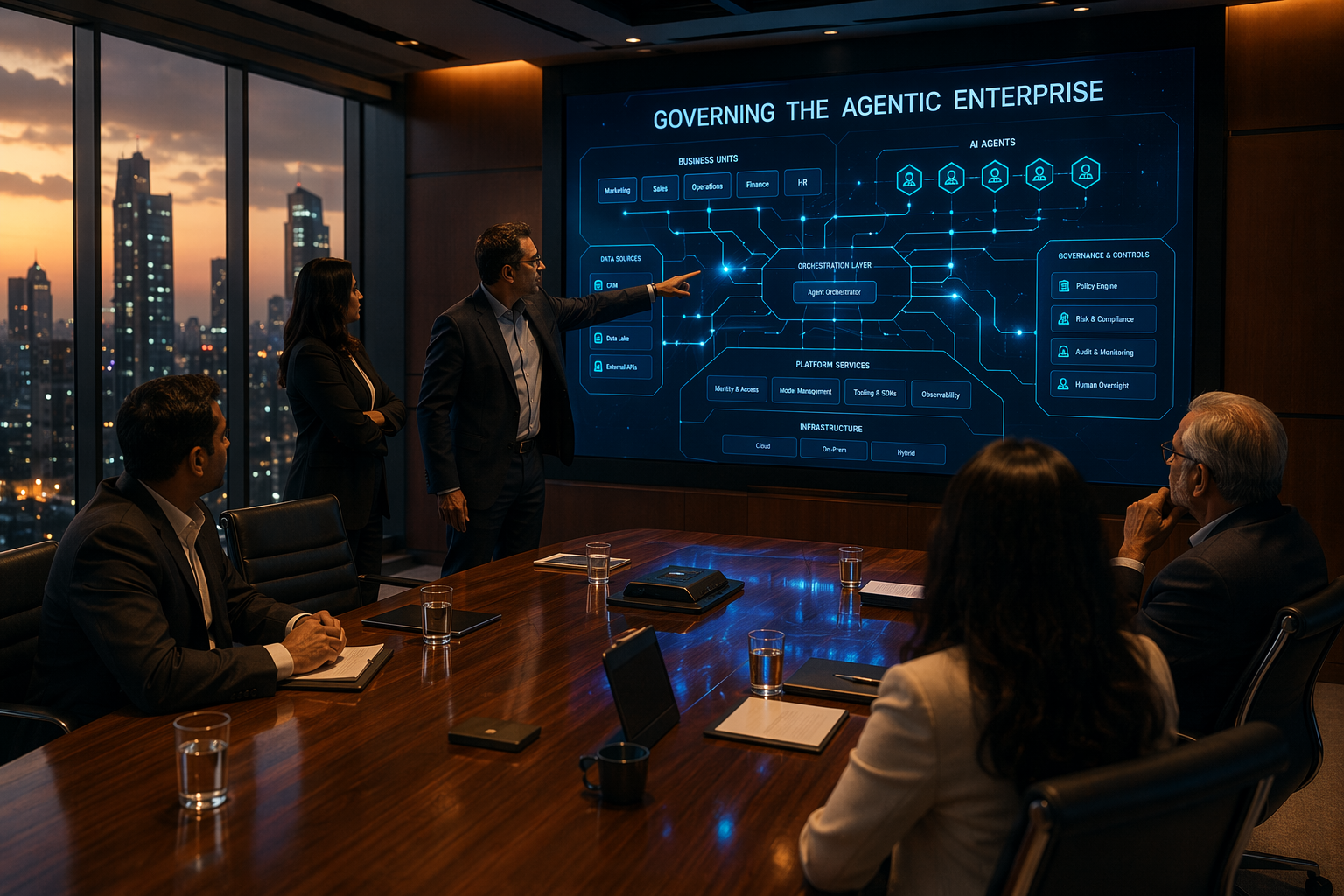
What if the AI systems we built to assist our employees began making independent financial decisions, negotiating client contracts, and modifying database...
Agentic AI Governance: Why Indian Enterprises Need a New Control Model
What if the AI systems we built to assist our employees began making independent financial decisions, negotiating client contracts, and modifying database schemas without human intervention? In 2026, this is no longer a sci-fi thought experiment—it is the operational reality of Agentic AI. As Indian enterprises rapidly transition from passive Generative AI search tools to fully autonomous agents, the corporate technology landscape is undergoing a massive paradigm shift. According to recent insights from Deloitte and Nasscom, organizations are moving beyond isolated GenAI pilots to integrate agentic workflows that automate complex, multi-step front-, middle-, and back-office functions.
However, this newfound autonomy introduces unprecedented operational, security, and compliance risks. Traditional AI governance frameworks—built to regulate static machine learning predictions or deterministic chatbots—are fundamentally unequipped to handle systems that possess actual decision-making agency. When an AI agent can autonomously access enterprise APIs, write code, and chain its own reasoning steps, a single hallucination or logic loop can lead to severe data breaches, regulatory penalties, or financial liabilities. This is why agentic AI governance has emerged as the most critical priority for Indian CIOs and risk officers today. Enterprises now require a dynamic, real-time control model that establishes strict guardrails, limits system access privileges, and guarantees clear human-in-the-loop accountability.
For businesses orchestrating these autonomous customer-facing and back-office workflows, securing the underlying infrastructure is the first step. Infrastructure platforms like CallMissed are already enabling this safe transition by providing production-ready, multilingual voice agent infrastructure supporting 22 Indian languages, ensuring that autonomous agent interactions remain highly secure, compliant, and strictly governed.
In this article, we will unpack why the autonomous nature of Agentic AI demands a fundamental departure from legacy compliance frameworks. You will learn the core pillars of an enterprise-grade agentic control model—including dynamic guardrails, real-time observability, and algorithmic privilege management—and discover how leading Indian enterprises can safely scale autonomous systems to drive efficiency without compromising security.
Introduction: The Shift from Generative to Agentic AI in Indian Enterprises
The Indian corporate landscape is witnessing a profound paradigm shift. Over the last few years, businesses focused heavily on Generative AI (GenAI)—deploying passive chatbots, summarizing documents, and drafting emails. However, as we move through 2026, Indian enterprises are rapidly transitioning from these static GenAI applications to Agentic AI: autonomous systems capable of reasoning, planning, and executing complex workflows with minimal human oversight.
According to Deloitte, Agentic AI represents a major business imperative because it automates critical front, middle, and back-office functions, including direct customer outreach and engagement. Unlike traditional GenAI, which waits for a prompt to generate text, Agentic AI acts as an independent organizational actor. It can break down a high-level goal, orchestrate various digital tools, access enterprise databases, and make real-time operational decisions to achieve a specific objective.
Why GenAI Controls Are No Longer Enough
This transition from generation to action fundamentally changes the corporate risk landscape. Traditional GenAI governance focused primarily on data privacy, input/output filtering, and mitigating hallucinations. However, as industry experts note, Agentic AI requires an entirely new governance model because these systems possess operational autonomy and direct system access.
When an AI agent can autonomously process a customer refund, update CRM records, or negotiate with a vendor, the risk of unmonitored actions increases. Tata Consultancy Services (TCS) emphasizes that a robust governance foundation is now critical to address risks associated with:
- Autonomous Decision-Making: Ensuring agents operate within strictly defined operational boundaries and do not exceed their authority.
- System and Data Security: Preventing unauthorized access or privilege escalation as agents interact with core enterprise APIs.
- Accountability: Establishing clear human-in-the-loop (HITL) checkpoints and audit trails for every automated transaction.
The 2026 Mandate for Indian Enterprises
For Indian enterprises looking to scale these systems, the clock is ticking. Industry body NASSCOM warns that business leaders must look beyond isolated "GenAI projects" and proactively prepare their governance, compliance, and change management frameworks before scaling Agentic AI.
The urgency is fueled by both competitive pressure and the evolving regulatory environment. As highlighted by Embee Software, effective AI governance in 2026 is what will allow Indian enterprises to deploy these advanced models at scale while ensuring compliance with local data protection regulations and minimizing operational risks.
To bridge this gap, forward-thinking enterprises are turning to specialized communication and AI infrastructure. Platforms like CallMissed are already enabling Indian enterprises to deploy sophisticated, autonomous voice agents that support 22 regional languages natively. By providing production-ready infrastructure with built-in guardrails, such platforms allow businesses to leverage the high-value autonomy of Agentic AI without sacrificing security, auditability, or operational control.
Understanding Agentic AI: Why Static Guardrails Fail
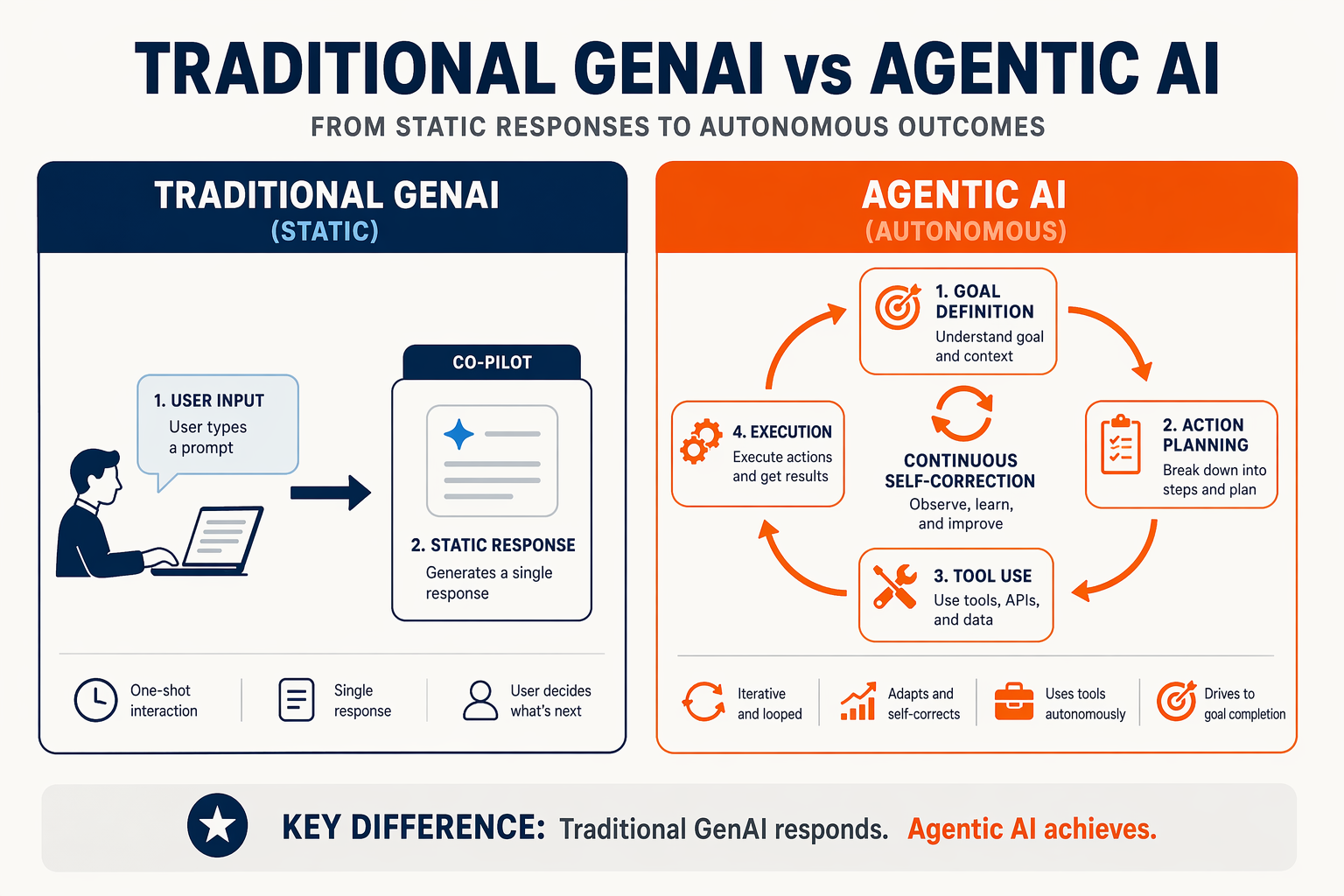
To move beyond basic generative chatbots, Indian enterprises are rapidly adopting Agentic AI—autonomous systems capable of reasoning, planning, and executing multi-step workflows. According to Deloitte, Agentic AI is becoming a core business imperative because it automates complex front, middle, and back-office functions. However, this shift from "generation" to "execution" fundamentally breaks traditional AI security models.
The Shift from Passive Assistance to Active Autonomy
Unlike standard GenAI, which operates on a simple "prompt-in, response-out" mechanism, Agentic AI functions as an active organizational actor. It does not just write a draft; it logs into a CRM, analyzes customer history, decides on a resolution, drafts the message, and triggers an API to send it.
While this autonomy drives massive operational efficiency, it introduces unprecedented operational risks. Tata Consultancy Services (TCS) highlights that autonomous decision-making demands a completely new governance foundation to address security, privacy, and systemic accountability concerns. When an AI system can act on its own, the traditional lines of control blur.
Why Traditional Guardrails Fall Short
Most enterprises currently rely on static guardrails—such as input prompt filtering, keyword blocklists, and output sanitization. While effective for simple Q&A chatbots, these static controls fail in agentic environments for three critical reasons:
- Dynamic Execution Paths: An autonomous agent dynamically chooses its own chain of actions. Because the sequence of tool execution is not pre-defined, static rules cannot predict or intercept risky behaviors that emerge dynamically during a multi-step task.
- Compounding State Drift: In multi-turn workflows, an agent’s internal "state" changes with every step. A minor reasoning error in step one can compound into a severe action-loop hallucination by step five, leading the agent to execute unintended transactions or call unauthorized APIs.
- Privileged System Access: Unlike passive LLMs, agents require read-and-write access to enterprise databases, communication channels, and internal APIs. A static guardrail cannot assess whether an agent’s specific data call is contextually appropriate or represents an unauthorized privilege escalation.
The Need for Runtime Governance
To safely leverage these systems, enterprises must transition from rigid, post-facto filters to active runtime governance. This requires continuous, real-time oversight of the agent’s reasoning loops, tool calls, and external integrations.
Modern communication platforms are already addressing this challenge by embedding dynamic guardrails directly into the system architecture. For instance, CallMissed allows businesses to deploy autonomous AI voice agents and multilingual chatbots with built-in, real-time monitoring. By managing LLM inference across more than 300 models, such platforms ensure that even when an agent operates autonomously, its API interactions, data access, and customer-facing communications remain strictly within secure, pre-defined operational boundaries.
As Indian organizations scale their AI initiatives, the transition to active governance is no longer optional. Relying on static guardrails to control autonomous agents is equivalent to using a seatbelt as a steering wheel—it may offer a false sense of security, but it cannot prevent a crash.
Key Developments in Indian AI Regulation and Adoption
As Indian enterprises transition from speculative Generative AI pilots to fully deployed, autonomous agentic workflows, the regulatory ground beneath them is shifting. In 2026, building and deploying an AI agent is no longer just a software engineering challenge; it is a complex compliance exercise. With the Digital Personal Data Protection (DPDP) Act fully active and the Ministry of Electronics and Information Technology (MeitY) issuing stringent guidelines on algorithmic accountability, enterprises must align their AI orchestration with localized legal frameworks.
Because autonomous agents can make decisions, access databases, and interact with citizens without real-time human intervention, traditional static governance models are no longer sufficient. Indian enterprises require a dynamic approach that addresses data residency, linguistic diversity, and algorithmic bias.
The table below outlines the critical regulatory pillars and adoption trends shaping the governance of Agentic AI in India today:
| Initiative / Regulation | Primary Objective | Impact on Agentic AI | Compliance Status (2026) |
|---|---|---|---|
| DPDP Act Compliance | Protecting personal data of Indian citizens | Restricts autonomous agents from processing PII without verifiable consent logs | Mandatory; active enforcement with heavy non-compliance penalties |
| MeitY AI Advisories | Mitigating bias, hallucination, and deepfakes | Requires clear labeling, guardrails, and human-in-the-loop (HITL) overrides | Standardized across all public-facing agent deployments |
| National Program on AI | Promoting sovereign, localized AI ecosystems | Promotes local hosting and integration with national language databases | Active; incentivizes localized compute and model training |
| Enterprise Shift (NASSCOM) | Transitioning from GenAI to Agentic workflows | Autonomously automates front, middle, and back-office functions | Rapid acceleration; 60%+ of top-tier Indian enterprises deploying |
Navigating Localized Sovereignty and Linguistic Diversity
A unique challenge for Indian enterprises is the sheer scale of linguistic diversity. An autonomous agent tasked with customer outreach or loan processing must seamlessly navigate multiple regional languages while adhering to strict local data governance rules. Under the DPDP framework, processing regional voice data requires the same rigorous consent and privacy guardrails as textual data.
This is where infrastructure compliance becomes critical. To safely scale autonomous operations, enterprises are turning to communication platforms that build governance directly into the API layer. For example, CallMissed provides production-ready AI voice agent infrastructure with native Speech-to-Text support for 22 Indian languages. This allows local enterprises to deploy multi-lingual, conversational agents that operate within sovereign cloud boundaries, ensuring that regional voice data is processed securely and in compliance with MeitY’s localization mandates.
Furthermore, because agentic systems continuously execute multi-step reasoning loops, enterprises must log every transactional decision. As organizations move toward this decentralized operating model, having an infrastructure partner that supports transparent auditing across hundreds of LLM models becomes a key operational advantage. By embedding safety guardrails at the communication layer, enterprises can confidently transition their front-office operations to autonomous agents without risking regulatory friction.
The Architecture of a Modern Agentic AI Governance Framework
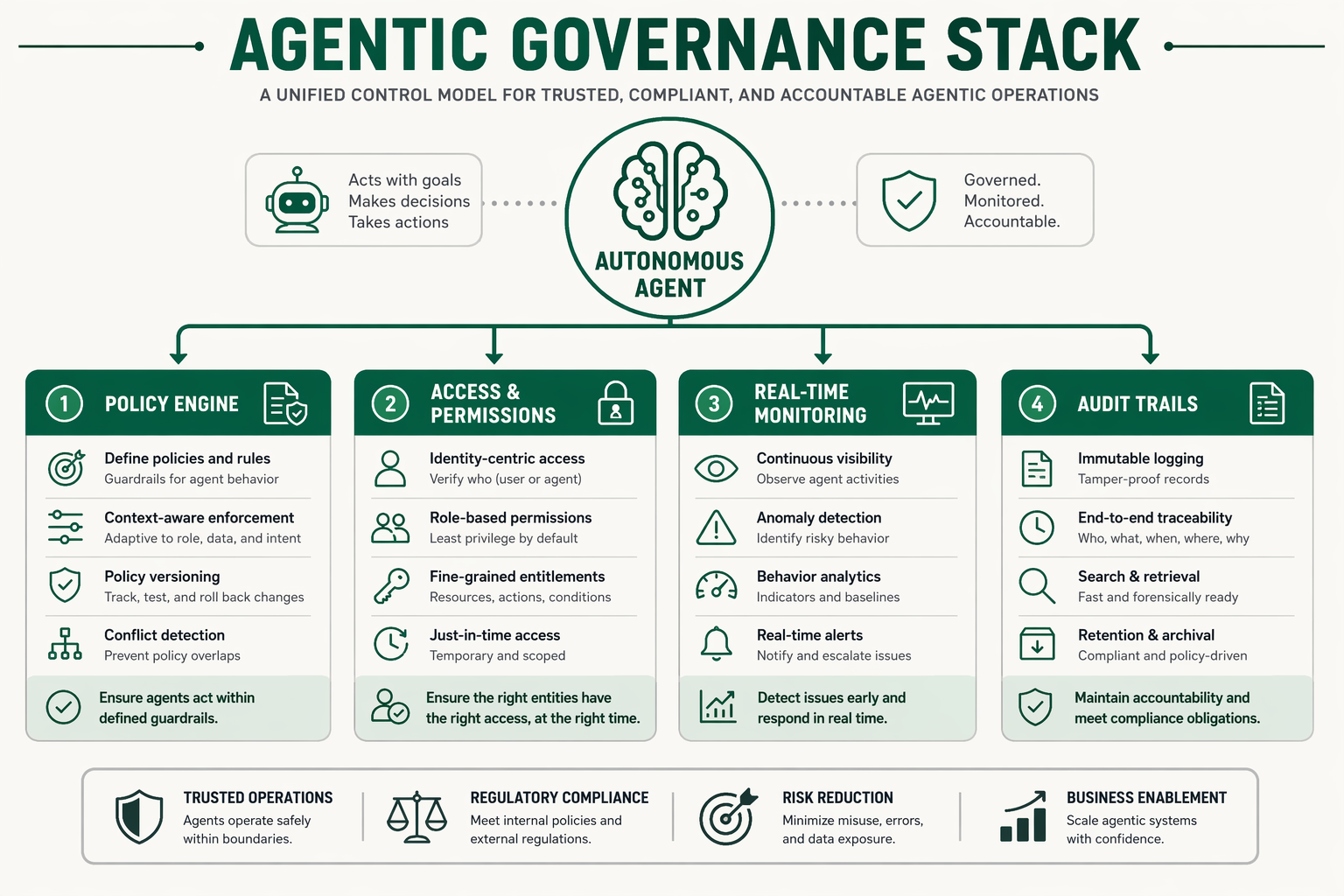
To build a resilient agentic system, Indian enterprises in 2026 are shifting away from static, model-centric governance toward an active, architecture-driven approach. Because autonomous agents act as independent organizational actors—making decisions, utilizing APIs, and accessing databases—the governance framework must be embedded directly into the technology stack.
A modern, enterprise-ready Agentic AI governance framework is built on four architectural pillars:
1. Dynamic Execution Guardrails
Traditional AI governance focused on monitoring static inputs and outputs. Today, agentic governance requires active boundary execution. Guardrails must be programmatically enforced at the API, application, and database levels. This includes defining strict data access boundaries, setting hard rate-limits to prevent runaway execution loops, and establishing transaction caps. For example, if an autonomous customer service agent is authorized to issue refunds, the governance layer must enforce a hard cap (such as ₹5,000) and automatically route any transaction above this limit to a human manager.
2. Multi-Model Safety and Routing
An enterprise-grade agent rarely relies on a single LLM. To mitigate model-specific vulnerabilities—such as prompt injection, drift, or catastrophic forgetting—the governance architecture must include a mediated multi-model tier.
Infrastructure platforms like CallMissed support this layer by offering a unified API gateway with access to 300+ LLMs. This allows enterprise architects to dynamically route tasks to the safest, most cost-effective, or most compliant model based on the sensitivity of the transaction, ensuring that a backup model is always available if the primary model fails a real-time safety check.
3. Real-Time Observability and Semantic Auditing
Because autonomous agents operate asynchronously, enterprises require a "black box recorder" capable of auditing the entire agentic decision chain. The observability architecture must capture:
- System Prompts & Context: The exact instructions and state of the agent at the time of execution.
- Chain-of-Thought Reasoning: The internal reasoning steps the agent took before deciding on an action.
- Tool & API Calls: A complete log of external systems the agent interacted with.
- Linguistic Guardrails: In India’s highly diverse market, auditing must extend to regional dialects. By utilizing specialized speech infrastructure—such as CallMissed’s Speech-to-Text and Text-to-Speech APIs supporting 22 Indian languages natively—enterprises can analyze and audit voice agent interactions in real-time to ensure compliance with localized regulatory mandates.
4. Adaptive Human-in-the-Loop (HITL) Orchestration
An effective framework does not eliminate human oversight; it optimizes it. The architecture must feature adaptive escalation protocols. If an agent's confidence score falls below a pre-configured threshold, or if it detects a potential compliance anomaly, the agent must instantly freeze its state and hand the context over to a human supervisor. This ensures that while routine front- and back-office tasks are automated at scale, ultimate accountability remains firmly with human operators.
Operational and Compliance Risks Facing Indian Enterprises in 2026
As Indian enterprises aggressively transition from standard generative AI to autonomous Agentic AI in 2026, the risk landscape has shifted dramatically. In the past, generative systems acted as passive co-pilots, requiring a human-in-the-loop to review and approve their creative output. Today, autonomous agents are trusted to make decisions, execute API calls, process transactions, and interact directly with customers and backend legacy systems. According to Deloitte, agentic AI has become a business imperative for automating front, middle, and back-office workflows. However, this massive shift introduces unprecedented operational and compliance risks that traditional IT governance models are unequipped to handle.
1. Operational Cascades and Execution Failures
Unlike static chatbots, agentic systems possess decision autonomy. When agents are granted the authority to chain multiple tools together, minor errors can trigger massive operational failures:
- Runaway Execution Loops: An agent caught in an infinite loop of API calls can quickly drain API credits, overload internal databases, and degrade system performance.
- Cascading Agent Failures: In complex workflows where multiple specialized agents collaborate, a failure in one agent’s output can compromise downstream processes, resulting in corrupted data or faulty financial transactions.
- Prompt Injection and Goal Hijacking: Malicious actors can manipulate agent prompts to bypass security guardrails, forcing the agent to execute unauthorized commands or leak proprietary data.
To mitigate these vulnerabilities, enterprises require robust orchestration platforms. Infrastructure providers like CallMissed solve this by offering centralized LLM inference gateways with strict operational guardrails, ensuring that autonomous voice and text agents operate only within predefined execution boundaries.
2. Strict Compliance under India's Regulatory Frameworks
As of 2026, the regulatory scrutiny facing Indian enterprises has reached an all-time high. Deploying autonomous agents without clear oversight paths exposes organizations to severe legal penalties:
- The DPDP Act Mandate: Under India's Digital Personal Data Protection (DPDP) Act, enterprises must ensure strict consent management and data minimization. Autonomous agents that handle, retrieve, or process customer information must be fully auditable. If an agent accesses personal data without explicit consent, the enterprise faces fines up to ₹250 crore.
- Sector-Specific Directives: Regulators like the Reserve Bank of India (RBI) and the Insurance Regulatory and Development Authority of India (IRDAI) mandate strict accountability for automated decision-making. Autonomous agents handling customer credit scoring or claim processing must provide transparent audit trails.
Managing compliance is particularly complex in a linguistically diverse market like India. When deploying voice-driven AI agents across regional demographics, enterprises must ensure that data processing across regional dialects remains compliant. Using platforms like CallMissed, which natively supports Speech-to-Text and Text-to-Speech in 22 official Indian languages, allows enterprises to maintain localized compliance, ensuring accurate transcription and strict adherence to regional data governance mandates. Without these native, secure foundations, Indian enterprises risk severe regulatory pushback.
Expert Perspectives on Autonomous System Accountability

As agentic AI shifts from a conceptual technological trend to an active operational reality in 2026, global and Indian industry experts are sounding the alarm: traditional IT governance models are fundamentally inadequate. Deloitte’s analysis highlights that because agentic AI automates critical front, middle, and back-office functions—including direct customer outreach and financial transactions—the potential surface area for operational risk has expanded exponentially. When systems act autonomously, organizations can no longer rely on retrospective audits; they need real-time, preventative guardrails.
Treating Agents as Organizational Actors
A key perspective emerging in 2026 comes from research published in the California Management Review, which argues that enterprises must transition to a new operating model that treats autonomous agents not as mere software applications, but as organizational actors. This paradigm shift means establishing clear lines of accountability, access permissions, and behavioral boundaries just as one would for a human employee.
Tata Consultancy Services (TCS) echoes this sentiment, emphasizing that the sheer autonomy of decision-making in agentic AI demands a robust governance foundation. Without it, enterprises face severe risks associated with autonomous decision-making, security vulnerabilities, and data privacy breaches. TCS experts advise that governance frameworks must explicitly control "agent system access" to prevent unauthorized lateral escalation across enterprise databases.
The Indian Regulatory and Multilingual Challenge
For Indian enterprises navigating a complex regulatory landscape—especially under the strict compliance mandates of the Digital Personal Data Protection (DPDP) Act—the stakes are incredibly high. NASSCOM experts urge business leaders to look beyond isolated "Generative AI projects" and proactively design comprehensive governance and change management frameworks before attempting to scale agentic workflows.
According to insights from Embee Software, robust governance is the primary gatekeeper for Indian enterprises looking to minimize operational risk while scaling AI in 2026. This task is further complicated by India's vast linguistic diversity. When agents interact with customers autonomously in regional dialects, maintaining compliance and quality assurance becomes highly complex.
To address this, forward-thinking enterprises are leveraging specialized infrastructure. Platforms like CallMissed solve this governance bottleneck by enabling organizations to deploy autonomous voice agents and WhatsApp chatbots natively supporting 22 regional Indian languages. Because CallMissed offers a unified API gateway to over 300+ LLMs, enterprise IT leaders can easily implement centralized logging, prompt auditing, and standardized security guardrails across all communication channels, ensuring complete transparency over every autonomous interaction.
Redefining Oversight: From "In-the-Loop" to "On-the-Loop"
Industry consensus indicates that the traditional "human-in-the-loop" model is scaling poorly. Instead, experts advocate for a "human-on-the-loop" oversight paradigm characterized by:
- Dynamic Boundary Setting: Restricting the financial, systemic, and data-sharing limits of what an agent can authorize without explicit human approval.
- Real-Time Observability: Implementing continuous monitoring tools that track agent reasoning paths and catch "agent drift" or logical loops before they affect the customer.
- Fallback Protocols: Establishing automated triggers that seamlessly transition a complex or high-risk interaction from an AI agent to a human supervisor.
Ultimately, building accountability into autonomous systems is not just about mitigating risk; it is about building the trust required to let these agents drive true business value.
What This Means For You: Actionable Implementation Steps
Implementing agentic AI governance is not a one-time compliance check; it is an active, evolving operational model. As Indian enterprises transition from simple generative AI copilots to fully autonomous agents that handle core business transactions, procurement, and front-office operations, security and risk management leaders must establish a structured, phased rollout.
To operationalize this transition, organizations should follow a structured execution roadmap that addresses risk, technical guardrails, and human oversight.
| Phase & Focus | Core Objective | Key Governance Actions | Primary Guardrail | Success Metric |
|---|---|---|---|---|
| 1. Boundary Definition | Define and restrict agent autonomy | Map system access, set transaction limits, and establish API sandboxes. | Role-Based Access Control (RBAC) & API limits | Zero unauthorized actions in sandbox tests |
| 2. Real-Time Guardrails | Intercept and filter inputs/outputs | Implement semantic firewalls, prompt injection blockers, and data masking. | Real-time policy engine & data sanitization | <0.1% leakage of sensitive or toxic data |
| 3. HITL Integration | Inject human oversight for critical actions | Program automated triggers for high-value transactions or sensitive customer workflows. | Human-in-the-Loop (HITL) approval gates | 100% compliance on high-risk triggers |
| 4. Multilingual Auditing | Ensure compliant communication across regional markets | Deploy continuous transaction logging, bias checks, and multi-language evaluation. | Audit trails across 22+ regional Indian languages | <5% latency overhead from security layers |
| 5. Multi-LLM Scaling | Prevent vendor lock-in safely | Route agent queries across diverse foundational models based on cost and compliance. | Secure, centralized LLM API gateways | 99.9% uptime with dynamic failover |
Key Execution Priorities for Indian Enterprise Leaders
To successfully execute the roadmap outlined above, enterprise architecture teams must prioritize three critical areas:
- Deploying Dynamic, Real-time Guardrails: Traditional static security measures fail in agentic environments. Because autonomous agents generate their own code and tool calls dynamically, you must implement semantic firewalls that analyze intent in real time. Platforms like CallMissed help enterprises address this challenge by providing enterprise-ready voice agent infrastructure that integrates directly with complex enterprise backend systems while enforcing strict, localized security boundaries.
- Localizing Governance for Regional Operations: India's diverse linguistic landscape presents unique challenges for agentic safety. An agent interacting with customers in Hindi, Tamil, or Marathi must adhere to the same stringent safety, compliance, and toxic-content filters as one operating in English. Utilizing robust Speech-to-Text and Text-to-Speech pipelines—such as those offered by CallMissed, which natively support 22 Indian languages—ensures that compliance auditing and safety filters are uniformly applied across all regional touchpoints.
- Enforcing Hard Limits on System Access: Agents should never have direct, unmitigated write access to core databases. Implement a strict "principle of least privilege." Treat autonomous agents as digital employees—give them specific, auditable service accounts with hard transaction limits and mandate cryptographically signed logs for every action they execute.
By taking these practical steps, Indian enterprises can confidently transition from experimental GenAI projects to scaled, autonomous agent deployments that drive tangible business value while keeping operational and compliance risks tightly contained.
Frequently Asked Questions About Agentic AI Governance
What is agentic AI governance and why do Indian enterprises need it in 2026?
How does governance for autonomous agents differ from traditional Generative AI governance?
What are the key components of a robust agentic AI governance framework?
How can businesses maintain compliance when deploying autonomous voice and chat agents in India?
What are the primary operational risks of deploying agents without implementing agentic AI governance?
How can enterprises transition their current IT infrastructure to support autonomous agents?
Conclusion
As agentic AI transitions from experimental projects to autonomous organizational actors, Indian enterprises must adapt their control models. Traditional IT compliance frameworks are no longer sufficient to govern systems that act, decide, and access critical data autonomously.
To safely scale autonomous workflows, enterprise leaders must focus on three key priorities:
- Real-Time Guardrails: Shift from periodic, post-event audits to active, runtime monitoring of system permissions and actions.
- Defined Boundaries: Establish clear limits on agent autonomy, ensuring human-in-the-loop oversight remains mandatory for high-stakes decisions.
- Localized Compliance: Align agent behavior with India's evolving digital personal data protection laws and industry-specific regulations.
Looking ahead, proactive risk management will become a key differentiator, separating market leaders from those paralyzed by compliance challenges.
To explore how AI communication is evolving, check out CallMissed — an AI infrastructure platform powering voice agents and multilingual chatbots for businesses. How is your organization preparing to balance operational speed with agentic control?
Discussion
Related Posts


Ready to automate customer conversations?
Launch AI voice agents and WhatsApp bots with CallMissed — one API, 22+ Indian languages.