
Agent 365 Shows Why Governance Is Becoming a Core AI Product Category


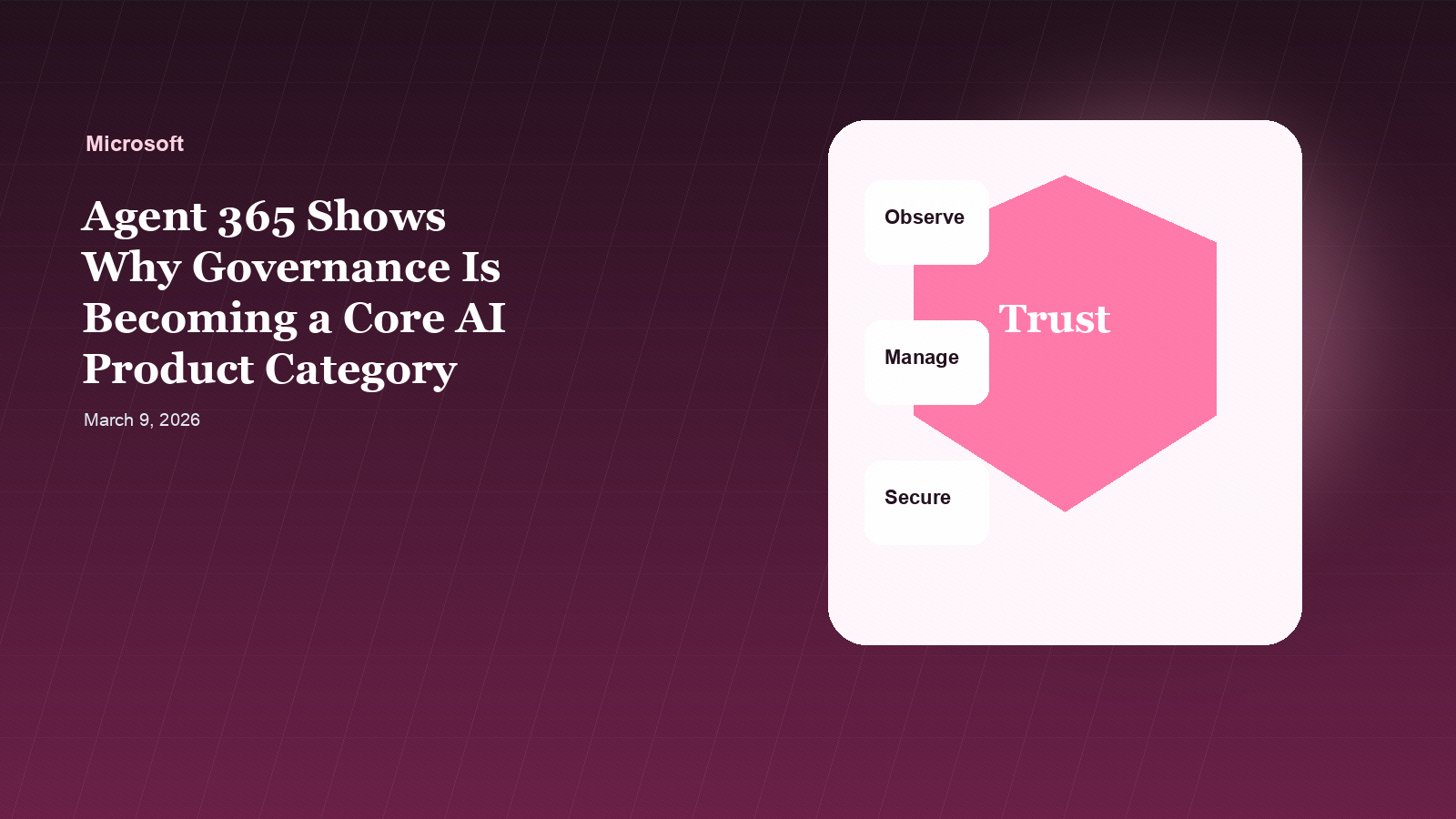
Agent 365 Shows Why Governance Is Becoming a Core AI Product Category explains what this AI launch means for CallMissed-style voice, WhatsApp, Smart IVR, and customer workflow automation.
Agent 365 Shows Why Governance Is Becoming a Core AI Product Category
Microsoft published Introducing the First Frontier Suite built on Intelligence + Trust on March 9, 2026, and the announcement matters because it points to where the AI market is heading for communication-heavy products. This is not generic model news. It is a signal about how customer-facing workflows, agent runtimes, voice systems, and business messaging are being rebuilt.
For CallMissed, the relevance is direct. The product is positioned as AI communication infrastructure with WhatsApp chatbots, AI voice call agents, Smart IVR, multilingual speech APIs, and OpenAI-compatible endpoints. That means each of these launches should be evaluated through one practical lens: does it improve how businesses answer, route, follow up, and complete customer work across channels?
What the source actually says
- Microsoft announced the May 1 general availability of Agent 365 as a control plane for AI agents.
- The company emphasized observing, governing, managing, and securing agents across the organization.
- The broader Frontier Suite message is that enterprise AI is moving from experimentation toward durable, trust-oriented operations.
The primary source is here: Introducing the First Frontier Suite built on Intelligence + Trust. In this article, the important move is not only the feature list. It is the direction of travel: more production readiness, more deployment maturity, more observability, better real-time performance, or stronger cost discipline depending on the topic.
Why this trend matters now
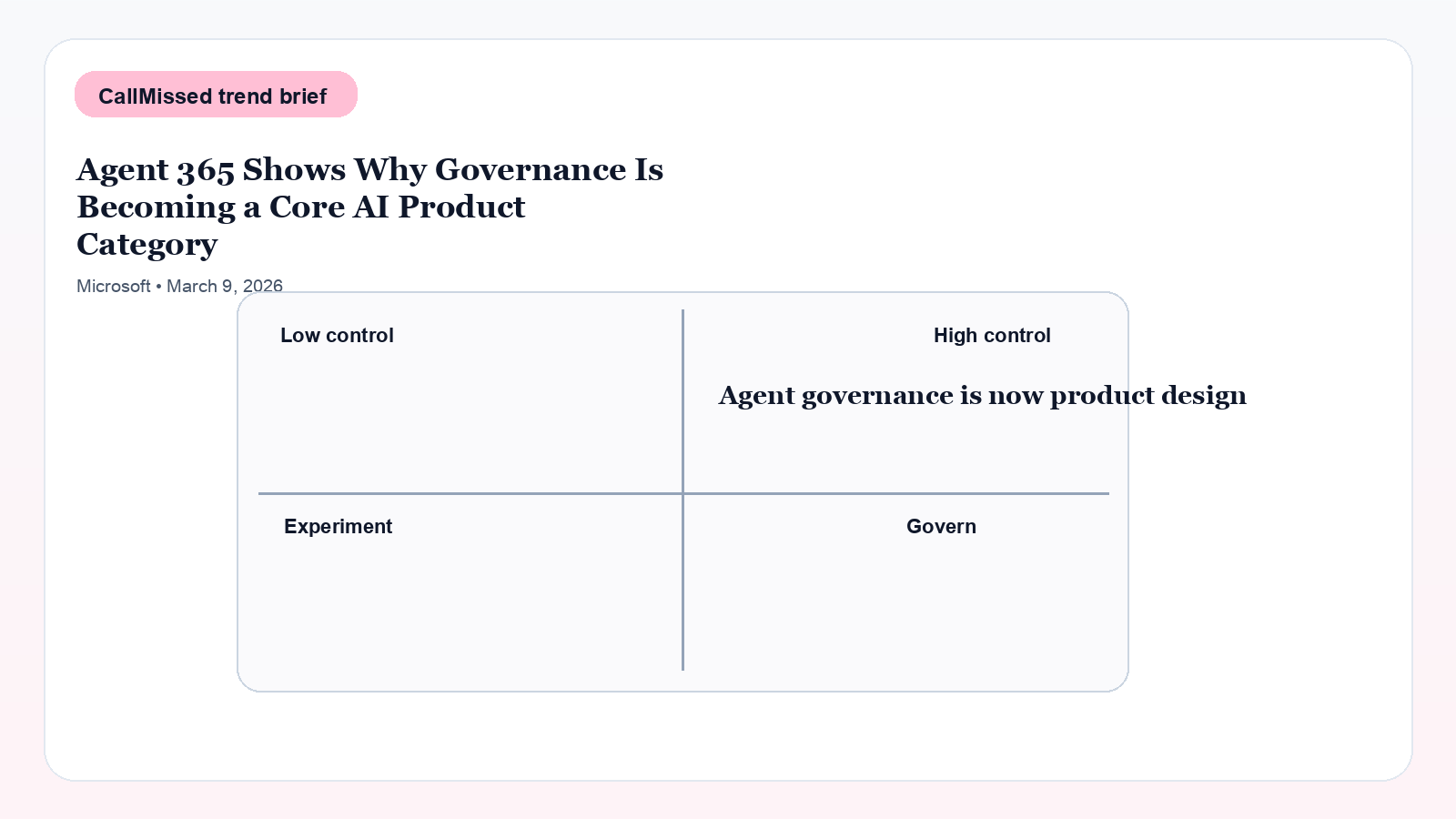
Governance used to be treated as a procurement concern. It is now a product concern. As more AI systems touch customer interactions and internal workflows, companies want visibility and policy controls built into the operating model.
That is especially true for communication products, where one workflow can span customer data, channel permissions, escalation paths, and external systems.
The more an AI platform participates in everyday work, the more buyers care about control, accountability, and standardized deployment patterns.
What this means for CallMissed
CallMissed is squarely inside this trend because communication automation is rarely just a conversational problem. It is an operational one involving tenants, API keys, webhooks, voice sessions, and customer data boundaries.
A platform in this category becomes easier to trust when governance is framed as part of the workflow, not as a slide-deck afterthought.
The product opportunity is clear: businesses want AI to answer, route, and follow up, but they also want the confidence that those behaviors can be observed and constrained.
CallMissed documentation reinforces the same architectural story. The platform offers AI-powered communication APIs, WhatsApp business workflows, voice-call agents, Smart IVR, speech-to-text in 22 Indic languages plus English, text-to-speech options for telephony, and OpenAI-compatible endpoints. Those verified capabilities make the product a natural surface for turning this market momentum into real business workflows instead of one-off experiments.
Practical operating blueprint
- Define workflow-level ownership for every AI communication path. Someone should own voice triage, WhatsApp follow-up, and escalation behavior separately if needed.
- Keep auditable summaries for every customer-facing automation step, including system-triggered messages and routing decisions.
- Separate tenant-specific configuration from platform-wide defaults so one customer experiment does not quietly affect another.
- Use governance metrics in rollout reviews: policy exceptions, bad transfers, fallback rates, and misrouted conversations.
- Build trust into product onboarding. The easiest governance problem to fix is the one that never enters production unmanaged.
Where teams can use this immediately
- Support platforms that must prove agent behavior is reviewable and controllable.
- Agencies or multi-tenant products that need clean separation across customer accounts.
- Enterprise voice and chat deployments where AI actions need tight policy boundaries.
- Organizations moving from proof-of-concept bots toward durable, governed operations.
Commercial perspective
The reason AI agent governance matters is that communication systems sit near revenue and support cost at the same time. When a company answers faster, routes more accurately, preserves context across channels, and lowers repetitive agent work, the gains show up in booked appointments, recovered leads, faster ticket flow, lower backlog, or healthier margins. That is why these infrastructure and model announcements matter even when they seem technical on the surface.
The other important shift is buyer expectation. Enterprise teams increasingly expect AI communication platforms to look like serious software infrastructure: secure enough to deploy, measurable enough to improve, and flexible enough to fit the business’s chosen channels and workflows. Products that only sound impressive in demos will lose to products that make the day-to-day operating loop cleaner.
Risks and mistakes to avoid
- Treating governance as documentation instead of product behavior.
- Letting each team improvise its own controls, logs, and routing rules.
- Over-focusing on hallucination risk while ignoring workflow risk like bad transfers or uncontrolled tool access.
- Delaying trust features until after the traffic and customer count increase.
Metrics to review after rollout
| Metric | Why it matters |
|---|---|
| Fallback policy exceptions | These reveal whether the workflow stays inside the boundaries the business actually intended. |
| Cross-tenant control hygiene | Multi-tenant communication systems need to prove configuration and data boundaries remain clean. |
| Escalation accountability | Human teams should be able to understand why the AI chose to transfer or not transfer a conversation. |
The common trap in AI communication programs is optimizing for the wrong layer. Teams celebrate a model change, a voice upgrade, or a faster runtime while the actual workflow remains fragmented. The right question is always the same: did the customer interaction become easier to complete, and did the business spend less manual effort to complete it?
FAQ
Why is agent governance a product category now?
How does this relate to CallMissed?
What should teams monitor first?
What is the practical takeaway?
Sources
- Microsoft (March 9, 2026): Introducing the First Frontier Suite built on Intelligence + Trust
- CallMissed Introduction: https://docs.callmissed.com/docs/introduction
- CallMissed Quickstart: https://docs.callmissed.com/docs/quickstart
- CallMissed Speech to Text: https://docs.callmissed.com/docs/speech-to-text
- CallMissed Text to Speech: https://docs.callmissed.com/docs/text-to-speech
- CallMissed Chat Completions: https://docs.callmissed.com/docs/chat-completion
Conclusion
Agent 365 Shows Why Governance Is Becoming a Core AI Product Category is important because it shows how quickly the market is professionalizing around communication AI. The lesson for CallMissed is not to chase every logo or every launch headline. The lesson is to keep building the operational layer where these advances become useful: voice, WhatsApp, Smart IVR, multilingual understanding, measured routing, and clean handoffs. That is where real business value appears.
Discussion
Related Posts
Ready to automate customer conversations?
Launch AI voice agents and WhatsApp bots with CallMissed — one API, 22+ Indian languages.