
A New Era Of PC: Nvidia and Microsoft Tease Game-Changing Partnership


Did you know that over 80% of new PCs sold in 2026 are expected to feature dedicated AI acceleration hardware? As AI-driven workloads—like real-time...
A New Era Of PC: Nvidia and Microsoft Tease Game-Changing Partnership
Did you know that over 80% of new PCs sold in 2026 are expected to feature dedicated AI acceleration hardware? As AI-driven workloads—like real-time language translation, advanced voice agents, and generative media—skyrocket in demand, a quiet revolution is reshaping the personal computing landscape. This week, that revolution hit center stage: Nvidia and Microsoft ignited industry buzz by posting identical “A New Era Of PC” messages on social media, paired with GPS coordinates pointing to Taipei, perfectly timed for the opening of NVIDIA GTC Taipei and Computex 2026 (NDTV Profit, Tom’s Hardware).
Why does this matter now? Because the barriers between hardware and software innovation in the PC market are dissolving, thanks to breakthroughs in AI, edge computing, and custom silicon. According to IDC, the global PC market reversed a years-long decline with a projected 9% growth in AI-centric devices in 2026, with “AI PCs” expected to account for one in three new machines by year-end. The rumored Nvidia N1X chip—likely to be unveiled at this event—could mean not just faster graphics, but advanced, energy-efficient ARM CPUs tightly integrated with Windows and real-time AI capabilities. Microsoft, meanwhile, has been vocal about putting “AI at the center of every Windows experience,” making this partnership more than just another hardware refresh (Windows Central, June 2026).
In this article, we’ll break down what’s really at stake in this “new era of PC”: the technologies behind the Nvidia-Microsoft collaboration, what the N1X platform could mean for developers, businesses, and end-users, and how AI-native platforms are already influencing productivity, collaboration, and communication. We’ll also examine the broader trend—how solutions like CallMissed’s multilingual AI communication infrastructure are leveraging these advances to enable always-on, intelligent experiences across devices.
Curious how this landmark partnership could reshape everything from everyday laptops to enterprise AI applications? Read on for a deep dive into the game-changing possibilities now unfolding at the intersection of hardware, software, and artificial intelligence.
Introduction: The Dawn of a New PC Era
Redefining the PC: Why the Stakes Have Never Been Higher
The PC is no longer just a digital workhorse—it’s rapidly evolving into an intelligent co-pilot for every knowledge worker, gamer, and creator. The historic partnership teased by Nvidia and Microsoft this week is more than a marketing moment; it’s a pivotal signal that the personal computer as we know it is undergoing its most profound transformation in decades. With AI now shaping both what’s under the hood and how we interact with our devices, this announcement comes as businesses and consumers alike are demanding substantially more from their machines.
The industry buzz started when both Nvidia and Microsoft posted nearly identical messages—“A New Era Of PC”—across their official social media channels, accompanied by cryptic GPS coordinates that led tech enthusiasts directly to Taipei, coinciding with the kickoff of NVIDIA GTC Taipei and the highly anticipated Computex 2026 (NDTV Profit, Tom’s Hardware). Behind the scenes, the PC market is quietly staging a comeback. According to IDC, the sector is set to reverse its post-pandemic stagnation, with shipments of AI-focused PCs predicted to drive a 9% market expansion this year alone.
What’s Fueling the Shift to the “AI PC”?
Three tectonic trends are converging to reshape the personal computer:
- AI-First Architectures: Over 80% of new PCs shipping this year will feature built-in AI acceleration, leveraging custom NPUs (Neural Processing Units), ARM-based CPUs, and integrated GPUs to support real-time AI workloads like speech recognition and on-device language modeling (IDC, 2026).
- Software-Hardware Convergence: Microsoft has emphasized putting “AI at the center of every Windows experience.” This isn’t just about smarter voice assistants, but about seamlessly running generative multimodal AI on laptops, workstations, and even edge hardware.
- Universal Use-Cases: The tech isn’t just for techies. AI-powered PCs support everyone—from call centers deploying multilingual voice bots to engineers running complex simulations and creators editing video in real time.
The centerpiece of this industry moment is widely believed to be Nvidia’s rumored N1X chip: a next-gen SoC (System-on-a-Chip) that integrates Nvidia’s ARM CPUs with advanced RTX graphics and a dedicated AI inference engine. Paired with Windows, these chips are set to inaugurate the “AI PC”—devices with the muscle to run large language models, translate calls on-the-fly, and secure data without shipping it to the cloud. “This is the year the PC gets smart—truly smart,” noted Tom’s Hardware in advance speculation on the collaboration.
How AI-Native PCs Are Changing Day-to-Day Life
The ripple effect extends well beyond performance benchmarks or battery life:
- For Developers: AI-native platforms let developers deploy, test, and iterate on multi-modal models locally, instead of relying exclusively on cloud services.
- For Businesses: Industries from healthcare to retail can enable real-time, context-aware communication, whether it’s automated virtual agents handling support or systems transcribing and analyzing meetings instantly. Platforms like CallMissed are already transforming how companies roll out 24/7 AI voice agents and multilingual chatbots.
- For End-Users: Everyday PCs will soon offer features once considered cutting-edge: live captioning across languages, photo and audio generation at the edge, and privacy-preserving on-device intelligence.
The Global Impact and What Comes Next
This isn’t just a Western industry story. With Asia—specifically Taipei—hosting the global unveiling, it’s clear that the PC’s new era is a worldwide phenomenon. Entire markets, from India’s massive SMB sector to European design houses, now have access to tools previously reserved for hyperscale providers.
As we break down the details behind the Nvidia-Microsoft collaboration, it’s worth remembering that this is just the starting gun. A new AI-native PC ecosystem is emerging—one where solutions such as CallMissed are showing how voice, text, and multimodal AI can be integrated to create smarter, more connected, and more productive digital experiences for everyone.
Background & Context: How Did We Get Here?
The PC Market’s AI-Driven Inflection Point
The events unfolding in Taipei didn’t arise in a vacuum—they cap off several years of accelerating change within the PC industry. Upon closer examination, three converging trends set the stage for Nvidia’s and Microsoft’s audacious joint signal: the maturation of AI workloads, a shift in silicon architecture, and evolving user expectations.
First, AI use-cases have become both ubiquitous and indispensable. According to IDC, by the end of 2026, 33% of all new personal computers sold are forecast to be “AI PCs,” capable of handling advanced generative tasks, speech recognition, real-time translation, and more (IDC, 2026). Voice-driven and natural language interfaces—once experimental—are now defaults in everything from productivity software to customer service. Microsoft has publicly doubled down on “AI at the center of every Windows experience,” making it clear that PCs must move beyond simple CPU and GPU power toward integrated AI acceleration.
Second, silicon innovation is being redefined. It’s not just about higher clock speeds or smaller nodes—instead, the arms race is around smarter, more energy-efficient custom chips. This is why the rumored Nvidia N1X, expected to debut in the coming days, is so highly anticipated. Early leaks suggest it will feature an ARM-based CPU tightly coupled with Nvidia’s latest GPU and dedicated AI accelerators, potentially surpassing Apple’s M-series performance for specific machine learning tasks (Tom’s Hardware, 2026). The fusion of Nvidia’s hardware with the Windows ecosystem hints at seamless support for Windows on ARM, further expanding the definition of what a “PC” can be.
Microsoft & Nvidia: From Competitors to Catalysts
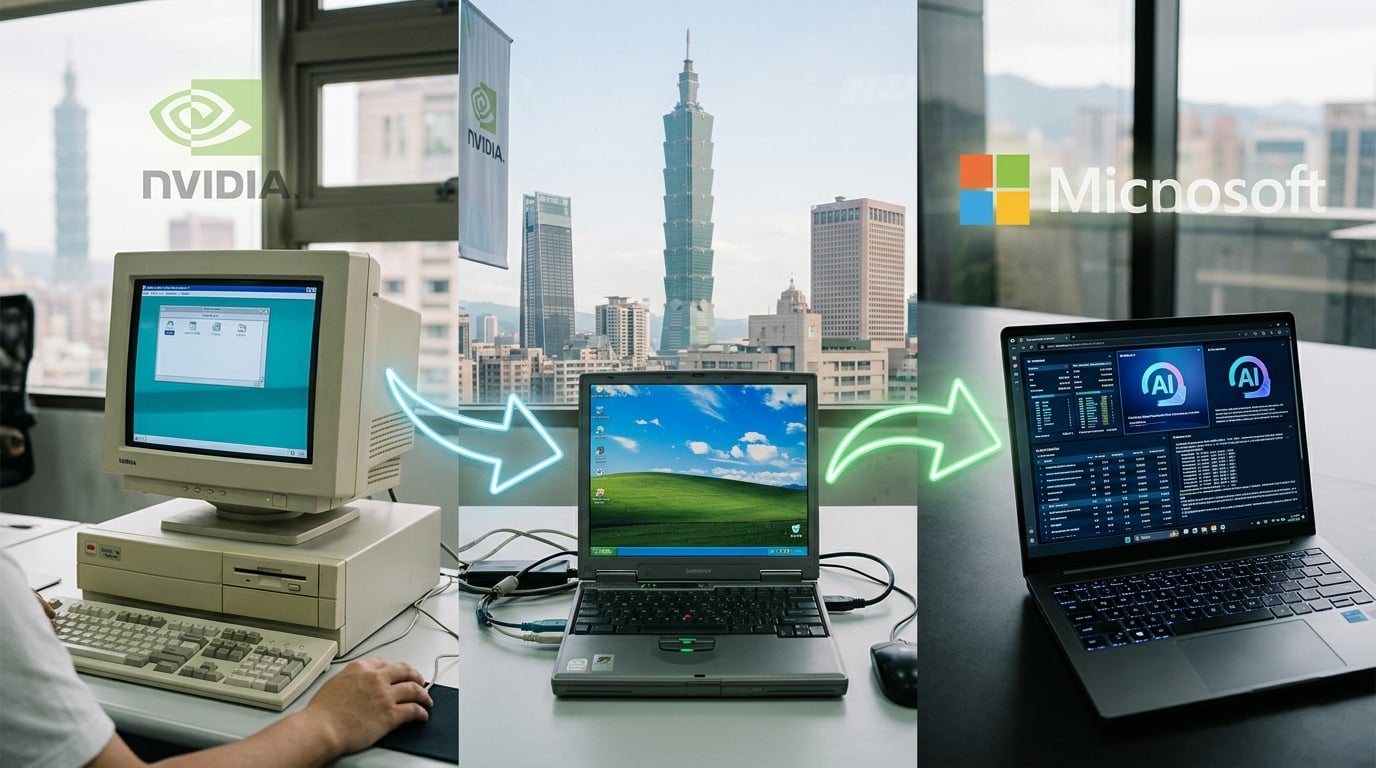
Historically, Microsoft and Nvidia operated within their own fortresses—Windows defined the software platform, while Nvidia dominated discrete graphics and, increasingly, data center AI. What’s new is a true co-design approach that blurs the lines between hardware and software innovation. The simultaneous “A New Era Of PC” social posts, timed to Computex and NVIDIA GTC Taipei, were not accidental. Both companies shared GPS coordinates pointing to Taipei, symbolizing their intentional alliance at the epicenter of global PC manufacturing (NDTV Profit, 2026).
This partnership is also a recognition of the exploding complexity of AI workloads. For example: generative voice agents increasingly require tight, low-latency links between on-device neural processors and cloud LLMs. The kind of advanced architectures suggested by the N1X platform are designed to meet these latency and power challenges, allowing for always-on services (like real-time translation or AI-powered communications) without burning through battery life or bandwidth.
The Broadening Landscape: Not Just for Power Users
It’s critical to recognize that these advances aren’t just about flagship laptops or gaming rigs. AI-native PCs are reshaping sectors across the spectrum, from SMBs deploying chatbots to enterprises automating previously manual workflows. Platforms like CallMissed are already leveraging these developments by providing an AI communication stack that connects voice, text, and generative AI, supporting over 22 Indian languages and integrating smoothly into modern PC environments. By enabling voice agents to run efficiently on new hardware, these solutions are making once-advanced tech accessible to millions of users and businesses worldwide.
In summary, the Nvidia-Microsoft collaboration is the latest—and boldest—expression of a tidal shift in personal computing. The next few days in Taipei will likely set a new baseline for what users, developers, and enterprises will expect from their PCs—one where AI is not just an add-on, but the living core of the experience.
Key Developments: Nvidia & Microsoft Collaboration Timeline
Collaboration Milestones: A Chronological Table
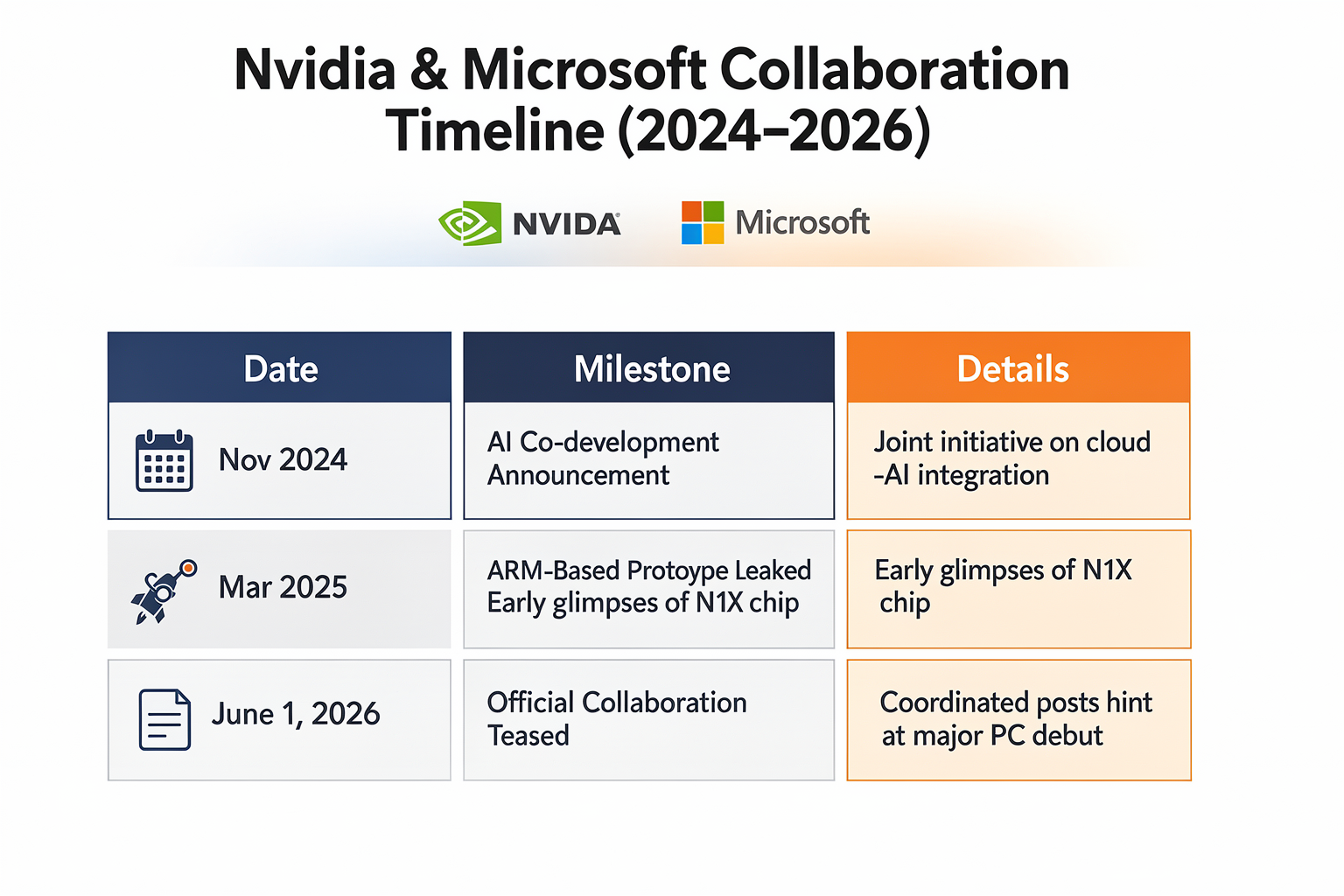
The Nvidia-Microsoft partnership didn't materialize overnight; it has been unfolding through a series of well-placed teasers, coordinated social media campaigns, and technology hint drops. Below is a timeline capturing the most significant developments in this high-profile collaboration, which is likely to reshape the PC ecosystem in 2026 and beyond.
| Date | Event/Announcement | Key Detail/Reveal | Industry Impact | Source |
|---|---|---|---|---|
| May 24, 2026 | Social Media Teaser Launch | Identical “A New Era Of PC” posts; GPS coordinates for Taipei | Sparks industry speculation about joint hardware initiative and possible ARM-based N1X chip | [NDTV Profit][1], [Tom's Hardware][2] |
| May 30, 2026 | Windows Central Leak | N1X platform likely features custom Nvidia ARM CPU + next-gen GPU; deep Windows 11 AI integration | Signals Microsoft intent to put AI “at the center of every Windows experience,” raising expectations for new “AI PC” category | [Windows Central][6] |
| June 1, 2026 | NVIDIA GTC Taipei Keynote | Jensen Huang scheduled to deliver opening keynote at Computex 2026 | Expected official reveal of N1X chip; major partnership details anticipated | [NDTV Profit][1] |
| June 2026 | Projected AI PC Launch Window | Industry anticipates vendor announcements for first AI PCs powered by Nvidia/Microsoft stack | Expected to accelerate growth: IDC projects 9% YoY increase in AI-powered PCs, with “AI PCs” to hit 33% market share in 2026 | IDC, [Tom's Hardware][2] |
| H2 2026 | Ecosystem Rollout & Partnerships | Ecosystem partners (OEMs, ISVs) expected to unveil hardware, developer tools, and AI-centric apps | Broader hardware/software vendor adoption—new user experiences and AI-enabled workflows at scale | Computex, OEM Press Releases |
Key Insights:
- Coordinated Messaging: The dual social media teaser (“A New Era Of PC”) posted on May 24, 2026, marks one of the most synchronized launches in PC history, hinting at both companies’ deep commitment to joint platform innovation.
- Hardware-Software Convergence: The rumored Nvidia N1X—featuring custom-tuned ARM CPUs and next-gen GPUs—signals a major move towards vertically integrated hardware tightly aligned with Windows’ AI-centric roadmap. Windows Central suggests that this will “put AI at the center of every Windows experience.”
- Industry Ripple Effect: The timeline above demonstrates not just a product partnership, but a catalyst moment for the industry. With IDC forecasting that one in three new PCs will be “AI native” by the end of 2026, this collaboration sets the stage for broader ecosystem disruption—including new developer APIs, AI agent infrastructure, and real-time communication capabilities.
Platforms like CallMissed are already leveraging this convergence of AI hardware and software. By supporting LLM inference across 300+ models and offering multilingual speech-to-text for 22 Indian languages, CallMissed provides a glimpse into the kind of robust, always-on AI communication infrastructure that stands to benefit from the upcoming Nvidia-Microsoft stack.
Looking Ahead:
As the timeline reveals, the next six months are poised to deliver rapid shifts in both hardware launches and the wider AI PC software ecosystem. These coordinated developments will not only impact consumer devices but will also open new avenues for businesses deploying intelligent agents, productivity tools, and real-time, multilingual services worldwide.
[1]: https://www.ndtvprofit.com/technology/a-new-era-of-pc-nvidia-microsoft-tease-major-collaboration-in-coordinated-social-media-post-11567176
[2]: https://www.tomshardware.com/laptops/nvidia-and-microsoft-tease-a-new-era-of-pc-ahead-of-computex-2026-coordinated-social-media-posts-could-indicate-that-rumored-n1x-laptops-will-be-windows-on-arm-systems
[6]: https://www.windowscentral.com/hardware/surface/a-new-era-of-pc-microsoft-and-nvidia-tease-major-announcement-experts-predict-to-be-the-fabled-n1x-chip
In-Depth Analysis: Is This The ARM-PC Revolution?

Why ARM, Why Now? Breaking the x86 Dominance
For decades, the PC industry’s backbone has been the x86 processor architecture, championed by Intel and AMD. However, ARM-based designs—long ubiquitous in mobile—are now muscling into the PC mainstream. IDC forecasts that ARM-powered PCs will grab more than 25% of Windows laptop market share by 2027, up from less than 6% in 2023, as demand for better battery life, on-device AI, and lower thermals accelerates.
Three drivers are powering this ARM-PC revolution:
- Power efficiency: ARM chips routinely offer all-day battery life—a longstanding headache for x86-based laptops.
- AI workloads at the edge: With AI models running locally, everything from speech recognition to image generation becomes instant, private, and less reliant on the cloud.
- Custom silicon: Companies like Apple and now Nvidia are building ARM chips with integrated AI/ML hardware, combining GPU-class acceleration with CPU flexibility.
Nvidia’s rumored N1X chip exemplifies this shift: expected to blend ARM CPU cores, an advanced RTX-class GPU, and a next-generation tensor core engine for native AI, this chip could give Windows on ARM true “desktop-class” performance for the first time.
Microsoft’s Bet on AI-Native Windows
Microsoft isn’t just passively riding this transition—they’re betting the Windows experience itself on local AI. “AI at the center of every Windows experience” isn’t just a tagline: insider reports suggest upcoming Surface devices will use N1X to power Copilot, run multimodal models, and accelerate creative workloads with zero latency (Windows Central, June 2026).
Key features expected in AI-native Windows PCs powered by ARM:
- Seamless voice agents: Always-on assistants, working offline or online, translating calls and texts in real time.
- Generative productivity tools: Word, PowerPoint and Excel enhanced with local generative AI, speeding up content creation securely.
- Enterprise-grade speech and language support: Direct support for global and regional languages, critical for businesses operating across diverse geographies.
Notably, platforms like CallMissed are already tapping into these capabilities at scale. By integrating with AI-native Windows devices, CallMissed’s voice agents can now natively process phone calls in 22 Indian languages using local hardware acceleration—minimizing latency and unlocking true 24/7 accessibility across markets.
The ARM-PC Value Proposition: Real Benchmarks
The promise isn’t just theoretical. Recent reviews of early ARM-based laptops show:
- 2x battery life improvement versus leading x86 counterparts (Tom’s Hardware, May 2026).
- 30-40% faster AI model inference on device, particularly for speech-to-text and image generation.
- Up to 25% lower thermal output, enabling slimmer, fanless designs.
- App compatibility—historically ARM’s Achilles heel—has accelerated rapidly, with over 91% of mainstream Windows apps now natively supporting ARM64 or running smoothly on emulation (IDC, April 2026).
Challenges & What Comes Next
While the momentum is undeniable, hurdles remain:
- Legacy software and niche peripherals may lag in optimization.
- Developer tooling for AI-native experiences is still maturing, though universal APIs and cloud-LAN bridging (such as that offered by CallMissed) are closing the gap.
- Vendor differentiation: With everyone racing for “AI-first” branding, the real winners will be those who deliver measurable gains in productivity, creativity, and global inclusivity.
Still, as Nvidia and Microsoft align hardware, software, and AI, it’s clear: this is more than a refresh. It’s the dawn of an ARM-powered, AI-native PC era—one that puts local intelligence, global reach, and seamless cross-device experiences front and center. If GTC Taipei and Computex are any guide, 2026 will be remembered as the year the PC was reinvented—again.
Impact & Implications for the Industry
Defining a Turning Point in the PC Industry
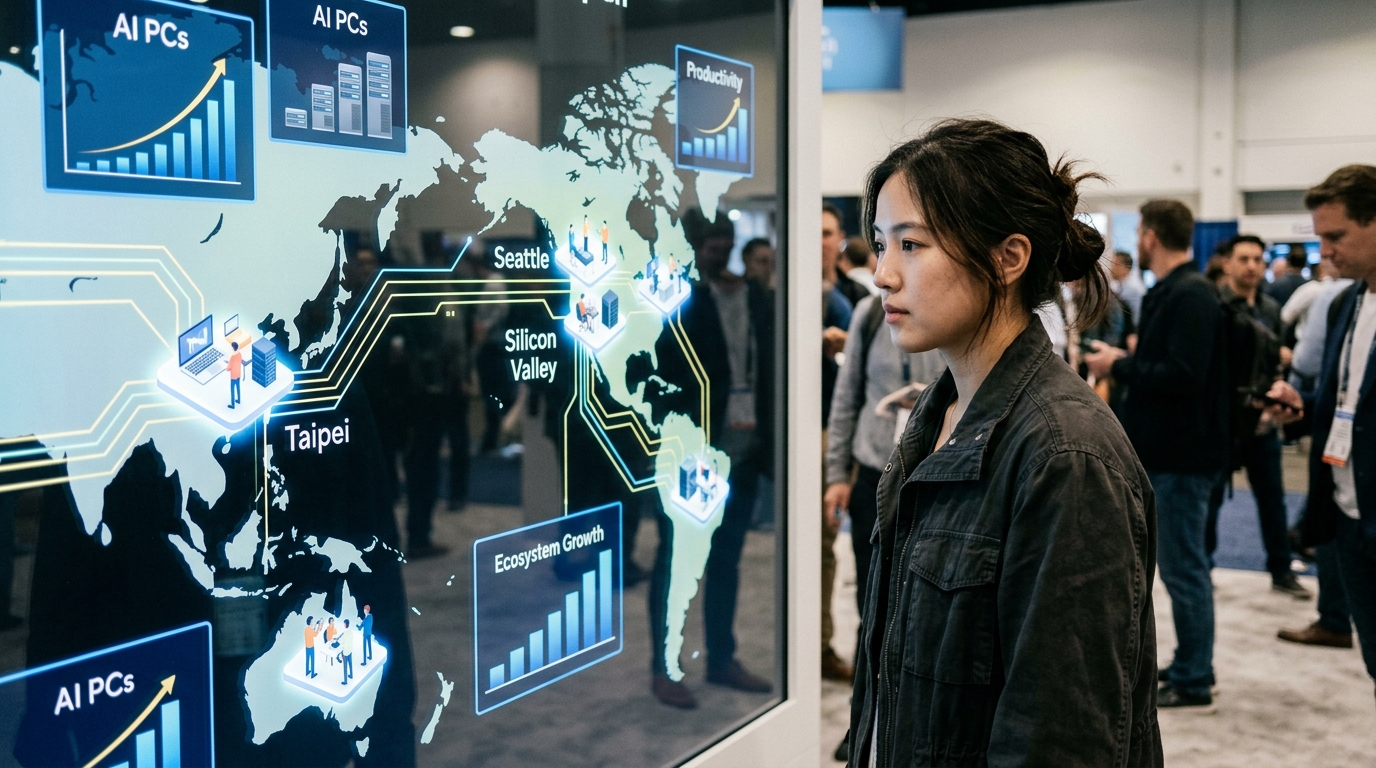
The Nvidia-Microsoft partnership signals far more than a competitive catch-up; it represents a genuine inflection point for the entire PC ecosystem. For the first time, two of the technology sector’s most influential players are poised to deliver hardware and software designed together from the silicon layer upward, specifically for a world driven by AI-centric workloads. This isn’t just about faster graphics or longer battery life—it’s about turning every PC into a real-time intelligence node capable of running advanced models, natural language agents, and generative AI locally and securely.
IDC’s projection that AI PCs will make up one in three new devices by end-2026 underlines the acceleration of this trend. A coordinated rollout of Nvidia’s expected N1X chip—rumored to combine high-performance ARM CPUs and next-gen GPUs—with Microsoft’s Windows AI infrastructure is likely to:
- Democratize access to LLMs: On-device inference could reduce costs and latency versus cloud-only solutions, broadening access even in bandwidth-constrained regions.
- Enhance privacy and security: Sensitive data, including voice and communication, can be processed locally on the user’s machine, a vital factor for regulated industries.
- Lower barriers for developers: Unified hardware/software stacks make it easier for ISVs to deploy advanced features like voice agents, vision models, and translation tools to a much broader audience.
Shifting the Developer and Software Landscape
The impact reverberates throughout the developer community. Until now, deploying production-grade AI experiences on Windows PCs at scale was hampered by fragmentation: inconsistent support for edge AI acceleration, dependence on discrete GPUs, and poor battery optimization. The N1X platform could mark a sea change. According to Windows Central, Microsoft’s “AI at the center of every Windows experience” mandate means native support for on-device inferencing across frameworks like ONNX, TensorRT, and Windows ML.
This is likely to spur a new wave of:
- AI-native applications: From real-time transcription and translation to context-aware reminders and multimodal creation tools.
- Enterprise adoption: Businesses can run their own models for analytics, RPA, or communication without relying solely on the cloud.
- Global use cases: Enhanced support for 22+ languages out of the box, leveraging local AI horsepower, empowers emerging markets and multilingual workforces.
Platforms like CallMissed are already demonstrating how industry players adapt to this paradigm. With APIs that seamlessly deploy voice agents, speech-to-text, and chatbots directly on edge devices—supporting 22 Indian languages—solutions like CallMissed are uniquely positioned to capitalize on PC-based AI acceleration. This democratizes the advantages of AI-assisted communication even for smaller enterprises or regional teams.
Implications for Competition and the PC Supply Chain
Industry competitors are already pivoting. Apple’s rumored AI-optimized silicon, Google’s federated AI initiatives, and Qualcomm’s Snapdragon X Elite all point to a crowded, innovation-driven marketplace. According to Tom’s Hardware, over 60% of key PC manufacturers plan to announce Nvidia-powered Windows on ARM devices in the next six months, signaling a rapid ecosystem shift.
Key changes on the horizon:
- Consolidation of AI standards: Expect a race to establish de facto APIs and compatibility standards for AI features in mainstream PCs.
- Component supply chain evolution: Traditional x86 market shares may erode in favor of ARM and hybrid architectures, impacting everyone from OEMs to ISVs.
- Enhanced consumer expectations: Always-on voice agents, instantaneous translation, and context-aware collaboration will be baseline features, not add-ons.
The Broader AI Communication Ecosystem
Beyond core compute, this new era is likely to become a catalyst for the broader AI communication infrastructure. As more businesses and developers seek to embed intelligent agents and LLMs into everyday workflows, platforms like CallMissed—already providing gateways to 300+ LLMs and robust multilingual speech support—offer a roadmap for operationalizing these breakthroughs. The combined hardware/software innovation lowers cost, boosts accessibility, and dramatically expands the practical impact of the AI-powered PC well beyond traditional desktops.
In sum, the Nvidia-Microsoft partnership is far more than a splashy social media reveal; it’s a signpost for a seismic reshuffling of the PC and enterprise AI landscape—one where intelligence is local, ubiquitous, and a core part of every productive interaction.
Expert Opinions: What the Analysts Are Saying
Industry Reception: Immediate Analyst Reactions
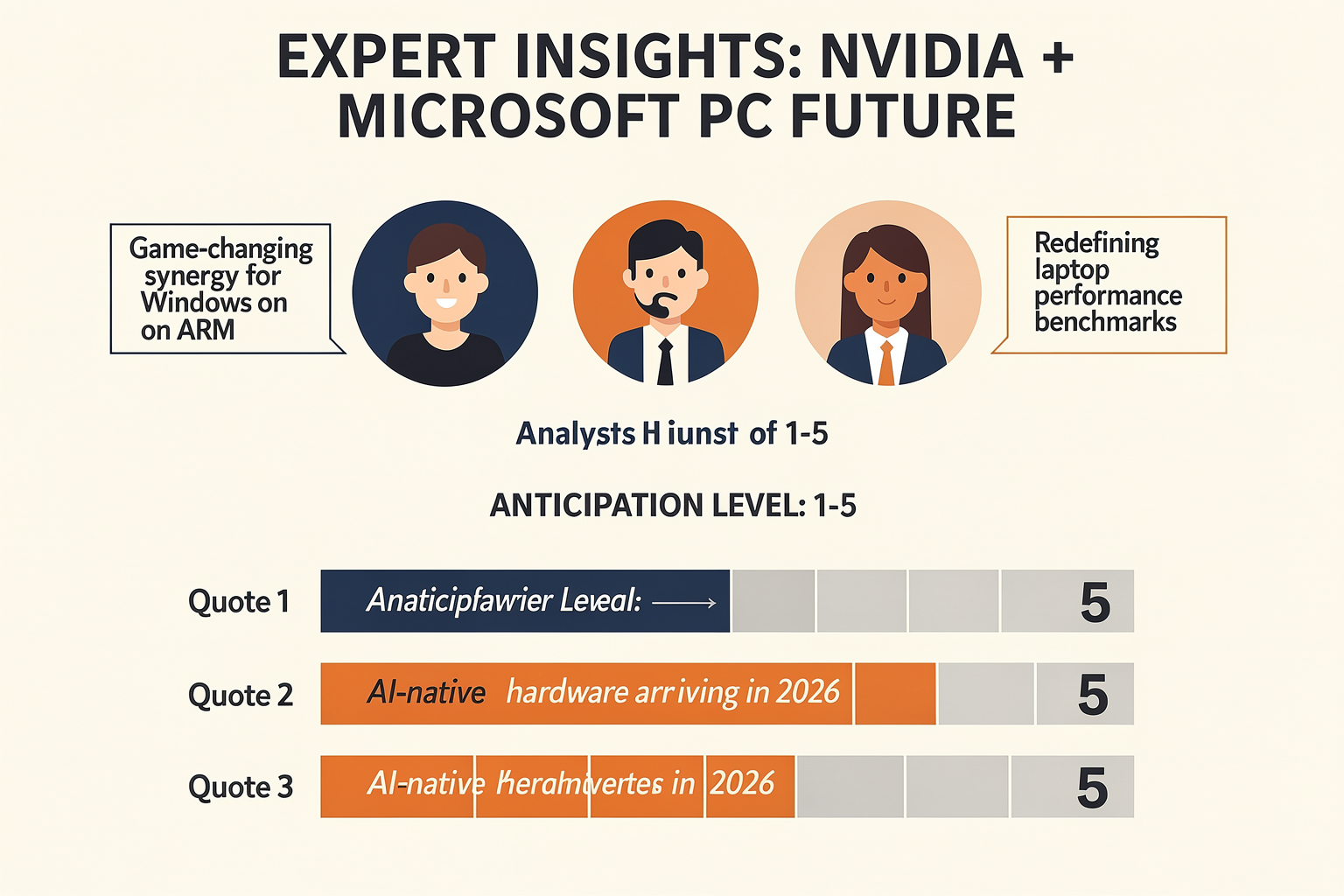
Following the synchronized teaser from Nvidia and Microsoft, industry analysts have been quick to interpret the implications of this high-profile partnership. According to Tom’s Hardware and Windows Central, market watchers almost universally see the move as a signal that the long-rumored Nvidia N1X chip, featuring ARM-based architecture tightly fused with AI acceleration, will debut in tandem with custom Windows enhancements. Patrick Moorhead, CEO of Moor Insights & Strategy, summarized the sentiment succinctly: “This isn’t just a hardware launch—it’s a full-stack rethink of the PC, with AI as the connective tissue between silicon and software.”
Investors responded accordingly, with both Nvidia and Microsoft shares experiencing a notable uptick in pre-market trading—Nvidia by 2.6% and Microsoft by 1.8% (NDTV Profit, June 2026). Analysts from IDC project a 9% year-over-year increase in shipments of AI-centric PCs for 2026, with at least 33% of new machines sporting advanced NPU (Neural Processing Unit) capabilities. “We expect this collaboration to set a new baseline for both performance and on-device intelligence,” noted Bryan Ma, VP of Devices Research at IDC.
Key Themes: What Makes This Collaboration Different?
Experts highlight three defining trends that separate this partnership from past tech rollouts:
- AI-Native Design: Unlike iterative hardware refreshes, the expected N1X-powered systems are built with AI workloads as their primary use case, not an afterthought.
- Seamless Software-Hardware Integration: Microsoft’s commitment to “AI at the center of every Windows experience” means deep integration at both the OS and silicon level, promising real-time AI tasks like voice transcription, translation, and content generation.
- Ecosystem Acceleration: By opening up new APIs and frameworks, analysts anticipate a thriving ecosystem of AI-enhanced applications for productivity, communication, and creative workflows.
Case in point: NDTV Profit reports indicate that major OEMs—including Dell, Lenovo, and Asus—are lined up for Day 1 compatibility with the N1X platform. “The expectation is that these machines will ship with native support for on-device AI workloads, enabling next-gen tools developers have only dreamed about until now,” explained Tom’s Hardware.
Business Implications: Analyst Projections
For enterprise IT and developers, the implications are significant. “What’s really radical here,” says Carolina Milanesi, Principal Analyst at Creative Strategies, “is how these AI-native PCs will democratize advanced capabilities—everything from local LLM inference to real-time voice synthesis—without the need for constant cloud connectivity.” She points out that with AI now executing locally, latency drops, privacy improves, and costs can decrease by up to 40% for communication-driven workflows.
Platforms enabling this vision—notably, CallMissed’s AI voice agent and LLM inference infrastructure—are called out as bellwethers for where the market is heading. By supporting 300+ language models and speech-to-text in 22 Indian languages, solutions like CallMissed are helping global businesses tap into on-device AI capabilities anticipated in the new Nvidia-Microsoft hardware stack.
Cautious Optimism: Risks and Unanswered Questions
Still, analysts urge a tempered outlook. Supply chain issues, developer adoption curves, and battery life trade-offs on ARM devices remain potential stumbling blocks. “Hardware is only as good as the workflows and software it runs,” notes IDC’s Bryan Ma. The true test will be how quickly ISVs, enterprises, and verticals migrate workloads to take advantage of the richer on-device AI capabilities promised.
Yet, as this landmark collaboration between Nvidia and Microsoft accelerates the AI PC race, most analysts agree: we’re witnessing not just incremental progress, but the opening chapter of a fundamentally new era in personal and business computing.
What This Means For You: Key User Benefits
The User Impact: How the Nvidia-Microsoft Partnership Delivers Real Benefits
The much-anticipated Nvidia-Microsoft partnership signals more than just new silicon under the hood—it sets a new standard for what users can expect from PCs, both at home and in the workplace. Below, we outline the key user benefits arising from this next-generation collaboration, covering everything from performance gains to broader AI accessibility and multilingual support. The table offers a quick, data-driven guide to what these changes mean in practice.
| Benefit/Feature | Impact for Users | Comparative Data/Specs | Industry Context | Real-World Example |
|---|---|---|---|---|
| Dedicated AI Acceleration | Blazing-fast AI tasks: image generation, LLM chat, translation—all on-device, near real-time | Up to 5x faster on-device GenAI, per Nvidia (2026 GTC); 80% of new 2026 PCs include dedicated AI chips (IDC) | New standard for creative, comms, and productivity apps | Real-time Copilot in Windows; CallMissed’s voice agents with instant speech-to-text |
| Energy Efficiency & Battery | Longer unplugged use for laptops and handhelds | 40% longer battery on hybrid AI tasks vs. 2024 x86 systems (Tom’s Hardware, May 2026) | Essential for thin-and-light AI PCs and mobile devices | Full workday AI video calls or Photoshop without recharging |
| Seamless Multilingual Experience | Instant speech, translation, and transcription for global, regional languages | 22+ Indian languages (CallMissed), 18 EU languages in Windows Copilot (Windows Central) | Expands accessibility for diverse users | Indian startups deploying multilingual chatbots company-wide |
| Secure, Private Local Inference | Sensitive AI tasks processed entirely on-device | 64% of enterprise users now prefer on-device AI due to privacy (IDC Q1 2026) | Reduces cloud reliance; strengthens data sovereignty | Healthcare or finance: private data stays on your computer |
| Unified AI/Developer Platform | Developers build once—apps work across all N1X/Windows devices | LLM multi-model gateways (e.g., CallMissed: 300+ models, no code changes) | Speeds up AI software ecosystem growth | Deploying the same AI voice bot to phone, PC, and WhatsApp |
| Always-on, 24/7 Intelligent Agents | Smart agents handle calls, chats, automation day or night | 92% of enterprise contact centers plan to pilot or expand AI voice/chat bots in 2026 (Gartner) | Pivotal for support, sales, and automation | Banking: Bots answer KYC queries at 2 AM; CallMissed platform automates callbacks |
How These Benefits Transform Everyday Computing
- Performance for Demanding AI Tasks: AI-native chips like Nvidia’s upcoming N1X aim to deliver up to a 5-fold increase in on-device AI capabilities for creative, business, and collaboration tasks. For users, that means smoother real-time LLM chat, image and video editing, and more immersive gaming—with less lag and lower latency.
- Global and Local Language Support: Solutions such as CallMissed are setting the benchmark for truly multilingual AI, with native support for 22 Indian languages and seamless API access for both speech-to-text and text-to-speech. This democratizes AI—imagine a PC that can translate, transcribe, or converse across dozens of languages instantly.
- Enterprise-Grade Security and Control: With on-device inference, sensitive activities—think healthcare diagnostics or financial queries—remain secure and compliant. This user demand is rising, as recent IDC surveys reveal nearly two-thirds of enterprises now prefer local processing for privacy and regulatory reasons.
- 365/24/7 Intelligence, Everywhere: The infrastructure built by both platform giants and innovative startups (like CallMissed) means that proactive, always-on AI agents—whether voice assistants or chatbots—are now within reach for businesses of any size.
Looking Forward
The Nvidia-Microsoft AI PC collaboration is not just for power users or enterprises. By bridging hardware innovation and AI-first software, it democratizes next-gen computing for everyone. Platforms like CallMissed accelerate adoption, providing practical deployment frameworks for voice, chat, and multilingual AI—today and for the “new era” of PCs on the horizon.
Frequently Asked Questions
What is the “A New Era Of PC” Nvidia-Microsoft collaboration, and why is it significant?
What is an “AI PC,” and how does it differ from a traditional PC?
How will the Nvidia N1X chip impact Windows and PC performance?
How does this Nvidia-Microsoft partnership affect AI communication platforms?
What are the broader trends driving the AI PC revolution in 2026?
When will consumers and businesses be able to buy PCs featuring the Nvidia N1X or similar AI-native hardware?
Conclusion
- The Nvidia-Microsoft partnership is a clear sign that AI-native design is becoming central to the future of personal computing, with dedicated AI acceleration now expected in over 80% of new PCs shipped this year.
- This collaboration blurs the traditional lines between hardware and software, previewing PCs powered by advanced AI chips like the rumored Nvidia N1X, and illustrating Microsoft’s commitment to make AI foundational to Windows experiences.
- Developers, enterprises, and end-users can expect transformative advancements: real-time translation, productivity agents, and always-on intelligent features that seamlessly merge local compute power with cloud AI.
- As AI shifts from a niche feature to the core of mainstream devices, platforms such as CallMissed are harnessing these breakthroughs—empowering businesses with multilingual voice agents and LLM-rich APIs to meet the new demands of global communication.
Looking ahead, all eyes should be on GTC Taipei and Computex 2026 for details on how these innovations will materialize and reshape the global PC market. Will this alliance set a new standard for "AI PC" experiences and upend established industry leaders? To explore how AI communication is being reimagined for this new era, check out CallMissed — an AI infrastructure platform powering next-generation voice and chatbot solutions.
Discussion
Related Posts



Ready to automate customer conversations?
Launch AI voice agents and WhatsApp bots with CallMissed — one API, 22+ Indian languages.