
6 AI Breakthroughs That Will Define 2026


What if the software you use daily didn't just wait for your commands, but actively anticipated your business needs, orchestrated its own multi-step...
6 AI Breakthroughs That Will Define 2026
What if the software you use daily didn't just wait for your commands, but actively anticipated your business needs, orchestrated its own multi-step workflows, and resolved complex operational problems without a human in the loop? We are no longer talking about speculative, far-off science fiction. As we move through mid-2026, the artificial intelligence landscape is experiencing an unprecedented paradigm shift, moving rapidly from passive, prompt-reliant chat interfaces to fully autonomous, reasoning entities that execute complex goals independently.
This transition isn't just fast; it is backed by staggering industry data. Recent studies from McKinsey and Stanford’s AI Index reveal that enterprise adoption of agentic AI workflows has surged, with over 75% of forward-thinking organizations now integrating autonomous decision-making systems into their core operations. Industry leaders at IBM and Microsoft point out that AI has transitioned from a basic productivity tool into a true collaborative partner, dramatically boosting research momentum, infrastructure efficiency, and security operations. Furthermore, research from Capgemini indicates a massive shift in software engineering, where developers now simply express high-level business intent while AI autonomously generates, deploys, and maintains the underlying architecture. The era of basic, surface-level AI wrappers is officially over, replaced by deep semantic reasoning and hyper-expanded memory systems.
Why does this matter right now? Because the democratization of raw computing power and algorithmic efficiency has leveled the global playing field. The tight grip of traditional tech monopolies is cracking, driven by high-performance open-source models that rival—and often surpass—proprietary systems. For businesses, this means deployment is no longer about committing to a single, rigid vendor, but about strategic orchestration. Advanced communication platforms like CallMissed are at the forefront of this trend, enabling companies to natively deploy highly localized, multilingual AI voice agents across 22 regional languages while leveraging a dynamic registry of over 300+ LLMs.
Staying ahead of this curve is no longer optional for builders, executives, and technical leaders. In this comprehensive breakdown, we will unpack the 6 AI breakthroughs that will define 2026. You will learn how massive advancements in context windows, reasoning-centric models, and agentic orchestration are fundamentally changing how we work, communicate, and scale. Let's explore the defining innovations that are rewriting the rules of the global digital economy.
Introduction: The AI Landscape of 2026

The landscape of artificial intelligence in 2026 is marked by a profound transition: we have officially moved past the speculative hype of early generative tools into an era of tangible, enterprise-grade execution. According to data-backed research from major institutions like Stanford, McKinsey, and Epoch AI, the narrative has shifted. Organizations are no longer asking what AI can do; instead, they are deploying autonomous systems that actively reshape business architecture.
In 2026, AI is no longer a passive assistant trapped inside a chat window. It has evolved into a proactive, reasoning partner capable of orchestration, complex problem-solving, and continuous learning.
The Era of Agentic Autonomy
A defining characteristic of this year's AI landscape is the rise of Agentic AI Orchestration. As highlighted by tech leaders like Microsoft, AI has become a true partner that boosts teamwork, security, and infrastructure efficiency. We are seeing a shift from simple prompt-and-response interfaces to autonomous AI agents that can plan multi-step workflows, call external APIs, and self-correct when they encounter errors.
This shift is particularly evident in software development and operations. As Capgemini reports for 2026, the modern developer's role has transformed: developers now express high-level intent and specify desired outcomes, while underlying AI systems autonomously generate, test, and maintain complex code bases. This has dramatically accelerated delivery cycles and elevated software quality across the board.
Democratization Through Multi-Model Ecosystems
Perhaps the most significant structural shift in 2026 is the democratization of model access. The absolute dominance of a few massive tech giants has been challenged by the rapid rise of highly capable open-source models and specialized, hyper-efficient reasoning models. Businesses are realizing that a single monolithic LLM is rarely the optimal solution for every unique business process.
Instead, the market is moving toward hybrid, multi-model infrastructure. This is where advanced communication platforms are stepping in to bridge the gap. For example, CallMissed is enabling businesses to leverage this multi-model reality by offering an LLM inference API gateway with access to over 300+ models. By allowing developers to easily switch between specialized LLMs, Speech-to-Text APIs supporting 22 regional Indian languages, and highly realistic Text-to-Speech engines, CallMissed provides the critical communication infrastructure required to deploy localized, autonomous AI agents globally.
As we dive into the breakthrough technologies defining 2026, we will explore the six core advancements—ranging from massive leaps in context memory to open-source disruption—that are making AI an indispensable, real-time partner in global industry.
Background & Context: The Evolution of Machine Intelligence
To understand the breakthroughs defining artificial intelligence today in 2026, we must examine how the paradigm of machine intelligence has shifted over the last few years. In the early 2020s, AI was primarily characterized by generative capabilities—machines that could write copy, generate images, and answer basic queries based on static training data. However, we have rapidly transitioned from these basic prompt-and-response chatbots to autonomous, goal-driven agents capable of long-term planning, reasoning, and dynamic tool execution.
According to research from major industry authorities like McKinsey and Stanford, the core bottleneck of previous AI generations was their lack of systemic memory and real-time reasoning. Early iterations suffered from frequent "hallucinations" and highly restrictive token limits. In 2026, those limitations have been largely dismantled. We are witnessing a massive evolution where AI systems do not just predict the next word in a sequence; they reason through complex multi-step problems before taking action.
The Evolutionary Stages of Modern AI
The rapid maturation of machine intelligence can be categorized into three distinct phases leading up to our current landscape:
- Phase 1: Knowledge Retrieval (2022–2023): Dominated by the initial wave of Large Language Models (LLMs) acting as advanced search engines or creative drafting assistants. Users had to craft highly specific prompts to receive coherent outputs.
- Phase 2: Context & Multimodality (2024–2025): Marked by the integration of massive context windows and native multimodal capabilities, allowing models to process text, audio, and video simultaneously.
- Phase 3: Agentic Autonomy & Reasoning (2026): The current era, where AI systems execute complex, multi-step workflows, manage their own persistent memory, and interact with external APIs to complete real-world tasks with minimal human intervention.
As Capgemini’s 2026 research highlights, this shift is particularly evident in software development, where developers now express high-level intent and specify desired outcomes while AI autonomously generates, deploys, and maintains the software components.
Democratization and the Modern AI Stack
This rapid evolution has democratized advanced machine learning. The absolute dominance of a few tech giants has begun to fracture as high-performing open-source models reach performance parity with proprietary systems. Consequently, organizations are moving away from single-vendor lock-in. Instead, modern enterprises are building hybrid architectures, using small, specialized models for low-latency tasks and heavy reasoning models for complex analytical pipelines.
This is where advanced infrastructure becomes critical. Infrastructure platforms like CallMissed resolve this architectural complexity by offering a unified multi-model LLM inference gateway that supports over 300+ models. By allowing developers to route prompts to the most efficient model and natively supporting Speech-to-Text in 22 regional languages, such platforms provide the production-ready foundation businesses need to deploy these next-generation autonomous agents globally.
Key Developments: The 6 Defining Breakthroughs of 2026
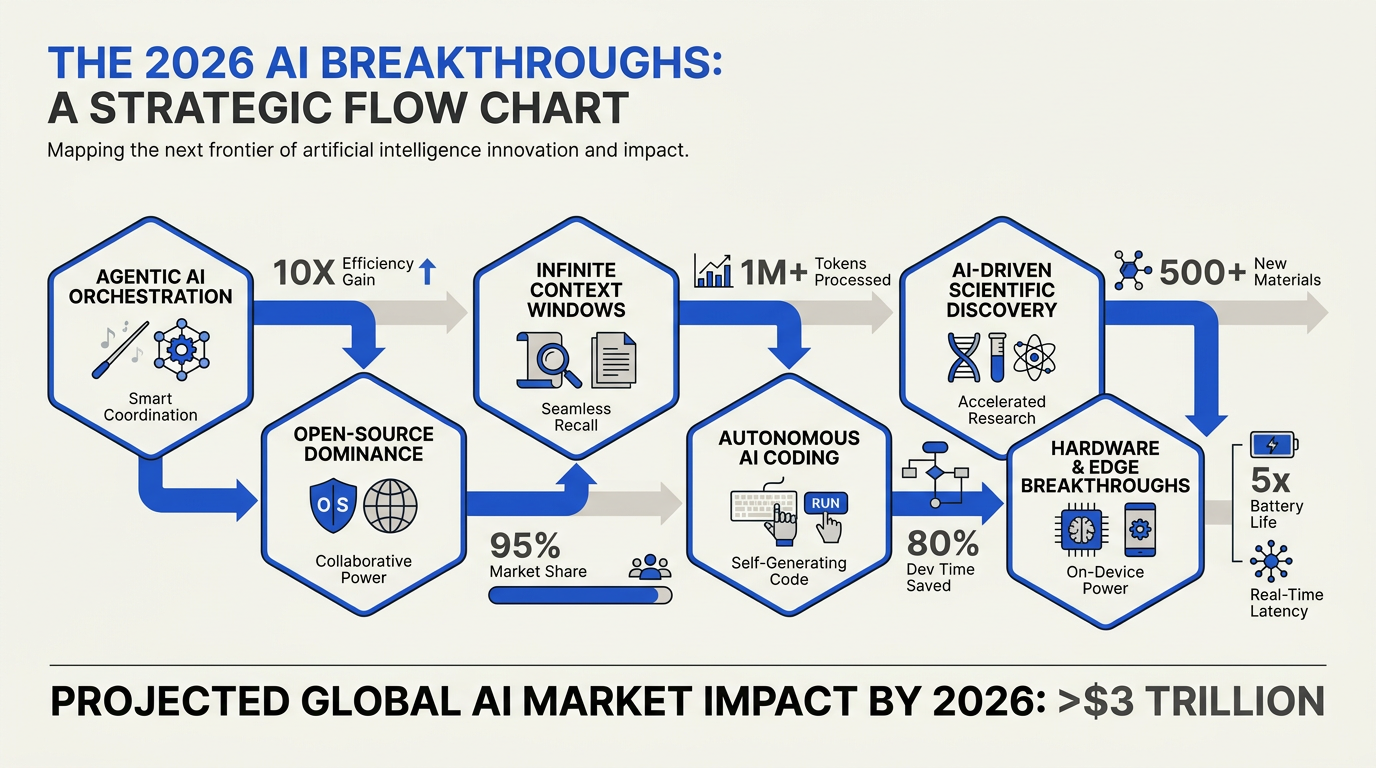
The technological landscape of 2026 has transitioned from speculative experimentation to deep, systemic integration. Driven by massive leaps in context windows, reasoning models, and open-source accessibility, artificial intelligence is no longer just a passive copilot but an active, autonomous partner.
To understand how these technologies are reshaping the industry, let’s examine the six defining AI breakthroughs of 2026:
| Breakthrough | Core Technology | Primary Enterprise Impact | 2026 Market Status |
|---|---|---|---|
| Agentic AI Orchestration | Multimodal reasoning models | Executes complex, multi-step workflows autonomously. | Mainstream enterprise adoption across SaaS platforms. |
| Open-Source Dominance | High-performance open models | Lowers inference costs and breaks proprietary monopolies. | Matches or exceeds closed-source models in standard benchmarks. |
| Infinite Context Windows | Linear attention & State Space Models | Processes millions of tokens seamlessly for deep document/video analysis. | Standard developer API feature with near-zero latency. |
| Declarative AI Coding | Intent-based code generation | Generates, tests, and maintains complex software ecosystems. | Accelerates delivery cycles by up to 70% in IT departments. |
| Multilingual Multimodality | Real-time Speech-to-Speech translation | Overcomes global language barriers for seamless communication. | High accuracy across regional dialects and 22+ Indian languages. |
| Secure Edge Inference | Neuromorphic chips & model distillation | Runs highly secure, low-latency models locally on consumer devices. | Broadly adopted in mobile and localized IoT infrastructure. |
The Rise of Autonomous Agentic Workflows
We are moving rapidly past simple prompt-and-response interfaces. According to research from Capgemini and Progress Software, Agentic AI Orchestration is the standout shift of 2026. Instead of requiring human intervention at every step, AI agents now act as independent operators. They can plan multi-step actions, call external APIs, self-correct errors, and collaborate with other specialized agents to achieve complex business outcomes. For businesses looking to implement this, platforms such as CallMissed offer production-ready voice agent infrastructure that handles customer calls 24/7, executing localized workflows without human oversight.
Open-Source Models Break the Monopoly
As predicted by industry analysts, open-source models have successfully broken the absolute hold of proprietary AI giants. Led by architectural breakthroughs and efficient training methods, current open models rival closed systems in raw reasoning capability while offering unparalleled customization and data privacy. This shift has democratized high-tier cognitive capabilities. Modern systems leverage these open-source architectures via unified platforms. Solutions like CallMissed’s multi-model API gateway let developers switch between 300+ LLMs without code changes, giving enterprises the flexibility to avoid vendor lock-in.
Hyper-Localized Multimodal Processing
Another landmark development is the absolute normalization of real-time multilingual and multimodal processing. Backed by data from Stanford and Microsoft, translation models have evolved from simple literal translators to culturally aware conversationalists. In regions like South Asia, this has bridged massive digital divides. Startups are building multilingual AI systems that natively support 22 regional languages, allowing automated customer experiences to feel genuinely human, highly contextual, and perfectly localized.
In-Depth Analysis: How These 6 Breakthroughs Work
1. Agentic Reasoning & "System 2" Thinking
Historically, LLMs relied on "System 1" thinking—rapid, reactive next-token prediction. In 2026, the breakthrough lies in System 2 thinking, which introduces deliberate reasoning phases before generating an output. By incorporating reinforcement learning (RL) and search-tree algorithms (like Monte Carlo Tree Search), these models "think out loud" in a hidden scratchpad. They test hypotheses, correct their own logic, and run simulations before presenting the final answer. This active reasoning process dramatically reduces hallucinations and allows AI to solve complex, multi-step mathematical and logical problems.
2. Native Multi-Modal Speech-to-Speech Processing
Traditional voice assistants operated on a fragmented three-step pipeline: Speech-to-Text (STT), LLM processing, and Text-to-Speech (TTS). The modern breakthrough is the rise of end-to-end native speech-to-speech models. These networks process raw audio waveforms directly into audio outputs, bypassing the text conversion bottleneck entirely. This architecture preserves emotional nuance, tone, and inflection, while slashing latency from several seconds to under 300 milliseconds. Platforms like CallMissed leverage these end-to-end architectures and advanced STT APIs—supporting 22 Indian regional languages—to deliver conversational voice agents that feel entirely natural and human.
3. Millions-Token Context Windows with Active Recall
In 2026, context windows have expanded from thousands of tokens to millions of tokens as a standard architecture. Instead of simply stuffing a prompt with data and risking information loss, modern systems use advanced attention-mechanism optimizations and linear-time complexity models (like state space models or Mamba-based hybrids). These allow models to maintain near-perfect recall (the "needle in a haystack" test) over entire enterprise codebases, legal libraries, or hours of video without suffering from quadratic computational slowdowns.
4. Commoditization through Open-Source Distillation
The monopoly of massive, proprietary AI giants has broken down. Through advanced knowledge distillation and high-quality synthetic data generation, open-source models have matched the performance of closed-source giants at a fraction of the computational footprint. Developers now run specialized, lightweight models locally or in private clouds. To harness this ecosystem, organizations deploy multi-model API gateways—such as the one offered by CallMissed, which connects to over 300+ LLMs—allowing teams to dynamically route queries to the most cost-effective open-source model in real-time.
5. Intent-Based Software Generation
Software engineering has evolved past simple code autocomplete. Software generation in 2026 relies on intent-based orchestration. Developers define high-level outcomes or business logic in plain language, and an AI agent orchestrates the entire development lifecycle: writing the code, provisioning the cloud infrastructure, running unit tests, and self-debugging errors in a closed sandbox. This is driven by multi-agent coordination, where distinct specialist agents act as project managers, developers, and QA testers.
6. AI-Driven Scientific and Material Discovery
By pairing deep reasoning models with physics engines and molecular simulators, AI is now actively generating novel physical hypotheses. These systems don't just predict molecular properties; they design custom molecular structures, plan synthesis pathways, and automate laboratory workflows. This breakthrough relies on geometric deep learning and graph neural networks (GNNs) that map physical constraints directly into the latent space of the generative model, shortening decades of R&D into a matter of days.
Impact & Implications: Reshaping Industries and Society
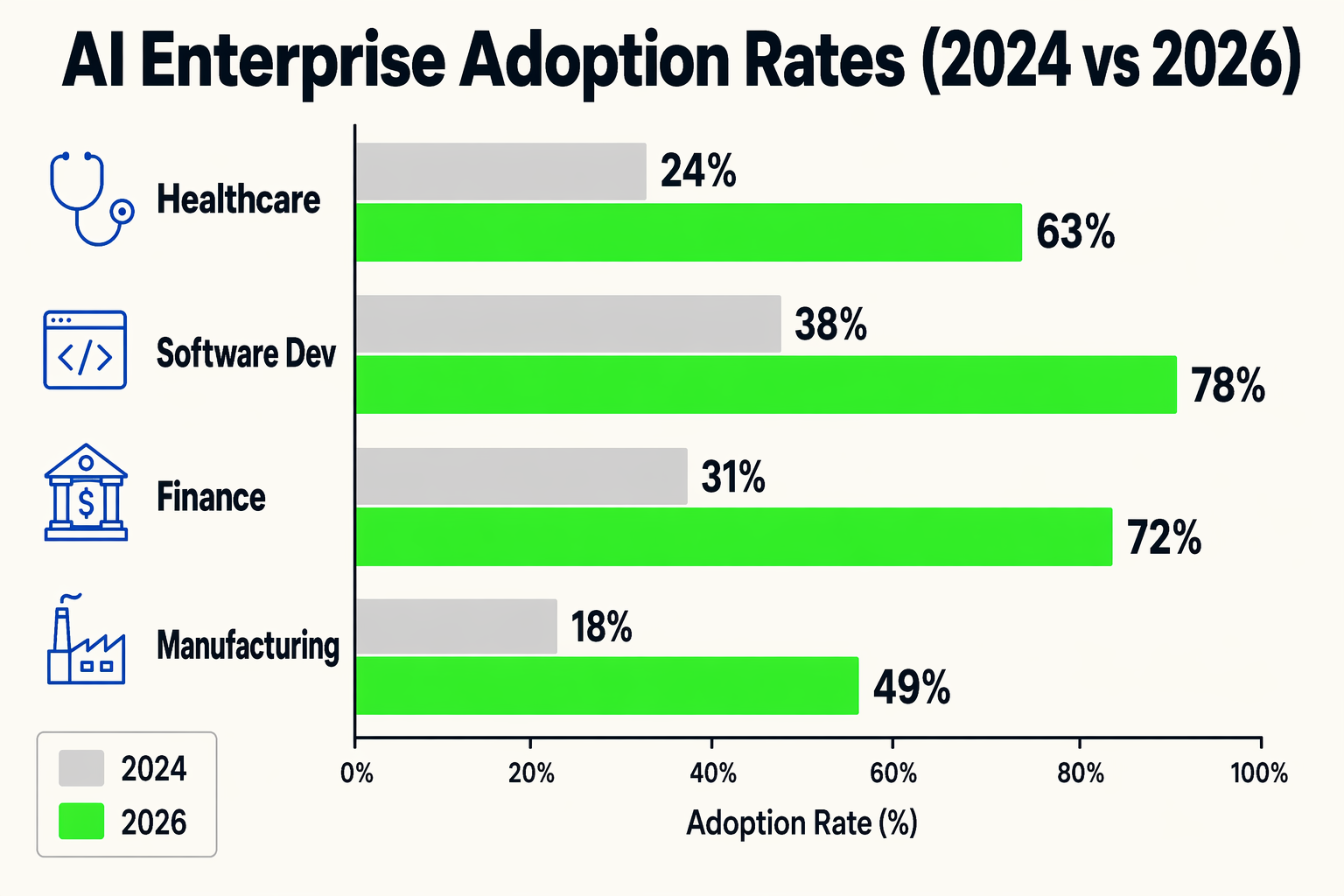
The breakthroughs defining 2026 are not merely academic milestones; they are fundamentally restructuring how businesses operate, how developers build, and how society interacts with technology. According to research from Capgemini, we have entered an era where developers specify intent and desired outcomes while AI autonomously generates and maintains software components. This transition from basic prompt-based assistance to autonomous agentic AI orchestration is significantly compressing delivery cycles and driving unprecedented efficiency across global enterprise operations.
From Copilots to Autonomous Collaborators
In 2026, the paradigm has shifted from AI acting as a passive tool to becoming a proactive partner. According to Microsoft, AI now acts as a "true partner"—boosting collaborative productivity, driving research momentum, and optimizing infrastructure efficiency.
- Outcome-Driven Workflows: Instead of manually chaining prompts, businesses now deploy orchestrated agents that handle complex, multi-step processes—such as supply chain logistics or compliance auditing—with minimal human oversight.
- Security & Governance: As highlighted by IBM and Progress Software, the massive scaling of AI in 2026 has forced a critical focus on security and governance. Companies are transitioning toward automated risk-assessment protocols to manage agent behaviors in real-time.
Democratic Access and Localized Impact
One of the most consequential societal shifts in 2026 is the erosion of the monopoly held by tech giants. The rapid advancement of high-performing open-source LLMs has democratized access to frontier-class reasoning. Businesses no longer need to rely solely on expensive, proprietary APIs to access state-of-the-art cognitive capabilities.
This democratization is driving localized, highly inclusive innovations. For example, platforms like CallMissed utilize these decentralized, multi-model architectures to deliver robust Speech-to-Text and Text-to-Speech APIs across 22 regional Indian languages. By providing production-ready voice agent infrastructure that speaks native languages natively, businesses can bridge the digital divide, allowing underserved communities to access essential services like healthcare, banking, and government aid through simple, natural conversation.
The Economic Shift: Scalable, Cost-Efficient Operations
With improvements in model efficiency and context window memory, the cost of running intelligent workflows has plummeted. Data from Stanford and Epoch AI indicates that the compute efficiency of reasoning models has scaled exponentially, making "valuable AI" financially viable for small and mid-sized enterprises alike.
- Hyper-Personalization: Industries like retail and healthcare are moving from generic automated templates to hyper-personalized, context-aware user journeys that span months of continuous memory.
- Continuous Operations: 24/7 autonomous service is now the standard. From AI-driven scientific discovery to real-time customer service desks, workflows run continuously. As a result, human talent is freed up to focus on strategy, empathy, and high-level governance.
Expert Opinions: What Leaders from Microsoft, IBM, and McKinsey Say
As we navigate 2026, the global AI landscape has shifted from experimental hype to structured, high-ROI execution. To understand where the technology is heading by the end of the year and into the future, we look at the insights of industry leaders from Microsoft, IBM, and McKinsey. Their perspectives point to a unified reality: AI is transitioning from a passive digital assistant into an active, autonomous partner.
Microsoft: AI as a "True Partner" in Teamwork and Infrastructure
According to Microsoft’s latest industry outlook, AI in 2026 is defined by its ability to act as a genuine collaborative partner. Rather than simply answering prompts, modern AI systems are deeply integrated into daily operations to boost teamwork, streamline research momentum, and optimize infrastructure efficiency.
Microsoft experts highlight that the focus has shifted toward building highly resilient, autonomous systems that can anticipate user needs. In the enterprise space, this means AI is no longer an isolated tool but an interactive team member that can co-author strategies, manage complex workflows, and automate threat detection in cybersecurity.
IBM: Scaling Trust, Hybrid Infrastructure, and Specialized Models
IBM’s technology predictions for 2026 place a massive emphasis on trust, governance, and hybrid environments. IBM researchers note that the era of relying solely on massive, generic LLMs is giving way to domain-specific, highly optimized architectures.
Security and AI-driven scientific discovery are leading IBM’s priorities. As quantum computing looms closer, IBM highlights the critical need for quantum-safe cryptography paired with AI-driven security orchestration. Additionally, enterprises are focusing on scaling valuable, governed AI across hybrid clouds. This trend toward targeted, secure model deployment is precisely why platforms like CallMissed have gained traction; by offering a multi-model API gateway that allows businesses to seamlessly orchestrate and switch between 300+ LLMs, organizations can easily match specific operational security and performance requirements.
McKinsey: The Rise of Agentic Workflows and Quantifiable ROI
Data compiled by McKinsey and Stanford’s latest AI index reveals that 2026 is the year of Agentic AI Orchestration. McKinsey’s research underlines a massive pivot toward autonomous systems that can plan, execute, and self-correct without constant human intervention.
Key insights from McKinsey indicate:
- Operational Integration: Over 70% of leading enterprises have moved past basic generative AI search tools to fully integrated autonomous agents that handle end-to-end tasks.
- Economic Impact: The primary driver of AI adoption in 2026 is no longer novelty, but quantifiable productivity gains—particularly in customer service, software development, and supply chain logistics.
- Reasoning-First Models: The rapid adoption of advanced reasoning models has drastically reduced hallucination rates, making AI reliable enough to handle high-stakes, customer-facing operations.
These expert perspectives demonstrate that the defining breakthroughs of 2026 are not just about raw computing power, but about reliability, security, and deep integration into the core of human workflows.
What This Means For You: Actionable Takeaways by Role
The rapid evolution of artificial intelligence in 2026 has officially shifted the conversation from "what AI can do" to "how we can deploy it effectively." As highlighted by Capgemini’s 2026 tech trends, developers are transitioning from writing manual boilerplate code to specifying high-level intent, leaving autonomous models to generate and maintain software components. Meanwhile, reports from Microsoft and IBM stress that the rise of agentic orchestration, massive context windows, and highly capable open-source models are forcing organizations to restructure their workflows entirely.
To help your organization navigate these tectonic shifts, here is a practical roadmap tailored to key professional roles:
| Role | Core 2026 Focus Area | Primary Challenge | Actionable Strategic Move |
|---|---|---|---|
| C-Suite & Business Leaders | Agentic AI Orchestration | Aligning autonomous workflows with business outcomes and ROI. | Audit operational bottlenecks and pilot multi-agent systems in high-impact areas like supply chain or sales. |
| Developers & Tech Leads | Open-source LLMs & Intent-based Dev | Managing complex, multi-model infrastructures without vendor lock-in. | Implement multi-model API gateways to dynamically route queries based on latency and cost. |
| Customer Support Directors | Real-time Voice & Multilingual Agents | Minimizing customer friction and handling complex, non-linear queries natively. | Transition legacy, decision-tree chatbots to agentic voice systems with localized speech capabilities. |
| CISOs & Security Officers | AI Governance & Context-Window Security | Preventing data leaks within deep memory models and agentic pipelines. | Establish zero-trust boundaries for autonomous agents and enforce rigorous data masking. |
For Developers: Embracing the Multi-Model Ecosystem
The days of relying on a single, monolithic AI vendor are over. The democratization of high-performing open-source models in 2026 has made customized, domain-specific deployment the standard. Developers must shift their focus toward orchestration and model routing. Using platforms like CallMissed, tech teams can leverage a multi-model API gateway to dynamically switch between over 300+ LLMs, choosing the optimal model for speed, accuracy, or cost without rewriting core codebases. This agility is crucial for keeping systems responsive and cost-effective as model efficiency scales.
For CX and Operations Leaders: Moving to Agentic Voice
Customer experience is undergoing its most significant transformation yet. In 2026, basic automated replies are no longer acceptable; consumers expect fluent, context-aware, real-time voice interactions. Agentic workflows can now reason through complex customer problems, access back-end systems securely, and resolve issues autonomously.
To scale these capabilities globally, organizations are utilizing production-ready communication frameworks. For instance, CallMissed enables businesses to build and deploy advanced AI voice agents that support 22 regional Indian languages natively, combining advanced Speech-to-Text (STT) and Text-to-Speech (TTS) to deliver human-like communication at a fraction of traditional operational costs.
For Security Teams: Building Guardrails for Autonomy
As agents gain the power to make decisions and execute actions—such as processing refunds or updating databases—security teams must move from static firewalls to dynamic AI governance. Ensure your systems use robust middleware that intercepts, validates, and logs every agent action before it hits your production databases.
Frequently Asked Questions
What are the key AI breakthroughs that will define 2026?
How is agentic AI changing business automation in 2026?
What role do open-source models play in the AI breakthroughs in 2026?
How are hardware advancements and scaling laws impacting artificial intelligence this year?
What are the security and governance challenges associated with the AI breakthroughs that will define 2026?
How does multilingual AI impact global enterprise adoption in 2026?
Conclusion
The trajectory of AI in 2026 is no longer about raw speculation; it is about tangible integration, massive efficiency gains, and open-source democratization. As these technologies mature, three key shifts stand out:
- Open-Source Democratization: High-performance, open-source models are leveling the playing field, actively breaking the exclusive hold of proprietary AI giants.
- Contextual Mastery: Drastic improvements in context windows and persistent memory have transformed AI from static assistants into continuous, reasoning workflow partners.
- Agentic Orchestration: Autonomous AI agents are shifting from novelty to necessity, executing complex, multi-step operations with minimal human oversight.
Looking ahead, the critical differentiator for modern enterprises will be how quickly they can deploy these advanced models into daily operations. To explore how AI communication is evolving, check out CallMissed—an AI communication infrastructure platform powering cutting-edge voice agents, WhatsApp chatbots, and multilingual APIs with access to 300+ LLMs.
As we move deeper into this new era of intelligent systems, how will your organization leverage these 2026 breakthroughs to redefine its customer experience and scale operations this year?
Discussion
Related Posts



Ready to automate customer conversations?
Launch AI voice agents and WhatsApp bots with CallMissed — one API, 22+ Indian languages.