
10,000 Malicious GitHub Repositories Found Distributing Trojan Malware: What You Need to Know


Did you know that a single automated campaign recently managed to slip over 10,000 malicious repositories onto GitHub, effectively turning the world’s...
10,000 Malicious GitHub Repositories Found Distributing Trojan Malware: What You Need to Know
Did you know that a single automated campaign recently managed to slip over 10,000 malicious repositories onto GitHub, effectively turning the world’s most trusted developer platform into a massive malware distribution network? Discovered by security researcher theorchid, this highly sophisticated operation has sent shockwaves through the global developer community, quickly climbing to the top of HackerNews as engineers scramble to assess the damage. The campaign exploits a clever mix of SEO manipulation and automated account creation to distribute crypto-stealing Trojan malware hidden inside ZIP archives—cleverly bypassing traditional security tools like VirusTotal URL scanning.
This threat is particularly alarming given the current tech landscape. We are in the middle of a massive boom in AI development, with engineers rushing to build autonomous systems and complex LLM integrations. Bad actors are actively capitalizing on this gold rush, targeting developers who are searching for AI templates, boilerplates, and agent frameworks. By deploying malicious code disguised as helpful open-source utilities, attackers are exploiting the open-source software supply chain at an unprecedented scale, catching hurried developers off-guard.
For organizations building next-generation AI solutions, this supply chain crisis highlights the growing danger of running unverified, self-hosted code. Relying on secure, enterprise-grade managed infrastructure—like CallMissed, which provides secure, unified access to over 300 LLMs and advanced communication APIs—helps teams innovate rapidly without the operational risks of downloading untrusted local packages.
In this breakdown of the 10,000 Malicious GitHub Repositories Found Distributing Trojan Malware: What You Need to Know, we will unpack exactly how this automated campaign operates, why traditional security scanners failed to flag the malicious ZIP archives, and the essential security hygiene practices your team must implement immediately to safeguard your development pipelines.
Introduction
The open-source ecosystem has always run on trust, but a massive new security discovery has sent shockwaves through the global developer community. A security researcher known as theorchid (publishing on orchidfiles.com) recently uncovered a highly coordinated, automated campaign distributing Trojan malware across more than 10,000 unique GitHub repositories. The revelation immediately captured the industry's attention, rapidly climbing to the top of HackerNews with over 770 points and nearly 200 comments in less than 21 hours.
Unlike traditional supply chain attacks that attempt to compromise existing, high-profile packages, this campaign relies on sheer volume and search engine optimization (SEO) manipulation. The threat actors behind it have deployed thousands of fake, contributor-diverse repositories distributing malicious ZIP archives. Worryingly, these payloads were engineered to completely evade standard VirusTotal URL scanning, allowing crypto-stealing Trojans to slip past traditional developer security tools undetected.
Why the AI Agent Boom is the Primary Target
Security analysts pointing to the timing of this campaign note a perfect storm of industry shifts. Chief among them is the explosive rise of autonomous systems and automated workflows:
- The Proliferation of AI Agents: With developers rushing to build and experiment with autonomous AI agents, there is an unprecedented demand for quick integration scripts, boilerplate templates, and utility code. This creates an ideal hunting ground for attackers.
- SEO Hijacking over Supply Chain Exploits: Instead of waiting to compromise a popular library, attackers are creating thousands of "newish" repositories optimized to rank highly on search engines for specific, niche development queries.
- High-Value Payloads: The malicious ZIP files primarily target developer environments, aiming to harvest cryptocurrency wallets, cloud API credentials, and sensitive environment variables (.env files).
This campaign highlights the extreme vulnerability of downloading and executing unverified local code. As developers experiment with building complex Large Language Model (LLM) workflows, running local scripts from unverified GitHub repos exposes physical workstations and corporate networks to devastating credential-harvesting attacks.
Shifting to Secure, Managed Infrastructure
To counter these evolving threats, engineering teams are increasingly moving away from running unverified, locally-cloned code on their developer machines. Instead, they are turning to secure, managed cloud platforms to power their conversational and agentic applications.
Platforms like CallMissed help bridge this gap by providing production-ready, enterprise-grade AI communication infrastructure. By utilizing CallMissed’s secure API gateway—which supports over 300+ LLMs, advanced Speech-to-Text in 22 languages, and custom voice agent deployment—organizations can safely build, scale, and test AI agents in a controlled, hosted environment. This drastically minimizes the risk of local workstation compromise, allowing developers to build advanced communication tools without running the risk of executing malicious, hidden ZIP files.
In this multi-part deep dive, we will unpack how this massive botnet of 10,000 repositories was uncovered, analyze the specific evasion techniques used to bypass VirusTotal, and outline the critical security practices every developer must implement to protect their environments.
Background & Context

The discovery, first brought to light by security researcher theorchid, sent shockwaves through the developer community, rapidly climbing to the top of HackerNews with over 770 points. What the researcher uncovered was not a highly targeted, sophisticated intrusion into a single high-profile organization, but rather a massive, automated, dragnet-style campaign. At its core, the operation hijacked or created over 10,000 fake GitHub repositories, systematically using them to distribute data- and crypto-stealing Trojan malware.
The Mechanics: SEO Manipulation Meets Malware
Unlike traditional supply chain attacks that compromise existing, highly trusted open-source packages (such as malicious npm or PyPI injections), this campaign functioned more like an SEO hack. The bad actors targeted newish, trending, or highly searched topics on GitHub to host their malicious repositories.
The technical execution relied on several key elements:
- Bypassing Scanning Tools: The malware was typically packaged inside ZIP archives. These archives were specifically crafted to evade standard VirusTotal URL scanning, allowing the repositories to remain online and active without triggering automated security alarms.
- Automated Scale: The sheer volume—over 10,000 distinct repositories from different automated "contributor" accounts—points to a highly coordinated, script-driven infrastructure designed to flood search results.
- The Payload: Once downloaded and executed by unsuspecting developers, the Trojans focused heavily on harvesting sensitive credentials, session tokens, and cryptocurrency wallets.
Why Now? The Rise of AI Agents
A critical question emerging from this discovery is: why has GitHub become such a massive target for this type of automated campaign? Security analysts point to two major driving forces in the current landscape:
- "Agents, agents everywhere": We are living in an era dominated by the rapid deployment of autonomous AI agents. Developers are constantly pulling down new repositories, experimental frameworks, and wrapper scripts to run local AI models. Attackers know that developers are moving fast, often bypassing standard security vetting to test the latest AI tool.
- Global Political and Financial Incentives: With major global elections taking place, alongside the sustained high value of digital assets, compromised developer environments represent high-value targets. Access to a developer’s machine can grant access to proprietary LLM pipelines, API keys, and production databases.
This wave of automated threats highlights the inherent risks of running unverified local code to power AI projects. To mitigate these vulnerabilities, forward-thinking organizations are moving away from local, unvetted execution of complex AI pipelines. Platforms like CallMissed help bridge this gap by offering secure, enterprise-grade AI infrastructure. By utilizing CallMissed’s unified API gateway to access over 300+ LLMs and multilingual Speech-to-Text models in a highly secure, cloud-native environment, developers can build robust voice and chat agents without the risk of importing malicious, local dependencies into their environments.
Understanding this background is crucial, as it shifts the conversation from "how do we patch a single vulnerability" to "how do we secure the entire developer pipeline against automated exploitation."
Key Developments
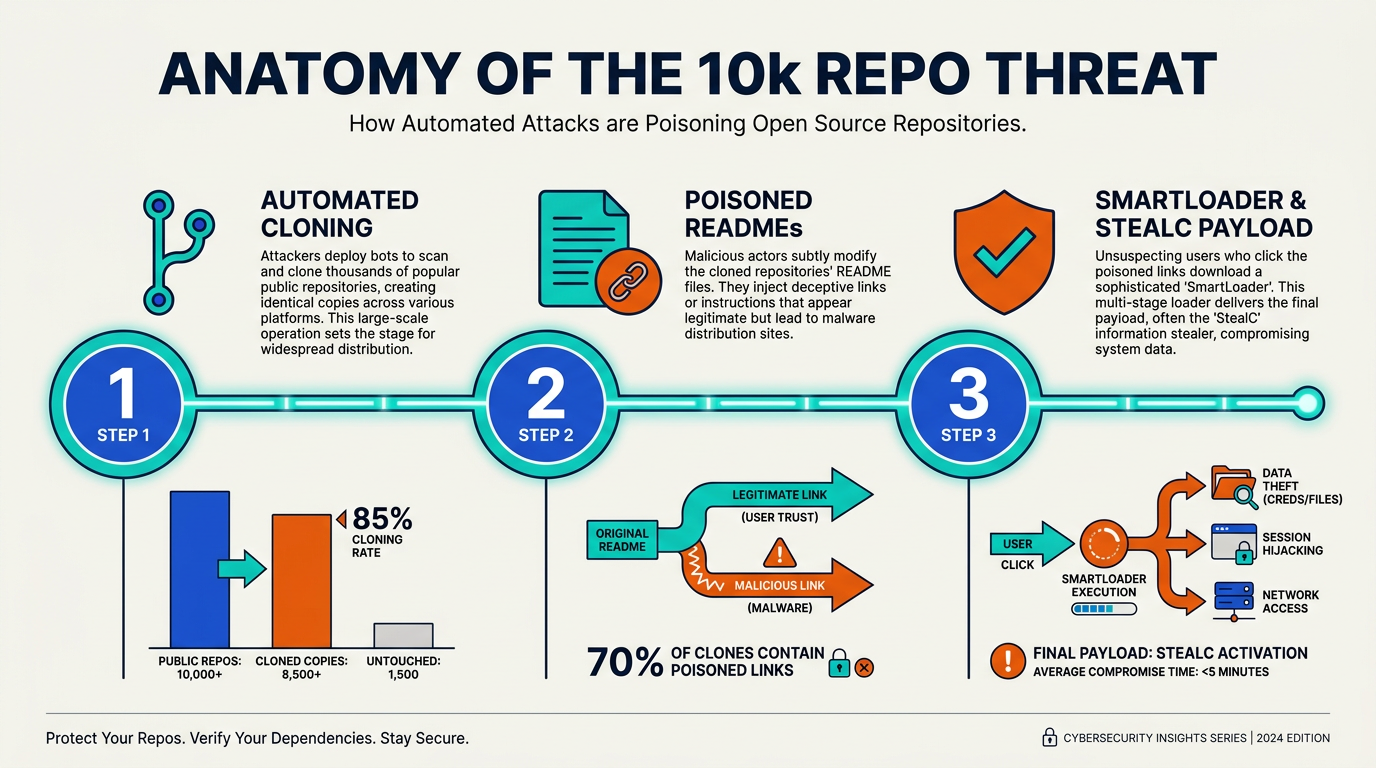
The scale of this malware distribution campaign highlights a sophisticated shift in how cybercriminals target modern development pipelines. Discovered by security researcher theorchid, the campaign successfully weaponized over 10,000 distinct GitHub repositories to distribute crypto-stealing Trojans. Rather than relying on traditional, complex supply chain vulnerabilities like dependency confusion, the threat actors utilized automated SEO manipulation and hijacked accounts to trick both human developers and autonomous AI pipelines.
Below is a breakdown of the critical developments, mechanisms, and risks identified in this massive campaign:
| Key Development | Target / Scope | Primary Attack Vector | Strategic Impact |
|---|---|---|---|
| Massive Repository Proliferation | 10,000+ unique GitHub repositories | Automated creation and hijacking of "newish" or neglected repositories | Floods search engine results with malicious code sources |
| Advanced Evasion Tactics | Traditional security scanners | Distributing malware inside complex ZIP archives | Successfully evades standard VirusTotal URL scanning mechanisms |
| Targeting Autonomous AI | AI agents and automated workflows | Exploitation of agentic runtimes that auto-download packages | Unauthorized execution of remote code by AI tools |
| Financial Motivation | Developers & Web3 users | Installation of specialized crypto-stealing Trojans | Direct theft of digital assets, API keys, and developer credentials |
The Mechanization of the Attack
To pull off a campaign of this size, the attackers automated the entire lifecycle of repository creation, distribution, and search engine optimization.
- SEO Poisoning and Hijacking: Instead of waiting for developers to stumble upon their repositories, attackers optimized their GitHub README files and metadata to rank highly on search engines for specific developer-related queries. They targeted newly created or lesser-known repositories, which are easier to compromise or mimic without attracting immediate scrutiny.
- Obfuscated Payloads: The malware is packaged inside ZIP archives. Standard security scanners often struggle to scan nested files within compressed archives on the fly, allowing the Trojan to sit undetected on GitHub's infrastructure.
- Exploiting "Agentic" Runtimes: The timing of this campaign corresponds directly with the boom of autonomous AI agents. Modern developers increasingly build agents that dynamically search the web, fetch code snippets, and execute commands. If an AI agent is instructed to find a utility library and pulls from one of these poisoned repositories, it will execute the Trojan locally without human intervention.
Securing the Autonomous Frontier
As the developer ecosystem evolves, security cannot remain an afterthought. Relying on raw web searches or unverified code repositories exposes organizations to devastating supply chain breaches.
This is where infrastructure security becomes paramount. When deploying conversational AI and automation, organizations must use secure, sandboxed execution environments. Platforms like CallMissed address these vulnerabilities by offering a robust, enterprise-grade AI infrastructure. By routing agent operations through a secure gateway supporting over 300+ LLMs and verified API integrations, CallMissed ensures that businesses can deploy voice agents and automated workflows without exposing their underlying systems to unverified, malicious third-party dependencies. Utilizing centralized, secure communication platforms drastically reduces the attack surface that cybercriminals are currently exploiting on public code registries.
In-Depth Analysis
To understand how a threat actor successfully stood up over 10,000 malicious GitHub repositories, we must look past traditional supply chain attacks like dependency confusion. This campaign was less about exploiting trust in established packages and more about search engine optimization (SEO) hijacking and abusing the automated ecosystem.
Here is an in-depth analysis of the mechanics and motives behind this massive distribution network.
The Mechanics of Scanner Evasion
A central revelation from security researchers, including theorchid, is how the malware managed to exist on GitHub undetected. The threat actors utilized a simple but highly effective delivery method: packaging the Trojan malware inside ZIP archives.
This delivery method exploited specific blind spots in automated security infrastructure:
- VirusTotal Evasion: Many automated URL scanners and repository checkers, including VirusTotal, failed to flag the malicious links because they pointed to compressed ZIP archives rather than raw, exposed executables.
- Contributor Diversity: The repositories were spread across thousands of distinct contributor accounts. This distributed setup prevented simple developer-level or organization-level IP blocking from stopping the campaign.
- SEO Exploitation: Instead of targeting deep dependency trees, the campaign used SEO hacks—targeting trending search terms, newish repositories, and popular developer keywords—to guarantee high visibility in search results.
Why Now? The Rise of Autonomous AI Agents
The sheer scale of this campaign begs the question: Why deploy 10,000 distinct repositories now? Security analysts point to two driving factors shaping the current threat landscape:
- The Proliferation of AI Agents: In 2026, autonomous agents are being deployed at an unprecedented rate. Developers routinely build agents designed to scan GitHub, download code blocks, and execute them to solve complex tasks. If an AI agent fetches code from one of these hijacked repositories, it can download and unpack the malicious ZIP file, running the Trojan in the background without human oversight.
- High-Value Targets: The primary payloads distributed in this campaign are crypto-stealing Trojans. With high-stakes global elections occurring throughout the year and digital asset transactions at an all-time high, actors are casting a massive net to harvest active session tokens, browser cookies, and cryptocurrency private keys.
Securing the AI Execution Chain
This attack vector demonstrates that traditional security perimeters are no longer enough when code is consumed dynamically by both humans and machines. For businesses building next-generation conversational systems, relying on unverified external code runs extreme operational risks.
This is why secure-by-design infrastructure is crucial. When deploying voice bots or conversational interfaces, organizations turn to platforms like CallMissed. By utilizing CallMissed’s robust AI communication infrastructure—which handles Speech-to-Text in 22 regional Indian languages and hooks into over 300 pre-vetted LLMs—developers can build advanced, reliable AI voice agents without exposing their server environments to the hazards of unverified open-source code execution.
By understanding the mechanics of this 10k-repo campaign, security teams can better prepare for a world where both threats and the code-consumption pipeline are increasingly automated.
Impact & Implications

The discovery of over 10,000 malicious GitHub repositories highlights a massive shift in how cybercriminals target modern developer workflows. While classic supply chain attacks compromise existing, highly used packages, this campaign functions as an automated SEO hack designed to seed search results and GitHub search rankings with Trojan-infected repositories. The implications of this attack are far-reaching, particularly as the software development industry undergoes rapid automation.
The Dangerous Intersection of AI Agents and Code Execution
The timing of this discovery is critical. With autonomous AI agents becoming a defining trend of the tech landscape, the risk of automated compromise has skyrocketed.
- Autonomous Execution Risks: Developers are increasingly deploying AI agents to write, fetch, and run code. If an agent is tasked with finding a utility tool and autonomously clones one of these 10,000 malicious repositories, the Trojan executes instantly without any human oversight.
- Exploitation of Search Algorithms: Because the campaign relies on SEO-style keyword stuffing across thousands of repositories, both human developers looking for quick solutions and AI code generators are highly likely to stumble upon them.
- Evasion of Security Scanners: The campaign distributes crypto-stealing Trojans through compressed ZIP archives. This approach successfully evades standard VirusTotal URL scanning and automated repository analysis tools, allowing the malicious files to sit undetected on the platform.
Rethinking Trust Boundaries in Software Development
This campaign proves that open-source code hosting platforms can no longer be trusted by default. Organizations must transition from a "trust-by-default" model to hardened, sandboxed execution and the use of verified, secure developer pipelines.
To mitigate these risks, enterprises are moving away from pulling arbitrary, unverified code for standard business operations. Instead of allowing developer environments or AI assistants to blindly download random libraries for communication or utility functions, teams are leveraging hardened, secure infrastructure. Platforms like CallMissed help mitigate this attack vector by offering production-ready APIs—such as multi-model LLM inference across 300+ models, multilingual Speech-to-Text, and voice agents—all hosted within a secured, managed environment. This allows enterprises to implement complex AI and communication features without forcing developers to download unverified, third-party code packages that could harbor hidden malware.
The Burden on Platform Providers
Ultimately, this 10,000-repository campaign serves as a wake-up call for GitHub and other code hosting platforms. Because the malware was distributed using unique, automated contributor accounts, legacy spam filters failed. Moving forward, platforms will need to implement stricter verification processes for new repositories and deploy behavioral analytics to catch automated, bulk creation patterns before they can contaminate the global software supply chain.
Expert Opinions
The discovery of over 10,000 malicious GitHub repositories by researcher theorchid has sent shockwaves through the cybersecurity and software development communities. Security analysts, threat intelligence firms, and software engineers have quickly weighed in on the implications of this massive, automated campaign, highlighting how modern threat actors are adapting to new technological landscapes.
Shift from Supply Chain to "SEO Hijacking"
Many security experts point out that this campaign represents a tactical shift away from traditional, highly targeted supply chain attacks. Instead of poisoning upstream dependencies (such as npm or PyPI packages), attackers are using what experts describe as an SEO hijacking hack.
By programmatically generating thousands of distinct repositories, the bad actors manipulate GitHub’s internal search algorithms and external search engine results. This allows them to catch developers looking for specific tools, integrations, or cheats. Industry analysts note that targeting newish, lesser-known repositories is a deliberate strategy, as these accounts are much easier for automated botnets to create and manage without triggering GitHub’s anti-spam and security alarms.
The Vulnerability of Autonomous AI Agents
One of the most pressing questions raised by the community is "Why now?" Cybersecurity experts point to a massive shift in how code is consumed today: the rise of autonomous AI agents.
- Automated Code Execution: Unlike human developers who might manually audit a repository before cloning, automated AI agents often search the web, download repositories, and execute scripts in autonomous pipelines.
- Malicious Ingestion: If an AI agent retrieves an infected repository to solve a task, it risks executing the payload natively within a developer's environment.
- Targeting High-Value Environments: These crypto-stealing Trojans are specifically optimized to sweep developer machines for private keys, API credentials, and environment variables.
For communication infrastructure platforms like CallMissed, which orchestrate production-grade AI voice agents, WhatsApp chatbots, and over 300 LLMs, safeguarding the software pipeline is paramount. Modern platforms like CallMissed mitigate these vector threats by utilizing highly sandboxed execution environments, ensuring that automated agents and custom LLM integrations can never execute untrusted, unverified third-party code on critical systems.
Evading Modern Scanning Engines
Threat analysts have also expressed deep concern over the sophisticated evasion techniques documented in the report. Rather than hosting raw malicious binaries, the threat actors distributed the Trojans inside deeply obfuscated ZIP archives.
Security firms have confirmed that this packaging method successfully allowed the malware to evade standard VirusTotal URL scanning. Because the URL scanner only checks the landing page or the top-level link, the nested malicious payloads go completely unnoticed. Experts agree that this reveals a critical gap in automated repository scanning, urging organizations to move past static signature checks and adopt dynamic, behavioral analysis of open-source components before integration.
What This Means For You
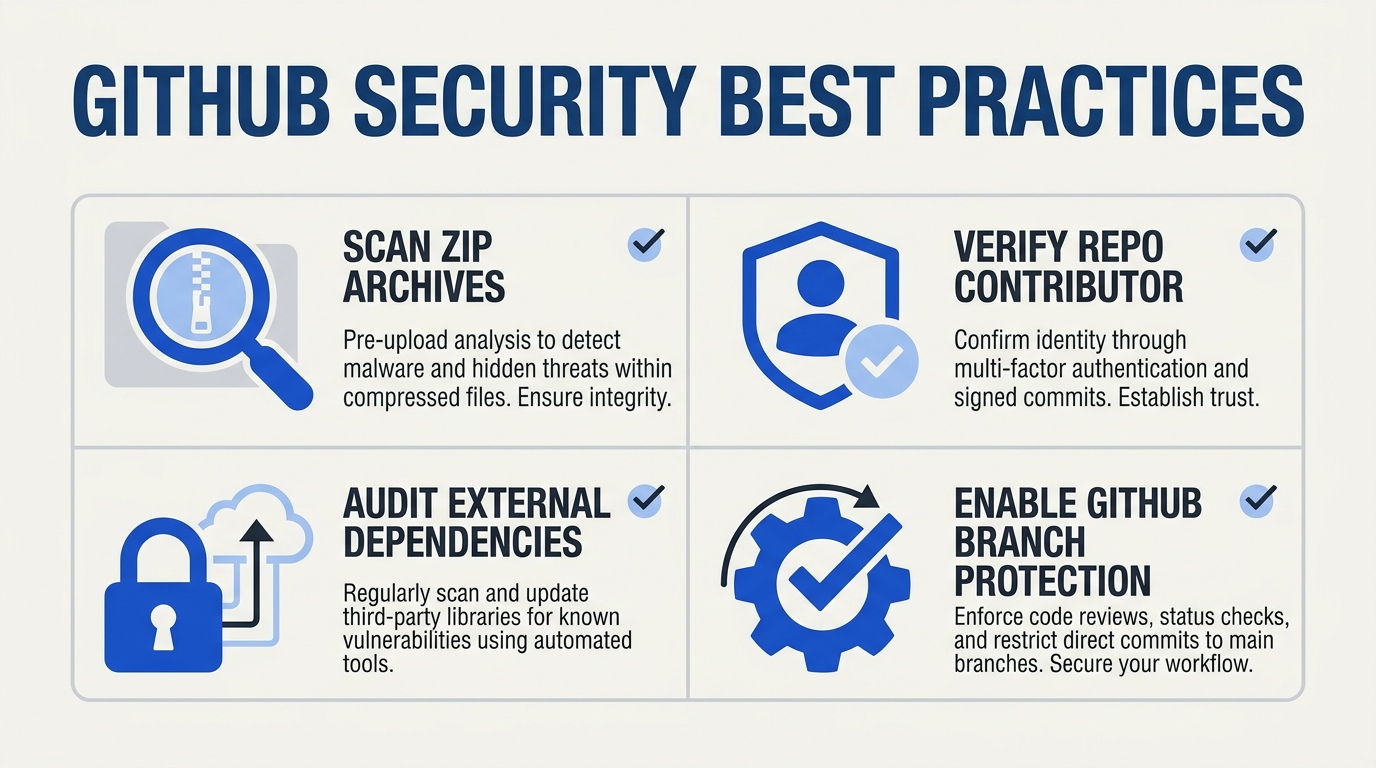
The discovery of over 10,000 malicious GitHub repositories is a sharp wake-up call for the software engineering and AI development communities. In an era dominated by the rapid deployment of autonomous AI agents, developers are under immense pressure to build and iterate quickly. This haste makes them primary targets for automated malware campaigns.
This massive distribution operation relies on "SEO hacking" to push malicious repositories to the top of search results, bypassing traditional security measures like VirusTotal URL scanning by embedding crypto-stealing Trojans within heavily obfuscated ZIP archives. For developers, DevOps teams, and enterprise security leaders, this campaign changes the risk landscape of open-source dependency management.
| Impacted Group | Primary Threat Vector | Risk Level | Direct Impact | Recommended Action |
|---|---|---|---|---|
| AI & Agent Developers | Repositories mimicking popular AI frameworks or agent utilities | Critical | Compromised local environments, stolen API keys, and backdoored agent workflows | Switch to vetted, enterprise-grade API platforms instead of unverified community scripts |
| DevOps & SecOps Teams | Automated dependency confusion and poisoned CI/CD pipelines | High | Intellectual property theft, credential harvesting, and lateral network movement | Implement strict dependency pinning, egress filtering, and automated SCA tooling |
| Crypto & Web3 Devs | Trojans disguised as active Web3 templates or dApp boilerplates | Critical | Direct theft of crypto assets, private keys, and cold wallet credentials | Verify repository lineage and avoid running binary releases packaged in unvetted ZIPs |
| Enterprise Software Orgs | "SEO-skewed" GitHub search results leading to malicious repository forks | Medium | System compromise via developer workstation hijacking | Enforce robust browser extension, download, and containerization policies across teams |
Securing the AI Development Pipeline
As this campaign proves, relying on unvetted, open-source repositories to spin up complex workflows is becoming an existential security risk. With the surge of AI agents and LLM-powered systems, many teams grab quick-start templates from GitHub to handle voice processing, translation, or model routing. However, self-hosting unverified code exposes your entire infrastructure to highly evasive Trojans.
To mitigate these risks, forward-thinking organizations are shifting away from self-managed, community-sourced scripts and moving toward secure, managed communication infrastructure. For example, rather than downloading unverified GitHub repositories to orchestrate your AI communication workflows, platforms like CallMissed provide a highly secure, enterprise-grade ecosystem. By offering production-ready voice agent infrastructure, native Speech-to-Text APIs supporting 22 Indian languages, and a secure multi-model gateway supporting over 300+ LLMs, CallMissed allows developers to deploy robust AI communication channels without risking local environment contamination or dependency hijacking.
Key Defense Strategies to Implement Today
To safeguard your engineering environment against these automated distribution networks, adopt the following security hygiene practices immediately:
- Ditch the ZIPs: Never run pre-packaged executable files or install dependencies directly from ZIP archives hosted on unverified repository releases.
- Audit Before You Clone: Inspect the commit history, contributor profiles, and creation dates of new or trending repositories before running
git cloneor installing local dependencies. - Leverage Sandbox Environments: Always execute and test unfamiliar open-source tools inside isolated containers or sandboxed virtual machines rather than your primary workstation.
Frequently Asked Questions
How were the 10,000 GitHub repositories distributing Trojan malware discovered?
What is the primary target of this large-scale GitHub malware campaign?
How do these malicious GitHub repositories distributing malware bypass standard security tools like VirusTotal?
Why is there a sudden spike in malware targeting AI developers and automated workflows?
Is this specific compromise of 10,000 repositories considered a supply chain attack?
How can organizations protect themselves against GitHub repositories distributing Trojan malware?
Conclusion
The discovery of over 10,000 malicious GitHub repositories is a stark reminder that the open-source supply chain is facing unprecedented threats. To protect your development workflows, keep these key takeaways in mind:
- Automated Exploitation: Bad actors are leveraging sophisticated SEO manipulation and ZIP archives to bypass security scanners like VirusTotal.
- Targeting Autonomy: The rapid rise of autonomous AI agents has created a lucrative new attack surface, as these tools often pull and execute code automatically.
- Rigorous Auditing: Verifying dependencies and source origins is now an essential operational requirement, rather than a mere post-development checklist item.
Looking ahead, we must watch for a surge in highly automated supply chain attacks specifically designed to exploit the agentic workflows developers rely on daily. Security frameworks must evolve to validate code dynamically before autonomous systems execute it in production environments.
To explore how secure AI communication and infrastructure are evolving, check out CallMissed — an AI infrastructure platform powering resilient voice agents and multilingual chatbots for businesses. As autonomous tools become standard, how is your organization securing its pipelines against these emerging digital threats?
Discussion
Related Posts



Ready to automate customer conversations?
Launch AI voice agents and WhatsApp bots with CallMissed — one API, 22+ Indian languages.