

Everything You Need to Know About GPT-5.6 Terra: OpenAI’s Balanced AI Model for 2026


GPT-5.6 Terra explained after its July 9 rollout: official pricing, Sol and Luna comparison, capabilities, use cases, and deployment guidance.
Everything You Need to Know About GPT-5.6 Terra: OpenAI’s Balanced AI Model for 2026
Did you know that OpenAI’s newest mid-tier AI model can process up to 1.5 million tokens of data—equivalent to over a thousand pages of text—at roughly half the cost of previous flagship models? Introduced in June 2026 as part of OpenAI's highly anticipated three-tier model family, GPT-5.6 Terra represents a massive paradigm shift in how enterprises approach generative AI. Positioned strategically between the ultra-powerful GPT-5.6 Sol and the lightning-fast, budget-friendly Luna, Terra is designed to be the ultimate daily workhorse for agentic workflows, complex coding, and cybersecurity operations.
This development matters immensely right now because the economics of AI deployment are shifting from pure raw capability to cost-effective, high-volume performance. While OpenAI’s previous breakthrough, GPT-5.5, set new benchmarks for complex research, it remained cost-prohibitive for sustained, agent-driven enterprise operations. GPT-5.6 Terra solves this dilemma by matching the core cognitive performance of GPT-5.5 while slashing execution costs by 50%. However, because OpenAI is staggering the release of the 5.6 suite in a limited preview—partially at the request of government authorities seeking to evaluate its advanced autonomous capabilities—navigating access is more complex than ever.
As organizations prepare for this new era of cognitive automation, managing diverse model architectures is becoming a critical operational challenge. Platforms like CallMissed are already easing this transition, allowing developers to orchestrate complex voice agents and conversational workflows by seamlessly switching between newly released models like GPT-5.6 Terra and over 300 other LLMs via a unified, production-ready API.
In this comprehensive guide, we will dive deep into everything you need to know about GPT-5.6 Terra. We’ll explore its impressive 1.5-million-token context window, compare its benchmarks against Sol and Luna, and analyze the practical cost efficiencies that make it the smartest choice for enterprise automation in 2026. Whether you are looking to deploy autonomous coding agents or scale your data analysis pipelines, here is your roadmap to OpenAI's most balanced model yet.
Introduction: Meet GPT-5.6 Terra, OpenAI's Balanced Mid-Tier Workhorse

Answer first: GPT-5.6 Terra is OpenAI’s balanced mid-tier model for teams that want a practical mix of capability and price. Businesses should choose Terra for production workloads that may need more depth than the lower-cost GPT-5.6 Luna, but do not require the premium GPT-5.6 Sol for every request.
As of July 10, 2026, Terra is no longer a limited-preview model. OpenAI publicly rolled out the GPT-5.6 family on July 9, 2026, with availability across ChatGPT, the API, and Codex.
Confirmed GPT-5.6 Pricing
OpenAI lists the following API prices per 1 million tokens:
- GPT-5.6 Sol: $5 input / $30 output
- GPT-5.6 Terra: $2.50 input / $15 output
- GPT-5.6 Luna: $1 input / $6 output
These prices establish Terra’s place in the lineup. It costs half as much as Sol for both input and output tokens, while Luna remains the least expensive GPT-5.6 option.
Pricing alone does not prove which model will deliver the best results for a particular application. Actual cost and performance will depend on prompt length, output length, tool use, retry rates, latency, and how often a workflow must escalate to a more capable model.
Who Should Choose GPT-5.6 Terra?
Terra is the logical starting point for organizations evaluating GPT-5.6 for everyday production use. Potential workloads include:
- Software development: Code generation, debugging, refactoring, test creation, documentation, and repository analysis.
- Agentic workflows: Assistants that plan tasks, call tools, process intermediate results, and recover from errors.
- Customer operations: Ticket summarization, response drafting, escalation support, and policy-aware assistance.
- Data and document work: Structured extraction, report generation, spreadsheet analysis, and internal knowledge workflows.
- Security operations: Alert enrichment, incident summaries, log interpretation, and analyst assistance.
These are appropriate evaluation targets, not guaranteed performance claims. Teams should test Terra with their own prompts, data, tools, and acceptance criteria before replacing an existing production model.
Terra vs. Sol vs. Luna
The simplest way to think about the GPT-5.6 family is by workload priority:
- Choose GPT-5.6 Sol when maximum model capability matters more than price, especially for unusually difficult reasoning or high-stakes work.
- Choose GPT-5.6 Terra when you need a balance between model capability and operating cost across general production workloads.
- Choose GPT-5.6 Luna when low cost and high request volume are the main priorities, particularly for simpler classification, extraction, routing, or summarization tasks.
Many businesses will not need to select only one. A routing strategy can send routine requests to Luna, standard production work to Terra, and the hardest cases to Sol.
What Businesses Should Test First
Now that GPT-5.6 is publicly available, teams can move from release speculation to controlled comparisons. A useful Terra evaluation should measure:
- Task success rate on representative production requests.
- Total cost per completed task, including retries and escalations.
- Latency at typical and peak traffic levels.
- Code quality using internal bugs, tickets, repositories, and regression tests.
- Tool-use reliability across multi-step workflows.
- Document accuracy when working with policies, contracts, transcripts, or knowledge bases.
- Security and compliance behavior before sensitive data is introduced.
- Fallback performance when Terra cannot complete a request successfully.
Avoid migrating every workflow at once. Start with a limited traffic share, compare Terra with current models, and expand deployment only when the results justify it.
A model-routing layer such as CallMissed can help teams compare Terra with Sol, Luna, and models from other providers without hard-coding every workflow to one model. That flexibility is useful when optimizing for quality, latency, availability, and cost as real-world GPT-5.6 performance data emerges.
Background & Context: The Birth of the GPT-5.6 Family
The public rollout of the GPT-5.6 family on July 9, 2026 reflects OpenAI’s shift away from a one-model-fits-all strategy. Instead of requiring every workload to use the most powerful—and most expensive—model, the family offers three options with distinct balances of capability, speed, and cost.
This tiered approach allows organizations to select a model based on the needs of each task, from demanding reasoning workloads to high-volume, latency-sensitive applications.
The Three Pillars of the GPT-5.6 Suite
OpenAI positions the three GPT-5.6 models as follows:
- GPT-5.6 Sol: The flagship model, intended for workloads that require the family’s highest level of capability. Sol costs $5 per 1 million input tokens and $30 per 1 million output tokens.
- GPT-5.6 Terra: A capable, lower-cost option that balances performance and price. Terra costs $2.50 per 1 million input tokens and $15 per 1 million output tokens—half the corresponding Sol rates.
- GPT-5.6 Luna: The fastest and most cost-efficient model in the family. Luna costs $1 per 1 million input tokens and $6 per 1 million output tokens.
These options give developers a straightforward way to match model spending to workload requirements without defaulting to the flagship for every request.
From Preview to Public Rollout
Following its earlier preview phase, the GPT-5.6 family entered public rollout on July 9, 2026. Sol, Terra, and Luna should therefore be discussed as publicly released models rather than systems still awaiting general availability.
The rollout also clarifies Terra’s role in the lineup. It is not the flagship or the lowest-cost model; it is the middle option for teams seeking substantial capability at a lower price than Sol.
Navigating the Multi-Model Era
For businesses, the GPT-5.6 release reinforces the value of model routing. A workflow can use Luna when speed and cost efficiency are paramount, Terra when a stronger balance of capability and price is required, and Sol for tasks that justify flagship-level performance.
Platforms such as CallMissed can help businesses build this kind of orchestration into their communication workflows. Rather than tying every interaction to one model, teams can route requests according to complexity, latency requirements, and budget—making Terra a practical default for many workloads while preserving access to Sol and Luna when their respective strengths are a better fit.
Key Developments: Comparing Sol, Terra, and Luna (TABLE)
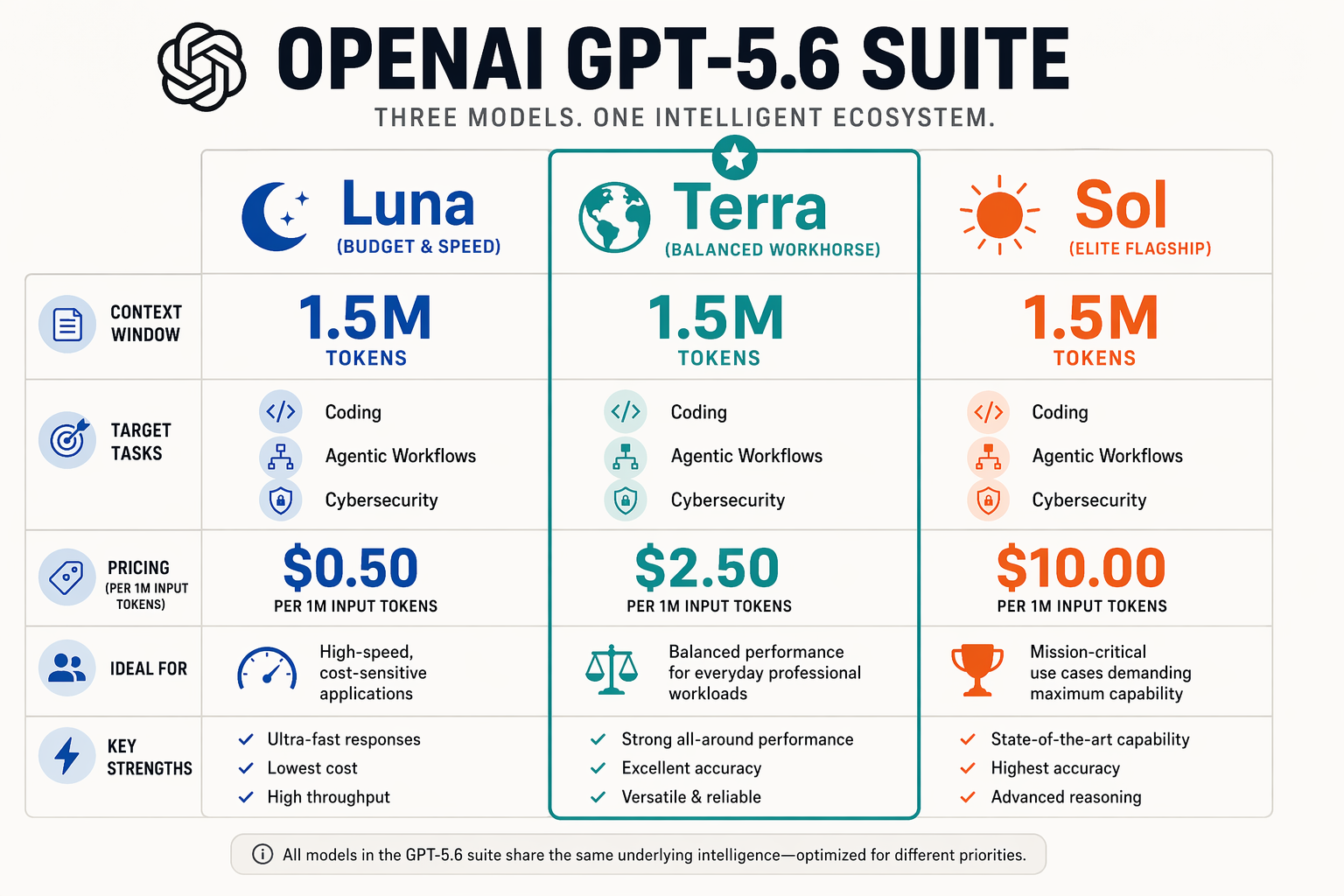
To understand OpenAI’s July 2026 multi-tier strategy, it helps to compare the three GPT-5.6 sibling models not just by capability, but by rollout maturity and operational fit. The reported July 9 rollout positioning makes the split clearer: GPT-5.6 Sol is the flagship model for maximum reasoning depth, GPT-5.6 Terra is the balanced production model for sustained agentic workloads, and GPT-5.6 Luna is the fast, low-cost option for high-volume interactions.
The practical takeaway is that GPT-5.6 is not a single-model upgrade path. It is an orchestration stack. Teams should test each model against the workload it was designed for rather than assuming the most powerful model is always the best production choice.
| Model | July 9 Reported Rollout Status | Target Use Case | Context Window | Relative Cost | Core Advantage | Recommended First Tests | Rollout Caveat |
|---|---|---|---|---|---|---|---|
| GPT-5.6 Sol | Flagship tier; reported as the premium-capability model with more limited/controlled rollout access | Frontier research, advanced math, cryptography, high-stakes autonomous reasoning | Up to 1.5M tokens | High / premium | Maximum autonomous capability | Benchmark against your hardest unresolved reasoning tasks, long-horizon planning, scientific or mathematical evaluation sets | Do not use as the default for every request until cost, latency, and access limits are validated |
| GPT-5.6 Terra | Balanced production tier; reported as the main model for broader enterprise and agentic deployment | Agentic workflows, coding, cybersecurity, long-document analysis, complex support automation | Up to 1.5M tokens | Medium; positioned below Sol | Best balance of reasoning depth, cost control, and production reliability | Run side-by-side tests against GPT-5.5 or your current production model on coding agents, escalation handling, and multi-step workflow completion | Validate tool-use behavior, memory handling, and spend controls before migrating always-on agents |
| GPT-5.6 Luna | Fast/low-cost tier; reported as the high-throughput model for latency-sensitive workloads | Transactional chat, routing, classification, short-form responses, voice-agent turns | Up to 128k tokens | Lowest / ultra-budget | Sub-second-style responsiveness and efficient scaling | Test intent detection, FAQ answers, call routing, summarization snippets, and high-volume classification queues | Not intended for the deepest reasoning tasks; route complex escalations to Terra or Sol |
| GPT-5.5 (Legacy) | Existing baseline for teams that have not yet migrated to GPT-5.6 | General-purpose enterprise workloads | 1M tokens | High / legacy flagship pricing | Familiar behavior and established integrations | Use as a control group when measuring GPT-5.6 quality, latency, and cost improvements | Migration should be benchmark-driven rather than automatic |
Navigating the Trade-Offs: When to Deploy Terra
The July 9 rollout framing reinforces why GPT-5.6 Terra is likely to be the default starting point for many production teams. Sol may be the most capable model in the family, but Terra is positioned as the model that best fits everyday enterprise AI: strong reasoning, long-context support, and more predictable operating costs.
That matters most for long-running autonomous workflows. A customer support agent that reads account history, checks policy, calls tools, drafts a response, and decides whether to escalate does not always need the most expensive flagship model. It needs consistent reasoning, stable tool use, and an economic profile that can survive thousands or millions of interactions. That is Terra’s role in the GPT-5.6 lineup.
When deciding which model to deploy, engineering teams should follow a simple framework:
- Choose Sol when accuracy and reasoning depth matter more than cost: frontier research, advanced simulations, scientific discovery, difficult mathematical reasoning, or high-stakes multi-step analysis.
- Choose Terra for production workhorses: coding agents, automated security patching, complex customer support, long-document contract review, internal knowledge assistants, and multi-step business workflows.
- Choose Luna for fast, high-volume interactions: voice-agent responses, routing, classification, FAQ handling, short summaries, and transactional chat where latency and cost are the primary constraints.
- Keep GPT-5.5 as a benchmark during migration so teams can measure whether GPT-5.6 improves quality, cost, or latency for their actual workloads.
For modern organizations, managing these tiers should not mean hard-coding brittle routing rules across every application. Unified communication platforms like CallMissed can help teams orchestrate model selection by workload. For example, a voice agent can use GPT-5.6 Luna for fast, low-cost call handling, route complex account-specific questions to GPT-5.6 Terra for deeper analysis, and reserve GPT-5.6 Sol for rare cases where maximum reasoning capability is justified.
The key is to treat the GPT-5.6 family as a routing strategy, not a simple upgrade ladder. Start with Terra for balanced production tests, add Luna where speed and volume dominate, and reserve Sol for the moments where its flagship reasoning advantage clearly outweighs its higher cost.
In-Depth Analysis: Performance, Features, and 1.5M Token Context Window
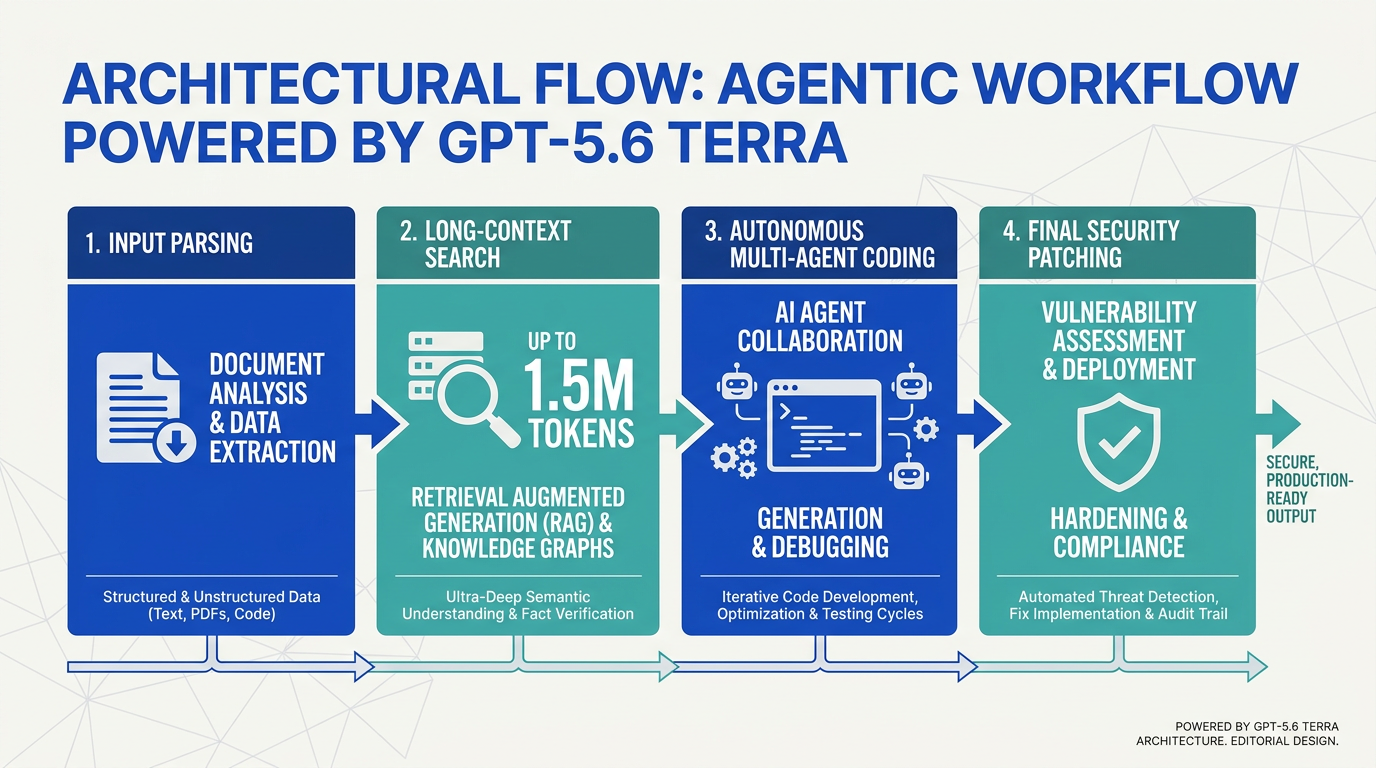
The core of GPT-5.6 Terra’s appeal lies in its technical specifications, which strike an unprecedented balance between raw cognitive power, massive data capacity, and economic feasibility. Rather than forcing enterprises to choose between the cost-prohibitive reasoning of a flagship model and the limited capabilities of a lightweight one, Terra serves as the high-utility middle ground built for real-world production.
The 1.5 Million Token Context Window: Redefining Enterprise Memory
One of the most notable engineering achievements of the GPT-5.6 lineup is Terra's massive 1.5 million token context window. In practical terms, this allows the model to process over 1,000 pages of text, massive multi-file codebases, or complex regulatory frameworks in a single query.
- Long-Horizon Comprehension: Terra can ingest entire repositories of technical documentation, allowing developers to perform deep-system debugging or analyze complex software architectures without chunking data or losing crucial contextual relationships.
- Multimodal Input Support: The model natively handles complex combinations of code, text, charts, and diagrams, making it highly effective for multi-step visual and data analysis pipelines.
Built for Agentic Workflows and Deep Reasoning
Beyond memory capacity, Terra is specifically optimized for agentic workflows—autonomous processes where an AI agent must plan, execute, and self-correct over extended periods. Because agentic operations require repeated API calls, previous models like GPT-5.5 were often too expensive to deploy at scale. Terra solves this problem by matching the core cognitive performance of GPT-5.5 while running 2x cheaper (representing a 50% reduction in execution costs).
In early benchmark previews, Terra has demonstrated performance that is virtually indistinguishable from GPT-5.5 in standard coding evaluations (such as HumanEval) and reasoning tasks, yet its operational footprint is drastically minimized. This makes it the ideal engine for:
- Autonomous Coding Agents: Generating, testing, and refactoring code across multiple directories.
- Cybersecurity Support: Ingesting massive network logs, parsing threat intelligence feeds, and conducting automated vulnerability assessments.
- Comprehensive Data Analysis: Parsing complex, unstructured datasets to identify trends and generate real-time executive reports.
Navigating the Multi-Model Ecosystem
While GPT-5.6 Sol remains the choice for frontier-level mathematics and scientific research, and GPT-5.6 Luna is optimized for low-latency, high-volume tasks, Terra is the undeniable sweet spot for 90% of standard enterprise operations.
For organizations looking to deploy these models without rewriting their entire infrastructure, integration platforms are becoming essential. Solutions like CallMissed’s multi-model API gateway allow developers to dynamically orchestrate their workflows. By using CallMissed, a business can leverage GPT-5.6 Terra for deep, context-heavy reasoning—such as analyzing a customer's entire transactional history during an interaction—while routing immediate, low-latency conversational responses to faster, more economical models, ensuring optimal performance at the lowest possible price point.
Impact & Implications: Transforming Everyday Coding and Cybersecurity Operations

The unique positioning of GPT-5.6 Terra as a highly capable, cost-efficient mid-tier model is poised to reshape two of the most compute-intensive domains in technology: software engineering and cybersecurity. By offering the cognitive depth of GPT-5.5 at half the execution cost, Terra transitions these fields from experimental, one-off AI assistance to continuous, autonomous agentic operations.
Revolutionizing Software Engineering and Agentic Coding
For developers, the primary bottleneck of previous-generation LLMs was the trade-off between context limits and operational costs. GPT-5.6 Terra removes this barrier by combining deep comprehension with unprecedented scale:
- Whole-Codebase Ingestion: Powered by its massive 1.5-million-token context window, software engineers no longer need to chunk code or selectively upload files. Terra can digest entire repositories, legacy codebases, and complex API documentation simultaneously.
- Continuous Agentic Loops: Building autonomous coding agents—which continuously write tests, refactor code, and debug CI/CD pipelines—historically incurred astronomical API bills. Because Terra is 2x cheaper than premium flagship models while matching the core programming proficiency of GPT-5.5, running persistent agentic developer environments is now commercially viable for mid-sized enterprises.
- Legacy Code Migration: Early feedback shows that Terra excels at multi-file architecture planning and complex logic translation, making it the ideal engine for modernization projects, such as migrating legacy systems to modern, cloud-native frameworks.
Elevating Cybersecurity Operations and Threat Detection
In cybersecurity, speed and volume are the ultimate battlegrounds. Security Operations Centers (SOCs) are constantly flooded with millions of alerts, many of which go unanalyzed due to resource constraints. Terra alters this dynamic by enabling deep, automated triaging.
- Massive Log Analysis: Security analysts can feed entire server logs, network packets, and system configuration state snapshots into Terra’s context window to detect subtle indicators of compromise (IoCs) that span multiple systems and dates.
- Autonomous Threat Hunting: Terra can act as an on-call, tier-1 security analyst. It can autonomously trace malware signatures, interpret obscure assembly code, and draft comprehensive incident response summaries in real time.
- Proactive Vulnerability Remediation: Instead of just identifying security loopholes, Terra's agentic coding capabilities allow it to draft, test, and propose secure code patches directly into development pipelines, accelerating patch management.
To operationalize these capabilities, organizations must manage a diverse ecosystem of AI models. Platforms like CallMissed make deploying these agentic workflows effortless. By providing a production-ready API gateway to seamlessly switch between GPT-5.6 Terra for heavy logical analysis and faster, lighter models for quick notification routing, CallMissed ensures that enterprises can orchestrate complex, multi-model pipelines without infrastructural bottlenecks.
Ultimately, GPT-5.6 Terra bridges the gap between high-level cognitive tasks and daily operational realities, proving that the most transformative AI is not always the most expensive one.
Expert Opinions: Why the Balanced Tier Model Wins the AI Race
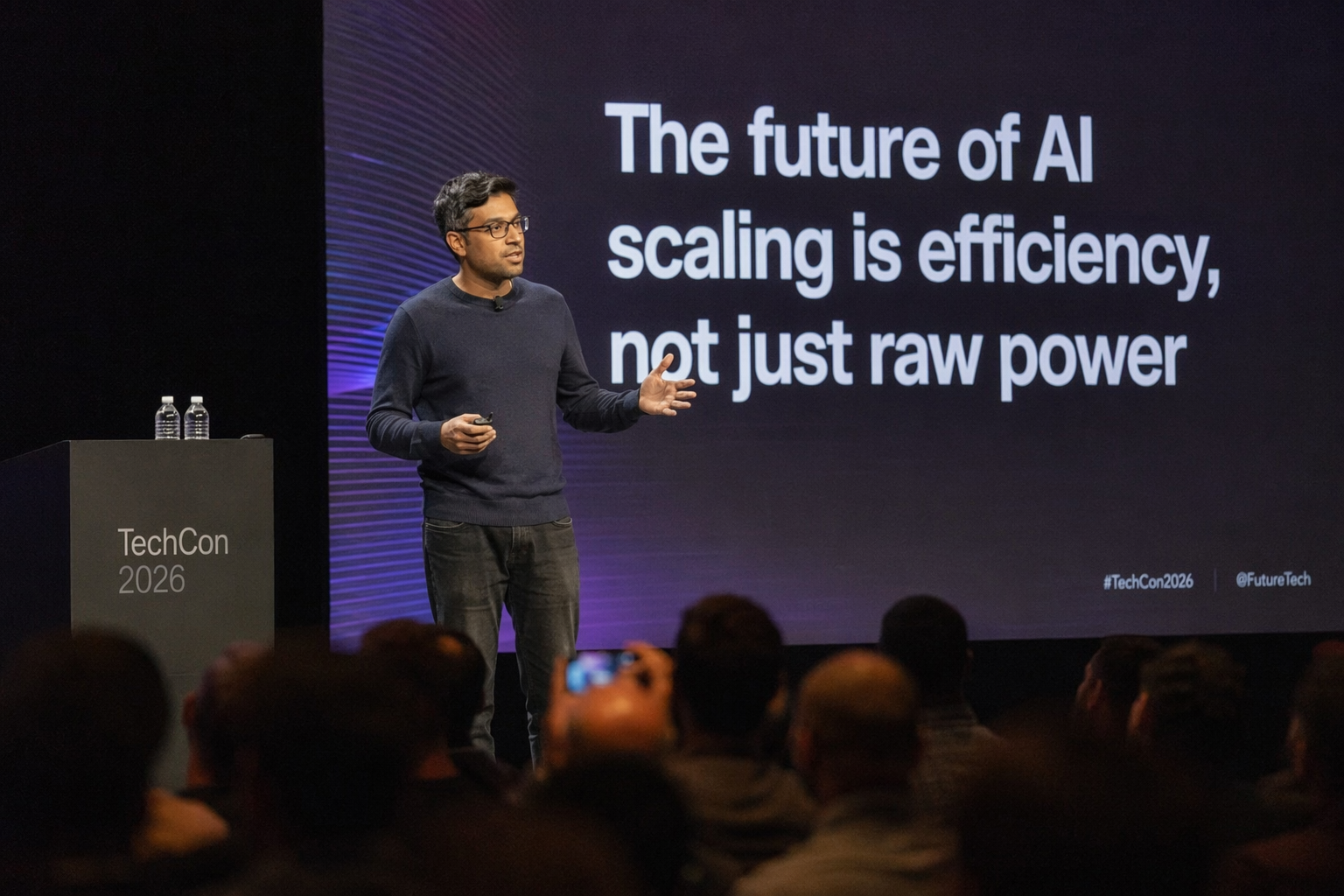
The transition from chasing raw parameter counts to optimizing unit economics has sparked intense debate among industry analysts in June 2026. According to AI research experts, the launch of OpenAI's GPT-5.6 suite—specifically GPT-5.6 Terra—proves that the "balanced tier" model is where the real commercial battle of generative AI will be won.
The Death of "Brute-Force" AI Scaling
For years, the tech sector operated under the assumption that the largest, most expensive flagship models would always dominate enterprise adoption. However, system architects are pointing out that deploying ultra-massive models like GPT-5.6 Sol for routine operations is financially unsustainable.
Industry analysts argue that GPT-5.6 Terra represents the ideal "Cognitive ROI." By matching the core capabilities of GPT-5.5 while running 2x cheaper, Terra allows businesses to scale operations without exponential budget increases. Experts point to three main reasons why this balanced-tier model is winning the enterprise race:
- Predictable Unit Economics: At half the execution cost of previous flagship models, companies can budget complex, multi-turn AI interactions without fear of runaway API bills.
- The Sweet Spot for Autonomous Agents: AI agents performing iterative tasks—such as codebase refactoring or continuous cybersecurity monitoring—require high intelligence but perform thousands of background API calls. Terra's 1.5-million-token context window and optimized reasoning make these agentic loops commercially viable.
- Reduced Latency Gaps: While Sol handles the heaviest multi-step scientific reasoning, Terra operates with significantly lower latency, making it far better suited for customer-facing applications that still require high-level cognitive understanding.
Orchestrating the Three-Tier Future
As experts look toward the latter half of 2026, the consensus is clear: successful enterprises will not rely on a single LLM. Instead, they will orchestrate dynamic, multi-tier workflows. A user interaction might start with a fast, ultra-low-cost model like GPT-5.6 Luna for initial triage, escalate to GPT-5.6 Terra for deeper contextual analysis, and only call upon GPT-5.6 Sol when highly specialized reasoning is required.
To successfully execute this multi-tier strategy, companies are turning to advanced infrastructure providers. Communication platforms like CallMissed are already enabling this exact operational agility. By offering a unified, production-ready gateway to over 300 LLMs, CallMissed allows developers to seamlessly route tasks between Luna, Terra, and Sol based on cost, latency, and complexity. This ensures that enterprises get the maximum possible value out of OpenAI’s latest releases without rewriting their core codebase.
Ultimately, the arrival of GPT-5.6 Terra confirms what AI researchers have predicted: the future of AI is not about who has the biggest model, but who can deploy the smartest model most efficiently.
What This Means For You: Enterprise Deployment and Cost Matrix (TABLE)
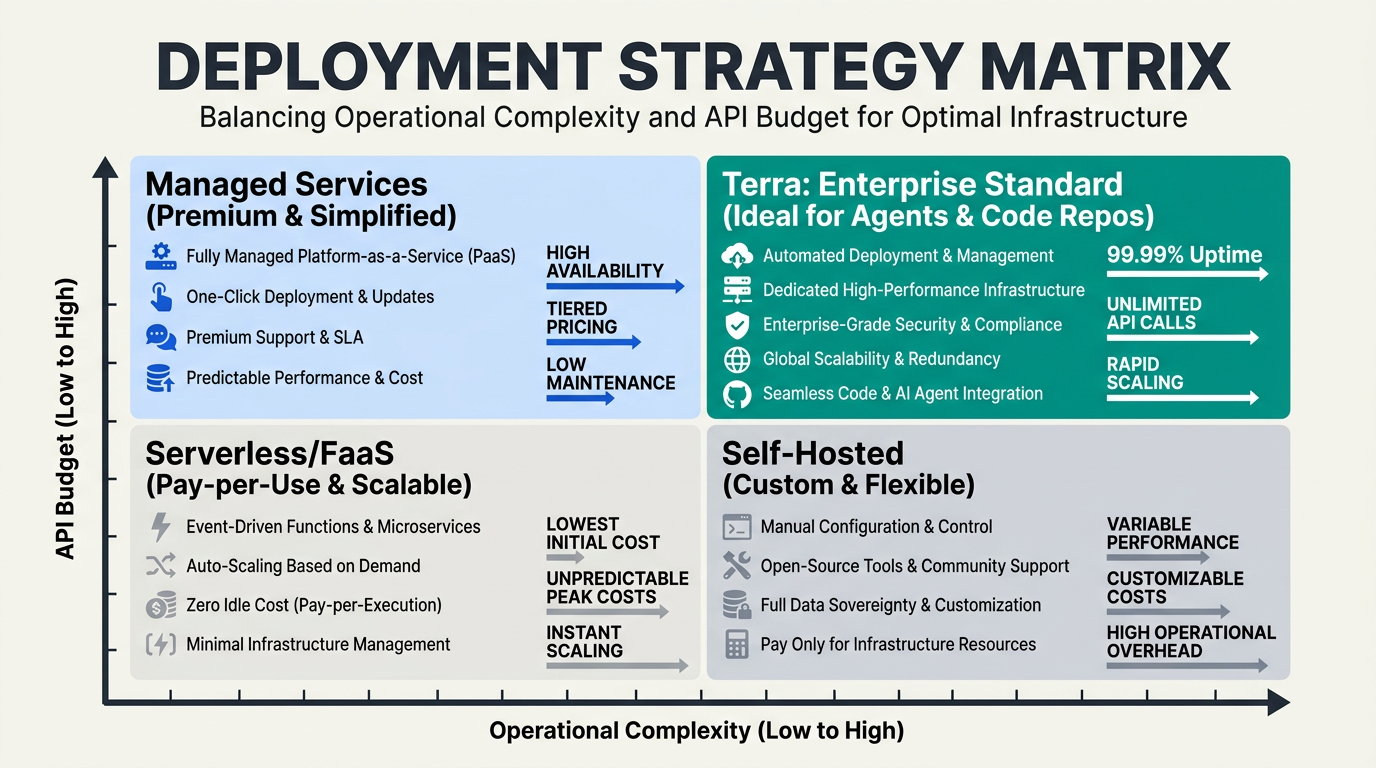
Deploying generative AI at scale in 2026 is no longer a question of finding the single most powerful model; it is about designing a cost-efficient, multi-tiered routing strategy. OpenAI’s June 2026 release of the GPT-5.6 suite addresses this directly by segmenting capabilities into Sol, Terra, and Luna. This tiered structure allows enterprises to stop overpaying for frontier-grade reasoning on routine tasks.
For most high-volume business processes, GPT-5.6 Terra serves as the optimal "sweet spot." It successfully matches the core cognitive performance of the older GPT-5.5 flagship while cutting operational costs in half. This 50% cost reduction, combined with its massive 1.5-million-token context window, fundamentally changes the economics of deploying autonomous agents.
The 2026 Enterprise Cost Matrix
To help your organization determine where to allocate API spend, the table below outlines how GPT-5.6 Terra compares to its sibling models and its immediate predecessor, GPT-5.5, across key deployment metrics:
| Model | Target Use Case | Context Window | Relative Cost | Primary Enterprise Value |
|---|---|---|---|---|
| GPT-5.6 Sol | Frontier research & deep reasoning | 1.5M+ tokens | 100% (Premium Base) | Maximum cognitive performance |
| GPT-5.6 Terra | Agentic workflows & coding | 1.5M tokens | ~50% of Sol | 2x cost efficiency vs. GPT-5.5 |
| GPT-5.6 Luna | High-volume, low-latency chat | 128K tokens | ~15% of Sol | Ultra-low cost, rapid execution |
| GPT-5.5 | Legacy flagship operations | 1.0M tokens | ~100% (Legacy) | Replaced by Terra's cost-efficiency |
Designing a Tiered AI Architecture
When planning your deployment, a monolithic approach—using one model for every task—is highly inefficient. Instead, forward-looking enterprises are adopting a hybrid routing model. Under this framework:
- Tier 1 (Luna): Handles initial customer routing, basic classification, and simple FAQ responses where sub-second latency is critical.
- Tier 2 (Terra): Executes the bulk of agentic workflows, such as digesting a 1,000-page enterprise database to resolve complex support tickets, auditing code repositories, or parsing cybersecurity logs.
- Tier 3 (Sol): Reserved strictly for highly sensitive, multi-step math problems or advanced strategic planning that demands frontier-level cognition.
Managing this level of infrastructure can quickly become complex for development teams. Platforms like CallMissed simplify this transition by offering a production-ready communication infrastructure. By utilizing CallMissed’s multi-model API gateway, developers can deploy sophisticated voice and text agents that seamlessly switch between GPT-5.6 Terra, Luna, and over 300 other LLMs in real-time. This ensures that a customer speaking to an AI voice agent receives lightning-fast responses from Luna for basic inputs, but is instantly routed to Terra’s deep analytical capabilities when complex problem-solving is required—all without changing a single line of core application code.
Ultimately, GPT-5.6 Terra represents the democratization of advanced agentic AI. By offering flagship-level capability at half the price, it enables businesses to move from limited proof-of-concepts to full-scale, autonomous enterprise deployment.
Frequently Asked Questions About GPT-5.6 Terra
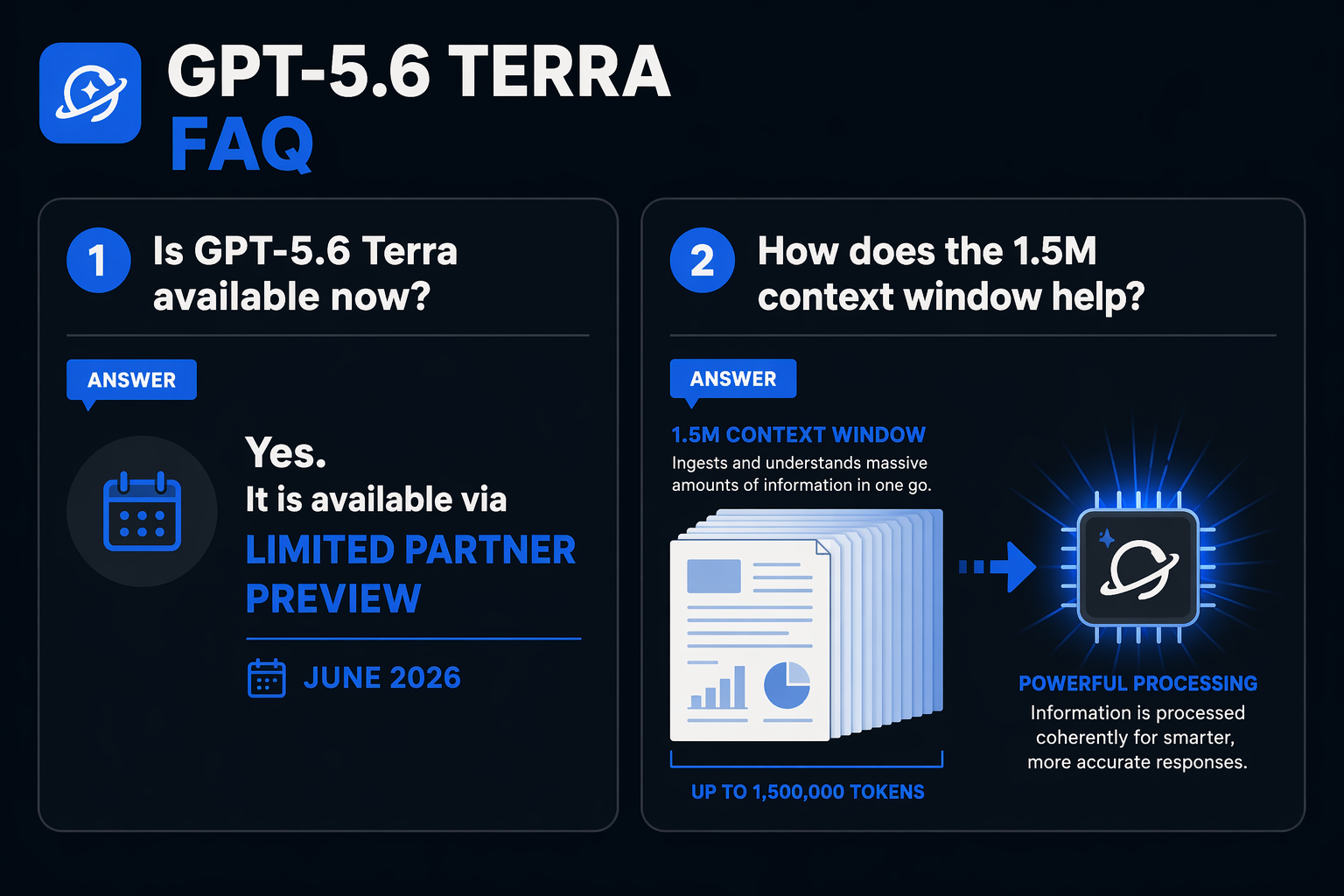
What is GPT-5.6 Terra and how does it fit within the GPT-5.6 lineup?
What is GPT-5.6 Terra pricing compared to Sol and Luna?
What are the default enterprise use cases for GPT-5.6 Terra?
How is GPT-5.6 Terra compared to Sol and Luna for pricing and use cases?
When should organizations choose GPT-5.6 Sol instead of GPT-5.6 Terra?
When should organizations choose GPT-5.6 Luna instead of GPT-5.6 Terra?
What are the key improvements in GPT-5.6 Terra compared to earlier models?
What is the current GPT-5.6 Terra rollout status as of July 9, 2026?
Can GPT-5.6 Terra be used for multilingual or region-specific workflows, such as in India?
Conclusion
GPT-5.6 Terra represents a pivotal shift in the AI landscape, proving that enterprises no longer have to compromise between high-tier cognitive power and operational viability. As you prepare for this next era of cognitive automation, keep these key takeaways in mind:
- The Balanced Workhorse: Terra sits strategically between the hyper-capable Sol and the ultra-fast Luna, serving as the ideal model for sustained enterprise operations.
- Massive Cost Efficiency: It matches the core intelligence of GPT-5.5 while slashing execution costs by 50%, making high-volume agentic workflows financially viable.
- Unprecedented Scale: Armed with a massive 1.5-million-token context window, Terra is tailor-made for complex coding, cybersecurity, and deep data analysis.
As the limited preview transitions into a wider public rollout later this year, watch for how autonomous agentic workflows redefine everyday business productivity. To explore how AI communication is evolving alongside these model breakthroughs, check out CallMissed—an AI infrastructure platform powering voice agents and multilingual chatbots for businesses. How will your organization leverage Terra's balanced intelligence to scale your automation pipelines in 2026?
Related Posts


Ready to automate customer conversations?
Launch AI voice agents and WhatsApp bots with CallMissed — one API, 22+ Indian languages.