

To Study How Chips Really Work, MIT Researchers Built Their Own Operating System: Meet Fractal


When Apple’s product security engineers recently paused to study a custom operating system built by MIT researchers, they weren’t looking at a future...
To Study How Chips Really Work, MIT Researchers Built Their Own Operating System: Meet Fractal
When Apple’s product security engineers recently paused to study a custom operating system built by MIT researchers, they weren’t looking at a future commercial competitor—they were searching for a cleaner way to understand their own M1 silicon. Modern microprocessors have become so staggeringly complex that they are now essentially black boxes. In an ongoing battle to extract more performance from silicon, chip architects have introduced a bewildering array of tricks—from speculative execution to specialized, proprietary coprocessors. While these advancements make our devices faster, they also introduce a massive challenge: standard operating systems like Linux or macOS generate too much "background noise" to let computer scientists measure what is actually happening inside the hardware.
To bypass this barrier and study how chips really work, researchers at the MIT Computer Science and Artificial Intelligence Laboratory (CSAIL) took a radical step: they built Fractal, a new operating system kernel designed entirely from scratch. Unlike traditional operating systems built to manage user applications, Fractal treats the hardware itself as the primary object of study, stripping away OS noise to expose the raw, unfiltered behavior of the processor.
This breakthrough comes at a critical juncture in computing. As we push the boundaries of energy-efficient computing and deploy resource-intensive artificial intelligence, optimizing the software-to-hardware interface is more vital than ever. While communication infrastructure platforms like CallMissed abstract away this physical complexity for developers—providing seamless APIs for multilingual voice agents and multi-model LLM routing—understanding the raw silicon underneath is what ultimately makes these real-time, low-latency breakthroughs possible.
In this post, we will dive deep into why the MIT CSAIL team built Fractal, how it manages to bypass traditional OS noise, and what its first major deployment revealed about Apple's M1 architecture. We will also explore how treating hardware as an active object of study could reshape the future of energy-efficient chip design and software optimization.
Introduction
Modern microprocessors are marvels of engineering, but they have also become incredibly complex black boxes. In response to relentless pressure to extract more speed and efficiency, chip architects have introduced a bewildering array of hardware tricks—ranging from speculative execution to complex cache hierarchies. For computer scientists, this complexity poses a major challenge: understanding how a chip actually behaves under real-world workloads has become nearly impossible. Standard operating systems like Linux or macOS introduce too much "noise" and abstraction, masking the physical reality of the silicon underneath.
To solve this, researchers at the MIT Computer Science and Artificial Intelligence Laboratory (CSAIL) took a radical approach. Instead of trying to strip down an existing operating system, they built an entirely new one from the ground up. Named Fractal, this custom operating system kernel treats the computer hardware itself as the primary object of study. By bypassing the layers of legacy code, multitasking overhead, and telemetry present in commercial operating systems, Fractal gives researchers an unprecedentedly clean, noise-free view of what is happening inside a processor.
Peering Inside proprietary Silicon
The creation of Fractal is highly timely. As silicon design shifts toward highly integrated, proprietary system-on-chip (SoC) architectures, third-party developers and researchers are often left in the dark about how instructions are physically processed. The MIT team put Fractal to work immediately by analyzing Apple’s proprietary M-series silicon.
In a notable research milestone, the team used the kernel to dissect the performance characteristics of the M1 chip, subsequently disclosing their findings to Apple's product security team. In an unusual reversal, Apple's own engineers examined the Fractal kernel to better understand the researchers' diagnostic methodology, highlighting just how valuable this bare-metal visibility is to the industry.
Why Low-Level Hardware Transparency Matters for AI
The implications of the Fractal project extend far beyond academic curiosity. In our current era of specialized AI accelerators and massive neural networks, understanding hardware-software interaction at the silicon level is critical for performance tuning.
For instance, high-performance communication infrastructure platforms like CallMissed rely on ultra-low latency to power real-time AI voice agents and route queries across more than 300 LLMs. When platforms like CallMissed run complex Speech-to-Text pipelines in 22 regional Indian languages, even microsecond-level delays in processor scheduling or cache misses can degrade conversational flow. Tools like Fractal pave the way for a new era of hardware-software co-design, helping developers optimize software stacks from the operating system down to the bare metal.
In this deep dive, we will explore:
- The Architecture of Fractal: How this unique kernel eliminates system noise to isolate hardware behavior.
- The Apple M1 Investigation: What the MIT CSAIL team discovered when they ran their custom OS on Apple's proprietary silicon.
- The Future of Chip Design: How bare-metal OS research will shape the next generation of energy-efficient computing and high-throughput AI infrastructure.
Background & Context: The CPU Measurement Crisis
For decades, the relentless march of computer hardware followed a predictable rhythm. However, as physical scaling limits have slowed down traditional gains, chip architects have had to resort to increasingly sophisticated workarounds. To squeeze every drop of performance out of modern silicon, processors have evolved from simple instruction executors into highly complex, non-deterministic systems.
Today's chips rely on a bewildering array of architectural optimizations, including:
- Speculative Execution: Predicting which path a program will take and executing instructions ahead of time.
- Out-of-Order Execution: Reordering instruction streams on the fly to maximize pipeline efficiency.
- Multi-tiered Cache Hierarchies: Managing complex layers of temporary storage to minimize memory latency.
While these innovations make computers blazingly fast for everyday tasks, they have created a profound crisis in computer science: we can no longer accurately measure or study how chips actually work under real-world conditions.
The "Noise" Problem in Modern Systems
The root of this measurement crisis lies in the symbiotic relationship between hardware and the operating system. Traditional operating systems like Linux, macOS, or Windows are designed for resource sharing, multitasking, and stability—not scientific observation.
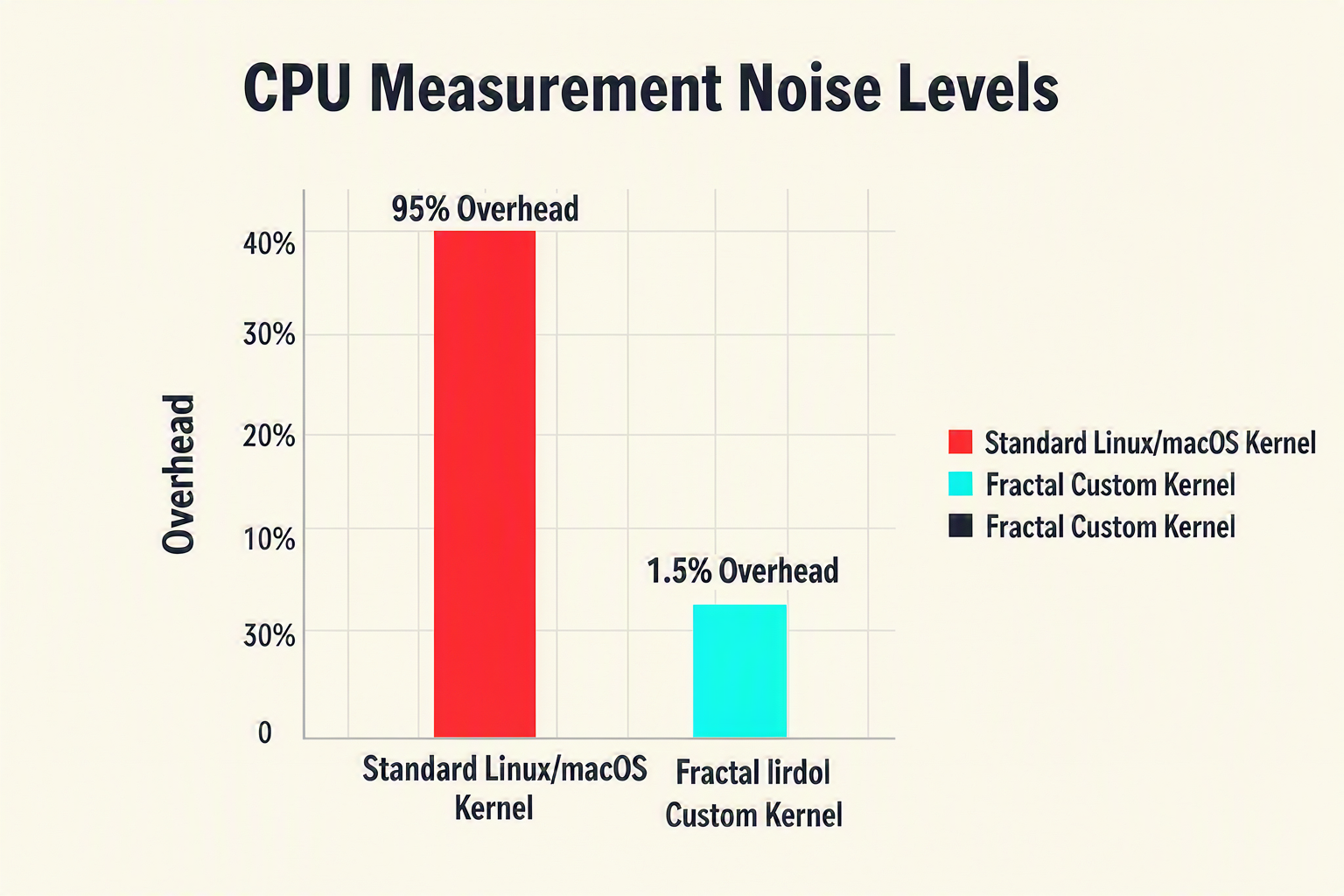
When a researcher attempts to measure a microscopic hardware event (such as a specific cache miss or a branch predictor state change), the operating system itself introduces an overwhelming amount of telemetry "noise." Background processes, thread schedulers, hardware interrupts, and virtual memory management constantly disrupt the CPU. This interference makes it virtually impossible to isolate the exact behavior of the physical silicon. To study the chip, researchers must look through the muddy lens of a heavy, multi-million-line OS kernel.
This challenge of isolating performance from underlying system noise is not unique to hardware engineering. In the software domain, developers face a similar hurdle when trying to deploy high-performance, real-time AI applications. Just as legacy operating systems obscure raw CPU metrics, bloated software wrappers often degrade the latency of AI workloads. To bypass this, cutting-edge infrastructure platforms like CallMissed optimize their communication pipelines, offering direct, low-latency API access to over 300 LLMs and real-time Speech-to-Text services (supporting 22 Indian languages) without the unnecessary middleware overhead.
Why Precision Matters
Without a clean, noise-free way to observe hardware, two critical areas of computing suffer:
- Security Analysis: Modern hardware vulnerabilities (such as Spectre, Meltdown, and their subsequent variants) rely on microarchitectural side channels. Detecting and mitigating these flaws requires clock-cycle-level precision that standard operating systems routinely obscure.
- Energy Efficiency: As global data centers consume unprecedented amounts of power, chip designers must find new pathways to energy-efficient computing. Doing so requires granular profiling of power-to-performance ratios across different silicon structures—measurements that are easily skewed by standard OS background activities.
Realizing that existing tools were inadequate for the task, a team of researchers at the MIT Computer Science and Artificial Intelligence Laboratory (CSAIL) decided to take a radical approach. Instead of trying to strip down an existing OS, they chose to build an entirely new one from scratch: Fractal.
Key Developments (TABLE)
The creation of Fractal by researchers at the MIT Computer Science and Artificial Intelligence Laboratory (CSAIL) represents a major paradigm shift in how we analyze processor hardware. For decades, computer scientists have had to peer through the "fog" of traditional operating systems to understand how modern chips execute instructions. Because consumer OS environments run hundreds of background threads, manage complex driver stacks, and introduce constant scheduling noise, getting an accurate, microsecond-by-microsecond reading of CPU behavior has been notoriously difficult.
Fractal solves this by treating the silicon itself as the primary object of study. Built completely from the ground up, this custom kernel bypasses the usual software abstractions to establish a direct, low-noise interface with the underlying hardware.
The table below illustrates how Fractal compares to traditional operating systems in its design, architecture, and utility for hardware research:
| Evaluation Metric | Standard OS (Linux/macOS) | Fractal Kernel (MIT) | Practical Research Benefit |
|---|---|---|---|
| Primary Focus | User application execution | Hardware telemetry and study | Eliminates software-induced bias |
| System Noise | High (constant background interrupts) | Minimal (highly deterministic execution) | Pristine signal-to-noise ratio |
| Silicon Visibility | Obscured by multiple abstraction layers | Direct, bare-metal access | Instant detection of chip anomalies |
| Security Auditing | Difficult to isolate side-channels | Native tracking of microarchitectural states | Discovers deep silicon vulnerabilities |
| Codebase Scope | Millions of lines of legacy code | Lightweight, built from scratch | Eliminates hidden kernel behaviors |
Key Breakthroughs in Hardware Visibility
By stripping away the bloat of standard operating systems, Fractal has allowed researchers to make several key developments:
- Analyzing Apple's M1 Architecture: In its first major deployment, Fractal was used to inspect the internal mechanics of Apple's M1 silicon. The MIT team uncovered critical microarchitectural insights, which they subsequently disclosed to Apple’s product security team. In an unusual and highly notable reversal, Apple's own engineers examined the Fractal kernel to better understand how the researchers achieved such high-fidelity hardware analysis.
- Isolating Chip Tricks: Modern chips use a bewildering array of hardware shortcuts—such as speculative execution, caching hierarchies, and out-of-order processing—to maximize speed. Because Fractal operates without the noise of typical OS processes, researchers can now isolate and visualize exactly how these tricks perform calculations in real-time.
Just as the MIT team built Fractal to remove the "noise" between software and silicon, modern businesses require similarly streamlined infrastructure to connect their software with advanced AI models. Platforms like CallMissed help developers bypass complex engineering noise by offering production-ready AI voice agents, direct API access to 300+ LLMs, and high-fidelity Speech-to-Text supporting 22 regional Indian languages. This allows enterprises to deploy high-performance conversational AI without having to build and maintain the underlying telecom and infrastructure pipelines from scratch.
Ultimately, Fractal’s bare-metal approach shows that to understand the most complex hardware on Earth, we must occasionally strip away the software layers we have relied on for generations.
In-Depth Analysis: How Fractal Bypasses OS Noise
To understand how modern silicon operates, we must first understand the primary obstacle standing in the way: operating system "noise." Standard operating systems like Linux, macOS, and Windows are marvels of software engineering, but they are designed for multitasking, security boundaries, and hardware abstraction. To achieve this, they run thousands of background threads, manage frequent hardware interrupts, and constantly shift memory pages.
For chip researchers, this creates a chaotic environment. Modern processors rely on highly complex, under-the-hood optimizations—such as speculative execution, branch prediction, and multi-tiered cache hierarchies—to maximize speed. The constant background activity of a standard OS introduces a massive amount of "noise" that obscures how these microarchitectural tricks behave in real-time. It becomes virtually impossible to isolate a single processor behavior when the OS is constantly context-switching.
How Fractal Architectures a "Clean Room" for Silicon
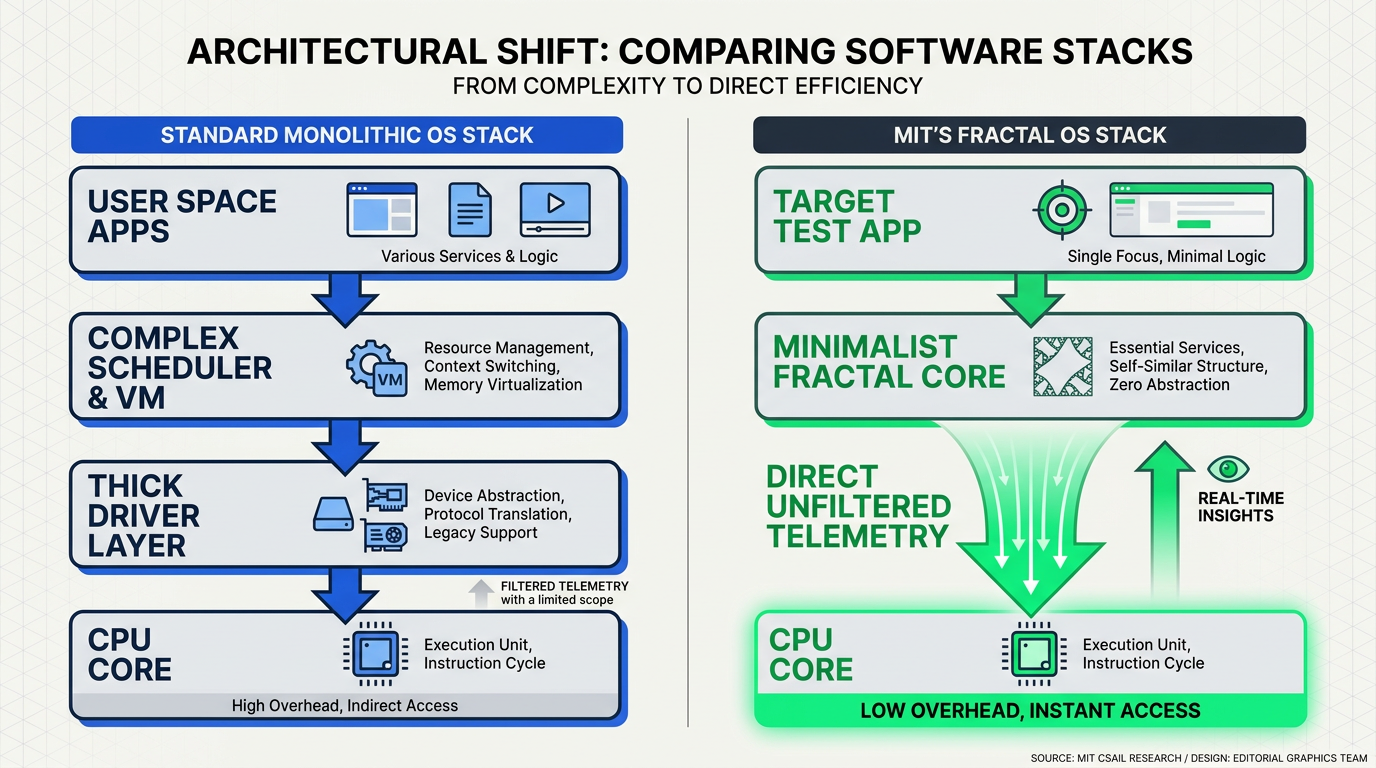
Developed by researchers at the MIT Computer Science and Artificial Intelligence Laboratory (CSAIL), Fractal is a custom operating system kernel written completely from the ground up. Instead of acting as a platform to run user-space applications, Fractal treats the underlying hardware itself as the primary object of study.
Fractal bypasses traditional OS noise through several core design principles:
- Eliminating Abstraction Layers: Rather than hiding hardware complexity behind virtualized drivers, Fractal exposes raw hardware registers directly to researchers, allowing them to monitor chip behavior without intermediate translation layers.
- Deterministic execution: Fractal avoids standard scheduling algorithms. By preventing background kernel tasks from interrupting the CPU, researchers can ensure a core executes an exact sequence of instructions with microsecond-level predictability.
- Bare-Metal Isolation: By stripping away the bloat of standard operating systems, Fractal creates a pristine testing environment where researchers can measure physical states—like cache-line hits, pipeline stalls, and power consumption—with zero software-induced interference.
Real-World Validation: Unlocking the Secrets of Apple Silicon
The power of Fractal's noise-free environment was put to the test when the MIT CSAIL team used it to analyze Apple’s M1 chip architecture. By bypassing the layers of macOS, Fractal allowed researchers to observe internal hardware behaviors that were previously invisible.
The findings were so significant that the MIT team disclosed their discoveries to Apple’s product security team. In an unusual reversal of typical industry dynamics, Apple’s own engineers examined Fractal to better understand how their hardware interacted at the absolute lowest levels of software execution.
Software-Hardware Harmony in the Age of AI
The lessons learned from Fractal extend far beyond academic research. Just as chip researchers require noise-free kernels to study raw silicon, enterprise AI architectures require highly optimized software pipelines to maximize modern GPU and TPU hardware.
For instance, high-performance platforms like CallMissed face a similar engineering challenge when deploying real-time AI communication agents. To process Speech-to-Text APIs across 22 regional languages and run inference on over 300 LLMs without lag, the underlying infrastructure must bypass unnecessary software overhead. By minimizing latency "noise" at the application and network layers, platforms like CallMissed ensure that enterprise AI voice agents can interact with human callers instantly, mirroring the same efficiency that Fractal uncovers at the silicon level.
Impact & Implications: From MIT Lab to Apple HQ

The creation of Fractal by MIT CSAIL researchers represents a shift from theoretical academic research to practical, industry-altering application. What began as an effort to bypass the "noise" of standard operating systems has quickly caught the attention of commercial silicon giants, demonstrating that to truly understand modern hardware, we must re-evaluate our software foundation from the ground up.
A Rare Peek Inside Apple’s Silicon
The most immediate and striking real-world impact of the Fractal kernel occurred when researchers turned their clean-slate operating system toward Apple’s proprietary hardware. Utilizing Fractal's highly transparent architecture, the MIT team was able to analyze the inner workings of Apple's M1 silicon with unprecedented clarity.
This investigation yielded critical microarchitectural insights, which the MIT team subsequently disclosed to Apple’s product security team. In a rare and highly unusual reversal, Apple's own hardware and security engineers took a deep dive into Fractal to analyze the researchers' environment and findings. For a company notoriously protective of its hardware secrets, Apple's engagement with an open-source, academic kernel highlights just how valuable clean-slate OS environments have become for verifying hardware security boundaries and performance bottlenecks.
Stripping Away the "Microarchitectural Noise"
Modern chip architects have spent decades implementing a bewildering array of tricks—such as speculative execution, branch prediction, and complex caching hierarchies—to extract maximum performance from silicon. While these tricks make computers faster, they also introduce immense complexity and "noise," making it nearly impossible for traditional operating systems like Linux or macOS to isolate hardware behaviors.
Fractal solves this by treating the hardware itself as the direct object of study, offering several key advantages for the future of chip design:
- Minimalistic execution paths that eliminate background OS jitter and scheduling noise.
- Direct visibility into how speculative execution and hardware-level optimizations behave in real time.
- Enhanced security auditing, allowing developers to identify microarchitectural vulnerabilities (similar to Spectre and Meltdown) before chips go into mass production.
- Energy-efficient computing pathways, helping designers build chips that maximize performance per watt by pinpointing precisely where power is wasted during idle cycles.
Redefining Tech Infrastructure from the Ground Up
The philosophy behind Fractal—that legacy software layers must be stripped away to unlock the true potential of the underlying infrastructure—is gaining traction far beyond chip design labs. Just as standard operating systems introduce too much noise for chip analysis, legacy software stacks often introduce too much latency for next-generation workloads like real-time AI.
In the communications space, platforms like CallMissed mirror this clean-slate philosophy. Rather than relying on fragmented, legacy telecom middleware that adds latency to voice applications, CallMissed provides direct, optimized AI communication infrastructure. By streamlining the path between Speech-to-Text, LLM inference (supporting over 300 models), and Text-to-Speech APIs, businesses can deploy AI voice agents that operate with the same low-latency precision that Fractal brings to hardware analysis.
As chipmakers struggle to keep pace with the massive compute demands of the AI era, the collaboration between MIT and Apple suggests that the next breakthroughs in hardware efficiency won't just come from shrinking transistors. Instead, they will come from building smarter, cleaner software designed to understand and optimize the hardware it runs on.
Expert Opinions
The academic and industrial reception of MIT CSAIL’s Fractal kernel highlights a critical turning point in computer architecture: modern chips have become so complex that existing software tools can no longer accurately diagnose them. Industry experts and systems researchers agree that traditional operating systems—designed to abstract hardware complexity—actually prevent us from understanding how modern silicon behaves under the hood.
The Quest for "Noise-Free" Hardware Telemetry
For decades, chip architects have introduced sophisticated tricks like speculative execution, branch prediction, and complex cache hierarchies to squeeze maximum performance out of silicon. However, systems experts point out that measuring these microarchitectural states is incredibly difficult on standard operating systems.
- The "Noise" Problem: Standard OS kernels like Linux or macOS introduce constant background scheduling, interrupts, and context switching. This activity "pollutes" the CPU cache, making precise hardware measurement nearly impossible.
- The Fractal Solution: By writing Fractal from the ground up, the MIT team created an operating system where the silicon itself is the primary object of study. Experts praise this "clean slate" approach because it eliminates software-induced noise, giving engineers a completely unobstructed view of processor internals.
A Rare Look Inside Apple's "Black Box"
One of the most compelling validations of the Fractal project came from its real-world application on commercial hardware. The MIT research team utilized Fractal to analyze Apple's M-series silicon, discovering critical insights that they subsequently disclosed to Apple’s product security team.
In what security analysts describe as an unusual and highly significant reversal, Apple's proprietary hardware engineers did not just patch the reported vulnerabilities—they actively examined the Fractal kernel itself. Experts note that Apple's interest in Fractal highlights a broader industry reality: even the world's leading chip design teams require external, specialized diagnostic tools to fully understand the edge-case behaviors and security boundaries of their own proprietary hardware.
Real-World Implications for AI and Cloud Infrastructure
The insights gained from bare-metal diagnostic operating systems like Fractal have massive implications for high-throughput, low-latency computing. As the industry transitions toward specialized AI accelerators and custom silicon, understanding the exact interactions between software and hardware is vital.
For example, real-time AI systems require sub-millisecond execution times to feel natural. Infrastructure platforms like CallMissed rely heavily on these hardware-level optimizations to power their multi-model API gateways (supporting over 300 LLMs) and Speech-to-Text APIs across 22 regional Indian languages. When developers can leverage hardware telemetry insights—such as those exposed by Fractal—to eliminate micro-latencies at the OS level, they can deploy AI voice agents that communicate with zero perceptible lag.
Ultimately, experts view Fractal not just as an academic curiosity, but as a blueprint for the future of hardware-software co-design. As we reach the physical limits of traditional silicon, the next frontier of performance lies in perfecting how operating systems talk to the chips underneath them.
What This Means For You (TABLE)
While MIT's Fractal kernel began as an academic venture to study CPU behavior, its real-world implications are profound. In an era where silicon manufacturing is hitting physical limits, extracting maximum performance from existing chips is critical. By stripping away the scheduling, background threads, and deep abstractions of traditional operating systems, Fractal provides a noise-free environment that reveals exactly how modern processors handle workloads.
This paradigm shift moves us away from generic software design toward hyper-optimized, hardware-aware development. The table below illustrates how Fractal differs from traditional operating systems and what these differences mean for the future of software efficiency:
| Feature | Traditional OS (e.g., Linux, macOS) | MIT's Fractal Kernel | Real-World Impact |
|---|---|---|---|
| Primary Focus | Running applications and managing user tasks | Treating the silicon hardware as the object of study | Reveals hidden hardware bottlenecks directly |
| System Noise | High (background processes, interrupts, telemetry) | Minimal to zero (clean execution path) | Eliminates artificial performance "smearing" during testing |
| Hardware Visibility | Shielded behind deep layers of abstraction | Direct, bare-metal telemetry and access | Allows developers to write code tailored to specific chip quirks |
| Chip Diagnostics | Indirect estimation (e.g., performance counters) | Direct, cycle-accurate mapping of processor state | Enables micro-optimizations for chips like Apple's M1 |
The Ripple Effect on Software Architecture
For software engineers and system architects, Fractal represents a new pathway to building energy-efficient code. Historically, developers relied on the OS to handle hardware complexities. However, as chip designs become more complex with specialized accelerators and neural engines, this "one-size-fits-all" abstraction layer creates massive inefficiencies.
By utilizing Fractal to observe real-time calculations without kernel interference, researchers can pinpoint exactly where processors waste power or stall. This level of granular visibility is crucial for high-performance applications, such as real-time audio processing and large-scale AI deployment.
Why Infrastructure Optimization Matters
As silicon-level insights make their way into commercial systems, software platforms must adapt to leverage this efficiency. This is particularly vital in the field of conversational AI, where latency and processing overhead can break the user experience.
Modern infrastructure solutions, such as CallMissed, are designed with this exact performance philosophy in mind. While researchers use Fractal to optimize low-level processor interactions, CallMissed optimizes the high-level communications layer—enabling developers to deploy AI voice agents and WhatsApp chatbots that leverage 300+ LLMs with minimal latency. By offloading the complex orchestration of Speech-to-Text (spanning 22 Indian languages) and Text-to-Speech APIs, businesses get the benefit of highly tuned, production-ready AI infrastructure without needing to write custom low-level kernels themselves.
Ultimately, MIT's work on Fractal proves that the future of computing lies in tighter, cleaner integration between software and hardware. As these academic insights trickle down into consumer operating systems, we can expect a new generation of blazingly fast, highly efficient digital tools.
Frequently Asked Questions
Why did MIT researchers build their own operating system to study how chips work?
What is the significance of the Fractal kernel created by the MIT Computer Science and Artificial Intelligence Laboratory?
How does isolating hardware bottlenecks with Fractal compare to how modern cloud systems optimize performance?
What did the MIT CSAIL team discover when they tested Fractal on Apple's M1 silicon?
How can Fractal help chip architects design more energy-efficient computing hardware?
Will Fractal be used to study other processor architectures beyond consumer computer chips?
Conclusion
By building Fractal from the ground up, the MIT CSAIL team has given the industry a powerful lens to look beyond compiler and legacy kernel abstractions, directly into the physical reality of silicon. Key takeaways from this breakthrough include:
- Unprecedented Clarity: Fractal eliminates background operating system "noise," letting researchers isolate and study raw processor behavior with surgical precision.
- Real-World Validation: The kernel has already analyzed Apple's complex M1 chip architecture, proving that clean-slate software can uncover deep hardware design insights.
- Hardware-Software Unity: To squeeze maximum efficiency out of modern chips, engineers must treat the hardware itself as an active object of study rather than a black box.
Moving forward, watch how clean-slate operating systems like Fractal reshape the optimization of next-generation AI accelerators and edge hardware. As compute demands skyrocket, co-designing hardware and low-level software will be critical.
To explore how AI communication is evolving alongside these hardware breakthroughs, check out CallMissed — an AI infrastructure platform powering voice agents and multilingual chatbots for businesses. As we strip away legacy abstraction layers, are we on the verge of a hardware-software co-design revolution?
Related Posts
कोडिंग पर GPT-OSS 120B का ओपन-सोर्स प्रदर्शन: विशिष्टताएँ, बेंचमार्क, मूल्य निर्धारण और API एक्सेस

तर्क कार्यों के लिए Grok 4.20 बनाम Gemini 3.1 Pro: क्या सत्यापित किया जा सकता है?

मैं LLM API गेटवे को वॉइस और WhatsApp एजेंट्स से कैसे कनेक्ट कर सकता हूँ? एक डेवलपर गाइड
Ready to automate customer conversations?
Launch AI voice agents and WhatsApp bots with CallMissed — one API, 22+ Indian languages.