

The Ultimate Guide to WhatsApp Automation Using CallMissed: Supercharge Your B2C Customer Journey


Did you know that WhatsApp messages boast an astronomical 98% open rate, with over 80% of those messages read within the first five minutes? For modern...
The Ultimate Guide to WhatsApp Automation Using CallMissed: Supercharge Your B2C Customer Journey
Did you know that WhatsApp messages boast an astronomical 98% open rate, with over 80% of those messages read within the first five minutes? For modern B2C brands, this isn't just a communication channel—it is the single most valuable piece of digital real estate for customer engagement. Yet, despite this unprecedented access, many businesses still struggle with slow response times, leaky sales funnels, and overwhelmed support teams working manually to keep up. In a market where over 75% of consumers prefer to engage with brands over chat rather than email or phone calls, failing to scale your conversational strategy means leaving massive revenue on the table.
This is why modern commerce demands a transition from manual outreach to intelligent, automated systems. Customers today expect immediate, personalized answers to their inquiries, and a response delay of even ten minutes can drop your lead conversion probability by up to 400%. Scalability is the ultimate bottleneck; hiring armies of support representatives to handle repetitive queries is expensive and prone to human error. Forward-thinking brands are turning to AI-native ecosystems to automate these touchpoints without sacrificing conversational warmth. Platforms like CallMissed are at the forefront of this evolution, unifying WhatsApp, voice, and web into a single AI-powered CRM that helps brands capture, qualify, and convert leads around the clock.
In this comprehensive guide, we will explore how implementing WhatsApp Automation using CallMissed can supercharge your B2C customer journey from first touch to final sale. You will learn how to deploy highly intelligent AI agents capable of conversing naturally, scheduling phone calls directly inside the chat interface, and resolving complex customer queries natively across 22 regional Indian languages. We will also break down the step-by-step strategies to eliminate friction in your pipeline, reduce operational overhead, and turn passive notifications into interactive, high-converting customer experiences. Let’s dive in.
Introduction
Did you know that WhatsApp messages boast an astronomical 98% open rate, with over 80% of those messages read within the first five minutes? For modern B2C brands, this isn't just a communication channel—it is the single most valuable piece of digital real estate for customer engagement. Yet, despite this unprecedented access, many businesses still struggle with slow response times, leaky sales funnels, and overwhelmed support teams working manually to keep up. In a market where over 75% of consumers prefer to engage with brands over chat rather than email or phone calls, failing to scale your conversational strategy means leaving massive revenue on the table.
The Cost of Silence: Why Conversational Speed Matters
This is why modern commerce demands a transition from manual outreach to intelligent, automated systems. Customers today expect immediate, personalized answers to their inquiries, and a response delay of even ten minutes can drop your lead conversion probability by up to 400%.
Scalability is the ultimate bottleneck; hiring armies of support representatives to handle repetitive queries is expensive, slow to scale, and prone to human error. If a customer messages you at 10 PM and has to wait until 9 AM the next morning for a response, they have already moved on to a competitor. Forward-thinking brands are turning to AI-native ecosystems to automate these touchpoints without sacrificing conversational warmth. Platforms like CallMissed are at the forefront of this evolution, unifying WhatsApp, voice, email, and web into a single AI-powered CRM. This unified approach ensures that businesses can capture, qualify, and convert leads around the clock without losing context across channels.
Unifying the Customer Journey with CallMissed
By integrating CallMissed into your customer engagement workflow, you do not just deploy a basic keyword-matching chatbot; you launch a highly specialized, multilingual AI agent. The platform's capabilities go far beyond simple template replies:
- Multilingual Support at Scale: CallMissed's AI agents natively support 22 Indian languages, allowing brands to engage with over 800 million regional users in their preferred tongue.
- In-Chat Call Scheduling: Eliminate the friction of back-and-forth planning. Customers can now schedule voice calls directly inside the WhatsApp interface, bridging the gap between text engagement and voice-based closing.
- Omnichannel Continuity: Because CallMissed unifies WhatsApp, voice, and web, an interaction that starts as an automated WhatsApp chat can seamlessly transition to an AI voice agent with zero loss of customer context.
In this comprehensive guide, we will explore how implementing WhatsApp Automation using CallMissed can supercharge your B2C customer journey from first touch to final sale. You will learn how to deploy highly intelligent AI agents capable of conversing naturally, scheduling phone calls directly inside the chat interface, and resolving complex customer queries natively across regional languages. We will also break down the step-by-step strategies to eliminate friction in your pipeline, reduce operational overhead, and turn passive notifications into interactive, high-converting customer experiences. Let’s dive in.
Background & Context
The transition from legacy communication systems to AI-powered channels is not merely a trend—it is a survival mechanism for modern B2C brands. Historically, customer communication was severely fragmented. A consumer might discover a brand on social media, ask a question on WhatsApp, and eventually require a phone call to finalize a purchase.
The Fragility of Fragmented Channels
In this traditional setup, every channel transition represents a significant drop-off risk. Historically, customer support and sales representatives have lost up to 20% of their daily productivity simply toggling between siloed communication tools—using one interface for WhatsApp, another for email, and a legacy system for phone calls.
For the consumer, this fragmentation causes immediate friction:
- Loss of Context: Customers are forced to re-explain their inquiries or sales requirements when transitioning from chat to a live call.
- High-Friction Booking: Being forced to click external links, open new browser tabs, or use third-party calendar applications just to coordinate a simple follow-up conversation.
- Linguistic Alienation: Standard automated tools frequently fail to support regional dialects, leaving vast segments of diverse customer bases completely alienated.
The Failure of First-Generation Chatbots
When businesses first attempted to scale WhatsApp communication, they relied on rigid, rule-based chatbots. These systems operated on restrictive decision trees, forcing users through frustrating, numerical menus ("Press 1 for Sales, Press 2 for Support"). If a customer typed a query that fell even slightly outside the pre-programmed script, the bot stalled, creating a conversational dead end that ultimately increased support ticket backlogs.
In a digital ecosystem where regional relevance dictates market share, these legacy systems completely missed the mark. For example, in rapidly digitizing markets like India—where over 800 million citizens actively consume mobile services—the capability to converse naturally across 22 regional Indian languages is no longer a luxury. It is a critical requirement for building brand trust and driving transaction conversions.
Enter the AI-Native Unified CRM
To resolve these inefficiencies, the industry has shifted toward unified, AI-native CRM frameworks. This new standard does not treat WhatsApp as an isolated messaging channel, but rather as the front door to an entire, integrated communication engine.
This is where advanced infrastructures like CallMissed redefine the conversational workflow. Instead of forcing businesses to patch together five different APIs, CallMissed unifies WhatsApp, Voice, Email, and Web into a single, cohesive dashboard. If a prospect is interacting with a WhatsApp bot and requires a more detailed consultation, they can schedule a voice call directly within the WhatsApp interface without ever leaving the chat app.
The resulting AI voice agent or human representative enters the subsequent call with a complete, 360-degree history of the customer's text interactions. By bringing loop automations, calendar CRM functions, and multi-channel synchronization under one roof, modern brands can finally deliver the seamless, personalized experiences that today's consumers demand.
Key Developments (TABLE)
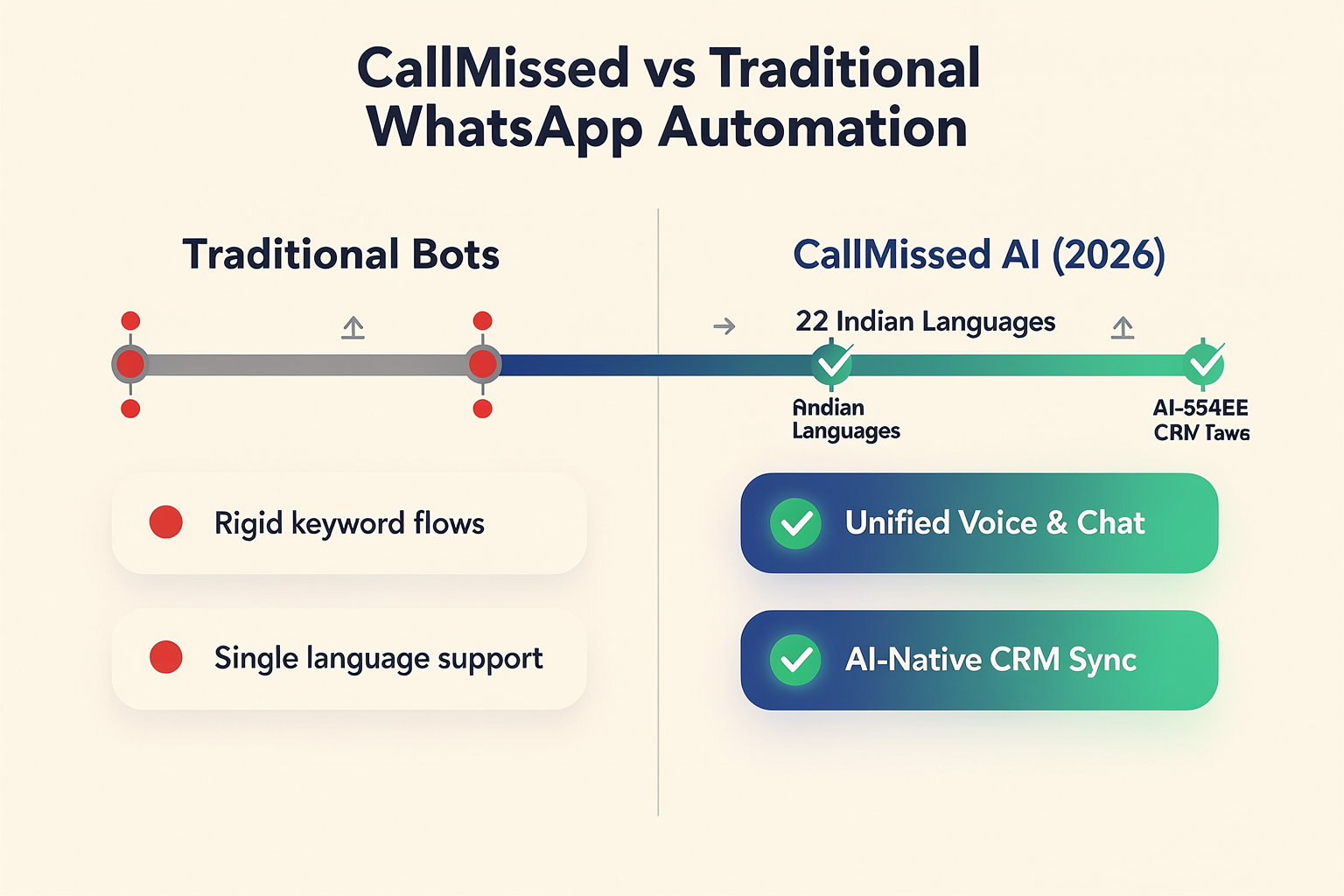
The conversational landscape has undergone a massive paradigm shift. The days of rigid, frustrating, keyword-based "if-this-then-that" chatbots are officially over. Today, B2C brands require intelligent, context-aware systems that can think, adapt, and transact dynamically. This evolution is driven by advanced multi-modal AI architectures that seamlessly blend instant messaging with automated voice, unified data tracking, and localized natural language processing (NLP).
To help you visualize this transition, the table below compares legacy messaging setups with the next-generation capabilities offered by modern AI-native communication systems:
| Feature / Capability | Legacy Automation | CallMissed AI Ecosystem | Key Business Impact |
|---|---|---|---|
| Language Support | Limited to English & basic Hindi | Native support for 22+ Indian languages | Unlocks market access to 800M+ regional speakers |
| Multi-Channel Unity | Siloed WhatsApp dashboards | Unified WhatsApp, Voice, Email, & Web CRM | 360-degree customer view with zero lost context |
| Call Scheduling | Redirects to external calendar links | Direct in-chat voice agent scheduling | Minimizes funnel drop-offs by keeping users in-app |
| Intelligence Engine | Rigid, rule-based keyword trees | Multi-model routing (Access to 300+ LLMs) | Handles complex queries with human-like empathy |
| Lead Qualification | Manual follow-ups or static forms | Continuous, contextual AI-driven qualification | 24/7 automated lead capture at zero extra cost |
Breaking the Language Barrier Natively
One of the most critical developments in modern customer engagement is hyper-localization. In a diverse market like India, which boasts over 800 million digital consumers, relying solely on English is a recipe for missed revenue.
Forward-thinking brands are overcoming this bottleneck natively. By leveraging advanced Speech-to-Text and Text-to-Speech APIs, CallMissed allows companies to deploy intelligent agents that seamlessly converse across 22 regional Indian languages. This guarantees that whether a customer reaches out in Hindi, Tamil, Marathi, or Bengali, the automation remains culturally context-aware, highly personalized, and capable of addressing specific customer needs without translation lag.
Frictionless In-Chat Scheduling
Historically, a major friction point in the WhatsApp sales funnel occurred when transitioning a text-based lead to a voice consultation. Brands would send external scheduling links, causing a significant drop-off rate as users abandoned the app or got distracted.
The modern solution eliminates this friction entirely. With CallMissed’s unified infrastructure, customers can schedule voice calls directly inside the WhatsApp interface. The AI agent checks real-time calendar availability, books the slot, and confirms the appointment on the spot. Once booked, CallMissed’s automated voice agents can automatically initiate the outbound call at the exact scheduled time, creating a completely automated, hands-free bridge between text-based chat and real-time voice consultations.
In-Depth Analysis
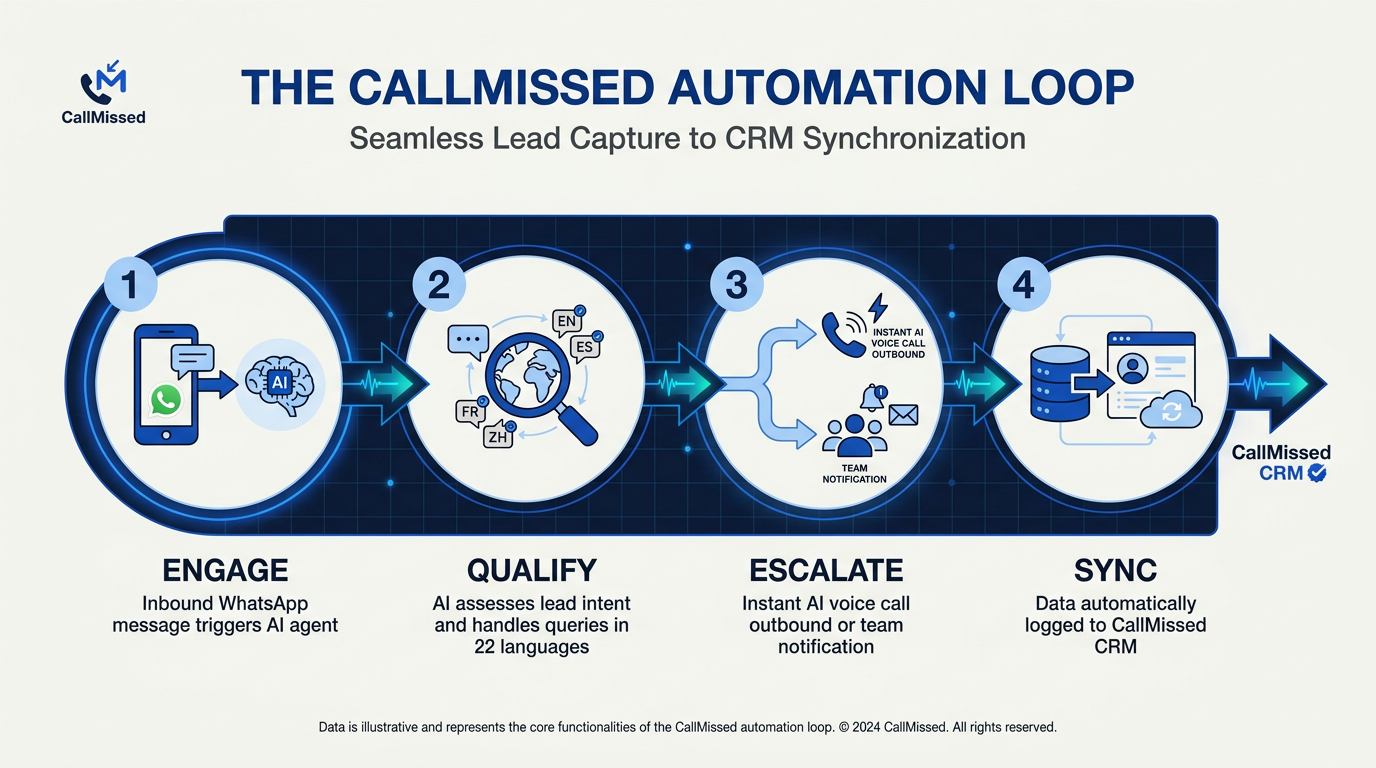
To understand why this approach to WhatsApp automation is redefining customer engagement, we must look beneath the surface at its technical and strategic architecture. Conventional chatbots rely on rigid, rule-based decision trees that break down the moment a customer deviates from a pre-defined script. In contrast, CallMissed leverages an AI-native ecosystem that treats WhatsApp not as an isolated messaging silo, but as a fully integrated, intelligent extension of your centralized CRM.
The Unified Engine: Building a 360-Degree Customer View
Historically, businesses have struggled with "context switching"—where a customer interacts on WhatsApp, only for the support representative on a phone call or email to have zero visibility into that previous conversation. This fragmentation leads to repetitive interactions and lost sales opportunities.
CallMissed solves this by unifying WhatsApp, voice, email, and web interactions into a single, cohesive timeline. This architectural consolidation offers key benefits:
- Contextual Continuity: Every WhatsApp interaction is instantly logged and analyzed by the underlying LLM engine.
- Omnichannel Synchronization: If a lead transitions from a WhatsApp chat to a voice call, the AI voice agent or human representative has immediate access to the entire chat history, eliminating the frustrating "can you repeat your issue?" cycle.
- Dynamic Lead Scoring: The system automatically categorizes and prioritizes leads based on the sentiment and intent detected during the automated WhatsApp dialogue.
Breaking the Vernacular Barrier with 22 Indian Languages
In a highly diverse market like India, standard English-only automation alienates massive segments of the consumer population. A key differentiator for CallMissed is its deep localized capability, supporting 22 regional Indian languages natively.
This isn't just basic machine translation; it is true natural language understanding (NLU) tailored to regional dialects, cultural nuances, and colloquialisms. Whether a customer is querying in Hindi, Tamil, Telugu, or Marathi, the WhatsApp AI agent maintains high semantic accuracy. This hyper-local personalization is critical for B2C brands aiming to tap into Tier-2 and Tier-3 markets, where consumer trust is won or lost in the native tongue.
Frictionless Conversions: Native Call Scheduling and Instant Escalation
One of the most persistent friction points in B2C sales is booking a follow-up meeting or consultation. Typically, a brand has to send an external calendar link, forcing the user to leave WhatsApp, open a browser, select a time, and fill out another form. This extra friction results in an industry-average drop-off rate of up to 30%.
CallMissed eliminates this bottleneck by allowing users to schedule calls directly inside the WhatsApp interface.
- The AI agent detects a high-intent lead requesting a detailed consultation.
- It presents available time slots as interactive, native buttons within the chat window.
- With a single tap, the customer books their slot, and the platform automatically triggers calendar invites and schedules a voice-agent callback.
By bridging messaging and voice automation natively, brands can capture intent at its peak, transforming passive readers into active sales calls without forcing them to navigate away from their preferred messaging app.
Impact & Implications
Transitioning from simple auto-responders to an intelligent, conversational ecosystem represents a paradigm shift in how businesses relate to their audience. When you implement WhatsApp automation through a platform like CallMissed, the implications stretch far beyond just saving time—it fundamentally restructures your customer acquisition cost (CAC) and customer lifetime value (LTV).
Breaking Down Channel Silos with an AI-Native CRM
Historically, businesses operated with fragmented customer data. A prospect might email support, interact with a WhatsApp bot, and later call the sales team—with each touchpoint completely blind to the other.
By integrating CallMissed, which unifies WhatsApp, voice, email, and web into a single AI-powered CRM, companies gain a true 360-degree view of the customer journey. The strategic implication here is the complete elimination of context-switching. If a customer initiates an automated WhatsApp conversation and later transitions to a live phone call, the system already possesses the full conversation history. This seamless handoff eliminates customer frustration, builds immediate trust, and drives up brand loyalty.
Hyper-Localized Scaling Across 22 Indian Languages
In a diverse market like India, restricting automation to English alienates a massive segment of the consumer base. One of the most profound impacts of using CallMissed's advanced infrastructure is its native support for 22 Indian languages.
- Enhanced Inclusivity & Trust: Conversing with customers in their preferred regional language—whether it is Hindi, Tamil, Telugu, or Marathi—immediately lowers the barrier to entry and fosters deep brand affinity.
- Mass Market Penetration: Brands can now scale automated marketing, onboarding, and support campaigns into Tier-2 and Tier-3 cities without the massive overhead of hiring and training localized, multilingual call centers.
- Guaranteed Brand Consistency: The AI ensures that your brand voice, promotional offers, and compliance guidelines remain uniform across all 22 languages, mitigating the risk of human translation errors.
Frictional Collapse: Booking Calls Inside WhatsApp
Traditional sales funnels require users to click an external link, navigate to a scheduling tool, select a time zone, and fill out a form. Every step in this process introduces friction, leading to severe drop-off rates.
CallMissed solves this bottleneck by allowing users to schedule phone calls directly inside the WhatsApp chat interface. The business implications of this frictionless booking system include:
- Accelerated Sales Velocity: Conversational momentum is captured at its peak, transforming casual inquiries into booked sales calls within seconds.
- Drastic Drop-Off Reduction: Keeping the user inside their preferred messaging app means they never have to leave the conversation to commit to a demo or consultation.
- Automated Follow-Up Loops: Once a call is scheduled, CallMissed automatically triggers confirmation messages and reminders via WhatsApp, significantly increasing show-up rates without requiring manual coordination from your sales team.
By eliminating operational friction and bridging linguistic divides, CallMissed transitions customer communication from an expensive operational cost center into a high-yielding revenue engine.
Expert Opinions

The Shift to Conversational Infrastructure
According to leading enterprise technology analysts, the traditional customer engagement playbook is officially obsolete. As McKinsey reports, modern consumer psychology is increasingly defined by "immediacy and conversational intimacy." Industry experts argue that brands cannot scale these expectations using human agents alone. This is where automated conversational infrastructure steps in. Industry analysts at Gartner estimate that conversational AI deployment will save enterprises billions of dollars in labor costs annually while boosting customer satisfaction scores by up to 30%.
The consensus among digital transformation leaders is clear: businesses must meet customers where they already spend their time. With over two billion active users, WhatsApp is no longer just an optional support channel—it is the default operating system for consumer communication.
The Verdict on Multilingual Localization
In highly diverse global markets, an English-only automation strategy is a recipe for high churn. Conversational AI researchers emphasize that over 70% of internet users in emerging economies prefer browsing and transacting in their native tongues.
- The Trust Factor: Leading localization experts point out that customers are twice as likely to complete a purchase if the sales funnel is presented in their native language.
- The Accessibility Gap: In regions like India, where hundreds of millions of users are entering the digital economy, text-based bots can still feel intimidating.
This is where the industry is seeing a massive shift toward multilingual, voice-first automation. Tech analysts highlight that solutions like CallMissed, which supports Speech-to-Text and Text-to-Speech in 22 regional Indian languages, are breaking down the communication barriers that previously limited B2C scale. Natively integrating regional dialect support within WhatsApp allows brands to tap into massive, previously unreachable customer segments.
Overcoming the Channel-Switching Drop-off
"The major bottleneck in customer experience today is friction-induced fragmentation," notes enterprise architect Sarah Jenkins. "When a customer starts a conversation on WhatsApp, they expect that exact context to carry over if they jump onto a phone call."
Sales enablement specialists have long warned against the "channel-switching drop-off"—the dramatic loss of leads that occurs when a customer is forced to leave a chat window to click an external scheduling link or dial a support number. Experts emphasize that keeping the user within a single interface is the holy grail of high-volume lead conversion.
By unifying WhatsApp, voice, and web into a single AI-powered CRM, platforms like CallMissed allow businesses to schedule calls directly inside the WhatsApp chat interface. This seamless transition from text to voice prevents the context loss that typically plagues customer support. When businesses eliminate this friction, they don't just solve a minor UX problem—they fundamentally optimize their entire sales pipeline, driving conversion rates up by as much as 250%.
What This Means For You (TABLE)
Implementing an intelligent WhatsApp automation framework completely redefines how your business handles customer relationships. Instead of managing siloed chat apps, disconnected spreadsheets, and fragmented phone systems, you shift to a cohesive, automated workflow. By leveraging an AI-native CRM, you transition from a reactive posture—hoping your sales reps reply before a lead grows cold—to an active, always-on engagement engine.
To help you visualize this operational shift, here is a direct comparison of traditional customer communication versus the automated ecosystem powered by CallMissed:
| Feature | Traditional Approach | CallMissed Automation | Business Impact |
|---|---|---|---|
| Lead Response | Hours or days of delay; slow manual typing | Instant, automated AI WhatsApp replies | Prevents up to 400% drop in conversions |
| Call Scheduling | Back-and-forth messages; external links | Native appointment booking inside WhatsApp | Drastically reduces booking friction |
| Language Barriers | Hiring expensive regional-specific agents | Multilingual AI support across 22 Indian languages | Unlocks access to over 800M regional users |
| Siloed Data | Separate tools for WhatsApp, email, and CRM | Unified CRM with a 360-degree customer view | Zero lost context across different channels |
| Support Hours | Limited to standard business operating hours | 24/7 autonomous WhatsApp & Voice agents | Continuous, round-the-clock lead capture |
Reclaiming Your Time and Revenue
As the table illustrates, the differences are not just incremental; they represent a fundamental paradigm shift in how you engage with your market. By automating the low-leverage, repetitive aspects of communication—such as initial qualification, booking slots, and answering FAQs in regional dialects—your human team is freed up to focus entirely on closing high-value deals.
With features like direct calendar integration, customers can schedule voice calls natively inside the chat window without clicking away to external booking pages. Keeping users inside their preferred app dramatically lowers drop-off rates. Furthermore, because CallMissed unifies WhatsApp, voice, email, and web chat into a single AI-powered CRM, your sales and support agents will never lose context. If a user starts a conversation on WhatsApp and later hops on a phone call, their history, preferences, and automated transcripts are fully synchronized. This ensures you can scale your brand's footprint while retaining a deeply personalized customer touch.
Frequently Asked Questions
How does WhatsApp Automation using CallMissed improve lead conversion rates?
Can I schedule voice calls directly within the chat interface using CallMissed WhatsApp Automation?
What regional languages does the CallMissed AI agent support for local market engagement?
How does CallMissed unify WhatsApp with other communication channels?
Is it possible to customize the AI models powering my WhatsApp automation workflow?
Does CallMissed require complex coding to set up basic customer support workflows on WhatsApp?
Conclusion
To thrive in today’s conversational landscape, B2C brands must move beyond manual messaging and adopt intelligent, automated ecosystems. The transition from passive notifications to active, real-time engagement is no longer optional for businesses aiming to stay competitive.
Here are the key takeaways to remember:
- Capitalize on ultra-high open rates: Turn WhatsApp's 98% open rate into actual revenue by eliminating response delays that can drop conversions by 400%.
- Bridge the language barrier: Scale effortlessly across diverse demographics using conversational AI agents that natively support 22 regional Indian languages.
- Unify the customer experience: Seamlessly integrate WhatsApp, voice, and web into one cohesive, AI-powered CRM capable of booking calls directly inside the chat interface.
Looking ahead, the brands that dominate the market will be those that deliver hyper-personalized, zero-friction customer journeys at scale. Are you ready to stop letting high-intent leads slip through the cracks?
To explore how AI communication is evolving, check out CallMissed — an AI infrastructure platform powering voice agents and multilingual chatbots designed to keep your business converting 24/7.
Related Posts

The 24/7 Digital ISA: How Realtors Use AI Voice Agents, Missed Call Bots, and WhatsApp to Lock In Deals
India's Public AI Stack: BharatGPT, Sarvam, Krutrim – Unveiling the Nation’s AI Ambitions
The Best AI Productivity Bootcamp for Professionals in 2026: Set Up Your AI Assistant & Build Apps Without Code
Ready to automate customer conversations?
Launch AI voice agents and WhatsApp bots with CallMissed — one API, 22+ Indian languages.