

The Return of the Founder: Inside Jeff Bezos’s $41 Billion Quest to Build the 'Artificial General Engineer'


What if the most disruptive engineer of the next decade isn't a human, but a $41 billion algorithmic powerhouse capable of designing skyscrapers,...
The Return of the Founder: Inside Jeff Bezos’s $41 Billion Quest to Build the 'Artificial General Engineer'
What if the most disruptive engineer of the next decade isn't a human, but a $41 billion algorithmic powerhouse capable of designing skyscrapers, optimizing aerospace trajectories, and rewriting the laws of manufacturing? On June 11, 2026, Amazon founder Jeff Bezos sent shockwaves through the global technology sector by officially unveiling Prometheus, his highly anticipated AI venture. Backed by a historic $12 billion funding round that instantly propelled the startup to a jaw-dropping $41 billion valuation, Prometheus isn't interested in writing poetry, generating marketing copy, or drafting generic code. Instead, Bezos and co-founder Vik are embarking on an audacious, capital-intensive quest to build what they call the "artificial general engineer"—an AI designed specifically to master, simulate, and manipulate the physical world.
This monumental move signals a massive, structural shift in the global AI landscape. For the past several years, the tech industry has been obsessed with digital-first Large Language Models (LLMs) capable of processing text, images, and basic software code. However, the true frontier of automation lies in the physical sciences. The physical world—governed by thermodynamics, structural mechanics, fluid dynamics, and material science—has remained notoriously difficult for digital AI to grasp. Prometheus wants to break this barrier. By developing an artificial general engineer, Bezos is betting that AI can bridge the gap between abstract computational reasoning and physical reality. This isn't just about software; it's about building an intelligence that can design next-generation rockets for Blue Origin, optimize complex global supply chains, and engineer entirely new materials.
The sheer scale of this $12 billion capital infusion is unprecedented, representing one of the largest single startup investments in history. It underscores a growing realization among tech visionaries that the next stage of the cognitive revolution must move beyond the screen. While platforms like CallMissed are already transforming the digital landscape by enabling enterprises to deploy production-ready AI voice agents to handle complex customer communications, Prometheus is aiming to automate the heavy, industrial backbone of society itself. If successful, an AI capable of general engineering could compress R&D cycles from decades to days, radically lowering the barriers to physical innovation.
In this deep dive, we will pull back the curtain on this high-stakes venture. We will explore the underlying technology required to train an AI on physical-world physics, examine why Bezos chose this exact moment to step back into the high-intensity founder's arena, and analyze how Prometheus plans to compete with established robotics pioneers and manufacturing giants. From the complex simulation environments needed to train these models to the geopolitical implications of automated engineering, this is the inside story of The Return of the Founder: Inside Jeff Bezos’s $41 Billion Quest to Build the 'Artificial General Engineer'. Let’s dive in.
Introduction: Jeff Bezos’s Boldest Bet Yet

Jeff Bezos’s legacy is defined by scale. From a garage-born online bookstore to a global e-commerce and cloud computing empire, his "Day 1" philosophy has shaped modern business. Now, in June 2026, Bezos has officially unveiled his most ambitious and disruptive project yet: Prometheus.
Co-founded with AI pioneer Vik, Prometheus is not merely aiming to compete with the likes of OpenAI, Google, or Anthropic in the digital playground. Instead, it is carving out an entirely new category in the technological landscape: the creation of an "Artificial General Engineer" (AGE).
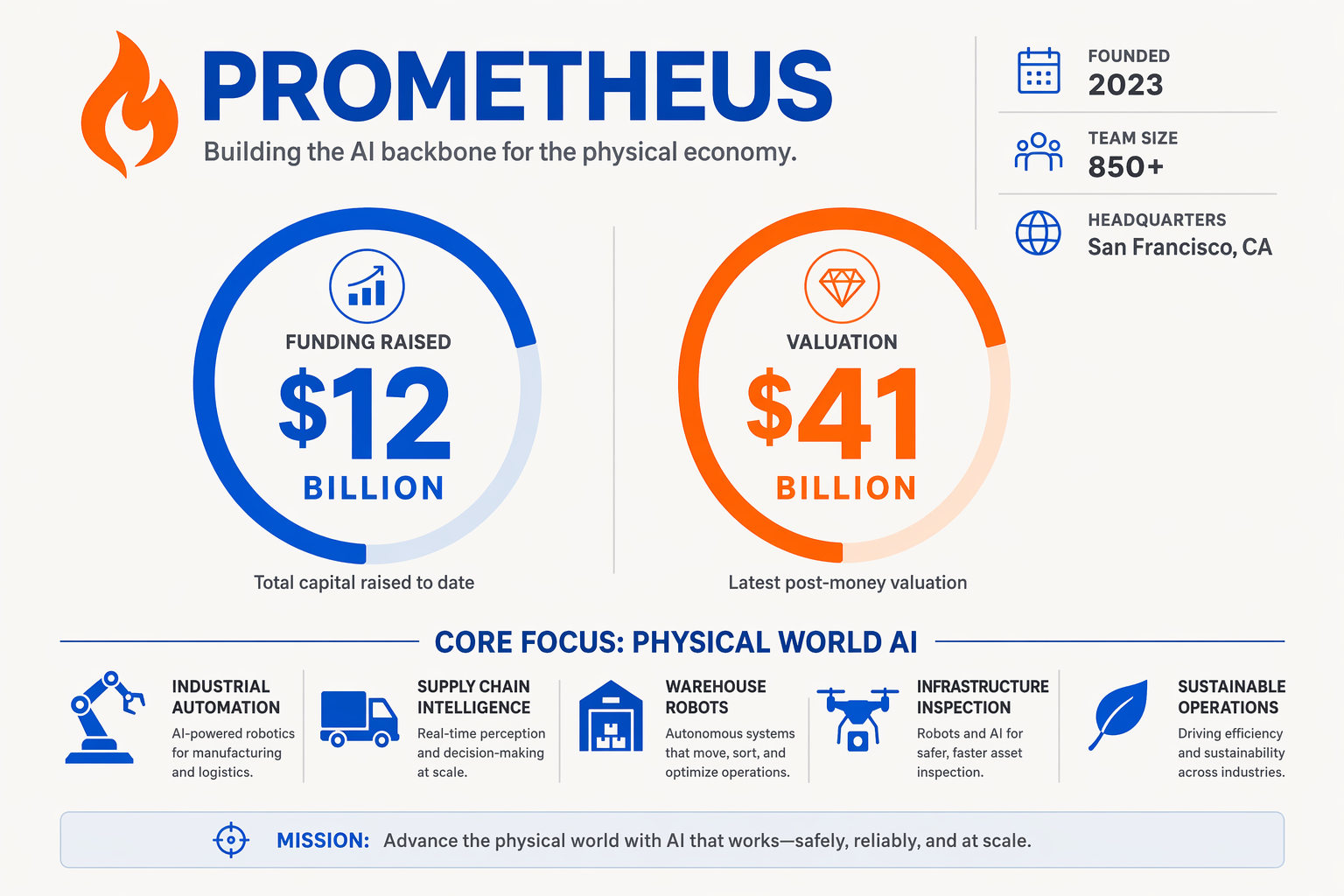
The scale of Prometheus's debut is unprecedented. The startup has raised a staggering $12 billion in funding, catapulting its valuation to $41 billion almost overnight. To put this in perspective, this single funding round exceeds the cumulative early-stage venture funding of several major AI players combined. It signals a massive paradigm shift in where venture capital, tech visionaries, and industrial giants believe the true value of artificial intelligence lies: the physical world.
Redefining AI: From Digital Minds to Physical Masters
For the past several years, the AI narrative has been dominated by Large Language Models (LLMs) and generative media. We have grown accustomed to AI that writes code, drafts marketing copy, and generates hyper-realistic art. However, these systems operate entirely within the digital realm. They do not understand gravity, friction, thermal dynamics, or the sheer unpredictability of physical materials.
An Artificial General Engineer is designed to break through this digital barrier. It is built to master the laws of physics, chemistry, thermodynamics, and structural engineering. The goal of Prometheus is to build a system that can design, simulate, test, and optimize physical objects and infrastructure without human intervention.
To achieve this, Prometheus is focusing on several core capabilities:
- Autonomous CAD and Blueprinting: Generating complex mechanical designs from scratch that adhere to real-world stress tolerances, material limitations, and manufacturing budgets.
- Predictive Material Science: Synthesizing and testing new molecular structures in hyper-realistic virtual environments to discover stronger, lighter, and more conductive materials.
- Closed-Loop Robotic Control: Translating abstract engineering concepts into precise physical actions, enabling robotic workforces to build, weld, and assemble complex structures on the fly.
- Cross-Disciplinary System Integration: Designing highly complex, multi-system environments—such as hydrogen propulsion systems, localized smart grids, and automated gigafactories—where mechanical, electrical, and software engineering must work in perfect harmony.
The Convergence of Bezos’s Empires
The launch of Prometheus is not an isolated venture; it is the ultimate convergence point for Bezos’s wider industrial ecosystem. By building an AI that excels at physical engineering, Bezos is creating a technology that could supercharge his other massive enterprises:
- Blue Origin: Space exploration requires solving some of the hardest engineering problems known to humanity. An AI capable of designing, testing, and optimizing rocket engines in real-time could accelerate deep-space exploration and lunar colonization efforts by decades.
- Amazon Logistics: The global retail giant relies on warehouse automation, advanced robotics, and complex supply chain algorithms. An Artificial General Engineer could design next-generation robotic fleets and optimize warehouse layouts with zero human intervention.
- Heavy Industry and Infrastructure: From localized clean energy grids to eco-friendly manufacturing plants, Prometheus aims to solve the physical bottlenecks that hold back heavy industry from decarbonizing and scaling.
The Infrastructure Bottleneck: Powering the Physical AI Era
Building an Artificial General Engineer requires an entirely different class of computing power, data architectures, and real-time communication pipelines. While Prometheus is tackling the deep-tech challenges of physical AI, businesses across the globe are already grappling with a more immediate challenge: how to integrate these advancing cognitive capabilities into their everyday workflows and customer-facing operations.
This is where platforms like CallMissed play a critical role. While giants like Prometheus build the brains of physical-world engineering, CallMissed provides the essential communication infrastructure that lets companies operationalize AI today. Through their robust APIs, developers can access over 300 LLMs, deploy highly responsive, multilingual AI voice agents, and run real-time Speech-to-Text pipelines supporting 22 Indian languages. For an enterprise trying to connect physical manufacturing floors, global supply chains, or customer service centers to complex AI decision-making models, having seamless, reliable communication layers is just as vital as the AI engine itself.
What Lies Ahead in the $41 Billion Quest
The age of AI that only writes essays and paints pictures is drawing to a close. With Prometheus, Jeff Bezos is ushering in the era of AI that designs, builds, and maintains the physical world.
Over the course of this deep-dive series, we will explore:
- The architecture of Prometheus’s proprietary neural networks and how they model physical laws.
- The stark differences between digital-only generative AI and physical-world AI.
- The quiet rivalry brewing between Bezos’s Prometheus, Elon Musk’s xAI, and Sam Altman’s OpenAI.
- The ethical, economic, and labor considerations of replacing human mechanical and structural engineers with autonomous systems.
Let us step inside the lab and examine how this $12 billion engine of innovation actually works, and what it means for the future of human industry.
Background & Context: The Genesis of Prometheus
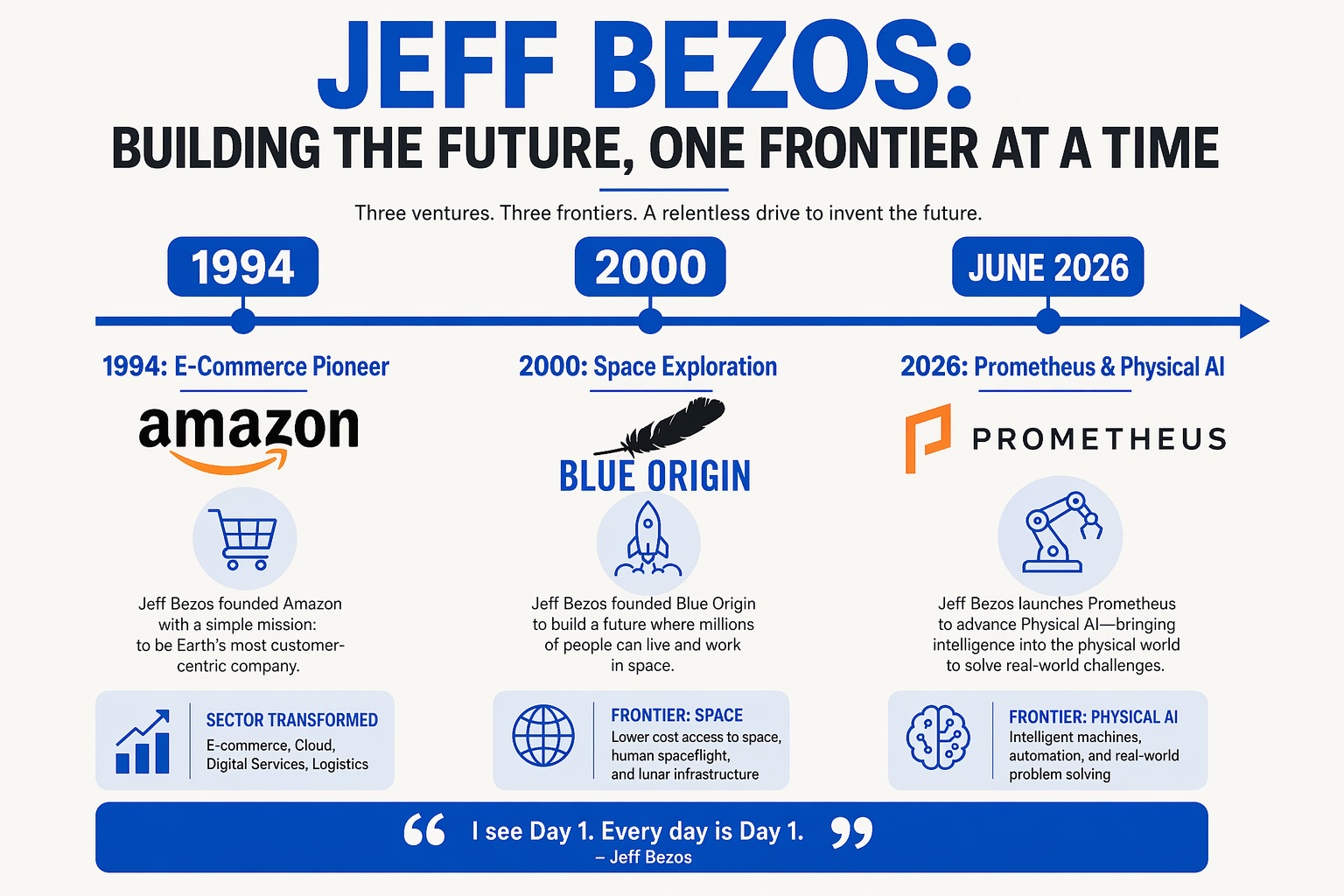
To understand the emergence of Prometheus, one must first look at the massive shift occurring in the broader artificial intelligence landscape. While the first wave of the AI revolution focused heavily on digital tasks—generating text, writing software code, and organizing unstructured data—the frontier has rapidly shifted toward the physical world. Officially unveiled in mid-2026, Prometheus is Amazon founder Jeff Bezos’s monumental bid to lead this next frontier. Backed by a historic $12 billion funding round that values the company at $41 billion, the startup, co-founded by Bezos and tech innovator Vik, has set its sights on a concept the world has never seen: the "Artificial General Engineer" (AGE).
The genesis of Prometheus represents a calculated convergence of Bezos’s lifelong obsessions: space exploration, heavy manufacturing, logistics, and automated infrastructure. For decades, Bezos has championed the idea of moving heavy industry and pollution off-earth to preserve the planet, a vision frequently highlighted during his public appearances, such as his address at the VivaTech conference in Paris. However, the bottleneck to achieving these grand engineering feats—whether building advanced rockets at Blue Origin or automating massive fulfillment networks—has always been the sheer complexity, cost, and time required for physical engineering. Prometheus was founded to break this bottleneck.
Defining the "Artificial General Engineer"
Unlike traditional Artificial General Intelligence (AGI), which seeks to replicate human-like cognitive abilities across all domains, an Artificial General Engineer is purpose-built to master the laws of the physical world.
While existing Large Language Models (LLMs) excel at tokenizing words, an AGE must master:
- Multi-Physics Comprehension: Understanding gravity, fluid dynamics, thermodynamics, and electromagnetism natively, rather than simply predicting the next word in a textbook.
- Material Science Integration: Predicting how new alloys, polymers, and composites will behave under extreme stress, heat, or vacuum conditions.
- Generative CAD and Spatial Design: Creating production-ready, three-dimensional blueprints that conform to strict manufacturing tolerances and real-world safety standards.
- Closed-Loop Simulation: Running trillions of virtual stress tests, wind tunnel simulations, and thermal analyses before a physical prototype is ever manufactured.
In essence, Prometheus is building an AI that does not just write software, but designs hardware—architecting everything from more efficient wind turbines and electric vehicle chassis to advanced aerospace propulsion systems.
The Strategic Timing: Why Now?
The timing of Prometheus’s launch is highly strategic. By 2026, the global industrial sector is facing a severe shortage of specialized engineering talent, paired with a pressing global mandate to accelerate green energy transition and advanced manufacturing. Traditional computer-aided design (CAD) and computer-aided engineering (CAE) workflows remain highly manual, siloed, and slow. A single iteration of a complex mechanical part can take weeks of back-and-forth between design engineers, simulation specialists, and manufacturing teams.
Bezos’s new venture aims to compress this multi-week cycle into seconds. By feeding the AI vast datasets of physical laws, material properties, and engineering schematics, Prometheus is training its models to act as an autonomous co-designer.
To put this in perspective, think of how modern software engineering has been revolutionized by AI coding assistants, or how digital communication workflows have been streamlined. In the digital space, platforms like CallMissed have democratized access to advanced AI by providing unified APIs that let developers orchestrate over 300+ LLMs, manage complex voice agents, and bridge the gap between digital systems and real-time human interaction. What CallMissed has done for simplifying enterprise communication infrastructure, Prometheus is attempting to do for physical manufacturing infrastructure: creating a unified, intelligent operating system that translates abstract human intent into highly complex, physically viable designs.
The $12 Billion War Chest
The sheer scale of Prometheus’s initial capital raise—$12 billion—is almost unprecedented for a newly unveiled AI venture, signaling the massive compute and infrastructure costs associated with physical-world AI. Training models to understand physics requires far more than just scraping text from the web. It demands:
- High-Fidelity Synthetic Environments: Generating billions of high-resolution physics simulations to train neural networks on cause-and-effect in the physical world.
- Robotic Testing Labs: Building state-of-the-art physical labs where robotic arms and testing rigs can physically validate the AI's designs, creating a continuous feedback loop between digital hypothesis and physical reality.
- Elite Interdisciplinary Talent: Recruiting top-tier minds across aerospace engineering, material science, deep learning, and robotic simulation.
By securing this funding, Bezos has positioned Prometheus not just as a software company, but as a foundational industrial powerhouse. While contemporaries like Microsoft-backed OpenAI and Google's Gemini continue to optimize digital productivity, Prometheus is carving out a highly defensible, incredibly capital-intensive moat in the physical domain. It is a bold, high-stakes wager that the future of AI supremacy will not be won on computer screens, but in the factories, research labs, and launchpads of the physical world.
Key Developments in the Rise of Prometheus (TABLE)
Timeline of a Tech Titan’s Resurgence
The trajectory of Prometheus represents one of the most aggressive capital deployment and development timelines in the history of Silicon Valley. While traditional AI startups scale incrementally through seed rounds, Series A, and gradual model iterations, Jeff Bezos's new venture has bypassed the standard maturation phases entirely. Co-founded by Bezos and AI pioneer Vik, Prometheus emerged from stealth with a singular, monolithic objective: to transition artificial intelligence from the digital realm of text and pixels into the physical domain of atoms, structures, and heavy machinery.
To understand the sheer velocity of this venture, one must look at the structural milestones that have defined its rise. Within a matter of months, Prometheus has secured computational resources, established key research partnerships, and closed a historic $12 billion funding round that values the nascent entity at an astonishing $41 billion. This rapid scaling is not merely a financial flex; it is a calculated effort to monopolize the talent, hardware, and data required to build the world's first Artificial General Engineer.
Key Milestones in the Prometheus Roadmap
The rise of Prometheus is characterized by a series of high-leverage developments designed to compress a decade worth of industrial AI research into a multi-year execution window. The table below outlines the core phases, financial metrics, and strategic implications of Prometheus’s journey as of June 2026.
| Phase / Milestone | Timeline | Key Financials | Core Technical Focus | Strategic Significance |
|---|---|---|---|---|
| Stealth Formation & Thesis | Late 2025 | Undisclosed Seed | Spatial intelligence and physics-informed neural networks (PINNs). | Jeff Bezos and co-founder Vik establish the core thesis: AI must master physical laws to design the future. |
| The Mega-Round Unveiling | June 2026 | $12 Billion Raised | Scaling computational infrastructure and acquiring top-tier engineering talent. | Achieved a historic $41 billion valuation, establishing Prometheus as a direct peer to OpenAI and Anthropic. |
| Compute & Simulation Acquisition | Mid 2026 | Multi-billion allocation | Securing high-density GPU clusters and advanced spatial simulator environments. | Allows the "Artificial General Engineer" to run millions of parallel physical stress tests in virtual environments. |
| Industrial Pilot Program | Late 2026 (Targeted) | Funded via $12B reserve | Integrating physical AI models with aerospace, robotics, and advanced manufacturing. | Testing the AI's ability to design, iterate, and optimize physical machinery without human intervention. |
| Closed-Loop Manufacturing | 2027 & Beyond | Expected commercial phase | Seamless translation of AI CAD designs directly into robotic assembly lines. | Completes the loop from pure digital conception to autonomous physical production. |
Analyzing the $12 Billion War Chest
To put the $12 billion capital injection into perspective, it is helpful to compare it to other landmark investments in the AI space. When Amazon announced its $4 billion investment in Anthropic, it was heralded as a market-defining move. Bezos's personal venture has tripled that figure in a single round, signaling that the barrier to entry for physical-world AI is exponentially higher than that of standard digital Large Language Models (LLMs).
Building an Artificial General Engineer requires more than just scraping the internet for text data. It demands:
- High-Fidelity Physics Simulators: Training an AI to understand structural integrity, thermodynamics, fluid dynamics, and material fatigue requires simulating the physical world with extreme precision. These simulations are incredibly compute-intensive.
- Proprietary Industrial Datasets: Prometheus must acquire or generate massive datasets of CAD models, blueprinted schematics, engineering failures, and manufacturing workflows that are not publicly available on the web.
- Cross-Disciplinary Talent: The company is aggressively poaching top minds not just from traditional AI labs, but from aerospace firms like Blue Origin, automotive giants, robotics manufacturers, and material science departments globally.
This unprecedented war chest ensures that Prometheus can absorb the massive upfront R&D costs of physical AI without the immediate pressure of commercial monetization.
The Architecture of Physical AI: Solving Complex, Real-World Workflows
Unlike digital AI models that generate text, code, or images, an Artificial General Engineer must operate with zero tolerance for "hallucinations." If an LLM writes a flawed paragraph, the user edits it. If an AI engineer designs a load-bearing beam with a structural calculation error, the resulting physical failure could be catastrophic.
To bridge this gap, Prometheus is developing a multi-layered model architecture that combines traditional deep learning with symbolic reasoning and rigorous physical constraints. This architecture must manage incredibly complex, low-latency workflows across physical and digital systems.
This operational challenge closely mirrors the infrastructure hurdles faced in other cutting-edge AI domains, such as real-time enterprise communication. For instance, platforms like CallMissed have built sophisticated communication infrastructures that allow businesses to deploy complex AI voice agents and WhatsApp chatbots, seamlessly orchestrating processes across 300+ LLMs and handling multilingual speech-to-text natively in 22 languages. In both domains—whether managing high-throughput, low-latency communication networks via platforms like CallMissed, or orchestrating real-time physical simulations in Prometheus’s engine—success relies on a highly robust, unified API gateway capable of translating complex digital inputs into reliable, real-world outputs.
The Paradigm Shift: Atoms vs. Bits
The rapid rise of Prometheus marks a broader philosophical shift in the technology sector. For the past two decades, venture capital and entrepreneurial energy have been focused on "bits"—software, social media, SaaS, and digital marketplaces. Jeff Bezos’s return to the entrepreneurial frontlines with a $41 billion physical AI startup signals that the next frontier of massive value creation lies in "atoms."
By targeting the engineering and manufacturing sectors, Prometheus aims to automate the actual creation of physical wealth. If successful, the Artificial General Engineer will drastically reduce the cost of designing everything from fuel-efficient aircraft to sustainable housing, fundamentally rewriting the rules of global manufacturing and industrial design.
In-Depth Analysis: What is an 'Artificial General Engineer'?
While Silicon Valley has spent the last few years obsessed with achieving Artificial General Intelligence (AGI) to automate digital workflows, software development, and content creation, Jeff Bezos’s newly unveiled startup, Prometheus, has shifted the spotlight to a far more tangible frontier. Backed by a historic $12 billion funding round at an eye-watering $41 billion valuation, Prometheus is pioneering an entirely new category of artificial intelligence: the Artificial General Engineer (AGE).
But what exactly is an Artificial General Engineer, and why does Bezos believe it is the key to unlocking the next industrial revolution?
To understand the AGE, one must look beyond the digital-only capabilities of current Large Language Models (LLMs). An Artificial General Engineer is not just a chatbot that can write code or generate text; it is an AI system designed to understand, simulate, manipulate, and optimize the physical world. It represents the convergence of generative AI, advanced physics engines, spatial computing, and robotics.
Redefining AI: From Digital Brains to Physical Builders
For years, AI development has focused on cognitive tasks that exist purely within digital environments. If you ask a standard LLM to design a bridge, it can generate a highly detailed text description and even write a Python script to draft a basic 3D model. However, it does not truly understand the physical constraints of that bridge—how wind shear, thermal expansion, material fatigue, and soil mechanics interact over a fifty-year lifespan.
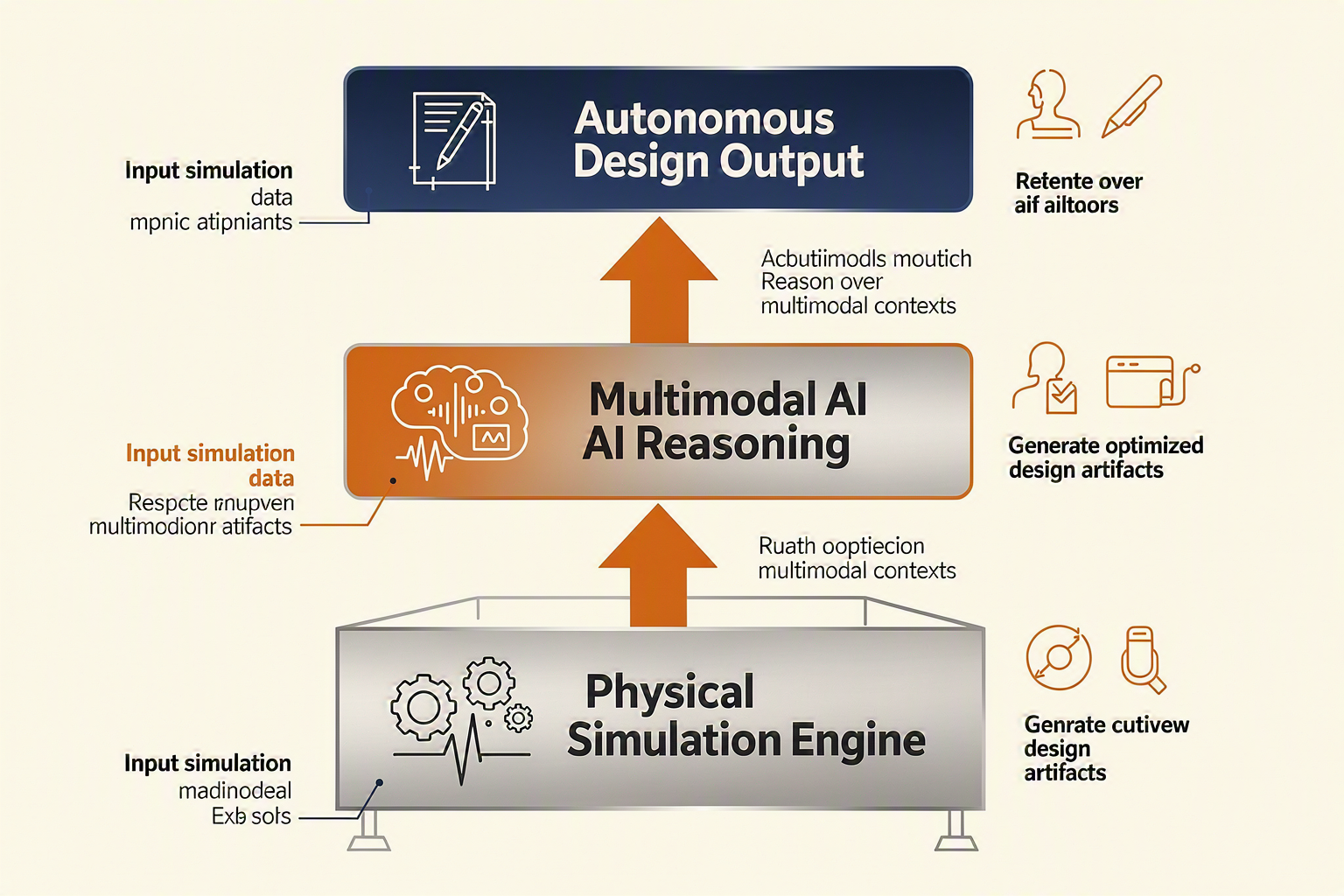
An Artificial General Engineer bridges this critical gap. It is built from the ground up to operate in the physical domain, synthesizing the analytical capabilities of a structural, mechanical, chemical, and aerospace engineer into a single, unified cognitive architecture. Rather than relying solely on pattern matching from text databases, an AGE utilizes physics-informed neural networks (PINNs) to ensure its outputs conform strictly to the laws of nature.
The Core Pillars of an Artificial General Engineer
An AGE is defined by four core technical pillars that distinguish it from any AI model currently on the market:
- Multimodal Physical Reasoning: An AGE does not just process text and images; it processes CAD schematics, 3D point clouds, thermal imaging, sensor telemetry, and stress-test data. It can look at a mechanical blueprint and immediately identify stress concentrations or manufacturing bottlenecks.
- Predictive Physics Simulations: Traditional engineering requires hours—sometimes days—of running Finite Element Analysis (FEA) or Computational Fluid Dynamics (CFD) simulations on supercomputers. An AGE can run surrogate machine learning models that approximate these complex physics simulations in milliseconds, allowing for near-instantaneous design iterations.
- Generative Material Science: Beyond structural design, an AGE can design new materials at the molecular level. If an aerospace component requires a specific strength-to-weight ratio and thermal tolerance, the AGE can propose novel alloy compositions or composite layups to meet those exact specifications.
- Autonomous Sim-to-Real (Simulation-to-Reality) Translation: An AGE does not stop at digital design. It translates its optimized blueprints directly into machine instructions—such as G-code for 3D printers, robotic assembly paths, and CNC machining sequences—minimizing human intervention on the factory floor.
Bridging the Human-Machine Gap in Heavy Industry
For an Artificial General Engineer to operate effectively in the real world, it cannot exist as an isolated supercomputer in a clean room. It must seamlessly collaborate with human engineers, maintenance technicians, and floor managers who are actively building and testing physical hardware. This requires an ultra-low-latency, highly intelligent communication fabric.
This is where the broader ecosystem of advanced AI infrastructure becomes indispensable. While Prometheus focuses on the heavy physical reasoning of the AGE, platforms like CallMissed are already enabling the vital communication pathways needed to deploy such systems in real-world industrial environments.
For example, on a noisy manufacturing floor or a remote rocket test stand, engineers cannot stop to type prompts into a terminal. By utilizing CallMissed’s production-ready voice agent infrastructure and highly accurate Speech-to-Text APIs, companies can deploy voice-activated AI agents that connect directly to the AGE. Technicians can verbally query the system—asking for immediate design modifications, structural diagnostics, or telemetry updates—and receive instant, synthesized audio responses. Because heavy manufacturing and supply chains are globally distributed, CallMissed’s native support for multilingual communication, including 22 regional Indian languages, ensures that localized engineering teams can interact with complex physical AI models in their native tongue, drastically reducing errors and operational downtime.
Why the Physical World is the Ultimate Frontier
The strategic reasoning behind Bezos’s $41 billion bet on Prometheus becomes clear when looking at his existing portfolio. Between Amazon’s massive, robotics-driven fulfillment network and Blue Origin’s complex aerospace ambitions, Bezos’s business empire is fundamentally rooted in physical infrastructure, logistics, and heavy engineering.
Historically, scaling physical businesses has been notoriously slow and capital-intensive compared to software. While a software startup can scale to millions of users with a few cloud servers, building a new rocket, cargo plane, or automated warehouse requires years of prototyping, testing, and regulatory approvals.
By deploying an Artificial General Engineer, the timeline for physical innovation could shrink from decades to weeks. If Prometheus succeeds, the AGE will not just assist human engineers; it will autonomously design the next generation of clean energy systems, space exploration hardware, and automated manufacturing plants—effectively decoupling physical innovation from the limits of human cognitive bandwidth.
Bezos vs. The AI Giants: Why Physical AI Matters
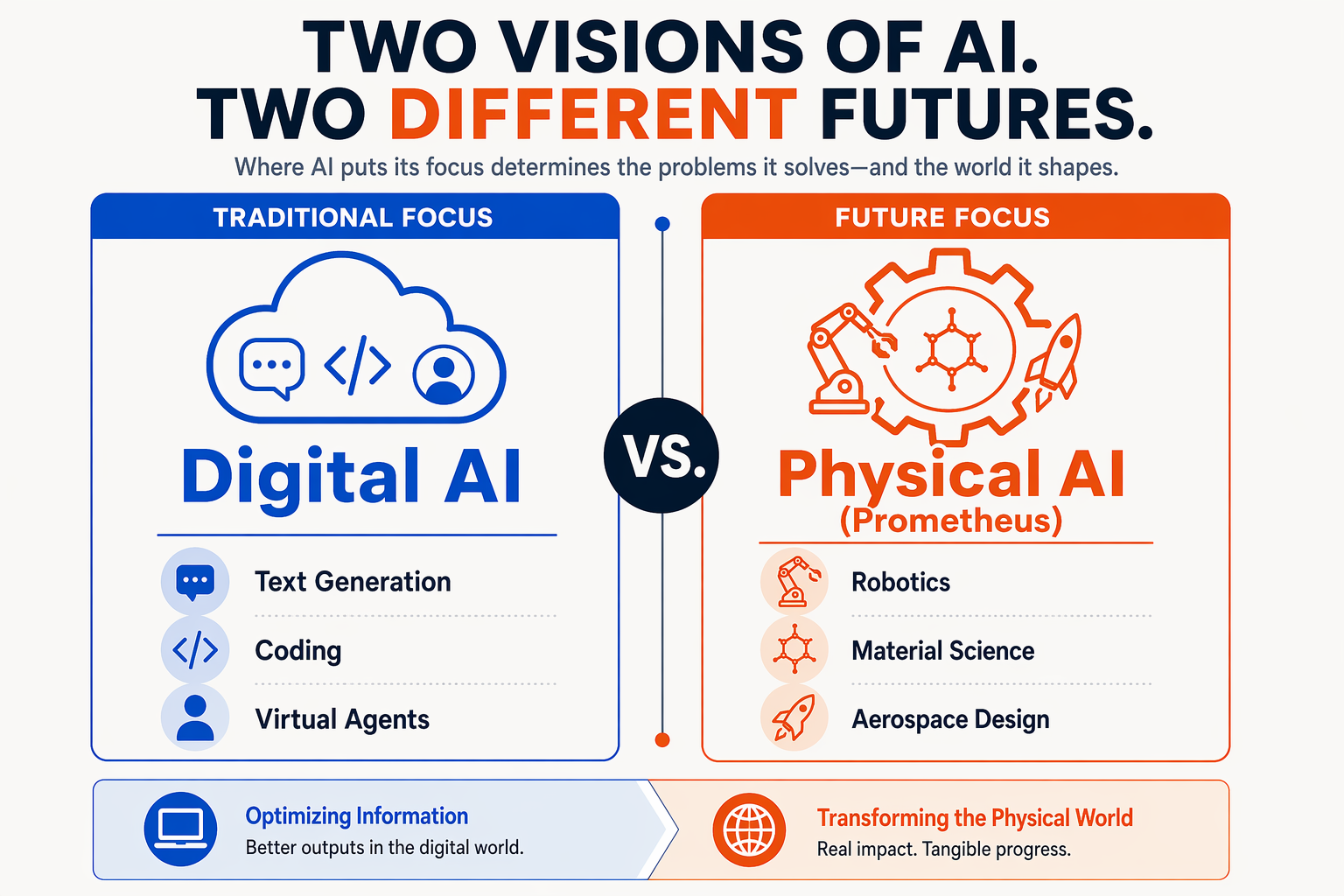
While the Silicon Valley elite remains locked in a fierce arms race to build the ultimate digital assistant, Jeff Bezos has quietly pivoted the AI conversation toward a far more tangible frontier. The mainstream AI landscape—dominated by the likes of OpenAI, Google, and Anthropic (in which Amazon itself has invested $4 billion)—is deeply focused on "Artificial General Intelligence" (AGI) designed for digital environments. These systems excel at writing essays, generating code, and manipulating spreadsheets.
However, Bezos’s new venture, Prometheus, which recently raised a staggering $12 billion at a $41 billion valuation, represents a fundamental departure from this digital-first consensus. Co-founded by Bezos and Vik, Prometheus is designed to build an "Artificial General Engineer."
This is not a chatbot built to answer trivia; it is an AI native to the physical world. The battle lines of the next decade of AI are being drawn between the Digital AI Giants and the pioneers of Physical AI. Understanding why this shift matters is key to understanding the next epoch of global industry.
The Digital-Physical Divide: Beyond the Screen
To date, generative AI has largely operated in a frictionless, virtual sandbox. If an LLM hallucinations a word or writes a buggy Python script, the cost of failure is relatively low. The digital world is forgiving; code can be debugged, and text can be rewritten.
In contrast, the physical world is governed by non-negotiable laws: gravity, thermodynamics, fluid dynamics, stress limits, and material fatigue. This is where current foundation models stumble.
- The Hallucination Problem: A digital AI can hallucinate a plausible-sounding legal brief with minimal real-world damage. If an AI designing a fuselage or a bridge hallucinations a stress-tolerance metric, the result is catastrophic structural failure.
- The Data Bottleneck: Digital AI has been trained on the internet—billions of pages of written text and code. Physical AI, however, requires high-fidelity spatial data, real-time sensor telemetry, and complex multi-physics simulations that cannot simply be scraped from public web pages.
- The Actuation Gap: Digital AI stops at the screen. Physical AI must understand how to interact with, manipulate, and restructure physical matter, translating digital intelligence into physical work.
By targeting the "Artificial General Engineer," Prometheus is positioning itself to bypass the crowded market of digital productivity tools. Instead, it is aiming directly at the industrial, manufacturing, and aerospace sectors—the heavy machinery of global GDP.
Why the "Artificial General Engineer" is a Trillion-Dollar Bet
An Artificial General Engineer represents the convergence of deep learning with advanced physics simulation. Rather than relying solely on pattern recognition, Prometheus aims to build models that natively understand physical constraints. This has radical implications for several trillion-dollar industries:
- Aerospace and Space Exploration: Bezos has long championed the vision of expanding human industry beyond Earth. At the VivaTech conference in Paris, he famously reiterated his vision to eventually "move all heavy, polluting industries into space" to protect Earth. Designing the rocketry, orbital habitats, and manufacturing facilities required for this future cannot be done manually; it requires an AI capable of iterating on complex engineering designs at a speed and scale humans cannot match.
- Automated Industrial Manufacturing: From automotive assembly lines to custom semiconductor fabrication, a physical-first AI can design, test, and optimize production pipelines autonomously. It can predict mechanical wear before it occurs and redesign components on the fly to maximize efficiency.
- Materials Science Discovery: Creating lighter, stronger, and more heat-resistant materials is the bottleneck for clean energy, electric vehicles, and deep-space travel. An Artificial General Engineer can run millions of virtual physical simulations per second, discovering novel alloys and composites that human researchers might take decades to uncover.
The Infrastructure Challenge: Bridging Digital and Physical Worlds
Building a physical-world AI requires an entirely different infrastructure stack. It demands massive computational clusters capable of running real-time 3D environments, ultra-low-latency data processing, and highly resilient communication frameworks.
As enterprises begin to integrate these highly specialized AI systems into their physical workflows, the need for robust digital-to-physical communication becomes paramount. This is where advanced AI infrastructure platforms are stepping in to bridge the gap. For example, platforms like CallMissed are already solving the parallel digital orchestration challenge. Just as Prometheus integrates multi-physics models to control physical processes, CallMissed’s multi-model API gateway allows developers to orchestrate over 300+ LLMs seamlessly.
For heavy industry, maintenance, and logistics crews operating in the field, accessing complex physical AI systems requires intuitive, hands-free interfaces. By leveraging CallMissed's enterprise-grade Speech-to-Text APIs—supporting 22 regional Indian languages natively—and production-ready voice agents, companies can connect front-line physical operators directly to their central AI brains without needing to touch a screen.
Bezos’s Master Play: The Ultimate Flywheel
The launch of Prometheus is not an isolated venture; it is the missing link in Bezos’s grand industrial flywheel.
- Amazon provides the ultimate testing ground for physical robotics, autonomous delivery drones, and automated warehouse logistics.
- Blue Origin provides the ultimate stress-test environment—aerospace engineering, rocket propulsion, and off-planet manufacturing challenges where physical precision is life or death.
- Prometheus provides the cognitive engine to power both, acting as the centralized "brain" that designs, optimizes, and executes physical tasks across these domains.
While Microsoft, Google, and Meta continue to fight over who can build the most creative digital copywriter or search engine, Jeff Bezos is positioning Prometheus to control the very physical infrastructure of the future. The $12 billion bet on Prometheus is a bet that the ultimate value of artificial intelligence lies not in replacing human thought on a screen, but in rebuilding the physical world from the atom up.
Impact & Implications: Transforming Manufacturing, Blue Origin, and Beyond
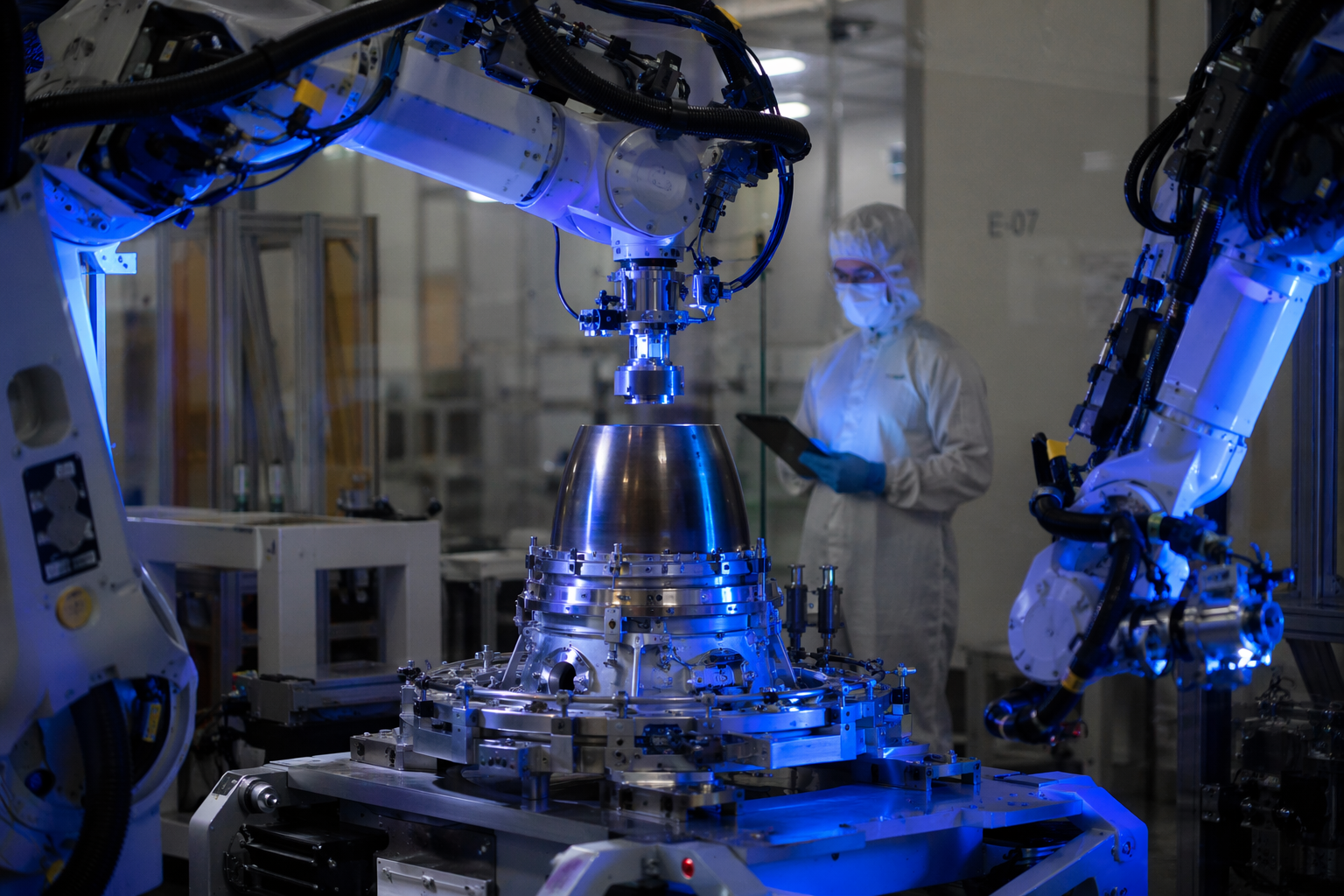
The creation of Prometheus, backed by an unprecedented $12 billion funding round at a $41 billion valuation, represents a tectonic shift in the artificial intelligence landscape. While the last wave of AI focused heavily on generative text, code, and creative media, Jeff Bezos and co-founder Vik are directing this massive capital injection toward the physical world.
By designing an "Artificial General Engineer" (AGE), Prometheus is moving beyond digital-only software assistants. The goal is to build an intelligence capable of understanding physics, material science, aerodynamics, and structural engineering. This technological leap will have profound implications across manufacturing, aerospace, and the broader global economy.
Redefining the Factory Floor: AI-Driven Manufacturing
Traditional manufacturing relies on a fragmented pipeline: human engineers design parts in CAD software, simulation specialists test them under stress, material scientists select the substrates, and machinists configure the assembly lines. This process is slow, iterative, and expensive.
An Artificial General Engineer will compress these steps into a unified, autonomous loop:
- Generative Structural Design: Instead of humans designing a bracket or engine mount, Prometheus's AGE could instantly generate thousands of structurally optimized, aerodynamically sound designs that minimize weight while maximizing strength.
- Predictive Material Synthesis: The AI can simulate how newly proposed alloys or composite materials will behave under extreme temperatures and pressures, skipping months of physical metallurgy trials.
- Self-Optimizing Assembly Lines: By integrating physical-world AI directly into factory robotics, manufacturing plants will be able to reconfigure themselves dynamically to accommodate design changes on the fly, eliminating downtime.
Propelling Blue Origin into the Next Era of Aerospace
Bezos’s space venture, Blue Origin, stands to be one of the primary beneficiaries of this engineering breakthrough. Bezos has long championed a grand, long-term vision—reiterated at events like VivaTech in Paris—of moving heavy, polluting industries off Earth and into space to protect our planet. To achieve this, the speed of aerospace engineering must accelerate exponentially.
Developing reusable rockets, lunar landers, and orbital habitats requires solving incredibly complex engineering problems under compressed timelines. An Artificial General Engineer could revolutionize Blue Origin’s R&D in several critical ways:
- Accelerating Rocket Engine Iteration: The AI can analyze telemetry data from hot-fire tests in real time, instantly identifying micro-fissures or thermal anomalies and redesigning engine components (such as fuel injectors or combustion chambers) to prevent failure.
- Autonomous Orbital Construction: Building large-scale space stations or lunar bases requires autonomous robots capable of making complex structural decisions without waiting for instructions from Earth. Prometheus's physical AI could serve as the "brain" for these orbital construction systems.
- Risk Mitigation: By simulating millions of flight hours and environmental stressors in a physics-engine-backed virtual environment, the AGE can predict and mitigate catastrophic structural failures before a rocket ever reaches the launchpad.
The Communication Layer: Bridging Digital Intelligence and Physical Operations
As AI systems like Prometheus begin managing physical-world infrastructure, the need for seamless, low-latency communication between human operators, field technicians, and AI agents becomes paramount. An Artificial General Engineer cannot operate in a vacuum; it must constantly coordinate with human teams on assembly floors, launchpads, and remote field sites.
This is where advanced communication infrastructure becomes critical. Platforms like CallMissed are already enabling this physical-to-digital transition. By providing production-ready AI voice agents, real-time Speech-to-Text supporting 22 Indian languages, and robust API frameworks, CallMissed allows heavy industry and logistics enterprises to deploy conversational AI interfaces. In a Prometheus-driven future, a field technician working on a complex aerospace assembly could use CallMissed-powered voice interfaces to query the AI engineer, adjust design parameters on the fly, and receive instant telemetry updates—all hands-free and in their native language.
Economic and Geopolitical Implications of Physical AI
The race to build the first true Artificial General Engineer is not just a commercial competition; it is a geopolitical priority. The nations and corporations that control physical-world AI will hold a massive competitive advantage in global trade, defense, and infrastructure development.
- Reshoring Manufacturing: High-cost labor markets (such as the US and Europe) could use AGE-driven automation to reshore heavy manufacturing, reducing reliance on long, fragile global supply chains.
- The Engineering Labor Market: While some fear the displacement of human engineers, the realistic outcome is a massive productivity multiplier. Human engineers will shift from manual drafting and calculating to supervising, directing, and validating AI-generated designs.
- The Next Infrastructure Boom: From designing ultra-efficient power grids to planning smart cities, an AI capable of solving complex civil engineering challenges will dramatically lower the cost of public works and renewable energy projects worldwide.
Expert Opinions: Skepticism and Excitement in Silicon Valley

The announcement of Prometheus—Jeff Bezos’s new AI venture co-founded with computer scientist Vik—raising a staggering $12 billion at a $41 billion valuation has sent shockwaves through Silicon Valley. While the tech industry has grown accustomed to eye-watering valuations and massive capital raises, Prometheus’s stated goal is radically different from the software-centric LLMs of the past few years.
By aiming to build an "Artificial General Engineer" (AGE), Bezos is steering the AI race directly into the physical world: manufacturing, aerospace, heavy infrastructure, and robotics. This pivot from digital chatbots to physical-world AI has sparked intense debate among AI researchers, venture capitalists, and industry veterans, dividing the Valley into camps of deep skepticism and intense excitement.
The Case for Excitement: Reimagining the Physical World
Optimists in Silicon Valley believe that the "low-hanging fruit" of purely digital text and code generation has peaked, and that the true frontier of AI lies in physical engineering. If Prometheus can successfully train models on the fundamental laws of physics, thermodynamics, chemistry, and materials science, it could compress decades of traditional engineering R&D into days.
- Accelerated Prototyping: Imagine an AI system that doesn't just draft a blueprint, but simulates its stress-tests under extreme weather conditions, optimizes its material cost down to the penny, and instantly sends the instructions to automated robotic assembly lines.
- The Space and Industrial Connection: This vision aligns perfectly with Bezos’s long-term ambitions, including his space venture, Blue Origin. At events like VivaTech, Bezos has famously advocated for moving heavy, polluting industries into space to protect Earth. An Artificial General Engineer would be the foundational software required to design, build, and maintain these space-bound manufacturing habitats and next-generation rockets.
- The Next Infrastructure Boom: Proponents argue that the world's most pressing challenges—from clean energy grids to efficient transportation—are physical, not digital. AGE could unlock breakthroughs in battery chemistry, carbon capture, and structural integrity that human engineers might take centuries to discover.
To make these automated physical systems functional on a global scale, they must interact seamlessly with human operators, supply chains, and distributed teams. This requires highly sophisticated, real-time communication architectures. While Prometheus tackles the physical design, AI infrastructure platforms like CallMissed are solving the communication bottleneck. Platforms like CallMissed provide the critical middleware—such as Speech-to-Text APIs supporting 22 regional Indian languages and production-ready voice agent infrastructure—to ensure that when physical AI systems generate operational alerts or design updates, they can immediately and intelligently communicate them to human supervisors worldwide.
The Case for Skepticism: The "Zero-Tolerance" Reality of Physics
On the other side of the spectrum, many seasoned engineers and computer scientists urge extreme caution. The primary argument against the immediate feasibility of an Artificial General Engineer is the zero-tolerance threshold for error in the physical world.
- The Catastrophic Cost of Hallucinations: In software engineering, a bug can be patched post-release with minimal real-world harm. In structural, mechanical, or aerospace engineering, a calculation error results in catastrophic physical failure—collapsed bridges, exploded rockets, or failed power grids. Critics point out that current deep learning models are notoriously prone to "hallucinations" and struggle with out-of-distribution reasoning.
- The "Sim-to-Real" Gap: Training an AI on physical laws is fundamentally harder than training it on internet text. It requires high-fidelity physics simulators, vast amounts of proprietary industrial data, and solving the notorious "sim-to-real" gap, where AI agents perform flawlessly in virtual environments but fail when confronted with the unpredictable friction, wear, and dust of the physical world.
- Data Scarcity: Unlike the open internet, which provided trillions of tokens of text for models like GPT-4, high-quality engineering data, CAD models, and proprietary manufacturing workflows are closely guarded secrets.
The Financial and Strategic Gamble
The massive $12 billion war chest is both a necessity and a target for criticism. Some analysts argue that Prometheus’s $41 billion valuation is highly speculative, driven more by Jeff Bezos's star power and the market’s FOMO (Fear Of Missing Out) than by validated technological breakthroughs.
However, supporters counter that building physical AI is an incredibly capital-intensive endeavor. It requires massive computational clusters, specialized sensor-laden robotics laboratories, and hiring top-tier talent from both AI research and traditional engineering disciplines. This funding puts Prometheus on par with the scale of investments seen in OpenAI and Anthropic (in which Amazon itself recently invested $4 billion), signaling that the next phase of AI will be a battle of sovereign-scale capital.
Whether Prometheus succeeds in building a true "Artificial General Engineer" or falls victim to the harsh realities of physical engineering, Bezos's bet has successfully shifted the Silicon Valley conversation. The AI race is no longer just about who can write the best essay or generate the most realistic image—it is now about who can master the physical world.
What This Means For You: Job Roles & Opportunities (TABLE)
The physical AI revolution, supercharged by Jeff Bezos’s staggering $12 billion funding round into Prometheus, is redrawing the boundaries of the global labor market. A $41 billion valuation for a startup focused on building an "Artificial General Engineer" (AGE) signals a profound shift: the era of AI restricted to digital-only environments (such as text, image, and code generation) is giving way to AI that understands, interacts with, and designs the physical world.
This transition from digital LLMs to physical-world engineering agents will not simply replace human workers; instead, it is creating entirely new classes of highly specialized, multidisciplinary job roles. The next generation of engineers, developers, and project managers must learn to collaborate with AI systems that can run millions of structural, thermodynamic, and fluid dynamics simulations in seconds.
To help you navigate this rapidly evolving landscape, the table below outlines the key emerging job roles, their core responsibilities, required skills, and growth projections as physical AI becomes deeply integrated into global industry.
The Emerging Job Landscape in the Physical AI Era
| Role | Key Responsibility | Required Skillset | Primary Industries | Growth Outlook (by 2030) |
|---|---|---|---|---|
| Physical AI Systems Architect | Bridge the gap between Prometheus-class physical AI models and actual robotic/manufacturing hardware. | ROS (Robot Operating System), C++, PyTorch, edge computing, sensor fusion. | Aerospace, Automotive, Advanced Manufacturing | High (+45% YoY) |
| Physics-Informed ML Engineer | Develop and fine-tune models that respect physical laws (thermodynamics, fluid dynamics, stress limits). | Neural ODEs, deep learning, simulation engineering (Ansys, CAD integration). | Material Science, Construction, Civil Engineering | Hyper-Growth (+60% YoY) |
| HITL Physical Safety Auditor | Validate AI-generated physical designs and mechanical workflows for safety, structural integrity, and regulatory compliance. | Mechanical engineering, safety protocols, predictive maintenance modeling. | Heavy Industry, Aviation, Energy Sectors | Critical / Highly Essential |
| Multi-Modal AI Pipeline Specialist | Design communication frameworks that connect edge hardware, voice interfaces, and central physical AI brains. | API infrastructure, real-time streaming, edge-to-cloud data routing. | Logistics, Smart Warehousing, IoT Systems | Rapid Expansion (+38% YoY) |
| AI-Native CAD Designer | Collaborate with generative engineering models to iterate on novel, generative physical-world components. | Generative design tools, structural optimization, 3D printing/additive manufacturing. | Product Design, Architecture, Bio-Mechanical | Steady Rise (+30% YoY) |
Deep Dive: Key Career Opportunities and Shifts
The emergence of the Artificial General Engineer means that technical professionals must transition from being "doers" of manual calculations to "orchestrators" of complex, AI-driven physical systems.
#### 1. The Rise of Physics-Informed Neural Networks (PINNs)
Traditional large language models struggle with physical constraints because they lack an innate understanding of gravity, friction, and material fatigue. To bridge this gap, companies like Prometheus are heavily recruiting engineers who understand Physics-Informed Neural Networks (PINNs).
If you are a mechanical or aerospace engineer, your domain expertise is becoming incredibly valuable to AI development teams. Instead of manually drafting parts in CAD, your role will pivot toward training AI models to respect the laws of physics. You will be defining the guardrails, objective functions, and boundary conditions within which an AI engineer like Prometheus can safely operate.
#### 2. Real-Time Human-to-Machine Communication Interfaces
As physical AI systems take over operations in smart factories, automated warehouses, and construction sites, the need for seamless, natural language communication between human operators and machine brains will skyrocket. It is no longer practical for a floor manager to write Python code to redirect an automated assembly line.
This is where the democratization of communication interfaces becomes vital. For instance, platforms like CallMissed are already paving the way by enabling developers to deploy sophisticated, multi-lingual voice agents and LLM-driven communication pipelines. By utilizing robust infrastructure like CallMissed’s APIs—which support 300+ LLMs and Speech-to-Text in 22 regional Indian languages natively—enterprises can build real-time voice interfaces that allow factory workers, field engineers, and supervisors to converse directly with physical AI systems. Whether it is asking a generative manufacturing tool to "adjust the structural tolerances of the wing flap design by 2%," or receiving a spoken diagnostic report from a warehouse drone, voice-to-physical-action interfaces will become the standard.
#### 3. Human-in-the-Loop (HITL) Validation
One of the most significant bottlenecks for physical AI is the cost of failure. While a software hallucination might result in a broken line of code or an awkward email draft, a physical AI hallucination can lead to a collapsed bridge, a shattered robotic limb, or a malfunctioning rocket engine.
Consequently, the demand for Human-in-the-Loop (HITL) Validation Experts will explode. These professionals will act as the final authority, auditing AI-generated designs, mechanical stress tests, and automated assembly paths. If you have a background in quality assurance, industrial safety, or regulatory compliance, upskilling in basic machine learning interpretability will position you for highly lucrative roles as the physical world's safety gatekeeper.
How to Position Yourself for the $41 Billion Physical AI Wave
If you want to capitalize on the massive wave of capital currently flowing into ventures like Prometheus, you must proactively adapt your skill set:
- For Software Developers: Move beyond web and traditional app development. Focus on spatial computing, computer vision, reinforcement learning for robotics, and physical simulation engines (such as NVIDIA Omniverse or Unity/Unreal Engine for physics rendering).
- For Mechanical and Civil Engineers: Learn the fundamentals of machine learning. Understand how generative design algorithms function and how to use Python-based physics libraries to feed data into deep learning pipelines.
- For Project and Product Managers: Specialize in multi-modal system integration. Learn how to manage projects where hardware, edge computing, centralized AI models, and real-time communication protocols (like CallMissed's voice and chatbot APIs) converge.
Jeff Bezos’s $12 billion bet on Prometheus confirms that the next decade of technological dominance will belong to those who can master the intersection of digital intelligence and physical reality. By identifying your niche in this new ecosystem today, you can transition from a spectator to a key architect of the automated physical world.
The Road to 2030: What Lies Ahead for Prometheus

As the industry processes the monumental news of Prometheus’s $12 billion funding round—propelling the startup to a staggering $41 billion valuation—the focus shifts from the sheer scale of Jeff Bezos’s war chest to the practical timeline of its execution. Building an "Artificial General Engineer" (AGE) is not a short-term software play; it is a multi-decade endeavor to bridge the chasm between digital intelligence and physical reality.
Between now and 2030, Prometheus is poised to redefine the boundaries of manufacturing, aerospace, and heavy industry. Achieving this requires navigating a highly ambitious roadmap, overcoming severe physical bottlenecks, and laying the infrastructural groundwork for a future where machines design the world around us.
The 2026–2028 Horizon: Master of the Digital Twin
The immediate phase of Prometheus’s roadmap focuses on the transition from pure generative AI to physics-informed AI. Unlike traditional large language models (LLMs) that predict the next word, an Artificial General Engineer must predict how a structural beam will bend under stress, or how air will flow over a hypersonic wing.
Over the next two years, Prometheus is expected to focus heavily on the following milestones:
- Unification of CAD and Physics Engines: Current computer-aided design (CAD) tools and finite element analysis (FEA) software operate in silos, requiring human engineers to manually bridge the gap. Prometheus aims to build unified models that generate, test, and optimize mechanical designs in closed-loop simulations millions of times per second.
- Material Science Discovery: By training neural networks on molecular structures and stress-test data, the AGE will begin recommending entirely new composite materials tailored for specific thermal and structural demands, bypassing years of manual laboratory trial-and-error.
- Robotic Teleoperation and Data Harvesting: To understand the physical world, Prometheus needs physical data. The startup is leveraging advanced telemetry from robotic arms and factory floors to teach its AI the "feel" of physical assembly, from the torque required for a specific bolt to the tactile feedback of welding.
Overcoming the Bottlenecks: Compute, Real-World Data, and Low-Latency Infrastructure
Despite a $12 billion war chest, Prometheus faces fundamental technical hurdles. Standard AI models are trained on internet text, which is abundant and cheap. Physical engineering data, however, is scarce, proprietary, and highly complex. To train an AI to design a rocket engine, Prometheus cannot simply scrape the web; it must generate synthetic physics data through incredibly expensive supercomputer simulations.
Furthermore, deploying these massive AI models to physical environments requires highly specialized infrastructure. When an AI engineer is monitoring a live manufacturing line or adjusting a robotic assembly in real time, latency is a critical failure point.
This infrastructure challenge is mirrored across the broader technology landscape. Just as industrial systems require ultra-low latency pipelines to feed physical telemetry to AI brains, modern businesses require robust communication infrastructures to connect their AI systems with the human world. For instance, platforms like CallMissed provide the critical, low-latency API infrastructure needed to route complex multilingual voice agents and speech-to-text workflows. For Prometheus, building equivalent high-performance data highways between physical sensors and core AI models will be the defining technical challenge of the late 2020s.
The 2030 Vision: Heavy Industry, Space, and the "Off-Earth" Paradigm
By 2030, the true scope of Jeff Bezos’s vision for Prometheus will begin to materialize. This vision is deeply intertwined with his long-held belief that humanity must transition heavy, polluting industries off Earth to preserve the planet. At VivaTech in Paris, Bezos famously reiterated his stance on moving heavy manufacturing into space.
Prometheus is the intellectual engine designed to make that orbital transition possible. By 2030, the Artificial General Engineer is projected to achieve several breakthrough capabilities:
- Autonomous Orbital Design: Designing structures for zero-gravity environments requires throwing out terrestrial engineering textbooks. An AGE can design orbital habitats, satellite constellations, and space-based manufacturing facilities optimized specifically for the vacuum and microgravity of space.
- Closed-Loop Robotic Factories: Terrestrial factories will transition to near-total autonomy. Human operators will act as high-level directors, inputting broad parameters (e.g., "design a drone with a 4-hour battery life and a 10kg payload capacity using locally sourced aluminum"), while Prometheus handles everything from initial blueprinting to programming the assembly-line robots.
- The Demise of the Prototyping Bottleneck: Traditionally, bringing a complex physical product to market takes years of physical prototyping. By 2030, Prometheus’s simulations are expected to be so physically accurate that a product’s first physical iteration will also be its final, production-ready version.
Preparing the Enterprise for the Physics-First AI Era
As Prometheus paves the way for the Artificial General Engineer, enterprises cannot afford to wait until 2030 to adapt. The integration of physical AI will require a complete overhaul of how businesses manage data, supply chains, and communication.
To keep pace with engineering cycles that operate at the speed of digital simulation, organizations must modernize their operational stacks. Integrating agile communication systems, such as CallMissed’s multi-model API gateway, allows businesses to deploy intelligent, multilingual AI agents that can instantly connect factory-floor telemetry, supplier databases, and customer support queues. When the AI design agent updates a blueprint, the entire supply chain and corporate communication network must adapt instantly.
The road to 2030 is no longer about teaching computers how to write or speak—it is about teaching them how to build. With Prometheus leading the charge, the next decade will decide whether Jeff Bezos can successfully digitize the physical laws of our universe, transforming the role of the engineer forever.
Frequently Asked Questions

What is Jeff Bezos's new AI startup Prometheus?
What is an artificial general engineer and how does it work?
How much funding has Jeff Bezos's Prometheus raised?
How will the artificial general engineer impact global manufacturing and design?
Who is co-founding Prometheus alongside Jeff Bezos?
How does an artificial general engineer differ from traditional AI models like GPT-4?
Conclusion
Jeff Bezos’s massive $12 billion bet on Prometheus marks a pivotal transition in the artificial intelligence landscape, steering the conversation away from digital-only models toward physical-world capabilities. As we watch this next chapter of industrial automation unfold, several key insights stand out:
- The Rise of Physical AI: Prometheus is redefining the AI frontier by aiming to build an "artificial general engineer" designed to revolutionize manufacturing, heavy industry, and physical design.
- Unprecedented Scale: Securing a $41 billion valuation right out of the gate proves that the market's appetite for hardware-adjacent, physical-world AI applications is eclipsing traditional software-only models.
- Founder-Led Industrial Disruption: Jeff Bezos's active return to the entrepreneurial trenches indicates that the next phase of tech supremacy will be won by those who can bridge the gap between digital intelligence and physical execution.
Looking ahead, the critical factor to watch will be how quickly Prometheus translates its massive war chest into functional, real-world deployments. The next phase of global innovation will rely on how seamlessly these general engineering models integrate with existing manufacturing pipelines, logistics networks, and hardware systems.
To explore how AI communication is evolving alongside these industrial advancements, check out CallMissed—an AI communication infrastructure platform powering intelligent voice agents and multilingual chatbots that keep modern businesses agile in a rapidly shifting tech landscape.
As artificial intelligence prepares to transition from writing software code to designing the physical infrastructure of tomorrow, one question remains: Is your organization ready to adapt to a world where machines do not just think, but build?
Related Posts
कोडिंग पर GPT-OSS 120B का ओपन-सोर्स प्रदर्शन: विशिष्टताएँ, बेंचमार्क, मूल्य निर्धारण और API एक्सेस
तर्क कार्यों के लिए Grok 4.20 बनाम Gemini 3.1 Pro: क्या सत्यापित किया जा सकता है?

मैं LLM API गेटवे को वॉइस और WhatsApp एजेंट्स से कैसे कनेक्ट कर सकता हूँ? एक डेवलपर गाइड
Ready to automate customer conversations?
Launch AI voice agents and WhatsApp bots with CallMissed — one API, 22+ Indian languages.