

Shopify + CallMissed: How AI Voice & WhatsApp Agents Stop E-commerce Cart Abandonment


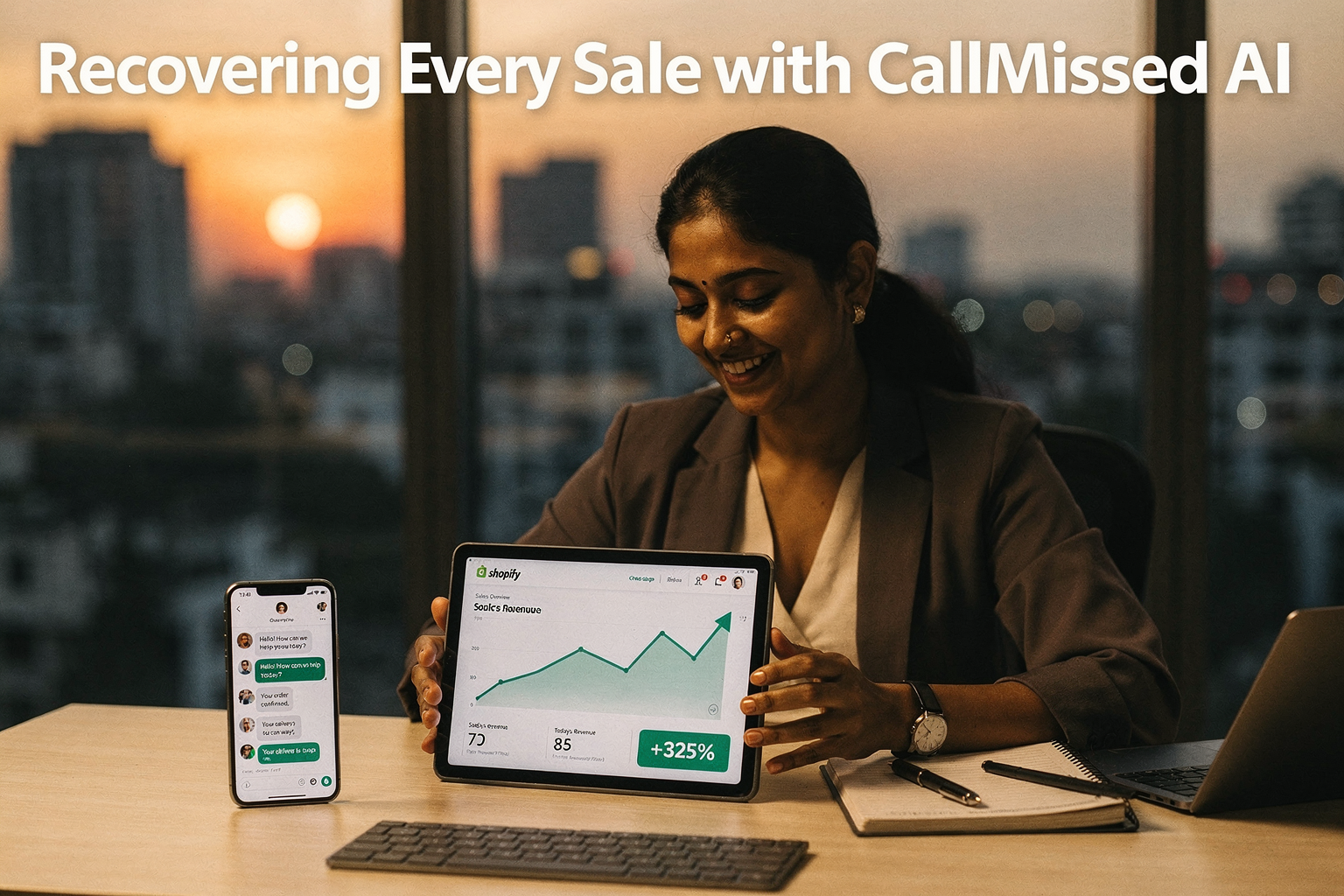
Did you know that nearly 70% of all e-commerce shopping carts are abandoned before a transaction is ever completed? In the fast-paced retail landscape of...
Shopify + CallMissed: How AI Voice & WhatsApp Agents Stop E-commerce Cart Abandonment
Did you know that nearly 70% of all e-commerce shopping carts are abandoned before a transaction is ever completed? In the fast-paced retail landscape of 2026, where mobile commerce dominates global retail, this single metric represents trillions of dollars in lost annual revenue. For years, Shopify merchants have relied on traditional recovery methods like email retargeting. However, with average email open rates hovering below 20% and SMS inbox clutter at an all-time high, these static, delayed nudges are no longer enough to win back hesitant buyers. When a customer hesitates at checkout due to a surprise shipping fee, a declined credit card, or a simple question about sizing, they don't want to wait hours for an email response—they want answers immediately.
This is why conversational commerce has become the ultimate battlefield for customer retention. To stop cart abandonment before it happens, forward-thinking brands are shifting from passive recovery to active, real-time engagement. By integrating Shopify + CallMissed, e-commerce businesses can bridge this communication gap instantly. Platforms like CallMissed enable store owners to automatically launch hyper-personalized AI voice agents and automated WhatsApp chatbots that engage high-intent shoppers the moment they abandon their carts, answering questions and resolving checkout objections in real time.
In this post, we will explore how combining the robust commerce engine of Shopify with CallMissed's advanced AI communication infrastructure can revolutionize your checkout completion rates. You’ll learn how real-time Voice AI and automated WhatsApp outreach can handle complex customer objections, offer instant localized assistance, and recover lost revenue on autopilot. It's time to stop letting warm leads slip through your fingers and start turning abandoned carts into completed checkouts.
Introduction
Did you know that nearly 70% of all e-commerce shopping carts are abandoned before a transaction is ever completed? In the fast-paced retail landscape of 2026, where mobile commerce dominates global retail, this single metric represents trillions of dollars in lost annual revenue. For years, Shopify merchants have relied on traditional recovery methods like email retargeting. However, with average email open rates hovering below 20% and SMS inbox clutter at an all-time high, these static, delayed nudges are no longer enough to win back hesitant buyers.
When a customer hesitates at checkout due to a surprise shipping fee, a declined credit card, or a simple question about sizing, they do not want to wait hours for an email response—they want answers immediately.
The Cost of Hesitation: Why Traditional Recovery is Failing
Static recovery methods fail because they lack immediacy and personalization. When a shopper leaves your Shopify store, every minute that passes drastically reduces the likelihood of conversion. Today's consumer expects real-time gratification and high-touch support. Sending a generic "You left something behind!" email three hours later often lands in the promotions tab, completely missed by the buyer.
To stop cart abandonment before it happens, forward-thinking brands are shifting from passive recovery to active, real-time engagement. This is why conversational commerce has become the ultimate battlefield for customer retention. To win, e-commerce businesses must meet their customers where they are, instantly resolving checkout hesitation.
Enter Conversational Commerce: Shopify + CallMissed
By integrating your Shopify store with CallMissed, you can bridge this communication gap instantly. CallMissed provides an advanced AI communication infrastructure that unifies WhatsApp, Voice, Email, and Web into a single, AI-powered CRM.
Instead of relying on slow, manual channels, Shopify merchants can leverage CallMissed to:
- Deploy Autonomous Voice Agents: Instantly trigger human-like voice agents to follow up on high-value abandoned carts, answering complex buyer objections and clarifying shipping or return policies in real time.
- Automate WhatsApp Conversations: Engage shoppers on the world's most popular messaging app. CallMissed allows you to deploy interactive WhatsApp chatbots that share direct checkout links, discount codes, and product recommendations.
- Provide True Multilingual Support: For global brands and businesses targeting regional markets, CallMissed’s AI agents natively support 22 Indian languages, effortlessly understanding local accents, dialects, and cultural nuances.
- Maintain Unified Customer Context: Because CallMissed integrates directly with your Shopify backend, the AI agents always know what is in the customer's cart, their purchase history, and their delivery address, providing a seamless, context-aware experience.
In this comprehensive guide, we will explore how combining the robust commerce engine of Shopify with CallMissed's cutting-edge AI infrastructure can revolutionize your checkout completion rates. You’ll learn how real-time Voice AI and automated WhatsApp outreach can handle complex customer objections, offer instant localized assistance, and recover lost revenue on autopilot. It's time to stop letting warm leads slip through your fingers and start turning abandoned carts into completed checkouts.
Background & Context: The Cost of Missed Connections in Modern E-commerce
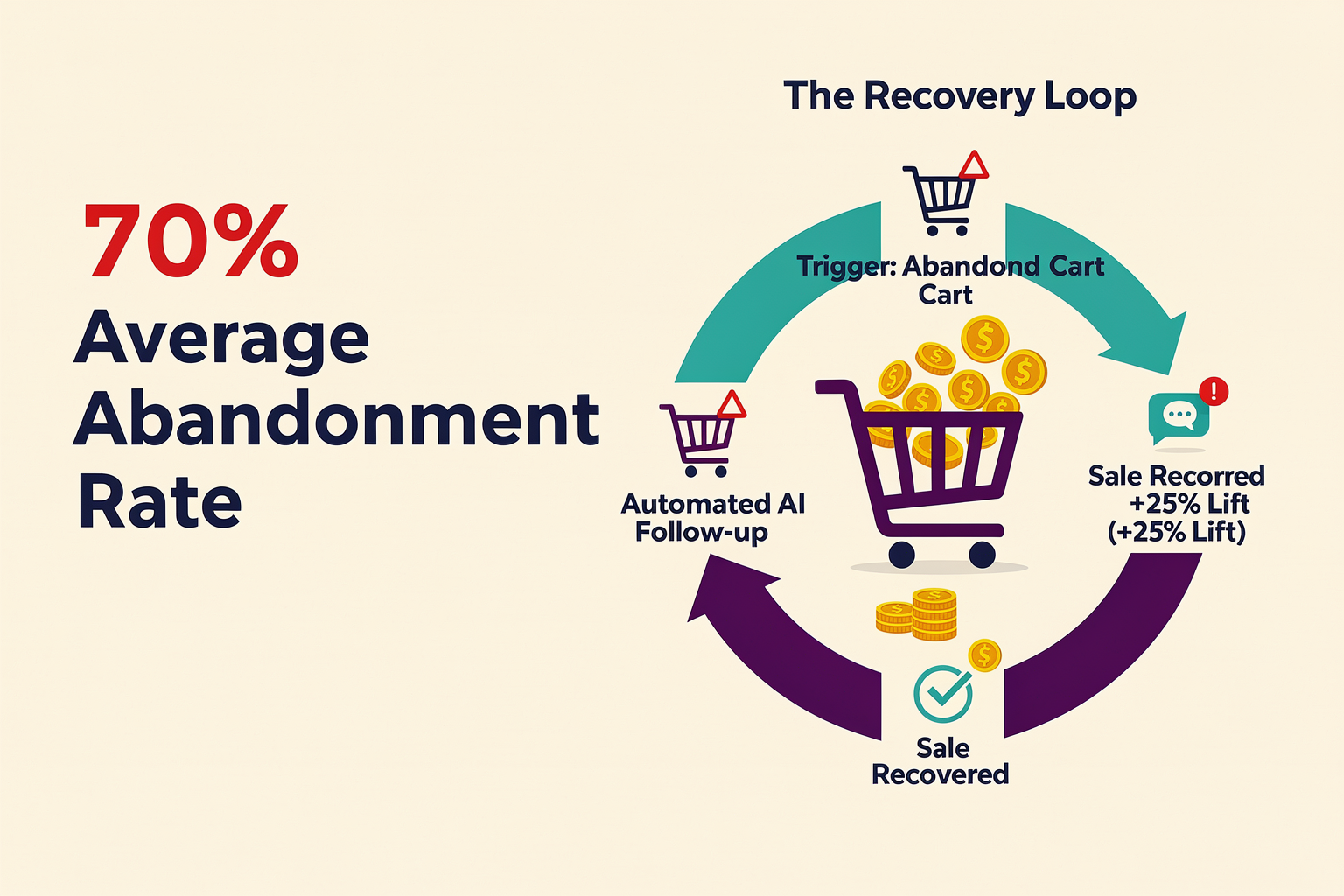
To truly understand why cart abandonment remains an expensive thorn in the side of Shopify merchants, we must look at the hidden cost of "missed connections." In modern e-commerce, a missed connection is any moment a high-intent buyer seeks clarity but receives silence, a delayed email, or a generic template response. When a shopper adds an item to their cart, they are at peak purchase intent. However, that intent decays rapidly. Industry benchmarks indicate that if a customer’s query is not resolved within five minutes, the probability of conversion drops by over 80%.
For the average Shopify store, this lag in communication translates directly to leaked revenue. The standard playbook of relying on static FAQ pages or legacy ticketing systems expects the customer to do the heavy lifting. In 2026, where instant brand interaction is the baseline expectation, expecting a buyer to hunt for information or wait hours for a support ticket is a guaranteed way to lose them to a faster competitor.
The Fragile Nature of Modern Buyer Trust
The friction points that cause a shopper to abandon their cart are often surprisingly small:
- Unclear shipping or return policies: A customer wants to know if they can return a product easily if it doesn't fit.
- Payment confusion: A preferred local payment method fails, or a discount code doesn't apply at checkout.
- Product-specific questions: Ambiguity around sizing, product compatibility, or delivery timelines.
When these questions arise, shoppers want a conversation, not a static contact form. If your Shopify store cannot offer real-time reassurance, you lose more than just a single transaction; you lose the Customer Lifetime Value (LTV) of a customer who would have otherwise stayed loyal.
The Pitfalls of Multi-Channel Fragmentation
Many e-commerce brands attempt to solve this by layering multiple isolated communication apps onto their Shopify stack—one tool for basic SMS notifications, another for legacy email ticketing, and a completely separate setup for customer phone calls. This disjointed approach creates a fragmented customer experience. If a customer receives an automated WhatsApp cart reminder but calls the store to ask a follow-up question, a legacy system has no record of the WhatsApp interaction.
This is where a unified AI communication infrastructure becomes essential. Modern solutions like CallMissed bridge these disjointed channels by unifying WhatsApp, Voice, Email, and Web into one AI-powered CRM. Instead of managing siloed apps, Shopify merchants can use CallMissed's real-time AI agents to engage customers instantly on their preferred platform with full historical context.
Breaking the Language Barrier in Localized E-commerce
For merchants targeting diverse regional markets, the missed connection is often a language barrier. Traditional automated bots are notoriously rigid, failing to comprehend accents, regional slang, or local languages. Platforms like CallMissed address this by equipping AI voice agents with native support for 22 Indian languages, allowing them to comprehend accents and conversational nuances flawlessly. By meeting customers in their preferred language, Shopify brands can build immediate trust and recover carts that would have otherwise been abandoned due to communication friction.
Key Developments: Comparing Traditional Support vs. CallMissed AI (TABLE)
To understand why Shopify merchants are migrating away from legacy customer recovery systems, we must look at the structural limitations of traditional support. Standard tools—like delayed email sequences, one-way SMS notifications, and human-staffed live chats—simply cannot keep pace with the real-time demands of modern consumers. When a transaction hangs in the balance, a delay of even five minutes can mean the difference between a completed sale and a permanently lost customer.
By contrast, integrating CallMissed directly into your Shopify ecosystem replaces passive, siloed channels with an active, unified AI communications layer. The table below highlights how legacy recovery methods compare to the real-time, interactive capabilities of CallMissed's AI platform:
| Capability | Traditional Support (Email/SMS) | CallMissed AI Platform | Checkout Impact |
|---|---|---|---|
| Response Speed | Hours for email; delayed static SMS templates | Immediate, automated Voice or WhatsApp outreach | Resolves high-intent objections before interest cools |
| Language Support | Static English-only text or expensive manual translation | Native Speech-to-Text (STT) & TTS in 22 languages | Captures regional and non-English-speaking buyers |
| Interaction Depth | One-way alerts; passive web-chat queues | Interactive, two-way Voice Agents and smart WhatsApp chatbots | Explains complex payment errors or sizing issues on the fly |
| Scalability | Linear scaling (requires hiring and training human agents) | Unlimited parallel AI sessions powered by an OpenAI-compatible API | Effortlessly handles seasonal spikes like Black Friday/Cyber Monday |
| Cost Efficiency | High overhead ($1.50–$3.00+ per live agent interaction) | Fractional micro-costs per automated call or message | Maximizes profit margins on recovered checkout carts |
| Data Integration | Disconnected data silos; hard to track real-time cart states | Deeply integrated into Shopify cart webhooks and AI-CRM | Personalizes calls using exact cart items and customer history |
Why Real-Time Communication Outperforms Static Triggers
Traditional recovery tools are fundamentally disconnected from the checkout experience. If a customer leaves their cart because their credit card was declined, an automated email sent two hours later does little to solve their immediate frustration. By the time they read it, they have likely moved on to a competitor.
Platforms like CallMissed solve this latency issue by leveraging real-time Shopify webhooks. The moment a cart is abandoned, CallMissed’s AI infrastructure can immediately trigger an interactive, two-way WhatsApp message or an automated AI voice agent call. Instead of receiving a generic discount code, the customer is greeted by name and asked if they experienced a technical glitch or had a question about product specifications.
Breaking the Language Barrier in E-Commerce
Another critical limitation of traditional Shopify support is localization. Standard chat widgets and email builders rarely support fluid, multilingual voice interactions. For global brands and diverse regional markets, this is a massive barrier to checkout completion.
With CallMissed's advanced Speech-to-Text and Text-to-Speech APIs, Shopify merchants can deploy voice agents that natively understand accents and regional nuances. Because the platform supports 22 Indian regional languages alongside global tongues, your automated agents can talk to your customers in their preferred dialect, answering questions and building trust in a way that static text never could.
In-Depth Analysis: Under the Hood of CallMissed’s Multi-Channel AI Agent
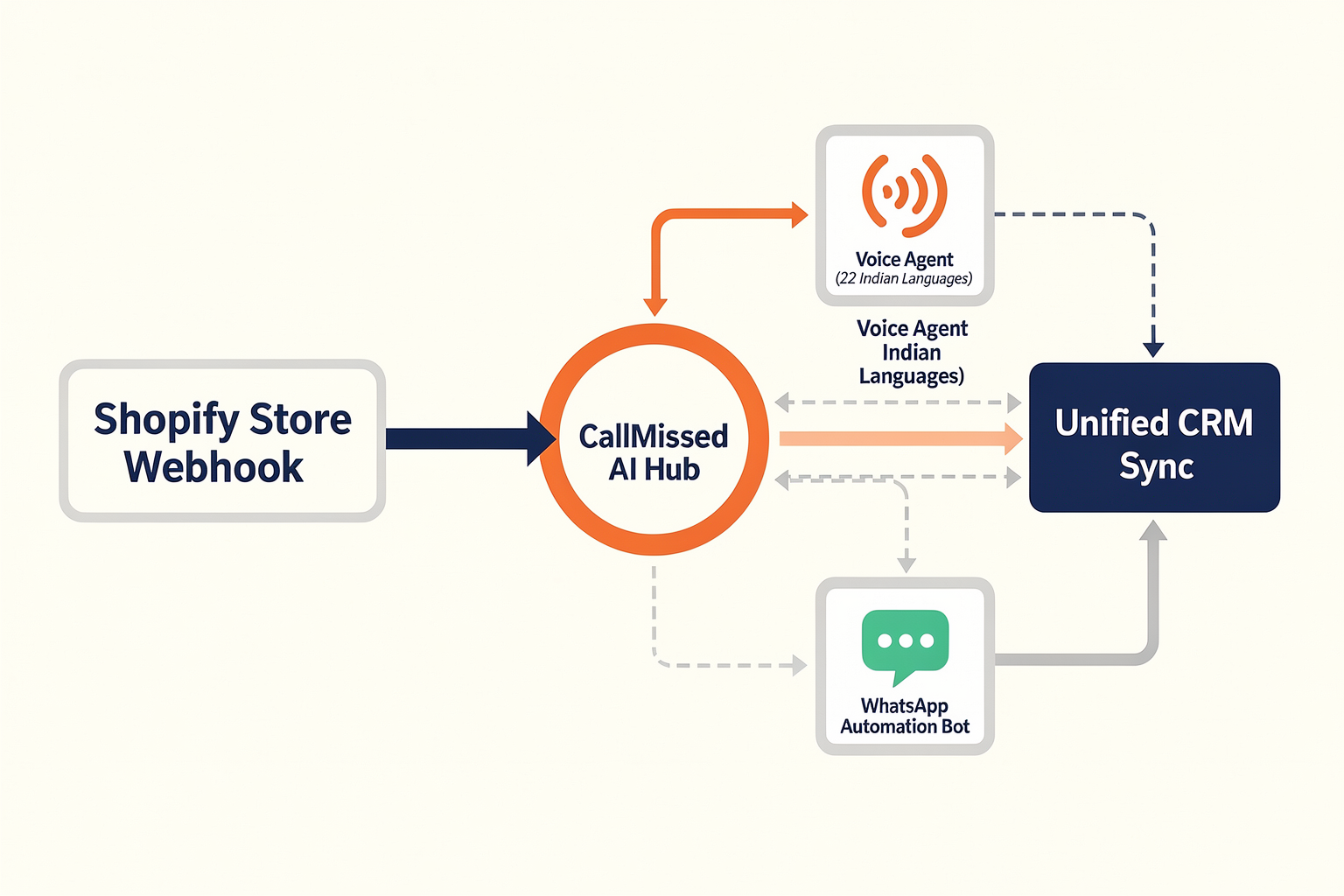
To understand how Shopify merchants are achieving double-digit recovery rates, we have to look "under the hood" of CallMissed's multi-channel AI architecture. Achieving seamless, real-time customer recovery requires more than just launching isolated bots; it demands a unified, highly optimized infrastructure capable of processing complex human interactions across text and voice simultaneously.
Omnichannel State Management: The Single Source of Truth
One of the primary frustrations in e-commerce customer support is fragmented communication. If a customer is chatting on WhatsApp about a cart discount and then chooses to resolve their issue over a quick phone call, they do not want to start the conversation over.
CallMissed solves this by unifying WhatsApp, Voice, Email, and Web into a single, cohesive AI CRM. The platform maintains a persistent state manager that syncs with your Shopify backend in real time.
- Contextual Handovers: When an AI voice agent initiates or picks up a call, it instantly references the customer’s live Shopify cart data and their recent WhatsApp chat history.
- Real-Time Cart Synchronization: If the AI agent offers a 10% discount during a phone call, that coupon code is instantly applied to the customer’s checkout link and pushed to their WhatsApp thread, eliminating purchase friction immediately.
To trigger these actions instantly, CallMissed integrates directly with Shopify’s Webhook API. The moment a checkout is abandoned, a secure webhook payload is sent to CallMissed, which automatically initiates the recovery sequence. This tight integration ensures that customer data never gets stale, allowing the AI to act during the critical "golden hour" of shopper intent.
The AI Gateway: 300+ LLMs and Dynamic Routing
At the core of CallMissed’s infrastructure is an enterprise-grade developer platform featuring an OpenAI-compatible LLM API gateway. Instead of locking Shopify merchants into a single AI model, CallMissed provides access to over 300 LLMs. This allows the platform to use dynamic model routing:
- Low-Latency Models: Simple queries (e.g., "Is shipping free?") are routed to lightning-fast, cost-effective models to ensure near-instantaneous response times.
- Advanced Reasoning Engines: Complex objections (e.g., payment failures or cross-border tax inquiries) are dynamically escalated to advanced reasoning models to provide highly accurate, nuanced resolutions.
The Speech-to-Text (STT) and Text-to-Speech (TTS) Pipeline
For voice interactions to feel natural and build trust, latency must be virtually imperceptible. CallMissed utilizes a highly optimized pipeline that converts spoken audio to text, processes it through the LLM, and synthesizes a human-like voice response in under 500 milliseconds.
Furthermore, global and regional e-commerce requires deep linguistic adaptability. CallMissed’s voice agents natively support 22 Indian languages alongside major global languages, effortlessly navigating diverse regional accents, colloquialisms, and local dialects. This ensures that whether your customer is checking out from London or Mumbai, they hear a natural, fluent voice that understands their exact intent.
Impact & Implications: Elevating D2C Scaling and Customer Retention

Scaling a Direct-to-Consumer (D2C) brand in 2026 requires balancing two competing priorities: expanding market reach and maintaining intimate, high-quality customer relationships. Historically, as order volumes scaled, customer experience fractured. Support queues grew longer, response times lagged, and customer satisfaction plummeted. However, by leveraging an integrated communication layer like CallMissed directly with Shopify, D2C brands can scale operationally without losing the personal touch that builds lifetime loyalty.
Scaling Support and Engagement on Autopilot
For fast-growing e-commerce brands, customer acquisition is only half the battle; scaling operational support to match that growth is where many stumble. During high-velocity retail events, support tickets for order tracking, shipping modifications, and sizing queries surge exponentially.
Instead of scaling support teams linearly—which introduces massive overhead and training bottlenecks—D2C brands can deploy automated AI agents to handle the volume. By leveraging CallMissed, Shopify store owners can deploy real-time voice agents and automated WhatsApp chatbots that handle up to 80% of routine inquiries instantly. Whether a customer wants to track their package or needs to modify a shipping address post-purchase, these AI agents resolve queries in seconds, ensuring that seasonal spikes do not lead to dropped customers or negative reviews.
Elevating Customer Retention with Multilingual, Omni-Channel Context
True retention is built on seamless, frictionless experiences. When a customer interacts with a brand across WhatsApp, voice calls, and web chat, they expect the brand to remember who they are. Fragmented communication is a leading driver of customer churn.
- Unified Customer Journey: CallMissed unifies WhatsApp, Voice, Email, and Web interactions into a single AI-powered CRM. This means when a customer abandons their cart on Shopify, is nudged on WhatsApp, and later calls the support line, the AI voice agent has complete context of their history and cart contents.
- Localization at Scale: Scaling regionally or globally requires native communication. CallMissed’s AI voice agents natively support 22 Indian languages, understanding local accents, colloquialisms, and cultural nuances. This allows D2C brands to tap into regional, non-English-speaking markets with hyper-localized support that builds deep consumer trust.
The Economic Impact: Decreasing CAC, Increasing LTV
In an era of rising digital advertising costs, relying solely on top-of-funnel acquisition is an unsustainable strategy. The brands winning today are those optimizing their Customer Lifetime Value (LTV) to Customer Acquisition Cost (CAC) ratio.
- Lowering CAC: Rescuing abandoned checkouts through instant, conversational outreach transforms lost ad spend into realized revenue, driving down the overall cost of acquiring a paying customer.
- Boosting LTV: Proactive post-purchase care powered by conversational AI ensures customers feel valued from the moment they buy, dramatically increasing repeat purchase rates.
- Operational Efficiency: Automated customer service reduces overall support costs by shielding human agents from repetitive, low-impact tasks, allowing D2C brands to maintain lean, highly profitable operations as they scale.
Expert Opinions: Why Voice-First AI is the Future of Commerce
As we navigate the retail landscape of 2026, industry analysts and e-commerce leaders are arriving at a unanimous conclusion: the future of checkout optimization is voice-first. While traditional text-based interfaces and static email recovery flows served their purpose in the early days of mobile shopping, they fail to replicate the organic human element of a brick-and-mortar purchase. Today, top retail strategists emphasize that Voice AI is the vital infrastructure needed to bridge the gap between high-intent browsing and final checkout.
The Shift from Clicks to Conversations
According to recent retail tech market reports, conversational commerce has transitioned from a supplementary support channel into a primary revenue driver. Experts point out that typing on mobile devices—especially when navigating complex product variants, entering long shipping addresses, or resolving payment errors—creates natural friction. Voice AI completely bypasses these physical limitations by allowing hands-free, natural dialogue.
Industry pioneers advocate for voice-first interactions because they align perfectly with the psychology of purchasing. When a customer hesitates at checkout, a real-time voice agent can address their objection immediately. Whether the barrier is an ambiguous return policy or a question about product compatibility, speaking to an intelligent agent provides immediate reassurance. By initiating instant, automated voice touchpoints, Shopify merchants can dramatically lower cart abandonment rates during the critical window of purchase intent.
Breaking the Localization Barrier
Global e-commerce experts also stress that true accessibility goes beyond simple translation; it requires deep cultural and linguistic nuance. Traditional text-based chatbots often struggle with regional accents, colloquialisms, and local dialects, leading to customer frustration.
To unlock massive regional markets and reach the next billion digital consumers, brands must adopt highly localized communication strategies. Platforms like CallMissed are leading this revolution by offering advanced Speech-to-Text (STT) and Text-to-Speech (TTS) APIs that natively support 22 regional Indian languages. This level of localized infrastructure allows Shopify merchants to engage shoppers in their preferred native language, handling complex accents and local dialects seamlessly to build immediate customer trust.
Recreating the In-Store Associate Experience Online
In physical retail, a skilled sales associate can save a failing sale simply by asking, "Are you finding everything okay?" or "Would you like me to check if we have your size in the back?" For years, online storefronts lacked this personalized, high-touch experience.
Retail futurists argue that Voice AI finally democratizes this personalized touch at an unprecedented scale. Instead of receiving a cold, automated SMS or an email that lands in a promotions folder hours too late, the shopper can receive an immediate, helpful voice call or an interactive WhatsApp message. Utilizing an AI-native platform like CallMissed, Shopify store owners can deploy virtual retail associates that manage thousands of simultaneous checkout-recovery conversations, retaining the natural warmth, empathy, and effectiveness of human speech.
What This Means For You: Implementation Roadmap (TABLE)
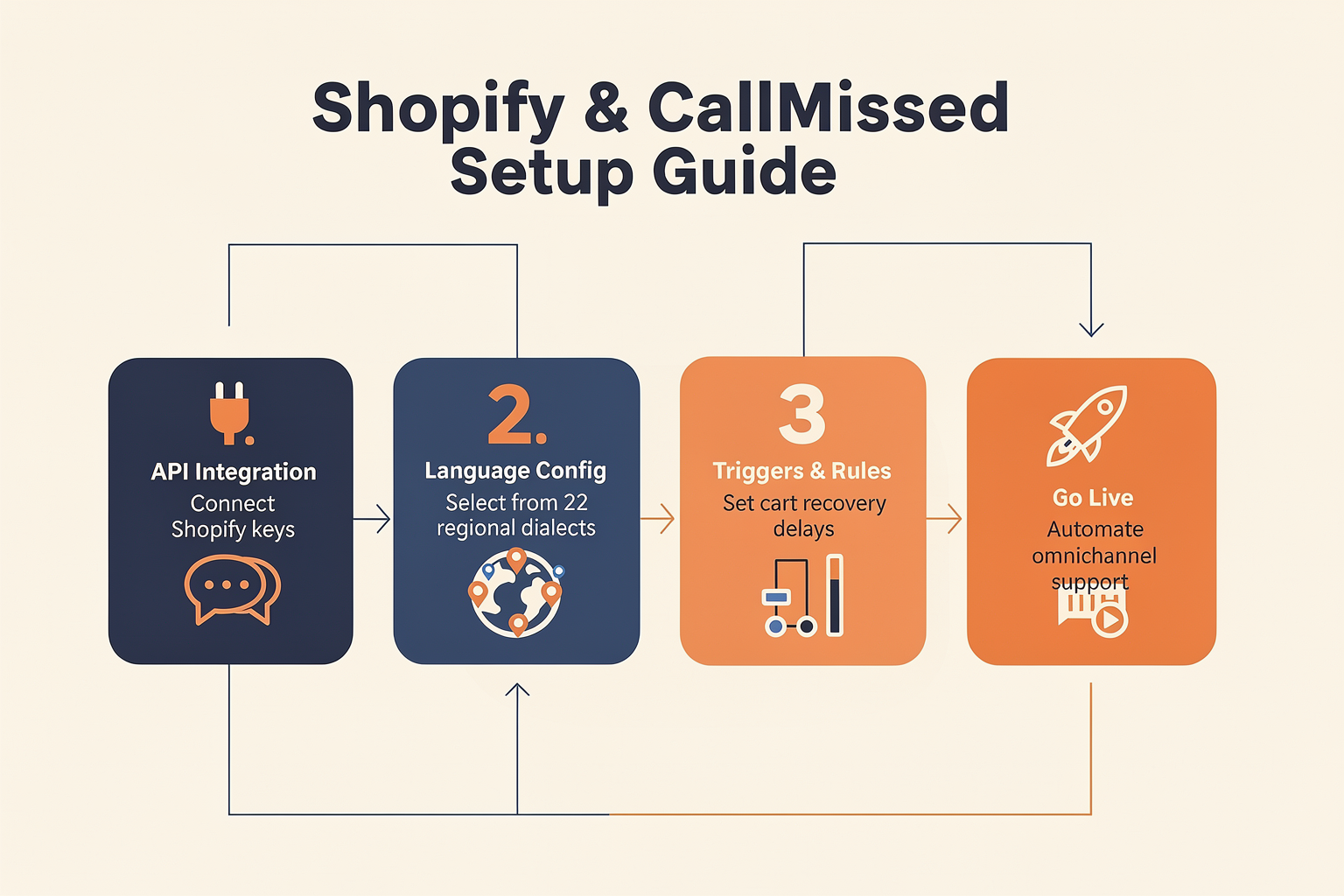
Transitioning your Shopify store from passive, delayed email recovery to real-time, AI-driven engagement requires a structured deployment strategy. Fortunately, modern API integrations have reduced what used to be a months-long development cycle down to just a few days. By utilizing CallMissed's robust developer ecosystem, e-commerce brands can build, test, and scale voice and chat agents with minimal friction.
Below is a step-by-step implementation roadmap designed to take your Shopify store live with CallMissed's automated recovery infrastructure:
| Phase | Objectives | CallMissed Assets | Timeline | Target Success Metric |
|---|---|---|---|---|
| 1. Integration | Link Shopify webhooks to CallMissed CRM | Developer Hub, Webhook APIs | Days 1–3 | < 1.5s system trigger latency |
| 2. Persona Prep | Define AI voice and WhatsApp agent tone | LLM Playground (300+ models) | Days 4–6 | 95% prompt alignment |
| 3. Localization | Enable regional dialects & accents | STT & TTS (22 Indian languages) | Days 7–8 | < 10% translation drop-offs |
| 4. Pilot Test | Deploy to 10% of abandoned checkouts | CallMissed AI-native CRM | Days 9–10 | 15% immediate cart recovery |
| 5. Full Scale | 100% automated outreach 24/7 | Multi-channel Voice & WhatsApp | Day 11+ | 25%+ overall recovery rate |
Phase 1: Linking Webhooks and Customer Data
The first step is establishing a real-time data bridge between Shopify and CallMissed. Using CallMissed’s Developer Hub and OpenAI-compatible APIs, your development team can configure webhooks triggered by specific customer actions, such as checkout_creation or payment_failed. The moment a checkout is abandoned, the webhook securely transmits customer details, cart contents, and contact info to CallMissed, queuing an automated engagement workflow instantly.
Phase 2: Selecting Models and Designing Personas
Conversational commerce relies on trust, meaning your AI agents must sound natural and aligned with your brand identity. Through CallMissed's multi-model API gateway, developers can select from over 300+ LLMs to power their bots, choosing models optimized for conversational speed and reasoning. Merchants can then build custom system prompts in the LLM playground, specifying how the agent should handle objections like high shipping costs, tax confusion, or discount code application.
Phase 3: Activating Multilingual Support
For e-commerce brands targeting diverse global or regional markets, localization is key to conversion. CallMissed’s specialized Speech-to-Text (STT) and Text-to-Speech (TTS) engines support 22 Indian languages natively, alongside regional accents and colloquialisms. During this phase, you will configure your voice agents to dynamically detect the customer's preferred language and transition the conversation seamlessly, ensuring that dialect boundaries do not stand in the way of a completed purchase.
Phase 4: Launch, Monitor, and Refine
Before going live to 100% of your traffic, run a pilot campaign targeting 10% of your abandoned baskets. Use the CallMissed AI-powered CRM to monitor real-time transcripts, review agent latencies, and analyze customer sentiment. This centralized dashboard allows marketing and support teams to identify common objections in real time, adjust prompts instantly, and ensure the AI-driven checkout recovery engine operates at peak efficiency before full-scale deployment.
Frequently Asked Questions
How does the Shopify + CallMissed integration help reduce shopping cart abandonment?
Can CallMissed AI agents handle customer support in multiple regional languages?
What makes Shopify + CallMissed a better alternative to traditional email and SMS retargeting?
Can I customize the LLM and voice models that drive my CallMissed conversational flows?
How does CallMissed handle incoming customer support calls during off-hours?
How can merchants get support or integrate Shopify + CallMissed with their existing tech stack?
Conclusion
The battle against cart abandonment is no longer won with delayed emails, but through immediate, conversational engagement. By bridging the gap between hesitation and checkout completion, merchants can recover lost revenue on autopilot.
Here are the key takeaways to remember:
- Immediacy is non-negotiable: With nearly 70% of carts abandoned, shoppers require immediate answers to checkout friction rather than delayed email follow-ups.
- Conversational commerce is the standard: Active, real-time channels consistently outperform static SMS and low-open-rate email campaigns.
- Instant objection handling: Deploying interactive voice and WhatsApp channels allows you to resolve issues, such as shipping fees or payment errors, instantly.
Looking ahead, the e-commerce brands that thrive will be those that transition from passive retargeting to predictive, natural voice and chat interactions. Are you ready to stop letting warm leads slip through your fingers and start converting abandoned carts in real time?
To explore how AI communication is evolving, check out CallMissed — an AI infrastructure platform powering voice agents and multilingual chatbots for businesses looking to dominate the conversational retail landscape.
Related Posts

The 24/7 Digital ISA: How Realtors Use AI Voice Agents, Missed Call Bots, and WhatsApp to Lock In Deals
Vapi vs CallMissed 2026: Voice AI API, Pricing and Features

India's Public AI Stack: BharatGPT, Sarvam, Krutrim – Unveiling the Nation’s AI Ambitions
Ready to automate customer conversations?
Launch AI voice agents and WhatsApp bots with CallMissed — one API, 22+ Indian languages.