Microsoft Copilot, ChatGPT to Gemini: The AI Productivity Tools Reshaping Office Work in 2026


Microsoft Copilot, ChatGPT to Gemini: The AI Productivity Tools Reshaping Office Work in 2026
Did you know that by the end of 2026, over 75% of large enterprises will have formally integrated generative AI assistants into their core IT infrastructures? The era of copying and pasting prompts into standalone browser tabs is officially over. Today, office productivity is being radically redefined by AI-native systems deeply embedded within our daily software ecosystems.
This shift represents a massive leap in organizational efficiency. According to McKinsey, generative AI tools are projected to boost the performance of knowledge workers by 30 to 45 percent by 2030. In 2026, we are witnessing the frontlines of this transformation as enterprises move far beyond basic drafting. Today's AI assistants do not just write; they synthesize hours of missed meetings, build complex data pipelines in spreadsheets, automate multi-step workflows, and retrieve siloed company knowledge instantly inside the apps employees already live in.
From the Microsoft 365 suite to Google Workspace, the battle for the ultimate corporate sidekick has intensified. Tools like Microsoft Copilot, ChatGPT to Gemini: The AI productivity tools reshaping office work in 2026 have transitioned from novelties to essential operational fabric. As companies build out these internal AI capabilities, many are transforming their external operations in parallel. For instance, platforms like CallMissed help businesses complete this digital transformation by offering production-ready AI voice agents and multilingual communication APIs that handle external customer calls just as seamlessly as Copilot handles internal workflows.
In this article, we will break down the current state of these dominant enterprise AI suites. You will learn how Microsoft Copilot, ChatGPT Enterprise, and Gemini for Workspace stack up against each other in terms of features, data privacy, and integration capabilities. Finally, we will explore practical, forward-looking strategies to help your team harness these tools, eliminate administrative friction, and build a highly efficient, AI-augmented workforce.
Introduction: The Dawn of AI-Native Office Work in 2026
In 2026, the era of copying and pasting prompts into standalone browser tabs is officially behind us. The modern workplace has entered the age of AI-native office work. Today, artificial intelligence is no longer just an external utility; it is the digital fabric of the workspace, running natively inside the software suites we use every day. From drafting complex client proposals and summarizing multi-hour video calls to automating cross-app workflows and retrieving highly specific company knowledge, tools like Microsoft Copilot, Google Gemini, and ChatGPT Enterprise are operating directly inside employees' daily workflows.
This deep integration is driving unprecedented enterprise adoption. According to Gartner, by 2026, over 75% of large enterprises have formally incorporated generative AI assistants into their IT infrastructure. This represents a massive shift from experimental, ad-hoc usage to standardized, company-wide deployment. The economic implications are equally staggering: McKinsey projects that generative AI tools designed to boost productivity could increase the performance of knowledge workers by 30% to 45% by 2030.
The New Baseline of Workplace Productivity
The current software landscape has shifted from reactive tools to proactive agents. Rather than requiring users to manually trigger every action, today’s AI-native tools offer:
- Deep Contextual Integration: AI assistants reside natively inside Word, Excel, Teams, Outlook, and Google Workspace, allowing them to pull context from emails, calendar events, and spreadsheets simultaneously.
- Knowledge Retrieval: Teams can instantly surface accurate information from siloed company data without having to search through hundreds of internal files.
- Workflow Automation: Mundane administrative tasks—like scheduling follow-ups, logging CRM entries, or drafting post-meeting summaries—are fully automated.
While internal productivity tools from Microsoft and Google have revolutionized the office, forward-thinking enterprises are realizing that internal efficiency is only half the equation. To truly unlock the benefits of this transformation, businesses are bridging the gap between internal AI knowledge bases and external customer-facing communication channels.
This is where platforms like CallMissed play a vital role. By providing production-ready AI voice agent infrastructure, WhatsApp chatbots, and a multi-model API gateway supporting over 300+ LLMs, CallMissed allows companies to extend their internal productivity gains directly to their clients. For instance, an AI agent can natively reference internal database updates to answer a customer call in real time, bringing the power of the AI-native office directly to the front lines.
As we navigate this new paradigm, understanding how the market’s primary drivers—Microsoft Copilot, Google Gemini, and ChatGPT Enterprise—compare is essential for any business aiming to maintain its competitive edge. Let's explore how these platforms are actively rewriting the rules of knowledge work.
Background & Context: Moving Beyond Standalone Chatbots

In the early days of generative AI, the technology was largely defined by a "copy-and-paste" workflow. Employees had to open a separate browser tab, prompt a standalone chatbot like ChatGPT or Claude, and then manually transfer the generated output back into their emails, slide decks, or spreadsheets. While revolutionary at the time, this fragmented experience created constant friction, heightened data privacy concerns, and limited the real-time utility of automated productivity.
By 2026, that era of disjointed workflows has officially come to an end. The modern office environment is now defined by deep integration, where generative AI is no longer an external destination but a native component of the business systems we use every single day.
The Era of Native, Embedded AI
Today, tools like Microsoft 365 Copilot, ChatGPT Enterprise, and Google Gemini for Workspace have moved directly into the daily workspace flow. Instead of switching tabs, professionals can now draft documents, summarize entire virtual meetings, automate complex multi-app workflows, and securely retrieve proprietary company knowledge natively inside the apps where employees already spend their time.
This shift from conversational novelties to integrated cognitive assistants is backed by compelling data:
- Widespread Enterprise Adoption: Gartner research indicates that by 2026, over 75% of large enterprises will have incorporated generative AI assistants into their formal IT infrastructure, cementing them as standard operating software rather than experimental tools.
- Unprecedented Performance Gains: According to McKinsey, AI tools designed to boost productivity could increase the performance of knowledge workers by 30 to 45 percent by 2030.
Breaking Down the Silos
The true value of this transition lies in contextual awareness. When an AI assistant lives inside an enterprise's primary workspace, it understands the context of ongoing projects, team dynamics, and historical archives. It eliminates daily "busywork" by automatically drafting email responses in Outlook, analyzing data trends in Excel, or synthesizing action items from Slack threads without requiring manual data entry.
However, the evolution extends beyond internal documentation and standard office suites. Forward-thinking organizations are realizing that customer communication must also be unified with this new AI-native backend. For instance, infrastructure platforms like CallMissed allow enterprises to bridge their internal systems with external-facing channels. By utilizing unified APIs that support 300+ LLMs and Speech-to-Text in 22 regional Indian languages, businesses can deploy AI voice agents and WhatsApp chatbots that tap into the exact same native company knowledge bases. This ensures that external communication is just as context-aware and deeply integrated as internal workflows.
Ultimately, the workspace of 2026 has transformed the AI chat window from a novelty assistant into the very fabric of enterprise operations. AI is no longer a tool that employees have to seek out—it is the invisible, foundational infrastructure powering how we get work done.
Key Developments: Comparing Copilot, ChatGPT, and Gemini (TABLE)
In 2026, the landscape of office productivity has shifted from isolated chat windows to deeply embedded, AI-native ecosystems. Enterprise adoption has moved past the experimental phase; according to Gartner research, over 75% of large enterprises have formally incorporated generative AI assistants into their IT infrastructures. This systematic integration is driving massive efficiency gains, with McKinsey estimating that generative AI productivity tools could boost the performance of knowledge workers by 30% to 45% by 2030.
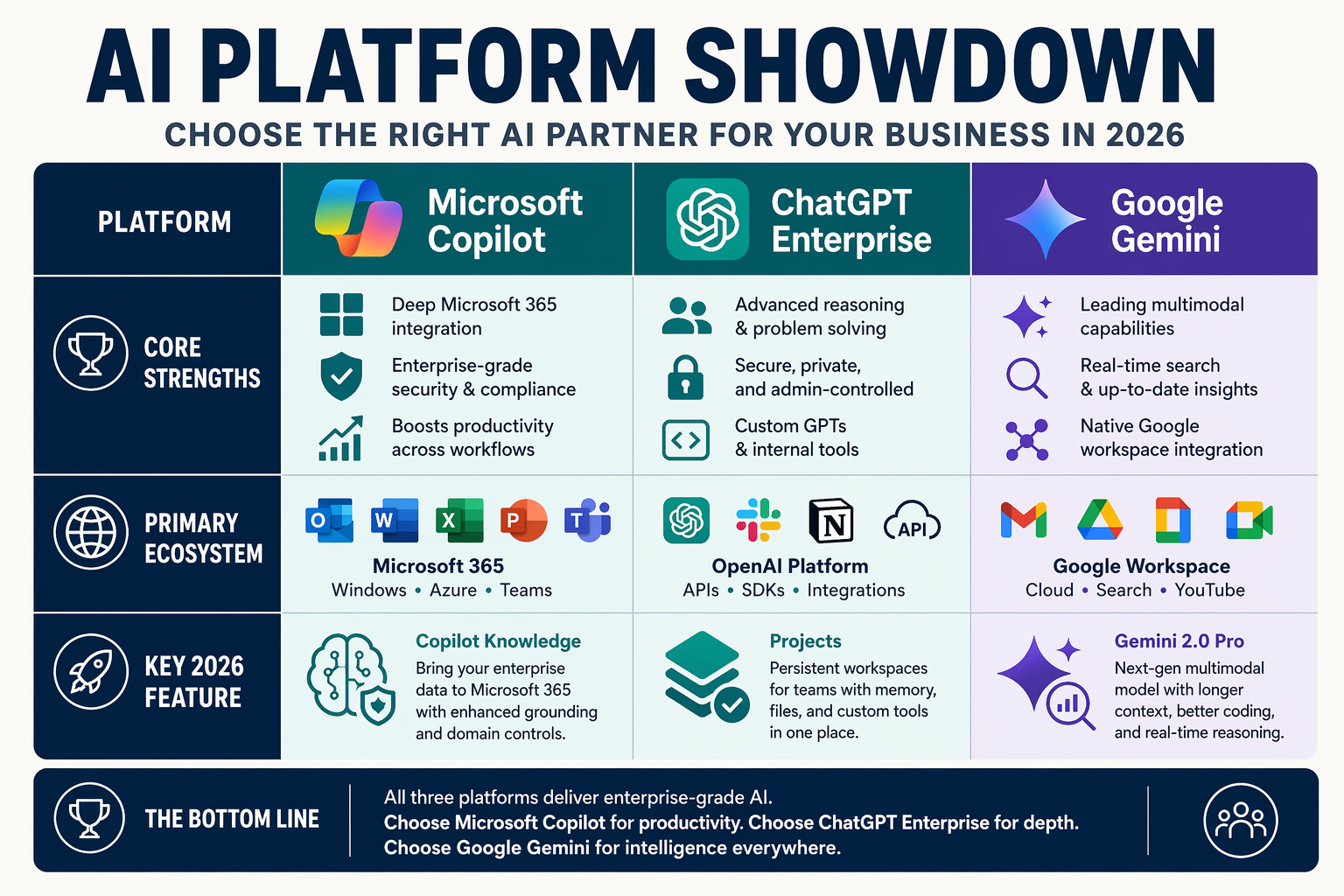
To help organizations navigate this rapidly evolving landscape, we have compared the three dominant AI platforms shaping modern work: Microsoft Copilot, ChatGPT Enterprise, and Google Gemini for Workspace.
| Feature | Microsoft Copilot | ChatGPT Enterprise | Google Gemini |
|---|---|---|---|
| Primary Ecosystem | Microsoft 365 (Word, Excel, Teams) | Standalone & API-first (Custom GPTs) | Google Workspace (Docs, Gmail, Sheets) |
| Core Strength | Native M365 integration, meeting summaries | Advanced reasoning, custom coding, custom GPTs | Multimodality, deep Google search integration |
| Data Privacy | Enterprise-grade, bound to tenant data | SOC 2 compliant, no training on user data | Workspace enterprise security, no public training |
| Key Use Case | Automating internal office workflows & docs | Scaling general research, custom workflows | High-speed collaboration & creative drafting |
| Enterprise Adoption | High (bundled with corporate IT) | High (broad developer & desk worker adoption) | Growing rapidly among Google Cloud clients |
Understanding the Ecosystem Trade-Offs
Each of these tools has carved out a distinct niche within the enterprise tech stack. Microsoft Copilot is designed for structured, corporate environments. By operating directly inside Teams, Word, and Excel, it acts as an invisible assistant that summarizes lengthy video calls, drafts internal memos, and analyzes spreadsheets natively.
On the other hand, Google Gemini leverages its native multimodality and Google Search integration directly within Workspace. This makes it an incredibly fast collaborator for teams relying heavily on Google Docs, Sheets, and Gmail. For specialized, high-reasoning tasks, custom software development, and deep research, ChatGPT Enterprise remains the gold standard, offering unmatched flexibility through the creation of internal Custom GPTs.
Achieving Agility with a Multi-Model Strategy
While choosing one ecosystem is a common starting point, relying on a single provider can create vendor lock-in. To stay agile, forward-thinking organizations are adopting hybrid AI architectures.
For instance, while Copilot or Gemini handles internal desk productivity, platforms like CallMissed enable businesses to leverage these same advanced LLM models for customer-facing communication. Through CallMissed’s multi-model gateway—which offers access to over 300+ LLMs—enterprises can deploy high-performance voice agents and WhatsApp chatbots that support 22 regional Indian languages. This allows companies to seamlessly extend the productivity gains of generative AI from internal spreadsheets directly to external customer support channels.
In-Depth Analysis: Inside the Automated Daily Workflow
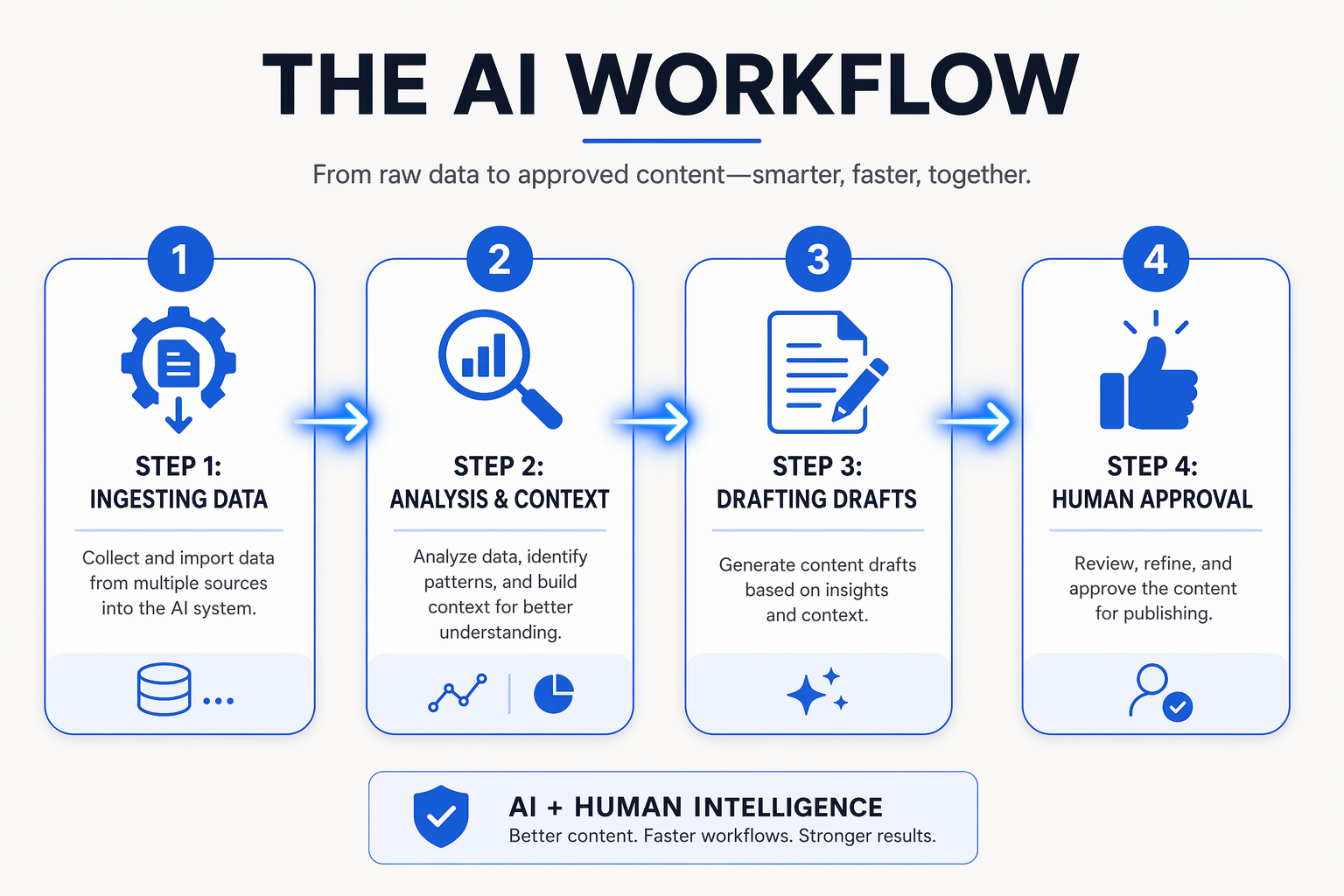
To truly understand how deeply generative AI has woven itself into the fabric of the modern enterprise, one must look past the boardroom promises and examine the daily routine of a typical knowledge worker. Gartner research indicates that over 75% of large enterprises have incorporated generative AI assistants into their formal IT infrastructures. This transition from novelty to necessity has fundamentally restructured how we sequence, execute, and collaborate on tasks.
08:30 AM – The Intelligent Daily Synthesis
The workday no longer begins with the anxiety of an overflowing inbox. Instead, tools like Microsoft Copilot and Google Gemini act as digital chiefs-of-staff, synthesizing overnight communications across email, chat, and project boards.
- Email Summarization: A prioritized digest replaces dozens of unread emails, highlighting urgent action items.
- Cross-Platform Retrieval: The AI automatically connects missing links—pulling context from a SharePoint document mentioned in Teams or a Google Doc linked in Google Chat.
- Asynchronous Integration: External communications are integrated into the same workflow seamlessly. For example, missed client calls received overnight are transcribed using CallMissed’s Speech-to-Text API—which natively supports 22 Indian regional languages—and summarized as actionable CRM tasks before the employee even opens their laptop.
11:30 AM – Real-Time Collaboration and Action Capture
During mid-morning meetings, AI-native systems move from passive listeners to active participants. Rather than assigning a team member to take notes, tools integrated directly into Teams, Zoom, or Google Meet draft real-time summaries, flag potential project roadblocks, and assign owner deadlines.
According to McKinsey, these generative AI tools are projected to increase the performance of knowledge workers by 30% to 45% by 2030. This performance leap is evident immediately following a meeting: within seconds, a highly accurate, structured action-plan document is generated and distributed directly to the team's project management software, eliminating post-meeting administrative lag.
03:00 PM – Deep Focus and Multi-Model Co-Creation
The afternoon is dedicated to high-value execution, where "blank page syndrome" has been virtually eliminated. Employees leverage AI to draft reports, analyze complex datasets, or build presentations directly inside the applications they use every day.
- Adaptive Drafting: ChatGPT Enterprise or Claude helps generate initial iterations of technical documentation or marketing copy inside native writing applications.
- Analytical Support: Employees run natural language queries over massive spreadsheets, allowing Gemini to instantly plot trends and highlight statistical anomalies.
- Infrastructure Agility: To optimize these workflows, companies utilize multi-model architectures. Infrastructure providers like CallMissed enable enterprises to dynamically route tasks across 300+ LLMs, ensuring that a simple text summary is handled by a cost-effective lightweight model, while a complex financial analysis is instantly directed to a frontier reasoning engine.
By automating these repetitive coordination loops, the modern workspace shifts human cognitive load away from administrative overhead, redirecting creative energy toward strategy, negotiation, and critical decision-making.
Impact & Implications: Performance Gains and IT Adoption
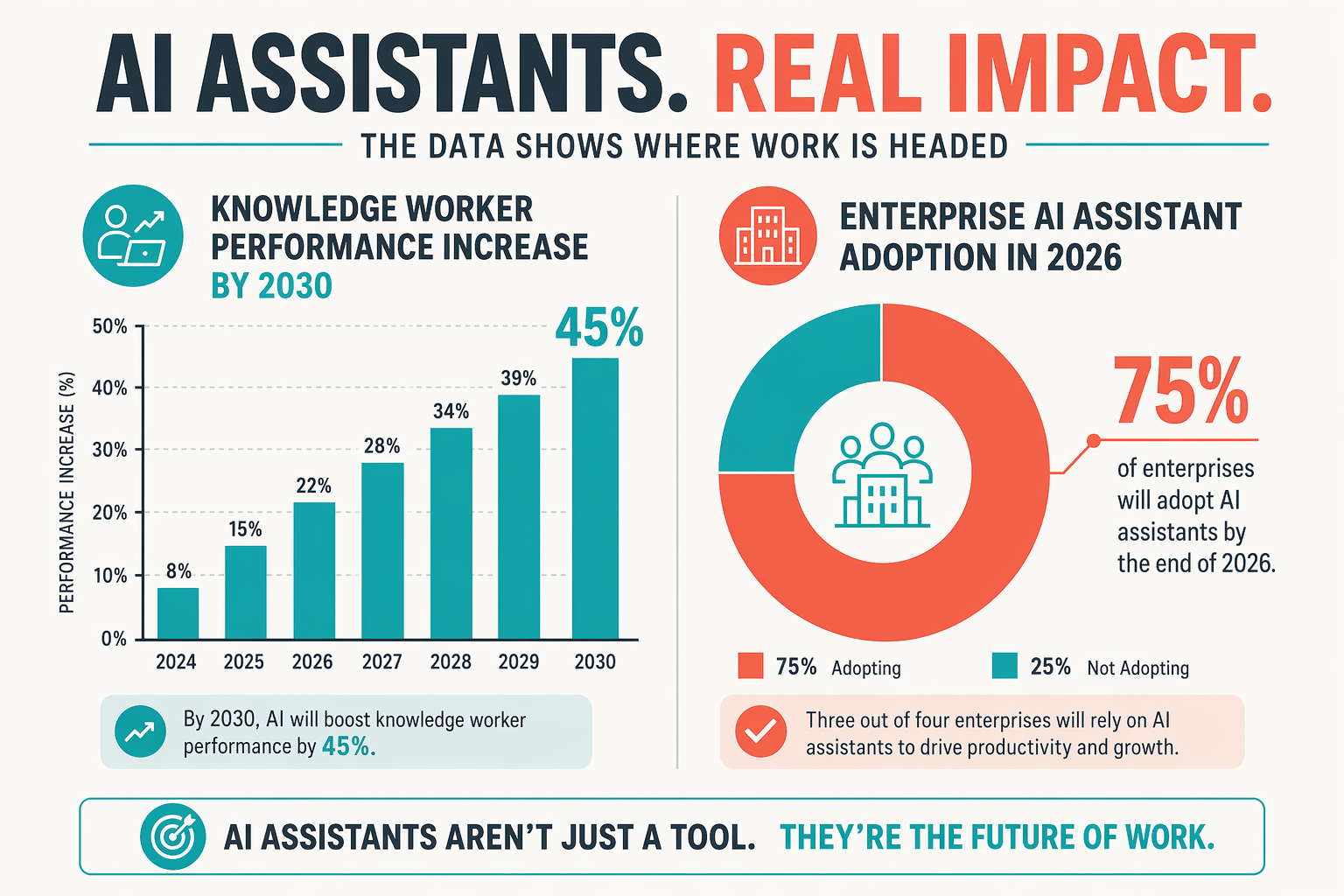
As we move through 2026, the discussion around generative AI in the workplace has shifted from experimental novelty to structural necessity. Enterprise deployment is no longer about isolated employees experimenting with standalone web browsers. Instead, it is characterized by the deep integration of AI-native systems directly into everyday enterprise workflows. The implications of this shift are visible in two key areas: measurable performance gains for knowledge workers and a massive wave of formal IT adoption.
Measuring the Productivity Surge: 30% to 45% Performance Gains
The deployment of integrated assistants like Microsoft 365 Copilot, Google Gemini for Workspace, and ChatGPT Enterprise is fundamentally redefining daily office tasks. Rather than switching between fragmented applications, employees now leverage AI built directly into their document processors, spreadsheets, and email clients to retrieve company knowledge and automate workflows.
According to research by McKinsey, generative AI tools designed to boost productivity are projected to increase the performance of knowledge workers by 30% to 45% by 2030. In 2026, we are already seeing the front-loaded realization of these gains across multiple corporate functions:
- Meeting & Communication Efficiency: Summarizing hour-long video conferences and drafting follow-up action items has shifted from a tedious administrative chore to a near-instant, automated task.
- Contextual Knowledge Retrieval: AI agents pull historical documents and internal company insights instantly, eliminating hours spent hunting through cluttered databases.
- Workflow Automation: From analyzing complex datasets to drafting personalized client proposals, cognitive workloads are being offloaded to intelligent copilots, freeing up workers to focus on strategic decision-making.
IT Adoption: Eliminating "Shadow AI" through Governance
For IT departments, 2026 marks the end of unauthorized "shadow AI" usage. Organizations are aggressively bringing generative AI into formal IT frameworks to ensure data privacy, security, and regulatory compliance.
According to research by Gartner, over 75% of large enterprises have officially incorporated generative AI assistants into formal IT frameworks as of 2026. This transition is crucial for mitigating security risks while maximizing return on investment.
This structured adoption is driving demand for unified platforms that align with corporate governance. For instance, platforms like CallMissed are helping organizations seamlessly extend these productivity gains from internal document drafting to external customer interactions. By providing an enterprise-grade AI communication infrastructure—featuring a multi-model API gateway supporting 300+ LLMs and secure speech-to-text APIs in 22 regional languages—CallMissed allows IT teams to deploy governed, multilingual voice agents and chatbots without risking data non-compliance.
The Hybrid, Multi-Model Enterprise Stack
As IT departments formalize their AI architecture, they are realizing that a single LLM rarely fits all organizational needs. The modern enterprise infrastructure relies on a hybrid, multi-model approach:
- Collaborative AI: Using Microsoft Copilot for daily document creation, email management, and internal team collaboration.
- Analytical AI: Employing Google Gemini for heavy data analysis, spreadsheet modeling, and workspace integrations.
- Communication AI: Deploying specialized, low-latency voice and text agents via infrastructure providers to handle customer-facing pipelines.
Ultimately, the organizations winning the productivity race are those that treat AI not as a series of standalone tools, but as the foundational layer of their entire operational stack.
Expert Opinions: Industry Perspectives on AI Integration

As we navigate 2026, the global discourse around generative AI has shifted from speculative excitement to structured execution. Leading market analysts and technology executives agree that AI-native systems are no longer optional add-ons; they have become the foundational layer of modern organizational design.
The Enterprise Standard: AI as Core IT Infrastructure
According to research by Gartner, by 2026, over 75% of large enterprises will have formally incorporated generative AI assistants into their standard IT infrastructure. This represents a massive shift from the fragmented, ad-hoc usage seen in previous years. Today, enterprise IT departments are bypassing standalone web interfaces in favor of deeply integrated ecosystem partners. Experts emphasize that the goal is to create a seamless fabric of automated workflows, where AI retrieves company knowledge, summarizes real-time meetings, and drafts documents directly inside daily-use applications.
For businesses seeking to scale these integrations beyond basic office suites, unified infrastructure is key. Platforms like CallMissed are bridging this gap, enabling companies to deploy advanced AI voice agents and WhatsApp chatbots powered by a multi-model API gateway supporting 300+ LLMs. By providing robust Speech-to-Text and Text-to-Speech APIs with native support for 22 regional Indian languages, CallMissed allows global enterprises to localize their automated workflows without fracturing their core IT architecture.
Redefining the ROI of Knowledge Work
The long-term impact of this integration on productivity is projected to be profound. McKinsey estimates that generative AI tools designed to boost productivity could increase the performance of knowledge workers by 30% to 45% by 2030. Industry leaders point out that this productivity leap is not about working longer hours; it is about eliminating administrative "busywork" so employees can focus on high-impact strategic tasks.
This shift is characterized by several key operational developments:
- Unified Knowledge Retrieval: Instead of manually searching through disparate folders, employees use natural language to query secure, internal company databases instantly.
- Context-Aware Automation: AI tools do not just execute isolated commands; they understand ongoing projects, draft client communications in the company's specific brand voice, and manage follow-ups automatically.
- Multimodal Workflows: Voice, text, and visual inputs are processed simultaneously, allowing team members to dictate complex briefs that the AI instantly structures into spreadsheets or presentations.
The Transition from "Copilot" to Autonomous Agent
A recurring perspective among tech analysts is that the definition of a "productivity tool" is fundamentally changing. In 2026, tools like Microsoft Copilot, ChatGPT Enterprise, and Gemini for Workspace have transitioned from passive assistants into active, autonomous agents. Instead of waiting for manual prompts, these systems proactively flag anomalies, propose workflow optimizations, and draft responses to pending inquiries. The consensus among industry experts is clear: the future of work belongs to organizations that can successfully transition from human-only execution to a human-AI collaborative paradigm.
What This Means For You: Action Plan by Office Role (TABLE)
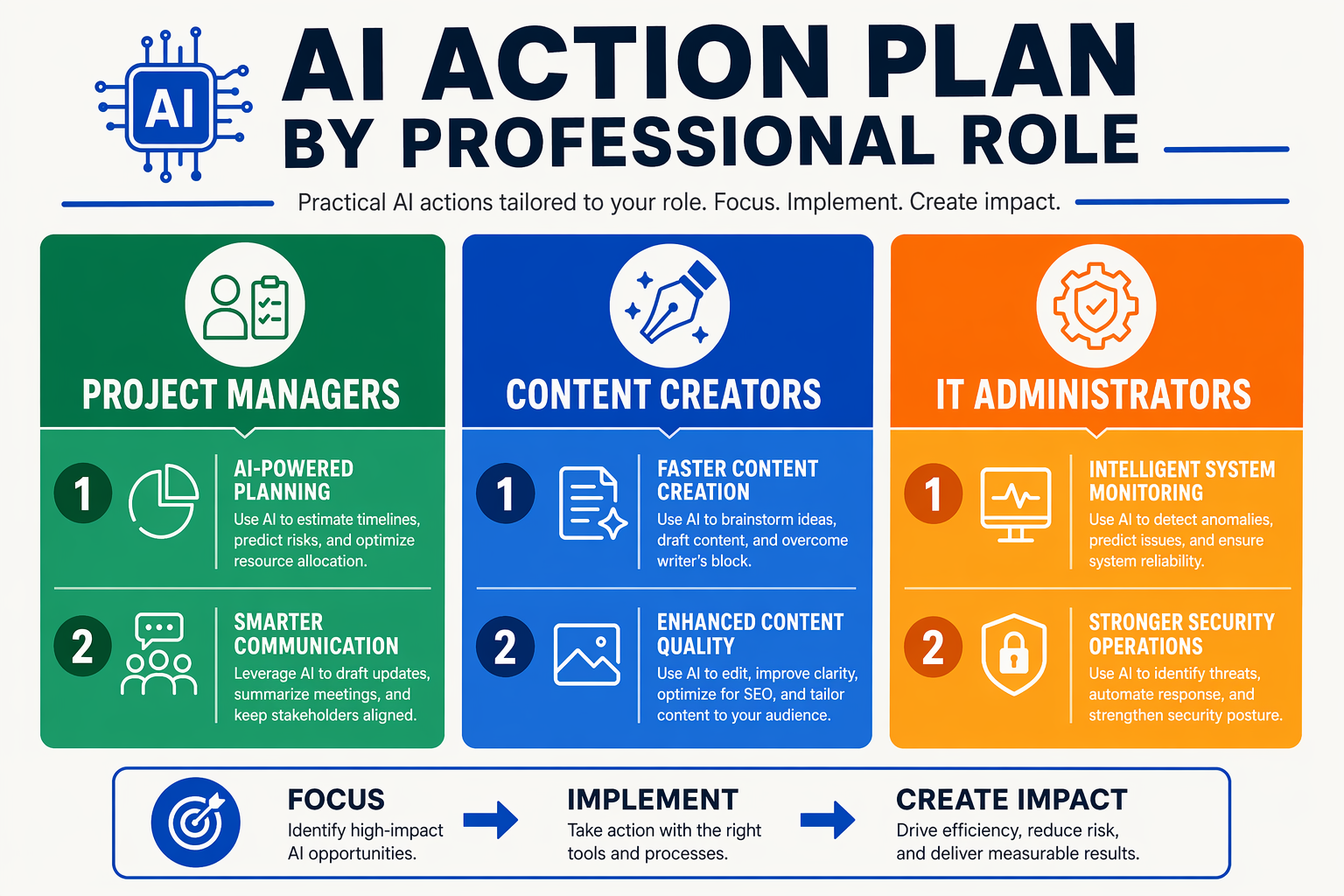
With Gartner reporting that over 75% of large enterprises have officially integrated generative AI assistants into their formal IT infrastructure, the question is no longer if you should use AI, but how you should apply it to your specific function. McKinsey forecasts that these productivity tools could elevate the output of knowledge workers by 30% to 45% by 2030. To capture this value, professionals must move past basic prompt engineering and transition toward role-specific, agentic workflows.
The transition from standalone chat interfaces to deeply embedded, native tools like Microsoft 365 Copilot, Google Gemini for Workspace, and specialized communication platforms requires a tailored playbook. Use the action plan below to align your daily workflows with the best-suited AI ecosystems.
| Role | Key Productivity Hurdle | Recommended AI Ecosystem | Primary Use Case | Immediate Action Step |
|---|---|---|---|---|
| Product Managers | Backlog grooming & market research | Claude, Gemini | Synthesizing user feedback, drafting PRDs, and mapping feature roadmaps. | Audit past roadmap docs; build a custom GPT or Project workspace pre-loaded with product context. |
| Sales & Support | Lead qualification & 24/7 customer queries | CallMissed, ChatGPT | Scaling personalized outreach and resolving customer queries via automated channels. | Deploy an AI voice agent through CallMissed to qualify warm leads and handle inbound after-hours calls. |
| Operations & HR | Meeting fatigue & document retrieval | Microsoft Copilot (Teams/Word) | Summarizing action items from internal calls, drafting policy docs, and retrieving company knowledge. | Enable Copilot in Microsoft Teams to automate post-meeting action-item generation and draft recap emails. |
| Marketing Teams | Content localization & multi-channel copy | Google Workspace (Gemini), Claude | Creating localized ad campaigns and drafting blog outlines tailored to regional search intent. | Connect Gemini to Google Docs to generate localized messaging frameworks across diverse global markets. |
| Developers & IT | Legacy system integration & API maintenance | GitHub Copilot, LLM Gateways | Generating boilerplate code, automating testing, and managing multi-LLM routing. | Set up a unified API gateway to route lighter tasks to smaller, cost-effective models. |
Customizing the Playbook for Maximum Impact
Achieving the double-digit productivity gains predicted by industry analysts requires moving beyond generic prompts. Successful implementation hinges on three core practices:
- Natively Embedded Context: Do not treat AI as an external sandbox. Whether you are using Microsoft Copilot to analyze an Excel spreadsheet or Gemini to query a Google Drive directory, ensure the AI has secure access to the correct internal enterprise data to eliminate hallucinations.
- Multilingual and Multimodal Workflows: Customer-facing roles must cater to diverse global audiences. For sales and support departments, this means leveraging advanced communication platforms. Solutions like CallMissed provide robust Speech-to-Text and Text-to-Speech APIs supporting 22 Indian regional languages alongside a gateway to 300+ LLMs, allowing businesses to localize voice interactions seamlessly.
- Continuous Auditing: As LLM capabilities improve, regularly evaluate your stack. Utilize unified API gateways that allow IT teams to switch models dynamically without rewriting the underlying application code, ensuring your role-based tools remain state-of-the-art.
By taking these structured, role-based steps, knowledge workers can offload cognitive busywork, allowing teams to focus on strategic execution and creative problem-solving.
Frequently Asked Questions
How do AI productivity tools like Microsoft Copilot and Google Gemini improve workplace efficiency in 2026?
What percentage of businesses are adopting AI productivity tools for daily operations?
How do ChatGPT, Microsoft Copilot, and Google Gemini differ as AI productivity tools?
Are AI productivity tools secure enough for handling sensitive enterprise data?
Can AI productivity tools handle multilingual business communications and meetings?
What is the future of AI productivity tools beyond basic text generation?
Conclusion
As we navigate 2026, the transition from standalone chat interfaces to deeply integrated, AI-native ecosystems is complete. Tools like Microsoft Copilot, Google Gemini, and ChatGPT have fundamentally rewritten the rules of daily office work.
Key takeaways from this AI-driven productivity shift include:
- Seamless App Integration: AI now resides natively inside your everyday workspace tools, automating document drafting, meeting summaries, and knowledge retrieval on the fly.
- Widespread Enterprise Adoption: Gartner research highlights that over 75% of large enterprises have formally integrated generative AI assistants into their IT infrastructure.
- Long-Term Economic Impact: McKinsey estimates that generative AI tools will boost the productivity of knowledge workers by 30% to 45% by 2030.
Looking ahead, the next frontier of office productivity belongs to autonomous, multi-modal agents that seamlessly bridge internal office workflows with external client communication. To explore how AI communication is evolving to meet this demand, check out CallMissed—an AI communication infrastructure platform powering intelligent voice agents, WhatsApp chatbots, and multilingual APIs that help modern businesses stay ahead.
Is your organization ready to move past basic prompt engineering and embrace full operational autonomy?