

Japan Eyes 'Continuous' AI Legal Reforms to Counter Mythos-Level Threats


Japan Eyes 'Continuous' AI Legal Reforms to Counter Mythos-Level Threats
Could a single, ultra-advanced AI model disrupt an entire nation's financial system and critical infrastructure overnight? This is no longer a hypothetical sci-fi scenario, but a pressing reality in Tokyo, where Japan eyes 'continuous' AI legal reforms to counter Mythos-level threats. As next-generation, large-scale AI systems—most notably exemplified by Anthropic's "Mythos" model family—redefine the limits of machine intelligence, they have simultaneously supercharged the scale and sophistication of cyberattacks and algorithmic disinformation.
The urgency of this shift cannot be overstated. In May 2026, Japan’s chief banking regulator scrambled to establish a specialized public-private working group to defend the country's financial networks against Mythos-powered cyber threats. Traditional legislative frameworks, which often take years to draft and pass, are fundamentally incompatible with an AI ecosystem where capability leaps occur in weeks, not decades. Recognizing this friction, the Japanese government is drafting a highly adaptable policy road map. This strategy transitions away from rigid, static legislation in favor of an active, ongoing review process capable of legally binding large-scale AI developers and enforcing guardrails in real-time.
This regulatory evolution has massive implications for the global tech sector. As organizations rush to integrate advanced cognitive capabilities into their workflows, maintaining compliance while remaining agile is becoming a complex tightrope walk. To survive in this environment, modern enterprises are turning to flexible, secure middle-tier solutions; for instance, platforms like CallMissed allow developers to seamlessly manage and route traffic across 300+ LLMs, ensuring enterprise-grade safety and compliance even as global regulations shift under their feet.
In this article, we will unpack Japan's revolutionary pivot toward continuous AI legislation, examine the exact nature of the Mythos-level cyber threats driving these reforms, and outline how businesses can proactively adapt to this dynamic new regulatory frontier.
Introduction: Japan's Bold Leap into Adaptive AI Governance

The rapid acceleration of artificial intelligence has officially outpaced traditional legislative timelines. In mid-2026, Japan signaled a monumental paradigm shift in how sovereign nations govern frontier technology. Recognizing the unprecedented capabilities—and systemic risks—posed by next-generation AI, the Japanese government announced a draft plan to "actively and continuously review" its AI-related legal frameworks. This strategy moves away from static, one-time legislation in favor of an agile, adaptive governance model specifically designed to counter what security experts call "Mythos-level" threats.
The Rise of Frontier "Mythos" Risks
The term "Mythos" refers to highly advanced, next-generation frontier AI models—such as Anthropic's Mythos model—that possess capabilities far exceeding the LLMs of the early 2020s. While these systems unlock massive economic potential, they also present highly sophisticated vectors for harm. Japan’s regulatory pivot is driven by several urgent concerns:
- Financial System Vulnerabilities: In May 2026, Japan’s banking regulator established a dedicated public-private working group to counter Mythos-powered cyber threats targeted at the nation's financial systems.
- Infrastructure Cyberattacks: The Japanese government has escalated efforts to prevent advanced AI systems from being weaponized to target power grids, transportation networks, and critical public infrastructure.
- Hyper-Realistic Disinformation: The draft plan emphasizes legally binding regulations for large-scale AI systems to combat the spread of deepfakes and coordinated disinformation campaigns that threaten democratic stability and market integrity.
Why "Continuous" Reform is the New Standard
Under this new policy directive, Japan aims to establish a living legal framework that evolves alongside AI capabilities. Rather than waiting years to draft and pass sweeping new acts, Japanese regulators will employ continuous reviews to adapt security standards, data privacy laws, and compliance mandates in real-time. Additionally, the draft plan states that Japan will "participate in international AI standardization efforts," aiming to align its domestic policies with global frameworks to ensure seamless cross-border data flows and standardized risk mitigation.
For enterprises deploying AI at scale, this shifting regulatory landscape introduces complex compliance challenges. Businesses cannot afford to rebuild their AI pipelines every time a government updates its safety guidelines. This is where adaptable AI infrastructure becomes indispensable.
Platforms like CallMissed—which offer developers unified access to over 300+ LLMs, advanced Speech-to-Text APIs supporting 22 Indian languages, and production-ready voice agents—enable companies to remain highly agile. By utilizing CallMissed's multi-model API gateway, businesses can seamlessly transition between models, enforce safety guardrails, and adjust data routing to remain compliant with Japan’s emerging, continuous legal requirements without disrupting their daily operations.
As Japan takes this bold leap into adaptive governance, it sets a precedent that other major economies are likely to follow. The era of static AI regulation is coming to an end, ushered out by the sheer velocity of Mythos-level innovation.
Background & Context: The Rise of 'Mythos-Level' AI Models

The landscape of artificial intelligence has shifted dramatically. The emergence of "Mythos-level" AI models—exemplified by cutting-edge, ultra-capable frontier systems like Anthropic's latest releases—has redefined the boundaries of machine intelligence. These next-generation models possess unprecedented reasoning, complex coding capabilities, and autonomous execution skills. While they unlock massive economic opportunities, they also introduce systemic risks that traditional regulatory frameworks are entirely unequipped to handle.
Historically, AI regulation focused on data privacy, copyright, and basic algorithmic bias. However, the sheer scale and capability of Mythos-level systems have forced global superpowers to rethink their defensive strategies. In Japan, this realization has triggered a fundamental paradigm shift. Instead of relying on static, slow-moving legislation, the Japanese government is pioneering a framework of "continuous" AI legal reforms designed to evolve in tandem with the technology itself.
The Anatomy of Mythos-Level Threats
The risks posed by these hyper-advanced models are not theoretical; they are immediate and multifaceted. Japanese policymakers, financial institutions, and security agencies have identified several critical vectors of concern:
- Systemic Financial Risks: The autonomy of Mythos-level systems allows for the automated execution of highly sophisticated, polymorphic cyberattacks. Recognizing this danger, Japan's banking regulator established a dedicated public-private working group in May 2026 specifically to address cybersecurity risks to the financial system posed by these advanced models.
- Mass Disinformation: The capability of these systems to generate highly persuasive, context-aware, and untraceable misinformation threatens democratic processes and social stability, prompting Japan to draft legally binding regulations to tackle large-scale digital deception.
- Critical Infrastructure Vulnerabilities: Security agencies warn that these models can rapidly identify and exploit zero-day vulnerabilities in national infrastructure, from power grids to communication networks, bypassing traditional defenses with ease.
Navigating a Fast-Evolving Compliance Landscape
For enterprises, navigating this continuous regulatory shift is a monumental challenge. Building custom integrations for every new model class or rewriting compliance protocols to match rapidly changing national guidelines can cripple development cycles.
This is where adaptable AI infrastructure becomes vital. Solutions like CallMissed's multi-model API gateway let developers switch between 300+ LLMs without code changes, allowing organizations to maintain robust compliance and security posture while instantly pivoting to safer, government-approved model variants.
As Japan positions itself at the forefront of international AI standardization efforts, the consensus is clear: the era of static, "one-and-done" AI legislation is officially over. To survive and thrive in the era of Mythos-level models, both governments and enterprises must build agility into their very foundations.
Key Developments: Japan's Evolving Policy Timeline (TABLE)
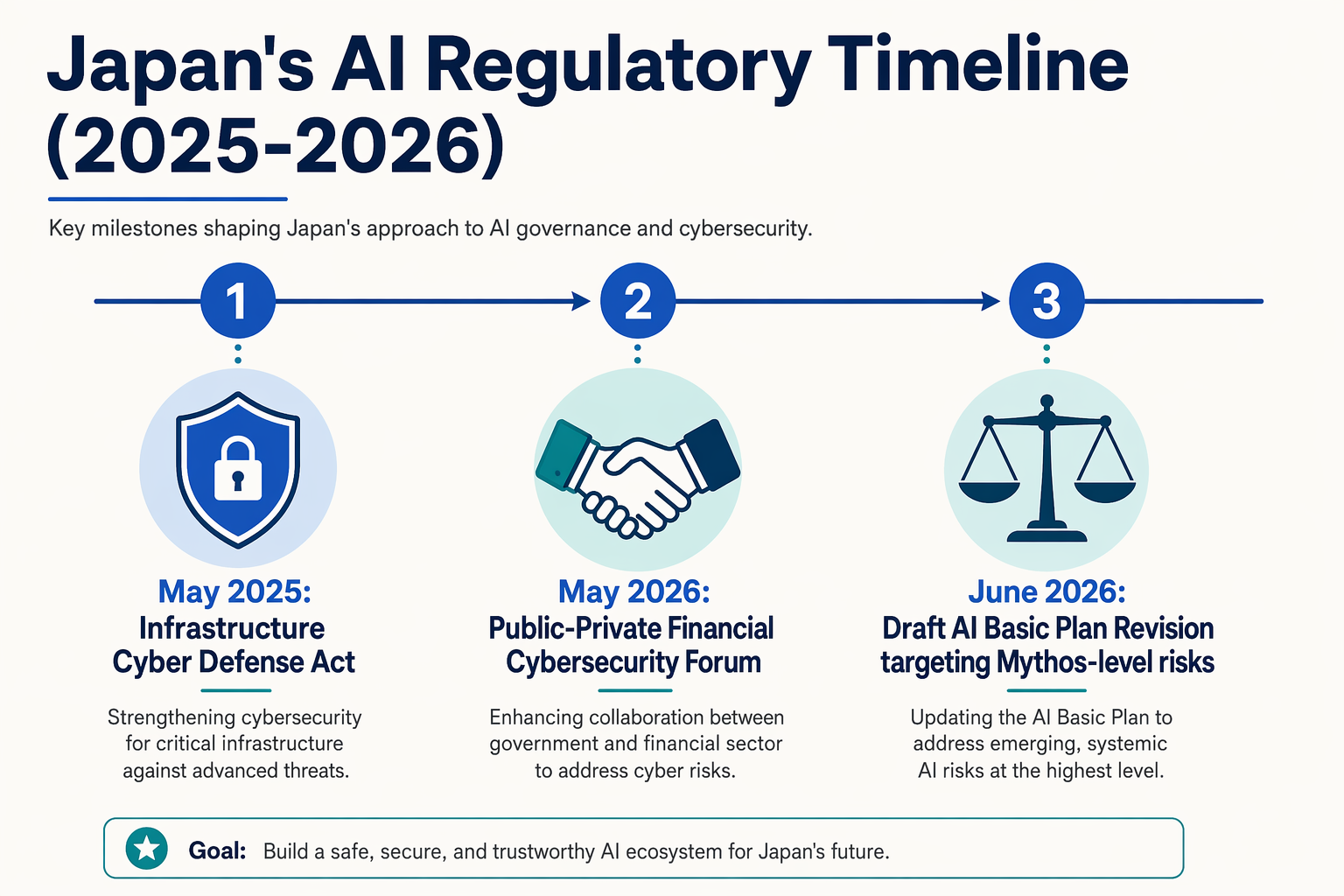
Japan’s strategy for AI governance has undergone a fundamental paradigm shift. Recognizing that traditional, static legislative cycles cannot keep pace with the exponential growth of frontier AI, the Japanese government has embraced a doctrine of "continuous" AI legal reform. This agile approach ensures that regulatory frameworks can be updated iteratively as new "Mythos-level" threats—such as highly autonomous cyber-exploitation capabilities and hyper-realistic disinformation campaigns—emerge in the wild.
Rather than relying on sweeping, once-in-a-decade bills, Japan is establishing specialized, rapid-response public-private bodies and flexible legal mandates. This ensures the nation can defend its critical infrastructure, financial networks, and democratic processes against highly sophisticated AI models, including advanced releases like Anthropic's Mythos.
The table below outlines the critical milestones in Japan’s rapid policy evolution, illustrating how the nation has moved from defensive infrastructure laws to dynamic, continuous safety frameworks.
| Timeline | Key Initiative | Focus Area | Regulatory Status |
|---|---|---|---|
| May 2025 | Infrastructure Defense Act | Protecting critical public infrastructure from cyber-intrusions | Enacted & Active |
| May 2026 | Financial Sector Working Group | Countering Mythos-powered systemic risks to banking networks | Established (Public-Private) |
| June 2026 | Continuous AI Reform Draft | Dynamic, legally binding regulations for frontier model creators | Draft Plan Proposed |
| June 2026 | Global Standardization Initiative | Disinformation countermeasures and cross-border alignment | Active Policy Development |
Moving Beyond Static Legislation
The core philosophy behind the June 2026 draft plan is to prevent regulatory obsolescence. When a model with "Mythos-level" capabilities is deployed, waiting years for parliamentary consensus to pass new legislation creates a dangerous window of vulnerability. By adopting continuous reforms, Japan’s regulators can adjust safety mandates, compliance audits, and security thresholds in real time as the threat landscape shifts.
This dynamic regulatory environment mirrors the operational realities faced by modern enterprises. For instance, companies deploying AI-driven communication infrastructures must remain highly adaptable to local policy changes. Platforms like CallMissed help businesses navigate this fluid landscape; by providing a unified API gateway to over 300+ LLMs, enterprise-grade Speech-to-Text APIs, and advanced voice agents, CallMissed allows companies to swap models instantly to comply with newly updated local safety standards without having to rebuild their entire communication architecture from scratch.
Targeting Multidimensional Threats
As shown in the timeline, Japan’s emerging legal reforms target several key vulnerability vectors:
- Financial System Integrity: Established by the bank regulator in May 2026, the new public-private forum focuses specifically on preventing highly sophisticated AI agents from orchestrating automated market manipulation or breaching secure banking networks.
- Information Integrity: Recent proposals from June 2026 place heavy emphasis on curbing state-sponsored disinformation and deepfakes, proposing that developers of large-scale AI systems incorporate rigorous origin-tracing technologies.
- International Standardization: Japan is actively aligning its domestic policies with global frameworks, ensuring that its continuous legal reforms support international AI safety standards and facilitate secure global data flows.
In-Depth Analysis: The Strategy Behind 'Continuous' Legal Reforms
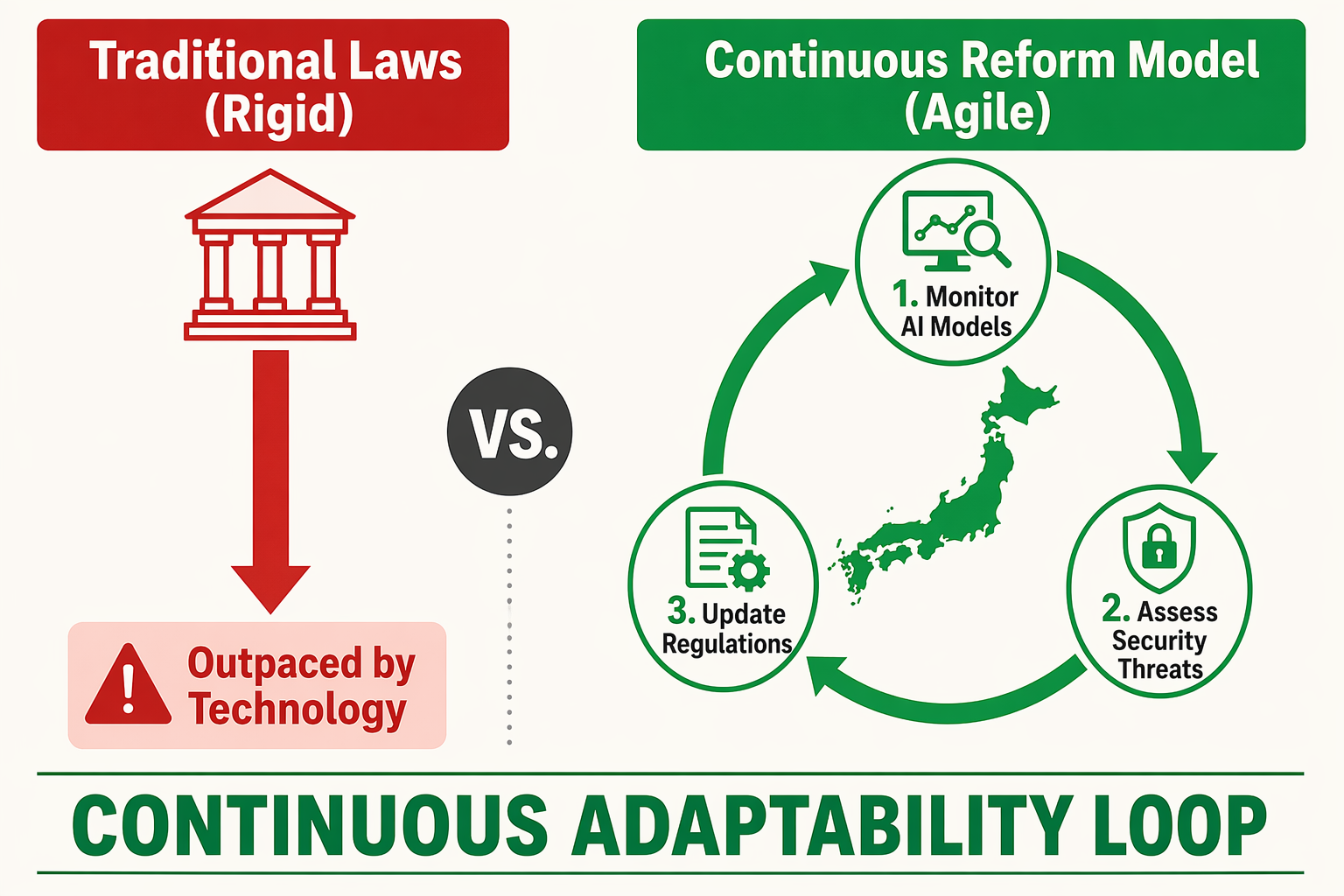
The rapid evolution of artificial intelligence—symbolized by the emergence of highly capable systems like Anthropic's Mythos—has exposed the limitations of traditional, static lawmaking. Under normal legislative cycles, a bill can take years to draft, debate, and pass. By the time it is enacted, the underlying technology has typically advanced by several generations. To prevent this regulatory obsolescence, Tokyo is pioneering a strategy of continuous legal reform, establishing a highly adaptive regulatory framework capable of real-time calibration.
Pivoting from Static to Dynamic Governance
Rather than relying on rigid, one-off pieces of legislation, Japan’s strategy commits the government to "actively and continuously review" AI-related laws. This paradigm shift acknowledges that "Mythos-level" AI models require dynamic oversight. The cornerstone of this strategy involves:
- Agile Legally Binding Rules: Drafting flexible regulations for large-scale AI models that can be updated via administrative decrees rather than waiting for full legislative sessions.
- Targeted Disinformation Countermeasures: Rapidly implementing policies and supporting verification technologies to address AI-generated deepfakes and mass disinformation campaigns.
- International Standardization: Actively participating in global AI standardization efforts to ensure Japan's framework remains interoperable with allied nations.
Defending High-Risk Sectors Against Advanced Threats
Japan’s continuous reform strategy is deeply pragmatic, prioritizing sectors most vulnerable to sophisticated AI exploitation. For instance, in May 2026, Japan’s banking regulator established a dedicated public-private working group to specifically address cybersecurity risks to the financial system posed by Mythos-powered threats. This continuous oversight strategy targets three critical domains:
- Financial Resilience: Mitigating automated, high-frequency cyberattacks and highly convincing social engineering schemes capable of bypassing legacy defensive protocols.
- Infrastructure Protection: Bolstering defensive capabilities to shield transport, energy, and communication grids from autonomous AI-driven infiltration.
- Information Integrity: Deploying technical and legal frameworks to verify digital content, protect intellectual property, and track the provenance of AI-generated media.
For enterprises operating globally, navigating this fluid environment requires flexible technology partners. Platforms like CallMissed help organizations adapt to these shifting regulatory landscapes. By offering secure AI voice agents, WhatsApp chatbots, and a multi-model API gateway with access to 300+ LLMs, CallMissed allows companies to swap models instantly to comply with localized, continuous regulatory shifts without rewriting their underlying communications infrastructure.
The Geopolitical and Standard-Setting Imperative
By adopting a continuous legal framework, Japan is positioning itself as a pragmatic leader in global AI governance. This strategy allows Tokyo to bridge the gap between the strict, preemptive approach of the European Union's AI Act and the more market-driven, fragmented approach of the United States. Through continuous iteration, Japan aims to foster an environment of high-tech innovation while maintaining a robust, proactive defense against the next wave of Mythos-level threats.
Impact & Implications: Cybersecurity, Disinformation, and Global Policy

Shoring Up Cybersecurity Against Next-Gen Exploits
The emergence of "Mythos-level" AI models—highly advanced, next-generation systems capable of complex reasoning and code generation—has fundamentally shifted the global threat landscape. In Japan, these risks are being treated with immediate urgency. In May 2026, the country’s financial regulator established a dedicated public-private working group specifically tasked with addressing cybersecurity risks to the financial system posed by Anthropic’s Mythos-powered technologies.
Because these highly capable models can autonomously detect software vulnerabilities and orchestrate complex cyberattacks, traditional, static defense mechanisms are no longer sufficient. Under legislative frameworks enacted in 2025, Japan is bolstering defenses for critical national infrastructure. To keep pace, enterprises must transition to secure, modular AI deployment architectures. This is where advanced infrastructure platforms play a vital role. For example, CallMissed offers a secure multi-model API gateway supporting over 300 LLMs, allowing organizations to route tasks dynamically and isolate or swap out specific models instantly if security vulnerabilities are detected in a particular system.
Weaponized Disinformation and Digital Trust
Beyond direct cyberattacks, the proliferation of Mythos-level generative models poses an unprecedented threat to public discourse. The Japanese government's latest draft plan places a heavy emphasis on mitigating synthetic media and coordinated disinformation campaigns. Key initiatives driving this regulatory shift include:
- Legally Binding Safeguards: Transitioning from voluntary guidelines to hard regulatory requirements for developers of large-scale AI systems to actively prevent the generation of deceptive content.
- Watermarking and Origin Tracking: Accelerating support for provenance technologies to verify the authenticity of digital media and combat deepfakes.
- Multilingual Verification: Ensuring that defense mechanisms can parse nuanced, localized disinformation campaigns across different regions and languages.
As regulatory scrutiny intensifies, businesses deploying conversational systems must ensure their AI communication channels remain verified and compliant. Leveraging secure, localized communication infrastructure—such as CallMissed’s Speech-to-Text and Text-to-Speech APIs that support 22 regional Indian languages natively—allows enterprises to deploy trustworthy, audited voice and chat agents that align with evolving international compliance and safety benchmarks.
A New Blueprint for Agile Global Policy
Japan's commitment to "actively and continuously review" its AI laws marks a departure from static regulatory models like the European Union's AI Act. By acknowledging that AI capabilities outpace traditional legislative timelines, Tokyo is pioneering an agile governance framework.
This continuous model aims to harmonize with international AI standardization efforts, creating a dynamic policy environment where regulations are updated in real-time response to model breakthroughs. For global businesses, this means compliance is no longer a one-time checklist but an ongoing operational protocol. Building AI stacks with flexibility, transparency, and robust defense layers is now a prerequisite for operating in the modern digital economy.
Expert Opinions: What Tech and Legal Scholars are Saying

Japan’s pivot toward "continuous" AI legal reforms marks a significant departure from its historically hands-off, "soft-law" approach. Legal and technology scholars are closely analyzing this shift, noting that traditional, static legislative cycles are fundamentally incompatible with the breakneck pace of frontier AI development.
The Death of Static Legislation
Scholars argue that the emergence of "Mythos-class" generative models—which possess advanced capabilities in autonomous reasoning, complex code generation, and hyper-realistic synthesis—demands a living, breathing regulatory framework. Legal experts point out that a static law enacted today could be rendered entirely obsolete within six months by a single model update. Japan's strategy of continuous review is being praised by policy analysts as a pragmatic model for the rest of the world, acknowledging that AI safety cannot be solved with a "one-and-done" bill. Rather than relying solely on post-hoc penalties, scholars suggest that continuous legal frameworks will force developers of large-scale AI systems to maintain active, transparent risk-mitigation pipelines.
Addressing Systemic and Cyber Risks
Cybersecurity scholars have sounded alarms over the potential weaponization of these advanced models. The urgency of this issue was highlighted in May 2026 when Japan's banking regulator, the Financial Services Agency (FSA), established a dedicated public-private working group to counter cybersecurity risks to the financial sector, specifically those powered by highly capable systems like Anthropic’s Mythos model.
According to security researchers, the core threats demanding continuous legislative oversight include:
- Automated Cyber Tactics: Mythos-level models can autonomously discover zero-day software vulnerabilities and draft highly targeted phishing campaigns at scale.
- Infrastructure Vulnerabilities: Building on critical infrastructure defense laws enacted last year, experts warn that AI-driven attacks on power grids and financial transaction networks require real-time, legally mandated defensive measures.
- Disinformation Vectors: Legal scholars emphasize that the ability of these systems to generate convincing, localized deepfakes threatens democratic processes and market stability alike, necessitating legally binding provenance standards.
The Compliance Challenge for Global Businesses
For organizations deploying conversational AI and automated workflows, these rapidly shifting legal sands present a massive operational hurdle. Tech scholars warn that continuous compliance updates could stifle smaller enterprises that lack the resources to constantly audit and overhaul their proprietary systems.
To navigate this fluid regulatory environment, forward-thinking enterprises are turning to agile, multi-model infrastructure. Platforms like CallMissed help businesses future-proof their operations by offering an API gateway that connects to over 300+ LLMs. If a specific model suddenly faces regional regulatory restrictions or fails to meet newly updated compliance standards in Japan, developers using CallMissed can seamlessly swap their voice agents and communication pipelines to an approved model with a single configuration change, avoiding costly system downtime.
Ultimately, scholars agree that Japan’s proactive stance on international AI standardization is a necessary step toward aligning global compliance. By participating in international standard-setting bodies, Japan aims to ensure that "continuous reform" leads to harmonized global guardrails rather than a fragmented, unmanageable patchwork of local laws.
What This Means For You: Actions for Businesses & Developers (TABLE)
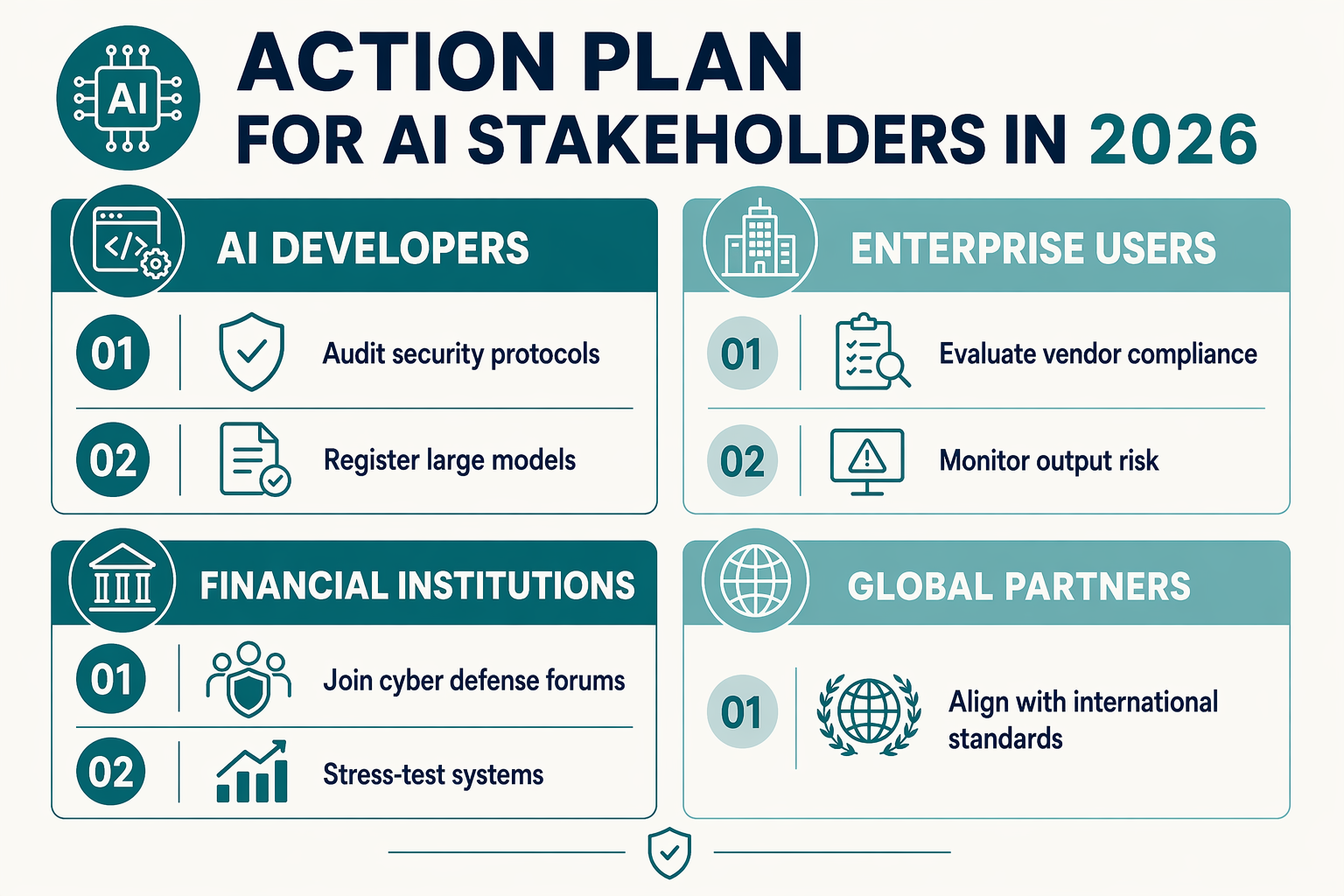
Japan’s pivot to "continuous" AI legal reforms signals a permanent end to "set-and-forget" compliance. As advanced Anthropic Mythos-class models demonstrate unprecedented capabilities—and risks—in autonomous cyber-reconnaissance and algorithmic disinformation, organizations must transition from static security checklists to dynamic risk mitigation.
Governments are already acting swiftly. In May 2026, Japan’s banking regulator established a dedicated public-private working group to counter Mythos-powered cyberthreats targeting the financial system. Meanwhile, Japan’s June 2026 draft policy outlines an aggressive timeline for international AI standardization and anti-disinformation frameworks. For global businesses and developers, waiting for finalized legislation is no longer a viable strategy; proactive architecture is required.
To navigate this highly fluid regulatory environment, developers should decouple their application layer from specific model providers. Utilizing flexible infrastructures like CallMissed, which provides access to over 300 LLMs through a unified API gateway, allows engineering teams to swap models instantly if a particular provider faces abrupt regional restrictions, licensing changes, or security audits.
The table below outlines the critical steps businesses and technical teams must take to align with Japan's evolving regulatory expectations:
| Strategic Action | Primary Focus Area | Threat Addressed | Regulatory Alignment |
|---|---|---|---|
| Model Decoupling & Redundancy | System Architecture | Single-point vendor lock-in & sudden compliance bans | Japan's "continuous review" paradigm |
| Automated Disinformation Auditing | Public-Facing Content | Mythos-driven social engineering & deepfakes | Japan's June 2026 anti-disinformation drafts |
| Dynamic Threat Hunting | SecOps & Infrastructure | AI-orchestrated zero-day cyberattacks | Public-private financial defense initiatives |
| Multilingual Input Validation | LLM Safety Gateways | Prompt injection and localized regional exploits | Global AI safety & international standards |
| Continuous Compliance Mapping | Legal & Risk Operations | Regulatory drift across multiple jurisdictions | Cross-border AI standardization frameworks |
Strategic Priorities for AI Engineering Teams
To effectively counter Mythos-level threats while maintaining operational agility, engineering teams should prioritize three core operational shifts:
- Deploy AI-Native Security Proxies: Implement intermediate security layers between your users and LLM endpoints. These proxies must actively sanitize inputs and outputs to prevent prompt-injection attacks that exploit the expanded reasoning capabilities of next-generation models.
- Establish Multilingual Guardrails: Because Mythos-level models easily bypass English-only filters using regional dialects, safety guardrails must be natively multilingual. For instance, platforms like CallMissed support advanced processing across 22 Indian languages and multiple Asian dialects, ensuring that safety parameters remain robust regardless of the input language.
- Transition to Real-Time Monitoring: Static logging is insufficient for highly adaptive AI threats. Organizations must adopt real-time, behavioral anomaly detection to identify when an LLM is being subtly steered toward generating malicious code or spreading coordinated disinformation.
Frequently Asked Questions
What are Japan's continuous AI legal reforms designed to prevent?
What exactly is a "Mythos-level" AI threat?
How does Japan plan to address cybersecurity risks in the financial sector under the new AI legal reforms?
Will Japan introduce legally binding regulations for large-scale AI models?
How can global businesses maintain compliance as Japan eyes continuous AI legal reforms?
What role does international collaboration play in Japan's new AI strategy?
Conclusion
As "Mythos-level" models redefine the boundaries of artificial intelligence, Japan’s proactive regulatory shift signals a new era of dynamic, security-first governance. To navigate this rapidly evolving landscape, several key takeaways stand out:
- Agile Governance: Static laws are obsolete; continuous legal reform is required to match the unprecedented speed of advanced AI developments.
- Securing Critical Infrastructure: National strategies must actively counter highly sophisticated disinformation and AI-driven cyber threats targeting financial and public systems.
- Global Collaboration: International standardization and public-private alliances will dictate how democratic nations govern frontier models without stifling innovation.
Moving forward, watch for global regulators to follow Japan's lead by drafting living, adaptable policy frameworks. For businesses building in this space, leveraging secure, compliant, and reliable technology is critical. To explore how AI communication is evolving alongside these global shifts, check out CallMissed — an AI infrastructure platform powering compliant voice agents and multilingual chatbots for businesses.
As governance and technology continue to evolve, one vital question remains: Are global regulatory systems truly agile enough to preemptively secure the future, or are we destined to always play catch-up with the next generation of AI?
Related Posts

US Grows Anxious Over AI: Trump Administration Orders OpenAI to Delay GPT-5.6 Rollout

OpenAI to Release GPT-5.6 in Limited Preview Following US Government Request for Staggered Launch

OpenAI Delays GPT-5.6 Public Launch: US Government Demands Early Access to Frontier AI