

Indian Stock Market Outlook: Navigating Rallies, Fed Decisions, and Key Trends


Did you know that the National Stock Exchange of India (NSE) recently cemented its position as the fifth-largest stock exchange globally, with its total...
Indian Stock Market Outlook: Navigating Rallies, Fed Decisions, and Key Trends
Did you know that the National Stock Exchange of India (NSE) recently cemented its position as the fifth-largest stock exchange globally, with its total market capitalization soaring past the $5 trillion mark? This historic milestone is not just a vanity metric; it represents a fundamental shift in global capital, positioning India as a primary engine of economic growth.
As of today, June 19, 2026, navigating the Indian stock market requires a delicate balancing act. Investors are currently watching a fascinating macroeconomic tug-of-war. While the US Federal Reserve’s latest interest rate decisions have triggered volatility in high-growth IT stocks, a sharp slide in global crude oil prices has stepped in to offset these losses. This underlying resilience was on full display this week as the Nifty celebrated a spectacular rally, ending green for a fifth consecutive trading session. This unique blend of global macro pressures and strong domestic liquidity means that understanding market trends has never been more critical for preserving and growing wealth.
This massive wave of retail participation has also forced a technological revolution across India's financial sector. Financial platforms are racing to keep up with millions of new traders seeking instantaneous, localized insights. To meet this demand, progressive brokerage firms are leveraging advanced communication infrastructure, like CallMissed’s AI voice agents, to deliver real-time stock alerts and seamless customer support natively across 22 regional Indian languages.
In this comprehensive market outlook, we will dissect the key trends driving the current rally, analyze how the latest Fed decisions will impact domestic sectors, and provide actionable insights into the daily trade setups. Whether you are a seasoned day trader tracking the pre-open market or a long-term investor building a resilient portfolio, this guide will help you decode the complexities of today's market dynamics.
Introduction
The Indian stock market is experiencing an unprecedented era of growth and digital transformation. As of June 19, 2026, investor sentiment remains highly optimistic, characterized by a sustained market rally that has seen the benchmark Nifty 50 end in the green for five consecutive trading sessions. This momentum is not an isolated event; it is part of a broader trajectory that has positioned India as one of the most dynamic and fast-growing financial ecosystems in the world.
At the heart of this expansion is the National Stock Exchange of India (NSE). Having surpassed the historic $5 trillion market capitalization milestone, the NSE is firmly established as the 5th largest stock exchange globally. Meanwhile, the BSE Sensex continues to trade at record-high levels, reflecting robust domestic institutional investor (DII) and foreign institutional investor (FII) activity. Today's trading environment is characterized by a delicate balance: while global macroeconomic factors like Federal Reserve interest rate decisions and shifting crude oil prices introduce short-term volatility, strong domestic fundamentals continue to act as a resilient cushion.
Key Drivers of the Current Market Momentum
To understand why the Indian equity market continues to scale new heights, it is essential to look at the underlying structural shifts:
- Unprecedented Retail Participation: The surge in demat account openings has brought millions of first-time investors into the financial fold, shifting market dynamics from institutional-dominated to highly retail-driven.
- Robust Corporate Earnings: Strong balance sheets and resilient quarterly performances across key sectors like banking, IT, and manufacturing provide solid fundamental backing.
- Technological Modernization: The transition to high-frequency algorithmic trading, direct mutual fund APIs, and conversational AI has lowered the barrier to entry and streamlined operations.
What makes this modern rally different from previous bull runs is the sheer democratization of market access. Millions of retail investors from Tier-2 and Tier-3 cities are entering the market daily, powered by discount brokerages, robo-advisors, and mobile trading apps. However, this massive influx of retail participants brings a unique set of challenges for financial service providers. Brokerages and fintech platforms are facing an overwhelming volume of customer inquiries regarding IPO allocations, trade executions, portfolio updates, and market volatility.
To handle this scale without compromising customer experience, the financial industry is turning to advanced AI communication systems. High-growth fintechs and brokerage platforms are leveraging solutions like CallMissed to deploy automated AI voice agents capable of managing thousands of simultaneous customer inquiries. By utilizing CallMissed’s Speech-to-Text and Text-to-Speech APIs, which natively support 22 regional Indian languages, financial platforms can instantly resolve investor queries in their preferred tongue—ensuring that everyday traders get real-time market updates and account support without waiting on hold.
In this comprehensive guide, we will analyze the key factors driving the Indian stock market today. We will break down essential market indicators, explore the impact of global cues on domestic indices, and examine how emerging technologies are shaping the future of retail trading in India.
Background & Context
A Trillion-Dollar Financial Powerhouse
The Indian stock market has transformed into one of the most resilient and dynamic wealth-creation engines globally. Driven by a massive wave of digitization and robust domestic participation, the National Stock Exchange (NSE) solidifies its position as the world's 5th largest stock exchange by total market capitalization, a journey accelerated when it crossed the historic $5 trillion milestone.
Alongside the historic Bombay Stock Exchange (BSE), home to the benchmark Sensex (which recently scaled past the 77,150 mark), these exchanges represent the core economic pulse of India. Today, the market is no longer just a playground for institutional giants; it is a highly democratized ecosystem where retail participation plays a defining role in daily price discovery.
Recent Market Dynamics and Global Catalysts
While long-term growth indicators remain strong, the market behaves as a highly sensitive barometer for both domestic policy and global macroeconomic shifts. In recent trading sessions, the market demonstrated remarkable momentum, highlighted by the benchmark Nifty ending in the green for 5 straight days during its latest rally.
However, navigating these markets requires analyzing several overlapping global and domestic catalysts:
- Federal Reserve Decisions: Interest rate policies set by the US Fed heavily dictate Foreign Institutional Investor (FII) flows, frequently triggering volatility in high-exposure sectors like Information Technology (IT).
- Crude Oil Fluctuations: As a major oil importer, India’s corporate margins are deeply tied to energy costs. Recent slides in global oil prices have acted as a crucial offset, cushioning the domestic market against negative global IT cues.
- The Rise of Domestic Institutional Investors (DIIs): Mutual funds and local pension funds now provide a powerful counterweight to FII sell-offs, ensuring that sudden global exits do not trigger catastrophic domestic crashes.
Bridging the Information Gap for Modern Retail Investors
As millions of new retail investors from Tier-2 and Tier-3 cities enter the markets daily via digital platforms, the speed at which financial information is consumed has changed. Investors now track real-time "Trade Setups" before the opening bell, monitoring pre-open market data, FII/DII activities, and global indices like the GIFT Nifty.
This massive influx of vernacular-speaking, mobile-first traders has highlighted a critical gap: the need for instant, localized financial communication. To scale customer support and deliver real-time market insights, financial brokerages are increasingly turning to advanced AI communication platforms. For example, platforms like CallMissed allow fintech companies and advisory firms to deploy production-ready AI voice agents and Speech-to-Text APIs supporting 22 Indian regional languages. This ensures that a trader in a remote town can receive instant, automated portfolio updates, margin calls, or stock advisory alerts natively and accurately, matching the breakneck speed of the modern trading floor.
Key Developments (TABLE)
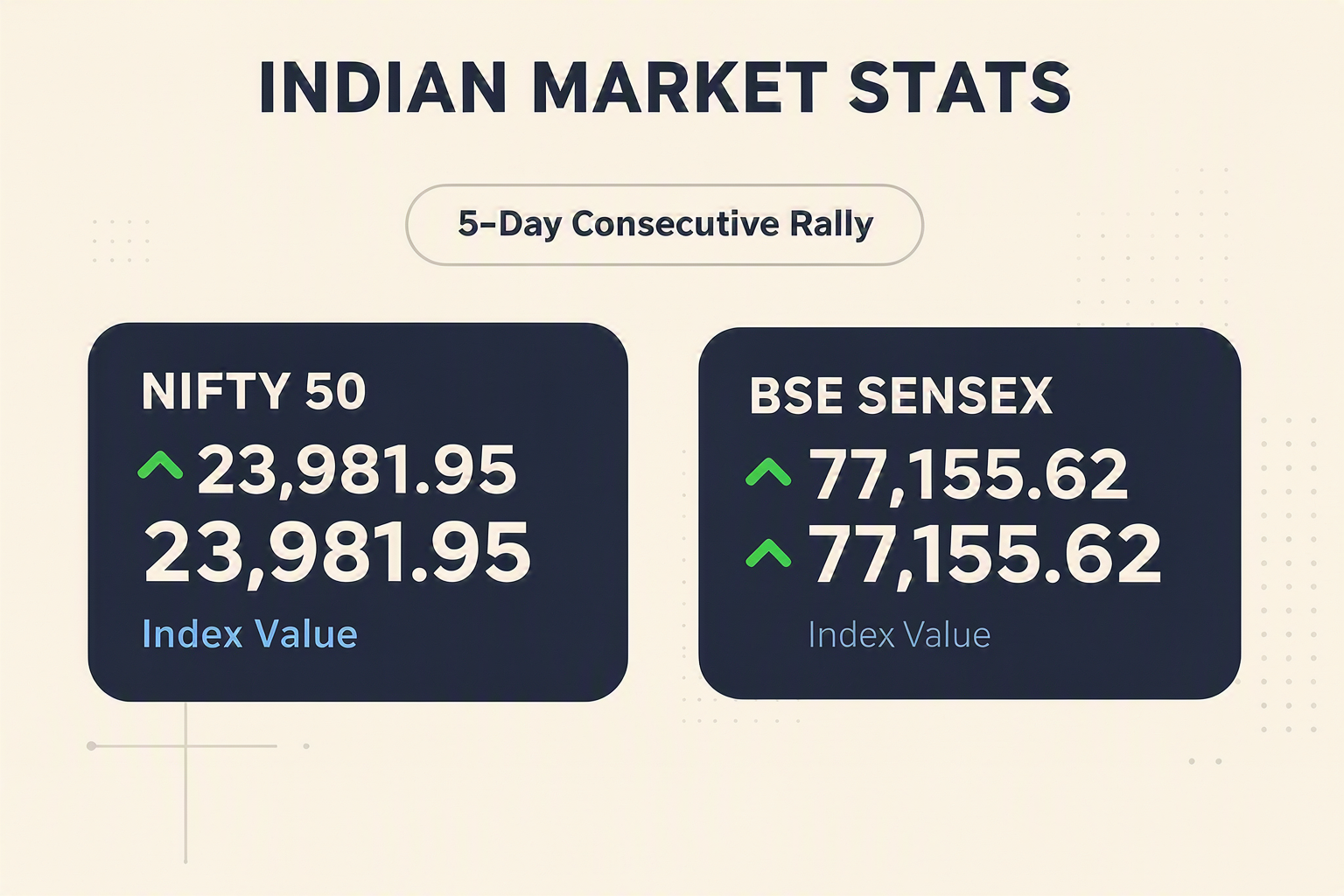
The Indian stock market has continued its remarkable run of resilience, driven by strong domestic liquidity, robust retail participation, and favorable macroeconomic conditions. As of June 19, 2026, the market has demonstrated high-volume activity, punctuated by a 5-day consecutive green streak for the Nifty, signaling persistent investor confidence despite shifting global cues.
While international developments—such as the latest U.S. Federal Reserve interest rate decisions—have introduced volatility to IT stocks, the impact has been largely cushioned by a slide in global crude oil prices, which directly benefits India’s import-dependent fiscal balance. Structurally, the National Stock Exchange of India (NSE) remains firmly positioned as one of the top five largest stock exchanges globally, comfortably maintaining its market capitalization milestone of over $5 trillion.
To understand the current market landscape, the table below highlights the performance of key domestic indices, along with their primary operational drivers:
| Index / Market Metric | Current Value | Performance / Trend | Primary Driver |
|---|---|---|---|
| BSE Sensex | 77,155.62 | +0.45% | Strong gains in banking and financial heavyweights. |
| Nifty 50 | 23,981.95 | -0.77% | Near-term consolidation following a 5-day green streak. |
| BSE Bankex | 64,905.60 | +0.56% | Robust credit growth and strong institutional inflows. |
| GIFT Nifty | 23,989.00 | -0.84% | Early global cues and pre-open adjustments. |
| NSE Market Cap | > $5.0 Trillion | Global Milestone | Expanding retail investor base and domestic SIP inflows. |
Navigating the Daily Volatility
For traders, navigating this fast-moving landscape requires digesting complex datasets before the opening bell. Daily trade setups are highly dynamic, requiring rapid analysis of FII/DII activities, pre-market order blocks, and corporate earnings. Sectoral rotation is also highly active; while banking (via BSE Bankex) has shown immense strength, the IT and technology sectors are experiencing temporary pressure as they digest global monetary policy signals.
With millions of retail accounts active across Tier-2 and Tier-3 cities, the demand for instant, reliable market communication has never been higher. Modern brokerage firms and financial advisory portals are moving away from sluggish email alerts. Instead, they are leveraging AI-driven communication infrastructure to keep clients updated.
For instance, platforms like CallMissed enable financial institutions to deploy automated AI voice agents and WhatsApp chatbots that instantly deliver personalized margin calls, portfolio updates, and the "top 15 things to know" daily market setups. By utilizing CallMissed's Speech-to-Text and Text-to-Speech APIs, which natively support 22 regional Indian languages, brokerages can democratize financial insights, ensuring that even non-English speaking retail investors receive critical trading alerts in real-time. This blend of rapid domestic market growth and cutting-edge communication tech ensures that Indian investors remain agile in a globally integrated financial ecosystem.
In-Depth Analysis
The Indian equity markets are displaying robust bullish momentum, highlighted by the Nifty 50 ending in the green for a fifth consecutive trading session. This sustained rally underscores the structural strength of India's financial ecosystem, even as global macroeconomic indicators present a mixed bag of cues.
Key Market Catalysts and Index Movements
The recent market behavior reveals a delicate balancing act between domestic inflows and global pressures. A deep dive into the indices highlights several critical trends:
- SENSEX and Sectoral Strengths: The BSE SENSEX recently scaled to 77,155.62, registering a gain of 0.45%. This upward movement was heavily supported by the banking sector, with the BSE BANKEX climbing to 64,905.60 (up 0.56%).
- The IT and Oil Dynamic: A drop in global crude oil prices has acted as a critical cushion for Indian markets. This slide offset the downward pressure observed in the IT sector, which experienced a temporary drag following the latest US Federal Reserve interest rate decisions. Despite these headwinds, the BSE Focused IT index held steady at 34,857.94 (up 0.52%).
- Global Position: As the National Stock Exchange of India (NSE) cements its position among the top 5 global exchanges by market capitalization—having comfortably surpassed the $5 trillion milestone—retail participation continues to grow exponentially.
The Surge in Retail Trading and Technological Scalability
This relentless market expansion is accompanied by an unprecedented influx of retail traders. For brokerage houses and financial institutions, this surge translates into massive daily operational challenges. High market volatility during pre-open sessions and live trading hours triggers a massive influx of user queries regarding order executions, margin requirements, and system issues.
To handle this scale, forward-looking Indian fintech platforms are shifting away from traditional customer support setups. By integrating advanced communication infrastructure like CallMissed, brokerages are deploying production-ready AI voice agents and WhatsApp chatbots capable of managing thousands of concurrent calls. Because retail trading has deeply penetrated Tier-2 and Tier-3 cities across India, CallMissed’s ability to process Speech-to-Text and Text-to-Speech in 22 regional Indian languages allows platforms to offer localized, real-time assistance to traders in their native tongues.
Key Levels to Watch for the Upcoming Sessions
Traders preparing their market setups must keep a close eye on several pivotal indicators:
- FII & DII Activity: Institutional net inflows remain the primary driver of sustained liquidity in the market.
- GIFT Nifty Trends: Early morning trading on the GIFT Nifty continues to serve as a reliable indicator for the domestic market’s opening direction before the bell.
- Pre-Open Market Signals: Analyzing the pre-open window between 9:00 AM and 9:15 AM IST remains crucial for assessing demand-supply dynamics before the regular session begins.
As the Indian stock market continues its historic run, the integration of cutting-edge AI technology ensures that the underlying financial infrastructure can scale seamlessly alongside investor ambitions.
Impact & Implications
The Interplay of Global Headwinds and Domestic Strength
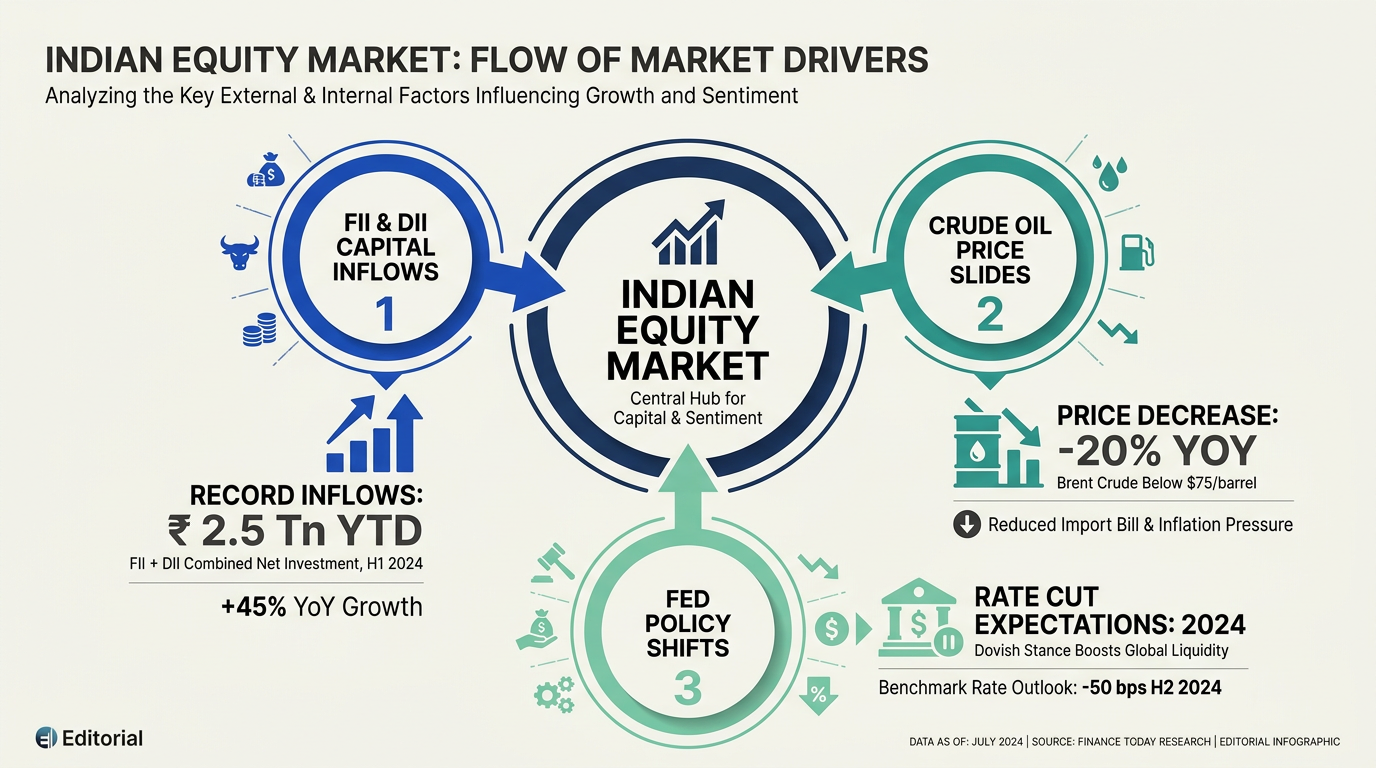
The Indian stock market’s sustained momentum—highlighted by the Nifty ending green for five consecutive days and the BSE Sensex trading robustly around the 77,155 mark—signals deep resilience. However, this upward trajectory is a balancing act between external pressures and domestic tailwinds.
The primary external pressure stems from the US Federal Reserve's monetary policy stances, which historically dictate capital flows in emerging markets. While hawkish Fed signals often trigger near-term consolidation in Indian IT stocks due to their heavy exposure to Western corporate spending, this drag is currently being neutralized by a slide in global crude oil prices. As India imports over 80% of its petroleum requirements, cheaper oil lowers the import bill, eases domestic inflation pressure, and strengthens the Indian Rupee. Consequently, domestic-focused sectors like banking (with the BSE BANKEX holding strong above 64,900) and automotive are seeing enhanced profitability and investor interest.
Democratization of Wealth and Infrastructure Demands
With the National Stock Exchange (NSE) firmly positioned as the world's 5th largest exchange by market capitalization—having scaled past the $5 trillion milestone—the structural composition of the Indian market has permanently shifted. The market is no longer solely at the mercy of Foreign Institutional Investor (FII) outflows. Instead, a massive wave of domestic retail participation via platforms like Groww and ICICI Direct has created a resilient cushion of domestic liquidity.
This unprecedented surge in retail trading has created a massive challenge for financial brokerages: maintaining high-uptime, multi-channel customer service during high-volatility trading windows. To address this, forward-looking fintechs are leveraging advanced AI infrastructure. For example, platforms like CallMissed allow brokerages to deploy production-ready AI voice agents and WhatsApp chatbots capable of communicating natively in 22 regional Indian languages. This ensures that retail investors, even in tier-2 and tier-3 cities, can instantly access real-time stock updates, order statuses, and portfolio support without facing delayed call center queues during market surges.
Strategic Takeaways for Investors
As the Indian indices touch historic highs, market participants must adapt to several emerging market realities:
- Active Sectoral Rotation: Investors must pivot from generic index investing to sector-specific allocation. While high-interest rates globally may keep IT and tech valuations muted, domestic cyclicals like banking, infrastructure, and defense are driving the broader market rally.
- The Power of Domestic Liquidity: Systematic Investment Plans (SIPs) continue to channel billions of rupees into mutual funds monthly, ensuring that any sharp market corrections are swiftly bought into by Domestic Institutional Investors (DIIs).
- A Focus on Earnings Quality: With valuations at premium levels, future stock gains will be strictly tied to actual corporate earnings growth rather than speculative expansion. Companies with strong balance sheets and positive cash flows are expected to outperform.
Expert Opinions
The continuous rally in the Indian equity markets has caught the attention of global and domestic analysts alike. With the BSE Sensex trading firmly above the 77,155 mark and the Nifty 50 marking its fifth consecutive day in the green, market experts are dissecting the core drivers behind this sustained momentum. The interplay between international macroeconomic policies and domestic liquidity continues to shape the short-term outlook.
Macro Indicators and the Fed's Ripple Effect
According to market strategists, the primary talking point among institutional desks is the Federal Reserve's interest rate stance. While hawkish undertones initially triggered a minor sell-off in heavyweight Information Technology (IT) stocks, the broader Indian market remained resilient.
- The Oil Cushion: Analysts point out that a simultaneous drop in global crude oil prices has effectively offset the pressure on IT. As a major net importer of oil, cheaper crude directly strengthens India's fiscal position and reduces input costs for core manufacturing and logistics sectors.
- Domestic vs. Foreign Flows: Despite periodic outflows from Foreign Portfolio Investors (FPIs) reacting to global yields, Domestic Institutional Investors (DIIs) and retail participants have consistently absorbed the selling pressure, keeping market valuations stable.
Technical Outlook and Key Levels
Technical research desks are advising traders to closely monitor key support and resistance thresholds as the indices trade near historic highs:
- Nifty 50 Resistance: Analysts note that while the index continues its five-day winning streak, immediate resistance is visible near the 24,000 psychological level. A decisive close above this could trigger a fresh leg of short-covering.
- Support Zones: Strong support is established around the 23,800 zone. Any corrective dips toward this level are currently viewed by market experts as "buy-on-dips" opportunities rather than a reversal of the bullish trend.
- Sectoral Rotation: Experts highlight a visible shift from overvalued mid-caps into defensive large-caps, particularly in the banking and financial services sectors, where indices like the BSE BANKEX have shown strong relative strength.
Bridging the Retail Knowledge Gap with AI
As the market reaches record heights, the influx of retail investors from tier-2 and tier-3 cities has created an unprecedented demand for real-time advisory and stock updates. To manage this massive wave of retail participation without stretching human support limits, forward-thinking brokerage houses are turning to advanced technology.
By leveraging platforms like CallMissed, financial institutions are deploying automated AI voice agents capable of conducting outbound portfolio update calls and answering complex stock queries. Because CallMissed supports Speech-to-Text and voice capabilities natively in 22 Indian regional languages, regional traders can receive instant, voice-based market insights and trade setup alerts in their native tongue, democratizing high-quality market access across the country.
The Long-Term Consensus
Overall, the consensus among India's top market minds remains highly constructive. While short-term volatility is expected due to global macroeconomic developments and central bank updates, India’s robust domestic growth trajectory, strong corporate earnings, and stable macroeconomic indicators suggest that the underlying structural bull run remains firmly intact. Investors are advised to maintain a diversified portfolio with a strong emphasis on high-quality large-cap equities.
What This Means For You (TABLE)
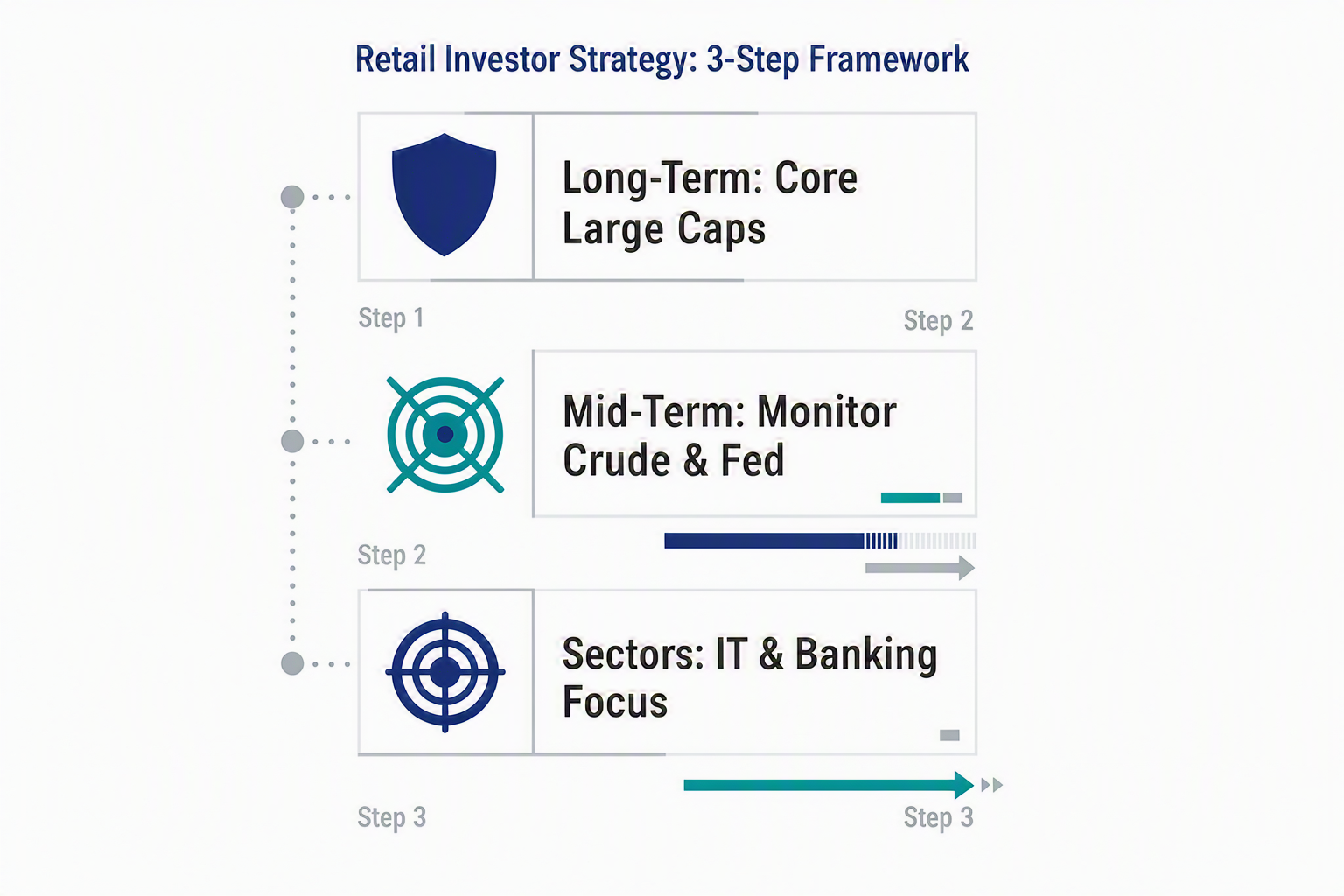
The current state of the Indian stock market shapes practical choices for every participant, from seasoned traders to long-term investors and first-timers. With the Nifty index recording its fifth consecutive day in the green (NDTV, June 2026), and Sensex currently above the 77,000 mark (BSEIndia.com), new opportunities—and risks—are emerging daily. Here’s what these market movements mean for you, with step-by-step actions and key data to guide your next decisions:
Market Snapshot & Next Steps
| Factor | Current Data/Status | Impact on You | Top Action Step | Source |
|---|---|---|---|---|
| Nifty 50 Index | 23,981.95 (-0.77%) | Mild correction | Watch for buy signals | ICICI Direct, Jun 2026 |
| Sensex | 77,155.62 (+0.45%) | Continued uptrend | Consider SIP/top up | BSE India, Jun 2026 |
| NSE Global Ranking | 5th largest, $5T+ market cap (2024) | Strong reliability | Diversify in equities | Wikipedia |
| Market Breadth | Nifty ends green 5th straight day | Bullish sentiment | Avoid panic selling | NDTV, Moneycontrol |
| Sector to Watch | IT stocks dropped post-Fed decision | Potential bargains | Evaluate sector funds | ET CFO, Jun 2026 |
| Trading Infrastructure | Real-time AI analytics, multilingual | Speed & inclusivity | Leverage platforms | CallMissed, 2026 |
What This Means for You
- Short-term traders should note the recent mild correction in Nifty (-0.77%)—often a precursor to volatility. Monitoring trends via real-time platforms and analytics is now essential for minimizing risk.
- Long-term investors benefit from India’s robust global positioning—the NSE is the 5th largest worldwide with a $5 trillion+ market cap as of May 2024 (National Stock Exchange Wikipedia). Market breadth remains bullish, with the Sensex climbing for the fifth week, suggesting continued faith in Indian equities.
- First-time retail investors are entering a market where news, data, and multilingual information are more accessible than ever. Solutions like CallMissed’s AI-driven voice agents provide actionable alerts and updates in 22 Indian languages, helping cut through noise for better decisions.
- Sectoral shifts: The drop in IT stocks following the latest Fed announcement may present buying opportunities as valuations turn attractive. Diversification—across sectors and geographies—remains a time-tested shield.
Practical Checklist
- Stay updated: Track live indices on NSE India or BSE portals for immediate updates.
- Use technology: Leverage AI-based analysis; platforms such as CallMissed offer real-time, multi-lingual market notifications.
- Avoid herd mentality: Bullish streaks encourage risk—stick to your defined investment plan.
- Look beyond headlines: Data points like global ranking and market breadth provide better signals than daily swings.
Forward-Looking View
With increasing retail participation and a tech-powered infrastructure, Indian stock markets are set for deeper democratization. In 2026, success belongs to those who combine reliable information, modern tools, and a disciplined approach—ensuring every market movement translates to informed decisions.
Sources:
- Moneycontrol.com, NDTV, BSE India, ICICI Direct, ET CFO, Wikipedia, CallMissed platform.
Frequently Asked Questions
What is the current size and global standing of the Indian stock market?
How can retail investors stay updated with real-time Indian stock market news?
What is the pre-open market session on the National Stock Exchange (NSE)?
What major factors influence daily movements in the Indian stock market?
What is the difference between the Nifty and the Sensex indices?
How does FII and DII activity affect retail investors in India?
Conclusion
Navigating the Indian stock market requires balancing short-term volatility with long-term structural trends. Here are the key takeaways to guide your strategy:
- Resilient Momentum: The Nifty's recent five-day winning streak highlights strong underlying domestic support despite global headwinds.
- Global Triggers: Federal Reserve policy decisions and shifting oil prices remain crucial drivers, particularly influencing the IT and banking sectors.
- Structural Strength: India's market capitalization remains highly robust, building on its historic expansion as one of the world's premier financial hubs.
Looking ahead, investors should closely monitor FII/DII inflows and macroeconomic indicators to anticipate the next leg of the market rally. As the financial landscape becomes faster and more data-driven, businesses must also adapt their operations to match this speed. To explore how AI communication is evolving to keep enterprises agile, check out CallMissed — an AI infrastructure platform powering voice agents and multilingual chatbots for modern businesses.
Is your portfolio positioned to capitalize on this ongoing momentum, or will global macroeconomic shifts catch you off guard?
Related Posts

GPT-5.6 टेरा के बारे में आपको जो कुछ भी जानना आवश्यक है: 2026 के लिए OpenAI का संतुलित AI मॉडल

24/7 डिजिटल आईएसए: रियल्टर्स सौदे पक्के करने के लिए एआई वॉइस एजेंट, मिस्ड कॉल बॉट्स और व्हाट्सऐप का उपयोग कैसे करते हैं

मिस्ड कॉल के लिए एआई वॉइस एजेंट — मिस्ड कॉल को संभावित ग्राहकों में बदलें
Ready to automate customer conversations?
Launch AI voice agents and WhatsApp bots with CallMissed — one API, 22+ Indian languages.