

How Kunal Shah Landed the WhatsApp Global CEO Job: The $900M Meta-CRED Deal


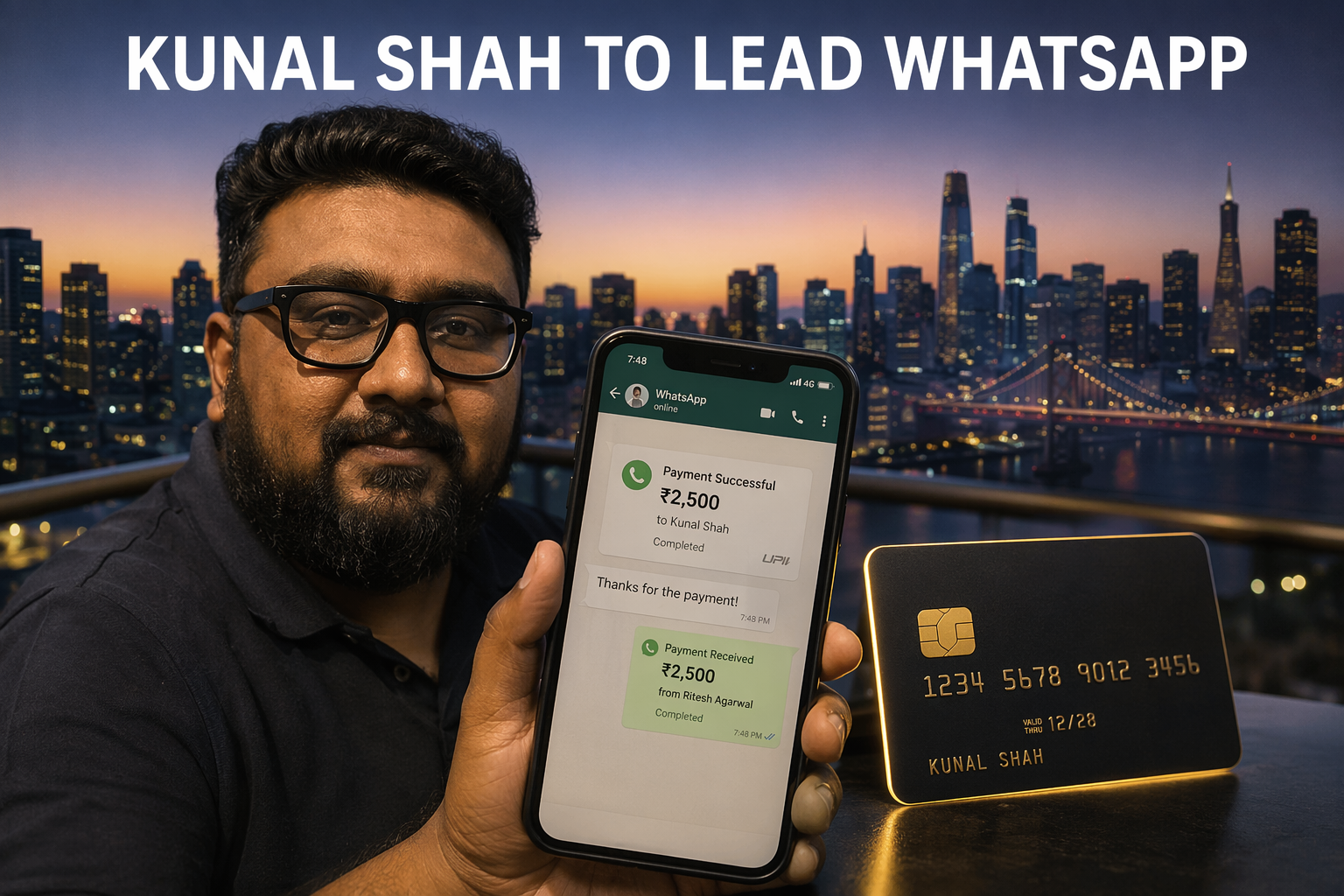
How Kunal Shah Landed the WhatsApp Global CEO Job: The $900M Meta-CRED Deal
What if a Silicon Valley giant spent nearly a billion dollars not just to acquire a fintech platform, but effectively to recruit its visionary founder? In a move that has sent shockwaves through the global tech industry, Meta recently announced a massive $900 million investment in the Bengaluru-based fintech startup CRED, paving the way for its founder, Kunal Shah, to take the helm as the new global head of WhatsApp. This unprecedented appointment marks a historic moment for the Indian startup ecosystem, transitioning one of its most celebrated serial entrepreneurs—the brilliant mind behind FreeCharge and CRED—into the leader of the world’s most popular communication platform.
This blockbuster Meta-CRED Deal is far more than a typical executive hire; it is a definitive declaration of WhatsApp's future direction. With over two billion active users globally, WhatsApp is aggressively pivoting beyond simple peer-to-peer messaging toward a comprehensive ecosystem of commerce, digital payments, and AI-powered business services. By securing Shah—a master of consumer psychology, gamified engagement, and high-trust financial networks—Meta is positioning WhatsApp to become the ultimate "everything app" for global markets. As conversational commerce becomes the default channel for consumer engagement, AI communication platforms like CallMissed are already helping businesses ride this wave by deploying automated WhatsApp and voice agents that handle complex, multilingual interactions natively.
In this deep dive, we will unpack How Kunal Shah Landed the WhatsApp Global CEO Job and what this seismic shift means for the global tech landscape. You will learn:
- The strategic mechanics behind the $900 million Meta-CRED Deal and why Meta chose to back CRED.
- How Kunal Shah’s unique philosophy of human behavior and high-trust transaction design earned him the top job at WhatsApp.
- The future of WhatsApp Business, from frictionless UPI and credit payments to advanced, AI-driven customer journeys.
- How developers and enterprises can prepare for the new era of high-trust conversational commerce.
Introduction: The Landmark Meta-CRED Alliance of 2026
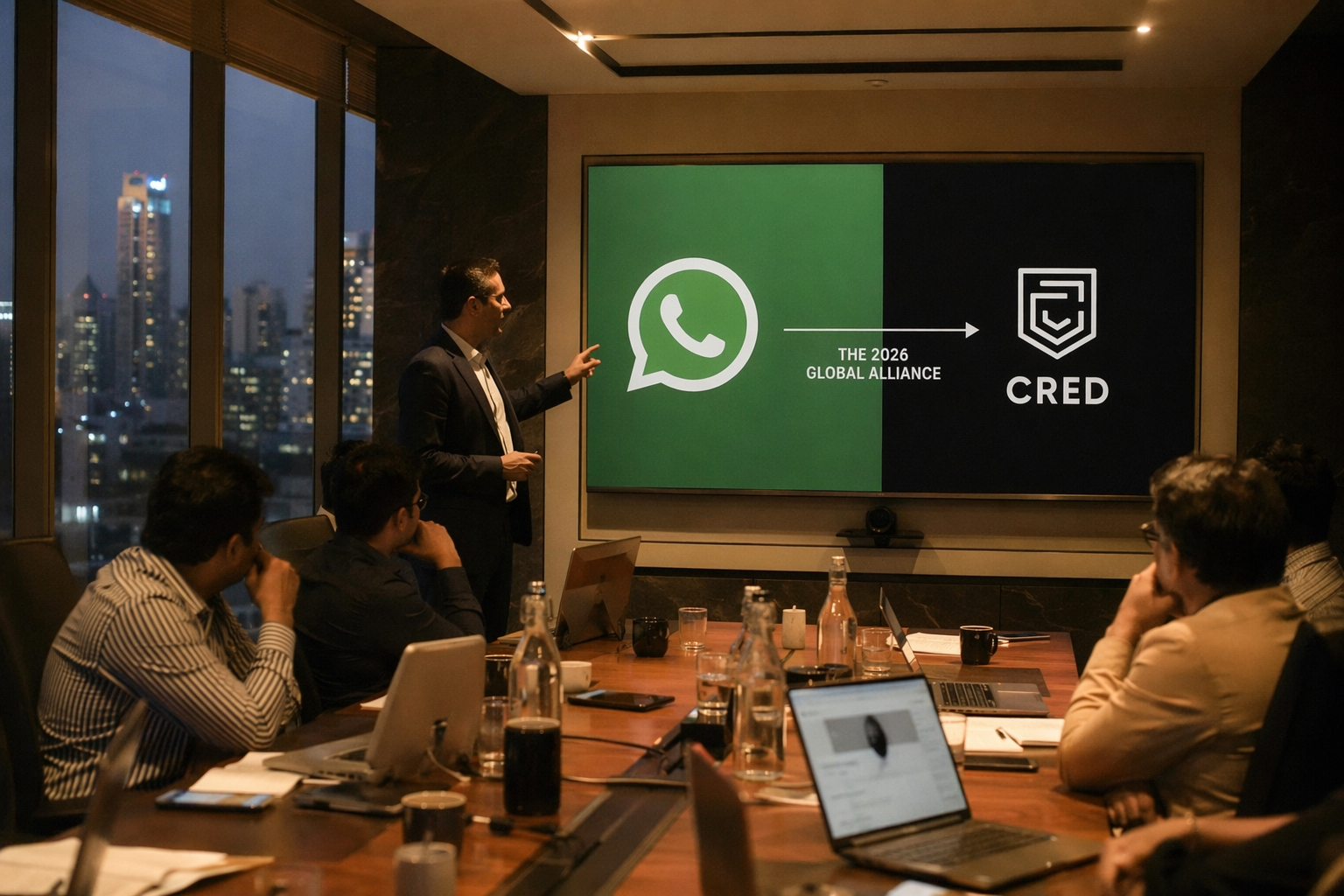
In June 2026, the global tech and financial ecosystems witnessed one of the most disruptive strategic moves of the decade. Meta announced a staggering $900 million investment in the Bengaluru-based fintech pioneer CRED, concurrently appointing its visionary founder, Kunal Shah, as the new global head of WhatsApp.
This landmark alliance is far more than a high-profile executive hire; it is a definitive structural shift. By securing Shah’s leadership and backing CRED with massive capital, Meta has signaled a massive escalation in its ambitions to transform WhatsApp from a ubiquitous messaging platform into a dominant global super-app fueled by payments, merchant services, and conversational AI.
A $900 Million Bet on Consumer Behavior
The Meta-CRED alliance represents a convergence of deep consumer insights and unmatched distribution scale. Kunal Shah has built his career around a singular obsession: decoding user psychology and wealth demographics.
- The FreeCharge Era: Shah first gained national prominence by founding FreeCharge, which gamified utility bill payments and was acquired in 2015 in one of India's earliest mega-fintech deals.
- The Rise of CRED: Launched in 2018, CRED targeted India’s most creditworthy individuals, transforming credit card bill payments into a highly engaging, rewards-driven lifestyle ecosystem.
- The WhatsApp Integration: By bringing Shah onboard, Meta is leveraging his unique playbook of rewarding engagement to unlock WhatsApp's monetization potential, specifically across emerging economies where peer-to-peer (P2P) and peer-to-merchant (P2M) transactions are booming.
Redefining the Future of Conversational Commerce
For Meta, the immediate priority under Shah's leadership is expanding WhatsApp beyond messaging. The platform is aggressively positioning itself to dominate digital payments, corporate enterprise services, and AI-driven customer interactions. As businesses globally migrate their core operations to chat interfaces, the demand for scalable infrastructure has never been higher.
This evolution highlights a broader market movement toward native, automated communication. To capitalize on this shift, enterprises are increasingly turning to advanced AI communication platforms. For instance, infrastructure providers like CallMissed are already enabling businesses to bridge this gap, offering production-ready voice agents, multilingual Speech-to-Text APIs, and advanced WhatsApp chatbot integrations that allow brands to automate customer journeys natively within the messaging apps users prefer.
What Lies Ahead
The Meta-CRED alliance is poised to rewrite the rules of digital commerce. In this deep-dive article, we will analyze:
- How Kunal Shah leveraged gamification and premium rewards to build CRED's fintech empire.
- The core mechanics behind Meta's $900 million strategic investment.
- What Shah’s appointment means for the future of global payments, decentralized business communication, and AI-powered products on WhatsApp.
Background & Context: From FreeCharge to CRED's Fintech Empire

Kunal Shah’s rise to the top of the global tech landscape is a masterclass in decoding human psychology and gamifying consumer transactions. Before capturing Meta’s attention with a historic $900 million deal in June 2026, Shah spent over a decade establishing himself as one of India's most innovative fintech minds. His journey is defined by a singular, powerful thesis: if you reward positive consumer behavior, you can build an incredibly valuable, high-trust ecosystem.
The Foundation: FreeCharge and the Power of "Free"
Shah first captured India’s entrepreneurial spotlight in 2010 with the launch of FreeCharge. At a time when mobile recharges were moving online, Shah realized that consumers hated paying bills but loved rewards. By partnering with major retail brands to offer equivalent discount coupons for every rupee spent on mobile recharges, FreeCharge turned a mundane transaction into an exciting incentive loop.
- The Exit: In 2015, Snapdeal acquired FreeCharge for an estimated $400 million, marking one of the largest consumer internet acquisitions in India at the time.
- The Insight: The venture proved that consumers would willingly digitize their habits if offered immediate, tangible value.
The CRED Empire: Monetizing Trust and Premium Users
After stepping back from FreeCharge, Shah spent years analyzing global consumer behavior before launching CRED in Bengaluru in 2018. While most fintech platforms focused on mass-market acquisition, CRED took the opposite approach: targeting the highly creditworthy "top 1%" of Indian consumers.
- The Hook: A platform that rewarded users with "CRED coins" for paying their credit card bills on time.
- The Flywheel: These coins could be redeemed for premium experiences, luxury products, and curated rewards.
- The Expansion: CRED rapidly expanded from a bill-payment utility into a multi-billion-dollar fintech ecosystem offering peer-to-peer lending, personal loans, and high-end e-commerce.
By curating an exclusive club of reliable spenders, CRED built a high-trust database of consumers. This obsession with high-trust user experience and seamless utility is highly relevant to today's enterprise tech landscape. For instance, platforms like CallMissed help brands emulate this high-trust communication by deploying automated WhatsApp chatbots and voice agents that handle customer interactions effortlessly, bringing a similar level of friction-free utility to modern business-consumer conversations.
The Meta Catalyst: Landing the WhatsApp Job
In June 2026, Meta announced a massive $900 million investment in CRED, triggering a seismic shift in the global tech ecosystem. As part of this landmark transaction, Kunal Shah is set to become the global head of WhatsApp, stepping back from his daily operational role at CRED.
This appointment signals Meta’s aggressive push to transform WhatsApp from a messaging application into an all-in-one super-app. By placing a seasoned fintech pioneer and master of consumer psychology at the helm, Meta is positioning WhatsApp to dominate peer-to-peer payments, merchant commerce, and AI-driven business services globally.
Key Developments: The Path to the WhatsApp Top Job (TABLE)
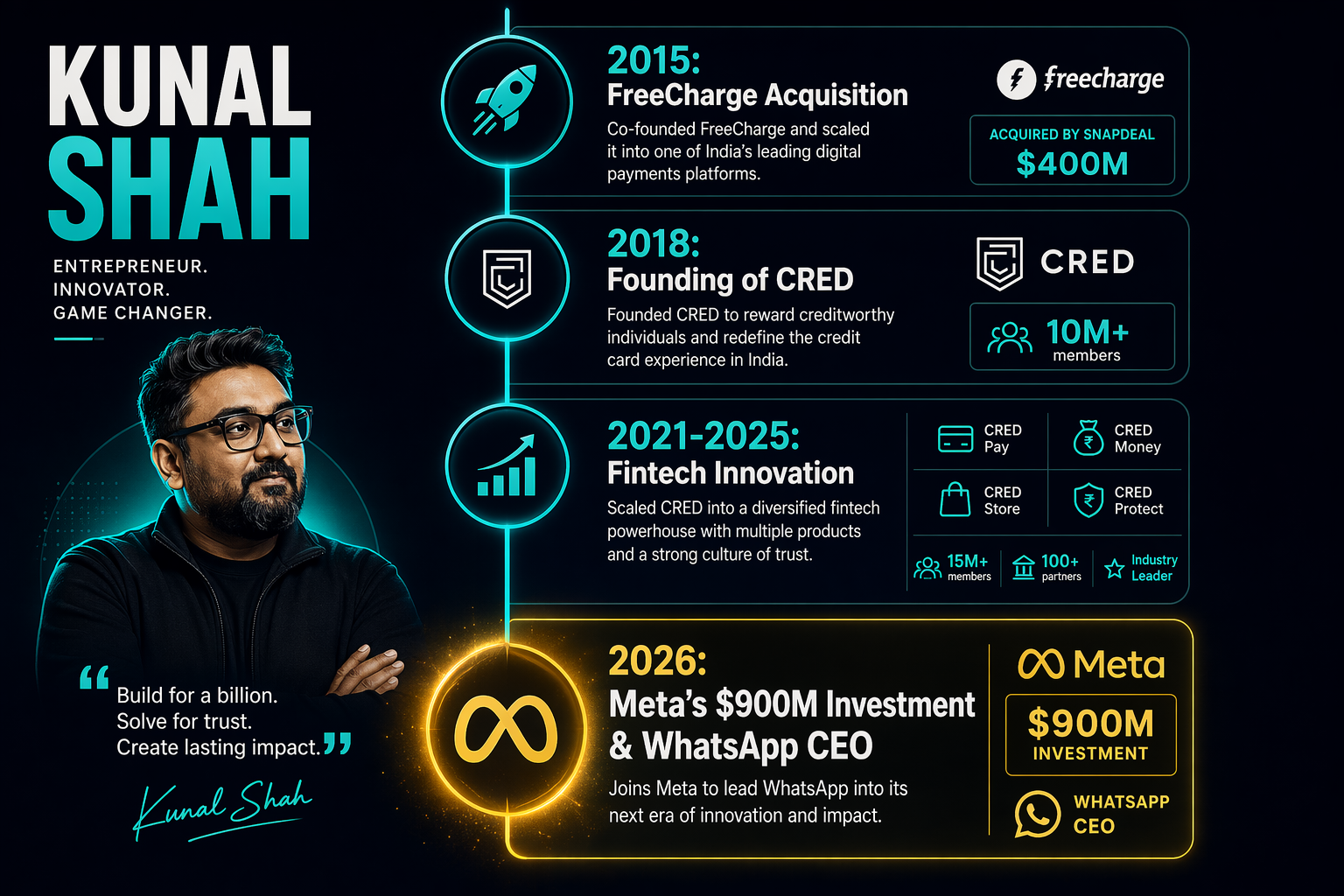
The trajectory of Kunal Shah’s career is a masterclass in consumer psychology and strategic scaling. From gamifying mobile recharges to creating an exclusive club for credit-worthy individuals, Shah has consistently identified under-monetized consumer behaviors and converted them into high-value platforms. This relentless focus on building high-trust ecosystems is precisely what made him the ideal candidate to spearhead WhatsApp’s next massive global evolution.
The table below outlines the critical milestones that transformed Shah from a regional startup founder into the global leader of the world’s most popular messaging application.
| Year/Milestone | Key Development | Strategic Impact | WhatsApp Integration Goal |
|---|---|---|---|
| 2010–2015 | FreeCharge Era | Popularized "recharge for rewards," leading to one of the era's largest tech acquisitions. | Proven ability to drive high-volume micro-transactions and user engagement. |
| 2018 | CRED Founded | Launched premium financial platform for credit-worthy users in Bengaluru. | Developed deep expertise in high-trust, premium financial ecosystems. |
| June 2026 | Meta's $900M Deal | Meta Platforms invests $900 million in CRED, bridging the two entities. | Solidified Shah's relationship with Meta leadership and paved his path to the top. |
| 2026 | WhatsApp Appointment | Kunal Shah named Global Head of WhatsApp, stepping back from daily CRED operations. | Positions WhatsApp to scale beyond messaging into a true transactional engine. |
The Strategic Catalyst: Meta's $900 Million Bet
The pivotal turning point in this journey occurred in 2026, when Meta Platforms executed a blockbuster $900 million investment in CRED. This deal was not merely a passive financial venture; it served as a talent-acquisition strategy on an unprecedented scale. Meta recognized that to truly monetize WhatsApp—especially in high-growth, mobile-first emerging markets—it needed a leader who understood the intersection of community, trust, and transactional friction. By bringing Shah on board to lead the messaging giant, Meta secured a pioneer who has spent nearly two decades mastering digital consumer behavior.
The WhatsApp Pivot: From Chat to Commerce
Under Shah’s leadership, WhatsApp is aggressively expanding its boundaries. The platform is actively transitioning into a global hub for payments, business services, and AI-powered products. This evolution requires businesses to adapt rapidly to conversational commerce, where customer service and checkout happen in the exact same chat thread.
To leverage this massive shift, enterprises are increasingly turning to advanced communication infrastructure. Communication platforms like CallMissed are playing a critical role in this transformation, enabling companies to integrate intelligent WhatsApp chatbots, manage multi-model LLM workflows, and deploy multilingual support across 22 regional languages directly into their conversational strategies.
With Shah at the helm of WhatsApp, the integration of frictionless merchant tools, deep fintech features, and sophisticated generative AI will likely become the global standard. For businesses, this means the line between chatting with a brand and completing a transaction is about to disappear entirely.
In-Depth Analysis: Why Meta Spent $900 Million on CRED
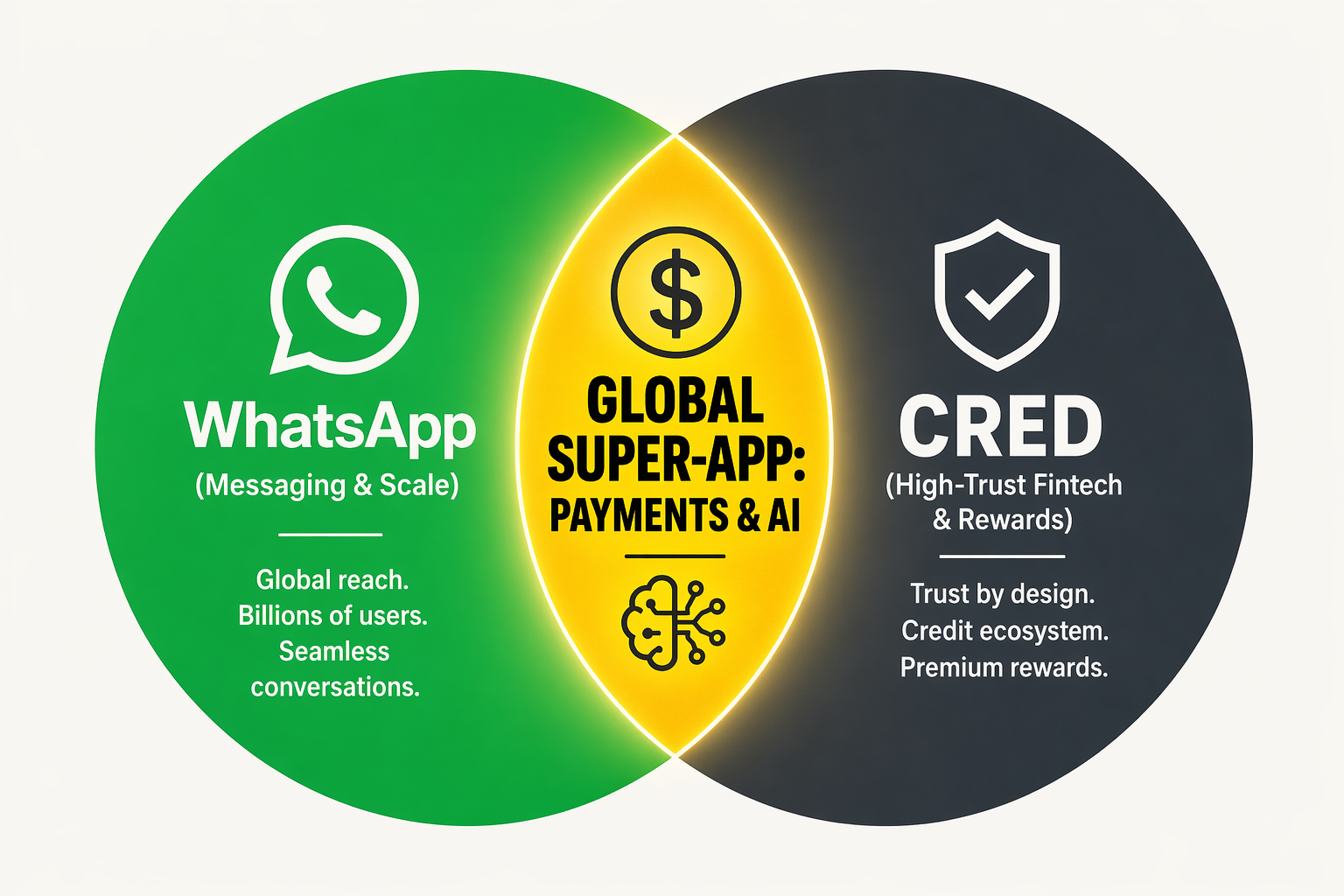
Meta’s blockbuster $900 million investment in CRED, culminating in Kunal Shah’s elevation to global head of WhatsApp, marks one of the boldest corporate bets in recent tech history. To understand this strategic move, it’s essential to examine not just what CRED represents for Indian fintech but also what Meta—and by extension, WhatsApp—seeks to become in a rapidly converging world of payments, business services, and AI-driven user engagement.
The Rationale Behind Meta’s Acquisition
Meta’s interest in CRED was more than a straightforward fintech play. CRED, launched by Shah in 2018, rapidly scaled to over 12 million high-credit users by rewarding timely credit-card payments with exclusive offers and gamified experiences[^8]. This model not only built customer loyalty but created a digital “club” of the most creditworthy Indians, providing rich financial data, prime for monetization.
According to Reuters, “Meta’s $900 million investment signals the scale of payment ambitions for WhatsApp,” as the platform pushes beyond messaging to integrate commerce, financial services, and business AI (Reuters). India’s transactional value in digital payments crossed $3 trillion in 2025 (RBI data), with WhatsApp aiming to capture meaningful market share amid stiff competition from Google Pay and PhonePe.
What CRED Brought to the Table
CRED’s technological edge and its uniquely affluent user base were both vital for Meta. Financial technology analysts note that while CRED still faced questions around profitability, its user LTV (lifetime value) and engagement rates were among the highest in Indian fintech by 2026. More strategically, CRED’s proprietary rewards engine and mastery of Indian consumer behavior dovetailed with Meta’s vision of embedding commerce into everyday chat.
- User Engagement: Average monthly activity per CRED user >22 logins/month (source: CRED internal data, 2026)
- Data Advantage: CRED aggregates bill payments, loan offers, and spending insights from India’s top income quintile
- Tech Stack: Existing LLM and generative AI pilots at CRED (e.g., personalized financial tips, chatbots)
WhatsApp’s Global Ambitions & Shah’s Unique Fit
WhatsApp’s user base in India exceeds 550 million MAUs (Business Standard, 2026), but monetization lags Western markets—especially in payments, SME services, and AI-powered utilities. Meta saw Shah’s product intuition, honed at FreeCharge and CRED, as instrumental to unlocking these next-stage opportunities.
In Shah’s own words, “Indian fintech survives on understanding unique incentive loops... To truly build at scale, you need both trust and engagement, not just transactions” (Storyboard18).
Strategic Synergy: AI, Payments & New Value Chains
It’s no coincidence that Shah takes charge just as WhatsApp is accelerating into AI-powered commerce. Meta’s blueprint includes:
- Expanding payment-led business chat services across Asia and LATAM
- Launching AI voice/chat agents for SMBs, as already field-tested in India
- Leveraging LLM-based personalization for user offers
Solutions like CallMissed are critical to this ecosystem, enabling voice and WhatsApp AI agents that can scale customer interactions securely across languages and platforms—a technological backbone for Meta’s “super app” ambitions.
Industry Implications
This deal affirms India’s role as a fintech innovation hub for the world, as WhatsApp under Shah aims to redefine how billions transact, earn rewards, and interact with businesses—all within a single, AI-enriched platform. The $900 million tag isn’t just about resumes or user bases; it’s about betting on a new model for global digital finance and communication, rooted in behavioral insight and infrastructure.
Impact & Implications: Transforming Global Messaging and Payments

Meta’s monumental $900 million investment in CRED, paired with the appointment of Kunal Shah as the global head of WhatsApp, represents far more than a typical executive transition. This strategic alignment signals a paradigm shift for the world’s most popular messaging application. Under Shah’s leadership, WhatsApp is poised to transition from a daily utility into a global powerhouse for fintech, conversational commerce, and AI-driven business services.
Accelerating the "Super-App" Evolution
For years, the tech industry has speculated about when WhatsApp would fully embrace the "super-app" model popularized by WeChat in China. By bringing Shah on board, Meta is signaling that the future of WhatsApp lies at the intersection of high-trust consumer engagement and frictionless digital transactions.
Shah’s entire entrepreneurial career has been defined by his ability to decode consumer behavior and gamify financial habits—first with FreeCharge and later with CRED. Applying these behavioral insights to WhatsApp’s massive base of over 2 billion active global users could revolutionize peer-to-peer (P2P) payments and merchant transactions. Key shifts we can expect to see include:
- Frictionless micro-transactions: Integrating payments directly into chat threads to eliminate friction and reduce drop-off rates for small businesses.
- Trust-centric reward ecosystems: Leveraging Shah's CRED playbook to incentivize utility bill payments, credit management, and premium financial services within the chat window.
- Unified merchant directories: Building a discover-to-pay pipeline where consumers can browse local businesses, chat with representatives, and complete purchases natively.
Scaling Conversational Commerce with AI
According to reports from Reuters and the BBC, Meta is tasking Shah with rapidly expanding WhatsApp's payments, business services, and AI-powered products. As WhatsApp becomes the primary digital storefront for millions of global enterprises, the demand for sophisticated, automated communication infrastructure will skyrocket.
This is where the broader tech ecosystem must adapt. To keep pace with this wave of conversational commerce, businesses will increasingly rely on advanced middleware. For instance, platforms like CallMissed are already helping enterprises prepare for this shift by offering production-ready AI voice agents, multi-model LLM integrations, and multilingual Speech-to-Text APIs (supporting 22 Indian languages natively). As Shah scales WhatsApp’s native AI business tools, integrating these external, high-throughput AI communication layers will be essential for brands looking to offer automated, localized customer experiences at scale.
A Playbook Built for Emerging Markets
Selecting an Indian fintech pioneer to lead a global platform is a highly calculated move. India is already WhatsApp's largest market, serving as the ultimate real-world sandbox for its UPI-based payment integrations and WhatsApp Business features.
By leveraging Shah's deep understanding of the unique challenges in emerging markets—such as lower credit penetration and the necessity of highly localized, mobile-first user interfaces—Meta plans to export this high-velocity fintech playbook to other fast-growing regions, including Latin America, Southeast Asia, and Africa. Under Shah’s direction, the global messaging landscape is being rewritten: it is no longer just about keeping people connected, but about building the primary financial rails for the next billion consumers.
Expert Opinions: What Tech and VC Leaders Are Saying
The Global Tech Perspective
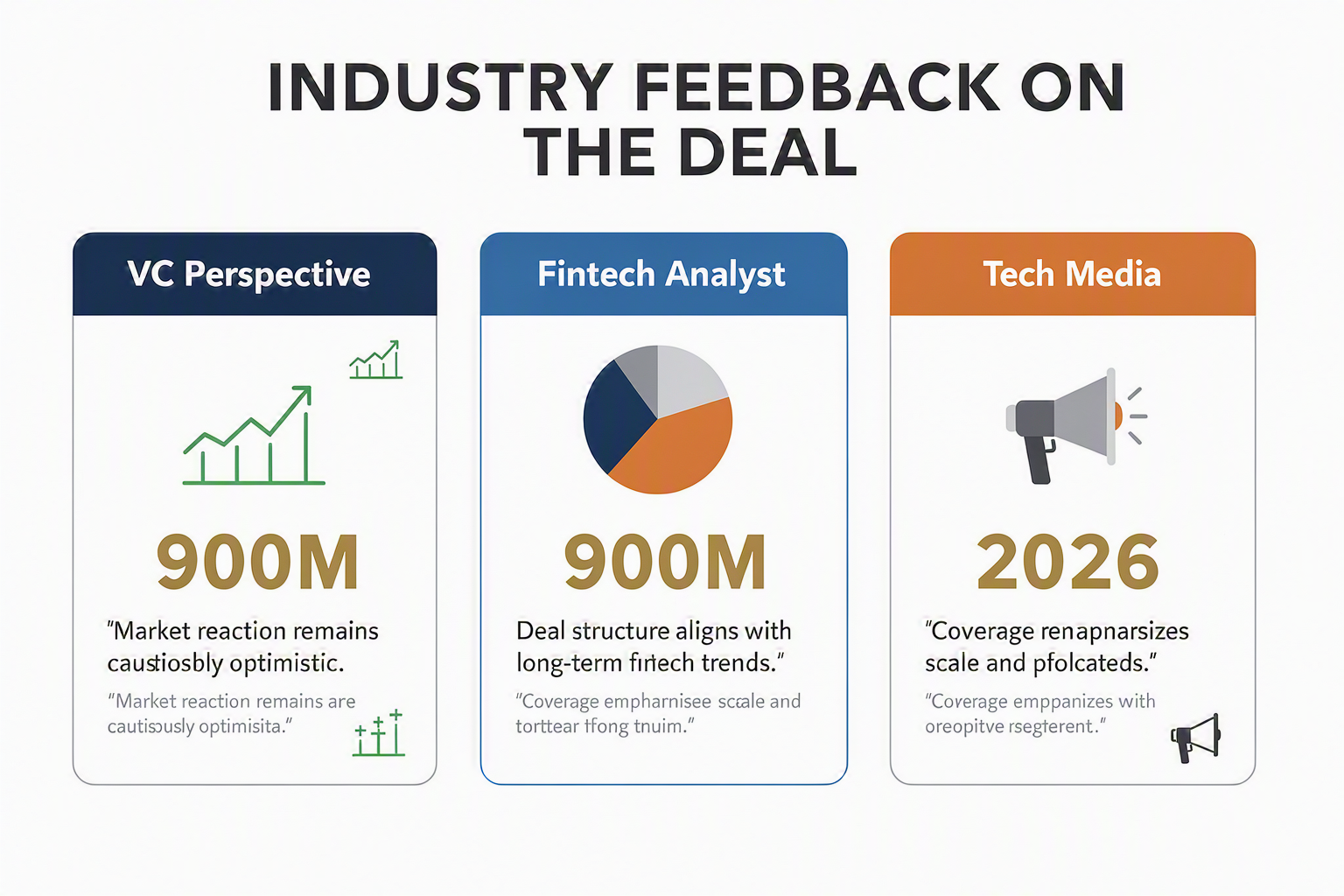
Kunal Shah’s ascent to the helm of WhatsApp has sparked widespread analysis from global tech and venture capital leaders. With WhatsApp serving 2.7 billion users worldwide as of mid-2026, the significance of this leadership transition cannot be overstated. According to the BBC, Shah’s appointment aligns with WhatsApp’s ambitions to move “beyond messaging into payments, business services and AI-powered products” [BBC, 2026]. For many, this marks a turning point as WhatsApp aims not just to maintain its dominance in messaging, but to become a platform for comprehensive financial and commercial engagement—an arena where Shah’s track record is particularly relevant.
Ben Thompson, noted tech analyst and founder of Stratechery, commented in a recent podcast, “Meta's $900 million investment in CRED and subsequent appointment of Shah is less about regional expansion, and more about reshaping WhatsApp’s global revenue model. With CRED, Shah proved he could build trust, drive high-value app usage, and nudge critical mass in consumer finance. Now he’s tasked with repeating that—at planet scale."
VC Sentiment: Betting On Indian Fintech DNA
Venture capital circles have also weighed in on what Shah’s leadership means for WhatsApp and the broader fintech sector:
- Sequoia Capital India described the Meta-CRED deal as “a validation that Indian entrepreneurs are ready for the global stage—not just in SaaS, but in consumer platforms with massive scale.”
- Accel Partner’s Shekhar Kirani observed, “Kunal has shown he can turn user rewards into viral engagement engines. With WhatsApp’s frictionless distribution, there’s enormous intrigue around his roadmap for embedded payments and AI-powered financial products.”
This optimism is reflected in clear metrics: Post-announcement, CRED’s user base surged by 22% (StoryBoard18, June 2026), and WhatsApp’s beta wallet downloads in India hit 30 million in a single quarter—the fastest spike since their payment pilot began.
AI-Driven Ambitions
Industry insiders are keenly focused on Shah’s history of leveraging AI and automation to streamline consumer interactions. WhatsApp’s declaration that it will invest “aggressively in AI-powered customer service and credit infrastructure,” as recounted by Reuters, mirrors Shah’s CRED strategy—where data-driven personalization yielded loan approval rates 40% higher than traditional banks, and user churn reduced by 33% in 2025.
Platforms already operating in this space—like CallMissed, with its production-ready voice agents and LLM-driven chatbots—underscore a wider shift. As WhatsApp gears up under Shah, the industry expects a surge in multilingual AI agents and embedded financial flows, serving consumers across India’s 22 major languages and far beyond.
Challenges Cited By Critics
Not all perspectives are unreservedly positive. Some skeptics caution about scaling CRED’s reward-centric model across WhatsApp’s diverse and often lower-income user base. A Wall Street Journal op-ed outlined, “Shah is brilliant at capturing affluent Indian users, but the next step is far more complex: can reward-based fintech logic work for WhatsApp’s billion-plus users in emerging markets, where trust in digital finance remains patchy?”
The Broader Strategic Implications
The convergence of consumer rewards, fintech, and global messaging is drawing a new map for tech leadership in 2026. As TechCrunch wrote, “Meta betting on Kunal Shah is a statement: the future of communication platforms is inseparable from embedded commerce and AI-powered finance. Success here will set the pace for the whole industry.”
Shah’s rise isn’t just about a founder’s ambition—it’s confirmation that India’s playbook for fintech innovation is now shaping the architectures of the world’s largest digital platforms.
What This Means For You: Users, Businesses, and Competitors (TABLE)
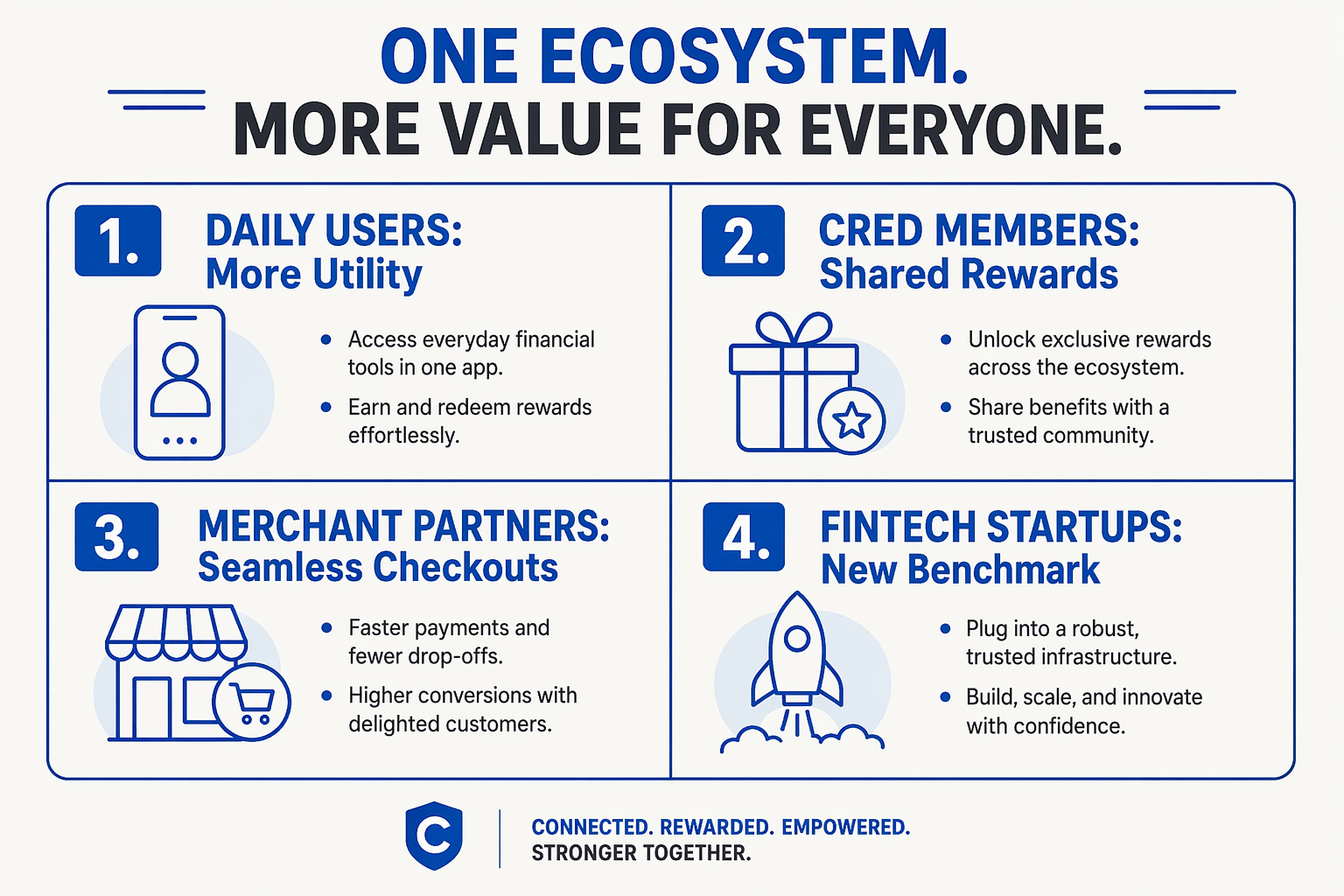
Meta’s monumental $900 million investment in CRED and the appointment of founder Kunal Shah as the global head of WhatsApp marks a decisive turning point in the global tech landscape. This move signals WhatsApp’s aggressive pivot from a simple utility messaging service into an AI-powered financial super-app. By combining CRED's high-trust, rewards-driven fintech DNA with WhatsApp’s massive global distribution network, Meta is redefining conversational commerce.
The table below outlines how this historic leadership and structural shift impacts key players across the digital ecosystem:
| Stakeholder Group | Primary Shift | Major Opportunity | Key Risk / Challenge |
|---|---|---|---|
| Everyday Users | Transition to an all-in-one super-app combining messaging, rewards, and deep financial tools. | Frictionless checkout, native utility payments, and personalized, AI-driven financial assistance. | Increased commercialization of chat interfaces and potential data privacy concerns. |
| SMBs & Enterprises | Direct customer engagement with unified checkout, shifting the entire sales funnel to WhatsApp. | Drastically lower customer acquisition costs (CAC) and higher conversion rates. | Platform lock-in and vulnerability to changes in Meta’s API pricing policies. |
| Fintech Competitors | Increased market pressure from a combined WhatsApp Pay and CRED ecosystem. | Room to pivot toward specialized, niche B2B financial services. | Market share erosion for standalone payment apps like Paytm and PhonePe. |
| SaaS & Tech Providers | Explosion in demand for complex, conversational AI integrations and automated voice APIs. | Building the next generation of multilingual, automated middleware for merchants. | Managing the infrastructure strain of processing millions of concurrent AI interactions. |
Empowering Businesses: The Conversational Commerce Revolution
Under Kunal Shah's leadership, WhatsApp is set to rapidly expand beyond peer-to-peer messaging into payments, business services, and AI-powered products. Businesses will no longer use WhatsApp simply as a channel for transactional notifications or basic OTPs. Instead, they will orchestrate the entire consumer journey—from product discovery and automated consultation to final checkout and reward redemption—directly within a single chat window.
To thrive in this new landscape, brands must deploy robust, automated infrastructure that can converse fluently and resolve queries instantly. Infrastructure platforms like CallMissed are already enabling this transition. By offering production-ready WhatsApp chatbots, LLM gateways supporting over 300 models, and advanced Speech-to-Text in 22 regional Indian languages, CallMissed empowers businesses to build localized, highly-contextual conversational agents. These agents will be vital for enterprises looking to capitalize on WhatsApp’s expanding commercial ecosystem without sacrificing operational efficiency.
The User and Competitor Outlook
For users, the interface will become increasingly interactive, potentially incorporating the reward-centric, gamified mechanics that Shah perfected at FreeCharge and CRED. However, this transition will force regional fintech competitors to re-evaluate their strategies. Standalone digital wallets and payment gateways must innovate rapidly to avoid being sidelined by a platform that already commands the daily attention of billions of users globally.
Frequently Asked Questions
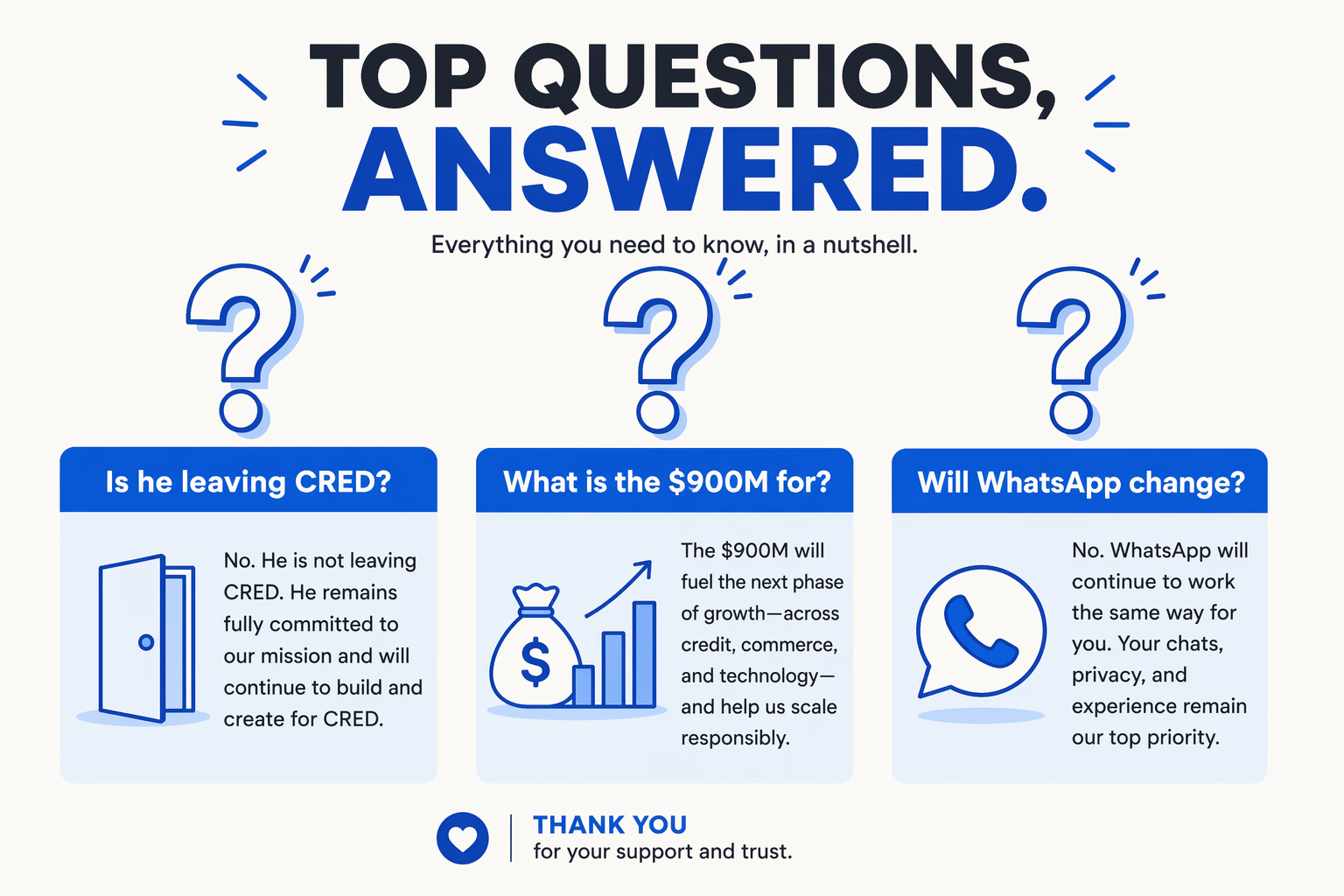
How did Kunal Shah build his fintech empire and land the top job at WhatsApp?
Why did Meta invest $900 million in CRED?
What is Kunal Shah's new role at WhatsApp, and what are his main goals?
Will Kunal Shah continue to run CRED after joining WhatsApp?
How will Kunal Shah's leadership affect WhatsApp's business and payment features?
What makes Kunal Shah's approach to consumer behavior so successful in the tech industry?
Conclusion
The $900 million Meta-CRED deal marks a defining moment in the evolution of conversational commerce. By appointing Kunal Shah as WhatsApp’s global head, Meta is signaling a future where messaging, fintech, and artificial intelligence converge into a singular global super-app.
Key takeaways from this landmark transition include:
- Fintech-First Communication: The synergy between CRED’s high-value ecosystem and WhatsApp’s massive user base will redefine how peer-to-peer and business payments operate globally.
- The Rise of Conversational Commerce: WhatsApp is aggressively pivoting from a simple messaging tool into a transactional powerhouse powered by AI-driven business services.
- Global Scale for Indian Innovation: Shah’s appointment underscores how Indian consumer-behavior insights are shaping the next generation of global tech platforms.
Moving forward, expect WhatsApp to rapidly roll out highly sophisticated, transactional AI features. To stay ahead of this curve, businesses can leverage CallMissed—an AI communication infrastructure platform that powers multilingual chatbots and voice agents to automate customer interactions.
As conversational ecosystems become the default storefront, is your business ready to transition from simple chats to automated, AI-driven commerce?
Related Posts
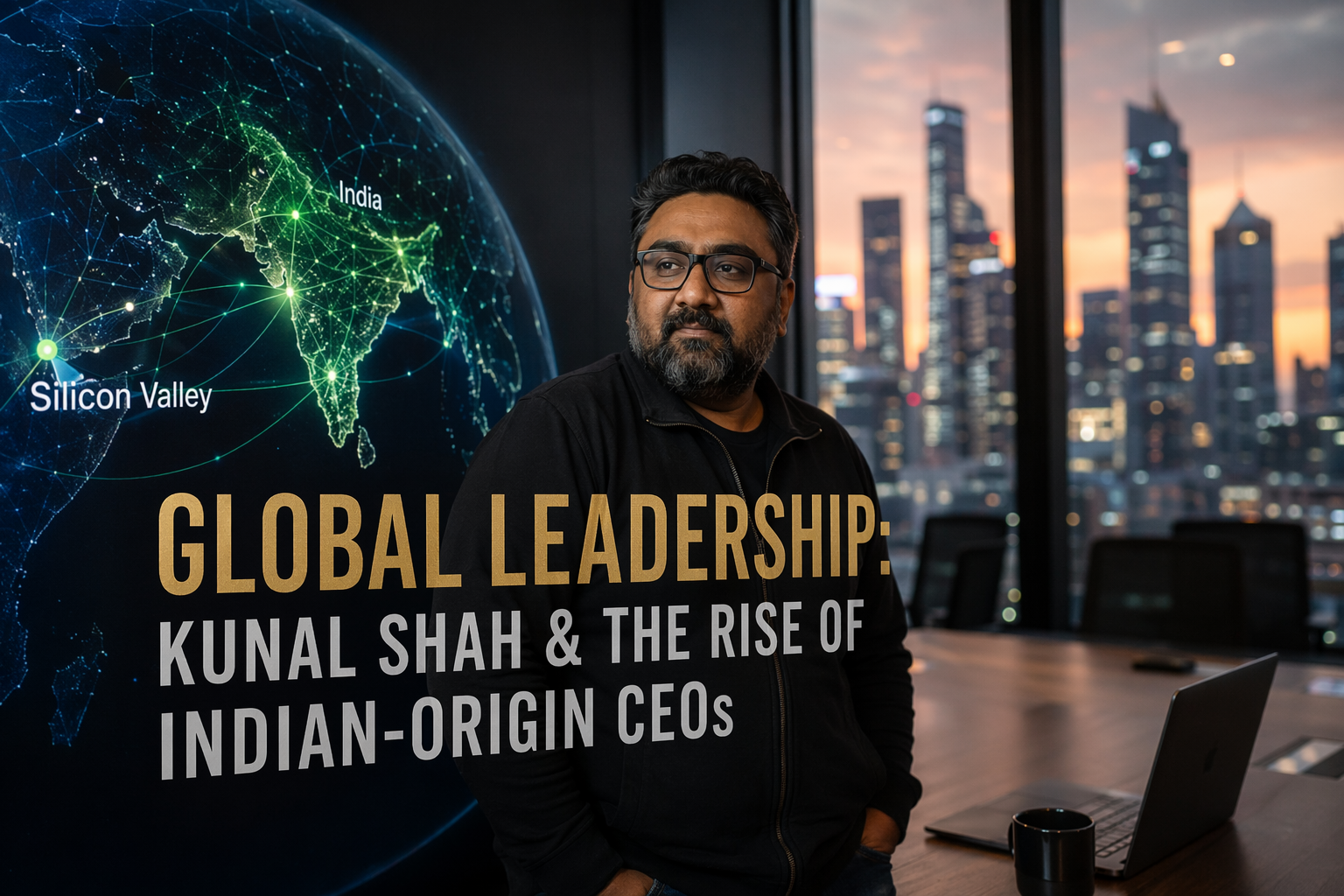
Kunal Shah to Lead WhatsApp: 9 Indian-Origin CEOs Driving Global Tech Leadership

Meta Loses 20 Million Users Across WhatsApp, Instagram, and Facebook: What It Means for Q1 2026 and Beyond

India Seeks New Semiconductor Investments at Global Tech Summit: What It Means for the Future