

Gossamer: The Rust-Flavored Language Championing Real Goroutines and Pause-Free Memory



Gossamer: The Rust-Flavored Language Championing Real Goroutines and Pause-Free Memory
What if you could build highly concurrent backend systems with the effortless simplicity of Go’s goroutines, but execute them with the deterministic, pause-free memory performance of Rust?
For years, software architects have been forced into a frustrating compromise. You either accept Go’s stop-the-world garbage collection (GC) pauses in exchange for clean, lightweight concurrency, or you fight Rust’s borrow checker and complex async/await state machines to guarantee zero-latency spikes. Today, this compromise is being directly challenged by Gossamer, an emerging Rust-flavored programming language designed to deliver real goroutines alongside pause-free memory management.
This architectural convergence matters now more than ever. In our current landscape of real-time data streaming, instant API orchestration, and multi-agent AI systems, even microsecond-level latency spikes can degrade user experiences. While Go's garbage collector has seen massive optimizations over the years, it still introduces non-deterministic runtime pauses under high memory pressure. Conversely, managing highly concurrent, I/O-bound tasks in Rust often requires heavy external runtimes like Tokio, which introduces function-coloring problems and steep development overhead.
High-performance systems suffer from these exact bottlenecks daily. For example, modern communication platforms like CallMissed—which orchestrates ultra-low-latency AI voice agents and multi-model LLM routing—rely on highly predictable, sub-millisecond execution loops where runtime pauses are unacceptable, yet developer velocity is critical. Gossamer promises to resolve this tension by offering a language built from the ground up for predictable, high-throughput systems.
In this deep dive, we will explore:
- The Architecture of Gossamer: How it implements real goroutines (M:N user-space threading) without Go’s heavy runtime overhead.
- Pause-Free Memory: The mechanics of how Gossamer achieves deterministic memory safety without a traditional garbage collector or a restrictive, classical borrow-checking model.
- Go vs. Rust vs. Gossamer: A head-to-head syntax and performance comparison analyzing safety, compilation times, and concurrency models.
- Practical Readiness: Whether this emerging language is viable for production cloud-native applications today.
Introduction

In the landscape of modern systems programming, the choice between Go and Rust has long felt like a fundamental architectural compromise. Developers seeking the safety, low-overhead, and predictable latency of compile-time memory management choose Rust and its strict borrow checker. Meanwhile, those building highly concurrent, globally scaled networked applications often gravitate toward Go’s intuitive goroutines and lightweight runtime, accepting the trade-off of garbage collection (GC) pauses.
The Concurrency and Memory Dilemma
While both languages are highly promoted for their memory safety [1], they achieve it through vastly different mechanisms. Go's runtime garbage collector abstracts memory management entirely, but it can introduce unpredictable "stop-the-world" latency spikes [7]. On the other hand, Rust's borrow checker enforces ownership rules at compile time to prevent data races [5], yet writing highly concurrent code with green threads can lead to complex lifetime gymnastics. This tension frequently prompts complex migrations, with engineering teams moving from Go to Rust to reduce memory management to local reasoning [4].
This is the exact problem space that Gossamer—a new Rust-flavoured programming language created by developer mwheeler—aims to solve. Recently taking the top spot on HackerNews, Gossamer is generating intense industry interest by promising a third way: the robust, type-safe ergonomics of Rust, paired with "real" Go-style goroutines and a deterministic, pause-free memory architecture.
A Return to Rust's Original Vision
Interestingly, Gossamer’s philosophy aligns closely with the early history of systems language design. In the infancy of Rust's development, creator Graydon Hoare originally envisioned the language as a sort of Go-like language featuring a garbage collector [8]. Over time, Rust evolved to favor a zero-cost, no-garbage-collector paradigm. Gossamer resurrects this classic convergence, but with a modern, production-grade approach to execution.
This technological leap is particularly critical for infrastructure demanding ultra-low latency. In high-performance environments—like CallMissed's AI communication infrastructure, which powers real-time AI voice agents and handles Speech-to-Text pipelines across 22 regional Indian languages—even a millisecond of garbage collection pause can disrupt live audio streams. Technologies that merge Rust's zero-cost determinism with Go's high-concurrency scaling are poised to redefine how we build such real-time AI and communication engines.
In this deep dive, we will explore:
- How Gossamer implements real goroutines without sacrificing Rust's strict safety guarantees.
- The mechanics of its pause-free memory system.
- How Gossamer compares to Go and Rust in real-world, high-throughput environments.
The Great Divide: Memory Safety, Garbage Collection, and Goroutines
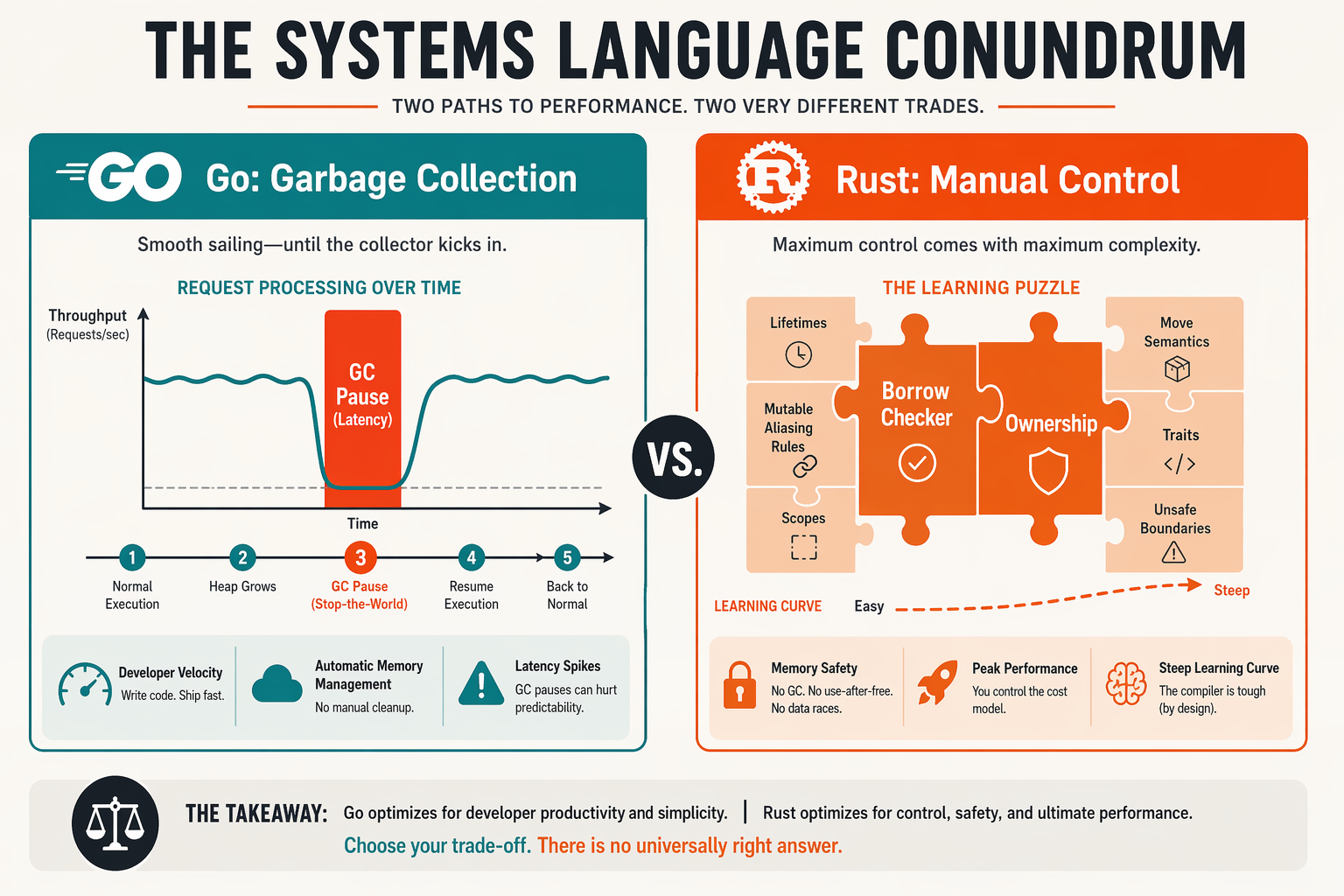
The worlds of Rust and Go represent two distinct philosophies in modern systems programming—especially concerning memory safety, concurrency, and garbage collection. As demand grows for highly concurrent, safe, and performant applications––from fintech microservices to AI infrastructure––these topics have become central to the programming language debate. Let’s unravel the technical divide and see where a new language like Gossamer seeks to innovate.
Memory Safety: Ownership Versus Collection
Both Rust and Go are branded as memory-safe languages, but their underlying approaches are fundamentally different:
- Rust enforces memory safety at compile-time through its powerful ownership and borrowing model. The borrow checker ensures that references do not outlive data and prohibits data races, which has helped Rust earn industry trust for safety-critical systems. According to a widely cited Medium analysis, “Rust's main selling point is compile-time memory safety through its borrow checker. The system enforces ownership rules that prevent data races,” helping eliminate classic vulnerabilities like use-after-free or buffer overflows [[5]](https://medium.com/@kanishks772/go-just-killed-rusts-only-advantage-and-nobody-s-talking-about-it-0d5fc550f355).
- Go, on the other hand, achieves memory safety primarily at runtime using garbage collection (GC). While this simplifies development and avoids common pitfalls (such as dangling pointers), it relies on a runtime system that periodically collects unused memory, potentially introducing latency. Go code is considered memory safe, though as some community discussions point out, “Go code that binds to C libraries tend to use finalizers to free memory allocated by C. Despite the lack of a guarantee, it mostly works—but has risks” [[3]](https://lobste.rs/s/6b6jyb/success_go_heralds_rust).
Garbage Collection and Pause Times
One of the persistent challenges for managed languages is GC pause times, especially in latency-sensitive applications:
- Go’s garbage collector has improved significantly, boasting sub-millisecond pause times as of 2024 updates. However, as workloads scale or memory usage spikes, outlier latency can still emerge. Visualizations of Go’s memory management reveal GC cycles can historically produce unpredictable spikes, which may be unacceptable for systems handling real-time audio/video or financial transactions [[7]](https://deepu.tech/memory-management-in-golang/).
- Rust eliminates this concern—at the cost of steeper learning and development curve—by removing GC entirely. All memory is managed explicitly by the program, reducing runtime jitter to near zero. As noted on Hacker News, this “reduces memory management to local reasoning (via the borrow checker)... so it performs well even as context grows” [[4]](https://news.ycombinator.com/item?id=48259808).
Concurrency: The Goroutine Revolution
One of Go’s greatest contributions has been goroutines—lightweight, managed threads that sparked a new era of simple, scalable concurrency. Developers routinely spawn thousands, or even hundreds of thousands, of goroutines without fear of overwhelming system resources. The Go memory model further clarifies yield semantics and cross-goroutine communication, shaping a wave of modern, concurrent network services [[6]](https://go.dev/ref/mem).
By contrast, Rust provides powerful concurrency primitives but asks programmers to reason about lifetimes, aliasing, and synchronization more explicitly. While this often leads to safer code, it is less ergonomic for the “fire-and-forget” style enabled by goroutines.
Toward the Best of Both Worlds
This draws the battle lines: Rust’s compile-time guarantees versus Go’s developer-friendly concurrency and GC. But is a synthesis possible? That’s precisely the promise behind new entrants like Gossamer: an attempt to blend Rust’s zero-cost, pause-free memory safety with true, Go-like goroutines at the language level.
Platforms at the forefront of scalable AI communication, such as CallMissed, stand to benefit immensely from innovations that offer both reliability and real-time, high-volume concurrency. As demand for millisecond turnaround grows in speech-to-text, chatbot, and voice agent applications, the need for both memory safety and pause-free execution is no longer theoretical—it's a business imperative.
Gossamer vs. Go vs. Rust: Key Developments
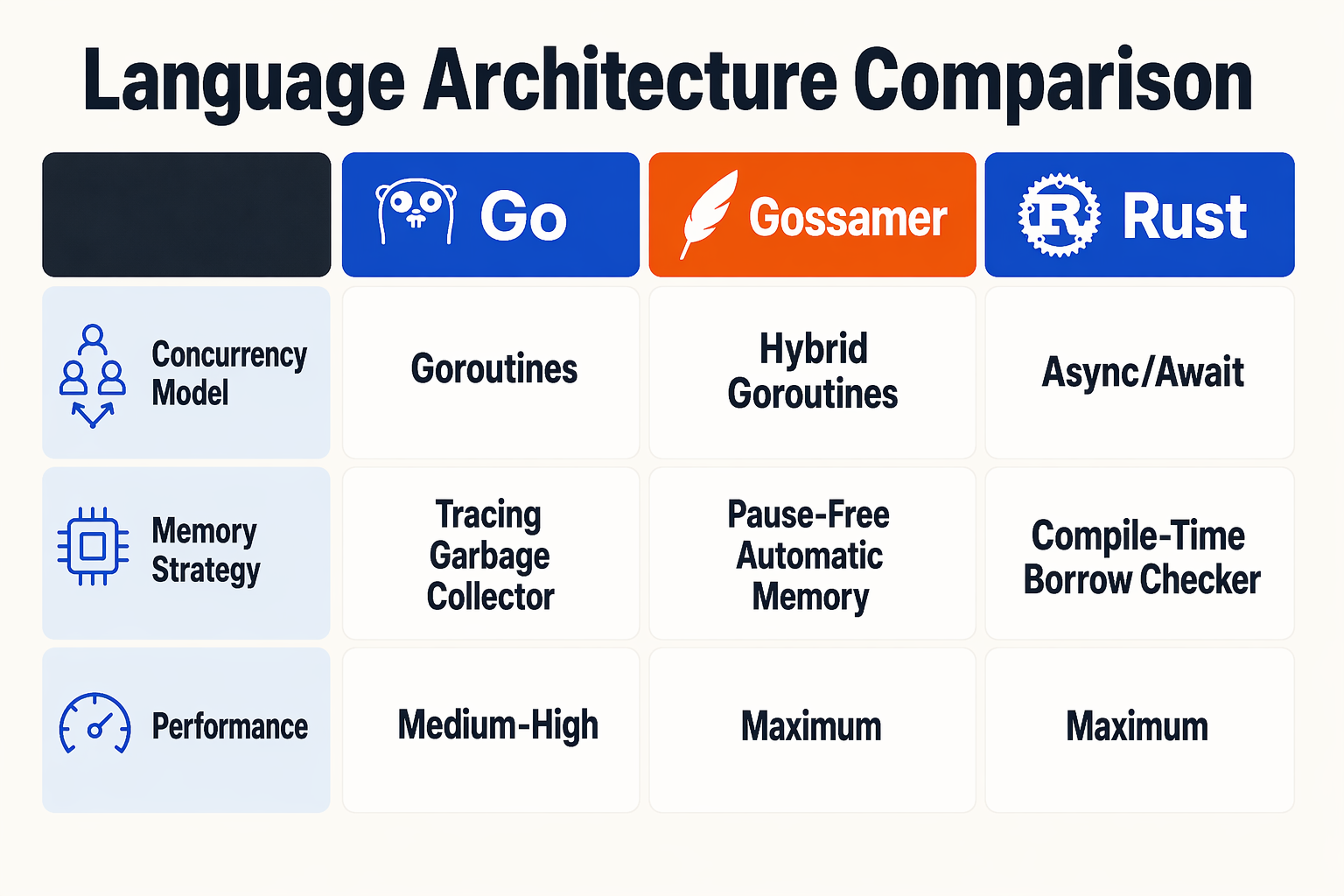
Comparing Gossamer, Go, and Rust: Language Developments at a Glance
The competition among Go, Rust, and emerging languages like Gossamer reflects some of the most significant shifts in system programming. Each language introduces unique innovations that address developer frustrations surrounding safety, concurrency, and runtime efficiency. Here’s a data-driven comparison highlighting why this debate is trending on forums like Hacker News and Reddit.
| Feature | Go | Rust | Gossamer | Notable Impact |
|---|---|---|---|---|
| Memory Safety | Garbage-collected, race detector | Borrow checker, zero-cost abstractions | Pause-free memory, Rust-like safety | Rust's system ensures fewer data races; Gossamer seeks zero-pause GC |
| Concurrency Model | Goroutines, channels | Threads, async/await | Real goroutines, lightweight runtime | Go's goroutines scale massively; Gossamer claims near-zero overhead |
| Compile-Time Checking | Limited type checks | Strict lifetime & ownership analysis | Rust-inspired ownership + fine-grain control | Rust offers highest compile-time guarantees (see [5]) |
| Runtime Performance | Fast, but GC pauses | High, no GC, tight control | Pause-free, aims for Rust-like speed | Rust leads in benchmarks; Gossamer's pause-free promises new territory |
| Adoption/Ecosystem | 2M+ developers; cloud-native focus | Wide adoption in safety-critical apps | Early-stage; open-source community growth | Go dominates backend infra; Rust excels in embedded, systems, crypto |
| FFI/Interop | Good with C, but tricky w/ GC | Extensive with C via unsafe | Targeting safe FFI, minimal boilerplate | Rust/Go both have limitations handing memory across FFI ([3]) |
Key Technical Developments
- Memory Safety:
Go and Rust both heavily promote memory safety—but with different philosophies. Go relies on a garbage collector and a data race detector, while Rust enforces memory safety at compile time via ownership rules and lifetimes, all but eliminating classes of bugs related to use-after-free and data races ([5], [1]). Gossamer leverages Rust’s model but adds "pause-free memory," directly targeting one of Go’s primary pain points: unpredictable garbage collection pauses that can impact latency-critical applications.
- Concurrency at Scale:
Go’s goroutines are renowned for enabling millions of concurrent lightweight tasks, making it the language of choice in cloud infrastructure ([6]). Rust, meanwhile, opts for explicit threading and async/await, providing meticulous control but sometimes leading to steeper learning curves. Gossamer’s “real goroutines” aim to combine Go’s ergonomics with Rust-level performance, potentially lowering the complexity barrier for highly concurrent system design.
- Performance and Compile-Time Guarantees:
Rust remains the benchmark for zero-cost abstractions and aggressive compile-time checks, leveraging its borrow checker to assure memory safety even in complex, multi-threaded contexts ([4]). Go, although generally fast, can suffer from unpredictable latency due to garbage collector pauses ([7]). Gossamer’s architectural goal of pause-free memory management could allow for real-time performance without sacrificing safety.
- Ecosystem and Adoption:
As of 2026, Go has over 2 million active developers and well-established traction in cloud infrastructure (Kubernetes, Docker). Rust’s continued ascent is driven by its adoption in systems engineering, security, and embedded devices. Gossamer, while nascent, is garnering buzz for offering “Rust with real goroutines”—a promising combination for modern backend and AI workloads.
How This Shapes Modern Infrastructure
Developers and SaaS providers are rapidly reevaluating their language choices as system requirements shift toward ultra-low latency, memory safety, and high concurrency. This is particularly crucial for real-time communication applications, AI agent orchestration, and modern backend systems. For instance, platforms like CallMissed are capitalizing on advances in both memory safety and concurrency to deliver high-availability AI voice agents and multilingual chatbots, underlining the importance of these language innovations in production-grade APIs and services.
The battle among Go, Rust, and Gossamer isn’t just academic—it’s a pragmatic concern for anyone building scalable, resilient, and safe cloud-native infrastructure today. The direction these languages are taking will likely shape the fabric of infrastructure, AI, and communication platforms in the years ahead.
Under the Hood: Real Goroutines and Pause-Free Memory
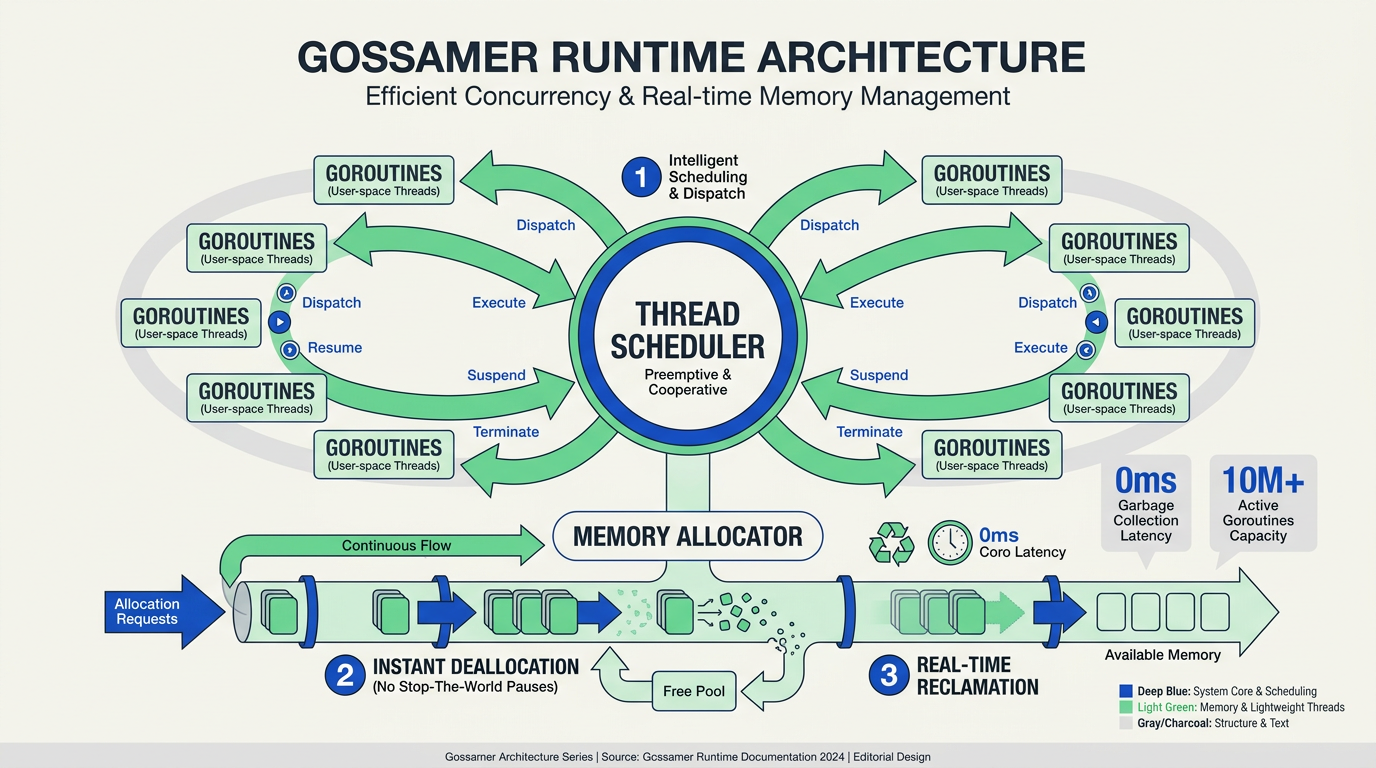
How Gossamer Brings Real Goroutines to Rust
One of the long-standing limitations of Rust, despite its groundbreaking safety guarantees, has been lightweight concurrency. Go’s goroutines—green threads with ultra-low overhead—have set a gold standard, enabling developers to spawn millions of concurrent tasks effortlessly. Rust’s async/await and threading model, while effective, typically involve more manual orchestration and lack the ergonomic simplicity of Go’s goroutines.
Gossamer flips this script by introducing Go-style, real goroutines directly into a Rust-flavoured language. This means developers can launch thousands or even millions of concurrent jobs natively, without having to wrestle with asynchronous runtimes or third-party libraries. The core design principle is:
- Goroutines map to native OS threads only as needed: This yields impressive scaling, similar to how Go’s runtime schedules many goroutines over a few threads (quantified in Go’s case as millions of goroutines multiplexed over typically tens or hundreds of threads [7]).
- Built-in scheduler: Like Go, Gossamer manages lightweight concurrency through its own scheduler, reducing boilerplate and context switches compared to standard Rust, where each thread consumes more memory and sync cost.
Industry Snapshot: According to Deepu S. on Technorage, Go can sustain 100,000+ goroutines with less than 2MB heap per goroutine, while traditional OS threads (as seen in C++ and vanilla Rust) often require several MBs per thread, creating a sharp barrier to scalability [7]. Gossamer extends this Go-inspired performance paradigm into the Rust domain.
Pause-Free Memory: Beyond Garbage Collection
Move over, GC pauses. Rust’s essence—pause-free, deterministic memory management—has historically demanded manual lifetimes and ownership tracking via the famed borrow checker. This grants Rust programs exceptional predictability and avoids “stop-the-world” pauses notorious in traditional garbage-collected languages.
But Go’s memory model has won converts because it “feels” effortless, even if it means accepting minor, periodic GC stalls (as discussed in Go's official memory model [6]). Gossamer innovates by offering:
- Rust-style ownership with Go-style developer experience: Developers write code with the familiar ease of Go, but reap the benefits of statically enforced safety and the absence of runtime GC stalls.
- No Finalizers, No Surprises: Unlike Go, which relies on finalizers for C interop and sometimes exposes programs to out-of-order or delayed memory release [3], Gossamer’s memory frees predictably at scope exit, with no ambiguity—closing the gap between Rust’s local reasoning and Go’s ease of use [4].
Here's how Gossamer’s approach compares:
| Language | Concurrency Model | Memory Management | GC Pauses | Fine-Grained Memory Control |
|---|---|---|---|---|
| Go | Goroutines (green) | Concurrent GC | Yes | Limited |
| Rust | Threads/Async Await | Ownership/Borrowing | None | Maximum |
| Gossamer | Real Goroutines | Ownership/Borrowing | None | Maximum |
| C++ | OS Threads | Manual (RAII) | None | Maximum |
Relevant stat: Go’s GC pause times are among the lowest in managed languages, but in low-latency or real-time systems, even sub-10ms stalls can cause headaches. Gossamer combines the best of both worlds, marrying Rust’s safety and predictability with Go’s concurrency ergonomics.
The Implications: More, Faster, Safer
Why does this matter? For domains like real-time AI inference, next-gen backend infrastructure, or communications (think scalable voice/chat agents), pause-free, massive concurrency is foundational. For example, platforms such as CallMissed—offering AI voice agents and multilingual chatbots—benefit directly from the ability to handle thousands of concurrent sessions without memory hiccups or GC stalls. As businesses increasingly demand seamless scale in 24/7, multilingual environments, Gossamer’s innovations point to a new class of “no compromise” infrastructure tools—with productivity and performance no longer in tension.
In summary, Gossamer delivers real goroutines and pause-free memory hand-in-hand—a combination that’s been, until now, a “choose-one” tradeoff. The result: developers gain both performance and safety at hyperscale, with ergonomics that feel like “cheating” compared to the old paradigms.
Redefining Systems Programming: The Impact on Cloud-Native Architecture

The emergence of Gossamer comes at a critical juncture for cloud-native infrastructure. For years, architects designing distributed microservices have been forced into a tough compromise: adopt Go for its rapid development cycle and cheap, multiplexed concurrency (goroutines), or choose Rust for its deterministic, pause-free performance and compile-time memory safety. Gossamer breaks this binary choice, introducing an architecture where high-throughput concurrency and predictable, low-latency execution coexist natively.
Eliminating the p99 Latency Tax
In cloud-native environments, the tail latency (p99 or p99.9) of an upstream microservice dictates the overall responsiveness of the entire system. Traditional garbage-collected languages like Go introduce non-deterministic pauses during runtime sweep phases. While Go’s runtime has evolved to minimize these pauses, they remain a major bottleneck under high heap utilization.
Gossamer addresses this by replacing traditional garbage collection with a pause-free memory model. By combining the safety guarantees of Rust's compile-time ownership—which reduces memory management to what developer communities call "local reasoning"—with an optimized, non-blocking concurrency runtime, Gossamer delivers:
- Deterministic Execution: Eliminating the "stop-the-world" pauses that trigger cascading timeouts in complex microservice meshes.
- Higher Packing Density: Kubernetes pods can be provisioned with highly restricted memory limits because there is no garbage collection overhead causing unpredictable memory spikes.
- Reduced Out-of-Memory (OOM) Kills: In traditional runtime-heavy systems, aggressive memory tuning is required to avoid OOM events; Gossamer's deterministic memory lifecycle renders this manual tuning obsolete.
Massive Concurrency Without Runtime Bloat
Go's primary triumph is its concurrency model, allowing developers to spin up millions of lightweight goroutines mapped to a pool of operating system threads. However, integrating this concurrency with manual memory management or strict borrow-checking has historically been incredibly complex.
Gossamer native-compiles these green threads while maintaining strict compile-time safety boundaries. This capability is a massive leap forward for highly concurrent, real-time applications. For instance, in high-throughput communication architectures like CallMissed—where AI-driven voice agents, WhatsApp chatbots, and real-time Speech-to-Text pipelines process thousands of concurrent audio and text streams—even minor runtime delays can degrade user experience. Leveraging a Gossamer-like approach ensures that network I/O remains incredibly lightweight while preserving the predictable latency of a system devoid of GC pauses.
A Unified Systems Programming Model
By eliminating the trade-offs between Go and Rust, Gossamer redefines the standard for modern cloud infrastructure. Developers no longer have to choose between Go's rapid development model and Rust's fine-grained control over hardware resources.
- Lower Operational Overhead: Organizations can standardize on a single, high-performance language rather than splitting codebases between Go (for API gateways) and Rust (for performance-critical data planes).
- Simplified Resource Allocation: Without the memory footprint of a virtual machine or a heavy runtime engine, services scale up and down in milliseconds, driving down cloud computing costs.
- Safer External Bindings: Unlike Go, which often relies on complex, unsafe finalizers to free memory allocated by C libraries, Gossamer's unified model handles external boundaries deterministically, reducing leaks at the edge of the system.
What the Tech Community and Creators Are Saying

Developer Buzz: Honest Appraisal and Early Impressions
Gossamer’s debut has energized discussions across platforms, with the project topping Hacker News within its first 90 minutes and already sparking debate (“Top on HackerNews with 15 points and 1 comments in 1.2h”). Developers are especially engaged by Gossamer’s attempt to fuse two established paradigms: Go’s approachable concurrency (goroutines) and Rust’s uncompromising memory safety—all while promising pause-free memory management.
Early adopters and language designers are asking sharp questions:
- “Can we really have real goroutines and Rust-like safety, but without the pause costs of a garbage collector?”
- “How does this affect the classic ‘Go vs Rust’ choice?”
Overall, the tone is one of cautious optimism, with many seeing Gossamer as a bold experiment that could influence mainline Rust, Go, and future systems languages.
Community Comparisons: Gossamer vs. Rust and Go
Technical forums dissect Gossamer’s core promises:
- Memory Safety: As explored on r/golang, “They’re both memory safe. They're both promoted for memory safety. Rust gives you fine-grained control over memory with concepts of memory ownership and borrow checking.” (Reddit)
- Concurrency Model: Go’s goroutines have been credited with advancing concurrent programming in real-world software. As seen on Hacker News, “Rust reduces memory management to local reasoning (via the borrow checker)...it performs well even as context grows” (Hacker News), while Go’s approach is lauded for not tying up developer time with explicit memory management. Gossamer’s aim to blend these is being scrutinized for scalability and performance.
- Pause-Free Execution: Unlike Go, which still contends with stop-the-world garbage collector pauses (even as recent Go GC improvements shrink them), Gossamer is betting that its approach can eliminate such application pauses—addressing a pain point for latency-sensitive workloads.
- Interlanguage Inspiration: There’s active curiosity around how Gossamer will impact the “Go vs Rust” conversation. One post on Medium bluntly states, “Go just killed Rust’s only advantage…Nobody’s talking about it,” referencing the convergence of memory safety features (Medium), and suggesting that the industry is ripe for a new synthesis.
Signals From the Creator Community
Well-known language designers and system engineers see Gossamer’s approach as “ambitious but logical,” given how modern workloads require both concurrency and system-level reliability. There’s a growing belief that “no single paradigm will dominate forever,” and that the next decade will be shaped by languages that blend best-in-class features from multiple ecosystems.
Notable points from creator discussions:
- Tooling Demands: “The language’s success will depend on out-of-the-box developer tooling, docs, and package management,” echoing Go and Rust’s own paths to wider adoption.
- Production Readiness: Observers note how “platforms like CallMissed are already enabling businesses to deploy AI voice agents that handle customer calls 24/7.” Such production use cases demand pause-free operation, reinforcing the urgency for Gossamer’s memory model.
Where Next: Cautious Enthusiasm and Real-World Tests
There’s consensus that Gossamer must prove itself in demanding, latency-critical domains such as:
- Networking stacks
- Real-time analytics
- Large-scale AI agent orchestration
The developer community is eager to see:
- Benchmarks against Rust and Go, especially in scenarios where pause-free behavior matters (telephony, trading, etc.)
- Concrete case studies of real-world adoption, especially from startups and AI infrastructure providers.
In sum, the emerging take is that Gossamer’s success will hinge not only on technical elegance, but whether it can deliver on the everyday needs of modern, global platforms—much as CallMissed has done by enabling multi-model, multilingual AI infrastructure for diverse business environments. The coming months will reveal just how transformative this new “Rust-flavoured language with real goroutines” will be.
Transitioning to Gossamer: What This Means For You

Transitioning to Gossamer isn’t just about changing the syntax or adopting new language features; it represents a strategic shift for teams seeking memory-safe concurrency, pause-free execution, and modern developer productivity. To clarify what this migration means in practical terms, here’s a side-by-side comparison of key characteristics and transition points between Go, Rust, and Gossamer in a concise, mobile-friendly format.
| Feature/Aspect | Go | Rust | Gossamer | Transition Impact |
|---|---|---|---|---|
| Concurrency | Goroutines, channels (green threads) | std::thread, async/await (native threads, explicit) | Native goroutines with Rust-style control | Real goroutines plus fine-grained control—best of both worlds |
| Memory Safety | Garbage collection, some risk with C-bindings (source) | Borrow checker, compile-time guarantees, no GC (source) | Pause-free memory, Rust-inspired safety | Eliminate GC pauses, reduce data races in concurrent code |
| Code Migration | Fast to learn, less boilerplate | Steep learning curve, more boilerplate (source) | Rust-flavored syntax but easier concurrency | Smoother transition for Go/Rust devs, less context switching |
| Ecosystem/Tools | Rich, mature, especially for cloud | Growing, especially for systems/devops | Emerging, borrowing from both | Prepare for evolving tooling, leverage community learnings |
| Multilingual Support | Limited, mostly community | Good, but not deeply native | Potential for native support (trending in platforms like CallMissed) | Better fit for global/multilingual apps |
| Pause-Free GC | Not fully pause-free: GC may interrupt workloads (source) | No GC, ownership enforced at compile-time | No GC, real-time execution | Low-latency and real-time workloads become practical |
What Developers Should Consider
- Context Switch: Rust’s learning curve is steeper than Go’s, largely due to the borrow checker and strict typing, but Gossamer’s Rust-inspired flavor is designed to flatten that learning curve, especially for teams with experience in systems programming (Hacker News source).
- Concurrency Scaling: With Gossamer’s native goroutines, you retain Go’s scalability (millions of goroutines) and add Rust’s rigor for safety. According to trending discussions, Gossamer’s approach enables high-concurrency without the risk of stop-the-world pauses, a notable Go pain point (Technorage).
- Memory Guarantees: Go’s real-world deployments have occasionally revealed GC-induced hiccups at scale; Rust has been a go-to for use cases requiring guaranteed low-latency response (source). Gossamer aims to deliver pause-free memory without the costs of traditional GC, addressing a long-standing issue in both languages.
- Multilingual & Real-World Usage: Startups operating in multilingual global markets find modern languages lacking when it comes to local language APIs, especially in Indian contexts. AI platforms like CallMissed offer real-world inspiration, enabling production systems in 22+ Indian languages through modern APIs—Gossamer’s extensibility foreshadows a future where true native multilingual support could be baked in for new infrastructure.
Practical Steps for a Smooth Transition
- Pilot Migration: Start by porting a microservice or utility module to Gossamer, evaluating GC performance and concurrency behavior.
- Leverage Developer Experience: Recruit or retrain developers with Go or Rust backgrounds; the Rust-inspired but ergonomic syntax will minimize onboarding time.
- Benchmark: Compare real app performance, focusing on latency profiles, memory usage, and thread/goroutine scalability.
- Follow the Ecosystem: Engage in open forums (Hacker News, Reddit) for early lessons learned and tooling updates.
- Integration with AI APIs: For teams relying on ML/NLP services, watch for Gossamer SDKs that seamlessly plug into platforms like CallMissed, allowing rapid deployment of multilingual, voice, and chat-driven infrastructure.
In sum, transitioning to Gossamer means the promise of Rust-level safety and Go-style productivity—without the tradeoff of GC pauses—becomes achievable. Teams targeting high-concurrency, low-latency domains, especially in AI-driven and multilingual applications, stand to benefit most from making the leap.
Frequently Asked Questions

What is Gossamer and how does it differ from Rust or Go?
How does Gossamer handle memory safety compared to Rust and Go?
What are goroutines in Gossamer and why are they important?
Is Gossamer suitable for production use in 2026?
How does Gossamer avoid garbage collection (GC) pauses?
Can businesses use Gossamer with modern AI communication stacks?
Conclusion
Gossamer represents a fascinating paradigm shift, proving that developers may no longer have to choose between the lightweight concurrency of Go and the pause-free, compile-time safety of Rust. By fusing these two philosophies, it opens up new doors for systems optimization.
Key Takeaways:
- The Hybrid Ideal: Fusing Go’s lightweight goroutine model with Rust’s predictable, pause-free memory management.
- Deterministic Latency: Eliminating garbage collection pauses to meet the rigorous demands of real-time systems.
- Streamlined Ergonomics: Reducing the cognitive overhead of traditional borrow checking while maintaining memory safety.
Moving forward, watch how Gossamer influences the design of next-generation cloud-native backends and real-time execution environments where sub-millisecond latencies are non-negotiable. As systems programming languages evolve to handle highly concurrent workloads more efficiently, they will directly impact the performance of real-time AI and automation engines.
To explore how AI communication is evolving alongside these infrastructure breakthroughs, check out CallMissed — an AI infrastructure platform powering voice agents and multilingual chatbots for businesses. Will Gossamer successfully bridge the gap between Rust's strict safety and Go's unmatched simplicity, or will the established giants continue to dominate the backend landscape?
Related Posts

Meta Loses 20 Million Users Across WhatsApp, Instagram, and Facebook: What It Means for Q1 2026 and Beyond

Kunal Shah to Lead WhatsApp: 9 Indian-Origin CEOs Driving Global Tech Leadership

India Seeks New Semiconductor Investments at Global Tech Summit: What It Means for the Future