

Claude Fable 5 vs Claude Mythos 5 vs Claude Opus 5: Which Should You Choose?


Compare Claude Fable 5 vs Claude Mythos 5 and Opus 5 by architecture, safeguards, access, benchmarks, and ideal use cases as of July 23, 2026.
Claude Fable 5 vs Claude Mythos 5 vs Claude Opus 5: Which Should You Choose?
What if the biggest difference between two frontier AI products were not their intelligence, but whether an external safety layer could refuse the prompt? Claude Fable 5 vs Claude Mythos 5 vs Claude Opus 5 is therefore more than a conventional benchmark contest: Fable 5 and Mythos 5 are two documented configurations of the same new Anthropic model, while Opus 5 remains unannounced and cannot yet be treated as an available Claude option.
The distinction matters immediately for developers, researchers, and regulated businesses. Anthropic’s Claude Fable 5 and Claude Mythos 5 System Card describes Fable 5 and Mythos 5 as “two configurations of a new large language model.” According to Anthropic’s platform documentation, Claude Fable 5 includes safety classifiers that can decline requests, whereas Claude Mythos 5 does not include those classifiers. MarkTechPost reported on June 10, 2026, that both configurations share the same underlying model but differ in safeguards and availability.
That architectural detail changes the buying decision. Organizations are not simply comparing which model writes better code or reasons more deeply; they must decide how much refusal behavior, deployment access, governance, and operational control their use case requires.
Why the three-way comparison matters
Early evidence suggests that the new model family can produce meaningful capability gains in specialized work:
- Vellum reported in 2026 that Anthropic’s scientists preferred Mythos 5’s molecular-biology hypotheses over outputs from Opus-class models in roughly 80% of blinded comparisons.
- Anthropic quoted one legal evaluation team as saying, “In blind review, our lawyers found its redlines matched or beat our current model every time.”
- Anthropic’s documentation identifies the decisive integration difference: Fable 5 can refuse requests through added safety classifiers, while Mythos 5 exposes the underlying model without those classifiers.
These results do not make one option universally superior. A strong biology result does not automatically predict better performance in software engineering, customer support, financial analysis, or multilingual production systems. Likewise, fewer external classifiers can offer researchers greater experimental flexibility while creating additional governance responsibilities.
This guide will compare Claude Opus 5, Claude Fable 5, and Claude Mythos 5 across reasoning quality, coding, specialist research, safety behavior, access, deployment risk, and practical use cases. You will learn why Fable 5 is generally the more deployment-oriented configuration, why Mythos 5 is relevant to tightly controlled research, and when Opus 5 may remain the more straightforward choice.
Multi-model infrastructure is also making these choices less permanent: OpenAI-compatible gateways such as CallMissed let developers access multiple model providers through one integration and use same-tier fallbacks rather than hard-wiring an application to a single model. The real question in July 2026 is no longer merely which Claude is smartest? It is which combination of capability, safeguards, and access best matches your workload?
Which should you choose: Claude Opus 5, Fable 5, or Mythos 5? The short answer
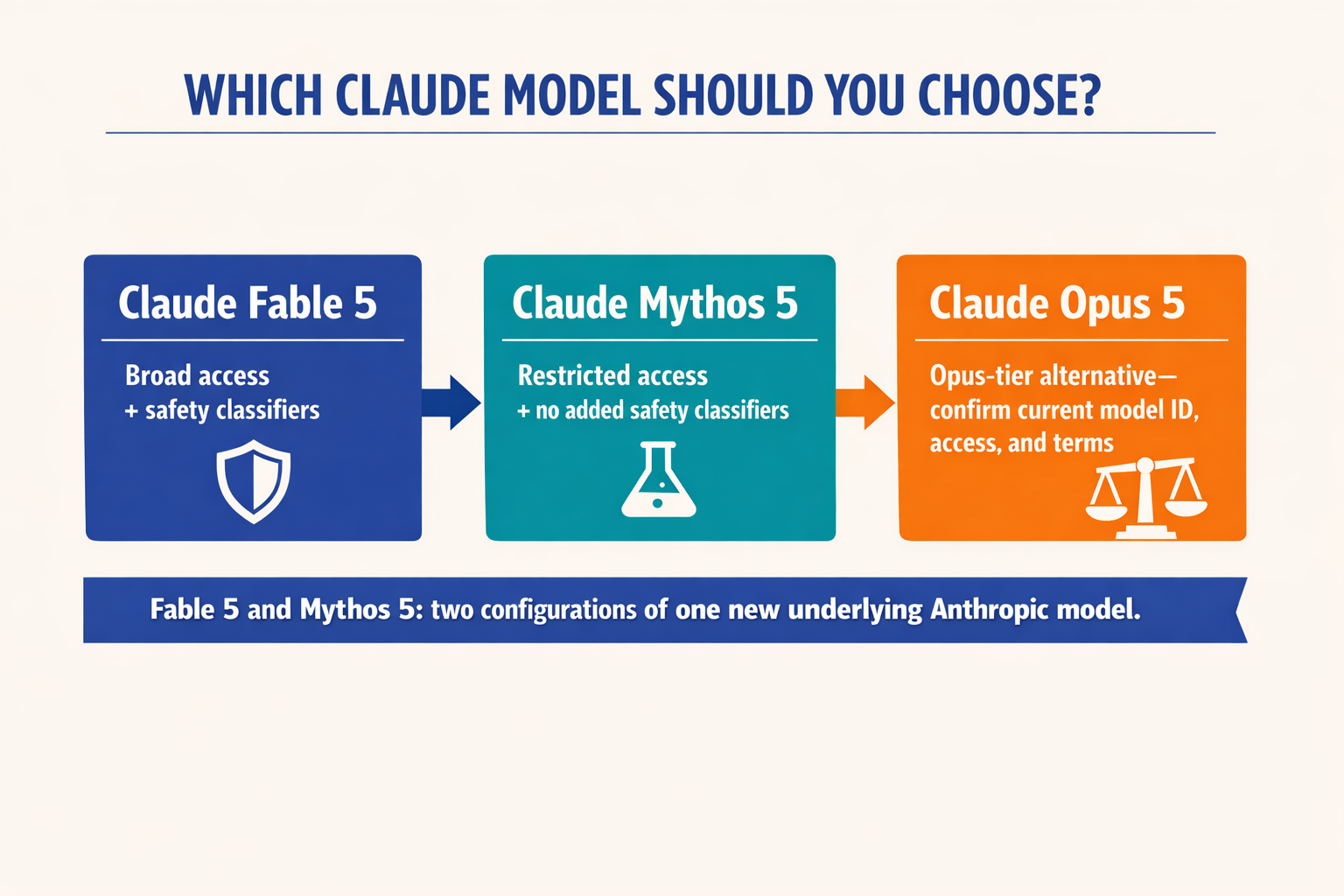
Choose Claude Fable 5 for most production deployments, Claude Mythos 5 for approved high-control research where classifier-level refusals would compromise the experiment, and Claude Opus 5 for established general-purpose workflows that do not require the new model’s specialist capabilities. Fable 5 and Mythos 5 are not separate base models; they are configurations of the same new Anthropic model.
The default choice: Claude Fable 5
Claude Fable 5 is the pragmatic starting point for customer-facing applications, enterprise automation, coding agents, and professional knowledge work. It combines the new model’s capabilities with additional safety classifiers capable of declining requests.
Anthropic’s 2026 platform documentation states that “Claude Fable 5 includes safety classifiers that can decline requests,” while Claude Mythos 5 does not include those classifiers. That distinction gives Fable 5 an extra control layer for deployments where prompts may come from employees, customers, or other untrusted sources.
Choose Fable 5 when:
- Users can submit open-ended or adversarial prompts.
- Compliance teams expect model-provider safeguards alongside internal controls.
- The application handles legal, scientific, financial, or other sensitive content.
- A potentially higher refusal rate is preferable to exposing less-filtered model behavior.
Fable 5 is not necessarily less intelligent than Mythos 5. Because both use the same underlying model, the practical difference is primarily how requests and outputs are mediated, not a conventional gap in model parameters or core reasoning architecture.
The specialist choice: Claude Mythos 5
Choose Claude Mythos 5 only when its classifier-free configuration is necessary and your organization can replace that missing layer with strong governance. Suitable scenarios may include controlled scientific research, safety evaluations, red-team testing, and specialist analysis in sandboxed environments.
Vellum reported in 2026 that Anthropic scientists preferred Mythos 5’s molecular-biology hypotheses in roughly 80% of blinded comparisons with Opus-class models. That result is notable, but it measures a narrow scientific task rather than universal superiority across coding, writing, mathematics, or agentic work.
The absence of Fable’s classifiers should also not be interpreted as meaning Mythos 5 has no safety properties. It means that specific external refusal mechanism is absent. Teams should still implement:
- Identity and access controls.
- Prompt and output logging.
- Data-loss prevention.
- Human review for consequential outputs.
- Domain-specific evaluation and incident procedures.
MarkTechPost reported on June 10, 2026, that Fable 5 and Mythos 5 share an underlying model but differ in safeguards and access, making Mythos 5 an intentional governance decision rather than a routine upgrade.
When Claude Opus 5 remains sensible
Claude Opus 5 is the conservative choice for broad, demanding workloads when the new family’s specialized gains or configuration choices are not essential. It provides a clearer conventional model-selection path: evaluate quality, latency, cost, and reliability without making classifier architecture the central deployment question.
The practical decision rule is straightforward:
- Production application with untrusted users: Fable 5.
- Controlled research requiring fewer classifier refusals: Mythos 5.
- General-purpose frontier work with an established Opus-oriented stack: Opus 5.
Whichever model looks strongest on paper, run workload-specific evaluations before migration. A molecular-biology preference rate or positive legal redlining review cannot substitute for testing your own prompts, languages, tools, risk thresholds, and failure cases.
What are Claude Fable 5 and Claude Mythos 5, and how does Opus 5 fit into Anthropic’s lineup?
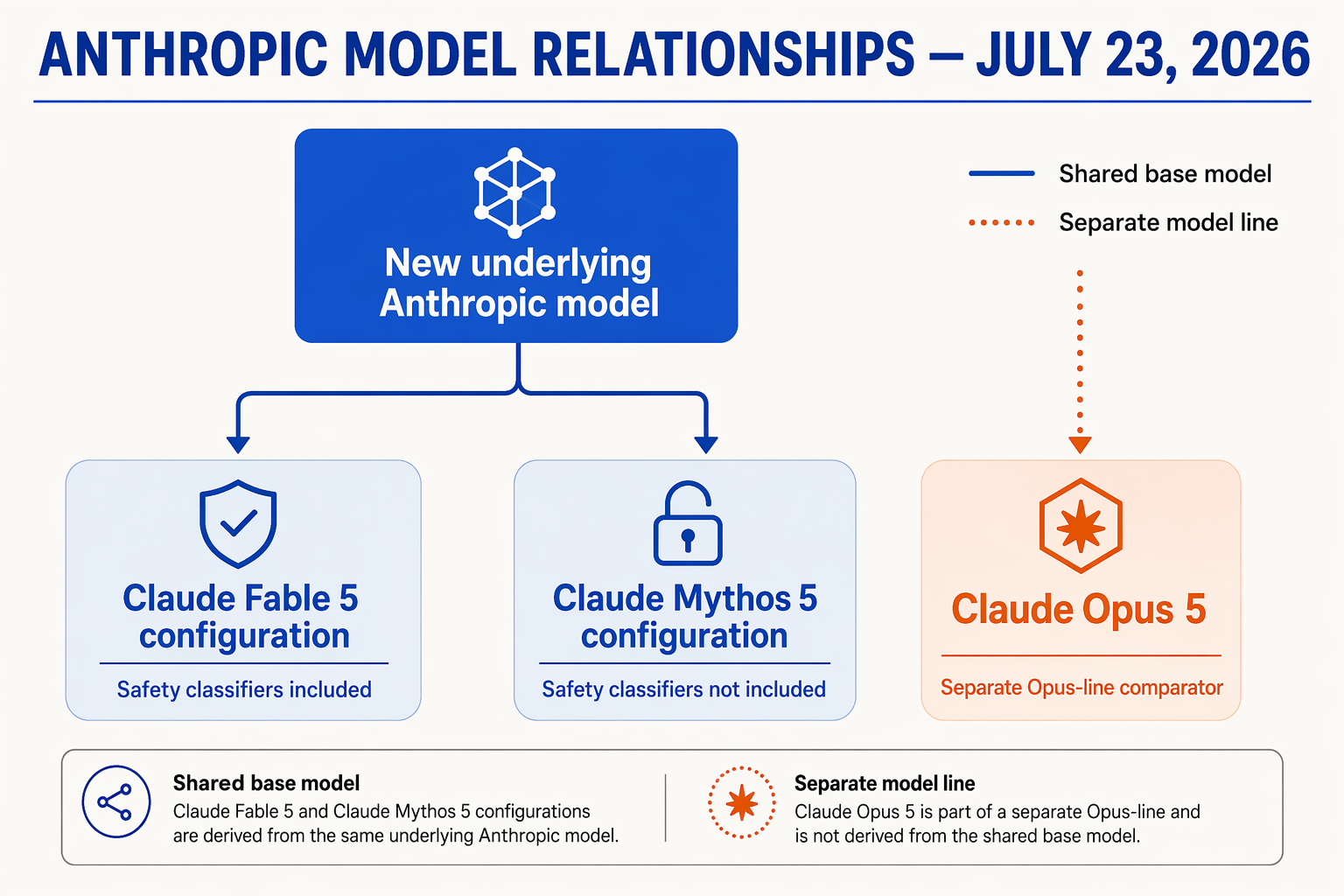
Claude Fable 5 and Claude Mythos 5 are not two independently trained models. Anthropic describes them as two configurations of one new large language model: Fable 5 adds deployment-facing safety classifiers, while Mythos 5 exposes the same underlying model without those classifiers. Claude Opus 5 is a separate general-purpose model option, so this comparison is partly model-versus-model and partly configuration-versus-configuration.
One model, two safety configurations
Anthropic’s Claude Fable 5 and Claude Mythos 5 System Card, published in 2026, explicitly calls the products “two configurations of a new large language model.” That means their core learned capabilities originate from the same base model rather than separate training runs optimized for different tasks.
The practical distinction sits around inference:
- Claude Fable 5 includes external safety classifiers capable of detecting and declining certain requests.
- Claude Mythos 5 does not include those classifiers, giving approved users more direct access to the underlying model’s responses.
- The absence of classifiers does not automatically mean that Mythos 5 has no safety training, policies, or deployment controls. It specifically means that the additional classifier layer documented for Fable 5 is not present.
- Prompt wording, system instructions, tool permissions, and organization-level controls can still affect outputs from either configuration.
Anthropic’s platform documentation identifies the integration difference directly: “Claude Fable 5 includes safety classifiers that can decline requests. Claude Mythos 5 does not include these classifiers.” MarkTechPost likewise reported on June 10, 2026, that Fable 5 and Mythos 5 share the same underlying model but differ in safeguards and access.
Where Opus 5 fits
Claude Opus 5 should be treated as a distinct member of Anthropic’s Claude lineup, not as a safer or less-safe switch for Mythos 5. Opus remains the familiar general-purpose category for demanding reasoning, coding, analysis, and agentic work, whereas Fable and Mythos introduce a configuration split around the newer model.
The lineup can therefore be understood in three layers:
- Underlying capability: Fable 5 and Mythos 5 share one model; Opus 5 is separate.
- Inference safeguards: Fable 5 adds classifiers; Mythos 5 omits that external classifier layer.
- Access model: Fable 5 is positioned for broader deployment, while Mythos 5’s configuration makes controlled access and user-supplied governance more important.
Third-party coverage has described the new model as part of a “Mythos class” above the Opus capability tier. Test Lab called Fable 5 “the first model from the Mythos class,” but buyers should distinguish that tier interpretation from Anthropic’s narrower, official statement that Fable 5 and Mythos 5 are configurations of the same model.
Why the naming can mislead buyers
The names resemble three conventional model SKUs, but the technical decision is different:
- Choose between Opus 5 and the new underlying model based on workload performance, latency, price, context limits, tools, and availability.
- Choose between Fable 5 and Mythos 5 primarily based on safeguards, access eligibility, and governance requirements.
- Do not assume Mythos 5 is intrinsically more intelligent than Fable 5; removing a classifier can change which answers reach the user without changing the model generating them.
As of July 23, 2026, the cleanest taxonomy is: one Opus model plus two operational configurations of a newer Anthropic model.
What key developments and verified claims define the three-way comparison? (TABLE)
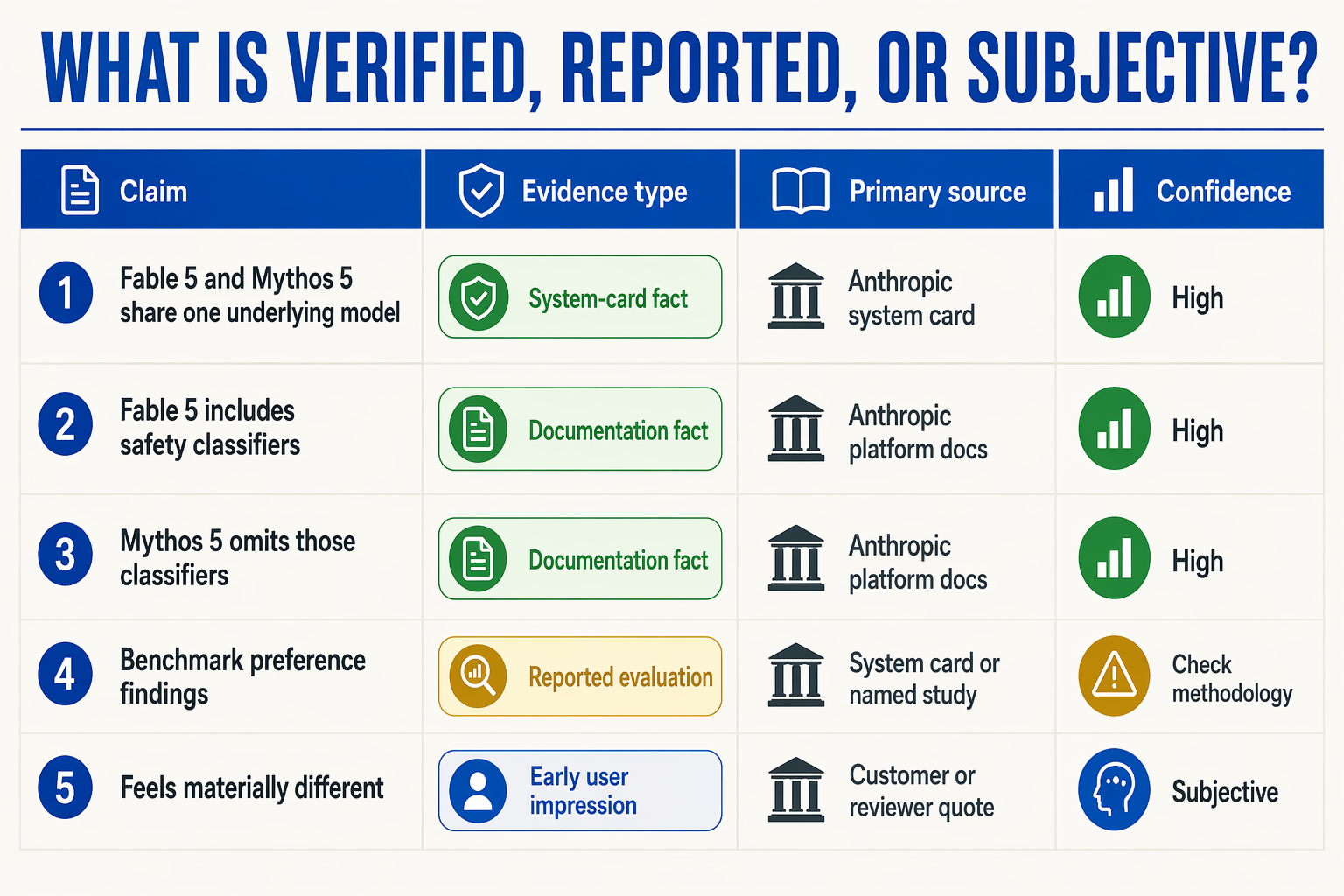
As of July 23, 2026, Anthropic’s primary documentation supports one unambiguous conclusion: Claude Fable 5 and Claude Mythos 5 are two configurations of the same new model—not separate models competing on underlying intelligence. Claude Opus 5 has not been officially announced, so no verified three-way performance comparison is currently possible.
Verified developments at a glance
| Claim | Evidence status | Source and date |
|---|---|---|
| Fable 5 and Mythos 5 are “two configurations of a new large language model” | Verified | Anthropic system card, accessed July 23, 2026 |
| Fable 5 includes external safety classifiers that can decline requests; Mythos 5 does not include those classifiers | Verified | Anthropic platform documentation, accessed July 23, 2026 |
| Published pricing is $10 per million input tokens and $50 per million output tokens, where the configurations are available through supported paid access | Verified | Anthropic pricing/platform documentation, accessed July 23, 2026 |
| Mythos 5 access is more restricted than Fable 5 access | Verified | Anthropic availability documentation, accessed July 23, 2026 |
| Specialist evaluations have reportedly favored one configuration in selected biology or legal tasks | Reported | Anthropic and third-party evaluation accounts, 2026; insufficient methodological detail for a general ranking |
| Claude Opus 5 is an announced Anthropic model | Unknown / not established | No Anthropic announcement or official documentation found as of July 23, 2026 |
| Claude Opus 5 has an official model card, API ID, price, benchmarks, or release date | Unknown / unavailable | No corresponding Anthropic primary source as of July 23, 2026 |
| A complete Fable 5–Mythos 5–Opus 5 benchmark exists | Unknown / not published | Anthropic documentation reviewed through July 23, 2026 |
What the evidence establishes
Anthropic’s system card describes Fable 5 and Mythos 5 as configurations of the same new model. The documented difference is the surrounding safety and access setup: Fable 5 uses external classifiers capable of refusing requests, while Mythos 5 omits those classifiers and is offered under tighter access controls.
This does not establish that Mythos 5 has different model weights, a larger parameter count, or inherently stronger reasoning. It only verifies that Anthropic exposes the model through two configurations with different safeguard layers.
Where paid access applies, Anthropic lists both configurations at $10/MTok for input and $50/MTok for output. Actual availability may differ because Mythos 5 is not offered as broadly as Fable 5.
What remains reported or unknown
Published accounts describe promising results in selected molecular-biology and legal-review tasks, but the available materials do not provide enough information about sample sizes, prompts, scoring procedures, comparison models, or statistical confidence to support numerical or general-purpose performance claims. These findings should therefore be treated as reported specialist evidence, not as a comprehensive benchmark.
Most importantly, Claude Opus 5 is unannounced as of July 23, 2026. Anthropic has published no official Opus 5 model card, API identifier, pricing, benchmark suite, availability date, or release date. Claims presenting Opus 5 as a currently selectable general-purpose alternative—or ranking it against Fable 5 and Mythos 5—are therefore unsupported.
The defensible comparison is currently Fable 5 versus Mythos 5: the same documented new model offered with different safety and access configurations at the same published token rates where available. A genuine three-way comparison must wait for an official Claude Opus 5 announcement and primary-source specifications.
How do capabilities, benchmarks, safeguards, and refusal behavior compare in practice?
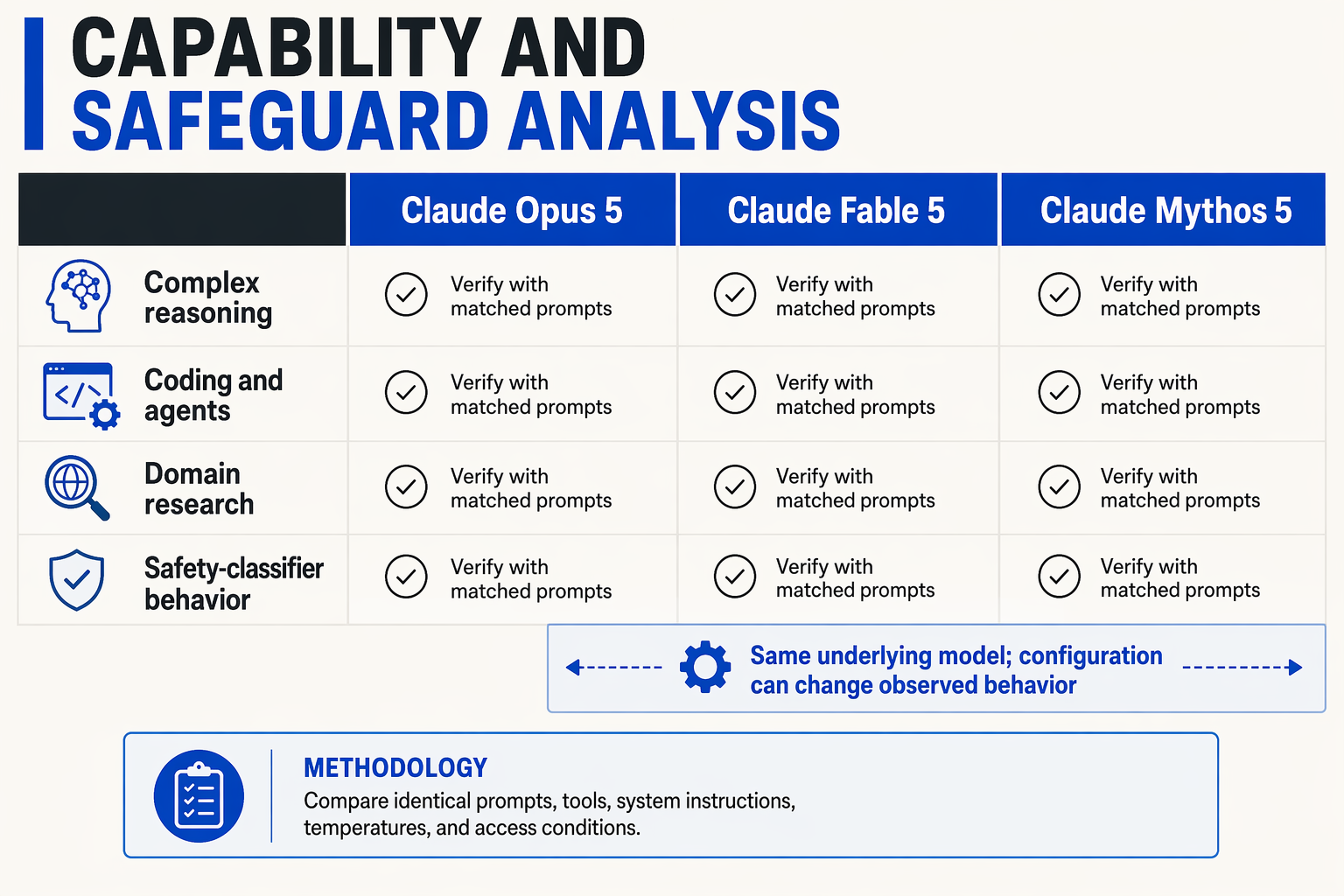
Claude Fable 5 and Claude Mythos 5 should deliver broadly similar capabilities on permitted prompts because they are configurations of the same underlying Anthropic model. Their practical divergence appears when Fable 5’s external safety classifiers decline a request; Claude Opus 5, meanwhile, is a separate general-purpose model and must be evaluated independently.
Capability evidence requires careful interpretation
The strongest disclosed results favor the Fable/Mythos model in specialist scientific and legal tasks, but they do not establish universal superiority over Opus 5.
- Vellum reported in 2026 that Anthropic scientists preferred Mythos 5’s molecular-biology hypotheses to Opus-class outputs in approximately 80% of blinded comparisons. “Opus-class” is broader than a controlled, head-to-head comparison against the final production version of Claude Opus 5, so the result should not be represented as an across-the-board win.
- Anthropic published a legal evaluator’s finding that Fable 5’s contract redlines “matched or beat our current model every time” in blind review. This is compelling qualitative evidence, although Anthropic did not provide a sample size, confidence interval, or standardized legal-benchmark score in the cited announcement.
- Anthropic’s system card describes Fable 5 and Mythos 5 as “two configurations of a new large language model,” meaning benchmark differences between them may reflect refusal handling or evaluation conditions rather than different core intelligence.
For production selection, teams should test all three models using representative documents, tool calls, languages, latency constraints, and scoring rubrics—not extrapolate from a single biology or legal result.
Safeguards change observable benchmark performance
Anthropic’s platform documentation states that “Claude Fable 5 includes safety classifiers that can decline requests” while “Claude Mythos 5 does not include these classifiers.” That distinction can alter both user experience and benchmark scores.
Consider three evaluation conditions:
- Clearly benign prompts: Fable 5 and Mythos 5 should normally behave similarly because the underlying model is shared, although nondeterministic generation can still produce different outputs.
- Ambiguous or dual-use prompts: Fable 5 may refuse, qualify, or redirect the request when its classifier activates; Mythos 5 may proceed because that classifier layer is absent.
- Clearly harmful prompts: Removing Fable’s classifiers does not automatically mean Mythos will comply, because model-level training and other controls may still influence its response.
Therefore, “no classifiers” does not mean “no safeguards.” It specifically means Mythos 5 omits the external classifiers identified in Anthropic’s documentation.
Practical refusal and governance differences
In deployment, the three options create different operational trade-offs:
- Claude Fable 5: Better suited to broad deployment where an Anthropic-managed refusal layer reduces exposure to unsafe or prohibited requests.
- Claude Mythos 5: Offers researchers more direct access to the underlying model’s behavior, but shifts more responsibility toward application-level moderation, access controls, logging, and human review.
- Claude Opus 5: Remains the cleaner baseline for established general-purpose workflows, especially where teams value conventional Claude behavior over specialized Fable/Mythos gains.
MarkTechPost reported on June 10, 2026, that Fable 5 and Mythos 5 share one model but differ in safeguards and access. In practice, the correct comparison is consequently not just accuracy versus accuracy; it is capability combined with refusal rates, false-positive refusals, governance burden, and the cost of an unsafe completion.
Why do access controls and safety configurations matter for developers, enterprises, and researchers?

Access controls and safety configurations determine who can use a model, under what conditions, and where responsibility for harmful outputs sits. For Claude Fable 5, Claude Mythos 5, and Claude Opus 5, these controls can matter as much as raw capability because they affect compliance, experimental validity, application reliability, and incident response.
Safety configuration changes production behavior
Anthropic’s platform documentation states that Claude Fable 5 includes safety classifiers capable of declining requests, while Claude Mythos 5 omits those classifiers. These classifiers create an additional enforcement layer around the shared underlying model.
For developers, that layer affects more than obviously dangerous prompts:
- Refusal rates: Legitimate but sensitive requests may be declined, requiring fallback logic or human review.
- Workflow consistency: Classifier decisions can interrupt multi-step agents, code execution, document analysis, or tool calls.
- Defense in depth: Added classifiers can help catch malicious requests that application-level filters miss.
- Observability: Teams need to distinguish a classifier refusal from a model error, timeout, malformed request, or policy decision.
The absence of these classifiers in Mythos 5 should not be interpreted as proof that the underlying model has no safety training. It means that one documented external control layer is not present, shifting more responsibility to the organization operating the model.
Access is itself a safety mechanism
MarkTechPost reported on June 10, 2026, that Fable 5 and Mythos 5 share an underlying model but differ in both safeguards and availability. Restricting access can reduce exposure when a highly capable model is intended for controlled evaluation rather than broad deployment.
A responsible Mythos 5 evaluation should therefore include:
- Named-user access with least-privilege permissions.
- Isolated environments without unrestricted network, shell, or production-database access.
- Prompt and output logging with privacy-sensitive retention policies.
- Human approval before consequential tool calls or external actions.
- Abuse testing and incident procedures tailored to the research domain.
Access approval does not replace these measures. Likewise, using Fable 5’s classifiers does not remove the need for application security, authentication, data-loss prevention, or human escalation.
Different users carry different responsibilities
Developers must design for refusals as a normal API outcome. Applications should provide clear user messaging, avoid endless retry loops, and route eligible requests to safer workflows rather than attempting to circumvent controls.
Enterprises need auditable answers to broader questions: Which employees can select Mythos 5? Can sensitive customer data enter prompts? Who approves model changes? How are model versions, policies, and outputs recorded? In healthcare, finance, legal services, and customer communications, model access should align with existing identity, risk, and records-management controls.
Researchers may value Mythos 5 because classifier-free evaluation can reveal the underlying model’s behavior without an added refusal layer confounding results. That experimental clarity creates a reciprocal obligation to use sandboxing, staged disclosure, qualified reviewers, and strict limits on releasing dangerous outputs.
The practical choice
Fable 5 is the more natural candidate when an organization wants Anthropic’s added classifier layer for deployment. Mythos 5 is better understood as a controlled-access configuration for qualified research where unfiltered measurement is essential. Opus 5 remains a separate general-purpose Claude option and should be assessed under its own documented availability and safety policies—not assumed to follow the Fable/Mythos configuration model.
The right decision is therefore not “maximum safety” versus “maximum freedom.” It is selecting the configuration whose controls match the organization’s users, threat model, regulatory duties, and capacity to govern failures.
What do Anthropic, benchmark reports, and early reviewers actually say?
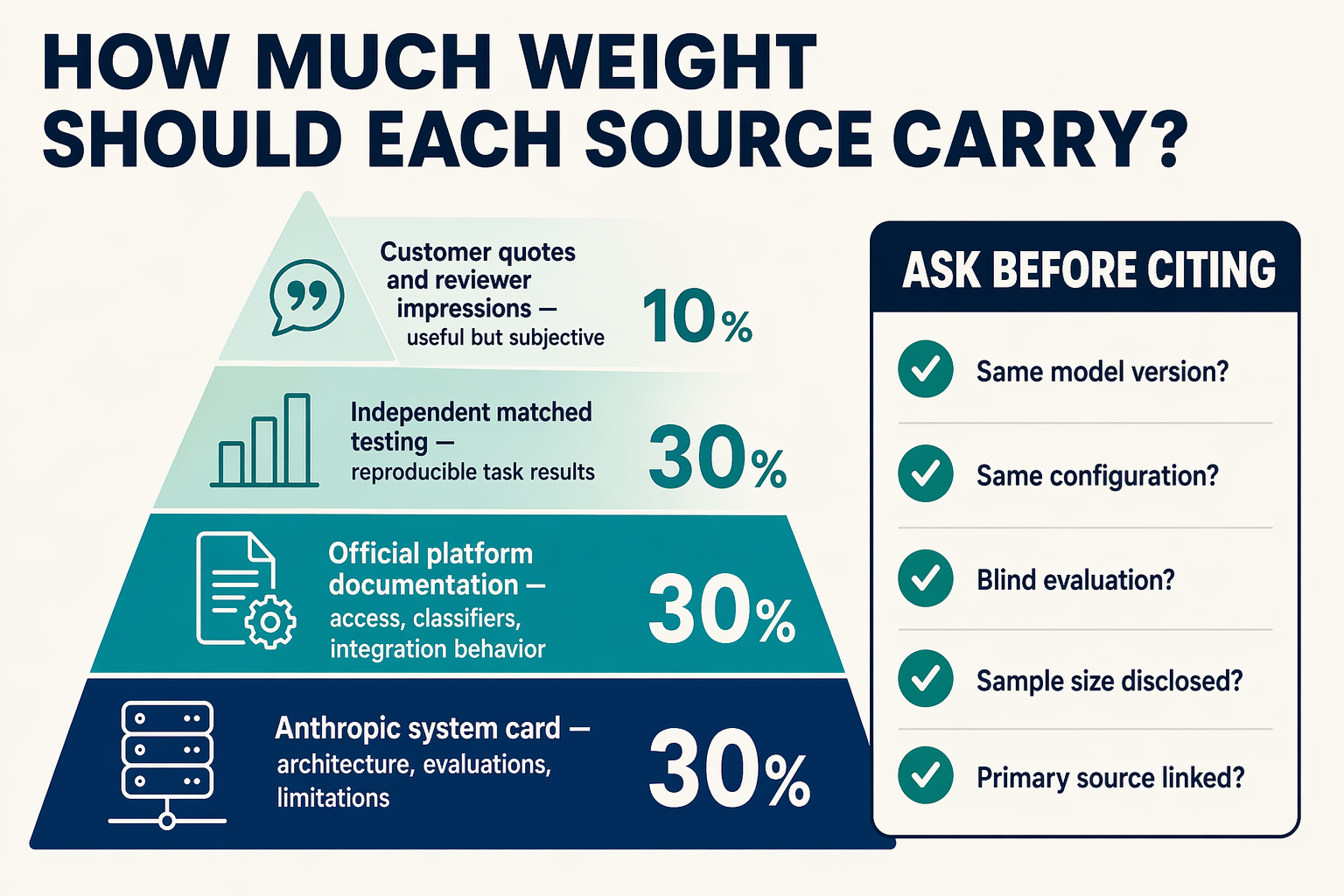
The available evidence supports a strong specialist-capability signal for Fable 5 and Mythos 5, but it does not establish a universal ranking over Claude Opus 5. Anthropic provides the clearest product and safety information, while benchmark reports and early reviews remain narrower than a complete, independently replicated three-model evaluation.
What Anthropic’s evidence establishes
Anthropic’s system card defines Claude Fable 5 and Claude Mythos 5 as two configurations of one new large language model, rather than separately trained models. Consequently, observed differences between them may reflect classifiers, access conditions, and deployment policies—not different core intelligence.
Anthropic highlights promising results in specialist workflows:
- Anthropic published a legal evaluator’s assessment: “In blind review, our lawyers found its redlines matched or beat our current model every time.”
- Anthropic’s product documentation says Fable 5 includes safety classifiers capable of declining requests, whereas Mythos 5 omits those external classifiers.
- Anthropic presents Mythos 5 as a more restricted configuration, making its practical evaluation conditions different from Fable 5’s broader deployment context.
The legal quote is valuable because it describes blind review, which can reduce brand and model-name bias. However, “every time” lacks a disclosed sample size in the supplied material, so it should not be interpreted as a statistically conclusive win across all legal tasks.
What benchmark reports indicate
The clearest quantitative result currently concerns scientific ideation, not general reasoning or coding.
Vellum reported in 2026 that Anthropic scientists preferred Mythos 5’s molecular-biology hypotheses to outputs from Opus-class models in approximately 80% of blinded comparisons. That is a substantial result for hypothesis generation, especially because the comparison was blinded, but its scope remains narrow.
Three limitations matter:
- “Opus-class” is not automatically equivalent to Claude Opus 5. Unless a report names the exact model version, configuration, prompts, and inference settings, the result cannot be treated as a direct Mythos 5-versus-Opus 5 benchmark.
- Preference is not ground-truth accuracy. Scientists may prefer a hypothesis because it is novel, plausible, or useful, even if later laboratory validation disproves it.
- One domain cannot determine the overall winner. Molecular biology says little about repository-scale coding, multilingual support, agent reliability, latency, or production cost.
Test Lab describes Fable 5 as the first model in Anthropic’s Mythos capability class, positioned above the Opus tier. That characterization helps explain Anthropic’s product hierarchy, but positioning is not a substitute for reproducible task-level results.
What early reviewers agree on—and what remains unknown
Early coverage is unusually consistent about the architecture. MarkTechPost reported on June 10, 2026, that Fable 5 and Mythos 5 share the same underlying model but differ in safeguards and availability. Appwrite likewise emphasized shared model foundations, broader Fable access, and differentiated safety controls.
The responsible reading as of July 23, 2026 is therefore:
- Mythos 5 has the strongest disclosed specialist-research signal.
- Fable 5 packages the same core model with additional refusal controls for broader deployment.
- Opus 5 should not be declared inferior without exact-version, independently reproduced three-way benchmarks.
Early reports make Fable 5 and Mythos 5 important contenders, but the evidence currently supports use-case-specific conclusions, not a blanket champion.
Which Claude model is best for your use case? (TABLE)
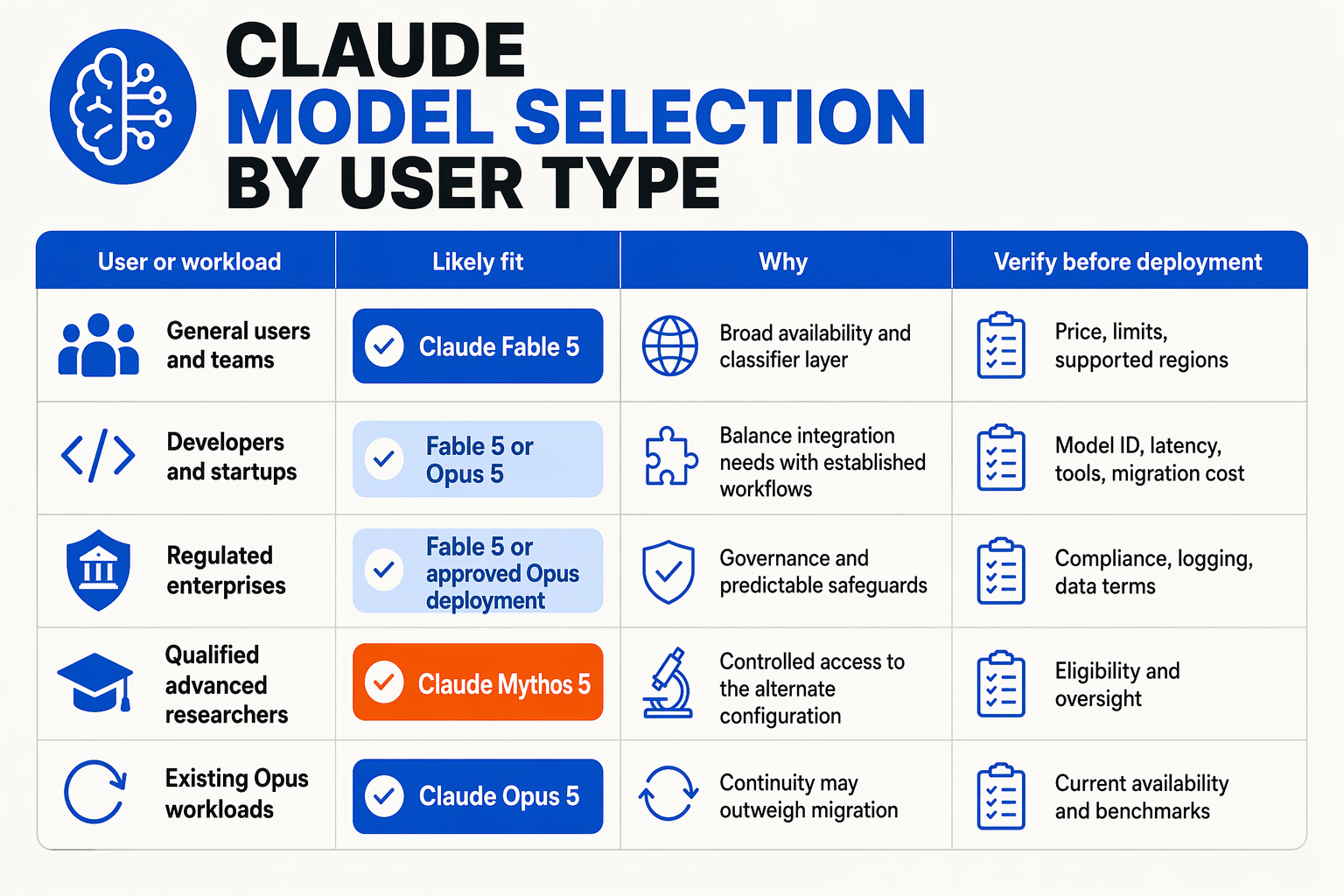
Claude Fable 5 is the default choice for most production deployments, Claude Mythos 5 fits tightly controlled specialist research, and Claude Opus 5 remains a practical general-purpose option when teams value established workflows over the new model family. The right decision depends less on headline capability than on access, refusal tolerance, and governance capacity.
Use-case decision table
| Use case | Best fit | Why it fits | Main caveat |
|---|---|---|---|
| Customer support, enterprise assistants, and public applications | Claude Fable 5 | Added safety classifiers can decline risky requests, making Fable 5 the deployment-oriented configuration of the new model. | Classifier refusals may interrupt unusual but legitimate workflows. |
| Legal review and contract redlining | Claude Fable 5 | Anthropic reported in 2026 that one evaluation team’s lawyers found its redlines “matched or beat our current model every time” in blind review. | Human counsel must still validate legal conclusions and jurisdiction-specific language. |
| Molecular biology and hypothesis generation | Claude Mythos 5 | Mythos 5 exposes the shared underlying model without Fable’s external refusal classifiers, preserving flexibility for sensitive scientific queries. | Requires restricted access, expert review, audit logs, and strong experimental controls. |
| Unconventional safety or alignment research | Claude Mythos 5 | Researchers can study the underlying model’s behavior without classifier-mediated refusals changing the observed output. | Removing one safety layer transfers more responsibility to the deploying institution. |
| Coding, analysis, writing, and mixed enterprise workloads | Claude Opus 5 | Opus 5 is the more straightforward general-purpose selection when existing prompts, evaluations, and operational processes already target the Opus line. | Do not assume Opus 5 will match the new model on every specialist task; run domain evaluations. |
| Multi-model applications needing resilience | Opus 5 plus evaluated alternatives | Routing by task and maintaining fallbacks reduces dependence on one model’s availability or refusal profile. | Outputs, tool use, latency, and safety behavior must be normalized across models. |
How to make the final selection
Anthropic’s Claude Fable 5 and Claude Mythos 5 System Card describes Fable 5 and Mythos 5 as two configurations of one new large language model—not two independently trained models. MarkTechPost reported on June 10, 2026, that the configurations share the same underlying model but differ in safeguards and access.
Use a short evaluation process rather than choosing from a single benchmark:
- Build a representative test set. Include routine requests, edge cases, tool calls, long documents, and prompts likely to trigger refusals.
- Score operational outcomes. Measure task success, factual error rate, refusal rate, latency, human-review time, and cost in your actual environment.
- Match controls to exposure. Public-facing systems generally need stricter safeguards than isolated research environments.
- Confirm current access. Mythos 5 availability may be more restricted, so eligibility can decide the shortlist before technical testing begins.
Practical recommendation
- Choose Fable 5 when external users can submit prompts or when predictable safety intervention is valuable.
- Choose Mythos 5 only when classifier-free access is scientifically necessary and your organization can supply equivalent controls.
- Choose Opus 5 when continuity, broad utility, and existing Opus-based evaluations outweigh the need to adopt the newest architecture immediately.
For teams avoiding a permanent single-model commitment, CallMissed’s OpenAI-compatible gateway provides a multi-model integration pattern with same-tier fallbacks. Regardless of infrastructure, production approval should follow workload-specific testing—not family names or isolated benchmark wins.
Frequently asked questions about Claude Fable 5 vs Mythos 5 vs Opus 5
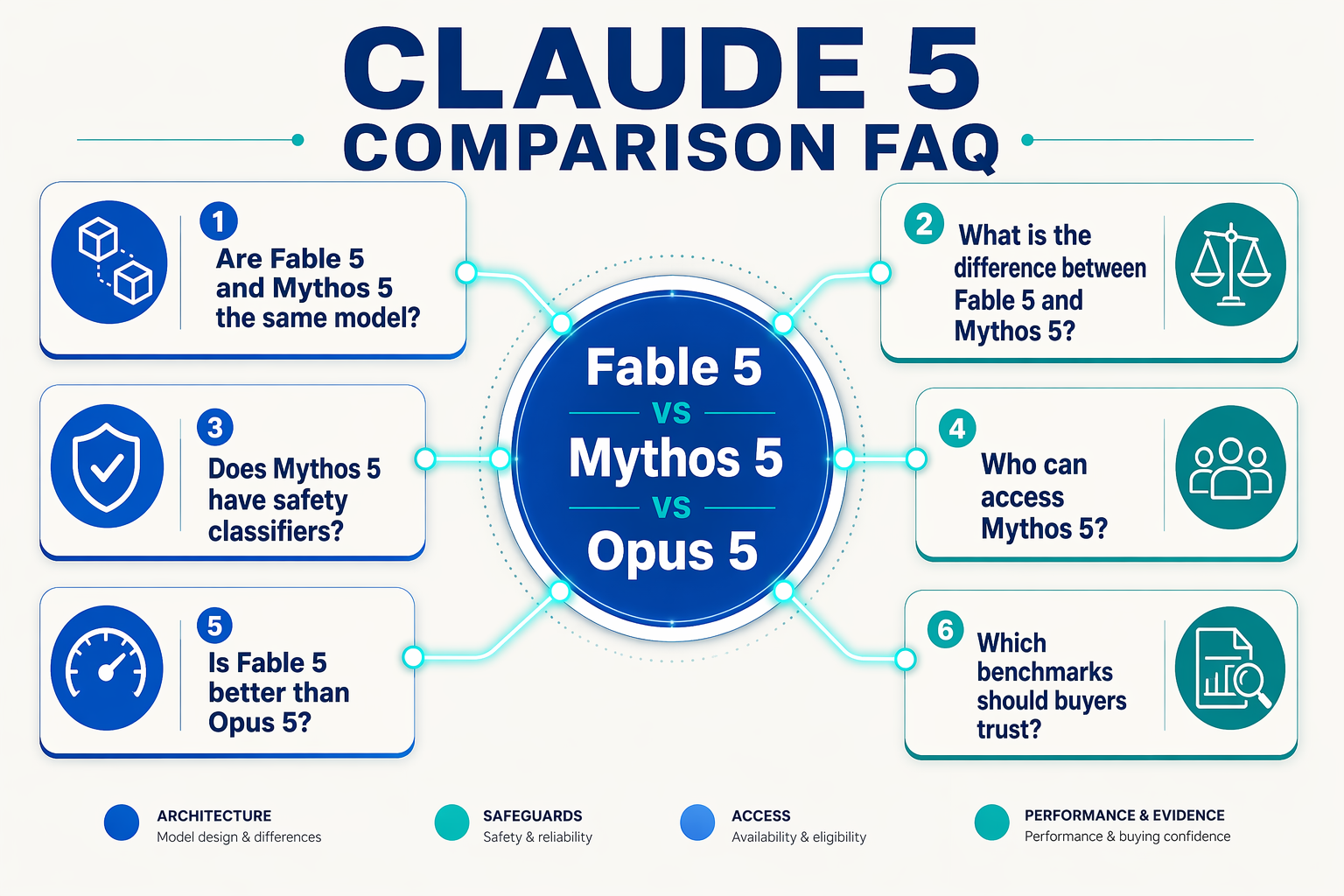
What is the main difference in Claude Fable 5 vs Claude Mythos 5 vs Claude Opus 5?
Are Claude Fable 5 and Claude Mythos 5 actually different AI models?
Which is safer for production use, Claude Fable 5 or Mythos 5?
Which performs better in Claude Fable 5 vs Claude Mythos 5 vs Claude Opus 5 benchmarks?
Should developers choose Claude Opus 5, Fable 5, or Mythos 5?
Does Claude Mythos 5 have no safety protections because it lacks Fable 5’s classifiers?
Conclusion
As of July 23, 2026, the right choice depends less on a simple performance ranking and more on the balance your organization needs between capability, safeguards, access, and operational control.
- Choose Claude Fable 5 for deployment-oriented workloads where added safety classifiers—and their ability to decline requests—support governance and risk management.
- Choose Claude Mythos 5 for tightly controlled research where qualified teams need the underlying model without Fable 5’s external classifiers and can assume greater oversight responsibility.
- Choose Claude Opus 5 for demanding general-purpose work when a more conventional Claude deployment path matters more than specialized Mythos-class performance.
- Evaluate on your own workload. Vellum reported in 2026 that Anthropic scientists preferred Mythos 5’s molecular-biology hypotheses in roughly 80% of blinded comparisons with Opus-class models, but that result does not guarantee equivalent gains in coding, support, or financial analysis.
What comes next will be equally important: watch for independent benchmarks across more domains, changes in Mythos 5 availability, and real-world evidence about how Fable 5’s classifiers affect reliability and refusal rates.
Multi-model infrastructure can make this decision less permanent. To explore that approach, visit CallMissed, an AI communication and OpenAI-compatible infrastructure platform supporting multi-model access, voice agents, and multilingual chatbots. Which configuration best matches your organization’s capability needs—and its willingness to govern the risks?
Related Reading
- Best AI Model for Coding 2026: GPT-5.6 vs Claude Opus 4.8, Sonnet 5, Fable 5 and Kimi K3
- GPT-5.6 Sol vs Terra vs Luna vs GPT-5.5: Which Model Should You Use?
- Why the US Restricted Foreign Access to Anthropic's Claude Fable 5 and Mythos 5
Sources
Related Posts

Ready to automate customer conversations?
Launch AI voice agents and WhatsApp bots with CallMissed — one API, 22+ Indian languages.