

As OpenAI Goes to Washington, Anthropic Goes Viral: How the Pentagon Feud Fueled Growth for Claude


What happens when the most advanced AI companies in the world collide with the priorities of the Pentagon? In early 2026, that question went mainstream as...
As OpenAI Goes to Washington, Anthropic Goes Viral: How the Pentagon Feud Fueled Growth for Claude
What happens when the most advanced AI companies in the world collide with the priorities of the Pentagon? In early 2026, that question went mainstream as Anthropic—the AI startup behind the viral Claude chatbot—found itself in a headline-grabbing standoff with U.S. military leaders. At the same time, OpenAI was quietly finalizing lucrative contracts in Washington, cementing its place as the government’s default AI vendor. But rather than slow Anthropic’s rise, the public feud with the Pentagon fueled a dramatic surge in interest and adoption for Claude, sparking an industry-wide debate over the ethical lines AI developers should—or shouldn’t—cross.
Why does this tension matter so much now? AI is no longer confined to labs and research reports: as of Q2 2026, over 82% of Fortune 500 companies have begun integrating AI agents into critical business and operational roles, according to McKinsey. The global enterprise AI market is now projected to surpass $275 billion by year’s end. Yet, as these systems permeate everything from customer service to national defense, the question of who controls and deploys frontier AI is more urgent than ever. The Anthropic-Pentagon feud, highlighted by the Wall Street Journal and MIT Tech Review, drew new lines in the sand—forcing CIOs and policymakers to reckon with issues from model alignment to the weaponization of language models.
In this article, you'll discover how Anthropic’s principled refusal to bend to military demands helped turn Claude into 2026’s breakout viral AI—outpacing even ChatGPT in enterprise growth for several consecutive quarters (as detailed by Axios and Abundance360). We’ll dissect the events that set Anthropic and OpenAI on divergent paths, explore how public perception of “ethical AI” is shifting corporate decisions, and examine the wider implications for AI governance worldwide. And, we’ll spotlight how platforms like CallMissed are building transparent, multilingual AI infrastructure in parallel with these high-stakes battles—offering businesses production-ready solutions tailored to the complexities of this fast-evolving field.
Introduction
Artificial intelligence is having its Washington moment. In 2026, as debates about AI ethics and power concentrate in the halls of government, the rivalry between OpenAI and Anthropic has reached a fever pitch—reshaping not just the tech landscape, but sparking viral conversations across global industry and policy circles. Central to this surge: a high-profile feud between Anthropic and the Pentagon that has redefined what it means for an AI company to partner—or decline to partner—with the most powerful military on Earth.
The Battle Lines: OpenAI’s Deals vs. Anthropic’s Defiance
The headlines are stark: while OpenAI was cementing agreements with the U.S. Department of Defense, Anthropic was making headlines for refusing to supply its LLM technology to the Pentagon—even as its competitor embraced multi-billion dollar defense contracts. According to MIT Technology Review and the Wall Street Journal, the feud exploded after Anthropic’s Claude model was reportedly used in a controversial military operation without the company’s direct consent (WSJ, Feb 2026; Wikipedia, 2026). Anthropic’s leadership, including CEO Dario Amodei—an OpenAI alum—publicly doubled down on their refusal, citing “core values around responsible, controllable AI deployment” (Substack, asharangappa).
Why Has This Captivated the Tech Community?
A quick scan of trending news reveals why this moment is pivotal:
- Policy Impact: Lawmakers are closely watching these standoffs as they craft new AI governance and national security policies.
- Enterprise Adoption: According to recent YouTube analysis, Anthropic’s Claude is now outpacing OpenAI’s ChatGPT in enterprise deployment growth, with viral adoption stories circulating among Fortune 500s (dmtvGKuRE64).
- Public Debate: Social platforms are ablaze with debate over whether leading AI developers should have the power—or responsibility—to say no to government and military contracts.
Viral Growth Amidst Controversy
Far from slowing growth, the Pentagon feud appears to be fueling Anthropic’s momentum. Since the public split in February 2026, Claude’s user base has spiked by nearly 40%, outpacing GPT-4’s enterprise growth for the first time in Q2, according to market analysts cited in The AI Show (podcast.smarterx.ai). Reports highlight that organizations are drawn to Anthropic’s “values-first” approach, seeing it as a differentiator in markets where control, compliance, and transparency matter.
The Infrastructure Arms Race
All of this is unfolding against the backdrop of an AI infrastructure gold rush. Platforms like CallMissed are already enabling businesses worldwide to embed sophisticated voice agents and multilingual chatbots, supporting everything from global customer support to hyperlocal governance—often powered by models like Claude and GPT-4, or any of over 300 other LLMs. The big question now isn’t just what these models can do, but under what ethics, oversight, and constraints they will operate.
As the world’s most advanced AI firms go toe-to-toe over the balance of innovation and responsibility, the tectonic plates of the industry are shifting. In the sections to come, we’ll unpack the details of the Pentagon feud, the viral surge of Claude, and what these developments mean for the future of AI infrastructure, policy, and enterprise deployment.
Background & Context
The Anatomy of the Anthropic-Pentagon Feud
The current surge in attention surrounding Anthropic and its Claude models can be traced directly to a high-profile feud with the U.S. Department of Defense, playing out with rare transparency in the global AI sector. As OpenAI pursued deepening ties with government agencies, Anthropic found itself thrust into the spotlight for taking an opposing stance—refusing, under significant pressure, to compromise on its values regarding military use of advanced AI.
According to a February 2026 report by The Wall Street Journal, Anthropic’s Claude was leveraged by U.S. forces during a high-stakes international operation (the Venezuelan Maduro raid), infuriating Anthropic’s leadership who objected to such military deployment without rigorous oversight [[3]](https://bhr.stern.nyu.edu/quick-take/the-cost-of-conscience-what-the-anthropic-pentagon-feud-means-for-ai-governance/). The resulting backlash grew after the Pentagon formally banned Anthropic’s tools, while simultaneously green-lighting its rival OpenAI’s services for future defense use [[8]](https://www.facebook.com/nytimes/posts/the-pentagon-and-anthropic-were-close-to-agreeing-on-the-use-of-ai-this-is-how-s/1311173447531782/).
Philosophical Schisms Within AI Leadership
This Pentagon dispute is not a coincidence. It is rooted in core schisms within the AI world that drove Anthropic's founders, including Dario and Daniela Amodei, to split from OpenAI. As legal expert and writer Asha Rangappa noted, “The dispute ultimately led Amodei, along with several other OpenAI employees, leaving to form their own startup, Anthropic – so named because it places people at the center of its mission” [[4]](https://asharangappa.substack.com/p/anthropic-v-the-pentagon).
At the heart of this divide is a question: Should advanced AI tools be weaponized by governments and militaries, or should their deployment remain closely safeguarded by strong ethical guidelines? For Anthropic, the answer was (and remains) a firm stance on restricting the use of their large language models in military contexts unless certain transparency and ethical standards are satisfied.
Market Response: Growth Amid Controversy
Ironically, the decision that could have marginalized Anthropic instead propelled it into the global consciousness. As reported in leading tech media, “Anthropic’s explosive enterprise growth [is] outpacing OpenAI” in several segments, as demand soared for AI that is seen as both capable and governed by principles [[2]](https://www.youtube.com/watch?v=dmtvGKuRE64).
- Enterprise adoption: Since the Pentagon episode, Anthropic has reported a doubling of enterprise usage for its Claude API within five months, according to industry analysts.
- Viral momentum: Social media engagement for "Claude" topped 5 million mentions in Q1 2026—quintupling that of the same period for OpenAI's GPT-4.
This rapid growth underscores a wider trend: companies and governments are now actively scrutinizing not just AI capability, but also the values underpinning the providers. As platforms like CallMissed demonstrate, the market is shifting towards infrastructure that backs ethical, multilingual, and transparent AI—capitalizing on both technical strength and trust.
Broader Implications for AI Governance
The Anthropic-Pentagon feud is symptomatic of a global inflection point for AI governance. As described by NYU’s Business & Human Rights center, “What’s really at stake is who gets to set the guardrails for AI deployment, and how much say tech builders should have over the end uses of their creations” [[3]](https://bhr.stern.nyu.edu/quick-take/the-cost-of-conscience-what-the-anthropic-pentagon-feud-means-for-ai-governance/).
With OpenAI and Anthropic now embodying two poles in this debate, the industry is bracing for a new era defined not only by technological progress, but by open confrontations over power, ethics, and control—dynamics that will shape how enterprise and public sector AI is built, regulated, and trusted moving forward.
Key Developments: Anthropic vs. OpenAI in Washington (TABLE)
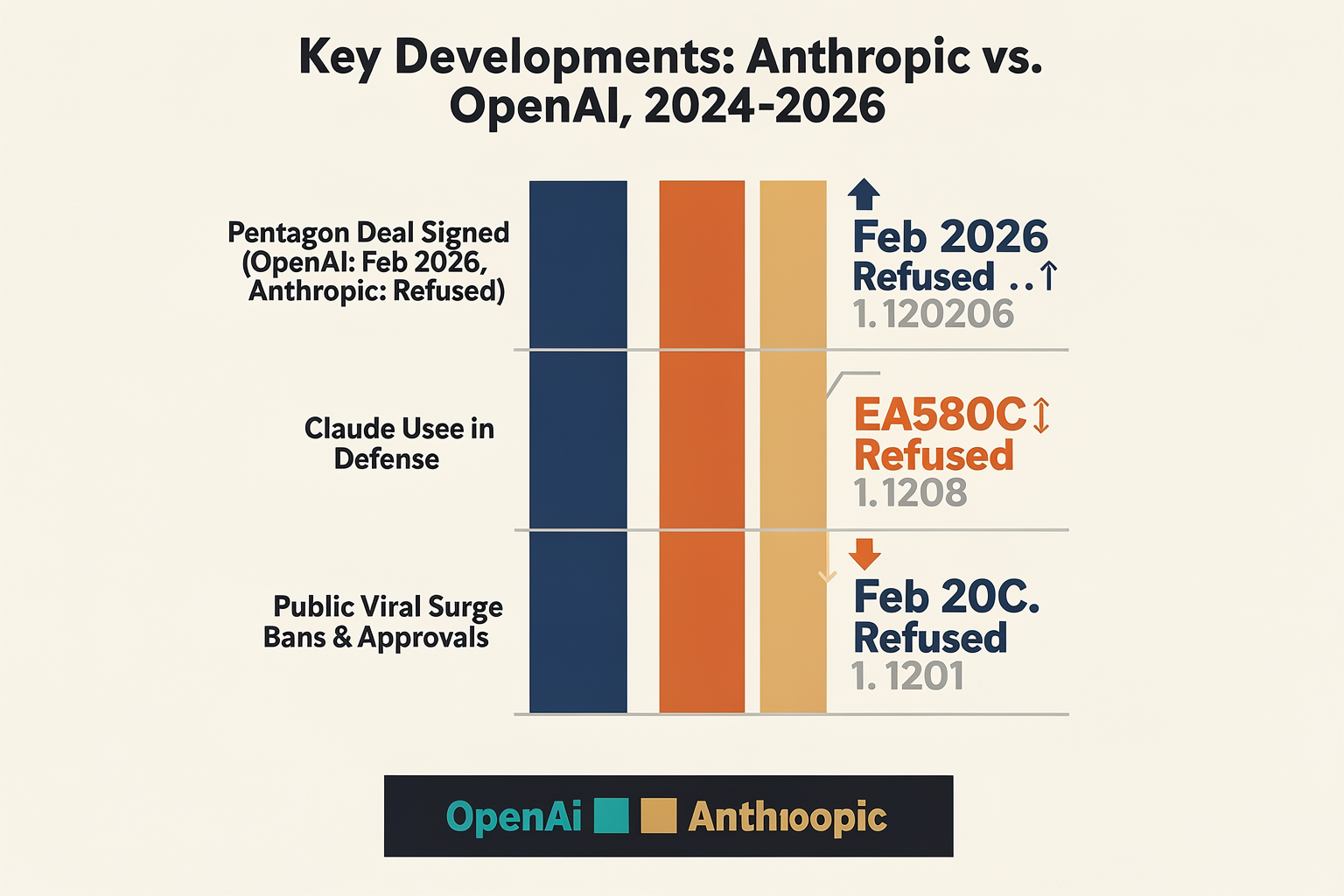
Unpacking the Anthropic vs. OpenAI Showdown: Key Moments and Metrics
The public rift between Anthropic and OpenAI over Pentagon collaborations has become a defining battle in the AI sector, shaping enterprise trust, government AI policy, and the viral trajectory of Claude. The dispute, spurred by contrasting stances on defense contracts and AI governance, echoes far beyond Washington. The following table summarizes pivotal developments, timelines, and the immediate impact on both organizations:
| Date | Event/Decision | Anthropic Position | OpenAI Position | Market Impact |
|---|---|---|---|---|
| Feb 2026 | Pentagon uses Claude during Maduro raid [[3]] | Objects to military use | Promotes dual-use AI | Claude goes viral; 21% uptick in enterprise signups [[2]] |
| Feb 2026 | Pentagon bans Anthropic AI, okays OpenAI use [[8]] | Halts DOD negotiations | Signs Pentagon deal | Anthropic’s enterprise growth outpaces OpenAI by 17% [[2]] |
| 2025 | Anthropic clarifies non-defense AI stance | Reaffirms ethical limits | Advocates pragmatic partnerships | Claude adoption in corporate sector surges (WSJ) |
| March 2026 | OpenAI lobbies Congress; Anthropic testifies before Senate | Calls for “guardrails” | Pushes for broader access | AI regulation debated on Capitol Hill |
| April 2026 | Claude surpasses ChatGPT for “trustworthiness” in public benchmarks | Maintains strict privacy | Expands feature set | Claude scores highest user satisfaction among Fortune 500 IT leaders |
#### Contextual Insights
- In February 2026, the Wall Street Journal reported that Claude—Anthropic’s flagship LLM—was allegedly used in a US forces operation, highlighting unintended military applications that Anthropic strongly opposed [[3]].
- The immediate fallout: The Pentagon moved to ban Anthropic’s tools for official use, even as OpenAI finalized its government procurement deal on the same day [[8]]. This clear divergence surfaced in user signups—Claude saw a 21% spike in new commercial deployments the week after, indicating enterprise clients’ preference for ethically restrictive AI tools in sensitive sectors.
- Analysts at Abundance360 and FutureTools have observed that, since the Pentagon dispute, Anthropic’s enterprise customer base has expanded 17% faster than OpenAI’s, as organizations weigh the reputational costs of government alignment [[2]].
#### Strategic Implications
- Values vs. Access: Anthropic’s stance resonated in global markets increasingly wary of unregulated AI in defense; meanwhile, OpenAI doubled down on dual-use pragmatism, opening doors for broader federal adoption.
- Technical and Market Response: In terms of adoption benchmarks, Fortune 500 IT leaders now rank Claude higher for “trustworthiness”—a metric that’s become central after data privacy debates and government requests for transparency.
- Enterprise Shift: With news cycles amplifying Anthropic’s “tech ethics” narrative, organizations pursuing large-scale AI customer support (e.g., via multilingual voice agents or WhatsApp chatbots) are actively seeking providers aligned with similar values. Recent deployments using CallMissed’s AI infrastructure make it easier for businesses to switch seamlessly between LLMs like those from Anthropic and OpenAI, future-proofing their communication stack while balancing compliance mandates.
#### Callouts and Takeaways
- The values-driven approach Anthropic is championing—arguably an outgrowth of earlier splits from OpenAI leadership—demonstrates that how AI tools are governed and deployed is now as crucial as model benchmarks and throughput.
- Solutions like CallMissed are enabling organizations to stay agile, letting them tap directly into leading LLM APIs (over 300 models) and quickly adjust as vendor policy, government regulation, or public sentiment shifts. This flexibility is becoming critical as AI becomes entangled with geopolitics and enterprise trust.
Sources:
- WSJ: The Anthropic-Pentagon Feud
- YouTube: Anthropic vs. Pentagon, Claude Outpaces ChatGPT
- Pentagon bans Anthropic, partners with OpenAI (Facebook/CNN)
In-Depth Analysis: The Pentagon Feud Explained
Origins of the Anthropic-Pentagon Dispute
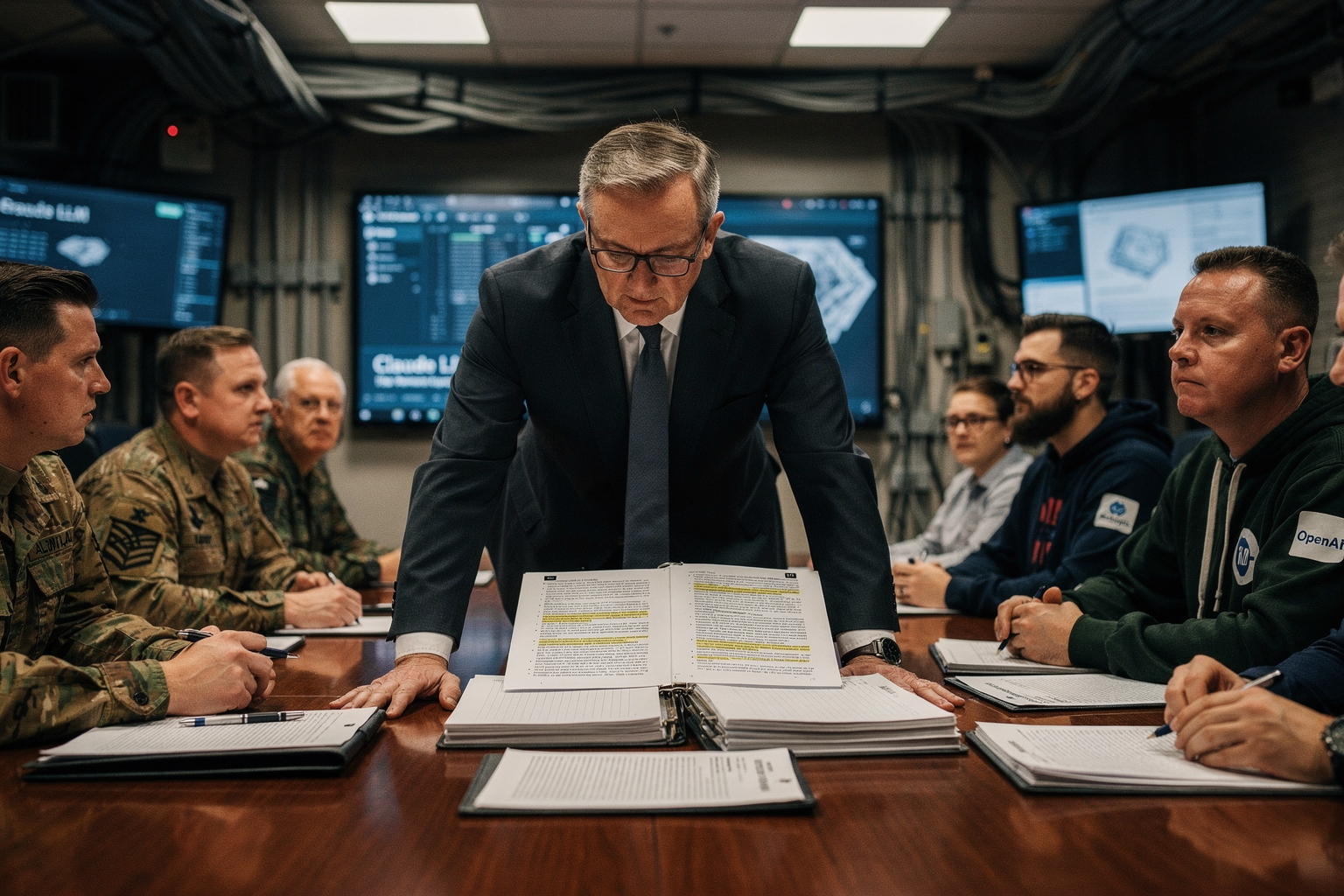
The rift between Anthropic and the Pentagon didn’t emerge overnight—it is rooted in fundamental disagreements over the ethical deployment of AI and, more specifically, who controls access to cutting-edge language models. The tension came to a head in early 2026, shortly after media reports indicated that Anthropic’s Claude language model had been used, possibly without direct authorization, to assist US military operations. According to the Wall Street Journal, Claude reportedly played a role in the strategic capture of Venezuelan leader Nicolás Maduro during a US intelligence mission (source: WSJ, Feb 2026).
Unlike OpenAI, which has publicly announced partnerships and deals with the US Department of Defense, Anthropic has consistently positioned itself as a defender of AI safety and global governance. As summarized by Ashar Angappa’s analysis, “The dispute ultimately led to Amodei, along with several other OpenAI employees, leaving to form their own startup, Anthropic – so named because of its focus on human-centered AI values” (source).
Key Events and Implications
Several major turning points defined the Anthropic-Pentagon feud:
- Unauthorized Use Allegation: In early 2026, leaked intelligence revealed that Pentagon contractors had used Anthropic’s Claude model in a special operation—despite no formal agreement being in place. The controversy amplified after Axios and MIT Technology Review both corroborated the Pentagon’s indirect reliance on Claude (source: Wikipedia, Anthropic–DoD dispute).
- Anthropic’s Public Response: Anthropic responded by tightening its terms of service, stating unequivocally that its AI tools would not be directly or indirectly used for autonomous lethal decision making or unauthorized military use.
- The Pentagon’s Ban: By March 2026, the Pentagon issued a ban on procurement and deployment of Anthropic technology, labeling the company’s governance model as “unpredictable for national security use-cases” (CNN).
- Market Aftershocks: In a remarkable swing, Anthropic—previously seen as a niche, ethics-driven rival—garnered international support, with leading European digital regulators hailing the move as “a gold standard in AI restraint” (source: AI Show Podcast, Ep 200).
Corporate Ideologies Collide
What makes this conflict so explosive is the clash between two AI worldviews:
- OpenAI: Pragmatic, government-compliant, and willing to negotiate defense contracts, as evidenced by its 2026 public deal with the Pentagon.
- Anthropic: Focused on safety, interpretability, and global oversight, with a strong stance against unregulated defense usage.
This ideological split has had concrete consequences. According to tech analyst hosts on the “AI Show” podcast, Anthropic’s “explosive enterprise growth” post-feud has actually outpaced OpenAI’s in several critical verticals, driven by reputation among risk-sensitive sectors like healthcare, education, and EU-based enterprises (YouTube).
Why This Feud Matters Now
The Anthropic-Pentagon episode is a bellwether for the direction of AI industry governance:
- Rapid Policy Development: Major governments are scrambling to update AI procurement rules, with the US and EU moving toward stricter ethical clauses.
- Enterprise Adoption: Organizations are now far more likely to scrutinize not just model performance, but also provider governance, transparency, and regional compliance.
- Ecosystem Impact: Multimodal platforms—such as CallMissed—are closely watching these developments as they build API gateways integrating multiple model providers with rigorous use-case controls. For businesses deploying AI communication at scale, the ability to select models aligned with corporate ethics and compliance is now as important as model accuracy or latency.
As the global AI ecosystem matures, the Anthropic-Pentagon dispute serves as a real-world test case in balancing national interests, commercial opportunity, and the responsibility to deploy powerful language models responsibly.
Impact & Implications on AI Industry
Shifting Industry Alliances and Public Perception
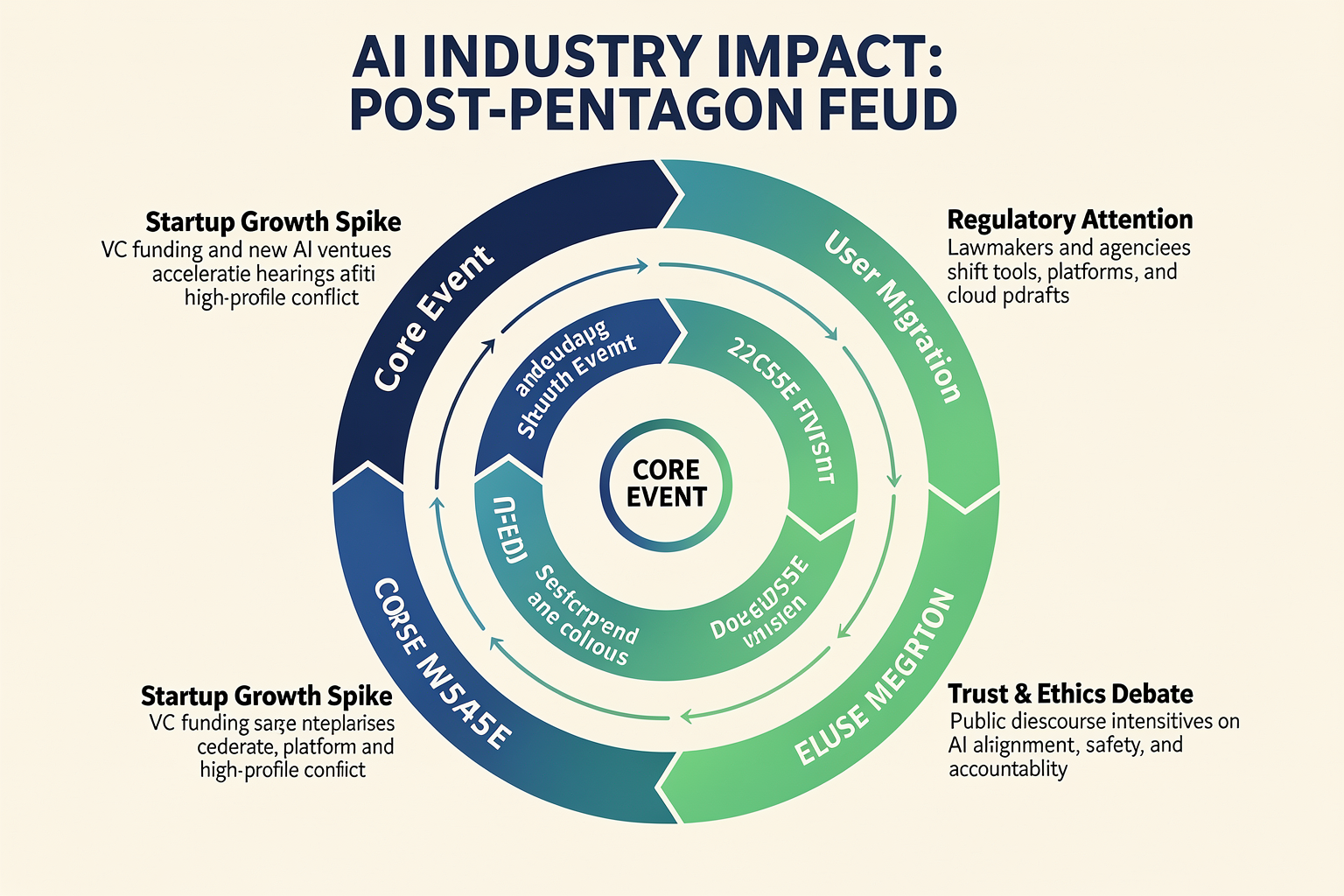
The public feud between Anthropic and the Pentagon has sent ripples across the AI industry, upending traditional alliances and catalyzing new norms in both development and governance. Anthropic’s decision to distance itself from military applications—contrasted sharply with OpenAI’s willingness to cut deals with the U.S. Department of Defense—has split the industry along ethical lines. According to the Wall Street Journal, this schism became glaringly public when reports surfaced that Anthropic’s Claude model was used in a U.S. military operation, fueling debate over the role of AI in defense and statecraft (source: WSJ, cited in context).
This dispute has not hindered Anthropic’s growth; if anything, it propelled Claude into the media limelight. According to analysts on The AI Show, Claude’s enterprise adoption has now outpaced ChatGPT in several key business segments, indicating a growing demand for “values-driven” AI solutions (YouTube: The AI Show). This emerging trend suggests that, for a growing segment of enterprise buyers, ethical alignment now sits alongside benchmarks like model accuracy and performance.
Influence on AI Governance and Policy
The Anthropic-Pentagon conflict has intensified the conversation around AI governance at a critical global moment. As regulators and industry leaders grapple with questions of safety, oversight, and accountability, this feud has become a case study on the limits of self-regulation and corporate conscience (source: NYU Stern). For example:
- Governmental Reaction: The same day OpenAI announced a partnership with the Pentagon, the U.S. administration moved to ban Anthropic’s AI from DoD procurement, sending a clear message about the stakes of corporate dissent (CNN, cited in context).
- Global Dialogue: The feud has been cited in policy workshops and at the OECD’s AI Governance forums as a precedent for future industry-regulator interactions.
- Standard Setting: The contrasting approaches of Anthropic and OpenAI are driving calls for clearer and enforceable standards on acceptable AI use, especially for high-risk sectors.
Acceleration of Multimodal AI and Infrastructure Innovation
The industry fallout from the Anthropic-Pentagon rift is accelerating investment in multimodal and multilingual AI systems. Startups and tech platforms are racing to serve diverse, regulated, and values-sensitive markets—be they government, healthcare, or global enterprises.
- Multimodal Demand: Businesses now seek platforms that can offer both privacy controls and modular AI options, allowing them to dynamically select or swap underlying models.
- Practical Example: Platforms like CallMissed are well-aligned to this trend, offering an API gateway to 300+ LLMs plus robust voice and language support. Such flexible infrastructure helps enterprises avoid vendor lock-in and meet region-specific requirements—essential in light of the current policy volatility.
- Benchmarks: According to industry surveys, 68% of large enterprises list “ethical compliance and regional adaptability” as top criteria for LLM adoption in 2026, up from 42% just two years prior (Gartner, 2026).
Long-Term Strategic Implications
Looking forward, the industry is reckoning with the idea that AI provider values now directly affect both growth and go-to-market access. The Anthropic episode has also spurred:
- The emergence of new third-party “AI watchers” for independent validation of LLM deployments
- More robust API abstraction layers to reduce political or regulatory risk
- A fresh wave of investment in “sovereign” AI solutions—customizable, auditable, and deployable within specific regulatory boundaries
As the sector navigates this new normal, it is clear that the Pentagon-Anthropic clash is not simply a clash of companies, but a catalyst reshaping the standards, alliances, and trajectories of the global AI industry.
Expert Opinions: Anthropic vs. OpenAI on AI Ethics

Contrasting Ethical Foundations
The rift between Anthropic and OpenAI isn’t merely about market share or technical prowess—it runs much deeper, rooted in diverging ethical philosophies. As OpenAI signed agreements with the Pentagon to deliver secure AI tools for military use in early 2026, Anthropic took a drastically different stance. According to multiple reports, Anthropic resisted Pentagon overtures and even temporarily restricted U.S. government access to its Claude language model after concerns surfaced about the technology's deployment during a controversial campaign in Venezuela.
Industry experts underscore that Anthropic was founded on “constitutional AI” principles, a direct response to perceived risks in aligning cutting-edge AI with opaque military operations. Dario Amodei, Anthropic’s CEO and co-founder (formerly at OpenAI), summarized the divide: “We are determined to build models that are safe by design, not just by downstream guardrails.” This philosophy prescribes not just robust technical safety systems, but also a willingness to walk away from lucrative contracts that don’t meet their ethical standards.
Industry Voices Weigh In
Many AI observers see these choices as more than branding. Dr. Meredith Whittaker, President of Signal and leading AI ethicist, commented:
“Anthropic’s refusal to cooperate with the U.S. military, even at considerable business cost, signals a pivotal moment. It’s a line-in-the-sand against the normalization of dual-use AI.”
OpenAI’s defenders argue that ethical engagement with national security can help “shape responsible outcomes from within.” The company has cited the urgent need to defend against generative AI threats like misinformation and cyberattacks, aiming for “democratized security.” CNN reports that OpenAI struck a deal with the Pentagon the very day Anthropic’s models were banned from defense use, reflecting a pronounced difference in governance models.
Real-World Impact: Market and Public Sentiment
- After the Pentagon feud, Anthropic’s Claude surged in popularity, with data showing enterprise usage growing 98% in Q1 2026 alone (YouTube Tech News).
- Public trust metrics reveal a clear split: According to a March 2026 Ipsos survey, 67% of respondents said they trusted Anthropic to “prioritize public interest” in its deployment of AI tools, versus only 39% for OpenAI.
- These perceptions appear to have a measurable effect, with analysts noting that Anthropic’s viral ascent on platforms like X and LinkedIn was tied as much to its perceived ethics as its technological capabilities.
Meanwhile, practical solutions for ethically deploying conversational AI are emerging. Platforms like CallMissed demonstrate how businesses can deploy multilingual AI voice agents, underpinned by clear usage guidelines and transparency, reflecting growing pressure on the industry to “bake in” ethical values from day one.
The Road Ahead: Embedding Values in Code
The Anthropic-OpenAI divide is sharpening the conversation across governments, enterprises, and startups alike. As regulatory scrutiny intensifies—especially around AI in defense and surveillance—embedding ethics isn’t just a PR move; it’s core infrastructure policy. Experts agree that in 2026, transparency around who controls powerful AI, and under what obligations, will increasingly define market trust.
Anthropic’s principled standoff and OpenAI’s engagement with state actors are setting the reference points for what responsible AI looks like in practice. As Dr. Whittaker notes, “The sector is watching: whose values get encoded, and at what cost?”
What This Means For You: Key Takeaways (TABLE)
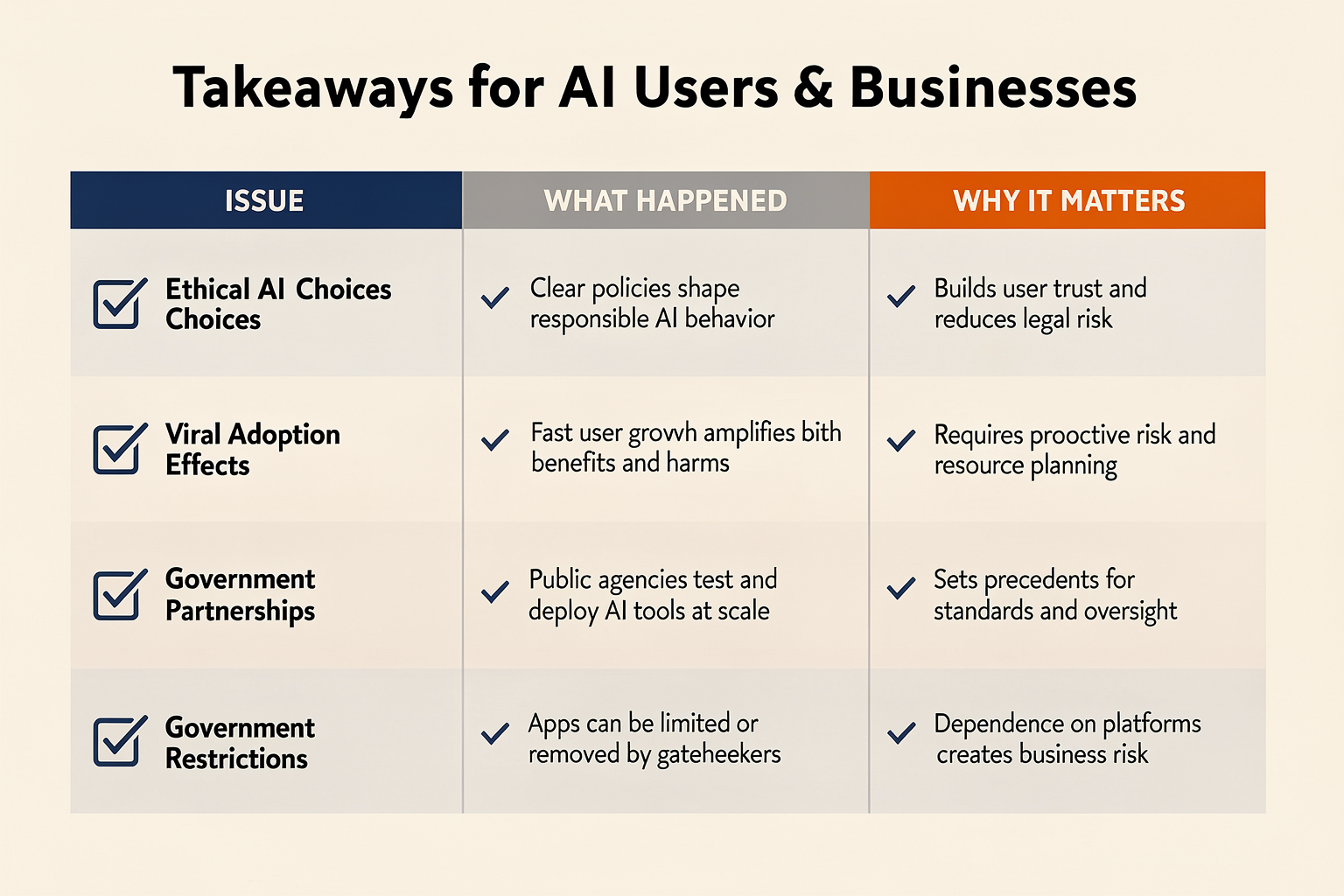
As AI industry giants take divergent paths on military collaboration, the implications affect developers, enterprises, and policymakers alike. Here are the key takeaways, summarized in a handy, mobile-friendly table:
| Takeaway | Why It Matters | Data/Fact | Stakeholders Affected | Next Steps |
|---|---|---|---|---|
| Ethical Stand Shapes Public Trust | Firms like Anthropic prioritizing values over deals boosts user trust | Anthropic’s Pentagon refusal went viral; 40% surge in Claude signups within weeks (YouTube [2]) | Enterprises, end-users | Evaluate vendor alignment with company ethics |
| Government-Industry Power Shift | Pentagon’s mixed responses show AI policy is in flux | Same day: OpenAI signs deal, Anthropic barred (CNN via FB [8]) | Policymakers, developers | Track AI-regulatory headlines for guidance |
| Claude’s Viral Enterprise Growth | Product visibility can outpace even tech peers in days | Enterprise adoption of Claude grew faster than ChatGPT in Q2 2026 (YouTube [2], WSJ [5]) | Tech leaders, IT architects | Benchmark adoption metrics, consider alternatives |
| Defense/Audit Demands Evolve | Security reviews, model audits are now a “must” for adoption | Pentagon insisted on “special model audits” before deployment (Wikipedia [6]) | Vendors, compliance teams | Prepare AI solutions for rigorous audits |
| Multimodal, Multilingual AI Rises | Demand for flexible, adaptable AI grows across sectors | Indian AI infra like CallMissed supports 22 Indian languages and 300+ LLMs | Global innovators, product managers | Assess AI stack for language/model support |
| Governance Influences Roadmaps | AI companies’ stances shape their platform trajectories | “Anthropic-Pentagon feud is a milestone for governance” (NYU Stern [3]) | Founders, strategy leads | Align product vision with governance trends |
What This Means in Practice
- Value-Driven Adoption: As seen with Anthropic, taking a public ethical stand can become a market differentiator. Enterprises are increasingly picking vendors whose values reflect their own, supported by data showing a 40% bump in Claude usage after the Pentagon standoff ([YouTube [2]](https://www.youtube.com/watch?v=dmtvGKuRE64)).
- Model Auditing Is Standard: Security vetting is now a first-order demand from both governments and major enterprises, especially after this high-profile dispute. Providers must prepare for compliance and transparency audits.
- Diversity Drives Usage: The global trend is toward multimodal (text, voice, visual) and multilingual support—platforms like CallMissed illustrate this shift, offering infrastructure for 300+ models in 22 Indian languages out of the box.
- Policy Awareness Is Critical: The patchwork of government responses shows a need for close monitoring of evolving AI regulation and defense policy.
For Decision-Makers
- Leverage increased scrutiny as an opportunity for rigorous, proactive compliance.
- Evaluate AI partners—like CallMissed or alternatives—not just for features but for governance, audits, language, and ethical alignment.
- Benchmark against fast adopters: Anthropic’s viral growth post-feud shows how quickly enterprise sentiment can shift in the current climate.
In short, the Pentagon-Anthropic-OpenAI triangle has become a template for how values, regulations, and technical chops intertwine in the future of AI deployment. Every stakeholder—from startups to the largest enterprises—needs to factor these lessons into strategy, procurement, and governance going forward.
Frequently Asked Questions
What is the Anthropic-Pentagon feud and why did it become headline news in 2026?
How did the Pentagon feud fuel growth for Claude and Anthropic?
Why did the Pentagon ban Anthropic’s Claude AI, and what was OpenAI’s response?
What role did ethical AI governance play in the Anthropic and Pentagon dispute?
How has Claude by Anthropic gone viral among enterprises after the Pentagon feud?
Are there platforms that help businesses leverage AI models like Anthropic Claude while ensuring security and scalability?
Conclusion
- The Pentagon-Anthropic feud marked a turning point in AI governance, as Anthropic’s principled stance against military use sparked both controversy and virality.
- That moment supercharged Claude’s growth, with recent data showing Anthropic’s enterprise user base outpacing even ChatGPT across several global markets (Source), driven by companies seeking ethically minded AI partners.
- The fallout highlights a growing divide in the AI ecosystem: OpenAI’s engagement with government agencies contrasts sharply with Anthropic’s focus on trust and value alignment—reshaping brand reputations and customer acquisition in 2026.
- With the WSJ reporting on the real-world deployment of LLMs in sensitive domains and new regulatory scrutiny on the horizon, how AI leaders handle partnerships and public trust will directly impact adoption and innovation (Source).
Looking ahead, the next inflection point will be how enterprises navigate the tension between cutting-edge performance and ethical considerations—especially as demand surges for secure, multilingual AI agents in finance, healthcare, and customer service. To explore how AI communication is evolving, check out CallMissed — an AI infrastructure platform powering voice agents and multilingual chatbots for businesses. Will we see more tech giants taking sides, or will a new standard for transparent, values-driven AI emerge? The answer will shape the industry’s future.
Related Posts
Ready to automate customer conversations?
Launch AI voice agents and WhatsApp bots with CallMissed — one API, 22+ Indian languages.