India's AI Hiring Boom Hits a Talent Wall: Navigating the 83% GenAI Skills Gap


India's AI Hiring Boom Hits a Talent Wall: Navigating the 83% GenAI Skills Gap
Did you know that despite boasting a massive workforce of over 920,000 AI professionals, Indian enterprises are currently facing a staggering 83% GenAI skills gap?
India has rapidly emerged as a premier global innovation engine for artificial intelligence, driving a massive 60% year-over-year surge in AI job openings across tech hubs like Bengaluru and Hyderabad. According to recent market data, Indian employers generated an unprecedented demand for over 350,000 AI roles in a mere 90-day window. This hiring frenzy marks a critical inflection point: the enterprise market is moving decisively beyond isolated proof-of-concept experiments to deploy large-scale, production-ready systems capable of autonomous execution.
However, India's AI hiring boom has run headfirst into a talent wall. While the country possesses a vast general IT workforce, the specialized skills required to build, orchestrate, and optimize complex agentic AI systems remain incredibly scarce. A landmark report by Quess Corp highlights this stark reality, revealing that the country is grappling with an 83% GenAI skills gap (specifically 82.9%). This mismatch is particularly severe as businesses shift from basic software engineering to core AI roles. Traditional degree-based hiring is failing to supply developers who understand prompt engineering, retrieval-augmented generation (RAG), and LLM fine-tuning at scale.
To bypass this severe engineering bottleneck, forward-thinking enterprises are increasingly leveraging managed infrastructure; for instance, platforms like CallMissed enable companies to deploy sophisticated, multilingual AI voice agents natively supporting 22 Indian regional languages without needing to recruit scarce, specialized LLM developers.
In this article, we will unpack the root causes of this widening talent shortage, explore how the transition from human augmentation to autonomous AI execution is disrupting the Indian IT landscape, and outline actionable strategies—ranging from skill-based hiring to low-code API integration—to help your organization bridge the gap and scale effectively.
Introduction

India’s technology sector is undergoing a massive, structural transformation. For decades, the Indian IT landscape thrived on scale, cost-arbitrage, and execution excellence. Today, however, we are witnessing a paradigm shift. Enterprises are rapidly moving past the era of sandbox experimentation and proof-of-concept (PoC) pilots to deploy real-world, autonomous AI systems at scale.
This transition from simple "AI augmentation" to "autonomous execution" has triggered an unprecedented hiring frenzy. According to recent market data, India's AI job market saw a staggering demand of 3.5 lakh (350,000) jobs in a single 90-day period. Yet, as organizations rush to scale their workflows, they have run headfirst into a formidable barrier: a severe shortage of specialized, production-ready GenAI talent.
The Great Talent Paradox: Supply vs. Skill
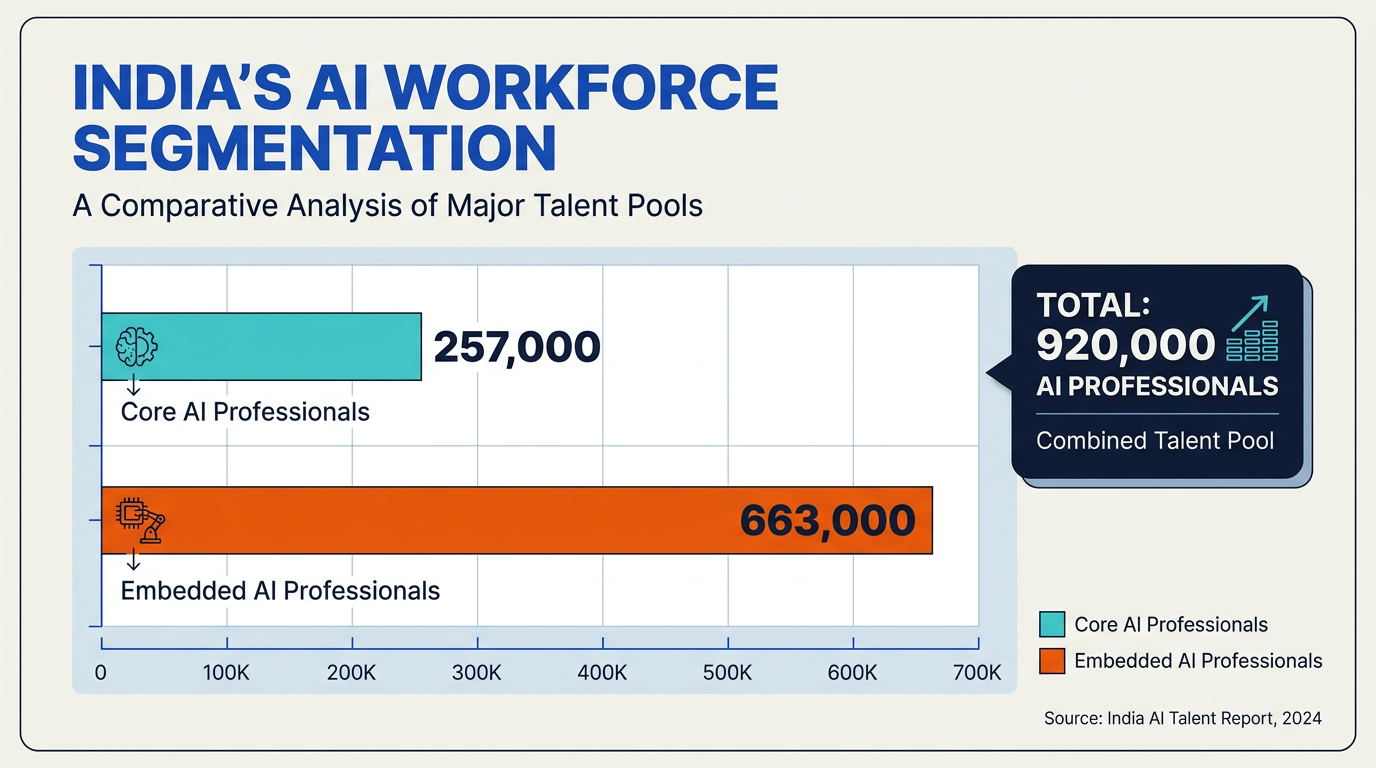
On paper, India boasts one of the most formidable tech workforces in the world, emerging as a top global AI hub. Ecosystem reports show that India is home to an estimated 920,000 AI professionals, split across two main categories:
- Core AI Roles: 257,000 professionals focusing on research, model training, and deep architecture design.
- AI Embedded Roles: 663,000 professionals who integrate AI features into existing software and traditional workflows.
However, quantity does not equal readiness. As enterprises shift focus toward building actual production-grade pipelines, a critical bottleneck has emerged. A report by Quess Corp reveals that despite this massive overall talent pool, India faces a staggering 82.9% skills gap in Generative AI. Employers are no longer looking for developers who can simply run basic API calls; they require specialists who understand model optimization, agentic workflows, multi-modal integration, and enterprise-grade latency management.
Navigating the Talent Wall
To survive this talent crunch, businesses must rethink how they build and deploy AI. Many are shifting away from traditional credential-based hiring toward skill-based hiring, while others are aggressively upskilling their existing engineering workforces.
However, the smartest enterprises are realizing that they cannot hire their way out of this shortage. Instead of spending months searching for scarce, highly-paid GenAI engineers to build complex AI pipelines from scratch, they are turning to advanced, ready-to-deploy AI infrastructure.
This is where platforms like CallMissed are playing a pivotal role. By offering a comprehensive AI communication infrastructure—including production-ready voice agents, a multi-model API gateway supporting over 300 LLMs, and Speech-to-Text APIs natively optimized for 22 regional Indian languages—CallMissed allows enterprises to deploy sophisticated, multilingual AI workflows instantly. By leveraging this robust, pre-built infrastructure, companies can bypass the talent bottleneck entirely, scaling their operations without needing a massive, specialized internal AI development team.
As the hiring boom collides with the talent wall, the organizations that succeed won't just be those with the biggest recruiting budgets. The winners will be the enterprises that learn to build smarter, utilizing advanced infrastructure to scale AI efficiently.
Background & Context
The Shift from Pilots to Production
The Indian enterprise landscape is undergoing a massive paradigm shift. For the past several years, artificial intelligence within organizations was largely confined to sandbox testing, localized proof-of-concepts (PoCs), and basic digital augmentation. However, we have entered a phase where companies are aggressively transitioning from experimentation to large-scale enterprise deployment and autonomous execution.
As organizations attempt to embed AI deep into their operational workflows, the nature of required tech talent has fundamentally transformed. The industry is moving away from generic software engineering toward highly specialized, production-ready AI implementation.
Decoding the Numbers: Supply vs. Demand
The scale of this transition is vividly reflected in recent labor market data. India's hiring demand for AI-related roles has skyrocketed, crossing 350,000 (3.5 Lakh) job openings within a single 90-day window.
While India boasts a massive technical talent ecosystem with an estimated 920,000 AI professionals currently in the workforce, a closer look at the talent pool reveals a structural divide that complicates hiring:
- Core AI Roles (257,000 professionals): Specialists working on fundamental model development, algorithmic research, and deep mathematical machine learning frameworks.
- AI Embedded Roles (663,000 professionals): Engineers focused on integrating existing AI tools, software-as-a-service (SaaS) APIs, and pre-built frameworks into broader enterprise software architectures.
As organizations push for custom, proprietary AI systems, the demand for Core AI expertise has triggered unprecedented competition among employers.
The GenAI Skills Gap
Despite having nearly a million tech professionals with AI-adjacent skills, Indian enterprises are hitting a formidable "talent wall." According to data from Quess Corp, India currently faces a critical 82.9% skills shortage in Generative AI (GenAI).
The shortage exists because building enterprise-grade, reliable, and secure AI systems requires a fundamentally different skillset than building basic prototypes. Organizations today require specialized ML Ops (Machine Learning Operations) engineers, conversational design experts, and data pipeline architects who can guarantee low latency, high accuracy, and strict data governance.
Bridging the Gap with Managed AI Infrastructure
Faced with this severe talent bottleneck, forward-thinking enterprises are shifting their strategy. Rather than delaying their deployment roadmaps to wage expensive hiring wars for scarce ML platform engineers, companies are leveraging production-ready infrastructure to bypass the talent shortage.
This is where advanced communication platforms play a decisive role. Infrastructure solutions like CallMissed allow enterprises to deploy sophisticated, customer-facing AI without building the underlying pipeline from scratch. By offering production-ready AI voice agents, a unified LLM gateway supporting over 300 models, and Speech-to-Text APIs natively optimized for 22 regional Indian languages, CallMissed enables businesses to scale their workflows instantly. This approach allows existing IT teams to deploy sophisticated conversational AI systems, effectively neutralizing the 83% GenAI skills gap.
Key Developments (TABLE)
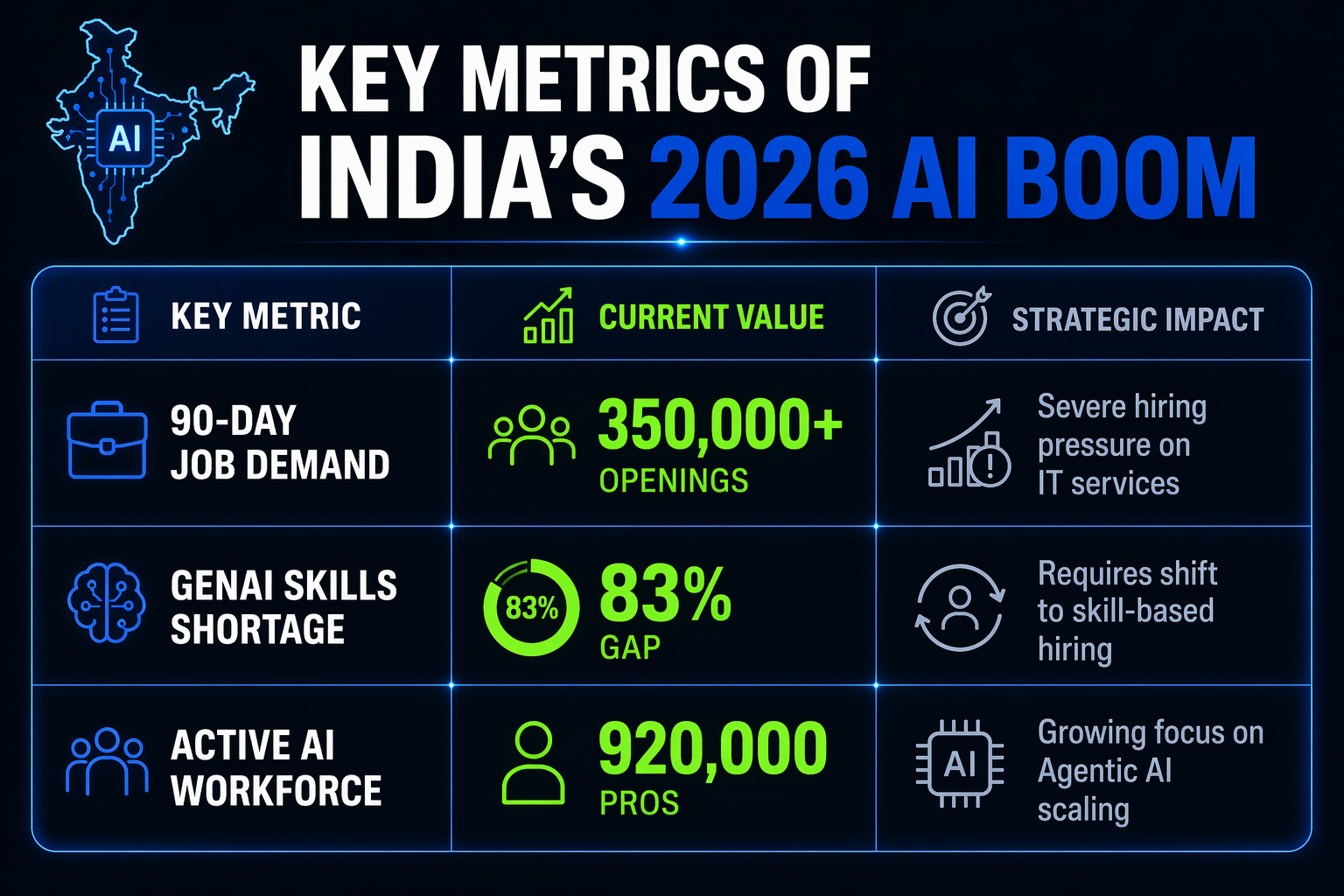
As Indian enterprises pivot from proof-of-concept (PoC) experimentation to production-grade deployment, the operational demands on technical talent have shifted. The industry is moving away from basic prompt engineering and entering the era of autonomous execution, agentic AI, and complex workflow automation. According to recent market studies, this rapid scaling has triggered a severe supply-demand mismatch across the country's technology hubs.
To understand the sheer scale of this talent crunch, we can examine the latest metrics shaping India's AI workforce landscape:
| Metric / KPI | Current Data Point | Key Driver | Talent Implications |
|---|---|---|---|
| Total AI Workforce | 920,000 professionals | Growth in Indian Global Capability Centers (GCCs) | Split between 257K Core AI and 663K Embedded AI roles |
| Active Job Demand | 350,000+ open roles (90-day period) | Enterprise shift from pilots to production deployment | Extreme competition for deployment & orchestration specialists |
| GenAI Skills Gap | 82.9% talent shortage | Rapid transition to autonomous, agentic workflows | Heavy reliance on skill-based hiring over formal degrees |
| AI Job Growth | 60% Year-on-Year increase | Expanding regional demand across Indian tech hubs | Concentrated hiring pressure on Bengaluru and Hyderabad |
Navigating the Core vs. Embedded AI Divide
The data highlights a critical bifurcation in the market: while India boasts a massive pool of 920,000 AI-adjacent professionals, only 257,000 are classified as Core AI developers. The remaining 663,000 occupy AI Embedded roles—professionals who use AI tools but lack the specialized engineering expertise to build, fine-tune, or deploy complex model architectures.
This distinction explains why, despite a massive tech ecosystem, staffing leaders like Quess Corp report a staggering 82.9% skills gap in generative AI. Enterprises can no longer rely purely on scale and traditional engineering execution. Instead, they are forced to shift toward skill-based hiring, intensive internal upskilling, and the adoption of managed AI infrastructure to bypass the talent bottleneck.
To scale workflow automation without waiting months to recruit elusive machine learning specialists, forward-thinking enterprises are leveraging pre-built cognitive infrastructure. For instance, platforms like CallMissed enable businesses to deploy highly scalable, conversational AI voice agents and WhatsApp chatbots immediately. By utilizing CallMissed's ready-to-use APIs—which support Speech-to-Text in 22 regional Indian languages and connect natively to over 300 LLMs—companies can execute complex customer communication workflows without needing to build an in-house team of speech and NLP specialists from scratch.
In-Depth Analysis: The Pilot-to-Production Chasm
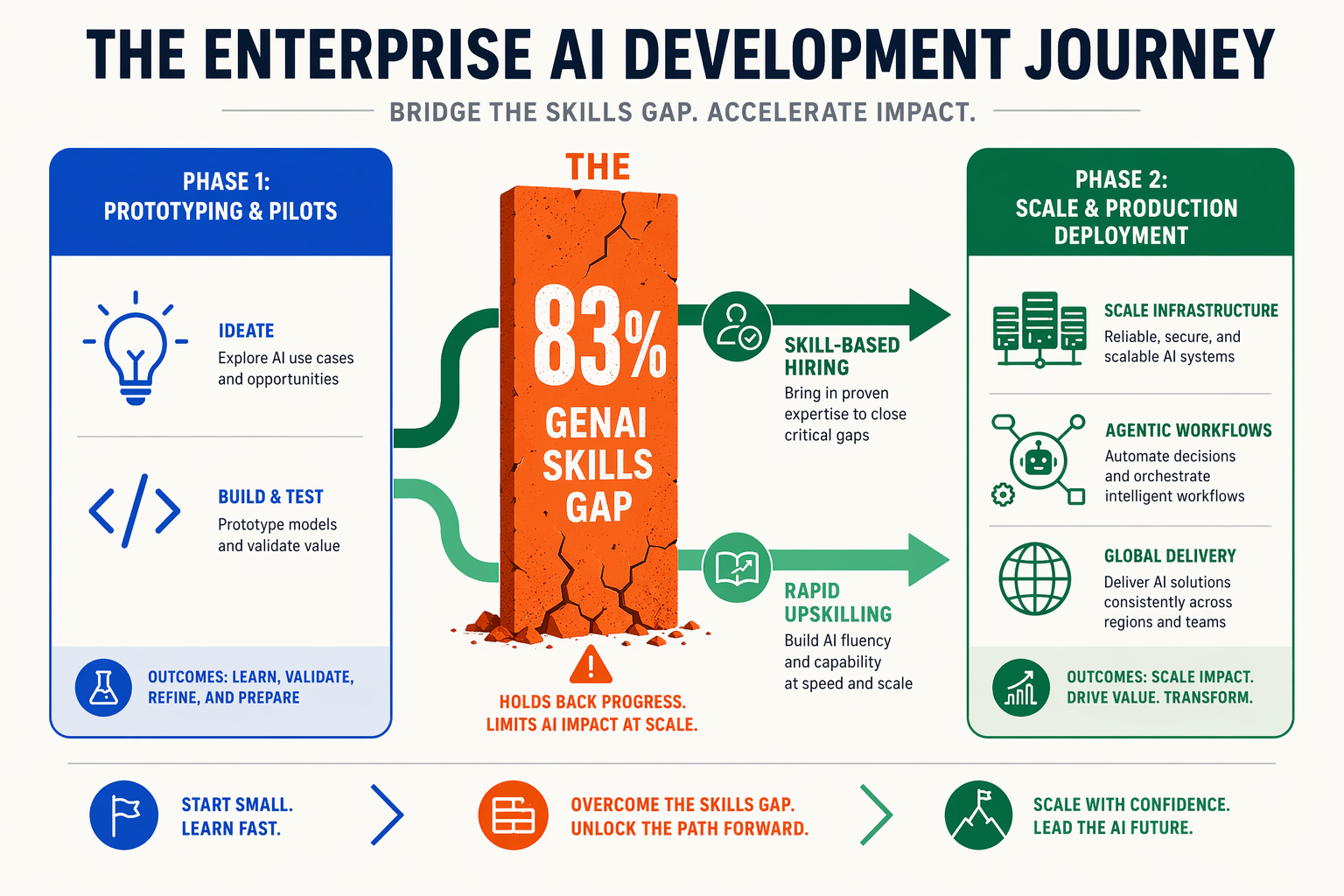
For years, Indian enterprises treated artificial intelligence as a playground for innovation labs. Today, the landscape has radically shifted. Companies are moving rapidly past isolated Proof of Concept (PoC) models and entering the challenging realm of large-scale, real-world deployment. This transition from "augmentation to autonomous execution" is a watershed moment for the Indian tech ecosystem, but it has exposed a deep structural valley: the pilot-to-production chasm.
The scale of this shift is visible in the numbers. Recent industry data indicates an unprecedented surge in demand, with over 350,000 AI job openings emerging within a single 90-day window as enterprises rush to operationalize their AI strategies. However, this massive demand has collided with a severe talent bottleneck. While India boasts a robust base of approximately 920,000 AI professionals—divided between 257,000 core AI specialists and 663,000 embedded AI roles—the specific skills required for production-grade deployment are critically scarce. According to reports from Quess Corp, the country faces a staggering 82.9% skills gap in Generative AI.
The Technical Reality of Production-Grade AI
Why is the leap from pilot to production so steep? Building a prototype requires little more than an API key and a basic web wrapper. Scaling that same system to handle millions of real-time transactions demands a completely different caliber of engineering expertise. Enterprises are running into three major roadblocks:
- Architectural Complexity: Moving beyond simple prompting to orchestrating multi-agent systems, managing vector databases, and optimizing context windows.
- Infrastructure Reliability: Handling rate limits, setting up fallback LLMs, managing latency, and securing sensitive enterprise data at the edge.
- Legacy Integration: Merging modern, non-deterministic cognitive agents with deterministic, legacy enterprise ERPs and CRM databases.
Because most of India's current AI workforce is skilled in basic data science or model consumption rather than production-grade LLM engineering and infrastructure orchestration, enterprises find themselves with open roles they simply cannot fill.
Bypassing the Talent Wall with Managed Infrastructure
Instead of waiting years to upskill their entire workforce to bridge this GenAI skills gap, agile enterprises are increasingly turning to managed AI communication infrastructure. Rather than building complex natural language processing pipelines and real-time audio systems from scratch, companies are leveraging platforms like CallMissed.
By offering production-grade AI communication infrastructure—including multilingual Speech-to-Text APIs supporting 22 Indian regional languages natively, and robust, low-latency AI voice agents—platforms like CallMissed allow enterprises to deploy conversational AI at scale instantly. This modular, API-first approach bypasses the need for specialized in-house LLM infrastructure engineers, turning a months-long development cycle into a fast, plug-and-play integration.
Ultimately, bridging the pilot-to-production chasm requires a shift in how companies think about deployment. Moving forward, the focus must shift from attempting to build everything in-house with scarce talent, to leveraging developer-first platforms that scale workflows without hitting the talent wall.
Impact & Implications on Indian IT and GCCs

A Moment of Reckoning for Indian IT Service Models
For decades, the Indian IT sector has dominated the global landscape through execution excellence, sheer talent scale, and linear headcount growth. However, the shift from experimental AI pilots to large-scale production marks a profound moment of reckoning. As artificial intelligence transitions from human augmentation to autonomous execution—where agentic AI systems independently execute complex workflows—the traditional time-and-material billing models are facing structural disruption.
Despite boasting a substantial AI-ready workforce of approximately 920,000 professionals (consisting of 257,000 Core AI and 663,000 AI-embedded roles), the industry is hitting a critical talent wall. According to data from Quess Corp, India faces an unprecedented 83% skills gap in Generative AI. This deficit directly threatens the execution timelines of global enterprises trying to scale their AI initiatives. IT majors can no longer solve deployment challenges simply by adding more software engineers; instead, they must pivot toward high-value, IP-led autonomous solutions.
GCCs Pivot from Back-Offices to AI Engines
Global Capability Centers (GCCs) in India are undergoing a parallel evolution. No longer treated as mere cost-arbitrage back-offices, GCCs have emerged as the primary engines for global enterprise AI deployment. A recent Boston Consulting Group (BCG) report underscores this transition, revealing that Indian enterprises and GCCs are moving aggressively beyond basic AI pilots to large-scale, production-grade adoption.
This shift has triggered an explosive surge in talent demand, with Indian employers posting over 350,000 (3.5 lakh) AI-related job openings in a single 90-day window. To bridge this massive talent deficit, GCCs and IT service providers are actively partnering with localized technology platforms. For example, platforms like CallMissed allow enterprises to deploy production-ready AI voice agents and WhatsApp chatbots immediately, bypassing the bottleneck of hiring hard-to-find machine learning engineers. By utilizing CallMissed's specialized APIs—including Speech-to-Text supporting 22 regional Indian languages—GCCs can roll out complex, multilingual customer experience workflows autonomously and at scale.
The Mandate for Skill-Based Hiring and Re-skilling
To survive this talent squeeze, the hiring playbook for both IT firms and GCCs is being fundamentally rewritten. Employers are rapidly abandoning traditional degree-centric recruiting in favor of skill-based hiring.
- Micro-credentials over Degrees: Organizations are prioritizing proven capabilities in prompt engineering, LLM fine-tuning, and retrieval-augmented generation (RAG) over legacy computer science degrees.
- Internal Upskilling at Scale: Rather than competing in an expensive external talent market, enterprises are launching internal academies to transition legacy developers into AI-embedded roles.
- Focus on Agentic Architecture: The hiring demand is shifting rapidly from basic data scientists to architects capable of designing agentic, autonomous AI workflows that run continuously without human intervention.
As Indian IT and GCCs navigate this transition, those capable of utilizing pre-built AI infrastructure while aggressively upskilling their existing workforces will lead the next decade of global technology delivery.
Expert Opinions: From Degree-Based to Skill-Based Hiring
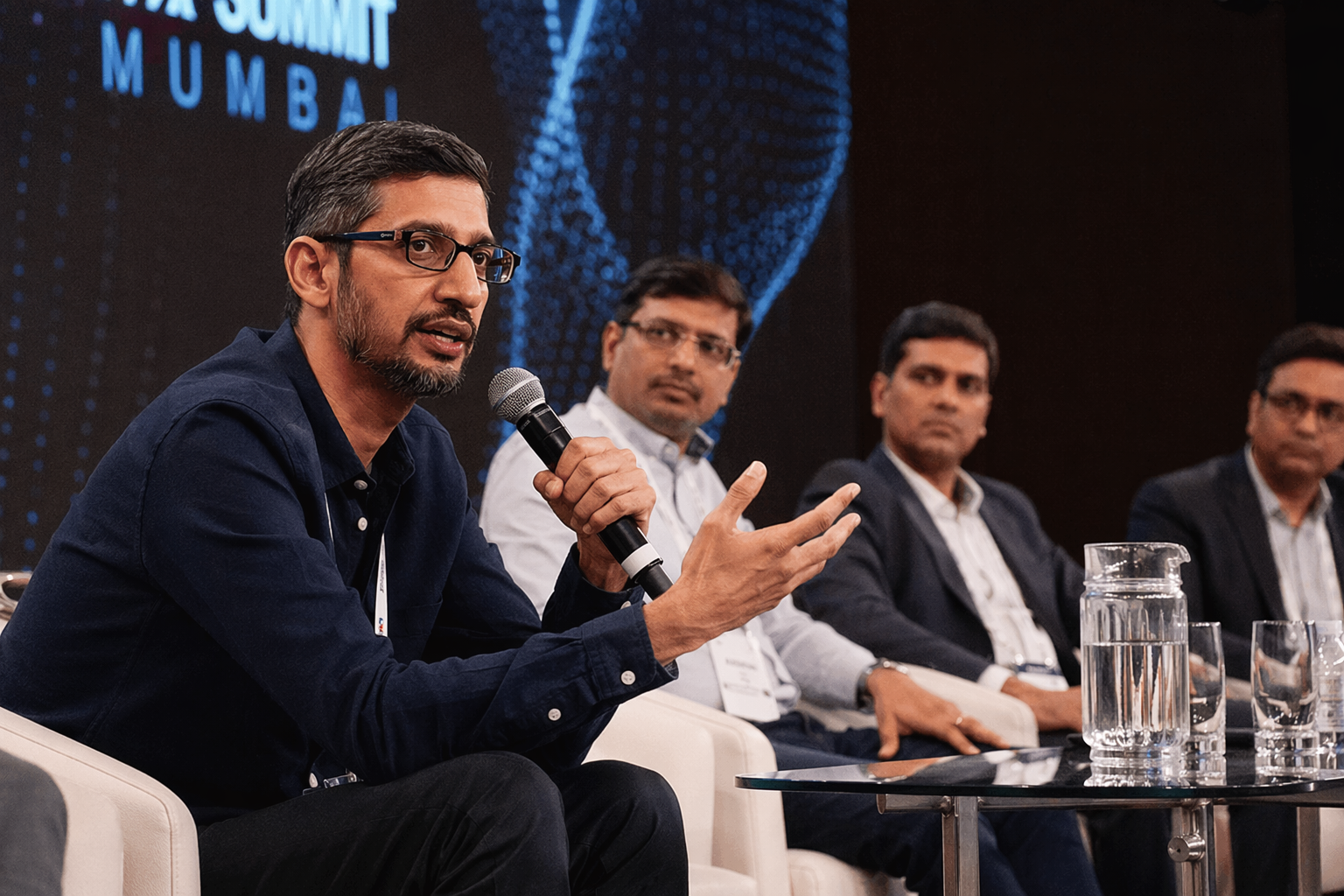
As Indian enterprises aggressively transition from experimental AI pilots to full-scale production, the traditional recruitment playbook is proving obsolete. With a surging demand of 350,000 (3.5 Lakh) AI jobs emerging in just 90 days, the talent shortage has reached critical levels. Industry experts are sounding the alarm: to survive this crunch, organizations must abandon rigid, degree-based hiring and pivot toward a dynamic, skill-based model.
The Deficit in Traditional Pedigree
According to a recent report by Quess Corp, despite India boasting a massive talent pool of 920,000 AI professionals—comprising 257,000 in Core AI and 663,000 in AI Embedded roles—the country faces a staggering 82.9% skills gap in Generative AI.
This deficit highlights a stark reality: academic degrees cannot keep pace with the exponential velocity of AI development. Experts emphasize that as AI shifts from basic task augmentation to autonomous execution, traditional credentials fail to measure a candidate's readiness for real-world deployment challenges, such as:
- Agentic AI Orchestration: Building self-correcting, multi-agent workflows.
- LLM Fine-Tuning & Optimization: Reducing latency and token costs for enterprise-grade deployment.
- Multilingual Contextualization: Adapting models to handle regional dialects and unstructured local data.
Redefining the Ideal AI Candidate
To bypass the talent wall, forward-thinking enterprises are restructuring their hiring pipelines to prioritize practical, verifiable capabilities over elite university credentials. Industry leaders recommend focusing on three core criteria:
- Proven Deployment Portfolios: Prioritizing developers who have successfully moved models out of experimental sandboxes (like Jupyter notebooks) and into scalable, high-availability production environments.
- API and Framework Orchestration: Valuing hands-on experience with modern LLM orchestration tools (e.g., LangChain, LlamaIndex) over theoretical mathematical modeling.
- Cross-Disciplinary Adaptability: Evaluating a candidate’s capacity to rapidly master and integrate newly released foundation models as they emerge.
Bypassing the Talent Bottleneck with Infrastructure
While restructuring hiring pipelines is vital for long-term growth, enterprises scaling their operations today cannot afford to wait for the talent market to correct itself. To mitigate immediate resource constraints, savvy organizations are leveraging advanced, pre-built AI communication infrastructure.
Instead of spending months attempting to recruit highly scarce, expensive NLP specialists to build custom localized models, companies are utilizing platforms like CallMissed. By leveraging CallMissed’s developer-friendly APIs, existing software teams can immediately deploy AI voice agents and WhatsApp chatbots that natively support 22 Indian languages. This approach allows enterprises to scale their communication workflows and tap into advanced Speech-to-Text capabilities without needing to hire a dedicated, specialized in-house GenAI research team.
Ultimately, the shift from degree-based to skill-based hiring is not just an HR trend—it is a strategic necessity. By combining pragmatic, skill-focused recruitment with robust AI infrastructure, Indian enterprises can successfully breach the talent wall and achieve true operational scale.
What This Means For You (TABLE)
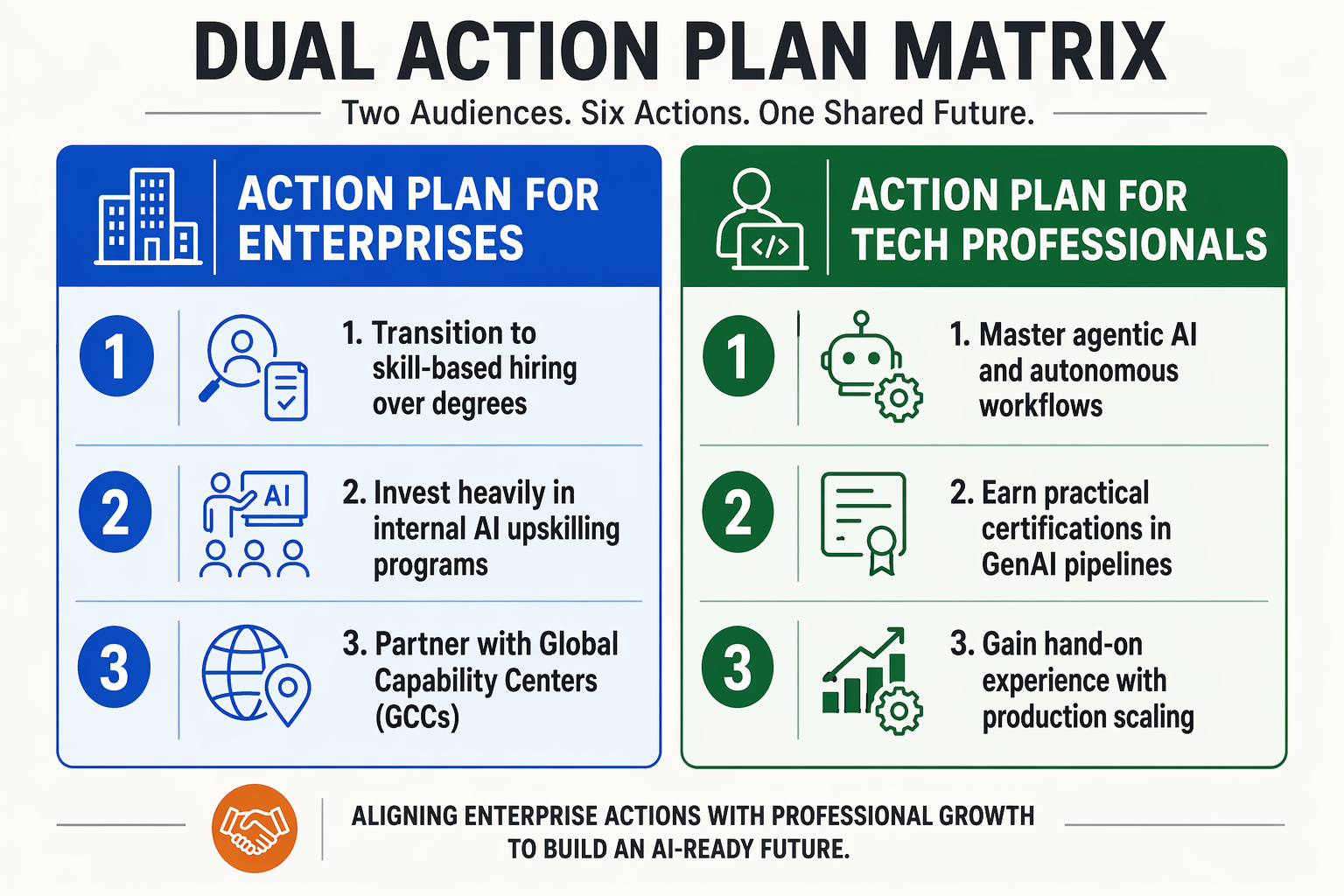
The transition of AI from experimental pilots to production-scale autonomous execution has fundamentally altered the Indian tech ecosystem. With a surging demand for 350,000 AI roles in a single 90-day window, India's existing pool of 920,000 AI professionals (consisting of 257,000 core and 663,000 embedded roles) is under immense strain. The resulting 82.9% GenAI skills gap means businesses can no longer hire their way out of this challenge using traditional recruitment. Whether you are a business leader trying to scale or a developer looking to capitalize on this boom, this talent wall requires a strategic pivot.
The table below outlines how different stakeholders must adapt to this rapidly shifting landscape:
| Stakeholder | Key Challenge | Strategic Action | Tech/Skill Focus |
|---|---|---|---|
| Enterprise Leaders | Scaling workflows amidst an 83% GenAI talent shortage. | Shift from building in-house to adopting API-first managed AI infrastructure. | Agentic AI, API Gateways, LLM Orchestration |
| Tech Professionals | Keeping up with rapid shift from prompt engineering to autonomous execution. | Transition from legacy coding to system integration, AI agents, and custom LLM tuning. | Multi-model fine-tuning, RAG, Speech-to-Text |
| HR & Recruiters | Sourcing bottlenecks due to legacy degree-based hiring models. | Pivot to skill-based hiring, practical hackathons, and aggressive internal upskilling. | Hands-on portfolio evaluation, GenAI certifications |
| IT & Tech Providers | Delivery pressure as clients demand production-grade deployment over pilots. | Integrate production-ready voice and text agent platforms to accelerate delivery. | Multilingual NLP, Conversational AI, TTS APIs |
Redefining Your Strategy for the Autonomous Era
As the industry shifts from human augmentation to autonomous execution and agentic AI systems, the skill sets in demand have dramatically evolved. It is no longer enough to understand basic machine learning models; enterprises need developers who can build reliable, production-ready systems that handle complex, real-world workflows.
- For Job Seekers: Focus on hybrid architectures like Retrieval-Augmented Generation (RAG) and orchestrating multi-model systems. The 60% rise in AI jobs in major hubs like Bengaluru and Hyderabad heavily favors professionals who understand deployments, latency optimization, and agentic workflows.
- For Enterprises: Stop trying to build complex AI pipelines from scratch. Attempting to hire a full stack of NLP, speech, and LLM specialists in this market is highly inefficient. Instead, leverage pre-built API infrastructures that allow you to orchestrate models without the massive engineering overhead.
Bypassing the Talent Wall with Managed Infrastructure
Building conversational AI pipelines in-house requires highly specialized talent—ranging from Speech-to-Text (STT) and Text-to-Speech (TTS) engineers to localized language experts. Given India's acute talent shortage, finding these professionals is both slow and prohibitively expensive.
To scale workflow automation without getting stuck behind this talent wall, forward-thinking enterprises are turning to production-ready AI communication infrastructure. Platforms like CallMissed enable companies to instantly deploy sophisticated, autonomous AI voice agents and WhatsApp chatbots. By leveraging CallMissed’s multi-model API gateway (supporting 300+ LLMs) and native Speech-to-Text capabilities across 22 regional Indian languages, businesses can deploy highly localized customer agents in days rather than months. This allows lean in-house engineering teams to focus on core business logic rather than rebuilding foundational AI architecture from scratch.
Frequently Asked Questions
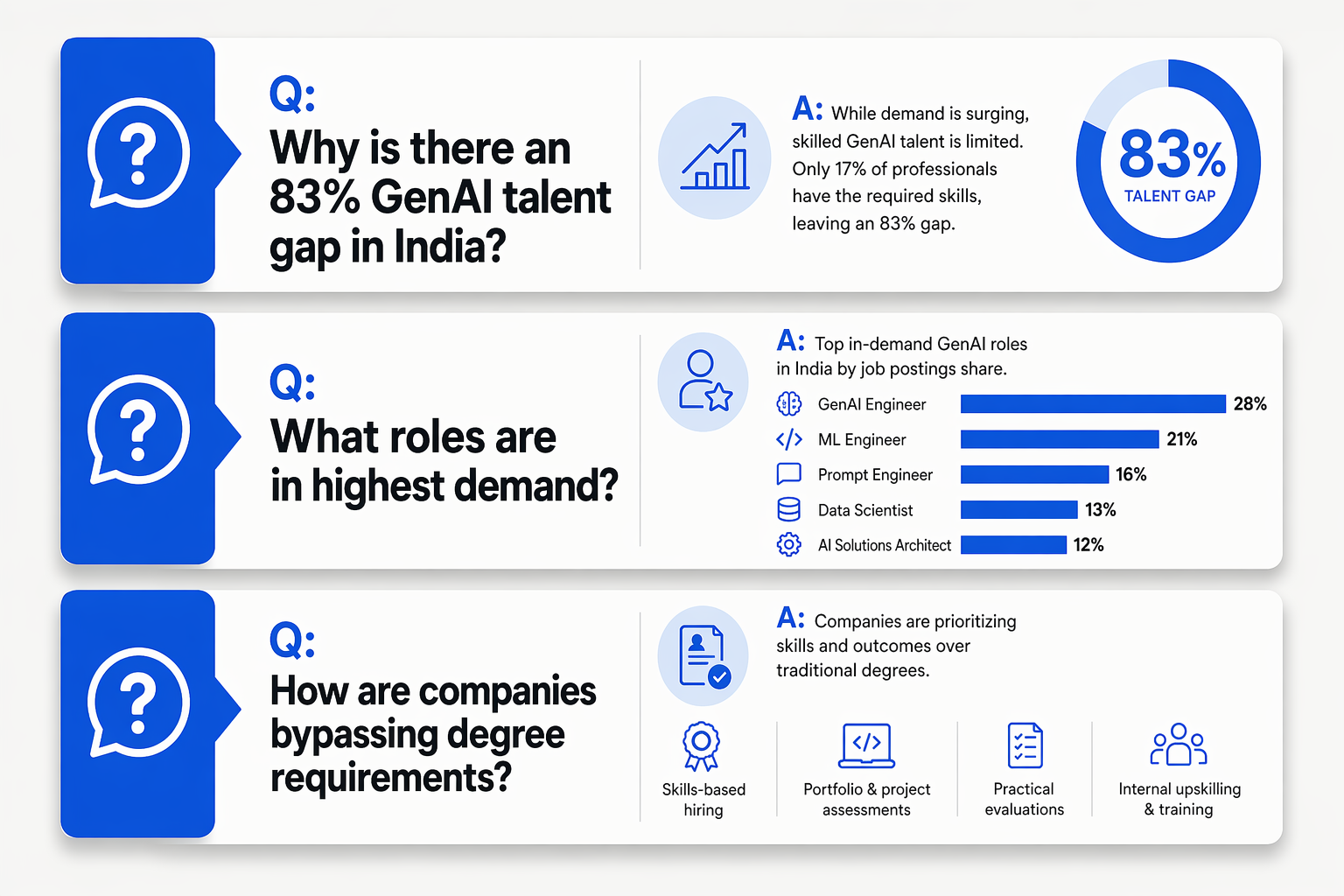
What is driving India's AI hiring boom as enterprises transition from pilots to production?
How severe is the talent shortage during India's AI hiring boom?
Which Indian cities are leading the demand for AI talent and job creation?
How can enterprises scale their operations when facing an acute AI talent shortage?
What specific roles are most sought after in India's AI hiring boom?
Why is there an 83% skills gap in GenAI despite India having nearly a million AI professionals?
Conclusion
As Indian enterprises aggressively shift from experimental AI pilots to large-scale, autonomous execution, navigating the severe talent crunch requires a strategic pivot.
Here are the key takeaways to guide your organization's transition:
- The Production Shift: Enterprise demand has surged to over 350,000 AI jobs, signaling a rapid transition from basic experimentation to real-world deployment.
- The Skills Chasm: Despite having a massive 920,000-strong AI workforce, India faces a stark 83% GenAI skills gap.
- Skills-First Recruitment: Overcoming this talent wall demands a shift toward skill-based hiring and low-friction, API-driven AI integration.
Moving forward, watch for businesses to increasingly bypass the developer bottleneck by relying on pre-built cognitive infrastructure rather than trying to code complex pipelines from scratch. To explore how AI communication is evolving and scale your operations without the hiring headache, check out CallMissed — an AI infrastructure platform powering multilingual voice agents and chatbots for businesses scaling up their workflows.
Is your organization equipped to bridge this critical skills gap internally, or will you leverage ready-to-deploy AI infrastructure to stay ahead of the curve?