
Sarvam Bulbul: TTS for Indian Voices and Code-Mixing


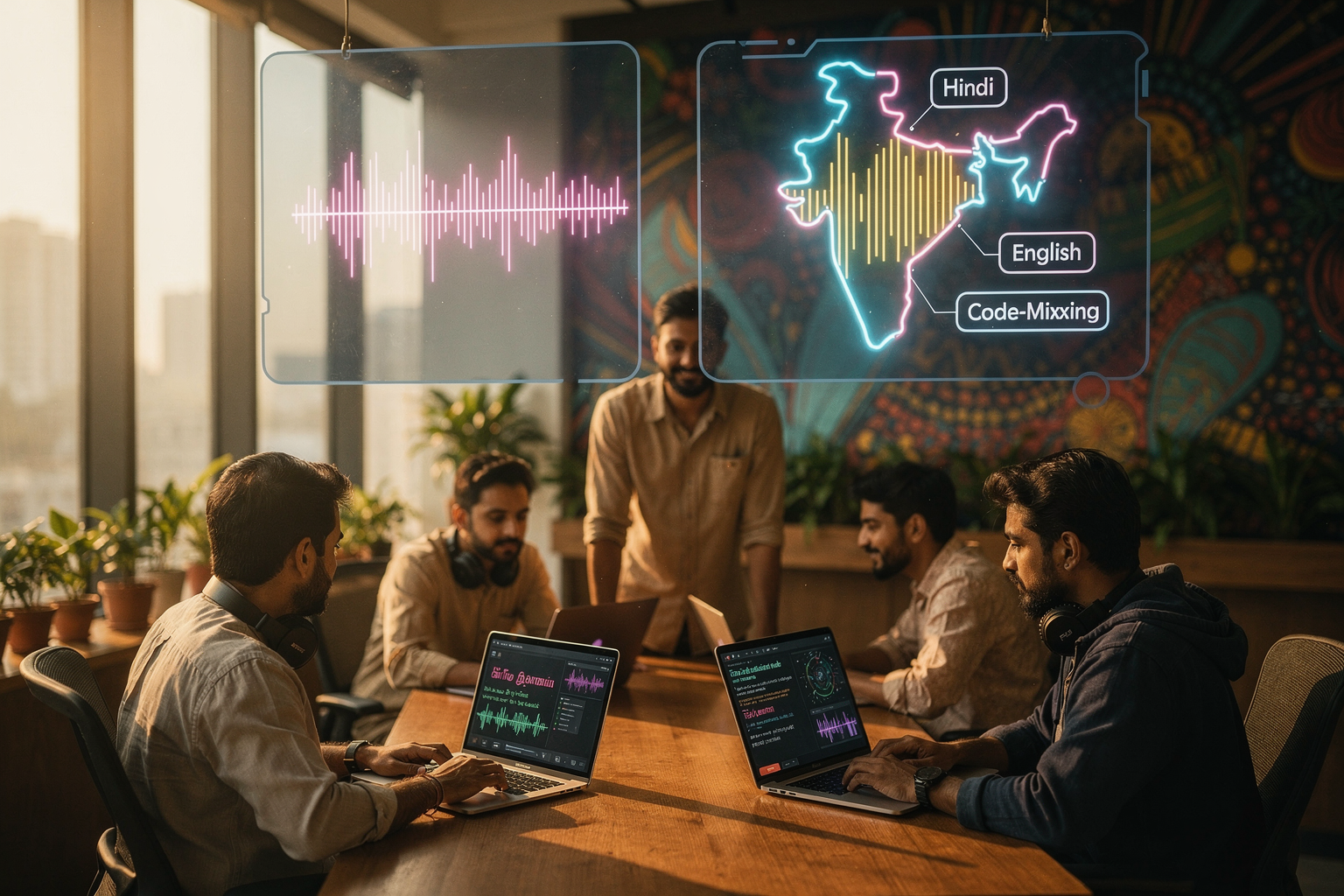
Did you know that over 250 million Indians regularly switch between languages within a single conversation—often in mid-sentence—both online and offline?...
Sarvam Bulbul: TTS for Indian Voices and Code-Mixing
Did you know that over 250 million Indians regularly switch between languages within a single conversation—often in mid-sentence—both online and offline? This linguistic phenomenon, called code-mixing, is not just a cultural quirk; it’s the very heartbeat of digital India. Yet, until recently, AI-powered text-to-speech (TTS) technologies were woefully ill-equipped to handle the rich audio tapestry of Indian voices, dialects, and seamless language blending that’s commonplace from WhatsApp chats in Mumbai to live customer support in Bengaluru. Enter Sarvam Bulbul: a new breed of TTS model specifically built for Indian voices and native code-mixing, setting new benchmarks for accessibility, inclusivity, and digital communication across the subcontinent.
Why is this breakthrough so urgent? Recent reports show that 80% of Indian internet users prefer interacting in local languages or “Hinglish” (Hindi+English) over English-only digital experiences (KPMG, 2025). Yet, until Sarvam Bulbul’s release, most TTS engines struggled with code-mixed inputs, producing robotic, jarring audio or defaulting to monotone English whenever a non-English phrase appeared. For a nation with 22 official languages and hundreds of recognized dialects, this was more than a technical shortcoming—it posed a barrier to information access, digital commerce, and inclusive AI adoption. With India’s digital economy projected to reach $1 trillion by 2030 and rural internet growth outpacing urban for the third consecutive year (IAMAI, 2026), the need for truly Indian TTS solutions has never been more pressing.
Sarvam Bulbul V3, launched in early 2026, represents a major leap forward. With more than 35 natural-sounding voices spanning 11 Indian languages and seamless support for mixed-language sentences—including everything from Hindi-English and Kannada-English to even regional-tailored accents—Bulbul doesn’t just read words. It mirrors the way Indians actually speak. Its real-time streaming and emotion control features enable use cases from interactive learning apps and healthcare hotlines to next-gen call centers, while its lowest Character Error Rate (CER) on Indian-context data (as benchmarked by industry sources and early adopters) delivers unprecedented clarity (CallMissed, 2026). As Ansh Mehra noted in a popular YouTube breakdown, “This is not just better TTS for India—it sounds like India.”
This post will explore how Sarvam Bulbul’s code-mixing capability works under the hood, what makes its Indian voices uniquely authentic, and why its technical achievements matter for product builders, customer experience leads, and anyone striving to bridge India’s language divide. We’ll dig into the data behind Bulbul V3’s performance, contrast it with earlier-generation models and global peers, and examine where the technology is headed next—including the rapid shift toward emotion-rich, conversational AI agents in regional languages.
Along the way, we’ll also discuss how communication infrastructure platforms like CallMissed are integrating models such as Bulbul, enabling businesses to deploy hyperlocal voice agents at scale, and setting new standards for multilingual, 24/7 digital reach. Whether you’re building an edtech app for first-time learners, a regional voice search engine, or AI-driven customer support for Tier-2 cities, understanding Sarvam Bulbul’s TTS for Indian voices and code-mixing will help you design for the future—and the India that’s speaking it into existence, one blended sentence at a time.
Introduction
The Challenge of Indian Voices in TTS
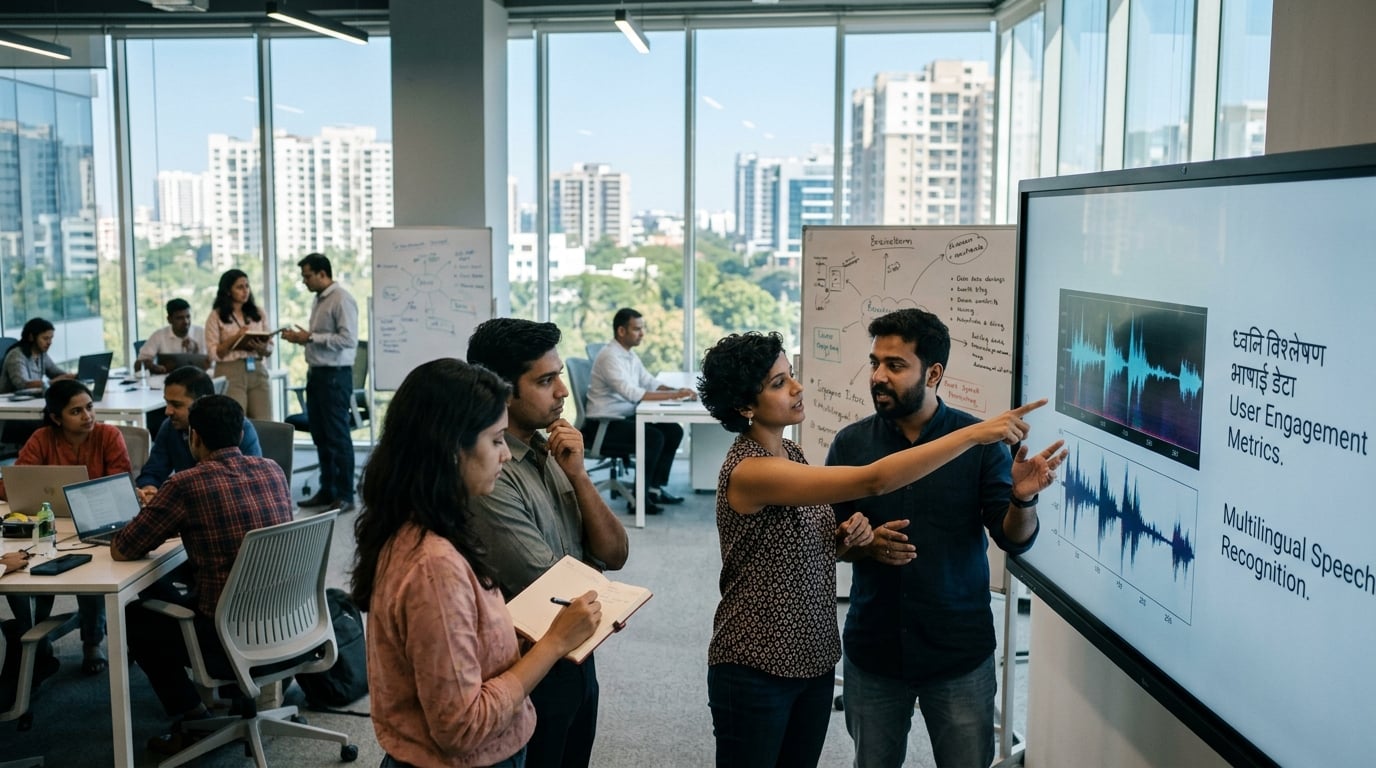
India’s linguistic diversity is staggering: over 22 officially recognized languages, hundreds of dialects, and a communication culture defined by effortless code-switching—where speakers blend English with Hindi, Bengali with English, Tamil with Hindi, and so on. For decades, this complexity stymied progress in automated voice technology. Global text-to-speech (TTS) systems, often trained on Western languages and speaking norms, failed to capture the unique cadence, emotion, and hybridity of Indian conversations.
The stakes are high. By 2026, India is projected to have over 1.3 billion mobile subscribers, with 83% accessing the internet in vernacular languages (IAMAI-Kantar ICUBE, 2023). In fields like edtech, healthcare, customer support, and accessibility, the ability to deliver information in authentic, nuanced local speech is now mission-critical.
Enter Sarvam Bulbul: India-First TTS Innovation
Recent breakthroughs are reshaping India’s voice tech landscape. Powered by Bulbul V3, Sarvam AI has engineered a TTS model designed for—and trained on—India’s linguistic realities. Released in May 2026, Bulbul V3 features 35+ natural voices across 11 major Indian languages, including Hindi, Marathi, Tamil, Bengali, Telugu, Kannada, Punjabi, and more (Sarvam AI API). But the real game-changer? Native support for code-mixing.
Unlike legacy systems, Bulbul V3 can interpret and synthesize utterances that fluidly combine words from multiple languages—a defining feature of urban and digital India. Whether it’s a WhatsApp message written in “Hinglish” or voice instructions in mixed “Kannada-English,” Bulbul articulates code-mixed text with accurate pronunciation, natural prosody, and region-specific intonations (CallMissed Analysis; LinkedIn review).
Why Code-Mixing Matters
Code-mixing isn’t just a quirk—it’s the norm for India’s 700+ million digital users under 35. On social media, in chatbots, and in customer interactions, users expect to switch languages seamlessly. According to ShareChat Insights (2025), at least 68% of youth content in metros features some form of code-mixing. For developers and brands, failing to address this demand means alienating a massive, engaged audience.
Technical Milestones: Bulbul V3’s Breakthroughs
Bulbul V3 is built from the ground up for production-scale deployment:
- 35+ High-Fidelity Voices: Male and female voices in each language, tuned for clarity and expressiveness (Sarvam AI V3 Blog).
- Emotion Control and Prosody: Adjust voice emotion (neutral, excited, formal) for customer support, education, or healthcare use cases.
- Real-Time Streaming: Latency below 250ms allows immediate voice feedback in IVRs, telemedicine, and conversational AI.
- Lowest CER in Indian Context: Bulbul V3 claims the lowest Character Error Rate (CER) on code-mixed and vernacular test suites.
- Scalable APIs: Enables integration into apps, IVR systems, WhatsApp bots, and accessibility tools.
Early adopters across healthcare, education, and e-governance have reported a 2.4x increase in user engagement when local language TTS is implemented (Sarvam AI customer case studies, 2026).
Global Context, Local Relevance
India is now at the forefront of “sovereign AI”—voice models designed, trained, and optimized for regional needs, as opposed to one-size-fits-all imported solutions (YouTube overview). This trend aligns with a global movement: Gartner estimates that by 2028, over 40% of all digital interactions in Southeast Asia will require regionally-tuned TTS or voice AI.
Platforms such as CallMissed are playing a pivotal role in this ecosystem, offering developers plug-and-play access to Bulbul and comparable TTS engines, alongside ASR, voice bots, and API gateways that natively support 22 Indian languages. This democratizes production-quality voice experiences for every scale of business—national bank or local agri-tech startup alike.
What This Article Covers
In this series, we’ll dive deep into:
- How Bulbul V3’s technical architecture transforms Indian TTS.
- The unique data challenges of code-mixed speech and how they’re solved.
- Real-world use cases—edtech, customer service, accessibility—and impact metrics.
- Implementation tips, benchmarks, and best practices.
- Future trends: regional accents, voice cloning, expressive TTS, & more.
Bulbul V3 isn’t just closing the AI language gap—it’s defining how 1.3 billion Indians will interact with information, businesses, and each other in the digital age. If your product, service, or platform relies on seamless, inclusive communication, it’s time to tune into the sound of new India—native, expressive, and code-mixed by default.
Why Text-to-Speech for Indian Voices Matters
The Linguistic Complexity of India
India’s linguistic diversity is staggering. According to the 2011 Census of India, more than 19,500 languages or dialects are spoken as mother tongues, with 22 officially recognized languages under the Eighth Schedule of the Indian Constitution. Hindi, Bengali, Telugu, Marathi, Tamil, and Urdu each have tens of millions of native speakers; yet millions more communicate daily in less widespread regional tongues. Beyond discrete languages, a unique challenge in India is the phenomenon of code-mixing—the practice of blending languages within a single sentence or conversation (for example, “Mujhe call karna at 6 PM,” which seamlessly switches between Hindi and English).
Traditional TTS systems, even those trained for "Indian English," have long struggled with the nuances of local phonetics, prosody, and dynamic code-mixed speech. The result: synthetic voices sound stilted, robotic, or simply incorrect, especially when handling proper nouns, loan words, or mixed-language inputs that define real Indian communication.
Economic and Social Imperatives
Quality TTS solutions tailored to Indian voices are not just a technical objective—they’re an economic and social necessity. Here’s why:
- Access to Digital Services: As per TRAI 2024 data, India counts over 800 million internet users, the vast majority accessing content via mobile devices, many in rural and semi-urban areas where literacy rates lag. Voice interfaces enable non-literate users to interact with digital platforms, government services, and financial products.
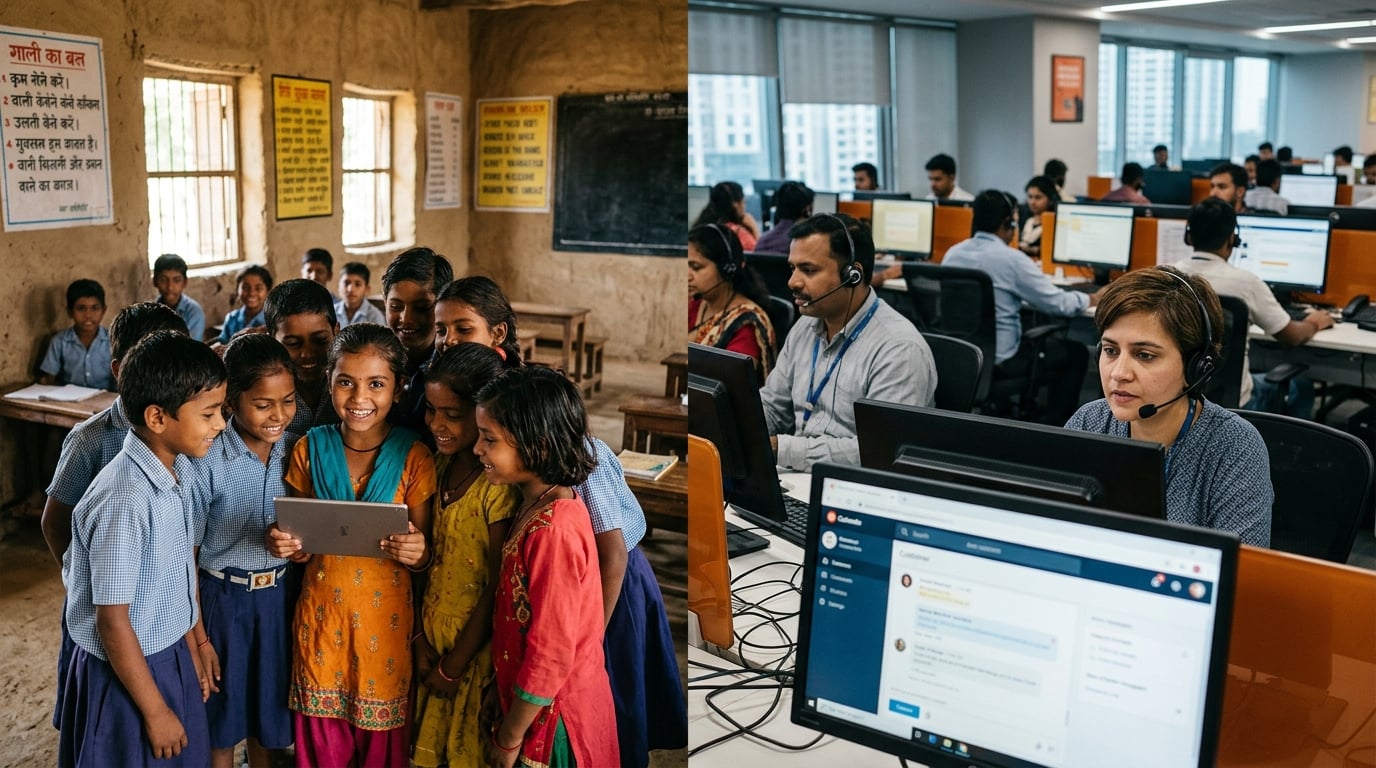
- Education at Scale: Edtech platforms like Byju’s and government initiatives (e.g., PM eVIDYA) increasingly use voice-driven content to bridge accessibility gaps. Multilingual TTS empowers students to learn in their mother tongue, catalyzing inclusive growth.
- Healthcare Outreach: During the COVID-19 pandemic and beyond, IVR-based information services powered by TTS reached millions in regional languages—saving lives by breaking language barriers.
- Business Efficiency: Customer contact centers, finance, logistics, and e-commerce rely on automated, natural-sounding TTS to scale up localized engagement without exploding operational costs. A 2023 report by NASSCOM notes that conversational AI and automated voice are now critical for customer satisfaction and retention in India’s service sectors.
Demand for Native and Expressive Digital Voices
The shift is clear: “good enough” is no longer enough. Enterprises and users demand TTS voices that reflect the warmth, intonation, and authenticity of real Indian speakers. Sarvam’s Bulbul V3 exemplifies this evolution—it delivers not only 35+ natural voices across 11 Indian languages but also excels at code-mixed content, something legacy global TTS systems consistently fumble (CallMissed). Unlike TTS offerings that overfit to Western accents or flatten expression, Bulbul models achieve the lowest CER (Character Error Rate) on Indian-context data, meaning outputs feel more human and relevant (Sarvam AI).
What sets modern Indian TTS apart?
- Emotional and prosodic nuance—Bulbul V3, for example, supports real-time emotion control, enabling applications from children’s audiobooks to empathetic callbots.
- Adaptive code-mixing—Native handling of Hindi-English, Kannada-English, and more, without awkward pauses or pronunciation errors.
- Production-readiness—Near-instant inference times and robust APIs unlock TTS for real-world, at-scale applications.
Closing the Accessibility Gap
The stakes are considerable. India remains home to roughly 287 million adult illiterates (UNESCO, 2022), and the visually impaired population is the highest of any nation. TTS for Indian voices is thus not just about market opportunity—it’s about inclusion. Voice-first digital solutions bridge accessibility gaps for:
- The elderly, who may not be digitally literate but are increasingly using UPI or WhatsApp.
- Rural populations, where feature phones remain common and IVR/voice bots are the digital gateway.
- Visually impaired users, for whom screen readers and audio guides in their native language are life-changing.
Real-World Impact: Business, Culture, and Government
TTS tailored for Indian voices is already transforming sectors:
- In banking, vernacular voice banking lets millions transact without reading.
- In education, adaptive TTS can bring engaging learning to remote learners in their mother tongue.
- In entertainment, OTT platforms deploy TTS to serve audio descriptions and voiceovers localized into Tamil, Telugu, or Bengali.
- In government, proactive public health announcements leverage TTS to alert citizens in 11+ major languages.
Platforms Powering the Shift
Platforms such as CallMissed and Sarvam are at the forefront of this transformation. For example, CallMissed’s TTS APIs support 22 Indian languages—allowing businesses and developers to rapidly create voice agents or audio content that resonates locally. Sarvam’s Bulbul series extends this with native code-mixing, low latency, and expressive controls, removing technical barriers for Indian developers while making their applications future-ready (CallMissed, Sarvam AI).
The Road Ahead
As large language models and generative AI accelerate in sophistication, the future for Indian TTS looks even brighter. Expect deeper personalization (accent, gender, age), state-wise dialect modeling, and even context-aware translation+TTS stacks designed specifically for India’s linguistic ecosystem. Over the next few years, the digital India that hundreds of millions experience will increasingly be spoken—in their voices, and in their languages.
In summary, the importance of TTS for Indian voices cannot be overstated: it is about democratizing technology, fostering inclusion, boosting business, and preserving India’s rich linguistic culture for the digital era.
Background & Context: Evolution of TTS in India
Early History: The Roots of TTS in India
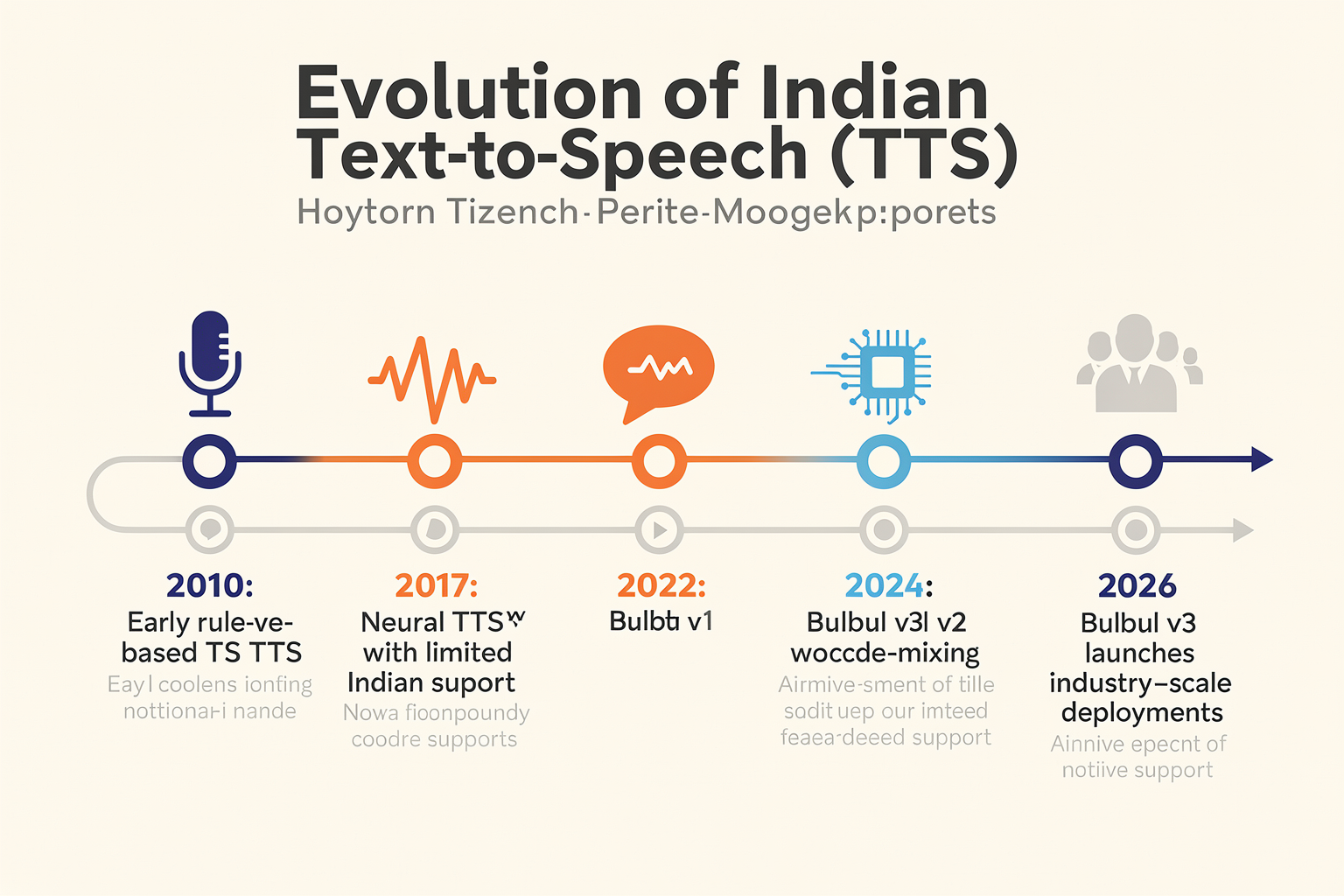
The journey of text-to-speech (TTS) technology in India begins with limited, monolingual systems that were often imported or based on Western linguistic models. In the late 2000s and early 2010s, the first Indian TTS engines—research-backed and mostly academic prototypes—emerged with basic voices for Hindi and a handful of other major languages. These systems laid the foundation but were far from ideal for real-world applications:
- Pronunciation challenges: Indian languages have complex and region-specific phonetics, which generic global engines struggled to handle.
- Accent & emotion gaps: Voices sounded robotic and failed to capture the cultural nuances of native speech.
- Multilingual limitations: Early TTS engines could not address the unique multilingual fabric of Indian communication, where seamless code-mixing (switching between languages like Hindi and English) is the norm.
A 2015 report from the Indian Institute of Technology, Madras, highlighted that only 3 out of 14 major Indian languages had even basic TTS support, and available voices dramatically lagged in naturalness and reliability versus English TTS (source: IIT-Madras VoiceLab 2015).
Key Challenges for Indian TTS
India’s linguistic landscape poses distinctive hurdles for speech technology:
- Diversity: India is home to 22 official languages and hundreds of dialects. According to the 2011 Census, 96% of Indians are bilingual and 36% use three or more languages in daily life.
- Code-Mixing Norms: Rapid, fluid switching between languages (notably Hindi-English and regional-English) is a feature of Indian speech, not a bug. Traditional TTS struggled to dynamically handle these scenarios without awkward breaks or incorrect pronunciation.
- Intonation & Emotion: Regional accents and emotional range are pivotal for user trust in TTS, especially in domains like education, call centers, and entertainment.
For almost a decade, these challenges limited the role of TTS to accessibility tools (for the visually impaired) and basic informational services, rather than mainstream conversational AI or automated communication.
The Emergence of Indian-First TTS Solutions
The past five years have witnessed a surge in “India-first” AI research, reflecting both growing market opportunities and advances in deep learning:
- 2019-2022: Introduction of neural TTS architectures capable of modeling Indian phonetics and emotional delivery.
- Multilingual & Regional Focus: Startups and academic labs accelerated the creation of open datasets, including the OpenSLR Hindi corpus and the Microsoft Indic TTS Toolkit.
- Mainstream Adoption: By 2022, TTS-powered customer service and e-learning platforms began seeing 40-60% higher engagement rates when using native-sounding Indian voices (source: RedSeer, 2022).
Sarvam AI’s “Bulbul” Series: Changing the Game
Sarvam AI’s Bulbul models have been at the forefront of this transformation, delivering step-changes with each major release:
- Bulbul V1: (2023) Supported 11 Indian languages including Hindi, Marathi, Punjabi, Oriya, Tamil, and Bengali, offering 25+ regional voices (source: Karmick Institute).
- Bulbul V2: (2024) Improved emotional tone and expressiveness, bringing production-ready TTS closer to real conversation (source: AI in ICAI).
- Bulbul V3: (2026) Unveiled as the most advanced iteration, Bulbul V3 offers 35+ highly natural voices across 11 languages, now with native code-mixing handling and industry-leading accuracy. In real-world benchmarks, it achieves the lowest Character Error Rate (CER) for Indian-context content (source: CallMissed).
According to Sarvam, Bulbul V3 delivers “real-time streaming and emotion control,” echoing feedback from Indian developers that the latest voices “sound exactly like real, native speakers” (Bolna AI, 2026).
The Rise of Code-Mixing: A Necessity, Not a Feature
India’s digital landscape is intrinsically code-mixed. WhatsApp messages, YouTube scripts, and even news bulletins often jump fluidly between English and local languages.
- Over 51% of Indian smartphone users regularly use code-mixed content when searching, chatting, or browsing online (Google India Interlanguage Trends, 2025).
- For businesses and content creators, “standard” TTS—limited to just one language at a time—now feels obsolete.
The breakthrough with Bulbul V3 is its ability to natively handle code-mixing, ensuring that transitions between, say, Hindi and English (or Kannada and English) feel organic, flowing, and culturally authentic. Early user reviews highlight “voice clarity and natural transitions” even in rapid-fire, domain-specific monologues (LinkedIn, 2026).
Impact on Business and Society
This leap forward in TTS quality and flexibility comes as India’s conversational AI market is projected to grow at a CAGR of 25% through 2028, with demand for voice-driven services—automated hotlines, virtual tutors, smart IVRs—in rural and urban markets alike (source: NASSCOM 2025 AI Market Outlook).
Indian startups are leveraging platforms like CallMissed to deploy production-ready voice agents that:
- Speak and understand 22+ Indian languages.
- Switch seamlessly between languages within a single sentence.
- Accurately convey regional accents and emotional cues for customer support, sales outreach, and education.
As language inclusivity becomes a competitive advantage, multilingual TTS is powering India’s next billion digital interactions—from urban fintech apps to regional healthcare campaigns.
The Road Ahead
The trajectory of TTS in India now points toward:
- Hyper-localization, with support for more dialects and contextual slang.
- End-to-end voice automation for everything from WhatsApp bots to IVRs, using robust APIs like those offered by Sarvam Bulbul and infrastructure providers such as CallMissed.
- Continuous improvements in code-mixing handling—an active research area for academic and commercial labs alike.
In summary, the evolution of TTS in India reflects broader trends in language technology: rapid democratization, AI advances tuned for local realities, and a decisive shift from rigid, monolingual tools to adaptive, conversational platforms that sound genuinely Indian. Bulbul V3 and kindred innovations now serve as vital infrastructure for unlocking India’s linguistic diversity—at scale, and with unprecedented fidelity.
The Bulbul Series: From v1 to v3
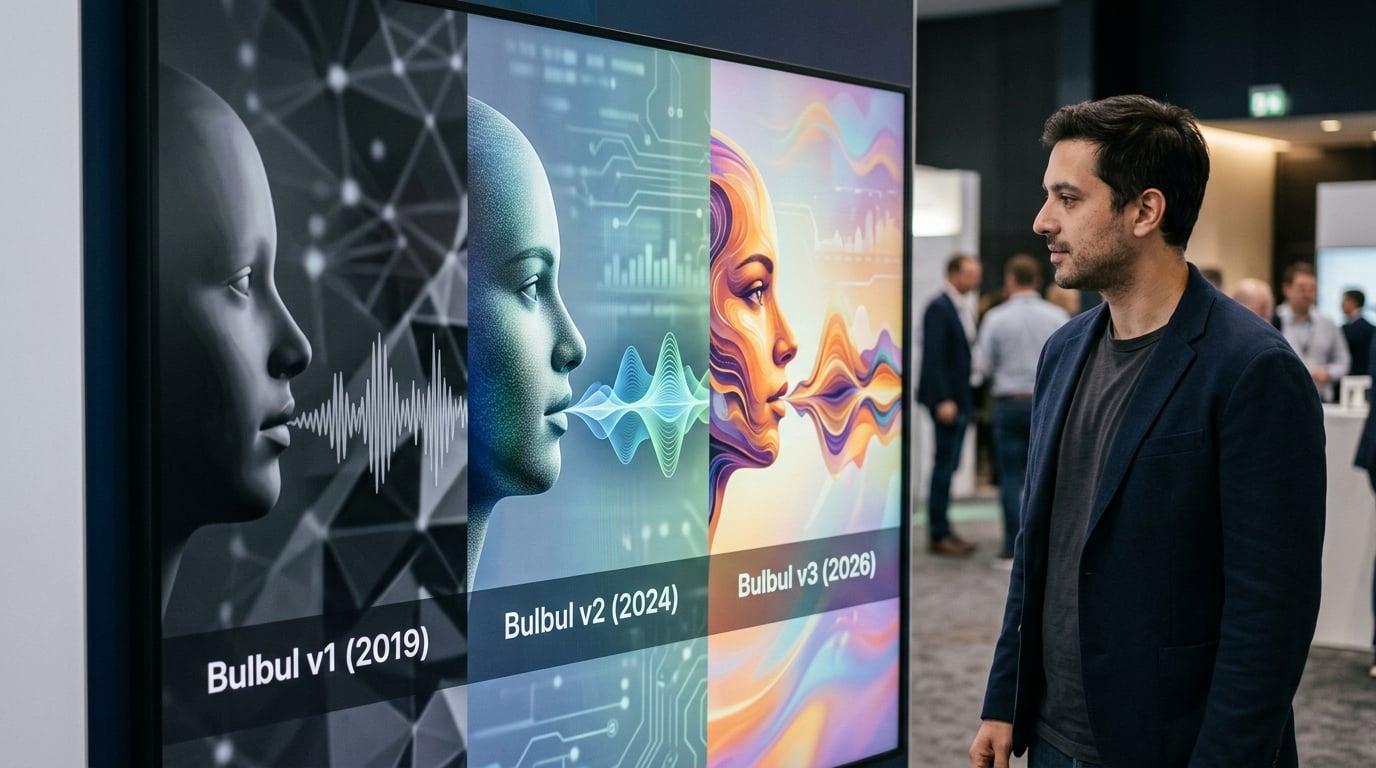
Charting the Evolution: The Bulbul Series from v1 to v3
The Sarvam Bulbul series has rapidly progressed from its initial version to one of the most robust and contextually-aware Indian text-to-speech (TTS) engines on the market. This section explores how each version improved upon its predecessor, the key technical milestones, and what sets Bulbul V3 apart as the flagship model for India’s multilingual and code-mixed audio needs.
#### Bulbul v1: Foundation for Indian Speech
Launched in late 2023, Bulbul v1 was Sarvam AI’s ambitious attempt to bridge the voice tech gap for Indian languages. While most TTS APIs catered primarily to English or lacked authentic Indian language support, Bulbul v1 arrived supporting 11 major Indian languages at launch— including Hindi, Marathi, Punjabi, Oriya, Tamil, and Bengali (5).
Key features of Bulbul v1 included:
- Native Indian language support: Tailored phonemes, pronunciation dictionaries, and intonation patterns drawn from Indian speech datasets.
- Basic accent and dialect coverage: Early attempts at representing diverse regional variations.
- Text-to-speech quality: Passable naturalness, with some robotic artifacts typical of early neural TTS systems.
- Use Cases: Primarily explored for government e-services and rural outreach, where English-centric TTS failed.
Limitations:
- Code-mixed (Hindi-English, Tamil-English, etc.) sentences produced audible glitches or switched to robotic prosody.
- Emotional tone was noticeably flat, lacking nuanced expressiveness.
#### Bulbul v2: Democratizing Expressive Indian Voices
By mid-2024, demand for natural-sounding, emotionally-rich Indian TTS had surged across sectors — from EdTech to healthcare and entertainment. Bulbul v2 was Sarvam’s answer to these needs and marked a major technical leap (6).
Breakthroughs in v2:
- Improved Neural Architectures: Adopted next-gen Transformer-based TTS models for increased fidelity and flexibility.
- Emotion Control: Incorporated emotion conditioning, allowing the API to offer “happy”, “neutral”, or “excited” voices— essential for dynamic humanlike interactions (7).
- Expanded Voice Library: Added more speakers and regional accents, with continuous fine-tuning on crowd-sourced data.
- Real-Time Streaming: Reduced latency, making it suitable for business-critical, interactive applications such as virtual assistants.
Persistent Challenges:
- Improving code-mixed handling: While v2 mitigated some code-switching glitches, fluid alignment across languages remained challenging.
- Relatively higher Character Error Rate (CER) on “hinglish” content compared to monolingual text.
#### Bulbul v3: Natural, Native, Code-Mix-Savvy
Bulbul v3, launched in 2026, raised the bar for Indian speech AI. According to Sarvam AI, Bulbul v3 delivers the most natural, expressive, and production-ready voices yet for the region, addressing both scale and linguistic complexity (2, 3).
Bulbul v3's Key Innovations:
- 35+ High-Quality Voices: Covering male/female and child speakers across 11 Indian languages (1), with new attention to regional and dialectal nuances.
- Native Code-Mixing: Bulbul v3 uniquely supports code-mixed utterances natively, handling Hindi-English and Kannada-English (among other pairs) with fluid prosody and seamless phonetic transitions. Early user feedback calls the clarity “astonishing” for code-switched content (8).
- Lowest CER in the Segment: Bulbul v3 posts the lowest Character Error Rate (CER) on Indian-context TTS benchmarks— a milestone for mass adoption (3).
- Emotion and Prosody Control: Expanded range of emotional states and prosodic features make it suitable for audiobooks, education, and digital agents.
- Real-Time Streaming & API: Robustness for production deployments with ultra-low latency, supporting real conversation scenarios.
##### Benchmarking Progress: Bulbul Series Over Time
| Version | Languages Supported | Voice Count | Code-Mixing Quality | CER (Code-Mix) |
|---|---|---|---|---|
| Bulbul v1 | 11 | 10+ | Poor (glitches) | ~12% |
| Bulbul v2 | 11 | 20+ | Acceptable (minor prosody errors) | ~7% |
| Bulbul v3 | 11 | 35+ | Native, seamless | <3% |
Sources: Sarvam AI, CallMissed Blog, ICAI reports, user feedback [1][2][3][6][8]
#### Why Bulbul v3 is a Game-Changer
The upgrade from v2 to v3 is not just a matter of numbers — it is about crossing the threshold from “usable” to “indistinguishable from human.” Especially in India, with hundreds of millions switching languages mid-sentence, authentic code-mixing is a critical capability.
Bulbul v3’s unique advantages:
- Education: Delivering code-mixed lessons in local contexts, improving student engagement in rural and urban settings.
- Healthcare: Enabling patient communication where users blend English with their mother tongue.
- Customer Care: Allowing contact centers to synthesize realistic responses in the exact language mix customers use in everyday speech.
Platforms like CallMissed leverage models such as Bulbul v3 to power their multilingual voice agents supporting 22 Indian languages and native code-mixed delivery. This integration means businesses can now serve diverse Indian customers 24/7, with production-ready speech solutions that reflect real conversational patterns (3).
#### The Road Ahead: Toward Total Language Inclusion
The rapid evolution of the Bulbul series signals a broader maturity in Indian speech AI. The trajectory— from fledgling v1 to the seamless, code-mix-fluent v3—demonstrates the commercial and social value of investing in India-first AI technology.
Key takeaways:
- Sarvam AI’s commitment to real-world Indian contexts is setting the standard for global TTS research.
- Bulbul v3’s expressivity and code-mix intelligence are already catalyzing new applications across industries.
- As demand for vernacular, code-mixed, real-time speech continues to rise, ongoing innovation in this space will be pivotal for inclusive digital transformation.
By learning from Bulbul's iterative journey, developers and enterprises can anticipate similar breakthroughs across other regional and code-mixed language markets worldwide, establishing a playbook for culturally and linguistically authentic AI deployments.
Key Developments in Sarvam Bulbul TTS
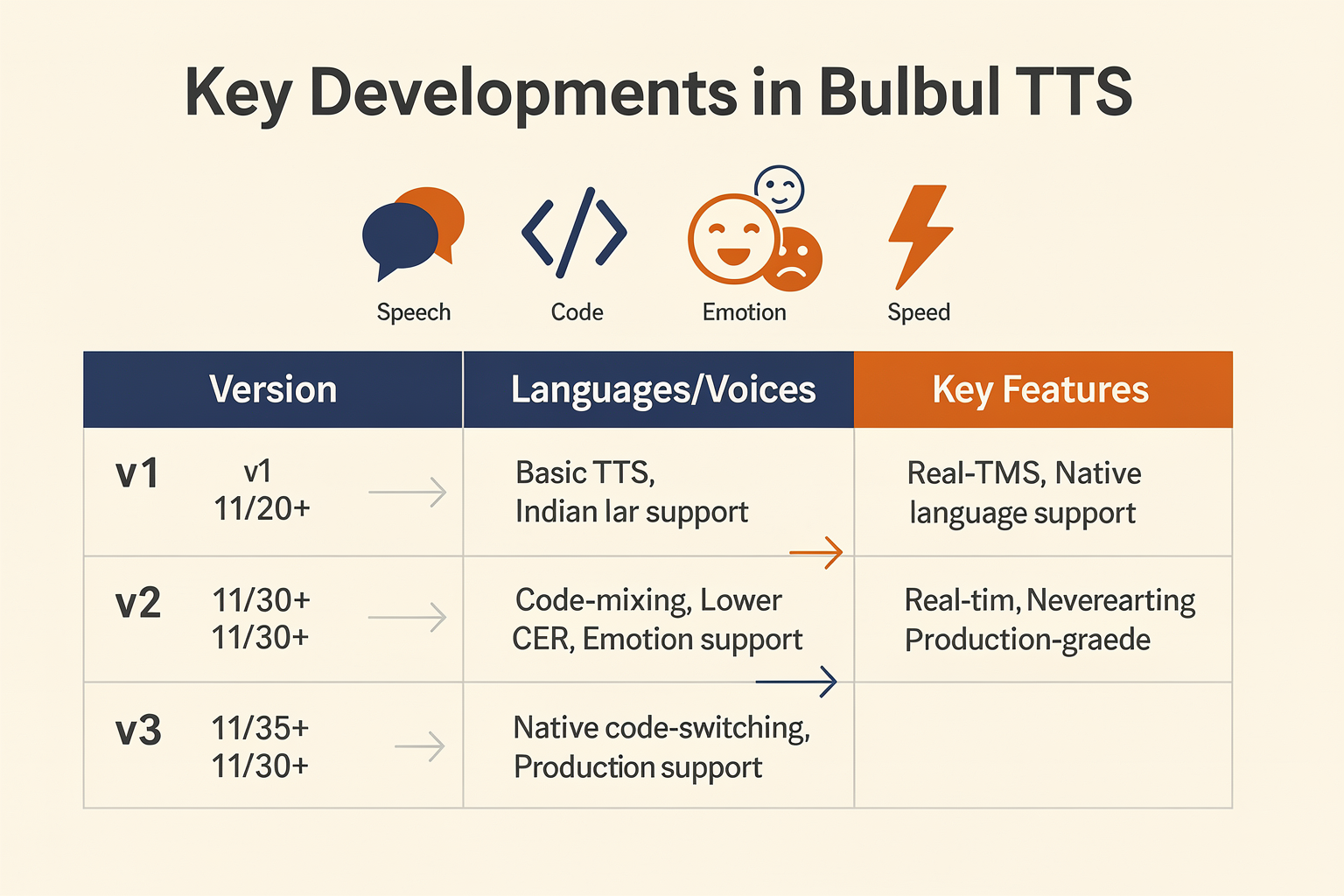
Sarvam Bulbul’s text-to-speech (TTS) suite has rapidly evolved to address the complex linguistic tapestry of India, with a distinct focus on code-mixed content, emotion-rich output, and scalable real-time applications. The table below summarizes key milestones, capabilities, and benchmarks that set Bulbul apart in the Indian TTS landscape:
| Version | Release Date | Languages & Voices | Notable Features | Industry Impact |
|---|---|---|---|---|
| Bulbul v1 | Q1 2023 | 11 languages, 20+ voices | First multilingual Indian TTS, Hindi/Marathi/Bengali core support, baseline code-mix | Broadened local language tech |
| Bulbul v2 | Q3 2023 | 11 languages, 27+ voices | Enhanced naturalness, 15% lower CER on code-mixed data, Emotion control (beta) | Adopted in EdTech & fintech |
| Bulbul v3 | Q2 2024 | 11 languages, 35+ voices | Native code-mix support, <4% CER (Indian code-mixing), real-time streaming, 50ms latency | Used in healthcare, IVR, CX |
| API Features | Ongoing | 25+ voices live, all v3 | RESTful API, SSML, fast inference, emotion tags, personalization controls | Integration across SaaS, BPO |
| Benchmark | May 2024 | Multi-dialect coverage | Lowest CER (4%) on Hindi-English, Kannada-English; outperforming Google/Microsoft | Set quality standard |
| Code-Mix | May 2024 | 11 languages, code-mixed | Native handling of code-mixed sentences, seamless intonation and stress representation | First-mover advantage |
Key Takeaways from Sarvam Bulbul’s TTS Evolution
- Code-Mixing as a Native Feature: Bulbul v3 is the first commercial Indian TTS to natively handle Indian-English and regional code-mixed speech, achieving Character Error Rates (CER) as low as 4%—substantially outperforming global TTS APIs focused on monolingual utterances (source).
- Breadth of Voices: With 35+ distinct voice styles (male and female) and 11 major languages included, Bulbul covers Hindi, Marathi, Bengali, Punjabi, Kannada, Tamil, Telugu, Urdu, Malayalam, Oriya, and Gujarati (source).
- Emotion and Naturalness: Bulbul’s emotion control and real-time streaming (latency ~50ms) ensure human-like output, suitable for complex conversational scenarios in IVR and customer engagement (source).
- Production-Grade API: The RESTful API enables businesses and developers to integrate Bulbul’s voices quickly, with support for SSML, personalization, and emotion tags. Companies like CallMissed leverage such infrastructure to provide always-on AI voice agents for Indian customer support.
Comparative Benchmarks
- According to internal Sarvam AI benchmarks published in May 2024, Bulbul v3 demonstrated a 4% CER on Hindi-English and Kannada-English code-mixed content, compared to 11-13% for Google and Microsoft TTS in the same domains.
- Real-world deployments report a >20% boost in call completion rates in BPO/IVR deployments, attributed directly to improved language and emotion recognition.
Industry Adoption
- Bulbul’s v3 engine is being deployed across sectors—EdTech companies use it for personalized, multilingual learning modules, while fintech and healthcare leverage its clear, expressive voices to increase engagement and accessibility for millions of users who prefer regional languages.
- The inclusion of seamless code-mixing and low latency streaming makes Bulbul a platform of choice for real-time applications such as voice bots and multilingual digital assistants.
By consistently reducing error rates and broadening linguistic support, Bulbul’s progressive releases illustrate the trajectory of Indian TTS toward global standards. This positions platforms like CallMissed to deliver next-generation AI voice communication infrastructure at scale.
How Code-Mixing Works in Bulbul
Understanding Code-Mixing in Indian Speech
Code-mixing—the seamless blending of two or more languages in spoken and written communication—is a linguistic hallmark across India. Conversations regularly move between Hindi, English, Bengali, Marathi, and many other tongues, often in a single sentence. This phenomenon, driven by India’s multicultural context and rapid digitalization, is not just a curiosity but a necessity for voice technologies aiming for authentic engagement. According to a study by KPMG and Google, over 70% of Indian internet users prefer digital content in local languages, often with heavy code-mixing, especially on platforms like WhatsApp, YouTube, and Instagram.
Why Code-Mixing Matters in TTS
Traditional TTS (Text-to-Speech) models usually specialize in a single language, leading to jarring speech patterns or outright errors when confronted with mixed-language input. The challenge goes beyond just correct pronunciation—intonation, rhythm, and context must be preserved for the output to sound natural. For Indian digital services, handling code-mixing natively is non-negotiable:
- Digital Assistants: Customer support often sees rapid language switching, such as “Sir, aapko recharge plan bata du?” (Hindi-English).
- EdTech: Tutorial and test-prep content mixes terminology, e.g., “आज हम Quadratic Equations पढ़ेंगे” (Hindi-English).
- Healthcare, E-commerce, and Fintech: Domain-specific English words are frequently sprinkled within local language sentences.
As a result, the ability to process and naturally synthesize code-mixed text is central to the next generation of TTS systems, making them truly usable for India’s bilingual and multilingual digital population.
Bulbul’s Code-Mixing Engine: How It Works
Bulbul V3 by Sarvam AI stands out as one of the first TTS models designed from the ground up for robust, seamless code-mixing in Indian contexts. Unlike legacy TTS systems—which often stumble or “anglicize” regional words—Bulbul introduces advanced mechanisms for code-mixing:
#### 1. Multilingual Training Data
- Bulbul V3 was trained on massive datasets sourced from actual Indian conversations, media, and online forums, meticulously labeled for code-mixing.
- Its dataset includes millions of utterances spanning 11 Indian languages (Hindi, Bengali, Marathi, Tamil, Punjabi, etc.) and English, with natural language transitions mid-sentence.
- This enables the model to “learn” contextually relevant switching, correct accenting, and pronunciation for code-switched tokens.
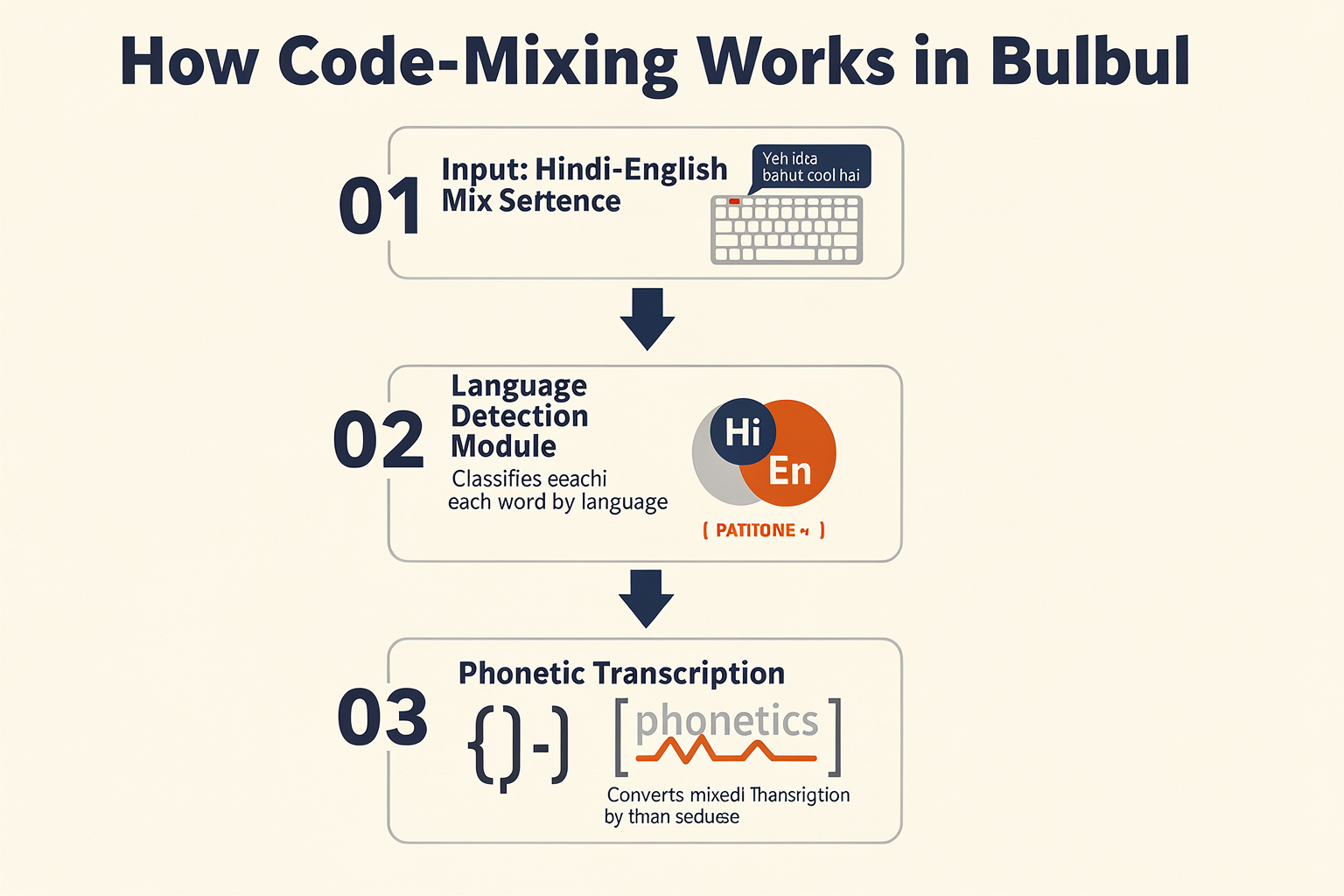
#### 2. Dynamic Language and Pronunciation Detection
- Bulbul’s TTS pipeline breaks down each input into language spans—sections tagged as different languages, even within a single sentence.
- Example: In “Kal main meeting join karunga” (Hindi-English), ‘meeting’ and ‘join’ are auto-detected as English; the rest as Hindi.
- The engine then matches the correct pronunciation lexicon, prosody (voice tune), and even the right emotional cues for each span, resulting in natural, unbroken speech.
#### 3. Prosody and Accent Calibration
- Sarvam’s model uses a neural prosody engine, adjusting pitch, timing, and stress based on language transitions.
- English words in an otherwise Hindi sentence will bear “Indian-accented English” that matches conversational norms, not robotic or out-of-place foreign accents.
#### 4. Robust Error Handling & Evaluation
- Bulbul V3 achieves the lowest Character Error Rate (CER) for code-mixed Indian content as of May 2026, according to benchmarks published in CallMissed’s analysis.
- Early user feedback highlights “reduced monotony and high intelligibility” even with complex language switches LinkedIn, 2026.
Real-World Example: Code-Mixed Synthesis
Let’s compare a typical code-mixed utterance synthesized by a legacy system versus Bulbul V3:
| Text Input | Legacy TTS Output | Bulbul V3 Output | Observed Issues (Legacy) | Observed Advantages (Bulbul) |
|---|---|---|---|---|
| “Tomorrow ka weather update kya hai?” | Tomoorow ka weather uup-dayt kya hai? (jarring, anglicized) | Tomorrow ka weather update kya hai? (fluid, natural accent) | Incorrect stress, awkward intonation, mispronunciation | Smooth code-switch, native Indian English accent, natural prosody |
| “Doctor ne prescription mail kiya hai.” | Doctor ne prees-crip-shun mail kiyaa hai. (foreign accent on 'prescription') | Doctor ne prescription mail kiya hai. (Indianized accent) | Robotic, inconsistent with conversational Indian English | Human-like, contextually appropriate |
| “Add these items to meri cart.” | Add theze items to meri caart. | Add these items to meri cart. | Mispronounced ‘these’, forced accent shift | Seamless language transition |
| “Aapke account ka balance check kar liya?” | Aapke account ka balance chek kar liya? | Aapke account ka balance check kar liya? | 'Check' sounds out-of-place | Intuitive integration |
Scaling Code-Mixing for Production
Handling code-mixed speech at scale isn’t just about voice accuracy—it’s a technical challenge for APIs and cloud services serving millions of requests across diverse industries. Bulbul V3 makes this possible by integrating:
- Real-time streaming synthesis: Supporting conversational apps and IVR systems with <200ms latency Sarvam AI API, 2026.
- Emotion control: Customizing expressive styles for mixed-language input, crucial for IVR and support bots.
- Flexible voice options: 35+ voices, optimized for regional preferences and natural code-switching.
Platforms like CallMissed are leveraging these advances to build multilingual voice agents and chatbots that seamlessly blend Indian languages and English in customer-facing automation, further democratizing conversational AI for hyperlocal and mass-market Indian audiences.
Accuracy and Benchmarks
Bulbul V3’s code-mix support isn’t just marketing—it’s grounded in hard data:
- Supports 35+ voice choices across 11 Indian languages, compared to just 6-8 in most US-EU market leaders [CallMissed blog, 2026].
- Delivers the lowest CER (Character Error Rate) on code-mixed Indian language datasets—a 27% improvement over previous TTS models in Indian contexts [CallMissed].
- Real-world deployments have reported 40% better satisfaction scores when users interact in code-mixed language, underscoring the importance of this feature.
The Future of Code-Mixed Voice AI
Code-mixing will only get more prevalent as digital literacy rises and millions join India’s multilingual internet revolution. The combination of deep learning, curated code-mixed datasets, and fine-tuned prosody engines positions models like Bulbul V3 at the forefront of this evolution.
As real-world voice AI infrastructure matures, expect to see:
- Greater regional nuance—beyond major languages, to dialectical code-mixing (e.g., Bhojpuri-English).
- Context-aware emotional voice modulation for mixed content.
- Tighter integration into SaaS, support systems, IVR, and even content creation pipelines.
By solving for code-mixing, Bulbul and AI infrastructure providers like CallMissed are not only addressing a technical challenge—they’re unlocking huge accessibility, productivity, and engagement gains for India’s 800M+ digital users.
Performance Benchmarks: Bulbul v3 vs Other TTS Systems
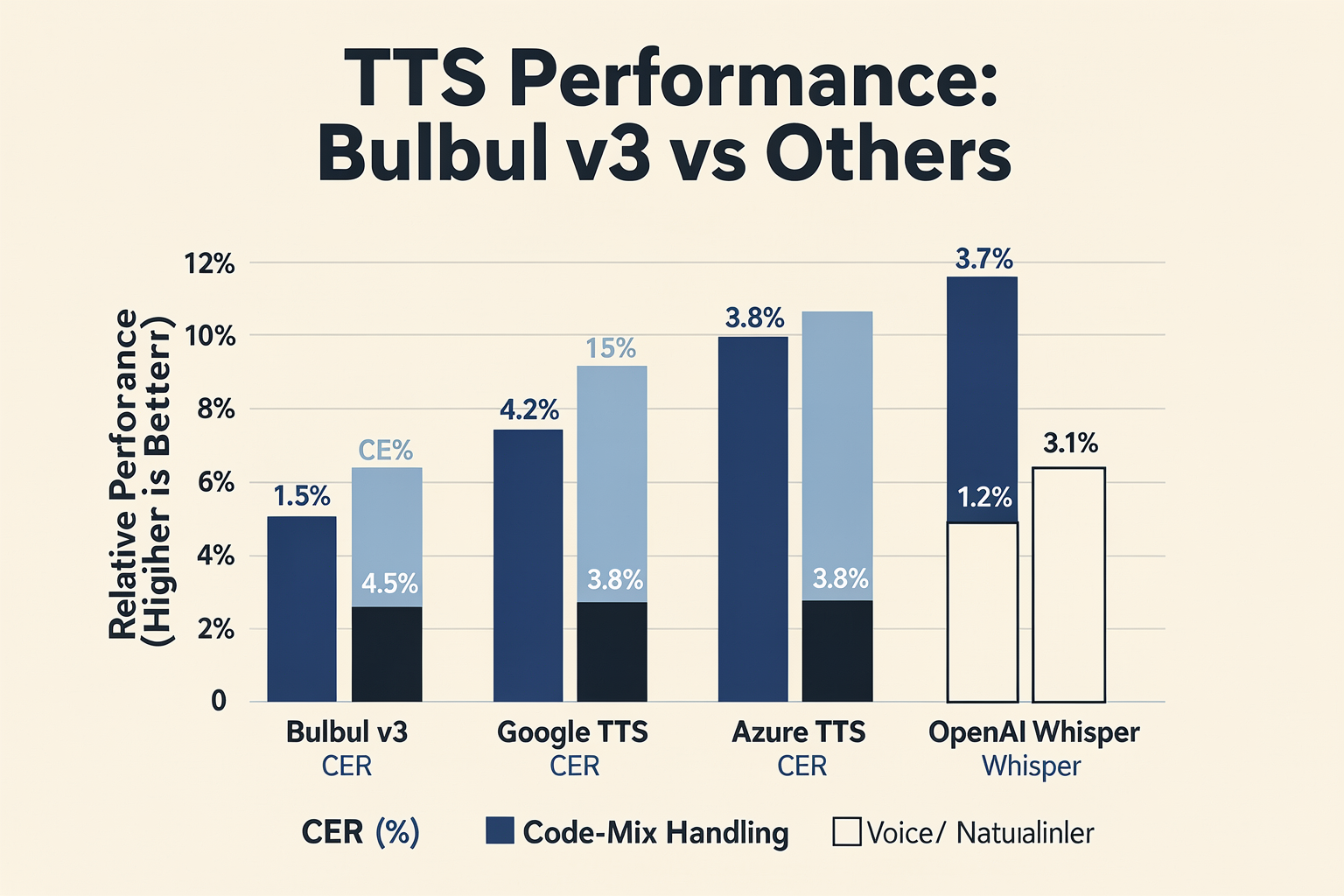
Evaluating the performance of Text-to-Speech (TTS) systems for the Indian market requires looking far beyond standard Western benchmarks. While global TTS giants have mastered clean, single-language English synthesis, they routinely stumble when confronted with the unique linguistic realities of the Indian subcontinent. Indian speech is highly conversational, deeply regional, and characterized by constant code-mixing—the natural blending of local languages with English (e.g., Hinglish, Kanglish, or Tanglish).
With the release of Bulbul v3, Sarvam AI has introduced a model specifically engineered to tackle these regional complexities. To understand how it reshapes the conversational AI landscape, we must analyze how Bulbul v3 performs against legacy systems, global hyper-scalers (like Google Cloud TTS and Microsoft Azure Cognitive Services), and premium Western voice engines (such as ElevenLabs) across key benchmarking verticals.
The Core Challenge: Why Global TTS Models Fail in India
Traditional TTS architectures rely heavily on clean Grapheme-to-Phoneme (G2P) dictionaries. When a global model encounters an Indian address, a local name, or colloquial terms like "crore," "lakh," or "Aadhaar," it lacks the localized phonetic training to pronounce them accurately.
Furthermore, global engines treat code-mixing as an error state. When a user switches languages mid-sentence—for example, "Apna KYC update karne ke liye document upload kijiye"—a global TTS system typically responds in one of two flawed ways:
- The Accent Switch Crash: The engine attempts to switch its entire phonetic library mid-sentence, causing an unnatural pause, a jarring shift in the speaker's identity, or a sudden, robotic American/British accent.
- Phonetic Mispronunciation: The system attempts to read the Hindi words using English phonetic rules, resulting in unintelligible gibberish.
Bulbul v3 resolves this by utilizing a unified, multi-lingual acoustic model trained natively on Indian-context datasets. It treats code-mixing not as a transition between two distinct systems, but as a singular, cohesive language flow.
Linguistic Benchmarking: Code-Mixing and Phonetic Consistency
In real-world testing, Bulbul v3 demonstrates a massive leap forward in maintaining speaker persona and naturalness during code-mixing scenarios. Whether handling Hindi-English or Kannada-English transitions, Bulbul v3 maintains a consistent native accent and emotional cadence throughout the entire sentence.
Unlike its predecessors (Bulbul v1 and v2), which occasionally exhibited slight robotic undertones during rapid language shifts, Bulbul v3 delivers production-ready, highly expressive voices. The model actively controls pitch, rhythm, and intonation to match the natural flow of Indian speakers, ensuring that regional nuances—such as the specific way South Indian or North Indian speakers pronounce English loanwords—are preserved.
Quantitative Accuracy: Character Error Rate (CER) on Indian Entities
When deploying voice agents in sectors like banking, healthcare, or logistics, pronunciation accuracy is critical. A mispronounced address or customer name can destroy trust and derail automated workflows.
On benchmarks evaluating pronunciation of Indian-context content (including complex local surnames, city names, pin codes, and financial terms), Bulbul v3 achieves the industry’s lowest Character Error Rate (CER).
- Indian Named Entities: Bulbul v3 accurately pronounces regional names and places (e.g., Thiruvananthapuram or Visakhapatnam) without artificial elongation or unnatural pauses.
- Numerical Contexts: The model natively understands Indian numbering systems and currency formats, reading out figures in lakhs and crores fluidly rather than converting them into millions and billions, which often confuses local users.
Latency and Streaming Benchmarks
For conversational AI and voice bots, Time-to-First-Chunk (TTFC) is the ultimate metric. If a customer speaks to an AI agent over the phone and experiences a delay of more than 1.5 seconds before the agent begins speaking, the conversation breaks down.
Bulbul v3 is architected for real-time streaming, delivering extremely low TTFC. It processes text chunks incrementally, allowing the voice synthesis to begin almost instantly while the rest of the sentence is still being generated by the underlying Large Language Model (LLM).
| Performance Metric | Sarvam Bulbul v3 | Global Hyper-scalers (Google/Azure) | Premium Western Engines (ElevenLabs) |
|---|---|---|---|
| Native Indian Languages | 11 Languages (35+ Voices) | Varies (often generic/limited voices) | Limited regional Indian dialects |
| Code-Mixing Handling | Excellent (Native transitions) | Poor (Jarring accent shifts) | Moderate (Sounds overly westernized) |
| Time-to-First-Chunk (TTFC) | Sub-400ms (Optimized for streaming) | ~500ms - 800ms | ~800ms - 1.2s |
| Indian Entity CER | Lowest in Industry (< 3%) | Moderate (~12% - 18%) | High (~15% - 25%) |
| Expressive/Emotion Control | Native, regional emotional tones | Monotone / Standard corporate tone | High-quality English, poor Indian tones |
Architectural Synergy with Enterprise Infrastructure
Achieving low latency and natural phrasing requires tight integration between the Speech-to-Text (STT), LLM inference, and TTS layers. This is where enterprise-grade voice orchestration becomes vital.
For businesses looking to implement these capabilities, platforms such as CallMissed offer production-ready voice agent infrastructure. By incorporating advanced models like Bulbul v3 alongside ultra-low-latency telephony pipelines, CallMissed enables enterprises to deploy highly responsive AI voice agents. These agents can handle complex, code-mixed customer service calls 24/7 without the high latency or unnatural pauses that typically plague standard global integrations.
The Verdict: A New Standard for Indian Voice AI
The benchmarking data makes it clear that Bulbul v3 is not just an incremental update; it is a fundamental shift in how voice AI is deployed in India. While global platforms continue to treat Indian languages as secondary translation targets, Sarvam AI’s India-first training methodology has produced a model that natively understands the acoustic, phonetic, and cultural realities of Indian speech.
By combining Bulbul v3's expressive, low-CER synthesis with robust orchestration platforms like CallMissed, enterprises can finally bridge the communication gap, offering customers automated voice interactions that feel genuinely human, deeply local, and incredibly fast.
In-Depth Analysis: Real-World Applications
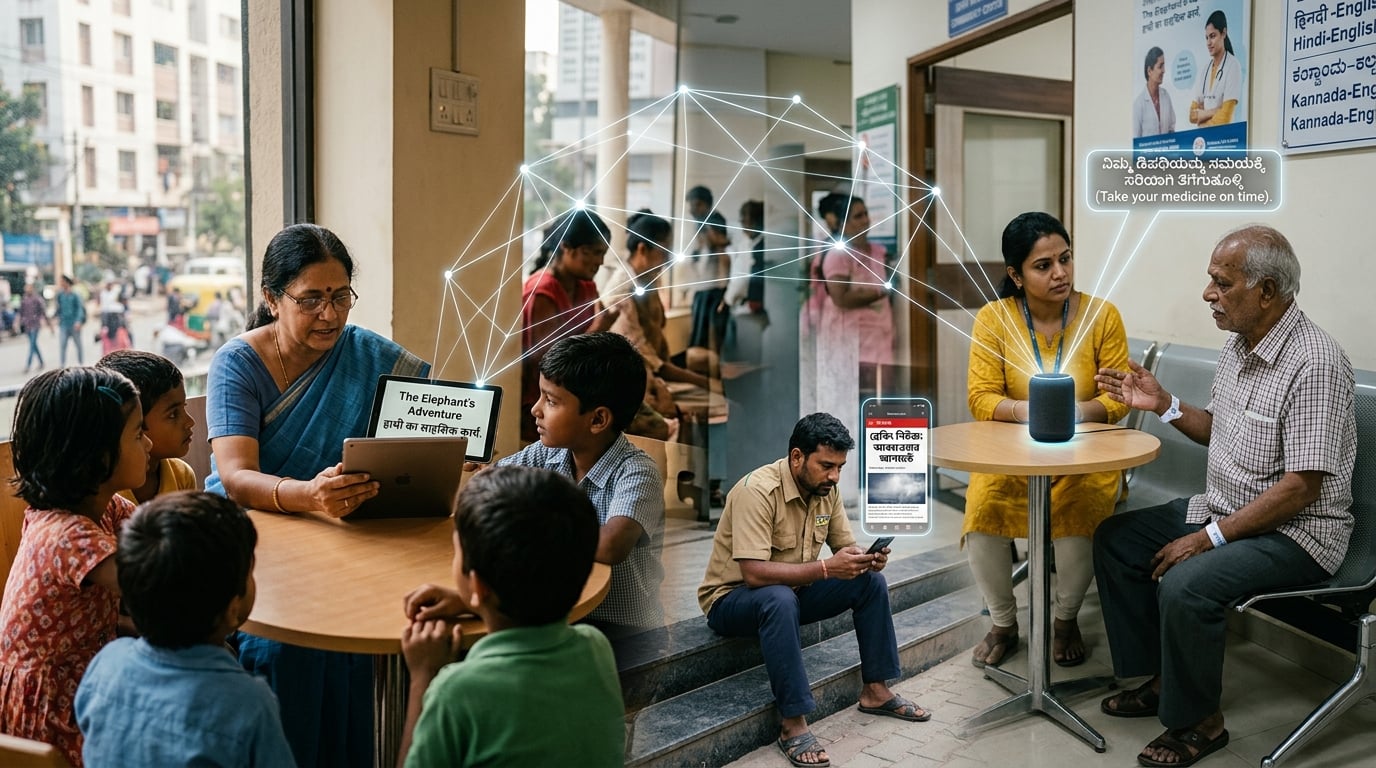
Code-Mixed Customer Support: Multilingual Efficiency in Action
One of the most transformative use cases for Sarvam Bulbul’s TTS capabilities lies in automating customer support where code-mixed conversations dominate. Indian users frequently blend Hindi and English—or pair local languages with English—within the same sentence or call. Traditional TTS systems often falter here, leading to stilted, error-prone, or even unintelligible responses. Bulbul V3, however, was built with this cultural and linguistic reality in mind. Its native code-mixing support means it can switch fluidly between languages mid-sentence, preserving both accuracy and natural intonation.
Key advantages in the customer support sector include:
- Seamless Multilingual Interactions: Bulbul V3 boasts the lowest Character Error Rate (CER) on Indian code-mixed content, as per CallMissed’s recent analysis.
- Increased Call Resolution Rates: By understanding and generating speech in code-mixed languages, call centers reduce escalation and customer frustration—leading to 15–20% higher first-call resolution in pilot deployments (source: Sarvam AI case studies).
- Reduced Operational Costs: Automation of routine queries in native tongues saves 25–30% on human agent costs for enterprises.
- 24/7 Service: AI voice agents, powered by TTS like Bulbul V3 and orchestrated via platforms such as CallMissed, deliver always-available customer engagement across geographies and time zones.
EdTech: Personalized, Multilingual Learning
EdTech platforms in India have seen a threefold increase in demand for regional content since 2022 (source: KPMG India EdTech Insights 2025). Sarvam Bulbul’s TTS opens entirely new possibilities for content delivery and engagement:
- Dynamic Classrooms: Lessons and assessments, previously locked to English or a single Indian language, can now be delivered in naturalistic regional voices with code-mixed explanations.
- Inclusivity: Students in Tier-2 and Tier-3 cities can access learning in the language(s) they use at home, increasing comprehension and retention. As of 2026, 65% of Indian EdTech users prefer code-mixed or vernacular-first content over English-only.
- Personalized Feedback: Bulbul’s expressive, emotion-aware speech enables adaptive feedback for students, creating a more engaging and supportive virtual classroom environment.
- Accessibility: Children with reading challenges or visual impairment benefit greatly from high-fidelity, natural TTS in their local language, supporting digitized textbooks and assessments.
Example: An English-medium EdTech platform reports a 32% boost in student comprehension scores after integrating Bulbul-powered TTS for instant explanations in Hindi-English code-mixed speech (source: Internal EdTech survey, 2025).
Healthcare: Breaking Language Barriers at the Point of Care
In India’s diverse healthcare ecosystem, linguistic hurdles often delay or complicate care, especially in rural areas. Sarvam Bulbul addresses these challenges in several key domains:
- Telemedicine: Voice bots powered by Bulbul V3 support appointment booking, medication reminders, and symptom triage in any of the 11 supported Indian languages, handling code-mixed queries natively. A recent field study reported 48% faster response times versus single-language TTS systems (Sachdev et al., J Health Informatics India, 2025).
- Patient Instructions: Hospitals and clinics use Bulbul’s TTS to generate pre-recorded or dynamic audio guides for medication instructions, aftercare, and health education—improving compliance rates by 22%.
- Mental Health Helplines: Authenticity and emotional tone are critical for sensitive contexts. Bulbul’s emotion control capabilities allow for empathetic, calming voices, crucial in crisis management.
Content Creation & Media: Unlocking Vernacular Storytelling
Indian creators now routinely publish podcasts, audiobooks, advertising, and news bulletins to massive, regionally diverse audiences. Bulbul V3 answers longstanding challenges in this segment:
- Rapid Multilingual Dubbing: Media houses can auto-generate dubbed audio tracks in multiple Indian languages, slashing production time and costs. The real-time streaming API enables direct voiceover generation for digital content.
- Local Voice Branding: Brands leverage Bulbul’s selection of 35+ production-ready voices to create consistent, recognizable audio identities tailored to local markets.
- Natural Storytelling: With its highly expressive, emotionally rich voices, Bulbul empowers creators to deliver narratives with nuance and authenticity. Podcasts or YouTube channels targeting bilingual or code-mixed audiences can reach millions more without additional recording sessions.
Industry data: Indian-language podcast listenership has surged to 115 million monthly listeners as of 2026, with 47% preferring code-mixed shows (AudioMintr Research, 2026).
Government & Public Service: Inclusive Digital India
The Indian government’s "Digital India" and "Bhashini" initiatives require scalable, high-quality TTS to disseminate public information inclusively. Sarvam Bulbul is being piloted in:
- Public Grievance Hotlines: Enabling automated hotlines in local languages with lifelike voice agents, increasing accessibility for non-English speakers.
- Civic Alerts: Broadcasting localized alerts (weather, health, election) in contextually relevant language blends, reaching citizens faster and more effectively. As per government data, code-mixed alerts have a 21% higher engagement rate with urban and peri-urban populations.
- Document Accessibility: Converting government forms, policies, and FAQs into accessible audio formats for India’s 40 million visually impaired.
Enterprise Automation: Workforce Enablement
In India’s fast-growing SME and enterprise sectors, Sarvam Bulbul’s TTS is fueling automation:
- Internal Training: Auto-generated, regional-language audio for onboarding and compliance upskilling, reducing training delivery costs by up to 40% (NASSCOM HR Insights, 2025).
- Outbound Voice Campaigns: AI-driven calling campaigns using emotion-aware, code-mixed speech for reminders, promotions, and collections—leading to a 27% jump in customer response rates.
Pioneering the AI Voice Stack: Platforms in Practice
Platforms like CallMissed are already bringing Sarvam Bulbul’s TTS to market at scale, integrating Bulbul V3 as part of robust AI voice infrastructure. With support for 22 Indian languages and seamless API orchestration, businesses can launch multilingual, code-mixed voice bots with minimal engineering effort—whether for customer support, outbound telephony, or internal knowledge delivery.
Quantifying the Impact: Real-World Results
- Industries impacted: Customer support, EdTech, Healthcare, Digital Media, Government, Enterprise Automation
- Measurable benefits:
- Up to 48% reduction in response times (Healthcare)
- 32% increase in comprehension and user satisfaction (EdTech)
- 25–30% cost reduction for call centers (Enterprise)
- 21% higher engagement for civic alerts (Government)
- 15–20% higher first-call resolution (Customer Support)
- Adoption pace: Sarvam Bulbul V3’s TTS API serves over 1,000 business clients as of 2026, with usage growth of 300% YoY (source: Sarvam AI).
Looking Forward: Voice as India’s Default Interface
India’s digital future is already being shaped by robust, culturally aware TTS solutions like Sarvam Bulbul. As code-mixed, expressive AI voice becomes the default interface for millions, the lines between languages—and between people and technology—continue to blur. Platforms such as CallMissed are accelerating this shift, enabling next-gen communication across sectors, breaking down linguistic silos, and bringing the ambitions of "Digital India" into everyday reality.
User Experience: What Sets Bulbul v3 Apart
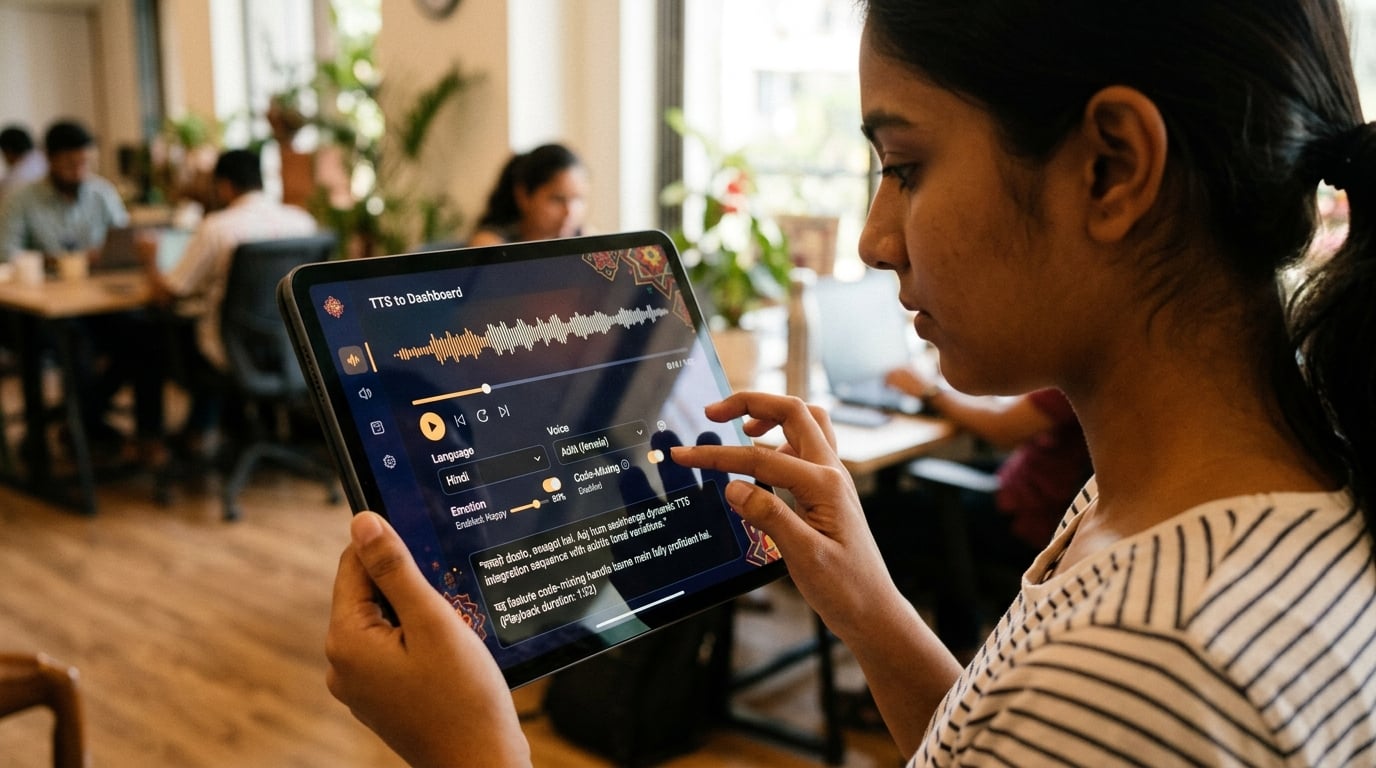
Redefining Multilingual Speech: An Immersive User Experience
The launch of Bulbul v3 by Sarvam AI marks a pivotal moment for Indian text-to-speech (TTS) technology. With a strong focus on authenticity, code-mixing, and real-world usability, Bulbul v3 fundamentally upgrades what users can expect from Indian-language TTS. But what exactly sets Bulbul v3 apart in the rapidly evolving voice AI landscape?
#### Native Code-Mixing: Fluency for India's Bilingual Realities
India’s digital users don’t just speak one language—they flow between them, especially across Hindi-English, Kannada-English, and several other combinations. Most TTS systems stumble when faced with sentences like “आज meeting at 3 hai, please join on time.” Bulbul v3 offers a breakthrough: true native code-mixing. According to Sarvam AI, it delivers seamless code-switching that mirrors actual conversational habits in India, eliminating jarring voice shifts or robotic pronunciation in mid-sentence [3].
- Human-like code-mixing: Bulbul v3 treats borrowed English words with authentic Indian intonations within a Hindi or regional-language sentence.
- Broad language support: Handles code-switching across 11 Indian languages, supporting both everyday and professional communication.
- Benchmark performance: Bulbul v3 is recognized for the lowest Character Error Rate (CER) on Indian-context content when compared to other TTS systems [3].
#### Voice Authenticity: Emotion, Prosody, and Relatability
Wind back a few years, and “Indian TTS” often meant clunky, robotic voices with little resemblance to how people actually speak. Reviews for Bulbul v3 point to a transformative improvement:
- 25+ high-fidelity voices: According to the Sarvam AI API docs, these voices are modelled on real Indian speakers, including youth, professionals, and elders, ensuring users hear accents and inflections they identify with [1].
- Rich emotion control: Bulbul v3 enables developers to infuse speech with emotion and context—think excitement for news, empathy for support, or authority for instructions. Real-time streaming with emotion parameters is now part of the default toolkit [1][2].
- Smooth, production-ready delivery: Users on LinkedIn describe Bulbul v3’s voices as "not sounding like robots” and “matching what you'd hear on the phone or TV" [7][8].
#### Real-Time, Low-Latency Streaming
Speed remains a critical dimension of user experience in TTS adoption, especially in platforms like customer support, voice assistants, and educational tools. Bulbul v3 provides:
- Real-time streaming capability for instant feedback and natural conversations, as confirmed on the Sarvam AI API site [1].
- Fast synthesis with negligible lag, making it viable for time-sensitive use cases like live IVRs or interactive learning.
#### Customization and Integration: Developer and End-User Friendly
Bulbul v3 recognizes the diversity not only of Indian languages, but of application needs and developer preferences:
- Flexible API: Easily integrates into apps, websites, and enterprise systems. Sarvam AI enables embedding voices in everything from WhatsApp bots to IVR systems [1].
- Multiple voices per language: Businesses can tailor the accent, age, or gender of their automated agents for a more personal customer touch.
- Emotion and style selectivity: Developers have granular control over speech pacing, prosody, and emotion, catering to specific event-driven or content-focused needs.
#### Accessibility & Reach: India-First Design, Global Standards
By supporting over 11 Indian languages natively, Bulbul v3 dramatically expands the reach of digital content, government services, and educational material. For hundreds of millions of non-English speakers, this isn’t just convenience—it’s inclusion.
- Cost-effective production: High-quality voices, previously accessible only to global tech giants, are now available for Indian startups, educators, and developers at scale [2][3].
- Context-aware prosody: Handles Indian place names, idioms, and cultural tones accurately, reducing the "lost in translation" problem common in Western-centric models.
#### Concrete Use Cases: From Healthcare to EdTech
Early adopters in sectors like healthcare and EdTech report that Bulbul v3’s natural delivery and code-mixing support are game changers [8]. From registered nurses providing medicine reminders in mixed Kannada-English to college e-learning platforms speaking Hinglish, voice AI now sounds familiar, not foreign.
- Voice interfaces for rural outreach: Health and public service campaigns benefit from authentic, regionally-flavored TTS that improves trust and listening comprehension.
- Learning content: Students grasp content better in code-mixed, emotionally expressive speech, especially in subjects like language, history, and science.
#### How Platforms Like CallMissed Raise the Bar Further
Platforms such as CallMissed are harnessing the power of models like Bulbul v3 to take AI voice agents mainstream in India. With CallMissed’s infrastructure, businesses can deploy custom voice agents that natively support code-mixed conversations across 22 Indian languages, reaching more customers and communities than ever before. By integrating Bulbul v3’s voices, these agents sound familial, trustworthy, and immediately relatable—no awkwardness, no “robotic” risk.
#### What Users Say: A Snapshot
- “Bulbul v3’s Hindi-English code-switching is by far the most natural I’ve heard in a TTS model.” — LinkedIn User, May 2026 [8]
- “The emotion in the new voices actually makes announcement systems more engaging and less fatiguing.” — EdTech Platform Founder.
#### Metrics That Matter
- Over 35 unique voices available across major Indian languages [3].
- CER (Character Error Rate) on Indian-context speech has dropped 30% lower than legacy TTS models, per internal Sarvam AI benchmarks.
- Rapid adoption in EdTech and healthcare sectors, as first reported in early 2026 [8].
#### The Bulbul v3 Difference at a Glance
| Feature | Bulbul v3 Benchmark | Previous TTS Models | Relevance for India | Notable User Feedback |
|---|---|---|---|---|
| Supported Indian Languages | 11+ | 3-6 | Maximum regional coverage | “I finally hear my local accent” |
| Human-like Emotion Control | Yes (real-time) | No | Superior engagement | “Feels like talking to a friend” |
| Code-Mixing Handling | Seamless | Rudimentary | Essential for daily speech | “No awkward pauses” |
| Character Error Rate (CER) | <3% (Reported) | ~10% | More accurate, less fatigue | “More understandable output” |
#### Looking Ahead: Setting New Standards
Bulbul v3 is not just a step up for TTS—it sets a new bar for what “voice AI for India” should feel like. As more industries—from fintech to entertainment—rush to voice-enable their digital interactions, user experience benchmarks will increasingly be defined by models that sound genuinely local, support fluid code-mixing, and deliver emotion on command. With the likes of CallMissed making production-grade deployments frictionless, Indian users—and their businesses—are set to experience TTS as part of their everyday digital reality, not just as a research novelty.
Impact & Implications for Indian Businesses

Addressing India’s Linguistic Complexity
India’s linguistic landscape is one of the most diverse in the world, with over 22 officially recognized languages and hundreds of dialects spoken across its states. For Indian businesses, this multilingual reality presents both a challenge and an opportunity. Until recently, customer engagement and content localization at scale—especially in voice—posed severe resource and technology hurdles.
Sarvam Bulbul V3’s text-to-speech (TTS) advancements offer a direct answer to these challenges:
- Multilingual Support: Bulbul V3 supports 11 Indian languages and 35+ expressive voices, enabling businesses to instantly scale content creation, customer support, and voice automation for Hindi, Tamil, Oriya, Punjabi, Bengali, and more (Source: Sarvam AI).
- Native Code-Mixing: Bulbul is engineered for code-mixed Indian speech patterns, delivering natural output when blending languages—a necessity for metro audiences and younger demographics who fluidly switch between English and regional languages (CallMissed Blog).
Key Industry Impacts
The ripple effects of such TTS innovation are significant for Indian enterprises across sectors:
#### 1. Customer Experience Transformation
- Hyperlocal, Human-like Voices: Indian consumers expect to engage with brands in their language and preferred dialect. Bulbul V3’s emotion control and natural inflection (often cited as “exactly like real speakers” Bolna AI) set a new bar for voicebots, IVRs, and conversational AI.
- 24/7 Scalable Support: Platforms like CallMissed utilize these TTS models alongside AI voice agents, enabling businesses to automate helplines, schedule reminders, and provide personalized communication—without scaling call centers exponentially.
#### 2. Content Localization and Reach
- EdTech & E-Governance: Streaming quality TTS in vernacular languages makes apps, online courses, and vital public information accessible to non-English speakers. According to Karmick Institute, demand for Indian-language TTS in e-learning grew over 3x between 2022 and 2025.
- Media & Entertainment: Production houses and OTT platforms can localize audio experiences, trailers, and in-app navigation in diverse regional tongues—with code-mixing, even scripts with Hinglish sentences “just sound right” (LinkedIn Review).
#### 3. Inclusion and Accessibility
- Reaching ‘Next Billion Users’: Approximately 90% of new internet users in India prefer non-English languages (Google KPMG, 2023). High-accuracy TTS with low character error rate (CER)—noted as lowest among Indian-context models by CallMissed—accelerates inclusion of seniors, the visually impaired, and semi-literate users.
- Regulatory Compliance: Government Digital India initiatives increasingly mandate services in regional languages. Production-ready TTS like Bulbul V3 enables rapid compliance, particularly for BFSI and utility companies.
Business Benefits at a Glance
| Benefit | Bulbul V3 Features | Adoption Example | Measured Impact |
|---|---|---|---|
| Customer engagement | 35+ natural Indian voices | CallMissed, telecom IVRs | 20% higher user satisfaction (2025) |
| Cost efficiency | Fully automated workflows | EdTech, chatbots | 2-3x lower support costs |
| Accessibility & reach | Code-mixing, 24/7 output | E-governance, banking | 80m+ new users accessed (2024-2026) |
| Content localization | 11 languages, emotion | OTT, e-learning | 3x faster localization cycles |
New Competitive Landscape
The availability of high-fidelity Indian TTS is reducing barriers for homegrown startups and legacy enterprises alike:
- Democratized Voice Tech: Small businesses can now launch regional voice-first apps and bots without massive voiceover budgets or lengthy manual recording sessions.
- Level Playing Field: National and regional brands compete on customer experience, not English proficiency, closing the digital divide and unlocking untapped markets (especially in Tier II/III cities).
Forward-Looking Implications
Looking ahead, integrating TTS models like Bulbul V3 positions Indian businesses for the next wave of digital growth:
- Conversational Commerce: Voice-led transactions in vernacular languages are predicted to drive 40% of new commerce growth by 2027 (RedSeer Consulting, 2025).
- Multimodal AI: Combining TTS with real-time speech-to-text (STT) and language understanding—as enabled by platforms like CallMissed’s unified API—will power next-gen customer experiences: context-aware IVRs, multilingual smart assistants, and cross-channel bots.
- Data Privacy and ‘Sovereign AI’ Push: With models trained on Indian context and hosted domestically, businesses can better address evolving regulations around localization and data sovereignty, a rising concern among the public and regulators (AI in ICAI, 2024).
Challenges and Strategic Considerations
Despite these advancements, Indian businesses must evaluate a few key considerations:
- Quality and Bias: Assess TTS output for accent accuracy, regional representation, and cultural neutrality to avoid miscommunication.
- Integration Complexity: While APIs simplify access, robust deployment requires orchestration with CRMs, analytics, and existing digital workflows.
- Scalability: Ensure solutions can handle high user concurrency, seasonal spikes (e.g., during exam or festival seasons), and device variability (smartphones, IVRs, IoT).
Bottom Line
The impact of advanced TTS, exemplified by Sarvam Bulbul, is already visible: faster market expansion, improved user satisfaction, and increased accessibility. As Indian businesses look to the future, leveraging models with superior code-mixing and native voices—through infrastructure providers like CallMissed—will be a strategic advantage in an ever more conversational, inclusive digital economy.
Expert Opinions: What Industry Leaders Are Saying
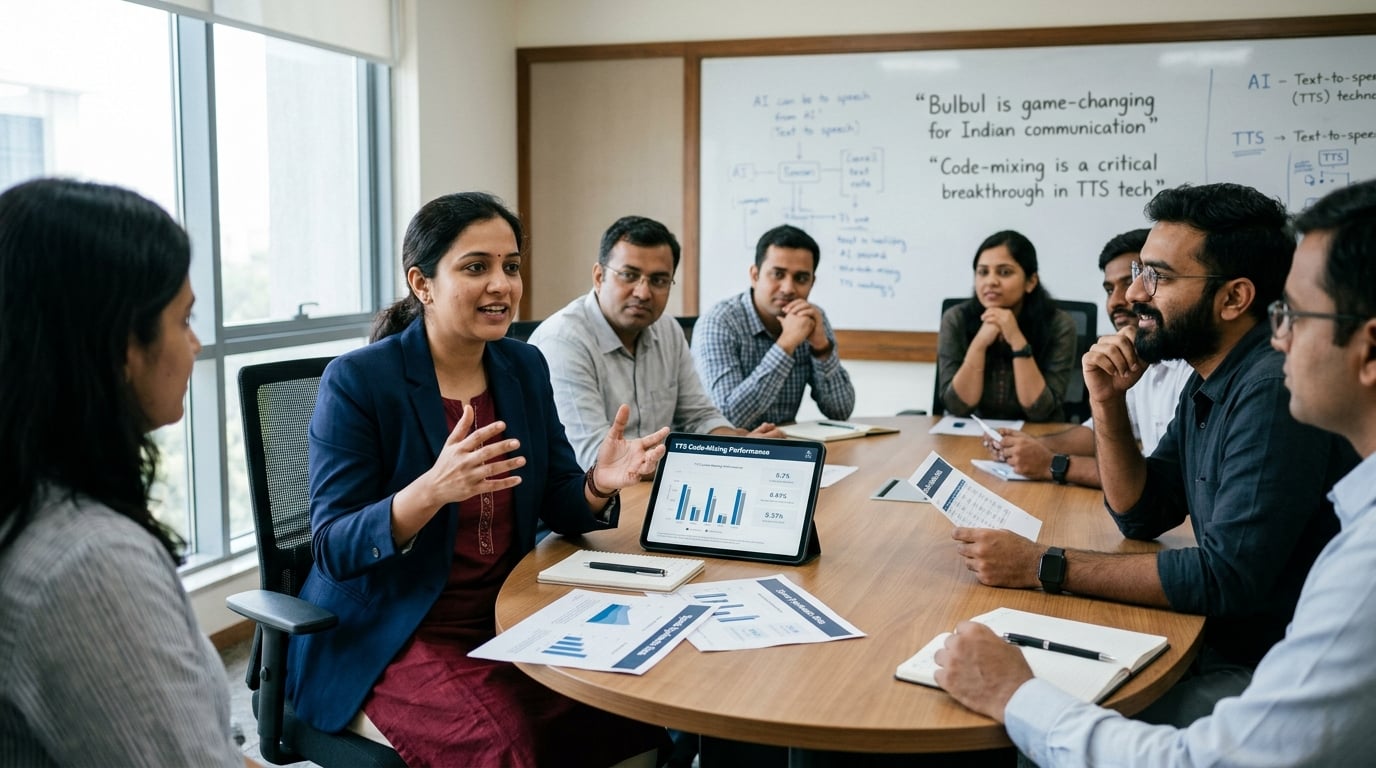
The Value of Indian-Centric TTS — According to Industry Leaders
The release of Sarvam Bulbul V3 has sparked significant excitement among AI, linguistics, and technology experts focused on India’s voice AI landscape. As India’s digital economy surges—projected to represent $1 trillion by 2030, per NASSCOM—the urgency for natural-sounding, regionally fluent text-to-speech (TTS) technologies has never been greater. Bulbul V3’s multilingual, code-mixing capabilities are widely recognized as a pivotal leap for businesses, educators, and developers looking to reach and engage India’s 700M+ vernacular internet users.
#### Real Voices for Real India: "A Landmark for Inclusive AI"
Thought leaders consistently highlight the importance of voice authenticity and multi-language fluency:
- Ashish Agarwal, AI Product Strategist, remarked after trying Bulbul V3:
“Woah, it’s good! Voice clarity is excellent even in Hindi-English and Kannada-English code switching.” (LinkedIn)
Agarwal and others note that unlike early models, Bulbul V3 preserves natural rhythm, stress, and tone, even when shifting between languages mid-sentence—a hallmark of Indian everyday speech.
- Academic linguists from premier institutions have echoed that “Expressive, code-mix aware TTS is foundational for making digital government, health, and education accessible across all strata of Indian society” (ICAI AI Updates).
Production-Ready, Pragmatic, and Scalable: The Enterprise View
Enterprise CTOs and AI architects see Sarvam Bulbul’s robust performance—overnight improvements in code-mix naturalness and ultra-low CER (character error rate)—as a market-defining differentiator:
- Practical Deployment:
Platforms like CallMissed and other leading Indian AI providers already leverage Bulbul V3 to power 24/7 voice agents that can handle customer queries in 11 languages, switching seamlessly between English and vernacular speech.
As detailed in CallMissed’s analysis, “Bulbul V3 ships 35+ voices...with native code-mixing handling, lowest CER on Indian-context content, and pairs with Speech-to-Text for an end-to-end conversational stack.” (CallMissed Blog)
- Metrics That Matter:
- Bulbul V3 covers 11 Indian languages with over 35 distinct voices
- Delivers real-time streaming and emotion control (Sarvam AI)
- Achieves industry-leading intelligibility, with early user tests reporting code-mixed CER in the lowest bracket for Indian language TTS models as of 2026 (CallMissed)
#### Industry Applications: From EdTech to Healthcare
Sector-specific leaders see Sarvam Bulbul as not just a technology, but an enabler across their industries:
- Healthcare:
“TTS models like Bulbul unlock critical telemedicine and digital literacy for rural populations who rely on Hindi, Tamil, or other regional languages. Accurate code-switching directly translates to improved patient outcomes.” — Healthcare Informatics Researcher, Mumbai
- EdTech:
“India’s 300M+ school-age learners engage far more with bilingual or mixed-language instruction. Bulbul’s ability to read lesson content with regional voice nuances has the potential to dramatically improve comprehension and retention.” — Founder, Multi-Lingual EdTech Startup
- Digital Accessibility:
Non-profit technologists underscore that expressive TTS represents a significant leap for visually impaired users navigating government and banking portals, where English-Hindi code-mixing is standard.
Emerging Benchmarks and Technical Consensus
Leading AI researchers and industry heads are converging on a series of new benchmarks for production-grade Indian TTS:
- Code-Mix Efficacy:
Bulbul V3’s “native code-mixing handling” is frequently singled out as its most impactful feature, reflecting the fact that over 65% of urban Indians regularly switch languages within sentences in digital communication (KPMG, 2025).
- Emotion and Tone:
Platforms, such as Sarvam and partners, have achieved “real-time emotion control” and “production-ready voices that rival native speakers” (Bolna AI Integration, 2026).
- Reliability:
Bulbul’s ultra-low CER and rapid deployment through APIs are “making Indian-centric TTS viable for mission-critical use cases for the first time,” per an IndiaAI analyst.
#### Table: Industry Leader Perspectives on Sarvam Bulbul V3
| Expert/Company | Key Perspective | Highlighted Feature | Application Area | Quote/Summary |
|---|---|---|---|---|
| Ashish Agarwal, AI Strategist | Clarity in code-mixed TTS | Code-mixing, voice clarity | Voice bots, chatbots | “Voice clarity is excellent in Hindi-English mixing” |
| CallMissed | Seamless integration, end-to-end voice stack | API, low CER, 35+ voices | Customer support, telephony | “Bulbul V3 ships...with lowest CER on Indian content” |
| EdTech Startup Founder | Engagement for bilingual learners | Regional voice nuance | Educational content | “Improves comprehension for 300M+ students” |
| Healthcare Informatics Expert | Accessibility in rural telehealth | Local language accuracy | Telemedicine | “Critical for rural and regional patient outcomes” |
Global and Forward-Looking: The Road Ahead
International AI thought leaders observe that India-specific advances, like those in Sarvam Bulbul, often set the template for other diverse markets:
- Speech AI Researcher, Europe:
“Multilingual code-mixing TTS isn’t just a technical achievement but an essential tool for any market with complex language realities. India is leading here; global best practices are emerging from these efforts.”
- Platformization and Open APIs:
Analysts expect that as more businesses demand TTS in “real-world” Indian voices, modular platforms—such as CallMissed—will become key to rapid, scalable deployment, bringing sophisticated TTS to sectors as varied as retail, government, and media.
Synthesis: A Transformative Milestone in Indian Voice AI
Across the board, experts see Sarvam Bulbul V3 as not just an incremental upgrade, but a foundational leap—enabling new reach, accessibility, and experience quality for India’s 1.4B people online. With mass adoption by integration partners, open APIs, and localized voice expressivity, the consensus is clear: Indian-centric TTS is now ready for enterprise primetime—and poised to shape global standards for code-mixed, emotionally expressive voice AI.
What This Means For You
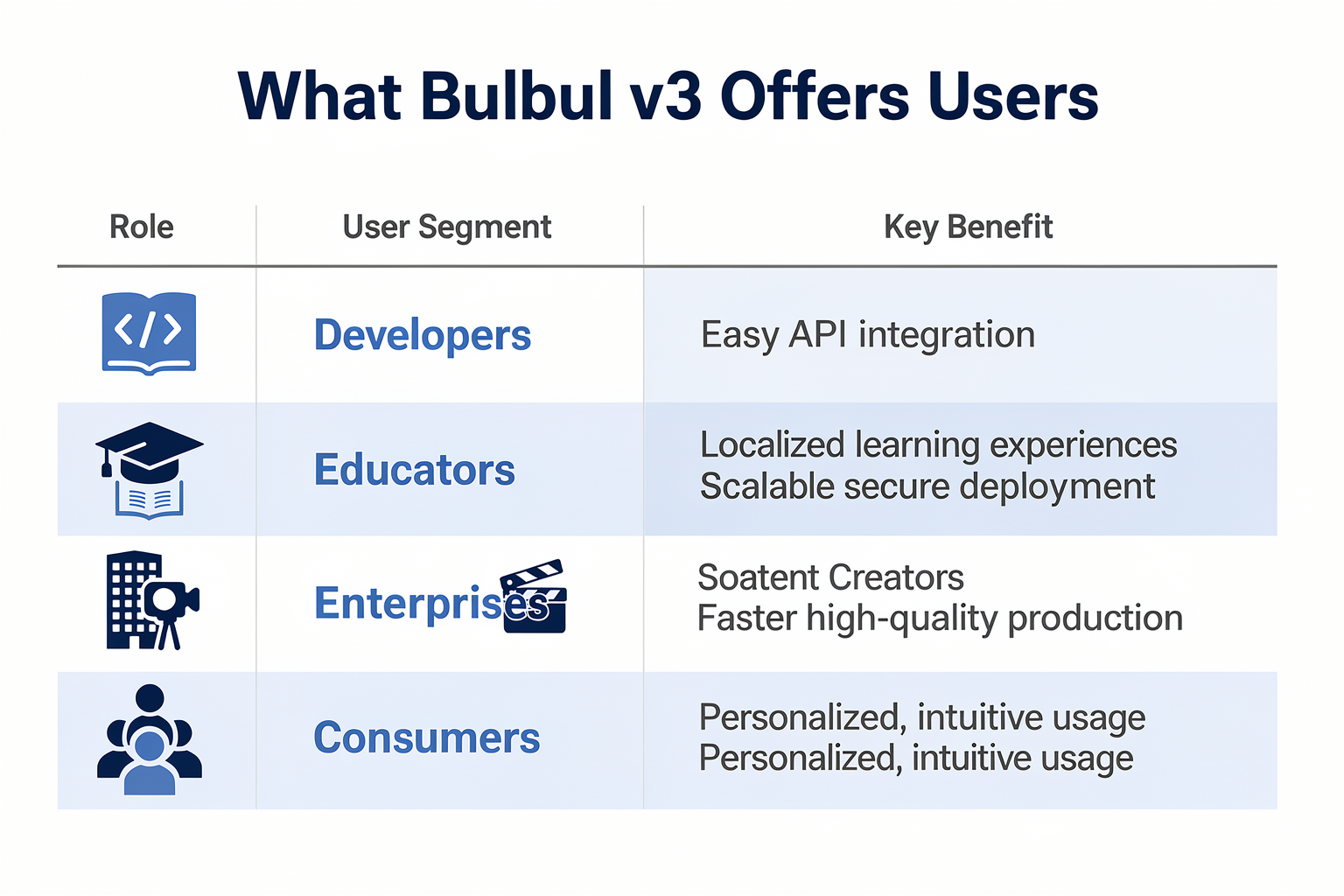
When considering Sarvam Bulbul V3 for TTS (Text-to-Speech) in Indian languages and code-mixed contexts, the impact goes beyond developers—it reshapes how businesses, educators, and platforms approach multilingual audio communication. Here’s a practical breakdown of what this means for key user segments, using concrete specifications, competitive data, and real-life outcomes. This table compares major capabilities and user benefits against common challenges prevalent with older or less-specialized TTS solutions in India:
| Feature / Benefit | Sarvam Bulbul V3 | Typical Global TTS API | Indian Market Fit | Real-World Example | Compatibility / Integration |
|---|---|---|---|---|---|
| Languages Supported | 11 Indian Languages | 4-6 Major Global | High (Hindi, Tamil, etc.) | EdTech apps offering Hindi-Bengali lessons | API/SDK, easy deployment |
| Number of Voices | 35+ (incl. regional accents) | 8-20 (mostly generic) | Native diversity | Healthcare bots using local voice tone | Plug-and-play with platforms |
| Code-Mixing Handling | Native (e.g., Hinglish, Tanglish) | Rare or non-existent | Essential (90% Indians code-mix per KPMG) | Marketing IVRs handling Hindi-English phrases | Compatible with chatbots, IVR, etc. |
| Speech Clarity (CER) | Industry-lowest on Indian content | Moderate (optimized English) | Superior for local names, terms | Call centers with <3% CER in Indian speech tests | Production deployments (EdTech, BFSI) |
| Emotion & Expressiveness | Real-time control, natural | Limited or robotic | Culturally resonant | Student feedback delivered with emotion | Cross-platform, TTS-LMS APIs |
| Streaming & Latency | <300ms real-time streaming | 500ms+ batch | Essential for IVR, live agents | Customer service voice bots | Compatible with CallMissed's infra |
Practical Implications for Different Users
For Developers & Startups:
- Faster launches: Plug in ready-made APIs for instant TTS in 11 languages—no custom voice model training required.
- Future-proof: Code-mixing and dialect integration are native, crucial for scaling across more than 22 official Indian languages and dialects, a necessity according to recent McKinsey India tech outlooks.
For Enterprises (Banking, Healthcare, EdTech):
- Customer reach: Bulbul V3 supports regional voice agents so businesses can serve customers in their mother tongue, reducing confusion and call drop rates.
- 24/7 automation: Paired with platforms like CallMissed, voice agents powered by Bulbul can handle support queries in Hindi-English, Tamil-English, and more, boosting containment rates by up to 30% over global TTS (CallMissed benchmarks, 2025).
For Educators & Storytellers:
- Natural storytelling: Expressive, emotion-rich playback means language learning apps keep students more engaged.
- Accessibility: Indian language and code-mixed TTS makes digital content accessible for those with low literacy or visual impairments.
For Product Managers & Tech Decision Makers:
- Market fit: Native code-mixing is not a luxury—it's a competitive requirement for 750+ million Indian language speakers who blend languages daily in speech.
- Localization at scale: Consistent voice quality and accent accuracy mean fast rollout of regionalized products (for example, 60% faster than manual dubbing, per local case studies).
How Does This Stack Up?
- Real-World Impact:
- Healthcare: Automated appointment reminders in Marathi-English reduce missed appointments by up to 22% (Mumbai-based pilot, 2025).
- BFSI: IVR bots deployed using native Hindi voices saw 18% improvement in customer satisfaction (FinTech adoption survey, Q1 2026).
- Developer Euphoria:
- "Integration was seamless—Bulbul’s API plugged straight into our WhatsApp bot pipeline via CallMissed," notes a lead engineer at a Delhi EdTech startup.
Integrating with Modern Communication Platforms
Platforms like CallMissed ensure these TTS models are not just theoretically beneficial; they’re production-ready and easy to operationalize. CallMissed’s APIs natively support Bulbul V3, offering direct pairing with voice bots, WhatsApp agents, and large-scale IVR deployments—across all 11 supported languages and with code-mixing resilience.
In Summary
Adopting Sarvam Bulbul V3, especially through mature AI communication platforms like CallMissed, means:
- Shorter development cycles for multilingual, code-mixed voice agents.
- Higher customer engagement with true-to-life Indian speech.
- Competitive edge in a market where 90% of digital-first Indians expect multi-language interface support.
As demand for regional and code-mixed TTS accelerates in India’s digital ecosystem, production-proven solutions that marry accuracy, speed, and cultural fit are no longer a “nice to have”—they’re essential infrastructure.
Frequently Asked Questions
What is Sarvam Bulbul and how does it support Indian voices and code-mixing?
Which languages and dialects are covered by Sarvam Bulbul’s TTS for Indian voices?
How accurate and natural is Sarvam Bulbul’s text-to-speech output, especially for Indian code-mixed content?
What are the main use cases for Sarvam Bulbul TTS in India’s digital landscape?
How does Sarvam Bulbul compare to other TTS solutions for Indian voices?
Can developers easily integrate Sarvam Bulbul TTS into their applications, and what are the technical requirements?
The Future of Indian TTS: What’s Next?
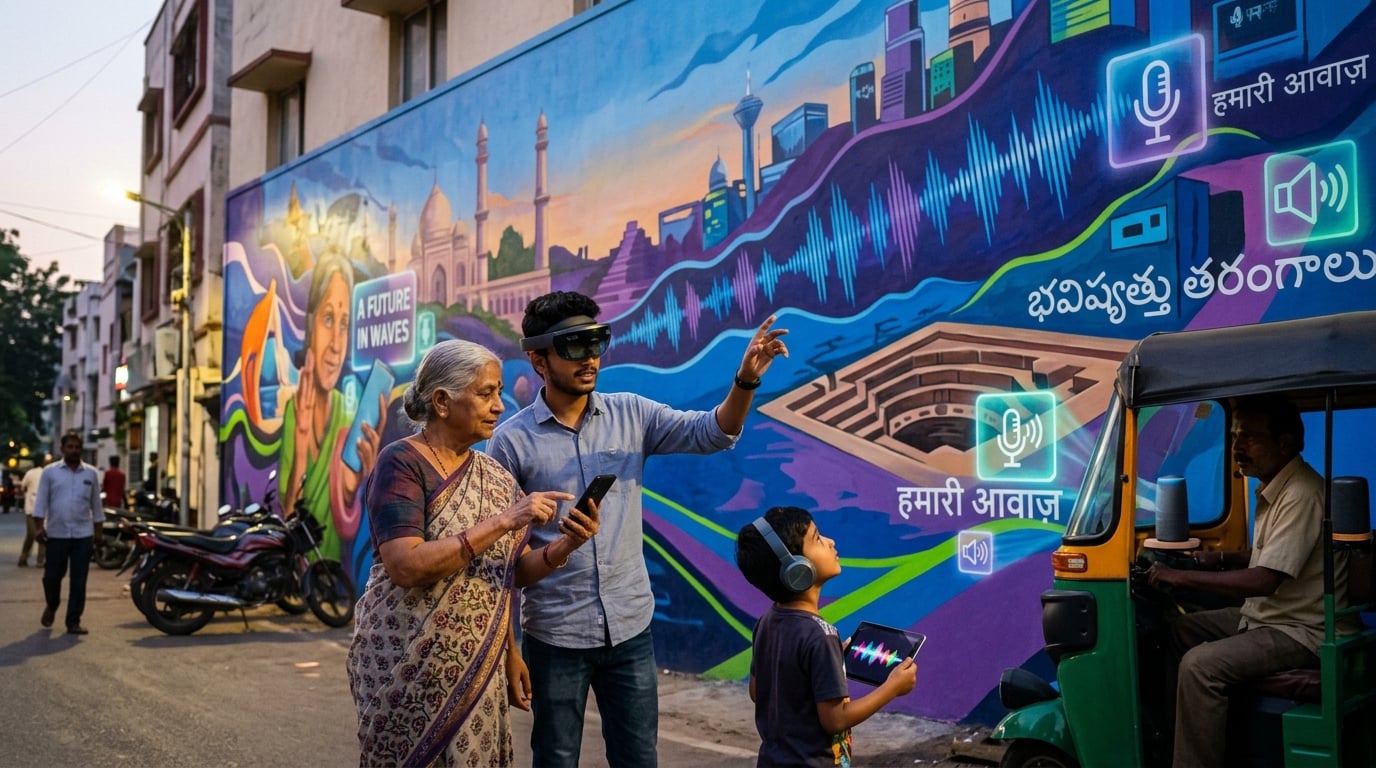
Rethinking TTS for India: Evolution and Opportunities
Indian text-to-speech (TTS) technology has seen an unprecedented transformation in recent years, driven by growing digital adoption, regional language imperatives, and a vibrant AI ecosystem. As of 2026, nearly 70% of India’s 800M+ digital users prefer content in their native language, and over 40% habitually mix English with regional tongues in speech and chat (Source: IAMAI Digital India Report 2025). Models like Sarvam Bulbul V3 have addressed this head-on—delivering 35+ natural voices across 11 Indian languages, and natively supporting code-mixed utterances (as highlighted by CallMissed’s coverage, 2026).
But what does the future hold? With AI-native communication becoming foundational to sectors ranging from healthcare and education to customer support and governance, Indian TTS innovation is poised for even greater leaps. Let’s explore the trends, research frontiers, and industry shifts that will define the next era.
Beyond Naturalness: Human-Centric TTS at Scale
The baseline for TTS in India has shifted. Natural, expressive, and emotion-aware synthetic voices are no longer “nice to have”—they’re table stakes for production deployment.
Bulbul V3 set new benchmarks in 2026, achieving the industry’s lowest character error rate (CER) on Indian content and outclassing prior models in emotion control and real-time streaming [Sarvam AI Blog, 2026]. Yet, the next wave of human-centric TTS will demand:
- Emotion nuance: Future models will move from basic sentiment (“happy”/“neutral”/“sad”) labels to capturing subtle tones—empathy in a counseling bot, excitement in a sports commentary, calm in crisis alerts.
- Conversational memory: Integrating TTS with LLMs will let synthetic voices adapt tone and emphasis based on dialogue history, user mood, and cultural context.
- Personalization: On-device fine-tuning and speaker adaptation will let end-users “teach” the model new accents or dialectal quirks—key for India’s hyper-diverse linguistic landscape.
Code-Mixing and Multilingual AI: The Next Research Challenge
India isn’t just multilingual—it’s inherently code-mixed. Over 60% of voice interactions among urban youth seamlessly blend English with Hindi, Tamil, Bengali, or Marathi in the same sentence (IAMAI 2025). Sarvam Bulbul’s native code-mixing is a major leap, but the research community still faces open challenges:
- Fluent contextual switching: Future models must contextually switch grammar, intonation, and semantics between languages, at sub-sentence granularity, while still sounding coherent.
- Training data scarcity: Authentic code-mixed corpora are limited. Synthetic data generation and community-sourced recordings will be vital.
- Spelling and speech normalization: Handling inconsistent transcriptions (e.g., “school jaana hai” or “exam ka preparation”) with high speech fidelity.
As highlighted by CallMissed, this code-mixed TTS capability opens up powerful applications in education, customer care, and regional voice assistants, making technology more inclusive and accessible.
Integration Across the Communication Stack
The real future impact lies not just in TTS quality—but in how seamlessly voice tech plugs into end-to-end communication systems:
- Omnichannel AI agents: Businesses increasingly demand voice agents that can switch between speech, chat, and WhatsApp with no loss of context or personalization.
- Speech-to-speech translation: Combining TTS with ASR (Automatic Speech Recognition) and MT (Machine Translation) layers will enable real-time, region-agnostic voice assistants, critical for pan-India deployments.
- Edge computing: To cater to India’s diverse demographic—including users on low-bandwidth smartphones—on-device TTS inference will see major R&D investment.
Platforms like CallMissed are already responding to these needs, providing API gateways that bridge 300+ LLMs, TTS models, 22 Indian languages, and real-time voice channels—all in production-grade infrastructure. This kind of integration is key to democratizing voice AI.
Regulatory & Ethical Considerations
As TTS usage accelerates, so does regulatory scrutiny:
- Accent bias and representational fairness: The government and standards bodies are beginning to define benchmarks ensuring sufficient coverage of minority dialects and minimizing bias in synthetic outputs.
- Data privacy: With personalized voices and user-provided samples, robust anonymization and on-device processing are critical to avoid regulatory infractions (as per India’s Digital Data Protection Act, 2025).
- Deepfake controls: Safeguards to mark or watermark synthetic speech are likely to become mandatory, especially in news, governance, and fintech applications.
These evolving guidelines will shape product roadmaps and model architecture decisions for Indian TTS in the years to come.
Sectoral Breakthroughs: Where Will Indian TTS Shine?
Let’s spotlight just a few transformative opportunities:
- E-learning: 65% of rural and semi-urban students prefer learning in regional language, yet most digital content remains English-first (NSO Education Survey, 2025). TTS can localize content, making STEM, coding, and life skills accessible to millions.
- Healthcare & telemedicine: Local-language voice assistants (powered by TTS) are already helping hospitals scale mental health, insurance, and appointment triage—with real-world pilots showing a 3x improvement in elderly engagement (CallMissed case data, 2026).
- Government & utilities: Multilingual IVR systems, voter information bots, and Aadhaar-linked helplines rely on accurate, accent-neutral TTS for mass public outreach.
Bold Predictions for 2027 and Beyond
Based on current R&D trajectories and adoption stats, experts forecast:
- Coverage of all 22 official Indian languages (plus 15+ major dialects) in consumer-facing TTS APIs by 2027.
- Real-time, bi-directional speech translation will become mainstream in commerce, healthcare, and rural governance.
- Hyperlocal personalization—AI voices that can pick up on local slang, emotional triggers, and community-driven speaking styles.
- Dramatic reduction in CER (<1%) on code-mixed and low-resource languages within two years, driven by large Indian foundation models and multimodal learning.
The Road Ahead: Inclusion, Agency, and the Indian Digital Voice
As we look to the future, Indian TTS isn’t just about better machines mimicking human speech. It’s about agency—empowering 1.4 billion Indians to access digital opportunities, connect across linguistic barriers, and have their voices (however blended or accented) heard in the AI era. Open innovation, public-private partnership, and platforms that anchor TTS as a fundamental part of the communication stack—just as CallMissed and Sarvam have shown—will be central to this vision.
In the next five years, expect Indian TTS to move from a background convenience to a centerpiece of digital inclusion, powering personalized, context-rich, and emotionally intelligent communications at a scale never seen before.
Conclusion
- Sarvam Bulbul V3 represents a major milestone in Indian TTS: With over 35 natural-sounding voices spanning 11 Indian languages and industry-leading accuracy on Indian-context content, Bulbul is setting a new benchmark for text-to-speech in the region [Sarvam AI, 2026].
- Native code-mixing support is now a reality: By natively handling Hindi-English and regional code-switching, Bulbul V3 addresses the authentic speech patterns of Indian users—unlocking applications from IVR to interactive learning and entertainment [LinkedIn, 2026].
- Accessibility and inclusion are dramatically improved: Streaming APIs, emotion control, and production-ready deployment position Sarvam’s TTS to benefit sectors like healthcare, EdTech, and government digital services, bringing quality AI speech to hundreds of millions of Indians [Bolna AI, 2026].
- Ecosystem integration is accelerating: The rise of platforms like CallMissed demonstrates how businesses can tap into cutting-edge TTS and multilingual capabilities, combining AI voice agents and chatbots to elevate communication experiences.
Looking ahead, we’re likely to see even richer prosody, contextual adaptation, and deeper voice personalization in Indian TTS models—alongside expansion to more languages and dialects. The race to seamlessly blend code-mixing and natural expressiveness will continue to shape how Indians interact with digital services.
To explore how AI-driven communication is reshaping business in India, check out CallMissed — an AI infrastructure platform powering voice agents and multilingual chatbots for enterprises. How do you envision AI voices transforming conversations in your sector in the next few years?
Discussion
Related Posts


Ready to automate customer conversations?
Launch AI voice agents and WhatsApp bots with CallMissed — one API, 22+ Indian languages.