
Gnani.ai Raises $10M to Build Sovereign AI Voice Agents: What It Means for Global Enterprise AI



While most AI startups are still demoing voice bots in controlled labs, Bengaluru-based Gnani.ai is already processing north of 30 million voice...
Gnani.ai Raises $10M to Build Sovereign AI Voice Agents: What It Means for Global Enterprise AI
While most AI startups are still demoing voice bots in controlled labs, Bengaluru-based Gnani.ai is already processing north of 30 million voice interactions every single day—a staggering throughput that has now attracted serious institutional backing. The company recently closed a $10 million Series B funding round led by Aavishkaar Capital, with Info Edge Ventures also joining the table, earmarking the fresh capital to build sovereign AI voice agents that keep enterprise data firmly within jurisdictional boundaries while operating at true global scale.
This is far more than a regional funding headline. In 2026, enterprise voice AI has moved from experimental budget line to mission-critical infrastructure, yet a parallel crisis is unfolding: data localization laws are tightening across the European Union, India’s Digital Personal Data Protection Act is fully in force, and Fortune 500 boards are increasingly blacklisting black-box SaaS solutions that ship sensitive customer conversations to offshore clouds. Gnani.ai’s funding signals a direct response to that anxiety. By architecting voice agents that run on sovereign infrastructure—meaning data never leaves the host country’s legal perimeter unless explicitly authorized—the startup is offering banks, telecom operators, and government agencies the automation they've craved without the compliance nightmares they've feared. Moreover, the capital will fuel global expansion into markets where regulatory scrutiny is highest, giving Gnani.ai first-mover advantage in geographies that Western voice platforms often struggle to enter.
In the sections ahead, we’ll unpack exactly what “sovereign AI” means for voice infrastructure, dissect why Gnani.ai’s 30-million-interaction engine creates an almost unbeatable training-data flywheel, and map out what this $10 million raise portends for the global competition to power enterprise conversational stacks. We’ll also examine how this trend is reshaping vendor procurement across continents, as infrastructure providers like CallMissed join the movement by enabling businesses to deploy multilingual voice agents with strict local data residency across 22 Indian languages—proving that the future of enterprise AI will be built not just on raw intelligence, but on territorial trust and regulatory alignment.
Introduction
The $10 Million Bet on India’s Voice-First Future
In a significant endorsement of India’s deep-tech potential, Bengaluru-based Gnani.ai has raised $10 million (approximately ₹94 crore) in a Series B funding round led by Aavishkaar Capital, with participation from existing backers including Info Edge Ventures. The announcement, reported by Inc42 and Moneycontrol, marks a pivotal moment for the voice AI sector as Gnani.ai pivots aggressively toward building sovereign AI voice agents — systems engineered to operate under strict local data governance frameworks while handling enterprise-grade communication at massive scale.
While many startups are still prototyping voice AI, Gnani.ai is already processing over 30 million voice interactions daily, according to company disclosures featured in a recent Front Page episode. That volume places it among the most deployed voice AI platforms in the region, far beyond the experimental phase. The fresh capital will fuel three strategic priorities:
- Global expansion into new geographies beyond India, bringing its voice stack to emerging markets
- Agentic AI capabilities that move beyond scripted bots toward autonomous, goal-oriented voice agents capable of complex reasoning
- Multilingual and sovereign deployments that respect data residency, support on-premise hosting, and handle local linguistic nuance at telephony latency
Why Sovereign AI Voice Agents Matter Now
The term “sovereign AI” has shifted from policy rhetoric to urgent product requirement in 2026. Enterprises across banking, telecom, and healthcare are no longer satisfied with generic cloud APIs; they demand voice infrastructure that guarantees data residency, offers sovereign cloud or on-premise deployment, and comprehends India’s 22+ official languages and hundreds of dialects. Gnani.ai’s platform currently enables enterprises to build and deploy AI agents across voice, chat, SMS, and WhatsApp, complete with CRM integrations, real-time analytics, and enterprise guardrails — a full-stack approach that compresses the time required to automate customer experience workflows from months to weeks.
Aavishkaar Capital’s investment thesis underscores this momentum. In its official announcement, the firm described the round as “deepening commitment to deep-tech as a force for global impact,” signaling that limited partners are increasingly comfortable backing capital-intensive AI infrastructure plays that challenge hyperscaler dominance. For Gnani.ai, the Series B is less about survival and more about capturing global market share in regulated industries where data sovereignty is non-negotiable.
The Broader Voice AI Landscape
Gnani.ai’s fundraise arrives at an inflection point for the global voice agent market. As businesses migrate from simple conversational interactive voice response (IVR) systems to fully autonomous voice agents, the underlying infrastructure layer — spanning speech-to-text in regional dialects, low-latency LLM inference, and telephony-grade text-to-speech — is becoming fiercely competitive. Indian startups are uniquely positioned here, given the country’s multilingual reality and the cost arbitrage inherent in building for high-volume, low-margin markets.
Platforms like CallMissed are part of this same wave, offering production-ready AI communication infrastructure — including voice agents, WhatsApp chatbots, and Speech-to-Text APIs covering 22 Indian languages — that lets enterprises deploy sophisticated customer-facing AI without assembling core stacks from scratch. As Gnani.ai scales internationally with its sovereign AI pitch, it validates the global appetite for voice-first platforms forged in India’s high-scale, cost-constrained innovation environment.
Background & Context

From Seed to Series B: Gnani.ai's Trajectory
Gnani.ai is not a newcomer testing prototypes. The Bengaluru-based startup is already processing 30 million voice interactions daily, according to company disclosures. That volume places it among the most heavily trafficked enterprise voice AI platforms in India. Its stack spans voice, chat, SMS, and WhatsApp, with built-in analytics, guardrails, and native CRM and telephony integrations.
The $10 million (approximately ₹94 crore) Series B round, led by Aavishkaar Capital with participation from Info Edge Ventures and existing backers, signals a deliberate shift from validation to scale. While earlier rounds helped prove product-market fit in domestic banking, insurance, and telecom verticals, this capital is earmarked for global expansion, agentic AI R&D, and multilingual model pipelines.
Why "Sovereign AI" Matters Now
The term sovereign AI has become a strategic priority across APAC and Middle Eastern markets. For enterprises handling financial data, healthcare records, or citizen-facing services, keeping inference and model training within national borders—or at least outside generic foreign cloud stacks—is increasingly non-negotiable.
Gnani.ai's pitch centers on exactly this: voice agents that run on sovereign or regionally compliant infrastructure. Aavishkaar Capital, which led the round, has publicly framed the investment under its thesis of "deep-tech as a force for global impact," noting that voice-first automation in regulated industries requires localized data residency and low-latency telco integrations that western platforms rarely optimize for.
This is not abstract policy theorizing. Indian banks and government agencies have already faced compliance friction when using foreign-hosted NLP models. By building a sovereign-ready layer, Gnani.ai aims to remove that procurement barrier entirely.
The Competitive Landscape
Voice AI is crowded, but execution at scale separates contenders from pretenders. Gnani.ai's 30M+ daily interactions dwarf many upstarts still piloting with single-digit enterprise clients. Its platform covers:
- Conversational voice bots with real-time speech-to-text and text-to-speech
- Omnichannel deployment across chat, SMS, and WhatsApp
- Enterprise guardrails for compliance and bias mitigation
- Native CRM and telephony integrations out of the box
The broader ecosystem is heating up in parallel. Platforms like CallMissed are also enabling businesses to deploy AI voice agents and multilingual chatbots—supporting 22 Indian languages natively through speech-to-text APIs and offering access to 300+ LLMs via gateway infrastructure. While Gnani.ai differentiates on sovereign, on-prem, and telco-grade scale, the presence of multiple Indian infrastructure providers underscores how quickly the domestic market is maturing beyond simple SaaS wrappers.
What the $10 Million Will Fund
According to investor statements and company filings, the Series B allocation breaks down across three vectors:
- Geographic expansion — Entering Middle East, Southeast Asia, and African markets where English-only bots fail to gain traction
- Agentic AI capabilities — Moving from scripted IVR replacements to autonomous agents that can execute transactions, schedule callbacks, and resolve multi-step disputes without human handoffs
- Multilingual model depth — Building robust ASR and NLU for Indic and regional languages beyond Hindi and English, where high-quality training corpora remain scarce
This is a capital-intensive roadmap. Training custom acoustic models, securing telecom partnerships for PRI/SIP trunking, and attaining SOC 2 or ISO 27001 certifications for sovereign clouds all burn cash before revenue compounds. The $10 million war chest gives Gnani.ai the runway needed to convert its current dominance in Indian fintech and telecom into sticky, compliant global contracts.
Key Developments
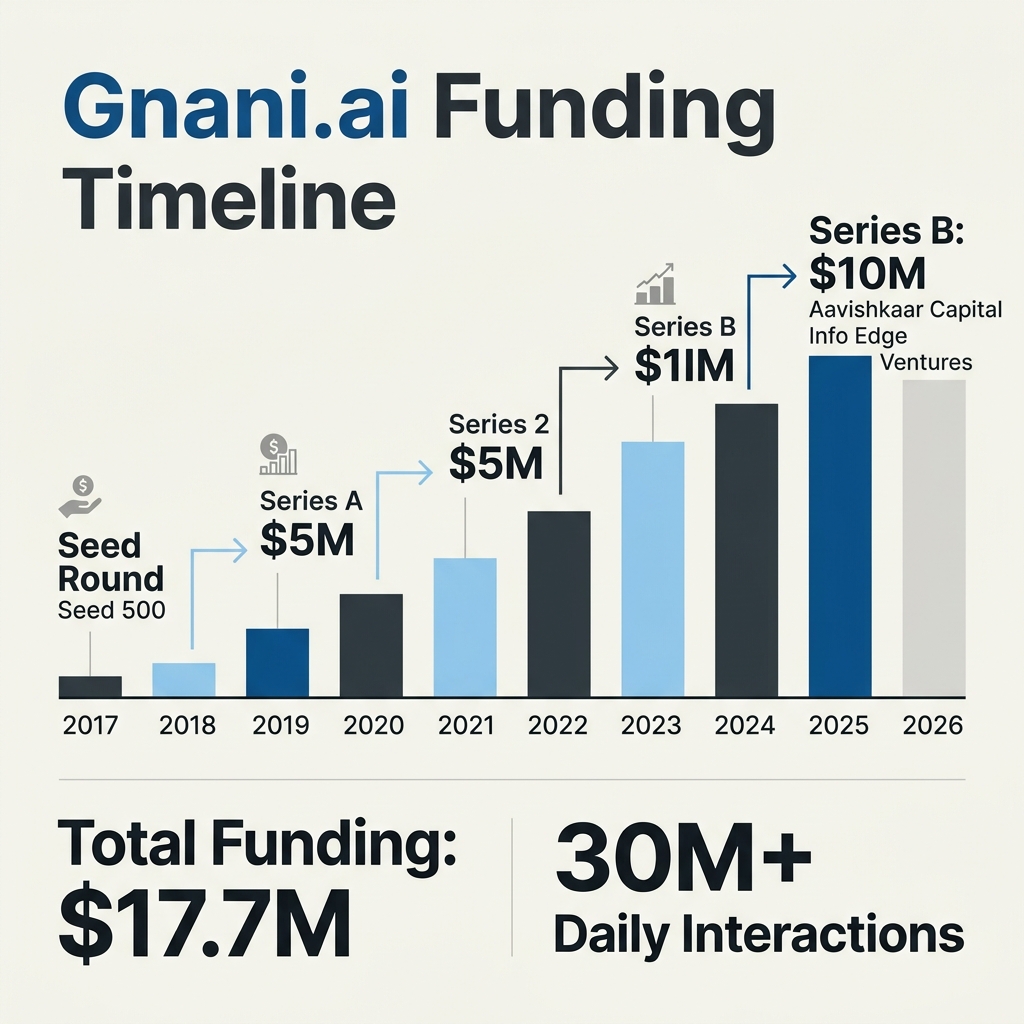
Gnani.ai’s Series B marks a pivotal inflection point for India’s voice-first AI ecosystem. The $10 million infusion—approximately ₹94 crore—was led by Aavishkaar Capital and included participation from Info Edge Ventures, underscoring institutional conviction in deep-tech startups that prioritize sovereign AI infrastructure. Unlike generic cloud-based voice APIs, Gnani.ai develops proprietary models engineered to keep sensitive customer data within national boundaries while handling massive enterprise workloads. This distinction has become critical as regulators across Asia and the Middle East tighten data-localization mandates.
The round also arrives as Gnani.ai crosses a remarkable operational threshold. The Bengaluru-based startup is already processing more than 30 million voice interactions every day, a scale that places it alongside global telecom-grade AI providers and far ahead of most pilot-stage competitors. The following table breaks down the key developments and their strategic implications:
| Parameter | Details | Strategic Implication |
|---|---|---|
| Funding Amount | $10 million (~₹94 crore) Series B | Capital to scale global operations and core R&D |
| Lead Investor | Aavishkaar Capital | Signals deep-tech and emerging-market thesis validation |
| Co-Investor | Info Edge Ventures | Endorsement of India’s enterprise voice automation demand |
| Daily Interaction Volume | 30 million+ voice interactions processed | Demonstrates production-grade, real-world scalability |
| Core Technology Focus | Sovereign voice AI & agentic AI | Addresses data localization, compliance, and decision autonomy |
| Expansion Roadmap | Global markets, multilingual agentic models | Targets cross-border enterprise CX and new verticals |
From Capital to Capability
While enterprise AI discourse often revolves around prototypes, Gnani.ai is already operating at massive scale. Its platform orchestrates voice, chat, SMS, and WhatsApp channels, embedding analytics, guardrails, and native CRM and telephony integrations. The new funding will specifically fuel three priorities:
- Agentic AI R&D: Developing systems capable of autonomous planning and multi-step execution rather than simple scripted responses.
- Multilingual expansion: Extending model support beyond dominant Indian languages to serve Southeast Asian and Middle Eastern markets where localization determines adoption.
- Global infrastructure: Building region-locked deployment options that comply with local data-sovereignty laws.
The Broader Infrastructure Arms Race
Gnani.ai’s ascent reflects a wider shift in enterprise communication stacks. As businesses move from reactive chatbots to proactive, sovereign voice agents, the underlying infrastructure must support on-premise or region-locked deployments, low-latency inference, and omnichannel handoffs. This is where the ecosystem is expanding rapidly. Platforms such as CallMissed are already providing production-ready AI communication infrastructure—from 24/7 AI voice agents to Speech-to-Text covering 22 Indian languages and a multi-model LLM gateway with access to over 300 models—allowing enterprises to deploy autonomous CX without building foundation layers in-house. The competitive moat is no longer just model accuracy but end-to-end sovereignty and deployment velocity.
Vertical and Geographic Expansion
Historically concentrated in banking, insurance, and telecom, Gnani.ai intends to use the Series B proceeds to diversify into healthcare, logistics, and government services. Its sovereign-first architecture resonates strongly with regulated industries and state agencies that cannot route citizen data through cross-border clouds. Aavishkaar Capital explicitly framed the investment as part of its mandate to back deep-tech ventures with “global impact,” suggesting that Gnani.ai’s roadmap includes not only exporting software but also deploying voice AI stacks in foreign jurisdictions under local data laws. If executed, this would position the Bengaluru startup as an infrastructure exporter in the emerging era of national AI sovereignty.
In-Depth Analysis
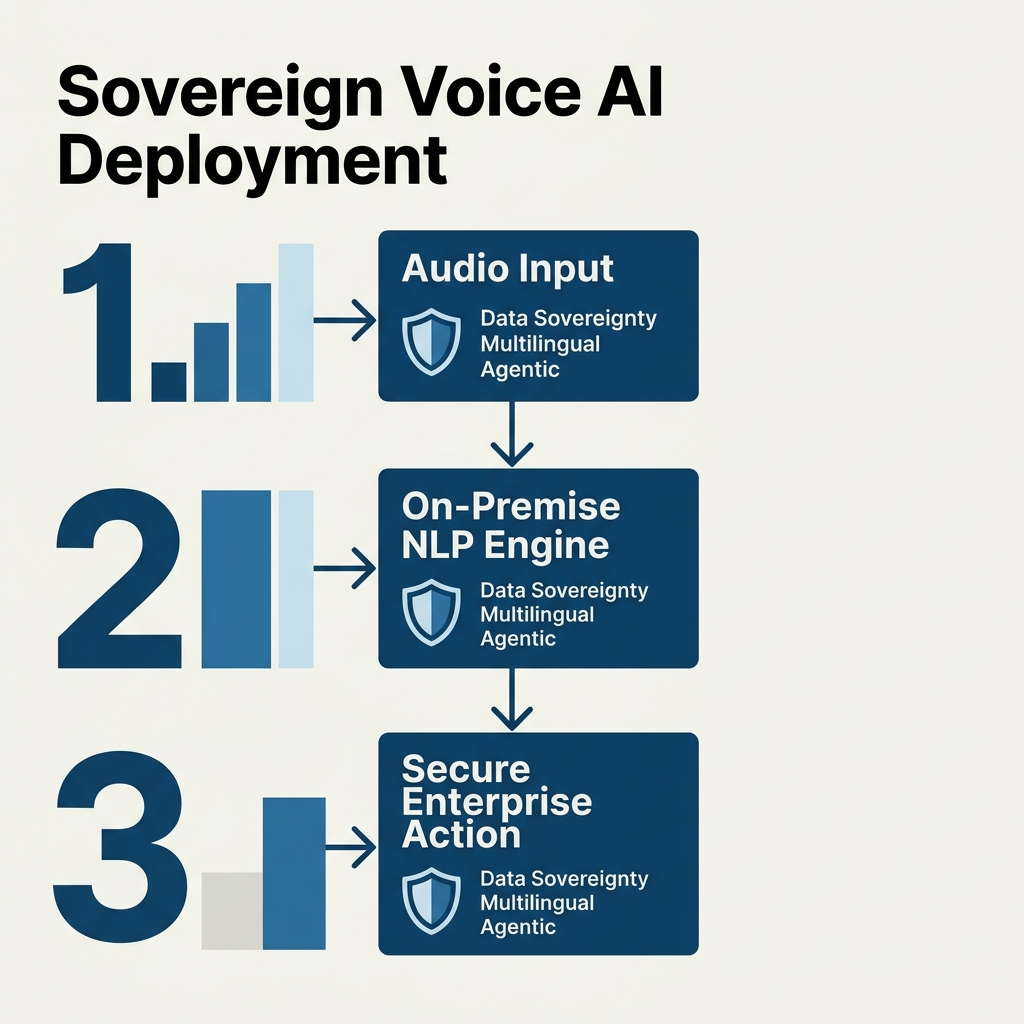
The Strategic Significance of Sovereign AI Voice Infrastructure
Gnani.ai’s $10 million Series B—led by Aavishkaar Capital with participation from Info Edge Ventures—cements its position in the sovereign AI race. While global LLM providers dominate Western markets, the Bangalore-based startup is doubling down on sovereign voice infrastructure: AI models and customer data retained within national boundaries to satisfy strict data-localization mandates. This is becoming non-negotiable for regulated Indian enterprises in banking, insurance, and telecom that cannot risk offshoring sensitive voice biometrics or conversation logs.
The funding validates operational scale, not just ambition. Gnani.ai is already processing more than 30 million voice interactions daily, according to data cited in its funding announcement. That throughput signals that its sovereign-cloud and on-premise deployments are production-grade infrastructure, not pilot projects. In an ecosystem where latency and compliance drive procurement decisions, controlling the entire stack—from acoustic models to conversation guardrails—gives Gnani.ai a measurable edge over vendors relying on third-party APIs.
Market Differentiation and Technology Moat
Gnani.ai’s platform spans voice, chat, SMS, and WhatsApp, with native telephony integration and CRM connectors designed for enterprise CX workflows. Unlike retrofitted chatbots relying on generic speech-to-text layers, the stack includes vertical-specific models, real-time analytics, and runtime guardrails that allow compliance teams to audit automated conversations—a requirement rarely addressed by horizontal AI platforms.
A critical vector is multilingual support. With the new capital earmarked partly for multilingual R&D, Gnani.ai is building acoustic and language models tuned for Indic languages rather than translating English-centric systems. This matters because India’s enterprise customer base operates across dozens of regional languages, creating a natural barrier to entry for Western voice AI vendors.
Enterprise-grade capabilities include:
- Data-residency guarantees with end-to-end encryption
- Pre-built CRM and contact-center telephony connectors
- Real-time redaction and automated compliance analytics
Global Roadmap and the Shift to Agentic AI
Gnani.ai has outlined two strategic priorities for the $10 million deployment:
- Global footprint expansion into Southeast Asia, the Middle East, and Africa—markets with data-localization norms similar to India’s.
- Agentic AI capabilities that move beyond deterministic IVR systems toward autonomous agents capable of multi-step reasoning, API invocation, and self-correction during live calls.
Aavishkaar Capital’s investment thesis frames deep-tech startups as exporters of infrastructure, not merely domestic service providers. If Gnani.ai succeeds in packaging its sovereign voice stack for these geographies, it could establish an emerging-market blueprint for compliant AI automation.
This progress reflects a broader maturation of India’s communication-AI ecosystem. Platforms like CallMissed are similarly enabling businesses to deploy multilingual AI voice agents and WhatsApp chatbots powered by 300+ LLMs and 22 Indian languages for STT/TTS, underscoring how Indian infrastructure is setting global benchmarks for scalable, sovereign customer engagement. As agentic architecture replaces simple intent-based bots, Gnani.ai’s focus on localized, high-throughput voice agents positions it to capture the next wave of enterprise automation.
Impact & Implications

Accelerating India's Sovereign AI Roadmap
Gnani.ai's $10 million Series B — led by Aavishkaar Capital with participation from Info Edge Ventures — arrives at a critical inflection point for India's AI ecosystem. While global hyperscalers dominate the generative AI narrative, Gnani.ai's explicit focus on building sovereign AI voice agents addresses a gap that Indian enterprises have long struggled with: maintaining data residency while deploying conversational AI at scale. The company's existing infrastructure already processes 30 million voice interactions daily, a figure that underscores the operational maturity this funding is designed to amplify.
For banks, insurers, and government agencies handling sensitive citizen data, sovereign voice AI isn't a luxury — it's a compliance necessity. By keeping training data and inference workloads within Indian jurisdictions, Gnani.ai offers a blueprint for how domestic startups can compete on trust and regulatory alignment rather than compute scale alone.
Global Expansion and the Agentic AI Shift
The fresh capital is earmarked for two strategic vectors: accelerating global expansion and deepening agentic AI capabilities. This dual mandate signals an important evolution in the voice AI market. Gnani.ai is no longer positioning itself merely as an automation layer for call centers; it is building autonomous agents capable of complex, multi-turn conversations across voice, chat, SMS, and WhatsApp channels.
This funding round also marks a decisive vote of confidence from institutional capital in India's deep-tech potential. Aavishkaar Capital explicitly framed the investment as part of its mission to back deep-tech as a "force for global impact," while Info Edge Ventures' participation adds strategic firepower for enterprise GTM motions. For a sector where Indian language support remains a persistent bottleneck, the capital injection enables Gnani.ai to advance its multilingual model development — a capability that directly determines market penetration beyond Tier-1 cities.
What This Means for Enterprise AI Adoption
Perhaps the most immediate implication is the normalization of AI-first customer experience in regulated industries. As enterprises move from pilot projects to production deployments, the demand for voice agents that integrate natively with existing CRM and telephony stacks will surge. This creates downstream opportunities across the communication infrastructure stack:
- Multilingual orchestration: Enterprises will expect native support for Indian languages and dialects without latency trade-offs
- Omnichannel continuity: Seamless handoffs between voice, WhatsApp, and SMS are becoming baseline requirements
- Sovereign compliance: Data localization and audit trails are now table stakes for BFSI and public-sector contracts
Platforms like CallMissed are already enabling businesses to deploy voice agents and WhatsApp chatbots that support 22 Indian languages natively, illustrating how the domestic AI communication ecosystem is maturing in parallel. Gnani.ai's focus on agentic workflows with embedded analytics and guardrails points to a future where voice AI isn't just answering queries — it's fully resolving tickets, updating records, and escalating exceptions without human handoffs.
Market Signal: Institutional Capital Backs Voice-First AI
At a macro level, this ₹94 crore (~$10 million) raise validates that voice AI has graduated from experimental tech to critical enterprise infrastructure. With Gnani.ai scaling to 30 million daily interactions and now securing growth capital for international markets, the competitive bar for conversational AI startups has risen materially. Founders building in this space must now demonstrate not just linguistic accuracy, but sovereign compliance, omnichannel orchestration, and enterprise-grade reliability — a standard that will ultimately benefit end consumers through faster, more secure, and truly multilingual AI interactions.
Expert Opinions
What Investors Are Betting On
Aavishkaar Capital's decision to lead Gnani.ai's $10 million Series B reflects a broader institutional shift toward deep-tech infrastructure that can scale beyond India's borders. The firm has publicly framed the deal as deepening its commitment to deep-tech as a force for global impact, signaling that sovereign voice AI is becoming a strategic asset class rather than a niche experiment. With Info Edge Ventures also participating, according to Moneycontrol reporting, the round underscores renewed confidence in applied AI startups with measurable revenue traction.
Key factors driving this investor optimism include:
- Proven scale: Unlike pre-revenue conceptual AI, Gnani.ai is already processing 30 million voice interactions daily
- Vertical integration: The platform spans voice, chat, SMS, and WhatsApp with native CRM and telephony guardrails
- Regulatory tailwinds: Sovereign AI architectures align with tightening data-localization mandates across APAC and the EU
The Technical Benchmark: Scale as Moat
Industry analysts highlight Gnani.ai's traffic volume as its most defensible competitive advantage. Handling 30 million daily interactions generates a proprietary data flywheel for intent recognition, acoustic modeling, and regional accent adaptation—capabilities that take years to replicate. Analysts note that while many competitors are still piloting voice bots in sandbox environments, Gnani.ai operates at production-grade scale with sovereign infrastructure keeping sensitive recordings and transcripts within national borders.
This scale is particularly critical in India's linguistically fragmented market, where deploying a single English-only model fails the majority of users. The funding will reportedly accelerate multilingual and agentic AI capabilities, allowing the platform to handle complex, multi-turn workflows across regional languages without latency degradation.
Market Positioning in a Crowded Field
The Series B timing is strategically significant. Horizontal LLM wrappers dominate headlines, but enterprise buyers are discovering that telephony-grade voice agents require specialized stacks—optimized acoustic models, barge-in handling, and sub-second latency—that generic chatbots cannot retrofit. Gnani.ai's focus on voice-native architecture, combined with omnichannel deployment options, positions it as infrastructure rather than software.
The competitive landscape is also maturing domestically. Platforms like CallMissed are building in parallel, offering businesses production-ready voice agents, multilingual Speech-to-Text across 22 Indian languages, and LLM inference gateways with sovereign hosting options. The coexistence of multiple well-funded Indian voice-AI stacks suggests the market is transitioning from experimental pilots to core enterprise infrastructure.
The Sovereign AI Imperative
Perhaps the strongest expert consensus surrounds the sovereign AI narrative. With cross-border data transfers facing scrutiny under India's DPDP Act and analogous regulations worldwide, enterprises actively seek voice agents that process PII without offshore dependency. Experts warn, however, that global expansion—the stated goal of this funding—will test this model. Entering Middle Eastern, Southeast Asian, and African markets requires navigating disparate telecom laws, local cloud mandates, and linguistic nuances.
Analysts suggest that while the $10 million (approximately ₹94 crore) Series B provides critical runway for this expansion, long-term winners will be determined by capital efficiency. Building sovereign voice infrastructure is compute-intensive; the startups that optimize inference costs while maintaining sub-second response times at scale will define the category.
What This Means For You
Gnani.ai's $10 million Series B is not merely a funding announcement—it is a market signal that sovereign, voice-first AI has crossed the chasm from experimental technology to mission-critical infrastructure. Whether you are steering CX strategy at a Fortune 500 company, building the next generation of agentic applications, or evaluating vendors for your support stack, the implications are immediate and material.
The Stakeholder Impact Matrix
The convergence of 30 million daily voice interactions, agentic AI capabilities, and multilingual sovereign stacks changes the calculus for every decision-maker. Here is how the competitive landscape shifts across roles:
| Stakeholder | Strategic Shift | Practical Impact | Immediate Action |
|---|---|---|---|
| Enterprise CX Leader | Voice AI transitions from pilot programs to scaled production | Proven capacity to handle 30M+ daily interactions with guardrails and CRM integration | Audit existing IVR costs and map a 90-day AI agent replacement roadmap |
| Startup / SMB Owner | Sovereign AI lowers the barrier to enterprise-grade voice automation | In-country data processing reduces compliance friction and vendor lock-in | Evaluate India-built voice stacks like Gnani.ai or CallMissed for 24/7 voice agent deployment |
| AI Developer / Engineer | Agentic AI APIs become standard with multilingual support out of the box | Build voice workflows once, deploy across voice, chat, WhatsApp, and SMS | Test voice agent SDKs with built-in analytics and telephony integrations before Q3 |
| Investor / VC | Deep-tech voice AI is now a validated Series B category | Aavishkaar Capital's $10M lead signals institutional confidence in vertical-specific voice infra | Map portfolio gaps in conversational AI and expect 25–30% CAGR in voice AI infrastructure |
| Regulated Industries (BFSI/Healthcare) | Sovereign AI ensures data residency alongside global-grade capabilities | Same voice quality as US alternatives at roughly one-third the cost, with full data sovereignty | Run parallel RFPs comparing India-first sovereign platforms against legacy cloud providers |
| Global Expansion Teams | Indian voice AI platforms are now building for APAC and beyond | Access to 22+ Indian languages enables localized customer experience at scale | Pilot multilingual voice agents for APAC markets using regional language STT models |
This matrix reveals a consistent pattern: sovereignty, scale, and cost efficiency are no longer trade-offs. Gnani.ai's daily processing volume demonstrates that India-developed voice agents can withstand production-grade traffic while keeping inference and data storage within national boundaries. For CX leaders, this means redundancy without geographic compromise; for developers, it means APIs that comply with local data regulations by default rather than by expensive retrofit.
What to Watch in the Next 12 Months
With fresh capital earmarked for global expansion and agentic AI R&D, expect three near-term shifts:
- Price compression in voice AI margins: As sovereign providers scale, per-minute voice agent costs will drop 20–40%, forcing global incumbents to localize infrastructure or surrender APAC market share.
- Vertical-specific agentic templates: Rather than generic voicebots, 2026 will see pre-trained agents for banking collections, insurance claims, and healthcare triage tuned on interaction data and deployed via WhatsApp and SMS.
- Platform interoperability: The winner will not be the best voice model alone, but the stack that integrates cleanly with existing CRM, telephony, and messaging infrastructure without six-month integration cycles.
For organizations evaluating their own deployment timeline, the message is unambiguous. The infrastructure to run multilingual, sovereign voice agents at scale is already operational today. Platforms like CallMissed—offering access to 300+ LLMs, Speech-to-Text across 22 Indian languages, and production-ready voice agent APIs—are part of the same ecosystem making sovereign AI accessible without custom engineering from scratch. The $10 million bet by Aavishkaar Capital confirms that the market is voting with its wallet: voice AI sovereignty is not a distant requirement for regulated industries. It is the current baseline for competitive customer experience.
Frequently Asked Questions
What are sovereign AI voice agents and why is Gnani.ai investing in them?
How will Gnani.ai use its $10 million Series B to advance sovereign AI voice agents?
Who are the key investors in Gnani.ai’s $10 million Series B funding round?
What is Gnani.ai’s daily transaction volume and why does it matter for enterprise voice AI?
Which communication channels does Gnani.ai support for enterprise AI automation?
How can enterprises deploy sovereign AI voice agents in the Indian market?
Conclusion
Gnani.ai’s $10 million Series B marks a pivotal moment for sovereign voice AI, proving that deep-tech built for local languages and data sovereignty can scale globally.
- Sovereign AI is now a boardroom priority — Gnani.ai’s focus on data-local voice stacks reflects growing enterprise refusal to outsource core CX infrastructure to foreign cloud providers.
- Scale precedes hype — Processing over 30 million daily voice interactions shows agentic voice AI is already handling production workloads, not just demos.
- India is exporting voice-first architecture — With capital earmarked for global expansion and multilingual agentic capabilities, Indian deep-tech is reshaping enterprise conversation automation.
- Institutional validation signals maturation — Aavishkaar Capital’s lead investment confirms voice AI is shifting from experimental budgets to predictable, revenue-generating software.
Looking ahead, watch whether “sovereign” becomes the default enterprise requirement rather than a niche selling point, especially as regulators in Europe, Southeast Asia, and the Middle East tighten data-residency rules. The platforms that deliver agentic voice AI within jurisdictional boundaries—while maintaining human-like latency—will define the next enterprise standard.
To explore how AI communication is evolving, check out CallMissed — an AI infrastructure platform powering voice agents and multilingual chatbots for businesses. As sovereign voice AI redraws the competitive map, the question for every enterprise leader is no longer if they will adopt autonomous voice agents, but whose infrastructure they will trust to run them.
Discussion
Related Posts



Ready to automate customer conversations?
Launch AI voice agents and WhatsApp bots with CallMissed — one API, 22+ Indian languages.