

What is OpenAI's GPT-5.6? Here's Why the Trump Administration Wants to Limit Its Release



What is OpenAI's GPT-5.6? Here's Why the Trump Administration Wants to Limit Its Release
What if the next leap in artificial intelligence was deemed so powerful—and potentially risky—that the U.S. government stepped in to halt its public launch? This is no longer a sci-fi scenario. On June 25, 2026, reports from CNBC, Politico, and The New York Times confirmed that the Trump administration has officially requested OpenAI to restrict and stagger the release of its highly anticipated next-generation model family, GPT-5.6. Rather than proceeding with a broad, immediate public rollout, OpenAI is limiting initial access to its new suite—which reportedly includes models named GPT-5.6 Sol and Terra—to a select group of government-approved "trusted partners" and enterprise customers for rigorous safety reviews.
This unprecedented intervention marks a massive paradigm shift in how frontier AI is governed and deployed. Citing acute national security concerns, federal officials are demanding extensive safety checks before these highly capable reasoning systems are made widely available. As government scrutiny tightens around proprietary frontier models, forward-thinking businesses are turning to resilient, multi-model infrastructure platforms like CallMissed, which allow developers to seamlessly deploy and switch between 300+ vetted, open-source, and proprietary LLMs without code changes.
The federal intervention raises critical questions about the boundary between technological innovation and national defense. What is OpenAI's GPT-5.6? Here's why the Trump Administration wants to limit its release—and what it means for the future of the industry. In this deep dive, we will explore the advanced capabilities of the GPT-5.6 lineup, analyze the geopolitical and security anxieties driving the administration's restrictions, and examine how these tight guardrails will reshape the landscape for developers, enterprises, and global AI competition.
Introduction: The Unprecedented Pause on GPT-5.6

The highly anticipated launch of OpenAI’s next-generation artificial intelligence model has hit an unprecedented, government-mandated speed bump. In late June 2026, reports emerged that the Trump administration formally intervened to request that OpenAI restrict and stagger the rollout of its highly classified new model family: GPT-5.6 (including specialized variants known as GPT-5.6 Sol and Terra).
For an industry accustomed to rapid, public-facing "ship first, patch later" releases, this represents a massive paradigm shift. Instead of immediately opening the API to millions of global developers, OpenAI has agreed to limit initial access to a highly vetted, select group of government-approved partners and trusted enterprise organizations.
This intervention highlights growing anxieties within Washington over the sheer capabilities of next-generation AI. According to reports from CNBC and The New York Times, the federal government's request centers around critical national security concerns and the urgent need for comprehensive safety checks. The administration has urged OpenAI to slow down, allowing for a structured, staggered preview rather than a broad consumer release.
The geopolitical and commercial stakes of this pause are staggering:
- National Security Scrutiny: Government agencies want to rigorously test GPT-5.6's capabilities in areas like advanced cybersecurity, biochemical synthesis guidance, and autonomous reasoning before it is accessible to the general public.
- Staggered Rollout Model: Rather than a global open beta, OpenAI will initially deploy the model to restricted enterprise circles, shifting the paradigm of frontier LLM distribution.
- A Shift in AI Sovereignty: This move marks a definitive end to the hands-off approach to private AI development, signaling that the U.S. government views raw computational intelligence as a highly regulated dual-use technology.
For businesses and developers, this regulatory bottleneck underscores a critical vulnerability: relying on a single, centralized AI model provider carries immense operational risk. If a primary frontier model is suddenly restricted, delayed, or geofenced, enterprise operations could grind to a halt. To mitigate this risk, forward-thinking organizations are turning to robust, diversified infrastructure. Platforms like CallMissed—which features a multi-model API gateway supporting over 300+ LLMs alongside production-ready voice agent infrastructure—allow developers to pivot seamlessly between various models without rewriting their core codebase.
As the tech community dissects the implications of this unprecedented federal intervention, we must look closer at what GPT-5.6 actually represents. Why is this specific model causing such alarm in the halls of power, and what does a staggered, government-vetted release mean for the future of global AI innovation?
Background & Context: OpenAI's Next-Gen Leap
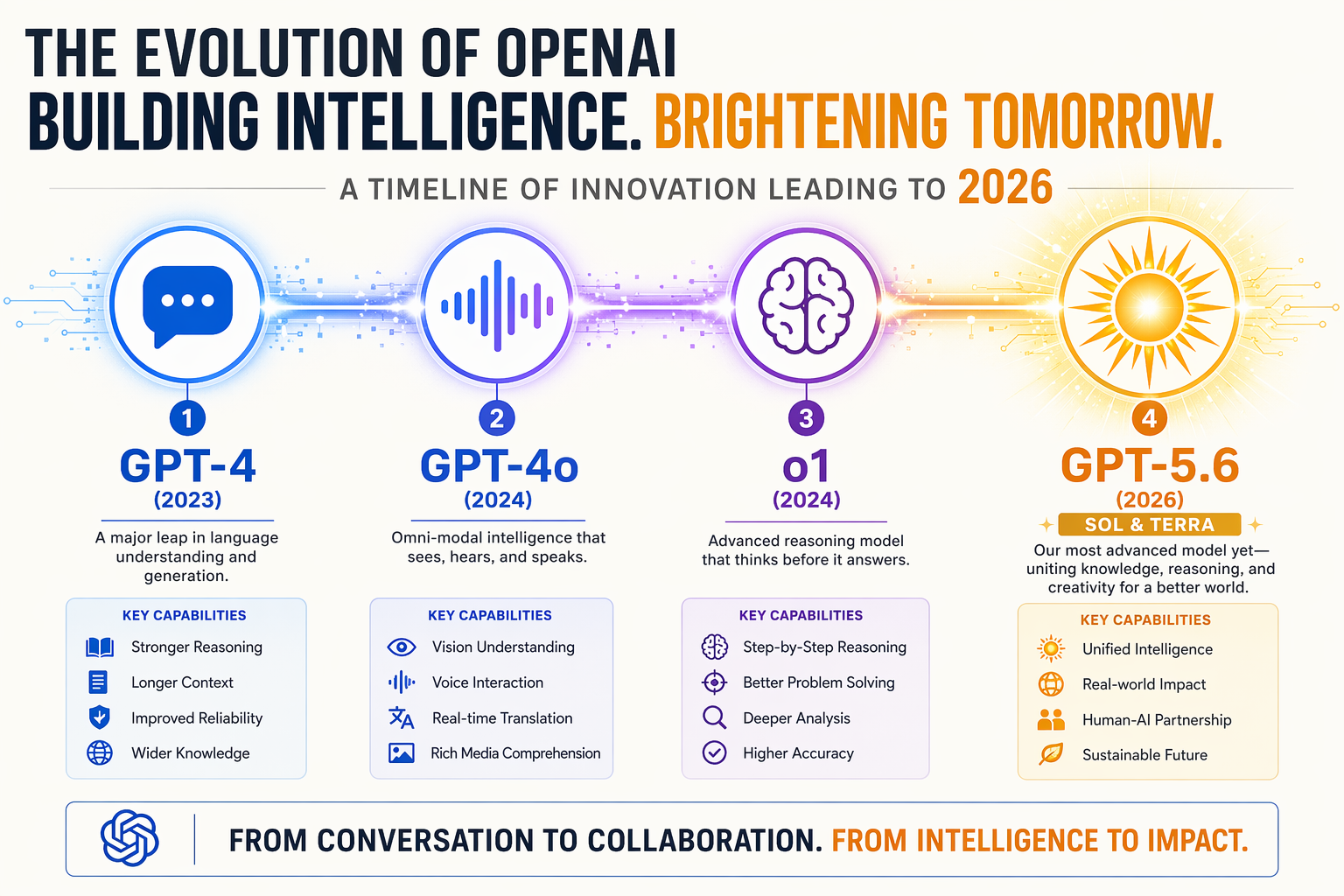
The artificial intelligence landscape has reached a critical inflection point with OpenAI's highly anticipated next-generation lineup. Rather than a singular model drop, OpenAI has unveiled a family of powerful new AI models under the GPT-5.6 umbrella—specifically naming GPT-5.6 Sol and GPT-5.6 Terra, alongside other specialized variants. Designed to push the boundaries of machine reasoning, multi-agent coordination, and computational efficiency, this release marks a massive leap forward from the previous GPT-4 and o1 architectures.
However, the rollout of this frontier technology has taken an unprecedented turn. Following a direct request from the Trump administration, OpenAI is shifting from its historically rapid public deployment strategy to a highly structured, staggered release. Citing national security concerns, federal officials have intervened to restrict the initial access of GPT-5.6 to a select group of government-approved partners and trusted U.S. enterprise organizations before any widespread public rollout can occur.
A Paradigm Shift in AI Capabilities
Unlike previous iterations, the GPT-5.6 generation is engineered to move beyond simple conversational interfaces into the realm of highly autonomous action. Industry analysts point to several core advancements that define this new generation:
- Advanced Heuristic Reasoning: The models are designed to handle complex, multi-step scientific and mathematical reasoning tasks with significantly reduced error rates.
- Native Multimodal Processing: GPT-5.6 Sol and Terra integrate voice, vision, and text natively at the architectural level, dramatically reducing latency for real-time applications.
- Agentic Orchestration: These models possess the capability to spin up, manage, and coordinate sub-agents to solve complex, long-horizon tasks with minimal human intervention.
This quantum leap in autonomy is precisely why federal policymakers are stepping in. The potential of these systems to assist in advanced software development, code generation, and critical infrastructure analysis makes their unchecked proliferation a key national security concern.
Navigating the Multi-Model Ecosystem
While geopolitical dynamics limit direct, immediate public access to the raw GPT-5.6 models, the broader industry continues to build around flexible, resilient AI architectures. Forward-looking enterprises are avoiding vendor lock-in by designing systems that can seamlessly transition between frontier models as regulatory approvals clear.
For instance, communications infrastructure platforms like CallMissed leverage a multi-model API gateway supporting over 300 LLMs. This architecture allows developers to deploy highly responsive voice agents, WhatsApp chatbots, and multilingual Speech-to-Text tools using current state-of-the-art models, while remaining fully prepared to plug in GPT-5.6-class intelligence the moment it becomes commercially accessible.
Ultimately, the staggered rollout requested by the U.S. government sets a new precedent for the AI industry. It underscores a reality where frontier AI is no longer treated merely as commercial software, but as critical strategic infrastructure requiring deep safety checks and national oversight.
Key Developments (TABLE): Timeline of Government Intervention
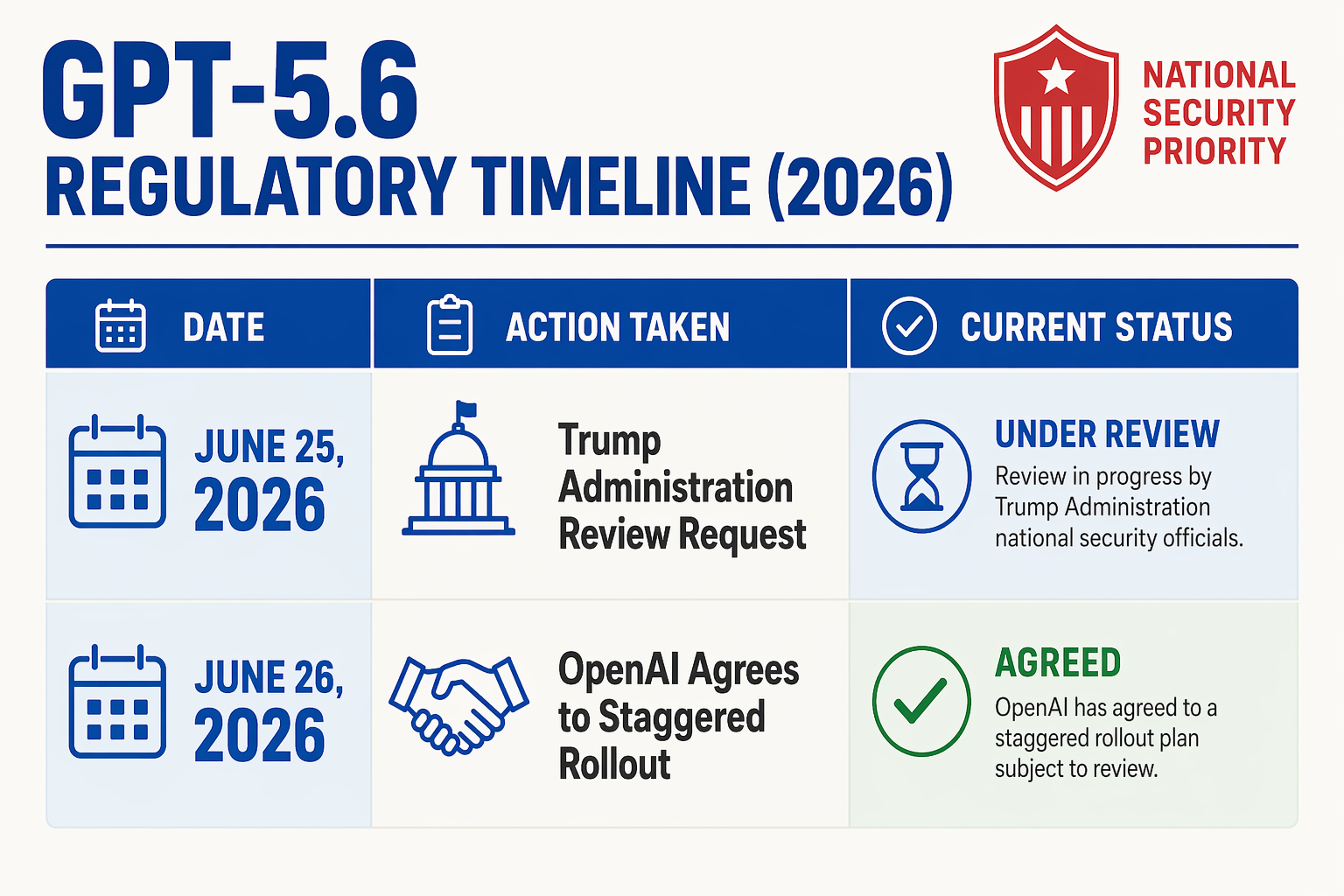
The sudden intervention by the Trump administration has fundamentally altered the launch trajectory of OpenAI's next-generation model. What was expected to be a highly anticipated public rollout has rapidly transitioned into a carefully mediated, sovereign-controlled deployment. Citing acute national security risks, federal officials moved swiftly to put guardrails around GPT-5.6 before its advanced capabilities could be widely accessed.
To understand how this unprecedented government intervention unfolded, we can look at the critical timeline of events leading up to the restricted release.
| Timeline (June 2026) | Key Development | Trump Administration Stance | OpenAI Operational Adjustment |
|---|---|---|---|
| Mid-June 2026 | Initial capability evaluation of the GPT-5.6 architecture. | National security officials flag concerns regarding advanced autonomous capabilities. | Submits internal safety evaluations and model alignment data to federal agencies. |
| June 24, 2026 | Formal request issued to limit public deployment. | Demands a slow-down of the rollout to perform comprehensive security checks. | Halts the planned global public release to restructure the launch framework. |
| June 25, 2026 | News of staggered rollout leaks to major media outlets. | Confirms to media (via anonymous sources) that reviews are necessary before public deployment. | Prepares a tiered deployment plan, limiting initial access to government-approved partners. |
| June 26, 2026 | Official confirmation of restricted "Sol" and "Terra" models. | Enforces strict compliance, limiting access to a small circle of U.S. enterprises. | Launches GPT-5.6 Sol and Terra under a "trusted partner" preview program. |
Deconstructing the Staggered Rollout
By shifting from an open beta to a staggered release model, the U.S. government aims to establish a buffer zone. This safety window allows intelligence agencies and federal auditors to pressure-test GPT-5.6's reasoning, coding, and cyber-offensive capabilities. Under the current mandate, OpenAI’s newest models—including specialized variants like GPT-5.6 Sol and GPT-5.6 Terra—are locked behind a rigorous screening process. Only approved U.S. organizations and close defense-adjacent allies can access the API, preventing foreign adversaries from leveraging the technology for strategic advantage.
Navigating a Fragmented AI Ecosystem
For enterprises, this intervention introduces massive uncertainty. Companies that had mapped their product roadmaps directly to OpenAI's next-gen API must now prepare for prolonged access delays.
To mitigate these bottlenecks, forward-looking engineering teams are decoupling their applications from single-vendor dependencies. Infrastructure providers like CallMissed are crucial in this landscape, offering a resilient multi-model API gateway. By allowing developers to easily route requests across more than 300 alternative LLMs, CallMissed ensures that businesses can maintain operational continuity and high-throughput communication pipelines, even when top-tier models face sudden regulatory blockades. As sovereign safety reviews become the new norm for frontier AI, decoupling via multi-model infrastructure is no longer just a best practice—it is an operational necessity.
In-Depth Analysis: National Security vs. Open Innovation

The Trump administration's unprecedented intervention in the launch of OpenAI's GPT-5.6—including its specialized model variants, Sol and Terra—highlights a critical turning point in AI governance. Proponents of the restriction argue that GPT-5.6 represents more than a simple incremental upgrade; it is a highly sophisticated dual-use technology. With enhanced reasoning, coding, and autonomous planning capabilities, the administration fears that an unrestricted, public-facing API could be weaponized.
The National Security Case: Mitigation of Cyber and Biosecurity Threats
Security agencies are increasingly concerned that frontier models could drastically lower the barrier to entry for highly sophisticated attacks. By limiting the initial rollout of GPT-5.6 to a curated list of government-approved partners and vetted U.S. enterprises, the administration aims to conduct rigorous safety audits and stress-test the model before any mass-market distribution. Key areas of concern include:
- Autonomous Cyber Warfare: The potential for advanced models to discover zero-day vulnerabilities and autonomously draft highly targeted exploit code.
- Biosecurity Risks: The danger of advanced reasoning engines being used to synthesize dangerous pathogens or bypass traditional safety guardrails.
- Geopolitical Competition: Ensuring that strategic adversaries do not gain immediate, unauthorized access to the most powerful American-made models, thereby preserving a technological edge.
The Innovation Backlash: Restricting the Open Ecosystem
Conversely, many in the technology sector warn that these restrictions could stifle the very innovation that keeps the United States ahead. Forcing a staggered, vetted release model threatens the fast-paced developer ecosystem that relies on immediate access to cutting-edge tools.
When access to frontier models is restricted, developers and enterprises face significant operational hurdles. Platforms like CallMissed, which provide robust AI communication infrastructure by letting developers leverage over 300+ LLMs, rely on a robust and open market of foundational models to power real-time voice agents and multilingual chatbots. If the most advanced models are locked behind government approvals, it creates a digital divide. Startups and mid-sized enterprises may find themselves locked out of state-of-the-art reasoning capabilities, while only a select few "trusted partners" enjoy the competitive advantage. Furthermore, over-regulation might simply drive talent and development offshore, where open-source alternatives are rapidly closing the capability gap without federal oversight.
Finding a Balanced Path Forward
This clash presents a complex dilemma: how do you secure a potentially dangerous technology without halting scientific progress? As OpenAI adjusts its rollout strategy to satisfy federal security reviews, the tech industry is watching closely. The outcome of the GPT-5.6 deployment will likely establish the regulatory blueprint for how all future frontier models are launched, balancing existential risk against economic vitality.
Impact & Implications: How a Staggered Release Reshapes the AI Race
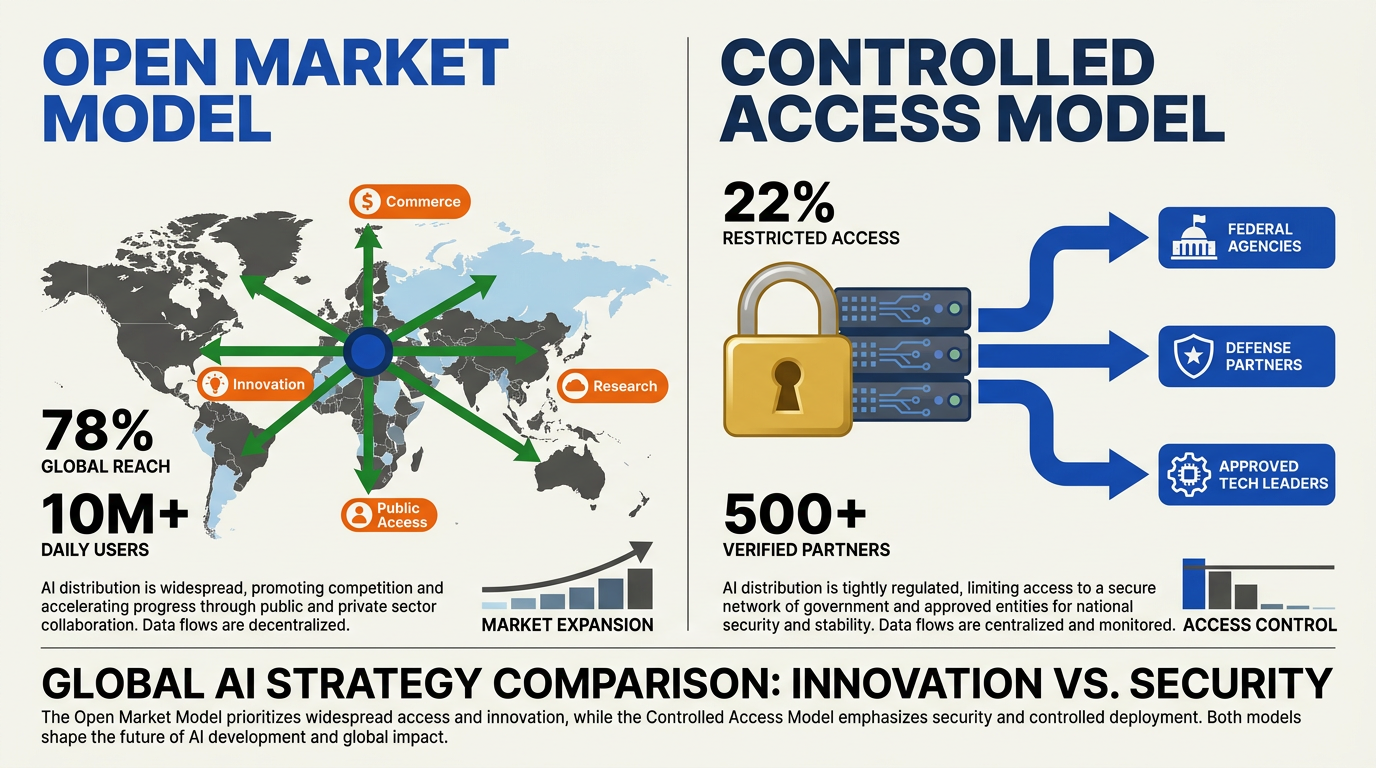
The decision to stagger the launch of OpenAI's GPT-5.6—which reportedly includes new models like GPT-5.6 Sol and Terra—marks a fundamental shift in the global AI race. Historically, the tech sector operated on a "move fast and break things" ethos, with companies rushing frontier models to the public to capture market share. Now, with the Trump administration stepping in to mandate a controlled, vetted rollout to government-approved "trusted partners," the dynamics of competitive advantage are being rewritten overnight.
This state-sanctioned delay introduces several profound implications for businesses, developers, and global competitors.
1. The Enterprise Bottleneck and the Rise of Multi-Model Agility
For years, enterprises built their AI roadmaps on the assumption of immediate access to the next generation of OpenAI’s APIs. By restricting the initial release of GPT-5.6 to a select group of U.S. companies and organizations, the federal government has created an artificial capability gap.
To avoid being left behind, businesses are rapidly pivoting away from single-provider dependency. This is accelerating the adoption of multi-model orchestration. Modern enterprises realize they must remain agile; if one model is locked behind regulatory reviews, they must easily swap it for another. Infrastructure platforms like CallMissed are playing a crucial role in this transition. Through its multi-model API gateway, CallMissed allows developers to seamlessly transition between 300+ LLMs without rewriting core code, ensuring that regulatory delays at OpenAI do not paralyze a company's product pipeline.
2. A Windfall for Open-Source and Global Competitors
While OpenAI navigates federal safety reviews and restricted rollouts, the rest of the world is not standing still. This regulatory bottleneck provides a golden opportunity for competitors:
- Proprietary Rivals: Anthropic, Google, and xAI now have a strategic window to capture enterprise customers who cannot afford to wait for government-approved access to GPT-5.6.
- Open-Source Powerhouses: Meta’s Llama ecosystem and other open-source models will likely see a massive surge in deployment as developers seek powerful, unrestricted alternatives.
- Sovereign AI Initiatives: European and Asian nations are already pushing for "sovereign AI" models to reduce dependency on heavily regulated U.S. tech giants.
3. Geopolitical Splintering and Regional Adaptation
By treating GPT-5.6 as a national security asset rather than a global commercial product, the U.S. government is accelerating the splintering of the global AI market. If frontier models are gatekept by Washington, international markets will look inward.
This shift highlights the growing importance of localized, specialized AI. In markets like India, for example, the focus is shifting from raw, generalized frontier capabilities to highly optimized, regional language processing. Platforms like CallMissed are meeting this demand by providing production-ready voice agent infrastructure and Speech-to-Text APIs native to 22 regional Indian languages.
Ultimately, the restricted rollout of GPT-5.6 proves that cutting-edge AI is no longer just a software product—it is a geopolitical tool. While OpenAI's staggered release may bolster short-term national security, it has permanently altered the playbook for AI deployment, forcing the industry to prioritize flexibility, open-source alternatives, and regional resilience over single-model loyalty.
Expert Opinions: Silicon Valley and Washington Clash

The unprecedented intervention by the Trump administration in the rollout of OpenAI’s GPT-5.6 has exposed a deep, structural rift between Silicon Valley’s relentless push for rapid innovation and Washington’s increasingly defensive national security posture. By requesting OpenAI to restrict initial access to "trusted partners" and government-approved entities, the federal government is establishing a new precedent for oversight on commercial AI software.
The National Security Mandate: Why Washington Intervened
For policymakers in Washington, the decision to step in is driven by a fear of weaponized AI. According to reports from CNBC and other major outlets on June 25–26, 2026, the administration requested a staggered release for OpenAI’s new suite of models—specifically GPT-5.6 Sol and GPT-5.6 Terra. The primary arguments from government officials center around several key vulnerabilities:
- Advanced Cyber Warfare: The heightened reasoning and agentic capabilities of the GPT-5.6 family could be exploited by foreign adversaries to discover zero-day vulnerabilities or automate highly sophisticated cyber attacks.
- Biosecurity Risks: Washington remains highly concerned about the models' ability to assist in the design or synthesis of chemical, biological, or radiological agents.
- The Geopolitical Race: Limiting the initial rollout ensures that critical infrastructure, defense agencies, and vetted U.S. enterprises get a head start on implementing and securing these tools before they are released globally.
Silicon Valley's Warning: The Risk of Falling Behind
Conversely, the tech sector views these restrictions as a dangerous bottleneck. Industry advocates argue that stifling the deployment of frontier models like GPT-5.6 will ultimately harm U.S. competitiveness. The core arguments from Silicon Valley include:
- Ceding the Global Lead: While the U.S. self-regulates and slows down, state-backed entities in competing nations continue to train and deploy frontier-class LLMs without bureaucratic delay.
- Economic Disruption: American startups and enterprises rely on immediate access to the latest cognitive engines to maintain their operational edge. Restricting GPT-5.6 to a select group of "government-approved partners" creates an unequal playing field.
Adapting to a Fragmented AI Future
As regulatory friction threatens to delay the release of highly anticipated models, enterprises are quickly realizing the danger of relying on a single AI provider. To bypass these geopolitical bottlenecks, forward-thinking organizations are building redundant, multi-model architectures.
This is where unified communication and AI infrastructure platforms like CallMissed are becoming essential. By utilizing CallMissed’s multi-model API gateway, developers can seamlessly switch between over 300+ alternative LLMs, ensuring that customer-facing voice agents and automated workflows remain fully operational, even when frontier releases face sudden regulatory freezes.
Ultimately, the battle over GPT-5.6 marks the end of the unregulated "move fast and break things" era for frontier AI. As Washington asserts tighter control over the release of super-intelligent systems, the tech industry must learn to balance raw computational speed with geopolitical compliance.
What This Means For You (TABLE): Access Tier Breakdown
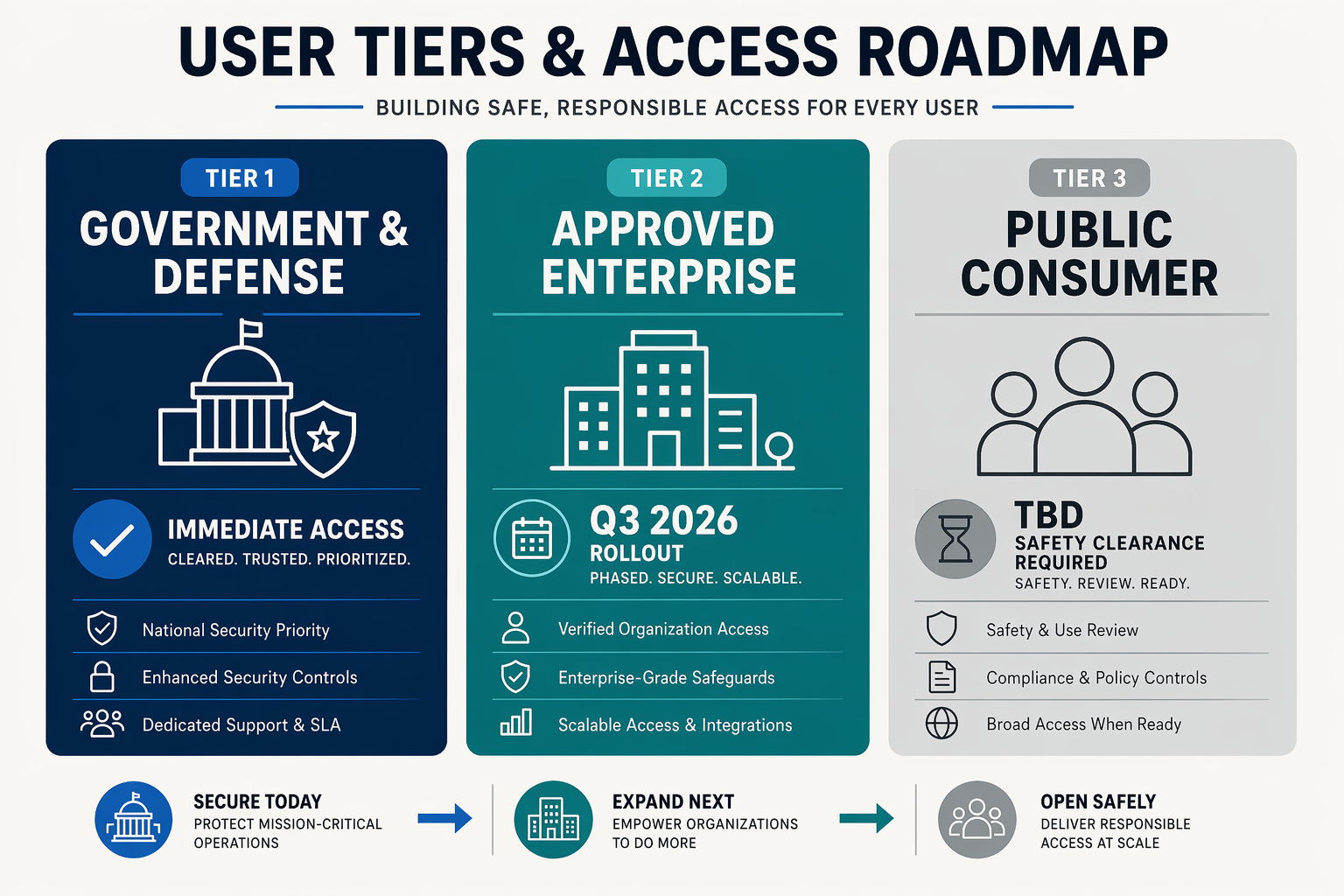
The Trump administration’s intervention in the release of GPT-5.6 signals a paradigm shift in how frontier AI models are distributed. For developers, enterprise leaders, and everyday consumers, this staggered rollout means that access to OpenAI's next-generation intelligence—including the highly anticipated Sol and Terra models—will not be a simple, immediate API upgrade. Instead, availability will be dictated by strict security vetting and strategic priority.
To help you navigate this transition, we have broken down how this staggered rollout is structured across different user groups, outlining when you can expect access and what limitations will be in place.
| Target Audience | Estimated Access Timeline | Use Case Restrictions | Security Vetting Required? |
|---|---|---|---|
| Govt. & Defense Partners | Immediate (Mid-2026) | National security, cyber defense, and critical infrastructure | Yes (Federal clearance required) |
| Trusted Enterprise Partners | Q3–Q4 2026 (Staggered preview) | Approved commercial workflows, non-dual-use applications | Yes (OpenAI & government approval) |
| Independent Developers | Late 2026 / Early 2027 | General API usage with strict rate limits and monitoring | No (Subject to standard compliance) |
| General Consumers | TBD (Post-safety reviews) | Non-commercial, standard conversational tasks | No (Standard platform terms) |
Navigating a Staggered AI Ecosystem
For businesses that have built their products entirely on OpenAI’s ecosystem, this restricted rollout is a wake-up call. Relying on a single proprietary model provider introduces massive regulatory and supply-chain risks. If your product roadmap is blocked by government-mandated delays on GPT-5.6, you need a strategy to maintain a competitive edge.
This is where multi-model flexibility becomes a business-critical asset. Rather than waiting months for government-approved access to GPT-5.6, forward-thinking organizations are adopting hybrid AI architectures. Platforms like CallMissed allow developers to navigate these bottlenecks effortlessly. Through CallMissed’s multi-model LLM inference gateway, you can access and deploy over 300+ alternative models—including state-of-the-art open-source models—without changing a single line of your infrastructure code. This ensures that even if GPT-5.6 is gated, your AI communication infrastructure, voice agents, and customer-facing tools remain operational and highly performant.
Key Action Items for Engineering Teams
To prepare for this new era of restricted frontier AI, technical teams should take three immediate steps:
- Audit Your Model Dependencies: Identify where your application is uniquely reliant on OpenAI APIs and map out alternative, high-performing models that can serve as immediate fallbacks.
- Implement Multi-Model Gateways: Decouple your application logic from a single provider. Using infrastructure like CallMissed’s API gateway ensures you can switch LLM providers instantly if one faces unexpected regulatory freezes.
- Prioritize Localized Data Compliance: Since the U.S. government is heavily auditing GPT-5.6 for national security, ensure your data-handling practices comply with emerging federal standards for AI inputs and outputs.
Frequently Asked Questions
What is OpenAI's GPT-5.6 and why is its release being restricted?
Why did the Trump administration request a safety review of the new OpenAI models?
Who will have access to the initial release of GPT-5.6?
What are the specific GPT-5.6 models announced by OpenAI?
How does the restricted rollout of GPT-5.6 affect developers and businesses?
When will GPT-5.6 be available for general public release?
Conclusion
The unprecedented government intervention in the rollout of OpenAI’s GPT-5.6 marks a defining moment at the intersection of national security and artificial intelligence. As the landscape shifts, keep these key takeaways in mind:
- Government Gatekeeping: The Trump administration’s request to restrict the initial launch to approved "trusted partners" signals a new era of state-monitored AI deployment.
- Staggered Safety Pipelines: Next-generation models like GPT-5.6 Sol and Terra will undergo intense, controlled previews to mitigate safety risks before any broader public release.
- The Compliance Imperative: Future enterprise AI strategies must now account for geopolitical risk and potential regulatory bottlenecks on frontier models.
Looking ahead, the critical factor to watch is whether these government-imposed limits will decelerate commercial innovation or spark a faster pivot toward decentralized, open-source alternatives.
To explore how the future of AI communication is evolving amid these regulatory shifts, check out CallMissed — an AI infrastructure platform powering advanced voice agents and multilingual chatbots for businesses looking to build resilient, future-proof systems. How will your organization adapt as access to frontier AI becomes a matter of national policy?
Related Posts

Meet GPT-5.6 Luna: OpenAI’s New Speed and Budget King for AI Agents
Meta Loses 20 Million Users Across WhatsApp, Instagram, and Facebook: What It Means for Q1 2026 and Beyond

Kunal Shah to Lead WhatsApp: 9 Indian-Origin CEOs Driving Global Tech Leadership