

Meta’s Brain2Qwerty Turns Brain Signals Into Text — But It’s Not Mind Reading Yet


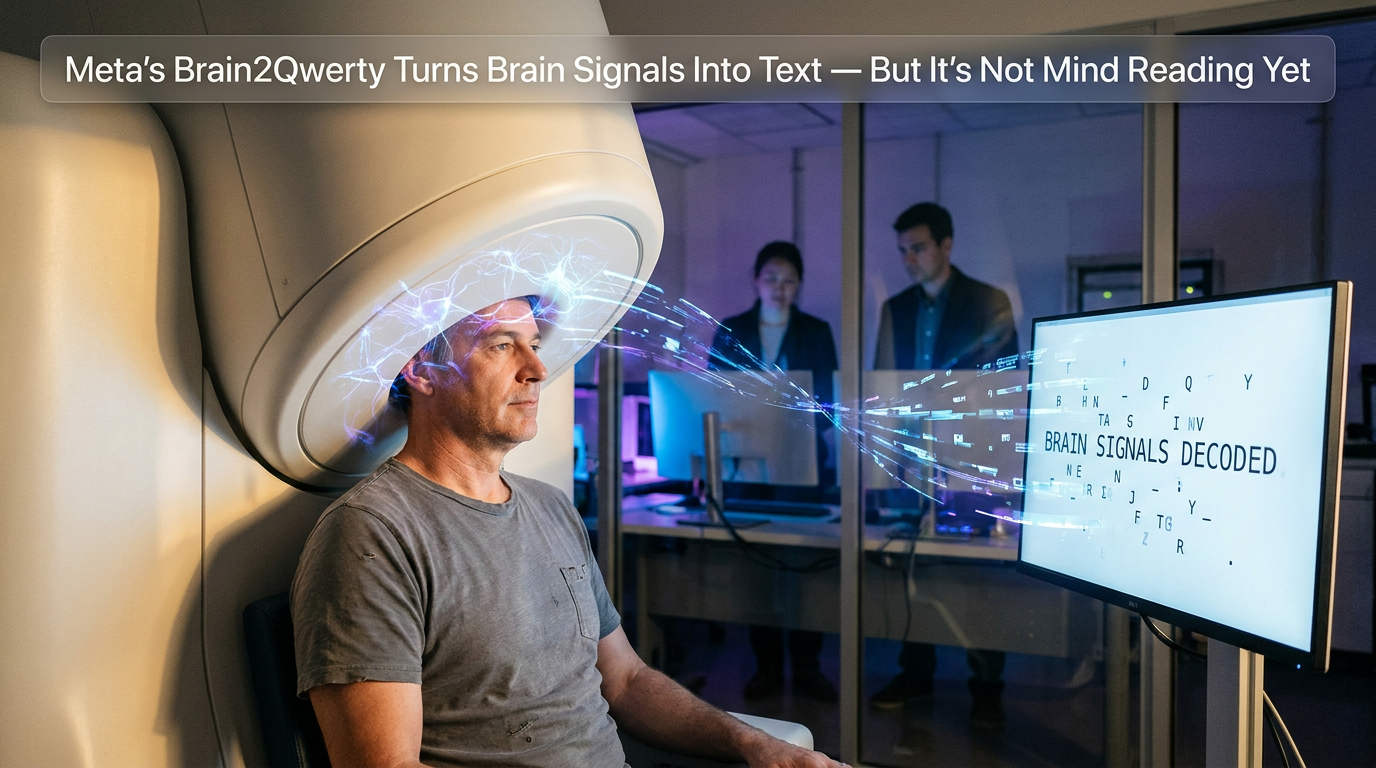
What if your brain signals could be translated into text — without surgery, implants, or a keyboard under your fingers? That is the headline-grabbing...
Meta’s Brain2Qwerty Turns Brain Signals Into Text — But It’s Not Mind Reading Yet
What if your brain signals could be translated into text — without surgery, implants, or a keyboard under your fingers? That is the headline-grabbing promise behind Meta’s Brain2Qwerty, a new deep learning system from Meta AI designed to decode typed sentences from non-invasive brain recordings. But despite viral claims of “mind-reading AI,” the reality is more nuanced: Brain2Qwerty is not reading private thoughts. It is reconstructing text from brain activity captured while participants are actively typing.
That distinction matters. Brain2Qwerty sits at the intersection of two fast-moving fields: brain-computer interfaces (BCIs) and generative AI. Unlike implant-based systems that require electrodes placed inside or on the surface of the brain, Meta’s approach uses EEG and MEG recordings — methods that measure brain activity externally. According to Meta AI’s publication and the accompanying arXiv paper, the model achieved an average 32% character-error rate using MEG and 67% using EEG. Put another way, MEG performed far better than EEG, but even the stronger result still leaves substantial errors compared with practical typing or speech-to-text systems.
The timing is important because public expectations around AI interfaces are rising fast. Voice agents, chatbots, and multimodal models are already changing how people interact with software; platforms like CallMissed reflect this broader shift by helping businesses deploy AI voice agents, WhatsApp chatbots, and speech APIs across real-world communication workflows. Brain2Qwerty points to an even more ambitious future: interfaces that respond not just to what we say or type, but to measurable neural patterns.
Still, this is a lab breakthrough, not a consumer product. The arXiv paper describes a multi-stage architecture that includes a convolutional module processing 500 ms windows of neural activity, showing how carefully engineered the decoding process is. And the best results depend on MEG, a large, expensive scanning technology that is far from something you would wear at home or use in an office.
In this post, we’ll unpack what Meta’s Brain2Qwerty actually does, why its MEG results are scientifically significant, where the “mind reading” narrative goes too far, and what this research reveals about the future of non-invasive brain-to-text interfaces.
Breaking Down the News
What Meta Actually Announced
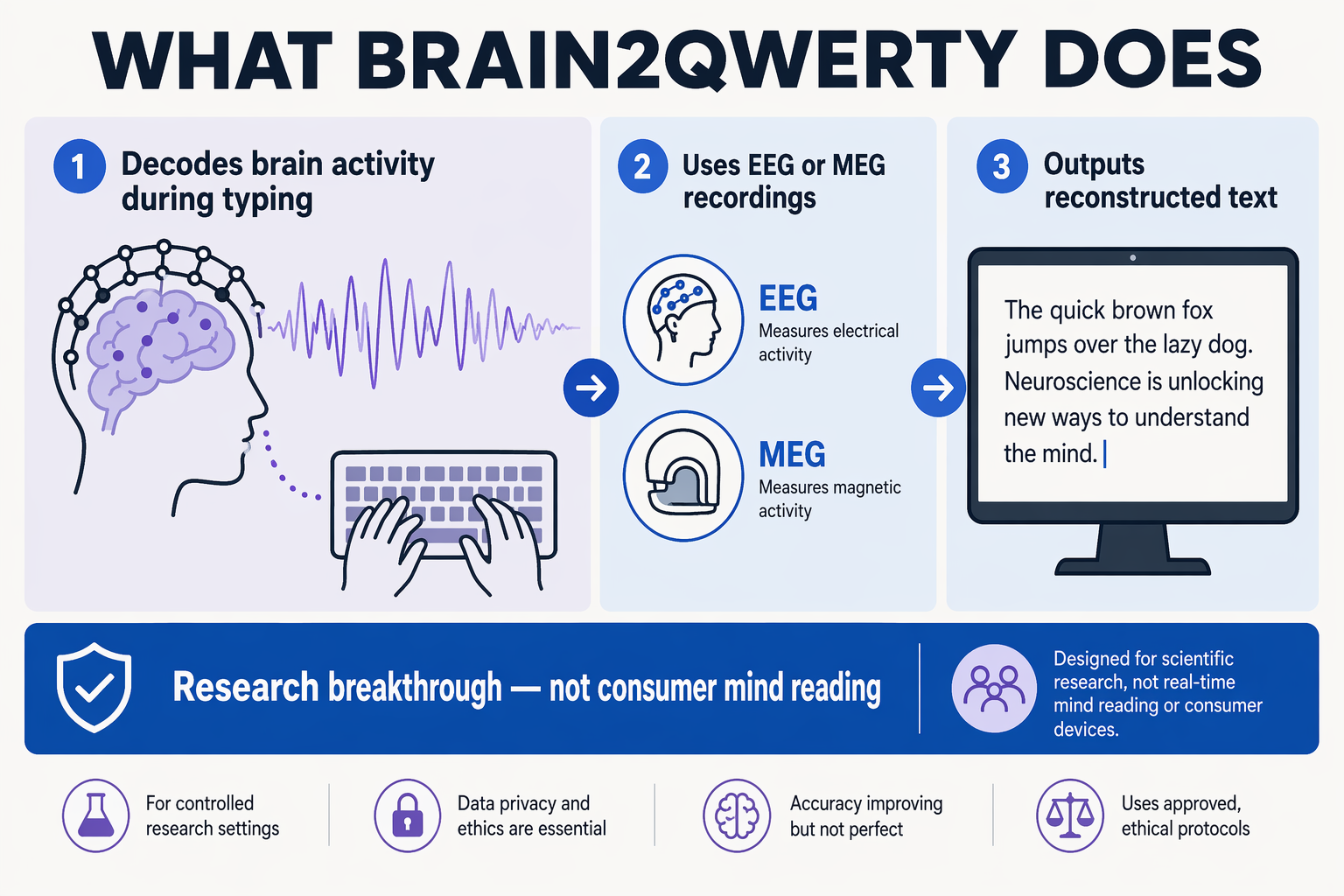
Meta AI has introduced Brain2Qwerty, a deep learning architecture designed to convert brain activity into typed text using non-invasive neural recordings. The research, published by Meta AI and detailed in the arXiv paper “Brain-to-Text Decoding: A Non-invasive Approach via Typing,” focuses on decoding sentences from two types of brain-sensing technology:
- EEG — electroencephalography, which measures electrical activity from the scalp
- MEG — magnetoencephalography, which measures magnetic fields generated by brain activity
The headline is striking because most high-performance brain-computer interface demonstrations rely on implants or invasive electrode arrays. Brain2Qwerty, by contrast, works with signals captured outside the skull. That makes it scientifically important, even if it remains far from a practical typing replacement.
The Key Detail: Participants Were Typing
The most important caveat is also the one most viral summaries gloss over: Brain2Qwerty does not decode spontaneous thoughts. It was trained and tested on brain activity recorded while people were actively typing sentences.
That means the model is learning relationships between:
- The sentence being typed
- The motor and cognitive activity involved in typing
- The timing of neural signals captured by EEG or MEG
- The resulting character sequence
So when people call it “mind-reading AI,” that overstates what the system does. A more accurate description is: AI-assisted reconstruction of typed text from brain signals during a controlled task.
This distinction matters for both privacy and practical expectations. Brain2Qwerty is not silently extracting hidden beliefs, memories, or private internal monologues. It is decoding structured neural patterns produced in a lab environment around a specific behavior: typing.
The Performance Numbers Tell a Mixed Story
The strongest reported results came from MEG, not EEG. According to Meta AI’s publication and the arXiv summary, Brain2Qwerty achieved:
- 32% average character-error rate with MEG
- 67% average character-error rate with EEG
Some coverage has described the system as reaching “up to 80% character accuracy” in favorable conditions. But the more precise benchmark is the 32% average character-error rate for MEG, which still means roughly one in three characters is wrong on average.
That is impressive for a non-invasive BCI research system — but it is nowhere near the reliability users expect from keyboards, dictation tools, or modern speech-to-text APIs. For comparison, production communication systems are usually judged by whether they can operate reliably in noisy, messy real-world environments, not only controlled lab settings.
Why MEG Outperformed EEG
The large gap between MEG and EEG is one of the biggest takeaways. EEG is cheaper, more portable, and widely used in research and clinical settings, but it captures relatively noisy signals after electrical activity has passed through the skull and scalp.
MEG generally provides cleaner spatial and temporal information, which helps deep learning models identify useful signal patterns. But there is a tradeoff: MEG scanners are large, expensive laboratory devices, making them unsuitable for everyday consumer use today.
That creates a practical bottleneck. Brain2Qwerty’s best results depend on the less accessible sensing method, while the more wearable-friendly option — EEG — produced a much higher 67% character-error rate.
Why the Architecture Matters
The arXiv paper notes that Brain2Qwerty uses a multi-stage model, including a convolutional module that processes 500 ms windows of neural activity. That detail is important because it shows this is not a simple “brain signal in, sentence out” pipeline.
Instead, the system relies on careful temporal modeling: it looks at short slices of neural activity, extracts patterns, and maps them toward likely character sequences. In other words, Brain2Qwerty is less like telepathy and more like a highly specialized decoder trained on synchronized brain-signal and typing data.
The news is still significant — just not for the reason the viral headlines suggest. Brain2Qwerty shows that non-invasive brain-to-text decoding is advancing, but it also shows how much work remains before such systems become practical, portable, or accurate enough for everyday communication.
What Happened
Meta Published a Non-Invasive Brain-to-Text System
Meta AI publicly detailed Brain2Qwerty, a research system that attempts to reconstruct typed sentences from brain activity recorded outside the skull. In its official publication, Meta describes it as “a new deep learning architecture trained to decode sentences from either electro- (EEG) or magneto-encephalography (MEG),” referring to two non-invasive methods for measuring neural signals.
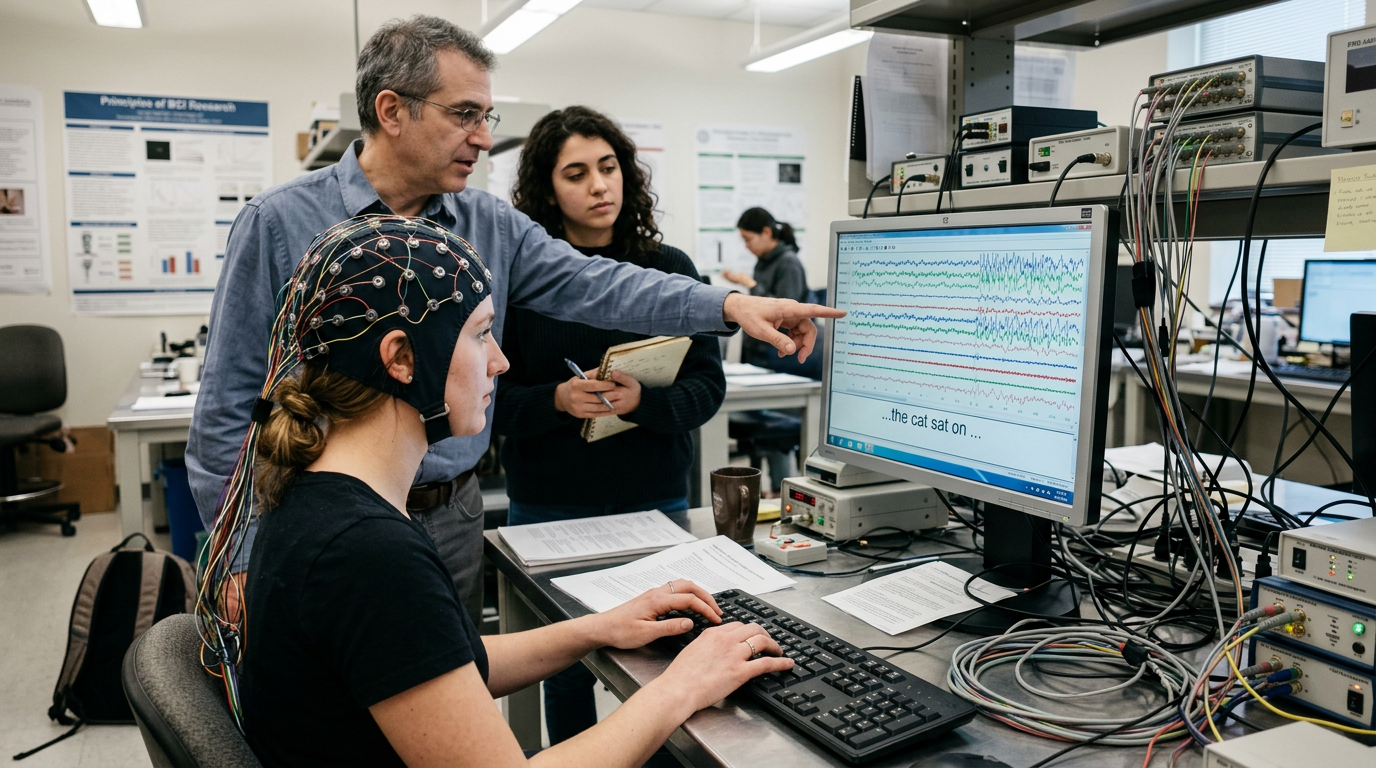
The important part: participants were not silently thinking random phrases. They were actively typing sentences, while EEG or MEG sensors captured the corresponding brain activity. Brain2Qwerty then learned to map those neural patterns back into text.
That makes the announcement significant, but narrower than many viral summaries suggest.
The Experiment in Plain English
The workflow looks roughly like this:
- A participant types a sentence in a controlled lab setting.
- EEG or MEG records brain activity during the typing process.
- Brain2Qwerty processes short slices of that neural signal.
- The model predicts the characters being typed.
- The output is evaluated using character-error rate, or CER.
According to the arXiv paper “Brain-to-Text Decoding: A Non-invasive Approach via Typing,” the model uses multiple stages, including a convolutional module that processes 500 ms windows of neural activity. That detail matters because this is not a magical one-step “thought-to-text” engine. It is a carefully engineered neural decoding pipeline trained on time-aligned brain recordings.
The Headline Numbers
Meta’s reported results show a large performance gap between the two sensing methods:
- MEG: average 32% character-error rate
- EEG: average 67% character-error rate
In simpler terms, MEG produced much cleaner decoding than EEG. A 32% CER means the system still makes frequent character-level mistakes, but it is far beyond random guessing and scientifically meaningful for a non-invasive setup. EEG, by contrast, remains much noisier, with roughly two-thirds of characters wrong on average.
Some coverage has framed the result as “up to 80% character accuracy” in favorable lab conditions. But the more precise benchmark from Meta’s publication is the 32% average CER for MEG and 67% for EEG. That distinction is important because “80% accuracy” sounds closer to consumer-ready typing than the average results actually imply.
Why MEG Is the Breakthrough — and the Bottleneck
The strongest results came from MEG, not EEG. MEG can capture magnetic fields generated by brain activity with more spatial and temporal precision than standard scalp EEG, which helps explain the lower error rate.
But MEG is also the reason this is not coming to your laptop next year. MEG systems are:
- Large lab instruments
- Expensive to operate
- Not wearable in everyday environments
- Highly sensitive to setup and signal quality
That means Brain2Qwerty is best understood as a research milestone for non-invasive brain-computer interfaces, not a near-term replacement for keyboards, voice input, or assistive communication devices.
The Real News
The real breakthrough is not that Meta can “read minds.” It is that a deep learning model can reconstruct meaningful text from externally recorded brain signals during typing, with MEG reaching a reported 32% average character-error rate. That pushes non-invasive BCI research forward while also showing how far the field still has to go before brain-to-text becomes practical outside the lab.
Key Facts (TABLE)
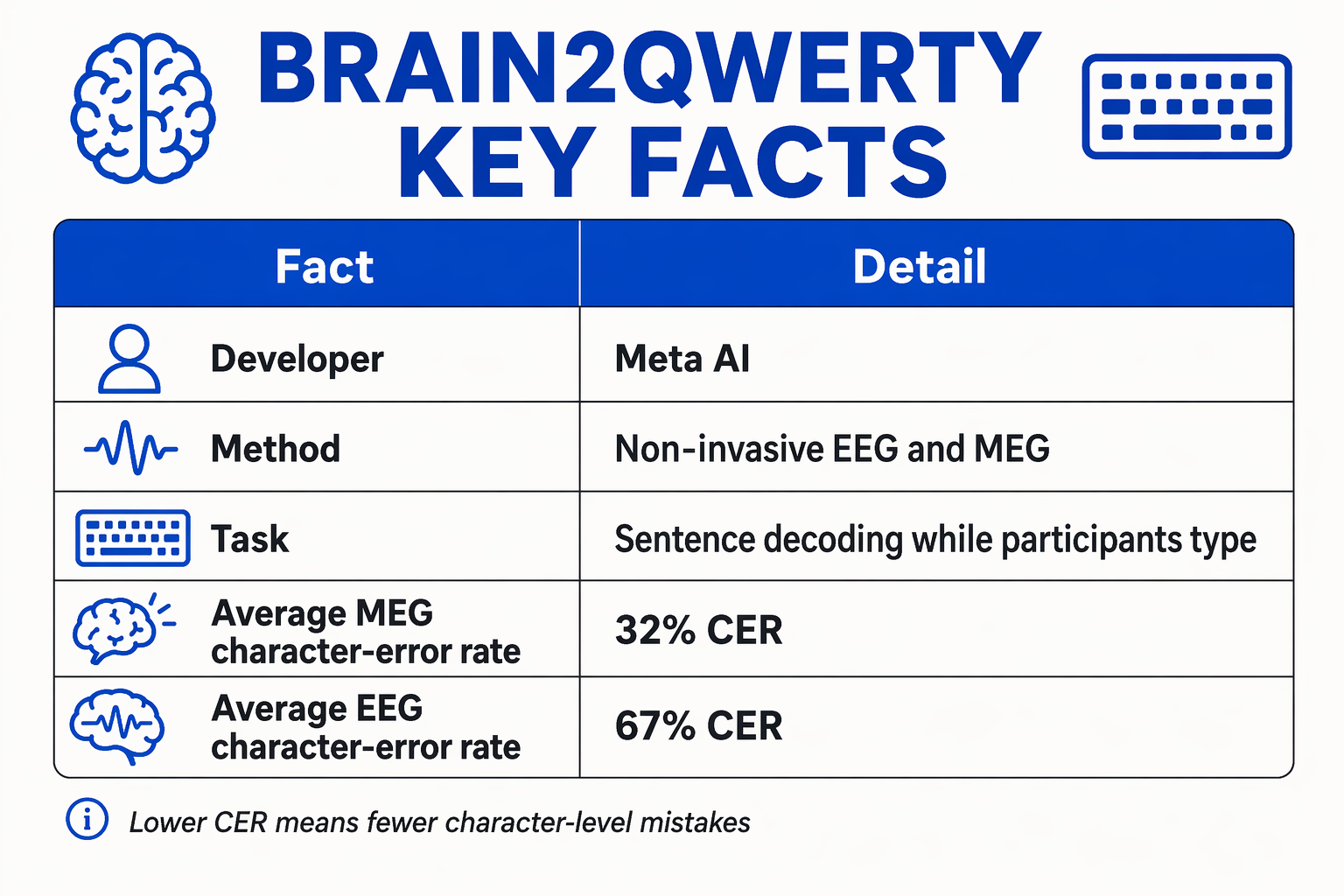
The numbers behind Brain2Qwerty
The most important takeaway is that Brain2Qwerty is a research milestone, not a finished brain-typing product. Meta AI’s own framing is careful: the system decodes sentences from EEG or MEG recordings collected while people are typing. That is very different from passively reading thoughts, intentions, or private inner speech.
| Category | Key Fact | Reported Data | Why It Matters |
|---|---|---|---|
| Research source | Meta AI introduced Brain2Qwerty in “Brain-to-Text Decoding: A Non-invasive Approach via Typing” | Meta AI publication + arXiv paper | Establishes this as peer-facing AI/BCI research, not a consumer launch |
| Input signals | Uses EEG and MEG brain recordings | Non-invasive external sensing | No implanted electrodes are required, unlike invasive BCIs |
| Best average result | MEG decoding achieved 32% character-error rate | Meta AI / arXiv | Scientifically impressive, but still error-prone for practical text entry |
| EEG result | EEG decoding achieved 67% character-error rate | Meta AI / arXiv | Shows cheaper/scalp-based signals remain much harder to decode accurately |
| Task setup | Decodes sentences while participants are actively typing | Typing-based experiment | This is not free-form “mind reading”; the motor/language task is constrained |
| Model design | Includes a convolutional module using 500 ms windows of neural activity | arXiv architecture description | Highlights how engineered and time-sensitive the decoding pipeline is |
What the error rates really mean
The headline number to remember is 32% character-error rate with MEG versus 67% with EEG. In plain terms, MEG substantially outperformed EEG, but neither result is close to the reliability people expect from keyboards, mobile autocorrect, or modern speech-to-text systems.
Some online coverage describes Brain2Qwerty as reaching “up to 80% character accuracy” in favorable lab conditions. That framing is not necessarily false, but it can be misleading if presented as the main result. The more precise figures from Meta AI and the arXiv summary are the average CER values: 32% for MEG and 67% for EEG.
A few interpretation points matter:
- Character-error rate is not the same as word accuracy. A sentence can become hard to understand even if many individual characters are correct.
- CER includes substitutions, insertions, and deletions, so it is more nuanced than simply “percentage wrong.”
- MEG’s stronger result comes with major hardware constraints: MEG scanners are large, expensive lab instruments, not wearable devices.
- EEG is more practical but much noisier, which explains the much higher 67% error rate.
Why the table should cool the hype
Brain2Qwerty is exciting because it shows that non-invasive brain-to-text decoding can work at the sentence level under controlled conditions. But the table also shows the limits: the best-performing setup depends on MEG, the model is trained around a typing task, and the error rates remain high.
So the correct framing is not “Meta built a mind reader.” A better summary is: Meta demonstrated a promising non-invasive BCI architecture that can reconstruct typed text from brain activity, with meaningful accuracy under lab conditions — especially using MEG — but it is not ready for everyday communication.
How Brain2Qwerty Works
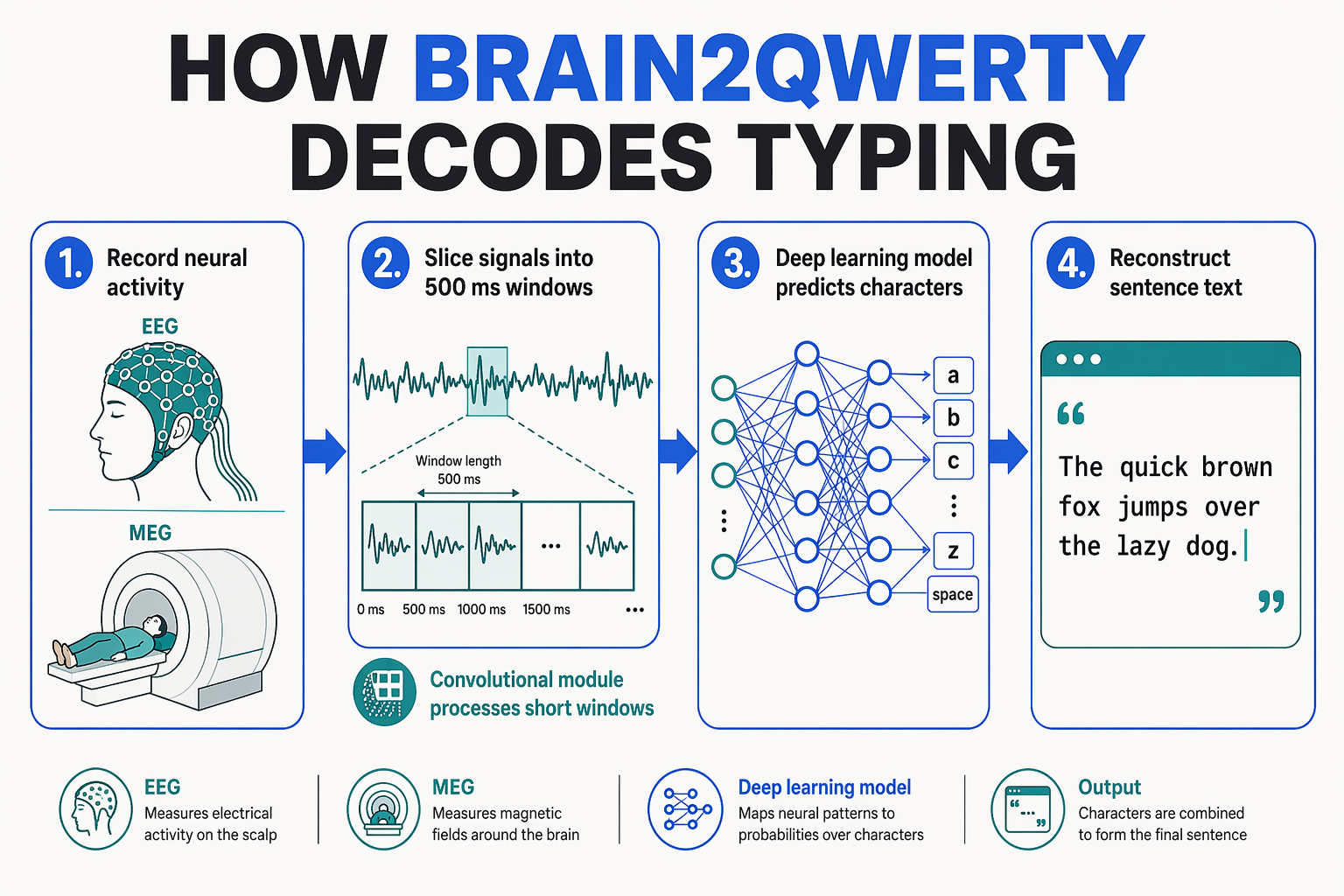
From Neural Signals to Characters
Brain2Qwerty works by treating brain activity as a sequence-decoding problem. Instead of asking an AI model to infer arbitrary thoughts, Meta’s researchers recorded neural activity while participants performed a specific task: typing sentences on a QWERTY keyboard. The model then learned statistical links between patterns in those recordings and the text being produced.
The key inputs are non-invasive brain measurements:
- MEG, which captures magnetic fields generated by neural activity
- EEG, which captures electrical activity from the scalp
- Time-aligned typing data, so the system knows what sentence was being typed during each neural recording
- A deep learning model trained to convert those signals into character sequences
This matters because the “brain-to-text” pipeline is not magic. It is supervised learning: the AI sees examples of brain activity paired with known typed text, then learns to predict text from similar patterns later.
The Three-Stage Decoding Pipeline
According to the arXiv paper “Brain-to-Text Decoding: A Non-invasive Approach via Typing,” Brain2Qwerty includes three core stages for decoding text from brain activity. The first stage is explicitly described as a convolutional module processing 500 ms windows of neural signals.
A simplified version of the workflow looks like this:
- Record brain activity during typing
Participants type sentences while EEG or MEG sensors capture neural activity. This gives the system a synchronized stream of brain signals and text output.
- Slice the signal into short windows
The model processes neural recordings in small time segments. The arXiv summary notes that the convolutional module operates on 500 millisecond windows, allowing the system to capture fast-changing brain patterns around typing actions.
- Extract useful neural features
The convolutional stage helps detect local patterns in the signal — for example, activity related to motor planning, finger movement, visual feedback, or language processing during typing.
- Decode character sequences
Later model stages use those features to predict a sequence of characters, effectively reconstructing the sentence the participant was typing.
- Measure errors against the original text
Performance is reported using character-error rate, or CER, which compares the decoded output with the actual typed sentence.
Why MEG Performs Better Than EEG
Meta AI’s reported results show a major performance gap between the two sensing methods. Brain2Qwerty achieved an average 32% character-error rate with MEG versus 67% with EEG. That means MEG preserved much more useful information for decoding typed text.
The difference is not surprising. MEG generally offers richer spatial and temporal information than scalp EEG, which is more affected by noise from the skull, skin, muscles, and electrode placement. In practical terms:
- MEG decoded more accurately, but requires large, expensive lab equipment
- EEG is more accessible, but produced far higher error rates
- Neither result is close to frictionless consumer-grade text input yet
Some coverage has described the system as reaching “up to 80% character accuracy” under favorable conditions, but Meta’s more precise headline figures are the average CER numbers: 32% for MEG and 67% for EEG.
Why This Is Not Free-Form Thought Decoding
The architecture works because the experiment is constrained. Participants are not silently thinking random ideas while the model reads them. They are typing known sentences, and the model is trained on recordings from that task.
That distinction is central to understanding Brain2Qwerty. The system is decoding brain activity associated with an intentional typing process, not extracting private thoughts directly from the brain. It is closer to translating noisy neural signals generated during a controlled input task than to “mind reading.”
In that sense, Brain2Qwerty is scientifically impressive but still early. It shows that non-invasive recordings can carry enough information to reconstruct typed language patterns — especially with MEG — while also revealing how far the field remains from practical, everyday brain-to-text communication.
Why It Matters
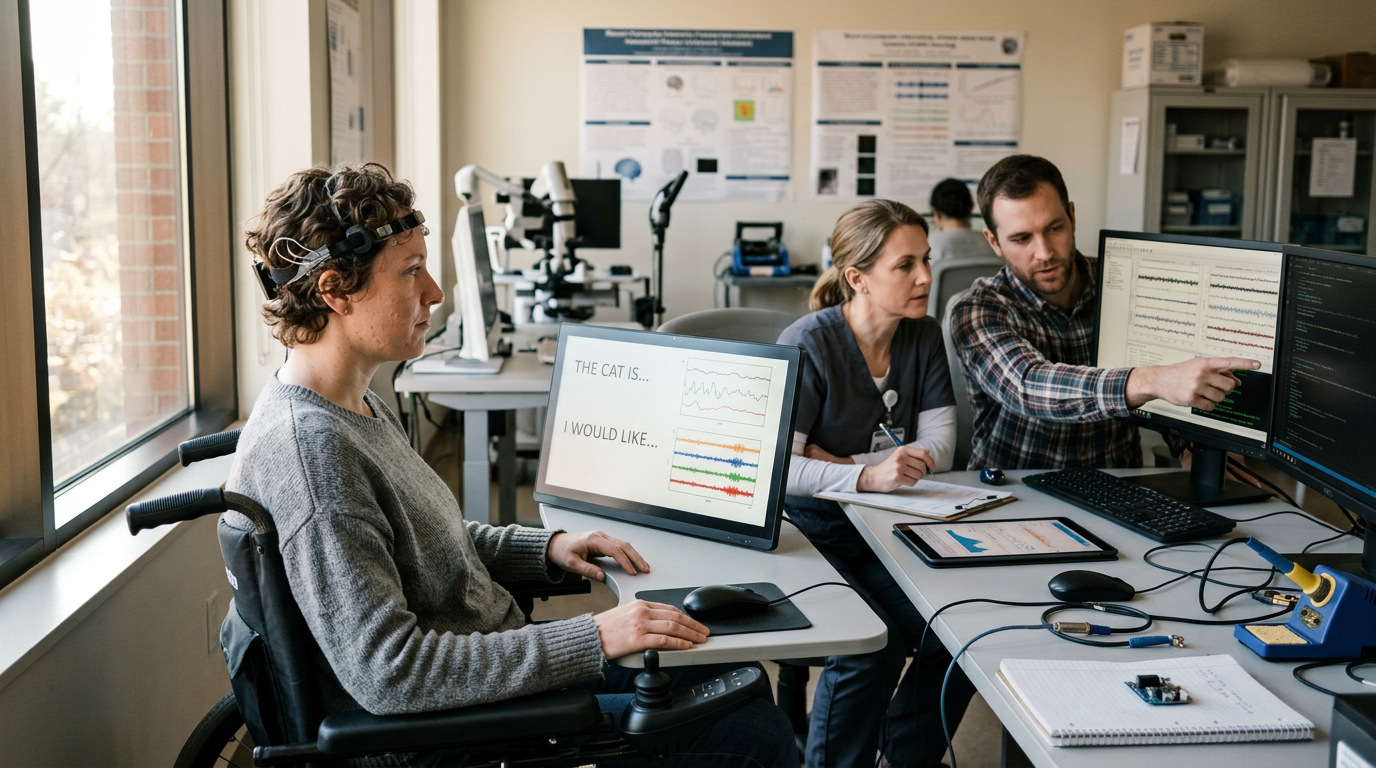
A Step Toward Lower-Friction BCIs
Brain2Qwerty matters because it pushes brain-computer interfaces (BCIs) closer to a world where communication does not always require hands, speech, or implanted hardware. Most high-performing brain-to-text systems have historically depended on invasive electrodes, which can capture cleaner neural signals but require surgery. Meta’s work is notable because it uses EEG and MEG, both external sensing methods.
That does not make it product-ready, but it does change the research trajectory. If non-invasive systems can keep improving, they could eventually support people who cannot reliably type or speak due to conditions such as paralysis, ALS, stroke-related impairment, or severe motor disability.
The immediate breakthrough is not “AI can read your thoughts.” It is more specific: AI can learn useful patterns from brain activity associated with intentional typing. That distinction is exactly why the research is important.
The Accuracy Gap Shows Both Progress and Limits
The headline numbers reveal why Brain2Qwerty is exciting — and why it remains early-stage. Meta AI and the arXiv paper report:
- 32% average character-error rate with MEG
- 67% average character-error rate with EEG
- A model pipeline that includes a convolutional module processing 500 ms windows of neural activity
A 32% character-error rate means the system is finding real signal in noisy neural data, especially under lab conditions. But it also means roughly one in three characters is wrong on average. That is far from the reliability users expect from keyboards, dictation tools, or modern speech-to-text APIs.
For comparison, business communication systems today are judged on speed, uptime, latency, and accuracy in messy real-world environments. Platforms like CallMissed, for example, already deploy production-grade voice agents, WhatsApp chatbots, and Speech-to-Text APIs across 22 Indian languages — use cases where errors directly affect customer experience. Brain2Qwerty is operating in a much more experimental category, but it points toward a future where neural input could become another communication channel.
Non-Invasive Does Not Mean Easy
The non-invasive angle is significant because it avoids surgery, but the hardware still matters. The stronger result came from MEG, not EEG. That is important because MEG systems are large, expensive, and typically used in specialized research or clinical environments. EEG is more portable and affordable, but its 67% character-error rate shows how much harder it is to decode from scalp electrical signals.
This creates a clear technology trade-off:
- MEG provides better signal quality, but is impractical for everyday use.
- EEG is more accessible, but currently too noisy for reliable sentence decoding.
- AI models can improve decoding, but cannot fully overcome weak input data.
- Real-world deployment will require hardware advances, not just better neural networks.
In other words, Brain2Qwerty is as much a sensing problem as it is an AI problem.
Why the Research Has Broader AI Significance
Beyond BCIs, this work reflects a broader shift in AI: models are increasingly being trained to interpret complex human signals, not just text prompts. Speech, gestures, images, biometric signals, and now neural recordings are all becoming possible inputs for machine learning systems.
That has major implications for accessibility, healthcare, privacy, and human-computer interaction. If systems can one day decode intentional communication from brain activity with low error rates, they could help users:
- Compose messages without physical typing
- Control assistive devices more naturally
- Communicate when speech is impaired
- Interact with software through quieter, lower-effort interfaces
But the privacy debate will be just as important as the technical one. Brain2Qwerty does not decode hidden thoughts, yet it still shows that neural data can carry meaningful linguistic information under the right conditions. That makes transparency, consent, data protection, and realistic public communication essential.
The real story is not that Meta has built a mind reader. It is that non-invasive brain-to-text decoding is becoming measurable, benchmarkable, and improvable — and that is a meaningful step toward the next generation of human-machine interfaces.
Why It’s Not Mind Reading Yet
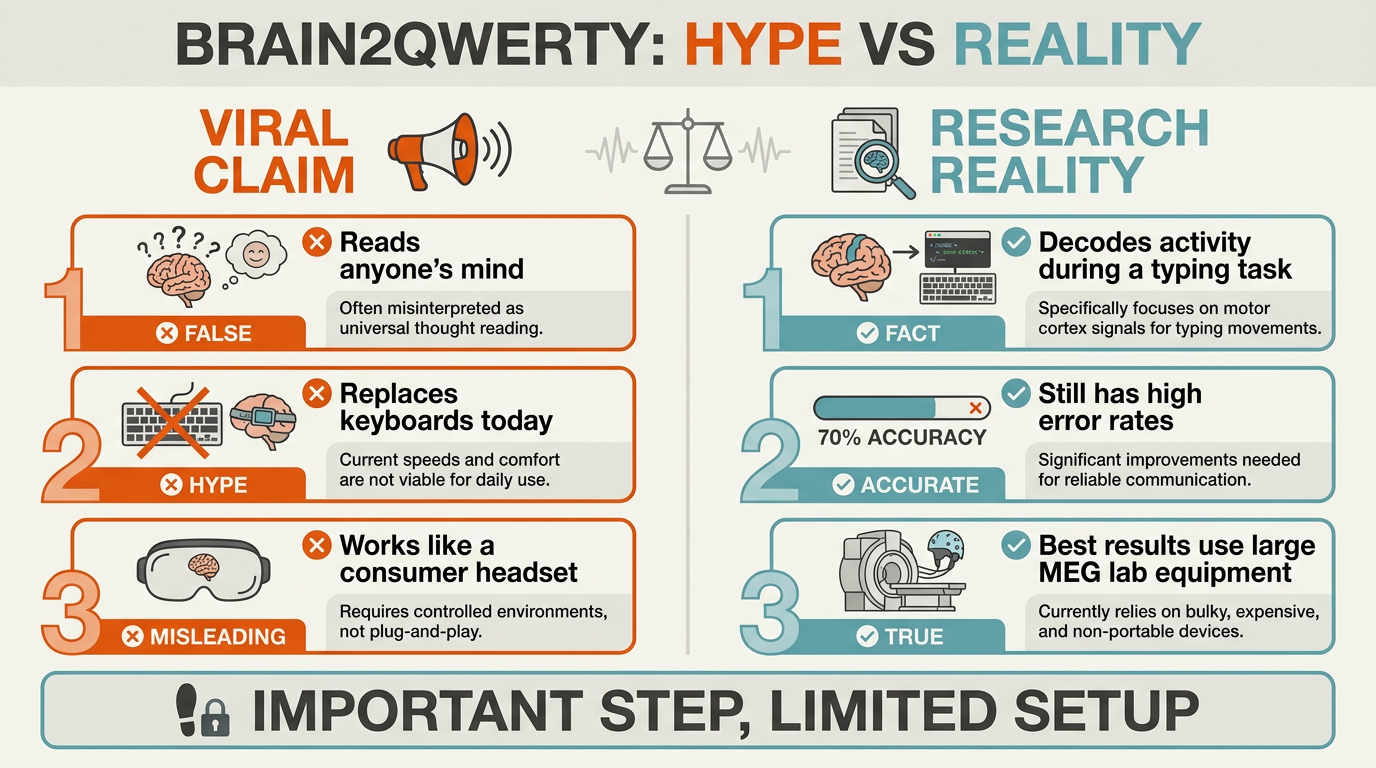
Decoding Intentional Typing Is Not the Same as Reading Thoughts
The most important limitation of Brain2Qwerty is also the easiest one to miss: the system does not decode random inner speech, hidden beliefs, memories, or private thoughts. According to Meta AI’s own description, Brain2Qwerty was trained to decode sentences from EEG or MEG recordings while participants were typing. In other words, the model is learning patterns associated with a specific, observable task: preparing and executing keystrokes.
That makes this closer to neural-assisted text reconstruction than science-fiction mind reading. The brain activity is not interpreted in isolation; it is tied to a constrained experimental setup where the participant is actively engaged in typing known sentence structures. The model’s job is to infer the likely character sequence from brain signals correlated with that typing process.
The Error Rates Are Still Too High for “Mind Reading” Claims
The performance numbers also put the hype in perspective. Meta AI and the arXiv paper report an average 32% character-error rate with MEG and 67% with EEG. That means MEG is clearly more effective, but even the better result still produces a significant number of incorrect characters.
Some headlines have framed the system as achieving “up to 80% accuracy” in lab conditions. That may sound impressive, but it can obscure the more precise benchmark: 32% average CER for MEG and 67% for EEG. For comparison, production-grade speech-to-text systems used in customer support, transcription, and voice agents are expected to work reliably across accents, noise, interruptions, and domain-specific vocabulary. A one-third character error rate would be unacceptable for most real-world communication workflows.
This is why platforms working on practical AI communication — including voice agents, speech APIs, and multilingual interfaces such as those built by CallMissed — still rely on mature input channels like speech, text, and messaging rather than neural decoding. Brain-to-text is promising, but it is not yet a dependable replacement for everyday interaction.
The Model Depends on a Highly Controlled Setup
Brain2Qwerty’s results come from a controlled research environment, not from a wearable consumer device. Several constraints matter:
- Participants are actively typing
The model is decoding neural signals linked to a deliberate motor-language task, not passively monitoring unspoken thoughts.
- The strongest results require MEG
MEG produced the reported 32% average character-error rate, while EEG was much worse at 67%. That gap shows how much the system depends on signal quality.
- MEG is not consumer-ready
Magnetoencephalography systems are large, expensive lab instruments. Some coverage has cited MEG scanners costing around $2 million, which makes near-term consumer deployment unrealistic.
- The architecture is heavily engineered
The arXiv paper describes a multi-stage model, including a convolutional module processing 500 ms windows of brain activity. This is not a general-purpose “thought translator”; it is a specialized decoder trained around a narrow signal-processing task.
Privacy Concerns Are Real — But the Immediate Risk Is Overstated
The phrase “mind-reading AI” raises valid concerns about consent, surveillance, and cognitive privacy. But Brain2Qwerty does not currently enable someone to point a sensor at a person and extract their thoughts. The system requires specialized equipment, recorded neural data, task-specific training, and a cooperative context.
Still, the research is a preview of debates that will become more urgent as non-invasive BCIs improve:
- Who owns neural data collected by devices or platforms?
- How should consent work when brain signals reveal health, attention, or intention patterns?
- Should neural data receive stronger legal protections than ordinary biometric data?
- What safeguards are needed before BCIs enter workplaces, classrooms, or medical settings?
The Better Framing: A Breakthrough, Not Telepathy
Brain2Qwerty is scientifically significant because it shows that non-invasive brain-to-text decoding can reconstruct typed sentences better than earlier approaches, especially using MEG. But calling it mind reading skips the key facts: it works during typing, depends on expensive lab-grade sensing, and still makes frequent errors.
The real story is not that Meta has built telepathy. It is that AI is getting better at mapping structured brain activity to language — and that may eventually reshape accessibility tools, assistive communication, and human-computer interaction.
Industry Reaction

Enthusiasm, With a Big Asterisk
The industry reaction to Brain2Qwerty has split into two clear camps: researchers see a meaningful advance in non-invasive BCI research, while much of the internet has framed it as “mind-reading AI.” The scientific response is more measured. Meta AI’s own publication describes Brain2Qwerty as a system trained to “decode sentences” from EEG and MEG recordings — specifically while participants are typing — not a tool that can extract arbitrary thoughts.
That distinction has shaped expert commentary. For BCI researchers, the headline is not that Meta has solved brain-to-text communication, but that a deep learning model can recover structured language signals from external brain recordings with measurable accuracy. The official results — 32% average character-error rate with MEG and 67% with EEG — are impressive for a non-invasive setup, but still far from production-grade text input.
In practical terms:
- MEG performance is scientifically significant, but depends on large lab equipment.
- EEG is more wearable and accessible, but its 67% character-error rate remains too high for reliable use.
- The task is constrained: users are actively typing known sentence-style text, not silently composing free thoughts.
- The model is experimental, with architecture details such as a convolutional module processing 500 ms windows of neural activity, according to the arXiv paper.
Why Media Hype Took Off
The phrase “brain signals into text” is almost guaranteed to go viral. Several online summaries described Brain2Qwerty as converting “thoughts into text,” and some coverage framed the results as roughly “up to 80% character accuracy” under best-case lab conditions. That number sounds cleaner than the more technical benchmark, but it can be misleading without context: Meta’s more precise average figures are 32% CER for MEG and 67% CER for EEG.
This gap between technical reporting and viral interpretation is common in AI. A lab result becomes a product-like claim; a constrained task becomes a general capability; “decoding activity during typing” becomes “reading minds.” The same pattern appeared earlier with generative AI, speech synthesis, and computer vision systems, where demos often outran deployment reality.
The more responsible industry view is that Brain2Qwerty is a research milestone, not a near-term consumer interface. DeepLearning.AI’s The Batch similarly positioned it as a system that translates brain waves into text “without surgery,” emphasizing the non-invasive angle rather than claiming solved telepathy.
What Startups and Enterprise AI Teams Are Watching
For AI infrastructure companies, the signal is broader than BCIs alone: human-computer interaction is moving beyond screens and keyboards. Voice agents, multimodal assistants, gesture interfaces, and eventually neural interfaces are all part of the same shift toward more natural input channels.
That is why communication platforms are paying attention. Businesses are already adopting AI systems that interpret speech, intent, and multilingual context in real time. Platforms such as CallMissed, for example, focus on today’s deployable layer — AI voice agents, WhatsApp chatbots, speech-to-text across 22 Indian languages, and LLM access — while research like Brain2Qwerty points to where interfaces may evolve over the next decade.
The Cautious Consensus
The industry’s emerging consensus can be summed up in three points:
- Brain2Qwerty is important science because it advances non-invasive neural decoding.
- It is not mind reading because it relies on recorded brain activity during an active typing task.
- Commercial readiness is distant because MEG is expensive and EEG accuracy remains limited.
So the reaction is not skepticism about the breakthrough itself. It is skepticism about the headline version. Brain2Qwerty deserves attention — just not the sci-fi framing.
Timeline of Events (TABLE)
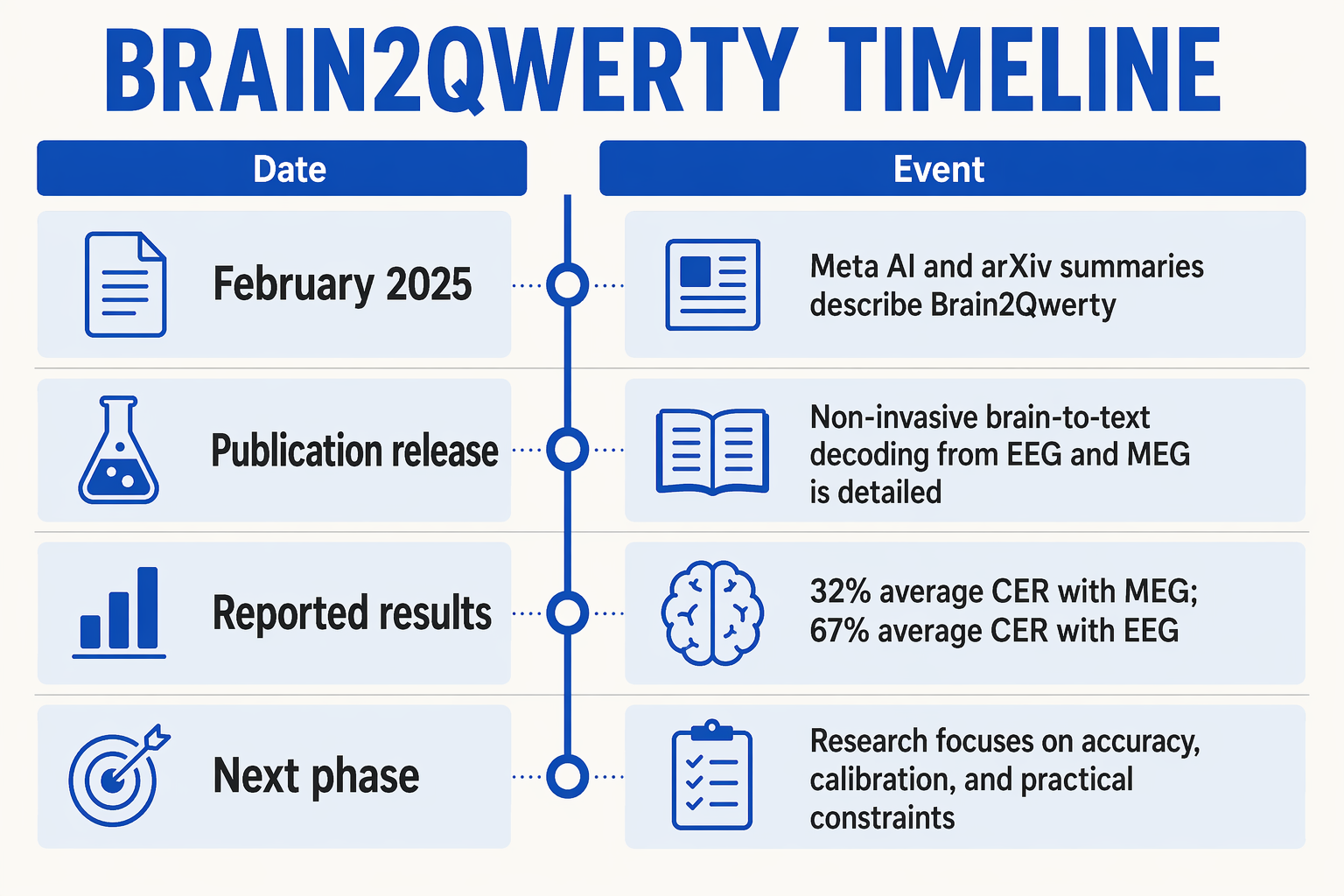
Timeline: From Lab Result to “Mind-Reading AI” Headlines
Brain2Qwerty did not appear in a vacuum. It arrived after years of progress in brain-computer interfaces, deep learning, and non-invasive neural sensing — then quickly moved through the familiar cycle of research paper, media amplification, technical clarification, and practical reality check. The timeline below separates what happened from what the headlines implied.
| Period | Event | What Changed | Key Data / Source | Why It Matters |
|---|---|---|---|---|
| Pre-2025 | Non-invasive BCI research matures | EEG and MEG become serious candidates for decoding language-related brain activity without surgery | EEG measures scalp electrical activity; MEG measures magnetic fields generated by neural activity | Set the stage for brain-to-text work that avoids implanted electrodes |
| Feb 2025 | Meta AI publishes Brain2Qwerty research | Meta introduces a deep learning architecture trained to decode typed sentences from EEG and MEG recordings | arXiv paper “Brain-to-Text Decoding: A Non-invasive Approach via Typing”; model processes 500 ms windows of neural activity | Marks a major non-invasive brain-to-text benchmark |
| 2025 release coverage | “Mind-reading AI” headlines spread | Public discussion shifts from technical decoding to exaggerated claims about reading thoughts | Some coverage described “up to 80% character accuracy,” but Meta’s clearer average metric is 32% CER with MEG | Shows the gap between research nuance and viral framing |
| Technical review phase | MEG clearly outperforms EEG | Researchers and analysts focus on the performance divide between sensing methods | Meta reports 32% character-error rate using MEG versus 67% using EEG | Demonstrates that sensor quality is still a major bottleneck |
| 2025–2026 | Practical limitations become clearer | The model is recognized as a lab system, not a consumer interface | MEG scanners are large, expensive lab devices; EEG is more portable but much less accurate | Keeps expectations grounded for businesses and users |
| As of June 2026 | Brain2Qwerty remains a research milestone | The field moves toward better datasets, lighter sensors, and safer AI interfaces | No evidence yet of a production-ready Meta brain-to-text product | The breakthrough is real, but deployment is still ahead |
What the Timeline Tells Us
The most important pattern is that Brain2Qwerty’s scientific significance and consumer readiness are not the same thing. The February 2025 research release showed that non-invasive signals can be mapped to typed text better than many expected, especially with MEG. But the same numbers also show why it is not ready to replace keyboards, speech recognition, or assistive communication devices.
A 32% character-error rate means roughly one in three characters is wrong on average under the reported MEG condition. EEG’s 67% character-error rate is far further from practical use, even though EEG is the more portable and potentially scalable sensing method. That trade-off — high-performing but impractical MEG versus accessible but noisy EEG — is the central engineering challenge.
The Broader Interface Shift
Brain2Qwerty also fits into a wider movement: interfaces are becoming more natural, multimodal, and AI-mediated. Today, that shift is already visible in voice agents, WhatsApp bots, and speech APIs. Platforms such as CallMissed, for example, help businesses deploy AI voice agents and multilingual speech systems now — while brain-to-text remains a longer-term research frontier.
The takeaway: Meta’s work is an important step toward future non-invasive BCIs, but the timeline makes one thing clear — this is not mind reading. It is early-stage decoding of brain activity during a controlled typing task, with impressive science and very real limitations.
Frequently Asked Questions
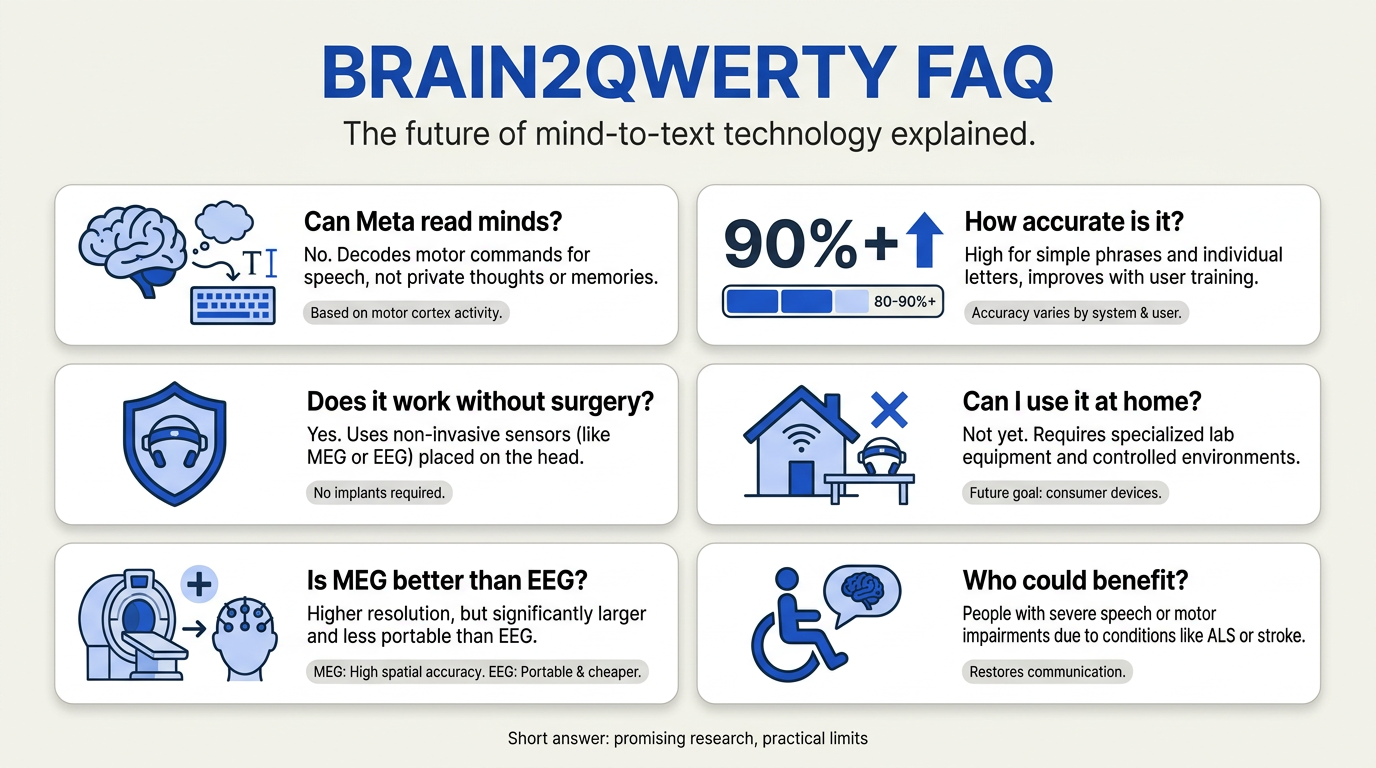
What is Meta’s Brain2Qwerty and how does it work?
Is Meta’s Brain2Qwerty actually mind reading?
How accurate is Meta’s Brain2Qwerty at turning brain signals into text?
Why does Brain2Qwerty work better with MEG than EEG?
How is Brain2Qwerty different from implant-based brain-computer interfaces?
When will Meta’s Brain2Qwerty be available as a consumer product?
Conclusion
Meta’s Brain2Qwerty is a meaningful research milestone — but its real significance is more scientific than sci-fi. It shows that non-invasive brain-to-text decoding is improving, while also reminding us how far the field remains from practical, everyday “thought-to-text” interfaces.
Key takeaways:
- Brain2Qwerty does not read minds; it reconstructs typed sentences from EEG and MEG recordings while participants are actively typing.
- MEG is the stronger signal source, with Meta reporting a 32% average character-error rate, compared with 67% for EEG.
- The system is still lab-bound, relying on carefully controlled recordings and, for best results, large and expensive MEG equipment.
- The architecture is technically sophisticated, including a convolutional module that processes 500 ms windows of neural activity — evidence of how engineered, not magical, this decoding process is.
What to watch next is whether non-invasive sensors become smaller, cheaper, and accurate enough to move beyond controlled experiments. Until then, today’s most deployable AI communication interfaces remain voice, chat, and multilingual automation. To explore that evolution, check out CallMissed — an AI infrastructure platform powering voice agents, WhatsApp chatbots, and speech APIs for businesses.
The big question is not whether AI can “read minds,” but how responsibly we build interfaces that understand human intent.
Related Posts



Ready to automate customer conversations?
Launch AI voice agents and WhatsApp bots with CallMissed — one API, 22+ Indian languages.