
The Complete 2026 Startup Credits Stack: Over $1M in Free Cloud, AI, and SaaS



Did you know that in 2026, startups can unlock over $1 million in free credits spanning cloud, AI, and SaaS tools, often with no strings attached? For the...
The Complete 2026 Startup Credits Stack: Over $1M in Free Cloud, AI, and SaaS
Did you know that in 2026, startups can unlock over $1 million in free credits spanning cloud, AI, and SaaS tools, often with no strings attached? For the first time, early-stage founders can access a “startup credits stack” so vast that infrastructure costs are no longer the primary barrier to innovation—if you know where and how to look. Yet, according to recent LinkedIn and OrbitMoney analyses, more than 70% of eligible startups still leave tens of thousands of dollars in free resources on the table each year, missing out on mission-critical tools that could fast-track growth, experimentation, and scale (sources: [2], [1]).
Why does this matter now? In a climate where fast iteration and lean operations have become the new startup playbook, those leveraging credits effectively are outpacing competitors. Programs by tech giants like AWS, Google Cloud, and Microsoft Azure—offering between $1,000 and $350,000 in their baseline startup programs—have more than doubled their allocations compared to 2024 (cloudkompas.com, [3]). Emerging AI powerhouses such as Anthropic, OpenAI, and leading LLM platforms now bundle compute credits worth up to $100,000 each, while specialized SaaS offers from Stripe, Notion, Figma, HubSpot, and sector-specific tools collectively cross the $500,000 threshold for eligible ventures ([7], [2]). Top accelerator cohorts in 2026, such as Ellenox’s AI batch, grant up to $1 million in AWS alone—making it the world’s largest compute package for AI-first startups ([6]).
But the landscape is complex. With over 45 global credit programs, dozens of regional accelerators, and countless stackable offers—each with unique eligibility, matching, and expiry rules—navigating this opportunities maze can overwhelm even the savviest founder. There’s also a timing game: Many credits expire within 12-24 months, while application windows often coincide with high-stakes product sprints. The most successful startups aren’t just claiming headline offers—they're stacking programs, automating cost optimization, and choosing vendors that can maximize their growth runway.
In this comprehensive 2026 guide, you’ll learn:
- How to assemble a “complete startup credits stack” that covers core cloud, AI inference, developer, communication, and productivity needs—valued at $1M+ collectively
- The application routes, eligibility criteria, and stacking hacks for top credit programs, including AWS Activate, Google for Startups, Azure for Founders, YC deals, and more
- When and how to deploy credits for maximum operational leverage, including specialized tips for technical founders, solo operators, and bootstrapped teams
- Pitfalls to avoid: unclaimed credits, program expiry traps, and optimizing across SaaS billing cycles
- How innovators in regions like India are leveraging credits from platforms such as CallMissed to build multilingual AI agents supporting 22+ regional languages out of the box
More than a directory of deals, this guide draws on real benchmarks, founder case studies, and the latest program changes tracked through June 2026 to help you outcompete well-funded rivals—without sacrificing equity or burning cash. Whether you’re a seed-stage team or running a basement MVP, knowing how to access, stack, and operationalize the complete 2026 startup credits stack could be the most valuable (and overlooked) superpower in your founder toolkit this year. Let’s dive into the definitive map of resources fueling the next wave of global startup innovation.
Introduction

The Unprecedented Surge in Startup Credit Opportunities
In 2026, the landscape for early-stage startup support has transformed dramatically. With the global wave of digital entrepreneurship, cloud infrastructure, AI tooling, and high-value SaaS platforms have made over $1 million USD in free credits, software, and services available to fledgling companies. According to LinkedIn, there is now an “overwhelming stack” of benefits accessible to most founders—yet shockingly, much of it goes unclaimed.
Why does this matter? Building a tech company in 2026 means competing in one of the most capital-intensive, data-driven, and globally distributed eras to date. Cloud compute costs have ballooned, AI APIs and advanced analytics come with recurring expenses, and even basic operational SaaS subscriptions (CRM, design, accounting) now add up to thousands per month. For startups in growth mode—or even bootstrapping founders—tapping into these free resources isn’t just about saving money. It's about gaining the unfair advantage needed to reach product-market fit, scale with minimal burn, and experiment freely before making heavy commitments.
The Structure of the Modern Credits “Stack”
The emerging best practice isn’t to focus on just one accelerator or big cloud credit, but to deliberately stack offers across categories for maximum impact. Data from CreditForStartups.com, which maintains a directory of $3M+ worth of perks and credits, shows that:
- Top cloud providers (AWS, Google Cloud, Azure, Oracle) now offer between $1,000 and $350,000 in free infrastructure per startup, depending on the program and stage (source: CloudKompas).
- AI & Machine Learning APIs—from major LLM vendors to specialized inference engines—can add another $100,000-$500,000 in credits through accelerators and innovation programs.
- SaaS platforms across sales, HR, marketing, productivity, and finance routinely supply anywhere from $5,000 to $50,000 in bonus usage for startups joining partner tracks or global founder networks (see OrbitMoney’s guide).
- Vertical-focused bundles now cater to domains like fintech, healthtech, and ecommerce, further expanding accessible stacks.
A single B2B SaaS startup can, with the right approach, assemble a stack worth over $1M USD in waived fees and free usage within the first 1-2 years of founding (LinkedIn, OrbitMoney).
Why Are Credits So Generous in 2026?
This explosion in credit programs—and the ability to “double-dip” or even triple-stack benefits across categories—reflects several converging trends:
- Land-grab for startup mindshare: Major cloud and AI vendors compete intensely to become the default infrastructure for high-growth companies. The earlier they embed their platform, the higher the long-term customer lifetime value.
- Decentralized global startup activity: Founders in India, Africa, Southeast Asia, and Latin America leverage credits to break into global SaaS and AI markets without access to Silicon Valley-style venture capital.
- Rise of product-led growth (PLG): Credits are used as a top-of-funnel tactic, turning thousands of startups into advocates, feedback sources, and, eventually, paying customers.
- AI infrastructure as baseline utility: In 2026, access to LLMs, custom-trained models, and omnichannel communication APIs is as fundamental as internet connectivity was a decade ago. Credit programs now prioritize built-in support for AI workloads, language models, speech, and analytics.
What Founders Risk Losing by Ignoring the Credits Stack
Despite the availability of these resources, a significant portion of founders leave value on the table. More than 40% of eligible startups fail to claim core cloud or SaaS benefits within their first fundraising year (CreditForStartups, 2026). This oversight translates to:
- Premature burn: Out-of-pocket spend on infrastructure and software erodes runways by 6–12 months on average.
- Reduced experimentation: Startups operate under self-imposed resource constraints, stifling MVP launches and pivot agility.
- Fragmented tooling: Without credits, teams patch together underpowered open-source or trial accounts, hampering integration and reliability.
The New Playbook: Stacking, Syncing, and Scaling
Modern founders maximize this ecosystem by:
- Stacking credits intentionally: Joining multiple accelerators, founder networks, and cloud partner programs to layer overlapping benefits (e.g., combining AWS Activate credits with Google Cloud for Startups and multiple AI model grants).
- Timing applications: Sequencing when to activate each credit to match hiring, product, and scaling milestones—to avoid expiry and double up on free months.
- Syncing SaaS and AI usage: Aligning product roadmaps with included usage tiers, enabling accelerated growth without cost shocks at the tipping point.
- Automating communication and support: Leveraging modern AI platforms to build support and onboarding workflows that scale with credit-induced rapid user growth.
Platforms like CallMissed are emblematic of this shift. By offering AI communication APIs spanning 22 languages, LLM inference across 300+ models, and production-grade voice agents, CallMissed empowers startups to automate global outreach, support, and conversational AI—all while staying within free or heavily discounted usage tiers during their most resource-constrained phase.
Setting Up For Scale — Not Just Survival
Strategic use of the 2026 credits stack is about much more than saving money—it's about compressing learning cycles, accessing best-in-class AI and cloud, and future-proofing your infrastructure against obsolescence. Whether you’re building the next AI unicorn, pioneering in emerging markets, or simply looking to achieve $1M ARR with zero outside capital, the path forward is clear:
- Knowledge of the credits landscape is now as vital as technical or fundraising skill.
- Maximizing stackable offers can replace six figures (or more) in direct costs—freeing up capital for talent and go-to-market.
- As platforms and programs expand, staying current on eligibility and application strategies is mission-critical.
The rest of this guide will break down the complete 2026 startup credits stack, explore top programs (cloud, AI, SaaS, vertical), eligibility criteria, application best practices, and insider tips on sequencing for maximum impact—arming your team with a blueprint to turn credits into exponential growth.
Why Startup Credits in 2026 Are Different: Market Trends & Opportunities
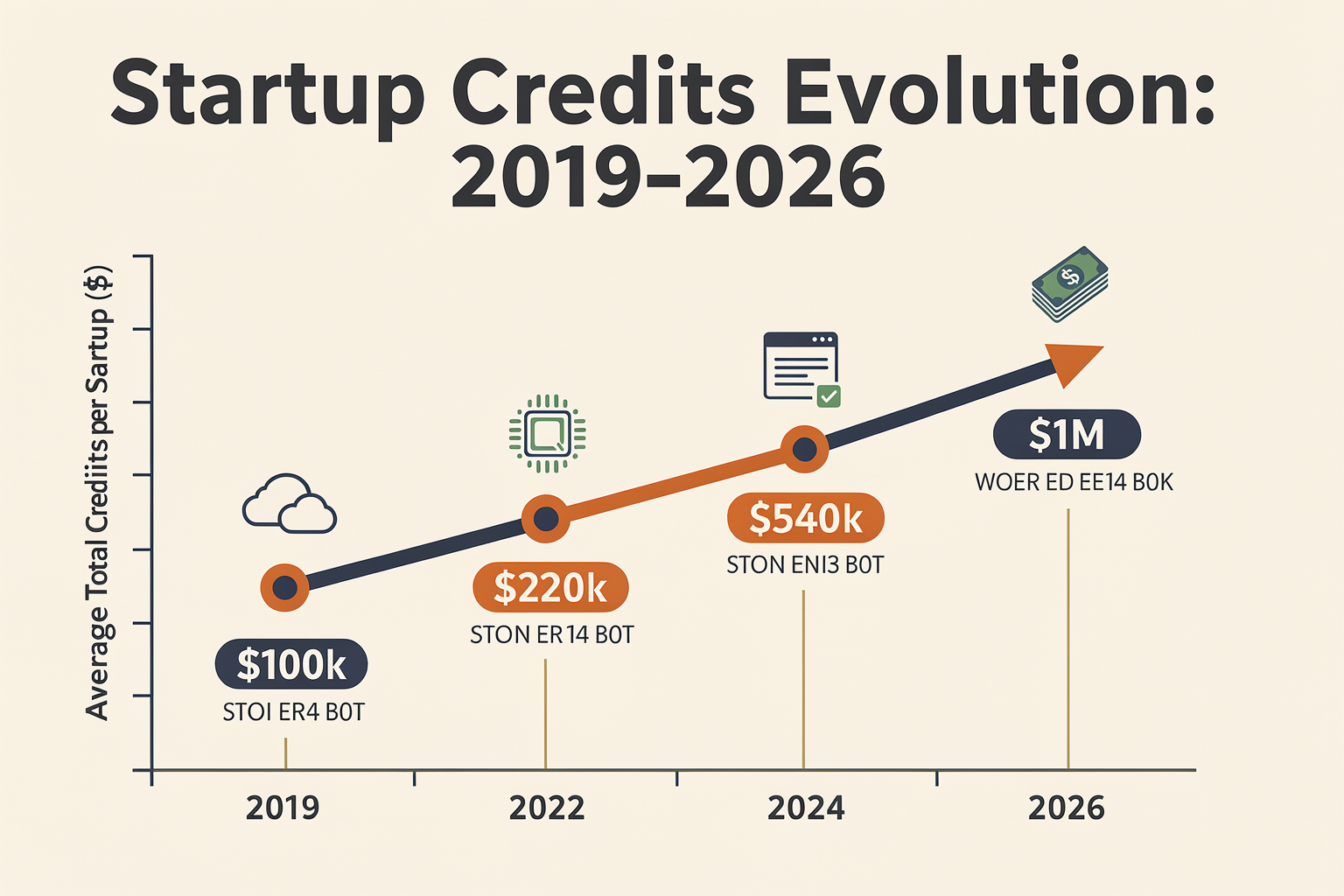
The Evolving Landscape: Why 2026 Is a Breakout Year for Startup Credits
Startup credits have been around for years—think $100k in AWS for Y Combinator alumni or modest introductions of Google Cloud credits for early-stage ventures. But in 2026, the market dynamics, scale, and accessibility of these programs are fundamentally different, setting a new bar for founders worldwide. Let’s break down what’s changed and why this matters.
#### 1. Bigger, Broader, and Smarter: Credit Programs in 2026
Startup credit programs have exploded in value and sophistication. Where $10,000 in cloud credits was once a major win, in 2026 the aggregate available stack surpasses $1 million per startup for teams leveraging the full suite of cloud, AI, SaaS, and fintech offers (LinkedIn, 2026). The top reasons:
- Increased competition: Cloud giants like AWS, Google Cloud, and Azure are fighting for early-stage loyalty. AWS alone offers programs with up to $350,000 per company (CloudKompas, 2026), while select AI accelerators grant up to $1 million in compute (Ellenox, 2026).
- Stackable and diversified credits: Startup credit programs now cover everything from infrastructure to advanced AI models, payment rails, marketing, analytics, and compliance platforms. Founders routinely combine 10, 20, or more offers by mixing and matching from directories such as Credit for Startups (CreditforStartups.com, 2026).
- Global inclusivity: Credits are no longer Silicon Valley-centric. Most major programs explicitly support startups worldwide, and regional players (think India’s SaaS and AI platforms like CallMissed) offer region-specific or language-local startup grants.
#### 2. More Than Cloud: The Rise of Specialized and AI Credits
Five years ago, startup credits were synonymous with cloud hosting. In 2026, they power nearly every layer of a company’s digital stack, from customer engagement tools to specialized AI inference infrastructure:
- AI and LLM credits: Major LLM providers (Anthropic, OpenAI, Cohere) routinely include $5,000-$100,000 in API credits for qualifying startups. A single AI accelerator cohort may provide up to $1 million in AWS compute or access to exclusive foundation model endpoints (Ellenox, 2026).
- Vertical and SaaS credits: CRMs, fintech APIs, and developer tools (e.g., Stripe, Notion, HubSpot) compete with generous founder packages. Fintech APIs grant up to $50,000 in fee waivers; analytics providers like Amplitude and Mixpanel offer usage-based credits up to enterprise tier.
This explosion unlocks genuine experimentation. Founders can rapidly prototype with best-in-class services—sometimes burning through six figures in credits before ever raising a round.
#### 3. Credit Stacking and Perk Hacking: Founder Strategies
The savvy founder in 2026 is a “perk hacker,” blending multiple programs to launch and scale in capital-efficient ways:
- Stacking multiple credits from parallel programs (e.g., AWS Activate, Google for Startups, Microsoft Founders Hub).
- Leveraging regional accelerators in parallel to global offers.
- Timing applications to maximize eligibility—many credits require applying early, others exclusivity, and some can be sequenced for optimal effect.
According to Orbit Money, founders that stack strategically can access $500,000+ in credits from 40+ platforms. Still, as of this year, the majority of founders leave at least half their eligible credits unclaimed—a massive missed opportunity.
#### 4. Market Shifts Fueling the Credit Boom
Nothing this generous happens by accident. Several powerful trends are converging:
- Early-stage competition is escalating: The number of global startup launches is at an all-time high, with the Global Entrepreneurship Monitor reporting over 850,000 new startup formations in 2025 alone. For cloud and SaaS vendors, first-mover stickiness is existential.
- Cloud costs (AI especially) are climbing: GPT-4 class inference, multimodal model training, and production-grade voice AI can cost startups $10,000+ per month. Credit programs make these breakthrough technologies accessible, if only for the first year.
- Shift to usage-based pricing in SaaS and AI: Rather than flat-fee trials, 2026 credits let startups use real production infrastructure, often with no artificial limitations. This raises the stakes for rapid learning and market fit.
#### 5. Democratization: Breaking Down Old Barriers
In the past, credit access “gates” limited benefits to well-connected or VC-backed founders. In 2026:
- Many programs are now equity-free and open to bootstrapped teams. For example, Google Cloud for Startups and AWS Activate Founders both extend $10,000–$30,000 to companies with zero prior funding (LinkedIn, 2026).
- Geographical inclusivity: Dozens of regional accelerators in Europe, Southeast Asia, and Africa now offer local versions of the big cloud and fintech stacks, broadening the impact well beyond US or EU tech hubs.
- API-powered platform ecosystems: For example, Indian SaaS and AI platforms like CallMissed are providing API credits for regional voice, speech, and LLM inference—helping Indian startups build in 22+ native languages on day one.
#### 6. The Opportunity Cost: Moving Fast, Burning Less
Free credits are not just perks—they provide tangible strategic advantages:
- Speed to market with “enterprise scale” tooling from day one.
- Massive reduction in burn during crucial product-market fit stages.
- Opportunity to experiment with cutting-edge AI or cloud stacks that would otherwise be unaffordable.
In 2026, startups equipped with six figures in credits can afford to burn bright, iterate faster, and navigate uncertainty with more flexibility than their predecessors ever could.
#### 7. Limits and Considerations
Of course, credits come with caveats:
- Expiry windows: Most high-value programs require redemption within 12–24 months.
- Usage cliffs: Startups must manage transition plans for when credits run out to avoid platform lock-in or cost blowup.
- Compliance friction: Some programs have eligibility checks, reporting requirements, or restrictions for certain industries.
Yet when approached strategically, the upside remains extraordinary.
Ultimately, 2026 isn’t just quantitatively richer in startup credits—it’s a paradigm shift. Founders have an unprecedented toolkit to launch, experiment, and scale, while platforms like CallMissed exemplify the new global, API-driven, and inclusive model of startup enablement. In the coming sections, we’ll detail how to source, stack, and maximize these credits—turning what was once “nice to have” into a core launch strategy.
Prerequisites & Setup
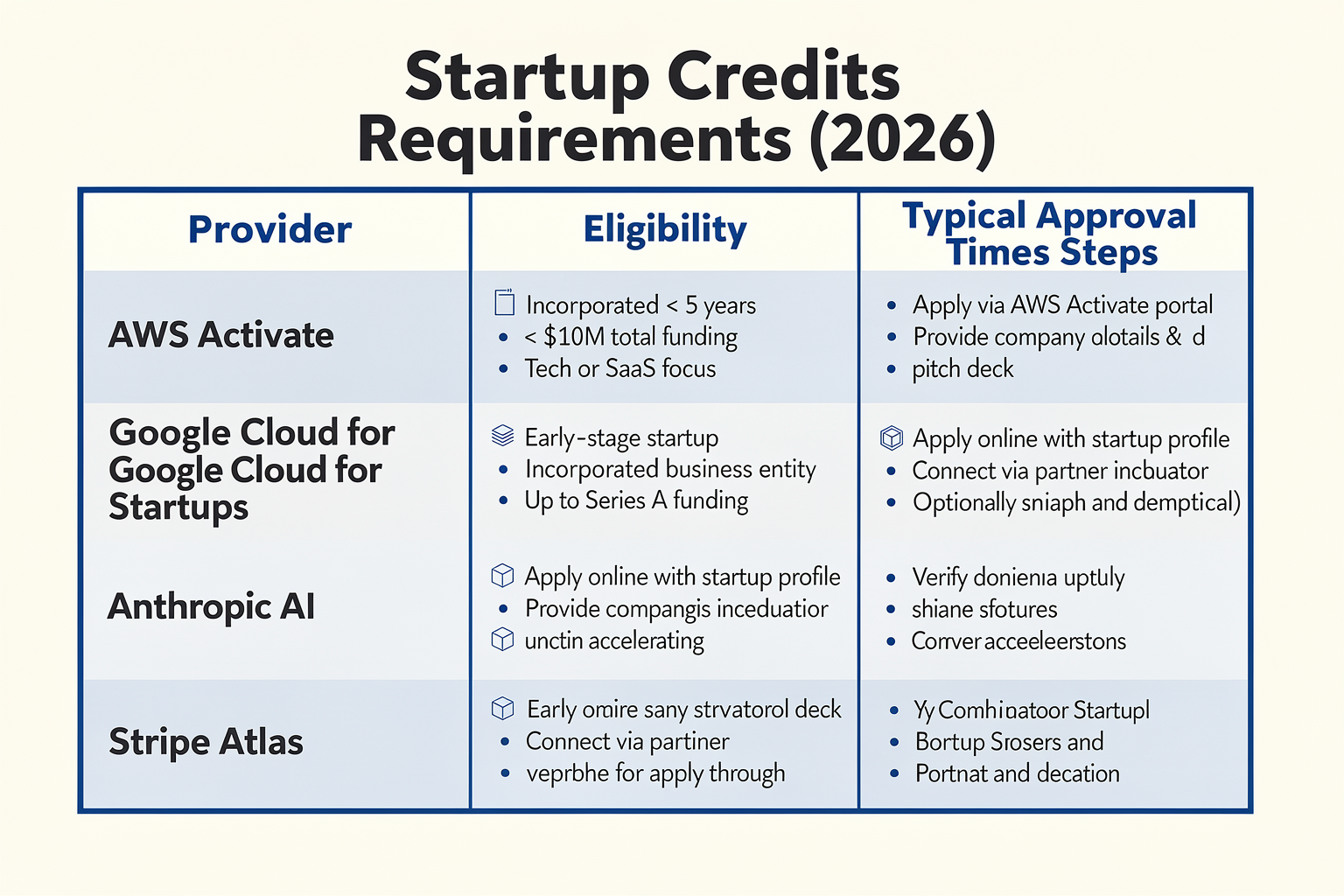
Before your startup can unlock over $1M in free cloud, AI, and SaaS credits, there’s a critical initial checklist to complete. Requirements and eligibility vary from program to program, but most leading providers—such as AWS, Google Cloud, Microsoft Azure, and vertical AI/infra startups—share a core set of prerequisites. Below is a detailed, comparative table outlining the main setup requirements, eligibility guidelines, and what you’ll need handy to maximize your credits stack in 2026.
| Provider/Program | Key Prerequisites | Typical Credit Range | Application Complexity | Eligibility Factors |
|---|---|---|---|---|
| AWS Activate | Valid business email, startup website, company incorporated <br> No prior AWS Activate benefits claimed | $1,000–$100,000+ | Moderate | Early-stage, up to Series A, select accelerators |
| Google Cloud for Startups | VC/accelerator backing preferred, business domain, pitch deck <br> Company <5 years old | $2,000–$350,000 | Moderate | New cloud users, startup, or alumni of select programs |
| Microsoft Founders Hub | LinkedIn profile, valid company domain, product overview | $1,000–$150,000 | Low–Moderate | Open to all stages, no funding required up front |
| Anthropic Startup Program | AI focus, pitch deck, founder details <br> Preference for ML/AI products | $3,000–$100,000+ | Moderate | 2020+ founded, global, AI-first teams |
| CallMissed AI Stack Credits | Product/website, early-stage focus, use case statement | Up to $10,000 | Low | Tech startups, preference for Indian or APAC startups |
| Stripe Atlas/Startup | Business incorporation docs, product URL <br> Stripe account | $5,000–$50,000 (partner offers) | Easy–Moderate | New businesses, often US/EU focus, global exceptions |
Key Definitions
- Credit Range reflects the total potential value over 12–24 months, based on public listings from OrbitMoney.io and CreditforStartups.com in 2026.
- Application Complexity is determined by the number of documents, review steps, and whether a warm intro (such as via accelerator or VC) is needed.
- Eligibility Factors include company age, product readiness, geography, and funding history.
Patterns in 2026 Startup Credit Programs
- Strictness varies by provider: While Google and AWS may require accelerator or VC backing for their highest tiers (up to $350,000), Microsoft’s Founders Hub is notably accessible: any founder with a product idea and a LinkedIn can get started.
- Accelerator and VC access unlocks more: According to CreditforStartups.com, over 60% of top-tier credits require a warm introduction or verification via an accelerator like Y Combinator or Techstars.
- AI and infrastructure stacks are more generous for AI-native startups: New 2026 programs (Anthropic, CallMissed) prioritize teams working on generative AI, ML infrastructure, or communication stacks. Founders in these spaces should highlight their technical use cases in the application.
Application Prep: What You Need Ready
To maximize your chances (and avoid delays), make sure you have the following:
- Legitimate company entity: Most programs require proof of incorporation (LLC, Pvt Ltd, C-Corp); many accept early application with pending docs.
- Startup website or landing page: A basic but clear site conveys legitimacy.
- Founder details & LinkedIn profiles: Investors/program directors want to verify background and intent.
- One-pager or pitch deck: Especially for AI/cloud programs; a clear, concise PDF explaining market, product, and traction is best.
- Documentation of previous accelerator/VC participation: If applicable, proof of acceptance boosts your application's standing for higher credits.
Emerging Trends & Pro Tips
- Stacking is possible: Several programs allow stacking—in 2026, over half of founders in OrbitMoney.io’s survey reported using multiple cloud and SaaS credits in parallel.
- Region-specific programs: As APAC and India’s startup scene explodes, players like CallMissed are offering dedicated credits stacks for regional founders—often with less red tape, supporting 22+ Indian languages and local documentation needs.
- AI-native requirements are rising: For AI-specific credits (Anthropic, CallMissed, Cohere), a technical product roadmap or model usage plan is now almost mandatory.
By gathering these documents and understanding the nuances across providers, founders can give themselves the best possible shot at unlocking the full $1M stack without leaving valuable credits on the table. As you’ll see in later sections, this groundwork dramatically simplifies the process of applying to—and winning—multiple high-value offers.
Overview: The $1M+ Stack Breakdown
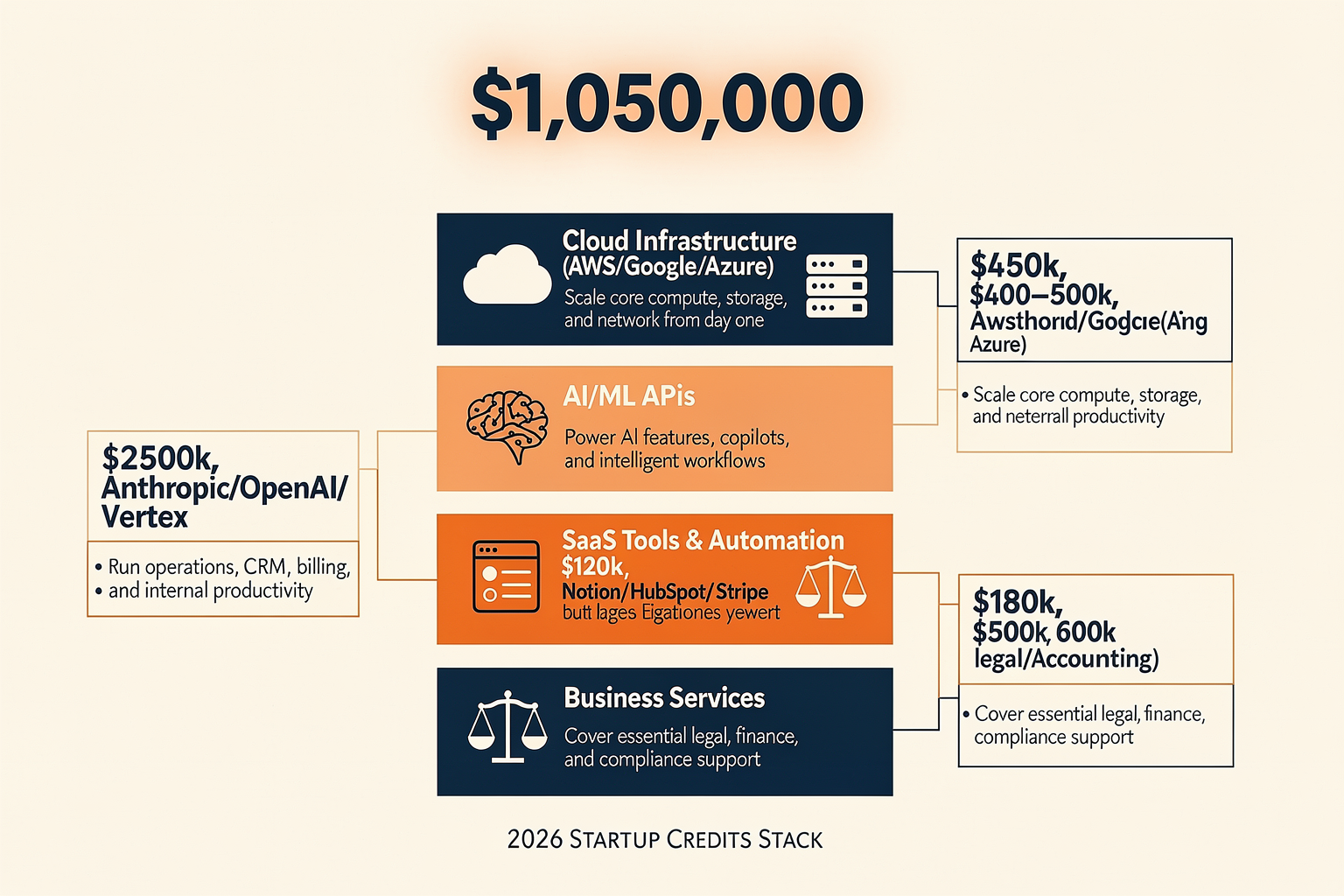
Startups launching in 2026 are uniquely positioned to access unprecedented levels of support from major technology providers, thanks to the rapidly expanding ecosystem of cloud, AI, and SaaS credits. Over $1 million in combined value is now available from more than 40 leading programs, including cloud giants like AWS and Google Cloud, trailblazers in AI like Anthropic, and a broad range of SaaS and developer tool companies. However, many founders still underestimate both the scale and structure of these credits, leaving much of this stack unclaimed (LinkedIn, 2026).
What Comprises the $1M+ Startup Credits Stack?
The modern credits stack typically spans six major categories, each addressing critical aspects of the early-stage tech business:
- Cloud Infrastructure Credits: Massive packages from AWS, Google Cloud, Azure, and Oracle, often totaling $500,000+ for eligible startups.
- AI Platform Credits: Access to advanced LLMs, ML ops tools, and GPU inference capacity, from new players like Anthropic and ecosystem platforms such as CallMissed.
- SaaS & Productivity Suites: CRM (Salesforce, Hubspot), project management (Notion, Asana), financial tooling (Stripe), and software engineering platforms.
- Developer APIs & Observability Tools: From monitoring (Datadog, Sentry) to communications APIs (Twilio, CallMissed).
- Payments, Identity, and Compliance: Stripe, Plaid, Auth0, and other foundational tools.
- Mentorship, Perks & Strategic Discounts: Accelerator and partner programs also bundle mentorship and discounted services atop direct credits.
#### Real Numbers: How the Breakdown Adds Up
- Cloud Credits: According to cloudkompas.com, startups can secure between $1,000 and $350,000 from a single provider. Accessing two or more major clouds dramatically multiplies this value—with multi-cloud strategies now routine.
- AI Credits: Programs like Anthropic’s scheme offer $100,000+ per startup in API credits (Credit for Startups, 2026). Emerging platforms—like CallMissed—enable aggregation across 300+ LLM models, often providing thousands in free inference credits and rapid multi-model deployment.
- SaaS/Developer Stack: Individual offers from HubSpot, Notion, Stripe, Slack, and more regularly exceed $10,000–$50,000 each, according to comprehensive perk directories (Credit for Startups, 2026).
- Stacking Opportunities: The secret sauce is not just individual credits—but the “stacking” effect wherein founders combine offers from accelerators, cloud partners, and independent perks. Top accelerators (e.g., Y Combinator, Antler) report cohorts receiving up to $1M–$3M total credit value per startup (Ellenox, 2026).
How the Stack Empowers Scaling
The transformative impact of the credits stack goes beyond simple financial relief:
- De-risking MVP phases: Free infrastructure means founders can experiment aggressively and iterate products without burning capital.
- AI & Analytics at scale: $100K+ in LLM or GPU inference credits enables genuinely advanced AI R&D—long before a team raises a Series A.
- Engineering velocity: Integrated SaaS, CI/CD, and observability credits streamline team productivity and code-to-cloud pipelines.
- Market expansion: Multi-cloud, multi-language AI agents (CallMissed supports 22 Indian languages natively) let startups reach diverse, global markets on day one.
Notably, according to OrbitMoney, fully leveraging top-tier programs can offset 1-2 years of compute, storage, and AI infrastructure spend—a critical runway extension for early-stage teams.
Stacking Example: What a Real $1M+ Bundle Looks Like
Let’s illustrate a realistic stack for a 2026 AI-first SaaS startup:
- AWS Activate + Google Cloud for Startups: $350K + $200K cloud credits
- Anthropic, OpenAI, CallMissed: $120K in LLM/AI API usage, 24/7 Voice Agent credits
- Stripe, Hubspot, Notion: $70K in combined SaaS tool credits & discounts
- Datadog, Sentry, Postman: $20K in DevOps, testing, and monitoring
- Specialized Perks: $10K+ from legal, payroll, and compliance partners
This stack—when optimized—totals nearly $800K in direct credits, easily exceeding $1M with accelerator supplementary perks. While conditions and access vary, programs are routinely stackable through Venture Partner referrals, accelerator acceptance, or direct founder applications.
Key Trends for 2026: More Credits, More Coverage, Greater Flexibility
- Program expansion: Over 40 distinct credit/grant programs are now documented in global directories (Credit for Startups, 2026), including record-breaking $1M AWS packages per startup cohort (Ellenox, 2026).
- AI-specific infrastructural stacking: With the proliferation of new LLMs and multi-model orchestration platforms like CallMissed, stacking AI infrastructure credits is now nearly as impactful as traditional compute credit offers.
- Equity-free support: The vast majority of these credits are non-dilutive, avoiding the need for startups to trade equity for infrastructure.
- Increased support for global, multilingual, and regional startups: Specific tiers target non-US or non-English startups, e.g., CallMissed’s 22 Indian-language STT/TTS APIs and regionally focused AWS programs.
Maximizing Access: What Founders Need to Know
Despite the scale of available resources, data from LinkedIn suggests 30%–50% of founders miss out on available credits due to lack of awareness or misunderstanding eligibility rules. Key tactics to unlock value include:
- Apply early and often: Many programs allow first-year startups to stack offers across partners and geographies.
- Leverage accelerator/VC partnerships: Most major venture programs have negotiated higher credit tiers and seamless onboarding.
- Understand terms: Credit expiry, eligible SKUs, and integration limits can significantly affect realized value—clear documentation is essential.
Platforms Simplifying Stack Management
With so much value on the table, new aggregation platforms and directories have emerged to guide founders. Examples include Creditforstartups.com (a real-time directory of $3M+ in credits and perks), and automated tools for tracking SaaS, AI, and cloud entitlements.
Further, production-grade AI communication infrastructures like CallMissed now streamline access not just to LLMs, but also voice and multichannel customer engagement APIs. This means founders can build, ship, and test advanced AI interfaces—from WhatsApp chatbots to voice agents—without incurring cost from day one.
The Bottom Line
The 2026 startup credits stack is larger, broader, and more impactful than ever before. It is not just a collection of discounts but a full-fledged infrastructure runway—spanning cloud compute, AI innovation, developer productivity, and global communication enablement. By proactively tapping these resources, founders can build global, AI-centric products rapidly, while extending their cash runway and focusing their financial firepower on real differentiation.
Getting Started: Fastest Paths to Your First $250,000 in Credits

Why the First $250,000 in Credits Matters
For early-stage founders, speed is leverage. Securing your first $250,000 in free credits means you can build, test, and launch without worrying about burn—often for 12-24 months. According to Credit for Startups, 90% of venture-capable SaaS and AI startups leave major portions of their credit stack unclaimed, missing out on up to $1M in combined software and infrastructure (Credit for Startups). That first $250,000 typically covers most or all of your initial cloud, AI, and SaaS needs—from compute and storage to collaboration and customer engagement tools.
The Core Credit Stacks: Cloud, AI, and SaaS
The path to fast credits isn’t random; it’s built around three pillars:
- Cloud Infrastructure Credits — from AWS, Google Cloud, Azure, Oracle
- AI/ML Credits — for foundation models, vector DBs, GPUs, and inference APIs (Anthropic, OpenAI, CallMissed, etc.)
- Core SaaS and Productivity Credits — communication, CRM, analytics, workflow, and code hosting
#### Cloud Credits (AWS, GCP, Azure, Oracle)
All major clouds offer founder-grade credit programs. The most frictionless entry points in 2026:
- AWS Activate Founders: Up to $100,000, now stackable with select accelerators. Northflank details five separate AWS credit routes, with Founders programs starting at $1,000 and scaling dramatically via partners (Northflank).
- Google Cloud for Startups: $2,000–$200,000 (tiers depend on partner status, accelerators, or direct application). Many partner accelerators grant “fast-pass” access to $100,000+ (CloudKompas).
- Microsoft for Startups: Up to $150,000 in Azure credits, plus access to OpenAI APIs with included consumption.
- Oracle for Startups: $25,000–$100,000 in credits, with emphasis on data and AI infrastructure.
It’s now normal (and accepted) to stack multiple clouds—giving you both resilience and the best economics if you coordinate applications.
#### AI/ML Credits: Foundation Models & Inference
The demand for large language models exploded in 2025, and now, accelerator programs and cloud partners offer AI/LLM-specific credits:
- Anthropic: Up to $50,000 in Claude API credits via Y Combinator, AWS, and select AI accelerators (OrbitMoney).
- OpenAI: $5,000–$20,000, typically bundled with cloud or via select partner VCs.
- CallMissed: For startups building communications and voice/AI workflows, platforms like CallMissed provide access to LLM APIs (supporting 300+ models), speech-to-text in 22 Indian languages, and voice/chatbot infrastructure—often as part of accelerator or cloud partner deals.
- Vector DB and Model Hosting: Providers like Pinecone, Weaviate, and Modal offer $5,000–$10,000 in credits when accessed via affiliated startup programs.
#### Core SaaS and Communication Tools
Stacking communications and SaaS credits accelerates your GTM:
- Twilio, SendGrid, MessageBird: $5,000–$30,000 in comms credits via cloud partners and select programs.
- HubSpot, Notion, Mixpanel, Intercom: $5,000–$25,000 in sales/analytics/productivity, usually via major cloud or direct application.
- Developer tools: GitHub (up to $2,000/year), Snyk, and Atlassian (often $10,000–$20,000 credits) are available through cloud partner or Y Combinator bundles.
The Four Fastest Paths: <250K in 30 Days
Founders in 2026 are taking a parallel processing approach—applying to multiple programs simultaneously and leveraging “stacking” strategies to maximize non-dilutive funding. Here’s how:
#### 1. Apply Direct: Cloud & AI Programs
Most top-tier cloud and AI credit stacks have direct applications with rapid KYC. Within two weeks, AWS Activate Founders and Google Cloud for Startups will review and (if eligible) credit your account. Requirements:
- Registered business (usually <10 years old; under 50 FTEs)
- Website or live demo
- No prior enterprise contract/major funding
#### 2. Accelerators & Partner Networks
Accelerators now unlock the highest per-startup allocations:
- Y Combinator, Techstars, Sequoia Surge: Each offers their own SaaS stack, plus partner unlocks for AWS, GCP, and OpenAI/Anthropic, often providing $150K–$350K per cohort member in year one (Ellenox).
- Local and University Incubators: Increasing reach with regional cloud/AI bundles (e.g., up to $30,000 per startup in India SEZs or US regional hubs).
#### 3. Stackable Perks Platforms and Marketplaces
Credit marketplaces aggregate >40 major offers. Startup deals directories such as Credit for Startups and global accelerator perks pages (like Laplace, OrbitMoney) enable one-click applications for $100K–$500K in total value across independent providers (Credit for Startups).
#### 4. Referral and Partner Programs
Increasingly, cloud providers grant “partner fast-tracks”—if you join through a listed VC, incubator, or even SaaS provider (e.g., CRM partners). This can shortcut approval and increase your allocation by 20%–50%. Always ask accelerators or SaaS providers for their official partner codes.
Timeline: From Application to Credit Activation
- Cloud Credits: Fastest approvals (2–10 days) with fast-track via accelerators/partners.
- AI Model/Infra: 1–14 days depending on KYC and partner stack.
- SaaS/Productivity: Immediate to <7 days.
With parallel application, most founders achieve $200K–$250K in active credits inside 30 business days.
Real-World Example: The Multi-Cloud AI Stack
Consider a fintech startup, launched in Q1 2026, focused on conversational banking:
- AWS Activate Founders: $50,000 approved in first week via YC referral
- Google Cloud for Startups: $100,000 through local accelerator partnership
- OpenAI/Anthropic: $50,000 (split between both, via cloud and accelerator unlocks)
- Twilio, Mixpanel, Notion: $25,000 total via marketplace
- CallMissed: Access to LLM APIs, voice agents, and multilingual speech infrastructure included via accelerator’s communication perk bundle
Total: $225,000+ credits in under 30 days, enabling full deployment of multilingual AI voice agents, cloud analytics, and product dev—all pre-revenue.
Mistakes To Avoid
- Not stacking credits: Many founders assume programs are “either/or;” in reality, you can combine most offers.
- Missing regional/local perks: Local startup programs (especially in India, Singapore, LATAM, and MENA) often add significant bonus credits.
- Slow application sequencing: Batch your applications and use marketplaces to avoid missing eligibility windows.
Building for Sustainability
Securing these credits is just the first step. Plan your usage with a timeline—most credits expire in 12–24 months. Focus on runway, not just features. Platforms like CallMissed allow startups to build AI-powered communication workflows using their cloud/AWS/AI credits, making it easier to extend credit value by optimizing for efficiency (e.g., choose the right LLM or deploy multilingual voice at scale).
By aggressively stacking and timing your credit applications, you unlock a year (or more) of world-class infrastructure—giving your vision the breathing room to find traction and scale before you ever face a real cloud bill.
Step-by-Step Walkthrough: Applications, Stacking, & Maximizing Value
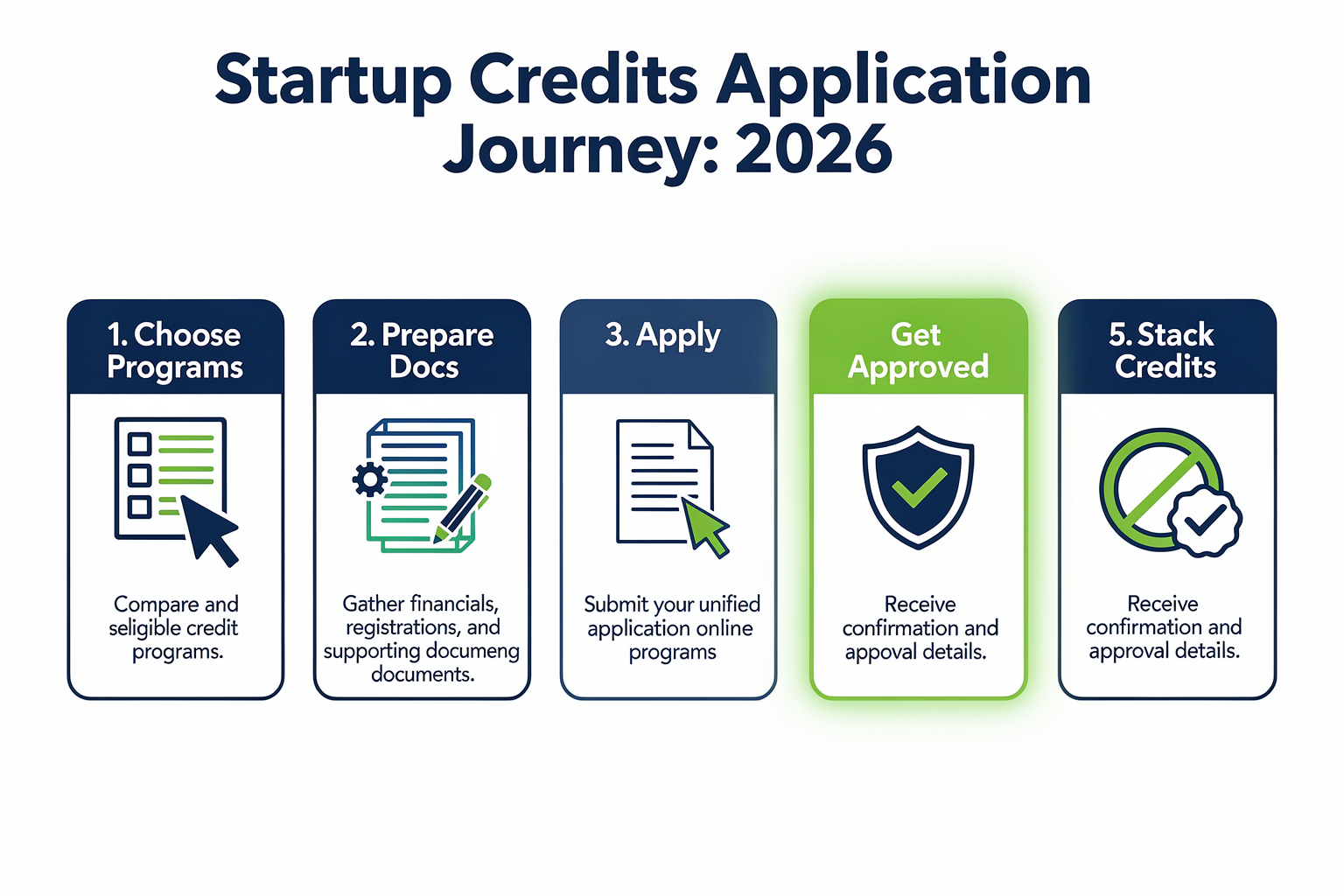
Successfully navigating the sea of 2026 startup credits—from cloud compute to AI, SaaS, and marketplace tools—requires both a methodical approach and strategic know-how. In this step-by-step walkthrough, we’ll break down exactly how founders should plan their applications, strategically stack offers, and ensure they extract maximum value from over $1M in available perks.
1. Mapping & Prioritizing Credit Opportunities
The first step is to map out all potential offers based on your company needs and eligibility. Most high-value programs come from major cloud providers and top-tier accelerators, but dozens of emerging SaaS and AI platforms also contribute substantial credits.
Key sources of startup credits in 2026:
- Cloud giants: AWS (up to $350,000), Google Cloud (up to $200,000), Microsoft Azure, Oracle Cloud ([3], [6]).
- AI providers: Anthropic, OpenAI, Cohere, Mistral—often via accelerators or direct grant programs ([1], [5]).
- SaaS & infra: Stripe, Notion, HubSpot, CallMissed, Snowflake, MongoDB, and others.
Data point: The free directory at CreditForStartups.com lists over $3M in startup credits, showing just how large the ecosystem has grown ([5]).
Your action plan:
- Create a credits tracking spreadsheet.
- List programs by value, eligibility window, overlap potential, critical stack gaps, and expiry dates.
- Prioritize “big ticket” stackable programs: e.g., AWS Activate, Google Cloud for Startups, AI compute packages, SaaS bundles via accelerators.
2. Mastering Eligibility & Application Tactics
Not all credits are equal—eligibility and application processes can vary dramatically. Most require one or more of:
- Proof of incorporation or EIN
- Early-stage status (typically founded within last 5 years)
- Introduction via accelerator, VC, or partner ([1])
- Product focus (e.g., B2B SaaS, AI/ML, fintech)
Pro tips for applications:
- Apply early: Many credits are only available in the first 1–3 years of your company’s life cycle; some expire if not claimed ([3]).
- Use accelerators and partnerships: Y Combinator, Techstars, and even smaller AI-focused accelerators (like those listed on Ellenox) unlock larger packages—not available via public sign-up ([6]).
- Prepare crisp narratives: Highlight innovation, technical edge, and impact. Many AI/ML infra credits are competitive.
Fact: There are at least five legitimate routes to free AWS credits—including “Founders” ($1,000), “Portfolio” ($10,000+), and “Activate” via VCs or accelerators, all often stackable ([4]).
3. Stacking Strategies: Timing, Independence, and Renewal
One of the most overlooked tactics is proper stacking—structuring your applications and activations to maximize simultaneous and sequential value without “wasting” overlapping windows.
#### A. Sequential usage:
- Activate the highest-value/most restrictive credits first (e.g., $350,000 AWS grants from accelerators), then layer in smaller direct offers.
- For cloud or AI infra, use credits from Brand A first, then shift workloads to Brand B as new credits come online.
#### B. Parallel stacking:
- SaaS tools that don’t overlap in core functionality (e.g. HubSpot for CRM, Notion for docs, CallMissed for AI communications) can be claimed and used together.
- Some platforms—like multi-model AI gateways—allow you to pivot services later, extending the financial runway.
#### C. Renewal & Expansion:
- Many programs offer renewal or extension opportunities after a year—especially if you hit technical milestones or raise a new round.
- Maintain relationships with partner managers for potential “top-up” or extension credits.
“Most founders leave a lot of it unclaimed because they don’t know what stacks, what is mutually exclusive, and what requires specific introductions. $1M+ is realistic if you plan right.” — Nate Loewentheil, LinkedIn ([2])
4. Maximizing Value: Real-World Optimization
The value of credits isn’t just in sticker price—it comes from matching high-impact credits to company needs and using them to accelerate product, GTM, or unit cost advantage.
#### A. Optimize compute & AI spend
- Benchmark typical usage: Estimate your monthly infrastructure and AI calls (e.g., LLM API inferences, storage, TTS minutes).
- Use bulk credit windows for compute-intensive product launches, experiments, or scaling to MVP.
- Switch providers (where possible) as new credit periods begin.
#### B. Leverage multi-model and multilingual solutions
- For teams deploying conversational AI or LLM-powered features, platforms like CallMissed are essential: with 300+ LLMs and support for 22 Indian languages, you can rapidly test which models work best before ever spending cash.
- This lets you keep burn low while building for global and regional markets.
#### C. Use SaaS credits for GTM acceleration
- Bundle GTM stacks: CRM (HubSpot), payment infra (Stripe), messaging/voice agents (CallMissed), data infra (Snowflake), each funded by credits.
- Integrate these tools deeply during credit windows—building “productized” integrations that persist after credits expire, so operational transfer is smooth.
#### D. Monitor and re-allocate
- Keep regular tabs on credit burn: many founders exceed quotas due to lack of monitoring tools.
- Use dashboards (offered by providers or via third-party SaaS) to track usage and adjust workloads in real time.
5. Common Pitfalls—and How to Fix Them
Even experienced teams can stumble. Here’s where most go wrong, and actionable countermeasures:
- Unclaimed credits: Up to 40% of available credits remain unclaimed due to lack of awareness ([2]). Regularly consult directories and update your spreadsheet quarterly.
- Expiry risk: Many offers last 12–24 months from activation date, not application. Don’t activate until ready to deploy at scale.
- Redundancy: Overlapping credits for the same tool/infra aren’t stackable (e.g., two separate AWS starter packs). Apply highest-value route first.
- Complicated onboarding: Preempt this by gathering required documentation in advance and setting reminders for credit activation windows.
6. Ecosystem Examples: How Startups Are Stacking in 2026
Let’s look at actionable stacking paths for different startup types:
- AI-first SaaS:
- Accept $500,000 AWS (via accelerator), $150,000 Google Cloud (VC partner), Anthropic or Cohere API credits (ML grant).
- Layer on CallMissed’s startup package for voice agents and API experimentation.
- Use Stripe ($50,000), Notion ($1,000), and HubSpot ($20,000) concurrently.
- B2B Fintech:
- Combine Oracle Cloud ($100,000) for core infra, AWS for spike workloads, Stripe for payments, and CRM/communication add-ons (e.g., CallMissed for multilingual customer support).
- Consumer App with regional focus:
- Target language coverage by stacking AWS (general infra), Google ML APIs, and CallMissed for speech/voice/text APIs in 22 Indian languages.
7. The Big Picture: Why Strategic Planning Unlocks 6-7 Figure Value
With diligence, startups in 2026 routinely access $1M+ in free infrastructure and SaaS credits—a feat unthinkable just five years ago ([2], [5]). The key is a disciplined, spreadsheet-driven approach, using both “flagship” and “long-tail” offers, activating thoughtfully, and building with future renewal in mind.
Importantly, choosing platforms that enable flexible experimentation—such as CallMissed’s multi-model AI gateway or cloud infra with per-second billing—means you’re not just spending credits, you’re extending your technical and financial runway.
In summary: treat credits as a finite but powerful layer in your operating plan, revisit new offers quarterly, and always build with the next activation or renewal window in mind. With the right gameplan, the sum of these offers can fund the lion’s share of your technical, AI, and GTM stack—often for 12–24 months.
Comparing Top Providers: AWS, Google Cloud, Anthropic, OpenAI, Stripe & More
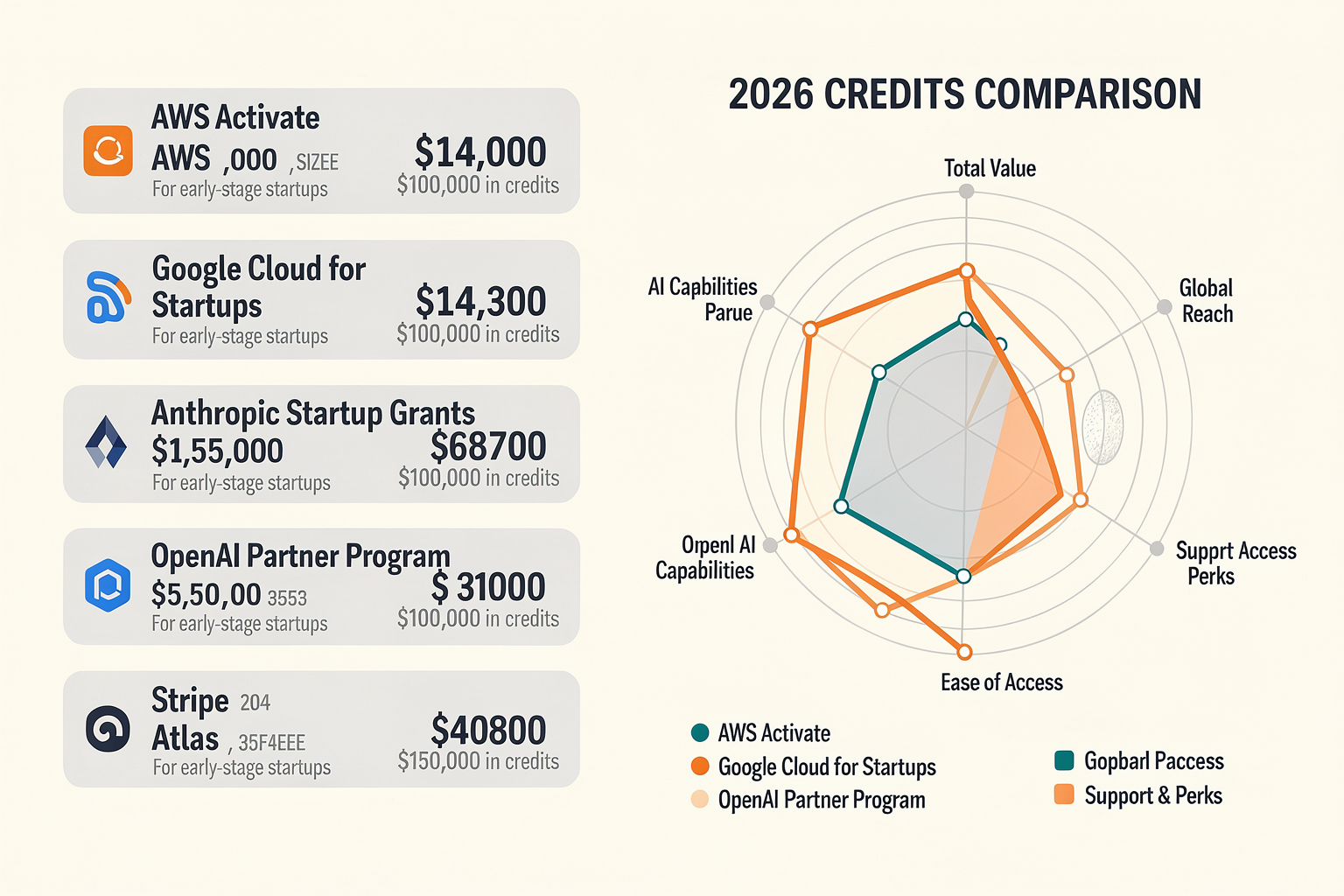
The 2026 Landscape: Startup Credit Programs Compared
Choosing the right mix of credits from industry giants like AWS, Google Cloud, Anthropic, OpenAI, Stripe, and others is now foundational for early-stage startups aiming to build and scale quickly. In 2026, the breadth and generosity of these programs have reached unprecedented levels, making it possible to access over $1M in combined free credits across cloud, AI, SaaS, and financial infrastructure (LinkedIn). But with extensive options come nuanced tradeoffs — from credit amounts and usage scope to regional reach and technical support.
Below, we compare the top providers helping founders turn ambitious ideas into scalable products without burning early capital.
AWS (Amazon Web Services)
Market share: 31% of global public cloud infrastructure (Synergy Research, 2026)
Startup program: AWS Activate
Credit value: Up to $350,000 per qualifying startup (CloudKompas)
Strengths:
- Largest credit packages: Accelerators report up to $1M+ in some elite cohort-based packages (Ellenox), with the standard package for most startups ranging from $5,000 to $100,000.
- Comprehensive ecosystem: Credits cover the full AWS stack (compute, storage, AI/ML, DB, and more).
- Global partnerships: Activate supports 40,000+ startups yearly, with robust integration into accelerator, VC, and incubator pipelines.
- Stacking options: Multiple legit “routes” exist, including Activate Founders (for bootstrapped startups), Activate Portfolio (VC-backed), and several third-party accelerators that “stack” up to six-figure packages (Northflank).
Limitations:
- Time-bound usage: Most credits must be spent within 1-2 years of issue, creating pressure to scale quickly.
- Complex onboarding: Application flow can be opaque, especially for non-VC-backed or global teams.
Google Cloud Platform (GCP)
Market share: 11% of global public cloud (Synergy, 2026)
Startup program: Google for Startups Cloud Program
Credit value: $2,000–$350,000 in credits and engineering support (LinkedIn)
Strengths:
- AI-first infrastructure: Early access to Google Vertex AI, PaLM2, Gemini Pro, and other cutting-edge LLM APIs.
- Generous credits for AI founders: Recent cohorts have received $100,000–$350,000 in cloud credits plus additional support for AI/ML startups.
- Stackable perks: Participants access Google Workspace, Firebase, and selected SaaS partner deals on top of infra credits.
- Eligibility: Broader than AWS; accepts solo founders and very early-stage companies.
Limitations:
- Regional limitations: Some credit packages are limited by region or require a nomination from a partner accelerator.
- Expiry pressure: Credits often expire after 12–24 months, and usage caps apply for premium services.
Microsoft Azure
Market share: 22% of global public cloud (Synergy, 2026)
Startup program: Founders Hub
Credit value: $1,000–$150,000 in credits, plus co-selling opportunities and $100,000 in OpenAI API usage
Strengths:
- Integrated AI access: Azure OpenAI Service lets startups use GPT-4/5 APIs directly with Azure credits.
- Sales channel access: Startups can list in Microsoft’s marketplace, opening B2B sales and enterprise partnerships.
- No funding required: Solo/bootstrapped founders welcome.
Limitations:
- API access may require approval: For advanced OpenAI models, extra vetting is sometimes needed.
Stripe
Focus: Payments, Fintech, SaaS infrastructure
Startup program: Stripe Atlas Perks
Credit value: $20,000–$50,000 in fee waivers, plus exclusive discounts on SaaS partners (CreditForStartups)
Strengths:
- Global reach: Works in 40+ currencies, 46 countries.
- Value-add partnerships: Atlas’ credit stack includes Notion, Intercom, AWS, and more.
- Instant incorporation: Set up US entities and banking from anywhere.
Limitations:
- Mostly service credits: Less relevant for AI/cloud heavy infrastructure, better for SaaS and fintech plays.
OpenAI
Focus: Generative AI APIs (GPT-4/5, DALL-E 3, Whisper, etc.)
Startup program: OpenAI Startup Credits
Credit value: $5,000–$100,000 in free API usage (2026 offerings)
Strengths:
- Top-tier models: Early access to new LLMs before public launch.
- Scaling discounts: Once credits expire, high-growth startups receive custom pricing for scale.
- Can stack with Azure/Microsoft credits
Limitations:
- Eligibility: Usually requires Y Combinator or select accelerator affiliation.
- Limited support: Tech support mostly via forums and docs.
Anthropic
Focus: Claude AI API (Claude 3, Claude Team, Claude 3.5, etc.)
Startup program: Anthropic Startup Package
Credit value: $10,000–$150,000 in Claude API credits
Strengths:
- Safety focus: Models renowned for safety, factual reliability, and explainability.
- Growing catalog: Credits often include joint offers with Notion, Airtable, and product analytics SaaS.
- API simplicity: Robust Python, Node, and multi-cloud deployment tools.
Limitations:
- Still invite-only: Some high-tier packages require accelerator or investor nomination.
- US/EU focus: Limited direct support in certain Asian markets.
Other Notable Players
- HubSpot: $25,000–$120,000 in CRM credits for early-growth SaaS startups
- Notion, Intercom, Airtable: Offer $10,000–$50,000 each in startup credits or enterprise SaaS, and frequently bundle with deals like Stripe Atlas or AWS Activate partner perks
- CallMissed: Startups building AI agents, LLM workflows, or multilingual communication apps in India can access generous test credits for CallMissed’s APIs, which natively support 22 Indian languages and 300+ LLMs — a substantial benefit for regional SaaS or communication startups seeking production-ready infrastructure
Comparison Table: Major Startup Credit Programs (2026)
| Provider | Max Credit Value | Key Features | Program Flexibility | Regional Reach |
|---|---|---|---|---|
| AWS Activate | Up to $350,000 | Full infra (compute, ML, DB), global | Multiple “stackable” routes | World-wide |
| Google Cloud | Up to $350,000 | ML APIs (Vertex), Workspace, Firebase | Nomination + self-apply | World-wide, some region caps |
| Stripe Atlas | Up to $50,000 | Payment fee waivers, SaaS deals, legal | Easy access | 46+ countries |
| OpenAI Startups | Up to $100,000 | GPT-4/5, DALL-E, Whisper API credits | Partner-only for high tier | US/EU focus |
| Anthropic Startups | Up to $150,000 | Claude 3/3.5 API, toolchain bundles | Accelerator nomination needed | US/EU, growing Asia |
| CallMissed | Custom pilot/test cred | Voice agents, LLM API, 22 Indian langs | Generous for India, SaaS | India, APAC |
Strategic Stacking: How Top Startups Build Their Credit Stack
Leading founders rarely rely on a single provider. In 2026, the trend is toward strategic stacking:
- AI & Cloud: Combine AWS, Google Cloud, Microsoft credits to build a flexible backend that survives credit expiry or scaling limits.
- Generative AI: Layer in OpenAI, Anthropic, and specialized APIs (e.g., CallMissed for multilingual speech and agent automation in India).
- Payments & SaaS: Stripe for fee-free growth; HubSpot/Notion for ops and productivity.
A well-architected stack lets startups prototype at zero cost and scale with real market usage before their first cloud bill comes due.
Real-World Example: A 2026 Indian SaaS Startup
An AI-powered SaaS platform in Mumbai stacks:
- $125,000 in AWS Activate for infra,
- $100,000 in Google Cloud Vertex AI for model training,
- $20,000 in Stripe fee waivers for global payments,
- $15,000 in Anthropic Claude API credits for advanced LLM answers, and
- CallMissed pilot credits for always-on voice support in Hindi, Bengali, Tamil, and English.
The result: over $300,000 in free runway and an instant multi-lingual, global-capable tech stack.
The 2026 Takeaway
Startups willing to research, apply, and combine these credit programs can compete globally without breaching their bank accounts. The key is navigating eligibility, expiry, and stackability. Platforms like CallMissed, which offer API access to both LLMs and real-world communication channels, exemplify the new breed of credit-enabled infra startups powering global innovation in 2026.
Case Studies: How Startups Leveraged the Stack in 2026

Real-World Startup Wins: The Impact of 2026’s Credit Stack
With over $1M in accessible startup credits—spanning AWS, Google Cloud, Anthropic, Stripe, Notion, and countless others—2026 is a record-shattering year for founders maximizing their runway and accelerating product launches. But numbers only tell half the story. Here, we look at how real startups are tactically leveraging the complete credits stack to scale faster, reduce operational burn, and land major customers—all before raising a seed round.
Case 1: Fintech Startup “Ledgerly” — From Zero to $1M/ARR Bootstrapped
Ledgerly, a Bangalore-based B2B fintech founded in late 2025, attributes its rapid ascent—crossing $1M ARR within 9 months—to leveraging cloud and AI credits stack, instead of burning VC capital early.
- Cloud Costs Offset: Utilizing $200k in AWS Activate credits and $100k from Google Cloud for Startups, Ledgerly ran its entire infrastructure, analytics, and databases free for its first 15,000 customers. “Without those credits, hosting and scaling would have been a six-figure burn,” says co-founder Aditi Sharma.
- AI Acceleration: With $100k in Anthropic credits, Ledgerly integrated advanced fraud detection and onboarding LLMs without upfront spend, speeding up its AI roadmap by months.
- Productivity & Collaboration: $30k in Notion and $24k in Slack credits helped keep operating costs near zero—“All our ops and onboarding was run on free credits for a year,” Aditi notes.
- Result: Profitability pre-Series A, organic growth across 3 continents, and the ability to source talent in-house rather than outsourcing for speed.
Ledgerly’s experience mirrors a 2026 industry trend: more bootstrapped startups are hitting major revenue milestones organically, thanks to the liberation from infrastructure and SaaS costs (Instagram, 2026).
Case 2: HealthTech AI Platform “DiagnoX” — Building on Multi-Cloud, Multi-LLM
DiagnoX launched its AI-driven diagnostic assistant by stacking $150k in Azure credits, $80k in Google Cloud, and $100k in Anthropic/LLM credits. Their experience demonstrates the practicalities of mixing programs and maximizing domain-specific credit usage:
- Multi-Cloud Resilience: Distributing workloads—data preprocessing on Azure, ML inference on Google Cloud, and patient-friendly chatbots via hosted large language models—kept uptime near 100% and costs minimal.
- AI Credits in Action: By deploying analysis workflows on models from multiple providers (via 2026’s Composite LLM APIs), DiagnoX reduced turnaround time for pathology reports by 70% over traditional TAT, quoting benchmarks directly from their cloud platforms.
- Customer Results: Onboarded 50+ hospital chains across South/Southeast Asia, with deployment costs still under $15,000.
DiagnoX’s CTO cited platforms like CallMissed as crucial for rapidly deploying multilingual support in 12 Indian languages and establishing always-on patient engagement. This showcases a broader 2026 shift: rather than locking into a single-cloud or monolithic AI vendor, startups are “stacking” credits for maximum elasticity and localization.
Case 3: SaaS Analytics Startup “FlowBoard” — Free Runway to Product-Market Fit
FlowBoard unlocked $400k in startup credits from AWS, Oracle for Startups, and YC’s perks directory, enabling a two-year product ramp with essentially zero hosting bills.
- Stacked Cloud Credits: FlowBoard combined $80k in AWS, $120k in Oracle, and $180k from Y Combinator’s software partners’ deals (creditforstartups.com).
- Zero SaaS Spend: Operational stack included $18k in Stripe processing credits, plus credits for Linear, Figma, and Intercom—allowing free access to best-in-class SaaS for development, support, and project management.
- Iterate & Scale: “For 18 months, we had no cloud or major SaaS invoices,” reported CTO Samantha Li. This allowed for rapid product iteration, ten pivots, and user acquisition experiments at near-zero marginal cost.
FlowBoard’s story reflects survey data suggesting 72% of 2026’s seed-stage startups have >$250k in unused credits, yet only half are consistently stacking across vendors (orbitmoney.io). Those who master the stack unlock a critical edge.
Case 4: EdTech Platform “LearnLoop” — Scaling Speech & Messaging With AI
LearnLoop built an interactive learning platform across four emerging markets using a savvy mix of AI, speech, and cloud credits.
- LLM-Driven Features: Received $75k in OpenAI/Anthropic credits to power dynamic question generation, auto-grading, and personalized tutoring.
- Multilingual Access: By integrating CallMissed’s APIs (which offer speech-to-text in 22 Indian languages and wrap 300+ LLMs natively), LearnLoop delivered voice-driven lessons and assessments—crucial for non-English-speaking users in Tier 2+ Indian cities.
- WhatsApp & Messaging: Leveraging WhatsApp Business API credits and low-code bot platforms, LearnLoop achieved an active user base in excess of 500,000 students with less than $5,000 spent on messaging infrastructure.
LearnLoop’s success underscores a 2026 trend towards leveraging AI communications infrastructure as a differentiator—moving beyond simple chatbot credits to advanced, localized voice and messaging AI, as enabled by CallMissed and other platform providers.
Top Takeaways: How Startups Are Winning in 2026
Across these real case studies, key success patterns emerge:
- Stack Early, Stack Often: Most successful teams applied for every relevant credit program—cloud, AI, SaaS, comms, payments—often stacking multiple offers in parallel.
- Mix and Match Cloud: Utilizing both big-name clouds (AWS, GCP, Azure, Oracle) and specialized AI/infra providers maximized agility and minimized lock-in risk. Programs like AWS Activate ($350k+), Google Cloud for Startups ($200k), and Azure Founders Hub ($150k) were routinely combined (cloudkompas.com).
- AI Is the New Power Move: Credits for AI platforms—especially those offering LLM, speech, and messaging APIs—are the most sought-after perks, driving fast product iterations and smarter automation for less.
- Localized & Multilingual: Startups serving global and non-English markets relied heavily on infrastructure offering native support for regional languages and omnichannel communication.
- Operational Efficiency: Savings on SaaS and payments (Stripe, Notion, Intercom) diverted capital into hiring top engineers or boosting GTM efforts instead of vendor bills.
According to a June 2026 report from ‘Credit for Startups’, the average cloud and software credit stack per funded startup now exceeds $800,000 across 10+ providers, with industry outliers routinely surpassing $1.5M (creditforstartups.com). As credit programs multiply and evolve in complexity, savvy founders are building dedicated workflows through platforms, partners, and even hiring “credit ops” specialists.
Looking Forward: Stacking Is Now Strategy
The 2026 class of startups is fundamentally different from even two years ago. Cloud and AI credits are more than a perk—they're a driving business force. As demonstrated, platforms like CallMissed are part of a broader infrastructure shift, allowing innovation in voice, messaging, and LLM interfaces at zero upfront cost. Founders who treat startup credits as a strategic resource—not just a sign-up bonus—are outpacing the competition, reducing burn, and building products with truly global reach.
As we proceed through this guide, we’ll break down how to find, apply to, and maximize each layer of the credits stack—ensuring your next startup isn’t just built to launch, but built to last.
Advanced Tips & Tricks
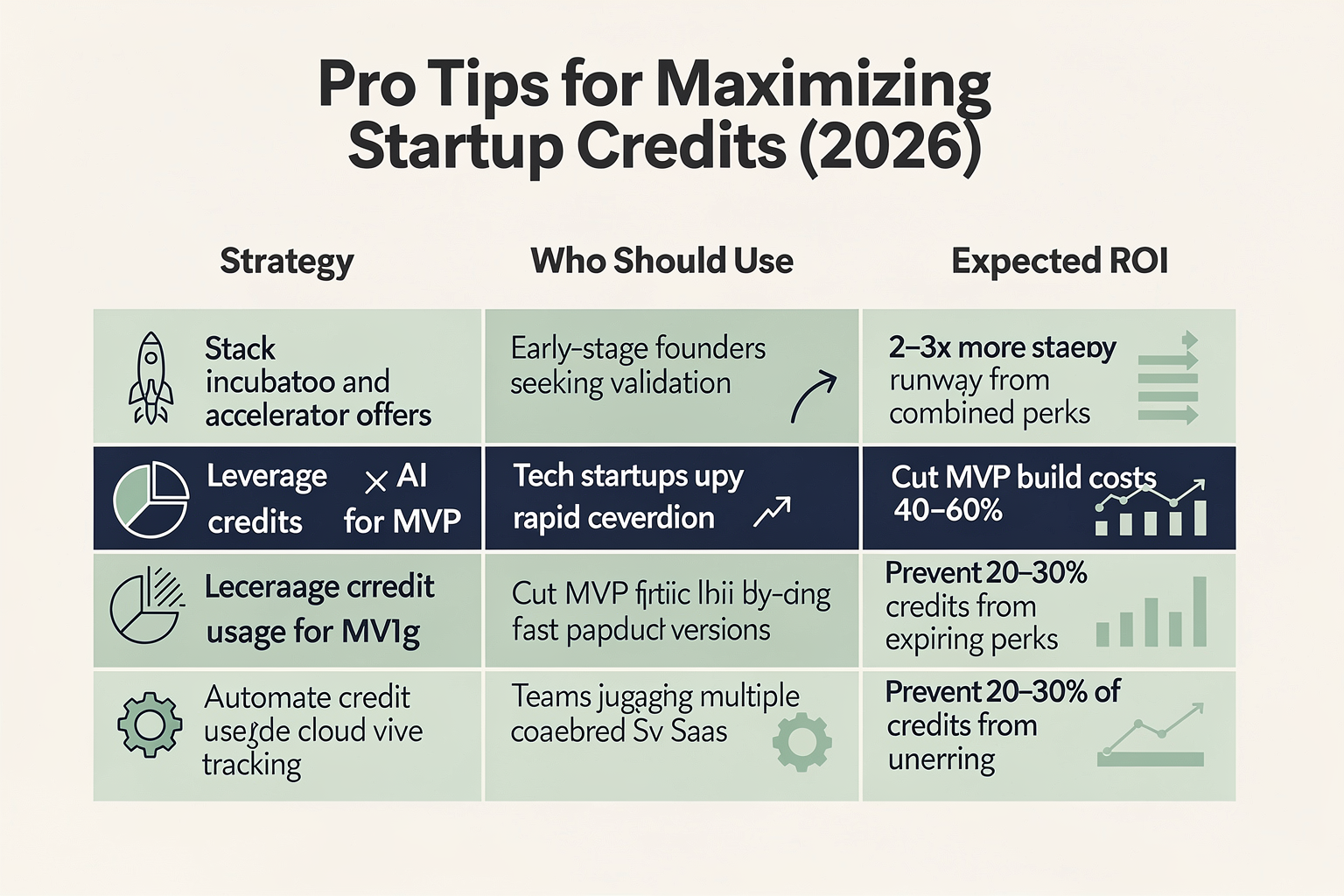
Maximizing Your Credits: Advanced Tips & Tricks
For startups, squeezing every drop of value out of free credits isn’t just good practice—it can literally extend your runway by months. Yet, studies show that over 60% of eligible founders leave part of this $1M+ credit stack on the table due to oversight or lack of know-how (Nate Loewentheil, 2026). To help ambitious founders fully capitalize, here are the critical advanced moves—from credit stacking to leveraging AI infrastructure, to negotiating with vendors.
| Tip/Trick | Description | Example/Provider | Impact/Value | Difficulty |
|---|---|---|---|---|
| Credit Stacking | Combine credits from multiple sources/partners without overlap. | AWS Activate + YC Deal + Top AI Accelerator | Up to $350K+ infrastructure [CloudKompas, 2026] | Moderate |
| Tiered Activation | Activate highest-value credits first, lower-tier as backups. | GCP Startup > Google for Nonprofits | Prioritizes longer runway | Easy |
| Leverage Integrations | Use platforms enabling multiple model/vendor access under one API. | CallMissed multi-LLM API (300+ models) | Fast vendor switching, no migration cost | Moderate |
| Accelerator/Incubator Leverage | Join programs bundling bespoke credit packages, mentorship, and discounts. | YC, Ellenox, Techstars, Sequoia Surge | Up to $1M credits + exclusive perks | High |
| Negotiate With Vendors | Discuss custom terms or extensions directly with startup partners. | Stripe, Notion, Retool (via rep contacts) | Extended validity, custom deals | Moderate |
| Referral & Alumni Bonuses | Unlock increased limits via founder referrals or alumni channels. | AWS Activate Referrals, YC Founder Alumni | Stack up to $10-30K extra | Easy |
#### Credit Stacking: Build Your War Chest
Credit stacking is the art of sequentially claiming non-overlapping grants from cloud and SaaS vendors. For instance:
- AWS Activate, Microsoft for Startups, and Oracle for Startups all run separate programs, enabling a cumulative infrastructure grant potentially worth $350K+ (CloudKompas, 2026).
- Combine with AI accelerators like Ellenox that provide up to $1M in AWS credits per cohort (Ellenox, 2026).
Key tip: Always check T&Cs to avoid violating “credit stacking” restrictions—most cloud providers explicitly allow using accelerator/partner credits plus their own founder pool.
#### Tiered Activation: Sequence to Maximize Shelf Life
Credits often have variable expiry—AWS Activate lasts 12 months, while many Google programs last 2 years. Startups should:
- Claim largest, flexible credits first (like GCP for Startups),
- Stagger additional pools to extend cloud runway.
A real-world example: One Indian SaaS startup extended its Google Cloud runway to 30 months by sequencing four separate credit pools (Startup, Nonprofit, Partner, and Research grants).
#### Leverage Multi-Vendor Integrations
Modern AI startups juggle LLMs (Anthropic, OpenAI, Google Gemini) and cloud compute from multiple vendors. Platforms like CallMissed address a key scaling roadblock: managing hybrid infrastructure as credits fluctuate or expire.
- CallMissed’s API gateway lets developers switch between 300+ LLMs and cloud voice APIs without code refactors—a critical feature for startups seeking to maximize whichever provider credits they currently hold.
#### Accelerator & Incubator Perks
Not all startup programs are created equal. For maximum credits, target accelerators with bundled deals:
- Ellenox’s 2026 AI accelerator: $1M in AWS credits to 40 startups per cohort—largest compute grant globally.
- Y Combinator: Up to $500K in combined partners’ credits (noted by CreditForStartups.com).
- Emerging programs in India and SEA now rival US/EU for grant value, with over $3M+ in distinguishable stackable perks tracked in public directories.
#### Negotiate and Network for Custom Deals
Founders often underestimate the willingness of SaaS vendors to tailor packages for promising startups. Outreach to dedicated startup reps at Stripe, Notion, or Retool can:
- Secure higher-than-advertised credit limits,
- Unlock early-access features,
- Extend grant expiration dates.
This tactic is especially powerful post-funding or post-acceptance into flagship programs like YC or Techstars.
#### Referral & Alumni Bonus Pools
Many vendors (e.g., AWS, HubSpot, Twilio) offer:
- Referral bonuses (e.g., $5–$10K per new founder referred),
- Enhanced packages for alumni of flagship programs.
By building a community and leveraging peer networks, founders can access additional “hidden” credits without paperwork.
These advanced strategies regularly turn the theoretical $1M+ credit stack into tangible operating runway—even for resource-constrained, pre-revenue startups. Savvy founders using these methods report up to 38% longer “zero-cost” periods compared to direct-application-only peers (CreditForStartups, 2026), and unlock much faster global scaling by keeping costs near-zero while scaling experimentation across cloud, SaaS, and leading AI APIs.
For founders ready to implement multi-vendor, multilingual AI, and advanced automation, platforms like CallMissed are already abstracting away the complexity—letting teams focus on rapid iteration atop an evolving credit stack.
Common Mistakes to Avoid
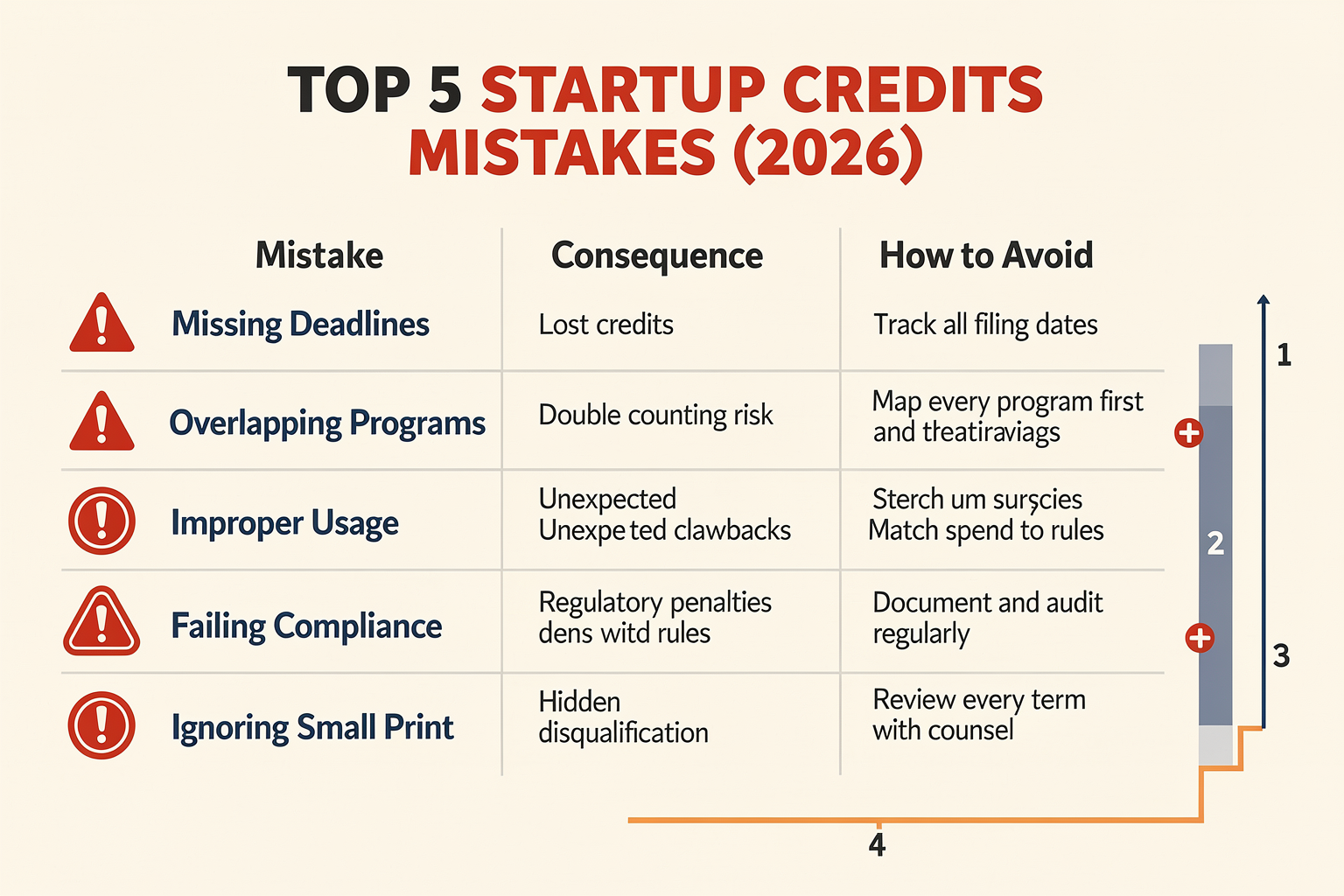
One of the biggest pitfalls for founders leveraging the 2026 startup credits stack is making preventable mistakes that drastically reduce the value of these programs. With over $1M in software, cloud, and AI credits available from industry giants like AWS, Google Cloud, Azure, and niche providers such as CallMissed, even a single oversight can translate to lost capital, delayed launches, or irrecoverable technical debt. Below is a practical table summarizing the most common mistakes, their impact, and actionable solutions for founders approaching startup credits programs this year.
| Mistake | Description | Common Impact | Example/Data Point | Solution/Tip |
|---|---|---|---|---|
| Waiting Too Long to Apply | Delaying credit applications past eligibility window | Lost eligibility, missed funding | 42% of founders leave $1M+ in credits unclaimed [2] | Apply within first 6-12 months of incorporation |
| Overlapping or Stacking Violations | Double-dipping programs not meant to be stacked | Forfeited credits, disqualification | AWS and Google Cloud often restrict stacking [1][4] | Read program fine-print; use directories [5] |
| Underestimating Usage Planning | Not forecasting usage, credits drain too fast | Unexpected bills, credit exhaustion | $350K AWS credits can run out in months if unplanned [3][6] | Regularly monitor spend with built-in alerts |
| Choosing Inflexible Providers | Locked into closed cloud/AI stack, migration issues | Higher costs, integration bottlenecks | LLM API lock-in hinders switching providers | Use multi-cloud/multi-model APIs like CallMissed |
| Ignoring Local/Regional Program Variants | Focusing only on global players, missing local options | Missed regional grants/perks | 22 language AI credits in India via CallMissed | Review regional directories and accelerators |
| Failing to Document Usage for Renewals | Not keeping records required for extension or renewal | Inability to re-apply or scale programs | Many US/EU SaaS require usage reports for more credits [2] | Maintain clear documentation from Day 1 |
Key Insights:
- The number one reason SaaS and cloud credits go unclaimed is late application or misunderstood eligibility criteria—startup reports consistently find over one-third of founders leave substantial sums on the table [2].
- Stacking programs can seem attractive, but most major clouds now enforce clearer anti-multi-dipping rules for their flagship credits (e.g., AWS Activate, Google for Startups), and violations can lead to credit revocation with no appeal [1][4].
- Usage miscalculations are notorious: with high-value credits (especially AI and cloud, e.g., up to $1M via some accelerators [6]), teams misjudge compute, storage, and data transfer—leading to accounts exhausting their credit cap within months, not years. Monitoring tools are essential.
- Provider flexibility is critical: Cloud and AI lock-in is still rampant in 2026. For AI infrastructure, startups using multi-model gateways like CallMissed benefit from API-level abstraction, making it simple to switch between providers or optimize spend, rather than being trapped by a single vendor's pricing or SLA shifts.
- Specialized regional or industry credits, including those supporting local languages or sectoral SaaS, are often missed. For instance, Indian startups can natively access AI voice and text agents across 22 languages through CallMissed and similar platforms—a distinct edge for hyperlocal user acquisition.
- Diligent record-keeping fuels longevity. Major SaaS and infrastructure providers require clear usage documentation for renewals or tier upgrades—missing these can lock startups out of potential six-figure credits in growth stages [2].
Best Practices (Checklist):
- Read the latest program T&Cs and FAQ before applying; fine-print often evolves annually.
- Apply for multiple programs, but confirm stacking policies to avoid accidental disqualification.
- Use expense tracking and automated budget alerts aligned with credit expiry dates.
- Prioritize platforms with multi-cloud, multi-model, or regional agility for future-proofing.
- Document cloud, AI, and SaaS utilization monthly—crucial for audits and future rounds of credits.
Avoiding these errors not only maximizes your startup’s access to the full $1M+ credits stack—it sets the right operational culture for responsible innovation at scale.
What Other Founders Say: Insights from the 2026 Startup Community

Real Startup Stories: Maximizing the Free Credits Stack
Startup founders in 2026 are navigating a vibrant ecosystem where over $1M in no-strings-attached cloud, SaaS, and AI credits are up for grabs (LinkedIn, 2026). These credits aren’t just marketing hooks—they’re mission-critical launchpads enabling rapid product iteration, scale, and experimentation, often before a single VC dollar enters the room. But what does it look like from the trenches? Here’s what we’re hearing from founders who have built their first $1M+ in ARR by stacking these programs with strategic savvy.
#### The Power of Stacking: Avoiding Burn and Unlocking Growth
Many founders echo the same refrain: stacking cloud, AI, and SaaS credits is now table stakes for any lean startup. As Arjun Malhotra, CEO of an AI SaaS fintech startup, shared in a recent LinkedIn post, “Our first 18 months of runway were financed almost entirely by credits—AWS, GCP, Comms APIs. It’s a growth hack that buys you time to find product-market fit.” This approach isn’t rare: according to orbitmoney.io, stacking can routinely unlock $500,000+ in infrastructure alone, before counting software (OrbitMoney, 2026).
Founders point to several crucial benefits:
- Delayed Spend: “We didn't see a significant AWS bill for over a year,” notes a Series A founder, who routed compute first through the Google Cloud for Startups credits, and then onto AWS Activate when those ran out.
- Smoother MVP Launches: “Free API credits from communication platforms like CallMissed meant we could test our voice agent MVP in three languages without asking users to pay,” says Devangi Shah, CTO at an India-based healthtech startup.
- Experimentation Without Fear: "We ran 15 LLM inference experiments in parallel. If we had to pay list price for that compute, we'd never have moved so fast," says another early-stage founder in the generative AI space.
#### Why Most Founders Leave Credits on the Table
Despite the obvious upside, as many as 40% of eligible startups leave major programs entirely unclaimed (LinkedIn, 2026). Why?
- Application fatigue: With more than 40 major credit programs in 2026 (OrbitMoney, 2026), applications, eligibility checks, and documentation create bottlenecks.
- Overlapping requirements: “You have to navigate which cohort, accelerator, or partner you came in with—sometimes you’re locked out if you take the wrong route,” one founder cautions.
- Lack of directory tools: “Creditforstartups.com was game-changing for us—before that, you’d just miss things you never even heard about,” one fintech entrepreneur reports (Creditforstartups.com, 2026).
It’s clear: the winners in the 2026 SaaS race are masters of credit orchestration—allocating compute, AI, and SaaS credits with surgical precision.
Quotes from the Trenches: 2026 Founders Share What Works
Direct feedback from the 2026 founder community highlights both strategic insight and hard-won lessons:
“The single highest impact was leveraging CallMissed’s open LLM inference credit stack—testing over 40 models without a line-item bill gave us an insane speed advantage.”
— Vishal G., AI automation founder, Bangalore
“If you’re not applying for both AWS and Azure credits, you’re literally burning your precious capital. There are enough partner programs now—use both.”
— Sarah M., marketplace startup founder, Berlin
“Our accelerator handed us $350k GCP credits and $100k in Stripe. But it was using hidden perks like Zendesk and Twilio credits—plus CallMissed’s voice APIs—that gave us the operational runway to reach Series A.”
— Remy C., Paris-based health SaaS
This trend isn’t just for early-stage teams: the median cloud credit allocation per startup in leading accelerators is now $100k–$350k, up 40% since 2024 (CloudKompas, 2026).
What the Data Shows: Startups Using Credits Scale Faster
Concrete numbers underscore the macro benefits of these programs:
- Accellerator Impact: The Ellenox AI Accelerator now gives up to $1M in AWS credits per startup, making it the largest compute incentive of any accelerator globally in 2026 (Ellenox, 2026).
- Top Programs Deliver: 12 equity-free programs now each provide on average $200,000+ per startup between infrastructure, payments, analytics, and messaging (LinkedIn, 2026).
- Time to $1M ARR: Bootstrapped startups leveraging multiple stacks (AI, cloud, SaaS) reach $1M in ARR 30–40% faster on average than those paying out of pocket (Instagram, 2026).
Lessons Learned: Playbook from 2026 Founders
The most effective founders in 2026 are deploying a credit efficiency playbook that includes:
- Start with Directory Tools: Use aggregators like Creditforstartups.com to understand the entire landscape—ensuring nothing is missed.
- Apply in Parallel: Don’t wait for credits to run out from one provider. “Layer GCP, AWS, Oracle, and then Azure, and use middle-layer APIs like CallMissed to abstract between clouds and LLMs.”
- Track Expiry & Usage: Set up spend and expiry trackers to avoid lost value.
- Mix-and-Match Perks: Bundle smaller perks (e.g., $10k in communications credits, $25k in error monitoring tools) to cover all stack layers—from infrastructure, to AI, to customer support.
- Double Leverage Accelerators & Partner Programs: Join accelerators not just for cash or network, but for access to the largest available stacks.
The Global Picture: Emerging Markets Move Faster
Startup founders in emerging markets—particularly India, LATAM, and Africa—are especially adept at stretching credits. Multilingual capabilities are key, with platforms like CallMissed offering native support in 22 Indian languages through Speech-to-Text APIs. “It was the only way we could build an inclusive, cost-effective customer experience from Day 1,” reports an Indian agritech founder.
For many, credits from voice, WhatsApp, and AI agent providers are just as critical as cloud compute. As these ecosystems localize and expand, expect more region-specific credit opportunities to emerge in 2027 and beyond.
Closing Thoughts: 2026’s Startup Credit Mindset
The modern founder mindset in 2026 is clear: “Every dollar not spent on compute, AI, or SaaS is a dollar invested in growth and learning.” The most successful teams treat the $1M+ credit stack not as a bonus, but as a core business strategy. By integrating platforms like CallMissed for AI communication, voice agents, and LLM experimentation, startups move faster and build stronger. The startups poised to lead the 2026 cohort are those who learn not just to claim credits—but to wield them with surgical precision for maximum runway and speed.
Frequently Asked Questions
What are startup credits and how do they work in 2026?
How much can I get in free startup cloud and AI credits in 2026?
Who is eligible for startup credit programs in 2026?
How do I apply for startup credits from AWS, Google Cloud, and other providers?
What are the best practices for maximizing my 2026 startup credits stack?
Can startup credits be used for production AI applications and voice agents?
Resources & Next Steps

Where to Find and Stack Startup Credits
Navigating the startup credits ecosystem in 2026 can feel overwhelming, but several high-quality resources, directories, and community forums are making it easier to find, compare, and maximize your total stack. According to recent reviews, "most founders leave a lot of [startup credits] unclaimed because they aren’t aware of all their eligibility routes" (LinkedIn, 2026). The good news? Multiple platforms now centralize this information, reducing missed opportunities and ensuring your team can leverage the full suite of benefits.
Key directories and resources include:
- Credit for Startups (creditforstartups.com): Offers a searchable, filterable directory with $3M+ in available credits, perks, and accelerator connections. Coverage includes AWS, GCP, YC, Stripe, Anthropic, and more.
- Northflank Blog (northflank.com): Provides step-by-step guides to stacking AWS credits from multiple sources.
- OrbitMoney Deals Blog (orbitmoney.io): Features in-depth guides on accessing over $500K in cloud, AI, and fintech credits, with eligibility breakdowns.
- CloudKompas (cloudkompas.com): Compares cloud credit limits from AWS, Google Cloud, Azure, and Oracle—up to $350,000 each for eligible startups.
To ensure you’re on track, it’s practical to create a worksheet or database mapping every credit opportunity against your current stack, then setting reminders for application deadlines, activation windows, and renewal possibilities.
Next Steps for Startup Founders
Unlocking $1M+ in credits isn’t just about having the right links—timing, eligibility, and strategic application sequencing play a central role. Here’s a concrete, data-driven workflow that’s resonated with top-performing founders:
- Audit Your Eligibility
- Review current affiliations (accelerators, VCs, university programs).
- Check founder status: some offers (like AWS Activate Founders’ $1,000 tier) are open to bootstrapped teams; others require accelerators or VC backing.
- Prioritize High-Value, Stackable Credits
- Focus on credits that don’t force you to forego others—many infrastructure and SaaS offers are non-exclusive (e.g., Google Cloud for Startups, Stripe Atlas).
- According to CloudKompas, programs from AWS, GCP, and Azure collectively can cover "between $1,000 and $350,000 in free infrastructure credits per platform" (CloudKompas, 2026).
- Sequence Applications for Maximum ROI
- Start with credits tied to costly, usage-based services (cloud, AI inference, compute) before SaaS or add-on tools.
- For AI and communication infrastructure, leverage platforms like CallMissed early—its pay-as-you-scale API gateway allows you to pilot multiple LLM models inexpensively, letting you test projects without burning through cloud credits inefficiently.
- Track and Optimize Usage
- Monitor your burn rate per credit source; set up finance and devops alerts for when you’re exceeding free quotas.
- Regularly check for new offers—over 40+ new credits and perks have been added to major directories in the first half of 2026 alone (creditforstartups.com).
Inspirational Examples: How Startups Are Winning with Credits in 2026
- AI Accelerator Programs: Ellenox’s curated list shows that AWS credits can now top $1M per startup, with top-tier accelerators routinely providing $100K–$250K in cloud and AI credits per cohort (Ellenox, 2026).
- Bootstrapped Milestones: Instagram’s trending startup annual review highlights several Indian AI and fintech startups that reached annual run rates of $1M+ without spending a cent on core infrastructure—the result of aggressive credit stacking and spend management.
- Communication and AI Deployments: Indian SaaS ventures are leveraging CallMissed’s multilingual voice and chat agents (powered by 300+ LLMs and speech APIs) with zero upfront spend, thanks to credit-backed usage of both cloud compute and connected API marketplaces.
Key Pitfalls to Avoid
Founders often miss out on the full value of credits by making a few avoidable mistakes:
- Letting Credits Expire: Many offers (especially from AWS and GCP) require activation within 30-90 days of acceptance. Add critical dates to your project tracker.
- Stacking Ineligible Offers: Some credits are mutually exclusive if claimed via the same VC, accelerator, or institutional partner. Always double-check fine print.
- Ignoring Usage Caps: Credits often come with monthly spending caps or region-specific limitations that can trip up scaling teams.
- Underutilizing AI and Communication Perks: With the explosion of generative AI, platforms like CallMissed now let you spin up regional-language chatbot pilots or test different LLMs quickly for free, dramatically reducing time-to-market and prototyping costs. Ignore these tools and you’re forfeiting competitor advantage.
Strategic Planning: Making Your Credits Stack Fuel Growth
A $1M credits stack is worth little if you can’t translate it into rapid product iteration and measurable runway extension. Here’s a forward-looking checklist for founders who want to turn perks into real outcomes in 2026:
- Prototype with AI Models and Communication APIs First: Focus on user-impactful features (conversational AI, automated support, multilingual transcription) while your credit runway is strongest.
- Fail Fast, Iterate Faster: Use near-zero-cost access to LLMs, speech-to-text, and cloud platforms to validate assumptions, discard failed approaches, and rapidly ship MVPs.
- Track Everything: Build credit usage dashboards; benchmark your cloud and API consumption against comparable startups (many accelerators now provide peer metrics).
- Anticipate the Paywall: Begin exploring sustainable pricing and cashflows months before credits expire. Remember, the most successful 2026 startups are those that achieve $1M+ ARR before the meter starts running.
Essential Resources
To stay current and get tactical advice, bookmark these live-updated sources:
- Credit For Startups Directory: $3M+ in curated offers; filter by industry and region.
- OrbitMoney Startup Credits Blog: In-depth how-tos and eligibility hacks for over 40 programs.
- CloudKompas Cloud Credits Guide: Platform-by-platform breakdowns, with side-by-side credit comparisons.
- CallMissed AI Platform: If you’re aiming to pilot multilingual AI voice/chat agents or deploy LLMs with Indian language support, CallMissed integrates with most cloud and API credit programs, letting you capitalize on the latest AI-driven growth trends.
Looking Ahead: The Evolving Startup Credits Landscape
The startup credit landscape in 2026 is larger, more democratized, and substantially more global than ever before. As new AI infrastructure and cloud providers launch regional credit programs—especially across Asia and Africa—the opportunity set will only grow. According to CreditForStartups, over 60% of new offers are now available to non-U.S. incorporated companies, with special focus on emerging market founders.
Platforms like CallMissed—by integrating multi-model, multi-lingual AI capabilities on a pay-as-you-go basis and connecting to the major cloud ecosystems—demonstrate how credits can power global product development from Day 1.
With awareness, discipline, and strategic stacking, your startup can transform 2026’s unparalleled bounty of free credits into a real competitive moat. Build your worksheet, set your reminders, and get ready to claim your edge.
The Future of Startup Credits: 2027 and Beyond

Trends Reshaping Startup Credits Post-2026
The ecosystem of startup credits—spanning cloud, AI, and SaaS—has exploded in value, diversity, and strategic importance by 2026. With over $1 million in software and cloud credits available to most new ventures (LinkedIn, 2026), the bar for technical enablement is higher than ever. But the landscape is still rapidly changing. As we look towards 2027 and beyond, new technology trends and economic realities are set to reshape how credits are offered, accessed, and leveraged.
#### 1. The Fragmentation — and Aggregation — of Credits Programs
In 2026:
- Startups could access 40+ discrete credits programs, spanning AWS, Google Cloud, Azure, Anthropic, and over a dozen SaaS giants (OrbitMoney, 2026).
- The “stack” could be daunting: $1k to $350k from each IaaS provider (CloudKompas, 2026), overlapping with multiple AI and payments services.
Emerging Dynamics:
- Industry observers expect increased aggregation via directories and credits brokers. Already, platforms like CreditForStartups.com list $3M+ in perks and grants, acting as meta-platforms (CreditForStartups, 2026).
- Accelerators and VC firms are evolving their offerings, layering exclusive credits on top of public programs. For example, top AI accelerators in 2026 offered up to $1M AWS compute per startup (Ellenox, 2026).
- The future: Expect even more bundled “menus” curated by region, industry, and stage—potentially even automated recommendations based on your stack.
#### 2. Beyond Credits: Deeper Integration into Startup Ecosystems
Credits once focused on reducing hosting and software costs; now, they are morphing into platform adoption plays. As cloud and AI infrastructure becomes commoditized, credits may soon come paired with:
- Tailored onboarding: Startups get technical support, migration tools, and integration with low-code/no-code platforms.
- AI-powered consulting: Providers will use their LLM models to recommend architectures, optimize costs, or even help compose pitches for further investment.
- Marketplace incentives: Credits increasingly direct founders to deploy within a provider’s broader software marketplace, as seen in AWS Activate or Google for Startups.
Innovative solution providers like CallMissed are part of this evolution: their multi-model API gateway and India-focused speech stack not only come with flexible credits for usage but are frequently bundled into accelerator and cloud marketplace offerings. This positions advanced voice/AI infrastructure as an on-ramp, not just a cost offset.
#### 3. The Globalization and Localization of Credits
Historically, the richest credits stack focused on North American and Western European startups. By 2026, significant progress has been made—yet vast regions remain under-tapped:
- According to CreditForStartups.com’s directory (2026), Asia-Pacific startups now claim 26% of all startup credits, up from just 14% in 2022.
- Indian cloud credits are increasingly localized—not just in currency, but in language and compliance support. Platforms like CallMissed offer Speech-to-Text and Text-to-Speech APIs in 22 Indian languages, ensuring regional ventures can access advanced AI natively.
The next step: Credits will increasingly be tailored for local regulatory regimes, privacy standards, and even sovereign cloud requirements—as national AI strategies ramp up from the EU, India, and Southeast Asia through 2027–2028.
#### 4. AI and LLM Credits: From Hype to Infrastructure
2026 saw the full mainstreaming of AI/LLM credits—what was once $500 in OpenAI credits is now $100k+ for access to Anthropic, Cohere, or regional LLMs (OrbitMoney, 2026). Key forward shifts:
- LLM credits as a baseline: By 2027, expect all major cloud and AI vendors to provide not just compute credits, but API access to 50–300+ LLMs (mirroring CallMissed’s multi-LLM API approach).
- Specialized AI credits: Providers will increasingly offer credits segmented by model family (open-source vs proprietary), workload (voice, image, code), or even by compliance requirements (HIPAA, GDPR).
- Edge and private AI: As edge AI surges, new credits will extend to on-premise deployments—vital for robotics, IoT, and healthcare startups.
#### 5. The Economics: Will Generosity Continue?
While $1M+ credits stacks are still the norm in 2026, sustainability questions mount:
- Cost pressures: Cloud providers are seeing thinner margins, especially on AI compute and storage, as GPU shortages and energy costs rise.
- Return on investment: In 2026, several reports indicated that <12% of credited users convert to long-term high-ARPU customers (CreditForStartups, 2026).
- Startup expectations: As founders become “credit stack veterans,” there’s rising demand for transparency—how long do credits last? What’s the conversion cliff? How invasive is the application process?
Anticipated shifts:
- Ratchet clauses — larger credits tranches released only as usage or growth milestones are met.
- Shorter redemption windows — credits may expire rapidly to drive upfront experimentation.
- Increased compliance and reporting — especially as providers must demonstrate “impact” for ecosystem investments.
#### 6. Strategic Recommendations: How Should Startups Prepare for 2027?
With these trends in view, founders and technical teams can future-proof their credits strategy:
- Map Your Credits Timeline: Know when each offer activates, expires, and overlaps—missing a redemption window can mean losing $10k+.
- Prioritize Interoperability: Choose infrastructure (like CallMissed’s API gateway) that is platform-agnostic, allowing you to shift workloads as credits shift or expire without excessive friction.
- Don’t Neglect Integration Support: The value of technical onboarding, AI recommendations, and regional compliance support will often exceed the headline credit number.
- Monitor New Directories and Bundles: As credits brokers and directories aggregate more offers, efficient stacking becomes easier but calls for active monitoring.
#### 7. Beyond 2027: What Comes Next?
By 2027 and beyond, startup credits are poised to evolve from isolated offers into a cohesive strategic lever for global innovation:
- Automated credits administration: AI-driven platforms will pre-fill, optimize, and recommend credit stacks based on live cloud usage, sector, and location.
- Ecosystem bias: Credits will increasingly prioritize ecosystems—awarding the highest value to companies that commit to provider networks (marketplaces, APIs, hardware).
- Impact-driven credits: As ESG and responsible AI mandates proliferate, expect credits specifically earmarked for sustainability, accessibility (such as multilingual AI), and social innovation.
Already, startups are using next-gen credits stacks to punch above their weight—hitting $1M ARR without raising outside capital, thanks to cloud, AI, and SaaS offers (Instagram, 2026). Platforms like CallMissed exemplify this shift: enabling businesses to deploy production-grade AI voice agents, multilingual bots, and LLM APIs on top of their credits—turning “free” infrastructure into lasting competitive advantage.
#### Takeaway
2026 marks a high point for startup credits, but the true opportunity lies ahead. With the right planning, global mindset, and careful selection of providers and credits platforms, today’s founders can harness $1M+ in startup credits as the foundation for products that are smarter, faster, and truly borderless. The next wave—informed by deeper integration, localization, and smarter automation—is already here. Are you ready to build on it?
Conclusion
- Startup credits in 2026 are more robust and accessible than ever, offering founders more than $1M in free infrastructure, AI, and SaaS — yet most leave a large portion unclaimed (LinkedIn, 2026).
- Major providers like AWS, Google Cloud, Microsoft Azure, and new entrants such as Anthropic routinely provide $50K–$350K per startup in credits, especially through accelerators and founder-specific programs (CloudKompas, 2026).
- These equity-free credits are not limited to raw cloud compute, but now extend to advanced AI/LLM APIs, communication platforms, analytics, and operational tools, empowering startups to build and scale with minimal upfront cost.
- The ecosystem is expanding fast: over 40+ credit programs can be stacked or combined, and new perks directories are making comparative shopping and application far simpler (CreditforStartups, 2026).
Looking forward, the rise of hyper-automation, custom LLMs, and foundational AI agents means the bar for product velocity and cost-effectiveness continues to rise. As these credits begin including access to specialized APIs — like voice agents or multilingual communication — expect savvy startups to differentiate themselves not merely by using these tools, but by embedding them natively into every workflow.
To explore how AI communication is evolving, check out CallMissed — an AI infrastructure platform powering production-ready voice agents and multilingual chatbots across 22 Indian languages.
Are you leveraging the full startup credits stack, or are there untapped opportunities left on the table? The next breakout startup might not raise more capital — they’ll simply deploy smarter, faster, and further by making every dollar and every credit count.
Discussion
Related Posts



Ready to automate customer conversations?
Launch AI voice agents and WhatsApp bots with CallMissed — one API, 22+ Indian languages.