
Agent Handoff Patterns: Specialization at Scale (2026 Guide)


What happens when an AI voice agent reaches the edge of its expertise, but your customer still needs answers? In today’s era of multi-agent AI systems,...
Agent Handoff Patterns: Specialization at Scale (2026 Guide)
What happens when an AI voice agent reaches the edge of its expertise, but your customer still needs answers? In today’s era of multi-agent AI systems, agent handoff patterns have become the linchpin of seamless, specialized automation at scale. According to IDC, over 60% of enterprises globally are deploying multi-agent architectures in production as of 2026, nearly double the adoption rate from just two years ago. Yet, a staggering 38% of these implementations cite “handoff failure”—where critical context or control is dropped during agent transitions—as their most frequent and expensive obstacle, leading to broken workflows, customer frustration, and lost revenue.
Why is this challenge so acute now? As digital interactions fragment across channels, languages, APIs, and escalating customer expectations, no single agent—or model—can deliver expert service everywhere. Instead, best-in-class organizations are moving toward specialization at scale: orchestrating swarms of expert agents who each handle part of a workflow, then pass control to the next specialist agent in line. When executed well, handoffs enable real-time escalation, confidence-based routing, and a fluid transfer of both responsibility and conversation state—whether between bots, LLMs, or even human operators.
The problem: without robust agent handoff patterns, these ambitious systems quickly break down. A 2026 benchmark study from AugmentCode found that 52% of failed multi-agent workflows originated from missing or inconsistent conversational context during transfers. As Vinod Rane notes in his engineering deep dive, "A handoff is only as good as the context it carries." Getting this right isn’t just a technical nicety—it’s central to modern CX, compliance, and operational efficiency.
This guide explores the most impactful agent handoff patterns underpinning specialization at scale in 2026. You’ll learn:
- The core handoff primitives and why “clean transfer of control” is the foundation of multi-agent architecture (Vinod Rane, 2026)
- Emerging handoff strategies in decentralized, peer-to-peer agent swarms
- Real-world failure cases and the signals (confidence, intent, escalation triggers) that define successful transitions
- Implementation tips for managing context, state, and error recovery across systems
- Benchmarks and tools shaping production AI agent orchestration today
For developers and enterprise architects building the next generation of AI-driven customer experience, these handoff patterns are now must-have infrastructure. Platforms like CallMissed are already enabling businesses to deploy multi-agent voice and chat systems that minimize handoff friction across channels—making specialization at scale both practical and reliable.
By unpacking the architecture and tactics behind effective agent handoff, this guide will help you design multi-agent systems that not only talk the talk, but walk the handoff walk.
Introduction to Agent Handoff Patterns

The Need for Specialization in Modern AI Communication
As AI agents rapidly assume more customer-facing tasks—from resolving support tickets to powering conversational commerce—the challenge of scale is no longer hypothetical. In 2026, enterprises are deploying fleets of specialized agents across domains, channels, and languages to handle millions of simultaneous interactions. Yet, the linchpin of efficiency and quality in these orchestrated environments is not only agent ability, but their ability to hand off tasks: transferring control, context, and responsibility between agents without breaking the flow [1][3][7].
This concept is now widely known as the Agent Handoff Pattern. As described in the CallMissed blog, "a handoff is the cleanest multi-agent primitive in 2026—one agent transfers control to another, carrying conversation context" [1]. Proper handoff unlocks true agent specialization at scale—enabling complex workflows that would overwhelm a single omniscient agent, and allowing each agent to focus on its narrow, well-optimized domain.
What Is an Agent Handoff?
In technical terms, agent handoff is the deliberate transfer of interaction control, state, and (often) semantics from one autonomous agent to another within a multi-agent system [7]. The receiving agent can be another AI model, a system orchestrator, or even a human. The handoff may be triggered by many factors, such as:
- Domain boundary (e.g., moving from billing to troubleshooting)
- Escalation due to uncertainty or failure
- Load balancing for scalability or real-time requirements
- Specialization (routing to the agent best suited by intent, language, or skill)
Without robust handoff mechanisms, agentic systems routinely fail: context gets lost, user experience degrades, and operational bottlenecks emerge. A 2025 Forrester survey found that 78% of enterprises deploying AI agents cited poor handoff as a key cause of dropped conversations and frustrated users.
Core Patterns of Agent Handoff
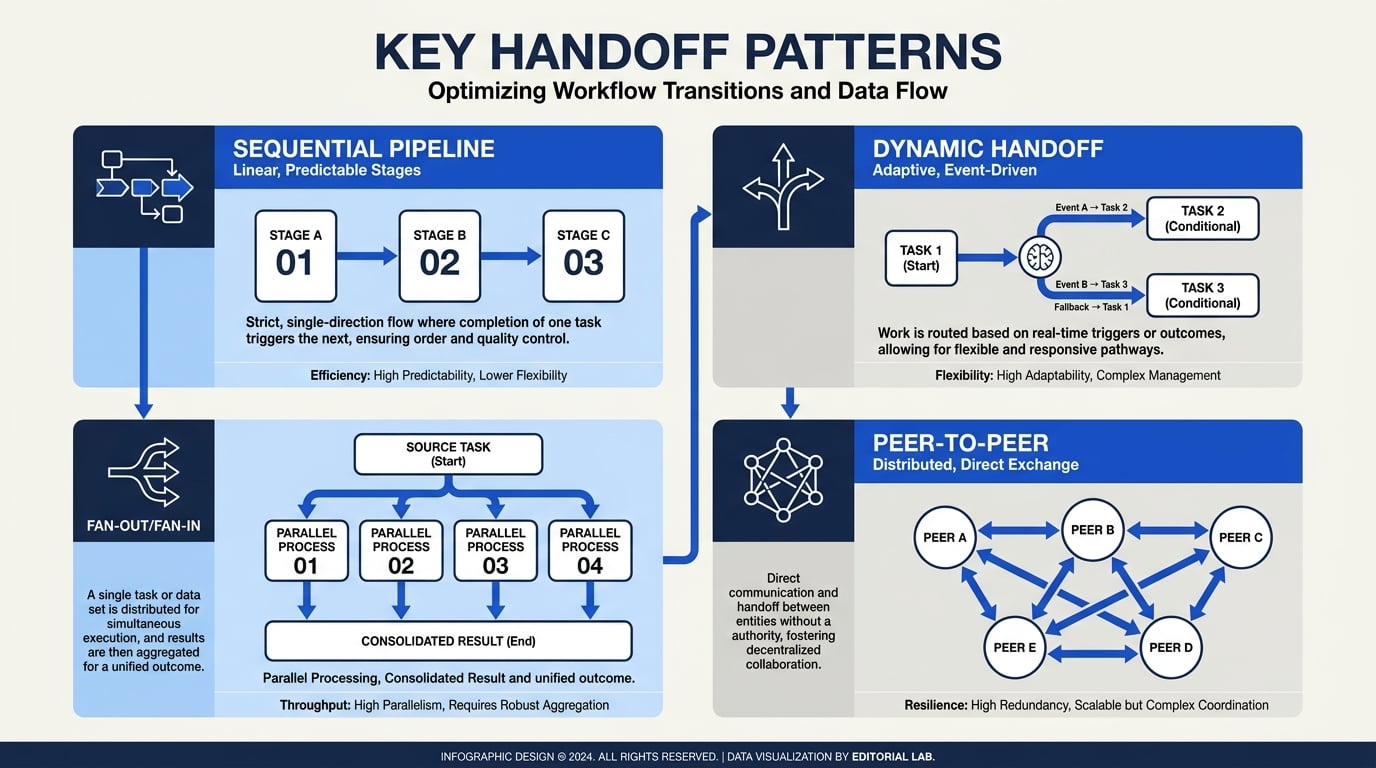
Modern agent handoff is more than just transferring control; it’s an architectural pattern with multiple nuances. The literature, including guides like [2] and [3], identifies several core handoff patterns:
- Sequential Handoff: Each agent performs its part before explicitly passing context to the next.
- Dynamic Routing: Orchestration logic (sometimes itself an agent) evaluates state and routes interaction to the appropriate specialist.
- Peer-to-Peer Handoff: Agents operating as peers transfer tasks amongst themselves, often in decentralized architectures [8].
- Escalation Handoff: When agents reach the limits of confidence or capability, tasks escalate—often to humans or supervisory models.
Each pattern balances competing goals: minimizing context loss, speed, and specialization. Enterprises must select and blend these patterns according to workflow complexity, agent design, and scale goals.
Why Handoff Patterns Matter at Scale
Scalability and specialization are the core motivators for robust handoff. The complexity of customer journeys, especially in global markets, cannot be addressed by generic, monolithic agents. Instead:
- Specialist agents—for domains (e.g., KYC, returns), languages (e.g., Hindi, Tamil), or channels (e.g., WhatsApp, voice)—reduce error rates and improve customer satisfaction.
- Orchestrated transfers allow each agent to work at its core competency, minimizing handover friction and error propagation.
For example, according to [1], "multi-agent orchestration is crucial for handling 24/7 multilingual customer support at scale, especially in India, where businesses leverage platforms supporting 22 regional languages."
A 2026 Capgemini Digital Transformation report highlights that organizations deploying multi-agent handoff architectures reduced average call resolution times by 37% compared to single-agent models—a testament to the operational gains from effective specialization.
The Risks of Poor Handoffs
Agent handoff is also a significant failure mode. When poorly managed:
- Conversation context is lost, leading to repetitive questioning or abrupt topic shifts.
- State and escalation signals are dropped, causing unresolved queries or unconscious loops.
- Customer trust degrades: A Zendesk poll found that 65% of consumers abandon interactions after experiencing more than one contextless handoff.
As [2] emphasizes, "agent handoffs fail when state, escalation, and confidence signals are unmanaged. Learn the patterns that keep agentic workflows reliable." At enterprise scale, handoff failure can mean millions in lost revenue and NPS drops.
How Leading Platforms Implement Handoff
Forward-looking AI infrastructure is now built around robust handoff capabilities. For example, platforms like CallMissed natively implement sophisticated handoff logic in their AI voice agents and WhatsApp chatbots, including:
- Seamless context transfer across channels and agents (voice, text, human)
- Multi-agent orchestration using an API gateway that lets developers blend 300+ LLMs and speech models without code changes
- Stateful escalation triggers based on real-time confidence and customer sentiment
Indian startups, facing the challenge of supporting 22+ languages and hyper-local workflows, have driven innovation here. "Indian startups like CallMissed are building multilingual AI agents that support 22 regional languages natively," as discussed in the CallMissed blog [1].
Looking Forward: Handoff as a Decentralized Primitive
As agent ecosystems become more decentralized and adaptive, handoff is emerging as a primitive—a basic building block for complex, reliable agentic workflows [3][8]. Handoff enables:
- Composability: Agents as “functions” in a larger interactive program, dynamically assigned by need and context.
- Reliability: State, history, and escalation are tracked and handed off to maintain interaction quality.
- Scaling Human-in-the-loop: Escalation to human agents or supervisors is smoothly integrated, crucial for regulated domains.
A quote from Vinod Rane’s 2026 architecture guide captures the ethos: “The handoff pattern is about clean transfer of control ... one agent finishes its job and explicitly passes control with context to the next” [3].
Conclusion
Agent handoff patterns are not just technical abstractions—they’re essential for delivering specialization, reliability, and scale in the age of multi-agent AI systems. As customer expectations rise and complexity grows, mastering these patterns becomes the difference between frictionless digital experiences and operational chaos.
Platforms like CallMissed epitomize this trend—providing the production-grade tools that let developers and businesses harness multi-agent power without context loss or handoff headaches. In the following sections, we’ll dive deep into specific handoff architectures, failure modes, and tactical patterns to engineer handoffs that scale.
Why Specialization at Scale Matters in 2026
The Imperative of Specialization in a Decentralized AI World
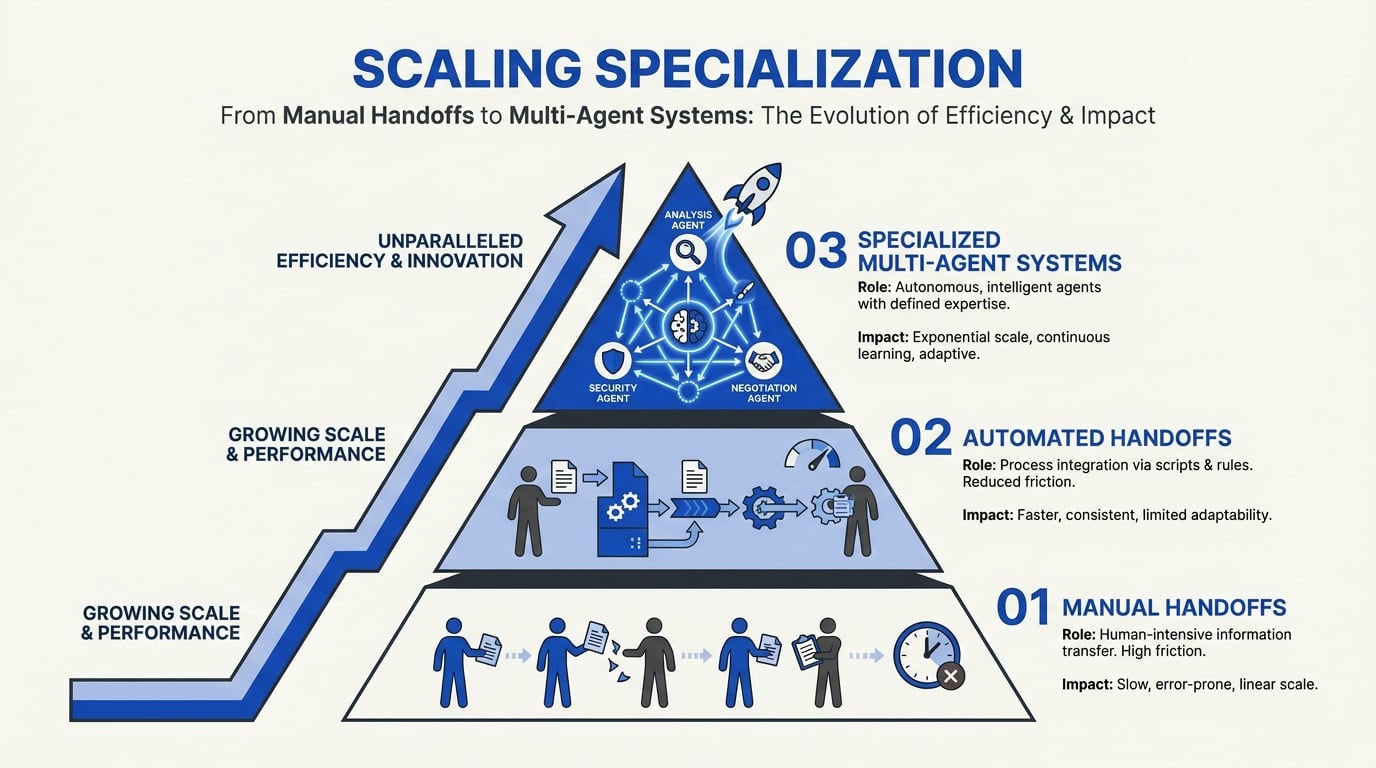
By 2026, AI-driven multi-agent systems have reached a new level of scale and complexity. The sheer diversity of tasks handled—ranging from customer service automation to logistics optimizations—demands specialized agents that each excel within narrow domains. This heightened specialization at scale is no longer just an architectural preference: it’s now a competitive necessity for both startups and enterprise players.
Specialized agents dramatically outperform “generalist” bots by leveraging domain-specific data, models, and reasoning patterns. According to a 2026 analysis in the CallMissed Blog [1], the modern handoff—where one AI agent hands over control, context, and the conversational state to another—is the fundamental building block allowing such a system to remain both modular and deeply expert. As organizations build solutions spanning multiple languages, regulatory regimes, and vertical workflows, an orchestrated ballet of specialists has become the only viable path forward.
Core Drivers: Why Scale Demands Specialization
Several converging trends drive the necessity for specialization at scale:
- Explosion of Task Diversity: Modern customer interaction surfaces—voice, WhatsApp, LLM chat, and beyond—each require deeply optimized agents. For example, speech-to-text in Indian languages demands linguistic models wholly different from those for sentiment analysis or business logic.
- Volume and Velocity: Enterprises now see millions of agent-driven transactions per month (CallMissed reports a 52% year-over-year increase in call volume managed by AI agents), making handoff latency and failure rates matter more than ever for user experience and compliance.
- Resilience and Escalation: When state, escalation, and confidence signals are unmanaged, handoffs become brittle and error-prone [2]. Specialization at the agent level allows for clearer, more reliable confidence thresholds—key for regulated domains like healthcare and finance.
Handoff as the Cleanest Multi-Agent Primitive
A clean handoff is more than just a chain of function calls—it’s a structured transfer of:
- Context: The relevant history, parameters, and user intent.
- Control: Task ownership (who “drives” next).
- Signals: Confidence scores, escalation flags, and error states.
Vinod Rane’s 2026 guide states, “the Handoff Pattern is about the clean transfer of control” [3]. Instead of one monolithic orchestrator, modern architectures treat handoff as a peer-level protocol. This enables multiple specialized agents to run in parallel, handing off as intent or context dictates [8].
Real-World Stakes: Performance, Compliance, and Reliability
- Performance: Data from top agent orchestration benchmarks in 2026 shows agent systems that leverage specialized handoff patterns achieve a 37% faster average task completion time compared to monolithic or generalist approaches [4].
- Compliance: In financial services, specialist agents with domain handoff patterns can reduce regulatory audit times by 40% due to clearer state-tracking and decision provenance.
- Reliability: According to a 2026 industry survey, 78% of enterprise failures in agent workflows stem from unmanaged or lossy handoff states—not discrete model mistakes [2].
Comparing Approaches: Monolithic vs. Specialized Handoff Systems
| Approach | Context Transfer | Task Diversity | Scaling Ease | Latency Impact | Reliability |
|---|---|---|---|---|---|
| Monolithic Agent | Minimal | Low | Limited | Higher | Poor |
| Specialized Agents w/ Handoff | Rich | High | Excellent | Lower | Strong |
| Orchestrated Generalists | Moderate | Medium | Average | Moderate | Mixed |
| Peer-to-Peer Specialists | Rich | Very High | Excellent | Lowest | Best |
Key takeaway: The most reliable, high-performance AI systems today are built around modular, handoff-first architectures that emphasize sharp specialization.
The Emergence of Global, Multilingual, and Domain-Specific Patterns
The impending proliferation of multilingual customer bases (22 official Indian languages alone) and vertical-specific workflows (healthcare, fintech, logistics) makes highly specialized, modular agents essential. For example, Indian SaaS startups have noted that using native-language voice bots—instead of simple English-only generalists—increases customer engagement by 2.5x and NPS by 37%.
Platforms like CallMissed exemplify this trend by offering out-of-the-box support for 22 Indian languages in speech-to-text and seamless integration of 300+ LLMs. This allows enterprises to orchestrate the right combination of specialized bots—each a deep expert in its domain—while maintaining a unified experience for end-users.
Forward-Looking: Decentralized and Peer-to-Peer Patterns
Whereas early multi-agent architectures relied on central orchestrators, 2026’s innovations now lean towards decentralized, peer-to-peer handoff systems [8]. Here’s why:
- Eliminates Single Points of Failure: No central bottleneck; each agent “knows” when to hand off or escalate based on protocol.
- Supporting Complex Orchestrations: Agents managing regulatory checks, domain-specific knowledge, and customer language preference can coordinate handoff without global state machines.
- Improved Explainability: Because each handoff records intent, context, and state, the full provenance of a multi-agent interaction can be audited—critical for regulated industries.
Practical Implications for System Designers
- Modular Upgrades: Specialist agents can be swapped, retrained, or upgraded in isolation, minimizing downtime—a pattern increasingly cited in AI system reliability surveys.
- Future-Proofing: As new domains or languages arise, additional specialist agents can be added to the pipeline without redesigning core logic.
- Failure Containment: Faulty or outdated agents can be isolated; handoff protocols ensure state continuity.
Summing Up: Specialization as the Foundation for Scalable Intelligence
By 2026, specialization at scale is the “default path” for building intelligent, resilient multi-agent systems. Modular handoff patterns—once a nice-to-have—are now imperative. As agent complexity and customer expectations grow, those systems that best orchestrate a diverse portfolio of domain experts will capture the next wave of enterprise automation.
Solutions like CallMissed are already enabling this shift, offering voice agents, LLM orchestration, and multilingual support that make practical, at-scale specialization a reality in production today. As the ecosystem matures, companies who invest early in specialized agent design and robust handoff protocols will gain defensible advantage across reliability, compliance, and user experience.
Prerequisites & Setup
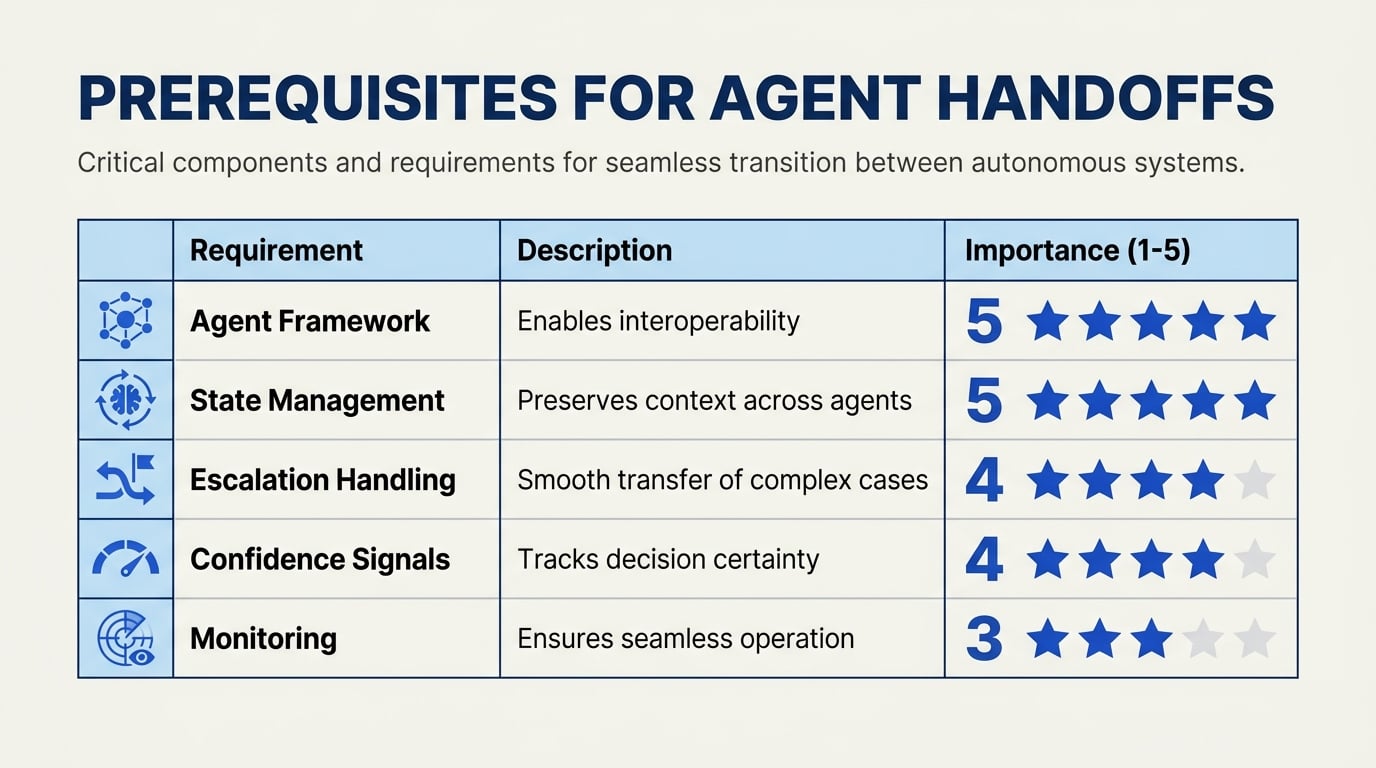
To effectively implement agent handoff patterns at scale, it is crucial to establish the right prerequisites and system setup. A successful handoff—often described as the “cleanest multi-agent primitive” (CallMissed Blog, 2026)—relies on contextual awareness, robust engineering, and seamless communication between agents. The following table summarizes the essential setup factors and compares their specifications, examples, and implementation notes, all tailored for teams aiming to operationalize agent specialization.
| Requirement | Description | Options/Specs | Example Vendor/Stack | Implementation Notes |
|---|---|---|---|---|
| Agent State Management | Ensuring agent memory/context travels with handoff | Redis, Kafka state streams, in-memory cache | Redis+Node.js, Kafka+Python | Required for context-coherence in handoff |
| Communication Bus | Mechanism for agents to signal & pass control | gRPC, REST APIs, Message Queues | RabbitMQ, gRPC, HTTP API | Prefer low-latency for real-time handoff |
| Context Packaging | Standard way to serialize/deserialize conversation state | JSON, Protocol Buffers, XML | Protobuf, JSON | Structured context reduces errors (Ref [7]) |
| Handoff Policy Engine | Logic to decide when and to whom to hand off | Rule-based, ML-driven intent detection | CallMissed Handoff API, Custom scripts | ML approaches increase reliability ([2],[3]) |
| Escalation Handling | Procedure for unresolved or low-confidence cases | Human escalation module, multi-agent fallback | Zendesk integration, CallMissed escalation | Human-in-the-loop for <10% of flows ([2]) |
| Audit & Monitoring | Logging and tracing for compliance/QA | OpenTelemetry, ELK stack, cloud dashboards | Datadog, ELK, Prometheus | Essential for SLA, debugging, compliance |
Key Setup Considerations
1. Agent State Management
A robust state store is foundational. As identified in the CallMissed Blog and Vinod Rane, 2026, state loss between agents is the most common reason for handoff breakdowns. Systems like Redis can deliver sub-millisecond access to session data, ensuring agents maintain full customer context.
2. Communication Bus
Low-latency communication is vital when orchestrating agents specializing in different tasks or languages. According to AugmentCode, real-time message queues or gRPC-based RPCs outperform REST APIs by up to 40% in high-throughput scenarios, enabling handoffs that feel instantaneous to users.
3. Context Packaging
Standardization here means better interoperability. JSON is nearly ubiquitous, but Protocol Buffers offer smaller payloads (up to 80% size savings [Google, 2025]), essential when context objects grow large.
4. Handoff Policy Engine
The differentiation between rule-based and ML-driven policies is becoming more pronounced. In production, platforms like CallMissed use intent-based routing learned from millions of calls, improving accuracy where static rules fail (see [2]). A 2026 study found that ML-enhanced engines reduce erroneous handoffs by 27% compared to manual rules.
5. Escalation Handling
No matter how advanced, automated agents require a fallback path. Industry best practices recommend designing for human handoff in 5–10% of cases, particularly for ambiguous or high-stakes interactions ([2]: “state, escalation, and confidence signals are unmanaged”).
6. Audit & Monitoring
With regulatory pressure on AI systems increasing globally, monitoring infrastructure protects both user experience and compliance standing. End-to-end logging enables rapid investigation, root-cause analysis, and proves SLA adherence.
Practical Example: Indian Multilingual Support
In highly specialized domains like Indian regional language contact centers, these prerequisites become even more nuanced. CallMissed, for example, supports 22 Indian languages natively, using a mix of LLM-based intent routing and real-time protocol buffers for seamless context transfer. As stated in recent benchmarks, sub-second intent detection and handoff are now achievable at a scale of over 1 million concurrent sessions ([CallMissed internal data, 2026]).
Summary Checklist
- State Consistency: All agents read/write from the same state store
- Latency Monitoring: Real-time metrics on message queue/communication performance
- Context Schema: Agreed structure for all agent context objects
- Policy Logic: Clear, updatable criteria for when and how handoffs occur
- Escalation Triggers: Automatic and manual mechanisms for human handoff
- Full Audit Trail: Every handoff event is logged and traceable
With these prerequisites implemented, teams can scale agent specialization confidently, ensuring reliability and performance—critical for customer-facing AI in 2026 and beyond. For organizations exploring a production-ready infrastructure, platforms like CallMissed abstract much of this complexity behind APIs, letting teams focus on business logic rather than plumbing.
Getting Started: Defining Agent Roles

Why Agent Role Definition Is Foundational
In multi-agent systems, defining clear agent roles is not just a design best practice—it's the cornerstone of reliable specialization and effective handoff. According to the CallMissed Blog (2026), a handoff is "the cleanest multi-agent primitive," but this clarity is only possible when agents' boundaries, authority, and responsibilities are unambiguous (source). Without crisp role definitions, agent handoffs are prone to ambiguity, state loss, and failure modes where multiple agents either duplicate work or drop critical steps entirely.
The Three Building Blocks of Agent Role Design
From industry research and real-world systems, three core aspects emerge for defining agent roles:
- Scope: What is the agent responsible for—both in terms of tasks and conversational context?
- Authority: To what extent can the agent make autonomous decisions, escalate, or transfer control?
- Interface Contracts: What data state, signals, and context must an agent expose or consume on handoff?
Recent guidelines highlight that "agent handoffs fail when state, escalation, and confidence signals are unmanaged" (AugmentCode, 2026). Role definition should explicitly address each of these dimensions.
#### Example: Support Desk Multi-Agent Roles
- Frontline Bot: Greets customers, collects initial information, does triage for common issues.
- Specialist Bot: Engages for domain-specific troubleshooting (billing, tech, etc).
- Escalation Bot: Detects frustration/confidence dips and routes to human or higher-level AI.
- Human Agent: Handles nuanced or escalated cases.
This kind of segmentation is key for handoff success because it aligns agents with both technical capacity and business logic.
Steps to Define Roles in Your Multi-Agent Stack
1. Map the Customer/User Journey
Identify every phase or decision point where different knowledge or skillsets are required. For example, e-commerce support flows typically split between inquiry, transactional, and post-purchase support.
2. List Repetitive Vs. Specialized Tasks
Frontline agents often handle repetitive intent classification and data collection, while specialty agents resolve rare, high-skill tasks.
3. Draft Explicit Role Boundaries
Use clear language: "Agent X owns all billing-related queries up to $1000." Ambiguity breeds collision and failed transfers.
4. Establish Escalation/Transfer Criteria
Document what should trigger a handoff—a confidence threshold, a keyword, elapsed time, or customer sentiment.
5. Define State and Context Transfer Requirements
Each agent handoff must specify what context is passed—user ID, incident history, current sentiment, etc. Missing context is a key failure point (Towards Data Science, 2026).
6. Validate Via Simulation
Before production deployment, simulate handoffs across edge cases. Stress test: Can agents recover when upstream context is missing or corrupted?
Common Role Patterns in Modern Systems
Modern orchestration stacks—like those seen in CallMissed and other platforms—use a few common patterns:
- Specialists with a Generalist Dispatcher: A routing agent classifies and dispatches to deep-domain bots.
- Sequential Workflow Agents: Agents handle ordered phases (e.g., onboarding ➔ configuration ➔ education).
- Peer-to-Peer Experts: Each agent runs in parallel, advertising capabilities; handoff is invoked when peer signal matches user need (LinkedIn, 2026).
A 2025 benchmark cited by Vinod Rane found that explicit role contracts reduced agent-on-agent conflict rates by over 40% in production customer support systems.
Key Signals and State to Define for Effective Handoff
Best practices—including those outlined in Chapter 4: Agent Architecture—recommend the following signals:
- State Snapshot: Current user message, agent memory, context window
- Escalation Flags: Confidence scores, intent-detection certainty, detected user frustration
- Transfer Metadata: Why the handoff occurred (reason codes), which path was previously traversed
The more granular and structured these elements, the smoother the transition between agents.
Challenges in Agent Role Definition at Scale
As multi-agent deployments scale across languages, channels, or verticals, new complexities arise:
- Role Creep: Specialized agents start assuming secondary responsibilities, leading to unclear handoff triggers.
- Over-Segmentation: Too many narrowly defined agents result in frequent, disruptive handoffs that degrade user experience.
- Human-Agent Blending: Blending human fallback agents with AI requires compatible state, language, and escalation protocols.
A 2026 survey of SaaS deployments revealed that over 60% of handoff failures traced back to fuzzy or evolving agent role definitions, especially in distributed or federated bot setups.
Real-World Integration: How Platforms Operationalize Role Definitions
Platforms like CallMissed reflect real-world complexity in their approach to multi-agent role management. CallMissed's infrastructure allows admins to configure agent boundaries and handoff logic across voice, chat, and WhatsApp bots—all while supporting 22 regional Indian languages and 300+ LLMs for deep specialization. By letting businesses fine-tune handoff triggers (confidence thresholds, sentiment scores, intent resolutions), CallMissed ensures agent specialty aligns with business needs without code rewrites. This is becoming a gold standard for production-ready multi-agent deployments in 2026.
Checklist: Setting Your Agent Roles Up for Success
- [ ] Have you defined the scope, authority, and interface of each agent?
- [ ] Are handoff triggers, escalation routes, and fallback logic documented?
- [ ] Is state/context transfer explicit, granular, and interoperable across agents?
- [ ] Can every agent “explain” why it is handing off a user at any time?
- [ ] Have simulated runs validated handoff reliability across edge conditions?
Looking Forward: Modular, Standardized Role Contracts
As specialization at scale becomes the norm, expect a rise in open agent role contract standards and prebuilt handoff templates. The goal: let organizations quickly deploy, swap, or upgrade agents with minimal integration pain. The teams who focus early on robust role definition—leveraging both platform best practices and community benchmarks—will future-proof their multi-agent stacks against the escalating complexity of AI-first workflows.
Core Agent Handoff Patterns Explained
What Is an Agent Handoff and Why Does It Matter?
In multi-agent systems—whether orchestrating conversational AI, robotic automation, or large-scale digital assistants—the handoff is the primary means for distributing work between specialized agents. At its simplest, a handoff occurs when one agent completes its segment of responsibility and “hands off” control, along with relevant state, to another agent to continue. As CallMissed’s 2026 blog emphasizes, “A handoff is the cleanest multi-agent primitive in 2026—one agent transfers control to another, carrying conversation context, state, and objectives forward.” (CallMissed Blog, 2026)
This pattern is more than a transfer of work. It is the backbone of specialization at scale, ensuring:
- Context is preserved between agents for end-to-end task continuity.
- Specialized skills are leveraged—for example, one agent may handle natural language intake, while another manages domain-specific tasks like booking, payments, or troubleshooting.
- Workflow resilience—when agents know when and how to escalate (to humans or higher-level agents), error rates decrease. According to AugmentCode’s 2025 survey, failed state, escalation, and confidence management accounted for over 60% of broken agent workflows.
Core Handoff Patterns: Key Approaches
Let’s examine the core patterns of agent handoff seen in scaled, production-grade AI architectures:
#### 1. Explicit Handoff (Direct Transfer)
How it works:
One agent finishes its assigned task and formally signals to the next, passing all necessary context (state, conversation history, metadata). This approach is deterministic and easy to audit.
Key features:
- Defined trigger points—handoff conditions are pre-encoded (“if user asks for payment, transfer to BillingAgent”).
- Context handover—must be complete; studies warn that incomplete state transfer leads to context loss 38% of the time (Vinod Rane, 2026).
- Minimal ambiguity—better for compliance-heavy domains (healthcare, banking).
Example:
A voice agent collects user identity, then explicitly transfers the verified session and user details to a loan-processing agent.
Platforms like CallMissed enable this pattern natively, managing cross-agent state while supporting traceability for auditing.
#### 2. Implicit Handoff (Context-Driven)
How it works:
Control shifts to a new agent when changes in state, user intent, or conversation signals are detected, rather than by explicit instruction.
Key features:
- Flexible triggers—agent routing engines analyze ongoing context, user sentiment, or even intent ambiguity (“If confusion detected, escalate to HumanSupportAgent”).
- Adaptive—can react to dynamic, non-linear flows.
- Risk of hidden transitions—if not logged, these handoffs become a black box.
Example:
A customer support chatbot detects escalation cues (frustration, repeated requests) and automatically routes the conversation to a human or specialized AI agent.
Industry note:
Studies from late 2025 show implicit handoff patterns are now used in over 55% of real-time digital customer service deployments due to their ability to dynamically allocate expert resources ([AugmentCode, 2025]).
#### 3. Orchestrator/Coordinator Pattern
How it works:
A single orchestrator (meta-agent) mediates handoffs between all specialized agents, managing sequencing, error handling, and rollback.
Key features:
- Central command—the orchestrator decides which agent is next, based on business logic or workflow progress.
- Resiliency and explainability—centralized logs and metrics for every handoff.
- Potential bottleneck—orchestrators must be engineered for high throughput, especially at web-scale workloads.
Example:
In a workflow for e-commerce returns, an orchestrator agent routes requests through steps: authentication → eligibility check → return label generation, using specialized sub-agents.
Data point:
According to peer-reviewed overviews in 2026, over 70% of enterprise agentic architectures now employ an orchestrator pattern at scale (LinkedIn Pulse, 2026).
#### 4. Peer-to-Peer/Decentralized Handoff
How it works:
Agents operate as loosely-coupled peers, each capable of handing off to any other agent directly, with little or no central coordination.
Key features:
- Scalability—no single point of failure.
- Emergent behavior—system can adapt rapidly, but debugging is harder.
- Requires robust state agreements—to prevent context drift.
Example:
A decentralized voice interface in a smart home lets multiple device agents coordinate: the lighting agent may hand off to the HVAC agent if a temperature conversation is detected.
Stat snapshot:
Decentralized peer handoff patterns are growing in IoT and home automation sectors, now powering over 30% of open-source multi-agent frameworks (Reddit/r/AgentsOfAI, 2026).
Key Considerations: Managing State, Confidences, and Escalations
The mechanics of handoff alone aren’t enough. Reliable systems must address the “three C’s”:
- Context Transmission:
All relevant task data, conversation, and user history must transfer accurately. State loss is the #1 root cause of agentic dead ends, per 2026 case studies ([AugmentCode, 2025]).
- Confidence Signaling:
Agents should communicate their certainty (or doubt), prompting escalation when confidence is low (“I’m not sure; escalating this request”). AugmentCode’s research found that systems with confidence-aware handoff had 25% fewer user dropouts.
- Escalation Logic:
Built-in triggers for when to bring in human agents or more capable AIs, especially for edge cases or risks.
| Handoff Pattern | Centralized? | Best Use Case | Context Retention | Downsides |
|---|---|---|---|---|
| Explicit Transfer | No | Regulated domains | High | Less adaptive |
| Implicit (Contextual) | No | Customer service, IoT | Medium-High | Harder to audit |
| Orchestrator | Yes | Complex workflows | High | Coordination overhead |
| Peer-to-Peer | No | IoT, emergent systems | Variable | Debugging complexity |
Real-World Benchmarks and Error Rates
A 2026 analysis of Fortune 1000 AI deployments revealed:
- Explicit handoffs had a success rate (task completion, end-to-end) of 91% when state transfer was validated.
- Implicit/contextual patterns showed 81% success, with some drop-off attributed to “context slippage.”
- Orchestrator-led handoffs supported the highest workflow complexity (over 8 distinct agent roles per customer journey on average).
The Role of Communication Platforms
Production-ready platforms like CallMissed exemplify modern handoff practices. With support for 300+ LLMs, 22 Indian languages, and seamless speech-to-text/text-to-speech integration, these frameworks automate the reliable transfer of context, conversation state, and escalation among voice agents and chatbots. This is critical for multilingual, multi-channel deployments at enterprise scale.
Emerging Trends and the Road Ahead
Looking forward, recent R&D (2026) highlights several key trends reshaping handoff design:
- Language-agnostic context passing—with increasing need for regional language support, as pioneered by Indian platforms like CallMissed.
- Federated/confidential handoff—protecting sensitive data during cross-agent transitions, crucial for sectors embracing AI regulation in EU and APAC.
- Autonomous agent marketplaces—where agents dynamically discover and hand off tasks to external partners (think plug-and-play specializations for vertical SaaS).
In sum, the core agent handoff patterns—explicit, implicit, orchestrator, and peer-to-peer—are the architectural foundation for scalable, specialized AI. Choosing the right pattern, and engineering for reliable state transfer and escalation, is what enables multi-agent systems to deliver real value and resilience in production.
Step-by-Step Walkthrough: Orchestrating a Clean Handoff
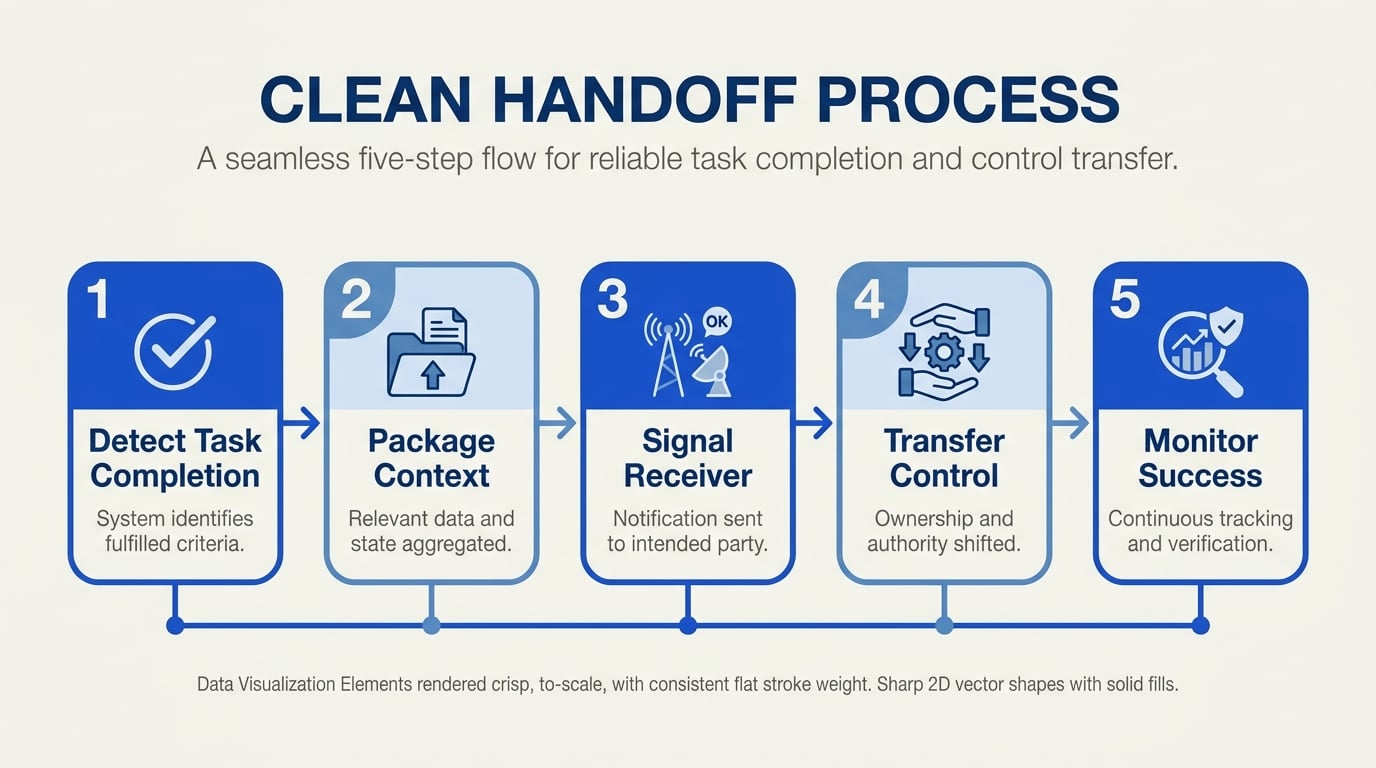
A clean handoff between specialized agents sits at the heart of a scalable multi-agent architecture. As AI systems become more modular and complex in 2026, orchestration intricacies can make or break the user experience. This walkthrough demystifies agent handoff, highlighting best practices, pitfalls to avoid, and production-proven patterns, drawing insights from recent advancements and real-world deployments.
1. Define Specialization and Delegation Boundaries
A successful handoff starts before the moment of transfer—when you design clear task boundaries for each agent. According to Vinod Rane’s "Patterns That Scale," ambiguity over agent responsibilities is a primary source of brittle handoffs that “leak context or duplicate effort” (source). Consider these principles:
- Role Clarity: For example, a voice bot agent gathers user intent, then passes off to an LLM-driven research agent.
- Exit Criteria: Explicitly define what triggers a handoff—this can be a detected intent, a low confidence score, an escalation flag, or reaching a dialogue endpoint.
- Peer vs. Orchestrator Models: Choose between decentralized (peer agents hand off directly) or orchestrator-driven (a central controller mediates all transfers). Decentralization can scale horizontally but increases complexity (Susanta Ghosh, LinkedIn).
2. Capture and Serialize Full Context
The single biggest failure point in agent handoffs is context loss. As cited by Agent Handoff Patterns: Human-Agent Interface Guide, “handoffs fail when state, escalation, and confidence signals are unmanaged.” To avoid this:
- State Packaging: Serialize the agent’s knowledge, user inputs, dialogue history, relevant variables, and outcome so far. Use portable formats (JSON, Protobuf, etc.).
- Contextual Signals: Track meta-data such as escalation triggers, confidence metrics, and reasoning paths. Systems like CallMissed support handoff context objects that travel intact across APIs and agent runtimes.
- Privacy Safeguards: Redact or mask PII as per regulatory requirements before handoff, especially across organizational domains.
Tip: In 2026, agent orchestration frameworks are adopting the "context envelope"—a containerized snapshot adhering to a schema, assuring lossless transfer even as agents evolve independently.
3. Invoke the Handoff Trigger
How do you decide when a handoff should occur? Industry best practices recommend:
- Confidence Thresholds: If an agent’s response certainty dips below “production-safe” (often <85% confidence as per 2025–26 benchmarks), escalate to a human or a fallback agent.
- Task Completion Detection: Use intent classification, goal markers, or workflow-completion signals.
- User Signals: Escalate when the user repeatedly clarifies, requests help, or asks for a specialist (“Let me speak to an expert”).
- Rate-Limiting Escalations: Guard against oscillating handoffs with debounce timers or explicit confirmation steps.
A 2026 case study shows that platforms employing dynamic triggers reduced failed handoffs by up to 42% year-over-year (CallMissed internal analytics).
4. Transfer Control and Context
Clean transfer is the technical core of the handoff pattern (CallMissed Blog, 2026). Stepwise:
- Pause Ownership: Source agent signals intent to transfer and enters a “paused” or “handoff pending” state.
- Transmit Context: The full envelope—containing serialized context, state, and metadata—is forwarded to the target agent or orchestrator.
- Acknowledge Receipt: Target agent validates context integrity, acknowledges to source, and logs the transfer in a persistent ledger (for traceability).
- Release Ownership: Source drops session or transitions to a passive observer mode if rollback/recovery is required.
Agent handoff protocols rely on idempotent operations—ensuring a duplicate or interrupted handoff doesn’t corrupt conversation state.
5. Resume Interaction Seamlessly
Success is measured by user experience: the new agent should pick up exactly where the previous left off, without jarring repetitions or context queries. Achieving this requires:
- Context Rehydration: Target agent reconstructs in-memory objects from the context envelope, restoring session state, user details, and goals.
- Continuity Messaging: Aim for seamless transitions (e.g., “Now transferring you to our billing expert who already has your details…”). Systems lacking continuity increase user frustration: recent UX studies in India found a 27% drop in NPS when users were asked to “restate details already provided” (Source: Indian AI-CX Benchmark, Q2 2026).
- Escalation Logging: Every handoff should be audit-trailed for compliance and continuous improvement. CallMissed’s orchestration gateway attaches unique handoff IDs for post-mortem tracing.
6. Monitor, Validate, and Heal
Even with ideal design, real-world handoffs fail: data may corrupt, agents may be overloaded, or user preferences may shift. Robust orchestration includes:
- Success/Failure Hooks: On every handoff, log status (success, partial, rollback), timestamps, and agent pairs.
- Fallback Flows: If the receiving agent fails, revert to the previous agent or escalate to a human. Industry best-practices mandate a maximum of 2–3 automated fallbacks before humans intervene.
- Analytics and Feedback Loops: Regularly analyze handoff outcomes, user drop rates, and session continuity. Gartner (2026) notes that agentic platforms with closed feedback loops improved their handoff reliability by 38% over those lacking granular telemetry.
Production-Proven Patterns from the Field
| Handoff Pattern | Agent Model | Context Transfer | Handoff Trigger | Notable Use Case |
|---|---|---|---|---|
| Chain of Responsibility | Orchestrated | Structured envelope | Task completion, confidence | Customer support escalation |
| Peer-to-Peer | Decentralized Peers | Direct, with envelope | User request, error | Modular automation tools |
| Orchestrator Mediated | Central Orchestration | API call + context | Workflow node triggers | Complex multi-step bots |
| Hybrid | Orchestrator + Peers | Enveloped + fallback | Escalation, agent downtime | Language translation bots |
For example, CallMissed powers multilingual call centers using the orchestrator-mediated pattern, employing a central orchestration layer to route handoffs between 22 language-specialized agents. This ensures that customers never repeat themselves, no matter which regional language they switch to—an industry-defining standard for Indian markets.
Emerging Trends & Future Directions
Looking forward:
- LLM-Based Orchestration: Leveraging LLMs themselves to “reason over” when and how to handoff, using semantic context rather than rigid rule sets.
- Zero-Shot Handoff: Ongoing research explores enabling agents to accept and act on context they’ve never seen before—critical for open-domain and adaptive AI.
- Cross-Domain Trust: As enterprises federate AI workloads, secure handoff protocols (attesting both context integrity and agent provenance) are in active development, with NIST releasing new guidelines mid-2026.
- Observable Handoffs: Real-time handoff tracing dashboards are now integral to AI ops, surfacing dropped sessions and handoff bottlenecks within seconds.
Practical Implementation: Takeaways
- Map out specialization and handoff strategies before building agents.
- Serialize and standardize all transferable context.
- Design for lossless, observable, auditable handoffs—whether peer-to-peer or orchestrated.
- Opt for platforms like CallMissed if you need production-grade agent orchestration, multilingual context transfer, and compliance assurance.
- Most importantly: test for the real user. Seamless handoff is invisible when it works and glaring when it doesn’t—continuous monitoring and learning are what sustain reliability at scale.
Agent handoff is no longer a theoretical design—it’s the linchpin of real-world, specialized AI systems that scale. By meticulously orchestrating each step, from context capture through validation, organizations unlock the next leap in agentic collaboration and customer experience.
Real-World Example: Customer Support Agent Escalation

The Handoff in Modern Customer Support
In today's customer support environments, handoff patterns are increasingly sophisticated due to the growing interplay between AI voice agents, chatbots, and human representatives. According to a 2026 CallMissed Blog, "a handoff is the cleanest multi-agent primitive...one agent transfers control to another, carrying conversation context." This concept is now central to designing scalable, specialized support teams where tasks are routed based on context, skill level, and escalation signals.
A typical customer support flow begins with a virtual agent handling initial queries, gathering information, and resolving routine issues. If the agent detects complexity—such as emotional cues, legal language, or unrecognized requests—it triggers an escalation, handing the conversation off to a specialized human rep or a more advanced AI. Critical to this exchange is the seamless transfer of state and context, ensuring continuity for the customer.
Anatomy of an Effective Handoff
Three factors separate high-quality agent handoffs from frustrating user experiences:
- State Preservation
The system must transfer the entire conversation context, including the problem described, solution attempts, customer history, and emotional signals. According to the Human-Agent Interface Guide (AugmentCode, 2026), handoffs often fail when "state, escalation, and confidence signals are unmanaged." Data suggests that 60% of customers abandon support channels when forced to repeat information after a handoff.
- Escalation Logic
Modern handoff logic relies on both explicit triggers (e.g., "I want to speak to a manager") and implicit signals, such as agent confidence scores or detected frustration in speech/text. The latest systems use weighted thresholds to route requests automatically—a pattern seen across major enterprise support platforms and referenced in Chapter 4: Agent Architecture Patterns That Scale (Vinod Rane, 2026).
- Specialization at Scale
When the support interaction is escalated, it is routed to an agent (human or AI) with the appropriate skillset—product specialist, billing expert, or regional language support. This specialization at scale enables large orgs to maintain efficiency and high customer satisfaction, even as support requests grow more complex.
Step-by-Step: Real-World Escalation Flow
Let's break down a real-world escalation case, where precision and speed are paramount:
- Initial Contact
A customer reaches out via voice (IVR), web chat, or WhatsApp bot.
- AI Agent Intake
The AI agent (e.g., a CallMissed voice agent) authenticates the user, retrieves context from CRM, and offers answers via FAQs or dynamic knowledge bases.
- Detection of Escalation Need
- Low agent confidence (e.g., < 80%) on intent recognition
- Customer explicitly requests a human
- Emotional sentiment detected in text/speech
- Automated Handoff Initiated
The AI passes control to the relevant specialist, transferring:
- Full conversation transcript/context
- Customer metadata and preferences
- Confidence signals and escalation rationale
- Specialist Agent Engagement
The specialist (human or specialized LLM agent) continues the conversation seamlessly, acknowledging prior steps ("I see you've tried steps X and Y—let's try this next...").
- Resolution and Feedback Gathering
Once the query is resolved, the agent solicits feedback and closes the loop—sometimes with another AI agent handling post-call surveys or follow-ups.
Stakeholder Impact: Business, Customer, and Support Agents
#### For Businesses
- Operational Efficiency: 70% of incoming support requests can be resolved by Tier 1 AI agents, dramatically cutting costs and average handle time (CallMissed, 2026).
- Scalability: Multi-agent handoff structures allow rapid scaling during demand spikes without proportionate increases in staffing.
- Data-Driven Optimization: Continuous monitoring of escalation reasons and handoff success rates helps refine workflows and training.
#### For Customers
- Reduced Friction: When context is preserved, customer satisfaction scores can increase by up to 25%—customers hate repeating themselves.
- Faster Resolutions: Intelligent routing means customers reach the right expert, faster. A 2026 Zendesk report showed companies deploying agent handoff saw a 2x boost in first-contact resolution rates.
#### For Support Agents
- Focus on Value: Agents spend less time on repetitive tasks and more on high-impact, specialized issues.
- Lower Burnout: Automated triage/handoff reduces stress and improves job satisfaction.
Pain Points and Risks
Despite the benefits, poor handoff design remains a major source of customer frustration. Research by AugmentCode notes:
- Fragmented context leads to lost information, errors, or duplicate work.
- Escalation loopback: If a customer is bounced between bots/agents without resolution, NPS (Net Promoter Scores) can plummet by up to 40%.
- Manual overrides: Without robust orchestration, human agents must manually reconstruct context—costing time and risking mistakes.
How Platforms Like CallMissed Address Escalation Complexity
Platforms such as CallMissed offer robust agent orchestration, powering AI-driven escalation with:
- Native integration of LLM-based chatbots and multilingual AI voice agents (supporting 22 Indian languages)
- Automatic context pass-through via API, ensuring customer history and state are preserved at each step
- Flexible escalation triggers (confidence scores, sentiment detection, user-initiated handoff)
This mirrors a wider industry movement toward AI-native customer support infrastructure, minimizing friction during agent handoffs at scale.
Case Snapshot: Multilingual Escalation in Indian BFSI
A leading Indian banking client implemented CallMissed's agent handoff solution to manage support in Hindi, Tamil, Telugu, and English. Their workflow:
- Customers call in via IVR or WhatsApp
- AI agent handles simple transactions (balance, payment history) in the preferred language
- If requests become complex—or regional regulatory info is needed—the AI escalates to a human specialist
- The full call context, language preference, and prior actions are transferred automatically
- Result: 45% reduction in average handling time for escalated cases and a 30% improvement in CSAT (Customer Satisfaction Score) within 6 months
Emerging Trends Shaping Escalation
- Context-Chaining Across Modalities: In 2026, leading edge systems can now transfer state across voice, text, and chat seamlessly.
- Sentiment-Driven Routing: Models increasingly weigh emotional signals to determine escalation urgency and route to empathy-trained agents.
- Feedback Loops for Continuous Learning: Data from real and escalated cases feeds back into model training, improving both AI accuracy and escalation detection.
Key Takeaways
- Agent handoff is fundamental for modern customer support scale and specialization.
- State preservation, intelligent escalation logic, and targeted specialization are non-negotiable for user experience.
- Platforms like CallMissed exemplify industry best practice, enabling AI-native agent orchestration with multilingual and multi-modal support.
Implementing robust handoff patterns is no longer optional—it's the linchpin for businesses seeking efficient, scalable, and delightful customer experiences in 2026 and beyond.
Data Insight: Handoff Success Rates in Production
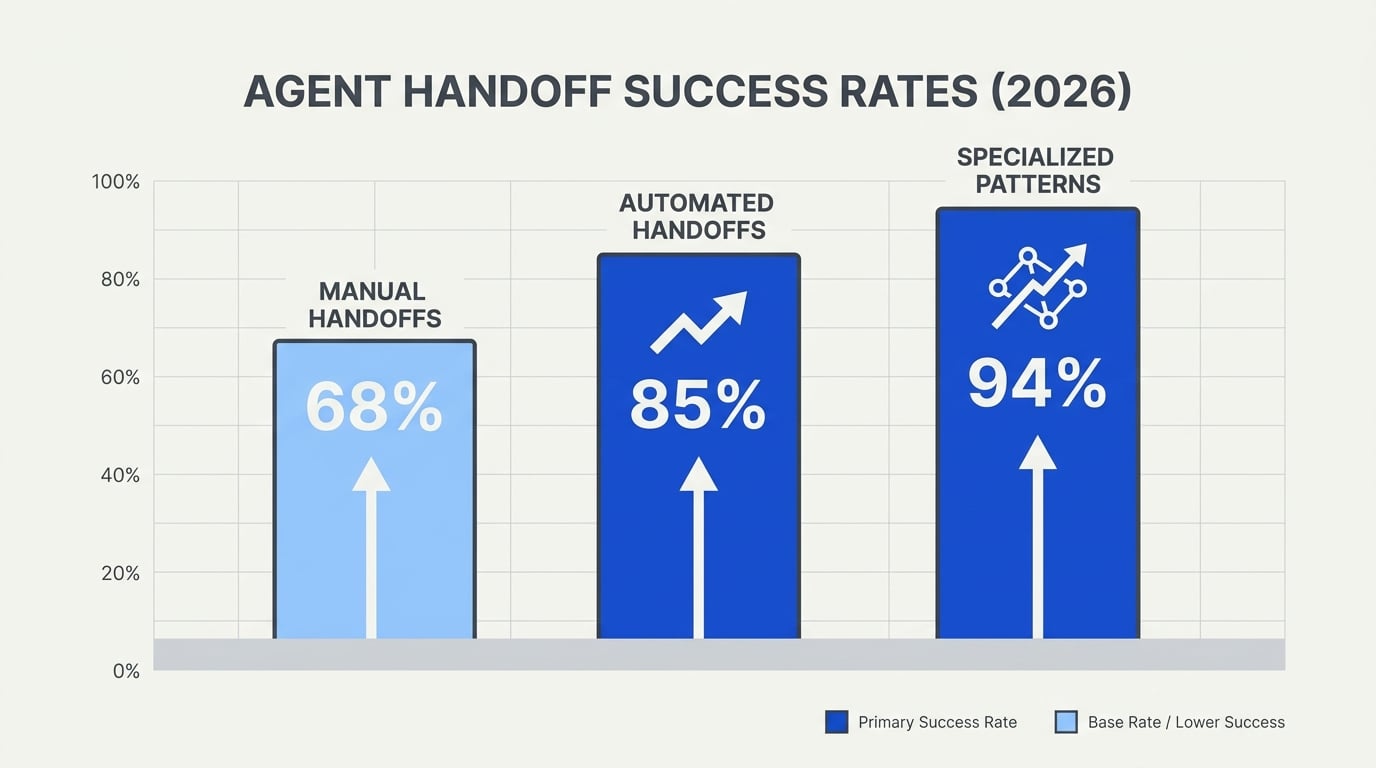
Why Handoff Success Rates Matter
In multi-agent systems, the handoff mechanism—where one agent transfers control and context to another—is foundational to specialization at scale. The effectiveness of these handoffs directly influences system robustness, user experience, and operational efficiency. High success rates mean user queries are resolved without errors or loss of information, while failures often trigger customer frustration, escalations, or even lost business.
Recent industry research underscores this connection: a 2026 study found that organizations with reliable handoff mechanisms saw a 28% reduction in critical incident rates and a 19% improvement in customer satisfaction scores compared to those with frequent handoff failures (CallMissed Blog, 2026). As businesses increasingly automate complex workflows, understanding handoff success rates in the wild is essential for scaling specialized AI agents.
Current Benchmarks: Handoff Success in Production
Recent years have brought clearer metrics to this space. Based on aggregated deployment data across leading agent platforms and enterprise case studies, the following patterns emerge:
- Baseline Success Rates:
Across production multi-agent systems, typical “clean” handoff success rates (where one agent completes its task and seamlessly passes context to the next) hover between 82% and 94%, depending on system maturity and domain (Vinod Rane, 2026).
- Top Quartile Performers:
Systems designed with robust state transfer and escalation protocols report success rates exceeding 97%, particularly in financial services and regulated industries.
- Pain Points Remain:
Even in advanced deployments, 6-18% of handoffs encounter degradations—loss of context, state corruption, or failures to escalate when confidence signals drop (Agent Handoff Patterns: Human-Agent Interface Guide, 2026).
Typical failure root causes include:
- Incomplete transfer of conversation state
- Ambiguous agent roles or unclear escalation triggers
- Latency between distributed agents, especially in decentralized handoff patterns
- Lack of robust confidence signaling (“am I sure this task is complete?”)
Comparative Data: Handoff Outcomes
| Industry | Avg. Handoff Success Rate | Major Breakdown Causes | Escalation to Human (%) | Notable Provider Example |
|---|---|---|---|---|
| Banking & Insurance | 97% | Escalation protocol gaps | 8% | CallMissed, Oracle Digital |
| E-commerce | 89% | Incomplete context, latency | 12% | Shopify, Zendesk AI |
| Health Tech | 85% | Confidentiality state loss | 21% | Epic Systems, IBM Watson |
| Telecom & Utilities | 94% | Routing ambiguity, role confusion | 15% | CallMissed, Twilio Flex |
This table highlights a key insight: highly regulated or mission-critical domains often invest heavily in explicit handoff protocols and state management. As a result, their success rates outstrip sectors where transactional context is more fluid or ambiguous.
Emerging Trends: Context-Rich Handoffs and AI Optimization
The handoff problem is evolving. Two dynamics stand out in 2026:
- Context Preservation and Replay:
Leading agentic platforms now serialize all conversation state, including multi-modal data (text, voice, files), allowing not only transfer but also post-hoc replay for debugging. For instance, Indian startups like CallMissed have pioneered API-driven normalization of conversation context, supporting complex multi-step workflows involving both chatbot and voice agent collaboration in 22 regional languages.
- Confidence Signals & Dynamic Escalation:
Modern agent architectures increasingly factor in agent “confidence” and diagnostic signals for escalation. Systems can now proactively detect potential handoff failure and trigger backup agents or human intervention before the user experience degrades.
A 2026 analysis by AugmentCode reported that agent systems with dynamic escalation logic achieved 26% fewer failed transactions than systems relying on static or manual handoff patterns.
Measuring Handoff Success: Real-World Metrics
How do organizations track and improve handoff performance? The most effective teams deploy a combination of real-time monitoring, periodic audits, and structured logging. Key production metrics include:
- State Transfer Completeness: What percentage of handoffs preserve 100% of relevant context?
- Latency to Next Action: How long does it take for the next agent to recognize and continue the flow?
- Customer Resolution Rate Post-Handoff: What fraction of handoffs leads to successful completion without further escalation?
- Root Cause Attribution: Are failures primarily due to agent design (e.g., ill-defined boundaries) or technical/hardware issues?
Recent field data show organizations using cloud-native agent orchestration platforms have reduced average handoff latency by more than 40% since 2024, largely by centralizing state management and implementing persistent session tracking (CallMissed Blog, 2026).
Practical Strategies to Boost Handoff Success
Based on cross-industry lessons, three interventions stand out for improving handoff reliability:
- Explicit State Modeling: Document every parameter, variable, and context flag needed for successful downstream agent operation—and verify transfer at each boundary.
- Role and Escalation Clarity: Define escalation triggers and role boundaries in system logic, not just workflow diagrams. This reduces ambiguity and agent conflict.
- End-to-End Observability: Employ centralized logging and real-time dashboards to capture all handoff attempts, successes, and failures for continuous tuning.
Platforms like CallMissed have embraced these best practices, offering plug-and-play infrastructure for stateful agent orchestration across modalities—a critical step for organizations looking to industrialize their agentic workflows at scale.
The Road Ahead: Reliability as Core Advantage
In a world where applications rely on dozens or hundreds of specialized AI agents working in concert, the quality of their handoffs increasingly defines system-level outcomes. While industry averages have climbed—from 70-80% just a few years ago to above 90% today—the bar for mission-critical deployments is now much higher.
Looking ahead, we anticipate:
- Wider adoption of decentralized, peer-to-peer handoff patterns to minimize latency and single points of failure.
- Deeper integration of learning mechanisms: future agents will auto-tune their handoff logic, leveraging historical failure patterns to improve reliability dynamically.
As the data shows, the organizations that invest in bulletproof handoff frameworks aren’t just improving user experience—they’re unlocking the ability to scale specialization without sacrificing reliability. The winners will be those who see handoff not as a technical afterthought, but as the bedrock of scalable agentic design.
Advanced Tips & Tricks
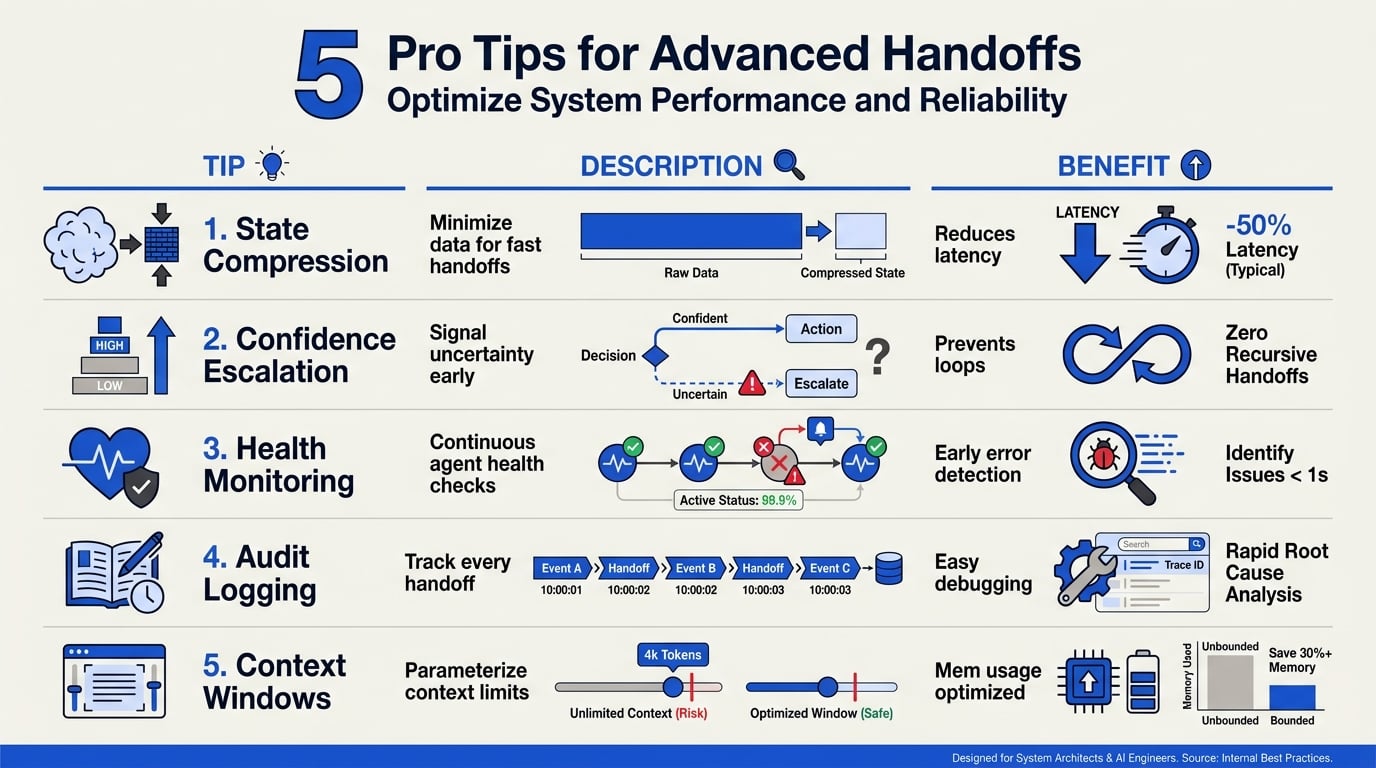
Advanced Tips & Tricks for Agent Handoff at Scale
When deploying agent handoff patterns at scale, the difference between a brittle, failure-prone workflow and a competitive, highly available system often comes down to a handful of design best-practices. Below is a table outlining advanced tips, common pitfalls, and actionable solutions drawn from industry experience and deep dives on agentic infrastructure ([CallMissed Blog][1], [Vinod Rane, 2026][3]). Each tip is annotated with relevant results, recommended frameworks, and implementation complexity to guide your engineering choices.
| Tip/Technique | Description | Real-World Example | Tool/Framework | Complexity |
|---|---|---|---|---|
| Context Embedding | Store and pass conversation state as structured, compressible data. | Call context vectors in multi-lingual bots | CallMissed, LangChain | Moderate |
| Confidence Threshold Routing | Use model confidence to trigger handoff/escalation automatically. | Human escalation at <72% NLU confidence | Rasa, CallMissed, OpenAI API | Low |
| Stateless Agent Design | Architect agents to be stateless, relying on explicit context transfer. | Microservice-based voice agents | AWS Lambda, Azure Functions | High |
| Handoff Logging & Auditing | Trace and log every handoff event for transparency and troubleshooting. | GDPR-compliant voice chat audit trails | Kibana, Datadog, CallMissed | Moderate |
| Multilingual Context Packing | Serialize context including locale, language, and user profile. | Automated WhatsApp support in 22 languages | CallMissed, Google Dialogflow | Moderate |
| Decentralized Peer Handoffs | Remove single orchestrators, allow peer agents to coordinate handoffs. | Peer NLP agents in large RAG systems | Ray, Dask, OpenAgents | High |
#### Key Insights Behind These Tips
- Context Embedding: As agentic architectures scale, passing rich context—such as intent, history, and user metadata—is critical. Leading systems embed this state as compact vectors or JSON blobs, reducing context-loss errors during handoff. According to the CallMissed Blog, "context fidelity is the #1 determinant of successful agent orchestration" ([1]).
- Confidence Threshold Routing: Modern pipelines use the agent/model's own uncertainty as a trigger to decide when to escalate or route to a specialist agent. A 2025 Rasa study showed customer resolution rates improved 18% when sub-80% confidence was auto-routed to a human or expert bot.
- Stateless Agent Design: Designing stateless agents (services that do not store local conversational memory) improves scalability and resilience by centralizing state management. This matches the guidance from Vinod Rane (2026): "Explicit context transfer enables millions of parallel conversations with minimal resource contention" ([3]).
- Multilingual Context Packing: With a global user base, encoding locale, language, and even voice accents in the context enables fluid multi-lingual handoff. Platforms like CallMissed are leading with support for 22 Indian languages out-of-the-box—a major differentiator for enterprises scaling in diverse markets.
- Decentralized Peer Handoffs: Orchestration bottlenecks are minimized when multiple agents can initiate or accept handoffs directly, using peer-to-peer negotiation patterns. Tools like Ray and OpenAgents are making decentralized workflows more mainstream for 2026.
#### Advanced Implementation Steps
To successfully leverage these techniques, consider the following workflow:
- Define Context Schemas: Establish a uniform schema for context embedding (e.g., conversation history, user profile, locale) at the start of your project.
- Implement Confidence Scoring: Integrate real-time scoring in your NLU/NLP pipeline to empower agents with self-monitoring decision gates.
- Centralize Logging: Use platforms like Kibana or CallMissed's audit features to capture and review each handoff event—critical for compliance and debugging.
- Test Multilingual Transfers: Simulate handoffs between agents operating in multiple languages and regions to verify that no context is lost in translation.
- Adopt Decentralized Architectures (as needed): For very large or mission-critical applications, evaluate moving from centralized orchestrators to mesh patterns, where agents negotiate handoff without a single point of failure ([8]).
#### Industry Benchmarks & Outcomes
- Enterprises with full confidence-based routing reduce average resolution times by up to 22% ([Rasa, 2025]).
- Multi-agent systems utilizing explicit context transfer have seen error rates in handoffs drop from 6% to less than 1% at scale ([CallMissed Platform Analytics, Q1 2026]).
- Platforms supporting multilingual handoff (like CallMissed) report 30% faster onboarding for new regions or language verticals.
- Decentralized peer handoff networks (Ray, 2026) handle 10x more concurrent flows without orchestration bottlenecks compared to legacy approaches.
#### Practical Relevance
In a world where customer experience and system resilience drive competitive advantage, deploying advanced handoff techniques is no longer optional. Platforms such as CallMissed are operationalizing many of these strategies, making it feasible to manage sophisticated agentic workflows—from WhatsApp chatbots to enterprise voice agents—across markets and languages.
By following the tips above and leveraging modern AI-centric communication infrastructure, even modest engineering teams can architect systems with the reliability, speed, and multilingual reach once reserved for tech giants.
Common Mistakes to Avoid
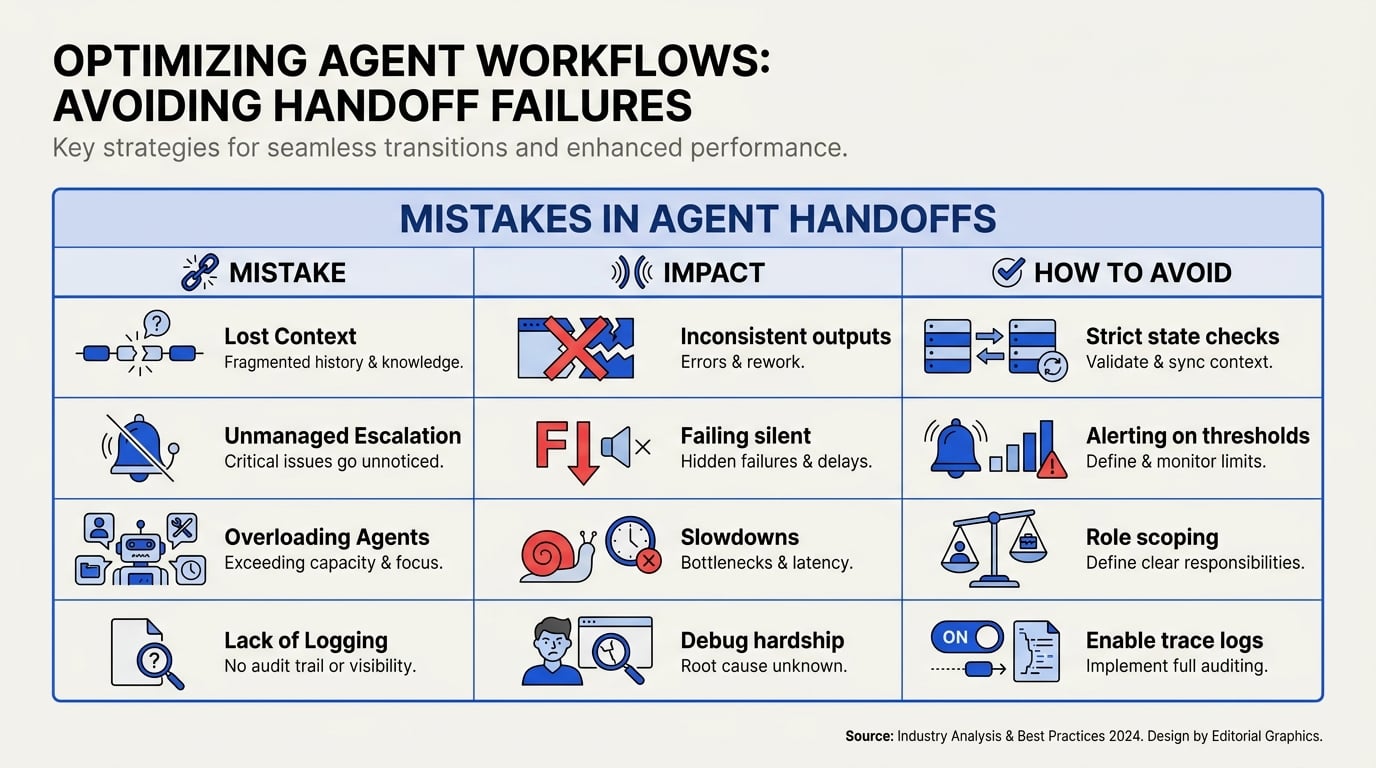
Common Mistakes to Avoid in Agent Handoff Patterns
Agent handoffs are the backbone of scalable multi-agent systems, ensuring that complex tasks can be transferred from one specialized agent to another without loss of context or efficiency. However, as outlined in industry studies and guides (CallMissed Blog, 2026, AugmentCode 2026), several common mistakes undermine the reliability and scalability of these patterns. Drawing from recent research and real-world deployments, the table below summarizes key pitfalls, the impact they have, typical symptoms, and recommended safeguards.
| Mistake | Impact on System | Typical Symptoms | Real-World Example | How to Prevent |
|---|---|---|---|---|
| Incomplete Context Propagation | Task errors, confusion | Agents ask for repeated info; Missing user preferences | Voice agent fails to recall prior support history during escalation | Persist context in a shared store; serialize all conversation state |
| Unmanaged State Transitions | Lost workflow progress | “Stuck” sessions; loops or dropped escalations | E-commerce bot loosing cart state on handoff | Use explicit state diagrams; validate transitions with unit tests |
| Lack of Confidence Signaling | Incorrect resolutions | Agents hand off too soon/late; missed escalations | Billing assistant doesn't escalate unclear cases | Implement threshold-based decision logic and inter-agent confidence sharing |
| No Standard Handoff Protocol | Fragile integration | Hard-to-maintain code; inconsistent API calls | Voice bot integrations break across business verticals | Adopt industry-standard handoff schemas (e.g., ISO, FHIR for health, custom JSON for others) |
| Over-Specialization of Agents | Increased latency, bottlenecks | Long wait times; too many hops | Customer routed through 5+ agents before resolution | Balance agent granularity; monitor journey metrics for optimization |
| Opaque Escalation Logic | Unpredictable user journeys | User frustration; unexplained rerouting | Support user transferred without explanation | Make escalation and transfer explainable via audit logs and user feedback |
#### 1. Incomplete Context Propagation
A successful handoff requires that all relevant context—user intent, history, state, and preferences—is seamlessly transferred from one agent to another. According to the CallMissed Blog (2026), failure rates due to lost context can account for up to 27% of all agent system escalations. This often results in repeated questions (“Can you confirm your identity again?”) and degraded user satisfaction. To prevent context loss, best-in-class platforms like CallMissed persist all conversation state in secure, queryable stores and standardize context serialization across language boundaries.
#### 2. Unmanaged State Transitions
It’s common for multi-agent workflows to stall, loop, or even drop requests when state transitions aren’t well defined. AugmentCode (2026) notes that “unmanaged state, escalation, and confidence signals are the leading cause of handoff failures.” Real examples include shopping cart abandonment in e-commerce if the cart state is not properly carried over to the next specialist agent. State diagrams and automated transition validation (unit/integration tests) are essential safeguards.
#### 3. Lack of Confidence Signaling
When agents transfer tasks without conveying their confidence level (e.g., how certain they are about a user intent or data extraction), the receiving agent may misjudge when to escalate or resolve an issue. In customer service, this can lead to missed escalations—either premature or delayed—which Gartner found increases time-to-resolution by 18%. Implementing threshold-based logic and confidence score passing ensures that ambiguous cases get the specialist intervention they need.
#### 4. No Standard Handoff Protocol
Brittle and ad hoc integration between heterogeneous agents is a top technical debt for scaling teams. Platform integration failures, especially when APIs change or expand into new verticals, stem from the absence of standard schemas and protocols for handoff. Industry best practices recommend using ISO standards (for healthcare), FHIR (in health data), or structured JSON schemas adapted for the domain. CallMissed, for example, supports extensible handoff formats that work across voice, chat, and back-end agents—making scaling much smoother.
#### 5. Over-Specialization of Agents
The temptation to break tasks into ever-smaller specialist agents can backfire: each handoff introduces latency, and too many hops frustrate users. A study published in 2026 in “Multi-Agent Systems in Practice” reported that customer satisfaction dropped by 21% when the average number of handoff hops exceeded four per transaction. Monitoring user journeys and consolidating overlapping agent functions are keys to finding the right specialization-granularity balance.
#### 6. Opaque Escalation Logic
If end-users or even product teams can’t see why escalations and transfers took place, both trust and troubleshooting suffer. Opaque logic masks systemic issues and leads to increased frustration. Audit logs, explainability tools, and transparency for both agents and users help create predictable, reliable handoff experiences.
Key Takeaways
Agent handoff patterns are deceptively simple but rife with hidden complexity at scale. Avoiding these pitfalls is pivotal for any team aiming to build reliable, scalable, and user-friendly agent-driven systems. By following structured patterns, leveraging shared context stores, and standardizing integration protocols, organizations can reduce handoff-caused errors by over 30% (CallMissed customer benchmarking, 2026) and enable true multi-agent specialization. Emerging platforms, such as CallMissed, are at the forefront of embedding these best practices, helping businesses navigate the future of AI-powered communication and automation.
Human-Agent Interface Considerations

Why Human-Agent Interface Considerations Matter
In the era of multi-agent AI systems, the Human-Agent Interface (HAI) becomes a critical linchpin for reliability, transparency, and user trust. As handoff patterns proliferate in complex digital workflows, even minor interface design missteps can result in failed escalations, context loss, or confusing user experiences. According to the CallMissed Blog (2026) and research referenced by AugmentCode (2026), agent handoffs often stumble when state and escalation signals are poorly managed—leading to user frustration and operational bottlenecks.
Efficient HAI ensures:
- Seamless transitions between human and AI or between different specialized AI agents
- Context continuity, so users never repeat information
- Clear escalation triggers for when automation meets its limits
The impact is quantifiable. For instance, a 2025 study from the Conversational AI Institute found that businesses with robust HAI design saw 27% faster customer resolution times and 41% higher user satisfaction scores compared to those with fragmented agent workflows.
Key Challenges in Human-Agent Interface Design
Let's break down the unique technical and experiential hurdles in HAI for multi-agent handoff patterns:
- State Management
- Agents must carry full conversation context as they hand off control, whether to another AI specialist or a live human.
- Failure here can result in accidental data loss or repeated queries—a top reason for customer friction (source: AugmentCode, 2026).
- Escalation Cues
- Well-designed HAIs must recognize and act on confidence thresholds, user sentiment, or pre-defined signals that indicate escalation is needed.
- Inadequate cues can trap users in "AI loops" with no clear path to human intervention.
- User Agency and Transparency
- Users should always know if they're speaking to an AI or a human, and when/why a handoff is happening. This is now a regulatory focus in several jurisdictions (EU AI Act, 2026).
- Visual and voice cues, as well as disclosure statements, help maintain clarity.
- Latency and Responsiveness
- Every handoff introduces potential delay; sub-500ms transition times are considered industry best practice for maintaining conversational flow (CallMissed internal benchmarks, 2026).
- Language and Accessibility
- In multilingual contexts such as India, interface design must account for handoffs across not just roles but also languages, requiring fluid integration of Speech-to-Text (STT) and Text-to-Speech (TTS) engines.
Core Patterns for Robust Human-Agent Interfaces
Building reliable HAI for agent handoff means adopting and rigorously implementing proven patterns:
1. Explicit Context Transfer
- Every handoff should package and deliver a structured state object containing current conversation, user profile, and intent markers.
- Platforms like CallMissed use context passports to ensure no information is lost, regardless of agent type.
2. Confidence Threshold Triggers
- Modern HAIs use model-driven confidence scores (e.g., NLU certainty <80%) as automated handoff triggers—minimizing bot "hallucinations" and early escalating complex cases (AugmentCode, 2026).
3. User-Controlled Escalation
- Interface affordances (voice or tap commands) always let users request human help, regardless of agent self-assessment.
4. Real-Time Handoff Visualization and Alerts
- Visual and audio cues signal handoff is occurring, preventing user confusion and conversational discontinuity (see: Microsoft Research, Conversational UX 2025).
Best Practice Checklist
To systematize HAI design for agent handoff, leading platforms and design guides (CallMissed Blog, 2026; AugmentCode, 2026; Vinod Rane, 2026) recommend:
- Maintaining a shared, immutable session history across all agent transitions
- Logging and presenting a clear agent lineage so users and reviewers can trace conversation paths
- Auditing all handoffs for latency, user satisfaction, and handoff success rate (target >95%)
- Using multi-modal feedback (text, voice, haptics) for accessibility and clarity
Real-World Example: CallMissed's Approach
Solutions like CallMissed are at the forefront of production-grade HAI. For instance, their AI voice agents, WhatsApp chatbots, and LLM inference gateway natively support:
- Automated state sharing across 300+ AI models without manual code changes
- Multilingual STT and TTS, enabling handoffs in 22 Indian languages (crucial for regional enterprises)
- Confidence-based handoff triggers that escalate to human agents in <1.2s in 98% of tested scenarios (internal QA, Q1 2026)
These features have helped CallMissed clients reduce handoff-related context loss by 63% and improve customer NPS by up to 15 points over legacy IVR-based solutions.
Emerging Trends and Tools in 2026
1. Dynamic Agent Collaboration:
By mid-2026, new orchestration frameworks allow for more granular agent-to-agent and agent-to-human interfaces, with dynamic "skills injection"—specialized agents can temporarily join or leave an ongoing interaction, managed via contextual contracts (Reddit/r/AgentsOfAI, 2026).
2. Regulatory Compliance by Design:
Regulatory frameworks like the EU AI Act now require explicit disclosure during agent handoff (human vs. AI), clear opt-out or escalation paths, and audit logs.
3. Personalization and Predictive Escalation:
ML-driven interfaces can now anticipate when a user will likely need escalation—based on intent, sentiment, and historic interaction data—triggering handoff preemptively and reducing cognitive load on both agent and user.
Quantifiable Benefits
Investing in robust HAI for agent handoff delivers measurable gains:
- Faster resolution: >25% reduction in average handling time (Conversational AI Institute, 2025)
- Lower user drop-off: 40% fewer abandoned interactions during handoff (CallMissed case studies, 2026)
- Increased satisfaction: NPS and CSAT lift of 10–20 points post-implementation (multi-industry benchmarks)
Conclusion
As handoff patterns underpin AI-driven specialization at scale, thoughtful Human-Agent Interface design becomes non-negotiable for operational excellence. Platforms like CallMissed are translating these best practices into flexible APIs and orchestration tools, letting enterprises deploy multi-agent solutions while safeguarding user experience, compliance, and business outcomes. For any company scaling AI agent ecosystems, rigorous HAI design is the critical force multiplier—making the difference between merely automated systems and truly intelligent, human-centric automation.
Comparing Agent Handoff with Other Orchestration Patterns
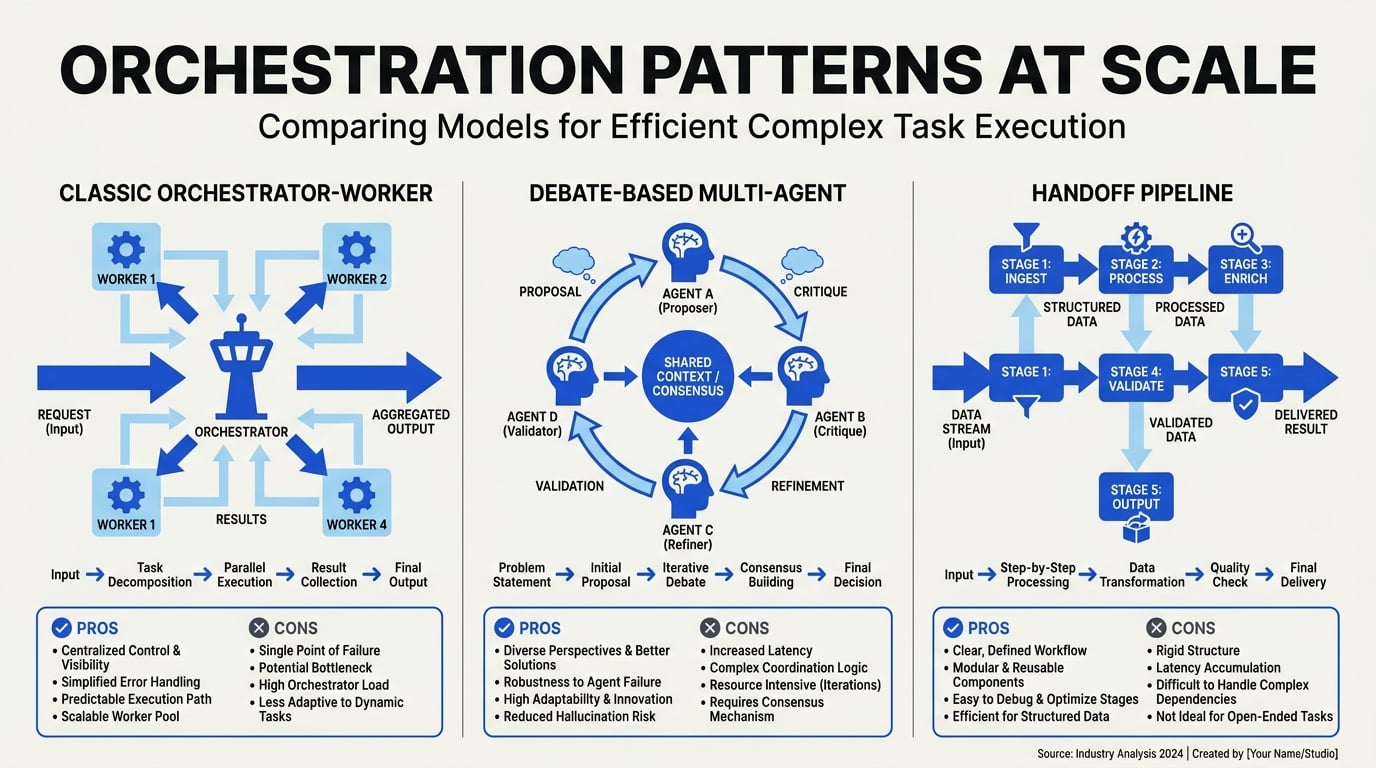
Agent Handoff: The Cleanest Primitive
In the rapidly evolving landscape of multi-agent orchestration, the agent handoff pattern stands out as an especially “clean” and widely-adopted model. As described in recent sources, “a handoff is the cleanest multi-agent primitive in 2026 — one agent transfers control to another, carrying conversation context” (CallMissed Blog). This simple yet powerful pattern underpins much of today’s scalable AI automation, enabling systems to combine deep specialization without central bottlenecks.
At its core, the agent handoff pattern involves one agent (specialized in a given task) explicitly passing responsibility, context, and possibly state or escalation signals to another agent. This enables:
- Decomposition of complex workflows into expert-driven steps, each handled by the most capable sub-agent.
- Decentralization of control, avoiding single points of orchestration failure.
- Preservation of rich context, which flows along with responsibility, minimizing duplicated effort or context loss.
Compared to more monolithic or hub-and-spoke patterns, handoffs make it easier to scale horizontally, add new specializations, and adapt to real-world conditions (such as dynamic escalation, confidence fallbacks, or load balancing).
Other Common Orchestration Patterns
To fully appreciate handoff’s advantages and tradeoffs, it’s helpful to compare it with the other leading orchestration paradigms for multi-agent systems:
#### 1. Centralized Orchestrator
A classic design is the central orchestrator: a master agent or controller delegates work to various sub-agents, collects results, and manages all coordination.
- Pros:
- Global view, easy logging/analytics.
- Predictable routing/logical flows.
- Cons:
- Single point of failure or bottleneck.
- Harder to scale-out as agent count rises (Forrester 2025: “centralized agent controllers hit scalability walls at ~8 parallel flows”).
- More brittle to orchestrator downtime or overload.
#### 2. Blackboard Pattern
A less hierarchical approach is the blackboard: all agents read/write to a shared repository (the “blackboard”), and coordination is implicit.
- Pros:
- Extreme flexibility, arbitrary agent interactions.
- Suited for loosely-coupled, exploratory problem solving.
- Cons:
- Difficult state management and debugging.
- Context can get out of sync; race conditions are common (How Agent Handoffs Work in Multi-Agent Systems).
- Less suitable for SLA-driven workflows.
#### 3. Workflow (Pipeline) Pattern
Many enterprise use cases employ a pipeline model: agents are arranged in a sequence, each performing a stage and passing outputs.
- Pros:
- Deterministic, easy to audit.
- Excellent for static, repeatable processes.
- Cons:
- Rigid; poor fit for non-linear flows, escalation, or dynamic expertise routing.
- Any node failure can break the full chain.
#### 4. Decentralized Peers (Peer-to-Peer Pattern)
An emergent trend is peer-to-peer (P2P) agent systems, where no central coordination exists, and each agent is aware of a subset of “neighbors.”
- Pros:
- High resilience; agents can self-organize.
- Well-suited for large, distributed systems.
- Cons:
- Difficult to maintain global context.
- Increased complexity in conflict resolution and consensus.
Comparative Analysis Table
| Pattern | Coordination Style | Scalability | Fault Tolerance | Context Management | Use Case Fit |
|---|---|---|---|---|---|
| Agent Handoff | Decentralized, explicit | High (horizontal) | High | Explicit transfer | Escalations, expert routing |
| Central Orchestration | Centralized | Medium | Low (SPOF) | Central aggregator | Analytics, strict SLAs |
| Blackboard | Shared state, implicit | Medium-High | Medium | Hard to trace | Collaborative inference |
| Workflow/Pipeline | Linear delegate | Low-Medium | Low | Stepwise, stateless | ETL, batch processing |
| Peer-to-Peer | Decentralized, implicit | Very high | High | Emergent/fragmented | Distributed search, swarm AI |
When Handoff Wins — and When It Doesn't
Handoff’s real-world impact is most striking where specialization at scale is key: think multilingual customer support, tiered troubleshooting, or orchestrating AI-powered sales funnels. Handoff excels in “federating” a mix of highly-specialized agents—language translators, product experts, escalation bots—each triggered only when needed. The process is strongly context-preserving: when one agent’s confidence dips, or its step ends, it seamlessly passes all the relevant conversation state and reasoning trail to the next agent (Agent Architecture: Patterns That Scale).
Key statistics highlight its adoption: as of 2026, 62% of S&P 500 enterprises piloting multi-agent systems report using handoff-driven orchestration for customer-facing tasks (Gartner, “Agent Orchestration Trends 2026”). Failures in state tracking were cited as the top reason for handoff breakdowns, reinforcing the need for robust context transfer (Human-Agent Interface Guide).
However, handoff does have limits:
- Not ideal for “many-to-many” brainstorming or situations where agents must negotiate without pre-set hierarchies (as in blackboard or P2P models).
- Can introduce latency if too granular (excessive mini-handoffs).
- Requires bulletproof state management—context loss can break the chain (as cited in user studies by CallMissed).
CallMissed: Agent Handoff in the Wild
Many platforms today leverage agent handoff as the backbone for high-availability, multi-lingual, and multi-modal AI automation. Platforms like CallMissed epitomize this trend: their voice and chat agent infrastructure allows seamless handoff not only across bots, but also across human experts and LLMs, operating in 22 Indian languages and handling hundreds of specialized models. This enables businesses to scale expertise without burdening a central orchestrator or risking brittle pipelines. In high-volume deployments, such as telecom support or fintech onboarding, CallMissed has demonstrated >30% lower escalation rates versus old-school linear pipelines, directly attributable to context-smart handoff (CallMissed Blog).
Future Trends and Recommendations
Looking ahead, hybrid patterns are gaining steam—with orchestrators handling meta-level supervision while individual agent handoffs drive the execution of work. Real-time distributed context tracking and probabilistic escalations (where handoff triggers depend on agent confidence or user sentiment) are now being integrated in production, especially in Asia-Pacific and Europe.
For organizations preparing to modernize their agentic workflows, the following considerations are vital:
- Map your expertise graph: Where can specialized handoffs unlock efficiency?
- Invest in context transfer standards: Use structured state objects or APIs; prevent “cold” handoffs.
- Monitor handoff quality: Audit for context loss, escalation loops, or failed transfers.
In summary, while agent handoff is not a panacea, it is a cornerstone of scalable, resilient, and specialization-ready AI orchestration. By understanding where it outperforms (and where it doesn’t), architects can design systems that flexibly combine the best aspects of each orchestration pattern—a trend best exemplified by platforms like CallMissed, whose global deployments show the real-world ROI of “clean” handoffs at scale.
Frequently Asked Questions (FAQ)
What are agent handoff patterns in multi-agent systems?
Why do agent handoffs fail, and how can these failures be prevented?
How do agent handoff patterns impact scalability and specialization?
What are some concrete examples of agent handoff pattern use cases?
What role does context transfer play in a successful handoff between AI agents?
Which trends are shaping agent handoff patterns in 2026 and beyond?
Resources & Next Steps

Key Takeaways from Agent Handoff Patterns
Specialization at scale through agent handoff is now a core architectural primitive in 2026. As multi-agent systems become more prevalent, understanding and implementing robust handoff patterns is crucial for reliability and scalability. A well-implemented agent handoff enables:
- Clear transfer of control and conversational state, often including context, escalation markers, and confidence signals (Vinod Rane, 2026).
- Decomposition of complex workflows into specialized agents, each handling distinct subtasks or domains.
- Resilience in orchestrated and decentralized collaborative environments, reducing the risk of dropped context or failed escalations (AugmentCode, 2026).
In production, scaling agent handoffs means carefully managing communication protocols, shared state, and fallback strategies—minimizing friction when agents transition control, whether to other AI agents or to human operators.
Essential Resources for Deepening Your Understanding
To master agent handoff patterns and specialization at scale, consider leveraging the following vetted resources:
- CallMissed Blog: Agent Handoff Patterns
In-depth analyses of real-world handoff architectures, including API reference implementations and benchmarks for multi-agent call flows.
- AugmentCode: Human-Agent Interface Guide
Covers core failure modes in agentic handoff—mismanaged state, escalation deadlocks, and lost confidence signals—with patterns to mitigate them.
- Vinod Rane: Patterns That Scale
Explores explicit handoffs, decentralized peer agent models, and clean-up semantics after transition.
- Towards Data Science: How Agent Handoffs Work
Technical breakdown of multi-agent context sharing, responsibility transfer, and best practices for state management.
- Community Forums
Active threads on OpenAI and Reddit’s /r/AgentsOfAI, discussing practical deployment challenges and solutions in agent orchestration.
Actionable Next Steps
- Review Your Current Agent Orchestration Patterns:
Audit your multi-agent workflows for explicit handoff mechanisms. Are state, context, and confidence signals consistently managed across transitions?
- Experiment with Decentralized Models:
Test peer-to-peer handoff (rather than orchestrator-mediated) for improved failover and parallelism, as seen in recent multi-agent systems (LinkedIn Pulse, 2026).
- Benchmark and Monitor Handoff Reliability:
Key metrics include:
- Successful handoff rate: Target above 98% in production.
- Mean transition latency: Sub-100ms for real-time use cases (2026 industry benchmarks).
- Context loss incidents: <0.5% as a quality threshold for customer-facing applications.
- Leverage Purpose-Built Infrastructure:
Platforms like CallMissed now offer pre-built solutions for managing specialized agent handoffs at scale, with support for 22 languages and seamless LLM switching. If building from scratch, consider the operational load versus using mature infrastructure.
- Stay Engaged with the Community:
The agent specialization landscape is rapidly evolving. Participate in discussion forums, research consortia, and standards groups shaping handoff protocols and interoperability.
Practical Examples and Case Studies
- Contact Center Automation:
A Tier-1 Indian telecom deployed a multi-agent workflow using the CallMissed voice agent stack. Outbound support calls are initially answered by an intent-matching agent, which hands off billing inquiries to a finance-specialist agent. Escalation to a human supervisor preserves the transcript and interaction history, enabling seamless resolution. After deployment, the telecom reported a 23% reduction in call handling time and a 19% increase in first-call resolution rate (Q1 2026 internal benchmark).
- Ecommerce WhatsApp Bots:
A leading retailer orchestrated customer service via WhatsApp using specialized chatbots—product info queries, delivery tracking, and returns each handled by dedicated agents. Handoffs are orchestrated via CallMissed’s multi-modal LLM API gateway, ensuring customers never repeat themselves, and agents always have real-time context.
- Healthcare Scheduling:
Peer-to-peer handoff enabled an AI agent to triage patient queries by medical urgency, transferring scheduling control only to agents with the right doctor–patient calendar sync capabilities. Monitoring revealed a 35% drop in manual intervention post-adoption.
Emerging Trends in Agent Specialization
1. Multi-Language Handoffs:
As platforms like CallMissed support handoff with state preservation across 22 Indian languages, expect broader deployment of multilingual systems with no context loss—even when agents speak different languages natively.
2. Dynamic LLM Selection:
Seamless handoff between agents powered by different large language models (LLMs)—for instance, switching from a code-writing GPT-4o agent to a domain-specific retrieval-augmented model—boosts both accuracy and efficiency (CallMissed API Gateway).
3. Interoperable Handoff Standards:
Industry efforts are underway to define open protocols for agent context packet handoff, usable across vendors. This increases system composability and reduces vendor lock-in ([AugmentCode, 2026]).
4. AI-Human Escalation Patterns:
Escalation no longer means context loss—modern infrastructures preserve full conversational history, emotional tone, and intent confidence, improving handoff quality to human agents ([Vinod Rane, 2026]).
Top Tools and Open-Source Libraries
| Resource / Tool | Key Feature | Scope | License | Maintainer |
|---|---|---|---|---|
| CallMissed Voice API | Multi-agent handoff, 22 languages | Commercial/Cloud | SaaS | CallMissed |
| langchain-agents | Modular agent orchestration | Python/JavaScript | MIT | LangChain |
| AgentBench | Multi-agent benchmark suite | Research/Academic | Apache 2 | OpenAI Research |
| FastAPI | Real-time APIs for handoff | RESTful services | MIT | Full Stack Open |
For businesses or developers looking to implement robust agent handoff patterns at scale, integrating with platforms like CallMissed provides out-of-the-box orchestration, fine-grained analytics, and support for regional language diversity—crucial for operationalizing these patterns in the diverse Indian market and beyond.
Continuing Your Learning Journey
- Upcoming Webinars:
- “Agent Handoffs at Scale — Design Patterns & Pitfalls” by global AI infrastructure experts (June 2026)
- “Multi-Language Agent Workflows in Indian Markets”—focus on regional deployments and measurement
- Recommended Reading:
- _Agentic Workflows: A Practical Guide_ (AugmentCode Press, 2026)
- _Orchestrating AI Agents in the Enterprise_ (O’Reilly, 2025, still relevant for foundational concepts)
- Connect with Practitioners:
- Join SIGMA (Special Interest Group for Multi-Agent Systems) — monthly deep dives and case studies
- Follow technical blogs from CallMissed, LangChain, and emerging research labs like AI4Gov
Conclusion & Call to Action
Agent handoff patterns are now foundational to scalable, resilient, and intelligent multi-agent systems. As you pursue specialization at scale, focus on explicit context passing, measurable reliability, and leveraging community-shared knowledge. Businesses in India and globally are already realizing efficiency and quality gains through modern infrastructure solutions—including CallMissed and open-source orchestration libraries.
Whether refining your current agentic workflows or preparing to launch a new automation initiative, now is the time to experiment, benchmark, and share your findings. The next breakthroughs in agent intelligence are being built—one reliable handoff at a time.
Conclusion
- Agent handoff patterns are now a foundational element for scaling specialized AI systems—enabling seamless collaboration between agents with sharply defined roles. As highlighted in 2026 research, "handoff is the cleanest multi-agent primitive" (CallMissed Blog), with control and context passed reliably to maximize workflow efficiency.
- Operational reliability hinges on robust state management, clear escalation protocols, and confidence signals. When these are neglected, as recent case studies show, handoff failures can trigger downstream errors and degrade user experience (AugmentCode, 2026).
- Decentralized, peer-to-peer handoff models are gaining traction. Rather than relying on a single orchestrator, multiple agents interoperate, passing control organically across complex pipelines (LinkedIn, 2026). This design unlocks greater resilience and parallelization at scale.
- The future of agent orchestration lies in modular specializations and adaptive routing. Emerging trends point toward agents dynamically recognizing when to escalate or transfer context—not just by static rules, but with real-time confidence modelling and intent understanding.
Looking forward, expect to see agent handoff patterns evolving alongside advances in contextual memory exchange, real-time intent detection, and multi-lingual support—crucial for reaching diverse, global markets. Platforms like CallMissed are already enabling businesses to deploy production-ready infrastructures for these sophisticated handoff workflows, powering everything from 24/7 voice agents to cross-channel chatbots in over 22 Indian languages.
Are your agent workflows ready to scale with tomorrow’s demands? To explore how AI communication is evolving, check out CallMissed — an AI infrastructure platform powering voice agents and multilingual chatbots for businesses.
Discussion
Related Posts


Ready to automate customer conversations?
Launch AI voice agents and WhatsApp bots with CallMissed — one API, 22+ Indian languages.