

CallMissed 22 Indian Languages: Voice AI Testing and Deployment Guide


Validate CallMissed 22 Indian languages with practical checks for code-switching, STT, TTS, accents, handoff, consent and launch.
CallMissed 22 Indian Languages: Voice AI Testing and Deployment Guide
What happens when a customer asks a billing question in Hindi, switches to English for a product name, and gives an address in Marathi—all in one breath? A production-ready system must do more than “support” a language: it must understand the speaker, preserve intent, pronounce the reply naturally, and recover safely when confidence drops. The CallMissed 22 Indian languages guide begins from that practical standard, not from a checkbox on a feature page.
India’s Eighth Schedule recognizes 22 scheduled languages, according to the Government of India’s Department of Official Language as of August 2026. Yet the Census of India 2011 classified 121 languages spoken by at least 10,000 people each, showing why “Indian language support” cannot be treated as a single, uniform requirement. The Census of India 2011 also reported that 43.63% of residents named Hindi as their mother tongue, meaning most Indians reported another mother tongue. For any team evaluating a multilingual AI voice agent India deployment, linguistic coverage therefore matters as much as model intelligence.
This guide shows how to choose languages by caller demand, geography, channel and task—not by national population alone. You will learn how to:
- Test Speech-to-Text (STT) with regional accents, noisy mobile audio, names, numbers and industry vocabulary.
- Evaluate Text-to-Speech (TTS) for pronunciation, pace, politeness, gender expectations and intelligibility rather than merely checking whether audio plays.
- Design code-switching, low-confidence prompts, language confirmation, fallback behavior and human handoff without trapping callers in repetitive loops.
- Score task completion, transcript accuracy, semantic correctness, latency and caller experience before expanding traffic.
- Build consent, disclosure, recording and retention controls into the call flow from the start.
CallMissed, an AI-native customer-engagement platform built in India, states that its Indic-first Speech-to-Text and Text-to-Speech capabilities cover 22 Indian languages and can power AI voice agents across phone and WhatsApp Business calling. Treat that coverage as a first-party capability claim, then validate it against your exact language pair, accent mix, call quality, vocabulary and workflow before production use. An Indian language voice AI pilot should include real utterances, adversarial code-switching cases, business-specific terms, and thresholds for escalation. The goal is not a demo voice; it is a dependable service that knows when it understood the caller, when to ask again, and when to transfer the conversation—to a person. By the end, you will have a deployment checklist for moving from a pilot to production without confusing language availability with proven performance.
What does CallMissed support for 22 Indian languages mean, and what should you verify first?
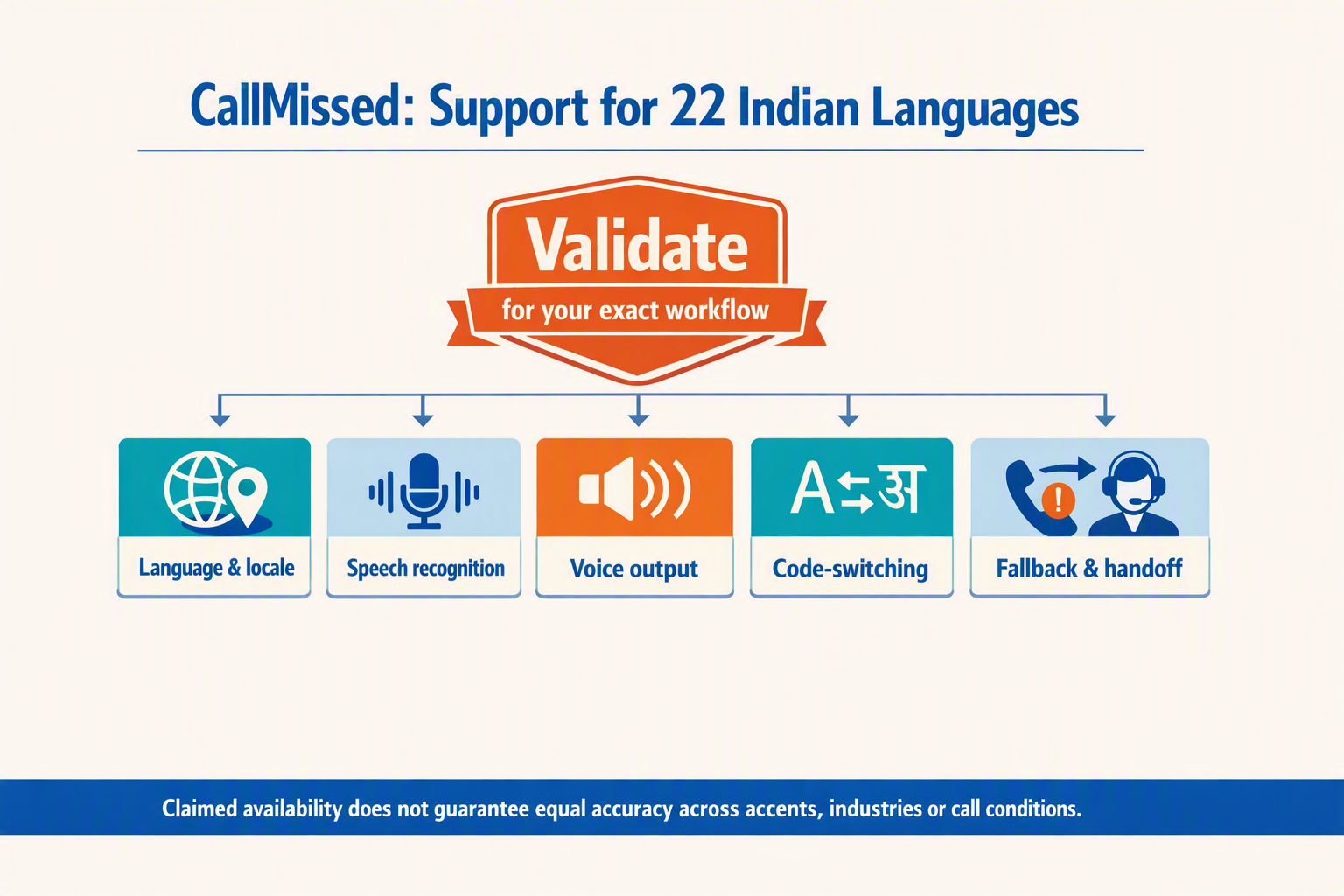
CallMissed’s support for 22 Indian languages means its Indic-first Speech-to-Text (STT) and Text-to-Speech (TTS) stack is designed to recognize and generate speech across those languages. It does not automatically guarantee equal accuracy for every accent, dialect, language pair, call channel or business workflow; each intended deployment must be tested independently.
Interpret “language support” across the full voice pipeline
A production Indian language voice AI system needs more than a selectable language label. Verify support at four separate layers:
- STT recognition: Can the system transcribe the caller’s speech, including names, numbers, addresses and English product terms?
- Intent understanding: Does the agent preserve meaning when the transcript contains regional phrasing, transliterated words or incomplete sentences?
- TTS generation: Can it pronounce the response intelligibly, with appropriate pace, emphasis and politeness?
- Conversation control: Can the agent detect uncertainty, request clarification, change languages and transfer the call without losing context?
The phrase CallMissed 22 Indian languages is a first-party coverage claim, not a universal accuracy benchmark. Before configuration, confirm the currently available language list in CallMissed documentation or the product interface, along with whether each required language is enabled for both STT and TTS. Do not assume that the number 22 necessarily maps one-to-one to India’s constitutional language categories or to every regional variety.
India’s Eighth Schedule recognizes 22 scheduled languages, according to the Government of India’s Department of Official Language as of August 2026. However, the Census of India 2011 identified 121 languages spoken by at least 10,000 people, illustrating why a broad coverage count cannot describe every dialect, accent or local speech pattern.
Define the language requirement before choosing a model
Build a language matrix from real caller demand rather than selecting every available option. For each workflow, document:
- Primary and secondary languages, including expected language switching.
- Regions and accents, such as differences between urban and rural speakers.
- Call channels, including conventional telephone audio and WhatsApp Business calling.
- Tasks, such as appointment booking, collections, order tracking or technical support.
- Critical vocabulary, including brand names, abbreviations, place names and industry terminology.
- Risk level, especially where incorrect dates, amounts or account details could cause harm.
For a multilingual AI voice agent India deployment, “Hindi” alone is not a complete specification. A caller population may use Hindi with English terminology, region-specific pronunciation and numerals spoken in more than one language.
Run a minimum verification test first
Before building the full conversation, test 20–30 representative utterances per target language and workflow. Include clean recordings, mobile-call audio and naturally code-switched speech. The first test should answer three go/no-go questions:
- Does STT capture the meaning and critical entities, not merely most words?
- Does TTS pronounce business terms and customer-facing prompts clearly?
- Does the agent recover safely when the language or transcript is uncertain?
CallMissed can power voice agents over phone and bridge WhatsApp Business calls to an AI agent, but channel-specific audio must be evaluated separately. Advance only when your team has documented acceptance thresholds for entity accuracy, task completion, response latency and human escalation.
Why is Indian language voice AI more complex than translating a single call script?
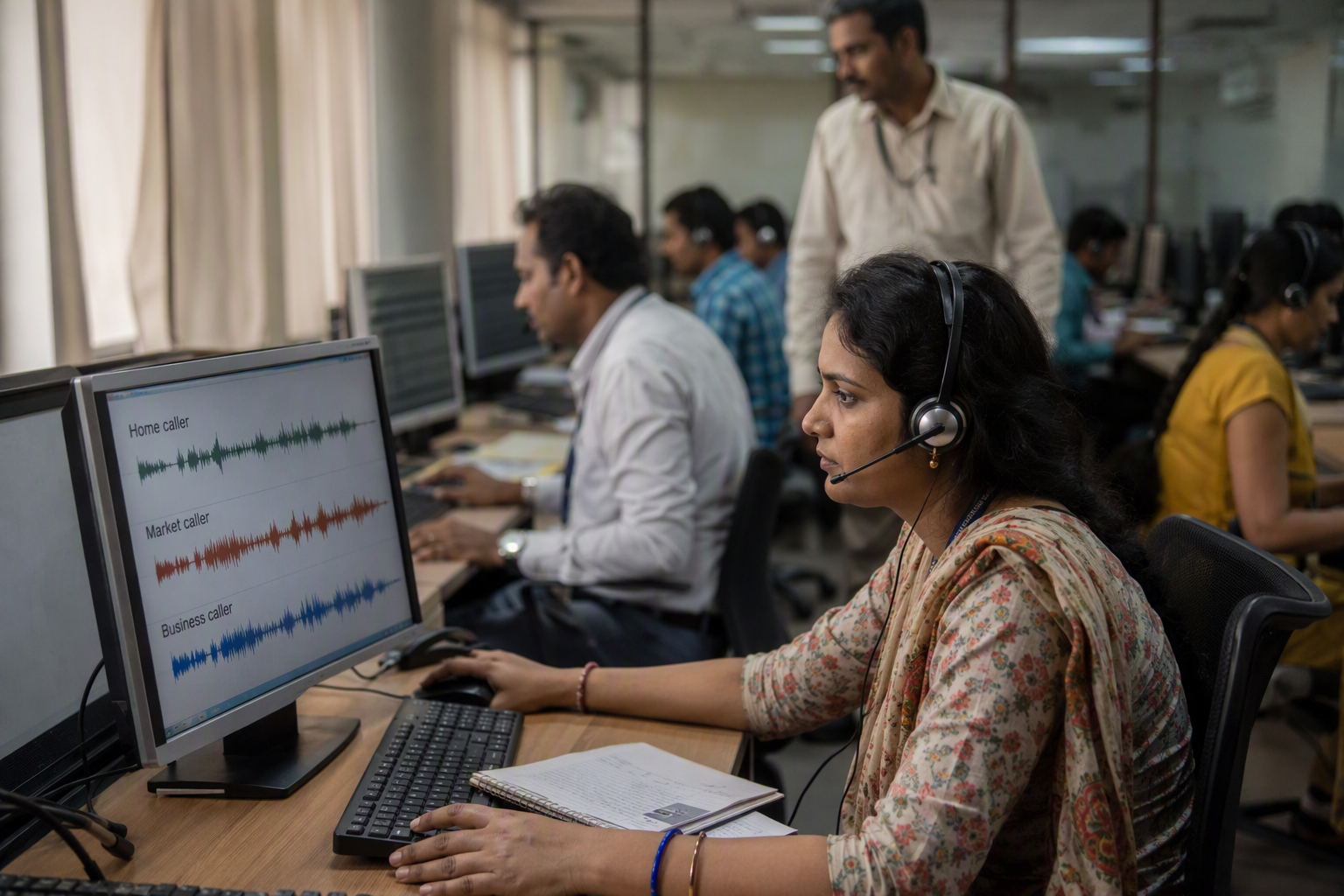
Indian language voice AI is more complex than script translation because a caller’s speech, accent, vocabulary, grammar and social context rarely map neatly to one written language. A reliable system must interpret mixed-language audio, preserve business intent and generate a response that sounds appropriate—not merely translate words.
One call may contain several language systems
Indian conversations commonly combine a regional language with English product names, abbreviations, numbers and technical terms. A caller might say, “Mera EMI due date change karna hai,” pronounce an account number in English, and give a locality name in another language.
This creates several challenges:
- Code-switching: The Speech-to-Text (STT) system must change language assumptions within an utterance rather than at the next turn.
- Transliteration: A caller may use Hindi words that would be written in Latin characters in a CRM, while the model internally represents them in Devanagari.
- Named entities: People, neighbourhoods, medicines and product SKUs may not appear in a general-language vocabulary.
- Number interpretation: “Pachchis hazaar five hundred” must resolve to 25,500, not two unrelated values.
- Borrowed terminology: Words such as “premium,” “claim,” “OTP” and “delivery slot” may be more natural than their formal translations.
For a multilingual AI voice agent India deployment, the language setting should therefore be treated as a routing signal—not a rule that every word must belong to one language.
Language labels do not represent every speaker
India’s Eighth Schedule recognizes 22 scheduled languages, according to the Government of India’s Department of Official Language as of August 2026. However, each language can include regional accents, dialects, speech rates and pronunciation patterns that materially affect recognition.
An STT model configured for Hindi may encounter speakers influenced by Bhojpuri, Haryanvi or regional Urdu usage. Tamil pronunciation and vocabulary can vary by region, while a customer’s age, education, occupation and exposure to English can further shape speech. Mobile-network compression, background traffic and inexpensive microphones add acoustic variation unrelated to language itself.
Consequently, teams evaluating the CallMissed 22 Indian languages capability should build test sets from their own caller population. A translated studio recording cannot represent actual customer traffic.
Meaning, tone and pronunciation require separate controls
Translation quality does not guarantee STT accuracy or natural Text-to-Speech (TTS). These are distinct layers:
- STT determines what the caller said.
- Intent processing determines what the caller wants.
- Business logic checks permissions, policies and account data.
- Response generation selects the appropriate language and level of formality.
- TTS determines how the response sounds.
A grammatically correct response can still fail if TTS mispronounces a customer’s name, stresses an acronym incorrectly or speaks a confirmation number too quickly. Politeness also matters: pronoun choice, honorifics and verb forms can make a response sound respectful, distant or rude.
Business vocabulary must be engineered, not simply translated
Create a domain lexicon before testing CallMissed or any other Indian language voice AI system. Include:
- Brand, product and competitor names
- Cities, localities and landmark variants
- Acronyms, SKUs and alphanumeric identifiers
- Industry terms and commonly used English borrowings
- Formal, colloquial and mispronounced versions of key phrases
- Preferred TTS pronunciations and words that must remain untranslated
The practical unit of quality is therefore not “language supported.” It is language + accent + channel + vocabulary + task. That combination determines whether the agent can complete a real call safely and naturally.
Which languages, accents and workflows should a multilingual AI voice agent India deployment prioritize? (TABLE)
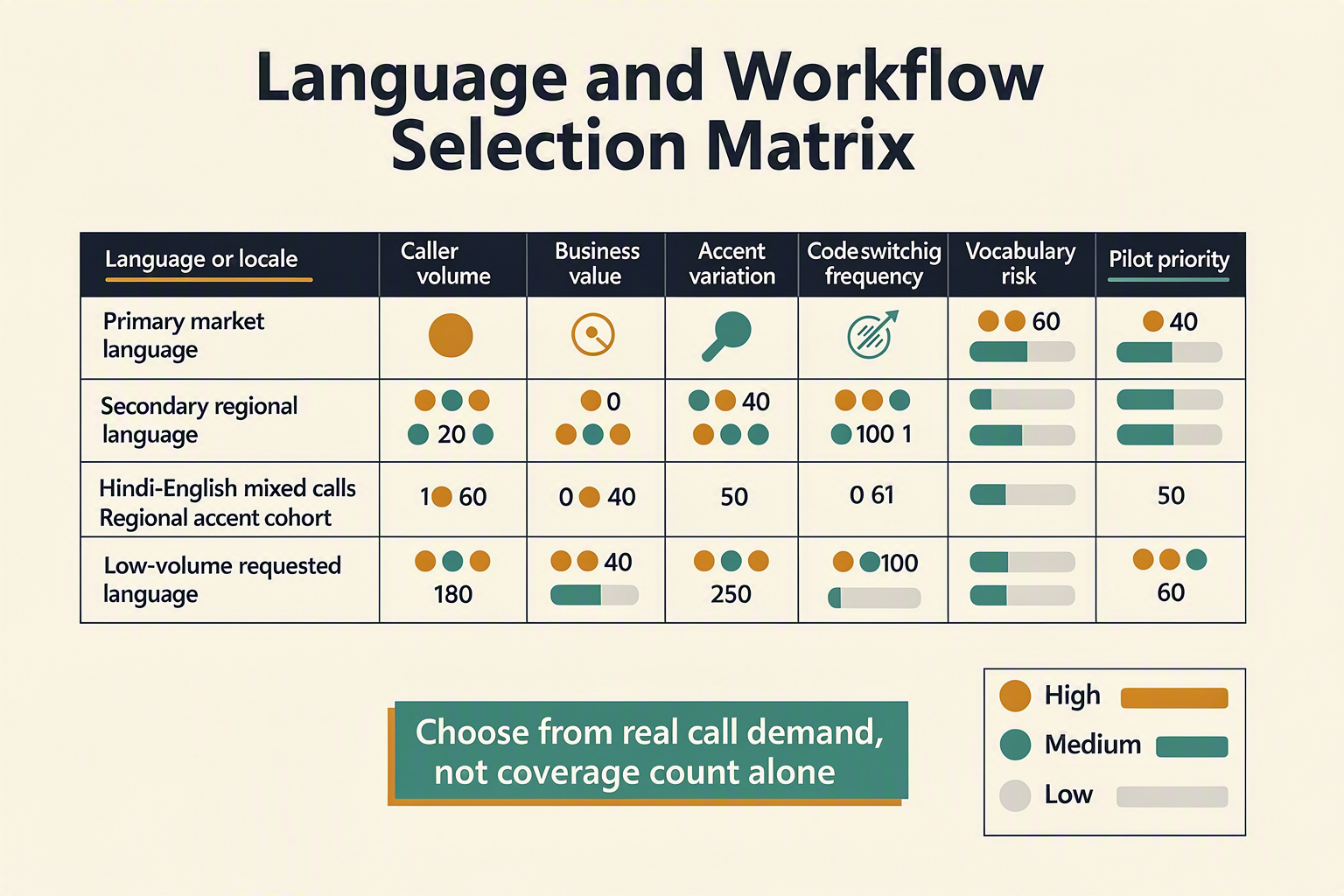
Prioritize languages using actual call volume, service geography, task risk and code-switching patterns—not population size alone. A multilingual AI voice agent India deployment should begin with the smallest language set that covers high-volume workflows, then expand only after Speech-to-Text (STT), Text-to-Speech (TTS) and human-handoff tests pass.
Recommended language and workflow priorities
| Language cluster | Likely deployment focus | Accent and code-switch tests | First workflow to validate | Critical vocabulary |
|---|---|---|---|---|
| Hindi and Hinglish | Multi-state customer service, sales and collections | Regional Hindi accents; English product names; Hindi-English switching within sentences | Lead qualification and order status | Prices, dates, PIN codes, brand names |
| Marathi and Gujarati | Maharashtra and Gujarat operations | Urban-rural variation; English finance or logistics terms | Appointment booking and delivery support | Local place names, addresses, invoice terms |
| Tamil and Malayalam | Tamil Nadu and Kerala service coverage | District-level pronunciation; English technical terms embedded in local grammar | Service scheduling and FAQs | Product models, hospitals, branches, time slots |
| Telugu and Kannada | Andhra Pradesh, Telangana and Karnataka | Mixed-language conversations in major cities; names spoken with local phonology | Customer verification and ticket creation | Personal names, account numbers, locality names |
| Bengali and Assamese | West Bengal and Assam operations | Closely related sounds; English commerce terms; border-region accent variation | Order confirmation and payment reminders | Amounts, dates, delivery locations, payment methods |
| Punjabi, Odia and other demand-led languages | State-specific or regional customer bases | Dialect variation, mobile-call noise and script-independent spoken forms | Narrow, high-volume intents before open-ended support | Sector terminology, landmarks and escalation phrases |
These clusters are deployment priorities, not claims that speakers within a language sound alike. The Government of India’s Department of Official Language recognizes 22 scheduled languages as of August 2026, but that administrative list does not predict an individual company’s caller mix. The Census of India 2011 identified 121 languages with at least 10,000 speakers, reinforcing the need to test accents and varieties beyond a platform’s language label.
Select languages from operational evidence
Build the first release from 60–90 days of contact data where available:
- Tag call recordings or agent notes by requested language, state and workflow.
- Rank languages by call volume, revenue impact and consequences of misunderstanding.
- Separate “understood by agents” from the caller’s preferred language.
- Recruit native speakers from the districts that generate the most calls.
- Retest quarterly because campaigns, migration and seasonal demand can change the mix.
For the CallMissed 22 Indian languages capability, confirm the precise STT and TTS options available for each selected language and voice. First-party coverage should be treated as the start of acceptance testing, not evidence that every accent-workflow combination will perform equally.
Prioritize realistic code-switching and vocabulary
An Indian language voice AI test set should include complete local-language calls, Hinglish-style mixing and entity-level switching. For example, a caller may speak Hindi grammar while retaining an English product name, pronounce a PIN code digit by digit, or give a Marathi locality after requesting service in English.
Evaluate whether the agent can:
- Preserve names, amounts, dates and identifiers without translating them.
- Recognize abbreviations, loanwords and company-specific terminology.
- Reply in the caller’s chosen language while pronouncing brands naturally.
- Ask a targeted clarification—such as repeating only the account number—instead of restarting the conversation.
- Transfer to an appropriately skilled human when repeated low-confidence recognition affects a critical action.
Start with bounded workflows such as booking, status checks and lead capture. Open-ended complaints should follow only after accent coverage, business vocabulary and escalation routing have been proven with real callers.
How do you test STT, TTS, accents, code-switching and business vocabulary?
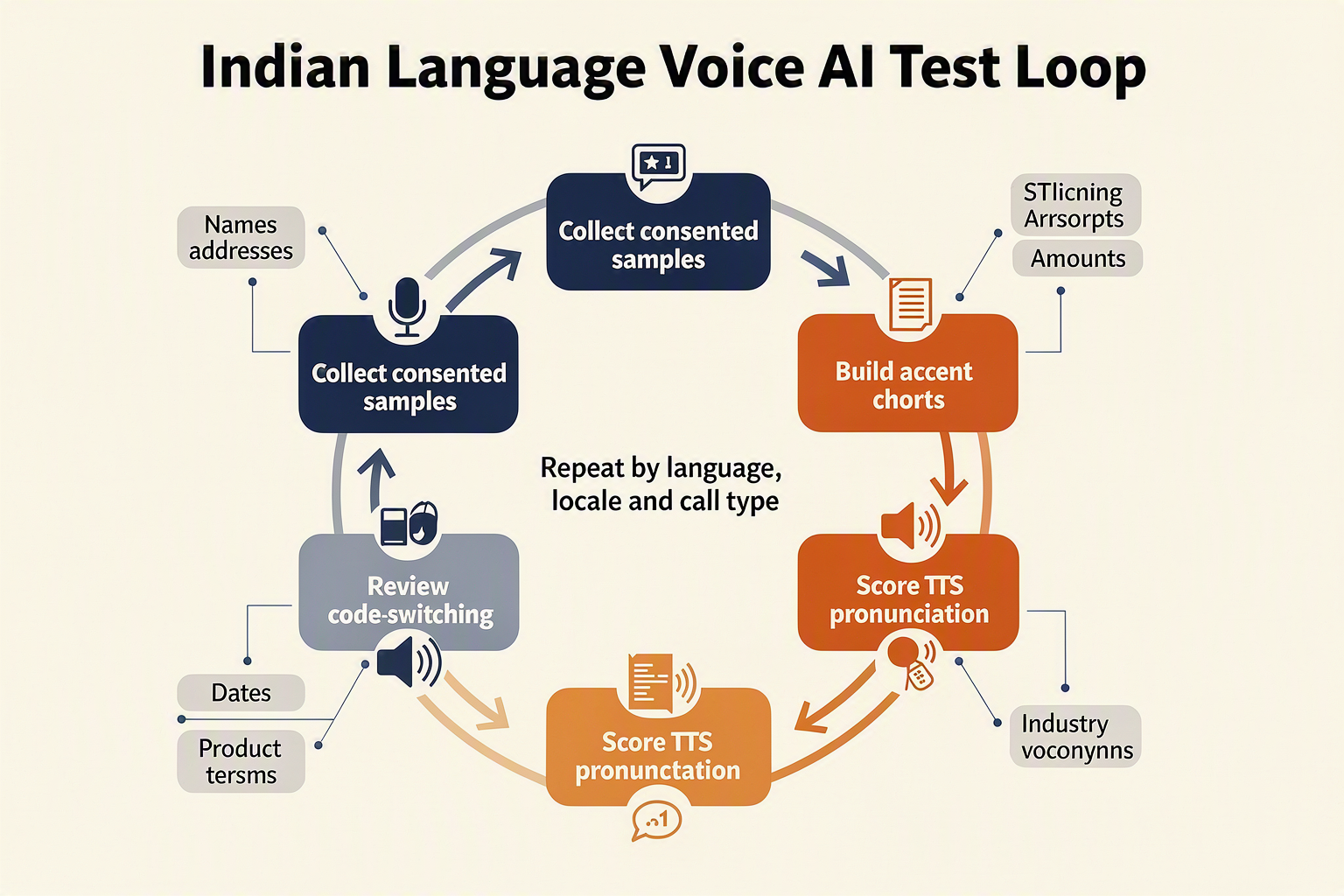
Test a multilingual voice agent with a representative audio set, not scripted studio recordings alone. Measure transcription, meaning preservation, pronunciation and task completion separately across languages, accents, code-switched sentences, phone conditions and business-specific terms.
Build a representative test corpus
Create a consented test set from speakers who match the deployment geography and customer profile. The Census of India 2011 identified 121 languages spoken by at least 10,000 people each, so testing one “standard” accent cannot represent India’s linguistic diversity.
For every priority language, include:
- Speakers from relevant states, districts, age groups and urban or rural markets.
- Quiet rooms, traffic, office chatter, speakerphone audio and weak mobile connections.
- Fast and slow speech, pauses, interruptions, corrections and incomplete sentences.
- Names, addresses, dates, prices, decimal values, order IDs and one-time passwords.
- At least two independent reviewers fluent in the language where practical.
The CallMissed 22 Indian languages capability should therefore be evaluated language by language. A model that performs well on Hindi appointment booking may behave differently on a Marathi address or a Tamil product-support call.
Score Speech-to-Text and meaning separately
Run each recording through Speech-to-Text (STT), preserve the reference transcript, and label errors. Word Error Rate (WER) is calculated as substitutions plus deletions plus insertions, divided by the number of words in the reference transcript. However, WER alone can over-penalize harmless spelling variants while hiding dangerous errors involving amounts or account numbers.
Use four complementary measures:
- WER or Character Error Rate: Measures literal transcription quality.
- Entity accuracy: Checks names, numbers, locations, SKUs and dates.
- Intent accuracy: Determines whether the agent understood the requested task.
- Task success: Confirms whether the workflow produced the correct outcome.
Mark critical errors separately. Transcribing ₹15,000 as ₹50,000 should carry more weight than omitting a filler word.
Stress-test accents and code-switching
Code-switching tests should reproduce how customers actually speak, including Hindi-English “Hinglish” and sentences containing regional-language grammar with English product terms. Test switches at the beginning, middle and end of an utterance:
- “मेरा premium plan renew कर दीजिए.”
- A regional-language address containing an English building name.
- English model numbers, medicine names or banking terminology inside a local-language sentence.
- A caller who changes the preferred response language during the conversation.
Record whether the Indian language voice AI preserves the original entities, selects the correct intent and answers in the caller’s preferred language. Also test whether language detection remains stable instead of switching voices after isolated English words.
Evaluate TTS with human listeners
Text-to-Speech (TTS) testing should examine more than naturalness. Ask fluent listeners to score each sample for:
- Intelligibility: Can every important word be understood?
- Pronunciation: Are names, abbreviations and borrowed English terms correct?
- Prosody: Do pauses, emphasis and question intonation sound appropriate?
- Pace and politeness: Does delivery suit customer service and the local context?
- Consistency: Are numbers, currencies and dates spoken predictably?
Maintain a pronunciation dictionary for brand names, locality names, acronyms and regulated terminology. Test alternative spellings or phonetic forms before changing the entire voice.
For a multilingual AI voice agent India pilot using CallMissed, rerun this suite after changing the voice, STT model, prompt, glossary or call-routing logic. Versioned test sets make regressions visible and turn broad language availability into evidence for the exact workflow.
What should happen when CallMissed cannot understand a caller or continue safely?
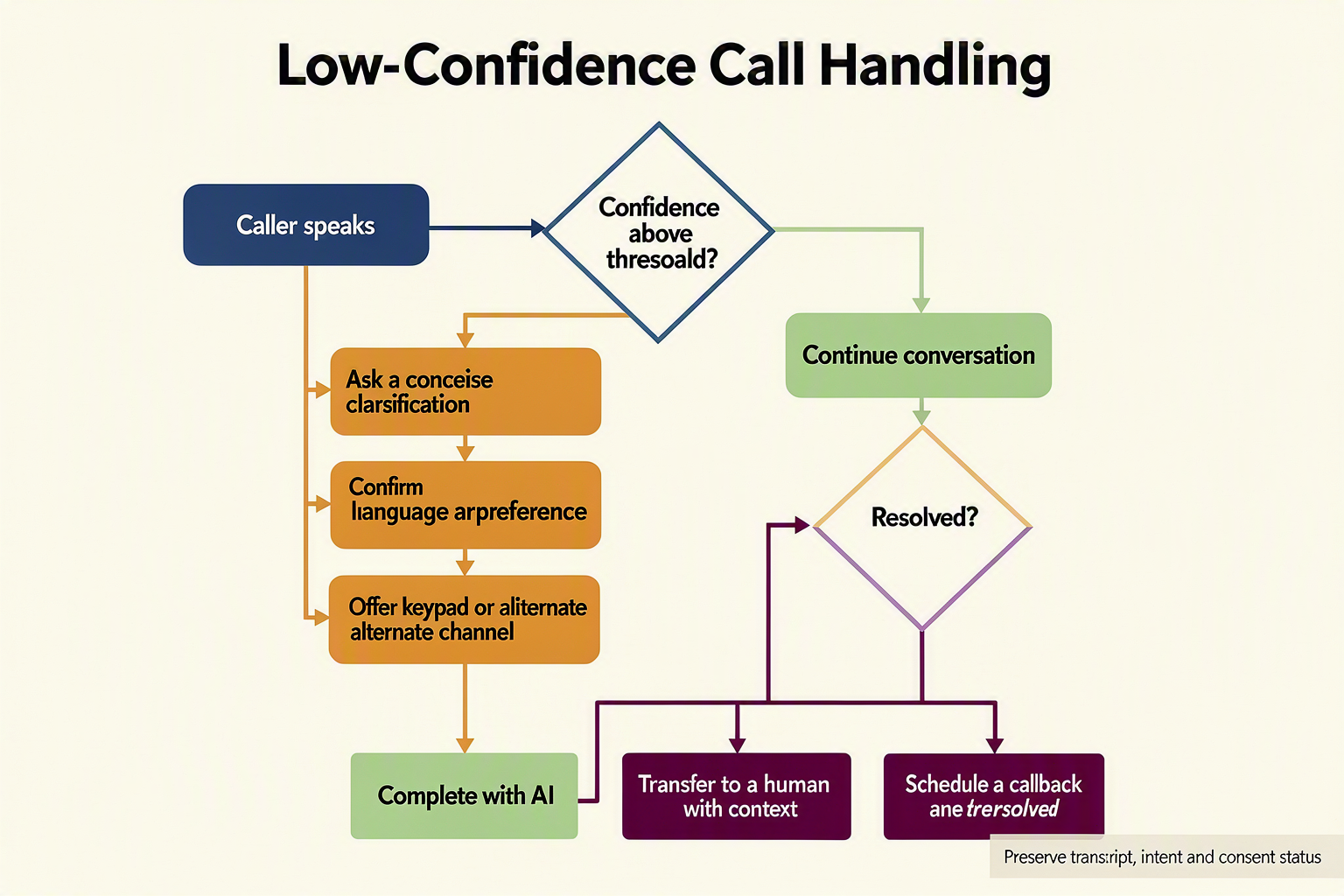
A CallMissed voice agent should clarify once, simplify once, and then transfer or offer another channel when understanding remains uncertain. It must never guess about identity, payments, medical needs, legal commitments, emergencies, or other high-impact actions.
Use a bounded recovery sequence
For a multilingual AI voice agent India deployment, configure a short recovery ladder rather than an unlimited “please repeat” loop:
- Confirm the language or intent: “Would you like to continue in Hindi or English?”
- Ask a narrower question: Replace “How can I help?” with “Is this about an order, payment, or return?”
- Confirm critical information: Read back names, dates, amounts, addresses, account numbers, and appointment details.
- Escalate after two failed attempts: Transfer to a suitable human queue or create a callback request.
- Preserve context: Send the detected language, transcript, confirmed fields, unresolved question, and failure reason to the agent.
Two attempts are a practical starting policy, not a universal benchmark. Test whether one, two, or three attempts produce the best balance between task completion and caller frustration for your workflow.
Treat confidence as one signal—not proof
An STT confidence score can be misleading when audio contains code-switching, regional accents, background noise, uncommon names, or business vocabulary. A high score may still produce a semantically dangerous transcription: “₹15,000” can become “₹50,000,” while a product code or medicine name may be converted into a common word.
Trigger clarification when any of these conditions occurs:
- STT or intent confidence falls below the threshold established during your pilot.
- The transcript conflicts with validated account or order data.
- The caller corrects the agent or says “no,” “wrong,” or the regional equivalent.
- A required field is missing, malformed, or inconsistent.
- Silence, overlapping speech, or repeated code-switching prevents reliable interpretation.
- The requested action exceeds the agent’s approved permissions.
Test thresholds separately for every enabled language. The CallMissed 22 Indian languages capability is a first-party coverage claim; production thresholds still need validation for each accent, language pair, telephony route, and task.
Apply stricter rules to sensitive actions
An Indian language voice AI system should not continue autonomously when uncertainty could create financial, legal, privacy, or physical harm. Require explicit confirmation or human review before:
- Taking or changing a payment
- Cancelling an order, policy, booking, or service
- Disclosing personal or account information
- Changing an address, phone number, nominee, or beneficiary
- Interpreting medical symptoms or emergency requests
- Recording consent or accepting contractual terms
For emergencies, provide the appropriate official contact route rather than implying that the AI agent can dispatch assistance.
Make handoff understandable and useful
The caller should hear a clear explanation such as: “I’m having trouble understanding the details, so I’ll connect you with a person. You will not need to repeat the information I already confirmed.” If no agent is available, offer a callback window or a secure WhatsApp or web flow—without forcing the caller into another failed automation.
CallMissed can support voice interactions across phone and WhatsApp Business calling, but channel switching should require caller agreement. Log the fallback reason, selected language, retry count, transcript revisions, transfer outcome, and eventual resolution; these records reveal whether failures come from STT, TTS, vocabulary, routing, or workflow design.
How should teams measure recognition, voice quality and task success before launch?
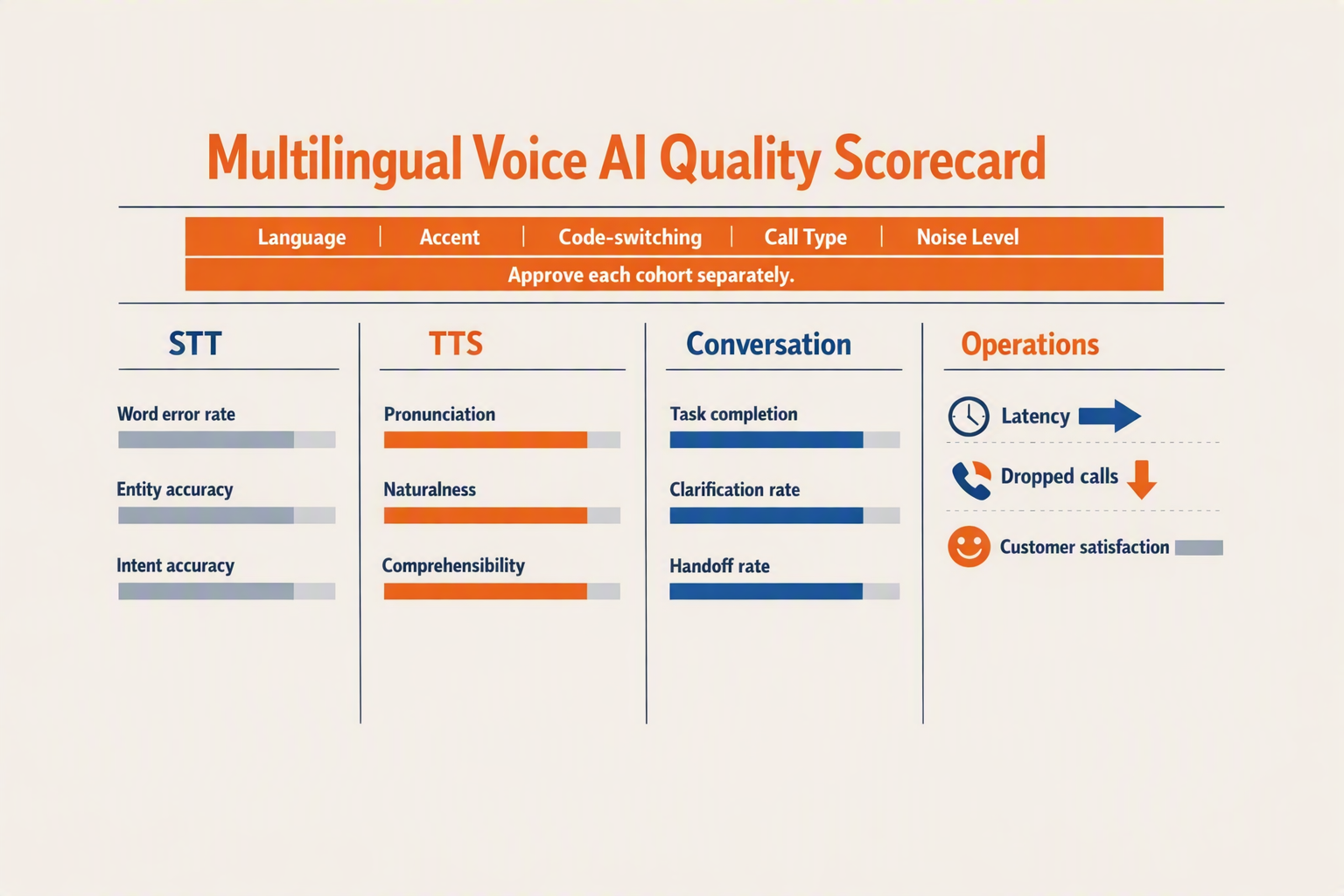
Teams should launch only when the voice agent meets predefined thresholds for recognition accuracy, perceived voice quality and end-to-end task completion across every priority language. Averages are insufficient: results must be segmented by language, accent, code-switching pattern, audio condition and business workflow.
Build a representative evaluation set
CallMissed states that its Indic-first STT and TTS cover 22 Indian languages, but coverage is a capability claim rather than a guaranteed accuracy score for every deployment. Evaluate CallMissed 22 Indian languages support using recordings that reflect actual callers, not studio-only samples.
Create a consented test set containing:
- Native and second-language speakers from relevant regions and age groups.
- Quiet rooms, street noise, vehicle noise and compressed mobile-call audio.
- Short answers, interruptions, corrections and long conversational requests.
- English product names embedded in Indian-language sentences.
- Customer names, locality names, amounts, dates, account numbers and industry terms.
- Both expected requests and unsupported or ambiguous requests.
Keep a held-out test set separate from prompts used to tune vocabulary, instructions or retrieval content. Otherwise, improvements may reflect memorization rather than generalizable performance.
Score STT and meaning separately
Use Word Error Rate (WER) for space-delimited transcripts and Character Error Rate (CER) where token boundaries or script variation make word-level scoring unreliable. WER is calculated as substitutions plus deletions plus insertions, divided by the number of words in the reference transcript.
Transcript accuracy alone does not prove business understanding. Also measure:
- Intent accuracy: Was “cancel my order” distinguished from “do not cancel”?
- Slot accuracy or F1: Were names, dates, amounts, locations and identifiers captured correctly?
- Code-switch accuracy: Were embedded English brands and technical terms preserved?
- Critical-field exact match: Did the system capture a phone number or payment amount without error?
- Low-confidence safety: Did it confirm or transfer rather than inventing information?
Set stricter thresholds for irreversible actions. A wrong product adjective may be recoverable; a wrong payment amount is not.
Evaluate TTS with human listeners
Assess voice output using a Mean Opinion Score (MOS) survey modeled on the International Telecommunication Union’s ITU-T P.800 listening methodology. Ask native listeners to rate naturalness and intelligibility, then separately record pronunciation errors.
Review whether the Indian language voice AI correctly handles:
- Regional place names and personal names.
- Acronyms, currencies, decimals and mixed-script text.
- Formal versus conversational honorifics.
- Pauses, speaking rate, emphasis and question intonation.
- English terms inside Hindi, Tamil, Bengali or another selected language.
A useful internal launch rule is no unresolved critical pronunciation defects, even when the overall MOS is acceptable.
Measure the whole task, not just the model
For each workflow, calculate:
- Task-success rate: Percentage of callers who reach the correct outcome.
- First-attempt completion: Percentage completing without repetition or correction.
- Repair rate: Share of turns requiring “please repeat” or confirmation.
- Handoff quality: Percentage of transfers carrying the transcript, language and collected fields.
- Latency: Median and 95th-percentile time from end of speech to audible response.
- Abandonment rate: Calls ending before completion or successful transfer.
Before releasing a multilingual AI voice agent India deployment, compare every language cohort against an approved baseline and define stop-launch thresholds. CallMissed can power AI agents over phone and WhatsApp Business calling, so teams should repeat the evaluation for each channel; different codecs, background conditions and caller behavior can produce different results.
How do consent, transparency and human handoff affect callers and businesses?
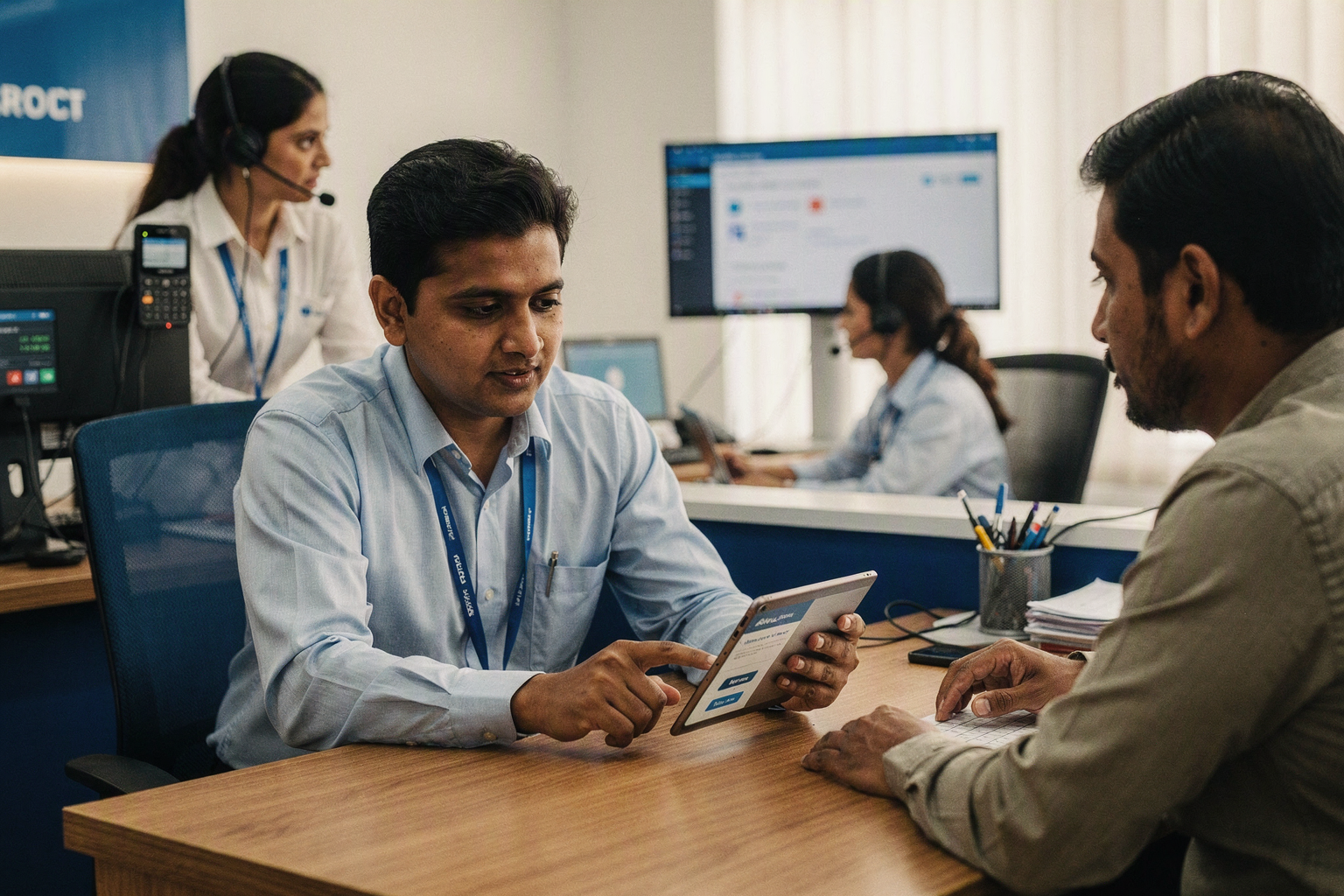
Consent, clear AI disclosure and reliable human handoff make callers more willing to continue while reducing privacy, reputational and operational risk for businesses. An Indian language voice AI agent should identify itself, explain recording or data use in the caller’s chosen language, and provide a practical route to a person before collecting sensitive information.
Make consent understandable, not merely available
Consent prompts fail when they are delivered too quickly, hidden inside a long greeting or translated into unfamiliar legal vocabulary. Under India’s Digital Personal Data Protection Act, 2023, the Government of India states that consent requests must be presented in clear and plain language and that consent must be withdrawable with comparable ease.
Design the opening in the language the caller selected or appears to be using:
- Identify the business and the AI agent: “You are speaking with the automated assistant for [business].”
- State whether the call is recorded or transcribed: Explain the purpose, such as service quality, order processing or fraud prevention.
- Ask for an explicit response where required: Accept a clear voice confirmation or keypad input rather than treating silence as agreement.
- Offer alternatives: Let callers continue without optional recording where operationally possible or request a human representative.
- Record the consent event: Store the prompt version, language, timestamp and caller response for auditing.
Do not assume that translating “I agree” is sufficient. Test whether speakers across age groups and literacy levels understand what data is collected, why it is needed and how they can decline.
Transparency should survive code-switching
A caller may choose Hindi but use English for “credit card,” “policy number” or a product name. The disclosure should remain valid even when the conversation switches languages; the agent should not silently begin a new purpose, such as marketing, after obtaining consent for support.
CallMissed states that its Indic-first STT and TTS capabilities cover 22 Indian languages as of August 2026, but each business should validate how its exact consent wording is recognized and pronounced. For a multilingual AI voice agent India deployment, test:
- Negative responses such as “nahin,” “नको,” “vendam” and mixed-language refusals.
- Requests including “human se baat karni hai” or “connect me to an executive.”
- Interruptions during the disclosure and ambiguous answers such as “theek hai, but don’t record.”
- Names, account numbers and health or financial details that require stronger handling controls.
Human handoff must preserve language and context
Handoff protects callers when confidence is low, the request is sensitive or automation repeatedly fails. It also protects the business from fabricated answers, incorrect transactions and caller frustration.
Trigger escalation when:
- STT confidence remains below the approved threshold after one clarification.
- The caller asks for a person at any point.
- Authentication fails or consent is declined.
- The workflow involves disputes, emergencies or policy exceptions.
- Sentiment deteriorates or the agent repeats the same prompt.
Use a warm transfer: pass the selected language, verified identity fields, concise transcript summary, consent status and unresolved intent to the representative. Do not force the caller to repeat the entire story.
For teams evaluating CallMissed 22 Indian languages, test these controls on both conventional voice and WhatsApp Business calls. Measure consent-completion rate, opt-out recognition, transfer success, time to answer and repeat-explanation rate; these metrics reveal whether transparency and handoff work for real callers rather than only scripted demos.
What do voice AI, localization and customer-experience experts recommend?
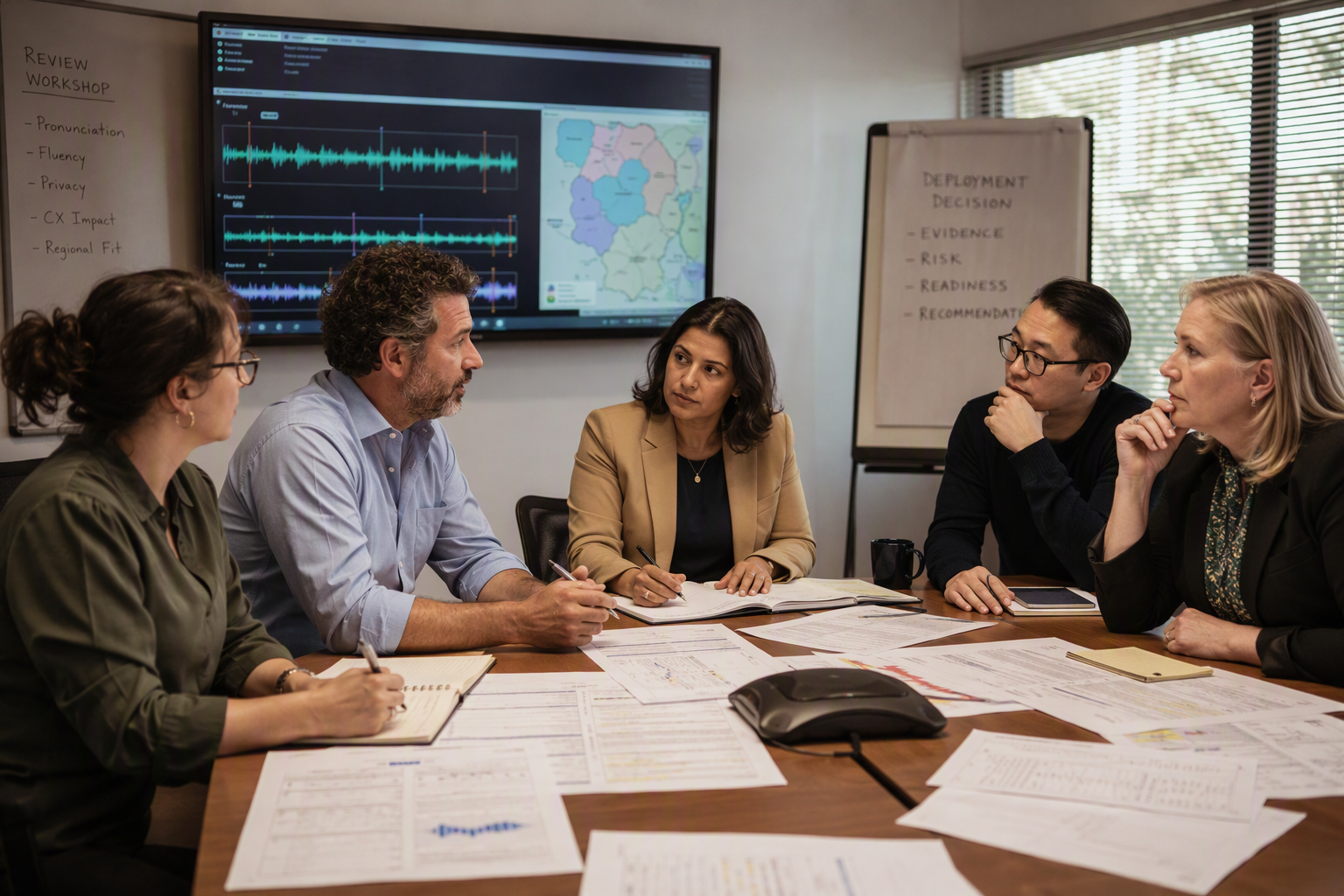
Experts in voice AI, localization and customer experience recommend treating multilingual performance as a measurable service outcome, not a language-availability claim. Their shared advice is to test each language, accent, task and channel independently, then deploy gradually with clear recovery and human-handoff paths.
Voice AI experts: measure meaning, not transcripts alone
Speech specialists recommend evaluating whether the agent preserves the caller’s intent rather than relying only on word error rate (WER). A transcript can contain mistakes yet retain the correct meaning—or appear accurate while corrupting an account number, date or product name.
Build a test set that separates:
- Semantic accuracy: Did the agent understand the requested action?
- Entity accuracy: Were names, amounts, dates, addresses and identifiers captured correctly?
- Task completion: Did the caller reach the intended outcome without assistance?
- Turn latency: Did responses arrive quickly enough to avoid interruptions or repeated “hello” prompts?
- Recovery quality: Did the agent confirm uncertain information instead of guessing?
For an Indian language voice AI deployment, experts would also test numerals in multiple forms: “five thousand,” “पाँच हज़ार,” “5K,” and mixed-language equivalents. High-risk entities such as OTPs, payment amounts and policy numbers should be read back or confirmed through keypad input, WhatsApp or an authenticated workflow.
Localization experts: design for communities, not language labels
Localization professionals distinguish translation from adaptation. Two callers may select the same language but expect different vocabulary, formality, pronunciation and conversational pace because of region, age or business context.
That distinction matters at national scale. The Census of India 2011 classified 121 languages spoken by at least 10,000 people each. The Government of India’s Department of Official Language recognizes 22 scheduled languages as of August 2026, but scheduled-language coverage does not represent every dialect or speech community.
Localization reviews should therefore include:
- Native speakers from target regions, not only professional translators.
- Local business terminology, including loanwords customers actually use.
- Politeness and honorific checks for sales, collections, healthcare and support scenarios.
- Pronunciation dictionaries for brands, locations, abbreviations and employee names.
- Code-switching samples drawn from realistic calls rather than translated scripts.
CallMissed states that its Indic-first STT and TTS cover 22 Indian languages. Teams evaluating the CallMissed 22 Indian languages capability should still certify every planned voice, language pair and workflow with representative callers.
Customer-experience experts: optimize effort and trust
CX practitioners focus on whether automation makes the interaction easier. A technically accurate agent can still fail if it repeats questions, forces callers into one language or hides the route to a person.
Recommended safeguards include:
- Let callers change languages mid-call without restarting.
- Ask one concise clarification question when confidence falls.
- Confirm consequential details rather than replaying the entire request.
- Explain when the caller is speaking with AI and when recording applies.
- Transfer the transcript, detected language and collected details during handoff.
- Track repeat contacts, transfers, abandonment and customer effort by language.
For any multilingual AI voice agent India rollout, experts favor a controlled progression: internal testing, native-speaker review, limited live traffic, monitored expansion and periodic regression tests. The practical standard is simple: deploy only where the agent can understand, respond and recover safely—and provide a fast human alternative everywhere else.
What should you do before deploying CallMissed in production? (TABLE)
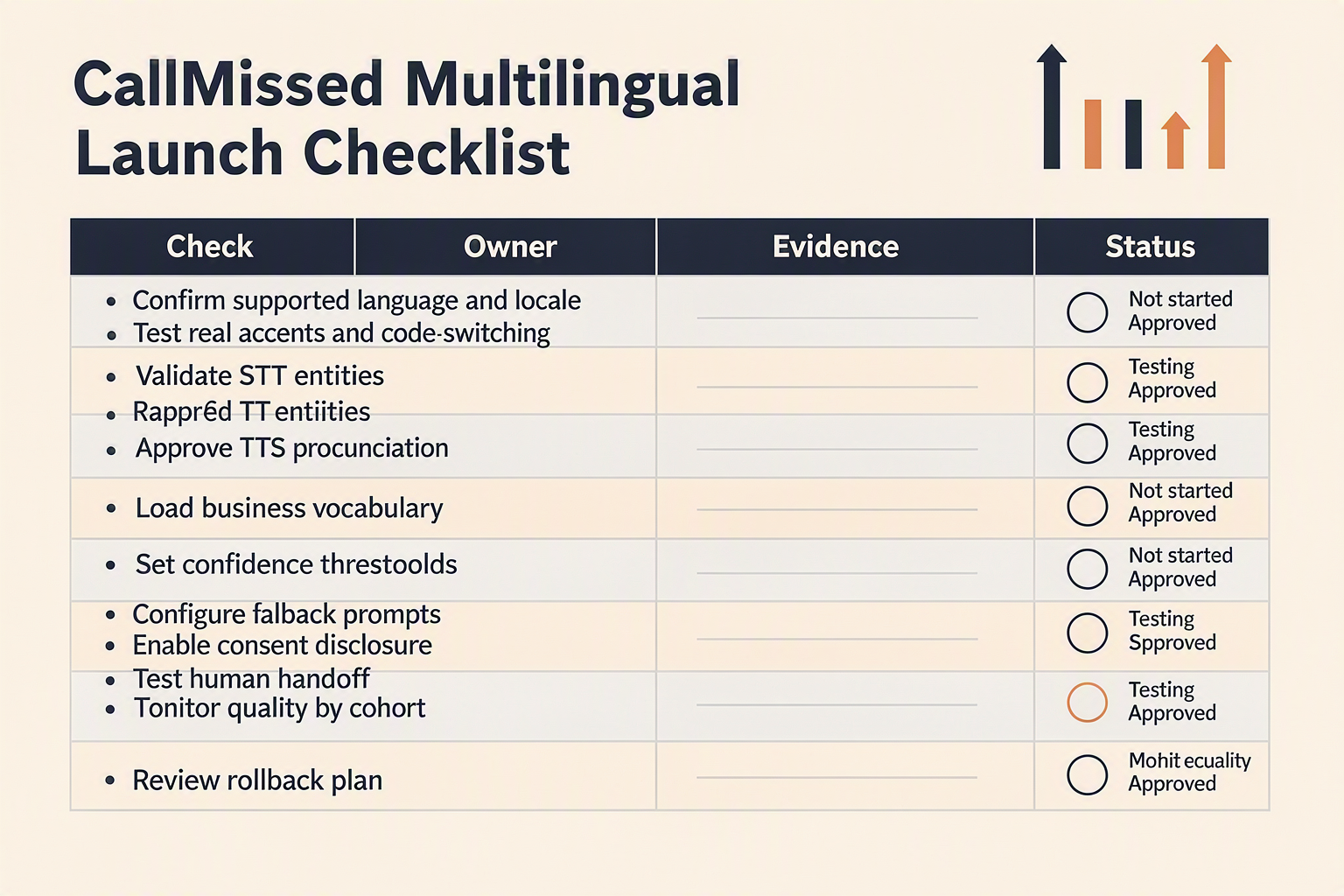
Before deploying CallMissed in production, convert pilot results into measurable launch gates, assign an owner to every failure mode, and release traffic gradually. Support for 22 Indian languages is a first-party capability claim; production approval should depend on evidence from your callers, vocabulary, audio conditions and workflows.
Production-readiness checklist
The thresholds below are practical starting points, not published CallMissed performance guarantees. Adjust them according to task risk: appointment booking can tolerate different error rates from payments, healthcare or financial-service calls.
| Deployment gate | Evidence to review | Example launch threshold | Failure action |
|---|---|---|---|
| Language and routing | Demand by language, region, channel and time | Every enabled language has tested prompts, routing and fallback rules | Confirm language or transfer to the appropriate queue |
| STT and intent quality | Transcripts covering accents, noise, names, numbers and code-switching | At least 90% task-intent accuracy on a representative test set | Repeat critical fields, offer keypad input or escalate |
| TTS experience | Human ratings for pronunciation, pace, clarity and politeness | No unresolved critical mispronunciations in names, amounts or instructions | Replace pronunciation, rewrite prompt or use alternate voice |
| Workflow reliability | End-to-end tests for API, CRM, knowledge base and telephony actions | 100% pass rate for critical paths; no duplicate transaction on retry | Stop the action, preserve context and route to a person |
| Consent and data controls | Disclosure scripts, recording settings, retention rules and access logs | Disclosure plays before recording or data capture where required | Disable recording or terminate collection safely |
| Operations and handoff | Alerts, dashboards, transfer tests and incident runbooks | Named on-call owner; successful transfer with transcript and call context | Reduce traffic, disable affected flow or revert to the prior version |
Validate the complete production path
Do not approve Indian language voice AI using isolated STT or TTS samples alone. Run end-to-end calls through the same phone numbers or WhatsApp Business calling path, network conditions, integrations and escalation queues that customers will encounter.
Your final test suite should include:
- Frequent and high-risk intents, including cancellation, refunds, payment questions and complaints.
- Mixed-language utterances, such as Hindi grammar containing English product names or Marathi addresses.
- Critical entities, including customer names, dates, prices, account identifiers, PIN codes and place names.
- Degraded conditions, such as mobile noise, interruptions, silence, packet loss and repeated API timeouts.
- Safe recovery, verifying that retries do not create duplicate bookings, tickets or transactions.
For context, the Department of Official Language recognizes 22 scheduled languages as of August 2026, while the Census of India 2011 identified 121 languages spoken by at least 10,000 people each. A multilingual AI voice agent India rollout therefore needs a documented policy for unsupported languages and dialects rather than assuming one of the 22 options will always fit.
Release gradually and monitor continuously
Start with employees, then a small customer cohort, and increase traffic only after each acceptance gate remains stable. Compare performance by language, intent, accent group, channel and call-quality band; an overall average can hide a serious regional failure.
For a CallMissed 22 Indian languages deployment, monitor task completion, transfer rate, repeat-prompt rate, caller abandonment, latency and correction frequency. Review failed transcripts weekly at first, update business vocabulary and pronunciation rules under version control, and preserve a tested rollback configuration. Production readiness is not a one-time certification: new products, seasonal place names, campaigns and changing caller behavior require continuing evaluation.
Frequently asked questions about CallMissed 22 Indian languages, mixed-language calls, accuracy, setup and human transfer
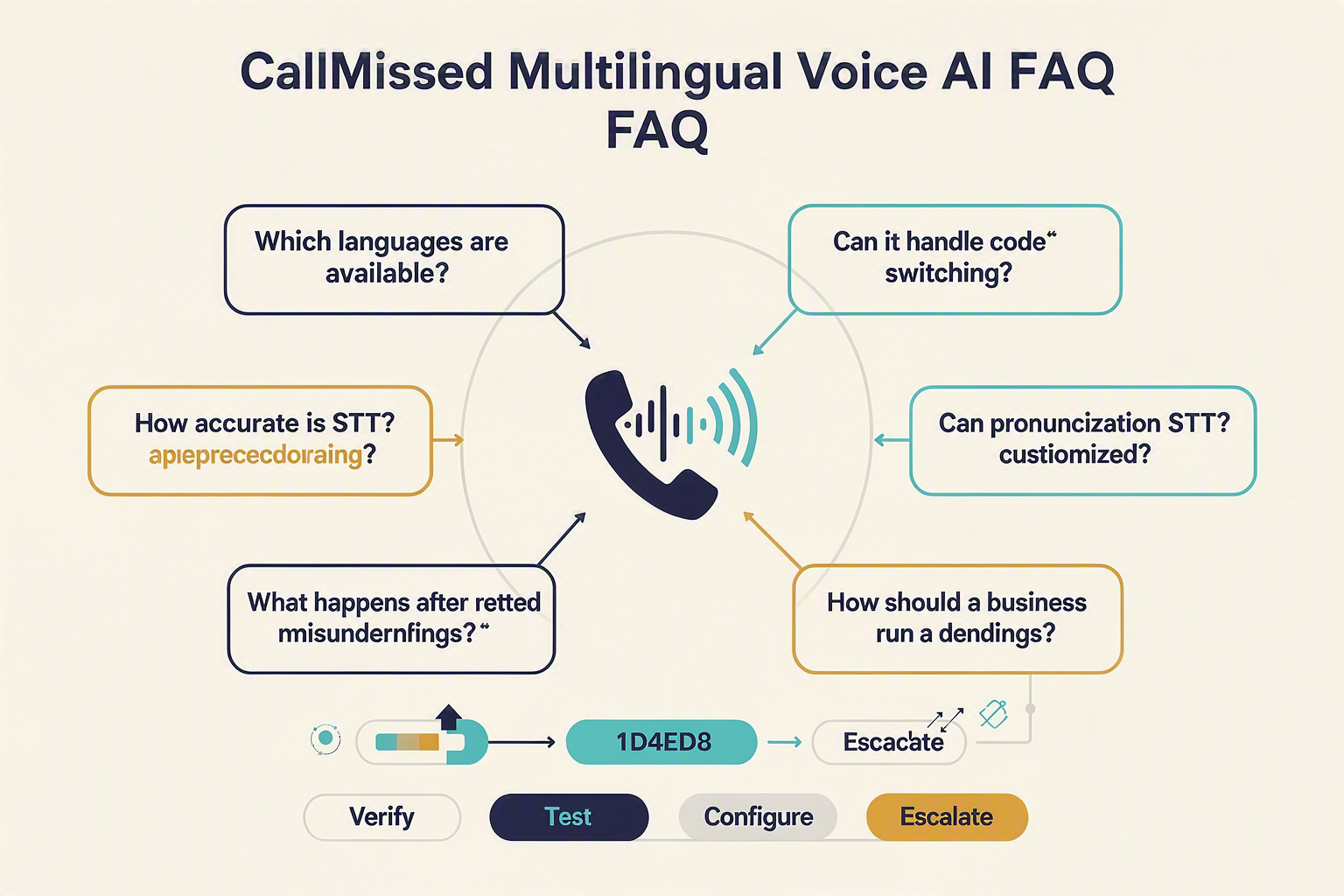
Which CallMissed 22 Indian languages can I use for an AI voice agent?
How do I set up a multilingual AI voice agent India deployment with CallMissed?
Can CallMissed understand mixed Hindi-English or other code-switched calls?
What accuracy should I expect from CallMissed 22 Indian languages voice AI?
How should I test accents, business vocabulary and pronunciation in Indian language voice AI?
When should a CallMissed multilingual voice agent transfer a caller to a human?
Conclusion
A dependable multilingual AI voice agent India deployment is not defined by a language count alone. It is defined by whether real callers—using regional accents, mixed-language sentences, noisy mobile connections and business-specific vocabulary—can complete tasks safely and naturally.
From language coverage to production readiness
The central lessons are:
- Select languages from evidence. Prioritize caller demand, geography, channel and workflow rather than national population alone. The Census of India 2011 found that 43.63% of residents reported Hindi as their mother tongue, so Hindi-only automation cannot represent India’s full linguistic diversity.
- Test complete conversations. Evaluate Speech-to-Text for semantic correctness, names, numbers, addresses, accents and code-switching; assess Text-to-Speech for pronunciation, pace, politeness and intelligibility. A transcript can contain errors yet preserve intent, while a seemingly accurate transcript can still derail a transaction.
- Design for uncertainty. Establish confidence thresholds, concise clarification prompts, language confirmation and human handoff. When the agent cannot reliably understand the caller, escalation is a feature—not a failure.
- Expand only after measurement. Track task completion, transcription quality, response latency and caller experience by language and use case. Build disclosure, consent, recording and retention controls into the workflow before increasing traffic.
India’s Eighth Schedule recognizes 22 scheduled languages, according to the Government of India’s Department of Official Language as of August 2026, while the Census of India 2011 identified 121 languages spoken by at least 10,000 people each. That gap explains why every Indian language voice AI rollout needs local validation.
Looking ahead, watch whether performance remains consistent as language pairs, accents, vocabulary and call volumes change. Teams should continuously refresh test sets with real and adversarial utterances instead of treating launch approval as permanent.
To explore this shift, visit CallMissed, an India-built platform offering Indic-first STT and TTS across its stated CallMissed 22 Indian languages coverage, plus AI voice agents for phone and WhatsApp Business calling. Which language, accent and customer journey will you validate first?
Related Reading
Related Posts
Ready to automate customer conversations?
Launch AI voice agents and WhatsApp bots with CallMissed — one API, 22+ Indian languages.