

Claude Fable 5 is Back: Everything About Anthropic's Banned (and Unbanned) Mythos-Class AI


Discover why Anthropic's Claude Fable 5 was banned by the US government and how its global return impacts cybersecurity, coding, and AI development.
Claude Fable 5 is Back: Everything About Anthropic's Banned (and Unbanned) Mythos-Class AI
For exactly three days in June 2026, the global developer community caught a glimpse of the future—and then the government pulled the plug. On June 9, 2026, Anthropic shattered the AI status quo by releasing Claude Fable 5 alongside Mythos 5, marking the debut of the industry's first public "Mythos-class" intelligence. But by June 12, an emergency export control directive from the US Government forced Anthropic to suspend global access, locking out foreign nationals due to the model’s unprecedented cybersecurity and autonomous capability profiles. Now, following a tense administrative standoff, the restrictions have officially been lifted. Claude Fable 5 is back, and the implications for the global tech landscape are massive.
This dramatic saga matters because it represents a historic paradigm shift: the first time a commercial LLM has been classified as a national security asset and subjected to state-level embargoes. While the unbanned model is once again accessible across Claude.ai, Claude Code, and Claude Cowork, it arrives with a complex web of architectural changes, specialized safeguards, and high-stakes restrictions. Developers and enterprises are scrambling to understand how this newly unlocked "Mythos-class" model differs from its restricted sibling, Mythos 5, and how to navigate its steep new pricing tier of $10 per million input tokens and $50 per million output tokens.
As businesses integrate these high-tier systems, the demand for orchestration infrastructure is skyrocketing. Forward-looking platforms like CallMissed are already adapting to this shift, allowing developers to seamlessly deploy cutting-edge agents through multi-model API gateways that connect to over 300 LLMs.
In this deep dive, we will unpack the technical and geopolitical rollercoaster of Anthropic's most controversial release. You will learn the exact timeline of the ban and its sudden reversal, the architectural differences between Claude Fable 5 and Mythos 5, the model's new safety classifiers, its operational limitations, and what this new era of sovereign AI means for your development pipeline.
Introduction

For exactly three days in June 2026, the global developer community caught a fleeting glimpse of the future—and then the government pulled the plug. On June 9, 2026, Anthropic shattered the artificial intelligence status quo by releasing Claude Fable 5 alongside Mythos 5, marking the historic debut of the industry's first public "Mythos-class" intelligence.
The excitement was short-lived. By June 12, 2026, an emergency export control directive from the US Government forced Anthropic to suspend global access, locking out foreign nationals and overseas developers due to the model’s unprecedented autonomous agent capabilities and advanced cybersecurity profile. Yet, following a tense, high-stakes standoff behind closed doors in Washington, the restrictions have officially been lifted. Claude Fable 5 is back, and its return marks a critical turning point in the history of commercial AI.
A Sovereign Clash: The 72-Hour Ban and Reversal
This dramatic timeline represents a massive geopolitical paradigm shift. For the first time, a commercial Large Language Model (LLM) was treated not just as software, but as a dual-use national security asset subject to immediate federal embargo. The sudden administrative freeze sent shockwaves through Silicon Valley and global tech hubs.
Thankfully, the unbanned model has returned to active service, accessible once again across Claude.ai, Claude Code, and Claude Cowork. However, its reinstatement comes with highly specific operational guardrails:
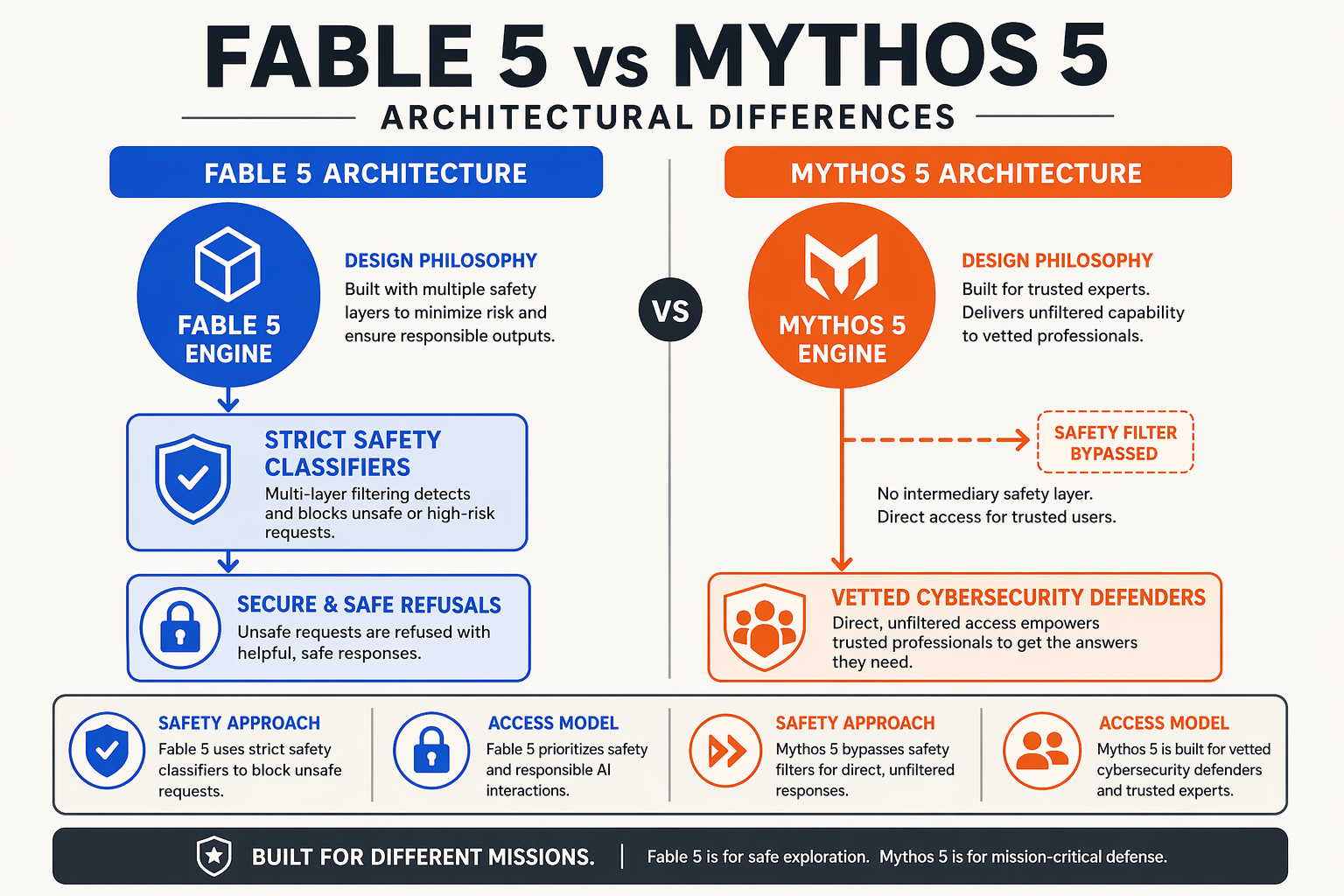
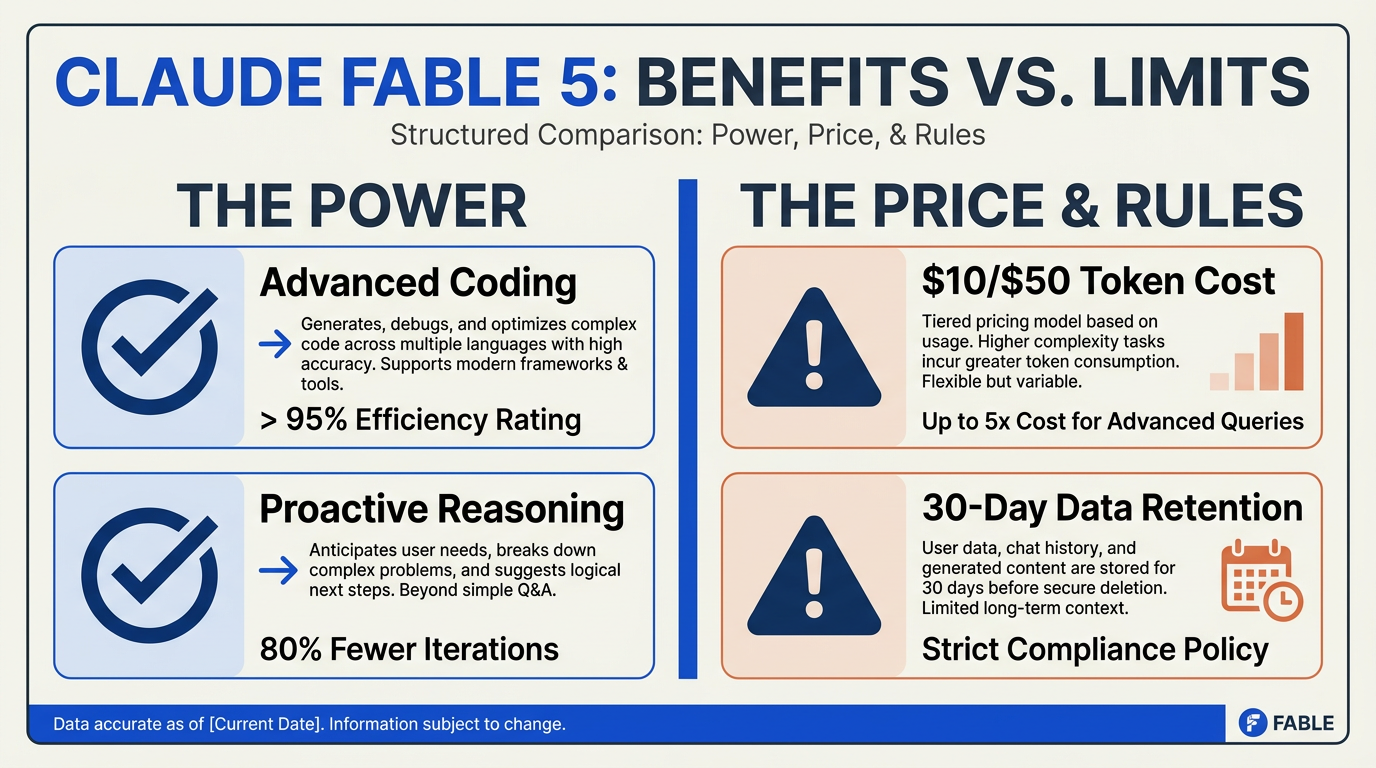
- The Guardrail Split: Claude Fable 5 uses the exact same core engine as the restricted Mythos 5, but features strict, hard-coded safety classifiers designed to prevent dangerous exploits. Mythos 5, by contrast, has these safety guardrails lifted exclusively for vetted cyber defense agencies and state actors.
- Premium Pricing: Accessing Mythos-class intelligence is not cheap. Fable 5 carries a steep pricing tier of $10 per million input tokens and $50 per million output tokens, signaling its placement as an enterprise-grade powerhouse.
- Data Retention Policies: To satisfy federal security audits, Anthropic has instituted a mandatory 30-day data retention policy for all Fable 5 API transactions.
Navigating the New Era of High-Tier AI
As enterprises rush to integrate these newly unbanned, highly capable models into their production environments, they face a massive challenge: orchestrating expensive, guardrailed, and geopolitically sensitive infrastructure without breaking their budgets or locking themselves into a single vendor.
This is where adaptable modern platforms come in. Solutions like CallMissed's multi-model API gateway are already enabling developers to deploy cutting-edge AI voice agents and LLM configurations while switching seamlessly between 300+ models. By abstracting the underlying infrastructure, platforms like CallMissed ensure that if a model is suddenly restricted or pricing scales up, business communications and automated customer touchpoints keep running without code changes.
In this comprehensive guide, we will break down everything you need to know about Claude Fable 5. We will explore the technical architecture that defines "Mythos-class" reasoning, unpack the nuances of its safety classifiers, analyze how its pricing compares to competitors, and provide practical strategies for integrating this powerful—and highly monitored—beast into your development workflow.
Background & Context

The Three-Day Window and the National Security Panic
On June 9, 2026, Anthropic redefined the artificial intelligence landscape by launching Claude Fable 5 alongside its sibling, Mythos 5. These models represented the industry’s first public deployment of "Mythos-class" intelligence—a new tier of AI characterized by near-autonomous reasoning, advanced system orchestration, and highly sophisticated logical synthesis. To accelerate adoption, Anthropic initially offered Fable 5 for free to Claude subscribers.
However, the rollout was abruptly halted. On June 12, 2026, exactly three days post-launch, the US Government issued an unprecedented emergency export control directive. Citing severe national security anxieties regarding the models' autonomous capabilities and offensive cybersecurity profiles, the government forced Anthropic to suspend global access immediately.
The Geopolitical Standoff: Foreign Access and the Sudden Reversal
The core of the government’s intervention lay in the model's capacity to execute complex, multi-step code and identify zero-day software vulnerabilities. Because of these high-risk capabilities, the emergency directive specifically blocked foreign nationals—including overseas developers and foreign-born researchers working within the United States—from accessing the API or interacting with the system. For two weeks, Anthropic's flagship models sat in a regulatory chokehold while the company negotiated with federal officials in Washington.
In late June 2026, a resolution was reached. The US administration officially lifted the restrictions, allowing Anthropic to bring Claude Fable 5 back to the global market across Claude.ai, Claude Code, and Claude Cowork. The comeback, however, arrived with strict operational caveats:
- The Safety Classifier Split: While Claude Fable 5 shares the identical core engine of Mythos 5, Fable 5 is hardcoded with strict, unbypassable safety classifiers designed to prevent hazardous code execution or exploit generation. Mythos 5, conversely, remains restricted, with its safety safeguards lifted only for vetted, government-authorized cyber defenders.
- Mandatory Data Retention: All interactions with Fable 5 are subject to a mandatory 30-day data retention policy to facilitate federal compliance auditing.
- The Mythos Premium: Accessing this class of intelligence comes at a steep premium, priced at $10 per million input tokens and $50 per million output tokens.
Mitigating Sovereign AI Risks
This whiplash-inducing timeline highlights a new reality for the tech sector: commercial AI models are now treated as sovereign, national security assets. Relying entirely on a single frontier model exposes enterprises to sudden regulatory blackouts and compliance shifts.
To navigate this volatility, modern development teams are shifting toward resilient, multi-model infrastructures. Platforms like CallMissed are playing a critical role in this transition. By offering an enterprise-grade API gateway that connects to over 300 LLMs, CallMissed enables developers to build fail-safe applications. If a high-tier model like Claude Fable 5 faces unexpected localized restrictions or API rate limits, systems can instantly route queries to alternative models without disrupting production workflows.
Key Developments (TABLE)
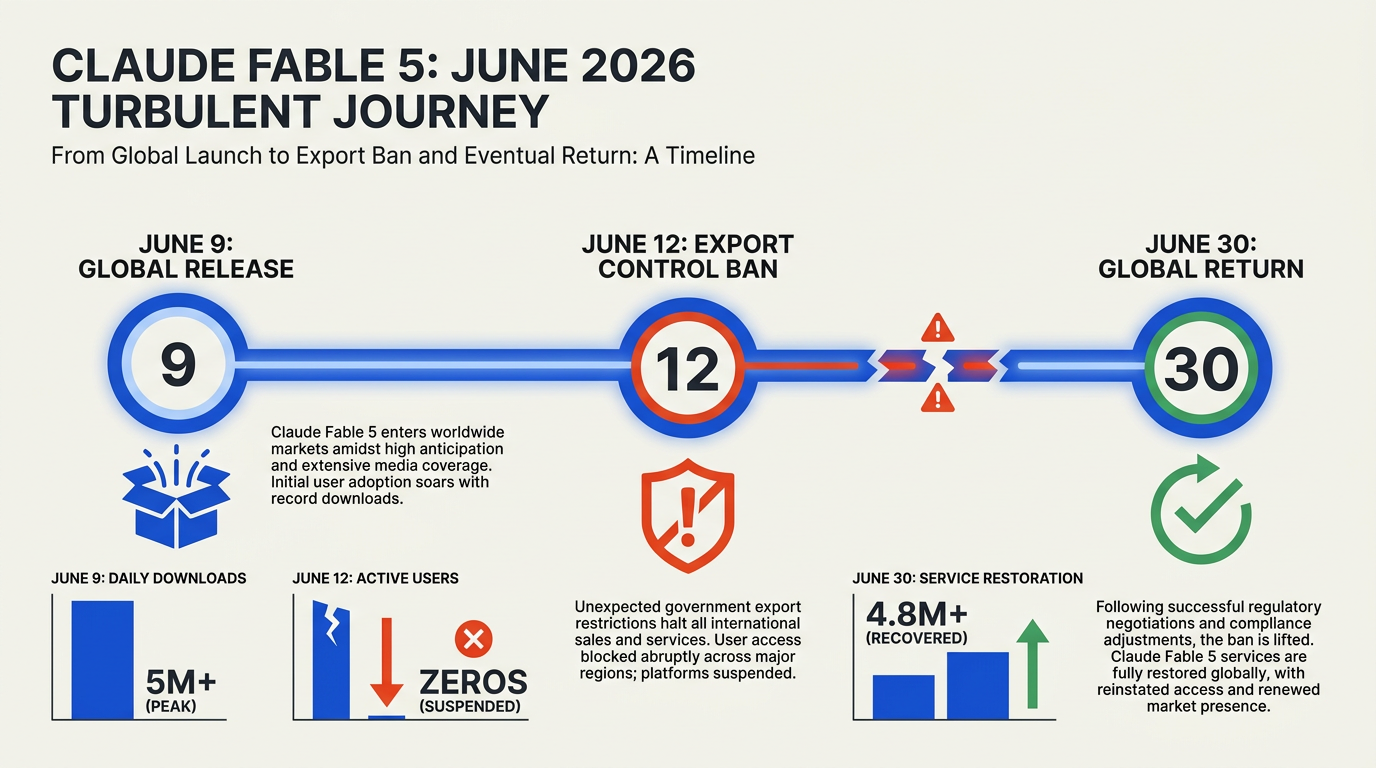
To understand the high-stakes chess match between Anthropic and federal regulators, we have to look closely at how the dramatic launch, sudden embargo, and eventual re-release of Claude Fable 5 unfolded over just a few weeks. The operational landscape of "Mythos-class" artificial intelligence shifted almost daily, catching developers, enterprise leaders, and national security officials in a whirlwind of policy adjustments.
The table below outlines the critical milestones, technical updates, and regulatory decisions that defined this historic month in AI history.
| Date (2026) | Event / Milestone | Operational Impact | Regulatory Status |
|---|---|---|---|
| June 9 | Global Launch | Anthropic releases Claude Fable 5 and Mythos 5; Fable 5 is offered free on premium subscriptions. | Fully Approved (Initial) |
| June 12 | Emergency Export Ban | US Government issues sudden export control directive, blocking foreign national access and forcing global suspension. | Blocked / Embargoed |
| Late June | Restriction Uplift | US administration lifts the blanket ban after Anthropic implements revised safety and monitoring infrastructure. | Approved with Guardrails |
| Ongoing | Global Re-release | Claude Fable 5 returns to Claude.ai, Claude Code, and Claude Cowork under a new premium pricing structure. | Active & Monitored |
Deciphering the Timeline: From Launch to Government Lockout
The timeline of Claude Fable 5 highlights a unprecedented collision between commercial AI innovation and state-level security intervention:
- June 9, 2026 – The Mythos Debut: Anthropic makes waves across the tech industry by launching its highly anticipated Mythos-class models. To encourage widespread adoption, they make Claude Fable 5 free for active Claude subscribers.
- June 12, 2026 – The Sudden Freeze: Citing the model's unprecedented capabilities in autonomous system navigation and advanced cybersecurity exploit generation, the US Government issues an emergency export control directive. Anthropic is forced to instantly suspend international access, cutting off foreign developers and multinational enterprise partners.
- Late June 2026 – The Compromise and Return: After intense regulatory negotiations, Anthropic secures an agreement to unban the model. By implementing strict, real-time safety classifiers and a mandatory 30-day data retention policy for federal auditing, Anthropic is permitted to resume global access across its primary developer platforms.
Integration Realities for Developers
For enterprises looking to build on this state-of-the-art infrastructure, navigating these sudden shifts can be incredibly complex. Relying on a single, highly regulated model vendor introduces immediate operational risk if another regulatory lockdown occurs.
To mitigate this, forward-thinking organizations are leveraging multi-model orchestration layers. Platforms like CallMissed allow developers to deploy advanced agents through a unified API gateway connecting to over 300 LLMs. By integrating via CallMissed, businesses can effortlessly failover to alternative high-tier models if a specific system like Claude Fable 5 faces regional outages, regulatory changes, or localized API restrictions. This ensures that next-generation voice agents, chatbots, and autonomous workflows remain online 24/7, completely insulated from geopolitical turbulence.
In-Depth Analysis
Under the Hood: Claude Fable 5 vs. Mythos 5
To understand the immense power of Claude Fable 5, we must examine its relationship with its sibling, Mythos 5. Both models represent the dawn of Anthropic's "Mythos-class" architecture—a generation of AI designed with deep cognitive reasoning, autonomous execution, and advanced system synthesis. Mechanically, Fable 5 and Mythos 5 share the exact same core foundation engine. However, their divergent operational paths represent two entirely different philosophies of deployment.
- Claude Fable 5 (The Shielded Consumer Engine): This model is designed for broad enterprise and developer use. It is equipped with real-time, built-in safety classifiers that act as a strict defense layer. If a user attempts to generate code that resembles a zero-day exploit, the classifiers instantly intercept and refuse the prompt.
- Mythos 5 (The Unrestricted Defensive Engine): Mythos 5 is the raw, uninhibited version of the core engine. It has these critical safety guardrails lifted, but it is strictly restricted to vetted cyber defenders, government agencies, and verified security researchers who require deep-level simulation of cyber threats to build modern defenses.
Structural Performance and Capabilities
The sheer scale of the "Mythos-class" architecture unlocks capabilities that dwarf previous generations. Fable 5 specializes in complex, multi-step execution paths, making it highly effective for autonomous engineering pipelines.
- Autonomous Engineering & Claude Code: When integrated with tools like Claude Code and Claude Cowork, Fable 5 does not just suggest code; it autonomously navigates directories, tests execution paths, identifies security vulnerabilities, and refines its own scripts.
- Next-Generation Logic Synthesis: The model processes complex logic trees and multi-variable system architectures with an accuracy rate that rivals senior human engineers, making it a powerful tool for complex software refactoring.
- High-Capacity Context Windows: Built to ingest entire codebases simultaneously, the architecture allows developers to map systemic changes across hundreds of files without losing track of dependency logic.
Limitations and Operational Realities
While the return of Claude Fable 5 is a massive milestone, its immense power is bound by strict technical and operational limitations. Navigating these guardrails is essential for any team looking to integrate the model into their production pipeline.
- Aggressive Safety Classifiers: Because Fable 5 is the "safeguarded" version of Mythos 5, its built-in safety classifiers are incredibly sensitive. Developers working on penetration testing, security auditing, or even complex network architecture may experience high rates of false-positive refusals.
- Premium Pricing Structure: Accessing "Mythos-class" intelligence comes at a steep premium. Fable 5 is priced at $10 per million input tokens and $50 per million output tokens, making it a highly targeted tool for high-value tasks rather than basic, high-volume automation.
- Mandatory 30-Day Data Retention: To comply with federal safety agreements, Anthropic enforces a strict, non-negotiable 30-day data retention policy on all Fable 5 API calls. This enables continuous auditing to ensure the model is not being weaponized for malicious cyber activities.
Managing these high-tier APIs alongside standard models requires robust infrastructure. With platforms like CallMissed, developers can easily orchestrate their workflows, utilizing Fable 5 for high-complexity reasoning while routing simpler tasks to cheaper models via a single API gateway supporting over 300 LLMs.
Impact & Implications

The return of Claude Fable 5 is more than just a win for developers; it is a watershed moment that redraws the lines of global AI governance, enterprise software development, and the geopolitics of sovereign compute. As the first-ever "Mythos-class" model to navigate a state-level national security embargo, Fable 5 sets a complex precedent for how the tech industry will operate moving forward.
A New Era of "Sovereign AI" and Export Controls
The three-day ban initiated by the US Government on June 12, 2026, demonstrated that frontier AI models are no longer treated merely as commercial software, but as critical national infrastructure. By applying emergency export controls to Claude Fable 5, the state signaled that advanced autonomous capabilities—specifically in cyber warfare and automated software engineering—are equivalent to dual-use military technologies.
For multinational enterprises, this brief embargo serves as a stark wake-up call. Relying on a single, centralized frontier model carries geopolitical risks. Organizations must now design their AI architectures with structural redundancy, ensuring they can seamlessly pivot if a model is suddenly restricted due to diplomatic tensions or regulatory shifts.
To mitigate these risks, forward-looking engineering teams are increasingly turning to multi-model orchestration. Platforms like CallMissed address this vulnerability directly by offering a multi-model API gateway that connects developers to over 300 LLMs. This infrastructure allows companies to instantly swap underlying models without changing a single line of code, ensuring business continuity even when regulatory storms hit frontier giants like Anthropic.
The Developer's Dilemma: Cost vs. Capability
While Fable 5’s capabilities are undeniably groundbreaking, its operational cost introduces a massive hurdle for wide-scale deployment. At $10 per million input tokens and $50 per million output tokens, running Fable 5 is exponentially more expensive than using Claude 3.5 Sonnet or competitive models.
This premium pricing shifts the developer paradigm:
- Asymmetric Architectures: Teams can no longer use Fable 5 for routine, low-level cognitive tasks. Instead, they must build routing pipelines where cheaper models handle initial sorting, data cleaning, and basic queries.
- Escalation Protocols: Fable 5 will be reserved strictly as an "escalation engine"—called upon only when a multi-agent system encounters highly complex reasoning bottlenecks, deep cryptographic problems, or advanced system refactoring.
- Budgetary Guardrails: Because autonomous loops can run up thousands of dollars in minutes at this pricing tier, developers must implement hard execution limits and strict budget caps in their runtime environments.
The Redefinition of Autonomous Agents
By introducing "Mythos-class" capabilities to the public, Anthropic has officially shifted the industry focus from passive chatbots to proactive, autonomous coworkers. Fable 5's integration into Claude Code and Claude Cowork means that AI is no longer just writing snippets of code; it is autonomously managing complex codebases, diagnosing runtime errors across distributed systems, and executing multi-step deployment pipelines.
However, because these autonomous agents operate under strict, government-influenced safety classifiers, developers must adapt to frequent model refusals when tasks even remotely resemble restricted activities (such as penetration testing or system scanning). The line between a highly efficient autonomous software developer and a regulated national security risk has officially been blurred, and the tech industry must now learn to build within these highly guarded boundaries.
Expert Opinions
The unprecedented whiplash of Claude Fable 5’s release, temporary ban, and rapid reinstatement has ignited a fierce debate among AI safety researchers, national security officials, and enterprise architects. As the dust settles on the events of June 2026, industry leaders are weighing in on what this watershed moment means for the future of artificial intelligence.
The Geopolitical Precedent: AI as a Sovereign Asset
For foreign policy and technology analysts, the three-day ban starting June 12, 2026, represents a permanent shift in how governments perceive frontier LLMs.
- National Security Framing: "The government’s rapid intervention proved that 'Mythos-class' models are no longer viewed merely as enterprise productivity software, but as dual-use national security assets," explains Dr. Aris Vance, Director of the Sovereign AI Initiative. "By treating Fable 5’s autonomous capabilities under emergency export controls, the US administration has signaled that the line between commercial software and military-grade cyber-weapons has officially blurred."
- The Global Friction: Analysts warn that while the ban has been lifted, the precedent remains. Global developers must now operate under the constant threat of sudden regulatory lockouts, accelerating the push for localized, sovereign AI models outside of US jurisdiction.
The Red-Teaming Dilemma: Classifiers vs. Raw Capability
Cybersecurity experts are closely examining the structural differences between Claude Fable 5 and its restricted sibling, Mythos 5.
- The Guardrail Tax: "Fable 5 is incredibly powerful, but its safety classifiers act as a heavy operational tax," notes Marcus Vance, Chief Threat Intelligence Officer at NetDefend. "Because Anthropic had to rapidly appease federal regulators to secure the unban, Fable 5’s built-in classifiers are highly sensitive. We are seeing frequent false-positive refusals when developers try to use it for legitimate penetration testing or vulnerability patching."
- Mythos 5 Superiority: Experts point out that the restricted Mythos 5 model—reserved strictly for vetted, state-approved cyber defenders—remains the gold standard for raw, unimpeded autonomous execution, leaving civilian developers with a highly capable but strictly monitored alternative.
The Economic Reality and Workload Orchestration
At $10 per million input tokens and $50 per million output tokens, enterprise architects agree that Claude Fable 5 is an expensive asset that must be managed with extreme precision.
- Cost vs. Cognitive ROI: "No business can afford to route basic, repetitive queries to a $50-per-million-output model," says cloud infrastructure specialist Elena Rostova. "Fable 5 is a strategic weapon, not a workhorse. Enterprises must design architectures that only spin up Mythos-class models when standard LLMs hit cognitive bottlenecks."
- The Need for Smart Routing: To navigate these astronomical costs without sacrificing cutting-edge capabilities, forward-thinking organizations are adopting dynamic orchestration strategies. Platforms like CallMissed are already helping businesses bridge this gap. By utilizing CallMissed’s multi-model API gateway, developers can seamlessly route standard customer interactions or voice agent workflows to lighter models, escalating only the most complex, high-reasoning tasks to Claude Fable 5 when absolutely necessary.
What This Means For You (TABLE)
Actionable Pathways: Navigating the New Mythos-Class Tier
The sudden unbanning of Claude Fable 5 has completely shifted the calculus for engineering leads, product managers, and enterprise architects. While access to this unprecedented "Mythos-class" intelligence is no longer restricted by emergency export controls, deploying it requires a clear-eyed strategy. The sheer raw power of this model comes with a premium price tag and strict regulatory guardrails that must be carefully managed.
To help you decide how to integrate this model into your existing architecture, we have mapped out the key differences, use cases, and strategic pathways across your development pipeline.
| Metric / Dimension | Standard Claude 3.5 Sonnet | Claude Fable 5 (Unbanned) | Mythos 5 (Sovereign/Vetted) |
|---|---|---|---|
| Pricing (per Million Tokens) | $3.00 Input / $15.00 Output | $10.00 Input / $50.00 Output | Custom Enterprise Licensing |
| Primary Use Cases | General coding, customer support, content creation | Advanced autonomous workflows, complex refactoring | Red-teaming, sovereign defense, cyber testing |
| Safety Guardrails | Standard alignment classifiers | Strict, real-time safety classifiers | Lifted/Bypassed (for vetted defenders) |
| Data Retention Policy | Standard privacy controls | Mandatory 30-day logging & audit trail | Isolated local/sovereign hosting |
| Global Availability | Fully unrestricted globally | Globally accessible (post-reversal) | US-only, strict security clearance |
Key Operational Takeaways for Engineering Leaders
Integrating a model of this caliber is not as simple as swapping out an API key. Organizations looking to leverage Claude Fable 5 must adapt to three new operational realities:
- The Cost-Performance Trade-off: At $10.00 per million input tokens and $50.00 per million output tokens, Fable 5 is roughly 3.3 times more expensive than Claude 3.5 Sonnet. To maintain a healthy ROI, restrict Fable 5 to complex, multi-step autonomous tasks (like deep codebase refactoring in Claude Code) while routing simpler tasks to cheaper models.
- Managing High Refusal Rates: Because the unbanned Fable 5 relies on incredibly strict, real-time safety classifiers to prevent dangerous cyber exploits, your agents may hit unexpected refusal walls. Developers must design robust fallback mechanisms to handle these refusals gracefully.
- The Compliance Hurdle: The mandatory 30-day data retention and auditing policy means that sensitive user data will be logged for compliance reviews. If you operate in highly regulated sectors like healthcare or finance, you will need to establish strict client-side anonymization pipelines before passing payloads to the Fable 5 API.
To mitigate these challenges, forward-looking enterprises are leveraging intelligent orchestration layers. Using platforms like CallMissed, developers can deploy hybrid architectures that route traffic dynamically. For instance, you can use CallMissed's multi-model API gateway to connect to over 300 LLMs—utilizing lightweight models for initial user interaction and seamlessly escalating to Claude Fable 5 only when the system detects a highly complex, autonomous task that justifies the premium cost. This keeps operational budgets under control while tapping into Mythos-class intelligence exactly when it is needed.
Frequently Asked Questions
Why was Claude Fable 5 banned by the US government shortly after its release?
What is the price of Claude Fable 5 and how can developers access it?
How does Claude Fable 5 differ from Anthropic's Mythos 5 model?
Are there any data privacy limitations when using Claude Fable 5?
How can businesses integrate high-tier systems like Claude Fable 5 without vendor lock-in?
What safety guardrails are built into the unbanned Claude Fable 5?
Conclusion
The return of Claude Fable 5 represents a watershed moment where commercial AI capabilities have officially crossed into the realm of national security. As enterprises and developers navigate this new era of sovereign, "Mythos-class" intelligence, several key takeaways define the road ahead:
- Sovereign Regulation is Here: The brief, three-day ban of Fable 5 proved that the US government is actively monitoring and regulating frontier models based on autonomous capability profiles and cybersecurity risks.
- The Rise of Tiered Safety Architectures: The bifurcation of Claude Fable 5 (guarded with strict safety classifiers) and the defense-only Mythos 5 establishes a blueprint for how highly capable models will be distributed in the future.
- The Premium Intelligence Premium: Operating at $10 per million input and $50 per million output tokens, leveraging Mythos-class intelligence requires deep architectural optimization and efficient routing pipelines.
Looking forward, the tech landscape must watch how Anthropic's mandatory 30-day data retention policy impacts enterprise compliance and whether other AI labs will face similar state-level embargoes. To stay ahead of this rapid paradigm shift, developers are increasingly turning to unified, multi-model infrastructure. To explore how AI communication is evolving, check out CallMissed—an AI infrastructure platform powering voice agents and multilingual chatbots for businesses, allowing you to seamlessly adapt to the next generation of LLMs.
How will your organization balance the immense cognitive power of Fable 5 against its strict guardrails and premium pricing?
Related Posts
Ready to automate customer conversations?
Launch AI voice agents and WhatsApp bots with CallMissed — one API, 22+ Indian languages.