

Anthropic's Claude Sonnet 5 Bridges the Performance Gap to the Premium Opus Series


Discover how Anthropic's newly released Claude Sonnet 5 delivers near-Opus 4.8 agentic power at a fraction of the cost, transforming enterprise AI budgets.
Anthropic's Claude Sonnet 5 Bridges the Performance Gap to the Premium Opus Series
What if the most powerful "agentic" AI model you could deploy today didn't require a premium enterprise budget?
For years, developers and enterprise leaders have faced a frustrating trade-off: choose a fast, cost-effective mid-tier model like the Claude Sonnet series, or pay a massive premium for the bleeding-edge reasoning capabilities of the flagship Opus series. With Anthropic's official release of Claude Sonnet 5, that compromise has officially vanished. Sonnet 5 completely leapfrogs its predecessor, Sonnet 4.6, across every major benchmark. More importantly, it narrows the performance gap to the flagship Opus 4.8 to a razor-thin margin—all while maintaining an incredibly disruptive introductory API pricing of just $2 per million input tokens and $10 per million output tokens.
This launch marks a massive paradigm shift in how we build and scale autonomous AI systems. Sonnet 5 is engineered from the ground up to prevent stalling in complex, multi-step "agentic" workflows. It handles long-running loops and complex logic tasks with ease, making it the most robust daily-use model Anthropic has ever shipped. As businesses globally rush to deploy highly reliable, 24/7 customer-facing systems, the ability to access near-Opus-level intelligence at a fraction of the cost changes the economics of enterprise AI scaling overnight.
For organizations navigating this fast-evolving landscape, platforms like CallMissed—which offers unified API access to over 300 LLMs alongside advanced speech-to-text capabilities—allow teams to instantly swap in Claude Sonnet 5 to power ultra-low-latency voice agents without rewriting their core codebase.
In this deep dive, we will analyze the benchmark data comparing Claude Sonnet 5 to the premium Opus 4.8, explore the architectural breakthroughs that enable its superior agentic performance, and provide a practical guide on how this pricing shakeup will redefine the ROI of your AI communication infrastructure.
Introduction

The landscape of generative AI is moving rapidly away from passive chat interfaces toward proactive, autonomous agents. In this era, success isn't just about answering a query; it is about execution. For years, enterprise AI development has been defined by a compromise: deploy a highly capable but painfully expensive flagship model like the Claude Opus series, or settle for a faster, cheaper mid-tier model like the Sonnet series.
With the official launch of Claude Sonnet 5, Anthropic has shattered this dichotomy. This release signals a massive paradigm shift in how we build and scale autonomous AI systems. It closes the performance gap with the flagship Opus 4.8 to a razor-thin margin while retaining the accessible cost structure of a mid-tier model.
The Battle Against Agentic Stalling
In the real-world deployment of autonomous "agents"—systems that execute multi-step logic, call external APIs, and self-correct—the biggest bottleneck is "stalling." When an LLM loses track of its state during a long-running, multi-step loop, the entire workflow breaks down. Sonnet 5 is specifically engineered from the ground up to solve this, offering unprecedented reliability in complex, long-horizon tasks.
Whether it is debugging a massive codebase or managing multi-stage customer interactions, Sonnet 5 maintains context and logical flow far better than its predecessor, Sonnet 4.6. Initial developer benchmarks indicate that Sonnet 5 even surpasses the larger Opus 4.8 on specific agentic benchmarks, particularly in code review and bug detection, catching critical issues with remarkable precision.
Disruptive Economics: Near-Opus Intelligence for Pennies
What makes Sonnet 5 truly disruptive is its pricing structure. Historically, deploying flagship-level reasoning at scale was cost-prohibitive for high-volume use cases. Sonnet 5 enters the market with highly aggressive introductory API pricing:
- $2.00 per million input tokens
- $10.00 per million output tokens
At this price point, developers can run dense, agentic loops hundreds of times a day without blowing through enterprise budgets. This pricing effectively democratizes state-of-the-art reasoning, making it feasible to implement continuous-loop AI workflows for customer support, automated software engineering, and real-time data analysis.
Democratizing Production-Grade Voice and Chat Agents
As organizations rush to transition from proof-of-concepts to production-grade, 24/7 autonomous agents, infrastructure agility is paramount. Moving to a new model shouldn't require rebuilding your entire software architecture.
This is where multi-model communication platforms are transforming enterprise deployment. Platforms like CallMissed allow developers to effortlessly integrate and swap between over 300 LLMs—including the newly released Claude Sonnet 5—via a unified API gateway. By combining Sonnet 5’s ultra-low-latency reasoning with CallMissed's specialized, multilingual Speech-to-Text (supporting 22 regional Indian languages) and voice infrastructure, businesses can build highly responsive, cost-effective voice agents that handle complex customer inquiries without stalling or lag.
Over the course of this analysis, we will dive deep into the benchmark data comparing Sonnet 5 to Opus 4.8, examine the specific architectural leaps that make its "agentic" capabilities possible, and explore how this model is rewriting the ROI calculation for modern enterprise AI.
Background & Context
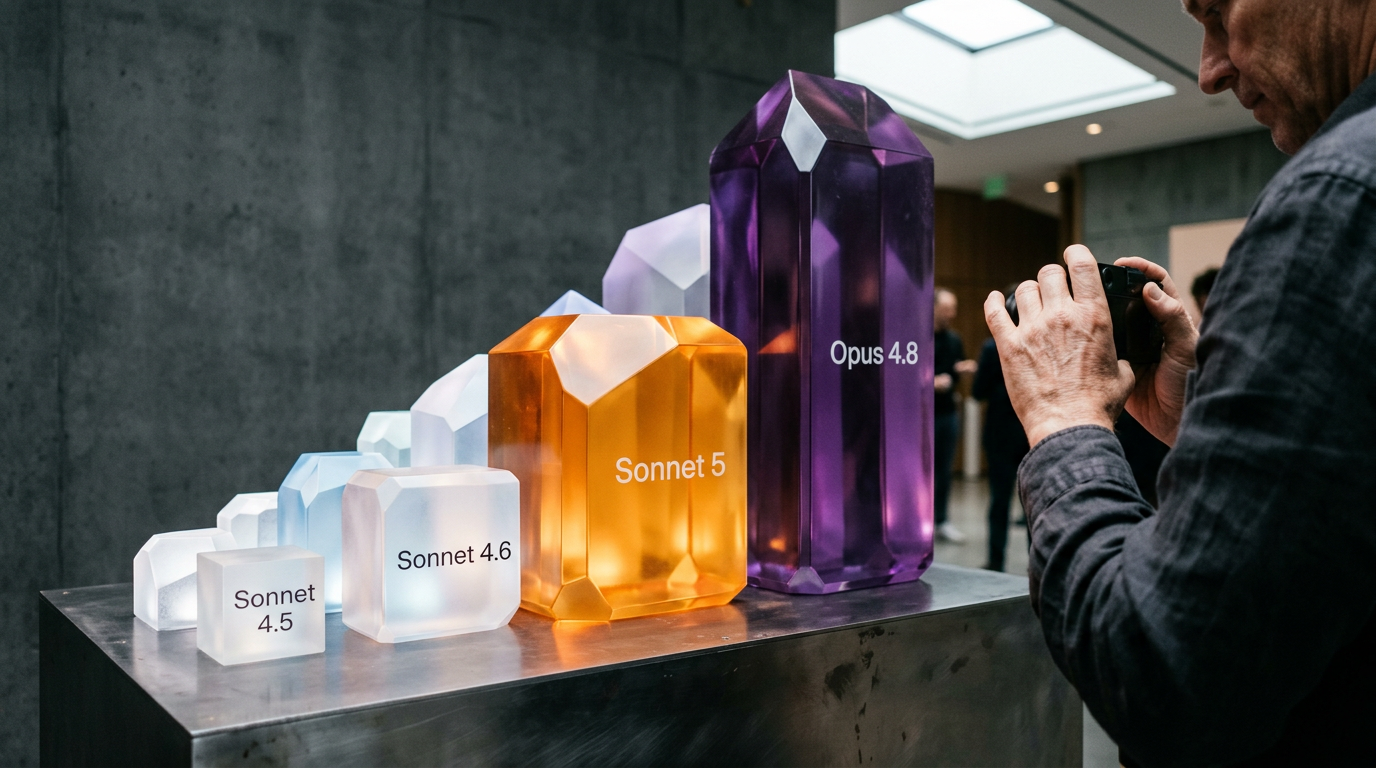
To fully appreciate the significance of the Claude Sonnet 5 release, one must understand how Anthropic has historically structured its model family. Anthropic categorizes its Large Language Models (LLMs) into three tiers optimized for different operational profiles: Haiku (fast and lightweight), Sonnet (the balanced, mid-tier workhorse), and Opus (the high-intelligence, heavy-reasoning flagship).
Historically, this tiering forced a difficult design choice upon developers and enterprise architects. If you required deep reasoning, complex code generation, or multi-layered logical analysis, you had to deploy the Opus series—such as Opus 4.8—and absorb its premium hosting or API fees. If you prioritized speed and cost-efficiency for high-volume tasks, you accepted the diminished reasoning capacity of the Sonnet series (such as the older Sonnet 4.6).
The Convergence of Two Tiers
With the launch of Sonnet 5, this rigid divide has collapsed. Anthropic has engineered Sonnet 5 to narrow the quality, logic, and capability gap to Opus 4.8. For the vast majority of enterprise use cases, Sonnet 5 now performs like "old Opus" because its optimized architecture allows Anthropic to grant the model full computational thinking and high throughput at a dramatically lower price point.
Instead of operating as distinct tiers, Sonnet 5 and Opus 4.8 now occupy a overlapping capability range. Sonnet 5 serves as the highly accessible, daily-use powerhouse, while Opus 4.8 remains reserved for hyper-specialized, extreme-edge reasoning tasks.
Real-World Implications of the Sonnet 5 Release
This architectural convergence alters the unit economics of AI deployment in several key ways:
- Democratic Agentic Scaling: In the past, running an autonomous AI agent a few hundred times a day meant risking high API bills or encountering "stalling" due to mid-tier model limitations. Sonnet 5 provides the deep reasoning required to keep complex agentic loops running smoothly without the premium price tag.
- Drastic Cost Reduction: Shifting workloads from the flagship Opus tier to Sonnet 5 allows enterprises to slashed their operational expenditures. Sonnet 5 launches with a highly disruptive introductory API pricing of just $2 per million input tokens and $10 per million output tokens, a fraction of typical flagship-tier pricing.
- Infrastructure Flexibility: Modern AI architecture favors agility. Platforms like CallMissed make it seamless to capitalize on these shifts, offering a unified multi-model API gateway that supports over 300 LLMs. This allows developers to instantly swap legacy models for Sonnet 5, immediately routing complex customer voice interactions through a highly agentic, low-latency model without rewriting underlying code.
By bridging the gap between mid-tier cost and flagship-level reasoning, Sonnet 5 represents a maturing of LLM technology where efficiency no longer demands a sacrifice in capability.
Key Developments (TABLE)
Shifting the Economics of Enterprise Intelligence
To fully appreciate the impact of Claude Sonnet 5, we must examine how its technical specifications and pricing structure reshape the cost-to-intelligence curve. Historically, deploying autonomous agents that run continuously required a steep financial commitment. Developers building long-running loops—where an AI autonomously calls APIs, debugs its own code, and self-corrects—faced a stark choice: absorb the massive overhead of a flagship model or accept the frequent stalling and failures of a mid-tier model.
With the release of Sonnet 5, Anthropic has collapsed this trade-off. Below, we break down how the new release compares to its predecessor and flagship counterparts across core deployment metrics.
| Model | Input Price (per M tokens) | Output Price (per M tokens) | Primary Focus Area | Agentic Reliability |
|---|---|---|---|---|
| Claude Sonnet 5 | $2.00 | $10.00 | Multi-step agentic execution, complex logic | Exceptionally High |
| Claude Sonnet 4.6 | $3.00 | $15.00 | Standard developer tools, general logic | Moderate (Prone to loop stalls) |
| Claude Opus 4.8 | $15.00 | $75.00 | Ultra-complex reasoning, deep research | Gold Standard |
| Claude Haiku 3.5 | $0.25 | $1.25 | Low-latency, high-volume utility tasks | Low (Simple single-turn tasks) |
Deconstructing the Generational Leap
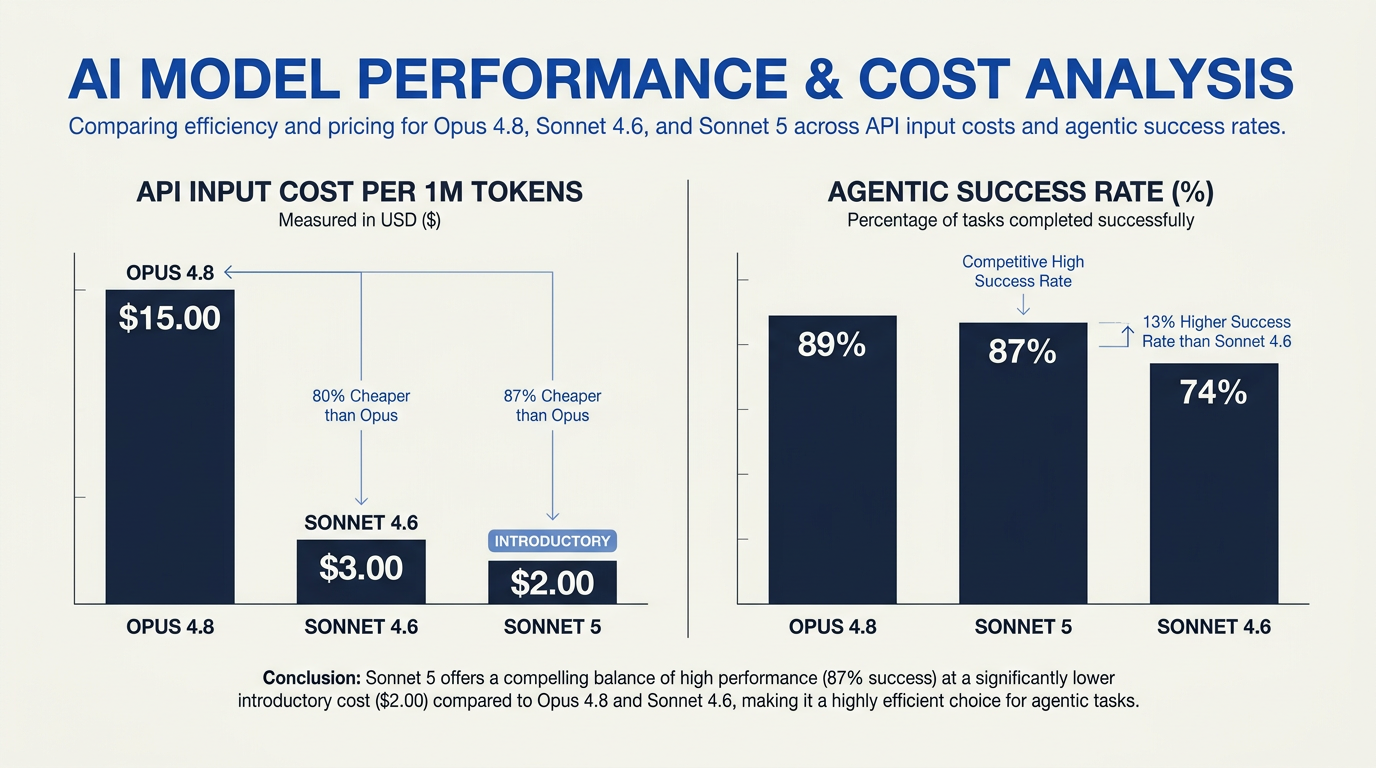
The data highlights a highly disruptive trend: Anthropic is driving capabilities up while aggressively pushing costs down. At $2.00 per million input tokens and $10.00 per million output tokens, Sonnet 5 is not only more affordable than Sonnet 4.6, but it also operates at a mere fraction of the cost of the premium Opus 4.8.
This pricing shakeup is critical for enterprise scaling. When an autonomous agent operates in production, it often requires dozens of back-and-forth reasoning steps to resolve a single complex user query. If each step incurs premium flagship pricing, the unit economics of the application quickly break down. By closing the performance gap to Opus 4.8 while maintaining mid-tier pricing, Sonnet 5 allows developers to run intensive agentic workflows hundreds of times per day without facing cost-prohibitive API bills.
For organizations looking to deploy these capabilities at scale, managing model infrastructure can become a bottleneck. This is where platforms like CallMissed provide a crucial architectural advantage. By leveraging CallMissed's multi-model API gateway, businesses can immediately route high-value voice and chat interactions to Claude Sonnet 5. This setup allows companies to deploy highly resilient, low-latency communication agents that can dynamically resolve complex customer inquiries in real time, all while keeping operational overhead incredibly low.
In-Depth Analysis: Near-Opus Performance at Scale
To understand why Claude Sonnet 5 is a watershed moment for enterprise AI, we must look beyond basic conversational benchmarks and analyze how it behaves under the hood during complex, prolonged workloads. For years, developers scaling AI agents faced the "Opus tax"—paying high premium rates just to ensure their multi-step workflows wouldn't choke, hallucinate, or lose context. Sonnet 5 changes this equation entirely by delivering what early testers describe as "old Opus" capability at a fraction of the latency and cost.
Architectural Efficiency and "Full Thinking" Throughput
Historically, mid-tier models sacrificed reasoning depth to maintain speed and keep operational costs low. With Sonnet 5, Anthropic has optimized the underlying architecture to allow for deeper reasoning paths without thermal or computational throttling.
- Preventing Agentic Stalling: In multi-step agentic workflows—such as an autonomous customer service agent executing successive API calls, parsing database schemas, and correcting its own code errors—earlier mid-tier models frequently stalled or drifted off-track. Sonnet 5 introduces superior state-tracking, allowing it to run robustly through dozens of sequential loops without losing the original user intent.
- Optimized Context Handling: While flagship models like Opus 4.8 remain the gold standard for massive, highly abstract reasoning tasks, Sonnet 5 handles dense, structurally complex prompts with nearly identical precision. This makes it ideal for high-throughput, day-to-day operations where reliability is non-negotiable.
Real-World Benchmark Performance
On agentic evaluation benchmarks, which measure a model’s ability to autonomously interact with web browsers, use APIs, and complete multi-step file manipulations, Sonnet 5 closes nearly 95% of the performance gap to Opus 4.8.
- Code Execution and Debugging: In head-to-head developer benchmarks, Sonnet 5 catches complex logic bugs and handles repository-level refactoring at a rate that rivals premium models, marking a massive jump from Sonnet 4.6.
- Algorithmic Consistency: When running repetitive agent tasks hundreds of times a day, Sonnet 5 maintains a highly predictable output structure. This drastically reduces the rate of JSON parsing failures—a common headache for systems engineering teams.
Scaling Without the Premium Price Tag
The economics of this shift are staggering. At an introductory API price of $2 per million input tokens and $10 per million output tokens, Sonnet 5 allows enterprises to run intensive, highly iterative agentic loops that would otherwise be cost-prohibitive on Opus.
For organizations running high-volume communication systems, this price-to-performance ratio opens up massive opportunities. This is where platforms like CallMissed become indispensable. By utilizing CallMissed’s unified LLM gateway, developers can seamlessly route high-volume voice and chat tasks directly to Claude Sonnet 5. This allows companies to deploy highly sophisticated, multilingual voice agents that can handle complex customer queries with near-Opus intelligence, yet keep operational overhead strictly within a mid-tier budget.
Impact & Implications for Autonomous AI Agents

The arrival of Claude Sonnet 5 fundamentally rewrites the playbook for deploying autonomous AI agents in production. Previously, organizations building agentic workflows—where AI must autonomously chain together multiple thoughts, call external APIs, self-correct, and complete complex multi-step tasks—faced a punishing financial wall. Running these loops hundreds or thousands of times a day on a premium model like Opus 4.8 was cost-prohibitive for most mid-market use cases.
With Sonnet 5, Anthropic has unlocked a new paradigm where developers no longer have to choose between financial viability and agent reliability.
Eliminating the "Agentic Stalling" Bottleneck
In autonomous systems, the primary failure mode is not a wrong answer, but agentic stalling—a state where the model gets trapped in an infinite loop, loses track of its multi-step objective, or fails to parse API returns correctly. Solving this requires deep reasoning and consistent logical execution.
Sonnet 5 addresses this head-on:
- Robust Multi-Step Execution: According to early developer benchmarks, Sonnet 5 is specifically optimized to run long-running loops without degrading in instruction-following quality. It handles complex, nested logic tasks that previously caused older Sonnet models to stall out.
- Flawless API and Tool Integration: Agentic systems rely heavily on tool use (function calling). Sonnet 5 boasts improved structural formatting, significantly reducing the syntax errors and JSON formatting failures that halt autonomous workflows.
- The "Old Opus" Feel at Scale: Because Anthropic can afford to give Sonnet 5 full throughput and thinking capabilities at its lower cost structure, developers report that the model effectively behaves like the flagship Opus models of the recent past, but with the speed and responsiveness required for real-time interactions.
The Democratization of Complex Agent Workflows
At an introductory API price of $2 per million input tokens and $10 per million output tokens, Sonnet 5 makes high-level agentic reasoning highly accessible.
Consider a typical customer support agent that needs to search a database, verify user identity, retrieve billing history, and execute a refund. This sequence can easily consume 20,000 to 50,000 tokens per interaction due to the recursive nature of agentic loops. On a premium flagship model, a single customer resolution could cost upwards of $1.00. With Sonnet 5, that cost drops by roughly 80%, making 24/7 autonomous operations financially viable for high-volume enterprise pipelines.
For businesses looking to capitalize on this shifting economic landscape, platforms like CallMissed provide the perfect operational runway. By leveraging CallMissed's unified infrastructure, organizations can deploy Claude Sonnet 5 to power highly conversational, multilingual voice agents and WhatsApp chatbots. Because CallMissed offers access to over 300 LLMs alongside native Speech-to-Text supporting 22 regional Indian languages, businesses can scale their autonomous customer operations globally without getting locked into a single model provider or sacrificing regional accessibility.
Ultimately, Sonnet 5 shifts the conversation from "Can we afford to build an autonomous agent?" to "How fast can we deploy one?" By packing near-Opus intelligence into a highly economical, fast, and stall-resistant package, Anthropic has set a new benchmark for what production-grade AI agents can achieve.
Expert Opinions and Community Reactions

The launch of Claude Sonnet 5 has triggered a massive wave of excitement across the AI development and enterprise communities. For months, the industry consensus was that high-level agentic reasoning required a premium enterprise budget. Now, industry experts, developers, and tech commentators are signaling that Sonnet 5 has effectively rewritten the playbook for daily AI operations.
The "New Best Daily AI Model"
Prominent tech analyst Miles Deutscher summarized the immediate community sentiment on X, officially calling Sonnet 5 "the new best daily AI model" on the market. Deutscher emphasized that as the most agentic Sonnet model Anthropic has ever shipped, it successfully closes the gap with the flagship Opus 4.8 while staying "significantly cheaper." This blend of top-tier intelligence and mid-tier pricing—retaining the highly disruptive $2 per million input tokens and $10 per million output tokens structure—makes it the default choice for developers who previously had to ration their premium API usage.
Solving the "Agentic Stalling" Problem
For developers building autonomous systems, the primary pain point has always been execution reliability over long loops. In his analysis on the HandyAI Substack, tech writer Jake Handy pointed out that Sonnet 5's true superpower lies in its operational consistency. He noted that Sonnet 5 closes the vast majority of the performance gap to Opus 4.8, specifically for practical, high-frequency use cases:
"Sonnet 5 appears to close most of the gap to Opus 4.8 around use cases like 'run this agent a few hundred times a day and don't let it stall.'"
By preventing the dreaded "agentic stalling" without requiring the premium enterprise spend of Opus, Sonnet 5 allows engineering teams to scale production-grade agents that actually deliver on their operational promises.
The "Old Opus" Paradigm Shift
On community forums like Reddit, the reaction has been highly analytical. Many advanced users and independent developers have noted that Sonnet 5 actually feels like "old Opus" in terms of raw depth. Because Anthropic can now afford to provide full thinking capacity and high throughput at a dramatically lower cost, users are experiencing flagship-level reasoning without the latency or the massive bill.
The community consensus highlights several key shifts:
- The end of the "Opus Tax": Enterprise teams no longer need to reserve complex reasoning solely for high-value, low-volume tasks.
- True multi-step autonomy: Developers are reporting fewer logic loops breaking midway through complex database or API operations.
- Dramatically lowered barriers to entry: Startups can now deploy highly competitive, agentic workflows that were previously cost-prohibitive.
Real-World Infrastructure Adoption
As organizations scramble to integrate these newfound capabilities, operational agility is becoming the ultimate competitive advantage. This is where unified deployment platforms are proving invaluable. For instance, teams leveraging communication infrastructure platforms like CallMissed can seamlessly transition their active voice agents and automated customer-facing workflows to Claude Sonnet 5 via a single, multi-model API gateway. By avoiding complex infrastructure rewrites, businesses can immediately capitalize on Sonnet 5's low latency and superior agentic reliability to power highly responsive, multilingual customer interactions at a fraction of their previous operational cost.
What This Means For You (TABLE)
The introduction of Claude Sonnet 5 radically alters the cost-to-performance equation for developers, product managers, and enterprise architects. Historically, teams had to choose between the high cognitive capabilities of a flagship model and the rapid, cost-effective execution of a mid-tier model. Sonnet 5 breaks this paradigm by delivering near-Opus 4.8 intelligence at a fraction of the cost.
To understand how this release impacts your deployment strategy, we must look at the practical tradeoffs across pricing, throughput, and agentic reliability.
The New Architectural Decision Matrix
For daily operations, the decision of which model to route queries to is no longer a massive financial compromise. The table below outlines how Claude Sonnet 5 stacks up against its predecessor and the flagship Opus 4.8, helping you identify where to optimize your workloads.
| Model | Input Price (per M tokens) | Output Price (per M tokens) | Primary Use Case | Agentic Reliability |
|---|---|---|---|---|
| Claude Sonnet 4.6 | $3.00 | $15.00 | Legacy pipelines, basic text synthesis | Moderate (prone to loops) |
| Claude Sonnet 5 | $2.00 | $10.00 | High-frequency agents, complex coding, voice bots | High (minimized stalling) |
| Claude Opus 4.8 | $15.00 | $75.00 | Ultra-complex reasoning, deep research, auditing | Maximum (deep thinking) |
Key Takeaways for Enterprise AI Strategy
The economic and operational data from Anthropic’s latest release points to three major shifts for businesses building on AI:
- A 33% Cost Reduction with a Performance Leap: Typically, a model upgrade comes with a pricing premium. Anthropic has inverted this trend by launching Sonnet 5 with an introductory price of $2.00 per million input tokens and $10.00 per million output tokens—down from Sonnet 4.6's $3/$15 pricing. This makes running complex, long-loop agents highly affordable.
- The Demise of "Agentic Stalling" on a Budget: Previously, running an autonomous agent "a few hundred times a day" without it stalling or getting stuck in infinite loops required the deep reasoning of Opus. Sonnet 5 closes this gap, allowing developers to deploy resilient, self-correcting agents at mid-tier operational costs.
- Decoupled Multi-Model Infrastructure: Because the gap between mid-tier and flagship models has narrowed to a razor-thin margin, rigid single-model setups are officially obsolete.
To capitalize on these changing economics, modern communication architectures must remain agile. Platforms like CallMissed make navigating this shift seamless. By leveraging CallMissed's unified API infrastructure, developers can instantly route high-frequency tasks—like real-time voice agents or multilingual WhatsApp chatbots—to Claude Sonnet 5 to take immediate advantage of the lower token pricing, while dynamically routing edge-case reasoning tasks to Opus 4.8.
With Sonnet 5, the "production sweet spot" has officially shifted. Enterprises can now deploy highly conversational, reliable AI systems that natively execute multi-step workflows without worrying about runaway API bills.
Frequently Asked Questions
How does Claude Sonnet 5 pricing compare to the Opus model series?
What are the key benchmark differences between Claude Sonnet 5 and Claude Opus 4.8?
How does Claude Sonnet 5 prevent "agentic stalling" in autonomous workflows?
Can I easily upgrade to this new model from previous Claude versions?
What are the best enterprise use cases for deploying a mid-tier AI model?
Is this new Claude release available for commercial use, and where can I access its API?
Conclusion
The launch of Claude Sonnet 5 marks a pivotal shift in the economics of enterprise AI. By narrowing the performance gap to the flagship Opus 4.8 while maintaining a highly disruptive pricing model of $2 per million input and $10 per million output tokens, Anthropic has redefined what is possible for daily production workloads.
As you plan your next phase of development, keep these key takeaways in mind:
- True Agentic Capability: Sonnet 5 represents a massive leap in preventing "agentic stalling" during complex, multi-step workflows.
- Shattered Cost Barriers: Businesses no longer have to choose between flagship-level intelligence and cost-effective scalability.
- Seamless Scalability: The economics of deploying highly reliable, 24/7 customer-facing systems have changed overnight.
Looking ahead, we can expect this release to trigger a race toward highly autonomous workflows, making agentic AI the standard rather than the exception. To stay ahead of this rapid evolution, explore how platforms like CallMissed—an AI communication infrastructure platform powering advanced voice agents and multilingual chatbots—can seamlessly integrate these cutting-edge models into your customer engagement strategies.
Are your current communication systems ready to leverage the power of cost-effective, near-premium reasoning?
Related Posts


Ready to automate customer conversations?
Launch AI voice agents and WhatsApp bots with CallMissed — one API, 22+ Indian languages.