
Deepgram’s Voice Agent API Confirms the Stack Is Moving Toward Unified Voice Workflows


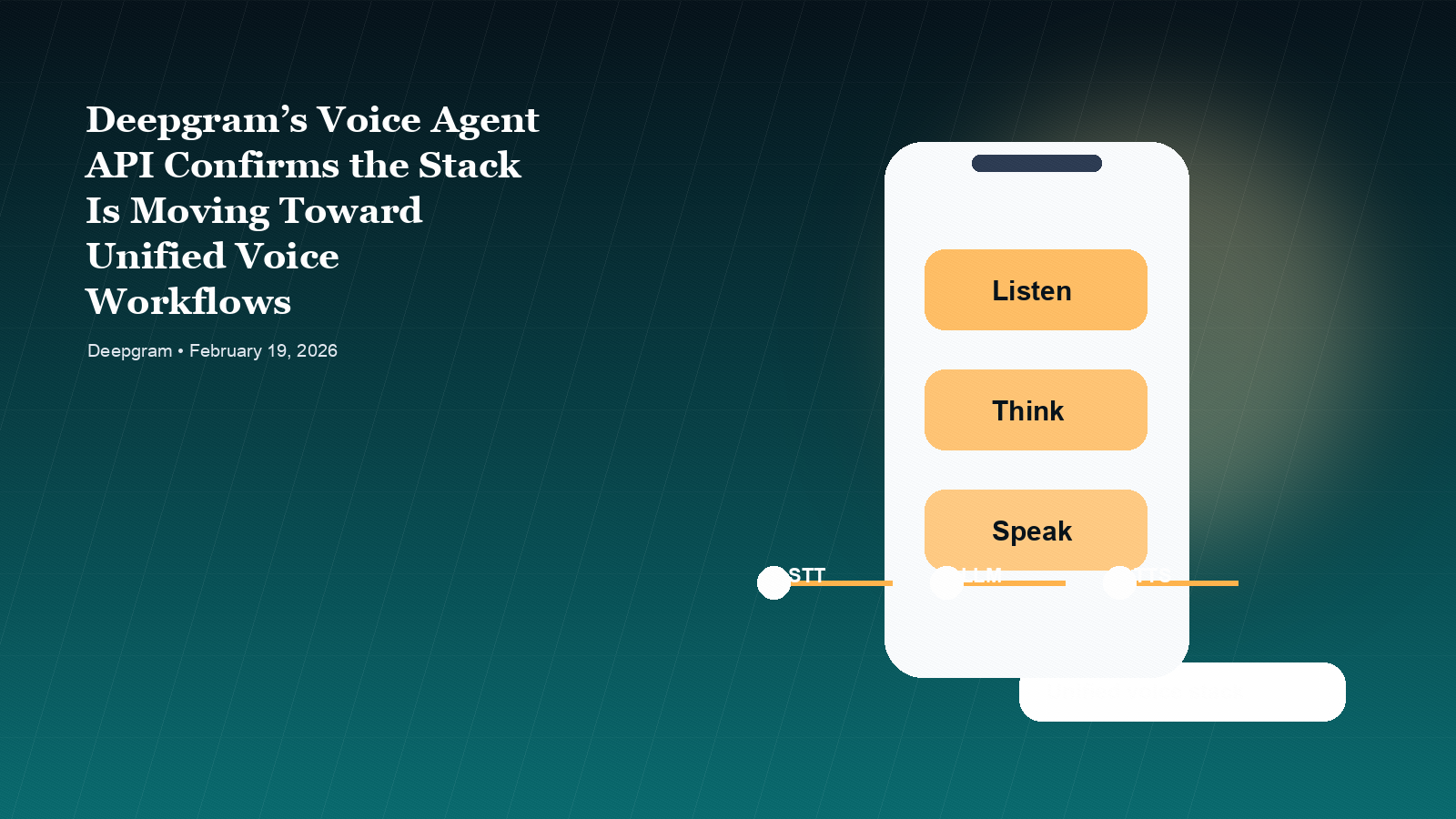
Deepgram’s Voice Agent API Confirms the Stack Is Moving Toward Unified Voice Workflows explains what this AI launch means for CallMissed-style voice, WhatsApp, Smart IVR, and customer workflow auto...
Deepgram’s Voice Agent API Confirms the Stack Is Moving Toward Unified Voice Workflows
Deepgram published Introducing Deepgram’s Voice Agent API on February 19, 2026, and the announcement matters because it points to where the AI market is heading for communication-heavy products. This is not generic model news. It is a signal about how customer-facing workflows, agent runtimes, voice systems, and business messaging are being rebuilt.
For CallMissed, the relevance is direct. The product is positioned as AI communication infrastructure with WhatsApp chatbots, AI voice call agents, Smart IVR, multilingual speech APIs, and OpenAI-compatible endpoints. That means each of these launches should be evaluated through one practical lens: does it improve how businesses answer, route, follow up, and complete customer work across channels?
What the source actually says
- Deepgram launched a unified voice-to-voice API for AI agents.
- The company emphasized real-time listening, thinking, and speaking in one developer surface.
- The launch also highlighted interruption handling and developer choice across LLMs.
The primary source is here: Introducing Deepgram’s Voice Agent API. In this article, the important move is not only the feature list. It is the direction of travel: more production readiness, more deployment maturity, more observability, better real-time performance, or stronger cost discipline depending on the topic.
Why this trend matters now
The stack is consolidating because developers are tired of stitching speech recognition, reasoning, and synthesis together for every new use case.
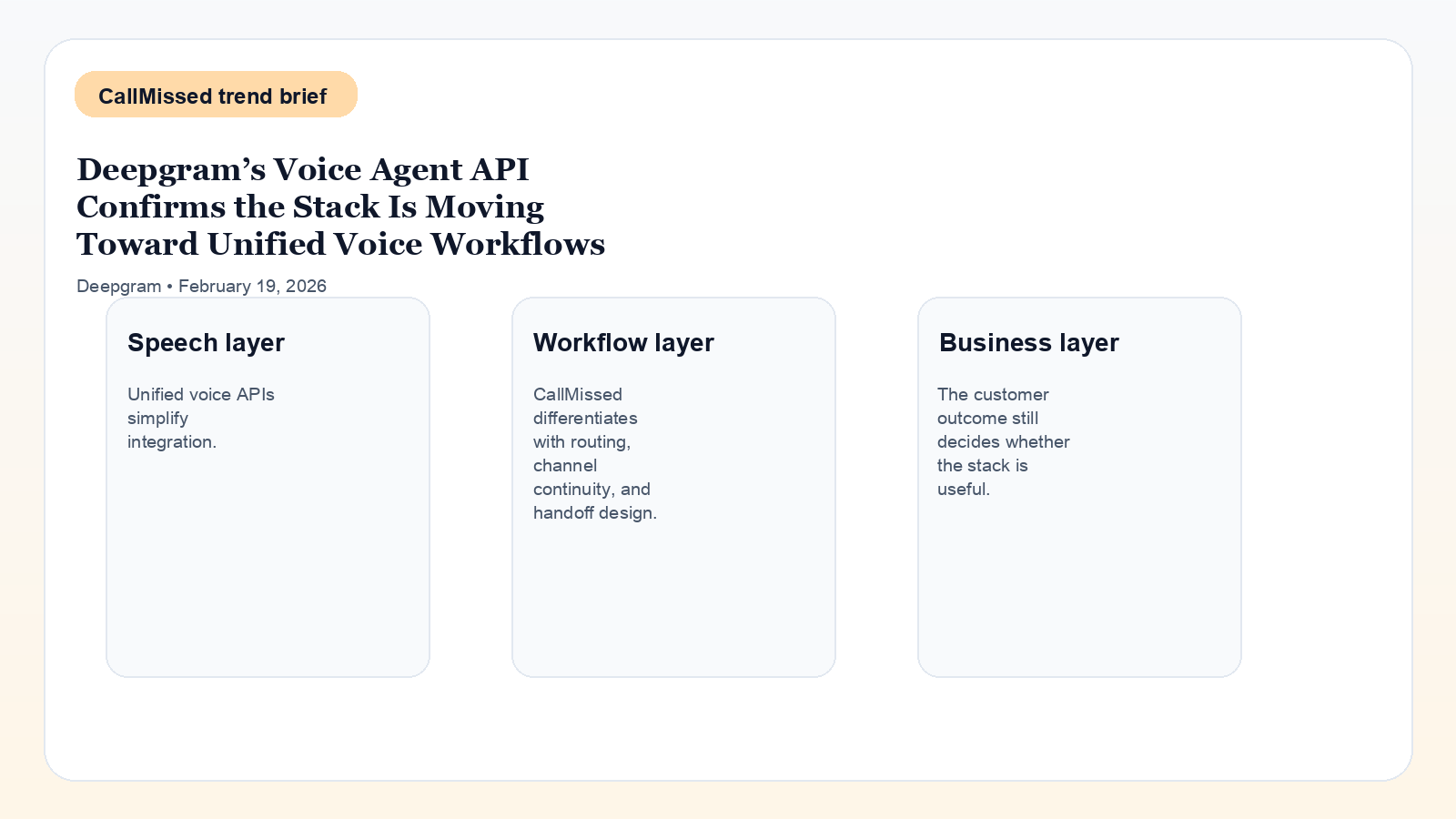
Unified voice APIs matter when teams need to ship quickly, but they do not remove the need for good workflow design. The orchestration is only the starting point.
The strongest products will be the ones that combine unified speech infrastructure with channel continuity, routing intelligence, and business context.
What this means for CallMissed
CallMissed fits naturally into this discussion because its product thesis is already closer to orchestration than to raw model access alone.
A unified voice stack is helpful, but businesses also need WhatsApp continuity, Smart IVR, multilingual support, and operational handoffs. That broader layer is where CallMissed differentiates.
In other words, as voice APIs become easier to consume, the value shifts upward toward workflow design, channel coordination, and business integration.
CallMissed documentation reinforces the same architectural story. The platform offers AI-powered communication APIs, WhatsApp business workflows, voice-call agents, Smart IVR, speech-to-text in 22 Indic languages plus English, text-to-speech options for telephony, and OpenAI-compatible endpoints. Those verified capabilities make the product a natural surface for turning this market momentum into real business workflows instead of one-off experiments.
Practical operating blueprint
- Use unified voice APIs to reduce integration complexity, but keep business routing outside the raw speech layer so workflows stay adaptable.
- Design interruption recovery early. Deepgram’s emphasis on end-of-thought handling reflects a real production need, not a cosmetic feature.
- Preserve channel continuity by moving confirmations, documents, or action links into WhatsApp after the call where appropriate.
- Choose evaluation metrics that reflect the full loop: speech quality, action success, and handoff efficiency.
- Treat voice API simplification as a chance to build better customer workflows, not only to replace components more quickly.
Where teams can use this immediately
- Customer support bots that need telephony-ready, real-time voice handling.
- Order and booking workflows where voice captures urgency and messaging carries the details.
- Outreach or verification flows where real-time spoken interaction is more effective than chat alone.
- Products that want to add voice without assembling every layer from scratch.
Commercial perspective
The reason unified voice agent API matters is that communication systems sit near revenue and support cost at the same time. When a company answers faster, routes more accurately, preserves context across channels, and lowers repetitive agent work, the gains show up in booked appointments, recovered leads, faster ticket flow, lower backlog, or healthier margins. That is why these infrastructure and model announcements matter even when they seem technical on the surface.
The other important shift is buyer expectation. Enterprise teams increasingly expect AI communication platforms to look like serious software infrastructure: secure enough to deploy, measurable enough to improve, and flexible enough to fit the business’s chosen channels and workflows. Products that only sound impressive in demos will lose to products that make the day-to-day operating loop cleaner.
Risks and mistakes to avoid
- Mistaking a unified speech API for a complete customer workflow platform.
- Skipping handoff design because the low-level stack got easier to integrate.
- Ignoring business-context storage, which is what makes repeat contacts and cross-channel flows coherent.
- Optimizing only speech quality while leaving routing and follow-up fragmented.
Metrics to review after rollout
| Metric | Why it matters |
|---|---|
| Conversation completion | Unified voice APIs are valuable when they help the workflow finish, not only when they simplify integration. |
| Interruption resilience | Real-time voice quality is strongly shaped by how well the stack handles barge-in and hesitation. |
| Cross-channel continuity | Support quality improves when the voice interaction and message follow-up share one stateful workflow. |
The common trap in AI communication programs is optimizing for the wrong layer. Teams celebrate a model change, a voice upgrade, or a faster runtime while the actual workflow remains fragmented. The right question is always the same: did the customer interaction become easier to complete, and did the business spend less manual effort to complete it?
FAQ
Why is a unified voice API important?
How does CallMissed differ from a raw voice API?
What should teams do after adopting a unified voice stack?
What metric matters most?
Sources
- Deepgram (February 19, 2026): Introducing Deepgram’s Voice Agent API
- CallMissed Introduction: https://docs.callmissed.com/docs/introduction
- CallMissed Quickstart: https://docs.callmissed.com/docs/quickstart
- CallMissed Speech to Text: https://docs.callmissed.com/docs/speech-to-text
- CallMissed Text to Speech: https://docs.callmissed.com/docs/text-to-speech
- CallMissed Chat Completions: https://docs.callmissed.com/docs/chat-completion
Conclusion
Deepgram’s Voice Agent API Confirms the Stack Is Moving Toward Unified Voice Workflows is important because it shows how quickly the market is professionalizing around communication AI. The lesson for CallMissed is not to chase every logo or every launch headline. The lesson is to keep building the operational layer where these advances become useful: voice, WhatsApp, Smart IVR, multilingual understanding, measured routing, and clean handoffs. That is where real business value appears.
Discussion
Related Posts

Ready to automate customer conversations?
Launch AI voice agents and WhatsApp bots with CallMissed — one API, 22+ Indian languages.