

CallMissed Lead Capture Workflow: Phone to WhatsApp to Email



Build a CallMissed lead capture workflow across phone, WhatsApp and email, with consent, qualification, CRM updates and timely follow-up.
CallMissed Lead Capture Workflow: Phone to WhatsApp to Email
What happens when a prospect calls your business, shares their requirements, and then receives a WhatsApp message or email that ignores everything they just said? CallMissed lead capture is designed to prevent that fragmented experience by turning phone enquiries into structured leads and coordinating follow-up across WhatsApp and email—with consent, ownership, and permitted context preserved.
Speed and continuity matter because buyer attention decays quickly. Harvard Business Review reported in March 2011 that companies contacting an online lead within one hour were nearly seven times more likely to qualify the lead than companies responding even one hour later. Channel choice matters too: Meta CEO Mark Zuckerberg stated in April 2025 that WhatsApp had surpassed 3 billion monthly active users, making it a critical customer-engagement channel in India and globally.
Yet effective AI lead follow-up requires more than automatically sending messages. A production workflow must determine:
- Which qualification fields the phone agent should capture
- Whether the customer has consented to WhatsApp or email communication
- How quickly each follow-up should be triggered
- Which details may safely move between channels
- How duplicate contacts and repeat enquiries should be merged
- When a human salesperson must take over
- Who owns the lead and how the CRM should be updated
From conversation to coordinated follow-up
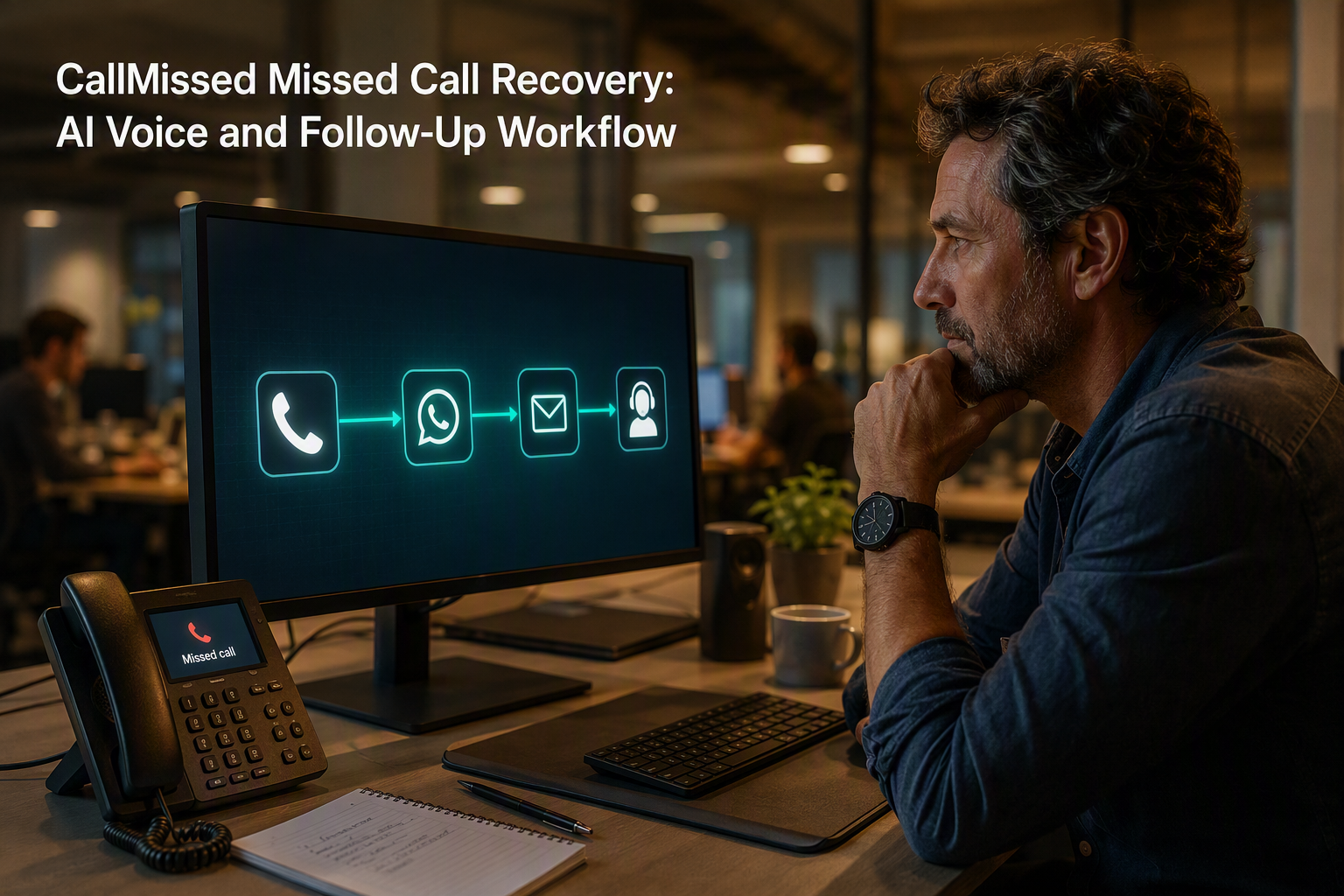
This guide follows one enquiry through a practical phone-to-WhatsApp-to-email journey. You will see how an AI voice agent can capture the caller’s name, contact details, location, product interest, budget, timeline, and preferred channel; how WhatsApp can continue the conversation without forcing repetition; and how email can deliver a detailed proposal or summary when appropriate.
CallMissed supports this model through AI voice agents, WhatsApp chatbots, WhatsApp Business calling, email tooling, and an omnichannel inbox/CRM, allowing businesses to coordinate engagement without treating every channel as a separate record.
Controls before automation
The workflow also covers the less visible elements that make omnichannel lead management reliable: identity matching, deduplication rules, timestamped consent, response-time targets, lead assignment, escalation, human takeover, CRM status changes, and measurable outcomes. A worked example will show how these components interact, while the accompanying table and FAQ will help teams translate the design into operating rules.
The objective is not to automate every interaction. It is to create a controlled workflow in which AI responds quickly, employees retain accountability, and prospects receive relevant follow-up without losing privacy or conversational continuity.
How does CallMissed lead capture move an enquiry from phone to WhatsApp to email?
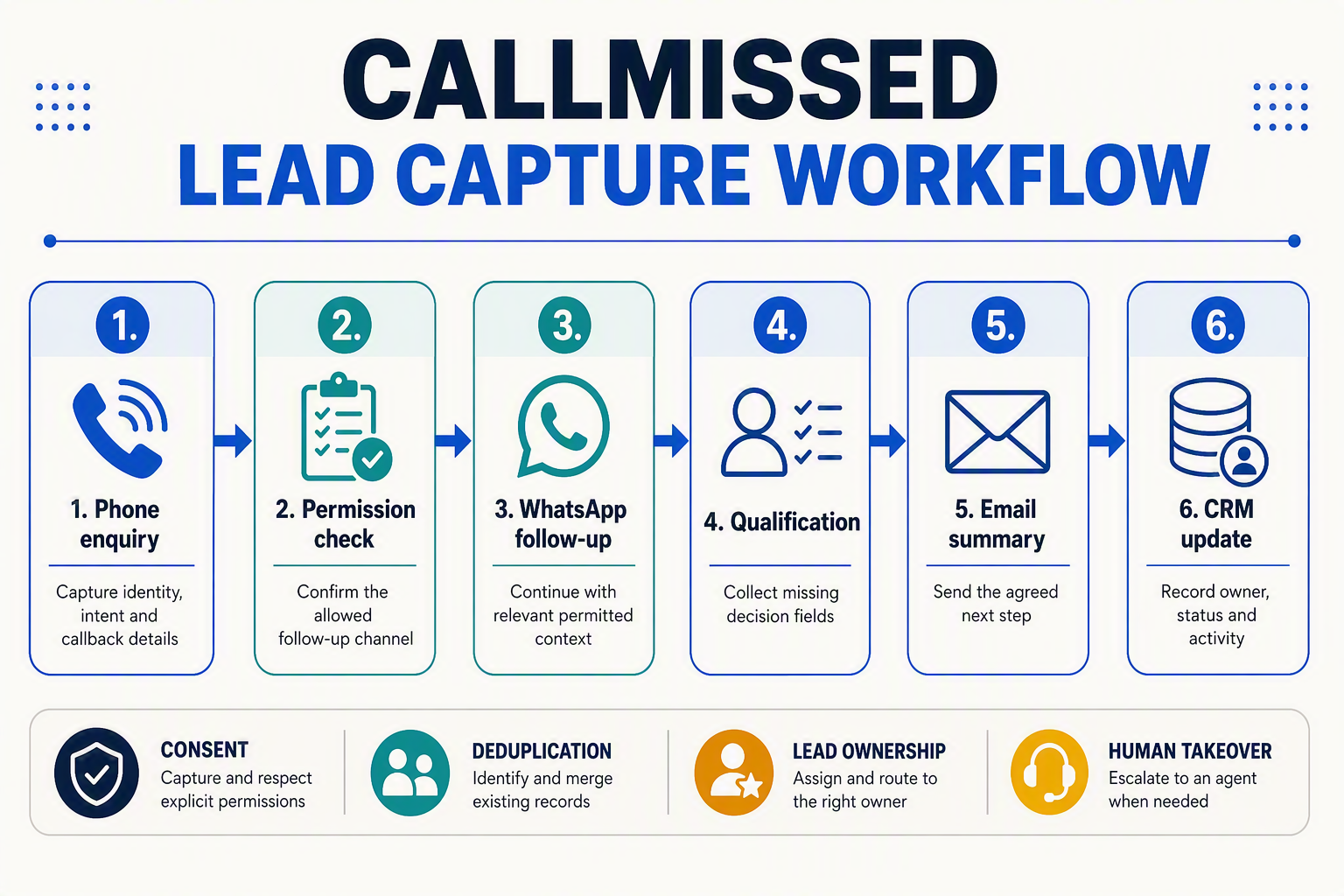
CallMissed lead capture moves an enquiry across channels by creating one structured lead during the phone call, attaching consent and conversation context to that record, and then using the same record for WhatsApp and email follow-up. Each transition should pass only the information required for the next interaction—not an unrestricted transcript or every detail the caller disclosed.
1. Capture and structure the phone enquiry
When a prospect calls, a CallMissed AI voice agent can answer initial questions and collect qualification data conversationally. For businesses serving regional audiences, CallMissed supports speech recognition and synthesis across 22 Indian languages, helping the workflow capture requirements without forcing every caller into English or Hindi.
The voice stage should populate defined CRM fields rather than storing the call solely as unstructured text:
- Identity: name, verified phone number and email address
- Enquiry: product, service, use case and location
- Qualification: budget range, quantity, timeline and decision stage
- Preferences: language, suitable contact time and preferred channel
- Compliance: WhatsApp and email consent status, source and timestamp
- Routing: territory, product team, priority and assigned owner
Sensitive information that is unnecessary for sales follow-up should be excluded or redacted. The workflow may retain a concise summary such as “seeking a 20-seat plan for a Bengaluru team this month” instead of exposing the full recording to every user.
2. Continue on WhatsApp with permitted context
After identity and consent checks, the workflow can send an approved WhatsApp template or continue within an eligible customer-service conversation. The message should acknowledge the known requirement without revealing sensitive details:
“Hi Ananya, thank you for calling about plans for your Bengaluru team. Would you like a pricing summary here?”
This is AI lead follow-up with continuity: the customer does not need to repeat the product, location or timeline, but remains in control of the conversation. CallMissed combines AI voice agents, WhatsApp chatbots and WhatsApp Business calling, including the ability to bridge a WhatsApp call to an AI agent.
Before sending, the automation should confirm:
- The normalized phone number matches the lead.
- Valid WhatsApp permission or another lawful messaging basis is recorded.
- The selected template and language fit the enquiry.
- No opt-out, suppression or active human conversation blocks automation.
- A named employee or queue owns the lead.
If identity is uncertain, the first message should verify the recipient without disclosing enquiry details.
3. Use email for detailed material
Email is appropriate when the prospect requests a proposal, brochure, quotation or written recap. The email step can reuse approved fields—such as product interest, company name and requested quantity—while omitting internal lead scores, agent notes and unrelated call content.
The CRM should record the email’s template, send time, delivery state and subsequent reply. A response should reopen the same conversation record rather than create another lead.
Maintain one lead throughout the journey
Reliable omnichannel lead management depends on a persistent lead ID rather than channel-specific records. CallMissed’s omnichannel inbox/CRM can coordinate voice, WhatsApp and email activity around that identity while preserving channel history.
At every transition, the system should update:
- Lead status: new, contacted, qualified, proposal sent or disqualified
- Last and next action timestamps
- Consent and opt-out changes
- Owner and reassignment history
- Human-takeover state
- Permitted context shared with the next channel
The result is a controlled sequence: phone captures intent, WhatsApp enables immediate dialogue, and email carries detailed documentation—without treating the prospect as three separate enquiries.
Why does shared, permitted context matter in omnichannel lead management?
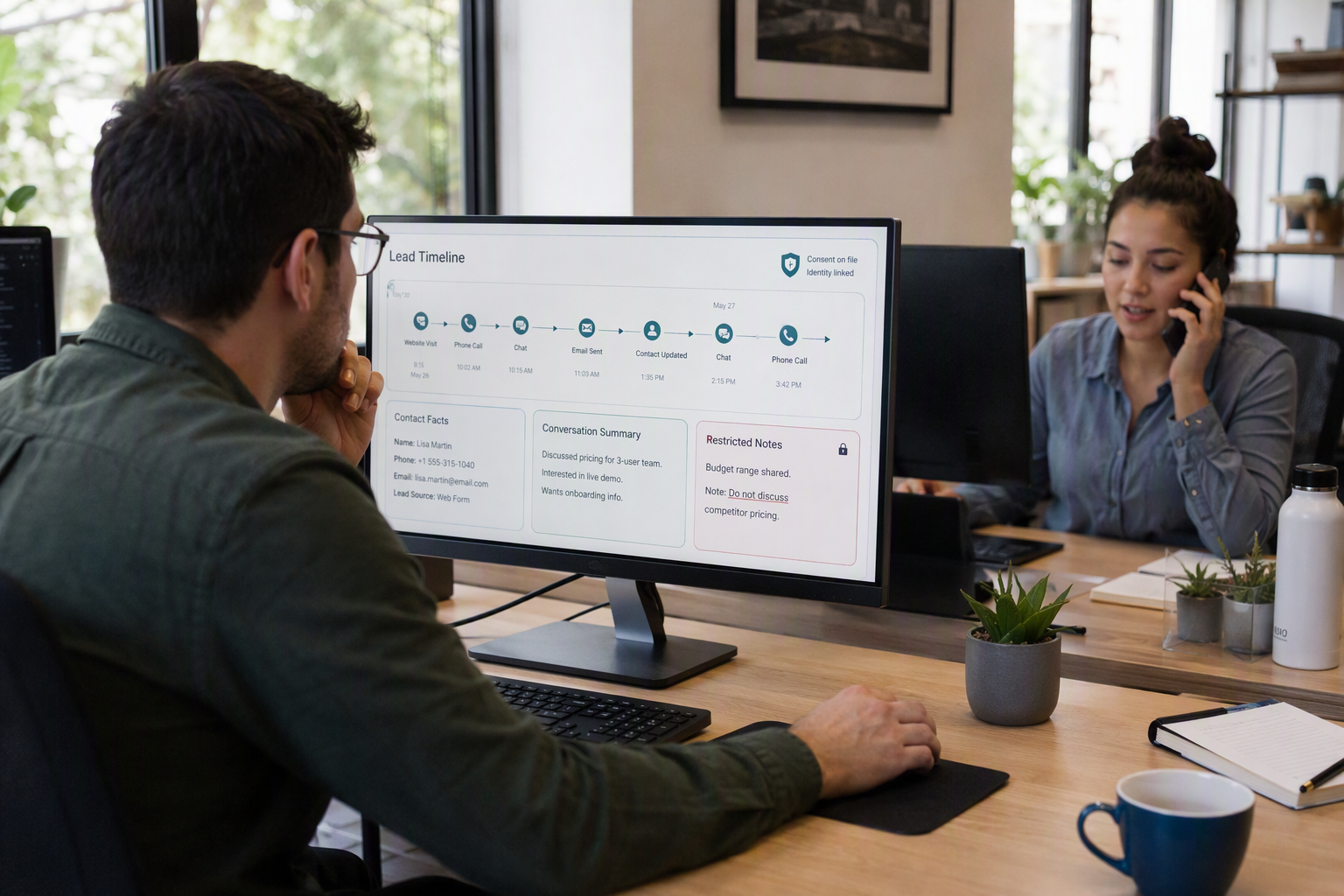
Shared, permitted context lets each channel continue the same enquiry without exposing unnecessary data or assuming consent that the prospect never gave. In omnichannel lead management, continuity should follow explicit permissions, verified identity, business purpose, and role-based access—not simply copy an entire phone transcript into every system.
Shared context is not unlimited memory
A useful cross-channel record contains the minimum information needed to progress the enquiry. For example, a phone conversation might produce a structured context packet containing:
- Verified name and phone number
- Product or service requested
- Location, budget range, and purchase timeline
- Questions already answered and promised next action
- Preferred language and communication channel
- Consent status, collection source, purpose, and timestamp
- Assigned lead owner and current CRM stage
Sensitive or irrelevant details should remain excluded. Raw call recordings, payment credentials, identity documents, health information, internal risk notes, and unrelated conversation history should not automatically appear in WhatsApp or email.
This approach reflects established privacy principles. India’s Digital Personal Data Protection Act, 2023 received presidential assent on 11 August 2023 and establishes purpose limitation and consent-related obligations for processing digital personal data. The European Commission similarly identifies purpose limitation and data minimisation among the core principles of the EU General Data Protection Regulation, which became applicable on 25 May 2018.
Permission must be channel- and purpose-aware
Permission to call a person does not automatically mean the business may send unrestricted WhatsApp promotions or add that person to an email newsletter. A production workflow should separately record whether the prospect permits:
- Transactional WhatsApp follow-up, such as a requested brochure or appointment confirmation
- Email communication, such as a quotation or detailed proposal
- Marketing messages, including future campaigns and offers
- Call recording or transcription, where applicable
- Human review, particularly when an AI agent escalates the conversation
Meta’s WhatsApp Business Platform documentation requires businesses to obtain opt-in before sending business-initiated WhatsApp messages. Meta also requires an approved message template when a business contacts a user outside the 24-hour customer-service window opened by the user’s WhatsApp message.
Continuity improves accuracy and accountability
Without shared context, separate agents may ask for the budget repeatedly, send the wrong product catalogue, or overwrite a salesperson’s follow-up. With permitted context, AI lead follow-up can reference the customer’s stated requirement while maintaining operational controls.
Before any cross-channel action, the workflow should verify:
- Identity: Does the destination number or email belong to the same prospect?
- Authority: Is this channel approved for the intended purpose?
- Relevance: Which fields are genuinely required for the next message?
- Freshness: Has the prospect changed their preference, budget, or timeline?
- Ownership: Which employee or queue is responsible for the next action?
- Revocation: Has the person opted out since the information was collected?
CallMissed lead capture can structure phone-enquiry data for use across AI voice, WhatsApp, email, and the omnichannel inbox/CRM. The governing rule remains straightforward: transfer enough context to make the next interaction useful, but never more than the customer permitted or the task requires.
Which stages, records and controls belong in an AI lead follow-up workflow? (TABLE)
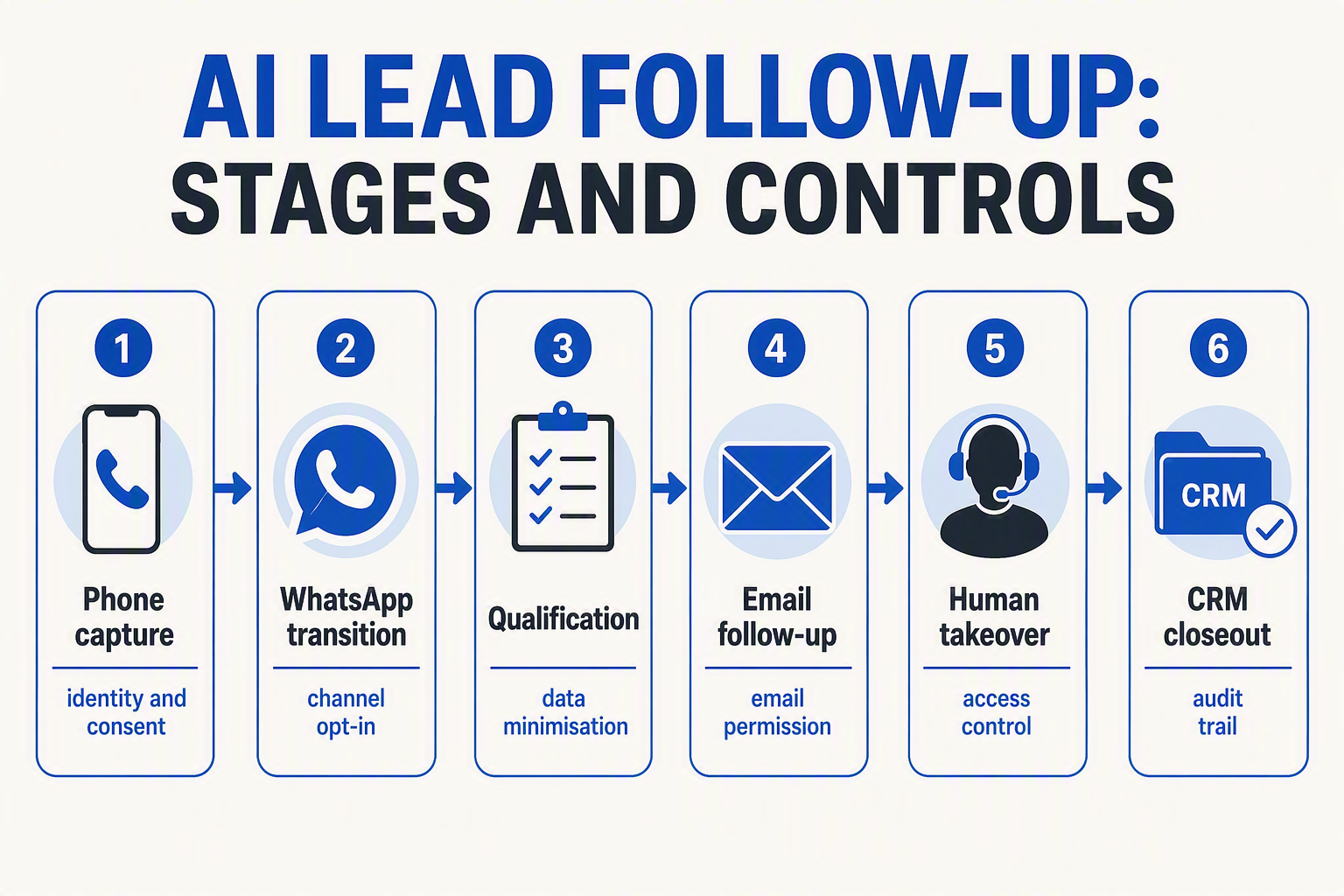
A reliable AI lead follow-up workflow needs six controlled stages: capture, identity resolution, qualification, channel follow-up, sales handoff, and closure. Every stage should update one lead record, expose a clear owner, and restrict cross-channel context to information the prospect permitted the business to use.
Recommended workflow structure
| Stage | Record or update | Context allowed downstream | Control and owner | Example target |
|---|---|---|---|---|
| 1. Phone enquiry | Lead ID, call ID, timestamp, phone number, transcript or summary | Basic identity and enquiry details | AI agent; operations owns configuration | Create record during the call |
| 2. Identity and consent | Matched contact, consent status, source, timestamp, preferred channel | Only fields covered by the recorded permission | System check; privacy owner reviews policy | Resolve before outbound messaging |
| 3. Qualification | Product interest, location, budget range, timeline, use case, urgency | Relevant qualification fields, not the unrestricted transcript | AI captures; sales validates uncertain values | Complete by call end or flag missing fields |
| 4. WhatsApp follow-up | Message status, replies, template used, next action | Approved summary and necessary qualification context | Automation owner; assigned rep monitors replies | Send within 5 minutes when eligible |
| 5. Email follow-up | Recipient, subject, proposal version, delivery status | Requested documents and validated lead details | Assigned salesperson or approved automation | Send within 30 minutes when requested |
| 6. Handoff and closure | Owner, CRM stage, tasks, outcome, reason code | Full permitted history needed for resolution | Named salesperson or team queue | Escalate immediately on trigger |
The times above are example service-level targets, not universal conversion benchmarks. Each business should set targets according to staffing, working hours, enquiry value, regulatory obligations, and channel rules.
Use separate records for identity, activity and state
A single contact can make several calls or enquire about multiple products. Omnichannel lead management should therefore avoid treating a phone number as both the person and the opportunity.
Maintain at least four linked objects:
- Contact: name, verified phone number, email address, language and communication preferences.
- Lead or opportunity: product interest, budget, location, timeline, source, score, stage and owner.
- Interaction: each call, WhatsApp exchange, email, summary, timestamp and delivery result.
- Consent event: channel, purpose, wording shown or spoken, response, source and timestamp.
This structure supports deduplication without erasing history. Match exact verified phone numbers first, then verified email addresses; send uncertain matches to review rather than automatically combining two people. A repeat caller may update an existing opportunity or create a new one, depending on product and intent.
Put controls before every channel transition
CallMissed lead capture can coordinate AI voice agents, WhatsApp, email and an omnichannel inbox/CRM, but continuity should rely on an approved context allowlist—not indiscriminate transcript sharing. Before a phone enquiry becomes a WhatsApp or email action, the workflow should verify:
- Channel eligibility: Is the destination valid, and is the planned message permitted under the organisation’s consent and messaging policy?
- Minimum necessary context: Does the next channel need the caller’s budget, or only the requested product and appointment time?
- Ownership: Is the lead assigned to a person, territory queue or fallback team?
- Escalation: Did the prospect request a human, dispute captured information, express urgency, or exceed the AI agent’s confidence threshold?
- CRM consistency: Did the message, reply, status change and next task write back to the same lead ID?
These controls preserve conversational continuity while ensuring that automation never becomes anonymous, unowned or broader than the customer’s permission.
Which qualification fields should the workflow capture without collecting unnecessary data?
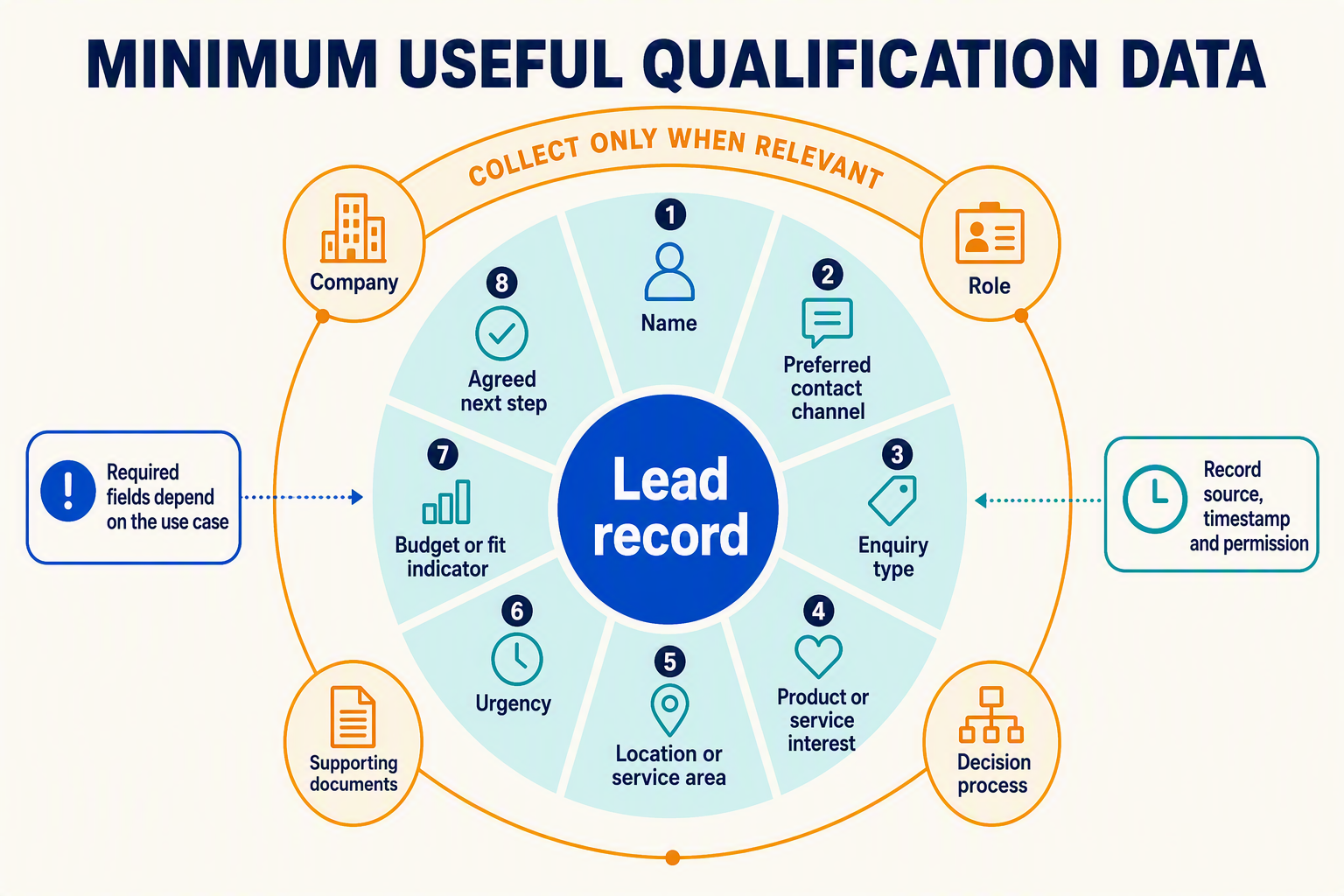
Capture only the fields needed to identify, qualify, route, and follow up with the lead. Every field should have a defined purpose, access rule, and retention period; if the workflow cannot explain why a value is necessary, it should not collect it.
Use a minimum viable qualification record
A practical CallMissed lead capture schema can begin with these fields:
- Identity: Customer name and verified phone number. Capture an email address only when email follow-up is requested or necessary.
- Enquiry details: Product or service category, stated requirement, quantity or expected scope, and the customer’s question.
- Qualification: Budget range, purchase timeline, service location, and decision stage. Use ranges such as “₹50,000–₹1 lakh” instead of requesting exact financial information.
- Communication preferences: Preferred channel, suitable contact time, language, and whether a human callback is required.
- Consent evidence: Approved channel, purpose, consent wording or version, timestamp, and source—for example, “verbal permission during inbound call.”
- Operational metadata: Lead source, enquiry timestamp, assigned owner, CRM status, conversation ID, and next action.
Not every business needs every field. A home-services company may require a PIN code to check coverage, while a software provider may need company size and intended use case. Configure conditional questions so irrelevant fields are skipped.
Separate facts, summaries, and assumptions
The workflow should distinguish between information the prospect explicitly supplied and information generated by an AI agent:
- Customer-stated fact: “Installation is required in Pune.”
- Structured value:
service_city = Pune - AI-generated summary: “Prospect wants installation within two weeks.”
- Unverified inference: “Likely price-sensitive.”
Only verified facts and clearly labelled summaries should drive automated AI lead follow-up. Inferences about income, health, religion, caste, political views, or emotional state should not become qualification fields unless a lawful, necessary use case has been reviewed. Sentiment can help a live agent understand urgency, but it should not silently determine eligibility or pricing.
Apply purpose limitation to every channel
India’s Digital Personal Data Protection Act, 2023 received presidential assent on August 11, 2023 and requires consent to be specific, informed, unambiguous, and limited to personal data necessary for the stated purpose. The European Union’s General Data Protection Regulation has similarly required data minimisation under Article 5 since May 25, 2018.
In practice, permission to answer an inbound phone call does not automatically establish permission for promotional WhatsApp or email campaigns. Store channel permissions separately:
whatsapp_service_updates = yes/nowhatsapp_marketing = yes/noemail_proposal = yes/noemail_marketing = yes/no
This separation lets omnichannel lead management preserve useful context without treating every captured detail as portable. CallMissed can retain structured enquiry context across its voice, WhatsApp, email, and CRM tooling, but workflow administrators should specify which fields each channel and employee role may access.
Avoid “just in case” collection
Do not request identity documents, full birth dates, bank details, precise income, family information, or unrelated demographic data during routine qualification. Prefer coarse values, make optional fields visibly optional, and review abandoned fields regularly. A smaller, well-governed lead record is easier to verify, deduplicate, secure, and use responsibly than an extensive profile assembled without a clear purpose.
How should consent, identity matching and deduplication preserve only permitted context?
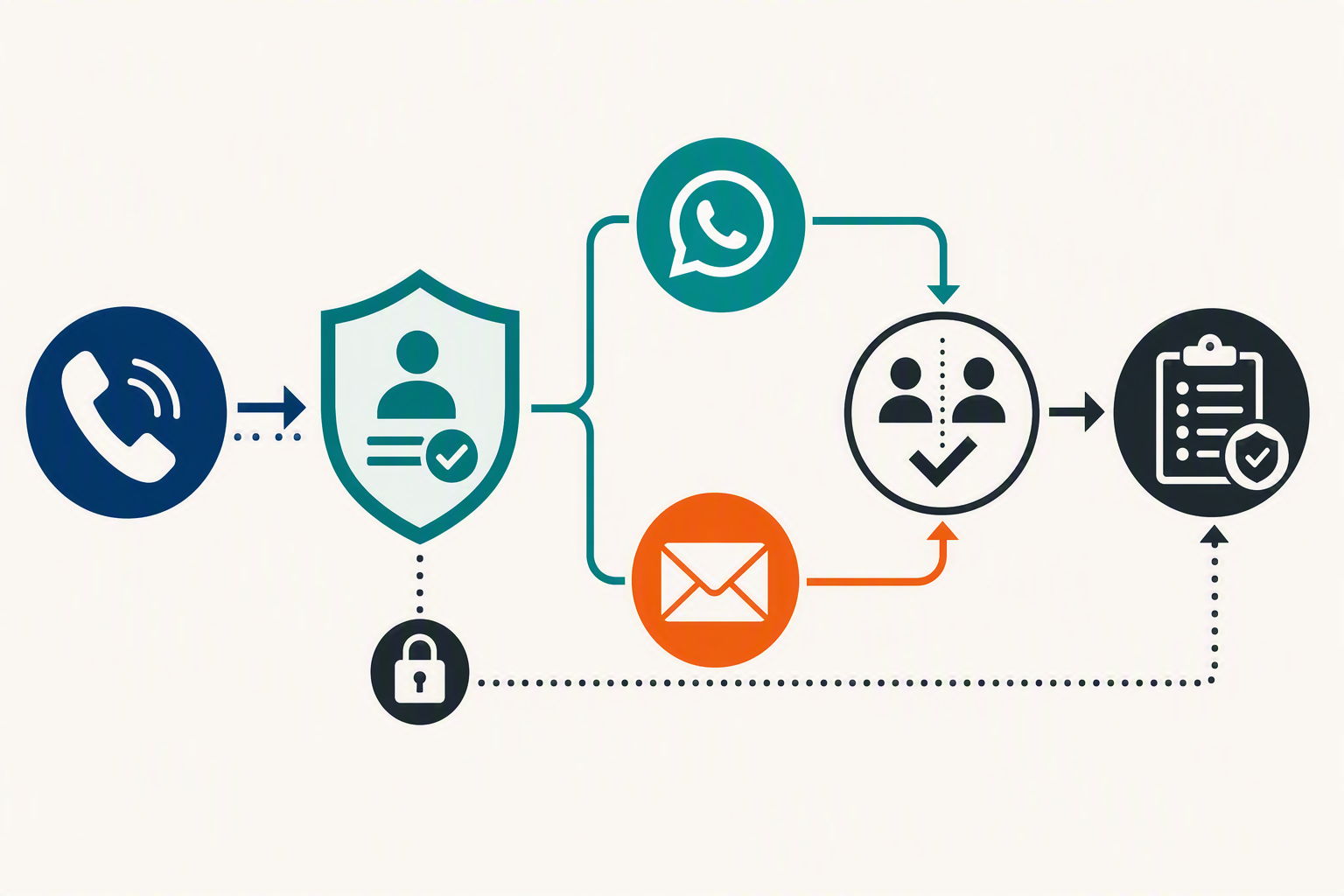
Consent, identity and context should be stored as separate, auditable records: matching a person does not automatically grant permission to contact them or transfer every conversation detail. A safe workflow shares only the minimum information needed for the approved purpose, channel and retention period.
Build a purpose-specific consent record
For every phone, WhatsApp or email permission, record:
- Channel: WhatsApp, email or voice
- Purpose: requested quotation, appointment updates or promotional communication
- Status: granted, declined, withdrawn or expired
- Source: recorded call, web form, WhatsApp reply or agent entry
- Timestamp and wording: when consent was captured and what the prospect accepted
- Evidence reference: call ID, message ID, form version or CRM event
- Jurisdiction and policy version: the rules applied when consent was collected
India’s Digital Personal Data Protection Act, 2023 states that consent must be “free, specific, informed, unconditional and unambiguous” and expressed through clear affirmative action. Consequently, agreement to receive a requested proposal by email should not be treated as blanket permission for recurring WhatsApp promotions.
Transactional follow-up and marketing should also be classified separately. If consent is withdrawn, AI lead follow-up must suppress future messages for that purpose without erasing information that must legitimately be retained for compliance, dispute resolution or an active service request.
Match identity before merging records
Use deterministic identifiers before probabilistic clues. A practical matching sequence is:
- Normalize the phone number to E.164 format, including the country code.
- Match a verified WhatsApp number or verified email address.
- Check CRM customer, company and enquiry identifiers.
- Use name, location and product interest only as supporting signals.
- Route uncertain or conflicting matches to a human review queue.
Never merge solely because two people share a name, household number or company domain. Shared business phones, recycled mobile numbers and assistants submitting enquiries on behalf of executives can create false matches.
Deduplication should also distinguish a duplicate contact from a new opportunity. A returning prospect asking about another product may belong to the same contact record but require a separate enquiry ID, owner, qualification status and follow-up schedule.
Transfer a permitted context envelope
Before moving from phone to WhatsApp or email, create a context envelope containing only approved operational fields:
- Prospect name and verified destination
- Product or service requested
- Location, budget band and buying timeline, where relevant
- Preferred channel and contact time
- Consent scope and timestamp
- Enquiry ID, assigned owner and next action
- A concise factual summary of the request
Exclude unrelated call transcript content, authentication data, payment details, sensitive personal information and internal agent notes. Full recordings or transcripts should remain access-controlled rather than being copied into outbound prompts.
CallMissed lead capture can support this separation through its voice, WhatsApp, email and omnichannel inbox workflows. For omnichannel lead management, configure channel permissions and redaction rules as workflow conditions—not merely CRM notes.
Apply merge and suppression rules atomically
When a duplicate is confirmed, merge identity references while retaining the most restrictive consent state. Opt-outs must win over older opt-ins, and every merge should preserve an audit trail showing the original records, decision rule, operator or automation, and timestamp. If identity or permission remains uncertain, pause automation and request confirmation instead of guessing.
When should the system respond, assign lead ownership or trigger human takeover?
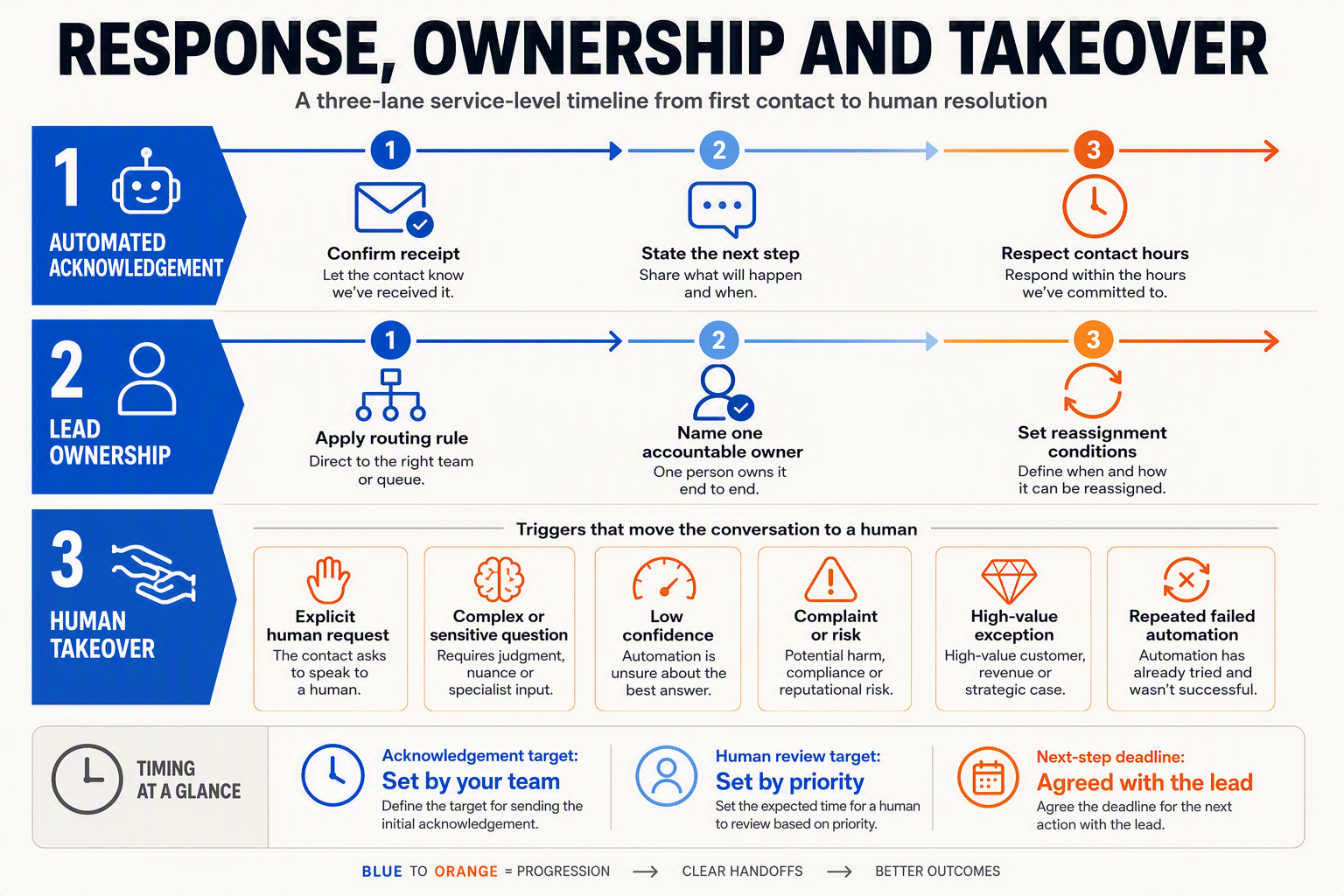
The system should acknowledge every eligible enquiry immediately, assign ownership as soon as qualification data is sufficient, and transfer control to a human whenever automation cannot safely or effectively advance the lead. Timing should follow explicit service-level rules rather than an indiscriminate sequence of messages.
Set response times by event and channel
For CallMissed lead capture, use configurable operating targets such as:
- During the phone call: Create or update the lead record in real time, including the call timestamp, qualification fields, consent status and conversation summary.
- Within one minute of call completion: Send a WhatsApp acknowledgement if the caller gave valid WhatsApp consent and requested follow-up there.
- Within five minutes: Notify the assigned salesperson when the lead meets high-priority criteria such as an urgent timeline, suitable budget or explicit purchase intent.
- Within 15 minutes: Place unassigned qualified leads into a monitored team queue and alert the queue manager.
- Within one business hour: Trigger a human follow-up task for qualified leads that require consultation, pricing approval or a proposal.
- After an agreed interval: Send email material only when consent, purpose and address validity permit it; suppress reminders after a reply, opt-out or status change.
These are recommended workflow targets, not promised conversion benchmarks. The one-hour boundary is nevertheless evidence-informed: as noted earlier, Harvard Business Review reported in March 2011 that companies contacting an online lead within one hour were nearly seven times more likely to qualify it than companies waiting even one additional hour.
Assign one accountable lead owner
An omnichannel lead management workflow needs one primary owner even when AI handles routine messages. Apply assignment rules in a fixed order:
- Existing ownership: Keep the current owner for a recognised contact, open opportunity or active account.
- Territory: Route by country, state, city, branch or service area.
- Product expertise: Assign specialist enquiries to the relevant sales team.
- Language: Match the prospect’s preferred language where staffing allows.
- Availability and capacity: Use round-robin or weighted distribution only after the preceding rules.
- Strategic value: Route enterprise, partner or regulated-sector enquiries to designated employees.
Record the owner, assignment reason, assignment timestamp and acceptance deadline in the CRM. Reassignment should create an audit event rather than silently overwriting history.
Trigger human takeover using clear conditions
AI lead follow-up should stop or pause when the system detects:
- A direct request to speak with a person
- Pricing negotiation, discount approval or contract discussion
- Legal, financial, medical or other high-risk advice
- Anger, distress, repeated misunderstanding or low-confidence intent detection
- A complaint, cancellation, payment dispute or data-rights request
- Conflicting identity, consent or deduplication signals
- Two unsuccessful clarification attempts
- A high-value or urgent lead defined by the business
At takeover, CallMissed’s omnichannel inbox can present the employee with the permitted conversation summary, captured fields, consent record, latest channel, unresolved question and recommended next action. The customer should receive a concise handoff message naming the team—not an invented employee—and stating the expected response window.
Automation must then enter a controlled state: paused, human-owned or assist-only. It should resume only after the employee closes the task or selects an approved next step, preventing overlapping calls, WhatsApp messages and emails.
How should CRM updates and metrics make lead management auditable?
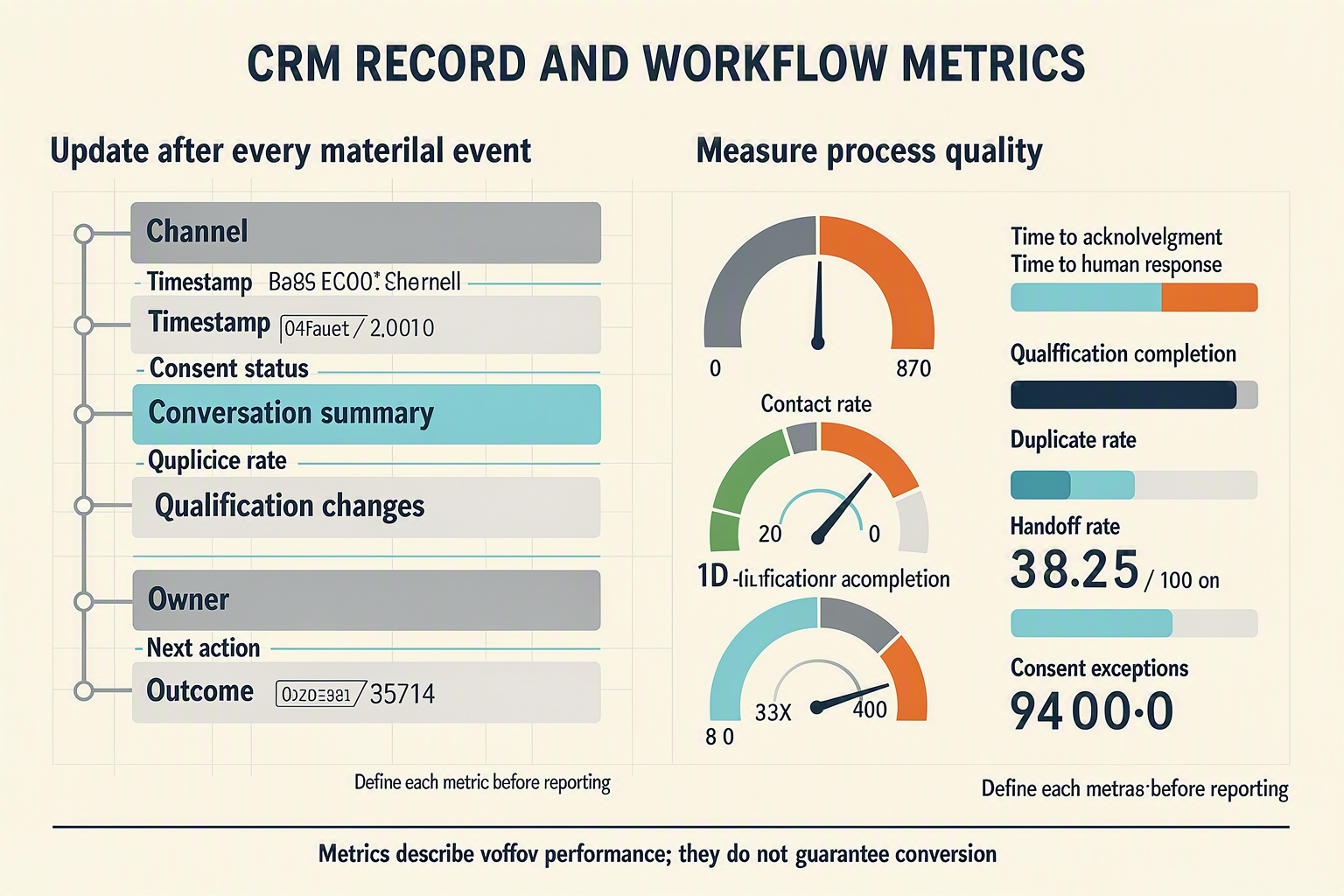
CRM updates make lead management auditable when every change is timestamped, attributable, and traceable to its source interaction. The CRM should show not only the lead’s current status, but also who or what changed it, which permitted context was used, and whether follow-up met the agreed service-level target.
Treat the CRM as an event ledger
A reliable omnichannel lead management workflow records each phone, WhatsApp, email, AI, and human action as a separate event rather than overwriting history. CallMissed lead capture can centralise these interactions in an omnichannel inbox/CRM while preserving channel-specific timestamps and ownership.
Each event should include:
- Lead ID and interaction ID
- Channel: phone, WhatsApp, email, or web
- Direction: inbound or outbound
- Actor: prospect, AI agent, assigned employee, or automation
- Event timestamp in Coordinated Universal Time, plus the operating team’s local time
- Field changes: previous value, new value, and reason
- Context source: call transcript, customer message, form submission, or employee note
- Consent basis and permitted channels
- Automation outcome: delivered, failed, replied, escalated, or opted out
For example, changing a lead from New to Qualified should not erase the prior state. The audit trail should show that an AI voice agent captured a three-month purchase timeline, a salesperson verified it, and the qualification status changed at a specific time.
Separate customer facts from AI-generated interpretations
AI-generated summaries are useful, but they should not silently become verified CRM facts. Store three distinct layers:
- Source evidence: the original recording, transcript, WhatsApp message, or email.
- Extracted fields: budget, location, product interest, timeline, and preferred contact channel.
- Interpretation: summary, intent classification, lead score, or recommended next action.
Mark uncertain values explicitly. If the caller says “around ₹2 lakh,” the CRM can retain the quotation while storing the budget as an approximate range. A human correction should create another timestamped event rather than modifying the original evidence.
Measure speed, quality, and commercial progress
The AI lead follow-up dashboard should distinguish operational activity from meaningful outcomes. Recommended metrics include:
- First-response time: first outbound response timestamp minus enquiry timestamp
- Qualification time: qualification completion minus first enquiry
- SLA attainment: percentage of leads receiving a response within the defined target
- Contact rate: leads with a successful two-way interaction divided by eligible leads
- Qualification completion rate: leads with all mandatory fields divided by leads assessed
- Human-takeover rate: escalated leads divided by AI-handled leads
- Stage conversion rate: leads entering the next CRM stage divided by leads entering the current stage
- Opt-out and delivery-failure rates, segmented by channel
- Duplicate-merge rate and the number of merges later reversed
Harvard Business Review reported in March 2011 that companies responding to an online lead within one hour were nearly seven times more likely to qualify it than companies responding one hour later. That benchmark makes response time worth monitoring, but each business should define targets by operating hours, lead source, and urgency.
Make reviews reproducible
Weekly reviews should examine exceptions, not merely totals: overdue leads, unassigned records, unsupported field changes, messages sent without valid channel permission, failed handovers, and reopened duplicates. Use fixed metric definitions and preserve dashboard filters so two reviewers examining the same period obtain the same result.
This structure makes accountability visible: automation has an identifiable rule, every lead has an owner, every handover has a timestamp, and every reported outcome can be traced back to the underlying interaction.
What does the phone-to-WhatsApp-to-email workflow mean in a worked example? (TABLE)
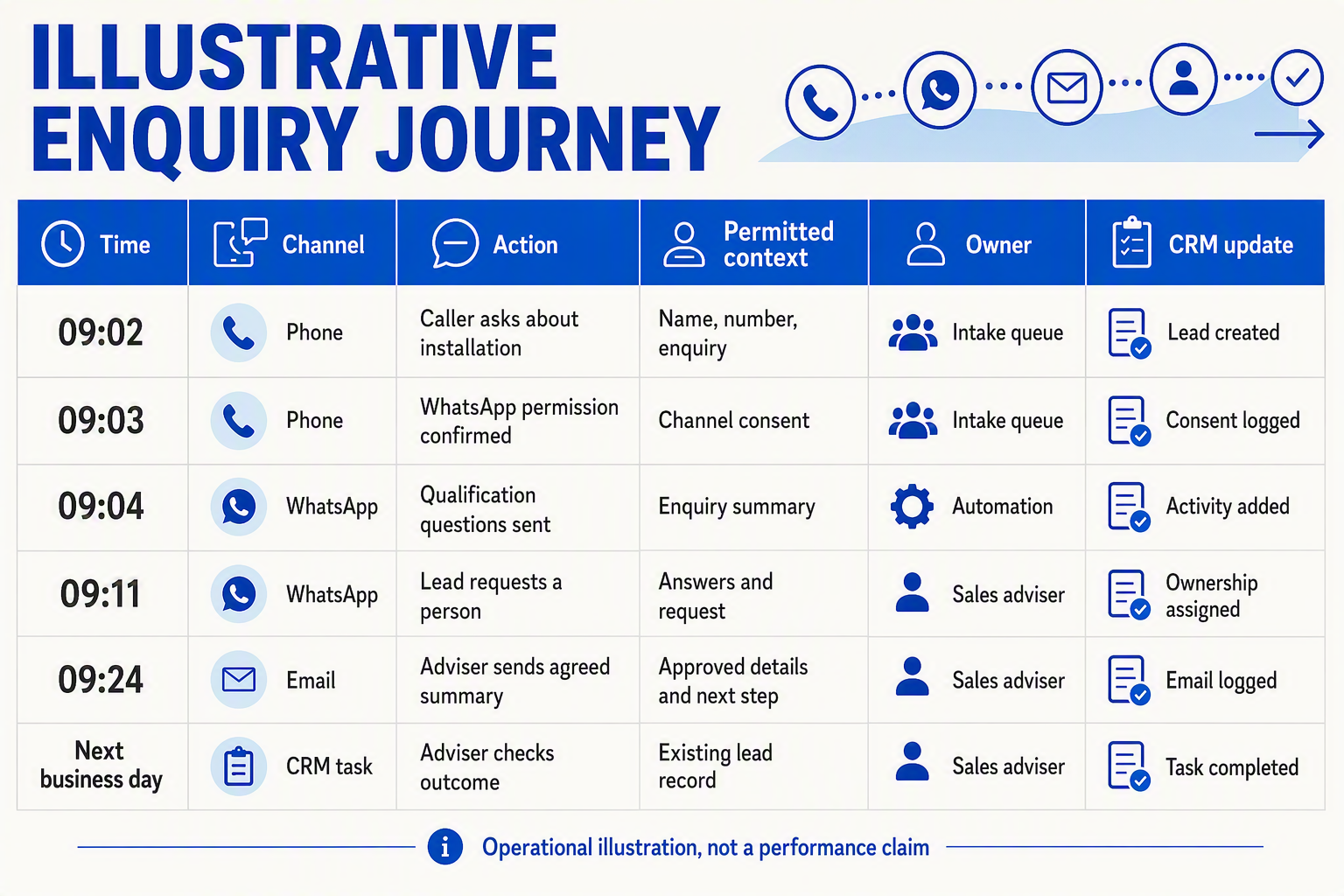
A phone-to-WhatsApp-to-email workflow means one qualified enquiry progresses through several channels without becoming several disconnected leads. In this worked example, a Pune-based solar installer uses CallMissed lead capture to preserve only consented, task-relevant information while transferring responsibility from an AI voice agent to a salesperson.
Worked example: Priya’s commercial solar enquiry
Priya calls about solar panels for a 5,000-square-foot warehouse. The AI voice agent records her stated requirements, confirms that WhatsApp is her preferred follow-up channel, and asks separately whether a detailed quotation may be emailed.
The timings below are illustrative internal service-level targets, not guaranteed conversion benchmarks. They prioritise a rapid first response because Harvard Business Review reported in March 2011 that companies contacting an online lead within one hour were nearly seven times more likely to qualify it than companies waiting another hour.
| Stage and target time | Customer or system action | Permitted context transferred | CRM update | Owner |
|---|---|---|---|---|
| 1. Phone call: 0–4 min | Priya asks about a 50 kW commercial system in Pune. The AI captures name, verified number, location, use case, budget range and 30-day timeline. | Call transcript summary and explicitly supplied qualification fields | Create lead; status: New—Qualified | AI voice agent |
| 2. Consent check: before call ends | Priya agrees to receive WhatsApp follow-up and separately provides her business email for a proposal. | Channel choices, purpose, consent wording and timestamp | Record WhatsApp and email permissions independently | AI voice agent |
| 3. WhatsApp: within 5 min | A message confirms the 50 kW requirement and asks for the latest electricity bill and preferred survey slot. | Name, project type, city, capacity and next action; no unnecessary transcript details | Log outbound message; status: Awaiting Documents | WhatsApp chatbot |
| 4. WhatsApp reply: within 20 min | Priya uploads the bill and selects Thursday at 11:00 a.m. | Uploaded document, appointment selection and conversation summary | Attach document; create survey task; run duplicate check | AI workflow |
| 5. Human review: within 30 min | A sales engineer checks feasibility, validates assumptions and takes over because technical pricing requires judgement. | Structured summary, source documents, consent state and unresolved questions | Assign lead; status: Sales Review | Named sales engineer |
| 6. Email: within 2 hours | Priya receives a proposal summary, indicative scope, survey details and salesperson contact information. | Approved proposal data and appointment details—not the complete phone transcript | Log email; set next-follow-up date; status: Proposal Sent | Sales engineer |
What continuity should—and should not—mean
This AI lead follow-up does not copy every utterance into every channel. It carries forward the minimum information needed to complete the customer’s requested journey:
- Safe operational context: product interest, location, budget band, timeline, preferred channel, documents received and agreed next step.
- Controlled context: call recordings, complete transcripts and internal qualification notes remain access-restricted unless required for the task.
- No assumed permission: consent to WhatsApp does not automatically authorise email, and providing an email address does not necessarily authorise unrelated campaigns.
- No duplicate record: the verified phone number is the primary match key, while email and enquiry details help distinguish a repeat enquiry from a new opportunity.
CallMissed’s omnichannel inbox/CRM can support this form of omnichannel lead management across AI voice, WhatsApp and email. The important design principle is that automation handles speed and structured hand-offs, while a clearly named employee retains ownership of pricing, exceptions and the next committed action.
What should sales, compliance and operations experts review before launch?
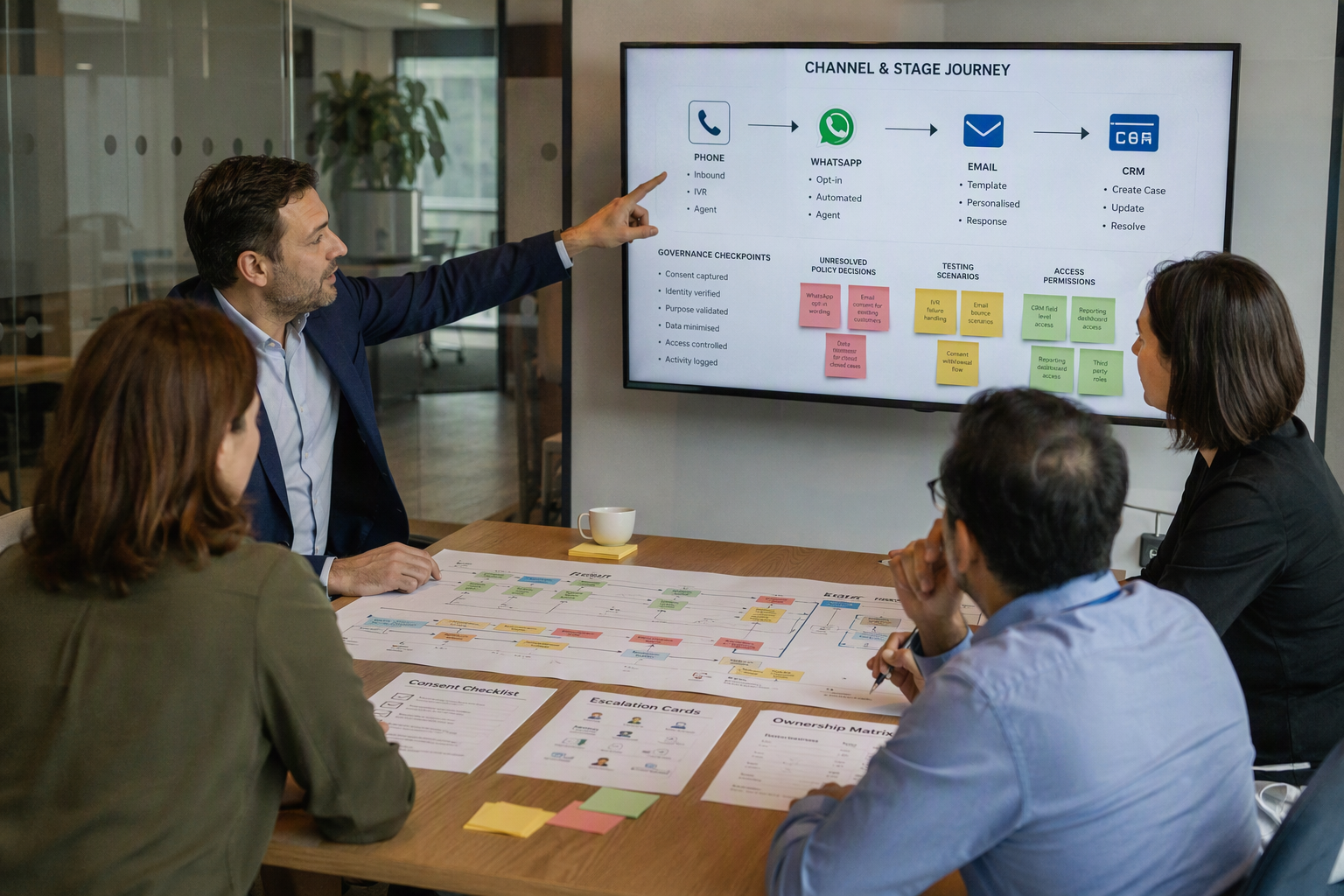
Before launch, sales, compliance, and operations must jointly approve the workflow’s qualification logic, consent evidence, channel permissions, ownership rules, escalation paths, and reporting controls. No automated journey should go live until each team has tested both the intended path and failure scenarios such as duplicate records, revoked consent, unavailable representatives, and incorrect AI summaries.
Sales review: qualification and handover
Sales leaders should confirm that CallMissed lead capture collects enough information to prioritise an enquiry without turning the initial call into an interrogation. Review the required fields, permitted values, and rules for incomplete answers:
- Contact identity and verified phone number
- Product or service interest
- Location or serviceability area
- Budget range and expected timeline
- Preferred follow-up channel and suitable contact time
- Qualification status, lead score, owner, and next action
Sales should also inspect AI-generated call summaries for accuracy. Budget, purchase timeline, and customer objections should be clearly distinguished from AI inference; uncertain information should be labelled “unconfirmed” rather than stored as fact.
Response-time targets need an accountable owner. Harvard Business Review reported in March 2011 that companies contacting an online lead within one hour were nearly seven times more likely to qualify the lead than companies responding even one hour later. Teams should therefore define measurable targets for first acknowledgement, salesperson assignment, human takeover, and overdue-lead escalation—without presenting any response time as a guaranteed conversion outcome.
Compliance review: consent and permitted context
Compliance or legal reviewers should map every data transfer from phone to WhatsApp, email, CRM, analytics, and third-party systems. Their checklist should cover:
- Consent evidence: purpose, channel, wording, source, timestamp, and policy version.
- Data minimisation: only details necessary for the next interaction should cross channels.
- Revocation: opt-outs must stop relevant automation and update the central contact record.
- Retention: call recordings, transcripts, summaries, and inactive leads need documented deletion periods.
- Access control: restrict sensitive records by role and maintain audit logs for changes and exports.
A customer agreeing to receive a WhatsApp quotation has not necessarily agreed to recurring promotions or email campaigns. Compliance teams should review WhatsApp Business messaging and calling permissions, approved template use, email consent requirements, and applicable privacy law with qualified counsel.
Operations review: resilience and accountability
Operations must prove that omnichannel lead management remains reliable when systems or people fail. Run test cases for:
- Two callers sharing one business number
- The same prospect using different phone and email details
- Repeat enquiries with a new product interest
- CRM write failures, delayed webhooks, and duplicate events
- After-hours enquiries and unavailable lead owners
- Low-confidence transcripts or unsupported languages
- Immediate requests for a human or complaints about automation
Each test should produce a predictable CRM status, assigned owner, visible error, and recovery action. CallMissed can coordinate voice, WhatsApp, email, and inbox activity, but teams must still configure permissions and operating rules for their own use case.
Final launch gate
Approve AI lead follow-up only after stakeholders sign a versioned launch record covering workflow logic, message templates, consent language, service-level targets, escalation contacts, dashboards, and rollback procedures. Begin with a controlled cohort, inspect transcripts and CRM updates daily, and expand only when consent failures, duplicate creation, unassigned leads, opt-out processing, and human-handover delays remain within internally approved thresholds.
Frequently asked questions about CallMissed lead capture and omnichannel follow-up
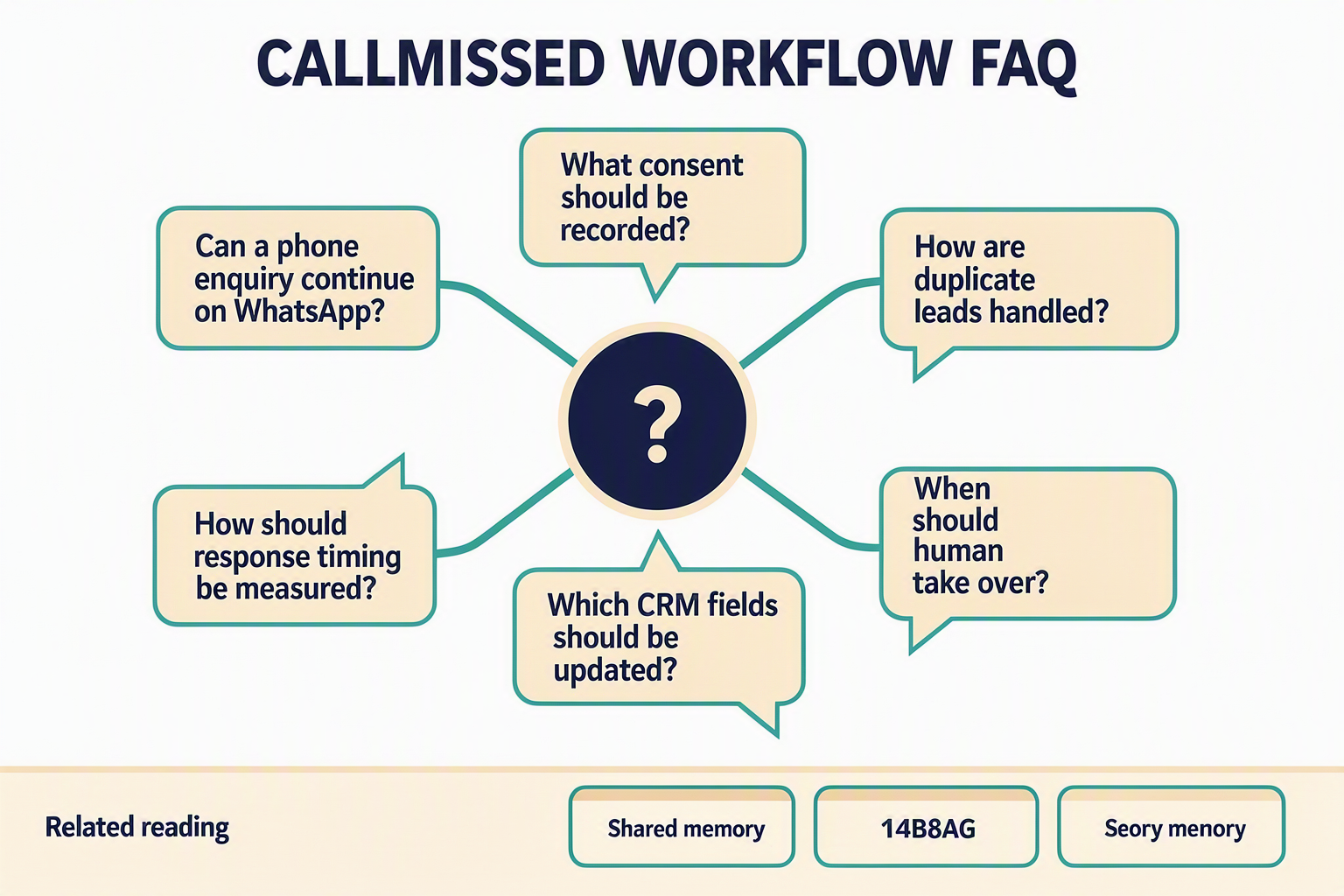
What qualification fields should CallMissed lead capture collect from a phone enquiry?
How quickly should AI lead follow-up happen after an inbound call?
How does CallMissed lead capture preserve context across phone, WhatsApp, and email?
Does a phone enquiry automatically provide consent for WhatsApp and email follow-up?
How should omnichannel lead management handle duplicate contacts and repeat enquiries?
When should AI lead follow-up transfer a prospect to a human salesperson?
Conclusion
A reliable phone-to-WhatsApp-to-email workflow should feel like one continuous, permission-aware conversation—not three disconnected exchanges. CallMissed lead capture provides the operational foundation by converting phone enquiries into structured lead records and coordinating timely follow-up through WhatsApp, email, and the omnichannel inbox/CRM.
Key takeaways
- Capture structured qualification data at the first interaction. Record the prospect’s name, verified contact details, location, product interest, budget, purchase timeline, preferred channel, and next action. Store call summaries as permitted context rather than transferring an unrestricted transcript to every channel.
- Make consent and identity checks mandatory workflow gates. Timestamp WhatsApp and email permissions, retain their source, and respect opt-outs before triggering messages. Match records using normalized phone numbers, email addresses, and secondary identifiers so that repeat callers or enquiries are merged without incorrectly combining different people.
- Set response targets without removing human accountability. Harvard Business Review reported in March 2011 that companies contacting an online lead within one hour were nearly seven times more likely to qualify the lead than companies responding even one hour later. Automated acknowledgement can protect response time, but a named salesperson should own the lead, review high-intent opportunities, and take over when the prospect requests a person, raises an exception, or reaches a defined qualification threshold.
- Treat CRM updates and measurement as part of the conversation. Each phone call, WhatsApp exchange, email, assignment, consent change, escalation, and status transition should update the same lead record. Teams can then assess response time, qualification completion, duplicate rate, consent rate, handoff speed, stage progression, and follow-up outcomes without relying on unsupported conversion assumptions.
What to watch next
WhatsApp’s scale makes this coordination increasingly important: Meta CEO Mark Zuckerberg stated in April 2025 that WhatsApp had surpassed 3 billion monthly active users. The next phase of AI lead follow-up will therefore depend less on sending more automated messages and more on enforcing precise context boundaries, reliable identity resolution, auditable consent, and clear lead ownership across channels.
Platforms such as CallMissed—combining AI voice agents, WhatsApp chatbots and Business calling, email tooling, and an omnichannel inbox/CRM—offer businesses a practical way to explore this controlled model of omnichannel lead management. The question for your team is simple: if a prospect calls today, can every subsequent message continue the conversation accurately without compromising consent, privacy, or accountability?
Related Reading
Related Posts
Ready to automate customer conversations?
Launch AI voice agents and WhatsApp bots with CallMissed — one API, 22+ Indian languages.