

CallMissed Missed Call Recovery: AI Voice and Follow-Up Workflow


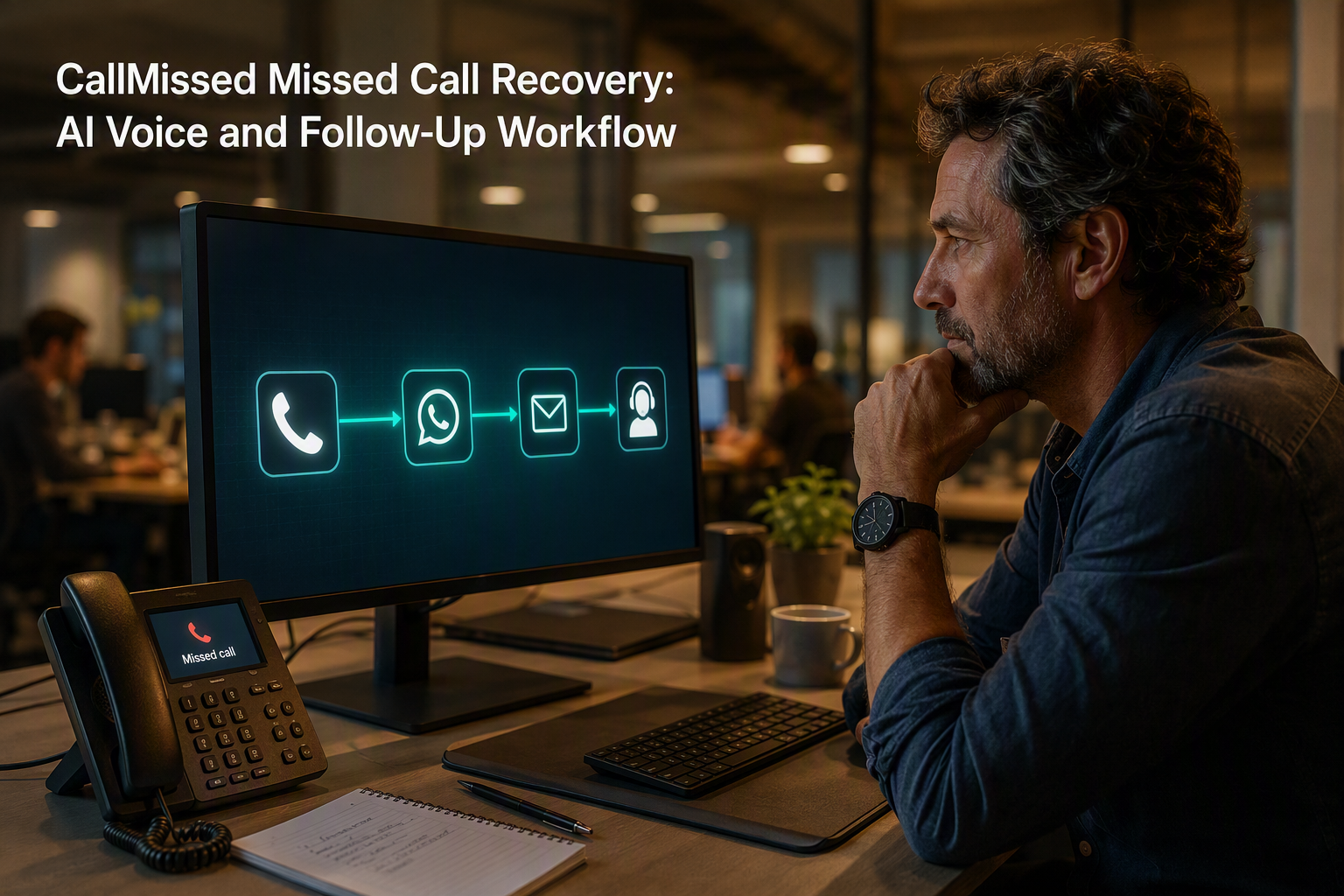
Learn how CallMissed missed call recovery can coordinate AI voice, WhatsApp or email follow-up, consent, human handoffs, and measurement.
CallMissed Missed Call Recovery: AI Voice and Follow-Up Workflow
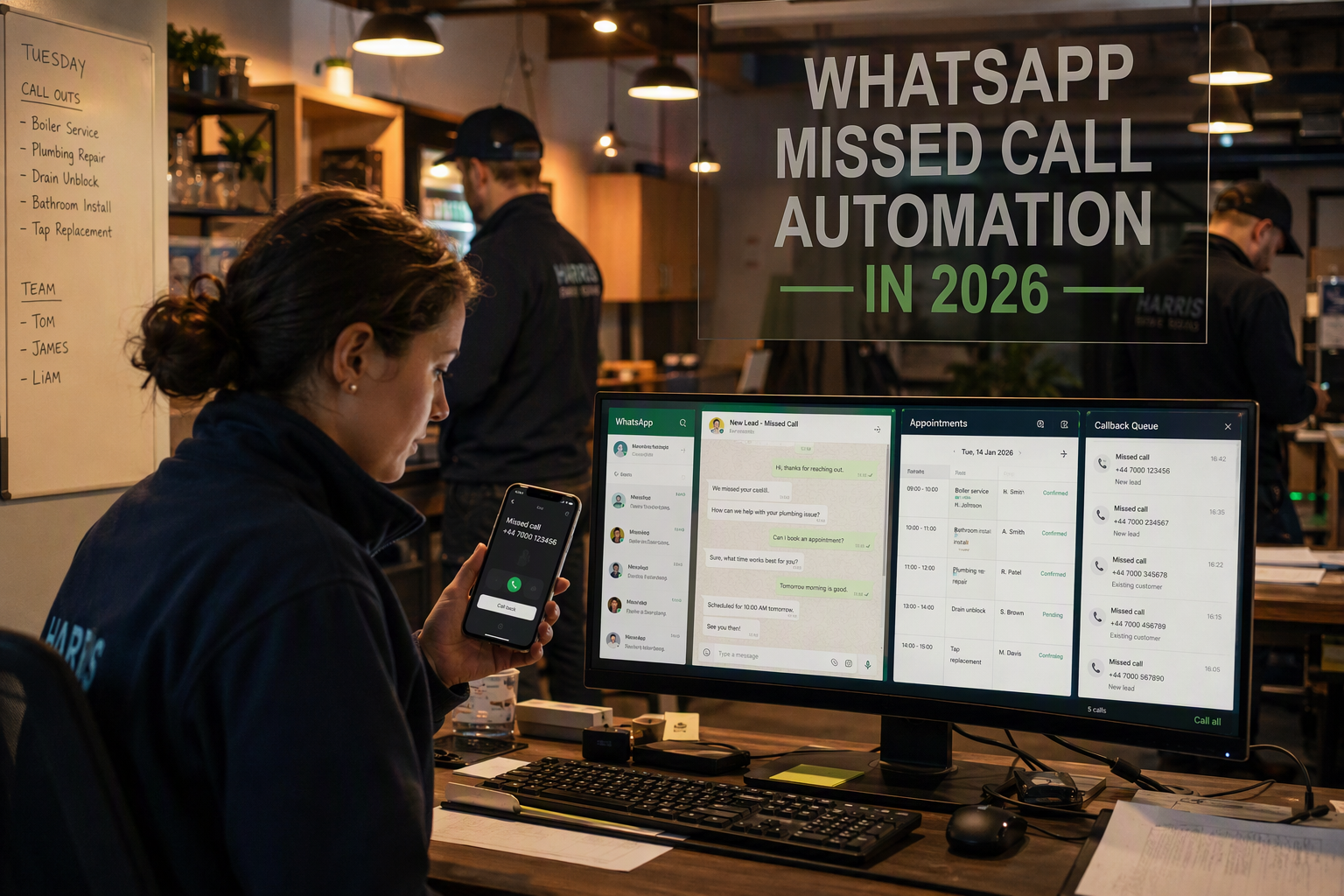
What if an unanswered phone call could become a qualified conversation within minutes—without forcing the customer to call again? CallMissed missed call recovery can turn that dropped opportunity into a structured workflow: detect the missed call, let an AI voice agent respond or call back, preserve the conversation context, and send an appropriate WhatsApp or email follow-up when permitted.
This matters because customer communication is increasingly conversational and cross-channel. Meta CEO Mark Zuckerberg said during Meta’s April 2025 earnings call that WhatsApp had surpassed 3 billion monthly active users, making WhatsApp a critical follow-up channel for businesses, particularly in India. At the same time, a missed call often carries more intent than a generic website visit: the caller may want an appointment, product availability, technical support, or an urgent escalation.
AI missed call automation closes the gap between that intent and the business’s capacity to respond. Instead of sending the same generic message to every caller, an AI-assisted workflow can use available context—such as the called number, time, campaign source, previous conversations, language preference, and CRM record—to determine the next action.
A practical workflow might:
- Capture the missed-call event and check whether another agent or automation has already responded.
- Apply consent, time-window, and suppression rules before initiating outreach.
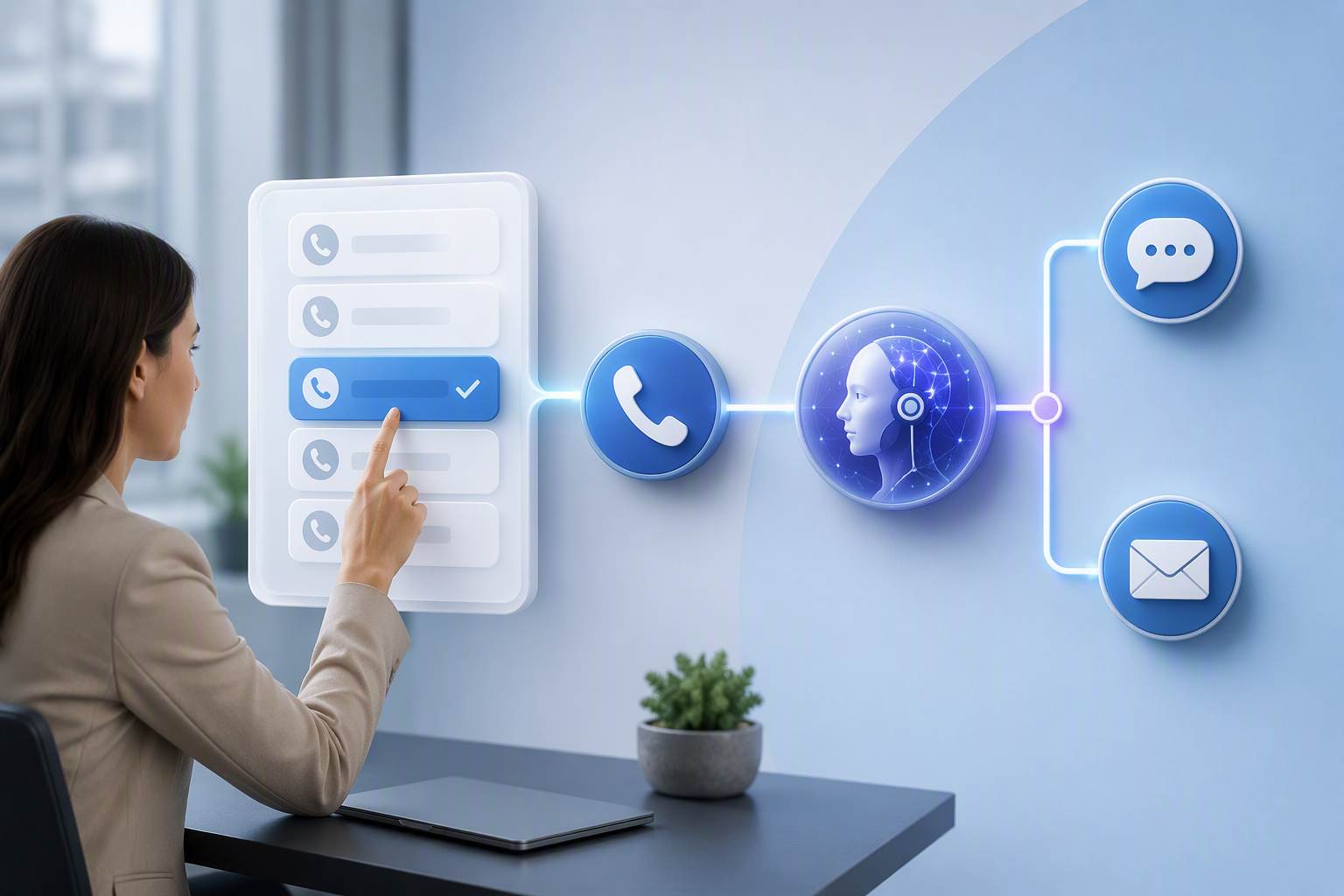
- Trigger an AI voice callback or route the caller into a voice agent when they reconnect.
- Identify intent and urgency, while collecting only the information needed for resolution.
- Send a contextual WhatsApp message or email, subject to channel consent and applicable template requirements.
- Escalate to a human when the customer requests one, expresses frustration, presents a high-risk issue, or exceeds the AI agent’s confidence threshold.
CallMissed supports this broader pattern through AI voice agents, an omnichannel inbox, WhatsApp chat and WhatsApp Business calling, email tooling, and knowledge-base retrieval; exact triggers, calling availability, templates, integrations, and channel permissions may depend on the account configuration and applicable Meta or telecom requirements.
This guide explains how to design the workflow step by step, choose between voice, WhatsApp, email, and human handoff, and prevent duplicate or non-consensual outreach. It also covers measurable missed call follow-up outcomes—including callback latency, contact rate, resolution rate, opt-out rate, handoff rate, and recovered conversions—so teams can evaluate whether automation is genuinely improving customer experience rather than merely increasing message volume.
How can CallMissed recover a missed call? It can trigger an AI voice callback, use available context, send an eligible WhatsApp or email follow-up, suppress duplicates and hand the conversation to a human when configured
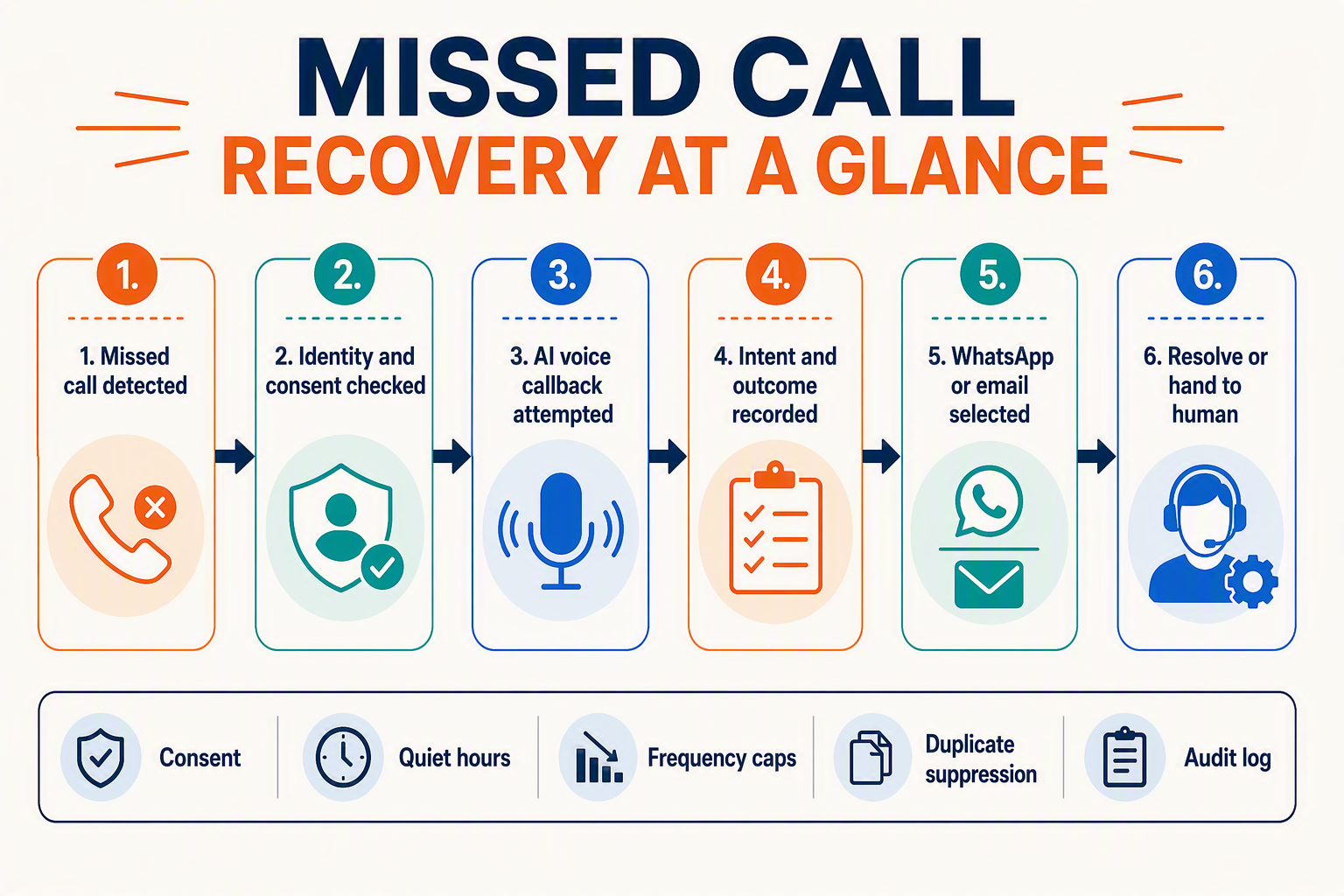
CallMissed can recover a missed call by turning the telephony event into a policy-controlled workflow: verify that outreach is allowed, initiate an AI voice callback, apply available customer context, and continue through WhatsApp or email when eligible. The workflow can also prevent duplicate outreach and transfer the conversation to a human according to configured escalation rules.
Step 1: Capture and qualify the missed-call event
CallMissed missed call recovery begins when a connected business number records an unanswered, busy, rejected, or timed-out call. The workflow should normalize the caller number and capture operational fields such as:
- Called business number and timestamp
- Call disposition and ring duration
- Campaign, branch, or department associated with the number
- Existing contact, lead, or conversation record
- Previous outreach attempts and suppression status
Before responding, the automation should check configurable conditions: business hours, caller-country restrictions, consent records, internal blocklists, and whether an employee has already returned the call.
Step 2: Resolve context and choose the next action
The system can match the phone number to information available in the omnichannel inbox, CRM, prior conversations, or connected knowledge base. AI missed call automation can then use that permitted context to personalize the opening—for example, referencing an appointment request rather than asking the customer to repeat everything.
Context should be treated as evidence, not certainty. If multiple contacts share a number or identity cannot be verified, the agent should ask a neutral confirmation question and avoid disclosing account-specific information.
Step 3: Trigger the AI voice callback
When callback rules permit, an AI voice agent can place the return call and:
- Identify the business and explain why it is calling.
- Ask what the customer needed.
- Retrieve approved answers from the business knowledge base.
- Capture a booking, lead detail, or support request.
- escalate when the request exceeds its scope.
CallMissed supports speech-to-text and text-to-speech across 22 Indian languages, helping businesses serve regional-language callers without treating Indic speech as an add-on. The exact callback trigger, telephone-number availability, supported calling route, and operating window remain account- and configuration-dependent.
Step 4: Continue through an eligible channel
If the callback is unanswered or the customer needs a written summary, the missed call follow-up can use:
- WhatsApp: Send an approved template when required, or continue within an eligible customer-service window. CallMissed also supports WhatsApp Business calling, including business-initiated calling where Meta eligibility and customer permission allow it.
- Email: Send requested details, appointment confirmation, quotations, or case summaries when a valid email address and lawful communication basis are available.
Channel consent is not interchangeable: having a phone number does not automatically establish permission for promotional WhatsApp messages or email.
Step 5: Suppress duplicates and hand off safely
A configurable suppression layer should create an idempotency key from the caller, called number, and event window. Before every action, it should check for an active conversation, completed callback, recent message, opt-out, or assigned human owner.
Human handoff should activate when the caller requests a person, identity verification fails, sentiment deteriorates, the issue is regulated or high-risk, or the AI agent’s confidence falls below the configured threshold. The agent should pass the transcript, captured intent, attempted actions, and unresolved question into the omnichannel inbox so the customer does not have to start again.
Why do businesses need AI missed call automation instead of a simple automatic reply?
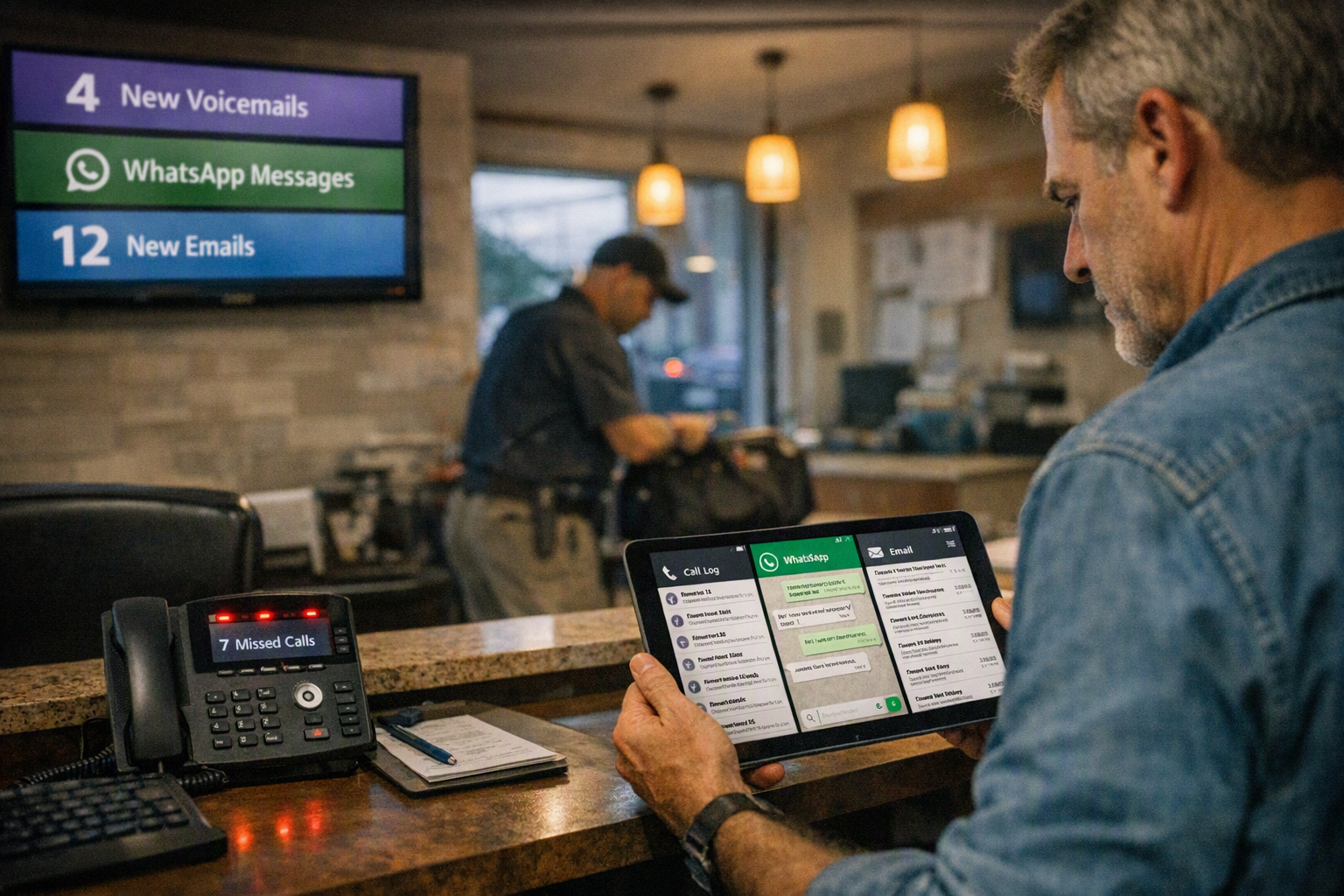
Businesses need AI missed call automation because an automatic reply acknowledges the call but does not determine intent, resolve the request, or coordinate the next action. A robust recovery workflow evaluates context, selects the appropriate channel, maintains conversation state, and escalates cases that require human judgment.
An acknowledgement is not the same as recovery
A simple “We missed your call” message treats every caller identically. It cannot reliably distinguish between a sales enquiry, an appointment change, a service outage, a payment issue, or an existing support case.
By contrast, CallMissed missed call recovery can support a decision-based workflow that considers available signals such as:
- The phone number or department the customer called
- The call time, business hours, and callback window
- Previous voice, WhatsApp, email, or CRM interactions
- The customer’s known language preference
- Consent, opt-out, and suppression status
- Whether another agent has already responded
This distinction matters at WhatsApp’s scale. Meta CEO Mark Zuckerberg reported in Meta’s April 2025 earnings call that WhatsApp had exceeded 3 billion monthly active users. For businesses using WhatsApp as a follow-up channel, sending a generic message is technically easy; sending a relevant, permitted, and non-duplicative response requires orchestration.
AI automation can complete actions, not merely send messages
An effective missed call follow-up should move the customer toward resolution. Depending on the detected intent and configured permissions, an AI voice agent could answer a common question, gather booking details, qualify an enquiry, retrieve approved knowledge, or prepare a concise summary for a human employee.
The workflow can proceed through four decision stages:
- Interpret the event: Determine which line was called, whether the caller disconnected before connection, and whether an active case already exists.
- Choose the response: Schedule a voice callback, wait for business hours, send an eligible WhatsApp message, use email, or assign a human task.
- Preserve context: Store the caller’s stated need and collected details so the next channel does not restart the conversation.
- Evaluate the outcome: Mark the enquiry as resolved, awaiting response, opted out, escalated, or closed.
CallMissed brings voice agents, WhatsApp chat, WhatsApp Business calling, email tooling, an omnichannel inbox, and knowledge-base retrieval into this pattern. Exact triggers, outbound calling options, WhatsApp templates, and integrations remain account-dependent and subject to Meta, telecom, and consent requirements.
Context also reduces harmful over-automation
The advantage of AI is not that every missed call receives more outreach. It is that the workflow can decide when not to contact someone.
Useful safeguards include:
- Idempotency controls that prevent the same missed-call event from triggering twice
- Frequency caps for repeated calls from the same customer
- Quiet-hour rules based on the recipient’s location
- Channel-specific consent checks before WhatsApp, email, or callback outreach
- Confidence thresholds that stop the AI from guessing
- Human handoff for complaints, emergencies, sensitive decisions, or explicit escalation requests
A basic automatic reply remains appropriate when the sole objective is acknowledgement. AI missed call automation becomes necessary when the objective is measurable recovery: understanding why the customer called, continuing the conversation across channels, and reaching a safe resolution without unnecessary repetition.
Which CallMissed capabilities are verified, unverified or account-dependent as of August 4, 2026? (TABLE)
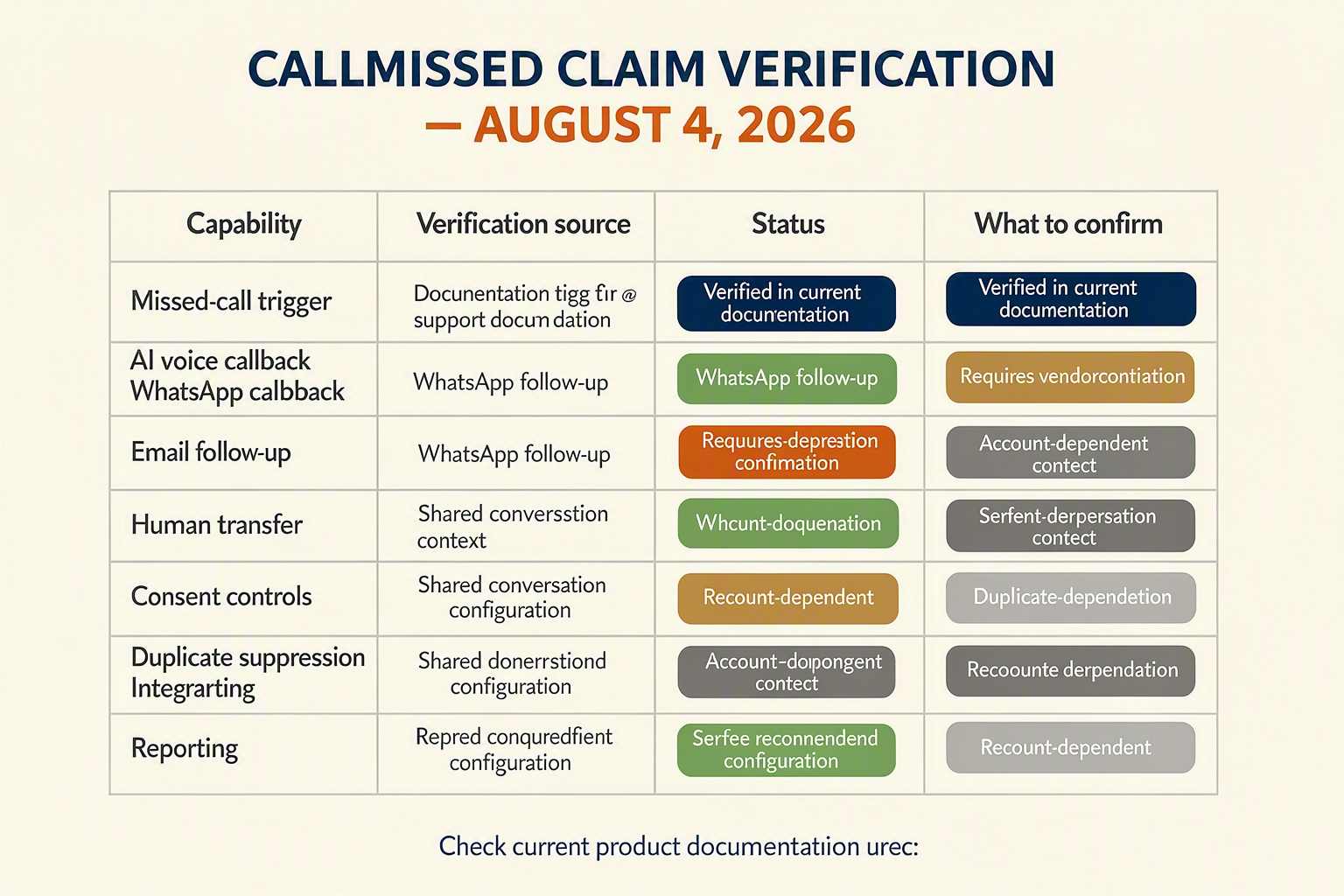
As of August 4, 2026, CallMissed has verified platform-level capabilities for AI voice, WhatsApp Business calling and chat, email campaigns, an omnichannel inbox/CRM, and knowledge-base retrieval. However, a turnkey CallMissed missed call recovery sequence—including automatic missed-call detection, callback timing, deduplication, and cross-channel consent logic—should be treated as account-dependent until confirmed in the specific workspace.
Capability-verification matrix
| Capability | Status as of Aug. 4, 2026 | What is verified | What must be confirmed |
|---|---|---|---|
| AI voice agents | Verified platform capability | CallMissed supports AI voice agents, including speech infrastructure across 22 Indian languages. | Phone-number compatibility, outbound callback permissions, concurrency, selected language/model, call recording, and production limits. |
| WhatsApp Business calling | Verified; account-dependent operation | CallMissed supports inbound and business-initiated WhatsApp Business voice calls bridged to an AI agent. | Meta eligibility, number onboarding, market availability, calling permissions, user consent, and account activation. |
| WhatsApp chatbot follow-up | Verified; policy-dependent | CallMissed supports WhatsApp chatbots and business messaging for contextual follow-up. | Whether a free-form reply or approved template is required, the applicable messaging window, opt-in evidence, and template approval. |
| Email follow-up and campaigns | Verified; configuration-dependent | Email and campaign tooling exists within the business platform. | Sending-domain authentication, sender reputation, unsubscribe handling, trigger availability, and whether the missed-call context can populate each email field. |
| Omnichannel context and knowledge retrieval | Verified building blocks | The omnichannel inbox/CRM and knowledge-base RAG can support customer history, intent handling, and grounded answers. | Identity matching across phone, WhatsApp, and email; CRM field mappings; retention rules; and which context is passed to each agent. |
| Missed-call trigger, deduplication and escalation | Unverified as a universal turnkey feature | These controls can form part of the proposed workflow architecture. | Native missed-call webhooks, retry rules, suppression windows, duplicate detection, confidence thresholds, analytics fields, and human-routing behaviour. |
Here, verified means the capability is included in CallMissed’s supplied and confirmed product scope; it does not mean every account receives identical access or default configuration. Unverified means the available evidence does not establish that the function is native, automatic, or universally enabled—not that the workflow is impossible.
What to validate before deployment
Before enabling AI missed call automation, the implementation owner should run an account-level readiness check:
- Create a controlled missed call and verify that the event exposes the caller number, called number, timestamp, and final call status.
- Confirm callback authority, including telecom rules, quiet hours, consent records, retry limits, and suppression lists.
- Test WhatsApp eligibility with both an active customer-service window and a template-required scenario.
- Authenticate the email domain and confirm that opt-out and bounce events return to the customer record.
- Simulate duplicate events to ensure one missed call cannot produce overlapping voice, WhatsApp, and email outreach.
- Force a human handoff and verify that the agent receives the transcript, detected intent, prior messages, and promised next action.
This distinction is essential for responsible missed call follow-up: CallMissed provides the relevant communication building blocks, while production behaviour depends on account enablement, integration design, customer consent, Meta policies, and applicable telecom requirements.
How does the step-by-step CallMissed missed call recovery workflow operate from trigger to resolution?
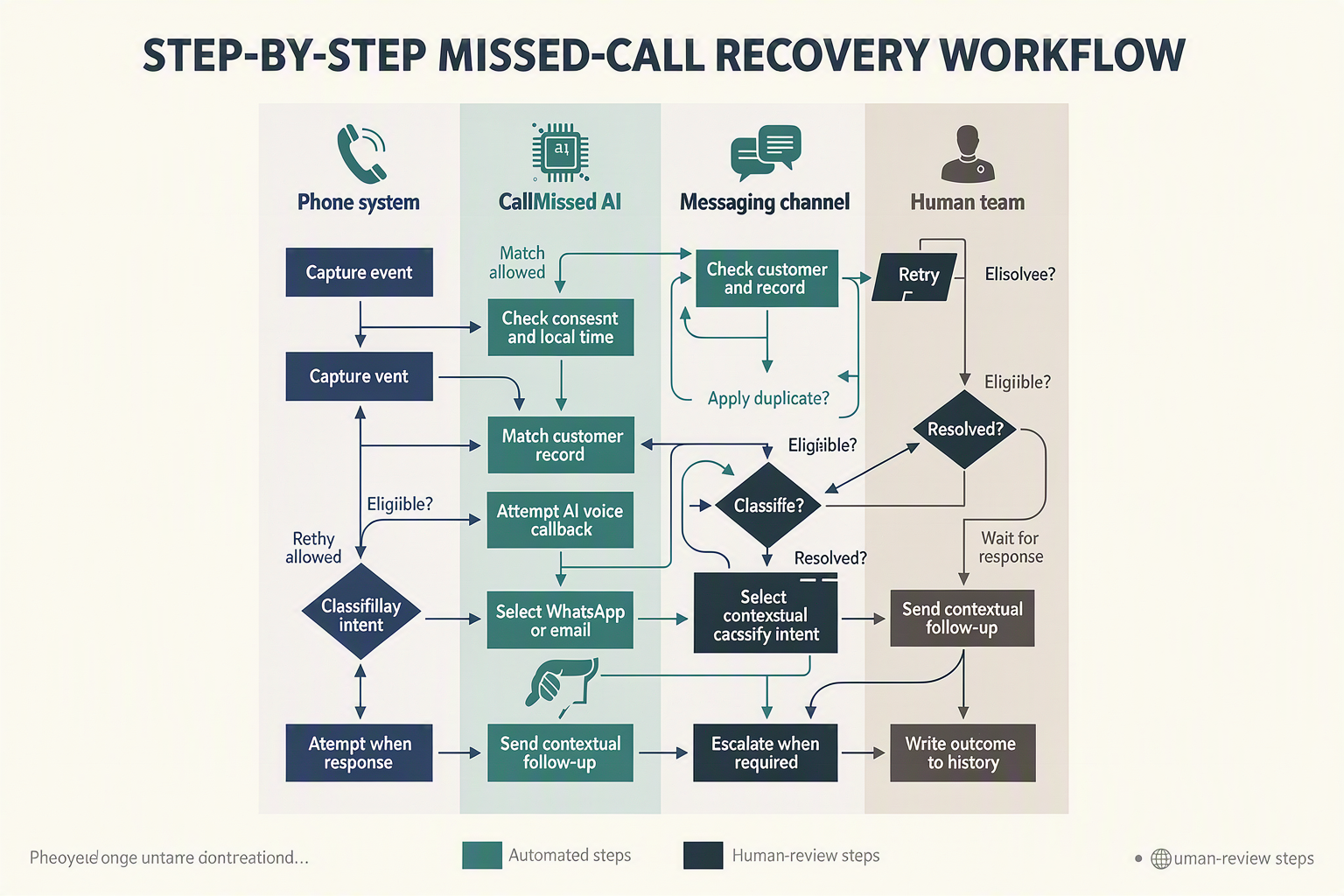
CallMissed missed call recovery operates as a stateful workflow: a missed-call event creates a recovery record, policy checks determine whether outreach is allowed, an AI voice agent attempts resolution, and the resulting context drives an eligible WhatsApp message, email, or human handoff. Each stage should update one shared conversation record so the customer is not contacted twice or asked to repeat information.
1. Register and enrich the missed-call trigger
When the business number records an unanswered call, the workflow should create a unique event containing the caller number, called number, timestamp, call status, and event ID. It can then enrich that event with account-dependent context such as:
- Previous voice, WhatsApp, or email conversations
- CRM identity, open cases, and customer status
- Campaign or department associated with the called number
- Known language and communication preferences
- Business hours, geography, and urgency indicators
CallMissed’s omnichannel inbox and knowledge-base retrieval can help the agent use this context, although available fields and integrations depend on the business’s configuration.
2. Validate eligibility before contacting the caller
The automation must pass through a policy gate before initiating outreach. This gate checks consent, applicable calling hours, opt-outs, internal suppression lists, channel eligibility, and whether an employee or another automation has already responded.
A robust AI missed call automation design uses an idempotency key—typically derived from the call event ID—to prevent retries or duplicate webhooks from launching multiple callbacks. It should also group repeated calls from the same number within a defined period into one active recovery case rather than treating every attempt as a new lead.
3. Select the appropriate recovery path
The workflow chooses its next action using the available context:
- Immediate callback: Initiate an AI voice callback when calling is permitted and the use case benefits from a live conversation.
- Scheduled callback: Offer or reserve a later time when the call occurred outside configured contact hours.
- WhatsApp follow-up: Send an eligible, approved message when WhatsApp consent and Meta’s applicable messaging rules permit it.
- Email follow-up: Use email when a verified address and suitable permission exist, particularly for documents or detailed instructions.
- Human queue: Route high-risk, sensitive, or explicitly requested interactions directly to an employee.
Exact outbound-calling triggers, WhatsApp templates, calling availability, and permissions remain account- and jurisdiction-dependent.
4. Let the AI voice agent diagnose and act
The AI voice agent should begin by identifying the business, explaining the callback, and confirming that the customer is available. It can then detect intent, retrieve approved answers from the knowledge base, collect only necessary details, and complete configured actions such as qualification or appointment intake.
For Indian audiences, CallMissed supports speech-to-text and text-to-speech across 22 Indian languages, allowing regional-language voice experiences to be designed natively rather than added only as text translation.
5. Generate a contextual channel handoff
After the conversation, the system stores the outcome, summary, detected intent, commitments, and next action. The missed call follow-up should reference the actual interaction—for example, an appointment confirmation, requested information, or a case summary—rather than sending a generic “we missed you” message.
CallMissed can support continuity across AI voice, WhatsApp, and email. For eligible WhatsApp interactions, it can also bridge WhatsApp Business calls to an AI voice agent, subject to Meta availability and account configuration.
6. Close, monitor, or escalate the case
The workflow marks the case as resolved, awaiting customer, scheduled, opted out, failed, or escalated. Human handoff should occur when the customer asks for an employee, the agent lacks confidence, authentication fails, sentiment deteriorates, or the request involves financial, legal, safety, or other sensitive decisions. The employee should receive the transcript or summary, customer context, and attempted actions so resolution continues without repetition.
When should missed call follow-up use an AI voice call, WhatsApp, email or a human agent? (TABLE)
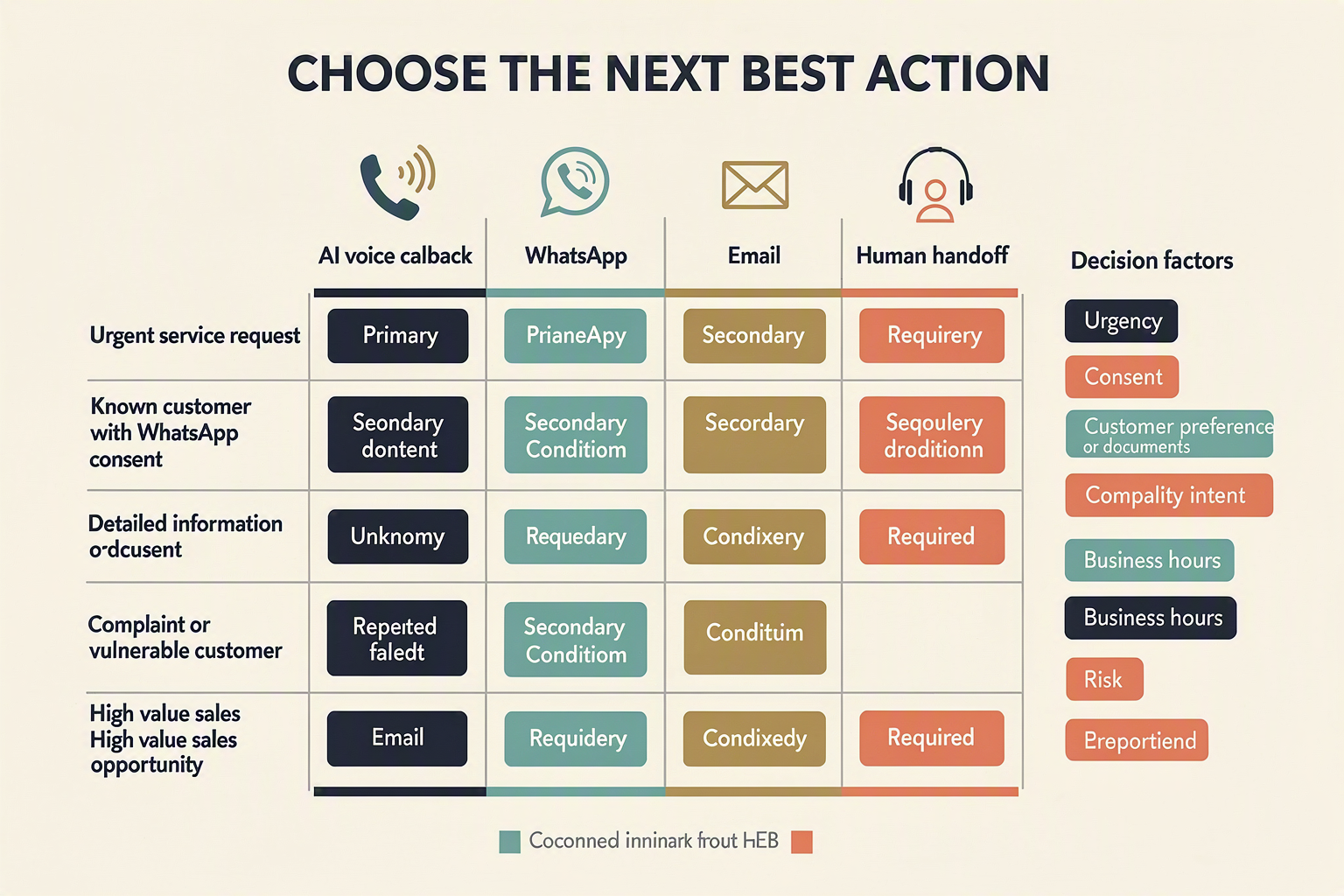
Use an AI voice call when the customer’s intent is urgent or requires dialogue, WhatsApp for concise conversational follow-up, email for detailed or formal information, and a human agent for sensitive, high-value, or low-confidence cases. The best missed call follow-up may combine channels sequentially, but only after checking consent, local calling hours, channel eligibility, and prior outreach.
Channel decision table
| Situation | Best next action | Why it fits | Key safeguard |
|---|---|---|---|
| Appointment, booking, availability, or sales enquiry | AI voice callback | Resolves multi-step questions quickly and can capture intent, language, preferred time, and qualification details | Call only during permitted hours; disclose automation where required |
| Customer does not answer the callback | Contextual WhatsApp message | Offers an asynchronous path without requiring another call; useful for short replies, links, or scheduling | Verify WhatsApp eligibility, consent, and any Meta template requirement |
| Quote, policy, invoice, technical instructions, or long summary | Email follow-up | Better for structured, searchable information and attachments that customers may need to retain | Confirm the email address and avoid including unnecessary sensitive data |
| Complaint, cancellation threat, repeated failed resolution, or explicit request for staff | Human agent | Empathy, negotiation, accountability, or policy discretion may be required | Transfer the transcript, intent, and actions already taken so the customer does not repeat everything |
| Urgent safety, fraud, medical, legal, or financially sensitive issue | Human escalation or approved emergency process | These scenarios can exceed an automated agent’s authority and risk tolerance | Do not let the AI improvise advice; follow the organisation’s verified escalation policy |
| Intent is unclear and urgency appears low | WhatsApp or email clarification | One focused question can establish the reason for contact without an intrusive callback | Send once, honour opt-outs, and suppress additional outreach after a response |
Apply the choice step by step
A practical AI missed call automation policy should evaluate the channels in this order:
- Classify urgency and complexity. A same-day appointment request may justify voice, while a brochure request may be better handled by email.
- Check customer preference and eligibility. Previous channel choices, language, consent records, time zone, and suppression status should influence the route.
- Select the least intrusive effective channel. Do not initiate a call merely because a phone number exists.
- Set a confidence threshold. Escalate when intent recognition, identity matching, or knowledge retrieval falls below the business’s configured threshold.
- Stop the sequence after resolution. A completed AI callback, customer reply, opt-out, or human takeover should cancel pending messages.
When a combined sequence makes sense
A channel sequence should have a clear purpose rather than repeat the same generic prompt. For example, an AI voice agent can qualify an appointment enquiry and then send the confirmed time through WhatsApp; a support agent can resolve a technical issue by voice and email the detailed instructions afterward.
Meta CEO Mark Zuckerberg stated during Meta’s April 2025 earnings call that WhatsApp had surpassed 3 billion monthly active users, reinforcing its relevance as an asynchronous follow-up channel. Reach, however, does not replace permission.
CallMissed missed call recovery can coordinate AI voice agents, WhatsApp chat, WhatsApp Business calling, email tooling, and an omnichannel inbox so context can move with the conversation. Exact callback triggers, WhatsApp calling access, templates, integrations, and permissions remain account-dependent and subject to applicable Meta, telecom, and consent requirements.
Which consent, privacy and duplicate-outreach safeguards should the workflow enforce?
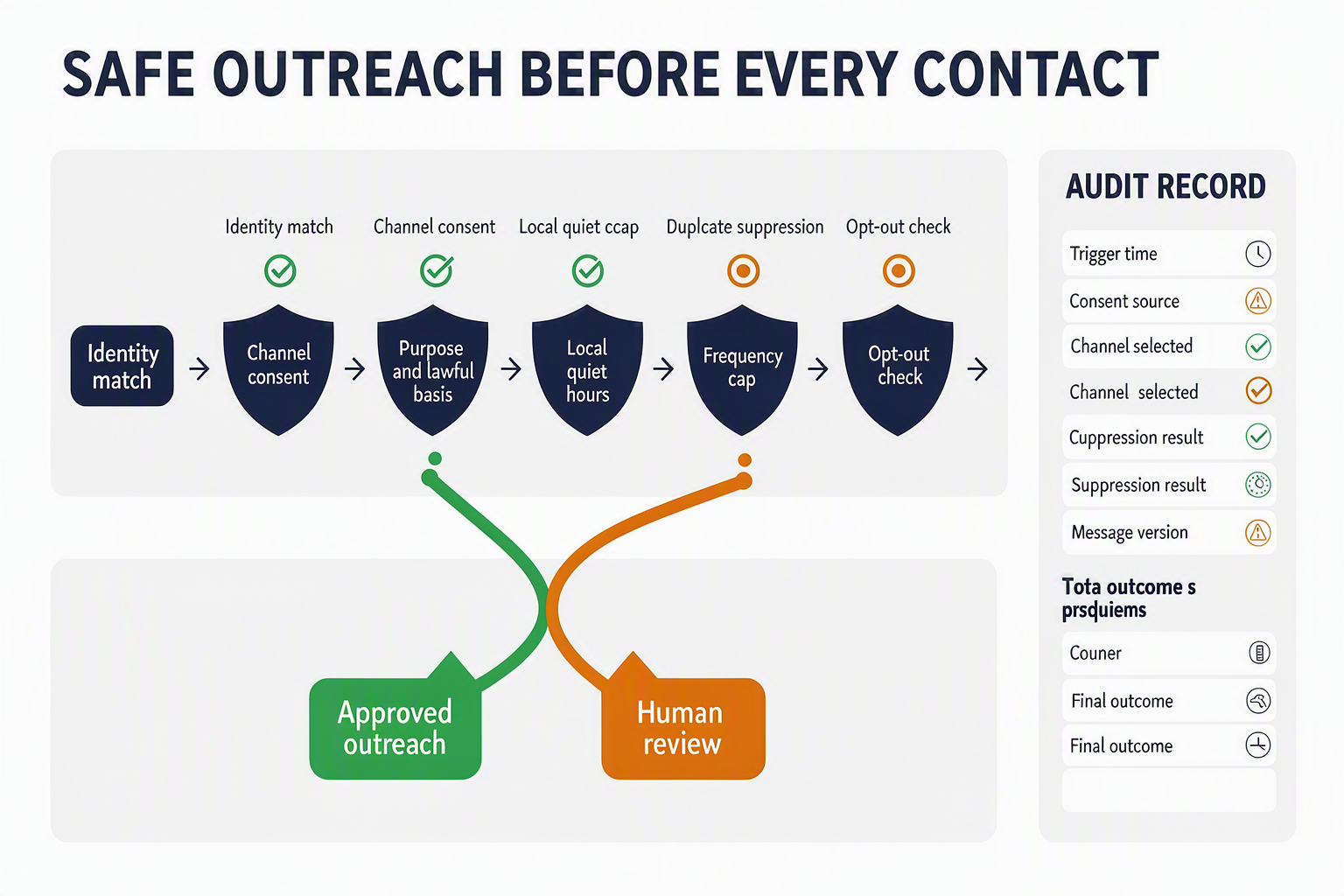
The workflow should contact a caller only when it has a valid purpose and channel-specific permission, while using suppression, idempotency and conversation-locking controls to prevent duplicate outreach. An unanswered call may justify resolving that enquiry, but it should not be treated as blanket consent for future marketing by phone, WhatsApp or email.
Enforce consent before selecting a channel
For CallMissed missed call recovery, record the evidence behind every contact decision rather than storing a single “consented” flag. The consent record should identify:
- Channel and purpose: Voice support, WhatsApp service updates, email follow-up or marketing.
- Source: Web form, recorded call disclosure, WhatsApp opt-in, contract or another documented interaction.
- Timestamp and notice version: When permission was obtained and which privacy notice was shown.
- Scope and status: Transactional or promotional, active or withdrawn, plus any expiry policy.
- Jurisdiction: The rules applicable to the customer, business and communication route.
India’s Digital Personal Data Protection Act, 2023 received presidential assent on August 11, 2023, and requires consent requests to be clear and withdrawal to be as easy as giving consent. India-based teams should also evaluate the Telecom Regulatory Authority of India’s Telecom Commercial Communications Customer Preference Regulations, 2018 when outreach could constitute commercial communication.
WhatsApp eligibility must be checked independently. A previous phone call or email address does not automatically establish WhatsApp consent. Business-initiated WhatsApp messages may require an approved template outside the applicable customer-service window, while WhatsApp Business calling availability and permissions are account-, region- and Meta-policy-dependent.
Run a pre-contact decision sequence
Before any AI missed call automation action, apply these controls in order:
- Identify the purpose. Distinguish fulfilment of the missed-call request from sales or unrelated marketing.
- Resolve the customer identity. Normalize the phone number to E.164 format and merge only confidently matched CRM records.
- Check suppression lists. Block customers who opted out, complained, requested no calls or appear on an applicable preference register.
- Check channel eligibility. Confirm voice, WhatsApp and email permissions separately.
- Apply quiet hours and frequency caps. Use the recipient’s local time and stricter jurisdictional or internal limits.
- Minimize context. Give the AI agent only the data needed to resolve the enquiry; do not expose unrelated CRM notes.
- Provide control. Identify the business, disclose AI use where required, offer an opt-out and make human escalation available.
Prevent duplicate callbacks and messages
A reliable missed call follow-up workflow should assume that webhooks can be retried and that human agents may respond simultaneously. Use:
- A unique idempotency key combining the missed-call event ID, customer, purpose and workflow version.
- An atomic conversation lock before scheduling a callback or message.
- A configurable cooldown window across voice, WhatsApp and email.
- A shared status such as
pending,claimed,contacted,resolvedorsuppressed. - Cancellation of queued automation when a human answers, the customer reconnects or another channel succeeds.
- Retry logic that resumes the existing job instead of creating a new outreach attempt.
CallMissed’s omnichannel inbox can support this shared-context pattern, but exact triggers, suppression logic, consent fields and WhatsApp permissions depend on account configuration. Every decision should leave an audit trail containing the event, legal or operational basis, policy result, selected channel, template version, timestamps and opt-out outcome.
What conditions require immediate human handoff, and what context should the agent receive?
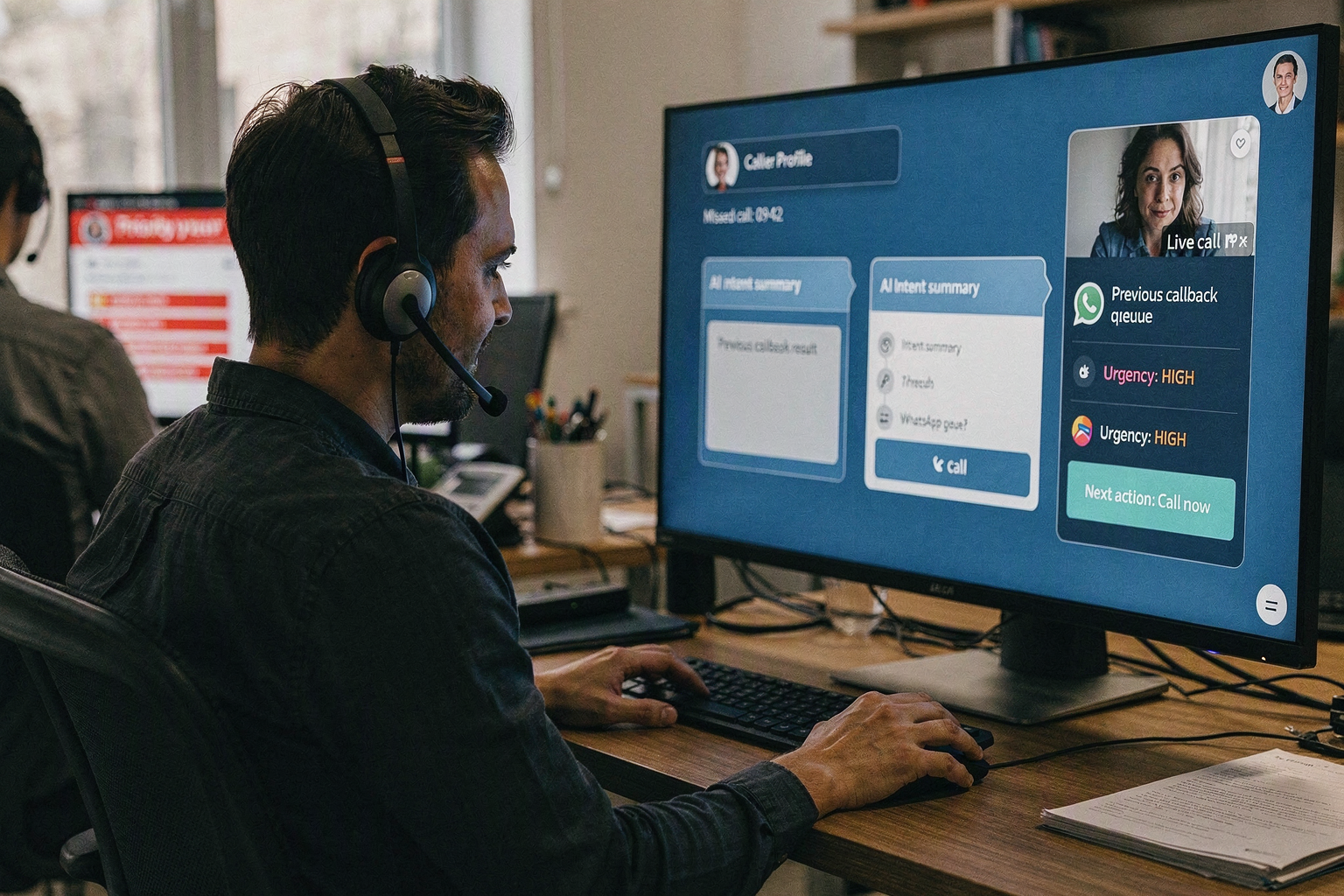
Immediate human handoff is required when the caller asks for a person, presents a safety or fraud risk, disputes a consequential decision, becomes distressed, or cannot be served reliably by the AI agent. The human should receive a concise transfer brief containing identity status, intent, urgency, conversation summary, actions already taken, and channel-consent information—not merely a transcript.
Conditions that should trigger an immediate handoff
Configure deterministic rules alongside confidence thresholds. A transfer should not depend solely on the language model deciding that a conversation “feels difficult.”
- Explicit human request: Transfer when the caller asks for an employee, supervisor, specialist, or named relationship manager. Do not force additional troubleshooting first.
- Emergency or safety concern: Escalate threats, accidents, medical distress, self-harm language, or danger to people or property. If the business is not an emergency service, the agent should clearly advise the caller to contact the appropriate local emergency service rather than imply that escalation guarantees immediate assistance.
- Fraud, account compromise, or privacy incident: Route suspected unauthorized transactions, stolen credentials, identity theft, or accidental exposure of personal data to an authorized team.
- High-impact decisions: A human should review cancellations with substantial penalties, payment disputes, legal complaints, insurance or credit decisions, and other regulated or financially consequential requests.
- Anger or repeated failure: Transfer after repeated misunderstandings, unsuccessful authentication, circular dialogue, or explicit dissatisfaction.
- Low confidence or missing knowledge: Escalate when intent classification, retrieved knowledge, or required customer information falls below business-defined thresholds.
- Priority-account rules: Organizations may require immediate routing for critical outages, vulnerable customers, high-value opportunities, or service-level agreement breaches.
These policies should distinguish immediate transfer, priority callback, and normal follow-up. If no qualified employee is available, the AI agent should state that clearly, collect an appropriate callback window, and avoid promising an exact response time unless staffing systems can support it.
What context should the human agent receive?
A useful handoff packet should answer “Who is calling, why, what has happened, and what must happen next?” Include:
- Caller and verification status: Name, phone number, customer or case ID, preferred language, and whether identity checks passed. CallMissed supports voice and chat across 22 Indian languages, which can help preserve language preference when serving regional audiences.
- Intent and urgency: A structured label such as “appointment reschedule,” “payment dispute,” or “technical outage,” plus the escalation trigger.
- Concise conversation summary: Customer objective, relevant facts, sentiment, unresolved questions, and any commitments already communicated.
- Actions completed: Knowledge-base articles consulted, troubleshooting attempted, appointment slots discussed, forms submitted, or messages sent.
- Cross-channel history: Relevant voice, WhatsApp, email, and web interactions, with timestamps and ownership status.
- Permission and suppression state: WhatsApp eligibility, email consent, opt-outs, quiet-hour restrictions, and whether another employee or automation has already responded.
Safeguard the transfer process
For CallMissed missed call recovery, route the conversation into the omnichannel inbox with the summary and source records attached. CallMissed can support AI voice, WhatsApp, email, knowledge-base retrieval, and shared inbox workflows, although exact routing triggers, integrations, WhatsApp permissions, and calling availability are account-dependent.
Before completing the handoff, AI missed call automation should lock or mark the case as owned. That prevents an employee callback, AI callback, and contextual missed call follow-up from reaching the customer simultaneously. Retain the full transcript for audit where lawful, but show the human a structured summary first and restrict sensitive data according to role-based access and retention policies.
Which metrics show whether the recovery workflow improves outcomes without causing excess outreach?
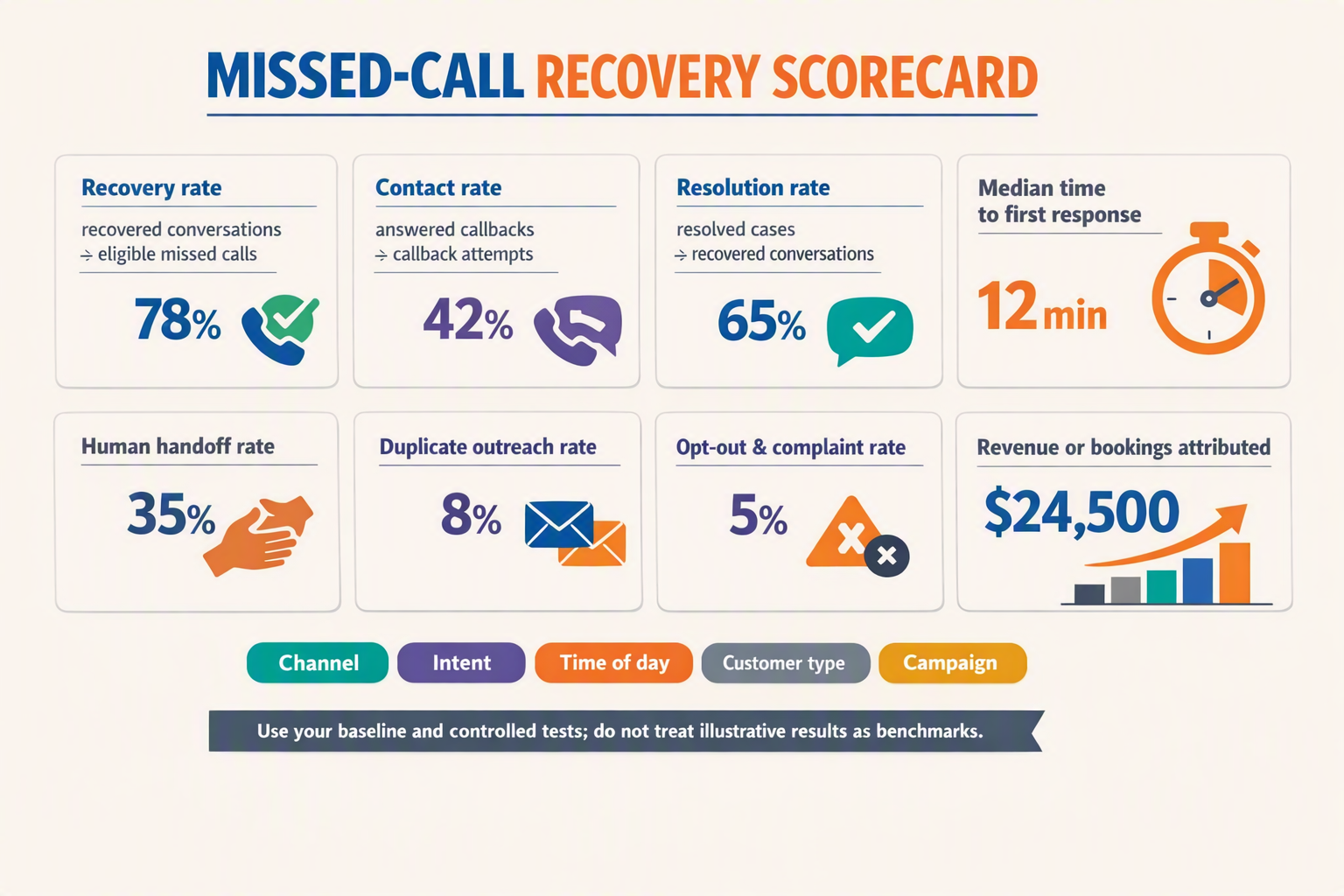
Measure recovery outcomes and outreach pressure together: callback speed, successful contact, resolution and recovered conversion should improve, while duplicate contacts, opt-outs, complaints and attempts per missed call remain flat or decline. A workflow is effective only when it creates incremental customer value—not simply more calls and messages.
Track the recovery funnel end to end
Use one recovery ID to connect the original missed call with every AI callback, WhatsApp message, email, human handoff and final outcome. For CallMissed missed call recovery, reporting availability and field-level attribution may depend on the account configuration and connected CRM, so confirm which events can be exported.
Calculate these core metrics consistently:
- Callback latency: Median time between the missed-call event and the first valid callback attempt. Also report the 90th percentile so long delays are not hidden by an average.
- Contact rate: Unique callers who answer or meaningfully respond ÷ eligible missed callers.
- Intent-capture rate: Contacted callers for whom the AI voice agent identifies a usable intent ÷ contacted callers.
- Resolution rate: Recovered conversations completed without unresolved follow-up ÷ contacted callers.
- Recovered-conversion rate: Eligible missed callers who complete the defined goal—such as booking, purchase or qualified lead creation—÷ eligible missed callers.
- Human-handoff rate: Conversations transferred to a person ÷ contacted callers. Segment this by customer request, policy requirement, urgency and low AI confidence.
- Time to resolution: Duration from the initial missed call to a recorded resolution, including cross-channel activity.
Use unique callers, not total events, as the denominator for customer-level measures. Otherwise, repeated WhatsApp replies or callback attempts can make performance appear stronger than it is.
Pair every outcome metric with a pressure metric
The guardrail dashboard for AI missed call automation should include:
- Outreach attempts per eligible missed call, separated into voice, WhatsApp and email.
- Duplicate-outreach rate: Callers receiving overlapping or repeated actions contrary to workflow rules ÷ eligible callers.
- Suppression rate: Events correctly blocked because of consent status, quiet hours, an existing response, frequency limits or an open human conversation.
- Opt-out rate: Recipients who revoke or decline channel permission ÷ recipients reached on that channel.
- Complaint rate: Recipients reporting unwanted, misleading or excessive contact ÷ recipients contacted.
- No-response saturation: Callers receiving the maximum permitted attempts without answering or replying.
- Recontact rate: Customers who contact the business again for the same unresolved issue within a defined window.
A rising contact rate accompanied by a sharply rising opt-out or complaint rate is not a clean improvement. Likewise, a lower handoff rate is beneficial only if resolution and repeat-contact metrics do not deteriorate.
Validate improvement against a baseline
Evaluate the workflow in four steps:
- Record at least one representative pre-automation baseline using the same eligibility rules and outcome definitions.
- Compare matched periods by business hours, campaign source, language, intent and customer type.
- Test one policy change at a time, such as callback timing or whether the missed call follow-up uses WhatsApp or email.
- Review both short-term conversion and delayed guardrails before expanding volume.
Report absolute counts alongside percentages. For example, “40 conversions from 1,000 eligible missed calls” is more interpretable than “a 4% conversion rate” alone.
CallMissed can connect AI voice, WhatsApp Business calling, chat, email and an omnichannel inbox within this measurement model. Exact trigger logs, analytics, CRM attribution and retention controls are account-dependent; teams should verify them before defining production targets.
What should your team verify, configure and test before launching? (TABLE)
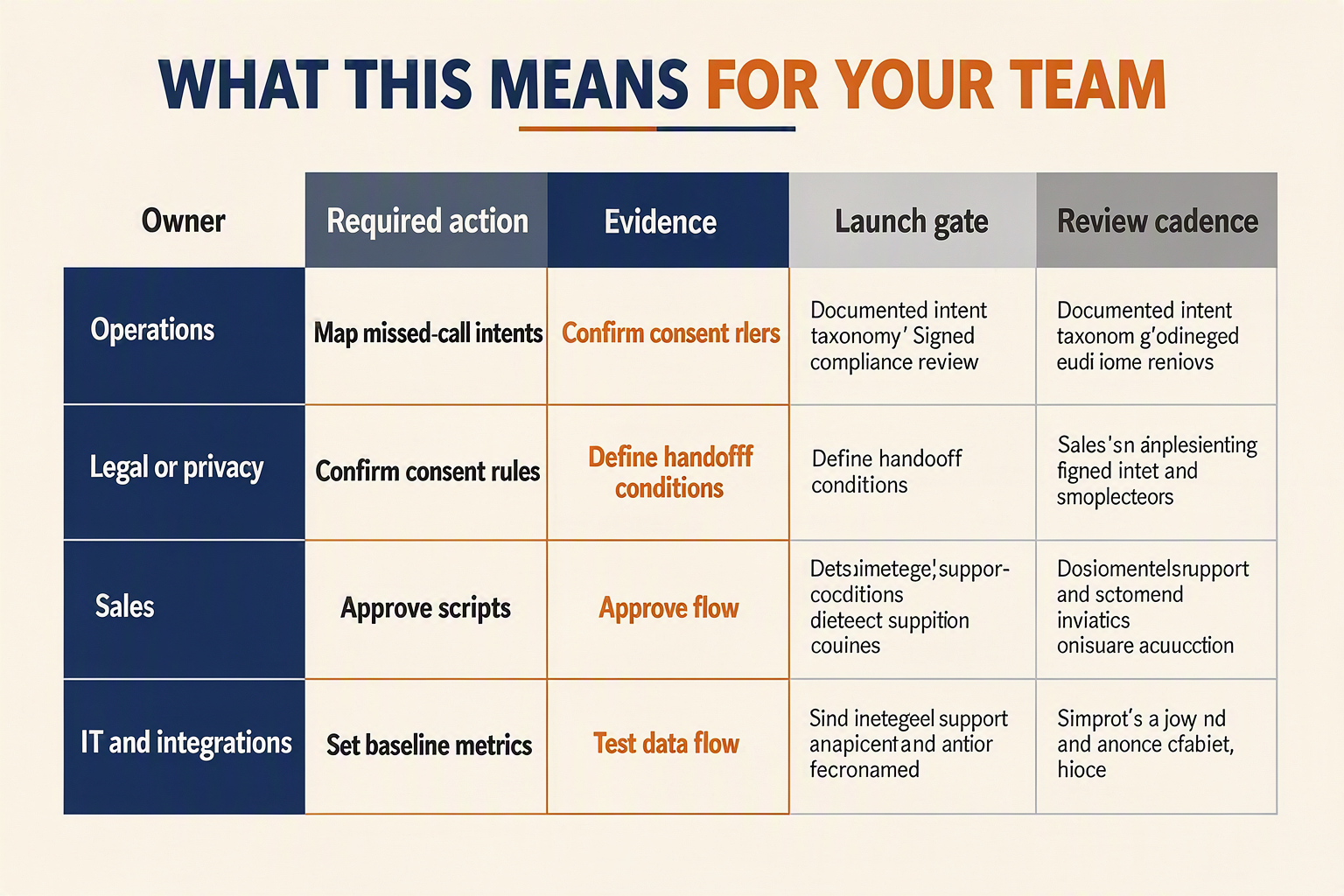
Before launch, verify event accuracy, outreach permissions, identity matching, AI behaviour, channel delivery and human escalation in a controlled environment. A CallMissed missed call recovery workflow should go live only after end-to-end tests confirm that it contacts the right person, through an eligible channel, with the correct context—and stops safely when anything is uncertain.
Pre-launch verification matrix
| Area | Verify and configure | Test scenario | Launch acceptance criterion |
|---|---|---|---|
| Missed-call detection | Confirm which call statuses trigger automation, how quickly events arrive and whether abandoned, busy and failed calls are treated differently. | Place test calls that are unanswered, rejected, disconnected early and later answered by an employee. | Each genuine missed call creates one event; answered calls and excluded statuses create none. |
| Identity and context | Define phone-number normalization, CRM matching, campaign attribution, previous-conversation retrieval and handling for shared or unknown numbers. | Call from an existing contact, a new number and a number linked to multiple records. | The workflow uses verified context only and asks the caller to confirm ambiguous information. |
| Permission and timing | Configure consent records, opt-outs, suppression lists, operating hours, retry limits and channel-specific eligibility. Meta template rules, WhatsApp Business calling availability and telecom requirements can be account- or jurisdiction-dependent. | Test an opted-in contact, an opted-out contact, an after-hours call and a number without WhatsApp eligibility. | Ineligible outreach is blocked; after-hours actions follow the configured schedule; every decision is logged. |
| AI voice agent | Set the greeting, business identity, supported intents, knowledge base, language options, confidence thresholds and prohibited actions. CallMissed supports speech workflows across 22 Indian languages, but each enabled language should be tested separately. | Use regional accents, background noise, interruptions, silence, unsupported questions and requests for a person. | The agent identifies itself appropriately, avoids unsupported claims and escalates when confidence or policy thresholds are crossed. |
| WhatsApp and email | Approve templates where required, map contextual fields, validate sender identities and create fallbacks for delivery failure. | Complete, abandon and escalate a voice conversation, then inspect the resulting missed call follow-up. | Messages reflect the actual outcome, contain no unresolved placeholders and do not expose sensitive conversation details. |
| Handoff and observability | Assign queues, operating hours, priority rules, alert recipients, ownership and service targets. Track callback latency, contact rate, delivery, opt-outs and duplicate suppression. | Trigger urgent language, repeated AI failure, customer frustration and an explicit human request. | A human receives the transcript, summary, contact context and reason for escalation without asking the customer to start over. |
Run an end-to-end launch rehearsal
Use a staging number or a limited internal pilot before exposing AI missed call automation to customers:
- Create test contacts representing consent, opt-out, unknown-caller and duplicate-record states.
- Place missed calls across business hours, after hours and retry windows.
- Review the voice recording or transcript, extracted intent, CRM updates and follow-up content.
- Confirm that WhatsApp or email delivery failures produce the approved fallback rather than repeated outreach.
- Ask operations, compliance and customer-support owners to sign off on logs and escalation behaviour.
Define rollback and monitoring controls
The launch plan should include a kill switch, configuration version history and a named incident owner. Start with a restricted call segment, monitor outcomes daily and expand only when duplicate outreach, incorrect routing and opt-outs remain within the team’s approved thresholds.
CallMissed combines AI voice agents, WhatsApp Business calling, an omnichannel inbox, email tooling and knowledge-base retrieval, but exact triggers, templates, integrations and channel permissions depend on account configuration. Record those dependencies explicitly so later platform or policy changes do not silently break the recovery workflow.
Frequently asked questions about CallMissed missed-call recovery, AI callbacks, WhatsApp or email follow-up, consent, timing, pricing and human escalation
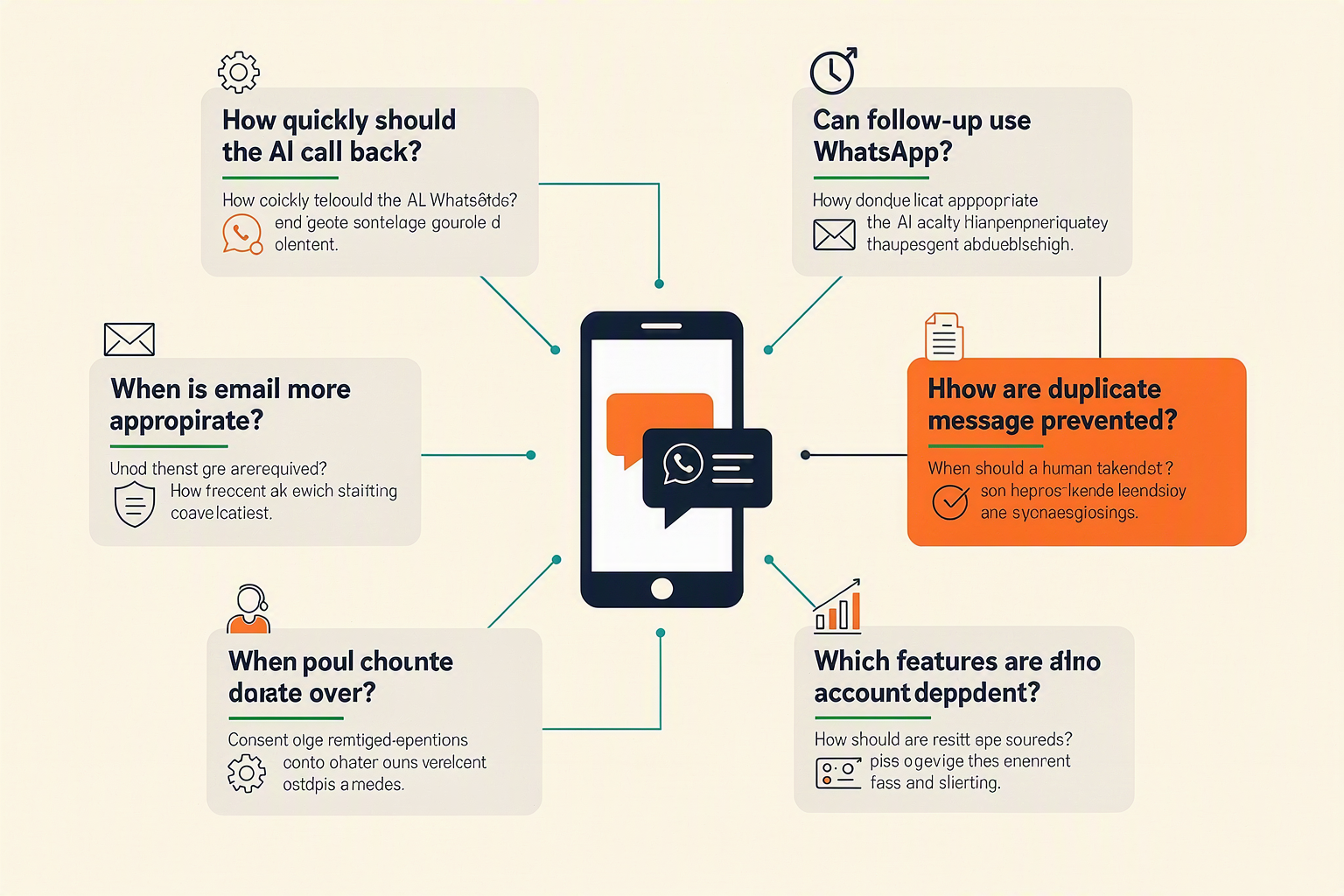
How does CallMissed missed call recovery work?
Can AI missed call automation call customers back immediately?
Can a missed call follow-up be sent through WhatsApp or email?
What consent rules apply to AI callbacks, WhatsApp messages and follow-up emails?
How much does CallMissed AI voice and missed-call automation cost?
When should a CallMissed AI voice agent transfer a missed caller to a human?
Conclusion
CallMissed missed call recovery turns an unanswered call into a governed, measurable workflow: capture the event, check consent and suppression rules, trigger an AI voice response, retain context, and continue through WhatsApp, email, or a human agent. The objective is not simply to increase outreach volume; it is to recover high-intent conversations quickly without duplicate, irrelevant, or non-consensual contact.
The core takeaways are:
- Start with reliable event handling. Record the missed call, called number, timestamp, campaign source, previous interactions, and language preference where available. Before responding, verify that another agent or automation has not already handled the caller.
- Choose the next channel from context and permission. An AI voice callback may suit urgent or complex requests, while an eligible WhatsApp message can provide immediate continuity and email can support longer-form information. Meta CEO Mark Zuckerberg said during Meta’s April 2025 earnings call that WhatsApp had surpassed 3 billion monthly active users, underscoring its importance as a customer communication channel.
- Design human handoff as part of the workflow. Escalate when a caller requests a person, shows frustration, raises a high-risk issue, or moves beyond the AI agent’s confidence threshold. Preserve the transcript, detected intent, and collected details so the customer does not have to start again.
- Measure outcomes rather than activity alone. Track callback latency, contact rate, resolution rate, handoff rate, opt-out rate, and recovered conversions. These metrics show whether AI missed call automation improves customer experience and commercial recovery—not merely message counts.
The next phase of missed call follow-up will be shaped by better cross-channel context, more accurate intent detection, and tighter consent controls. Businesses should watch how Meta requirements, telecom rules, account-level calling availability, templates, and channel permissions evolve before expanding automation.
To assess this workflow in practice, explore CallMissed, an AI-native communication platform supporting voice agents, WhatsApp Business calling and chat, email tooling, an omnichannel inbox, and knowledge-base retrieval, with exact capabilities dependent on configuration. How many valuable conversations could your business recover if every missed call received a timely, contextual, and permission-aware response?
Related Reading
Related Posts
Ready to automate customer conversations?
Launch AI voice agents and WhatsApp bots with CallMissed — one API, 22+ Indian languages.