

AI Call Summary Email: A Practical 2026 Guide to Better Follow-Ups


Learn how to build an AI call summary email with structured fields, action items, CRM routing, quality controls, privacy, and CallMissed.
AI Call Summary Email: A Practical 2026 Guide to Better Follow-Ups
What if every customer call ended with a clear, accurate follow-up email before the agent even opened the CRM? An AI call summary email turns a recorded conversation into an actionable business record—capturing the customer’s intent, decisions, commitments, and next steps, then delivering that information to the right people within seconds.
The productivity case is compelling. Salesforce reported in its 2024 State of Sales that sales representatives spend only 30% of their working week actually selling, with the rest consumed by activities such as administration, planning, and data entry. Automating post-call notes can reclaim part of that time, but speed alone is not enough. A vague paragraph generated from a transcript may omit a promised callback, misstate a price, or bury an urgent cancellation request.
A useful call transcription summary must therefore be designed as structured operational data rather than a generic meeting recap. Depending on the workflow, it should capture:
- Caller identity and contact details
- Call date, duration, language, and channel
- Primary intent and sentiment
- Key questions, decisions, and objections
- Action items with owners and deadlines
- Consent, escalation, and compliance indicators
- Links to the recording, transcript, and CRM record
This matters even more in 2026 because AI-generated notes increasingly influence routing, customer communication, and automated CRM updates. Privacy requirements are also becoming more consequential: IBM’s Cost of a Data Breach Report 2024 placed the global average cost of a breach at US$4.88 million, underscoring why recordings, transcripts, and emailed summaries need strict access controls and retention policies. In Europe, the European Commission states that most provisions of the EU AI Act become applicable on 2 August 2026, adding urgency to governance and transparency planning.
This guide explains how to build a dependable summary pipeline from transcription to delivery. You will learn how to define structured fields, extract action items, classify calls by intent, route emails to sales or support teams, log results in a CRM, and apply human or automated quality checks. It also covers privacy safeguards, failure handling, confidence thresholds, and practical email templates for sales, support, appointments, and escalations.
Platforms such as CallMissed can support this workflow by connecting AI voice agents—including WhatsApp Business calls—with transcription, knowledge-base context, omnichannel engagement, and downstream follow-up automation. For a broader production architecture, see the WhatsApp Calling API and AI agent guide.
The goal is not simply a voice agent email integration that sends more messages. It is a reliable system that gives every recipient the right facts, responsibilities, and next action—without forcing them to replay an entire call.
What should an AI call summary email include? Transcript highlights, structured facts, owners, deadlines, and next steps
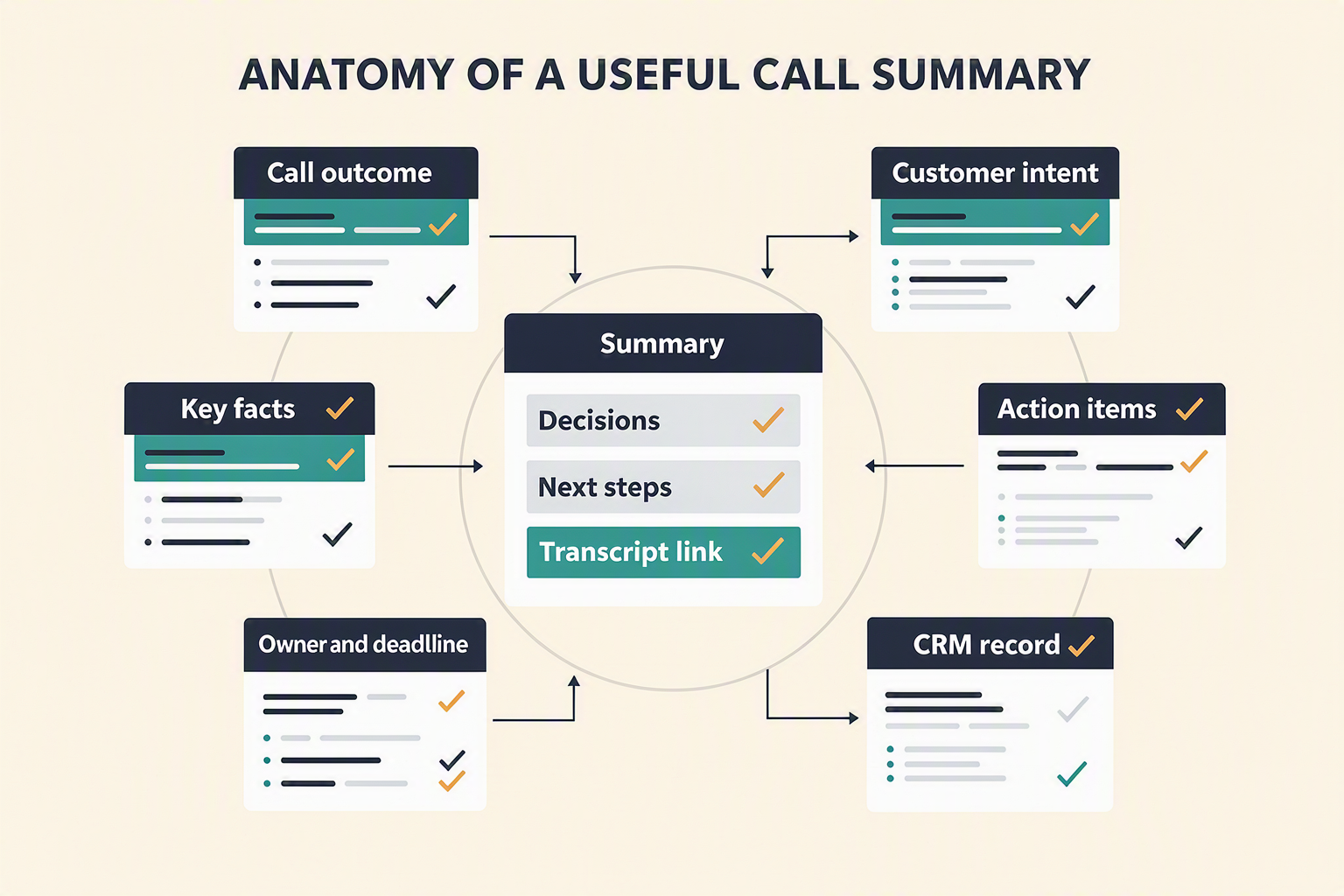
A useful AI call summary email should let a recipient understand the call, identify commitments, and take the next action without reading the full transcript. It should combine a concise narrative with structured facts, transcript-backed highlights, named owners, explicit deadlines, and links to the source records.
Start with an operational subject line
The subject line should communicate intent, urgency, customer, and status. Avoid generic subjects such as “Call summary” that are difficult to scan or route.
Use a predictable format:
[Intent] [Priority] — [Customer] — [Required action or status]
Examples include:
- [Sales] Hot lead — Aditi Sharma — Demo requested by 4 August
- [Support] Urgent — Mehta Logistics — Shipment escalation required
- [Appointment] Confirmed — Rahul Verma — 6 August at 11:30 IST
- [Retention] Cancellation risk — ABC Retail — Manager callback due today
Present structured facts before the narrative
The first block should contain fields that people, CRM systems, and workflow automations can process consistently:
- Caller: Name, company, phone number, and verified email
- Call metadata: Date, start time, duration, channel, and language
- Primary intent: Sales inquiry, support, booking, billing, cancellation, or other controlled category
- Outcome: Resolved, appointment booked, follow-up required, escalated, or no decision
- Priority: Low, normal, high, or urgent
- Sentiment: Positive, neutral, negative, or mixed—with a confidence score
- CRM identifiers: Contact, account, ticket, opportunity, or conversation ID
- Source links: Recording, complete transcript, and CRM record
Keep unknown values explicit. “Email not provided” is safer than an AI model inferring an address, while “Deadline not stated” prevents a missing commitment from being mistaken for an open-ended task.
Include selective transcript highlights
A call transcription summary should not reproduce the entire conversation. Include three to six timestamped highlights covering the customer’s need, important evidence, decisions, objections, and commitments.
For example:
- [02:14] Customer: “We need 40 licences before the new branch opens.”
- [05:42] Agent: Confirmed that a revised quotation would be emailed by 3 August.
- [08:09] Customer: Requested data residency and cancellation-policy details.
Quotes should remain verbatim where wording has contractual, financial, consent, or compliance significance. Paraphrased highlights should be labelled as summaries rather than direct quotations.
Convert commitments into accountable actions
Every action item needs four components:
- Action: A specific, observable task
- Owner: A named person, team, or system
- Deadline: An exact date, time, and time zone
- Status: Open, scheduled, blocked, completed, or awaiting customer
Instead of “Follow up soon,” write: “Priya Nair — send the revised ₹85,000 quotation by 3 August 2026, 17:00 IST — Open.” If the caller promised to provide documents, record the caller as the owner rather than assigning the task internally.
End with decisions and next steps
The closing block should distinguish what was decided from what still needs confirmation. It should also state whether an automated customer email may be sent or whether human review is required.
This structure directly addresses administrative workload: Salesforce reported in its 2024 State of Sales that sales representatives spend only 30% of their working week selling. A well-designed voice agent email integration reduces note-taking without turning uncertain AI output into authoritative customer data. High-impact facts—prices, dates, consent, refunds, and cancellations—should therefore carry confidence indicators and be checked against the transcript before downstream execution.
How does a call transcription summary become a reliable email after each conversation?
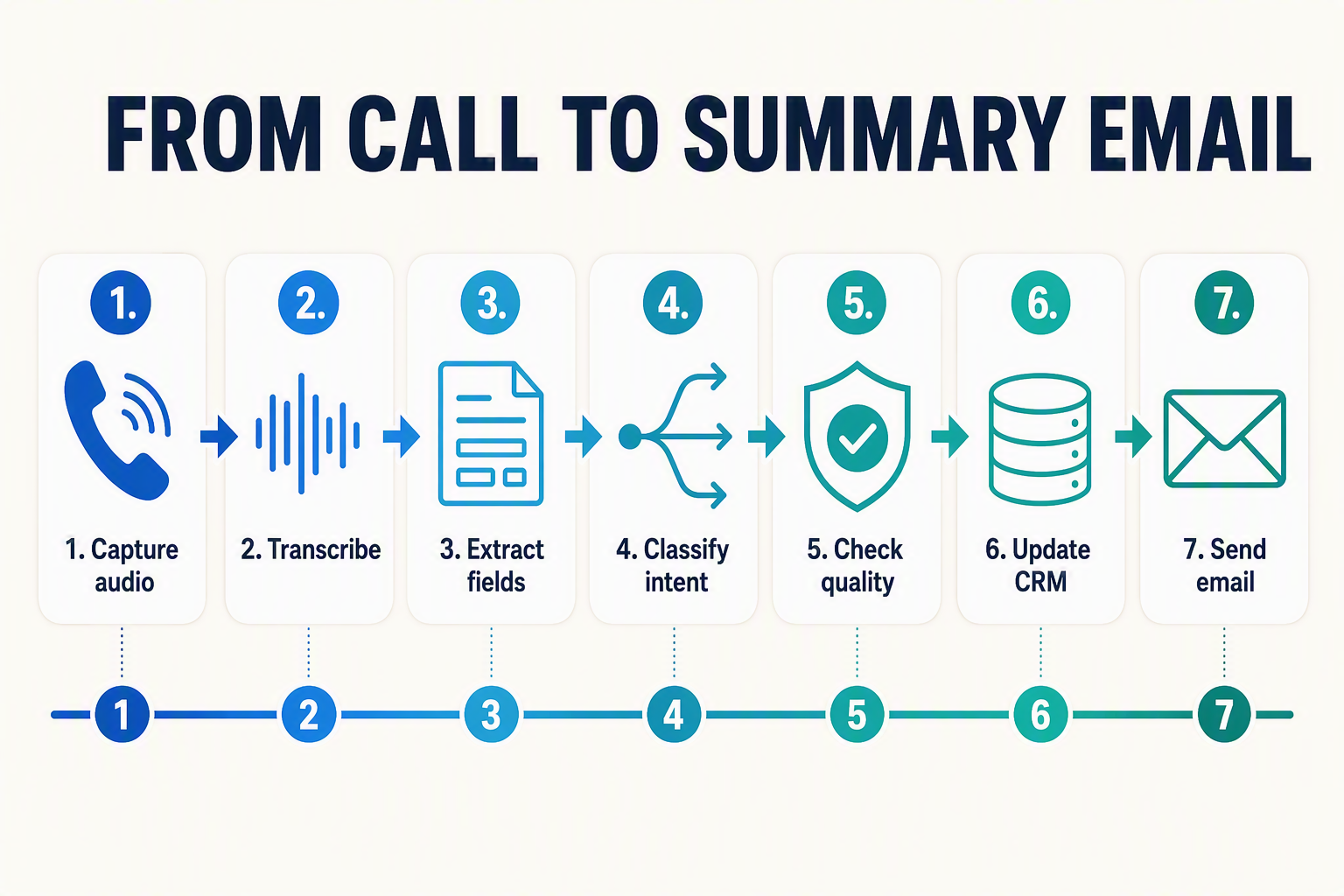
A call transcription summary becomes a reliable email only when the system treats generation as a validated data pipeline, not a single “summarise and send” prompt. The transcript should remain the evidence layer, while structured extraction, confidence checks, deterministic templates, routing rules, and delivery controls turn that evidence into an operational message.
Build the pipeline in controlled stages
A production workflow should separate tasks so that each stage can be tested and retried independently:
- Capture and identify the call. Assign a unique call ID and record timestamps, participants, language, direction, and relevant account identifiers.
- Transcribe and segment the audio. Preserve speaker labels and timestamps so extracted claims can be traced to the caller or agent.
- Extract a predefined schema. Ask the model for valid JSON containing intent, outcome, commitments, action items, urgency, and other approved fields—not unrestricted prose.
- Validate the output. Check required fields, data types, email addresses, dates, currency values, and references to products or policies.
- Generate the email. Render validated fields through an approved template, with separate layouts for internal notes and customer-facing follow-ups.
- Route, deliver, and log. Select recipients from intent and ownership rules, send the email once, and record the result in the CRM.
This staged approach makes a voice agent email integration easier to audit. If delivery fails, the system can retry the email without retranscribing the call or creating a duplicate CRM activity.
Ground every important claim in the transcript
The summarisation model should distinguish between explicit facts, reasonable classifications, and unknown information. It must not convert “I may renew next month” into “Customer will renew next month,” or infer a deadline when none was agreed.
For high-impact fields, store supporting evidence alongside the extracted value:
commitment: “Agent will send the revised quote”owner: account executivedue_at: null if no deadline was statedevidence: transcript segment and timestampconfidence: model confidence or verification status
A dependable call transcription summary uses unknown, not stated, or a null value instead of inventing missing details. Exact figures—such as quoted prices, payment amounts, appointment dates, phone numbers, and cancellation terms—should receive stricter validation than general topic labels.
Apply send, review, and stop rules
Not every generated message should be dispatched automatically. Define thresholds according to business risk:
- Auto-send: complete schema, recognized recipient, high-confidence extraction, and no sensitive exception.
- Human review: ambiguous commitments, low-confidence names or dates, unusual pricing, negative sentiment, or multiple competing intents.
- Stop and escalate: missing transcript, consent concern, unsupported recipient, policy-sensitive request, or schema-validation failure.
The resulting AI call summary email should also include a stable call ID and links to authorized records, enabling reviewers to compare the email with its source.
Governance should be designed now rather than added later. The European Commission states that most provisions of the EU AI Act become applicable on 2 August 2026, making traceability, human oversight, and documented controls especially relevant for organizations operating in Europe.
Finally, use idempotency keys, delivery-status tracking, bounded retries, and dead-letter queues. Reliability means producing the right email, sending it to the right recipient exactly once, and preserving enough evidence to explain how every material statement was generated.
Which 2026 developments make voice agent email integration more useful? (TABLE)
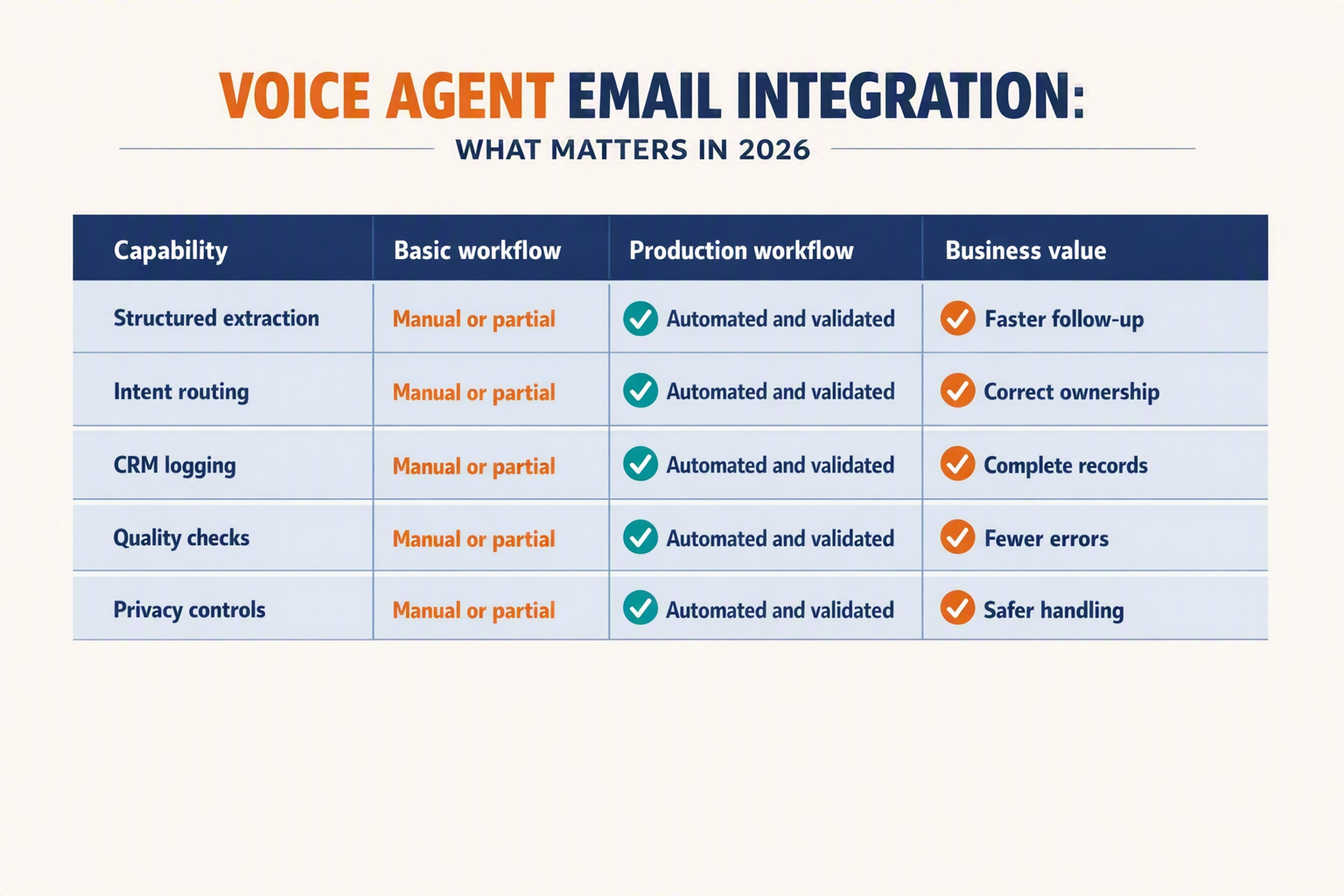
The most useful 2026 improvements are implementation capabilities, not automatically verified market-wide developments. Schema-constrained extraction, evidence-separated tool results, multilingual quality assurance, identity resolution, confidence-aware routing, and audit controls can make an AI call summary email reliable enough for operational workflows.
Capabilities that improve production workflows
| Implementation capability | Practical value | Recommended design | Required control |
|---|---|---|---|
| Schema-constrained extraction | Converts the transcript into predictable fields such as intent, customer ID, owner, due date, consent status, and next action | Define a versioned schema with required fields, data types, enumerated values, and null handling; validate before creating the email or CRM entry | Reject invalid outputs and represent unavailable information as null or “not confirmed,” never as an inferred fact |
| Tool-result separation | Distinguishes verified account, order, ticket, or appointment data from the model’s interpretation of the conversation | Store tool responses, transcript evidence, and generated conclusions in separate objects linked by source identifiers | Allow-list tools and require human approval for refunds, cancellations, payments, or contractual changes |
| Multilingual and code-switching QA | Makes a call transcription summary more useful when speakers change languages or use regional names and terminology | Preserve the source language, original transcript excerpt, normalized field, and optional translation separately | Review uncertain names, dates, addresses, amounts, product terms, and mixed-language passages |
| Identity resolution | Connects the call with the correct CRM contact, account, or case instead of relying on a similar name | Match using verified phone numbers, account IDs, one-time passwords, or another authenticated identifier | Block automatic merges when identifiers conflict, a number is shared, or multiple records are plausible |
| Confidence-aware routing | Automates routine outcomes while directing uncertain or high-impact cases to a person | Calculate separate confidence or evidence statuses for transcription, intent, identity, and extracted fields | Treat confidence as a routing signal rather than proof; apply stricter rules to financial, medical, legal, and consent-related details |
| Audit and privacy controls | Makes voice agent email integration traceable, correctable, and easier to govern | Record model and prompt versions, schema version, timestamps, source references, human edits, CRM updates, and email delivery status | Enforce role-based access, encryption, redaction, retention periods, deletion workflows, and recipient restrictions |
Use a staged workflow instead of one-pass summarisation
A production workflow should separate extraction, verification, and action:
- Extract structured fields. Parse the transcript, customer record, and tool outputs into typed fields. Keep direct customer statements distinct from inferred intent and verified system data.
- Verify high-impact details. Compare names, dates, amounts, commitments, consent indicators, and requested actions against transcript spans or tool-result identifiers.
- Resolve identity. Confirm that the caller belongs to the intended CRM record before attaching the summary or disclosing account information.
- Route by field-level status. A correctly identified intent does not guarantee a correctly transcribed appointment date. Route each critical field according to its own evidence and confidence.
- Act and record. Render the email, create CRM tasks, assign an owner, log delivery, and retain an audit reference without unnecessarily copying sensitive transcript content.
Minimum release checks
Before sending an automated summary, confirm that:
- Every required field passes schema validation.
- Facts, tool results, and model interpretations are visibly separated.
- Critical values have supporting transcript or system evidence.
- Conflicting identities trigger manual review.
- Email recipients are authorised to receive the included data.
- Human corrections are logged and can improve future quality testing.
These choices make automation safer without assuming that any model, language, or confidence score is error-free.
Which structured fields and sample email templates work for sales, support, and appointments?
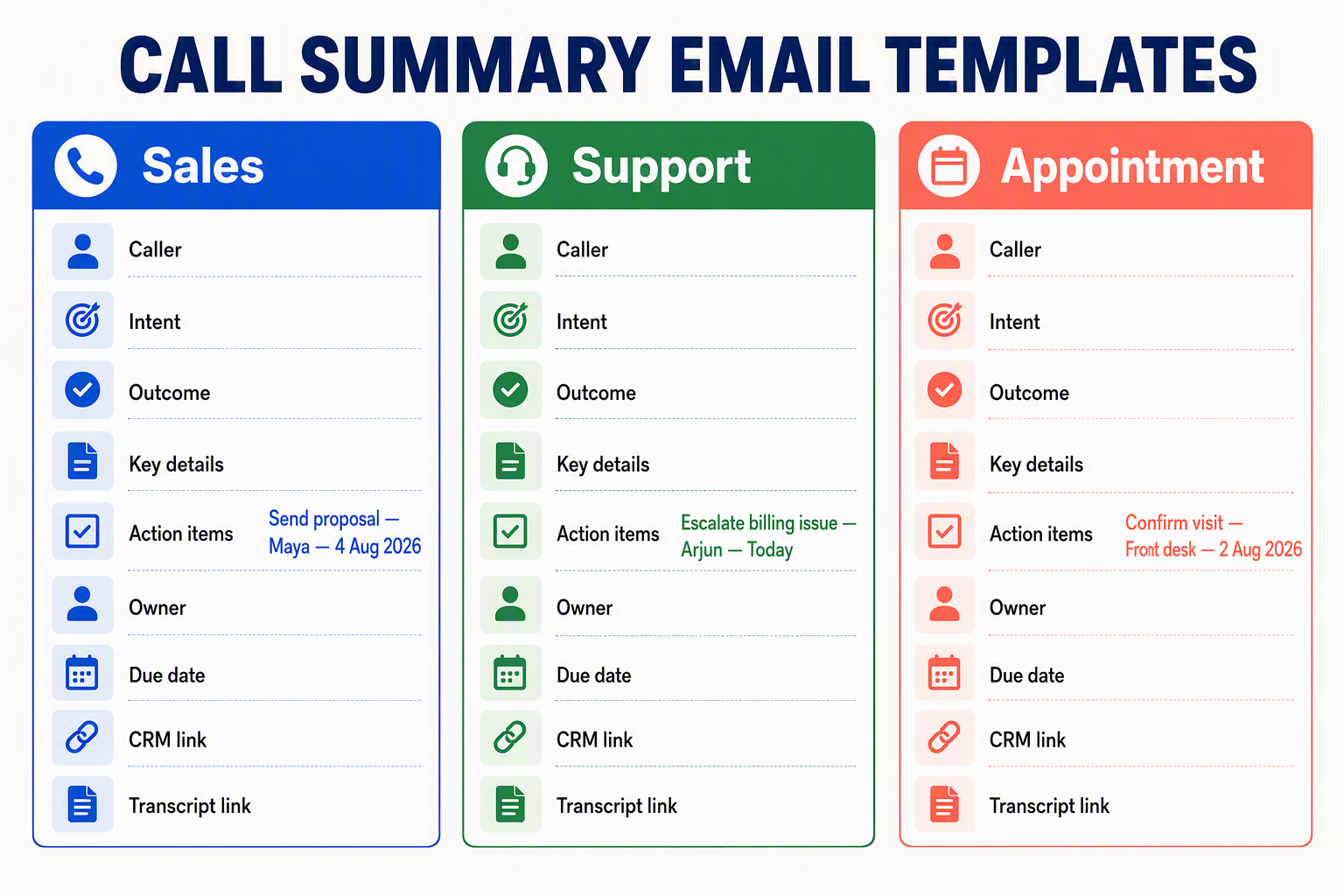
The most effective AI call summary email combines a shared, machine-readable schema with fields tailored to sales, support, or appointment workflows. Put the outcome, accountable owner, deadline, and confidence status first; add narrative context and transcript evidence afterward.
Use a common schema across every call
Keep field names consistent across email, CRM, ticketing, and automation systems. Use controlled values such as qualified, urgent, or confirmed instead of unrestricted prose.
- Call identity: Unique call ID for deduplication
- Contact: Name, verified phone, email, company, and CRM ID
- Metadata: Start time, duration, direction, channel, and detected language
- Classification: Primary intent, secondary intent, disposition, urgency, and sentiment
- Outcome: What was agreed, resolved, promised, or left open
- Actions: Task, owner, ISO 8601 due date, priority, and status
- Evidence: Transcript timestamps supporting material claims
- Confidence: Field-level score or
verified,review required, andunknown - Record links: Recording, transcript, CRM record, ticket, or opportunity
Use unknown rather than guessing. Include currency codes such as INR or USD, and assign every action to one accountable owner. The completed examples below are fictional.
Sales summary template
Sales emails should prioritize qualification, requirements, objections, commercial discussions, and the next commitment.
Subject: [Sales][Qualified] Acme Solar Services — demo requested by 2026-08-05
Contact: Neha Kapoor, Operations Director, Acme Solar Services
Intent: Evaluate an AI voice agent for inbound lead qualification
Qualification: Budget: INR 150,000 annually | Authority: Decision-maker | Need: Reduce missed enquiries | Timeline: September 2026
Key requirements: CRM sync, call recording, English and Hindi workflows
Objections: Concerned about setup time and human handoff accuracy
Commercial details discussed: Indicative Growth plan; final pricing not approved
Next action: Arjun Mehta to schedule a technical demo by 2026-08-05
CRM: Opportunity OP-20481, fictional CRM record
Evidence/confidence: Budget at 06:42, review required; demo request at 11:08, verified
This format also fits an outbound AI calling agent for lead qualification.
Support summary template
A support call transcription summary must separate the customer’s reported facts from diagnosis or inference.
Subject: [Support][High] TKT-7319 — checkout fails after payment authorization
Customer/account: Priya Nair / AC-55821
Product and environment: Merchant Portal 4.8, Chrome 127, Windows 11
Reported issue: Customer reports that checkout returns to the cart after bank authorization
Steps attempted: Cleared cache, retried in incognito mode, and tested another card
Diagnosis: Unknown
Hypothesis: Session token may expire during the bank redirect; engineering verification required
Current status: Escalated
Business impact: Customer reports 14 affected orders since 2026-07-31
Owner and SLA deadline: Rohan Shah / 2026-08-01T16:00:00+05:30
Sensitive-data warning: Review required; caller spoke the final four card digits
Records: Ticket TKT-7319 and transcript TR-88204
Never transform a reported symptom into a confirmed root cause. Label unverified interpretation as hypothesis.
Appointment summary template
Appointment emails require normalized time, timezone, location, prerequisites, and change rules.
Subject: [Appointment][Confirmed] Dental consultation — 2026-08-06 at 10:30 IST
Customer: Kavita Rao
Service/provider: Dental consultation / Dr. Ananya Sen
Date and time: 2026-08-06T10:30:00+05:30 (Asia/Kolkata)
Location: Lakeside Dental Clinic, Bengaluru
Special instructions: Arrive 15 minutes early and bring previous X-rays
Consent or prerequisites: Intake consent pending
Reminders: Email 24 hours before; WhatsApp message 2 hours before
Change/cancel record: Booking BK-41072
With voice agent email integration, one structured payload should populate both the email and the CRM, ticket, or booking record. A CallMissed workflow can support this pattern across voice and WhatsApp Business calls while preserving structured fields for downstream routing.
How should intent routing, action-item ownership, and CRM logging work together?
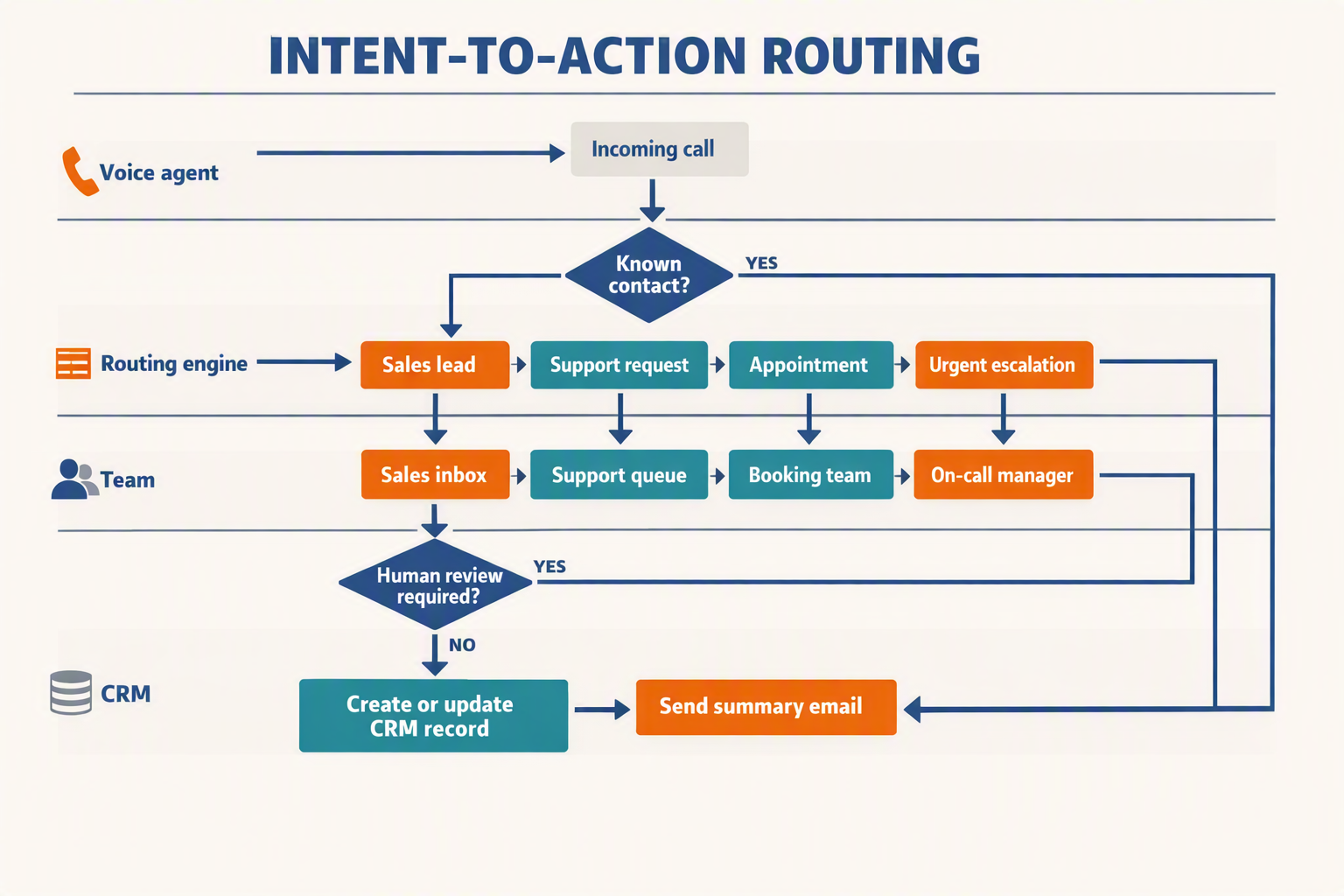
Intent routing, action-item ownership, and CRM logging should operate as one transactional workflow: classify the call, resolve each commitment to an accountable owner, write the structured record to the CRM, and only then send the AI call summary email. The email is a notification layer; the CRM remains the operational source of truth.
1. Convert intent into a routing decision
The intent classifier should return more than a label such as “support.” Use a structured routing object containing:
- Primary intent: billing dispute, cancellation, appointment, sales enquiry, technical support
- Secondary intent: refund request, plan downgrade, product complaint
- Priority and SLA: routine, urgent, safety-critical, or compliance-sensitive
- Destination: named user, CRM queue, department, or escalation group
- Confidence score: plus the transcript evidence supporting the classification
- Required record type: lead, opportunity, case, appointment, or general activity
For example, “I was charged twice and want the second payment reversed” should create a billing case, route it to the payments queue, and flag “refund review” as an action—not merely categorize the conversation as customer support.
Set confidence thresholds by consequence. A low-confidence product enquiry might enter a general sales queue, while uncertain cancellation, fraud, or medical language should trigger human review before automated action.
2. Assign every action to one accountable owner
Each extracted action item needs a machine-readable record:
action: Review duplicate charge
owner_type: team
owner_id: payments_queue
due_at: 2026-08-03T17:00:00+05:30
status: open
evidence: “Please reverse the second charge”
confidence: 0.94
Apply ownership rules in a fixed order:
- Honour an explicitly named owner when that identity matches an authorised CRM user.
- Otherwise, map the intent to a team queue.
- Apply territory, account-owner, language, workload, and availability rules.
- Assign a fallback queue if no individual qualifies.
- Escalate unowned tasks before the SLA expires.
Distinguish employee-owned tasks from customer commitments. “Customer will email the invoice tomorrow” should not become an internal task unless someone must monitor or follow up. This precision matters because Salesforce reported in its 2024 State of Sales that representatives spend only 30% of their working week selling; replacing manual administration with inaccurate tasks simply creates a different form of overhead.
3. Commit to the CRM before distributing email
The voice agent email integration should write related objects in a single transaction wherever possible:
- Call activity with timestamps and participant identifiers
- Lead, contact, account, case, or opportunity association
- Primary and secondary intent
- Tasks with owners, deadlines, and statuses
- Recording and transcript references
- Model version, confidence values, and review status
Use a unique call ID as an idempotency key so retries do not create duplicate cases or tasks. If the CRM write fails, queue the operation and mark the call transcription summary as “logging pending”; do not send an email claiming that tasks were assigned successfully.
Before delivery, validate that the customer matches the correct CRM record, deadlines include a timezone, owners are active, and email recipients are authorised to view the content. The final message should link to the CRM record and show routing status, ownership, and due dates clearly.
For multichannel workflows, CallMissed can connect AI voice interactions—including WhatsApp Business calls—with downstream follow-up automation. Regardless of platform, the governing rule is simple: one classified intent, one accountable owner per action, and one auditable CRM record per call.
How do you check transcription accuracy, summary completeness, and unsupported AI claims?
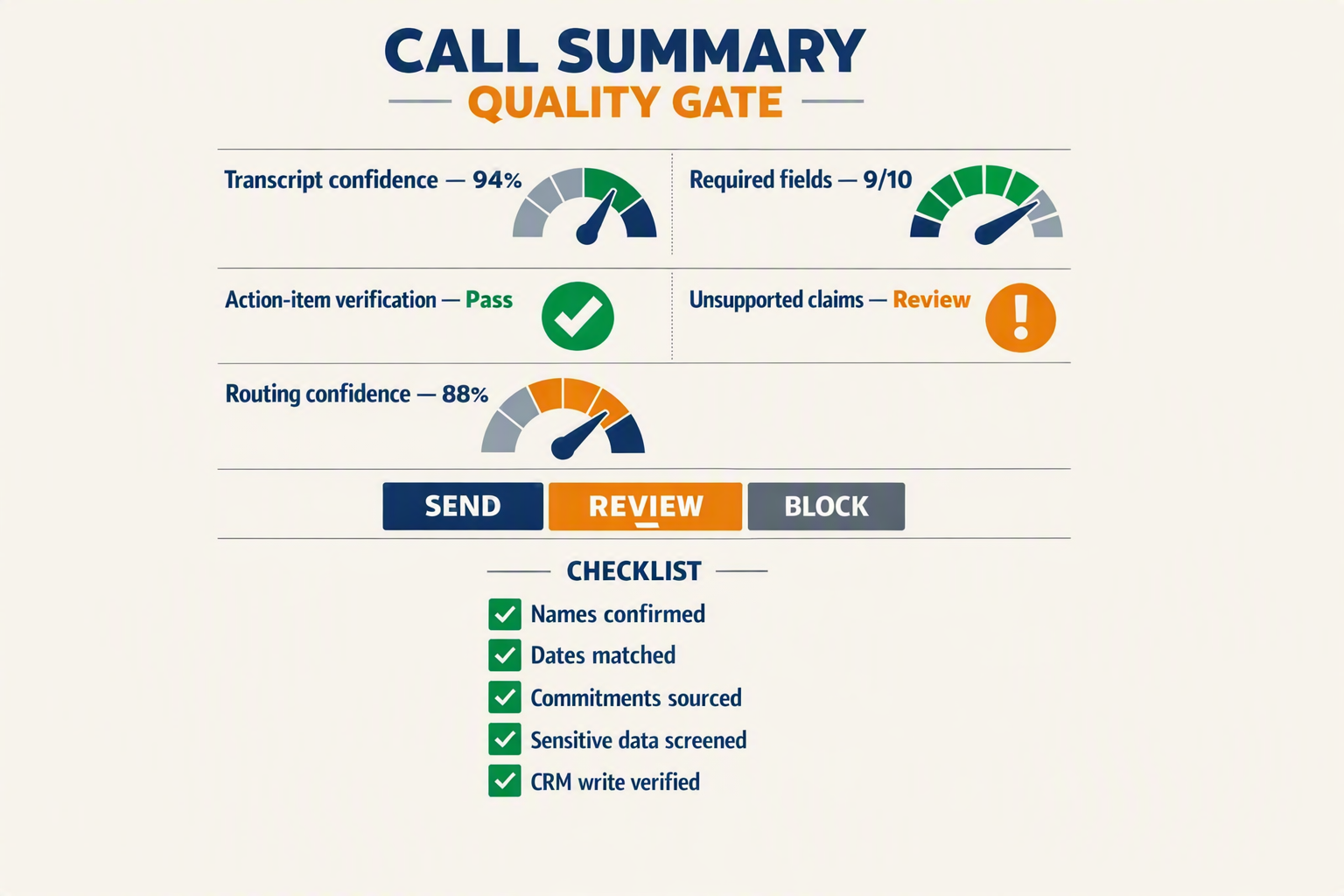
Check an AI call summary email at three separate layers: whether the transcript matches the audio, whether the summary contains every required fact, and whether each generated claim is supported by the conversation or approved business data. Do not treat a fluent summary as proof of accuracy; block automatic emailing and CRM updates whenever confidence or evidence falls below defined thresholds.
1. Measure transcription accuracy against the recording
Review a representative sample of calls manually, including different languages, accents, call lengths, background-noise levels, and telephony conditions. Track word error rate (WER) using substitutions, deletions, and insertions:
WER = (substitutions + deletions + insertions) ÷ reference words
WER is useful for benchmarking, but operational accuracy matters more. A transcript can score well overall while getting a critical number wrong. Add field-level checks for:
- Customer names, phone numbers, and email addresses
- Prices, quantities, account numbers, and dates
- Negation, such as “do” versus “do not”
- Product names and technical terminology
- Commitments, consent statements, and cancellation requests
- Speaker attribution in multi-party calls
Use deterministic validation where possible. Dates must be valid, email addresses must match an expected pattern, and quoted prices should be checked against the product catalogue. For multilingual calls, test each supported language separately rather than relying on one blended accuracy score.
2. Score summary completeness against the schema
A call transcription summary is complete only when it fills the fields required for that call type—or explicitly marks them as unavailable. Compare the generated output with the workflow schema and calculate:
Completeness rate = correctly populated required fields ÷ applicable required fields
A practical QA sequence is:
- Identify the call’s intent and select the corresponding schema.
- Check whether every decision, objection, commitment, and next step appears.
- Verify that each action item has an owner, deadline, and status when stated.
- Distinguish “not mentioned” from “unknown” and “not applicable.”
- Confirm that urgent signals have not been compressed into neutral language.
Set stricter gates for high-impact fields. For example, a missing sentiment label may permit delivery, while a missing cancellation request, payment dispute, safety concern, or promised callback should require human review.
3. Detect unsupported AI claims
Every factual statement should be traceable to one of three approved sources: the call transcript, verified CRM data, or an authorised knowledge base. Require the summarisation model to return evidence references—such as transcript timestamps or utterance IDs—alongside extracted claims.
Flag the output when the model:
- Invents a deadline that the caller never gave
- Converts a question into a confirmed decision
- Attributes an action to the wrong participant
- Infers sentiment without sufficient evidence
- Adds policies, prices, or guarantees absent from approved sources
- Resolves ambiguous speech without marking uncertainty
The safest rule is: if evidence cannot be retrieved, the claim cannot be emailed as fact. Rewrite uncertain content as “The customer may be asking about…” or route it for review.
4. Apply confidence-based release gates
For a production voice agent email integration, combine transcription confidence, schema completeness, evidence coverage, and business risk into one release decision:
- Auto-send: all critical fields validated and claims evidence-backed
- Send with warning: non-critical uncertainty remains
- Human review: critical ambiguity, contradiction, or low confidence
- Do not send: missing recording, failed transcription, or unsupported high-risk claim
Store the original transcript, generated version, corrected version, reviewer, model identifier, and timestamp in an audit trail. For workflows built with platforms such as CallMissed, these checks can sit between transcription and downstream email or CRM automation, ensuring that speed never bypasses evidence. This governance becomes particularly timely because the European Commission states that most EU AI Act provisions apply from 2 August 2026.
How can teams protect privacy when recording, transcribing, emailing, and storing calls?

Teams should protect call data with informed notice, purpose limitation, data minimisation, encryption, role-based access, and automatic deletion across the entire pipeline. An AI call summary email should expose only what each recipient needs—not become a second, uncontrolled copy of the recording or transcript.
Establish consent and a lawful purpose
Before recording begins, tell callers that the conversation may be recorded, transcribed, and summarised by AI. The notice should identify the purpose—such as service quality, order fulfilment, or appointment management—and offer an alternative where local law requires it.
Legal requirements vary by jurisdiction. Teams should map workflows against applicable rules, including the EU General Data Protection Regulation (GDPR), India’s Digital Personal Data Protection Act, 2023, sector-specific obligations, and local call-recording laws. The European Commission states that most provisions of the EU AI Act apply from 2 August 2026, making documented transparency and governance especially important for European deployments.
Record the notice version, timestamp, caller response, processing purpose, and applicable retention policy. Consent should not be inferred merely because the caller continued speaking where explicit consent is required.
Minimise and secure data at every stage
Apply different controls to the recording, transcript, summary, email, and CRM record:
- Recording: Capture only necessary audio and pause recording during payment-card entry or other sensitive exchanges.
- Transcription: Redact passwords, card numbers, government identifiers, health information, and authentication answers before downstream processing.
- Summarisation: Instruct the model to exclude irrelevant personal details and distinguish customer statements from verified facts.
- Email delivery: Send a secure link rather than attaching the full recording or transcript. Use recipient allowlists, link expiry, multifactor authentication, and forwarding restrictions where available.
- Storage: Encrypt data in transit and at rest, separate production access by role, and maintain tamper-evident access and deletion logs.
These controls have measurable business relevance: IBM’s Cost of a Data Breach Report 2024 placed the global average breach cost at US$4.88 million.
Restrict email and CRM exposure
A privacy-preserving call transcription summary should generally contain intent, decisions, action owners, deadlines, and a record identifier. It should not include complete identity documents, payment credentials, medical details, or the entire verbatim conversation unless the workflow genuinely requires them.
Configure routing using least privilege:
- Sales receives qualified interest and agreed follow-ups.
- Support receives the issue, troubleshooting completed, and escalation status.
- Finance receives transaction references, not complete call histories.
- Supervisors receive sensitive cases only when an escalation rule is triggered.
- Customers receive externally approved wording rather than internal sentiment, risk, or fraud labels.
CRM permissions should independently govern who can view the summary, transcript, recording, and model-generated classifications. A user authorised to see an action item may not need access to the underlying audio.
Add privacy checks to the automation
Before any voice agent email integration sends a message, run automated checks for sensitive-data patterns, invalid recipients, missing consent, and prohibited attachments. High-risk summaries should be quarantined for human review.
Set retention periods by purpose rather than keeping everything indefinitely. Test deletion across primary storage, CRM exports, email archives, backups, and model-processing logs. For workflows built on platforms such as CallMissed—including AI voice agents and WhatsApp Business calls—teams should configure downstream access, routing, and retention according to their own legal and operational requirements. Finally, document subprocessors, data locations, incident procedures, and model usage so privacy controls remain auditable rather than merely promised.
What do experienced operations, sales, support, and compliance leaders expect—and what are the implications?

Experienced leaders expect an AI call summary email to function as a dependable operational handoff, not merely a shorter transcript. Their shared requirement is simple: every extracted fact must support a decision, workflow, or auditable record—and uncertain information must be clearly identified rather than presented as fact.
Operations leaders expect predictable execution
Operations teams judge summaries by whether they reduce process variance across agents, locations, languages, and call types. They expect consistent schemas, measurable delivery times, and visible failure states.
A production workflow should therefore provide:
- Standard field definitions across channels and teams
- Delivery and CRM-write status, including retries and final failures
- Queue-level metrics for extraction accuracy, latency, and human corrections
- Version tracking for prompts, models, routing rules, and schemas
- Language identification and normalization without erasing the caller’s original meaning
The implication is that a voice agent email integration needs observability comparable to any other business-critical integration. Operations leaders should be able to determine whether an email was generated, delivered, opened for review, corrected, or blocked.
Sales leaders expect momentum and accountability
Sales leaders want the summary to advance the opportunity. They care about qualification evidence, objections, buying authority, competitor mentions, commercial terms, and the next committed interaction.
Every sales summary should answer:
- What does the prospect need?
- How urgent and valuable is the opportunity?
- What did each party commit to doing?
- Who owns the next step, and by when?
- Which CRM fields should change?
Automatic updates should distinguish a customer statement from an AI inference. For example, “Customer confirmed a ₹5 lakh budget” is evidence; “high purchase intent” is a classification that should carry a confidence score. This distinction helps reclaim administrative time without corrupting pipeline data—an important objective when Salesforce’s 2024 State of Sales found that representatives spend only 30% of their working week selling.
Support leaders expect faster, context-rich resolution
Support leaders need a call transcription summary that preserves diagnostic detail while making escalation easy. Expected fields include the affected product, symptoms, troubleshooting already attempted, error messages, business impact, promised response time, and required specialist team.
The operational implication is intent-aware routing with severity controls. A billing question may enter a standard queue, while an outage affecting production should bypass normal routing. Sentiment can provide supporting context, but it should not independently determine priority; calm callers can still report critical failures.
Compliance leaders expect evidence and restraint
Compliance leaders ask whether the organisation can explain what was captured, why it was processed, who received it, and how long it remained accessible. They expect:
- Consent and disclosure records
- Role-based access to recordings, transcripts, and emails
- Redaction of payment, identity, health, or authentication data
- Configurable retention and deletion
- Immutable audit logs for generation, edits, access, and CRM writes
- Human approval for legally or financially consequential outputs
These controls have direct financial relevance: IBM’s Cost of a Data Breach Report 2024 placed the global average breach cost at US$4.88 million. European deployments also need governance readiness because the European Commission says most EU AI Act provisions become applicable on 2 August 2026.
The practical implication: define an acceptance contract
Before deployment, the four functions should jointly approve a summary contract covering required fields, confidence thresholds, prohibited automation, routing ownership, review rules, retention, and rollback procedures. Success should be measured not by emails sent, but by fewer missed commitments, lower correction rates, faster handoffs, and complete auditability.
What does this mean for your team, and how can a CallMissed workflow support implementation? (TABLE)
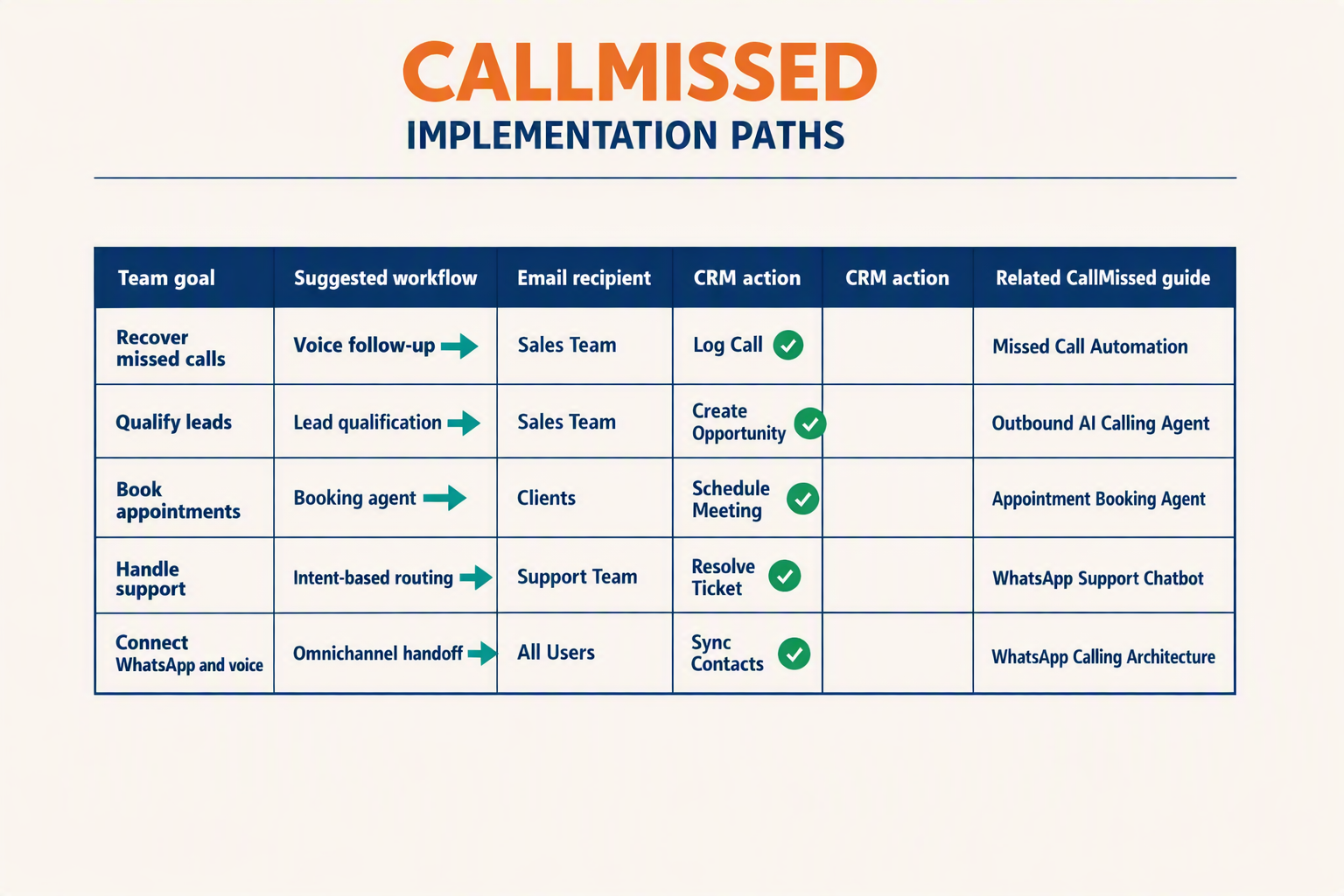
Shortlist CallMissed when your team needs a voice-agent platform that can capture and transcribe calls, apply knowledge-base context, support omnichannel follow-up, and pass structured results into controlled email and CRM workflows. It is most appropriate when your organization defines the data schema, routing rules, validation thresholds, access controls, and human-review gates. An AI call summary email should not be treated as an automatically forwarded transcript.
| Business need | CallMissed workflow role | Required validation | Human control |
|---|---|---|---|
| Transcription and summary | Capture the voice-agent interaction, produce a transcript, and use available context to create a structured call transcription summary | Check speaker details, intent, outcome, dates, amounts, commitments, and required fields against the source call | Review low-confidence or high-impact summaries before distribution |
| Action items | Extract proposed tasks, owners, deadlines, and dispositions | Confirm that each action is supported by the transcript and uses allowed values | Approve commitments, cancellations, refunds, legal matters, and other sensitive actions |
| Email delivery | Pass an approved AI call summary email into an internal or customer-facing workflow | Test recipient rules, templates, minimum-necessary data, delivery status, and retry behavior | Require approval for customer-facing or sensitive messages |
| CRM logging | Map structured call data to CRM records, activities, and tasks | Validate field mappings, customer matching, required fields, and a stable call ID used as an idempotency key | Resolve uncertain matches and block write-back when required data is missing |
| Privacy and records | Associate recordings, transcripts, summaries, consent status, and context with the workflow | Verify recording notices, lawful handling, permissions, retention, deletion, and incident procedures | Allow privacy or compliance owners to restrict access, correct records, and pause automation |
| Multilingual calls | Process calls through the configured voice-agent and transcription workflow | Test each intended language, accent, code-switching pattern, terminology set, and audio condition | Route unsupported or low-confidence cases to a qualified person |
| Escalation | Use detected intent and context to direct calls or follow-up to the right queue | Measure routing accuracy and test fallbacks for ambiguous or urgent cases | Escalate legal, safety, cancellation, complaint, and other high-impact cases |
An AI call summary email works best as one controlled output within a broader workflow. It should have a defined source, purpose, recipient, and review policy.
Establish ownership from capture to follow-up
Assign an accountable owner to every stage. Test the workflow against representative call types, customer segments, languages, accents, intents, and audio conditions before setting service-level objectives.
| Workflow stage | Team owner | Required control | Success measure |
|---|---|---|---|
| Capture and transcribe | Contact-centre operations | Recording notice, consent status, language rules, and unique call ID | Eligible calls captured and attributed correctly |
| Create structured output | Sales or support operations | Required fields, controlled values, source evidence, and confidence thresholds | Field completeness and factual-error rates |
| Classify and route | Process owner | Intent rules, fallback queue, and escalation criteria | Correct-routing and escalation rates |
| Send email and log CRM activity | CRM administrator | Recipient rules, templates, field mappings, and idempotency controls | Delivery, write-back, and duplicate-record rates |
| Review sensitive cases | Quality-assurance lead | Human-review policy, sampling plan, and error taxonomy | Critical-error rate and correction time |
| Govern records | Privacy or compliance owner | Access, retention, deletion, correction, and incident-response procedures | Requests completed within policy |
The owner of each stage should know when an AI call summary email can proceed and when it must be held. Do not rely on one universal accuracy score. Set separate baselines for transcription, factual summary content, action-item extraction, routing, email delivery, and CRM write-back.
Roll out through controlled gates
- Define the output contract. Specify required fields such as customer identity, intent, outcome, action owner, deadline, consent status, source call ID, and CRM record ID. Use the contract to keep each AI call summary email consistent.
- Configure routing and escalation. Direct opportunities, unresolved issues, booking requests, cancellations, complaints, and urgent matters to the appropriate queue. Provide a fallback for uncertain classifications.
- Apply validation thresholds. Hold uncertain names, dates, amounts, consent statements, deadlines, and customer commitments for review. Block downstream actions when required fields are absent.
- Prevent duplicate actions. Use a stable call ID as an idempotency key. This helps prevent retries from creating multiple emails, tasks, or CRM activities.
- Separate launch phases. Start with an internal AI call summary email. Enable CRM logging, agent tasks, internal email, and customer-facing follow-up separately after testing each control.
- Monitor and correct. Compare sampled summaries with the source transcript or recording. Categorize errors, then update prompts, knowledge sources, routing rules, or review thresholds.
A customer-facing AI call summary email generally needs stricter controls than an internal summary. Approval should be required when content is sensitive or could create a commitment.
Make governance a launch requirement
Treat recordings, transcripts, summaries, emails, and CRM entries as governed records. Before production, document who can access each record type, how long it is retained, and how corrections or deletion requests are handled. Name the person who can suspend the automation.
Governance should cover the full lifecycle of an AI call summary email, not only its generation. Recipient selection, access, retention, correction, and downstream CRM use all need defined controls.
Frequently asked questions about AI-generated call summaries sent by email
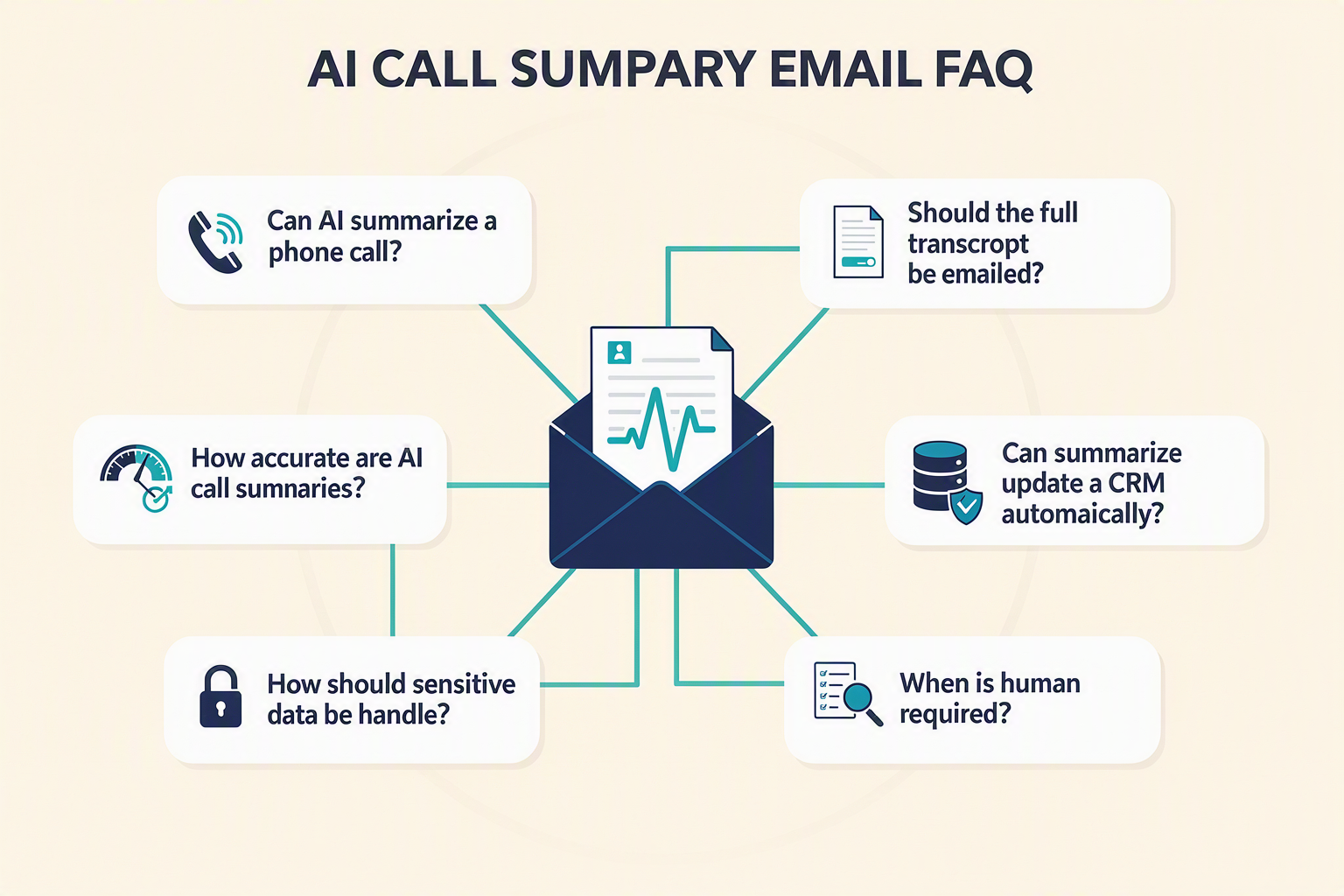
How do I create an AI call summary email automatically?
What fields should a call transcription summary include?
How accurate should an AI call summary email be before it is sent?
How can AI call summaries route requests and update a CRM?
Are emailed AI call summaries secure and compliant with privacy laws?
How does a voice agent email integration work with WhatsApp Business calls?
Conclusion
A dependable AI call summary email should turn each conversation into structured, actionable data—not merely shorten a transcript. The strongest 2026 workflows combine accurate extraction, intelligent routing, CRM synchronization, privacy controls, and quality checks so teams can follow up quickly without sacrificing trust.
- Structure the record: Capture caller identity, intent, sentiment, decisions, objections, consent indicators, and links to the recording, transcript, and CRM entry.
- Make ownership explicit: Every call transcription summary should assign action items to named owners, include deadlines, and flag urgent or low-confidence details for human review.
- Automate with safeguards: Route calls by intent, validate critical facts such as prices and appointment times, restrict access, and apply appropriate retention policies. IBM reported in 2024 that the global average data-breach cost reached US$4.88 million.
- Measure operational value: Monitor transcription accuracy, field completeness, routing errors, CRM write failures, and whether promised follow-ups happen on time.
Looking ahead, watch for tighter governance as most provisions of the EU AI Act become applicable on 2 August 2026, alongside greater use of confidence-aware automation and multilingual voice workflows.
Teams evaluating a voice agent email integration can explore CallMissed, which connects AI voice agents—including WhatsApp Business calls—with multilingual transcription, omnichannel workflows, and follow-up automation. Is your current post-call process ready to act automatically while keeping humans in control?
Related Reading
Related Posts
Ready to automate customer conversations?
Launch AI voice agents and WhatsApp bots with CallMissed — one API, 22+ Indian languages.