

Claude Opus 5 vs GPT-5.6 Luna: API Cost, Latency and Support


Use this Claude Opus 5 vs GPT-5.6 Luna comparison to assess verified API costs, test latency and plan voice or support automation.
Claude Opus 5 vs GPT-5.6 Luna: API Cost, Latency and Support
What if the cheaper model—not the presumed flagship—is the safer production choice? Claude Opus 5 vs GPT-5.6 Luna is an unusually asymmetric comparison as of July 23, 2026: OpenAI has published Luna’s API pricing and positioning, while Anthropic has not provided verified commercial pricing, latency, throughput, availability, or benchmark data for a model named Claude Opus 5.
That evidence gap matters because customer-support systems cannot be selected on model reputation alone. They must deliver predictable cost per resolved conversation, low time to first token, sufficient concurrent-request capacity, reliable tool calling, and graceful recovery from rate limits or provider outages. For voice agents, even a capable language model can produce a poor experience when streaming delays accumulate across speech recognition, inference, text-to-speech, telephony, and network transport.
OpenAI’s model documentation listed GPT-5.6 Luna at $1 per million input tokens, $0.10 per million cached-input tokens, and $6 per million output tokens as of July 23, 2026. OpenAI also described Luna as the “fastest and lowest-cost model in the GPT-5.6 family,” but that vendor positioning is not a substitute for workload-specific latency tests.
The published prices already enable realistic budgeting:
- A support interaction using 2,000 input tokens and 500 output tokens costs approximately $0.005 with GPT-5.6 Luna at standard text-token rates.
- 100,000 interactions of that size would cost approximately $500 in model-token charges, excluding speech, messaging, storage, search, tools, and infrastructure.
- A batch containing 1 million input tokens and 200,000 output tokens costs $2.20 before any cached-input savings.
- Claude Opus 5 equivalents cannot be calculated responsibly until Anthropic publishes or confirms its API rates.
This comparison will therefore separate verified facts, vendor claims, derived calculations, and unknowns rather than filling missing data with speculative benchmarks. It will provide a deployment decision matrix covering API cost, latency testing, throughput, privacy, regional availability, voice-agent suitability, support automation, fallback routing, and production architecture. Platforms such as CallMissed, an OpenAI-compatible multi-model gateway, reflect this shift toward same-tier fallback routing and unified access across LLM, speech-to-text, text-to-speech, image, and search models.
The goal is not to declare a universal winner. It is to determine which model can be justified for each workload today—and what evidence teams must collect before trusting either one with live customer conversations.
Which model should you deploy? Claude Opus 5 vs GPT-5.6 Luna decision matrix (TABLE)
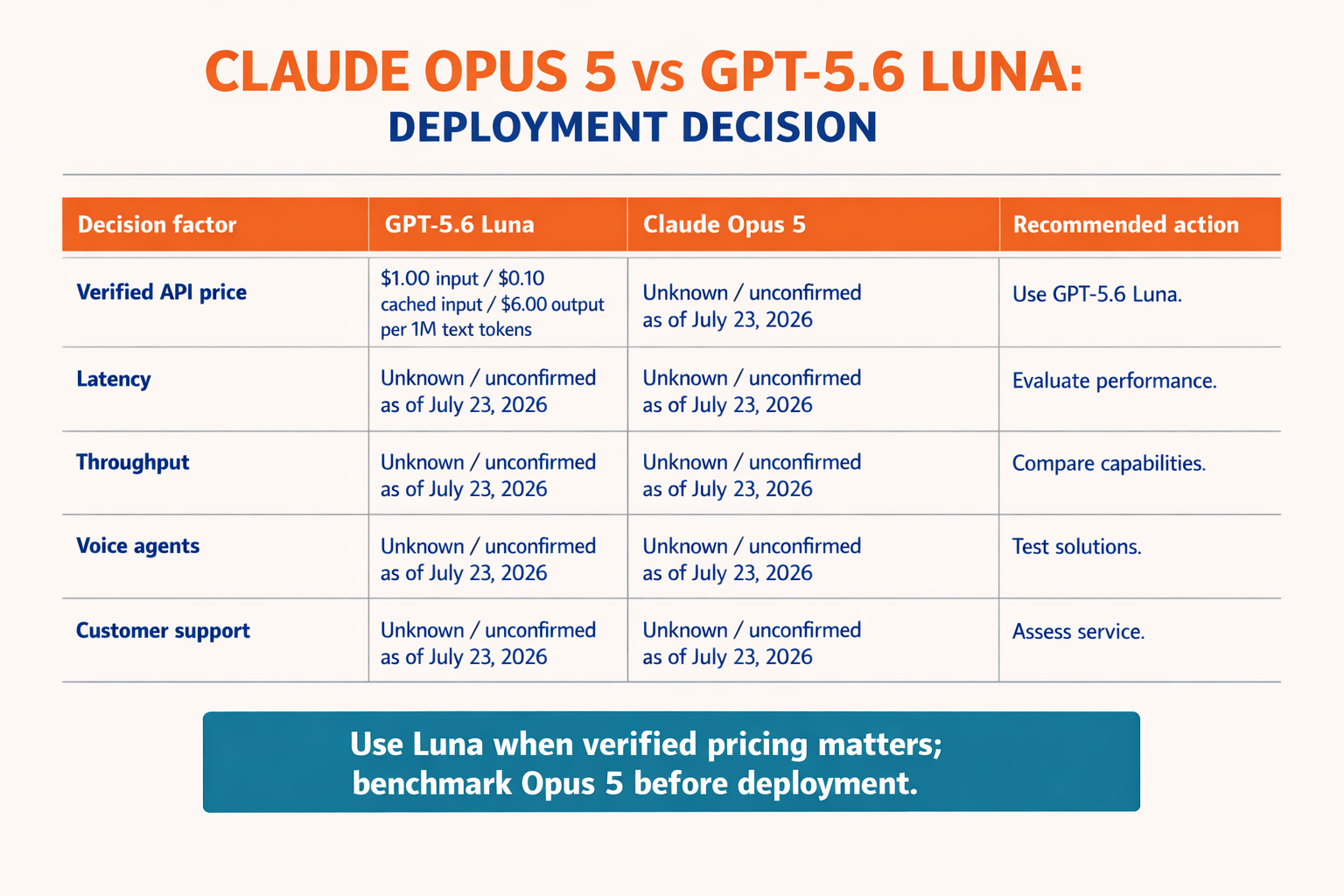
Deploy GPT-5.6 Luna for cost-sensitive production workloads that require a priceable API today; keep Claude Opus 5 behind a controlled evaluation gate until Anthropic publishes verifiable API, availability, latency, and throughput details. This is a procurement decision based on evidence completeness—not proof that GPT-5.6 Luna is universally more capable.
Deployment decision matrix
Evidence labels: Verified means documented by the provider; vendor claim means provider positioning without independent workload validation; unknown means no confirmed data was available as of July 23, 2026.
| Decision area | GPT-5.6 Luna evidence | Claude Opus 5 evidence | Deployment decision |
|---|---|---|---|
| API cost | Verified: $1 per million input tokens, $0.10 per million cached-input tokens, and $6 per million output tokens, according to OpenAI’s API documentation on July 23, 2026. | Unknown: No verified commercial API price. | Choose Luna when budgets, unit economics, or customer quotes require predictable token costs. |
| Latency | Vendor claim: OpenAI calls Luna the “fastest and lowest-cost model in the GPT-5.6 family,” but publishes no workload-specific time-to-first-token figure in the supplied documentation. | Unknown: No verified time-to-first-token or end-to-end latency result. | Benchmark Luna before production; do not infer absolute speed from family positioning. |
| Throughput and scaling | No verified requests-per-minute, concurrent-session, or sustained tokens-per-second figure is provided here. | Unknown: No confirmed rate limits or throughput measurements. | Load-test both under expected concurrency; Luna is easier to shortlist, not automatically proven at scale. |
| Voice agents | Streamable model output may support conversational orchestration, but speech-to-text, text-to-speech, telephony, and network delays still determine end-to-end responsiveness. | Unknown: Voice-agent latency and streaming behavior are unconfirmed. | Use Luna only after measuring interruption handling, first-audio latency, and p95 turn duration. |
| Customer-support automation | Published pricing supports calculable cost per conversation; tool-call accuracy and resolution quality still require testing. | Unknown: No verified API economics or support-automation benchmarks. | Prefer Luna for a budgeted pilot; admit either model to production only after task-level evaluation. |
| Availability, privacy, and fallback | OpenAI Help states that API access follows OpenAI’s supported countries and territories; contractual privacy controls must be checked for the deployment account. | Unknown: Availability and commercial data-processing terms for Opus 5 are unconfirmed. | Confirm region, retention, data-processing, and failover requirements before handling customer data. |
Cost gate for a production shortlist
At Luna’s documented standard rates, a larger support turn using 4,000 input tokens and 800 output tokens costs $0.0088: $0.004 for input plus $0.0048 for output. Repeating that workload one million times would produce $8,800 in text-token charges, excluding cached-input discounts, speech services, retrieval, messaging, storage, and observability.
Claude Opus 5 cannot pass the same financial gate until a verified price exists. Teams should not substitute Claude Opus 4.8 pricing or another Anthropic model’s terms, because that would create an unsupported comparison.
Recommended deployment pattern
Use a staged architecture rather than binding customer traffic permanently to either model:
- Route low-risk support requests to GPT-5.6 Luna with strict token limits and tool permissions.
- Record p50, p95, and p99 latency, tokens per second, successful tool calls, escalation rate, and cost per resolved case.
- Evaluate Claude Opus 5 offline only after model access and commercial terms are confirmed.
- Maintain a same-tier fallback for timeouts, rate limits, and provider incidents.
Platforms such as CallMissed, an OpenAI-compatible multi-model gateway, can support this architecture through unified model access and automatic same-tier fallbacks while also connecting voice, speech, search, and customer-engagement workflows.
What is officially confirmed about GPT-5.6 Luna and Claude Opus 5 as of July 23, 2026? (TABLE)
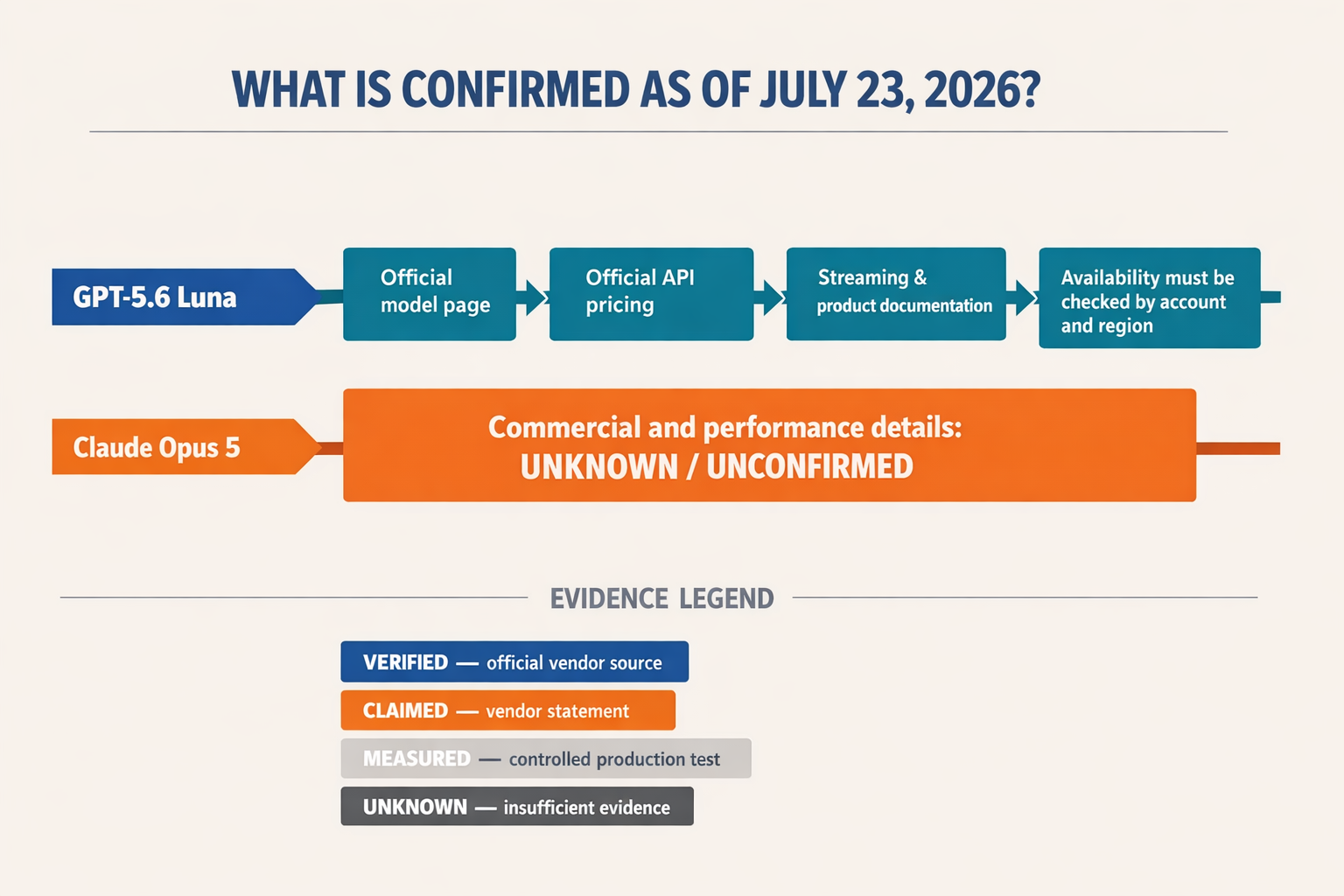
As of July 23, 2026, OpenAI officially documents GPT-5.6 Luna as an API model for cost-sensitive, high-volume workloads. Its token pricing and model limits are published. Anthropic’s official model documentation does not list a model named Claude Opus 5, so claims about its API, price, latency, limits, or performance remain unconfirmed.
Officially confirmed facts versus unresolved claims
| Deployment factor | GPT-5.6 Luna | Claude Opus 5 | Evidence status |
|---|---|---|---|
| Model identity | Official API identifier: gpt-5.6-luna | No official Anthropic model page or API identifier | Confirmed / unannounced |
| Standard API price | $1.00 per 1M input tokens; $6.00 per 1M output tokens | No official price | Confirmed / unknown |
| Cached-input price | $0.10 per 1M cached input tokens, according to OpenAI’s pricing documentation | No official cached-input price | Confirmed / unknown |
| Context window | 1,050,000 tokens | No official context-window specification | Confirmed / unknown |
| Maximum output | 128,000 tokens | No official maximum-output specification | Confirmed / unknown |
| Model positioning | Positioned by OpenAI for cost-sensitive, high-volume use | No official positioning for a model with this name | Confirmed / unknown |
| Latency | No universal official time-to-first-token, tokens-per-second, or tail-latency figure | No official latency data | Unknown for both |
| Throughput and rate limits | No single universal limit applicable to every account tier and deployment | No official limits for this model name | Deployment-specific / unknown |
| Support or voice benchmarks | No official end-to-end voice-agent or customer-support resolution benchmark | No official benchmark | Unknown for both |
OpenAI’s official model documentation lists GPT-5.6 Luna’s 1,050,000-token context window and 128,000-token maximum output. OpenAI’s API pricing documentation lists standard rates of $1.00 per million input tokens and $6.00 per million output tokens, with cached input separately priced at $0.10 per million tokens.
These prices provide a verifiable budgeting basis. Before other charges, one million uncached input tokens plus one million output tokens would cost $7.00:
- Input: 1 × $1.00 = $1.00
- Output: 1 × $6.00 = $6.00
- Total: $7.00
OpenAI’s high-volume positioning is not a latency guarantee. It does not establish a production service-level objective for time to first token, generation speed, P95 or P99 latency, concurrency, or end-to-end call response time.
Anthropic’s official Claude model documentation does not identify Claude Opus 5 as an announced or commercially available model as of July 23, 2026. Consequently, there is no official basis for assigning it an API price, context window, output limit, latency result, benchmark score, or launch region.
What “unknown” means for deployment
An unknown value should not be interpreted as zero, unavailable, or poor. It means that official evidence is insufficient to make a defensible production estimate.
For Claude Opus 5, teams would need Anthropic to confirm:
- The official model name and API identifier
- General API availability and supported regions
- Standard, cached-input, and batch pricing
- Context-window and maximum-output limits
- Streaming, tool-use, and structured-output support
- Rate limits and data-handling terms
- Latency, throughput, voice-agent, and support-resolution results
For GPT-5.6 Luna, official prices and token limits support initial capacity and cost planning. Operational performance still requires testing because latency and throughput can vary with prompt size, output length, tools, region, account tier, traffic, and concurrency.
Practical evidence standard
Before using either model for live calls or support tickets, test the exact API model and configuration with the same replay set. Record:
- P50, P95, and P99 time to first token
- Output tokens per second
- End-to-end response latency
- Successful tool-call rate
- Rate-limit, timeout, and retry frequency
- Cost per correctly resolved conversation
As of July 23, 2026, GPT-5.6 Luna is the only model in this comparison with an officially documented API identity, token price, context window, and output limit. That makes evidence-based budgeting possible, but it does not by itself prove lower latency or better customer-support performance.
How much does GPT-5.6 Luna cost for realistic customer-support workloads? (TABLE)
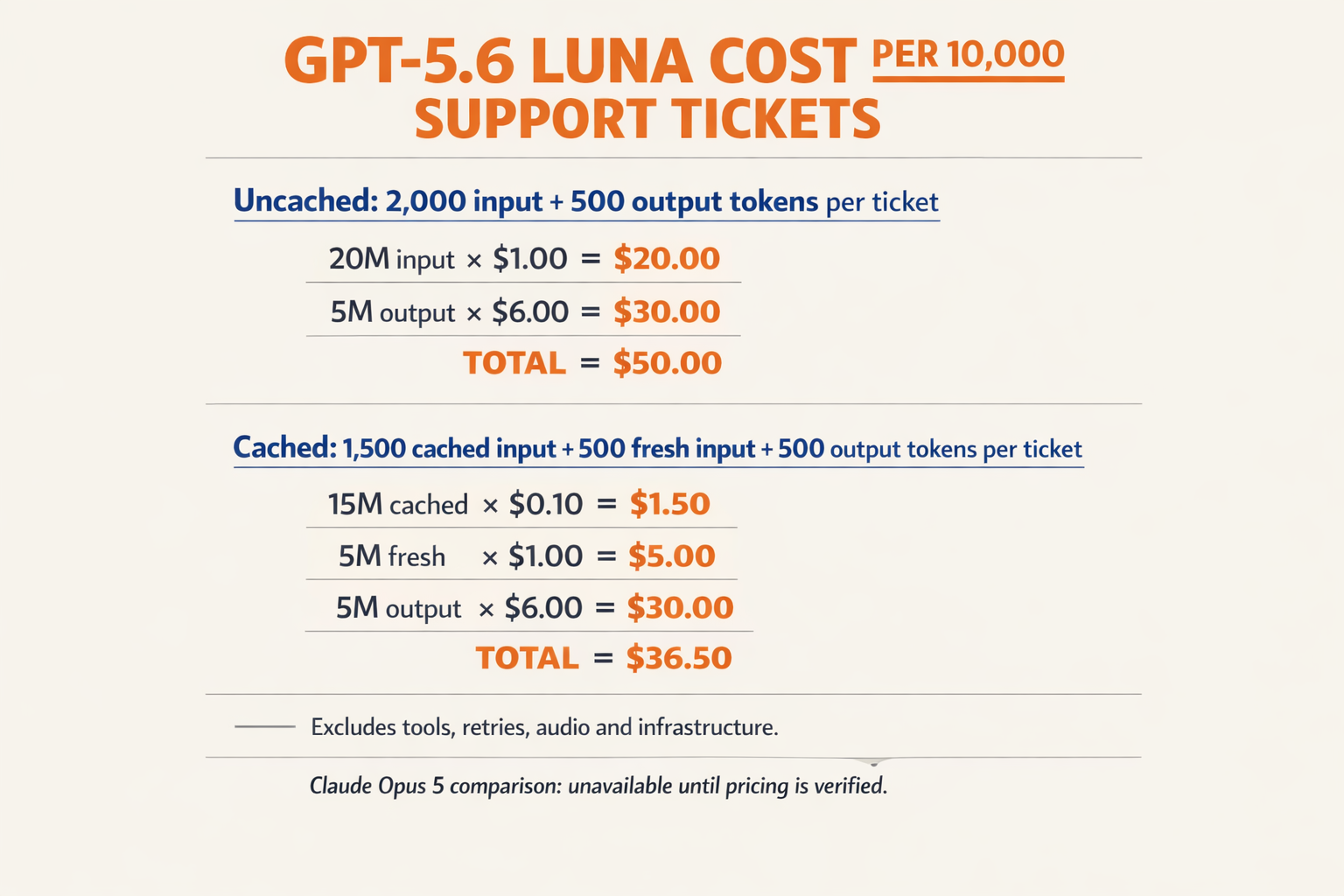
GPT-5.6 Luna’s text-model cost ranges from roughly $0.0019 for a short FAQ answer to $0.021 for a long escalation workflow under the scenarios below. Output generation is the main cost driver because OpenAI charges six times more for output than standard input tokens.
Cost estimates by support workload
OpenAI’s API documentation lists GPT-5.6 Luna at $1 per million input tokens, $0.10 per million cached-input tokens, and $6 per million output tokens as of July 23, 2026. The calculations use standard, non-cached text rates and exclude speech, WhatsApp or telephony fees, retrieval, web search, storage, and application infrastructure.
| Customer-support workload | Input / output tokens | Cost per interaction | Cost per 100,000 |
|---|---|---|---|
| FAQ deflection | 1,000 / 150 | $0.0019 | $190 |
| Order-status lookup | 1,500 / 200 | $0.0027 | $270 |
| RAG product-support answer | 4,000 / 400 | $0.0064 | $640 |
| Voice-agent conversation transcript | 6,000 / 900 | $0.0114 | $1,140 |
| Multi-tool troubleshooting workflow | 8,000 / 800 | $0.0128 | $1,280 |
| Long escalation and case summary | 12,000 / 1,500 | $0.0210 | $2,100 |
The formula is:
Cost = (input tokens ÷ 1,000,000 × $1) + (output tokens ÷ 1,000,000 × $6).
These are budgeting scenarios rather than vendor benchmarks. Actual token use depends on conversation length, tool schemas, retrieved documents, system instructions, language, and whether the application repeatedly submits the full conversation history.
How prompt caching changes the bill
Cached input can materially reduce the cost of repeated system prompts, policies, product catalogs, and tool definitions. OpenAI prices GPT-5.6 Luna cached input at 90% below its standard input rate, although output remains $6 per million tokens.
For example, consider the table’s RAG support interaction:
- Standard cost for 4,000 input and 400 output tokens: $0.0064.
- If 60% of input tokens receive cached-input pricing, 1,600 uncached tokens cost $0.0016 and 2,400 cached tokens cost $0.00024.
- Adding the $0.0024 output charge produces a total of $0.00424, a 33.75% reduction from the uncached scenario.
That saving is not guaranteed: production budgets should use measured cache-hit rates rather than assuming every repeated prefix qualifies.
What voice and support teams should budget beyond tokens
For a voice agent, the table’s $0.0114 covers only Luna’s text inference. A complete cost model must also include:
- Speech-to-text and text-to-speech
- Telephony or WhatsApp Business calling
- Retrieval, search, and tool execution
- Conversation storage and observability
- Retries, fallbacks, and human-agent transfers
Platforms such as CallMissed combine an OpenAI-compatible multi-model gateway with speech support across 22 Indian languages and can bridge WhatsApp Business calls to an AI voice agent. That architecture makes it important to track both LLM cost per conversation and the all-in cost per successfully resolved case.
A corresponding Claude Opus 5 table cannot be calculated responsibly because verified Anthropic API pricing was unavailable as of July 23, 2026. Until pricing is published, GPT-5.6 Luna is the model in this comparison with an auditable workload budget—not necessarily the lower-cost model in every future deployment.
How should you test latency, throughput and cost per successful task?
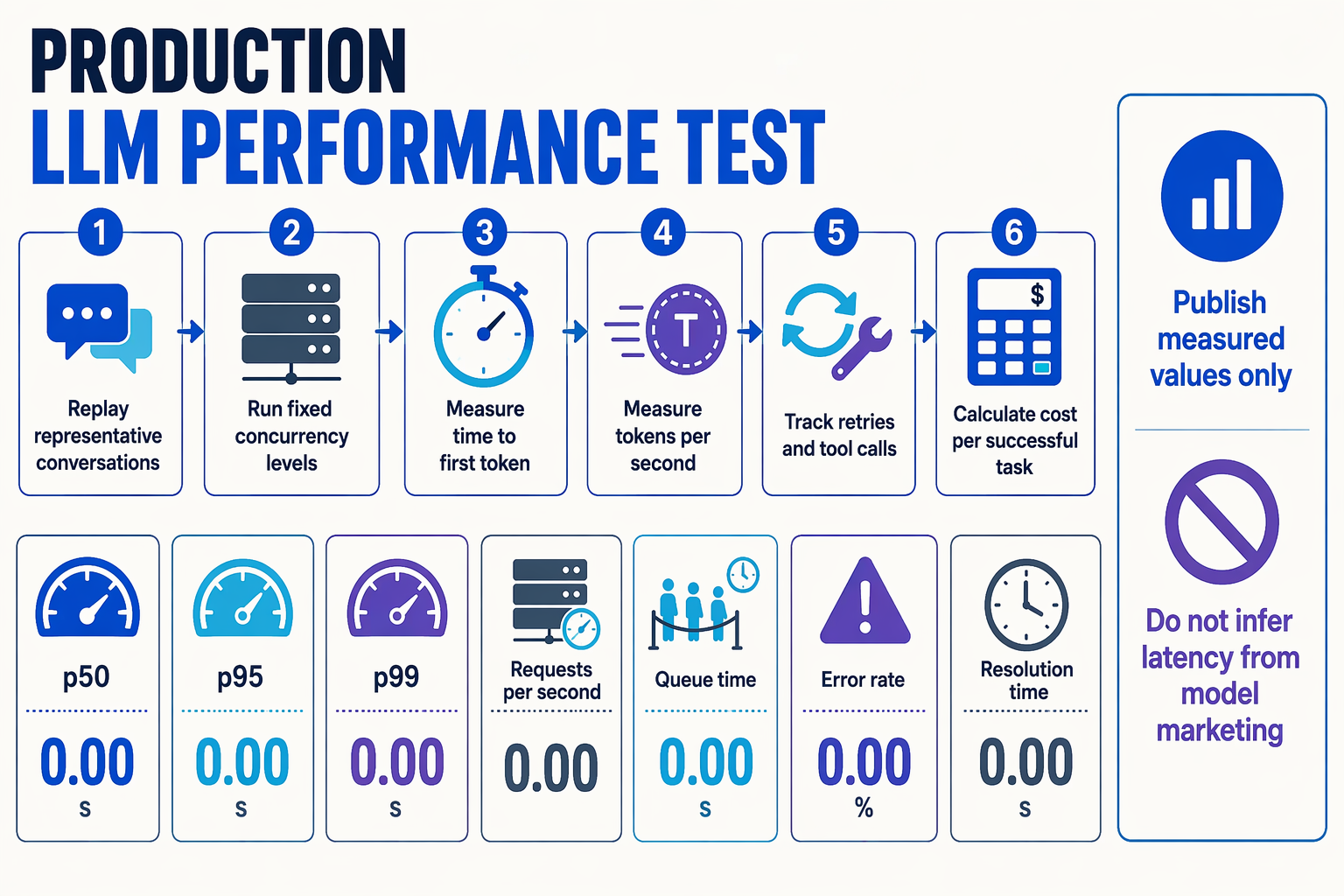
Test both models with the same production-like conversations, concurrency patterns, tool calls and success criteria. Compare p50/p95/p99 latency, sustained throughput and total cost per successful task—not a single response time or nominal token price.
Build a representative evaluation set
Create a fixed, version-controlled set of at least several hundred anonymized tasks drawn from the intended workload. Separate them by complexity because a password reset and a refund dispute impose different inference and tool-use demands.
Include:
- Short FAQ answers grounded in a knowledge base.
- Multi-turn conversations with long histories.
- CRM lookup, order-status and appointment-booking tool calls.
- Escalations requiring accurate summaries and structured handoffs.
- Regional-language and code-switched voice transcripts.
- Adversarial cases involving ambiguity, interruptions or missing data.
For Claude Opus 5, record pricing, API availability and rate limits as unconfirmed until Anthropic supplies deployable documentation. For GPT-5.6 Luna, tag OpenAI’s claim that Luna is the “fastest and lowest-cost model in the GPT-5.6 family” as a vendor claim—not a measured result.
Measure latency across the complete path
Run every scenario multiple times from the same cloud region and connection pool. Report distributions rather than averages:
- Time to first token (TTFT): request submission to the first streamed token.
- Inter-token latency: pauses between streamed chunks.
- Generation throughput: output tokens divided by generation time.
- End-to-end latency: request start to validated final answer or completed tool action.
- Queueing and retry time: delays caused by rate limits, timeouts and failovers.
For voice agents, instrument each stage independently:
Caller audio → speech-to-text → retrieval/tool call → LLM → text-to-speech → telephony playback
Measure time to first audible response, interruption recovery and turn-completion time. A fast LLM cannot compensate for slow transcription, synthesis or network transport. Indian deployments should also test all required regional languages and code-switching; CallMissed, for example, provides speech-to-text and text-to-speech coverage across 22 Indian languages.
Load-test throughput without hiding failures
Increase concurrency gradually until latency or error rates breach the service-level objective. Record requests per minute, tokens per second, active streams, HTTP 429 responses, timeouts and successful tool completions at every load level.
Test three conditions separately:
- Steady traffic at expected production volume.
- Bursts representing campaign replies or outage-driven support spikes.
- Provider degradation with retries and same-tier fallback enabled.
Keep prompt, output cap, temperature, tool schema and retrieval context identical. Randomize model order to reduce time-of-day and warm-cache bias.
Calculate cost per successful task
Use the billing export—not estimated word counts—to calculate:
Cost per successful task = total model, retry, tool and fallback charges ÷ tasks meeting the success rubric
OpenAI’s API documentation priced GPT-5.6 Luna at $1 per million input tokens, $0.10 per million cached-input tokens and $6 per million output tokens on July 23, 2026. Track cached and uncached tokens separately, and include failed generations, retries and unnecessarily verbose outputs.
Define success before testing: factual correctness, required tool completion, policy compliance, response-time SLO and no human correction. Report confidence intervals and segment results by task type. Until equivalent Anthropic billing and performance data are verified, Claude Opus 5 can produce an experimental score, but not a defensible production cost comparison.
Which model is better for a real-time voice agent?
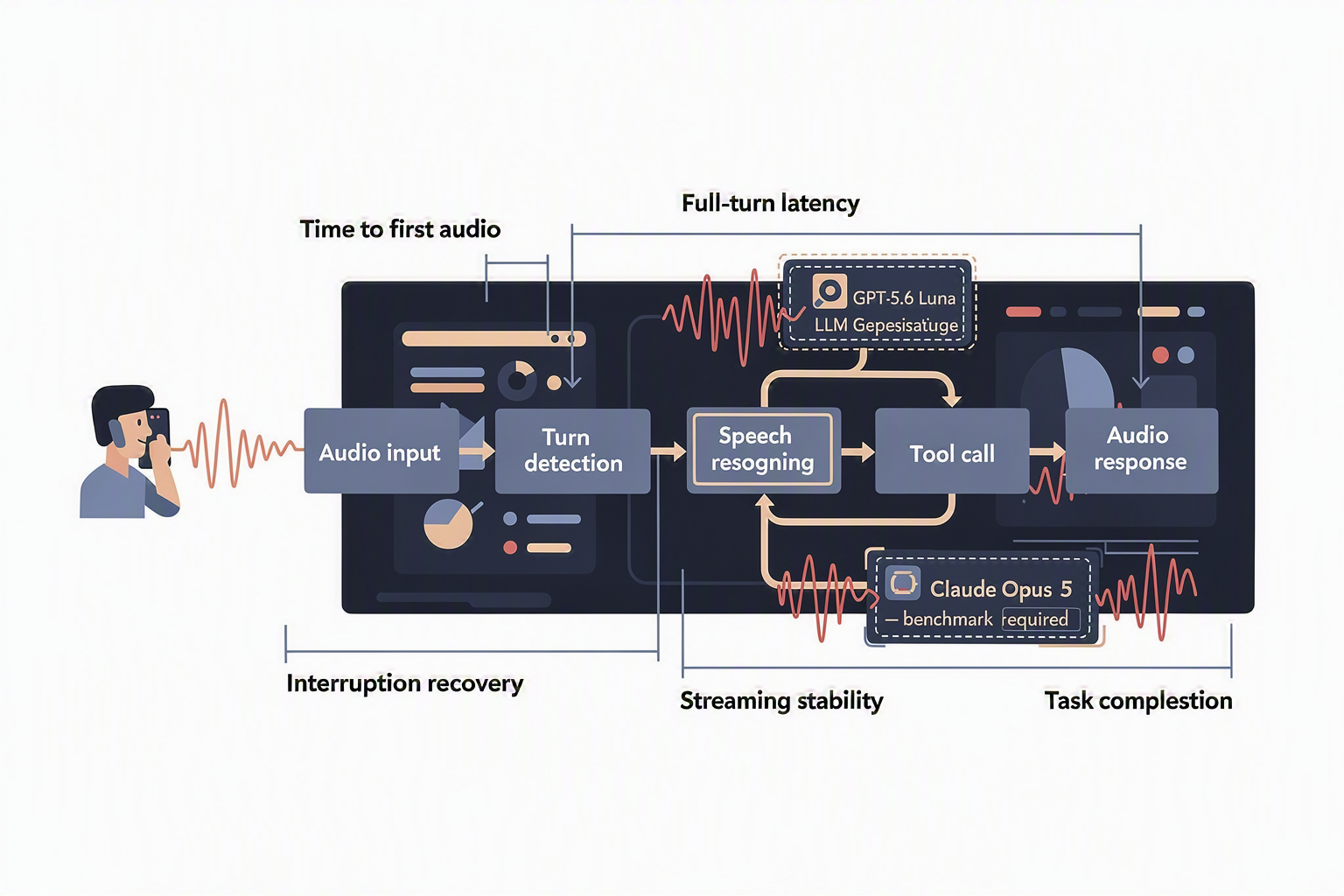
GPT-5.6 Luna is the more defensible choice for a production voice agent as of July 23, 2026—not because it has proven lower latency than Claude Opus 5, but because Luna has verified API pricing and availability while equivalent Claude Opus 5 evidence remains unconfirmed. Claude Opus 5 should remain in shadow testing until Anthropic publishes access, pricing, streaming, rate-limit, and performance details.
Voice quality depends on the entire pipeline
A real-time voice agent is a latency chain, not simply an LLM. Its response time includes:
- Audio transport and voice-activity detection
- Speech-to-text transcription
- Prompt assembly, retrieval, and tool calls
- LLM time to first token and generation speed
- Text-to-speech synthesis
- Telephony or WhatsApp delivery
Neither OpenAI nor Anthropic data in the available evidence establishes measured time to first token, tokens per second, or end-to-end call latency for these two models. OpenAI calls GPT-5.6 Luna the “fastest and lowest-cost model in the GPT-5.6 family,” but this remains a vendor claim, not an independent voice-agent benchmark.
Therefore, the evidence-based verdict is:
- GPT-5.6 Luna: Deployable candidate with known token economics; latency must still be tested.
- Claude Opus 5: Evaluation candidate with unknown commercial availability, cost, rate limits, and streaming performance.
- Direct latency winner: Undetermined without identical production tests.
Luna’s pricing supports high-volume, concise dialogue
OpenAI’s API documentation listed GPT-5.6 Luna at $1 per million input tokens, $0.10 per million cached-input tokens, and $6 per million output tokens on July 23, 2026. OpenAI’s pricing page separately lists audio pricing, so teams must not assume Luna’s text-token rates cover speech recognition, synthesis, or telephony.
For example, a voice turn containing 1,200 uncached input tokens and 250 output tokens costs approximately $0.0027 in Luna text-token charges. This derived estimate excludes STT, TTS, retrieval, tools, network transport, and the calling provider.
Because Luna output costs six times more per token than uncached input, voice prompts should enforce:
- Short, conversational answers
- One question per turn
- Structured tool results rather than verbose payloads
- Cached system instructions and policy text
- Immediate escalation when repeated clarification is unlikely to help
Test interruption handling, not just raw speed
A useful voice evaluation should replay the same recorded calls through both candidates and measure:
- Speech-end-to-first-audio latency at p50, p95, and p99
- LLM time to first token and output tokens per second
- Tool-call completion and schema-validity rates
- Interruption or “barge-in” recovery
- Hallucination, transfer, and containment rates
- Concurrent-call capacity before throttling
- Cost per successfully resolved call, including every pipeline component
Indian deployments should also test code-switching, names, addresses, noisy mobile audio, and regional-language speech. Platforms such as CallMissed can bridge WhatsApp Business calls to an AI voice agent and support speech workflows across 22 Indian languages, illustrating why the surrounding voice infrastructure can matter as much as model selection.
Recommended production decision
Use GPT-5.6 Luna as the primary text-reasoning candidate, place Claude Opus 5 behind a feature flag, and configure deterministic fallback responses for timeouts. Do not route live calls to Claude Opus 5 until Anthropic’s API terms are verified and the model passes the same streaming, concurrency, tool-use, and end-to-end latency tests.
Which model is better for customer-support automation?
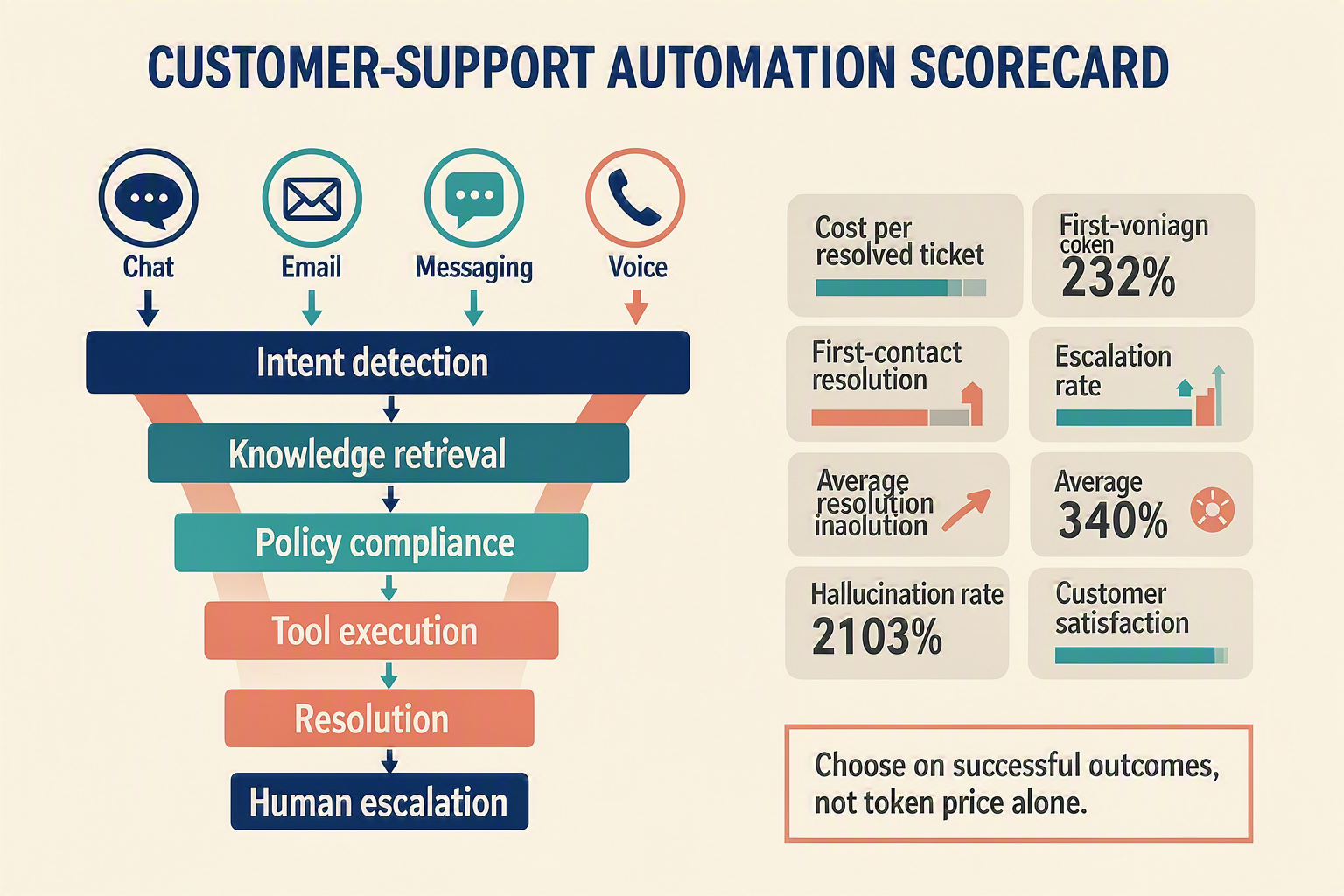
GPT-5.6 Luna is the more defensible choice for customer-support automation as of July 23, 2026 because it has published API pricing and explicit positioning for fast, economical workloads. Claude Opus 5 may eventually prove suitable, but Anthropic has not supplied enough verified commercial or performance data to justify making it the default production model.
Where GPT-5.6 Luna fits best
Customer support usually consists of high-volume, repeatable tasks rather than a single difficult reasoning benchmark. GPT-5.6 Luna should be evaluated first for:
- Intent classification and routing
- FAQ and knowledge-base answers
- Order, booking, and account-status workflows
- Conversation summarization and CRM note generation
- Multilingual response drafting
- Tool-driven actions, such as opening tickets or scheduling callbacks
- Voice-agent dialogue, provided streaming latency passes real-call tests
OpenAI describes GPT-5.6 Luna as the “fastest and lowest-cost model in the GPT-5.6 family,” although this remains a vendor claim rather than an independently verified latency result. OpenAI’s model documentation priced Luna at $1 per million input tokens, $0.10 per million cached-input tokens, and $6 per million output tokens on July 23, 2026.
That cached-input rate is 90% below Luna’s standard input-token rate, according to OpenAI’s published pricing. Support systems can exploit this difference by caching stable instructions, policy text, tool definitions, and other reusable prompt content instead of resending everything at full input cost.
Why Claude Opus 5 needs an evaluation gate
The issue is not evidence that Claude Opus 5 performs poorly; it is the absence of verified evidence for the model named Claude Opus 5. Anthropic has not confirmed the pricing, general API availability, context limits, rate limits, latency, throughput, tool-calling reliability, or regional coverage needed for this deployment comparison.
Accordingly, Claude Opus 5 should remain behind a controlled gate until teams can verify:
- Cost per resolved case, including retries and escalations
- Time to first token at median, p95, and p99
- Output tokens per second during streaming
- Successful requests per minute under expected concurrency
- Tool-call accuracy across valid, invalid, and ambiguous requests
- Grounded-answer rate against the approved knowledge base
- Human-escalation accuracy for sensitive or unsupported requests
Do not substitute results for Claude Opus 4.8—or any other Anthropic model—for direct Claude Opus 5 measurements. Model-family reputation does not establish production behavior for an unverified release.
The voice-agent decision requires end-to-end testing
For voice support, the language model is only one part of the latency chain. Measure speech-to-text, retrieval, LLM inference, text-to-speech, telephony transport, and interruption handling together. A low model price cannot compensate for long pauses, missed barge-ins, or incorrect tool execution.
Run recorded and live-call tests covering noisy audio, accents, code-switching, silence, customer interruptions, and failed backend actions. Platforms such as CallMissed can bridge WhatsApp Business calls to AI voice agents and support speech workflows across 22 Indian languages, making language-specific testing especially important for businesses serving regional Indian audiences.
Production recommendation
Use GPT-5.6 Luna as the primary candidate, but promote it only after workload testing. Keep deterministic workflows outside the model, ground answers with retrieval, require confirmation before consequential actions, and route low-confidence or policy-sensitive cases to humans. Add a same-tier fallback model so rate limits or provider failures do not interrupt customer service.
How should fallback routing and production architecture work?
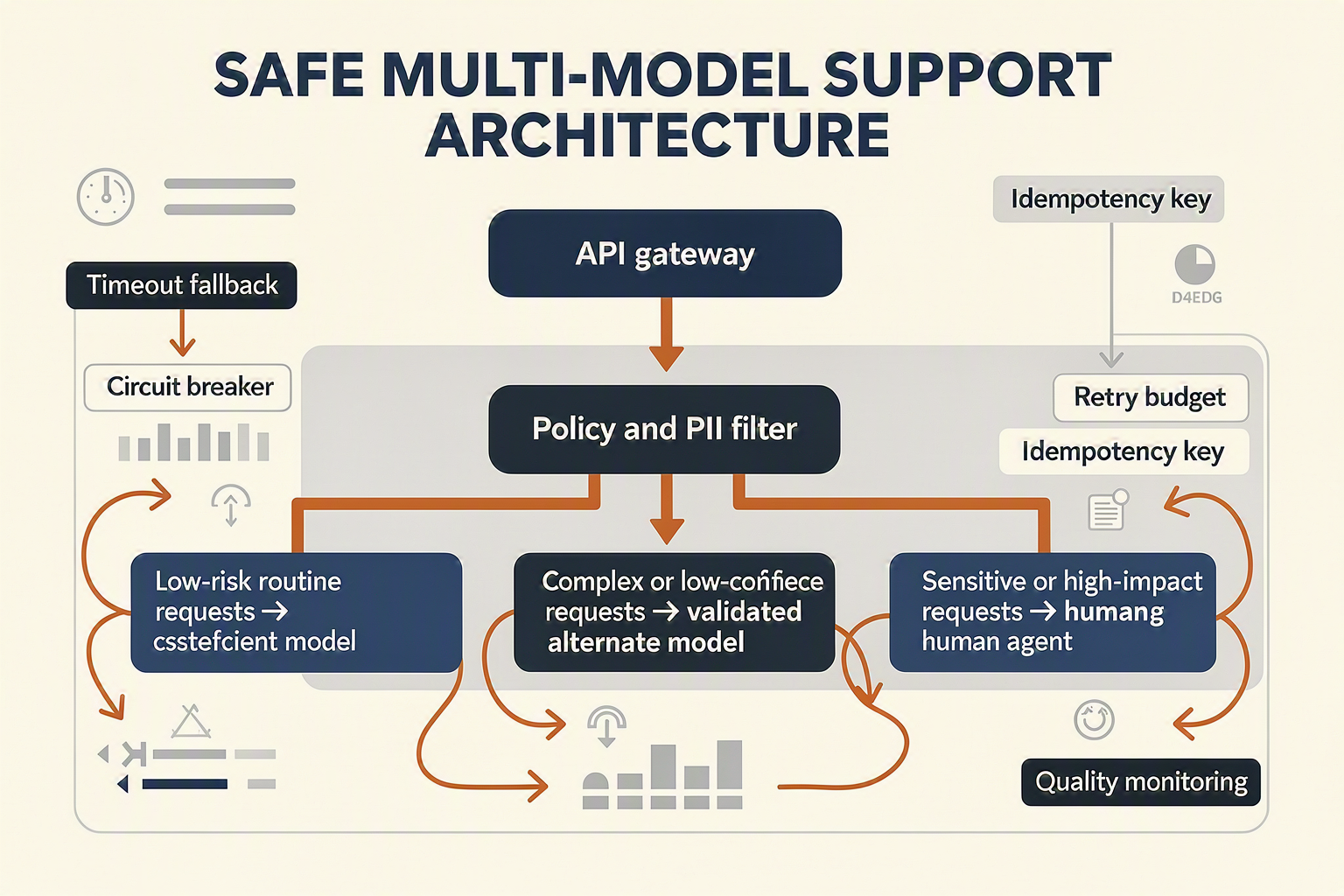
Use a policy-based router with GPT-5.6 Luna as the priceable primary path and Claude Opus 5 as a disabled-by-default evaluation route until Anthropic confirms API access, pricing, limits, and production performance. Fallbacks should respond to specific failure classes—not automatically send every timeout to a potentially slower, costlier, or unverified model.
Build a provider-neutral control plane
Keep orchestration outside either model’s proprietary interface. The application should own:
- Conversation state: Store normalized messages, summaries, tool results, consent, and customer identifiers in your system of record.
- Model adapters: Translate the neutral request into each provider’s supported schema.
- Policy routing: Select a model using channel, language, task risk, token budget, region, and current service health.
- Tool execution: Validate model-generated arguments, enforce permissions, and execute CRM, refund, scheduling, or ticketing actions separately.
- Observability: Record time to first token, total latency, output tokens, errors, retries, tool-call success, and resolution outcomes by model version.
An OpenAI-compatible abstraction reduces integration changes, but applications should not assume that prompts, tool schemas, safety behavior, or tokenization transfer perfectly between models. Solutions such as CallMissed’s OpenAI-compatible multi-model gateway add automatic same-tier fallbacks while giving developers one endpoint across LLM, speech-to-text, text-to-speech, image, and web-search models.
Route by failure type and workload
A production router should use an explicit sequence:
- Attempt GPT-5.6 Luna for routine support classification, retrieval-grounded answers, summarization, and structured tool selection.
- Retry only transient failures such as network errors, HTTP 429 responses, or provider-side 5xx errors. Apply exponential backoff with jitter and respect provider retry headers.
- Open a circuit breaker when recent failures exceed the service’s internal SLO, preventing retry storms and cascading latency.
- Use a verified same-tier fallback for latency-sensitive traffic.
- Escalate to a human when no approved model is healthy, confidence rules fail, or the requested action carries financial, legal, privacy, or safety risk.
Do not route to Claude Opus 5 merely because Luna returns an undesirable answer. As of July 23, 2026, Anthropic has not published verified Claude Opus 5 commercial pricing, latency, throughput, availability, or rate-limit data in the supplied evidence. Introduce Claude Opus 5 only after contract tests and controlled shadow traffic establish that it satisfies the same production SLOs.
Protect cost and consistency
OpenAI lists GPT-5.6 Luna at $1 per million input tokens, $0.10 per million cached-input tokens, and $6 per million output tokens as of July 23, 2026. That makes cache-aware routing useful, but failover can lose provider-specific cache benefits and increase effective cost.
Production safeguards should include:
- Per-conversation token and spend ceilings
- Maximum retry counts and deadline propagation
- Idempotency keys for bookings, refunds, and outbound messages
- Schema validation before every tool execution
- Prompt and model-version pinning
- Regional and privacy eligibility checks before routing
- Redaction or tokenization of sensitive customer data
Treat voice fallback as a deadline problem
For voice agents, measure speech recognition, LLM inference, tool execution, text-to-speech, telephony, and network transport separately. If the remaining turn deadline is too short, use a deterministic acknowledgement—such as “I’m checking that now”—rather than launching another full-model request.
Fallback success should therefore mean a completed, correct customer outcome within the channel’s latency and cost budget, not simply a second model returning text.
What do official sources and expert evaluations actually prove?

Official sources prove that GPT-5.6 Luna has documented API pricing and product availability, but they do not prove that Luna has lower production latency, higher throughput, or better support quality than Claude Opus 5. As of July 23, 2026, no supplied Anthropic source confirms Claude Opus 5’s API specifications, so an evidence-based head-to-head performance verdict remains impossible.
What OpenAI’s documentation establishes
OpenAI’s official model documentation provides several verified facts:
- OpenAI listed GPT-5.6 Luna at $1 per million input tokens, $0.10 per million cached-input tokens, and $6 per million output tokens on July 23, 2026.
- OpenAI described GPT-5.6 Luna as the “fastest and lowest-cost model in the GPT-5.6 family” on July 23, 2026.
- OpenAI’s GPT-5.6 announcement priced Sol at $5 input and $30 output, Terra at $2.50 input and $15 output, and Luna at $1 input and $6 output per million tokens.
- OpenAI’s Help Center states that GPT-5.6 Luna API access follows the OpenAI API’s supported-country-and-territory policy.
These sources establish a budgetable commercial offering and Luna’s position within OpenAI’s own model family. They do not establish its rank against an Anthropic model.
OpenAI also says GPT-5.6 Luna outperforms Fable 5 at approximately one-sixteenth the cost, but OpenAI’s GPT-5.6 page describes latency using simulated fast-API conditions. That is a vendor evaluation, not independent evidence of real-world time to first token, tokens per second, tail latency, or concurrency under a customer-support workload.
What remains unproven about Claude Opus 5
The supplied evidence contains no official Anthropic model card, pricing page, API documentation, or availability notice for a product named Claude Opus 5. Consequently, the following must remain unknown, not estimated from earlier Claude releases:
- Input, cached-input, and output-token prices
- API model identifier and release status
- Context window and maximum output
- Streaming latency and generation throughput
- Rate limits, concurrency tiers, and regional availability
- Tool-calling reliability and benchmark performance
- Data-retention, privacy, and enterprise-control details specific to Opus 5
Search interest in comparisons such as GPT-5.6 Luna vs Claude Opus 4.8 does not validate Claude Opus 5’s existence or specifications. Claude Opus 4.8 results must not be relabelled as Opus 5 evidence.
What expert evaluations would need to measure
No named independent expert evaluation in the supplied research reports a controlled Claude Opus 5 vs GPT-5.6 Luna test. A defensible evaluation should therefore publish:
- Latency: median, p95, and p99 time to first token and end-to-end completion time.
- Throughput: output tokens per second, successful requests per minute, and throttling rates.
- Support quality: resolution accuracy, escalation precision, hallucination rate, and tool-call success.
- Voice performance: interruption recovery and total turn latency across speech-to-text, LLM, text-to-speech, and telephony.
- Economics: cost per correctly resolved conversation, including retries, tools, speech, and fallback traffic.
Platforms such as CallMissed’s OpenAI-compatible multi-model gateway can support controlled routing and same-tier fallbacks, but each candidate model still requires workload-specific measurement. The evidence supports deploying Luna where documented pricing is mandatory; it supports only evaluating Claude Opus 5 after Anthropic publishes verifiable commercial and technical details.
What does this comparison mean for your workload, privacy and availability requirements? (TABLE)
For most production teams, GPT-5.6 Luna is the deployable option only where OpenAI’s privacy terms, regional access and service limits satisfy internal requirements. Claude Opus 5 should remain evaluation-only until Anthropic confirms its API availability, data-handling terms and operational specifications.
Workload, privacy and availability decision table
| Requirement | GPT-5.6 Luna | Claude Opus 5 | Recommended deployment decision |
|---|---|---|---|
| Cost-sensitive support automation | Public API pricing enables pre-deployment budgeting and cost controls. | Commercial pricing is unconfirmed as of July 23, 2026. | Use Luna with token budgets; do not forecast Opus 5 costs speculatively. |
| Low-latency voice agents | OpenAI calls Luna the “fastest and lowest-cost model in the GPT-5.6 family,” but production latency must still be measured. | Time to first token and output throughput are unconfirmed. | Run streaming tests across the complete STT–LLM–TTS pipeline before live calls. |
| High-volume asynchronous work | Published pricing supports capacity-cost modelling, but verified rate limits depend on the customer’s API tier. | Rate limits, concurrency and batch support are unknown. | Load-test Luna; admit Opus 5 only after documented quotas and tests become available. |
| Regulated or sensitive customer data | Retention, training use, residency and contractual controls must be verified against the applicable OpenAI plan. | Equivalent Opus 5 controls have not been confirmed in the available evidence. | Require legal and security approval rather than inferring privacy from the model name. |
| Regional service availability | The OpenAI Help Center says API access follows its supported countries and territories list. | Opus 5 geographic API availability is unconfirmed. | Check every operating and failover region before selecting either provider. |
| Business continuity | A working Luna integration still creates provider and regional concentration risk. | Opus 5 cannot be treated as a production fallback without verified access and behaviour. | Maintain a tested same-tier fallback, circuit breaker and provider-neutral request layer. |
Privacy approval requires more than model selection
Neither model should receive production transcripts merely because it performs well in a sandbox. A security review should obtain written answers covering:
- Data retention: how long prompts, outputs, audio and diagnostic logs persist.
- Training use: whether API data can be used for model improvement and which opt-outs apply.
- Data location: where inference, storage, backups and support access occur.
- Subprocessors: which organizations may process customer data.
- Deletion and auditability: whether deletion deadlines, access logs and incident notifications are contractually defined.
For Indian customer-support deployments, teams must additionally map processing to the Digital Personal Data Protection Act, 2023, including consent, purpose limitation and grievance workflows where applicable. Payment information, health data and authentication secrets should be redacted or tokenized before model invocation.
Availability must be tested as an end-to-end property
A model endpoint being reachable does not make a voice agent available. Production readiness depends on speech recognition, inference, text-to-speech, telephony or WhatsApp transport, retrieval systems and business tools all operating within the latency budget.
Use three safeguards:
- Set separate timeouts for connection, first token and total generation.
- Apply circuit breakers and bounded retries to prevent outage amplification.
- Route degraded requests to a tested alternative model or human agent.
Platforms such as CallMissed, an OpenAI-compatible multi-model gateway, support this provider-neutral pattern through same-tier fallbacks. For multilingual Indian operations, CallMissed also combines LLM routing with speech-to-text and text-to-speech across 22 Indian languages, helping teams test availability across the complete customer-conversation path rather than the LLM alone.
Frequently asked questions about Claude Opus 5 vs GPT-5.6 Luna API deployment
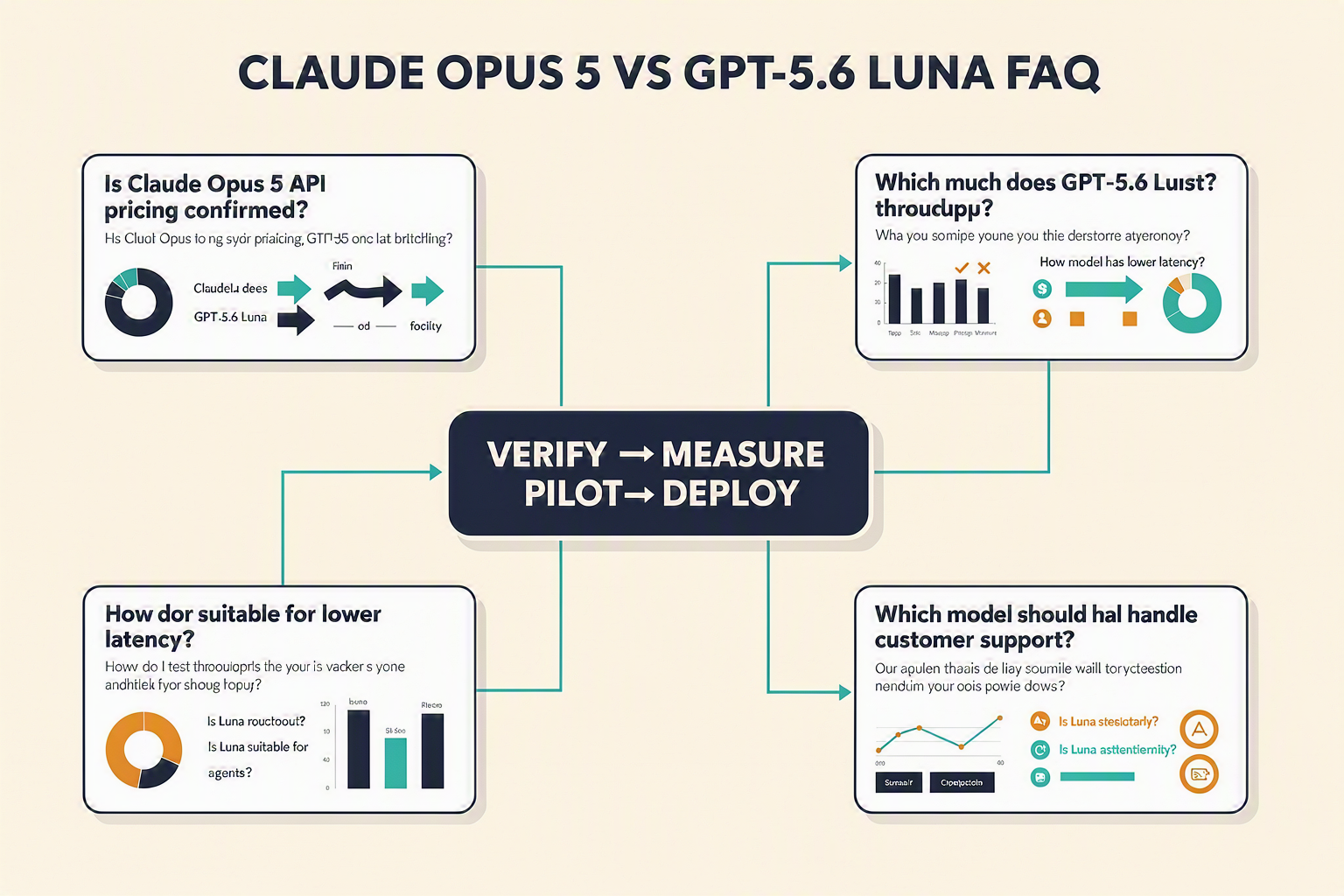
Which API is cheaper in the Claude Opus 5 vs GPT-5.6 Luna comparison?
How should developers test Claude Opus 5 vs GPT-5.6 Luna API latency?
Is GPT-5.6 Luna suitable for real-time AI voice agents?
How do I compare GPT-5.6 Luna and Claude Opus 5 API throughput?
Which model should handle customer-support automation in Claude Opus 5 vs GPT-5.6 Luna?
What production architecture reduces risk when deploying either API?
Conclusion
As of July 23, 2026, GPT-5.6 Luna is the more defensible production choice for cost-sensitive voice-agent and customer-support deployments because its API economics are published. Claude Opus 5 should remain behind a controlled evaluation gate until Anthropic confirms its pricing, availability, latency, throughput, and commercial terms.
- GPT-5.6 Luna is budgetable: OpenAI lists pricing of $1 per million input tokens, $0.10 per million cached-input tokens, and $6 per million output tokens.
- Costs remain workload-dependent: A conversation using 2,000 input tokens and 500 output tokens costs about $0.005, making 100,000 such interactions roughly $500 in model-token charges before speech, messaging, tools, and infrastructure.
- Vendor positioning is not a latency benchmark: OpenAI calls Luna the “fastest and lowest-cost model in the GPT-5.6 family,” but teams should measure time to first token, streaming consistency, concurrency, tool-call success, and end-to-end voice latency themselves.
- Resilience matters more than model loyalty: Production systems need fallbacks, rate-limit handling, observability, and cost-per-resolution tracking.
Watch for verified Claude Opus 5 API documentation and independent, workload-matched tests. To explore resilient multi-model routing, voice agents, and multilingual automation across 22 Indian languages, visit CallMissed. Which model will earn deployment based on measured customer outcomes rather than its flagship label?
Related Reading
- Claude Opus 5 vs GPT-5.6 Sol vs GPT-5.6 Terra vs GPT-5.6 Luna: July 2026 Comparison
- GPT-5.6 Luna vs Gemini 3.5 Flash-Lite: Cost, Speed, API Availability Compared
- Gemini 3.5 Flash-Lite vs GPT-5.6 Luna: API, Cost, and Speed
Sources
Related Posts



Ready to automate customer conversations?
Launch AI voice agents and WhatsApp bots with CallMissed — one API, 22+ Indian languages.