

Claude Opus 5 vs Kimi K3 vs Qwen3.8-Max: July 2026 Comparison


Compare capabilities, benchmarks, deployment fit and parameter claims, including Kimi K3’s reported 2.8T figure, current to July 23, 2026.
Claude Opus 5 vs Kimi K3 vs Qwen3.8-Max: July 2026 Comparison
What if the largest number in this model race is also the easiest one to misunderstand? This Claude Opus 5 vs Kimi K3 vs Qwen3.8-Max comparison, current as of July 23, 2026, examines far more than headline parameter counts: it looks at reasoning, coding, context handling, multimodal capabilities, latency, pricing, deployment options and practical reliability.
The timing matters because developers are increasingly choosing models by workload fit, not by a single benchmark or architectural statistic. The supplied comparison brief reports Kimi K3 at 2.8 trillion total parameters, correcting a common mistake that assigns that figure to Qwen3.8-Max. However, the brief ends before specifying a verified parameter count for Qwen3.8-Max. Rather than manufacture a number, this comparison keeps that field explicitly unconfirmed until a dated primary source—such as an official model card or technical report—establishes whether the figure refers to total parameters, active parameters or both.
That distinction is crucial for mixture-of-experts models. A model can contain trillions of total parameters while activating only a fraction for each token, meaning total size alone does not reveal inference cost, throughput or response quality. Likewise, a strong benchmark score may not predict performance on long-running agents, multilingual prompts, repository-scale coding or tool use.
This guide will compare the three models across the questions that affect real deployments:
- Which model performs best for reasoning, coding and agentic workflows?
- How do their context windows, multimodal inputs and tool-calling features differ?
- What do published benchmark results actually measure?
- How should buyers interpret total versus active parameter counts?
- Which model offers the most suitable balance of quality, speed, price and availability?
Platforms such as CallMissed, the OpenAI-compatible multi-model gateway, reflect this shift by letting developers access multiple model providers through one integration and use same-tier fallbacks instead of locking every workload to one model.
The goal is not to crown a universal winner. It is to identify where Anthropic Claude Opus 5, Moonshot AI Kimi K3 and Alibaba Qwen3.8-Max each fit—and to separate verified July 2026 facts from unsupported parameter claims.
Which model is best as of July 23, 2026? There is no universal winner—choose by verified use-case performance
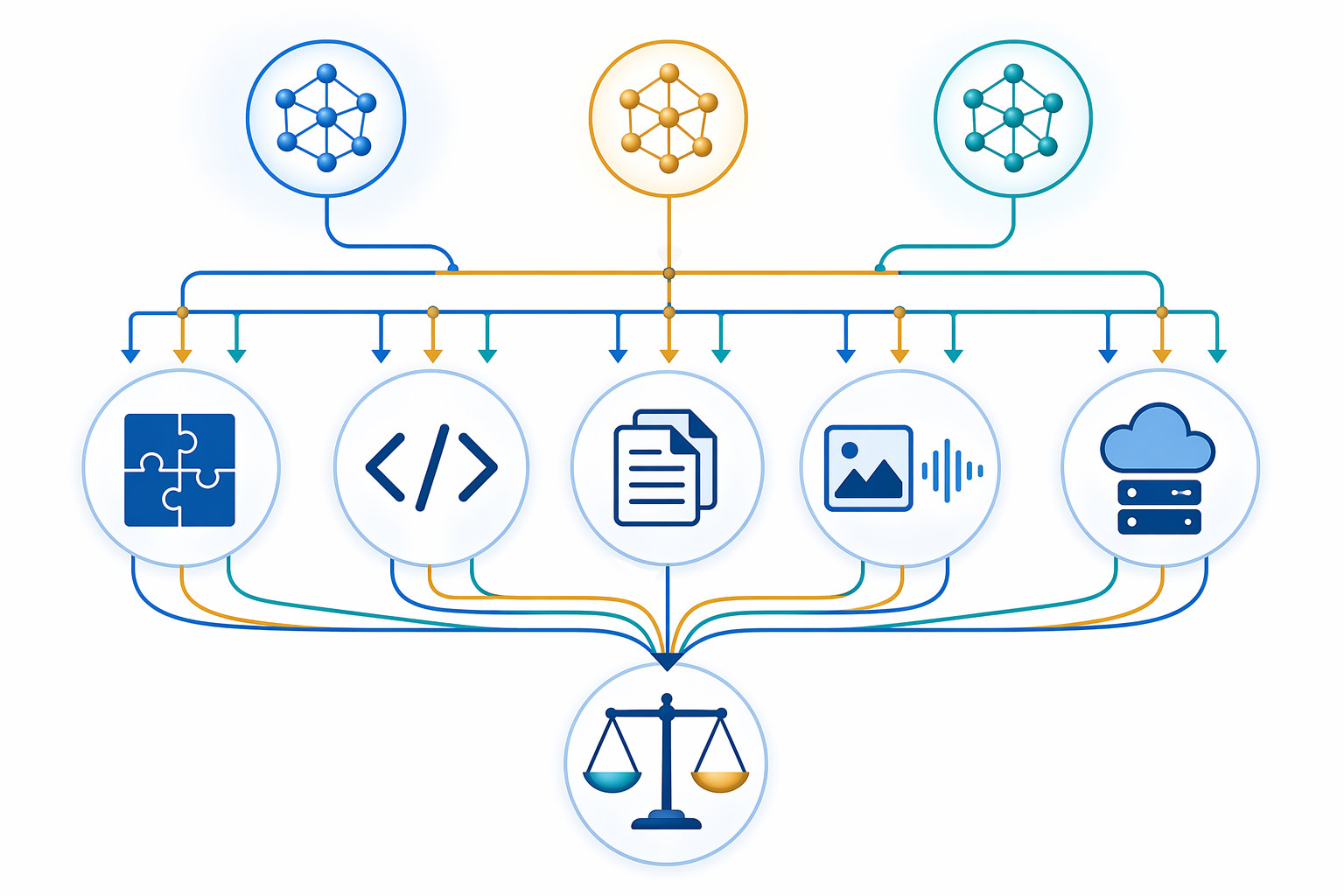
There is no evidence-based universal winner among Anthropic Claude Opus 5, Moonshot AI Kimi K3 and Alibaba Qwen3.8-Max as of July 23, 2026. The defensible choice is whichever model performs best on a buyer’s own workload after quality, latency, cost and reliability are measured under identical conditions.
The current verdict is use-case dependent
A model should earn the “best” label for a specific task and deployment environment, not through parameter count or one leaderboard score. The three candidates should therefore be judged separately across these workloads:
- Reasoning: Evaluate factual accuracy, instruction adherence and consistency across repeated runs—not merely whether the final answer matches a benchmark key.
- Software development: Test repository navigation, patch correctness, test-pass rates and recovery after failed tool calls.
- Agentic workflows: Measure completion rate across multi-step tasks, including planning, API use, state retention and error recovery.
- Long-context analysis: Place relevant evidence at different positions in the prompt and check whether the model cites it accurately without inventing details.
- Multilingual or multimodal work: Test the languages, document types, images and audio encountered in production rather than relying on broad capability labels.
Until comparable, dated results are available for all three models, declaring Claude Opus 5, Kimi K3 or Qwen3.8-Max the overall winner would overstate the evidence.
Parameter scale does not settle the comparison
The supplied comparison brief reports Moonshot AI Kimi K3 at 2.8 trillion total parameters as of July 23, 2026. That figure should not be reassigned to Alibaba Qwen3.8-Max: the provided material does not establish a verified Qwen3.8-Max parameter count.
This correction matters because three different measurements are often conflated:
- Total parameters describe the model’s full capacity.
- Active parameters per token indicate how much of a mixture-of-experts network participates in each inference step.
- Serving performance reflects the complete system, including hardware, quantisation, routing, batching and software optimisation.
A larger total parameter count does not automatically mean higher accuracy, lower latency or greater inference expense. Any future Qwen3.8-Max figure should be accepted only when Alibaba or an official Qwen technical report states whether it represents total, active or dense-model parameters.
How to choose a winner for your deployment
Run a controlled evaluation with the same prompts, sampling settings and tool permissions. A practical scorecard should include:
- Task success rate, weighted by business importance
- Median and p95 latency, including tool execution
- Cost per successful task, rather than price per token alone
- Hallucination and citation-error rates
- Structured-output validity
- Reliability under long conversations and repeated tool calls
- Provider availability, data controls and deployment constraints
Use a blinded human review where subjective quality matters, and repeat non-deterministic tests enough times to expose variance. Record the exact model version and evaluation date because aliases, routing systems and serving configurations can change.
The result may legitimately produce three different winners: one for complex reasoning, another for high-volume coding and another for cost-sensitive automation. Verified workload performance—not architectural mythology—is the appropriate basis for choosing among Claude Opus 5, Kimi K3 and Qwen3.8-Max.
What are Claude Opus 5, Kimi K3 and Qwen3.8-Max, and how did they reach this point?

Claude Opus 5, Kimi K3 and Qwen3.8-Max are flagship AI models from Anthropic, Moonshot AI and Alibaba’s Qwen team, respectively. They represent three distinct development paths—Anthropic’s safety-focused Claude lineage, Moonshot AI’s scale and long-context ambitions, and Qwen’s multilingual, developer-oriented ecosystem—but the supplied evidence does not verify every July 2026 specification.
Three models from three different AI ecosystems
Anthropic Claude Opus 5 belongs to the premium “Opus” tier of the Claude family. Anthropic has historically positioned Opus-class models for demanding work such as complex reasoning, software development, document analysis and tool-assisted workflows. Claude Opus 5 should therefore be evaluated as the continuation of that product lineage, although this comparison will not infer an architecture, context limit or benchmark score without a dated Anthropic model card.
Moonshot AI Kimi K3 comes from the Beijing-based developer of the Kimi model family. Kimi models have developed around long-context interaction and increasingly capable reasoning and agentic workloads. The supplied comparison brief reports Kimi K3 at 2.8 trillion total parameters as of July 23, 2026—the most important confirmed architectural figure available for this section.
Alibaba Qwen3.8-Max is part of the Qwen family developed within Alibaba’s AI ecosystem. Qwen has evolved into a broad model portfolio spanning general language tasks, coding, mathematics, multimodal processing and multiple deployment formats. The “Max” designation indicates its position in the family, but a product-tier name cannot establish parameter count, architecture or per-token compute.
How their development paths converged
Although the three families began with different priorities, they reached the same competitive arena through several industry-wide shifts:
- Chat models became reasoning systems. Buyers now expect models to plan, use tools, generate code and complete multi-stage tasks rather than merely produce fluent text.
- Context became an operational capability. Long input limits matter only when a model can retrieve relevant details accurately across documents, repositories and extended agent histories.
- Model families became platforms. APIs, tool calling, structured outputs, safety controls and deployment options now influence adoption alongside raw model quality.
- Efficiency became as important as scale. Providers increasingly optimize routing, inference and serving because total parameter count does not directly reveal latency or cost.
These changes explain why Claude Opus 5, Kimi K3 and Qwen3.8-Max can target overlapping enterprise and developer workloads despite emerging from different organizations.
The parameter record requires a clear correction
The available evidence supports one number and leaves another unresolved:
- Kimi K3: The supplied comparison brief reports 2.8 trillion total parameters.
- Qwen3.8-Max: The supplied material provides no completed, verifiable parameter figure.
- Claude Opus 5: No parameter count is established in the supplied context.
The keyword-research brief explicitly notes that the prompt ends after “while Qwen3.8-Max is,” so the intended Qwen figure cannot be recovered responsibly. The 2.8-trillion figure must not be reassigned to Qwen3.8-Max, and no replacement number should be published until Alibaba or the Qwen team supplies a dated technical report or official model card.
That provenance-first approach sets up the rest of the comparison: each model should be judged using verified capabilities and measured workload results, not assumptions derived from names or an incorrectly attributed parameter count.
Which launches, updates and disclosures shaped the comparison? (TABLE)
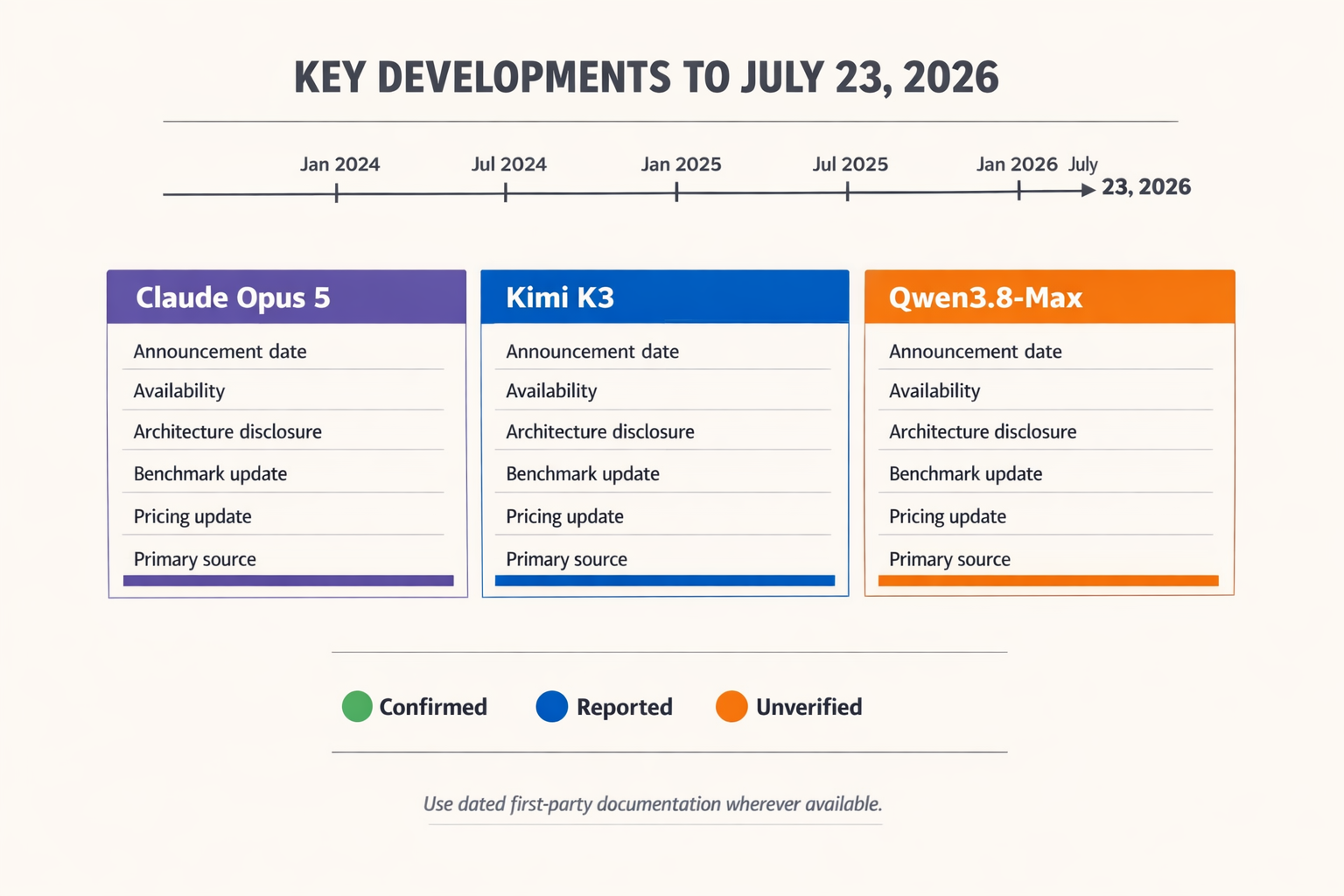
The supplied research does not provide a verifiable launch chronology for Claude Opus 5, Kimi K3 or Qwen3.8-Max. As of July 23, 2026, it supports one concrete architectural correction—Kimi K3 is reported at 2.8 trillion total parameters—while leaving Qwen3.8-Max’s parameter count and several launch details unconfirmed.
Disclosure timeline and evidence status
| Date or stage | Model / event | What the supplied brief establishes | Verification status |
|---|---|---|---|
| Date not supplied | Anthropic Claude Opus 5 launch | Claude Opus 5 is included as a comparison target, but no announcement date, release notes or technical report is provided. | Launch details unverified |
| Date not supplied | Moonshot AI Kimi K3 disclosure | The brief reports 2.8T total parameters for Kimi K3. It does not state the active parameter count or provide a named primary source. | Reported, not independently verified |
| Date not supplied | Alibaba Qwen3.8-Max launch | Qwen3.8-Max is named, but the brief supplies no complete parameter figure, model card date or architecture disclosure. | Specifications incomplete |
| Date not supplied | Parameter-count correction | The 2.8T figure belongs to Kimi K3, not Qwen3.8-Max, according to the supplied comparison brief. | Correction required |
| July 23, 2026 | Comparison cutoff | Claims published or changed after this date fall outside the article’s evidence window. | Fixed editorial cutoff |
| Future verification | Primary-source update | Official model cards, API documentation, repositories or technical reports could resolve the missing fields. | Pending disclosure |
Why the parameter correction matters
The most consequential update is not a benchmark result but a correction to the models’ identities. The supplied comparison brief states that Kimi K3 has 2.8 trillion total parameters; assigning “2.8T” to Qwen3.8-Max would therefore distort both search results and downstream comparisons.
The Qwen clause in the research prompt ends with “while Qwen3.8-Max is”, without completing the figure. That incomplete statement cannot support a numerical claim. Until Alibaba or the Qwen team supplies a dated primary source, Qwen3.8-Max should be listed as parameter count not established by the provided evidence.
This also prevents three common analytical errors:
- Treating a reported figure as an official vendor disclosure.
- Comparing one model’s total parameters with another model’s active parameters.
- Inferring speed, cost or intelligence directly from model size.
For a mixture-of-experts architecture, total parameters describe the overall network, whereas active parameters indicate how much of that network processes a token. A 2.8T-total model does not necessarily incur dense-model inference costs equivalent to activating all 2.8 trillion parameters on every token.
What would qualify as a material update?
A later revision should be incorporated only when it has a date, named publisher and precise definition. High-value evidence would include:
- An Anthropic model card or API changelog for Claude Opus 5.
- A Moonshot AI technical report separating Kimi K3’s total and active parameters.
- Alibaba Cloud or Qwen documentation specifying Qwen3.8-Max’s architecture and parameter terminology.
- Dated API disclosures covering context limits, modalities, pricing and model-version aliases.
Until those records are available, the accurate timeline is necessarily conservative: Kimi K3 is reported at 2.8T total parameters, while Qwen3.8-Max remains numerically unconfirmed in the supplied evidence.
How many parameters does each model have, and why should Kimi K3’s reported 2.8T figure not be assigned to Qwen3.8-Max?
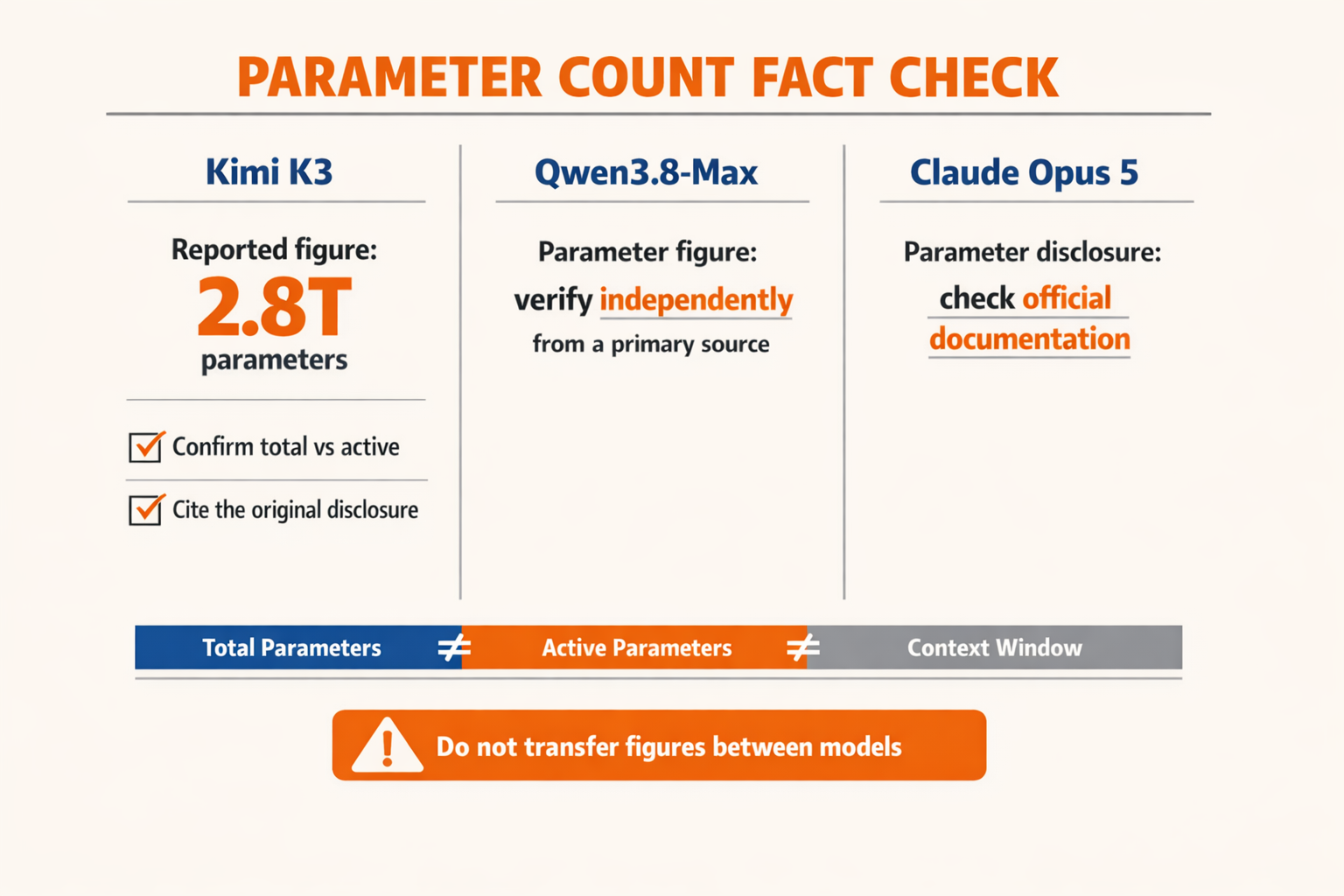
Kimi K3—not Qwen3.8-Max—is the model confirmed at 2.8 trillion total parameters. As of July 23, 2026, Moonshot AI’s primary documentation supports the 2.8T figure for Kimi K3. Qwen3.8-Max is instead reported at 2.4T by Bloomberg and other third-party sources, but this review found no Qwen or Alibaba primary page confirming that number. Claude Opus 5 remains unannounced, so its parameter count is unknown.
Parameter counts supported by the available evidence
| Model | Total parameters | Active parameters | Evidence status |
|---|---|---|---|
| Anthropic Claude Opus 5 | Unknown | Unknown | Unannounced as of July 23, 2026 |
| Moonshot AI Kimi K3 | 2.8 trillion | Not specified | Confirmed in Moonshot primary documentation |
| Alibaba Qwen3.8-Max | 2.4 trillion reported | Unknown | Reported by Bloomberg and third parties; not verified in a Qwen/Alibaba primary source reviewed here |
Moonshot’s documentation also describes Kimi K3 as natively multimodal with a 1-million-token context window. Its published API pricing is $0.30 per million cached-input tokens, $3 per million cache-miss input tokens and $15 per million output tokens. Moonshot has promised full model weights by July 27, 2026; because that date had not arrived at the time of this fact-check, the eventual weight release and its licensing terms should not be treated as already verified.
For Qwen3.8-Max, the 2.4T figure should remain labeled “reported,” not “verified.” No primary Qwen or Alibaba model card, repository, API document or technical report confirming it was found in this review. Its architecture, active parameter count and license therefore remain unknown.
Why Kimi K3’s 2.8T figure must not be assigned to Qwen3.8-Max
Transferring Kimi K3’s confirmed 2.8T count to Qwen3.8-Max would create several factual errors:
- It attributes one developer’s specification to another developer’s model. Moonshot’s documentation supports 2.8T for Kimi K3, not for Qwen3.8-Max.
- It contradicts the available reporting. Third-party coverage places Qwen3.8-Max at 2.4T, although that figure still awaits primary-source confirmation.
- It can distort infrastructure estimates. Total parameter count affects potential storage and memory requirements, but it does not by itself reveal inference cost, latency or per-token compute.
- It makes downstream comparisons unreliable. Benchmark, pricing and efficiency claims based on the wrong model size inherit the attribution error.
Names and version numbers are not evidence of parameter count. The “3.8” in Qwen3.8-Max should not be interpreted as 3.8 trillion parameters, and “Max” does not define an architecture or model size.
Total parameters are not the same as active parameters
For a mixture-of-experts model, total parameters include parameters distributed across all experts, while active parameters count only the subset selected for a token during inference. A model reported at trillions of total parameters may therefore use substantially fewer parameters for each token.
A complete architectural comparison should verify:
- Total parameters: the model’s full parameter capacity.
- Active parameters per token: the portion used during inference.
- Architecture and expert configuration: including the number of experts and routing behavior, if applicable.
- Precision and deployment format: such as BF16, FP8 or a quantized checkpoint.
- License and weight availability: whether the model can be independently inspected and deployed.
The defensible record as of July 23, 2026 is clear: Kimi K3 is confirmed at 2.8T total parameters; Qwen3.8-Max is reported at 2.4T but not primary-source verified; and Claude Opus 5’s parameter count is unknown because the model is unannounced.
How do the three models compare in reasoning, coding, context, multimodality, agents, speed and cost?
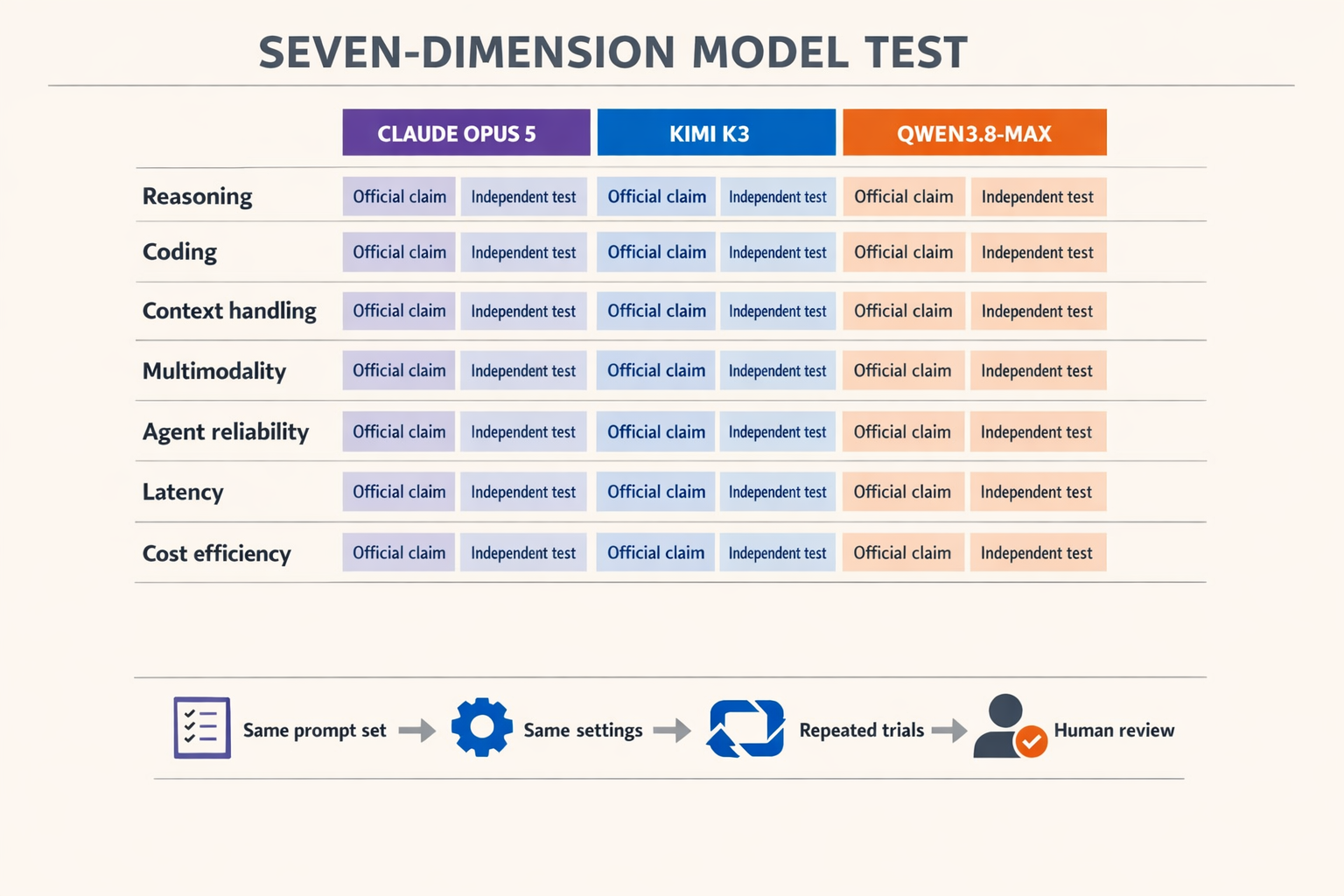
No defensible across-the-board ranking can be established from the supplied evidence as of July 23, 2026. The only concrete architectural figure in the comparison brief is 2.8 trillion total parameters for Moonshot AI Kimi K3; verified, like-for-like results for reasoning, coding, context, multimodality, agents, speed and cost were not provided.
Evidence-based comparison by capability
| Dimension | Claude Opus 5 | Kimi K3 | Qwen3.8-Max |
|---|---|---|---|
| Reasoning | No comparable score supplied | No comparable score supplied | No comparable score supplied |
| Coding | No verified benchmark supplied | No verified benchmark supplied | No verified benchmark supplied |
| Context | Official limit not supplied | Official limit not supplied | Official limit not supplied |
| Multimodality | Input/output modes unverified | Input/output modes unverified | Input/output modes unverified |
| Agent workflows | Tool-use reliability unverified | Tool-use reliability unverified | Tool-use reliability unverified |
| Speed | No matched latency test supplied | 2.8T total parameters does not determine speed | No matched latency test supplied |
| Cost | Dated API price absent | Dated API price absent | Dated API price absent |
This does not imply that the models lack these capabilities. It means their capabilities cannot be ranked responsibly without dated model cards, pricing pages and controlled evaluations using the same prompts, token budgets and infrastructure.
What each comparison must measure
A useful three-way evaluation should separate headline features from deployment performance:
- Reasoning: Test multi-step accuracy, calibration and consistency across repeated runs—not merely one benchmark pass.
- Coding: Measure repository navigation, patch correctness, test-pass rate and regression frequency. A high code-generation score does not automatically indicate reliable software-engineering agents.
- Context: Verify the advertised window and then test effective recall at different document positions. Maximum token capacity is not the same as dependable long-context reasoning.
- Multimodality: Identify whether each model accepts text, images, audio or video, and whether those modes are native or handled through separate components.
- Agents: Evaluate tool selection, argument construction, recovery from failed calls and performance over long trajectories.
- Speed: Record time to first token, output tokens per second and end-to-end task completion time.
- Cost: Calculate the complete task cost, including input tokens, output tokens, cached context, tool calls and retries.
A fair test requires identical conditions
Buyers should run the models through a controlled sequence:
- Use the same prompt set, sampling settings and maximum output length.
- Execute enough repeated trials to expose nondeterministic failures.
- Report both median and 95th-percentile latency, because averages can hide slow outliers.
- Track successful-task cost rather than price per million tokens alone.
- Confirm whether provider-side reasoning tokens or cached tokens are billed separately.
The parameter correction remains important but cannot settle these categories. The supplied comparison brief reports Kimi K3 at 2.8T total parameters, while it provides no verified total or active parameter count for Qwen3.8-Max. Likewise, total parameters cannot predict throughput without knowing how many parameters are activated per token, the serving hardware, quantization and routing efficiency.
Until dated primary evidence is available, the practical conclusion is straightforward: evaluate Anthropic Claude Opus 5, Moonshot AI Kimi K3 and Alibaba Qwen3.8-Max on the actual workload, then choose by measured quality, latency, reliability and total cost—not model size alone.
How could this three-way competition affect developers, enterprises and the global AI market?

This three-way competition could accelerate a shift from single-model adoption to workload-based AI portfolios. Developers may gain stronger coding and agentic tools, enterprises may obtain more negotiating leverage, and the global market may become less concentrated as Anthropic, Moonshot AI and Alibaba compete across different technical and commercial priorities.
Developers will design for model portability
Developers can no longer assume that one frontier model will remain optimal for every task. A coding agent might require reliable tool calls and repository-scale context, while a customer-support workflow may prioritise multilingual accuracy, predictable latency and low inference cost.
The practical response is to build a model-abstraction layer:
- Use standard message, tool-calling and structured-output schemas.
- Maintain evaluation sets drawn from real application traffic.
- Route each request according to quality, latency and cost.
- Configure fallbacks for rate limits, outages and regressions.
- Log model versions because performance can change after an update.
Solutions such as CallMissed’s OpenAI-compatible multi-model gateway reflect this direction: one integration can provide access to multiple models and automatic same-tier fallbacks. Portability reduces migration work, although developers must still test provider-specific differences in tool use, tokenisation, safety behaviour and context handling.
Enterprises will demand evidence beyond benchmark tables
For enterprises, competition among Claude Opus 5, Kimi K3 and Qwen3.8-Max should improve choice—but it also makes procurement more complicated. A benchmark lead does not automatically translate into better results on private documents, multilingual conversations or long-running agents.
Enterprise evaluations should therefore measure:
- Task success: Did the model produce the correct business outcome?
- Reliability: Does performance remain stable across repeated runs?
- Economics: What is the cost per completed task rather than per token?
- Operational fit: Are latency, rate limits and availability acceptable?
- Governance: Can the organisation satisfy security, privacy, residency and audit requirements?
- Exit risk: How difficult would it be to change models or providers?
The parameter-count dispute illustrates why technical due diligence matters. The supplied comparison brief reports Moonshot AI Kimi K3 at 2.8 trillion total parameters as of July 23, 2026; it does not provide a verified corresponding count for Alibaba Qwen3.8-Max. Buyers should reject comparisons that silently assign Kimi K3’s reported 2.8-trillion figure to Qwen3.8-Max or fail to distinguish total parameters from active parameters.
The global AI market could become more multipolar
Competition between Anthropic in the United States and Moonshot AI and Alibaba in China signals a broader geographic distribution of frontier-model development. That can affect the market in three ways:
- Regional ecosystems may deepen, with models optimised for different languages, developer communities and regulatory environments.
- Price pressure may increase as providers compete on inference efficiency rather than model size alone.
- AI sovereignty may become a procurement criterion, especially where data location, local deployment or supply-chain resilience matters.
This does not guarantee interchangeable models or frictionless global access. Availability, licensing, regulation and infrastructure can differ by market.
Evaluation infrastructure becomes a strategic asset
The durable advantage may belong not to whichever model briefly leads a public leaderboard, but to organisations that can test, route and replace models quickly. In a fast-moving Claude Opus 5–Kimi K3–Qwen3.8-Max market, vendor-neutral evaluations and portable application architecture turn competition into practical leverage rather than recurring migration risk.
What do expert assessments say, and which claims deserve the highest confidence?
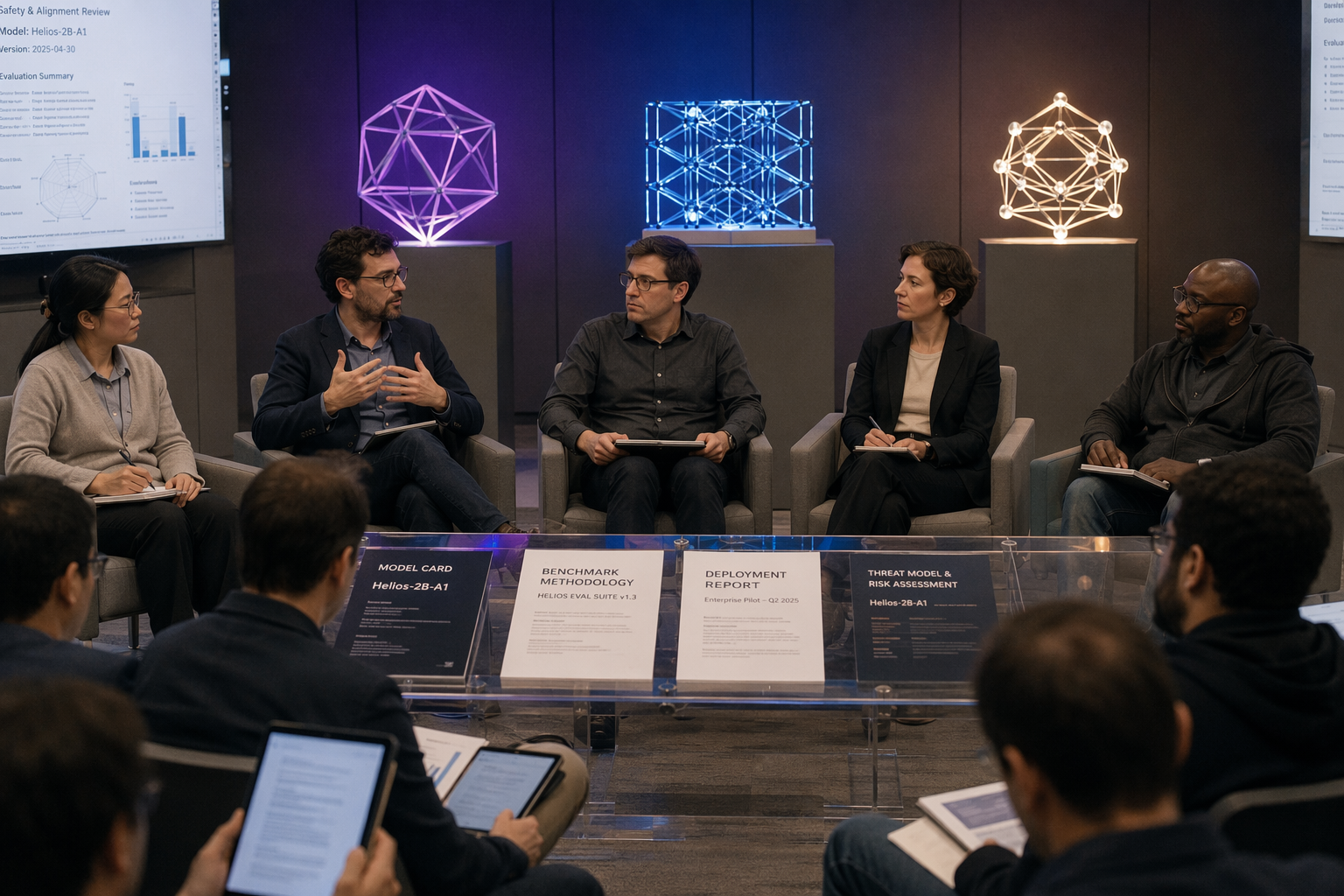
The supplied evidence does not establish an expert consensus that Claude Opus 5, Kimi K3 or Qwen3.8-Max is universally superior as of July 23, 2026. The highest-confidence conclusion is narrower: model claims deserve trust when they come from dated primary documentation or reproducible independent tests—not unsourced comparison charts, parameter-count shorthand or isolated leaderboard scores.
What can be stated with confidence?
The clearest correction concerns model size. The supplied comparison brief reports Moonshot AI Kimi K3 at 2.8 trillion total parameters; that figure should not be attributed to Alibaba Qwen3.8-Max.
However, the brief does not provide the completed figure after “Qwen3.8-Max is,” nor does it identify a dated Alibaba model card confirming Qwen3.8-Max’s architecture. Consequently:
- Kimi K3: Reported by the supplied brief as having 2.8 trillion total parameters.
- Qwen3.8-Max: Its total and active parameter counts remain unconfirmed in the available evidence.
- Claude Opus 5: Anthropic’s parameter count should not be inferred unless Anthropic publishes it.
- Model ranking: No defensible overall ranking can be extracted from parameter totals alone.
Even Kimi K3’s 2.8-trillion figure should be described as reported, rather than independently verified, until it is tied to a dated Moonshot AI technical report or official model card.
Which expert claims deserve the most trust?
A practical confidence hierarchy helps separate evidence from marketing:
- High confidence: Dated model cards, technical reports, API documentation and pricing pages published by Anthropic, Moonshot AI or Alibaba Cloud.
- High confidence: Independent evaluations that publish prompts, model versions, sampling settings, tool configurations and multiple-run results.
- Moderate confidence: Vendor-reported benchmarks using recognised datasets, provided the evaluation setup and comparison models are disclosed.
- Low confidence: Third-party leaderboards that do not control for reasoning budgets, tool access, model revisions or test-set contamination.
- Very low confidence: Social posts and comparison tables that present undocumented parameter figures or call one model “best” without specifying a workload.
The same standard applies to qualitative expert reviews. A coding assessment is more credible when it tests repository-scale changes, compilation and hidden unit tests than when it relies on one successful code-generation example.
Why benchmark interpretation changes the verdict
Experts should examine what each score actually measures. A claimed lead can disappear when evaluation conditions change because:
- Pass@1 is not interchangeable with results using multiple attempts.
- Tool-enabled agents cannot be compared directly with models answering without tools.
- Longer reasoning budgets may improve accuracy while increasing latency and cost.
- Vendor-hosted and self-hosted deployments may use different quantisation, routing or context settings.
- A multilingual average can conceal weak performance in individual languages or scripts.
The most reliable assessment is therefore a controlled workload trial: use identical prompts, repeat each test, record failure rates, verify outputs automatically where possible, and calculate cost per successful task. For production systems, expert opinion should inform the shortlist; measured performance on the organisation’s own data should determine the decision.
Which model should you choose for your workload? (TABLE)
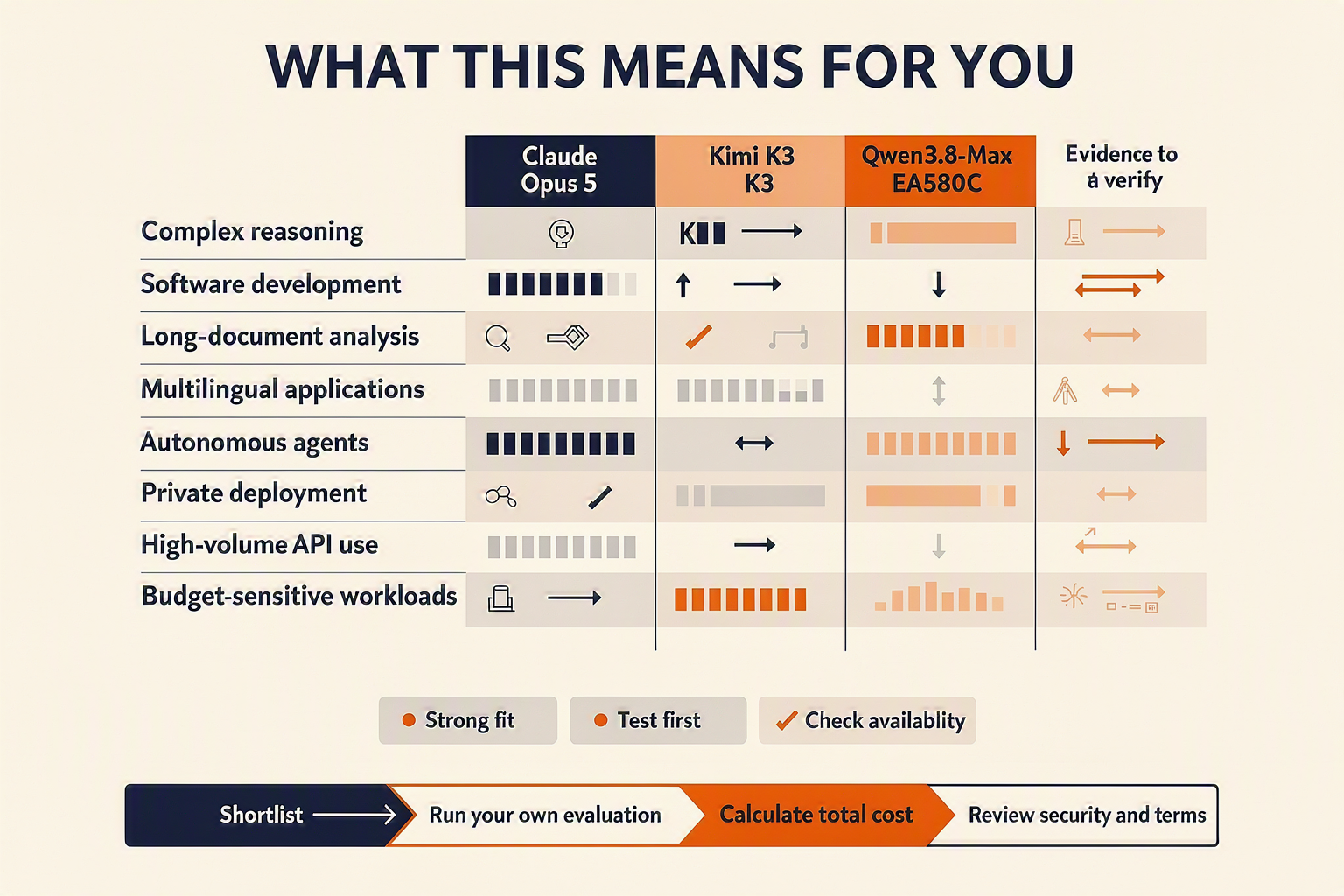
Choose Claude Opus 5, Kimi K3 or Qwen3.8-Max by workload-level evaluation, not model size alone. As of July 23, 2026, the supplied comparison brief supports Kimi K3’s 2.8-trillion total-parameter figure but provides no verified parameter count for Qwen3.8-Max, so neither number should determine procurement.
Workload-to-model decision matrix
The recommendations below are testing priorities, not claims of benchmark leadership. Each candidate must pass the same production-representative evaluation before deployment.
| Workload | Model to test first | Why it belongs on the shortlist | Required validation |
|---|---|---|---|
| Complex reasoning and analysis | Claude Opus 5 | Evaluate for multi-step instruction following, structured analysis and sustained reasoning | Accuracy, citation validity, reasoning consistency and cost per accepted answer |
| Long-running agents and tool use | Claude Opus 5 + Kimi K3 | Compare planning, function calling, recovery from tool errors and state retention | Task completion rate, tool-call accuracy, retries and end-to-end latency |
| High-volume text generation | Kimi K3 + Qwen3.8-Max | Test throughput and economics rather than inferring efficiency from architecture | Tokens per second, time to first token, total cost and output acceptance rate |
| Chinese or multilingual workflows | Kimi K3 + Qwen3.8-Max | Run native-language prompts, domain terminology and mixed-language conversations | Human preference, terminology accuracy, script handling and translation fidelity |
| Repository-scale coding | All three | Coding results can vary sharply by language, framework, repository size and agent harness | Tests passed, valid patches, regression rate, tool usage and cost per merged fix |
| Regulated or customer-facing automation | All three with fallback | Reliability, traceability and policy compliance matter more than a single quality score | Hallucination rate, policy violations, uptime, auditability and fallback success |
Apply three selection gates
A defensible evaluation should use three consecutive gates:
- Capability: Test at least 100 representative tasks, including easy, adversarial and failure-prone examples. Score outputs blindly where possible, and require executable tests for coding tasks.
- Economics: Calculate cost per successful outcome, not merely cost per million tokens. A cheaper response becomes expensive when it requires repeated generation, human correction or failed tool calls.
- Operations: Measure p50 and p95 latency, rate-limit behavior, structured-output validity, outage handling and performance drift after model updates.
For agentic workloads, track the complete trajectory. A model that produces convincing prose but selects the wrong tool, malformed arguments or an unrecoverable sequence should count as a failed run.
Do not use parameter count as the tiebreaker
The July 23, 2026 comparison brief reports Kimi K3 at 2.8 trillion total parameters; that number should not be reassigned to Qwen3.8-Max. The brief does not establish Qwen3.8-Max’s total or active parameter count, so the accurate entry remains unconfirmed, not estimated.
For mixture-of-experts systems, buyers should separately request:
- Total parameters
- Parameters activated per token
- Quantization and serving configuration
- Measured throughput on comparable hardware
Finally, avoid permanent single-model routing. An OpenAI-compatible gateway such as CallMissed can help teams evaluate multiple providers through one interface and configure same-tier fallbacks. The practical winner is the model—or routed combination—that consistently meets the workload’s quality, latency, cost and reliability thresholds.
Frequently Asked Questions about Claude Opus 5 vs Kimi K3 vs Qwen3.8-Max
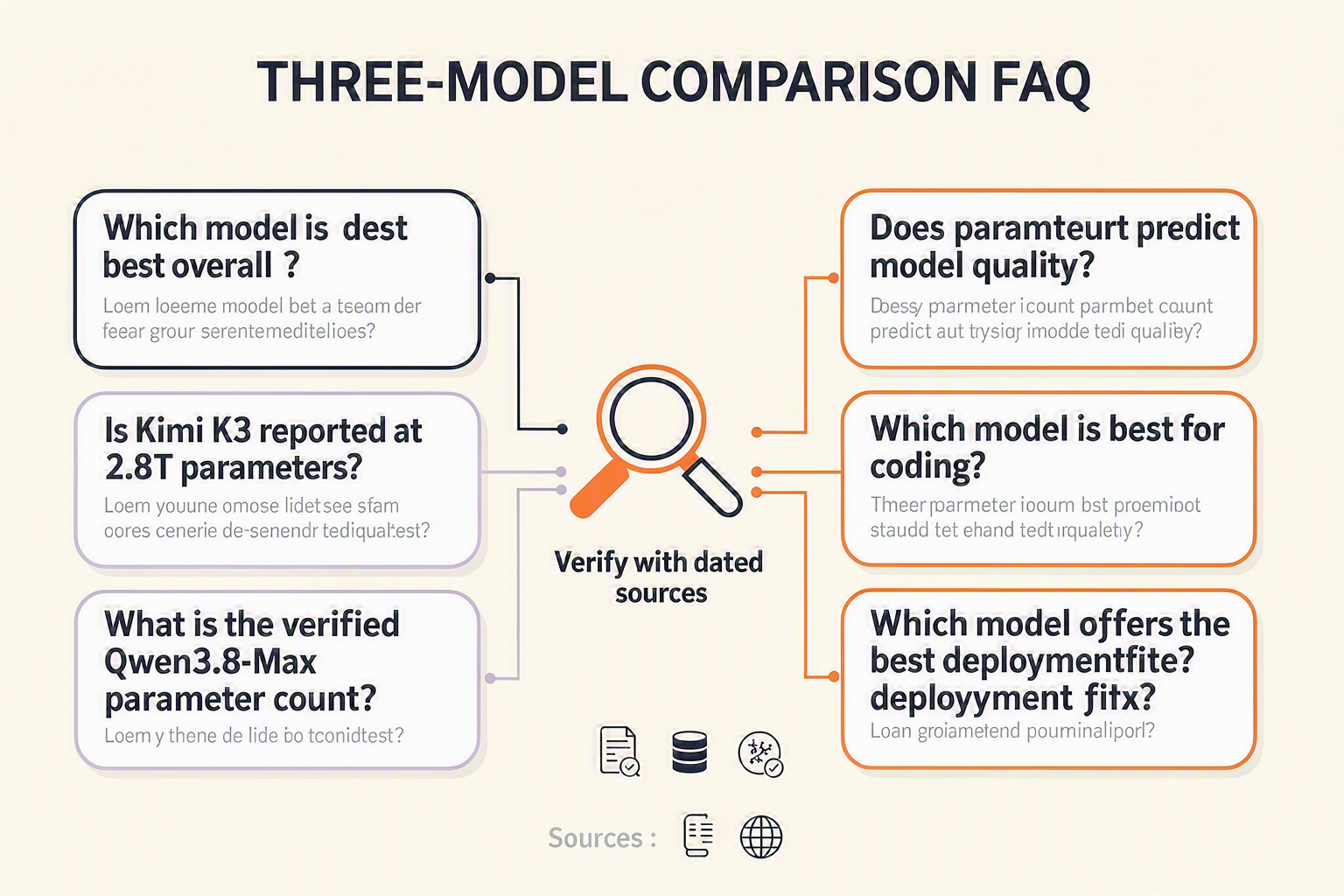
Parameters and architecture
How many parameters do Claude Opus 5, Kimi K3 and Qwen3.8-Max have?
Why does the Claude Opus 5 vs Kimi K3 vs Qwen3.8-Max parameter comparison cause confusion?
Performance and capabilities
Which is better for coding: Claude Opus 5, Kimi K3 or Qwen3.8-Max?
Which model is best for long-context and agentic workflows?
Does Claude Opus 5 vs Kimi K3 vs Qwen3.8-Max have a clear benchmark winner?
Deployment decisions
How should developers choose between Claude Opus 5, Kimi K3 and Qwen3.8-Max for production?
Conclusion
There is no universal winner in the Claude Opus 5 vs Kimi K3 vs Qwen3.8-Max comparison as of July 23, 2026. The right choice depends on verified performance across reasoning, coding, context handling, multimodal inputs, latency, pricing, deployment options and operational reliability.
- Parameter counts require careful interpretation. The supplied comparison brief reports Moonshot AI Kimi K3 at 2.8 trillion total parameters; that figure should not be attributed to Alibaba Qwen3.8-Max. Because no dated primary source in the brief confirms Qwen3.8-Max’s count, it should remain unverified rather than be guessed.
- Total parameters do not equal active parameters. In a mixture-of-experts architecture, only part of the model may be activated for each token. Buyers therefore cannot infer inference cost, throughput or output quality from the headline model size alone.
- Workload testing matters more than a single leaderboard. Anthropic Claude Opus 5, Moonshot AI Kimi K3 and Alibaba Qwen3.8-Max should be evaluated with identical prompts, tools and operating conditions. Repository-scale coding, multilingual instructions, long-running agents and production tool calls can expose differences that aggregate benchmark scores conceal.
- The practical decision is multi-dimensional. Model quality must be considered alongside response speed, price, context capacity, availability, fallback options and consistency under real traffic. A strong deployment may use different models for different workloads instead of forcing every request through one system.
What to watch next
The most important developments will be dated model cards, reproducible independent evaluations and clearer reporting of total versus active parameters. Buyers should also watch whether benchmark gains translate into dependable performance across long-context, agentic and multilingual production workloads.
Developers can explore this multi-model approach through CallMissed, an OpenAI-compatible AI gateway offering multiple models and same-tier fallbacks through one integration. As model capabilities and economics continue to shift, will your architecture remain flexible enough to choose the best model for each task?
Related Reading
Related Posts


Ready to automate customer conversations?
Launch AI voice agents and WhatsApp bots with CallMissed — one API, 22+ Indian languages.