

AI Voice Agent ROI: A Practical Measurement Guide for 2026


Measure AI voice agent ROI with a practical framework for calls, leads, bookings, attribution, experiments, and cost per outcome.
AI Voice Agent ROI: A Practical Measurement Guide for 2026
What if the most expensive customer call is not the one your team answers, but the one that rings out unnoticed? AI voice agent ROI measures whether automation converts those missed opportunities into qualified leads, booked appointments, resolved requests, and successful human handoffs—after accounting for every technology and operating cost.
Why measurement matters in 2026
Customer expectations and AI capabilities are converging around immediate, always-available service. Salesforce’s April 2024 State of the Connected Customer report found that 77% of customers expect to interact with someone immediately when they contact a company. Meanwhile, Gartner forecast in March 2025 that agentic AI will autonomously resolve 80% of common customer-service issues by 2029, potentially reducing operational costs by 30%.
Those projections make voice automation compelling, but they do not prove that a particular deployment is profitable. A system can answer every call and still produce weak returns if it captures poor-quality leads, books appointments that do not occur, frustrates callers, or transfers conversations without sufficient context.
The practical question is therefore not, “How many calls did the agent handle?” It is, “What measurable business outcomes changed because the agent handled them?”
From call volume to business value
This guide builds an ROI framework around the complete call funnel:
- Establish a missed-call baseline before deployment.
- Measure answer rate, response time, qualified leads, and booked appointments.
- Track speed to lead, containment, escalation, and transfer success.
- Calculate cost per qualified lead, appointment, resolution, and retained opportunity.
- Implement missed call conversion tracking across phone, CRM, calendar, and revenue data.
- Separate genuine impact from seasonality, campaign changes, and existing team performance.
You will also learn how to define reliable voice AI metrics, design holdout or phased experiments, assign attribution when several channels influence a conversion, and avoid misleading vanity measures such as raw call counts or average duration alone. A reusable worksheet will connect incremental gross profit and cost savings to platform fees, telephony charges, implementation expenses, human-review time, and ongoing maintenance.
Platforms such as CallMissed can help Indian businesses apply this framework across AI voice agents, WhatsApp Business calls, CRM workflows, and 22 Indian languages while retaining outcome-level measurement.
The goal is not to manufacture an impressive percentage. It is to create an auditable model that finance, operations, sales, and customer-service teams can inspect—and use to decide where voice AI should expand, improve, or stop.
How do you calculate AI voice agent ROI in 2026? Use incremental value minus total cost, divided by total cost
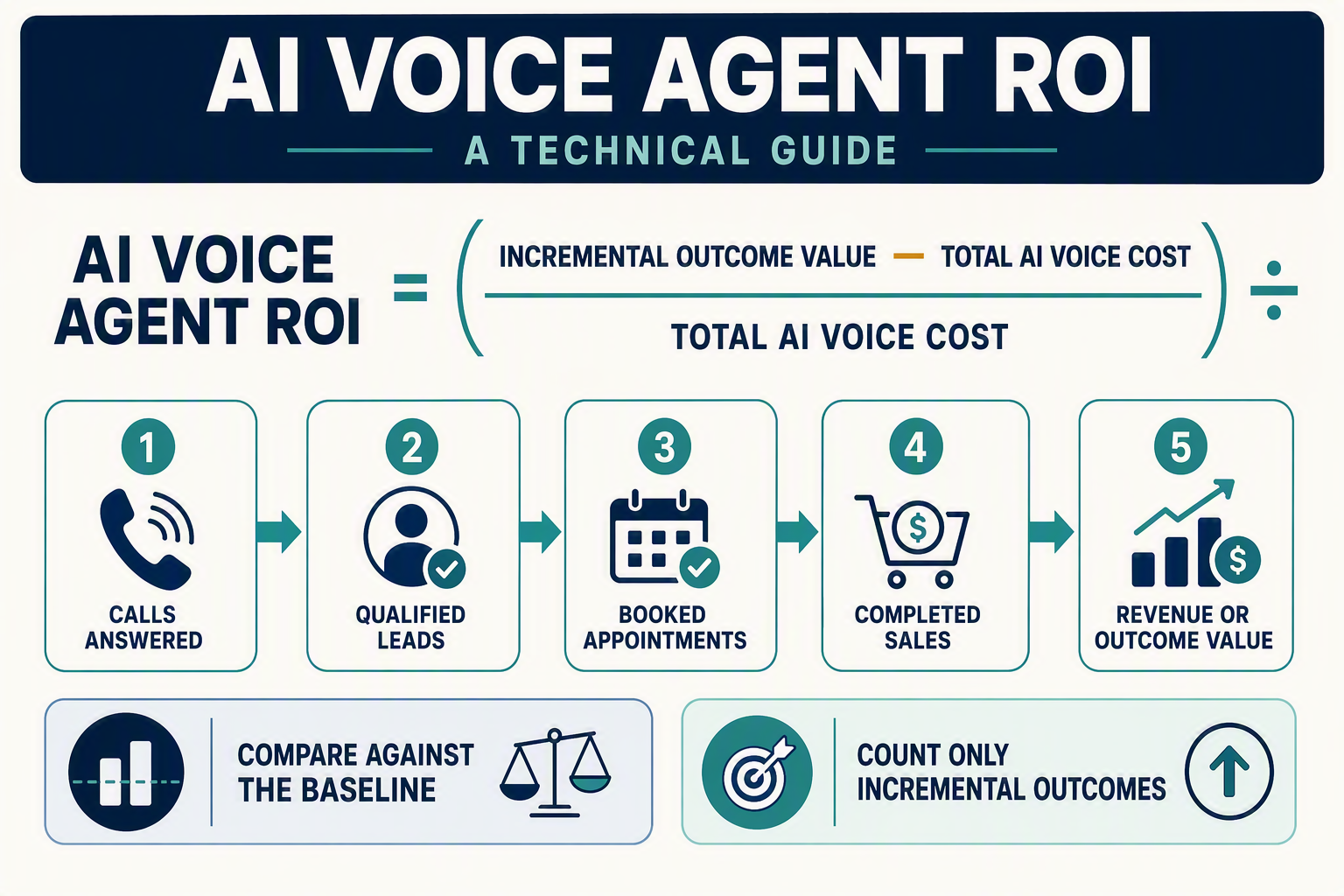
AI voice agent ROI is calculated as incremental business value minus the fully loaded cost of the AI deployment, divided by that fully loaded cost. The calculation must compare performance against a credible no-AI baseline—not assume that every call handled by automation created new value.
\[
\text{AI Voice Agent ROI (\%)} =
\frac{\text{Incremental Value} - \text{Total Cost}}
{\text{Total Cost}} \times 100
\]
Define incremental value against a counterfactual
Incremental value is the economic difference between observed results and what would probably have happened without the AI voice agent.
\[
\text{Incremental Outcomes} =
\text{Observed Outcomes} - \text{Expected Baseline Outcomes}
\]
The baseline can come from a randomized holdout group, a phased rollout, matched locations, or historical data adjusted for seasonality and marketing activity. For example, converting 100 callers is not incremental if human agents would ordinarily have converted 80; the AI-attributable increase is 20 conversions.
Value should be based on gross profit or contribution margin, not headline revenue. Include:
- Incremental qualified leads multiplied by their historical lead-to-sale rate and contribution margin.
- Incremental attended appointments multiplied by appointment-to-sale probability and contribution margin.
- Contained service requests multiplied by genuinely avoidable human handling cost.
- Retained customers or recovered payments valued using expected contribution, not total contract value.
- Productivity released to other work, but only where redeployment or cost avoidance can be demonstrated.
Gartner’s March 2025 forecast that agentic AI could reduce operational costs by 30% by 2029 is a directional market estimate, not a saving that businesses should automatically insert into an ROI model.
Include the fully loaded cost
Total cost must cover more than the AI platform subscription. Use a consistent measurement period—usually monthly, quarterly, or annually—and include:
- Platform and model usage fees, including speech recognition, language-model, and text-to-speech consumption.
- Telephony costs, phone numbers, call minutes, recording, and carrier charges.
- Implementation expenses, such as workflow design, CRM integration, prompt development, and testing.
- Human operating costs, including monitoring, quality assurance, escalations, and compliance reviews.
- Maintenance costs for knowledge updates, analytics, retraining, and failure investigation.
- One-time costs, amortized over the deployment’s expected useful life when appropriate.
Platforms such as CallMissed make usage easier to reconcile through transparent credit pricing—where one credit equals ₹1—but finance teams should still add telephony, staffing, integration, and maintenance costs.
Worked ROI example
Consider a hypothetical 12-month deployment:
- Incremental contribution from attended appointments: ₹480,000
- Avoidable cost from contained service calls: ₹72,000
- Contribution from retained customers: ₹120,000
- Total incremental value: ₹672,000
- Fully loaded deployment cost: ₹516,000
\[
\text{ROI} =
\frac{₹672,000 - ₹516,000}{₹516,000} \times 100
= 30.2\%
\]
The deployment therefore generated ₹1.30 of incremental value for every ₹1 spent, before considering tax or financing effects.
Prevent double counting
A single caller may appear as an answered call, qualified lead, appointment, and sale. Count the final economic outcome once rather than adding value at every funnel stage. Missed call conversion tracking should connect call IDs with CRM records, calendar events, attendance, sales, and refunds, while supporting voice AI metrics such as answer rate, containment, transfer success, and speed to lead as diagnostic—not independently additive—measures.
What background data must you capture before launching an AI voice agent?
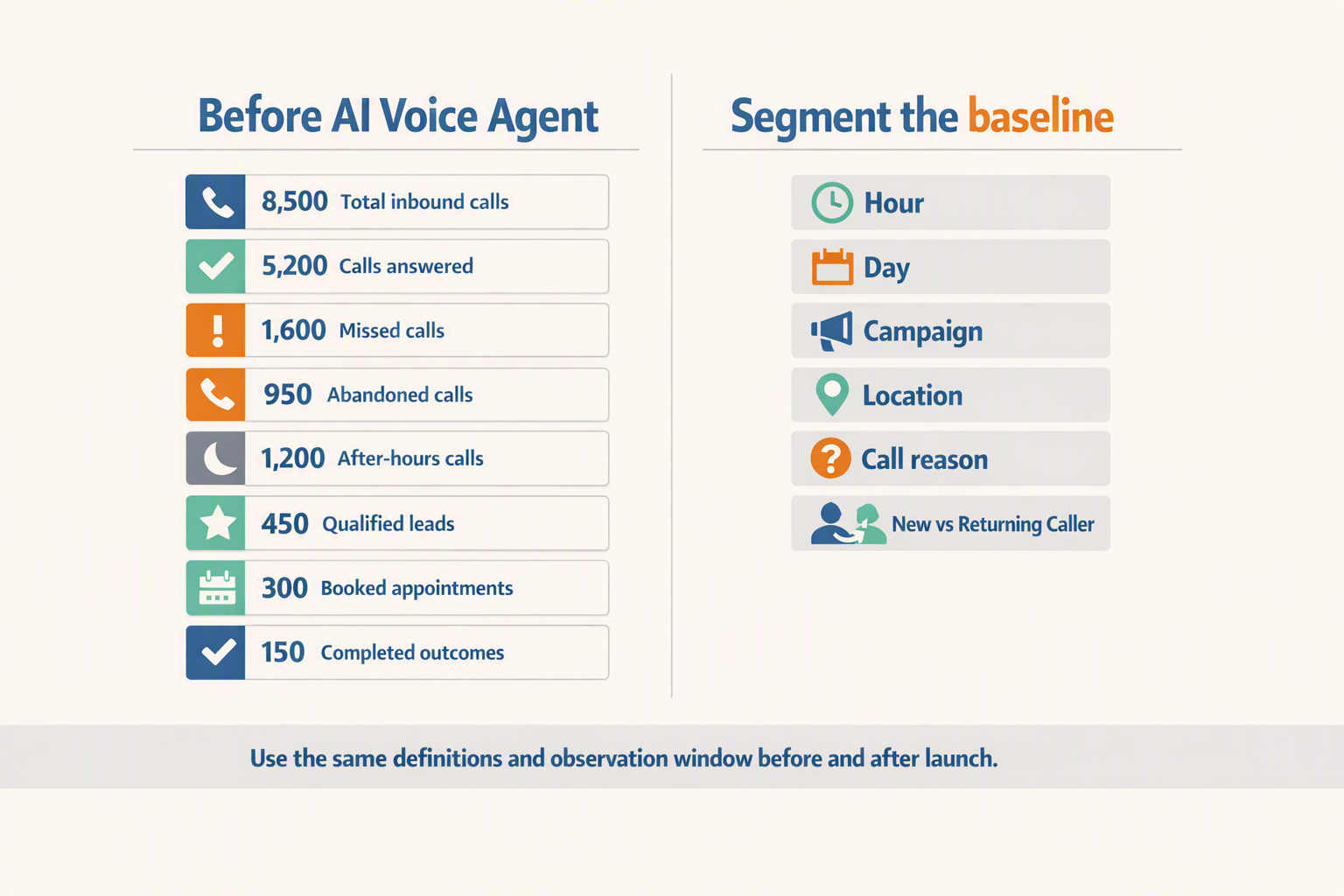
Before launch, capture a representative pre-deployment dataset linking every inbound call to its source, handling outcome, customer record, downstream conversion, revenue, and cost. This baseline is the counterfactual required to determine whether later changes in AI voice agent ROI came from automation rather than seasonality, marketing spend, staffing, or demand fluctuations.
1. Define the baseline observation window
Use enough historical data to cover at least one complete sales or service cycle. The appropriate window may be several weeks for appointment-led businesses or several months where purchases have long consideration periods.
Record results by hour, day, location, campaign, language, call reason, and new-versus-existing customer status. Segmentation prevents an apparent improvement caused by a shift toward easier calls—for example, more daytime enquiries and fewer after-hours support requests.
Preserve these baseline counts:
- Total inbound call attempts and unique callers
- Calls answered by a person, abandoned while waiting, sent to voicemail, or missed
- Repeat attempts from the same phone number
- After-hours, busy-line, and no-agent-available calls
- Average and percentile wait times, not only averages
- Calls returned and the elapsed time before callback
The original urgency benchmark remains relevant: Salesforce reported in April 2024 that 77% of customers expect to interact with someone immediately when contacting a company. Therefore, a missed call returned hours later should not be classified as equivalent to an immediately answered call.
2. Connect calls to commercial outcomes
A telephony log alone cannot measure value. Establish a persistent call ID and map it to CRM, calendar, ticketing, and payment records. For each call, capture:
- Lead status: valid enquiry, qualified lead, unqualified lead, spam, or existing customer.
- Conversion event: appointment requested, booked, attended, cancelled, or marked as a no-show.
- Service event: issue resolved, escalated, transferred, reopened, or abandoned.
- Financial result: order value, expected gross profit, refund, renewal, or retained revenue.
- Attribution fields: campaign ID, source number, landing page, location, and prior customer touches.
This schema enables missed call conversion tracking. A missed call becomes measurable when the business can determine whether the caller tried again, received a callback, booked elsewhere in the journey, or generated revenue.
3. Establish operational and cost baselines
Capture the current process cost before comparing it with automation:
- Agent wages and employer costs attributable to call handling
- Outsourced contact-centre or answering-service fees
- Telephony, recording, CRM, and scheduling expenses
- Supervisor review, training, quality assurance, and callback time
- Average handling time, after-call work, and calls handled per paid hour
Also document existing answer rate, speed to lead, qualification rate, booking rate, resolution rate, transfer completion, and cost per outcome. These become the pre-launch voice AI metrics, not targets selected after results are visible.
4. Audit data quality before deployment
Verify timestamp consistency, duplicate handling, consent and recording rules, CRM completeness, and the meaning of every status. Sample call records manually to test whether “answered,” “qualified,” and “resolved” match reality.
For CallMissed deployments spanning AI voice agents, WhatsApp Business calls, and CRM workflows, use the same customer and outcome identifiers across channels. This creates an auditable baseline from which incremental conversions, cost savings, and genuine automation impact can later be calculated.
Which 2026 voice AI metrics connect calls to business outcomes? (TABLE)
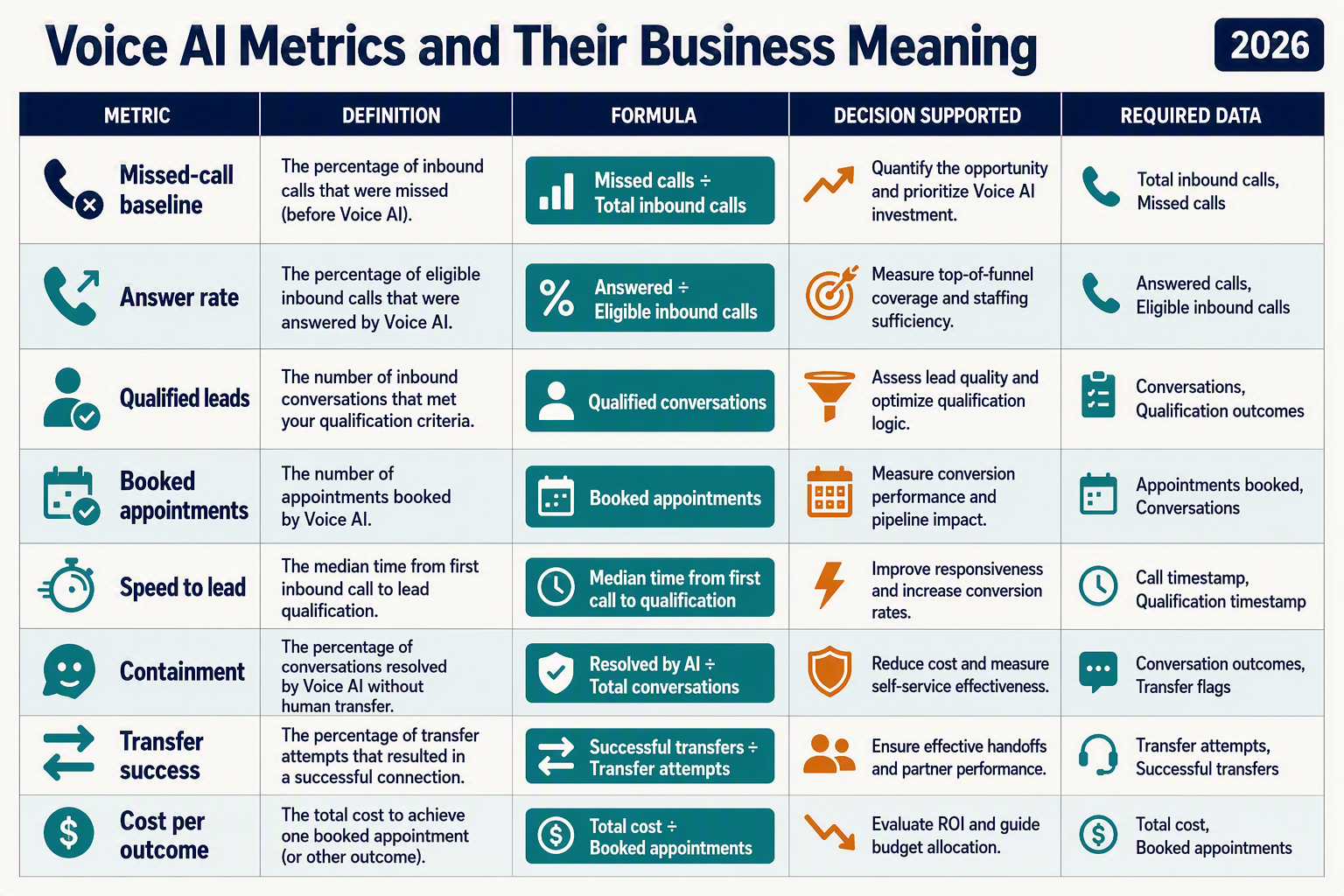
The voice AI metrics that matter in 2026 trace each eligible call from initial ring to a financially meaningful outcome. Measure the entire funnel—not isolated activity—using consistent denominators, unique call IDs, CRM dispositions, calendar events, and eventual revenue or resolution data.
Outcome-linked measurement framework
| Metric | Calculation | Business outcome | Required data | Key guardrail |
|---|---|---|---|---|
| Missed-call recovery rate | Missed calls later answered or converted ÷ eligible missed calls | Opportunities recovered | Phone logs, caller ID, callback records, CRM outcome | Exclude spam, duplicates, abandoned calls under an agreed threshold, and calls outside the target cohort |
| Answer rate | Answered eligible calls ÷ total eligible inbound calls | Customer access and captured demand | Telephony status, timestamps, business hours | Report human, AI, and combined answer rates separately |
| Qualified-lead rate | Calls meeting documented qualification criteria ÷ completed sales conversations | Sales-ready demand | Transcript fields, CRM stage, qualification rules | Freeze criteria before testing; an AI-generated label alone is not proof of quality |
| Appointment conversion | Valid appointments booked ÷ eligible conversations | Pipeline creation | Call ID, calendar booking, CRM contact | Pair booking rate with attendance, cancellation, and duplicate-booking rates |
| Speed to lead | Median time from enquiry or missed call to first meaningful response | Faster contact and higher recovery potential | Enquiry timestamp, dial event, connected-call timestamp | Use median and percentile distributions; averages can hide long delays |
| Containment and transfer success | Resolved without human help ÷ eligible service calls; successful handoffs ÷ attempted transfers | Automation savings and preserved customer experience | Intent, resolution status, transfer event, queue answer, post-call outcome | Do not classify hang-ups, silent calls, or failed transfers as contained resolutions |
Define the funnel before calculating ROI
A defensible measurement chain should follow:
- Eligible calls
- Answered calls
- Completed conversations
- Qualified leads or resolved service requests
- Booked appointments
- Attended appointments, sales, or verified resolutions
Each stage needs a written definition. For example, a booked appointment should require a valid customer identifier, available time slot, and confirmed calendar event. A qualified lead might require service fit, location eligibility, purchase timeframe, and customer consent. These rules prevent teams from improving reported conversion simply by loosening labels.
For missed call conversion tracking, assign one persistent interaction ID across telephony, the AI agent, customer relationship management system, calendar, and payment or case-management platform. When identity matching is uncertain—such as several family members using one phone number—mark the record as probabilistic rather than forcing attribution.
Add quality and cost guardrails
No metric should be interpreted alone. Rising containment can reduce costs while concealing repeat calls or incorrect resolutions; higher transfer rates may be appropriate for regulated, sensitive, or high-value conversations. Track supporting indicators such as:
- Repeat contact within 24 hours or seven days
- Transfer queue answer rate
- Appointment show rate
- CRM disposition accuracy
- Opt-out, complaint, and escalation rates
- Cost per qualified lead, booking, attended appointment, or resolution
For CallMissed users, the same framework can connect AI voice-agent and WhatsApp Business calling events to CRM outcomes. CallMissed’s transparent model of one credit equalling ₹1 also makes platform usage easier to place in the cost ledger alongside telephony, implementation, human review, and maintenance.
Ultimately, AI voice agent ROI should be based on verified incremental outcomes—not calls handled, minutes spoken, or containment percentages viewed in isolation.
How should containment and transfer success be measured without hiding poor customer experiences?
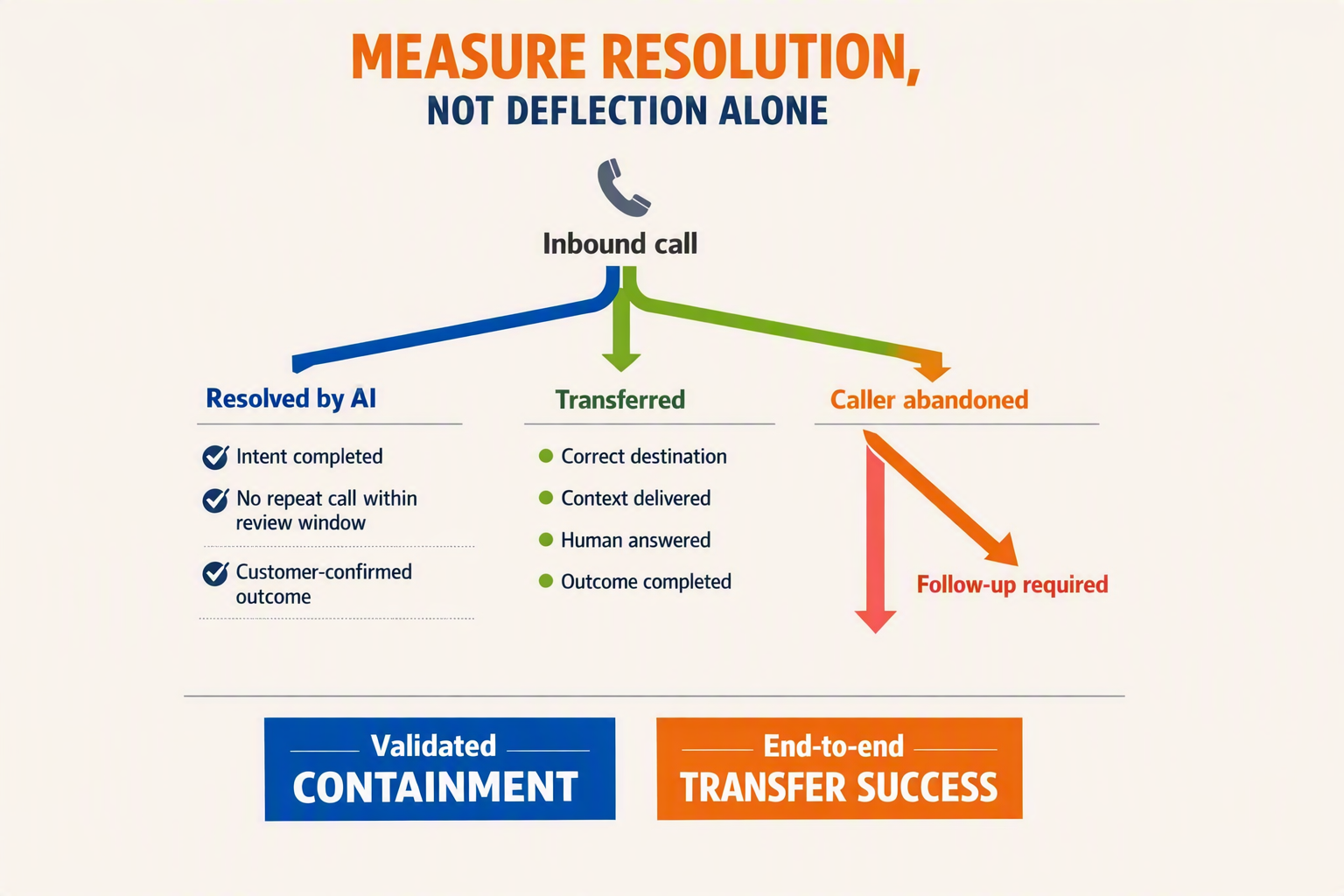
Containment should count only calls that the AI fully resolves, while transfer success should count only handoffs that connect the caller to the right human with usable context. Neither metric should treat hang-ups, repeat calls, or abandoned transfers as successful outcomes.
Define containment by verified resolution
Use an eligible-call denominator rather than all answered calls:
Verified containment rate = AI-resolved eligible calls ÷ eligible calls × 100
An eligible call is one the AI is authorised and technically equipped to complete. Exclude spam, test calls, wrong numbers, outages, and requests that policy requires a human to handle.
A contained call should satisfy all three conditions:
- The requested task was completed or the question was correctly answered.
- The caller did not request a human before completion.
- No repeat contact for the same issue occurred within a defined window, such as 24 hours or seven days.
Completion must be tied to system evidence: a confirmed appointment ID, payment status, CRM update, ticket closure, or authenticated information delivery. “The caller hung up without transferring” is not proof of resolution.
Measure transfer success as an end-to-end outcome
Transfer connection rate = transfers connected to a human ÷ transfer attempts × 100
Connection alone remains insufficient. A stronger successful-transfer rate requires:
- Connection to the correct team or queue.
- Transfer within the promised wait-time threshold.
- Delivery of the transcript, intent, authentication state, and collected details.
- No need for the caller to repeat material information.
- A documented disposition or next action from the human agent.
Track failed handoffs separately as no answer, queue abandonment, wrong destination, technical failure, or context failure. These categories reveal whether the problem lies with AI routing, telephony, staffing, or workflow design.
Add customer-experience guardrails
A high containment rate can conceal callers who give up. Pair core voice AI metrics with:
- Repeat-contact rate: callers returning about the same issue.
- Escalation-request rate: callers explicitly asking for a person.
- Premature-disconnect rate: calls ending before task completion.
- Post-call CSAT: collected consistently across AI-only and human-assisted calls.
- Complaint and correction rate: cases requiring remediation after an incorrect answer.
- Transfer latency: time from escalation decision to human connection.
- First-contact resolution: issues completed without repeat contact or reopening.
These guardrails are commercially relevant: Salesforce reported in April 2024 that 77% of customers expect to interact with someone immediately when contacting a company. A transfer that leaves the caller waiting or forces them to restart the conversation fails that expectation even if the dashboard records a connection.
Audit outcomes, not just transcripts
Review a stratified sample of contained and transferred calls every week, covering languages, intents, call lengths, customer types, and operating hours. Human reviewers should score task completion, factual accuracy, policy compliance, conversational friction, and handoff quality using a shared rubric.
For AI voice agent ROI, report containment alongside downstream outcomes—not as an isolated efficiency claim. Gartner forecast in March 2025 that agentic AI could autonomously resolve 80% of common customer-service issues by 2029, but an individual deployment should never use that forecast as its target or assumed benefit. Verified resolutions, successful transfers, repeat contacts, and customer outcomes provide the auditable evidence needed to distinguish genuine automation from hidden service failure.
How do attribution and experiment design prove that the AI agent caused incremental results?
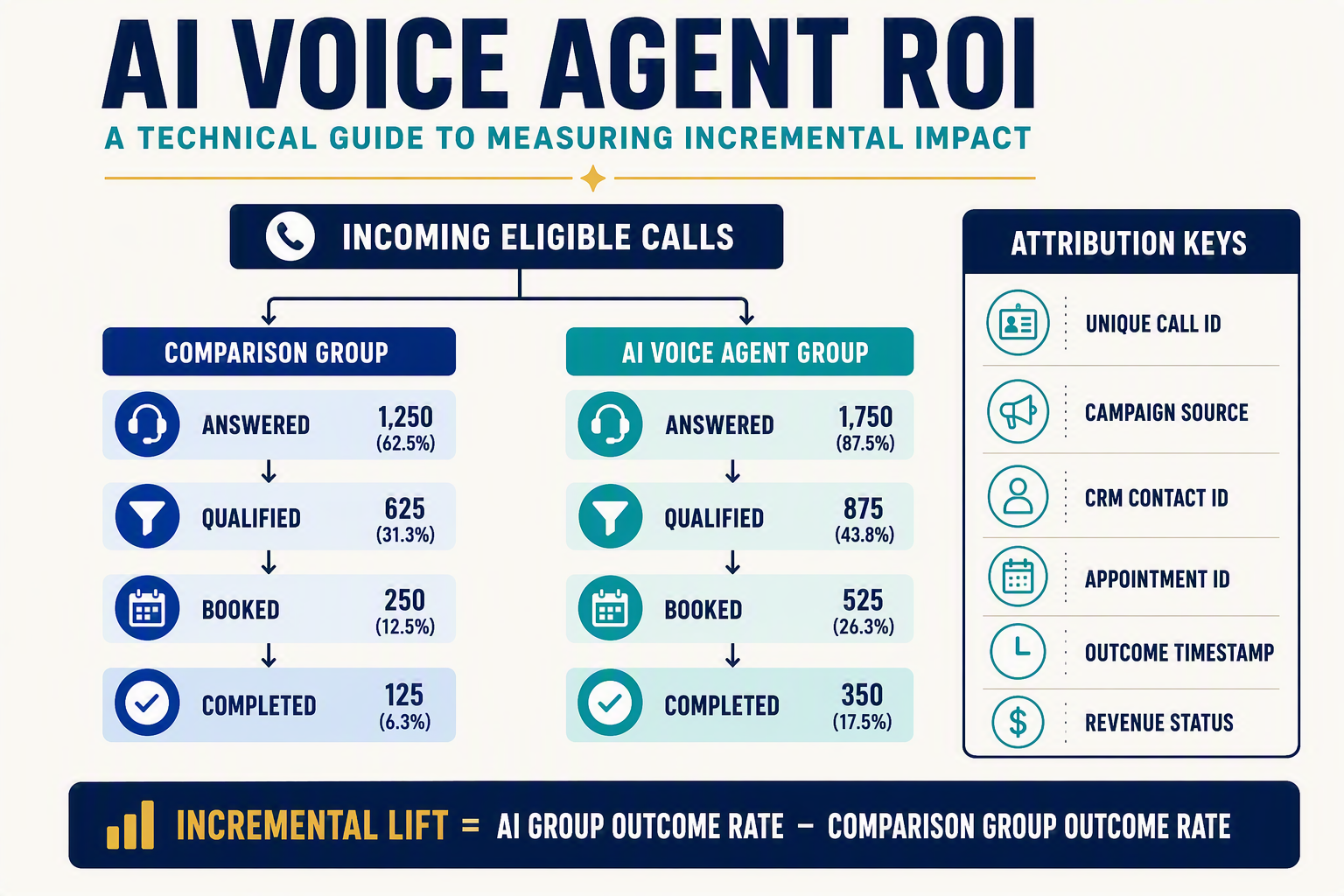
Attribution shows where a conversion came from; experiment design establishes whether the AI voice agent caused it. The strongest proof compares outcomes for otherwise similar calls that did and did not receive AI treatment, then values only the statistically credible difference as incremental benefit.
Build a causal test, not a before-and-after comparison
A simple pre/post comparison is vulnerable to seasonality, advertising spend, staffing changes, holidays, and shifts in caller intent. Gartner’s March 2025 forecast that agentic AI could resolve 80% of common service issues by 2029 is an industry projection—not evidence that a specific deployment caused incremental results.
Use one of these designs:
- Randomized holdout: Randomly route eligible calls to either the AI agent or the existing process. This is the preferred design because randomization balances observed and unobserved differences.
- Phased rollout: Introduce the agent across branches, regions, queues, or time blocks in a randomized sequence. Compare early and late adopters using a difference-in-differences analysis.
- Matched control: When randomization is impossible, match AI-assisted calls with comparable historical or concurrent calls by source, location, intent, language, hour, and customer type.
- Switchback test: Alternate AI and control routing across predefined time windows. This works for high-volume queues but requires controls for weekday and intraday demand.
Keep assignment stable. A caller allocated to the control group should not enter the AI group on a repeat call unless the analysis explicitly operates at the call rather than customer level.
Instrument attribution across the funnel
Reliable missed call conversion tracking requires a persistent identifier connecting telephony events to downstream outcomes. Store:
- Call ID, anonymized caller ID, timestamp, campaign source, and routing group.
- Treatment assignment and AI model or workflow version.
- Intent, language, qualification status, containment, and transfer result.
- CRM lead, appointment, order, resolution, cancellation, and revenue identifiers.
- Conversion timestamps and an explicit attribution window, such as 7, 30, or 90 days.
Use deterministic matching—such as a CRM contact ID or verified telephone number—before probabilistic matching. For multi-channel journeys, report both first-touch or last-touch attribution and the experimental lift. Attribution may assign credit to voice, WhatsApp, email, or paid search; randomized lift estimates whether adding the voice agent changed the final outcome.
Platforms such as CallMissed can connect AI voice and WhatsApp Business calling workflows, but teams should still pass consistent call, CRM, calendar, and campaign identifiers into their analytics layer.
Calculate incremental lift and test reliability
For each outcome, calculate:
Incremental lift = AI-group conversion rate − control-group conversion rate
If 1,000 eligible AI-routed calls produce 140 booked appointments and 1,000 control calls produce 100, the observed lift is 4 percentage points, or 40 incremental appointments. Do not value all 140 appointments as AI-generated.
Pre-register the primary voice AI metrics, eligibility rules, attribution window, minimum sample size, and stopping date. Also:
- Report confidence intervals, not only point estimates.
- Segment results by intent, language, new versus returning customer, and operating hours.
- Monitor contamination, routing failures, and CRM matching rates.
- Run tests long enough to include normal weekly demand cycles.
- Apply gross margin—not total revenue—to incremental sales.
The resulting incremental gross profit and verified labour savings should feed the AI voice agent ROI calculation. This prevents normal demand, marketing activity, or conversions the human team would have captured anyway from being mislabelled as AI-created value.
What do cost per outcome and sensitivity analysis reveal about financial impact?
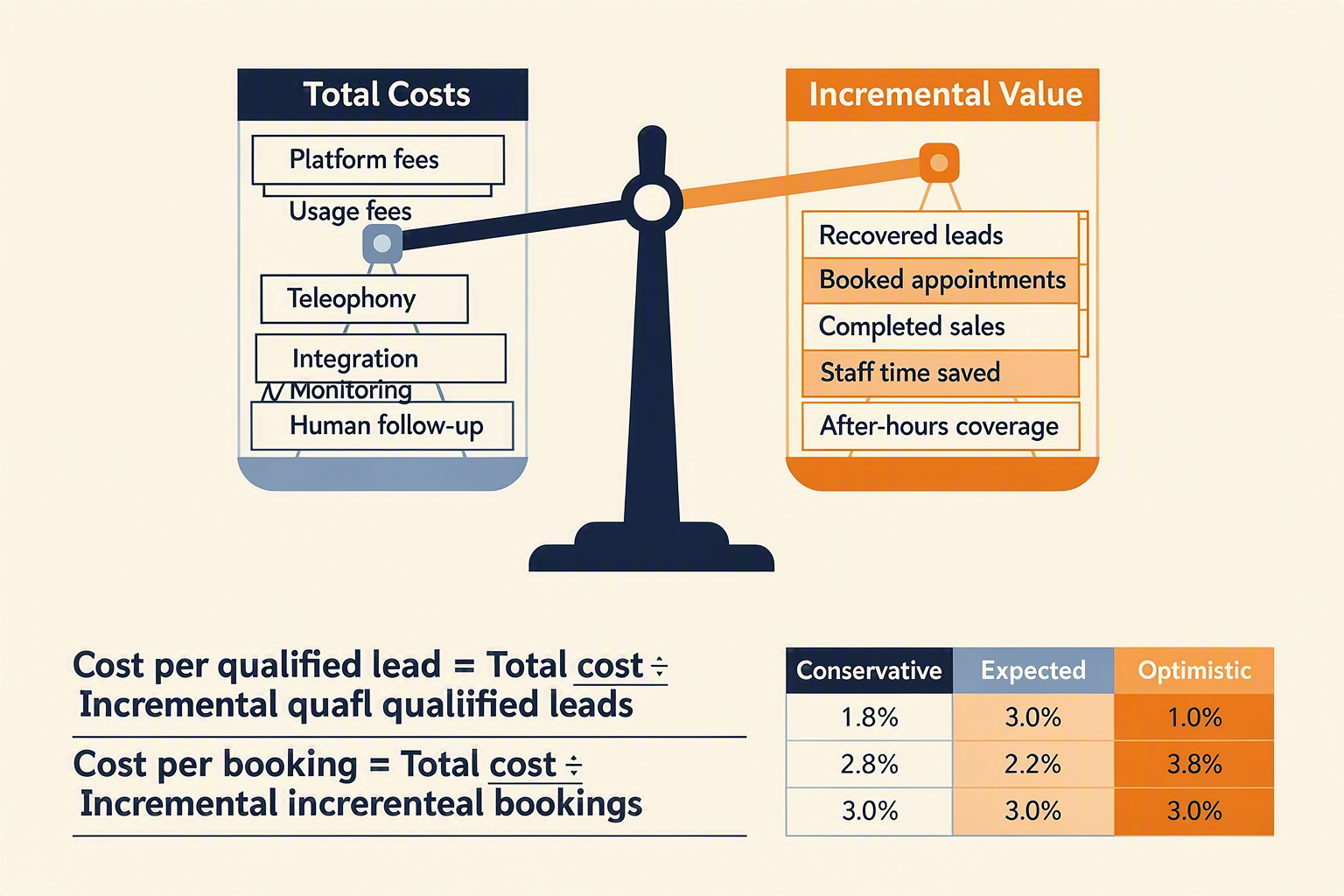
Cost per outcome shows whether AI voice automation produces valuable results efficiently; sensitivity analysis shows whether that conclusion survives realistic changes in volume, conversion, value, and cost. Together, they reveal financial impact more reliably than answer rate or call volume alone.
Calculate cost per outcome at each funnel stage
Use incremental outcomes—results created above the pre-deployment baseline—rather than every outcome touched by the agent:
Cost per incremental outcome = Total incremental AI cost ÷ Incremental successful outcomes
Calculate the metric separately for:
- Qualified leads, using the same CRM qualification rules for AI- and human-handled calls.
- Booked appointments, excluding duplicates, cancellations, and test bookings.
- Attended appointments, because a booking that becomes a no-show may have limited economic value.
- Contained resolutions, limited to issues completed without repeat contact inside the defined window.
- Successful transfers, where the caller reaches the correct human team with usable context.
- Recovered missed calls, verified through missed call conversion tracking rather than inferred from answered-call counts.
The cost numerator should include platform subscriptions, telephony, model usage, implementation amortisation, integrations, monitoring, human review, maintenance, and incremental human handling after transfers. Platforms with transparent usage units simplify this step: CallMissed defines one credit as ₹1, enabling teams to reconcile model or communication usage with a rupee-denominated cost ledger. However, credits are only one component of the fully loaded cost.
Compare cost per outcome with its expected contribution margin, not top-line revenue. If an attended appointment costs ₹1,500 to generate and produces ₹3,000 in expected gross profit after fulfilment costs, its expected contribution before AI overhead allocation is ₹1,500.
Build downside, base, and upside scenarios
Sensitivity analysis changes uncertain inputs to identify which assumptions control AI voice agent ROI. Consider this illustrative deployment with a fixed monthly AI cost of ₹120,000:
| Scenario | Incremental attended appointments | Gross profit per appointment | Cost per appointment | ROI |
|---|---|---|---|---|
| Downside | 48 | ₹2,500 | ₹2,500 | 0% |
| Base | 80 | ₹3,000 | ₹1,500 | 100% |
| Upside | 112 | ₹3,500 | ₹1,071 | 227% |
These figures are an example, not an industry benchmark. ROI is calculated as [(appointments × gross profit) − ₹120,000] ÷ ₹120,000; the upside result is rounded.
Test inputs individually before combining them into scenarios:
- Eligible call volume: What happens if seasonality reduces calls by 20%?
- Incremental conversion lift: How much lift remains after removing conversions that would have occurred anyway?
- Show or completion rate: Do bookings produce attended, revenue-generating outcomes?
- Outcome value: How does ROI change when product mix or gross margin declines?
- Variable cost: Do longer calls, multilingual routing, transfers, or retries increase usage?
- Containment quality: Does apparent containment create repeat calls or later human work?
Find the break-even threshold
The break-even outcome count is:
Monthly AI cost ÷ Gross profit per successful outcome
In the base example, ₹120,000 ÷ ₹3,000 = 40 incremental attended appointments. Finance can therefore ask whether observed lift is credibly above 40, rather than debating dozens of isolated voice AI metrics.
The most useful sensitivity model highlights the few assumptions capable of reversing the investment decision. If a small change in show rate turns positive ROI negative, the deployment is financially fragile—and improving appointment confirmation may matter more than answering additional calls.
Which expert claims and vendor benchmarks should you trust when evaluating AI voice agent ROI?
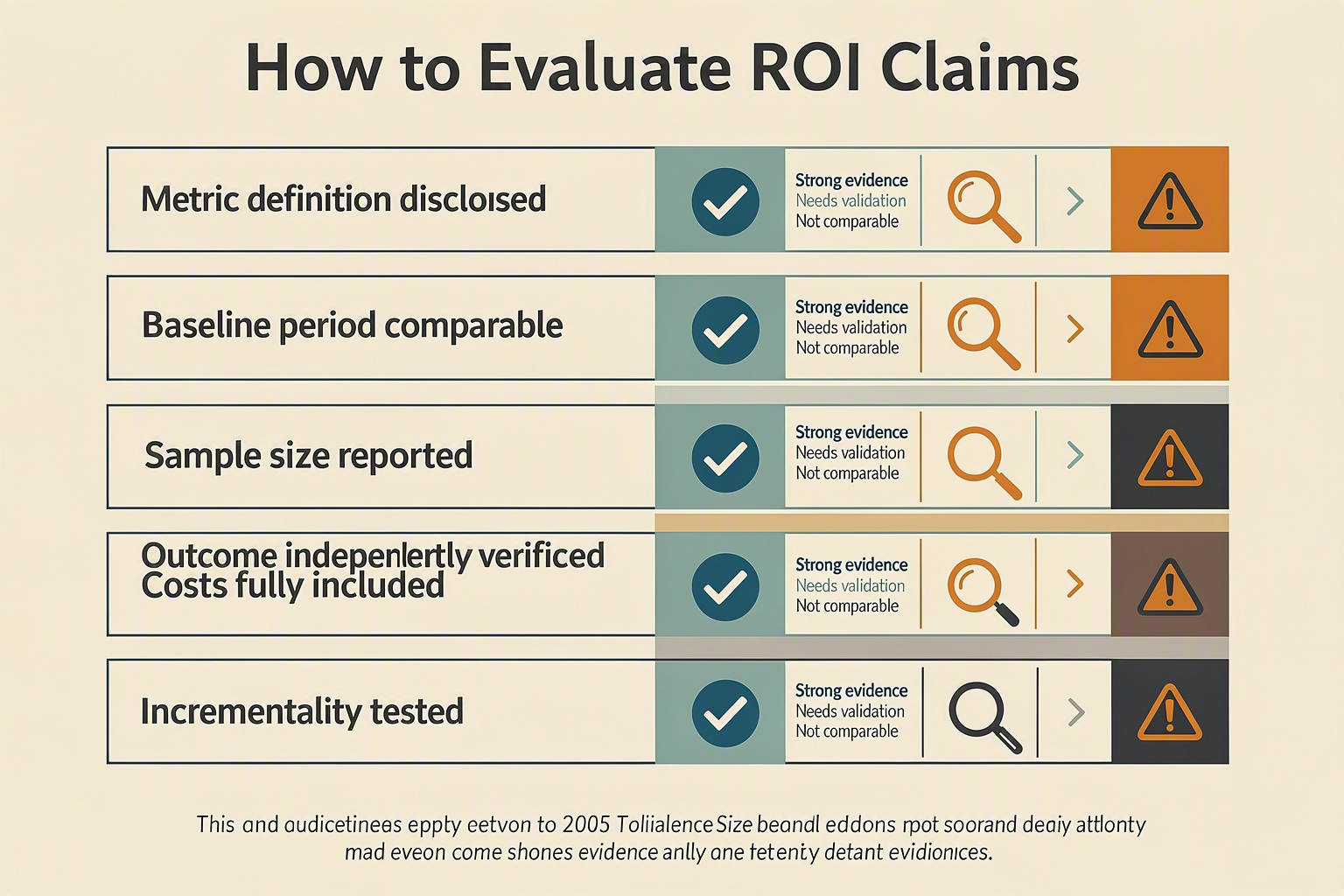
Trust independently sourced, clearly defined, segment-specific benchmarks—and treat every vendor number as a hypothesis until your own controlled data validates it. Industry forecasts can establish direction, but only audited operational results can establish AI voice agent ROI for your business.
Separate forecasts from measured outcomes
Not all statistics answer the same question. Gartner forecast in March 2025 that agentic AI could autonomously resolve 80% of common customer-service issues by 2029 and reduce operational costs by 30%. This is a market forecast, not evidence that every voice deployment should achieve 80% containment or 30% savings in 2026.
Likewise, Salesforce reported in April 2024 that 77% of customers expect to interact with someone immediately when contacting a company. That finding supports investment in rapid response, but it does not specify how much additional revenue an AI agent will generate.
Classify external claims before using them:
- Observed benchmark: Aggregated production results from identifiable deployments.
- Controlled finding: Results from an experiment with a comparison group.
- Survey statistic: Reported expectations, attitudes, or intentions.
- Forecast: A projection about future adoption or impact.
- Vendor case study: A customer result that may be accurate but selectively published.
- Marketing claim: A number without definitions, sample size, period, or methodology.
Only the first two categories should materially influence a financial model—and even then, they should inform assumptions rather than replace internal measurement.
Apply a benchmark credibility checklist
Before trusting a claim about answer rate, containment, bookings, or cost reduction, ask:
- What is the denominator? “90% success” could mean 90% of answered calls, eligible calls, completed conversations, or all inbound attempts.
- How is the metric defined? Containment should exclude abandoned calls, silent calls, spam, and callers who unsuccessfully retry later.
- What was the sample size and period? Ten thousand calls across six months are more informative than a short pilot with unspecified volume.
- Was performance measured in production? Laboratory accuracy does not capture noise, accents, interruptions, telephony latency, or CRM failures.
- Which use case was tested? Appointment confirmation is structurally easier than collections, technical support, or regulated financial advice.
- What comparison was used? A credible uplift requires a pre-deployment baseline, holdout group, phased rollout, or matched cohort.
- Are costs fully loaded? Telephony, model usage, integration, monitoring, human review, transfers, and maintenance all belong in the denominator.
Normalize external benchmarks before comparison
Vendor benchmarks become more useful when converted into your own voice AI metrics. Compare like with like by segmenting results by language, call intent, acquisition source, business hours, geography, and new versus returning callers.
For example, a reported 70% booking rate is not comparable with your result unless both figures use qualified callers who reached the booking step as the denominator. Similarly, missed call conversion tracking should distinguish an AI-recovered opportunity from a customer who would have called back and converted anyway.
Use three assumption bands in the ROI worksheet:
- Conservative: Your lower observed confidence bound or weakest comparable cohort.
- Base case: Validated production performance after exclusions.
- Upside: A credible improvement target, never an unqualified vendor headline.
The safest rule is simple: external evidence sets expectations; your instrumented call funnel determines investment decisions. If a benchmark cannot be reproduced from event-level call, CRM, calendar, transfer, and revenue records, it should not be presented to finance as proven ROI.
What does this framework mean for CallMissed users? A reusable ROI worksheet (TABLE)
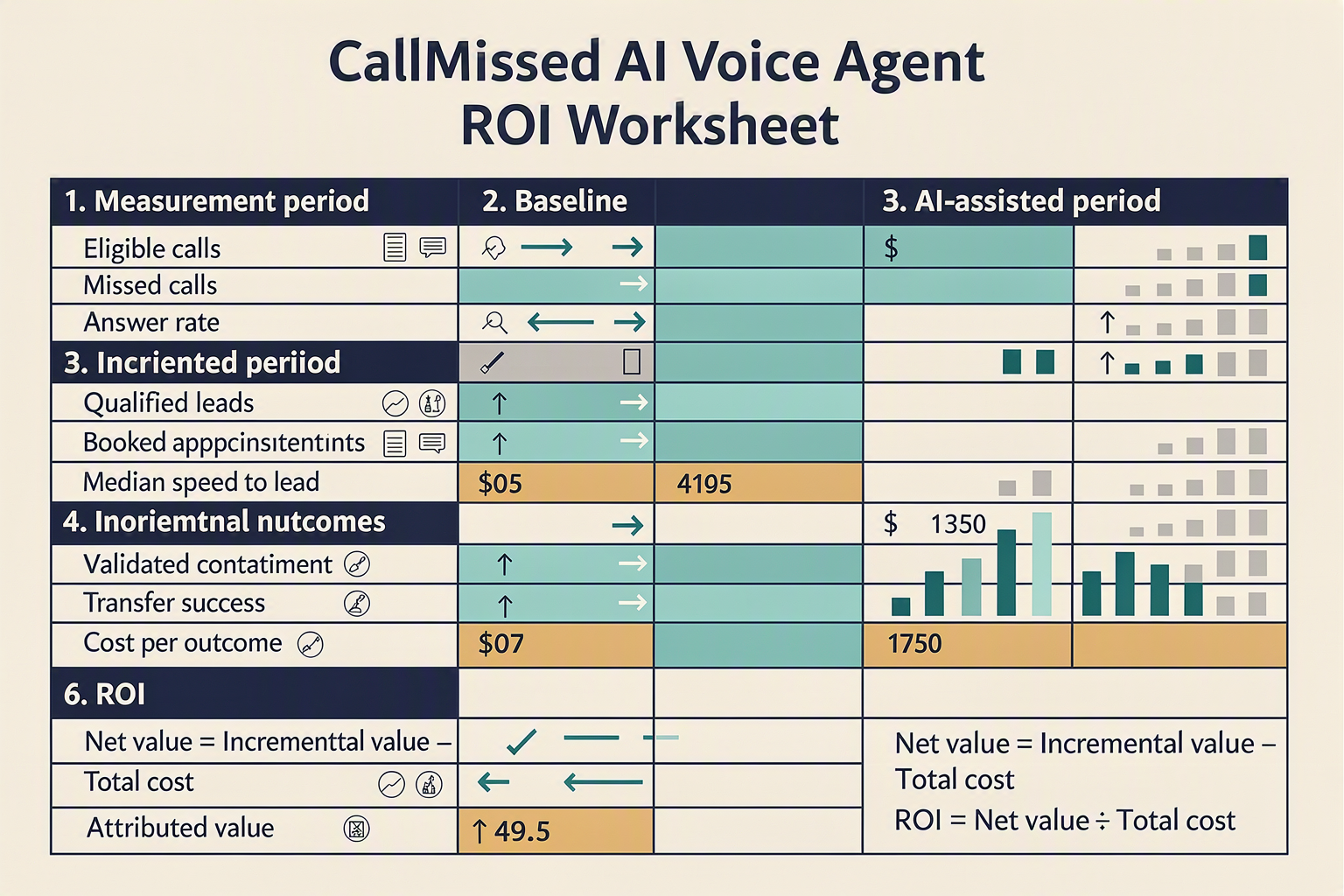
Businesses evaluating CallMissed should measure incremental qualified leads, bookings, validated resolutions, successful transfers, customer outcomes, and fully loaded costs—not call volume alone. The central question is whether CallMissed produces more verified business value than the outcome expected without the voice agent.
Reusable ROI worksheet
Copy this table into a spreadsheet. Record baseline and pilot-period data separately, and define each decision threshold before reviewing results.
| Metric | Formula or required input | Data source | Decision threshold set by the business |
|---|---|---|---|
| Incremental answered calls | AI-period answered calls − expected answered calls at the baseline answer rate | CallMissed call logs and baseline phone records | Minimum additional eligible conversations |
| Incremental qualified leads | Actual qualified leads − (eligible calls × baseline qualification rate) | CRM, call dispositions, and qualification records | Maximum cost per qualified lead or minimum incremental lead count |
| Incremental bookings | Actual valid bookings − expected bookings at the baseline booking rate | CRM, CallMissed records, and calendar | Maximum cost per booking |
| Incremental held appointments | AI-attributed attended appointments − expected attended appointments based on the baseline show rate | Calendar, CRM, and attendance records | Maximum cost per held appointment |
| Validated resolutions | Calls completed without human intervention and without a repeat contact for the same issue during the validation window | Call outcomes, support system, and repeat-contact records | Minimum containment rate and acceptable repeat-contact rate |
| Transfer success | Connected eligible transfers ÷ attempted eligible transfers × 100 | Call and agent logs | Minimum connection rate, wait-time limit, and abandonment limit |
| Customer outcomes | Compare satisfaction, complaints, cancellations, repeat contacts, and escalation rates with the baseline or control | CRM, support platform, surveys, and cancellation records | No material deterioration in agreed customer safeguards |
| Speed to lead | Median time from lead creation or call receipt to the first meaningful response | CRM, call logs, and campaign records | Target response time or required improvement from baseline |
| Incremental gross profit | Incremental conversions × gross profit per conversion | CRM and finance records | Minimum contribution required to justify expansion |
| Resolution savings | Validated incremental resolutions × avoided human cost per resolution | Support operations and finance records | Minimum verified savings after quality checks |
| Total cost | Platform, telephony, implementation, integration, monitoring, maintenance, human review, and applicable taxes | Vendor records, telephony data, and finance records | Approved pilot or operating budget |
| Net ROI | (Incremental value + verified savings − total cost) ÷ total cost × 100 | Finance-approved worksheet | Minimum ROI or payback requirement established before the pilot |
Use eligible offered calls as the denominator for answer-rate calculations. Exclude test traffic, spam, duplicates, and calls abandoned before the business-defined minimum ringing threshold. Document exclusions so the calculation can be reproduced.
For containment, count only requests completed without human intervention that also pass the chosen quality check. A caller who contacts the business again about the same issue within the validation window may indicate that the original interaction was not a successful resolution.
Value outcomes without double counting
Agree on valuation rules with finance and operations before calculating ROI:
- Lead value: incremental qualified leads × verified lead-to-sale rate × gross profit per sale.
- Appointment value: incremental held appointments × verified close rate × gross profit per conversion.
- Resolution savings: incremental validated resolutions × avoidable human handling cost.
- Retention value: verified prevented cancellations × expected contribution margin, adjusted for uncertainty.
- Total cost: all platform, usage, telephony, integration, implementation, oversight, review, maintenance, and tax costs attributable to the deployment.
Do not count the same conversion as both lead value and appointment value. Use gross profit or contribution margin rather than headline revenue when the objective is to calculate economic return.
Make attribution defensible
Assign each eligible call a stable identifier and retain it across call records, CRM entries, calendar events, transfers, and revenue outcomes. Compare the pilot with a pre-launch baseline or, where practical, a concurrent control group. A randomized holdout or phased rollout by branch, campaign, language, time window, or use case is generally more reliable than comparing unrelated months.
Report results by channel, intent, language, location, and workflow where volumes permit. Aggregate voice AI metrics can conceal segments that create value as well as segments with poor conversion, transfer, or customer outcomes.
Before approving expansion:
- Lock eligibility rules, attribution windows, and outcome definitions.
- Deduplicate repeat callers and cross-channel conversions.
- Apply equivalent measurement rules to baseline and pilot groups.
- Reconcile call outcomes with CRM, calendar, support, and finance records.
- Review failed transfers, incorrect qualifications, repeat contacts, complaints, and opt-outs.
- Report underlying volumes alongside rates, costs, and ROI.
When is CallMissed a suitable candidate?
CallMissed may be a suitable candidate when a business has measurable missed or delayed call demand, repeatable qualification or booking workflows, clear escalation paths, and systems that can verify downstream outcomes. It is less suitable for immediate expansion when outcome definitions are unclear, integrations cannot preserve attribution, call handling requires extensive unsupported judgment, or customer and compliance risks cannot be monitored adequately.
A pilot should verify call quality, qualification accuracy, booking validity, resolution quality, transfer reliability, customer outcomes, integration performance, and fully loaded costs under the business’s actual traffic conditions. Expand only where the pilot demonstrates repeatable incremental value above the business-set threshold without unacceptable customer, operational, or compliance trade-offs.
Frequently asked questions about AI voice agent ROI, missed call conversion tracking, and voice AI metrics
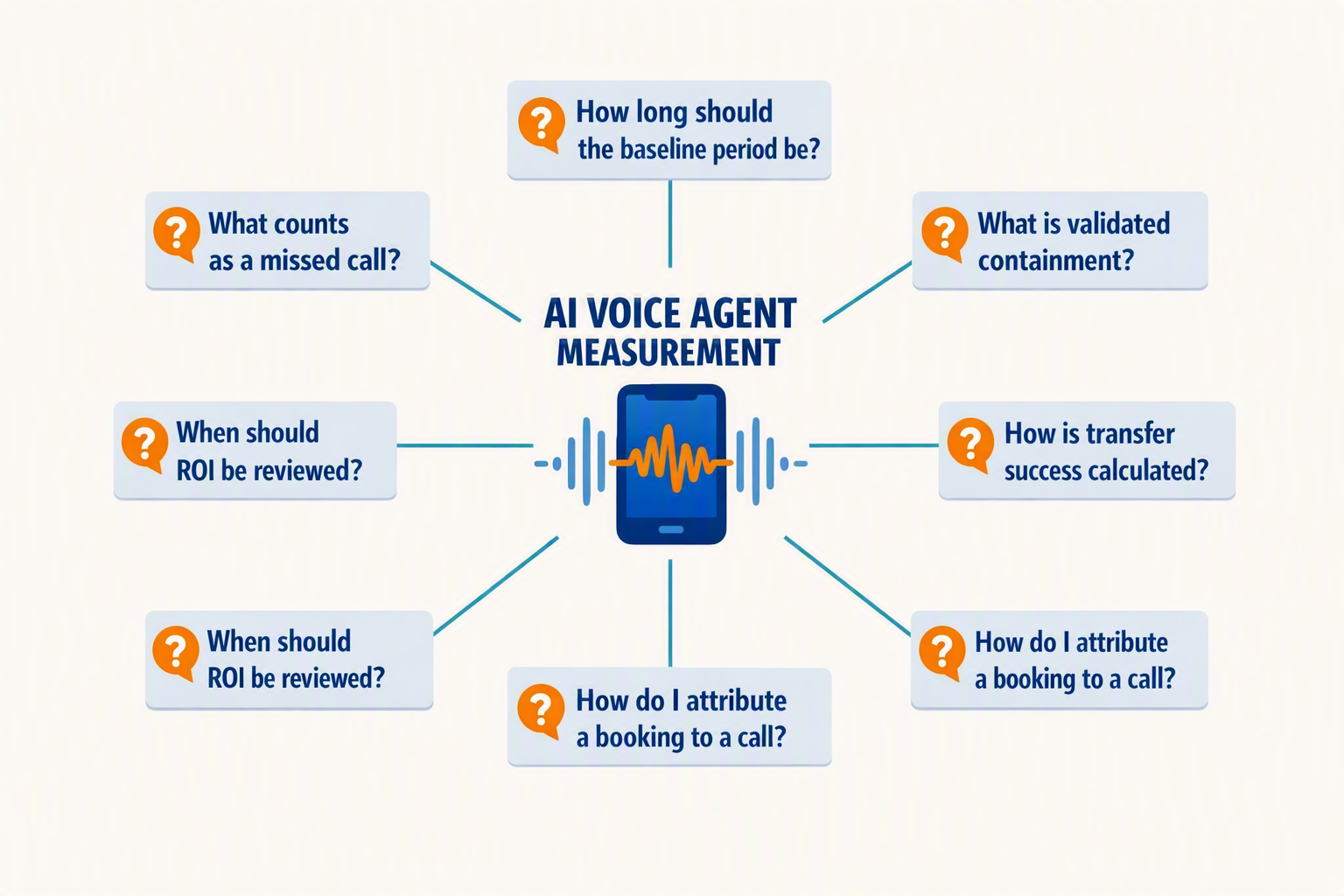
How long should a business measure AI voice agent ROI before making a decision?
How does missed call conversion tracking work for AI voice agents?
Which voice AI metrics should executives and operations teams monitor?
What is the difference between containment rate and successful call resolution?
How can businesses prove that improved conversions came from the AI voice agent?
What is a good AI voice agent ROI benchmark in 2026?
Conclusion
AI voice agent ROI in 2026 should be judged by incremental business value—not by call volume or automation rates alone. The most credible model connects missed calls to qualified leads, appointments, resolutions, retained opportunities, and gross profit, then subtracts the full cost of technology and operations.
- Establish a pre-deployment missed-call baseline, then compare answer rate, speed to lead, lead quality, and booked appointments against it.
- Use missed call conversion tracking across telephony, CRM, calendar, and revenue systems to follow each opportunity through the complete funnel.
- Monitor voice AI metrics such as containment, escalation, and transfer success alongside cost per qualified lead, appointment, or resolution.
- Validate causality through holdout groups or phased rollouts, controlling for seasonality, campaign changes, and existing team performance.
The next stage of voice AI measurement will demand more rigorous attribution and clearer links between automated conversations and downstream revenue. This matters because Salesforce reported in April 2024 that 77% of customers expect an immediate response, while Gartner forecast in March 2025 that agentic AI could autonomously resolve 80% of common service issues by 2029.
Businesses can explore CallMissed to apply this framework across AI voice agents, WhatsApp Business calls, CRM workflows, and 22 Indian languages. The decisive question is: Can your team prove which automated calls create measurable value—and which should be improved or stopped?
Related Reading
Related Posts
وكيل صوتي بالذكاء الاصطناعي لخدمات المنازل: دليل السباكة والتدفئة والتهوية وتكييف الهواء والكهرباء لعام 2026

موظف استقبال بالذكاء الاصطناعي للعيادات: قائمة التحقق للإطلاق في عام 2026 لضمان الحجز الآمن وتسليم المهام

وكيل صوتي متعدد اللغات بالذكاء الاصطناعي في الهند: دليل الشركات الصغيرة لعام 2026
Ready to automate customer conversations?
Launch AI voice agents and WhatsApp bots with CallMissed — one API, 22+ Indian languages.