

AI Receptionist for Clinics: 2026 Go-Live Checklist for Safe Booking and Handoffs


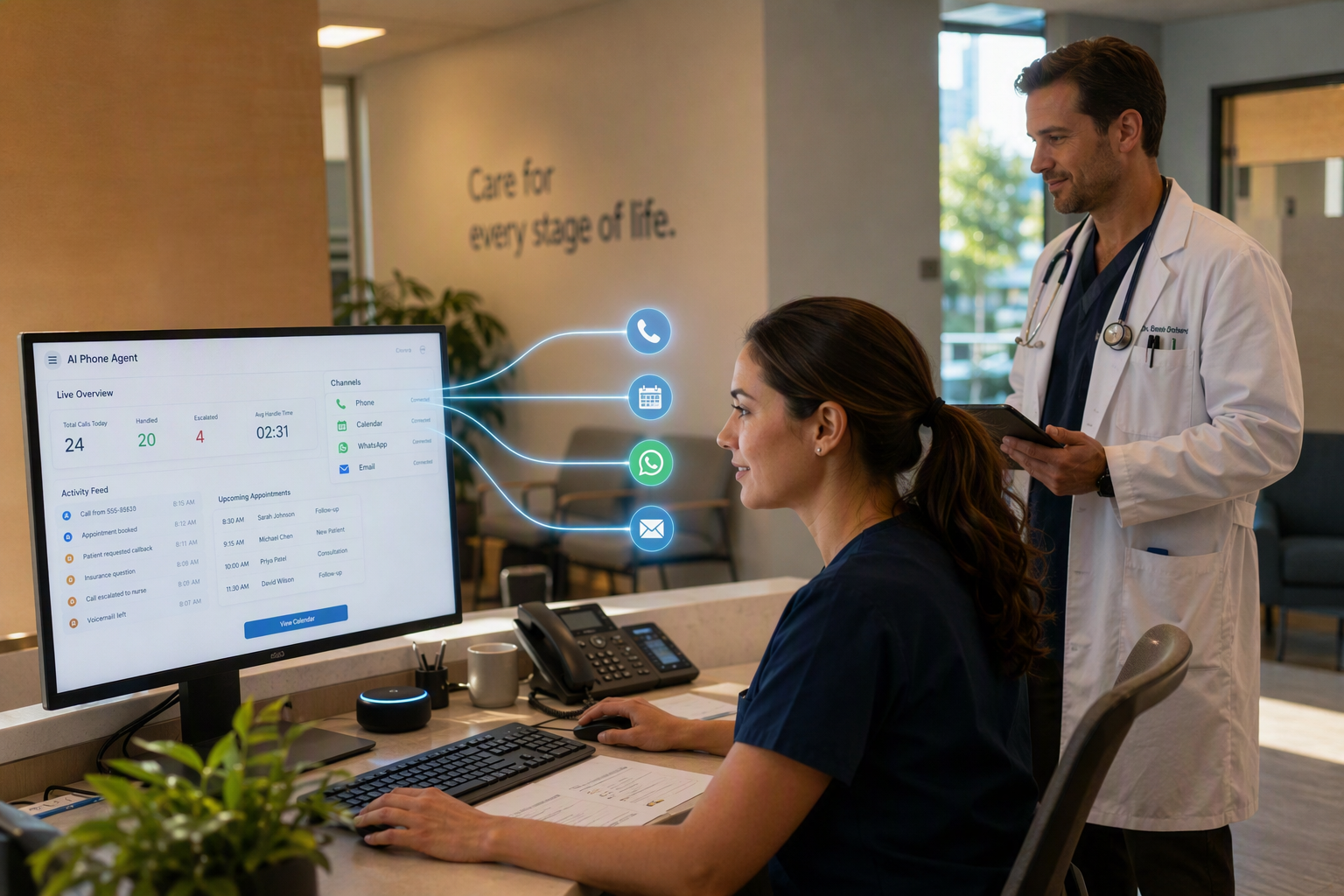
Use this AI receptionist for clinics checklist to plan call flows, booking, escalation, messaging, privacy, testing, and human handoffs.
AI Receptionist for Clinics: 2026 Go-Live Checklist for Safe Booking and Handoffs
What happens when a patient calls at 11:47 p.m.—and the clinic’s “smart” receptionist confidently books the wrong service or fails to escalate chest pain? An AI receptionist for clinics can reduce missed enquiries and repetitive front-desk work, but safe deployment in 2026 depends less on a polished demo than on disciplined workflow design.
This guide turns that design into a go-live checklist for clinics and other appointment-based businesses. The timing matters: the World Health Organization projects a worldwide shortage of 10 million health workers by 2030, with the largest gaps expected in low- and lower-middle-income countries. Meanwhile, India’s Digital Personal Data Protection Act, 2023 makes clear that digital personal data requires purposeful handling, valid consent where applicable, safeguards, and accountable processes—although no technology vendor or checklist can guarantee compliance for a clinic.
A safe appointment booking voice agent should act like a tightly scoped coordinator, not a clinician. It can identify the caller, capture approved details, offer eligible slots, reschedule or cancel appointments, and send confirmations through WhatsApp or email. It should not diagnose symptoms, interpret test results, recommend treatment, decide clinical urgency beyond an approved script, or improvise when confidence is low.
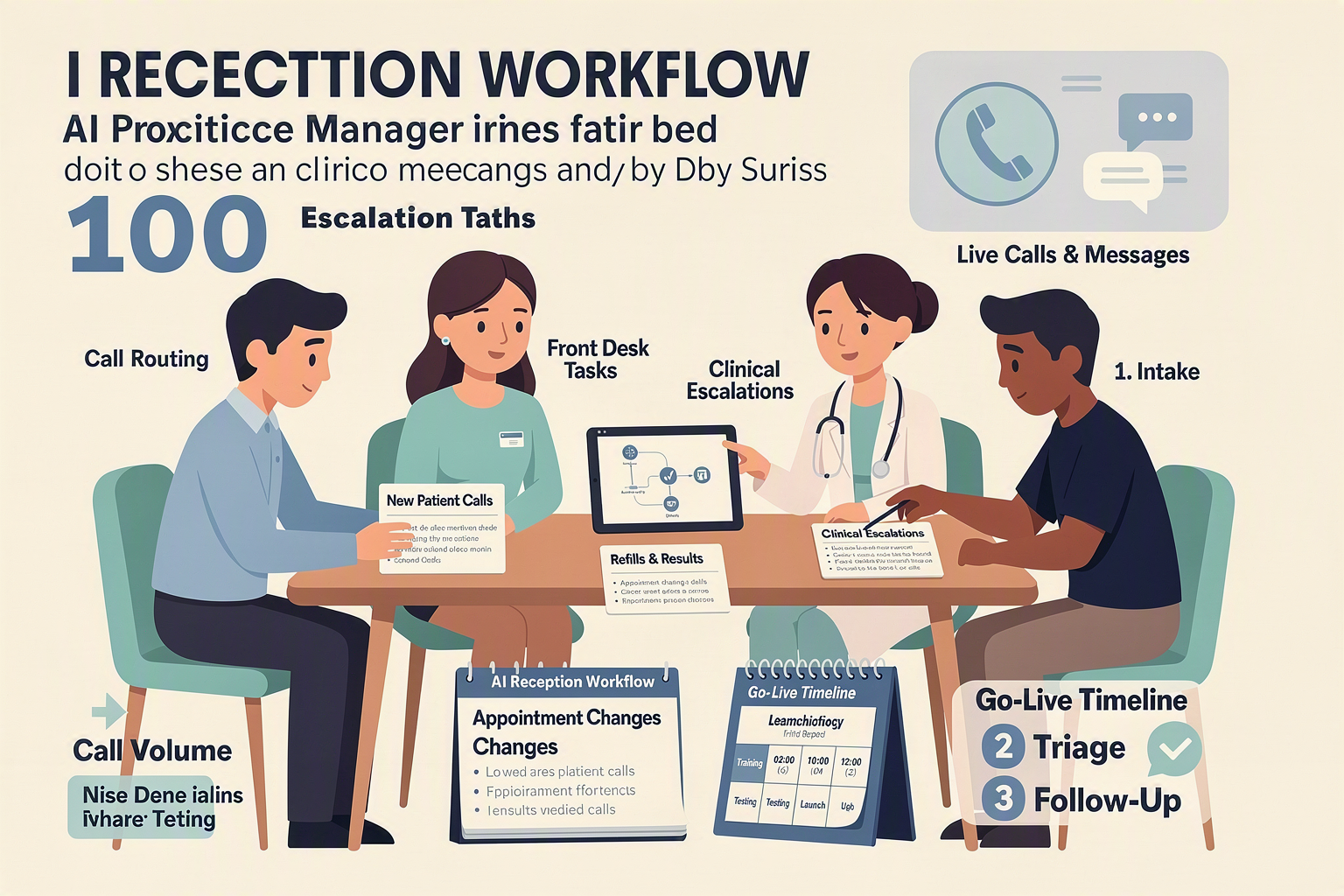
Before switching on clinic call automation, this checklist will help your team define:
- Call flows: greetings, language selection, identity checks, booking rules, after-hours handling, and fallback paths.
- Intake boundaries: the minimum information needed, prohibited questions, and clear disclosure that the caller is speaking with AI.
- Urgent escalation: approved trigger phrases, immediate transfer routes, emergency messaging, and what happens when no human answers.
- Scheduling controls: service-specific durations, clinician eligibility, buffers, duplicate prevention, timezone handling, and confirmation or reminder rules.
- Privacy and operations: consent records, access controls, retention, vendor review, test scenarios, audit logs, quality monitoring, and incident ownership.
Platforms such as CallMissed reflect this shift by combining AI voice agents with WhatsApp chat and Business calling, including support for 22 Indian languages. But the platform is only one layer: clinic leaders must own the policies, calendars, escalation roster, and clinical boundaries.
The goal is not to remove people from patient access. It is to let automation handle predictable administrative steps while humans retain judgement-heavy work: clinical questions, distressed callers, complaints, exceptions, accessibility needs, payment disputes, and uncertain emergencies. By the end, you will have a practical pre-launch standard for safer booking, reliable handoffs, measurable monitoring, and a decision on whether the receptionist is ready for live calls.
What should a 2026 AI receptionist setup include? Define call flows, intake limits, scheduling rules, urgent escalation, confirmations, privacy controls, testing, monitoring, and human ownership before launch
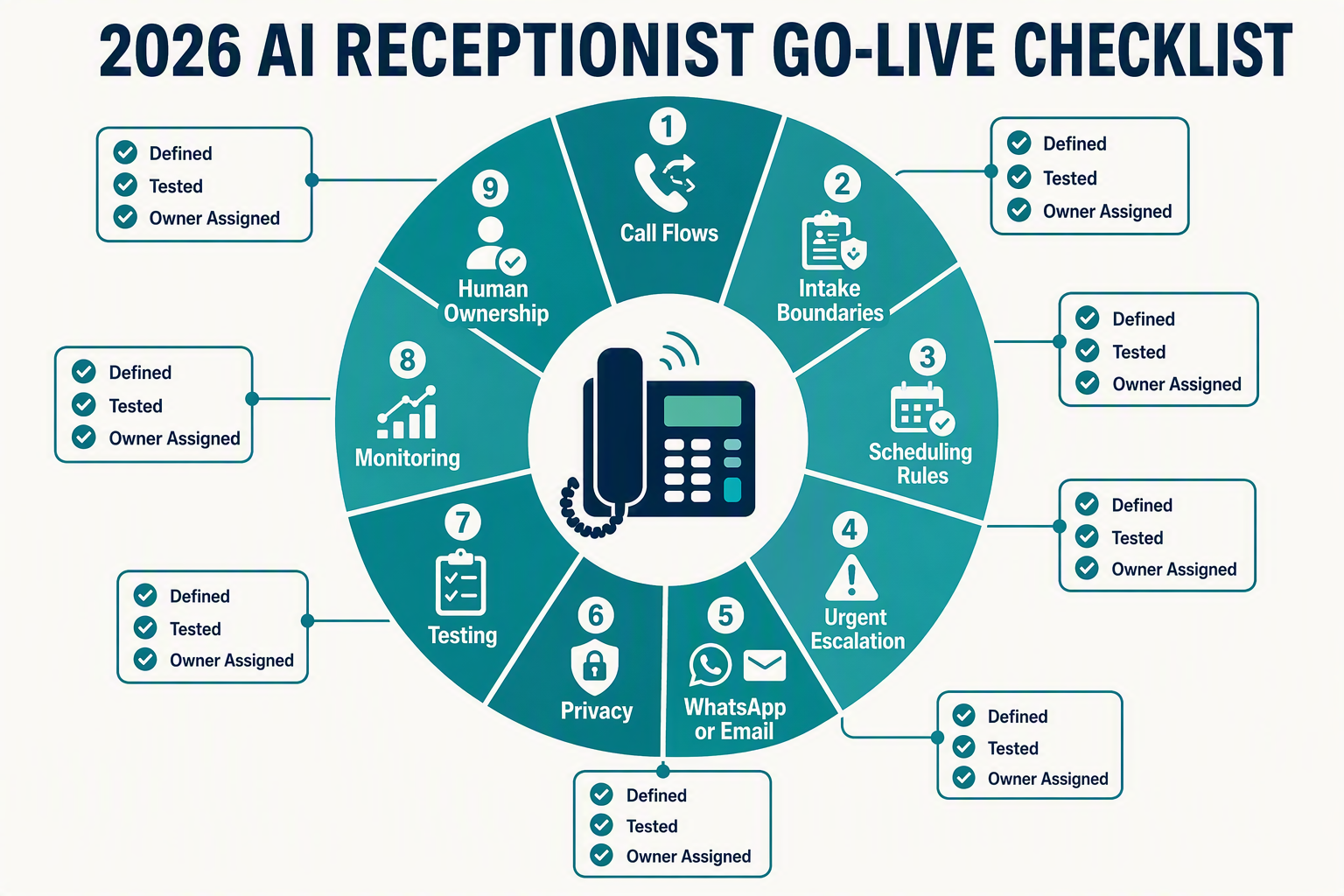
A 2026 AI receptionist for clinics should launch only after the business has documented its call paths, automation boundaries, calendar logic, escalation procedures, message templates, privacy controls, test results, monitoring thresholds, and accountable human owners. Treat these requirements as operational controls—not optional software settings.
1. Map every call flow
Document the expected route from greeting to resolution, including failure paths:
- Disclose that the caller is interacting with an AI system.
- Offer supported languages and accessibility options.
- Identify the caller using only approved verification fields.
- Classify the request: new booking, rescheduling, cancellation, directions, billing, or human assistance.
- Complete the permitted task or transfer the caller.
- Summarise the outcome and obtain confirmation before ending.
Define separate flows for after-hours calls, existing patients, new enquiries, dropped calls, background noise, silence, unsupported languages, and low-confidence speech recognition.
2. Set firm intake limits
Specify what the appointment booking voice agent may collect, such as name, contact details, preferred location, service category, and availability. Create a prohibited-actions list covering diagnosis, treatment recommendations, test-result interpretation, medication advice, and unscripted assessments of clinical urgency.
The agent should stop asking questions and initiate a handoff when:
- The caller requests a clinician or human receptionist.
- The caller becomes distressed, confused, or angry.
- Identity checks fail.
- The request falls outside the approved knowledge base.
- Speech recognition or intent confidence drops below the clinic’s threshold.
3. Encode scheduling rules
Connect automation to a controlled scheduling layer rather than letting the model invent availability. Configure:
- Service duration, preparation time, and cleanup buffers
- Eligible clinicians, locations, equipment, and appointment modes
- Minimum notice, maximum booking horizon, and cancellation windows
- New-versus-returning patient restrictions
- Duplicate-booking and calendar-conflict prevention
- Timezone, holiday, closure, and daylight-saving behaviour
- Rules for waitlists, overbooking, deposits, and payment failures
Require the caller to confirm the practitioner, service, location, date, time, and contact channel before the calendar write occurs.
4. Build urgent escalation paths
Use clinician-approved trigger phrases and scripts, but do not position clinic call automation as a medical triage system. For possible emergencies, configure an immediate safety message, a warm transfer to the designated number, and a fallback instruction if nobody answers.
Maintain an escalation roster with primary and secondary contacts, operating hours, transfer timeouts, and incident logging. Test what happens when the phone network, calendar, AI provider, or human destination is unavailable.
5. Control confirmations and personal data
Send confirmations through WhatsApp or email only after validating the destination and recording the appropriate communication preference. Templates should contain the minimum necessary information, avoid sensitive details in previews, and provide clear rescheduling or cancellation instructions.
India’s Digital Personal Data Protection Act, 2023 establishes requirements around purposeful processing, notices, safeguards, and accountability for digital personal data. Clinics should therefore document:
- Data fields collected and their purpose
- Consent or other applicable processing basis
- Role-based access and administrator permissions
- Recording, transcript, and log-retention periods
- Deletion, correction, and access-request procedures
- Vendor, breach-response, and audit responsibilities
These controls support governance but do not by themselves guarantee legal compliance.
6. Test, monitor, and assign human ownership
Before launch, run scripted and adversarial tests across accents, languages, interruptions, ambiguous dates, urgent phrases, unavailable slots, and transfer failures. Obtain written approval from operations, privacy, IT, and an authorised clinical representative.
After launch, monitor booking accuracy, transfer completion, abandoned calls, correction rates, low-confidence events, message-delivery failures, complaints, and privacy incidents. Assign named human owners for calendar rules, escalation scripts, knowledge updates, daily exception review, incident shutdown, and final go-live authority.
Why does clinic call automation need stricter boundaries than a general business answering service?
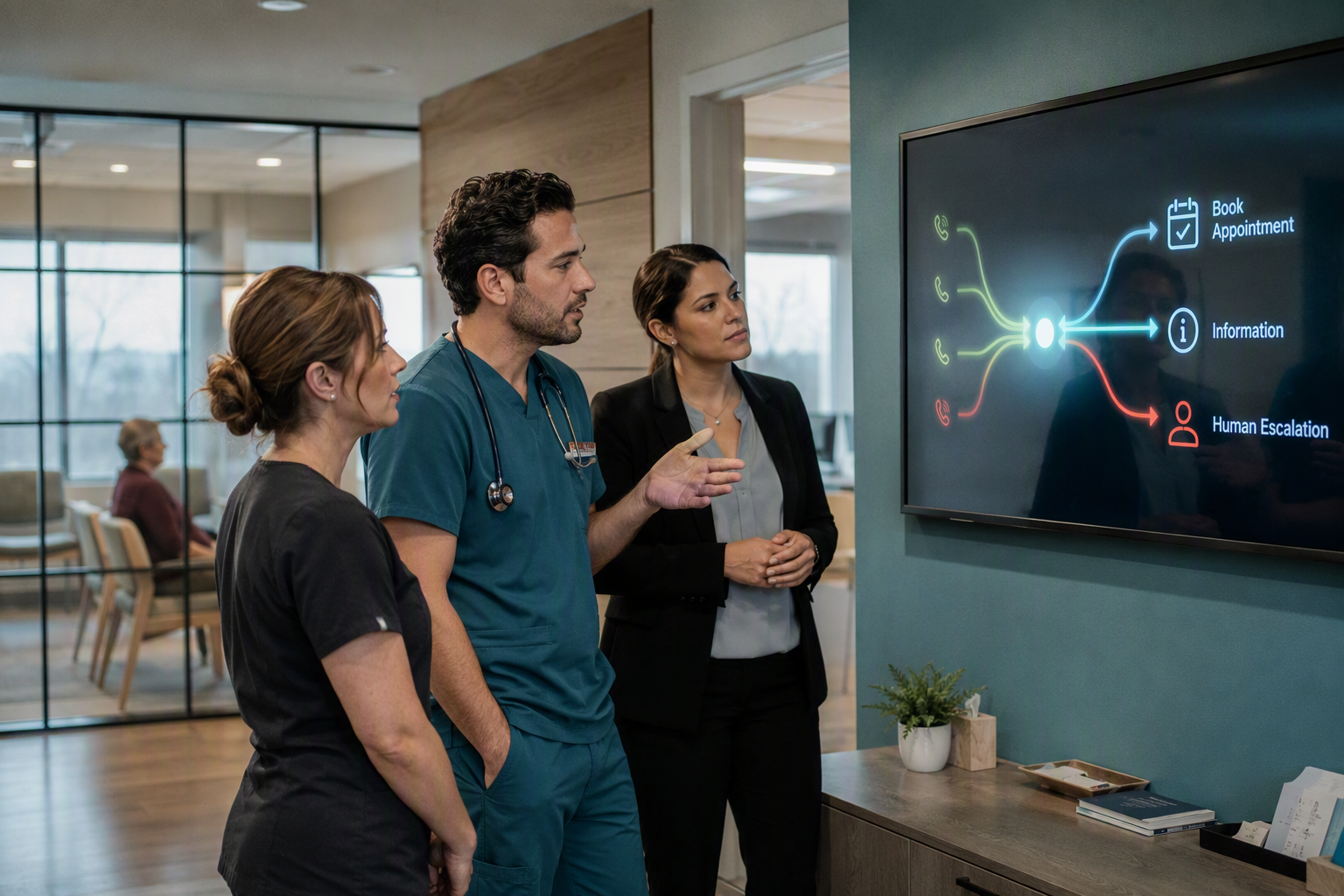
Clinic automation needs stricter boundaries because a routine booking conversation can quickly become a health, safety, privacy, or clinical-judgement issue. Unlike a general answering service, an AI receptionist for clinics must recognise when to stop the workflow, avoid interpretation, and transfer responsibility to an authorised person.
Treat the agent as an administrative coordinator
The operating principle should be “book, route, document—do not assess.” An appointment booking voice agent may collect information required to complete an approved administrative task, but it should never convert that information into a medical conclusion.
Permit the agent to:
- Identify the requested clinic, service, location, and preferred language.
- Offer slots using clinician eligibility, duration, and availability rules.
- Capture contact details and the clinic’s approved reason-for-visit categories.
- Reschedule or cancel appointments under documented policies.
- Send confirmations and administrative instructions through WhatsApp or email.
- Transfer callers when a request falls outside the defined workflow.
Keep human-led:
- Symptom assessment, diagnosis, and treatment recommendations.
- Interpretation of prescriptions, reports, scans, or laboratory results.
- Decisions about whether a patient can safely wait for an appointment.
- Medication changes, dosage questions, and contraindications.
- Complaints involving harm, consent, abuse, or clinical conduct.
- Exceptions requiring professional judgement or compassionate handling.
Design for the cost of a wrong answer
A general business bot that misunderstands a product enquiry may inconvenience a customer. In a clinic, the same technical failures—speech-recognition errors, outdated knowledge, hallucinated answers, or incorrect routing—can delay human attention or expose sensitive information.
The World Health Organization projects a global shortage of 10 million health workers by 2030, with the greatest shortfalls in low- and lower-middle-income countries. Automation can reduce administrative load, but that staffing pressure is not a reason to delegate clinical judgement to a probabilistic system.
Configure clinic call automation around asymmetric risk:
- Low-risk administrative requests: Complete the workflow automatically when identity, intent, and booking rules are clear.
- Uncertain requests: Ask one approved clarifying question, then route to staff if uncertainty remains.
- Clinical requests: Stop booking dialogue and hand off without answering the medical question.
- Potentially urgent requests: Use the clinic-approved emergency message and escalation route immediately rather than continuing intake.
Minimise sensitive-data collection
Healthcare conversations can reveal more than a booking requires. The Digital Personal Data Protection Act, 2023 establishes requirements around purposeful processing, consent where applicable, safeguards, and accountability for digital personal data in India.
Use a field-level boundary checklist:
- Is each question necessary to book, route, or confirm the appointment?
- Is the caller told they are interacting with AI?
- Are recordings and transcripts enabled only under an approved policy?
- Can WhatsApp or email confirmations avoid diagnoses and other sensitive details?
- Are access, retention, correction, deletion, and incident procedures assigned to named owners?
- Does the workflow prevent one caller from receiving another patient’s information?
These controls support responsible operations but do not guarantee legal or regulatory compliance; clinics should obtain advice appropriate to their jurisdiction and services.
Make stopping a successful outcome
An AI receptionist should not be measured solely by containment rate. Track safe transfers, prohibited-answer avoidance, escalation completion, booking accuracy, and privacy incidents alongside automation rates.
The correct response to ambiguity is not a more confident script. It is a controlled stop: disclose the limitation, preserve the relevant context, and connect the caller to a trained human.
Which 2026 capabilities and operating controls matter most before selecting an AI receptionist? (TABLE)
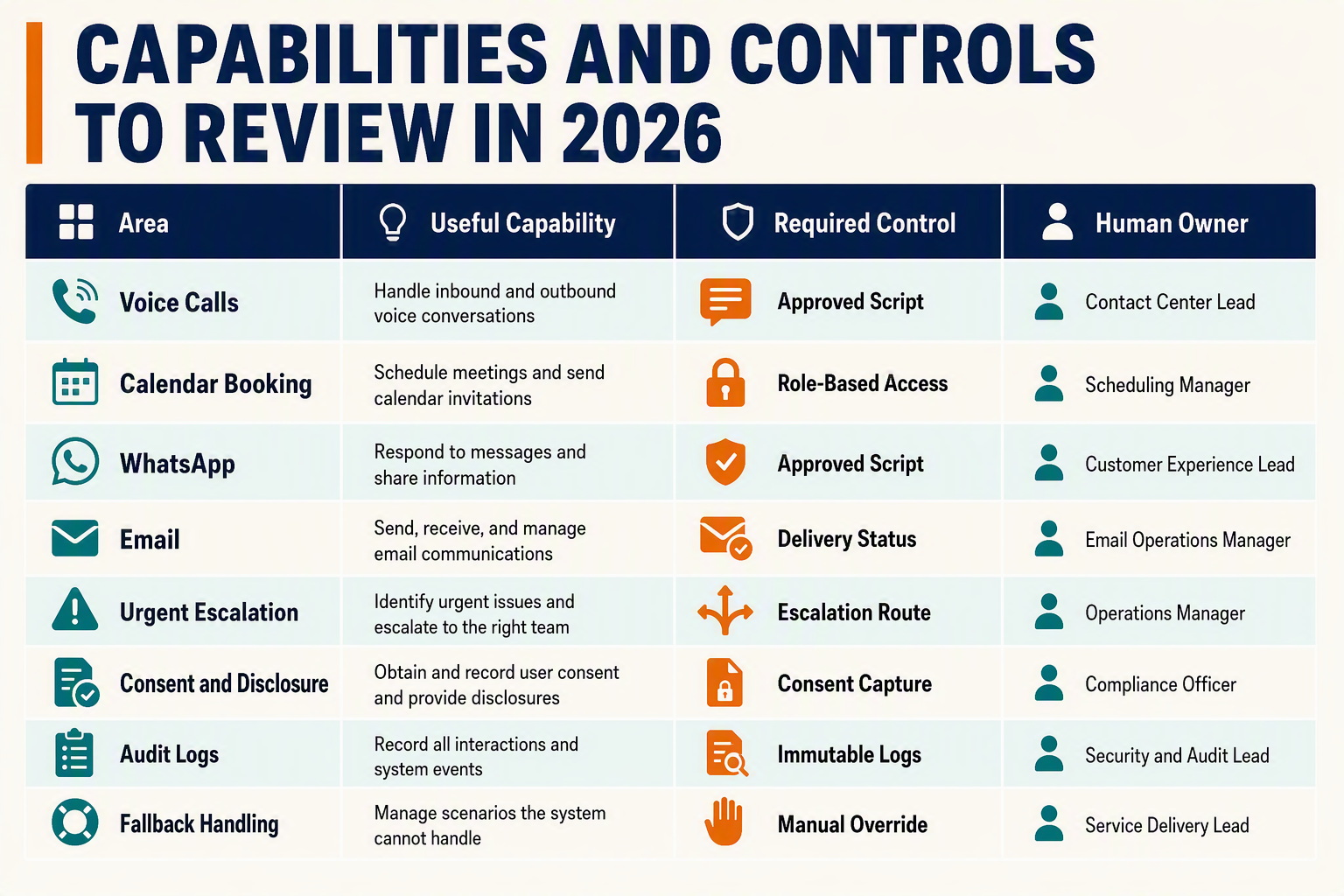
Select an AI receptionist based on bounded automation, reliable integrations, deterministic escalation, privacy controls, and observable performance—not conversational fluency alone. In 2026, every capability should have an operating control, a named owner, and testable evidence that it works under real clinic conditions.
Pre-selection capability and control matrix
| Capability | Minimum 2026 requirement | Required operating control | Evidence to request |
|---|---|---|---|
| Voice and language handling | Natural turn-taking, interruption handling, multilingual recognition, and graceful recovery from noise or unclear speech | Set confidence thresholds; repeat critical details; transfer rather than guess after repeated failures | Test recordings covering accents, code-switching, background noise, silence, and poor mobile connections |
| Scheduling integration | Real-time calendar availability, service-specific durations, clinician eligibility, buffers, rescheduling, cancellation, and timezone support | Restrict booking actions to approved services and calendars; prevent duplicate appointments and race conditions | Live sandbox demonstration showing simultaneous bookings, calendar outages, and rollback behaviour |
| Intake boundaries | Configurable fields, AI disclosure, approved scripts, and suppression of diagnostic or treatment responses | Permit only minimum administrative intake; block prohibited topics; route uncertainty to trained staff | Versioned prompt and policy controls, transcript samples, and documented boundary tests |
| Urgent escalation | Phrase-based and rule-based triggers, warm transfer, after-hours routing, and backup contact paths | Clinic-approved emergency wording; never let the model independently diagnose or downgrade urgency | End-to-end tests for distress, disconnection, unavailable staff, failed transfers, and ambiguous statements |
| Omnichannel confirmation | Consent-aware WhatsApp or email confirmations, reminders, changes, cancellations, and delivery-status tracking | Use approved templates; avoid unnecessary sensitive details; define retries and failed-delivery follow-up | Message logs showing consent state, timestamps, delivery results, opt-outs, and correction workflows |
| Security and observability | Role-based access, encryption, configurable retention, audit trails, redaction, export controls, and incident logs | Assign access, review, deletion, quality-monitoring, and incident owners before launch | Security documentation, subprocessors, retention settings, audit-log samples, uptime history, and exit/export procedure |
Apply pass-or-fail selection gates
A polished AI receptionist for clinics should not progress beyond a pilot unless the clinic can answer yes to these questions:
- Can administrators constrain actions without vendor engineering? Clinic staff should be able to change hours, services, scripts, escalation contacts, and booking eligibility through controlled configuration.
- Does failure produce a safe outcome? Calendar downtime, low speech confidence, unavailable humans, or messaging failure should create a callback task or human handoff—not a fabricated answer.
- Is every consequential action traceable? Teams need timestamps for what the caller said, what the agent understood, which rule ran, what calendar action occurred, and whether confirmation was delivered.
- Can the clinic minimise and delete data? India’s Digital Personal Data Protection Act, 2023 makes purposeful personal-data handling, safeguards, and accountability central considerations; vendor features support these duties but do not guarantee compliance.
- Can performance be evaluated by workflow? Measure booking completion, transfer success, correction rates, abandoned calls, confirmation delivery, and false urgent escalations separately—not through one headline “accuracy” score.
Prioritise operational fit over feature volume
The global workforce context makes dependable automation relevant: the World Health Organization projects a shortage of 10 million health workers by 2030, concentrated mainly in low- and lower-middle-income countries. That pressure does not justify broad autonomy; it strengthens the case for narrowly scoped administrative support.
For an appointment booking voice agent, insist on a monitored pilot using representative calls before enabling write access to production calendars. Effective clinic call automation should reduce repetitive coordination while preserving human control over clinical questions, distressed callers, unusual requests, accessibility exceptions, complaints, and payment disputes.
How should an appointment booking voice agent handle calls from greeting to human handoff?
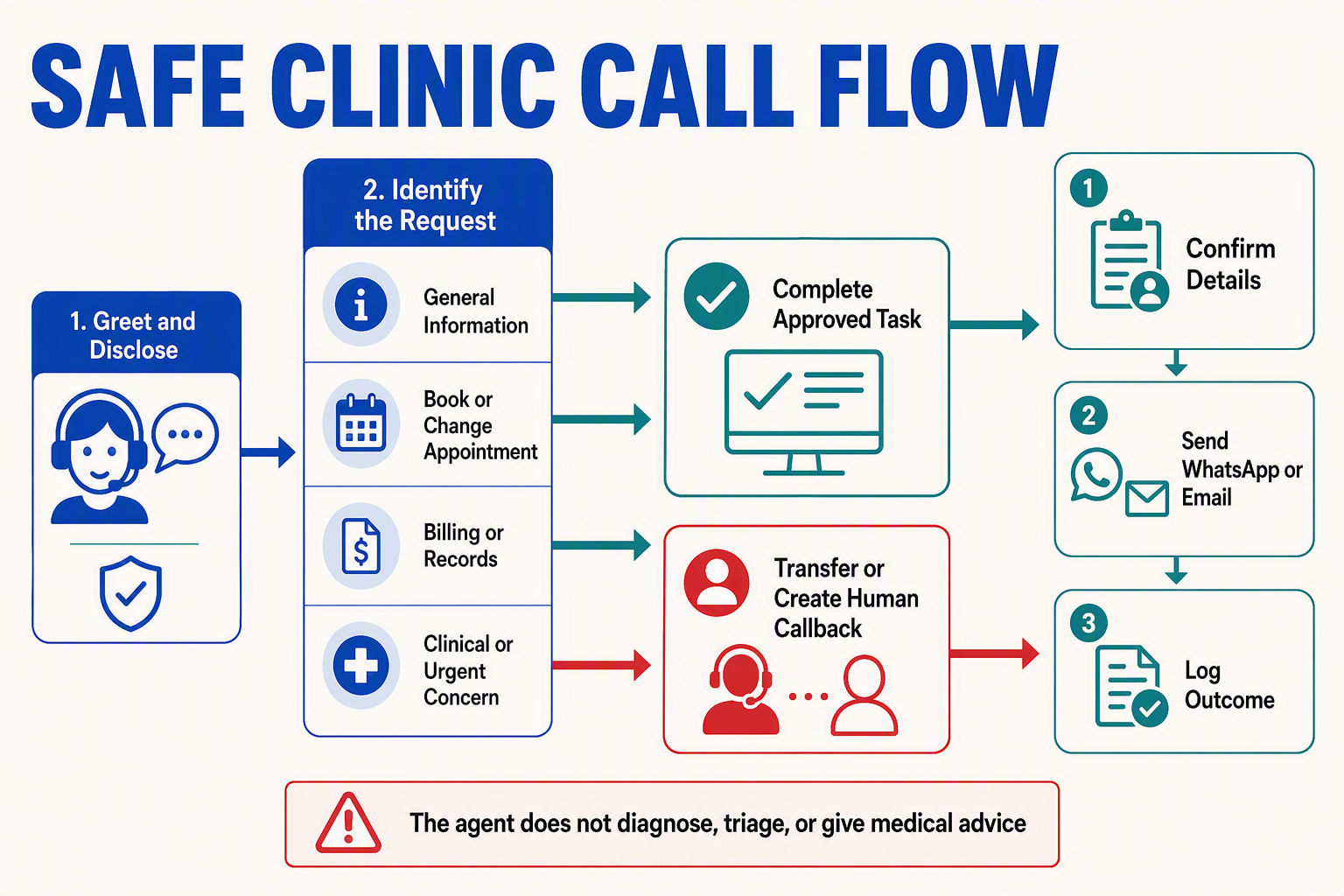
An appointment booking voice agent should follow a deterministic call flow: disclose that it is AI, establish the caller’s goal, complete only approved administrative tasks, confirm the outcome, and transfer whenever urgency, uncertainty, or policy requires human judgement. Every branch should have a defined success state, retry limit, and fallback destination.
Checklist: Build the end-to-end call flow
- Open with a concise greeting
- Name the clinic or business.
- Clearly state that the caller is speaking with an AI assistant.
- Explain the permitted scope: booking, rescheduling, cancellation, directions, hours, or message-taking.
- Offer language selection before collecting information.
Example: “You’ve reached Sunrise Clinic’s automated appointment assistant. I can help with bookings and general clinic information. You can ask for a staff member at any time.”
- Identify intent without forcing a rigid menu
- Let callers describe their purpose naturally.
- Map the request to an approved intent such as new booking, reschedule, cancel, hours, or human assistance.
- Confirm ambiguous requests rather than guessing: “Are you calling to book a new appointment or change an existing one?”
- Route unsupported requests—including diagnosis, prescriptions, test interpretation, complaints, and billing disputes—to staff.
- Check for escalation before continuing
- Run the clinic-approved urgent-language check early, not after completing intake.
- If a trigger appears, stop the normal booking flow and execute the escalation policy.
- The agent must not tell callers that a situation is harmless or assign its own clinical priority.
Checklist: Complete the booking accurately
For routine calls, clinic call automation should collect only the fields needed for the selected task:
- Caller or patient name and approved contact details.
- New or existing patient status, if relevant to scheduling.
- Requested service, location, clinician preference, and time window.
- Calendar-specific requirements configured by the clinic.
- Explicit confirmation of the chosen date, time, location, and appointment type.
Before writing to the calendar, the system should repeat critical details and ask for confirmation. It should then recheck availability, prevent duplicate reservations, and handle race conditions where another person takes the slot during the call.
After a successful transaction, send a confirmation through the caller’s approved channel—such as WhatsApp or email—with practical information and a clinic contact route. Platforms such as CallMissed can connect AI voice workflows with WhatsApp Business messaging and support conversations across 22 Indian languages, helping regional-language callers continue the interaction in a familiar channel.
Checklist: Make human handoff reliable
An AI receptionist for clinics should transfer immediately when the caller requests a person, repeatedly fails verification, sounds distressed, disputes information, has accessibility difficulties, or reaches an unsupported workflow.
Configure every handoff with:
- Context transfer: send the caller’s intent, language, completed steps, and reason for escalation to staff.
- Warm-transfer messaging: tell the caller what will happen and avoid claiming that someone is available unless presence has been verified.
- Timeout rules: define how long the transfer may ring before fallback.
- Failure handling: offer voicemail, a callback request, or an approved after-hours instruction if no one answers.
- Auditability: record timestamps, transfer destination, outcome, and any failed attempts.
The call should end only after the agent summarizes the outcome: booked, changed, cancelled, transferred, or awaiting human follow-up. Silence, dropped transfers, and vague promises are not valid completion states.
What are the operational impacts of scheduling rules, urgent escalation, privacy safeguards, testing, and ongoing monitoring?
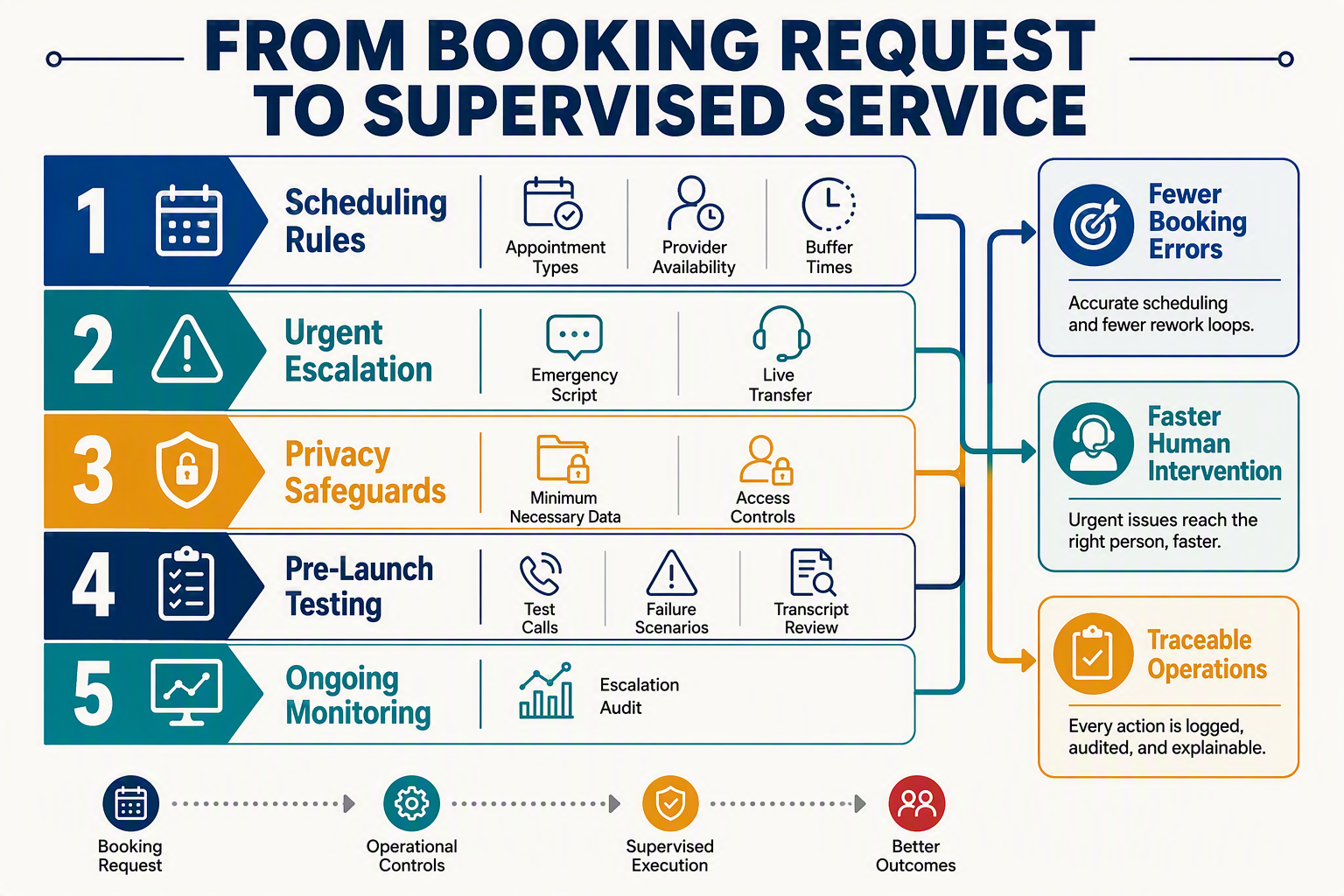
Scheduling rules determine whether automation reduces workload or creates double bookings; escalation, privacy, testing, and monitoring determine whether failures are contained. Treat the AI receptionist for clinics as a production workflow with named owners, measurable thresholds, and a manual fallback—not as a set-and-forget answering service.
Lock scheduling rules to real operational capacity
Every bookable service should map to a controlled calendar configuration. Before launch, verify:
- Service duration: Include consultation time, preparation, cleaning, equipment reset, and documentation buffers.
- Eligibility: Restrict each service to approved clinicians, locations, age groups, referral conditions, and appointment modes.
- Availability: Define holidays, leave, lunch breaks, same-day cut-offs, maximum advance-booking windows, and timezone rules.
- Conflict prevention: Recheck availability immediately before confirmation, block duplicate bookings, and use idempotency controls so retries do not create extra appointments.
- Exceptions: Route overbooking requests, unavailable services, payment disputes, and special-accessibility requirements to staff.
The operational impact is direct: calendar changes become configuration changes. Assign one person to update schedules and require approval before altering durations, buffers, or eligibility rules.
Design urgent escalation as a staffed service
An appointment booking voice agent must not independently diagnose or clinically classify callers. It should detect clinic-approved words or responses, stop the normal booking flow, present the approved emergency message, and attempt an immediate human handoff.
Test the entire escalation chain:
- Transfer to the designated clinical or front-desk number.
- Retry or contact the secondary responder if the first route fails.
- Tell the caller what to do when nobody answers, using clinic-approved wording.
- Record the trigger, transfer result, timestamp, and technical failure without generating a clinical conclusion.
Escalation coverage must match operating hours. If nobody is assigned at night, clinic call automation should not imply that a clinician is available.
Apply privacy safeguards across every channel
India’s Digital Personal Data Protection Act, 2023 establishes obligations around purposeful processing, notices and consent where applicable, safeguards, and accountability for digital personal data. Clinics should obtain legal and security advice for their specific workflows rather than treating software configuration as a compliance guarantee.
Use a minimum-necessary-data checklist:
- Disclose that the caller is interacting with AI.
- Collect only approved booking and contact details.
- Mask sensitive fields in logs and restrict transcript access by role.
- Define retention periods for recordings, transcripts, summaries, and message delivery records.
- Review vendors, subprocessors, data locations, deletion procedures, and incident-notification responsibilities.
- Require confirmation before sending details through WhatsApp or email, especially when a shared device or address may be involved.
Test failures, not just successful bookings
Run scripted tests in every supported language, channel, and opening-hours state. Include noisy calls, silence, accents, repeated interruptions, unavailable slots, duplicate callers, calendar outages, failed transfers, incorrect identity details, and WhatsApp or email delivery failures.
Do not launch until the system can safely say it is uncertain, transfer to a human, or capture a callback request. A fluent but incorrect answer is more operationally dangerous than an explicit fallback.
Monitor outcomes and assign human ownership
Review performance weekly at launch and at a risk-based cadence thereafter. Track booking completion, transfer success, duplicate appointments, cancellation errors, message delivery, low-confidence turns, caller abandonment, complaints, and privacy incidents.
Sample recordings and transcripts under controlled access, document corrective actions, and maintain rollback procedures. Humans must remain responsible for clinical questions, urgent judgement, complaints, unusual scheduling exceptions, accessibility support, and every incident that could affect patient safety or privacy.
Which decisions should remain human-led, according to responsible clinic operations practice?
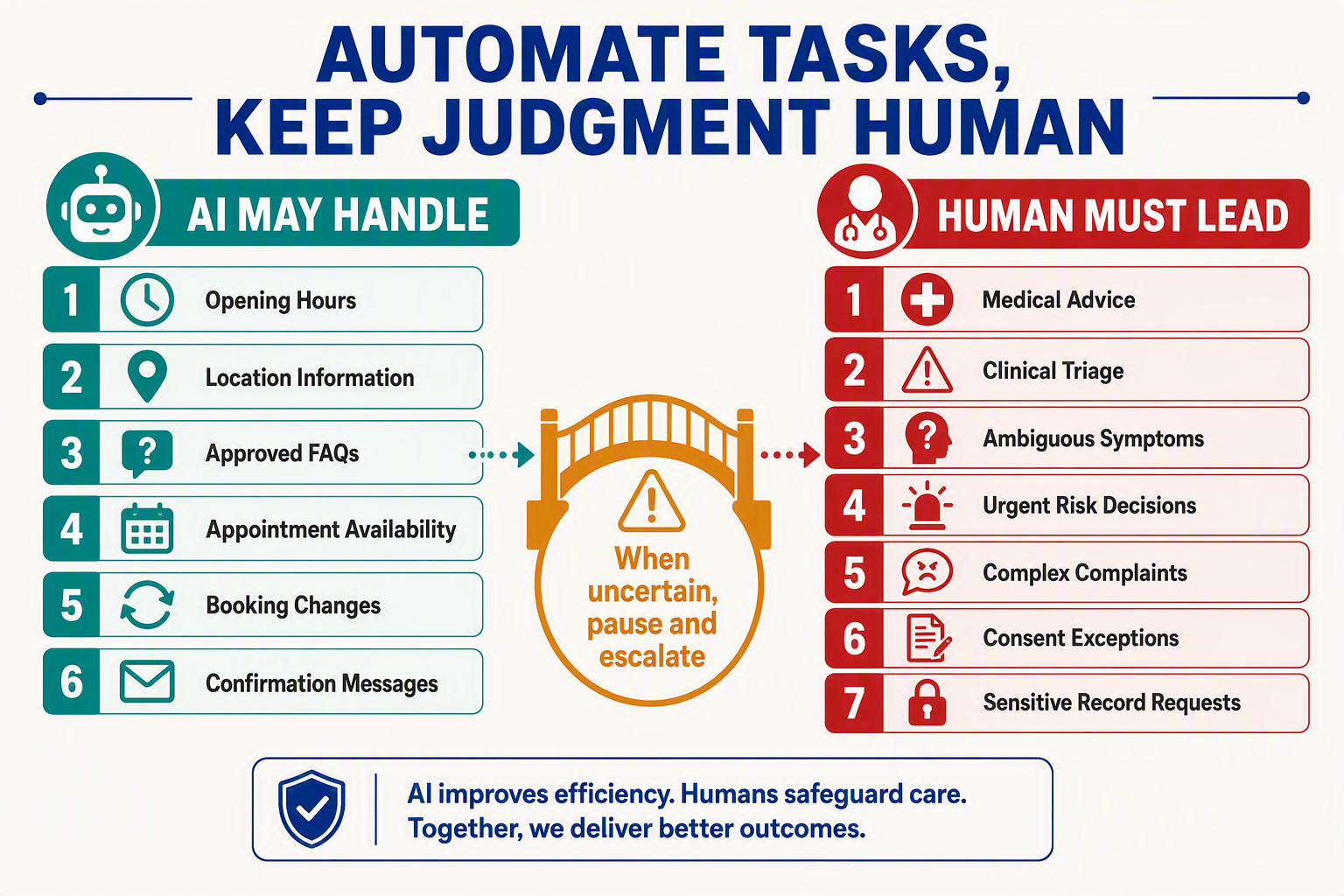
An AI receptionist for clinics should handle approved administrative tasks, while humans retain decisions involving clinical judgement, urgency, consent ambiguity, conflict, financial exceptions, and patient welfare. The operating rule is simple: if an incorrect decision could materially affect care, rights, safety, or access, the appointment booking voice agent must escalate rather than improvise.
Keep clinical judgement entirely with qualified people
Clinic automation must never diagnose, interpret results, recommend treatment, or independently determine that symptoms are harmless. Human-led decisions should include:
- Assessing symptoms or deciding the appropriate level of care.
- Interpreting laboratory reports, scans, prescriptions, or clinical notes.
- Recommending medicines, procedures, clinicians, or treatment pathways.
- Deciding whether a patient needs emergency, same-day, or routine care.
- Answering questions about side effects, contraindications, or prognosis.
- Handling requests that conflict with a clinician’s documented instructions.
The AI may follow a clinic-approved emergency script when it detects phrases such as “chest pain,” “cannot breathe,” or “unconscious.” However, keyword detection is an escalation mechanism—not clinical triage. The system should immediately offer a human transfer and deliver the clinic’s approved emergency guidance if transfer fails.
Require human review for sensitive access decisions
Scheduling appears administrative, but some requests contain clinical or ethical complexity. Route the following cases to authorised staff:
- Unclear service selection: The caller cannot identify the required appointment or describes symptoms instead of naming a service.
- Restricted bookings: The service requires a referral, prior evaluation, age check, clinician approval, or specific preparation.
- Vulnerable callers: The caller appears distressed, confused, cognitively impaired, or unable to provide informed responses.
- Consent uncertainty: A family member, employer, insurer, or caregiver seeks information or acts for the patient without clearly verified authority.
- Access exceptions: No standard slot meets an apparently time-sensitive need, or the caller requires accessibility accommodations outside configured options.
The World Health Organization projects a global shortage of 10 million health workers by 2030, especially in low- and lower-middle-income countries. That pressure supports automating repetitive coordination, but it does not justify transferring professional judgement to an unsupervised system.
Preserve human ownership of disputes and exceptions
A person should decide complaints, refunds, fee waivers, payment disputes, repeated no-show exceptions, and requests to override clinic policy. Human review is also appropriate when a patient challenges an AI-generated record, disputes what was said, or asks why a booking was refused.
Privacy-related decisions must likewise have an accountable owner. India’s Digital Personal Data Protection Act, 2023 establishes obligations around purposeful processing, consent where applicable, safeguards, and accountability for digital personal data. Clinic staff—not the AI—should resolve consent withdrawals, correction requests, identity disputes, retention exceptions, and suspected data incidents.
Add a human-led decision checklist before launch
Confirm that clinic call automation cannot independently:
- Mark a situation as clinically non-urgent.
- Reveal records without the clinic’s approved identity and authority checks.
- Override eligibility, referral, payment, or scheduling restrictions.
- Close complaints or safety incidents without review.
- Continue confidently when speech recognition, identity, intent, or language confidence is low.
- Change escalation scripts, knowledge sources, or booking rules without approval.
Assign a named owner and response target to every handoff queue. Review escalated-call samples regularly, document why escalation succeeded or failed, and update rules under clinical and operational supervision. Safe automation is not measured only by calls completed; it is also measured by how reliably uncertainty reaches the right human.
What does this setup checklist mean for your clinic or appointment-based business? (TABLE)
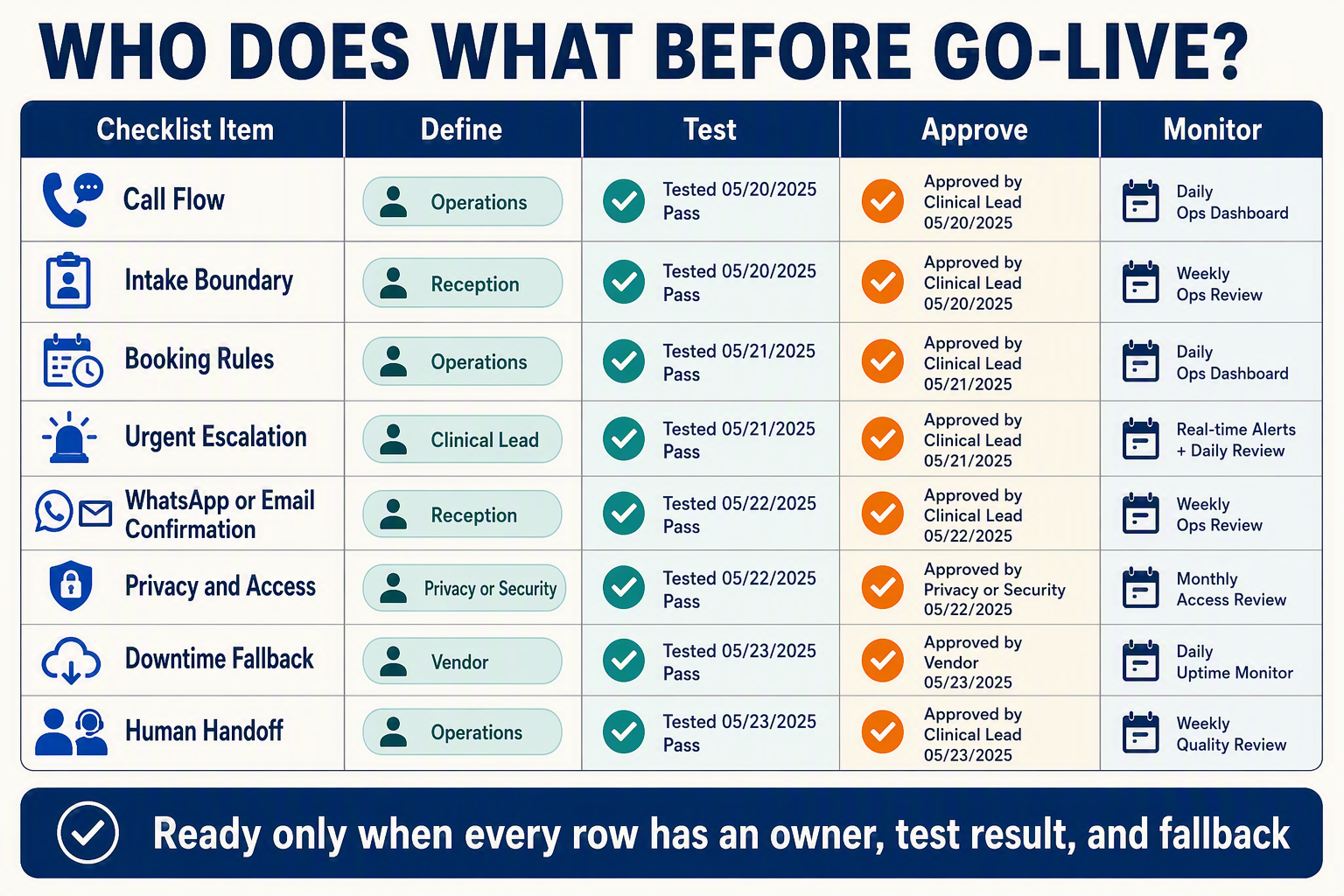
CallMissed is worth shortlisting when a clinic needs an AI voice agent for high-volume, administrative conversations: answering routine calls, managing approved appointment workflows, sending WhatsApp or email confirmations, communicating in required languages, and escalating defined cases to staff. Shortlisting should remain conditional on a successful workflow demonstration, integration testing, privacy review, and agreement on human ownership.
It should not diagnose, interpret symptoms or results, recommend treatment, assess clinical urgency, or replace clinical judgement. Any clinical, ambiguous, sensitive, or unsupported request must follow a clinic-approved handoff or emergency-information pathway.
Match each task to a safeguard and owner
| Suitable task | Required safeguard before go-live | Human owner |
|---|---|---|
| Administrative call answering | Approved knowledge base, AI disclosure where required, identity checks, low-confidence fallback, and no clinical advice | Front-desk lead |
| Booking, rescheduling, and cancellation | Live calendar integration, practitioner and service eligibility rules, timezone and buffer controls, duplicate checks, and reversible changes | Practice manager |
| WhatsApp or email confirmations | Valid contact details, appropriate consent or communication preference, minimum necessary information, delivery-failure handling, and a correction route | Patient-access lead |
| Multilingual communication | Demonstration in every required language, review of scripts and pronunciation, and transfer when meaning or caller intent is uncertain | Language or operations lead |
| Urgent or complex call escalation | Clinic-approved trigger phrases, transfer roster, after-hours route, no-answer fallback, and emergency wording that does not rely on AI assessment | Designated clinician |
| Call records and monitoring | Role-based access, retention rules, audit logs, incident reporting, transcript review, and a process for correcting sensitive records | Privacy and operations leads |
Verify the platform against the clinic’s real workflows
Before selecting an AI receptionist for clinics, require CallMissed to demonstrate the proposed configuration using realistic scenarios rather than a generic sales script. Testing should cover:
- New bookings, rescheduling, cancellation, unavailable calendars, and simultaneous requests
- Clinical questions, unclear intent, distressed callers, accessibility needs, and policy exceptions
- Successful, unanswered, and after-hours transfers
- WhatsApp or email consent, delivery failure, incorrect contact details, and corrected appointments
- Every required language, including mixed-language and low-confidence conversations
- Audit trails showing what the agent heard, changed, sent, and escalated
Also verify the availability and limits of calendar, CRM, telephony, WhatsApp, and email integrations. Confirm where data is processed, who can access it, how long it is retained, whether recordings or transcripts are created, and how deletion, correction, security incidents, and vendor changes are handled.
Treat compliance and clinical safety as buyer responsibilities
CallMissed can provide automation infrastructure, but software deployment alone does not establish compliance. The clinic remains responsible for validating consent, privacy notices, data minimisation, access controls, local healthcare requirements, professional guidance, and applicable data-protection rules. In India, this review should include the Digital Personal Data Protection Act, 2023; organisations operating elsewhere should assess the laws and sector requirements that apply in each jurisdiction.
The World Health Organization’s guidance on ethics and governance of AI for health emphasises human autonomy, transparency, accountability, safety, and public interest. In practical terms, the clinic—not the voice agent—must define clinical boundaries and retain authority over patient-impacting decisions.
Use a clear shortlist decision
Shortlist CallMissed if the platform can demonstrate:
- Reliable administrative answering and appointment handling
- Accurate WhatsApp or email confirmations with failure alerts
- Acceptable performance in the clinic’s required languages
- Controlled transfer to named staff, including no-answer fallbacks
- Traceable actions, role-based access, and workable retention controls
- Compatibility with the clinic’s calendar and other authoritative systems
Do not approve go-live if escalation is unreliable, the integration can create incorrect or duplicate appointments, consent requirements are unresolved, language performance is unverified, or the agent can stray into diagnosis or clinical judgement. Classify each control as ready, conditionally ready, or blocked; any safety-, privacy-, or escalation-related block should stop launch.
Frequently asked questions about an AI receptionist for clinics, appointment booking, WhatsApp confirmations, urgent calls, privacy, costs, testing, and human handoffs
Can an AI receptionist for clinics book, reschedule, and confirm appointments automatically?
How should an AI receptionist handle urgent or emergency calls to a clinic?
Is an AI receptionist for clinics compliant with patient privacy requirements in India?
How much does clinic call automation cost in 2026?
How do you test an appointment booking voice agent before launch?
When should an AI receptionist for clinics transfer a caller to a human?
Conclusion
The safest AI receptionist for clinics is a tightly scoped administrative coordinator—not a substitute for clinical judgement. A clinic is ready to go live only when booking rules, intake limits, urgent escalation, privacy controls and human ownership work reliably together.
Final go-live checks
- Constrain every call flow. Disclose that callers are interacting with AI, support clear language selection and identity checks, and define explicit routes for booking, rescheduling, cancellation, after-hours enquiries and low-confidence responses. The appointment booking voice agent should collect only approved information and never diagnose, interpret results or recommend treatment.
- Make scheduling deterministic. Validate service durations, clinician eligibility, buffers, duplicate prevention, time zones and calendar availability. Confirm every completed action through an approved channel such as WhatsApp or email, while giving callers a simple way to correct errors or reach staff.
- Treat urgent handoffs as a safety-critical workflow. Test approved trigger phrases, immediate transfer paths, emergency messaging and the fallback used when no human answers. Distressed callers, uncertain emergencies, clinical questions, complaints, accessibility needs and unusual exceptions must remain human-led.
- Operate clinic call automation as a monitored system. Maintain consent records where applicable, role-based access, appropriate retention, audit logs, vendor reviews and named incident owners. India’s Digital Personal Data Protection Act, 2023 requires purposeful handling and safeguards for digital personal data, but software alone cannot guarantee a clinic’s compliance.
This discipline will become increasingly important as demand grows: the World Health Organization projects a global shortage of 10 million health workers by 2030, with the largest gaps in low- and lower-middle-income countries. In 2026 and beyond, watch for better multilingual speech accuracy, more dependable human handoffs and tighter coordination across calls, WhatsApp, email and clinic calendars—but evaluate each improvement against real test scenarios rather than vendor demos.
To explore how this infrastructure is evolving, visit CallMissed, an AI-native platform offering voice agents, WhatsApp Business calling and support for 22 Indian languages. Before activating live calls, ask one final question: when the AI is uncertain, urgent or wrong, does your workflow move the caller to the right human quickly and visibly?
Related Reading
Related Posts

Ready to automate customer conversations?
Launch AI voice agents and WhatsApp bots with CallMissed — one API, 22+ Indian languages.