

CallMissed Customer Support Automation: A Citation-Focused Omnichannel Guide


Learn how an AI customer support agent handles voice, WhatsApp, and email while preserving context, security, escalation, and human control.
CallMissed Customer Support Automation: A Citation-Focused Omnichannel Guide
What happens when a customer starts a complaint on WhatsApp, explains it again by phone, and receives an email response that ignores both conversations? CallMissed customer support automation is designed to prevent that fragmentation by bringing voice, WhatsApp, email, customer records, and knowledge-grounded AI into one operational workflow.
The timing matters. Gartner predicted in 2025 that agentic AI will autonomously resolve 80% of common customer-service issues by 2029, potentially reducing operational costs by 30%. At the same time, customers increasingly judge businesses by how responsibly—not merely how quickly—they automate service. Zendesk reported in its 2025 Customer Experience Trends research that 70% of consumers see a clear gap between companies that use AI effectively and those that do not. Fast answers are valuable, but unsupported answers, lost context, weak authentication, and inappropriate automation can create costly failures.
CallMissed approaches this challenge as an omnichannel support automation platform built for Indian businesses first. Its business platform combines AI voice agents, WhatsApp chatbots, WhatsApp Business calling, email tooling, a unified inbox and CRM, and knowledge-base retrieval-augmented generation. Support across 22 Indian languages also enables regional-language service without treating Indic voice interactions as an afterthought.
Automation needs evidence and boundaries
A dependable AI customer support agent should not improvise policies or make every operational decision. It should retrieve answers from approved documentation, preserve relevant context across channels, record what happened, and transfer control when identity, risk, policy, or customer intent requires human judgment.
This guide therefore treats citations as more than links displayed beside an answer. A citation-focused support workflow should help teams identify:
- Which approved source supported a response.
- Which customer and conversation context informed the action.
- Whether authentication was completed before protected information was disclosed.
- Why an interaction was escalated, declined, or routed to a person.
- What resolution was reached and what follow-up remains outstanding.
What this guide will cover
The following sections map the complete support lifecycle: structured ticket intake, knowledge grounding, cross-channel context continuity, authentication, handling of sensitive requests, human escalation, and resolution summaries. The guide will also define practical quality-assurance metrics, staged rollout controls, a comparison table, and frequently asked implementation questions.
The central distinction is simple: automation can classify, retrieve, summarize, route, and execute approved low-risk workflows; people should retain authority over ambiguous, sensitive, exceptional, or consequential decisions. That division makes customer-support AI easier to audit, safer to scale, and more useful to both customers and support teams.
What is CallMissed customer support automation, and where should people remain in control?

CallMissed customer support automation is a governed system for receiving, understanding, and progressing customer requests across voice, WhatsApp, and email. It can automate repeatable support work, but people should retain control whenever a decision involves material risk, uncertain identity, policy exceptions, sensitive data, or irreversible consequences.
What the automation layer actually does
CallMissed combines an AI customer support agent, WhatsApp chatbots, WhatsApp Business calling, email tooling, customer records, a unified inbox, and knowledge-base retrieval-augmented generation. Rather than operating as disconnected channel bots, these components can contribute to a shared support workflow.
Within clearly defined permissions, the automation layer can:
- Capture and structure requests: Convert a voice call, WhatsApp message, or email into a ticket with the customer’s issue, channel, language, urgency, and relevant identifiers.
- Retrieve approved information: Ground responses in selected policies, product documentation, troubleshooting guides, and account-specific data the workflow is permitted to access.
- Continue routine workflows: Ask follow-up questions, collect non-sensitive details, provide status updates, schedule callbacks, and route requests to the appropriate queue.
- Maintain operational records: Save transcripts, citations, tool actions, escalation reasons, and concise resolution summaries.
- Communicate across languages: CallMissed supports Speech-to-Text and Text-to-Speech across 22 Indian languages, allowing regional-language interactions to enter the same governed process.
This is the practical meaning of omnichannel support automation: channels share a controlled operating context, while every channel remains subject to the same identity, evidence, privacy, and escalation rules.
Where human authority should begin
Automation should stop—or request explicit approval—when the system cannot safely establish the customer’s identity, the applicable policy, or the likely consequences of an action. Human review is especially important for:
- High-value financial actions: Large refunds, disputed charges, credit decisions, or changes affecting contractual obligations.
- Sensitive account changes: Phone-number replacement, ownership transfer, payment-detail updates, credential resets, or disclosure of protected information.
- Policy exceptions: Requests that fall outside published eligibility, warranty, cancellation, or service-level rules.
- Safety, legal, or reputational risk: Threats, harassment, suspected fraud, regulatory complaints, medical emergencies, or litigation notices.
- Ambiguous evidence: Conflicting customer records, outdated knowledge sources, low-confidence transcription, or contradictory policy documents.
- Customer preference: A direct request to speak with a person should be treated as a valid escalation signal, not an obstacle to automation.
Use decision rights, not a vague “human in the loop”
The strongest operating model assigns each workflow one of three decision modes:
- AI may act: The request is authenticated where necessary, low-risk, evidence-grounded, and reversible.
- AI may recommend: The system gathers evidence and proposes an action, but a person approves execution.
- Human must decide: The request is sensitive, exceptional, consequential, or outside the automation policy.
This boundary matters as autonomous service expands. Gartner predicted in 2025 that agentic AI could autonomously resolve 80% of common customer-service issues by 2029, but “common” issues should not be confused with every issue. CallMissed can provide the communication and workflow infrastructure; each business remains responsible for defining permissions, approval thresholds, retention rules, and accountable human owners.
How does omnichannel support automation fit into the customer service lifecycle?
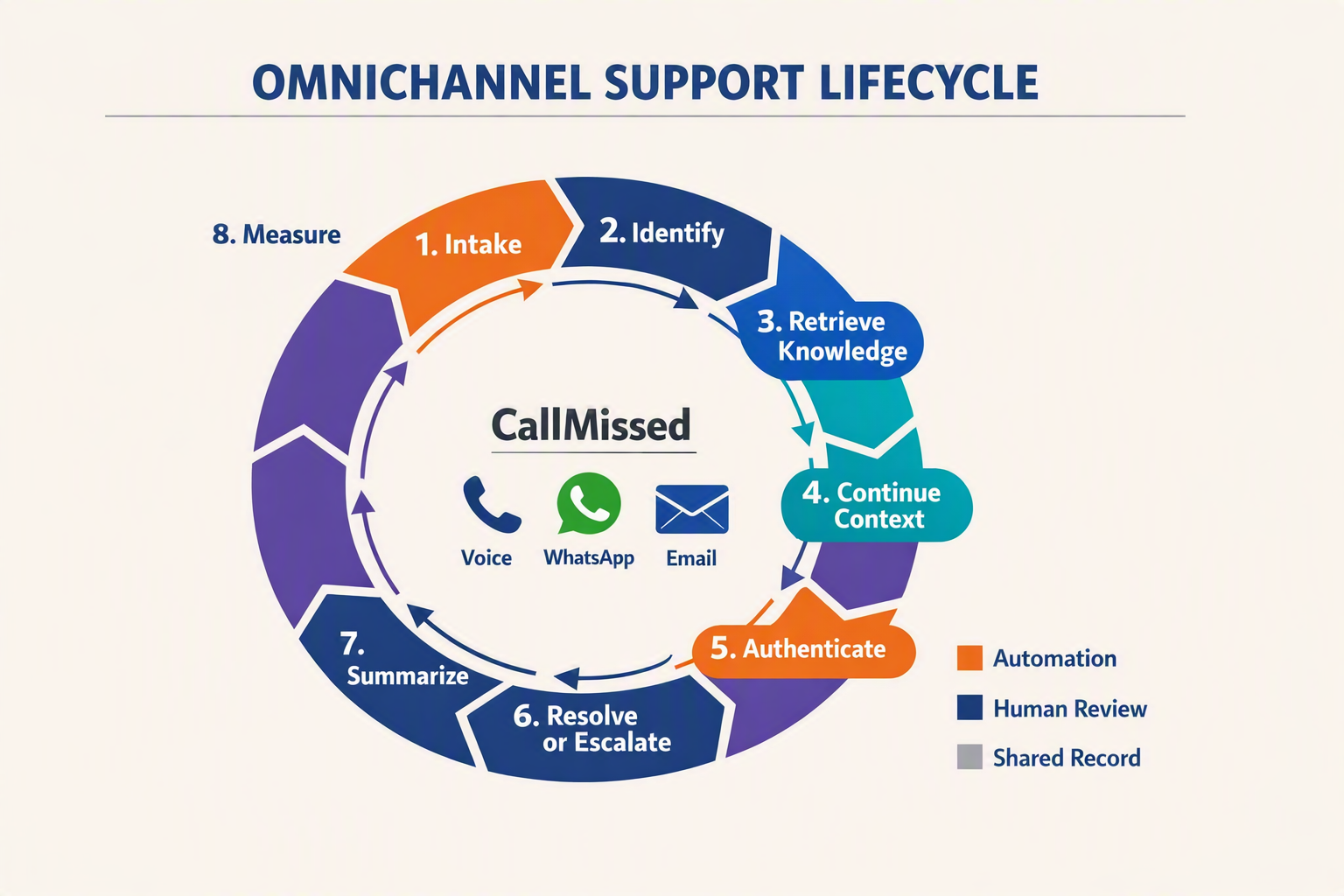
Omnichannel support automation fits across the entire customer-service lifecycle—from intake and identity matching to retrieval, escalation, resolution, and follow-up—but it should not control every decision. The operating model is one governed case record that voice, WhatsApp, and email workflows can read and update according to their permissions.
A seven-stage support lifecycle
- Capture and normalize the request.
An inbound WhatsApp message, voice call, or email becomes a structured case containing the channel, timestamp, customer identifier, detected language, intent, urgency, attachments, and transcript. Voice transcription should preserve the original recording or an authorized reference to it so reviewers can verify what was actually said.
- Match identity and conversation history.
The system links available identifiers—such as a verified phone number, WhatsApp identity, email address, or CRM customer ID—to the appropriate record. Matching signals can suggest an identity, but protected account details should remain unavailable until the required authentication succeeds.
- Classify and route the case.
An AI customer support agent can identify topics such as delivery status, billing, cancellation, technical support, or complaints. Rules then assign priority, service-level targets, and ownership. Low confidence, threatening language, repeated contact, or regulated subject matter should trigger review rather than an unsupported automated decision.
- Retrieve grounded information.
Retrieval-augmented generation searches approved policies, product documentation, account data, and troubleshooting instructions. The response should retain the source title, version, retrieval time, and relevant passage—not merely produce fluent text. This creates a traceable distinction between an answer grounded in company policy and an unverified model inference.
- Authenticate before acting.
Authentication requirements should reflect the requested action. General product guidance may require no verification, while an address change, refund, account disclosure, or payment-related request may require a one-time password, logged-in session, or human verification. Channel access is not automatically proof of authority.
- Resolve or escalate.
Automation can execute predefined, reversible actions within explicit limits. A person should handle ambiguous identity, policy exceptions, disputed charges, safety concerns, legal threats, unusually large refunds, or requests involving sensitive personal data. Escalation must include the transcript, retrieved evidence, authentication status, actions attempted, and reason for transfer.
- Summarize, close, and learn.
The final record should document the issue, verified identity level, sources consulted, actions taken, owner, outcome, and promised follow-up. Quality teams can then examine containment, reopen rates, unsupported-answer frequency, authentication failures, escalation accuracy, and customer satisfaction.
One case record, channel-specific execution
Omnichannel support automation does not mean forcing identical interactions across every channel. Voice demands low-latency turn-taking; WhatsApp supports persistent messages and media; email is suited to longer, formal explanations. The shared element is the governed case context.
CallMissed customer support automation connects AI voice agents, WhatsApp chatbots, WhatsApp Business calls, email tooling, and an omnichannel inbox/CRM. Its support for 22 Indian languages is particularly relevant when a customer speaks in a regional language by phone but later continues the same case in written English or Hindi.
Across this lifecycle, the safest division of responsibility is clear:
- Automate: intake, transcription, classification, retrieval, summarization, approved notifications, and low-risk actions.
- Require people: exceptions, consequential judgments, sensitive disclosures, uncertain authentication, and contested outcomes.
- Audit both: sources, context used, permissions, actions, handoffs, and final resolution.
Which CallMissed capabilities support each stage of a customer request? (TABLE)
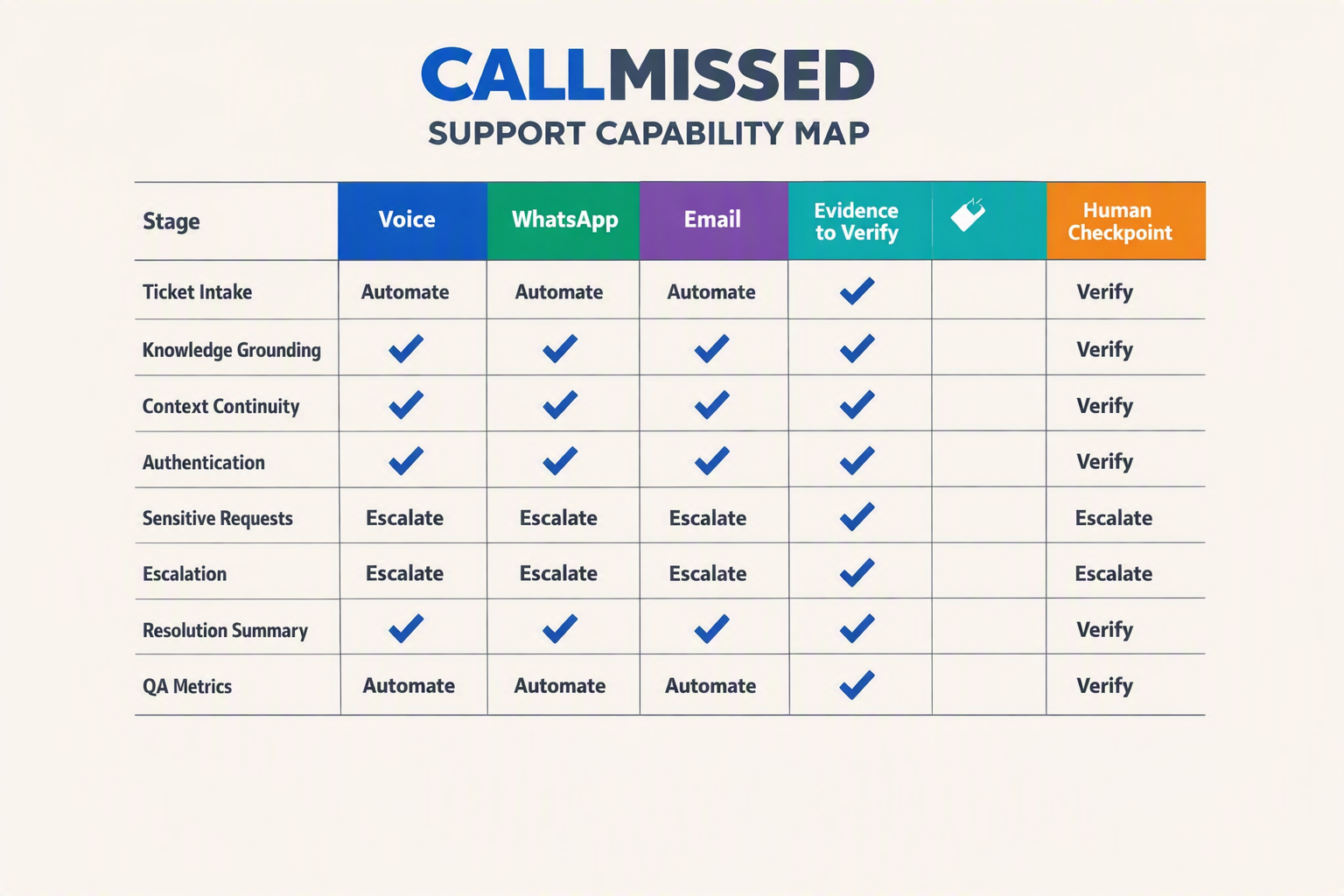
CallMissed customer support automation supports the request lifecycle by combining channel intake, a unified inbox and CRM, knowledge-base retrieval-augmented generation (RAG), AI voice agents, WhatsApp automation, email tooling, and human handoff. The platform can automate repeatable support work, while authentication rules, sensitive disclosures, exceptions, and consequential decisions remain governed by the business and its authorised staff.
| Request stage | CallMissed capability | Safe automation scope | Evidence to retain | Human control point |
|---|---|---|---|---|
| 1. Intake and classification | AI voice agents, WhatsApp chatbots, WhatsApp Business calls, email tooling, unified inbox | Capture the issue, identify intent, collect required fields, assign priority, and route by configured rules | Channel, timestamp, customer identifier, transcript, attachments, detected intent | Review ambiguous, abusive, high-value, or urgent cases |
| 2. Identity and authentication | Conversational workflows connected to customer records and approved verification systems | Request non-secret identifiers and initiate business-defined OTP, callback, or account-verification steps | Verification method, result, time, attempts, and consent state—not raw credentials | Handle failed verification, suspected fraud, or account-ownership disputes |
| 3. Knowledge grounding | Knowledge-base RAG across approved business content | Retrieve relevant policy, product, troubleshooting, or account-process information and draft a grounded response | Source title, version, retrieved passage, retrieval time, and response generated | Resolve conflicting sources, policy exceptions, or missing documentation |
| 4. Context continuity | Omnichannel inbox and CRM spanning voice, WhatsApp, email, and web interactions | Summarise prior exchanges, preserve case state, and continue the workflow without repeatedly asking for the same details | Conversation IDs, linked customer record, channel history, summary, and unresolved tasks | Correct mistaken identity matches or inaccurate summaries |
| 5. Action and sensitive requests | Configurable AI workflows, messaging, voice, and integrations | Perform approved low-risk actions such as sending instructions, confirming receipt, or scheduling follow-up | Authentication state, action requested, system response, approval rule, and outcome | Approve refunds, cancellations, protected-data disclosures, disputes, or irreversible changes |
| 6. Escalation and resolution | Routing, agent inbox, transcripts, summaries, and outbound email or WhatsApp follow-up | Transfer the case with a concise briefing, record the resolution, and send an approved closure message | Escalation reason, assigned owner, cited sources, decision, resolution summary, and next step | Make the final judgment and verify closure for exceptional cases |
How the stages work as one governed flow
An AI customer support agent should move a request through these stages only when the required evidence is present. For example, a caller asking about a public returns policy may receive a RAG-grounded answer immediately. A caller requesting an address change should first pass the company’s configured authentication process, while a disputed refund may require a person even after identity verification succeeds.
CallMissed’s WhatsApp-native capability is especially relevant at intake and continuity stages: a business can handle messages and bridge WhatsApp Business voice calls to an AI voice agent rather than treating calling as a separate support environment. Subsequent email follow-up can then reference the same governed customer record, subject to correct identity matching and access controls.
Minimum controls for production use
Before enabling omnichannel support automation, teams should define:
- Required fields for every case type and channel.
- Approved knowledge sources, owners, versions, and review dates.
- Authentication thresholds based on the sensitivity of the requested action.
- Automatic escalation triggers, including low confidence, repeated failure, customer request, and policy conflict.
- Resolution evidence, including the source used, action taken, decision owner, and outstanding commitments.
This separation is critical: CallMissed can capture, retrieve, summarise, communicate, and route, but the deploying business remains responsible for verification design, permissions, retention policies, and decisions that materially affect a customer.
How should ticket intake, knowledge grounding, and context continuity work across channels?
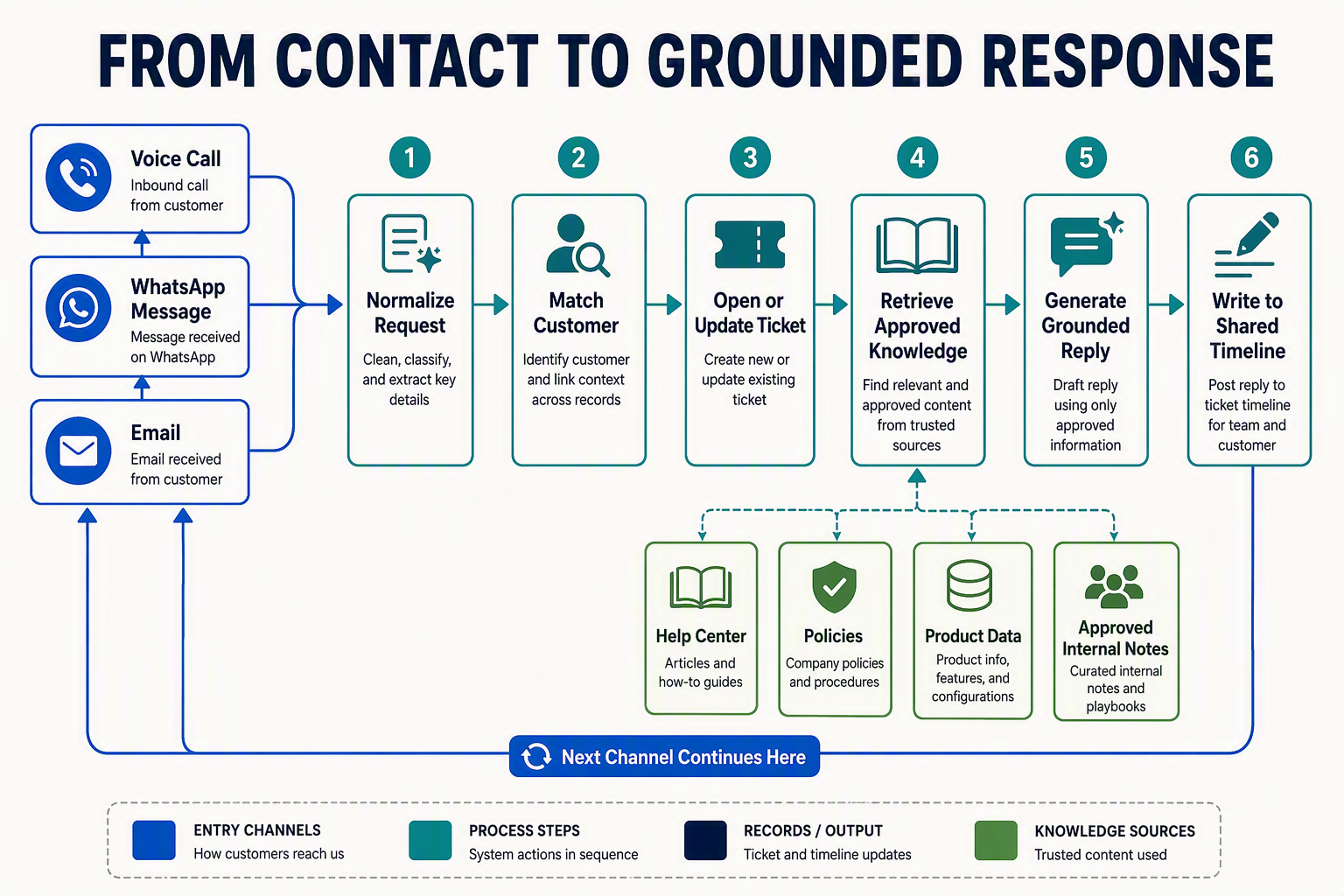
Ticket intake, knowledge grounding, and context continuity should operate through one governed support record: every voice call, WhatsApp exchange, and email must attach to a common ticket, retrieve from approved sources, and preserve an auditable history. The AI customer support agent may classify and summarize interactions, but it should not silently merge uncertain identities, invent missing context, or treat generated text as policy.
1. Convert every interaction into structured ticket data
CallMissed customer support automation can bring voice, WhatsApp, email, and CRM activity into a unified workflow. Regardless of the entry channel, intake should capture a consistent minimum dataset:
- Ticket ID, channel, timestamp, and customer identifier
- Customer intent, such as delivery status, cancellation, complaint, or refund
- Product, order, account, or service references supplied by the customer
- Urgency, sentiment, language, and routing category
- Authentication status, recorded separately from identity assumptions
- Original evidence, including call transcripts, messages, attachments, and email headers
- Automation actions and outstanding follow-ups
Voice transcription and intent classification can populate fields automatically, while WhatsApp messages and emails can retain their original text. The system should preserve both the source interaction and the AI-generated summary because summaries can omit qualifiers, dates, or customer objections.
2. Ground answers in approved knowledge
Knowledge grounding should follow a retrieval-augmented generation workflow rather than allowing the model to answer solely from general training data:
- Interpret the request using the current message and relevant ticket history.
- Retrieve approved material such as return policies, product manuals, service-level terms, or troubleshooting procedures.
- Check applicability by market, product, plan, effective date, and customer type.
- Generate a bounded answer supported by the retrieved material.
- Record the evidence used for the response.
A useful citation record includes the document title, section, version or effective date, retrieval timestamp, and quoted passage or chunk identifier. If no authoritative source supports an answer, the automation should state that it cannot verify the information and route the question appropriately. An older policy should not override a newer version merely because its wording is a closer semantic match.
3. Maintain continuity without collapsing distinct identities
Effective omnichannel support automation should let a customer continue a case across channels without repeating the entire story. CallMissed’s unified inbox and CRM can provide the operational layer for linking related WhatsApp conversations, voice calls, and email threads.
Context continuity should distinguish three concepts:
- Conversation match: the interaction appears related to an existing ticket.
- Identity match: available identifiers suggest the same customer.
- Verified identity: the required authentication process has been completed.
These states are not interchangeable. A matching phone number may help locate a ticket, but it should not automatically authorize disclosure of protected account information.
Before each response, the AI should receive only the minimum relevant context: the latest customer request, verified profile fields, unresolved actions, channel history, and applicable knowledge excerpts. Stale instructions, unrelated tickets, and sensitive data unnecessary for the task should be excluded.
The resulting record should make the support journey reconstructable: what the customer said, what evidence the AI retrieved, what response it gave, which action it took, and where human judgment became necessary.
When must an AI customer support agent authenticate the customer or hand the decision to a person?
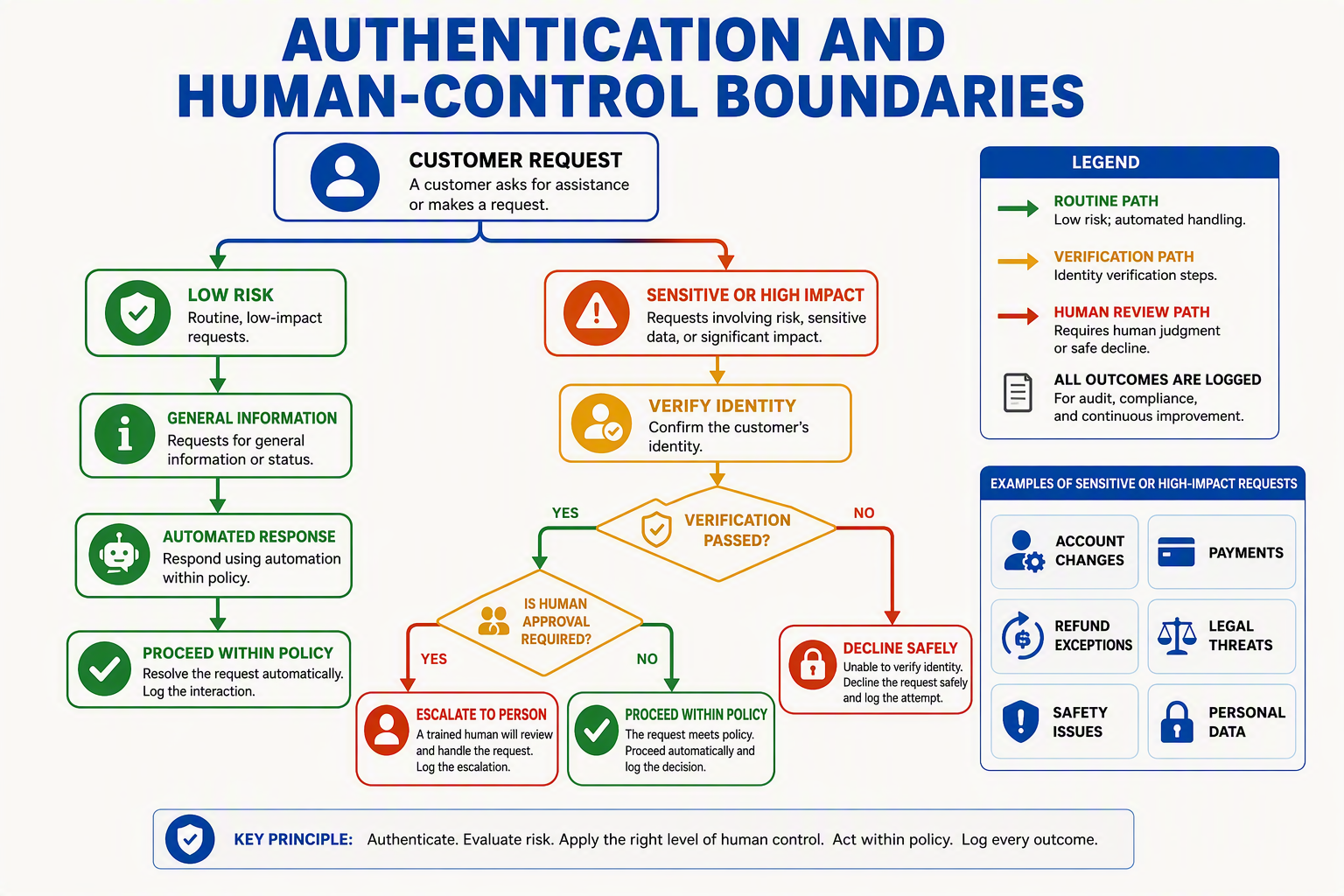
An AI customer support agent must authenticate a customer before revealing protected account data or executing an account-changing action. It must hand the decision to a person when the request is high-impact, legally sensitive, ambiguous, exceptional, or outside an explicitly approved policy.
Authentication should follow the action’s risk
Recognizing a phone number, WhatsApp profile, email address, or prior conversation is identification—not authentication. A familiar channel can help locate a customer record, but it does not prove that the current sender or caller controls the account.
Use step-up authentication rather than applying the same challenge to every interaction:
- No authentication: Public FAQs, product availability, branch hours, general troubleshooting, and policy explanations.
- Basic verification: Order status or appointment details with limited disclosure, using an approved combination such as an order reference and one-time password.
- Strong authentication: Address changes, account recovery, payment-method updates, cancellation of valuable services, or access to personal records.
- Human review plus authentication: Refund exceptions, disputed transactions, suspected fraud, bereavement cases, legal threats, or decisions affecting eligibility and customer rights.
The National Institute of Standards and Technology’s NIST SP 800-63B warns that knowledge-based authentication questions are weak because answers may be discoverable or shared. Support teams should prefer time-limited one-time passwords, authenticated account sessions, verified callbacks, or another factor appropriate to the transaction.
Protected data must not become an authentication factor
An agent should request only the minimum information needed and should never ask customers to provide complete passwords, PINs, card security codes, or one-time passwords intended for another transaction. PCI Security Standards Council’s PCI DSS v4.0.1 prohibits storing sensitive authentication data, including card verification codes, after authorization—even when encrypted.
For CallMissed customer support automation, authentication status should travel with the governed customer record across voice, WhatsApp, and email. However, a successful check in one conversation should not become permanent authorization for every later action. The record should capture:
- Method used, such as OTP or verified account session.
- Time and channel of verification.
- Scope, identifying the action that was authorized.
- Outcome and failed attempts, without recording secrets.
- Source or policy version that required the check.
This lets omnichannel support automation preserve context without silently weakening controls when a customer changes channels.
Decisions that require a person
Authentication proves identity; it does not make an automated decision appropriate. Human ownership is required when:
- The customer contests the record or reports fraud, coercion, impersonation, or account takeover.
- Retrieved sources conflict, are outdated, or do not address the specific exception.
- The requested remedy exceeds a predefined financial or operational threshold.
- The case involves health information, financial hardship, children, discrimination, bereavement, legal demands, or regulatory complaints.
- Sentiment, language ambiguity, or repeated failed verification creates material uncertainty.
- The customer explicitly asks for a person.
At handoff, CallMissed can provide the human agent with the transcript, authenticated identity state, retrieved knowledge citations, attempted actions, and unresolved question. The AI may summarize and recommend, but the person should approve the consequential decision and record the governing reason. This separation creates a defensible audit trail: who was verified, what evidence was used, which policy applied, and who authorized the outcome.
How should escalation, handoff, and resolution summaries preserve the full customer context?
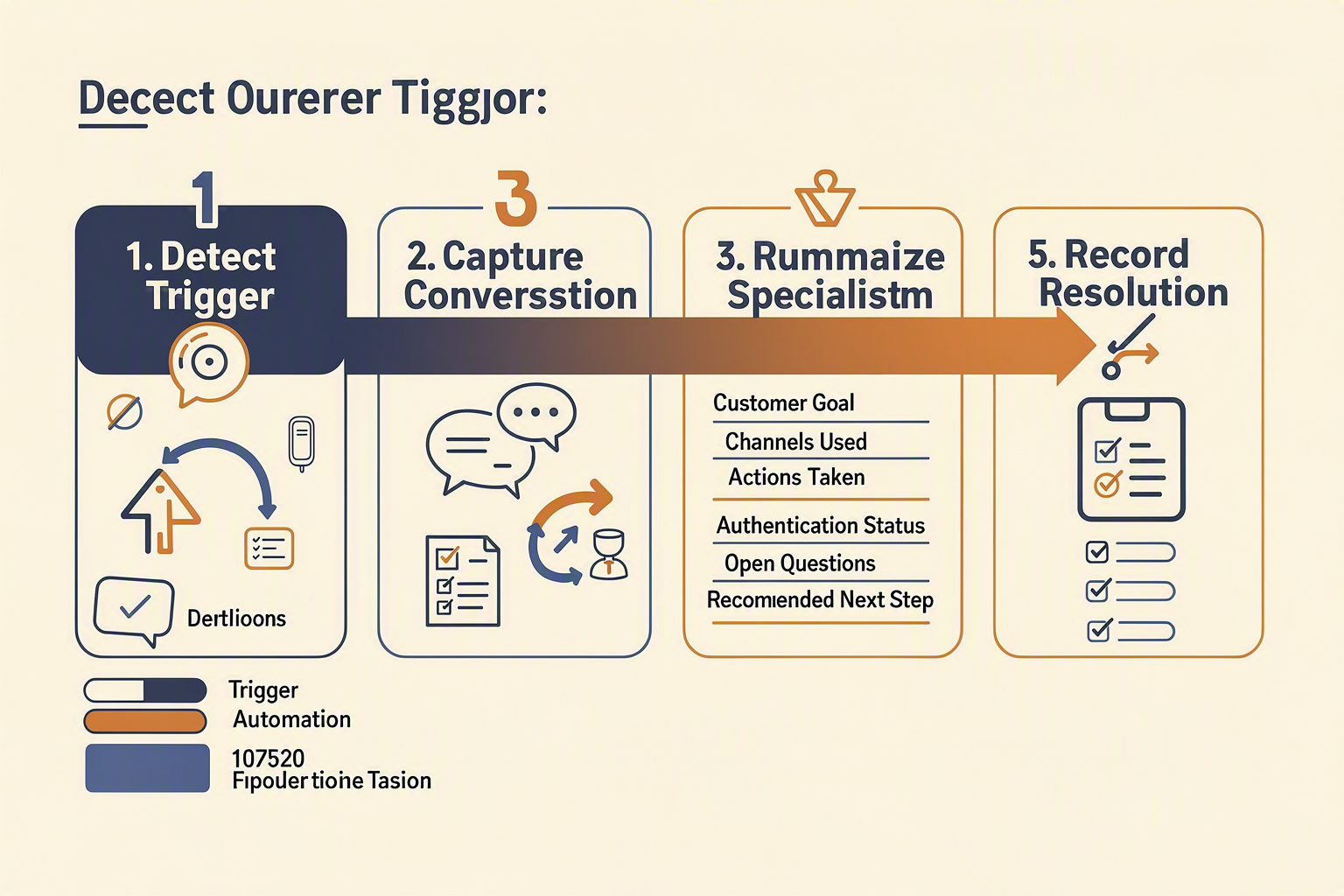
Escalation should transfer a structured, auditable case record, not merely a transcript or AI-generated paragraph. The receiving person needs the customer’s objective, verified identity state, cross-channel history, supporting knowledge sources, actions already taken, unresolved risks, and the next required decision.
Build a handoff packet around decisions
A dependable AI customer support agent should create the handoff packet before assigning the case. For CallMissed customer support automation, voice, WhatsApp, and email interactions can feed the same operational workflow, allowing the packet to represent one case rather than three disconnected conversations.
The handoff should contain:
- Customer and case identity: CRM record, ticket number, relevant account or order identifiers, preferred language, and contact channel.
- Authentication state: Verification method, completion time, permitted scope, failed attempts, and whether re-authentication is required. The summary should never imply that identity was verified merely because a phone number or email address matched.
- Customer intent: A concise statement of the requested outcome—not just a list of messages.
- Cross-channel timeline: Timestamped voice calls, WhatsApp messages, emails, attachments, commitments, and prior transfers.
- Evidence and citations: Approved knowledge articles, policy versions, order records, or other sources used to generate answers.
- Actions and outcomes: Steps attempted, tools invoked, confirmations received, and any partial results.
- Escalation reason: The specific ambiguity, policy exception, authentication failure, customer request, or sensitive decision requiring a person.
- Next action: Assigned owner, priority, deadline, promised follow-up channel, and decision still outstanding.
A summary should link back to the underlying transcript or message where retention policy permits. This allows an agent to verify nuance instead of treating a generated summary as the authoritative record.
Preserve uncertainty and sensitive-data boundaries
Good omnichannel support automation distinguishes facts from inference. For example, “The customer said the payment was duplicated” is an attributed statement; “The payment was duplicated” is a conclusion that may require transaction evidence.
The handoff should therefore label:
- Verified facts obtained from authenticated systems.
- Customer-reported claims that remain unconfirmed.
- AI classifications or summaries that require review.
- Low-confidence transcription segments, especially names, numbers, and regional-language terms.
- Restricted information that must be masked, omitted, or accessed only by authorised staff.
“Full context” does not mean copying passwords, one-time passcodes, payment credentials, health details, or unrelated personal information into every ticket. Teams should apply data minimisation, role-based access, and retention rules while preserving enough evidence for the next agent to act safely.
Close the loop with two resolution summaries
After resolution, create separate internal and customer-facing records:
- The internal summary should capture root cause, authentication status, sources consulted, approvals, actions, exceptions, owner, timestamps, and follow-up obligations.
- The customer summary should state what was understood, what was done, the result, any remaining step, and when the customer should expect an update. It should exclude internal risk scores, private notes, and unnecessary personal data.
Platforms such as CallMissed can centralise these records across the omnichannel inbox and CRM, but a human should approve consequential exceptions, refunds, disputes, account restrictions, or other policy-sensitive outcomes. Automation preserves evidence and continuity; authorised people remain responsible for judgments that materially affect the customer.
Which QA metrics and rollout stages make automation safer and more useful?
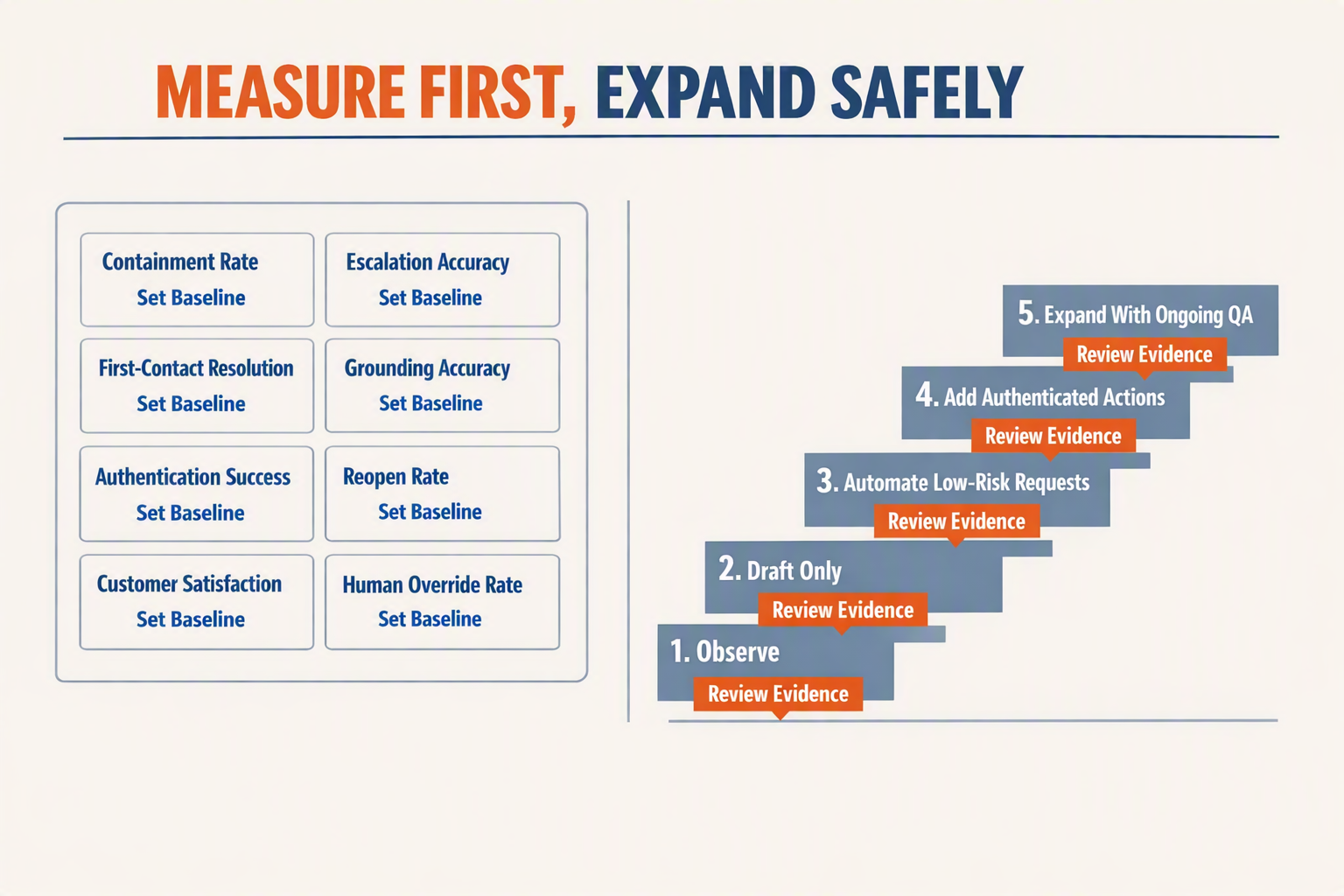
Safer automation requires two controls: a channel-specific QA scorecard and a staged rollout that expands autonomy only after predefined quality, security, and escalation gates are met. Teams should evaluate outcomes—not merely response speed—and let people retain authority over sensitive, ambiguous, or consequential cases.
Measure correctness, containment, and customer effort
For CallMissed customer support automation, evaluate voice, WhatsApp, and email separately as well as collectively. Voice transcription errors, incomplete WhatsApp threads, and misread email attachments create different failure modes.
A practical weekly scorecard should include:
- Grounded-answer rate: Percentage of factual answers supported by an approved knowledge source. Review whether the cited passage actually supports the answer, not simply whether a citation exists.
- Citation precision: Supported citations divided by all citations presented. Unsupported, obsolete, or irrelevant sources count as failures.
- Resolution accuracy: Percentage of reviewed cases in which the recorded outcome matches the customer’s issue and approved policy.
- Safe containment rate: Percentage of conversations completed without human assistance and without later reopening, correction, complaint, or policy breach.
- Escalation recall: Percentage of cases requiring human judgment that the automation correctly escalated. Missed escalations should carry more weight than unnecessary transfers.
- Authentication compliance: Percentage of protected actions completed only after the required identity checks. The launch target for bypasses should be zero.
- Context continuity: Percentage of cross-channel cases in which the agent correctly carries forward verified facts, prior actions, consent, and unresolved tasks.
- Customer effort: Repetition requests, transfers, reopenings, and contacts required per resolution.
- Operational performance: First-response latency, end-to-end resolution time, abandonment rate, and human handling time after transfer.
Do not optimize raw containment in isolation. An AI customer support agent that closes more tickets by giving weak answers is less useful than one that escalates uncertainty accurately.
Use risk-weighted test sets
Create a representative evaluation set containing common requests, regional-language conversations, noisy calls, code-switched speech, incomplete messages, stale documentation, prompt-injection attempts, and adversarial identity claims. Score results by channel, language, intent, customer segment, and risk level so averages cannot hide concentrated failures.
Governance should follow recognized frameworks. The U.S. National Institute of Standards and Technology released AI RMF 1.0 in January 2023 around four functions: Govern, Map, Measure, and Manage. ISO/IEC 42001:2023 specifies requirements for establishing and continually improving an AI management system. These frameworks support documented ownership, testing, monitoring, and corrective action rather than one-time model approval.
Roll out autonomy in controlled stages
- Offline evaluation: Test historical, redacted cases without contacting customers or changing records. Block deployment if the system discloses protected data, invents policy, or misses mandatory escalation.
- Shadow mode: Let automation classify, retrieve, and draft while human agents respond. Compare proposed actions with actual decisions.
- Agent-assist pilot: Expose summaries, citations, and suggested replies to a trained support group. Require approval before sending or executing actions.
- Low-risk automation: Enable narrow workflows such as ticket acknowledgement, status updates, approved FAQs, and routing. Begin with limited hours, languages, queues, or customer cohorts.
- Measured expansion: Add intents only after sustained performance across multiple review periods. Use versioned prompts, knowledge snapshots, audit logs, and rollback controls.
- Continuous monitoring: Sample resolved interactions, review every high-risk failure, monitor drift, and suspend affected workflows when authentication or grounding controls regress.
CallMissed’s omnichannel support automation can apply these gates across voice, WhatsApp, and email, but deployment authority should remain workflow-specific. Passing an FAQ pilot should never automatically authorize refunds, account changes, legal commitments, or other decisions requiring a person.
What evidence and expert review should support claims about CallMissed?

Claims about CallMissed customer support automation should be supported by a combination of first-party documentation, reproducible product testing, dated operational records, and review by relevant domain experts. Marketing pages can establish stated capabilities, but reliability, language quality, security controls, and workflow outcomes require independent verification in the buyer’s own environment.
Match each claim to the right evidence
Not every statement requires the same standard of proof. Teams evaluating CallMissed should classify claims and preserve evidence that another reviewer can inspect:
- Product-capability claims: Verify voice agents, WhatsApp chatbots, WhatsApp Business calling, email tooling, unified inbox functions, CRM records, and knowledge-base retrieval against current CallMissed documentation and an active product demonstration.
- Language-support claims: The stated coverage of 22 Indian languages should be checked using representative accents, code-switching, names, addresses, and industry terminology—not merely a list of supported language codes.
- Integration claims: Confirm that WhatsApp, voice, email, CRM, and external systems exchange the expected identifiers, timestamps, consent states, and conversation context.
- Performance claims: Measure answer accuracy, latency, containment, escalation, and authentication success using a documented test set. A successful scripted demo is not evidence of production reliability.
- Commercial claims: Validate current plan limits, credit consumption, taxes, telephony charges, and pay-as-you-go terms against the applicable quotation and billing documentation.
Broader market forecasts can explain why evaluation matters, but they do not prove an individual platform’s performance. Gartner predicted in 2025 that agentic AI could autonomously resolve 80% of common customer-service issues by 2029 and reduce operational costs by 30%; this is an industry forecast, not a guaranteed CallMissed outcome. Likewise, Zendesk reported in 2025 that 70% of consumers perceive a clear gap between companies using AI effectively and those that do not; that finding supports careful deployment rather than any vendor-specific claim.
Require reproducible operational evidence
A credible test of an AI customer support agent should include both ordinary and adversarial scenarios. Evidence should be timestamped, versioned, and tied to the relevant model, prompt, knowledge source, channel, and workflow configuration.
The evaluation set should cover:
- Correct and outdated knowledge articles.
- Contradictory policies and missing information.
- Authenticated and unauthenticated customers.
- Sensitive refund, account-change, fraud, and complaint requests.
- Voice-to-WhatsApp and WhatsApp-to-email handoffs.
- Regional-language speech, mixed-language conversations, and noisy calls.
- Explicit escalation requests and automation failures.
Reviewers should inspect transcripts, retrieved passages, citations, authentication events, tool calls, human handoffs, and final resolution summaries. A citation proves which source was retrieved; it does not, by itself, prove that the source was current, correctly interpreted, or appropriate for that customer.
Assign expert review by risk
Effective omnichannel support automation needs multidisciplinary approval:
- Support operations leaders should validate routing, escalation, and resolution logic.
- Security and privacy specialists should review identity checks, access controls, retention, redaction, and audit logs.
- Legal or compliance counsel should assess consent, recording, disclosure, and sector-specific obligations.
- Indic-language reviewers should evaluate meaning, pronunciation, politeness, and code-switching across target regions.
- Frontline agents should confirm that summaries and handoffs are usable under real workloads.
CallMissed capabilities should therefore be described with precise qualifiers such as “supported,” “configured,” “tested,” or “measured,” accompanied by dates and test conditions. This separates verifiable functionality from projections and keeps consequential decisions with accountable people.
What does CallMissed automation mean for your support team? (TABLE)
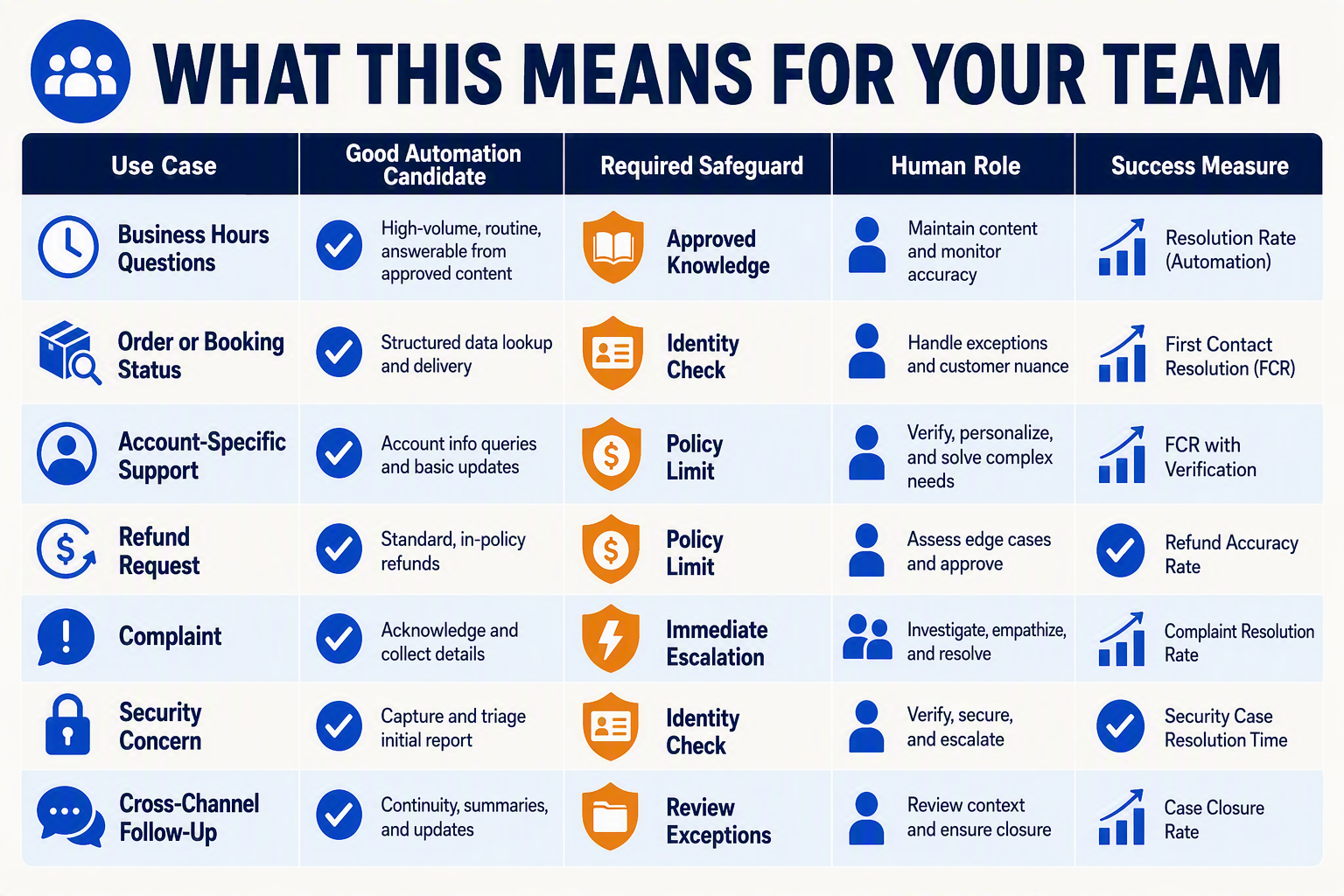
CallMissed customer support automation changes the support team’s role from repeatedly collecting information to supervising evidence-backed workflows, resolving exceptions, and improving service quality. Automation handles predictable operational steps; people retain authority over sensitive, ambiguous, or consequential decisions.
How responsibilities change
| Support stage | CallMissed automation | Human responsibility | Evidence to retain |
|---|---|---|---|
| Ticket intake | Capture voice, WhatsApp, or email enquiries; classify intent; create or update the case | Correct unclear classifications and define routing rules | Original message or transcript, channel, timestamp, detected intent |
| Knowledge response | Retrieve relevant passages from approved knowledge-base content | Approve policies, maintain sources, and resolve conflicting documentation | Source title, retrieved passage, document version, response generated |
| Context continuity | Associate channel activity with the appropriate customer and conversation record | Review uncertain identity matches or incorrectly merged records | Customer identifier, linked interactions, context used, matching confidence |
| Authentication | Run approved verification steps before entering a protected workflow | Handle failed verification, suspected impersonation, and account recovery | Verification method, outcome, time, and attempts—without exposing secrets |
| Sensitive request | Recognise risk signals and pause, restrict, or route the interaction | Decide refunds, exceptions, legal complaints, fraud cases, or protected-data changes | Risk reason, policy invoked, assigned owner, decision trail |
| Resolution and follow-up | Draft a case summary, record actions, and send approved status updates | Confirm consequential resolutions and close disputed or incomplete cases | Final outcome, approver, commitments, citations, outstanding actions |
This operating model does not remove the support team from service delivery. It moves employees away from repetitive transcription, channel switching, and document searching toward exception handling, policy ownership, and quality assurance.
A practical division of authority
An AI customer support agent can generally act independently when the workflow is low-risk, reversible, and supported by a current approved source. Examples include answering delivery-policy questions, collecting troubleshooting details, sharing an existing ticket status, or scheduling a callback.
A person should take control when:
- The customer’s identity cannot be established with the required assurance.
- Two approved sources produce materially different instructions.
- The request involves payments, fraud, legal threats, vulnerable customers, or irreversible account changes.
- The customer explicitly asks for a human or repeatedly rejects the automated response.
- Sentiment, language ambiguity, or missing context makes the intended outcome uncertain.
These boundaries align automation with customer expectations. Zendesk reported in its 2025 Customer Experience Trends research that 70% of consumers perceive a clear difference between companies that use AI effectively and those that do not. Effective automation therefore depends on governance and continuity, not response speed alone.
What managers should measure next
For support leaders, omnichannel support automation introduces a new management loop:
- Review containment alongside reopen, correction, and escalation rates.
- Sample grounded answers and verify that cited sources actually support each claim.
- Audit authentication failures and access to sensitive workflows.
- Compare summaries against original voice transcripts, WhatsApp messages, and emails.
- Update routing rules and knowledge content when failures reveal systematic gaps.
Gartner predicted in 2025 that agentic AI could autonomously resolve 80% of common customer-service issues by 2029 and reduce operational costs by 30%. That forecast represents potential, not a rollout target: teams should expand autonomy only after their own evidence shows that accuracy, safety, and customer outcomes remain within approved thresholds.
Frequently asked questions about CallMissed voice, WhatsApp, and email automation
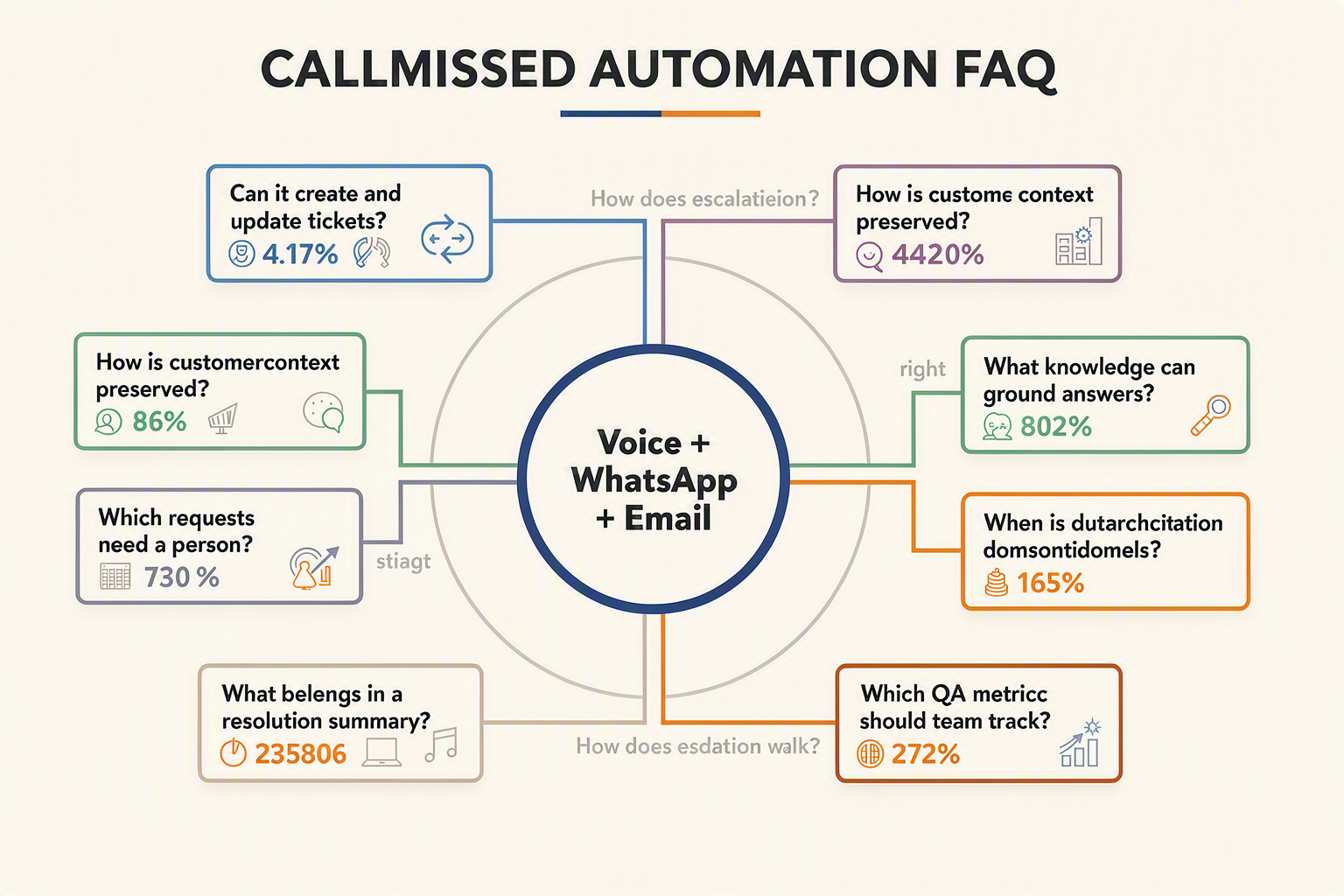
How does CallMissed customer support automation manage voice, WhatsApp, and email tickets?
How does an AI customer support agent avoid giving unsupported or outdated answers?
Can omnichannel support automation remember a customer across WhatsApp, phone calls, and email?
How should CallMissed authenticate customers before discussing account information?
When should a CallMissed AI workflow escalate a support request to a human agent?
What metrics should businesses track after deploying CallMissed across Indian-language support channels?
Conclusion
CallMissed customer support automation turns fragmented conversations across voice, WhatsApp, and email into one governed support workflow. The objective is not automation at any cost; it is faster service grounded in approved knowledge, preserved context, verified identity, clear audit trails, and timely human judgment.
Key takeaways
- Unify intake and customer context. Tickets should capture the customer’s identity, channel, intent, history, and outstanding actions so people do not need to repeat a complaint when moving from WhatsApp to a phone call or email.
- Ground every answer in approved evidence. A dependable AI customer support agent should retrieve relevant policies and documentation rather than improvise. Records should show which source supported the response, which conversation context informed it, and what resolution or follow-up was recorded.
- Authenticate before disclosing or acting. Automation can classify, retrieve, summarize, route, and complete approved low-risk workflows. Sensitive, ambiguous, exceptional, or consequential requests should remain subject to authentication, policy controls, and human authority.
- Measure quality and expand in stages. Teams should evaluate citation accuracy, context continuity, authentication compliance, escalation quality, and resolution completeness before extending automation to additional workflows or channels.
These controls will become more important as autonomous service expands. Gartner predicted in 2025 that agentic AI will autonomously resolve 80% of common customer-service issues by 2029 and could reduce operational costs by 30%. However, adoption alone will not guarantee trust: Zendesk reported in its 2025 Customer Experience Trends research that 70% of consumers perceive a clear difference between companies that use AI effectively and those that do not.
What to watch next
The next phase of omnichannel support automation will be defined by whether businesses can preserve evidence, identity, and accountability as conversations move between channels. Platforms will need to make citations, authentication status, escalation reasons, and resolution summaries operational records—not optional details hidden inside transcripts.
Businesses preparing for that shift can explore CallMissed, an AI-native customer-engagement platform combining voice agents, WhatsApp chatbots and Business calling, email tooling, a unified inbox and CRM, knowledge-grounded retrieval, and support for 22 Indian languages. The practical question is: Which support workflows can you automate confidently today—and which decisions should still belong to a person?
Related Reading
Related Posts
Ready to automate customer conversations?
Launch AI voice agents and WhatsApp bots with CallMissed — one API, 22+ Indian languages.