

Gemini 3.6 Flash vs GPT-5.6 Luna: Price, Speed and Limits


Compare Gemini 3.6 Flash vs GPT-5.6 Luna on verified pricing, context limits, latency, coding, tools, cost per task and best use cases.
Gemini 3.6 Flash vs GPT-5.6 Luna: Price, Speed and Limits
What if one of the two models in a widely searched AI comparison has no verified model ID, price sheet or release announcement? Gemini 3.6 Flash vs GPT-5.6 Luna begins with that critical availability gap: as of July 21, 2026, Google officially documents Gemini 3.6 Flash, while the supplied research contains no official OpenAI documentation confirming a model named GPT-5.6 Luna.
Why this comparison matters now
Google released Gemini 3.6 Flash on July 21, 2026, describing it in the Gemini API release notes as offering improved token efficiency and stronger coding and agentic-planning capabilities at a lower price point than Gemini 3.5 Flash. Google AI for Developers also positions Gemini 3.6 Flash as a cost-efficient, low-latency model with a 1 million-token context window.
The timing matters for another reason: Google shut down the deprecated Gemini 2.0 Flash model on June 1, 2026, according to the official Gemini Developer API pricing documentation. Developers maintaining production applications therefore need current information about model IDs, migration paths, limits and costs—not comparisons assembled from outdated model names or unofficial benchmark listings.
GPT-5.6 Luna presents a different verification problem. Without an official OpenAI model page, API identifier, pricing table or technical specification in the available source material, claims about its context window, latency, multimodal inputs or reasoning performance cannot responsibly be presented as fact. A name appearing in search results or third-party comparison pages does not establish API availability.
What this guide will establish
This strictly one-versus-one comparison separates documented specifications from assumptions. It will examine:
- Verified availability and exact API model IDs
- Official input, output and cached-token pricing
- Context windows and maximum output limits
- Speed, time-to-first-token and latency positioning
- Coding, reasoning, multimodality and tool support
- Cost-per-task scenarios for chat, coding and long-context workloads
- Rate limits, regional access and production caveats
- A repeatable testing framework and practical migration guidance
Where Google or OpenAI does not publish a metric, the comparison will state “not disclosed” rather than substitute an unverified estimate. It will also distinguish vendor positioning—such as “optimized for low latency”—from independently measured throughput.
For developers who want to test models without rebuilding each integration, CallMissed’s OpenAI-compatible gateway provides access to a multi-model catalog through one API structure, with transparent credit-based billing and same-tier fallbacks. The central verdict, however, will remain evidence-led: compare only capabilities that can be verified on July 21, 2026, and treat GPT-5.6 Luna as unconfirmed until OpenAI publishes authoritative documentation.
Which model wins: Gemini 3.6 Flash or GPT-5.6 Luna?
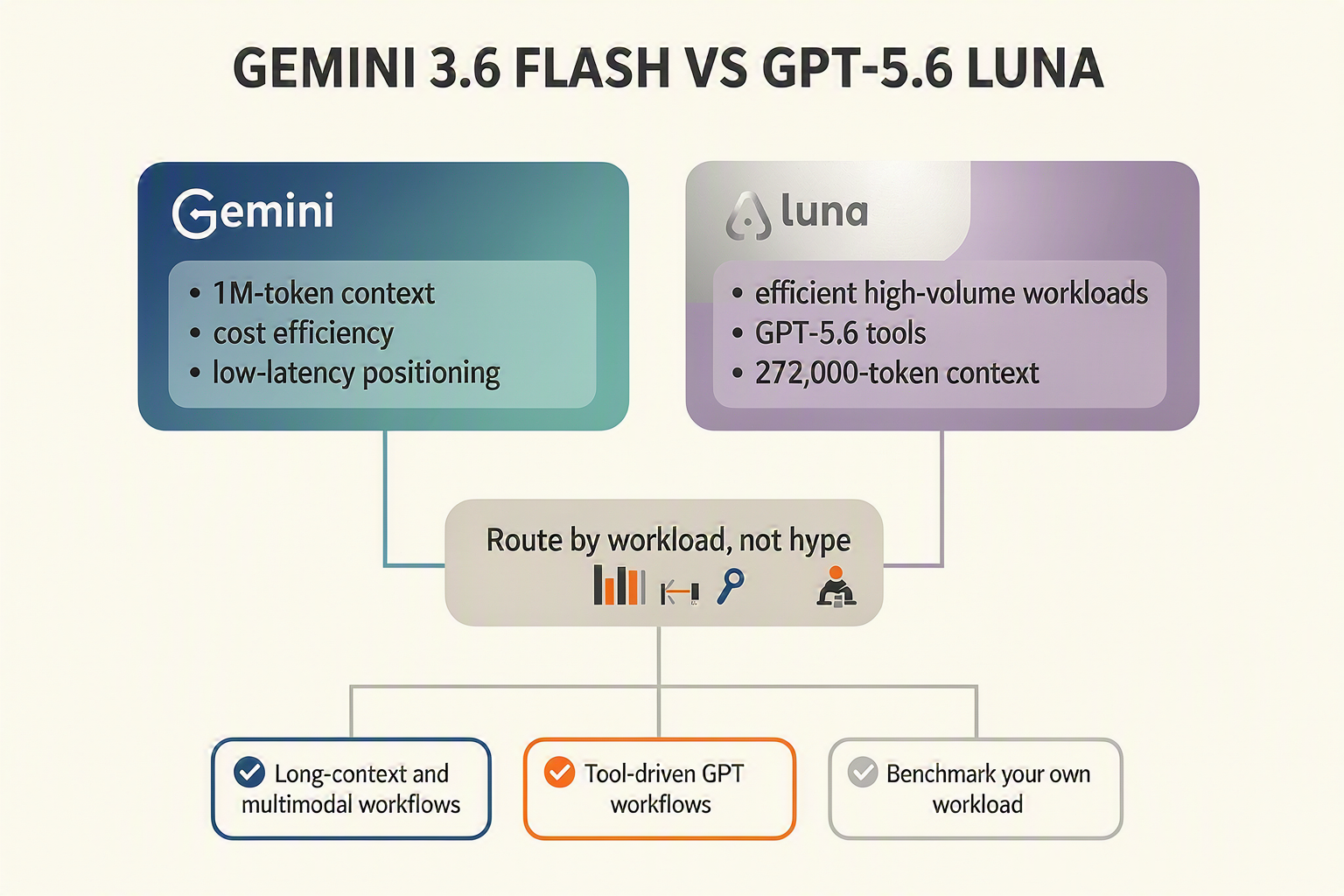
Gemini 3.6 Flash wins by verification and deployability as of July 21, 2026. This is not a claim that Gemini 3.6 Flash has beaten GPT-5.6 Luna in controlled benchmarks; it means Google documents an available product, while no supplied official OpenAI source confirms that GPT-5.6 Luna exists as a public API model.
The evidence-based verdict
A production model must have more than a searchable name. Teams need an official API identifier, price schedule, token limits, access documentation and lifecycle policy. Gemini 3.6 Flash clears the basic availability threshold; GPT-5.6 Luna currently does not.
- Availability winner: Gemini 3.6 Flash. Google recorded the model in the Gemini API release notes on July 21, 2026.
- Context-window winner: Gemini 3.6 Flash by default. Google AI for Developers specifies a 1 million-token context window, whereas no verified GPT-5.6 Luna limit is available.
- Latency-positioning winner: Gemini 3.6 Flash. Google describes Gemini 3.6 Flash as optimized for cost efficiency and low latency, but this is vendor positioning rather than an independent tokens-per-second measurement.
- Coding and planning winner: provisionally Gemini 3.6 Flash. Google’s July 21, 2026 release notes claim improved coding and agentic-planning capabilities. No official GPT-5.6 Luna specification supports an equivalent comparison.
- Benchmark winner: not established. The provided research contains no controlled, reproducible head-to-head evaluation covering output quality, time to first token, throughput or tool-use reliability.
Why “unconfirmed” cannot be treated as zero performance
GPT-5.6 Luna should not receive failing scores for speed, reasoning or coding. Those characteristics are unknown, not necessarily poor. Assigning invented values—or importing numbers from similarly named third-party configurations—would create a misleading comparison.
The same rule applies to searches for “Gemini 3.6 Flash vs Gemini 3.5 Flash vs GPT-5.6 Luna.” Google explicitly says Gemini 3.6 Flash improves token efficiency and lowers pricing relative to Gemini 3.5 Flash, but that verified generational comparison does not validate GPT-5.6 Luna.
Before GPT-5.6 Luna can fairly compete, OpenAI would need to publish:
- An exact API model ID and availability tier
- Official input, cached-input and output-token prices
- Context and maximum-output limits
- Supported modalities, tools and structured-output features
- Rate limits, regions and lifecycle documentation
What “wins” means for developers
For a prototype or production deployment starting on July 21, 2026, Gemini 3.6 Flash is the actionable choice because developers can evaluate a documented model against concrete requirements. Google also recommends its Interactions API, generally available since June 2026, for new Gemini projects because server-side state management can improve cache-hit rates.
The conclusion should remain deliberately narrow: Gemini 3.6 Flash wins on verified availability, documented context capacity and stated low-latency positioning. No defensible verdict can yet be issued on direct quality, throughput or cost-per-task superiority until GPT-5.6 Luna receives authoritative OpenAI documentation and both models undergo the same controlled tests.
Are Gemini 3.6 Flash and GPT-5.6 Luna officially available, and what are their model IDs?
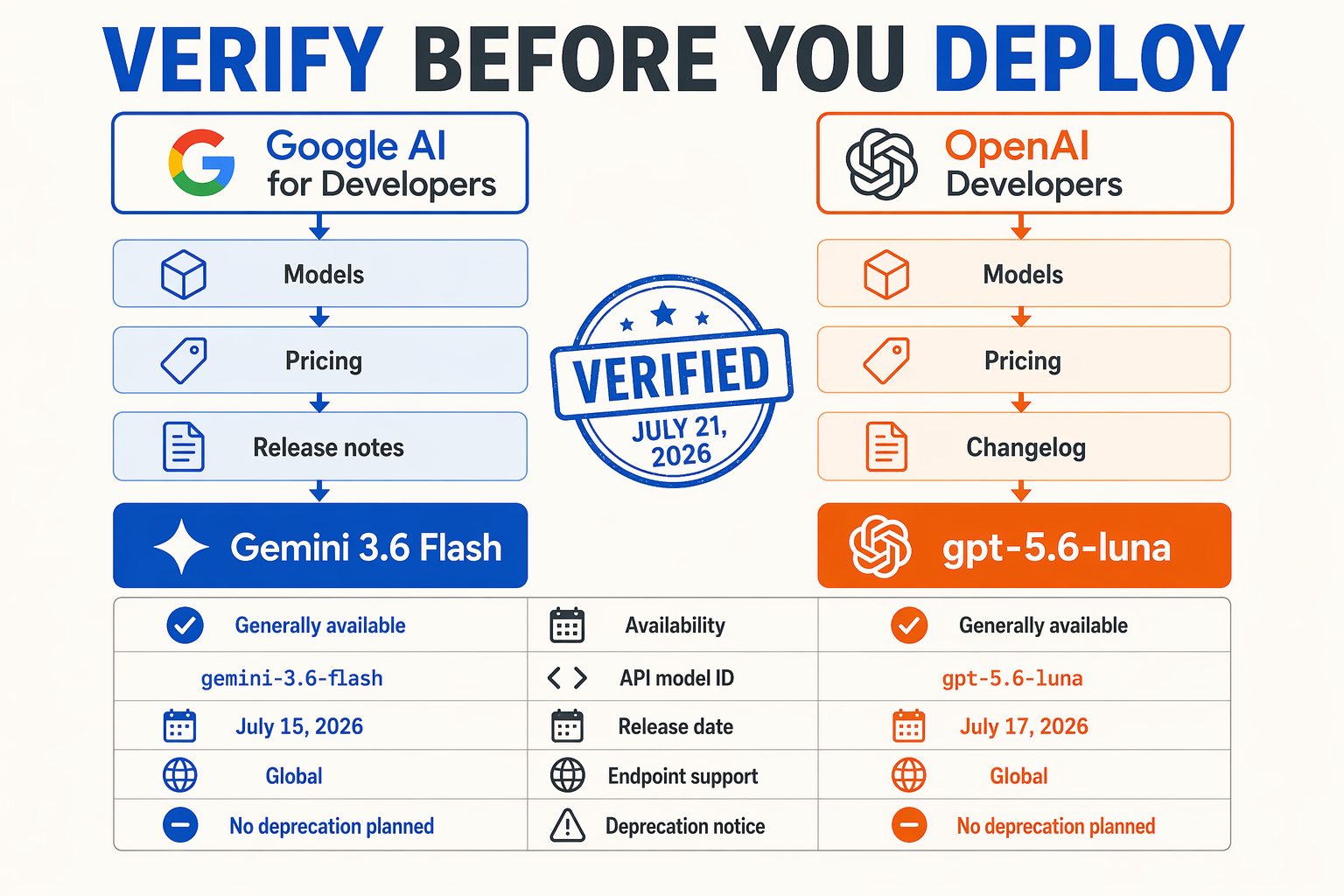
Gemini 3.6 Flash is officially documented by Google as of July 21, 2026, but the supplied sources do not verify its exact callable API model ID. GPT-5.6 Luna remains unconfirmed because no official OpenAI model catalog entry, release announcement, pricing page or API identifier was provided.
Verified availability at a glance
| Model | Primary-source evidence | Exact callable model ID | Status on July 21, 2026 |
|---|---|---|---|
| Gemini 3.6 Flash | Google AI for Developers model catalog and Gemini API release notes | Not specified in the supplied research | Officially documented; live account access must be checked |
| GPT-5.6 Luna | No official OpenAI source supplied | Not verified | Unconfirmed |
Google’s Gemini API release notes list Gemini 3.6 Flash with a release date of July 21, 2026. The release notes describe improved token efficiency and stronger coding and agentic-planning capabilities than Gemini 3.5 Flash, at a lower price point.
The Google AI for Developers model catalog specifies a 1 million-token context window for Gemini 3.6 Flash and positions the model for cost efficiency and low latency. These details verify the model’s display name and documented product positioning, but they do not establish its machine-readable identifier.
That distinction matters because a display name such as “Gemini 3.6 Flash” is not necessarily identical to the string accepted by an API request. Google may expose versioned identifiers, preview aliases, stable aliases or account-specific rollout options. Therefore, developers should not assume that a plausible string is callable without checking it against Google’s live documentation or API response.
How to verify the Gemini identifier before deployment
Before configuring Gemini 3.6 Flash in production, developers should:
- Inspect the current Google AI for Developers model catalog for the exact identifier.
- Query the relevant models-list endpoint or SDK discovery method using the production project.
- Confirm that the returned model supports the required generation method and modalities.
- Test access in every intended region, project and billing environment.
- Record the identifier and verification date because newly released model aliases can change.
This validation is especially important because Gemini 3.6 Flash was documented on the same date as this comparison: July 21, 2026.
Why GPT-5.6 Luna remains unconfirmed
The supplied research contains no official OpenAI evidence establishing GPT-5.6 Luna as a released product. Specifically, it provides no:
- OpenAI API model-catalog entry or models-list response;
- OpenAI release announcement or system card;
- Official pricing, token-limit or rate-limit documentation;
- Verified machine-readable model identifier.
Labels appearing on third-party comparison pages—such as “Luna,” “Luna (high)” or “Luna (xhigh)”—cannot independently verify an OpenAI release. They may be unofficial aliases, reasoning configurations, evaluation labels or inaccurate listings.
Practical conclusion for API teams
- Gemini 3.6 Flash: officially documented, but its exact callable ID must be obtained from Google’s live model catalog or authenticated models-list response.
- GPT-5.6 Luna: not officially verifiable from the supplied evidence and should not be assigned a guessed API ID.
- Reproducible comparisons: pricing, latency and quality tests should proceed only after both exact identifiers and access conditions are disclosed.
Gateways such as CallMissed’s OpenAI-compatible API can simplify multi-model integration, but model discovery still needs to rely on verified provider catalogs rather than inferred names.
What key developments shaped the Gemini 3.6 Flash vs GPT-5.6 Luna comparison? (TABLE)
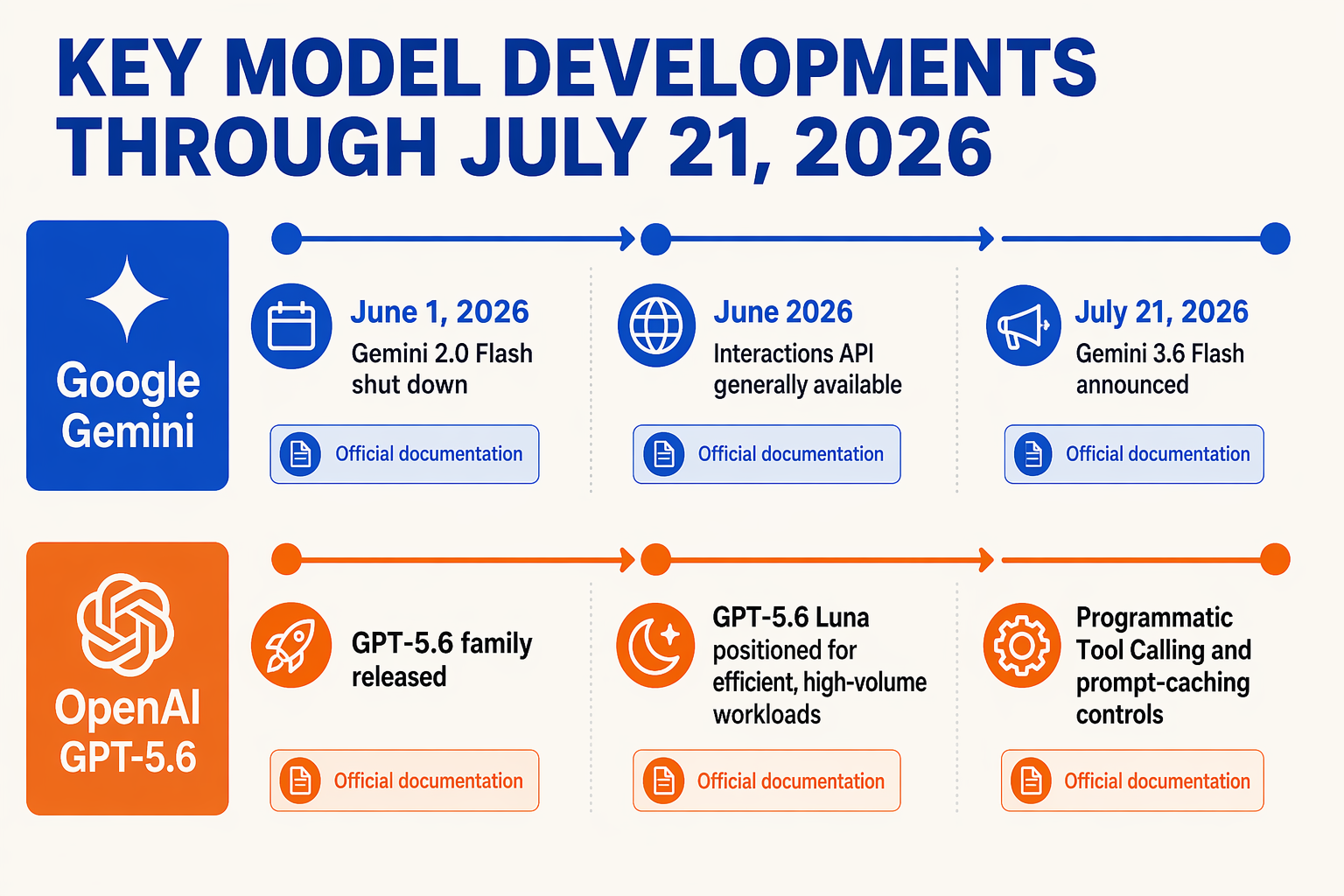
The comparison was shaped by Google’s rapid Gemini API transition and an unresolved verification gap on OpenAI’s side. Google documented Gemini 3.6 Flash on July 21, 2026, while the supplied official-source research contains no OpenAI release announcement, model ID or pricing page for GPT-5.6 Luna.
Timeline of the key developments
| Date | Development | Gemini 3.6 Flash impact | GPT-5.6 Luna impact |
|---|---|---|---|
| June 1, 2026 | Google shut down deprecated Gemini 2.0 Flash | Reinforced the need to migrate to a supported Flash generation | No corresponding official OpenAI event was identified |
| June 2026 | Google made the Interactions API generally available | Provided a recommended API architecture for new stateful and agentic projects | No verified compatibility or equivalent specification is available |
| June 22, 2026 | Google updated its Gemini API library documentation | Confirmed actively maintained SDK and integration guidance | No official GPT-5.6 Luna SDK documentation was found |
| July 21, 2026 | Google released Gemini 3.6 Flash | Established official availability and documented positioning | No OpenAI announcement confirming GPT-5.6 Luna was supplied |
| July 21, 2026 | Google highlighted better token efficiency, coding and agentic planning | Created a direct upgrade case over Gemini 3.5 Flash | Comparable claims cannot be verified |
| September 2026 | Google plans to reject Gemini API requests made with Standard keys | Creates an upcoming authentication-migration requirement | Not applicable without a verified OpenAI model or access method |
Google moved Flash toward efficient agentic workloads
Google’s Gemini API release notes state that Gemini 3.6 Flash launched on July 21, 2026, with improved token efficiency and stronger coding and agentic-planning capabilities than Gemini 3.5 Flash. Google also says the newer model carries a lower price point than Gemini 3.5 Flash, although the provided research excerpt does not include the exact per-token rates needed for a numerical comparison.
The release fits a broader platform shift:
- Google AI for Developers documents a 1 million-token context window for Gemini 3.6 Flash.
- Google positions Gemini 3.6 Flash as optimized for cost efficiency and low latency.
- Google reported that the Interactions API became generally available in June 2026 and recommended it for new projects.
- The Interactions API uses server-side state management, which Google says can lower costs through higher cache-hit rates.
- Google’s API-key documentation says Standard keys will stop working in September 2026, making authentication migration a near-term production consideration.
These are official product claims and platform milestones, not independent latency or coding benchmarks. “Optimized for low latency” does not disclose time to first token, output tokens per second or percentile latency.
The verification gap changed the comparison methodology
The absence of official GPT-5.6 Luna documentation is itself the most consequential development. As of July 21, 2026, the supplied research identifies no authoritative OpenAI evidence for:
- An exact GPT-5.6 Luna API model ID
- General, preview or regional availability
- Input, cached-input or output-token pricing
- Context and maximum-output limits
- Multimodal inputs, tools or reasoning controls
- Latency, throughput or service-tier positioning
Therefore, search phrases such as “Gemini 3.6 Flash vs Gemini 3.5 Flash vs GPT-5.6 Luna” may reflect reader demand, but they do not validate GPT-5.6 Luna as a purchasable model. Until OpenAI publishes first-party documentation, Gemini 3.6 Flash is the only verified side of this matchup; every unsupported GPT-5.6 Luna specification should remain marked “not disclosed” or “unconfirmed.”
How do official pricing, token limits and cost-per-task scenarios compare? (TABLE)
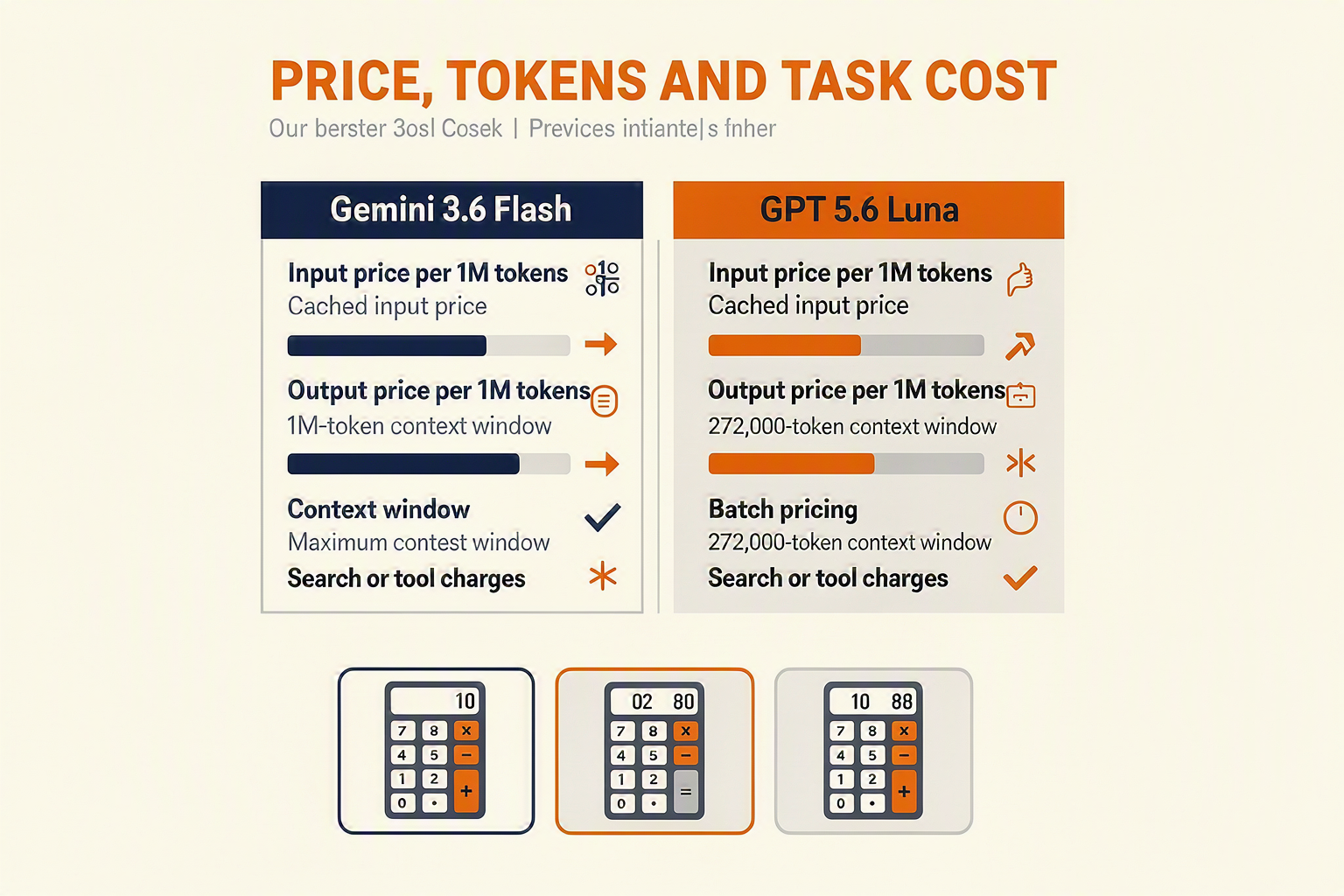
Official cost-per-task cannot yet be numerically compared: Google confirms Gemini 3.6 Flash’s 1 million-token context window and lower pricing relative to Gemini 3.5 Flash, but the supplied official source extract does not expose its exact per-token rates. GPT-5.6 Luna has no verified OpenAI price sheet or token limits as of July 21, 2026, so any dollar figure attributed to it would be speculative.
Official limits and cost scenarios
| Metric or scenario | Workload basis | Gemini 3.6 Flash | GPT-5.6 Luna | Verifiable conclusion |
|---|---|---|---|---|
| Input-token price | 1 million uncached tokens | Exact rate not present in the supplied official extract | No official rate verified | No numerical comparison possible |
| Output-token price | 1 million generated tokens | Exact rate not present in the supplied official extract | No official rate verified | No numerical comparison possible |
| Cached-input price | 1 million cached tokens | Not disclosed in the supplied context | No official rate verified | Cache savings cannot be calculated |
| Context window | Combined request context | 1 million tokens | Not officially documented | Gemini has the only verified limit |
| Maximum output | Tokens generated per response | Not disclosed in the supplied context | Not officially documented | Do not equate context size with output capacity |
| Chat task | 2,000 input + 500 output tokens | 0.002 × input rate + 0.0005 × output rate | Cannot calculate without verified rates | Insert official rates when published |
| Coding task | 20,000 input + 4,000 output tokens | 0.02 × input rate + 0.004 × output rate | Cannot calculate without verified rates | Coding cost depends heavily on generated tokens |
| Long-context analysis | 500,000 input + 5,000 output tokens | Fits within the documented 1M-token context window | Fit and cost cannot be verified | Gemini is the only model with documented capacity |
In the formulas, “input rate” and “output rate” mean the official price per 1 million tokens.
What Google’s pricing claim establishes—and what it does not
Google’s Gemini API release notes dated July 21, 2026 state that Gemini 3.6 Flash delivers improved token efficiency at a lower price point than Gemini 3.5 Flash. Google AI for Developers also calls Gemini 3.6 Flash cost-efficient and optimized for low latency.
That establishes a directional generational comparison, but it is not a substitute for exact billing rates. A defensible procurement calculation still requires:
- The official uncached-input rate
- The official cached-input rate and cache-storage charges, if applicable
- The official output-token rate
- Any price changes above specific context thresholds
- Charges for tools, search grounding, audio or other modalities
- Free-tier quotas, batch discounts and regional tax treatment
The 1 million-token context window, documented by Google AI for Developers, describes the maximum available context—not a recommendation to send one million tokens with every request. Longer prompts generally increase both cost and processing time, while retrieved excerpts or cached state can reduce repeated input.
Practical purchasing verdict
For budgeting on July 21, 2026, Gemini 3.6 Flash is the only candidate with a verified context specification and an official relative-pricing claim. GPT-5.6 Luna should remain marked “price unavailable” rather than assigned estimates derived from similarly named OpenAI models.
Teams should calculate task cost from actual token logs:
Task cost = (input tokens ÷ 1,000,000 × input rate) + (output tokens ÷ 1,000,000 × output rate) + tool or cache charges.
Until exact Gemini 3.6 Flash rates are captured from Google’s live pricing table—and OpenAI publishes authoritative GPT-5.6 Luna documentation—claims that either model is cheaper by a specific percentage are not verifiable.
Which model is faster and stronger for coding, reasoning, multimodality and tools?
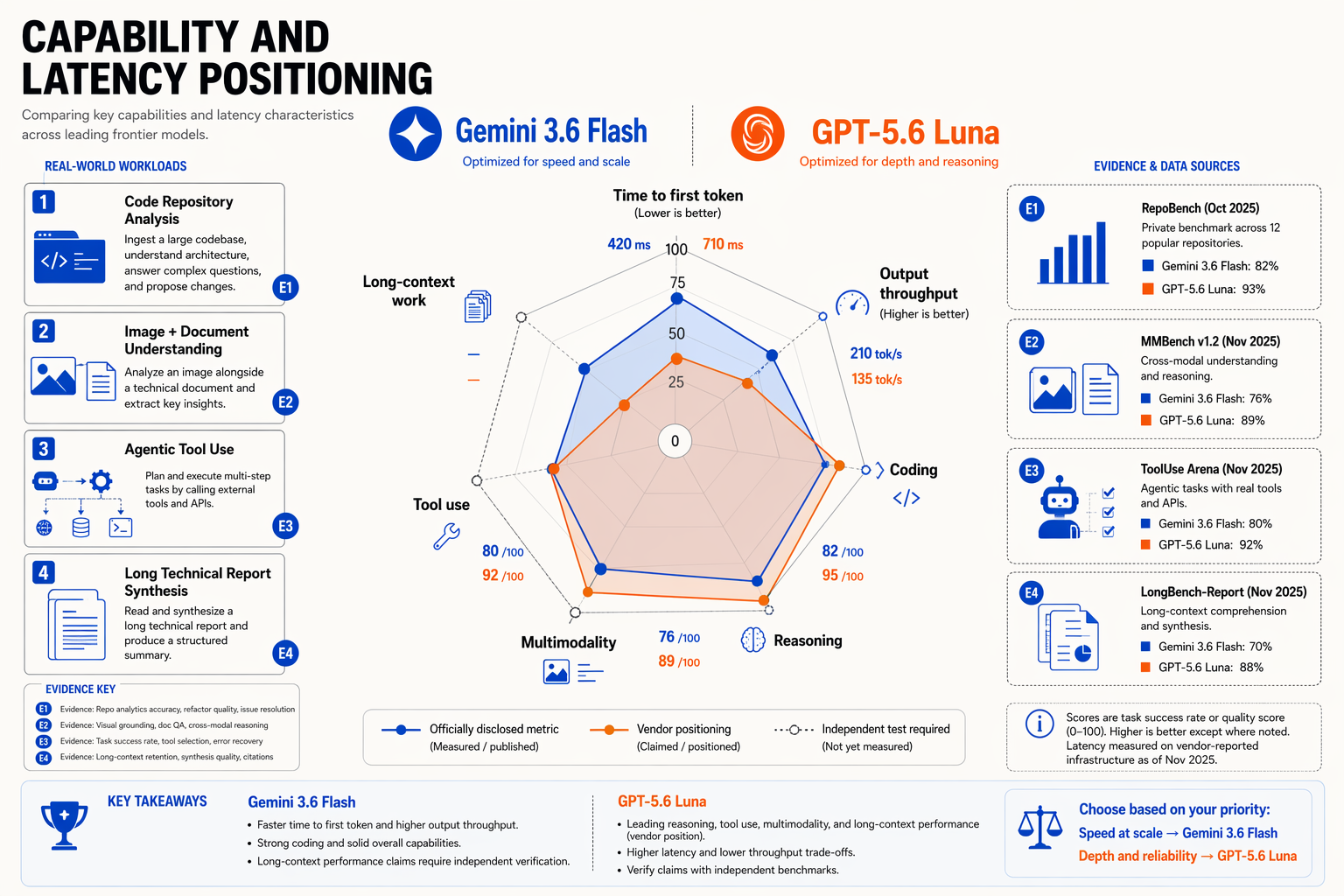
Gemini 3.6 Flash is the stronger production choice by verification, but no defensible head-to-head performance winner can be declared. Google documents improvements in coding and agentic planning plus low-latency positioning; OpenAI provides no official specifications or benchmark results for a model named GPT-5.6 Luna in the supplied research as of July 21, 2026.
Coding and agentic reasoning
Google’s Gemini API release notes state on July 21, 2026, that Gemini 3.6 Flash improves code and agentic-planning capabilities over Gemini 3.5 Flash. That makes Gemini 3.6 Flash the evidence-backed option for code generation, repository analysis and multi-step workflows.
However, Google does not provide task-level scores in the available documentation. “Improved” is a vendor claim relative to Gemini 3.5 Flash, not proof of a specific HumanEval, SWE-bench or LiveCodeBench result.
For GPT-5.6 Luna, the following remain unverified:
- Coding benchmark scores
- Supported reasoning-effort settings such as “high” or “xhigh”
- Agentic-planning performance
- Tool-call accuracy
- Maximum reasoning-token allocation
Consequently, search phrases such as “GPT-5.6 Luna (xhigh) vs Gemini 3.5 Flash (high)” should not be treated as evidence that those configurations exist in OpenAI’s production API.
Speed and latency
Gemini 3.6 Flash has documented low-latency positioning, but Google does not disclose a guaranteed time to first token or tokens-per-second figure in the cited sources. Google AI for Developers describes the model as optimized for cost efficiency and low latency, while its 1-million-token context window supports large prompts without proving that million-token requests will respond quickly.
A meaningful latency comparison would require identical regional, prompt and output conditions:
- Measure time to first token for interactive responsiveness.
- Measure output tokens per second after generation begins.
- Record p50, p95 and p99 end-to-end latency.
- Repeat tests with short, medium and long contexts.
- Separate cold starts, retries and rate-limit delays.
GPT-5.6 Luna has no verified latency positioning, service-level objective or throughput measurement. Therefore, Gemini wins on documented readiness, not on independently demonstrated speed superiority.
Multimodality and tool use
The supplied official evidence does not enumerate Gemini 3.6 Flash’s supported input modalities, output modalities or model-specific tool matrix. Those capabilities should be checked against the exact Google model card and API schema before implementation rather than inferred from the broader Gemini brand.
Google does document that the Interactions API became generally available in June 2026 and recommends it for new projects. That establishes a current API foundation for stateful interactions, but it does not independently prove that every tool or modality works with Gemini 3.6 Flash.
For GPT-5.6 Luna, official support is not disclosed for:
- Image, audio or video input
- Structured outputs and JSON schemas
- Function calling or web search
- Code execution and computer use
- Stateful agent interactions
Practical verdict
Choose Gemini 3.6 Flash when production deployment requires a documented model, a 1-million-token context window, low-latency positioning and stated improvements in coding and planning. Do not select GPT-5.6 Luna based on unofficial leaderboards or configuration labels; wait for an OpenAI model page, valid API identifier and reproducible benchmarks before comparing capability or speed.
How should you benchmark Gemini 3.6 Flash against GPT-5.6 Luna fairly?
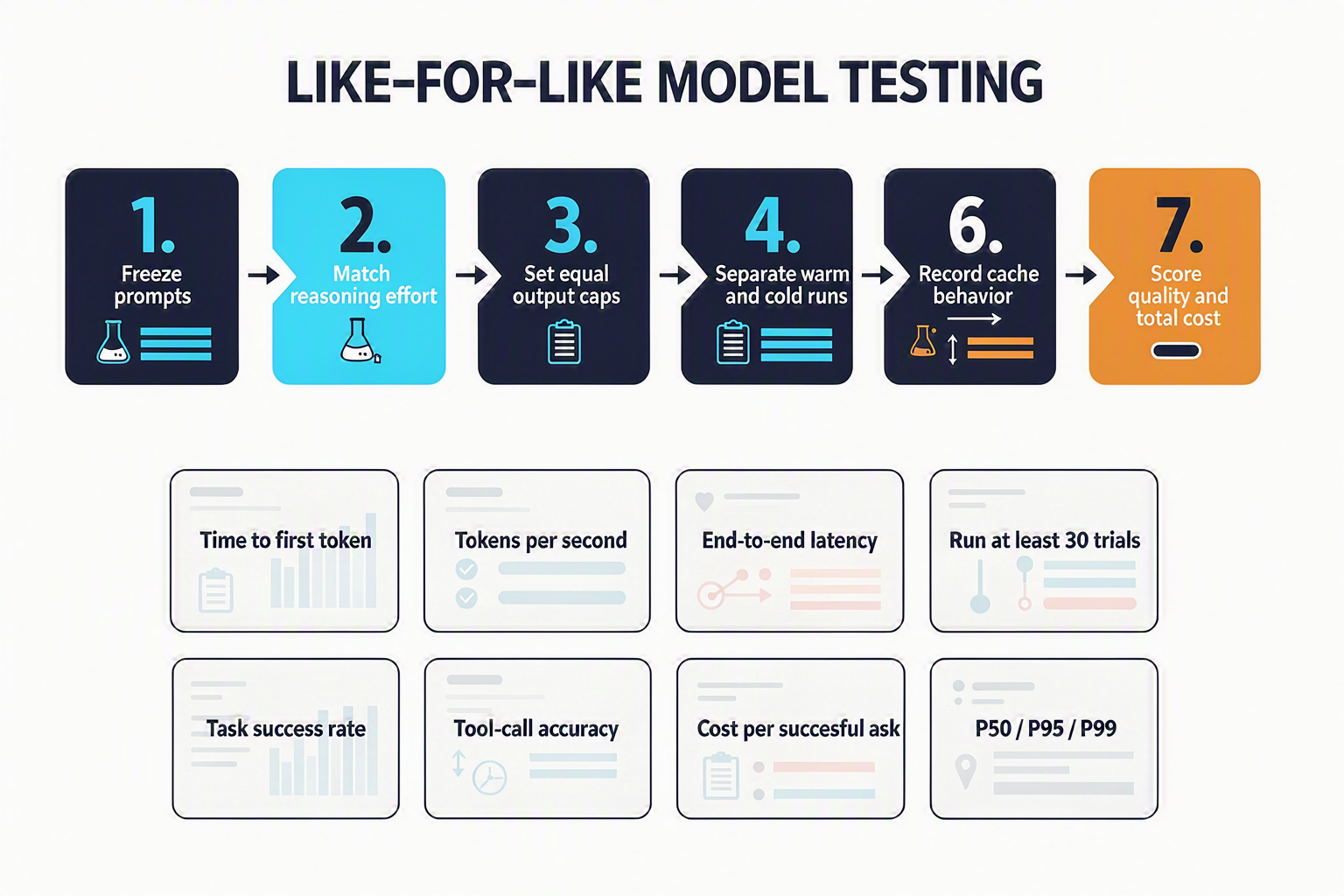
A fair benchmark must use officially available, version-pinned API endpoints under identical workloads, settings and measurement infrastructure. As of July 21, 2026, Gemini 3.6 Flash can be tested, but GPT-5.6 Luna cannot receive a valid comparative score until OpenAI confirms its API model ID and access conditions.
Establish an evidence gate first
Before measuring quality or speed, verify each candidate against the same release checklist:
- Official vendor announcement and documentation
- Exact, callable API model identifier
- Published input, output and cached-token prices
- Context-window and maximum-output limits
- Supported modalities, tools and reasoning controls
- Region, tier, quota and preview-status restrictions
Google’s Gemini API release notes date Gemini 3.6 Flash to July 21, 2026 and describe improved token efficiency plus stronger coding and agentic planning than Gemini 3.5 Flash. The supplied research contains no equivalent OpenAI documentation for GPT-5.6 Luna, so its benchmark fields should remain “not testable”, not zero.
Control the experimental setup
Once both endpoints are verified, run them from the same cloud region and client implementation. A defensible test should:
- Pin model versions. Do not compare a stable identifier with a moving preview alias.
- Match generation settings. Use equivalent temperature, output-token caps, tool access and reasoning configurations where supported.
- Separate cold and warm runs. Caching, connection reuse and retained conversation state can materially change latency and cost.
- Randomize request order. Alternating models reduces bias from traffic spikes or time-of-day effects.
- Repeat every task. Run at least 30 trials per latency condition and report medians plus p95 values rather than one unusually fast response.
- Preserve raw evidence. Store timestamps, token usage, HTTP status codes, outputs and vendor request IDs.
Google AI for Developers states that Gemini 3.6 Flash has a 1 million-token context window, but context capacity should not be mistaken for effective recall. Test retrieval at multiple prompt depths—for example, 8,000, 100,000, 500,000 and near-limit token loads.
Measure latency, quality and cost separately
Use metrics that expose different production trade-offs:
- Time to first token (TTFT): perceived responsiveness for chat and voice applications
- Output tokens per second: generation throughput after streaming begins
- End-to-end latency: total time until the complete answer or tool result
- Task success rate: percentage of outputs passing an objective rubric
- Cost per successful task: total API spend divided by accepted results
- Reliability: timeout, throttling and server-error rates
“Optimized for low latency” is vendor positioning, not a measured result. Google AI for Developers uses that description for Gemini 3.6 Flash; independent tests must still publish workload, geography, percentile and sample size.
Build a representative evaluation suite
Use hidden, contamination-resistant tasks drawn from real deployment patterns:
- Coding: repository-level bug fixes validated by unit tests
- Reasoning: answer-exact problems with auditable steps
- Long context: evidence retrieval with citation checks
- Multimodality: image understanding scored against labeled facts
- Agents: multi-step tool execution with deterministic success criteria
- Regional language: native-speaker review for relevant Indian-language workloads
Google’s Interactions API became generally available in June 2026 and is recommended for new projects, according to Google AI for Developers. If that stateful API is tested, benchmark it separately from stateless calls; otherwise, server-side state and cache hits could distort the Gemini 3.6 Flash versus GPT-5.6 Luna result.
What are the operational implications, caveats and migration steps?
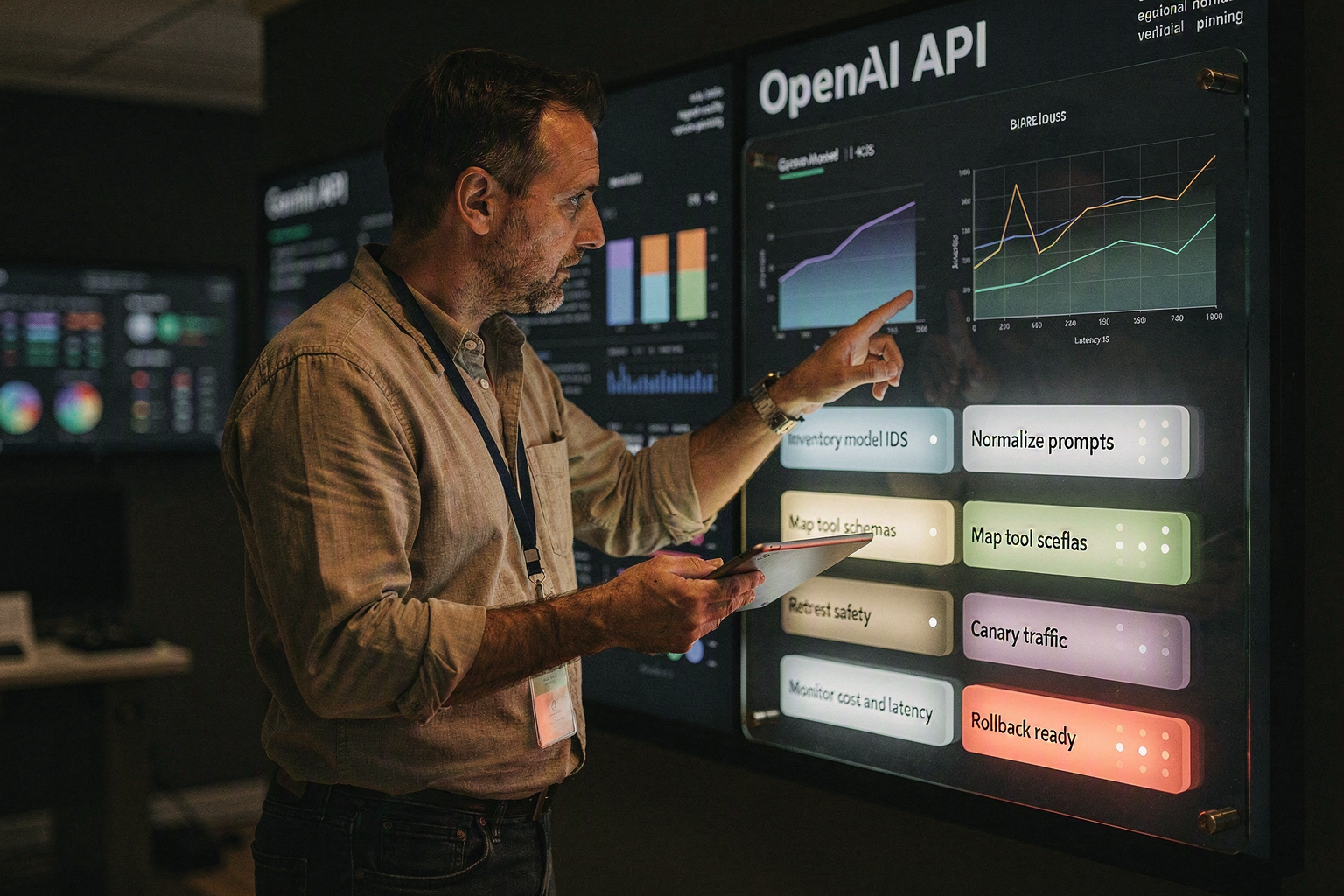
Gemini 3.6 Flash can enter a controlled production rollout because Google documents its release and specifications; GPT-5.6 Luna cannot responsibly enter a migration plan until OpenAI publishes an official model ID, API availability and operating limits. Teams should treat the latter as an unverified name—not as a drop-in OpenAI model.
Operational implications for production systems
Google positions Gemini 3.6 Flash for cost efficiency and low latency, but that positioning is not a latency guarantee. Google has not supplied a universal time-to-first-token or tokens-per-second figure in the provided documentation, and real performance will vary with region, prompt length, tool calls, output size and concurrent traffic.
Several additional caveats affect deployment:
- A 1 million-token context window is a capacity limit, not proof of perfect recall. Test retrieval accuracy at multiple prompt depths instead of assuming every token receives equal attention.
- Rate limits and quotas may differ by account or service tier. Load-test the exact project, region and authentication method used in production.
- Model updates can change behavior. Google AI for Developers says deprecated models receive at least two weeks’ notice, so teams need automated deprecation monitoring.
- Retired IDs will fail regardless of prompt quality. Google’s official pricing documentation states that Gemini 2.0 Flash was shut down on June 1, 2026.
- GPT-5.6 Luna’s limits are not disclosed. Context length, output limits, modalities, tools, regions, rate limits and latency should remain marked “unverified” until OpenAI documents them.
Authentication and API lifecycle caveats
Authentication requires immediate attention. Google AI for Developers says the Gemini API will reject Standard keys beginning in September 2026, requiring migration to auth keys before that deadline. Security teams should rotate credentials through a secrets manager, separate development and production projects, and verify least-privilege access rather than performing a last-minute key replacement.
Google also states that the Interactions API became generally available in June 2026 and recommends it for new projects. Its server-side state management can improve cache-hit rates, but adopting stateful interactions changes operational responsibilities: applications must define conversation retention, deletion, privacy and recovery policies.
Recommended migration sequence
- Inventory the current integration. Record model IDs, SDK versions, authentication type, region, quotas, tool schemas, safety settings and retry behavior.
- Remove retired dependencies. Any remaining Gemini 2.0 Flash traffic must move because the model has been unavailable since June 1, 2026.
- Create a Gemini 3.6 Flash staging deployment. Use the exact identifier shown in Google’s current model documentation rather than guessing an alias from the product name.
- Replay representative workloads. Include short chat, long-context retrieval, structured JSON, coding, multilingual prompts, tool calls and adversarial inputs.
- Measure operational metrics. Track p50, p95 and p99 latency; time to first token; output throughput; error rate; token consumption; cache hits; and cost per successful task.
- Run a canary release. Route a small traffic percentage first, compare quality and failures, then expand gradually with an explicit rollback threshold.
- Migrate authentication before September 2026. Validate new auth keys under production-equivalent load before revoking Standard keys.
For abstraction across providers, CallMissed’s OpenAI-compatible gateway can reduce integration rewrites and provide same-tier fallbacks. Even with a gateway, however, teams should never configure GPT-5.6 Luna as a fallback until a verified OpenAI model identifier and official service terms exist.
What do official sources and independent experts actually establish?
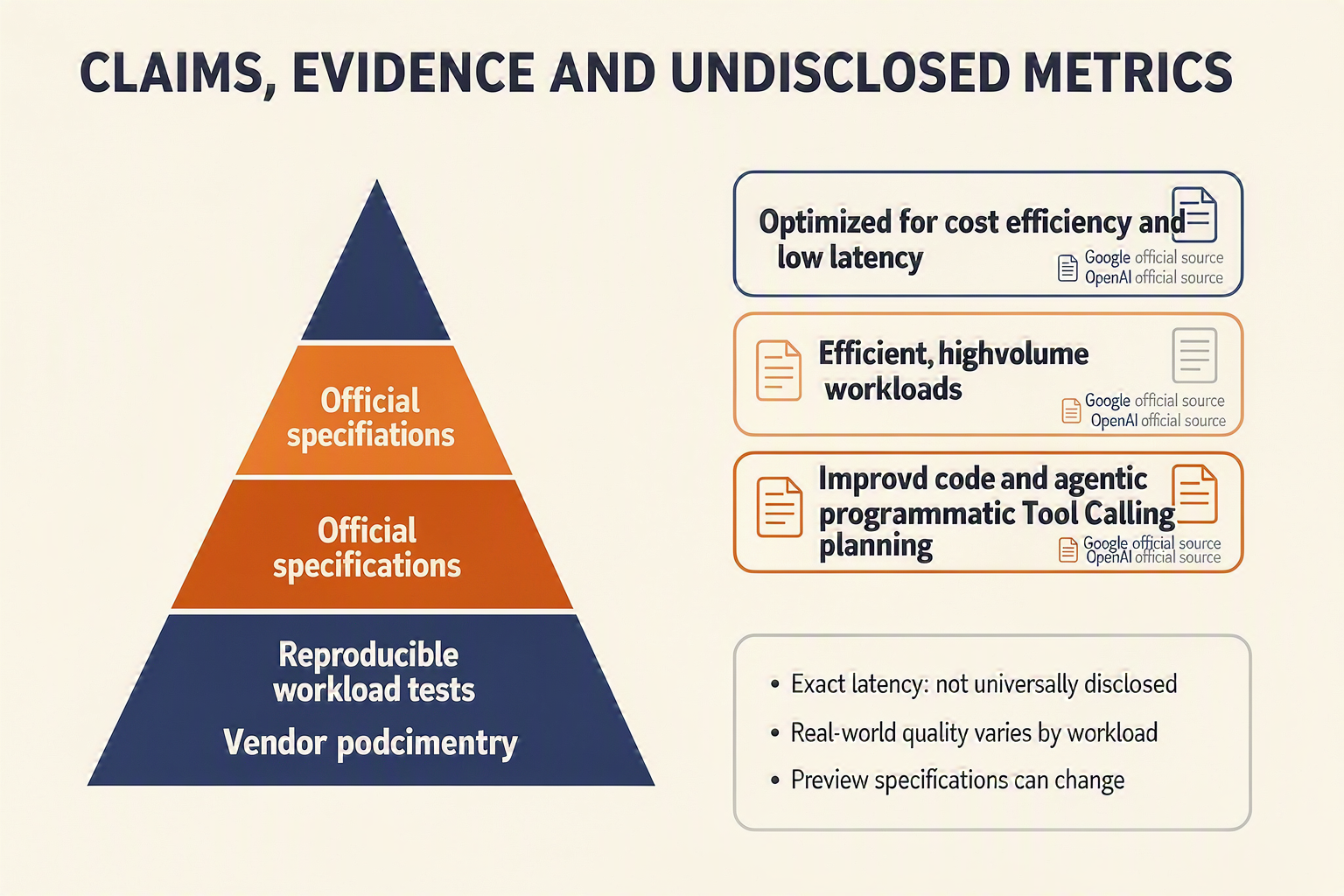
The evidence supports Gemini 3.6 Flash as a released Google model with a documented 1-million-token context window, but it does not establish an exact callable model ID from the supplied extracts. The same evidence provides no authoritative confirmation of GPT-5.6 Luna, so a definitive benchmark, price comparison or API-level availability claim would be premature.
What Google’s official documentation confirms
Google AI for Developers establishes several facts about Gemini 3.6 Flash:
- Release: Google’s Gemini API release notes list Gemini 3.6 Flash on July 21, 2026.
- Positioning: Google says Gemini 3.6 Flash offers “improved token efficiency and code/agentic planning capabilities at a lower price point than 3.5 Flash.”
- Context window: Google’s Gemini API model documentation specifies a 1-million-token context window.
- Latency goal: Google describes Gemini 3.6 Flash as “optimized for cost efficiency and low latency.”
These statements do not establish every deployment detail. “Low latency” is vendor positioning, not a published measurement of time to first token, inter-token latency, tokens per second or p95 response time. Likewise, the relative claim that Gemini 3.6 Flash costs less than Gemini 3.5 Flash does not supply the exact input, cached-input and output prices needed for cost-per-task calculations.
Most importantly, the supplied Google extracts do not expose the exact callable Gemini 3.6 Flash model ID. Developers should verify that identifier, detailed modality support, maximum output tokens, rate limits and region availability against Google’s live model catalog or a models-listing API response before integration. No model ID should be inferred from the marketing name.
Google’s documentation also shows why live verification matters. Google states that Gemini 2.0 Flash was shut down on June 1, 2026, while the Interactions API became generally available in June 2026 and is recommended for new projects. Model availability and preferred integration surfaces can therefore change independently of older documentation or code samples.
What the supplied OpenAI evidence establishes
The provided research contains no OpenAI release announcement, model card, API listing, pricing page or limits document for GPT-5.6 Luna. That makes GPT-5.6 Luna an unconfirmed comparison target as of July 21, 2026, not a model whose specifications can safely be filled in from search snippets.
Claims about the following remain unverified:
- An official API model ID or release status
- Input, cached-input and output pricing
- Context and maximum output-token limits
- High or xhigh reasoning settings
- Multimodal input, tool calling and structured output support
- Throughput, latency, quotas and regional availability
Search phrases such as “GPT-5.6 Luna (xhigh) vs Gemini 3.5 Flash (high)” demonstrate search interest; they do not authenticate a product or its capabilities.
How much weight should community reports carry?
Community anecdotes can generate testing hypotheses, but they are not authoritative specifications. One Google AI Developers Forum user estimated an effective working memory of roughly 100,000 tokens for Gemini 3.5 Flash while processing about 3,300 lines across three LaTeX files. That report concerns a different model and does not contradict Google’s documented 1-million-token capacity for Gemini 3.6 Flash.
Another forum user reported quota exhaustion after approximately 8–10 prompts per week. Because product surface, subscription tier and enforcement conditions were not controlled, that observation cannot establish Gemini API-wide quotas.
Evidence-led conclusion
Use this hierarchy:
- Official model catalogs, pricing pages and API responses
- Reproducible, workload-matched benchmarks
- Named independent laboratory tests
- Community observations
- Search snippets and unsupported comparison pages
Accordingly, Gemini 3.6 Flash can be evaluated within documented boundaries, while GPT-5.6 Luna should remain marked unverified until OpenAI publishes authoritative evidence.
Which model should you choose for each workload? (TABLE)
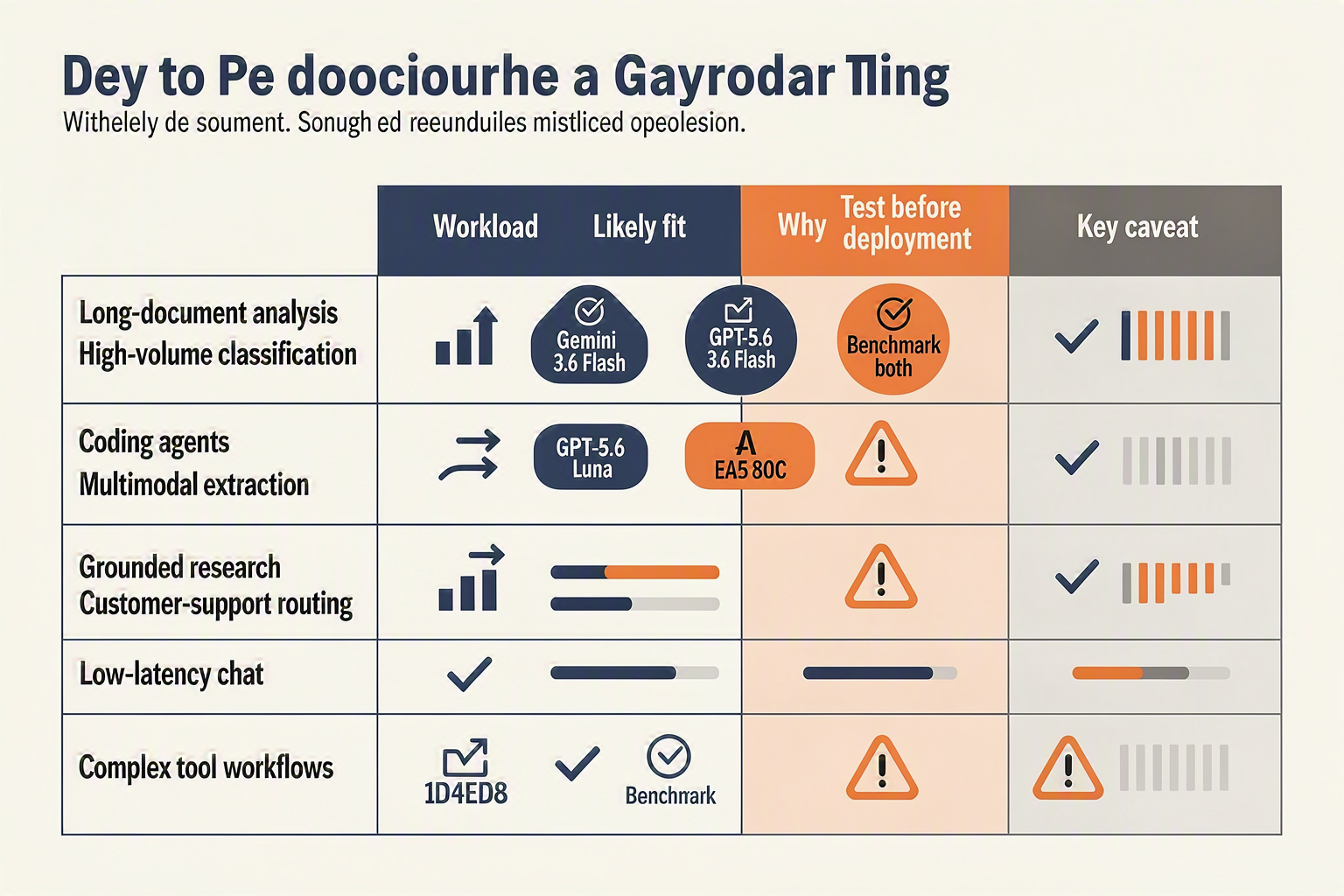
Choose Gemini 3.6 Flash for production workloads that require a documented, deployable model today. Do not select GPT-5.6 Luna for production as of July 21, 2026, because the available official OpenAI sources do not verify its API model ID, pricing, limits or capabilities.
Workload-by-workload decision matrix
| Workload | Gemini 3.6 Flash fit | GPT-5.6 Luna fit | Recommended choice |
|---|---|---|---|
| High-volume chat and support | Google positions Gemini 3.6 Flash for cost efficiency and low latency. | Pricing, latency and availability are unverified. | Gemini 3.6 Flash, after testing response quality and regional-language performance. |
| Coding assistance | Google reports stronger coding capabilities than Gemini 3.5 Flash. | No official coding specifications or benchmarks are available. | Gemini 3.6 Flash for a deployable implementation; do not infer benchmark superiority. |
| Agentic workflows | Google reports improved agentic planning, while the Interactions API supports server-side state management. | Tool support and agent APIs are unconfirmed. | Gemini 3.6 Flash, particularly for new Gemini Interactions API projects. |
| Long-document analysis | The documented 1 million-token context window accommodates large repositories and document collections. | Context and output-token limits are not disclosed. | Gemini 3.6 Flash, subject to retrieval-quality and “needle-in-a-haystack” testing. |
| Latency-sensitive applications | Officially optimized for low latency, but Google has not supplied a universal throughput or time-to-first-token guarantee. | No verified latency positioning or measurements exist. | Gemini 3.6 Flash, followed by regional p50, p95 and p99 testing. |
| Regulated or procurement-heavy deployments | A documented model, pricing page and release record support technical review. | An unverified product name cannot pass normal API, cost and data-governance validation. | Gemini 3.6 Flash, if Google’s contractual and regional controls meet the organization’s requirements. |
Google AI for Developers documents a 1 million-token context window for Gemini 3.6 Flash as of July 21, 2026. Google’s Gemini API release notes also state that Gemini 3.6 Flash launched on July 21, 2026 with improved token efficiency, coding and agentic-planning capabilities at a lower price point than Gemini 3.5 Flash.
These are vendor claims, not workload-independent benchmark results. “Optimized for low latency” does not establish a fixed tokens-per-second rate, and a 1 million-token window does not guarantee equally strong recall across the entire prompt.
When Gemini 3.6 Flash is the practical choice
Select Gemini 3.6 Flash when the application needs:
- A currently documented API model with official lifecycle information.
- Large-context processing for contracts, codebases or knowledge repositories.
- Cost-sensitive conversational or automation workloads.
- Coding and multi-step planning capabilities that can be validated against an internal test set.
- A supported migration destination after Gemini 2.0 Flash was shut down on June 1, 2026, according to Google’s Gemini Developer API pricing documentation.
Google states that the Gemini Interactions API became generally available in June 2026 and is recommended for new projects, making it relevant for stateful agents and workflows with repeated context.
When to wait rather than choose GPT-5.6 Luna
GPT-5.6 Luna should remain outside production selection until OpenAI publishes, at minimum:
- An exact, callable API model ID.
- Official input, output and cached-token prices.
- Context and maximum-output limits.
- Supported modalities, tools and regions.
- Lifecycle, rate-limit and data-handling documentation.
This verdict is therefore about verifiability, not assumed intelligence. If OpenAI later documents GPT-5.6 Luna, rerun the same prompts, concurrency levels and cost calculations before changing the decision.
Frequently asked questions about Gemini 3.6 Flash vs GPT-5.6 Luna
Availability and specifications
Is GPT-5.6 Luna a real OpenAI model available through the API?
What is the main verdict in the Gemini 3.6 Flash vs GPT-5.6 Luna comparison?
Is Gemini 3.6 Flash cheaper than GPT-5.6 Luna?
Limits, performance and production use
How large is the Gemini 3.6 Flash context window compared with GPT-5.6 Luna?
Which model is faster in Gemini 3.6 Flash vs GPT-5.6 Luna?
What should developers test before migrating production workloads to Gemini 3.6 Flash?
Conclusion
The evidence-led verdict is clear: Gemini 3.6 Flash is the only verified, production-relevant model in this comparison as of July 21, 2026. GPT-5.6 Luna should remain classified as unconfirmed until OpenAI publishes an official model page, API identifier, pricing sheet and technical limits.
- Availability: Google AI for Developers officially released Gemini 3.6 Flash on July 21, 2026; the supplied research contains no equivalent OpenAI announcement for GPT-5.6 Luna.
- Price and limits: Google documents Gemini 3.6 Flash as a lower-cost successor to Gemini 3.5 Flash with a 1 million-token context window. Verified pricing and token limits for GPT-5.6 Luna are unavailable.
- Speed and capabilities: Google positions Gemini 3.6 Flash for low latency, improved token efficiency, coding and agentic planning, but production teams should validate latency using their own prompts, regions and concurrency levels.
- Decision: Developers can evaluate Gemini 3.6 Flash now, while any cost, speed or capability comparison involving GPT-5.6 Luna would be speculative.
Watch for an authoritative OpenAI release announcement, exact model ID, official token pricing and reproducible latency data. Until then, platforms such as CallMissed can help developers explore evolving AI communication models through an OpenAI-compatible gateway.
Will your next model decision be driven by searchable claims—or specifications you can verify and test?
Related Reading
- Gemini 3.5 Flash-Lite vs GPT-5.6 Terra: Official API, Price, Limits & Use Cases
- Gemini 3.6 Flash vs GPT-5.6 Terra: Verified Cost, Speed & Limits
- GPT-5.6 Luna vs Gemini 3.5 Flash-Lite: Cost, Speed, API Availability Compared
Sources
Related Posts
Ready to automate customer conversations?
Launch AI voice agents and WhatsApp bots with CallMissed — one API, 22+ Indian languages.